.jpg)
AIDS is treatable but as of this writing not curable. There was a time though when the mere mention of AIDS created a terror to anyone who heard it. Anyone who was diagnosed with it was more than terrified. He or she was shamed, sometimes hidden. Common Threads: Stories from the Quilt ties five AIDS patients along with their families, to tell their stories. Each story brings us individual faces to this single plague.
We get stories as individual and varied as those who tell them. Dr. Tom Waddell, former Olympian who helped found the Gay Games. Robert Perryman, struggling drug addict but devoted family man. Jeff Sevcik, film fan and partner to film historian Vito Russo. David Mandell, Jr., a tween hemophiliac. David Campbell, landscape architect. As we weave in and out of who each of them was, we hear from their loved ones, ranging from lovers to friends to parents.
Common Threads follows a structure with each storyteller; we start with how they met or in Mandell's case, his early childhood. We then learn how they contracted AIDS. We conclude to their dying days. Some of their storytellers do not have the disease. For example, Sara Lowenstein, a lesbian whom Waddell fathered a child with. Others, however, are also HIV-positive. Such is the case of Robert Perryman's wife Sallie.
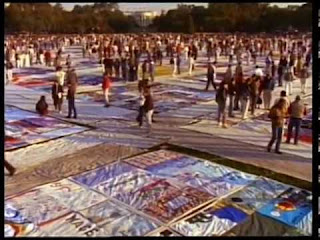
Intermixed with these five individual stories are news reports on the growing crisis. We also hear from narrator Dustin Hoffman, who reads the increasing number of people who have died of AIDS. We start with 355 in 1981, then see each year increase to 1,235 (1982), 3,933 (1983) up to 55,388 in 1988. As the numbers grow, we end Common Threads with the unfurling of the massive quilt on the Washington Mall. Here, those left behind grieve their loved ones. Those not directly affected are left to ponder the massive loss.
We see how Sallie Perryman, calmly, almost serenely, tells us that she too tested positive. This was a straight black woman, devout in her faith, yet AIDS will claim her too. We also see, perhaps jarringly but very necessary, Campbell's lover Tracy Torrey. He was a Navy officer who was closeted but who is clearly in the final stages of death. It was a brave act to show Torrey, who died before the film was released, speak his own tale as well as that of Sevcik, the love of his life.
Another partner, Vito Russo, was also HIV-positive but healthy-looking. He was more outspoken in his activism, making clear that both his and Sevcik's diagnoses pushed him to be vocal about the disease.

One of the most moving moments in Common Threads is perhaps also one of the oddest. It is when David Mandell, Jr. (who lived to be 12) has a video chat with the character ALF. It takes a lot to make one get teary-eyed at seeing a child talk to a puppet. However, I found it deeply emotional. Mandell was a big ALF fan; while we know ALF can't do anything, seeing the alien from Melmac offer words of hope and encouragement to his fan got to me. It underscores that Mandell was a child who saw the world in a childlike manner. It also underscores the great human tragedy of AIDS.
Common Threads is barely political. We do get mention of Russo's activism. There is some mention of the slow/little action from the Reagan Administration as well as and from those who saw AIDS as a punishment. However, those were few. Instead, Common Threads was more focused on the individuals who died of AIDS and those that were left behind.
If I found things to criticize, it would perhaps be the Bobby McFerrin vocal score. I sometimes found it a bit much, but it was not a dealbreaker.
Sadly, AIDS has been all but forgotten. The red ribbons, once ubiquitous at any awards show, have been long relegated to video archives. Even now, seeing the paranoia AIDS caused early on might be seen as more a curiosity than anything else. Common Threads can be seen as a time capsule on early AIDS fears. It can be seen as a chance to see those who lived and died from it speak to us.
It should be seen, period. AIDS is still with us, and just because one can live with AIDS does not mean people are no longer dying of AIDS. It is true: we are bound by Common Threads.


I have always hated Alf but I could tell that little puppet alien was doing his best to offer hope when it was known there was none. You have this a B+! that’s tough because this was a lovely moving movie.
ReplyDeleteIt came SO CLOSE to hitting an A. Unfortunately, the Bobby McFerrin music was driving me crazy. I knocked it down just a touch because it was becoming too distracting and irritating to me.
Delete