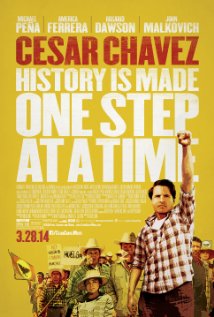
CESAR CHAVEZ
Today was Cesar Chavez Day. March 31, 1927, was when the United Farm Workers cofounder was born. His memory would have been celebrated. More than likely, his centennial next year would have been a major production. Now, his name is verboten after allegations of sexual assault, grooming and rape were made against him 33 years after his death. Literally days after the accusations were made, various Cesar Chavez murals and statues were removed. Chavez had been "cancelled" faster than Robert E. Lee. What the future holds for Chavez's legacy remains to be seen. The same fate of expunging from history might not befall Chavez's biopic. Cesar Chavez, however, would have faded on its own. Now, it will serve as a time capsule of sorts, recalling when Chavez was seen as heroic versus demonic.
Cesar Chavez (Michael Peña), in his words, went from owing the land to working the land. This change in status, however, allows Cesar to move away from the union office to the fields. Here, he can get up close and personal with the migrant farmworkers. Their lot is especially hard. They get low pay for long, backbreaking work. They get no bathrooms (the wealthy white landowners suggesting that as Mexicans and Filipinos, the farmworkers would not know how to use them).
Into this comes Cesar, his wife Helen (America Ferrera) and their eight children. The oldest, Fernando (Eli Vargas) loves baseball more than anything. His first question when told that they are moving to Delano, California is what team plays for them. Fernando, however, resents how much time and energy Cesar gives to "La Causa" (The Cause). Fernando is bullied and beaten for being both Mexican and the scion of the union organizer.
Chavez's biggest opponent is landowner John Bogdanovich, Sr. (John Malkovich). He, unlike the other landowners, both speaks Spanish and is an immigrant from Croatia. Like his fellow growers, however, Bogdanovich is leery of these Commies. Cesar Chavez now must fight them with both labor and hunger strikes. He gets an unexpected ally in Senator Robert F. Kennedy (Jack Holmes). He gets an unexpected antagonist in Fernando Chavez, forever angry at being neglected. Will Cesar balance out the Huelga with being a good father?

Take for example the very lengthy sequence of his hunger strike. I put aside how there did not seem to be much thought into it. His various dreams and struggles looked a bit exaggerated. Cesar, all but emaciated, is supposed to be helped to a Catholic mass where he will finally break his fast. Michael Peña did not look worse for wear. In fact, he looked downright silly attempting to play someone on the brink of starvation. His performance, his mannerisms, all looked too theatrical. In short, it looked fake.
Add to that how director Diego Luna did not build up what could have and should have been a very serious, somber moment. This man is finally about to break his long fast with the bread of Christ. It does not have any effect. Luna opted not to make this a major moment. No stirring music. No focus on the significance. Nothing.
Perhaps Luna and screenwriters Timothy J. Sexton and Keir Pearson (story by Pearson) expected us to be in awe of Chavez the same way that everyone in Cesar Chavez was. This Cesar Chavez had basically no flaws. The closest that he came to one was when he balked at having Helen arrested for violating court orders to not mention the word "huelga" (strike in Spanish). "You can't get arrested!" he tells her. "Why not?", she replies. "Who'll take care of the kids?" is his curt reply.

For most of Cesar Chavez though, the main character is pretty much a great man. Cesar Chavez falls into an unfortunate trap that capture many biopics. We are presented with a symbol and not a person. The film attempts to give us domestic drama with Fernando. It just never goes anywhere. Oddly, Cesar Chavez does not even give us big speeches from the now-disgraced union leader. He is just...there.
Cesar Chavez is also both poorly cast and acted. Michael Peña did not do a bad job. He just never had any charisma to make people believe that he could lead a conga line, let alone a picket line. Rosario Dawson was completely miscast as Dolores Huerta. She looks nothing like the real-life person. Dawson, it should be pointed out, is of Cuban, Puerto Rican and African roots. Huerta is none of those. It is worse given that she was pretty much a shadow, having nothing to do in Cesar Chavez. It is so rare that Dawson' character is referred to as "Dolores Huerta". Most of the time, she was just "Dolores" and could have been any random Dolores.
America Ferrera would have been a better choice as Dolores Huerta than she was as Helen Chavez. Granted, Ferrera is not of Mexican descent either. However, she is closer in appearance to Huerta than the taller, thinner Dawson. Cesar Chavez wastes Ferrera in a nothing role. She is there to provide domestic drama. Ferrera has nothing to work with. Wes Bentley as UFW lawyer Jerry Cohen just popped in there. Jack Holmes' RFK was just bad. It is hard to sound like Robert F. Kennedy. It is harder to sound like Robert F. Kennedy. Holmes failed on both counts.
John Malkovich is pretty good as the not-so-harsh antagonist. Hearing him speak Spanish, however, is oddly hilarious. You have Malkovich's distinct cadence and voice coupled with his efforts at a foreign language. That ought to make for interesting watching.
Speaking of languages, Cesar Chavez has a lot of Spanish dialogue. That is correct but it also was to where I initially thought that I had hit the dubbed button by mistake.
Cesar Chavez will, I figure, no longer be screened on this or any other day. It was already bad on its own. Now, it is forever tainted with association to someone damned to be hated on all sides. No one could have foreseen that a mere twelve years after Cesar Chavez was released, and over a quarter-century after his death, this biopic's subject would be tossed out like rotten grapes.
 |
| 1927-1993 |
No comments:
Post a Comment
Views are always welcome, but I would ask that no vulgarity be used. Any posts that contain foul language or are bigoted in any way will not be posted.
Thank you.