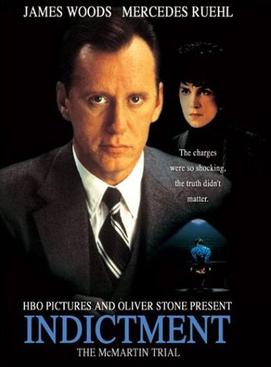
The idea that an accusation equals guilt is not a new one. Indictment: The McMartin Trial chronicles one of the most infamous court cases in American history. A shocking tale of frenzied panic overruling common sense, Indictment's impact still hits the viewer.
Christine Johnson (Chelsea Field) on August 12, 1983, makes a shocking accusation against the staff of the McMartin Daycare. She claims that her son Malcolm has been sexually molested by people there. Twenty-six days later, the police start arresting everyone in the McMartin preschool. There is the sole man, Ray Buckey (Henry Thomas), grandson of McMartin owner Virginia Thompson (Sada Thompson). There is Ray's sister Peggy Ann (Allison Elliott) and their mother Peggy (Shirley Knight). Other employees are arrested as well. The last arrest is that of Virginia McMartin, hauled off in her wheelchair before intense media attention.
Attorney Danny Davis (James Woods) takes the case. He believes the McMartins and the daycare to be guilty. He also knows that this will be great publicity. Facing off against Davis is Los Angeles District Office prosecutor Lael Rubin (Mercedes Ruehl). It is not long before Los Angeles television reporter Wayne Satz (Mark Blum) reports the shocking allegations, never questioning their veracity or looking into them. The case soon becomes a media storm. The storm increases thanks to the work of Kee McFarlane (Lolita Davidovich). She is the director of the Children's Institute International that interviews hundreds of children, all of whom allege all sorts of accusations. The District Attorney's Office is overwhelmed with information and trusts McFarlane and the CII's notes from the videotapes to prosecute the case.
All but ADA Glenn Stevens (Joe Urla). He reads Johnson's statement and thinks that it is the ramblings of a mentally unstable person. His concerns are brushed off by Rubin. Children wouldn't lie. Believe all children is the DA's Office mantra. Yet can the children be believed? There are inconsistencies in their stories. McFarlane's questionings, down to showing the children anatomically correct dolls, seem to be more pressuring kids to remember things that they initially insist did not happen. One, for example, remembers Ray molesting him even though Ray had left the preschool by the time. Other stories become more outlandish. There are tales of Mrs. McMartin wheeling herself naked in a circle. Another child claims to have been made to perform satanic rituals in a church and made to drink the blood of rabbits. One child identifies two men from pictures as his sexual molesters. One of the identified is action film star Chuck Norris.
Davis sees that the growing hysteria is blinding people to reasonable doubt. The mob mentality against the McMartins, who are psychologically tortured by everyone around them, arouses his anger. Stevens too is deeply troubled by how the case is growing out of control. Stevens is more troubled when Johnson at one point calls him and claims that someone has sexually molested her dog. Yet the prosecution and persecution continue. For all the Sturm und Drang of the case, the longest trial in American history results in no convictions and ruined lives.

Abby & Myra Mann's screenplay and Mick Jackson's direction shows us this in simple ways. As Davis, Ray and Peggy Ann Buckey watch the videotapes, we see McFarlane's questionable questioning methods. Using puppets, McFarlane seems dismissive whenever a child says that no one touched them in their private parts. When she finally gets the answer that she liked, we hear McFarlane squeak out "AMAZING!". The empty courtroom where they watch starts echoing "AMAZING!" over and over. The camera pulls back further and further away. It is a subtle but effective way to show how these dubious methods are reverberating.
Other moments are more chilling but no less effective. As one of the child witnesses continues his bizarre story of drinking rabbit blood and robed figures in hoods, the reporters listening in another room look at each other in shock and disbelief. I initially thought that they would find such a story so ludicrous that they would openly question whether any of it was true. Instead, they all rush onto the halls, call their various outlets and report the story as more "shocking revelations".
That no adult ever questioned the logic of some of the charges no matter how bonkers they were never ceases to amaze and trouble me. As Davis and his second go to the remains of the McMartin preschool (it having been attacked by arson for a second time), Davis comments that there are no closets where the children claim to have been taken in and molested. One child says that they were driven to a local supermarket and made to parade naked in their storeroom. Davis goes to the market and finds that the storeroom is openly visible to everyone. It would be impossible to have a nude fashion show there. Yet again, neither the DA's Office nor the opportunistic Satz ever questioned or appeared to investigate the charges.

Shirley Knight, who won an Emmy Award for her performances, is heartbreaking as Peggy. In one particularly somber scene, Peggy is forced to strip and be examined by two disinterested female officers. The officers show her no kindness as they make this old woman bend over. "Can I put my clothes on?", a visibly distraught and humiliated Peggy asks. The officers ignore her, continuing their conversation on their weekend plans. It is hard to not feel for the horror that Peggy is going through. This is a woman who had to ask what a "dildo" was.
Her costar Sara Thompson was also nominated for Emmy recognition as Virginia McMartin. Seeing the wheelchair-bound woman rise on her crutches and tell the judge that she was leaving shows the righteous fury of a falsely accused woman. Thompson later has a strong scene with Elliott. Peggy Ann observes her grandmother watching kids at play. She asks her how she could not be bitter after all they've gone through. Virginia replies that she is not bitter enough to smile at seeing children at play.
Henry Thomas makes it believable to see Ray as a bit creepy in his manner and look. Davis on their first meeting tells him that with his glasses, he does look like a child molester. Thomas has his best scenes when on the stand. Facing off against an equally strong Mercedes Ruehl, he shows how Ray has a backbone. He responds calmly and firmly against Ruben's charges and insinuations. She brings up his past interests in pyramids and how he was a virgin until age 24. He turns the tables against her increasingly eccentric connections between pyramids and lurid sexual tastes.

We do end up hating Lolita Davidovich's Kee McFarlane. She grows more arrogant and smugger on the witness stand. That she and Wayne Satz were having an intimate relationship makes it all the more appalling. Mark Blum's Satz was downright evil as the reporter whose sense of infallibility and unquestioning belief in children being made to partake in satanic rituals shields him from any sense of responsibility. Joe Urla is unsung as Glenn Stevens, the ADA who is the first to see that the accusations have serious room for doubt.
Indictment: The McMartin Trial is a shocking and tragic tale of how the mere accusation is enough to create panic, paranoia and hysteria. Sadly, some things have not change. We still have people accused of all sorts of things and their accusers believed no questions asked. The lessons from the McMartin trial have yet to be learned. Indictment: The McMartin Trial however will remind us that accusers should be heard but not unquestionably believed.
9/10


No comments:
Post a Comment
Views are always welcome, but I would ask that no vulgarity be used. Any posts that contain foul language or are bigoted in any way will not be posted.
Thank you.