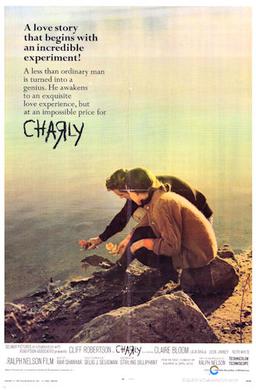
I remember reading Flowers for Algernon, which Charly is based on. I do not remember much about Flowers for Algernon, except that I was sad at the end. That was not how I finished Charly. I finished the film slightly confused over how the third act went. Charly is not a terrible adaptation. It is a dated one that goes off the rails by the end.
Charly Gordon (Cliff Robertson) has an IQ of 70. He makes many efforts to improve his cognitive skills but still struggles with things. Charly has a job as a janitor at a bakery. His "friends" are terribly abusive, routinely mocking him and setting him up for ridicule.
Good fortune might have finally come Charly's way. Alice Kinnian (Claire Bloom) has been teaching Charly with her regular ESL class. Kinnian is also affiliated with two doctors working on a major project. Dr. Anna Straus (Lilia Skala) and Dr. Richard Nemur (Leon Janney) both believe that they can increase intelligence in people after successful tests with lab mice. With some convincing from Alice, Charly is ultimately chosen.
The way to measure Charly's growth is to have races with the primary lab rat named Algernon. Algernon and Charly must both go through a maze (the former physically, the latter on a paper map). Algernon has repeatedly won these races until he starts not to. It is the first sign that Charly is becoming brighter. He shows his bakery bullies that he can handle the complicated machinery. He starts painting and reading both literary and scientific books.
He also starts developing sexual designs on Alice Kinnian. Dr. Nemur has been pushing Charly's intellect too fast. Dr. Straus all but begs him to let Charly's emotional intelligence grow. Charly is intellectually bright but emotionally immature if not downright disturbed. This culminates in Charly attempting to sexually assault Kinnian. He goes full-on rebel, hitting the clubs and riding in a motorbike.
For reasons I simply do not understand, Alice dumps her fiancée to go and be with her attacker. They fall in love, in bed, and in cahoots. Dr. Nemur and Dr. Straus are ready to present Charly Gordon and Algernon to the world. Unfortunately, their fellow scientist Bert (Dick Van Patten, billed as Richard) sees what they do not. The formerly successful mice are regressing to their original state. Also, Algernon is dead. Charly realizes that he too will revert to his own state. He at first applies his intelligence to solving the problem. Alas, he cannot and he ends up where he began: playing with a group of children in a playground while wearing a suit.

I can say that as a film, Charly mostly works for the first two thirds of it. The film shows us Charly's world in a steady and non-sensational manner. There is almost a documentary-like manner to how director Ralph Nelson eschews using a lot of music. There is some which was written by Ravi Shankar which is quite lovely. However, a lot of the early part of Charly focuses more on how Charly is treated by others. The film tells you a lot about Charly Gordon without dialogue. The film opens with this grown man in a suit happily sliding down a slide and going around the merry-go-round. Without saying anything, it is quickly established that this man is mentally a child.
Charly comes apart completely after he violently attacks Kinnian. It was already slipping off with some odd choices. Why exactly Algernon was left with Charly at his apartment the film never explains. How his abusers at the bakery failed to see that Charly moved with more confidence and spoke better is similarly unexplained. However, once he attempted to force himself on Kinnian, Charly never recovered.

Nelson made a bizarre choice to show Charly's rebellion by having be a biker hippie or hippie biker. The montage that shows Charly's wild living is unintentionally hilarious. It is about the fourth of five split-screen sequences in Charly. The split-scene sequences where we see two people simultaneously might have worked once. Its first use when we see the intelligence test from both Kinnian and Charly's point of view works. However, like a cheap magic act that grows stale, its overuse was a wild mistake.
Not as wild as seeing the rebellious Mr. Gordon's montage. He looked almost deliberately comic, as if it was clear that no one was taking this seriously. Looking at it from a distance of almost sixty years, Charly's rumspringa looks like the squarest event in history. No number of split screens, however, could make the Charly/Anne romance look remotely plausible. This man had attempted to force himself on her earlier; yet, after his return, are we supposed to believe that she willingly if not eagerly goes to bed with him? The forced romance in Charly never works. That said romance is expressed via voiceovers from Cliff Robertson and Claire Bloom does not help sell the believability of it.

Cliff Robertson should have known the character inside and out by now. However, while watching Charly, I never shook the feeling that he was acting and not being. There seemed to be a bit too much focus on the technical elements to show Charly's initial mental impairment. In an odd criticism, I think Robertson was thinking too much on how to show that he was intellectually disabled. His efforts to come across as mentally challenged was rather calculated. Of particular note is when his supposed friends pull another mean prank on him at the bakery. They had stuffed dough into his locker. I think that anyone regardless of mental capacity would have been hurt or enraged at this affront. Charly seems openly delighted and amused. I get what Charly and Charly were going for. I just did not believe it.
Things did not get any better when he started developing intellectually. Robertson does not show someone amazed at discovering a whole new world of knowledge and possibilities. He shows an average person learning new things. It is when he gets to his hippie/biker era that Cliff Robertson becomes almost embarrassing to watch. His facial expressions came across as deliberately comical. It does not look like a good performance let alone an Oscar-winning win.

Charly lost its way by the end. That is unfortunate, as until about the midpoint mark the film was serviceable. It was not great but serviceable. It had an interesting story. It had good but not great performances from the cast. Once Charly decided to get at Kinnian, the film never recovered. There are no Flowers for Algernon and no bouquets for Charly.


No comments:
Post a Comment
Views are always welcome, but I would ask that no vulgarity be used. Any posts that contain foul language or are bigoted in any way will not be posted.
Thank you.