
"The light shines in the darkness, and the darkness has not overcome it". This passage from the Gospel of John (John 1:5) might be the theme of The Miracle Worker. This film adaptation of the Broadway play is still a bit stagebound. However, it also has both almost universally excellent performances and a moving true-life story that impacts the viewer.
A sudden but brief childhood illness has robbed little Helen Keller of sight and sound. She cannot see, hear nor speak. Her parents, Confederate Captain Arthur Keller (Victor Jory) and his second wife Kate (Inga Swenson) are doing their best with their daughter. Helen (Patty Duke), however, is a menace. She is a bit of a wild animal, picking food out of their plates and running free. In a mix of desperation and frustration, Captain Keller agrees to contact the Perkins School in Boston for a teacher who might help.
That teacher is Annie Sullivan (Anne Bancroft). She is a feisty Irish lass who is herself a former Perkins student. That Annie is close to blindness herself only adds to Captain Keller's fury and immense dislike for her. He was bound to dislike any Yankee, still being bitter about losing the war. However, his rages are somewhat tempered by both Kate and James (Andrew Prine), his son from an earlier marriage.
Annie senses that there is a mind buried in Helen's dark world. She is also enraged at how Helen is treated by her family. Helen is not abused. Instead, she is coddled, kept almost like an injured pet than a person. It is time for a lot of tough love. That means a fierce battle between the willful, spoiled Helen and the no-nonsense Annie at the breakfast table. Helen will learn to eat at the table, with a spoon, and fold her napkin.
In all that time, Annie continues to teach Helen American Sign Language by spelling out various objects with her hands. Annie grows frustrated at how Helen cannot or perhaps will not make the connection between the words and the objects. She insists on having two weeks alone with her in a secluded home to teach her. The Kellers reluctantly agree to Annie's request. Will Annie break through Helen's darkness? Will Helen find that words have meanings?

The Miracle Worker brought two of its original Broadway actors to recreate their roles for the film adaptation. Anne Bancroft and Patty Duke were not originally considered for the roles despite their Broadway success. Bancroft had a brief film career before The Miracle Worker, making her debut in Don't Bother to Knock with Marilyn Monroe. However, she had left Hollywood and had not made a film in five years. Patty Duke for her part was at sixteen technically too old to play Helen Keller. Despite those circumstances, both of them eventually won the parts.
Both are brilliant in their roles. Each received an Academy Award for their intense performances. Anne Bancroft's Annie is loving but also firm in her ideas. We get to see through William Gibson's adaptation of his own play how Annie is a haunted woman. There are shadowy flashbacks that reveal Annie Sullivan's past. There is the loss of her beloved younger brother Jimmy. There is her own struggle with vision impairment. There are her own fears of failure with Helen.
Some of her best scenes, curiously, are not with Duke's Helen. Rather, they are whenever she argues with Helen's parents. Bancroft shows the steely woman behind the dark glasses. Annie knows that Helen has been getting away with murder. Helen is spoiled, spiteful, and used to getting her way. Annie will not let her. Annie, however, also knows that the Kellers' ideas of compassion have done great damage to Helen. She has to fight them as well as fight Helen.

The rest of the cast with one exception is able to match Bancroft and Duke under Arthur Penn's direction. Victor Jory was loud and proud as Captain Keller. He made Captain Keller a man used to being obeyed until he met his match with the stubborn Annie. Andrew Prine had a small role as Helen's half-brother James. However, he left a positive impression as a sarcastic but aware young man. He could dismiss Annie's plans while also challenging Captain Keller to let her finish them.
The one performer whom I think failed was Inga Swenson as Katie Keller. I found her overdramatic to the point of parody. Swenson, to me, looked as if she thought that she was on a stage instead of film production. In her first scene, her hysterics were hysterical.
The Miracle Worker also played a bit like it was a filmed play. To be fair, the film opened up more with outdoor scenes. However, a lot of the film still holds to its theatrical roots. The film more than makes up for its somewhat stagey manner with almost universally strong performances and Laurence Rosenthal's score.
The Miracle Worker is a showcase for Anne Bancroft and Patty Duke. This story of tough love par excellence will hold the viewers' attention. It is a moving and powerful portrait of two profiles in courage.
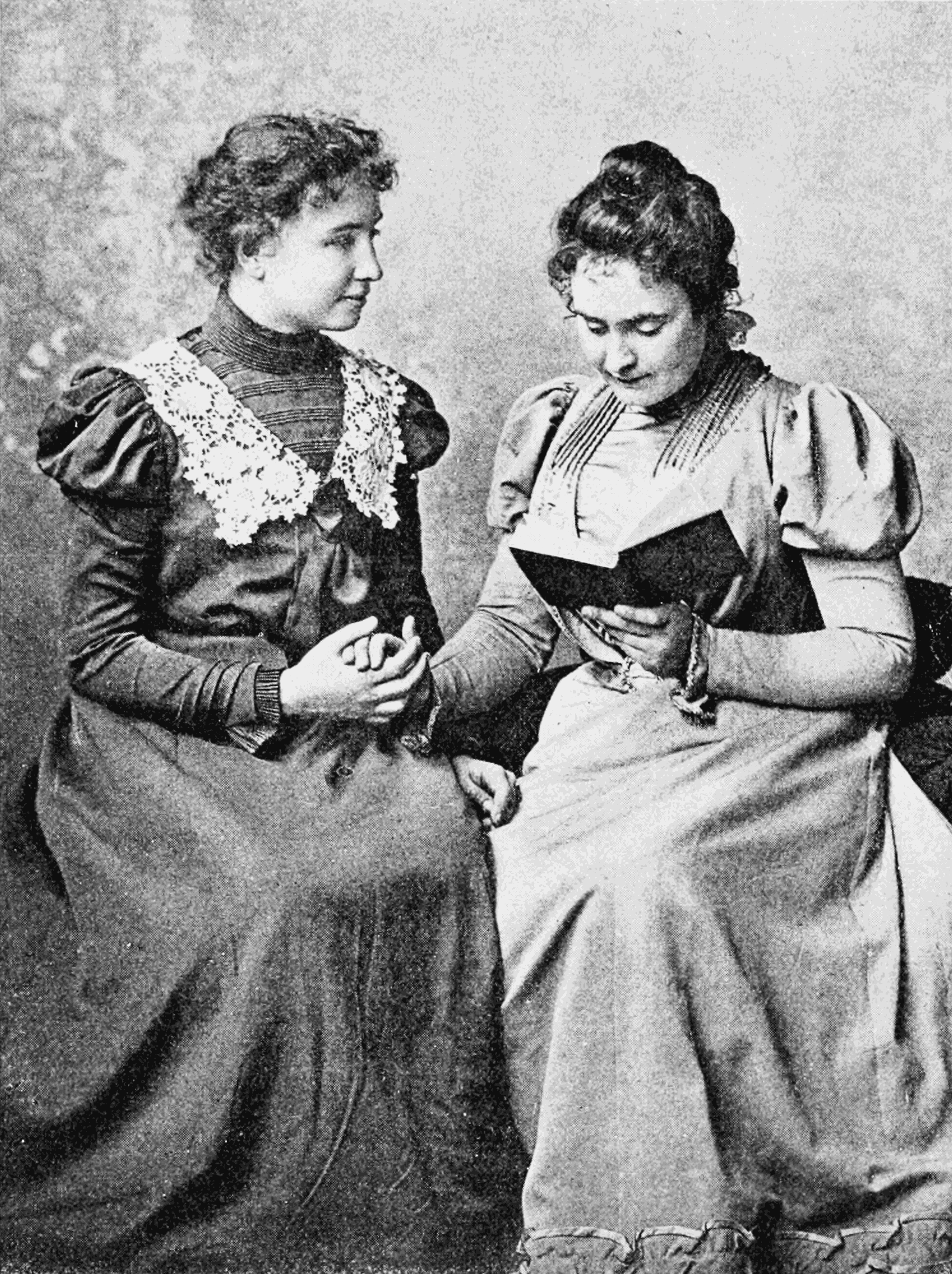 |
| Helen Keller (Left): 1880-1968 Annie Sullivan (Right): 1866-1936 |


No comments:
Post a Comment
Views are always welcome, but I would ask that no vulgarity be used. Any posts that contain foul language or are bigoted in any way will not be posted.
Thank you.