.jpg)
It must be, I imagine, one of the greatest compliments that an actor can receive to have a part written specifically for them. Such is the case with The Rose Tattoo. This adaptation of a Tennessee Williams play was written specifically for its star, Italian actress Anna Magnani. She could not play the role on Broadway due to her limited command of English. Once the film came about, Magnani's English had improved enough to let her play the part. After seeing The Rose Tattoo, one can see why Williams was set on having Magnani play the role.
Sicilian seamstress Serafina Delle Rose (Magnani) adores her husband Rosario and her daughter Rosa (Marisa Pavan). While she lives in the American South near the Gulf of Mexico, Serafina is still closer to the old world in outlook. Her adoration if not idolization of Rosario is such that she will not contemplate the thought that he has been stepping out on her. She also won't accept that he is a smuggler who is killed attempting to outrun the law.
Three years on, Serafina has become a recluse. While still working as a seamstress from home, she will not come out of her house for almost anything. She also has a tight hold on Rosa. Despite her sewing skills, Serafina will not make Rosa a formal dress for a dance. Despite this, Rosa meets Jack Hunter (Ben Cooper), a sailor who is a friend's brother. An instant romance between them begins. Serafina, however, does not approve. Serafina debates attending Rosa's graduation but is held up by two women demanding their blouses. They are eager to meet with New Orleans conventioneers and mock Serafina for her airs of respectability, down to throwing the stories of Rosario's mistress at her. This mystery woman, they tell her, went so far as to get a rose tattoo on her chest that matched Rosario's.
Determined to find the truth, Serafina ventures out to the church to ask Father De Leo (Sandro Giglio) if Rosario ever confessed anything. De Leo will not say what was said in confession, enraging our fiery Sicilian baroness (Rosario having an old title despite his poverty). The church is coincidentally having a bazaar. Here, simple truck driver Alvaro Mangicavallo (Burt Lancaster) is enthusiastic about Serafina. He takes her home and she offers to repair his shirt. From this, Alvaro cheerfully prods Serafina into a potential romance. Alvaro is so smitten with Serafina that he too gets a rose tattoo on his chest.
However, Serafina cannot rest with the doubts about Rosario. Will she be able to confront Rosario's mistress, card shark Estelle Hohengarten (Virginia Grey)? Will Serafina lose Rosa and Alvaro, or will everyone manage a happy ending?

The Rose Tattoo is interesting in that unlike some of Tennessee Williams' better-known works, it has a positive conclusion. It is as optimistic an ending as I think Williams ever gave one of his works. The film is surprisingly upbeat, with the suggestion that both Serafina & Alvaro and Rosa & Jack will have happy endings. I cannot say whether this is due to the habit of having happy endings in films of the era or not. However, I enjoyed that we got a Tennessee Williams adaptation that did not end in despair but in hope.
Anna Magnani has always been seen as a force of nature. In her Oscar-winning performance, Magnani is theatrical without being big, straddling being grandiose and being natural. She is fierce, almost unhinged whenever she is attacking someone. However, she is also amusing, even tender, when expressing regret or sorrow. Given that English is not her first language, The Rose Tattoo allows for unintentional moments of malapropisms. Early on, Serafina is told by one of her fellow Italian neighbors, "You dressed for a party?". "No, I'm dressed for a big celebration", Serafina replies. She did not mean it as a joke or as sarcasm. It is a credit to Anna Magnani that she made it sound as if Serafina was actually answering the question and not just being silly.
I was trying to remember what Anna Magnani's performance reminded me of. Now I remember. She is similar to Shirley MacLaine in Terms of Endearment. Both play respectable, perhaps excessively prim and proper widows, who find the most outlandish suitors imaginable. Yet, I digress.
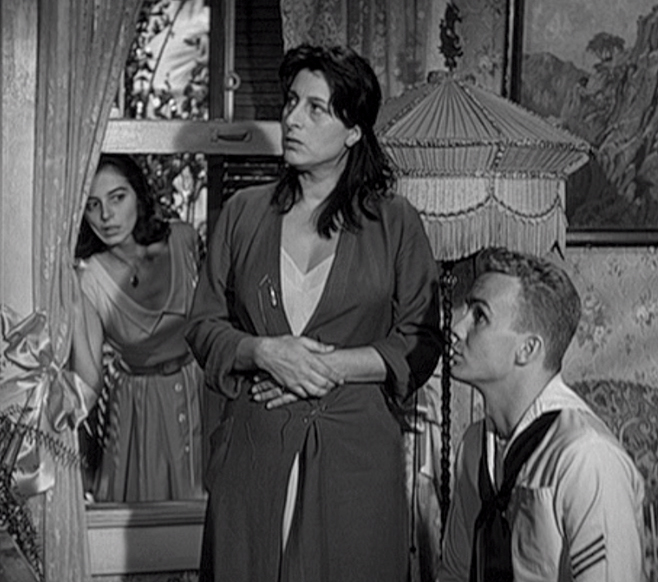
Marisa Pavan also received a nomination for her performance. That one I found a bit harder to accept. She was fine as Rosa, the dutiful American daughter who chafes at Rosa's forced confinement. She does have good moments with an equally good Ben Cooper. There is almost something sweetly lustful about Rosa. She is coy or defiant when she needs to be. However, at times, Rosa comes across as a bit whiny.
As a side note, Pavan's character's name translates to "Rose of the Rose" (Rosa Delle Rose). Granted, my Italian is not strong. That is just how it sounds to me.
As mentioned, Cooper makes it believable that Jack too is, in his words, innocent. I think it is understood that he means "a virgin", but we were not about to hear that term used here.
The big drawback, and it is a big drawback, is Burt Lancaster. I don't think there is any universe where Burt Lancaster can be believed as a Sicilian immigrant. He seems too big in his manner, exaggerated, cartoonishly so, as someone meant to be seen as "happy-go-lucky". He comes across more as a grinning idiot, someone who in Serafina's words has the body of her husband but the head of a clown. Lancaster's big grin and very forced manner made it pretty much impossible for me to see him as Alvaro Mangicavallo. He came across as Burt Lancaster trying to play something that he was not suited for.

I do have some quibbles with The Rose Tattoo. In the film, Rosa is graduating from high school and ends off going with Jack with Serafina's blessing. However, it is also mentioned that Rosa is 15. I was puzzled as to how Rosa could be 15 and be graduating from high school. I won't even go into going off to marry a sailor at that age. The film's screenplay, credited to Tennessee Williams and adaptation by Hal Kanter, also could not fully escape its theatrical background. The scenes of the two women haggling with Serafina over blouses and men, as well as some of Serafina and Alvaro's scenes, felt like a filmed play. However, on the whole director Delbert Mann kept things going well.
The Rose Tattoo seems to be a Tennessee Williams work that is not as well-remembered as something like Cat on a Hot Tin Roof, The Glass Menagerie or A Streetcar Named Desire. It may be because it does not deal with Southern characters or crazy people. As stated, The Rose Tattoo has as optimistic an ending to a Tennessee Williams work as I have seen. At one point, someone advises Serafina to have no outburst of emotion. That seems something that does not seems impossible for someone as volcanic, fiery and earthy as Anna Magnani. However, she is a standout in The Rose Tattoo, a perhaps long but entertaining film of love's labor's lost and found.


No comments:
Post a Comment
Views are always welcome, but I would ask that no vulgarity be used. Any posts that contain foul language or are bigoted in any way will not be posted.
Thank you.