Showing posts with label Lewis Carroll. Show all posts

Saturday, December 21, 2024

Dreamchild: A Review

DREAMCHILD

"Who are you?" This question, posed by the Caterpillar in Lewis Carroll's Alice in Wonderland, might be the theme to Dreamchild, a surprisingly obscure film connected to Carroll's wild fantasy. Well-acted, Dreamchild blends fact and fantasy to paint a portrait about creativity and the ties that bind past and present.

In 1932, almost eighty-year-old Alice Hargreaves (Coral Browne) is sailing to America to receive an honorary doctorate from Columbia University for the centennial of the Reverend Charles Dodgson's birth. Mrs. Hargreaves, accompanied by her lady's companion Lucy (Nicola Cowper), accepts that it is due to her connection to the man better known as Lewis Carroll, whose book he wrote with her as the de facto main character. However, why are so many American newspaper people hounding her so?

Among the most persistent is Jack Dolan (Peter Gallagher), recently fired from his newspaper job but who nonetheless hoodwinks both Mrs. Hargreaves and Lucy into speaking to him. Lucy, shy by nature, becomes quickly besotted albeit dubious of the handsome young American eager to cash in on the Alice in Wonderland craze that Mrs. Hargreaves has created. Jack talks Lucy into going to a tea dance at the hotel, leaving Mrs. Hargreaves presumably asleep and resting. However, she is anything but resting.

Her mind soon flows back to her halcyon days when she knew Dodgson (Ian Holm), the shy, stuttering math professor who was fond of the Liddle sisters. Alice, it seems, was her favorite, but was his interest more than just as a father figure? Alice now sees Dodgson and finds herself in a Mad Tea Party, struggling to fit in as both her old self and her younger version (Amelia Shankley). As she gets closer to the ceremony, Alice finds herself both puzzled and delighted by various opportunities for money that Jack, her new agent, is creating for her. Will she, however, come to terms with her celebrity and what all that means? Will Lucy find her own voice?

Dreamchild has an appropriately dreamlike manner thanks to screenwriter Dennis Potter, director Gavin Millar and the Jim Henson creations that bring Lewis Carroll's creations to life. Together, they blend fantasy and reality to Dreamchild. The film blends the past, the present and the fantasy world of Alice in Wonderland, giving us an imagined life of an old woman who finds herself famous for something not of her own making. 

The film feels a bit like a play given that there are many scenes that involve just Hargreaves, Lucy and Jack. Another scene where Jack and his girl Friday, Sally (Caris Corfman) meet for drinks at a bar, also has a feel that we are seeing a stage production. I imagine that Dreamchild, with some tinkering, could be adapted as a play.

As a whole, Dreamchild is well-acted, written and directed. Coral Browne made few films, concentrating mostly in the theater. Here, her Alice Hargreaves is sometimes confused, sometimes puzzled, sometimes even fascinated and amused by how her accidental celebrity is seen. While she clearly has no idea what products she is endorsing are, she finds the production of a radio show where she will record her commercials highly delightful. Potter's script detailing that she recorded commercials for "soup, soap and soda water" has a nice sense of alliteration to it. Her Alice is neither saintly nor tyrant. She is confused, even frightened, when she cannot find Lucy. She is haughty when initially dealing with Jack. She is downright mean when berating the put-upon Lucy and is proper but remorseful when she apologizes for her behavior. 

In the end, Alice Hargreaves in Dreamchild is a woman accepting the strange legacy of her association with Dodgson. She recognizes, now long after his death, that a man she was fond of and respected but whom she was also wary of gave the world a great legacy.


Despite the film involving the creation of Alice in Wonderland, Lewis Carroll is not a major part of Dreamchild. Despite this, Ian Holm does wonderful work as this shy, stuttering figure, struggling with his emotions. Was he literally in love with a child? Was it more a need to find joy in Alice's innocence? Dreamchild leans towards the idea of Dodgson as having very a very curious interest in young Alice. However, it is to the film's credit that any suggestion of a tawdrier element in Dodgson is not overt. I might have seen hints of it, but others may not.

Gallagher was good as Jack, this overtly sleazy but charming man. It was unclear to me whether he was genuinely fond of Lucy or was playing with her to get at what he wanted. Hargreaves' oblivious admission that Jack was taking twenty percent of what people were paying her reveals Jack to be very shifty. The same goes for his behavior towards Lucy. Is it love? Is it self-interest? Is it self-interest that turned into love? 

A standout is Copwer as Lucy. She is shy, hesitant, but slowly coming into her own. Lucy is becoming a woman, something that Mrs. Hargreaves does not account for. In her awkward manner with Mrs. Hargreaves and with Jack, one starts empathizing with Lucy. As such, when she finally explodes (albeit in a calm manner) at Alice Hargreaves, you almost cheer for her. Despite this, Lucy knows that she was wrong in her behavior, making her a fascinating figure to follow.

A highlight to Dreamchild is the puppetry of Jim Henson in bringing Carroll's creations to the screen. They are not sweet and charming. I would argue that they are slightly frightening. However, I think that was the point of their design: to be less cutesy and delve into the darker elements of the original book as well as Hargreaves' somewhat confused and conflicted relationship with Dodgson and the book's characters. 

Dreamchild has an appropriately dreamlike quality thanks to Gavin Millar's direction. When Dodgson and the Liddle family sail down a river on a rowboat, there is an almost lyrical quality in both the imagery and the overall mood. It is tranquil but somewhat unreal, as if everyone was floating. Stanley Myers' score adds to that vaguely unreal world.

Dreamchild is a story of legacy, good and bad. Regrets, confusion but acceptance and reconciliation with one's past moves the viewer. It is not the definitive story of the making of Alice in Wonderland, its inspiration or its author. However, the film works well, has some strong performances and style that enhance it on viewing. 

Alice, forever young.

Alice Liddell Hargreaves
1852-1934

Charles Dodgson (Lewis Carroll)
1832-1898


DECISION: B+

Saturday, June 4, 2016

Alice Through the Looking Glass: A Review


ALICE THROUGH THE LOOKING GLASS

I cannot recall much if anything from Alice in Wonderland, apart from the fact that I absolutely hated it.  Therefore, it should come as no surprise in what is turning out to be the worst year in film in recent memory, that a sequel to a very bad film is what audiences actually want.

Then again, given that same audience also voted to have either Donald Trump or Hillary Clinton be the next President of the United States, they might actually have wanted an even worse sequel to an already bad film (American taste and logic having left long ago).  Alice Through the Looking Glass decided that we needed a giant case of 'the feels', to be sad for such characters as The Mad Hatter and even the Red Queen.  It's not their fault they grew up to be what they became...they were made that way by this cruel, cruel world.  We need to CARE about them, the film says. 

Pity the film makes no case for us doing so.

It's been three years since Alice Kingsleigh (Mia Wasikowska, aka My Secret Love) sailed and became one of the most successful ship captains in private business.  Oh sure, why not...makes perfect sense for a woman and seamen to mix.   Her latest journey to the Orient ended, she yearns to make one final journey, but her mother (Lindsay Duncan) has bad news.  Alice's company has been taken over by her ex-fiancĂ©e,  Lord Hamish Ascot (Leo Bill), and he intends to sell her ship, the Wonder, in exchange for the Kingsleighs to get their home back.  At the Ascot mansion, Alice, in her Mandarin-inspired ensemble, is distraught over all this.  However, there is hope, as the caterpillar-turned-butterfly Absolem (Alan Rickman, in his final role), leads her to a room in the estate, where she goes through the looking glass back into Underland.

There, she meets all her old friends: Queen Mirana (Anne Hathaway), Tweedledee & Tweedledum (Matt Lucas), the White Hare (Michael Sheen), the Cheshire Cat (Stephen Fry) and the Dormouse (Barbara Windsor).  They give Alice an important mission: save The Hatter (Johnny Depp)!  He's been sad and a bit out of it (even for him apparently) ever since he found a tiny hat he had made many years ago.  He's convinced that since his hat survived, so must have his family, whom he believed dead at the hands of the Jabberwocky and the evil Red Queen (Helena Bonham Carter).  Alice can't convince him of the impossibility of this, so now she has to go back in time to prevent the Hatter's family to die.

I already smell timey-wimey idiocy coming down the pike.

First though, she must get the Chronosphere, the device that controls time, from Time Himself (Sasha Baron Cohen).  Time isn't about to hand that over to anyone, let alone Alice.  He's turned down the requests to have it from his girlfriend, the Red Queen herself.  Time cannot be rewritten (which goes against all Doctor Who theology, but that's for another day).  Alice decides to steal the Chronosphere anyway and head on back to that fateful day, with Time in hot pursuit to set things in order.

On that fateful day, she learns how the Red Queen (real name Iracebeth) got such a big head (and how the Hatter got on her bad side PLUS shamed his family).  The young Mirana recalls that Eracebeth hasn't been the same since "that day".  Well, Alice figures that is she changes whatever "that day" was, things would change for the better for everyone.

Timey-wimey strikes again!

She goes further back to stop whatever happened at the stroke of six, only to discover rather than stop it, she caused it!  A quick sojourn to her world (where she's diagnosed as suffering from 'female hysteria') causes her to escape from the looney bin and go back through the looking glass, where she discovers that the Hatter's family weren't killed, but merely captured by the Red Queen...and turned into the size of ants.

Exactly WHY the Red Queen opts to hold the Hatter's family hostage for what I imagine must have been twenty to thirty years without ever doing anything with them (or threatening the Hatter over them) is just one of the many questions Alice Through the Looking Glass never bothers to answer, but there it is.

Eventually, while Time is weakening, a rescue attempt is made...which not only fails but lets the Red Queen get the Chronosphere.  She uses it to go back to the day of her accident, to confront her younger sister who lied about eating tarts and framing Iracebeth for the crime.  Pity that in her anger the Red Queen didn't realize what would happen if she met her younger self.  Soon all Underland starts going under, and it's a race to get the Chronosphere back to its rightful place or the world will end.

Back in the present, Alice's mother tells Lord Ascot off and ends up joining her daughter at sea, with First Mate James Harcourt (Ed Speleers) to join them in more adventures.

Alice Through the Looking Glass is a sheer mess of a movie: bombastic, overblown, frenetic, incoherent, and so convoluted I think most people will leave with a slightly puzzled reaction, wondering what exactly this...thing, was. 

Screenwriter Linda Woolverton has studied in the Steven Moffat School of Screenwriting, because the story so wildly depends on you a.) caring about 'feelings' over plot and logic, and b.) going back in time to get things right.  Alice Through the Looking Glass stubbornly insists that we really care about how sad the Hatter is, or how the Red Queen is just a misunderstood person and not just a loud, evil Queen who likes to lob people's heads off just because she likes it.

Moreover, as much as it tries, Alice Through the Looking Glass fails spectacularly to make us care about any of them.  The film never made a case as to why we should care anything about the Hatter's pain over the loss of his family (and as a side note, I think it would have been better if they had died and Alice led him to accept that and move on rather than have them magically come back).  Same goes for the loud, obnoxious Red Queen.

I doubt Underland would have fallen apart if the Hatter had died of a broken heart, or things improved if the White Queen had confessed to eating the tarts (for Iracibeth was pretty 'irascible' to begin with, with or without a head injury and tears).

I truly feel for the actors in this dreg, for the film is cluttered with genuine talents (and Sasha Baron Cohen).  I have never subscribed to the idea that SBC is a comedic genius, and while I wasn't puzzled as to why Time had a Germanic accent (a nod to Swiss watches? a comment on German efficiency?), I found him highly mannered and excessively idiotic.


I really don't want to go into Johnny Depp's performance.  Suffice it to say he made a nice chunk of change and has no interest in his artistic reputation.

Oh, Mia...I still love you, even when you're in horrors like this.  I think you try, you really do, to make things work, but director James Bobin's singular task was to get out of the way and let Alice Through the Looking Glass be about how big, how loud, how CGI everything could be.  As we race frantically through one odd sequence to another (the entire hospital scene was pointless, unless it was to give Andrew Scott something to do while he waits for Sherlock to bring Moriarty back...again).

Going back to the Steven Moffatization of Alice Through the Looking Glass, IF Alice interacted with the Underland characters when they were younger, wouldn't they have some memory of it all?  Did restoring the Chronosphere erase what had apparently happened in the past (and/or wiped out their memories of having met Alice in the past)?  How exactly did the Hatter's family survive all those years in the ant farm with no food or water?  Being so small, how'd they see the Hatter and make a sign to him? Like in any Moffat-Era Doctor Who episode, logic is irrelevant...so long as you cried.

It's not as if there were things I didn't actually enjoy in Alice Through the Looking Glass.  At the Tea Party that Time crashed, some of the time-related puns were funny (the Cheshire Cat appearing on top of him and declaring, "I'm right on time", and the Hatter taking Time's hand and telling everyone, "I've got Time on my hands").  I liked that the Kingdom was called "Wit's End".  I like that Iracebeth had this Duchess of Windsor-type hairdo. 

Honestly, Alice Through the Looking Glass is just a terrible film: loud, overblown, nonsensical (in a bad way versus Lewis Carroll's good nonsense).  It isn't even the story Carroll told (no Walrus, no trial, nothing really).  It's just a waste of everyone's time and talent.  I say smash this glass and throw it in the trash.


DECISION: F

Thursday, April 28, 2011

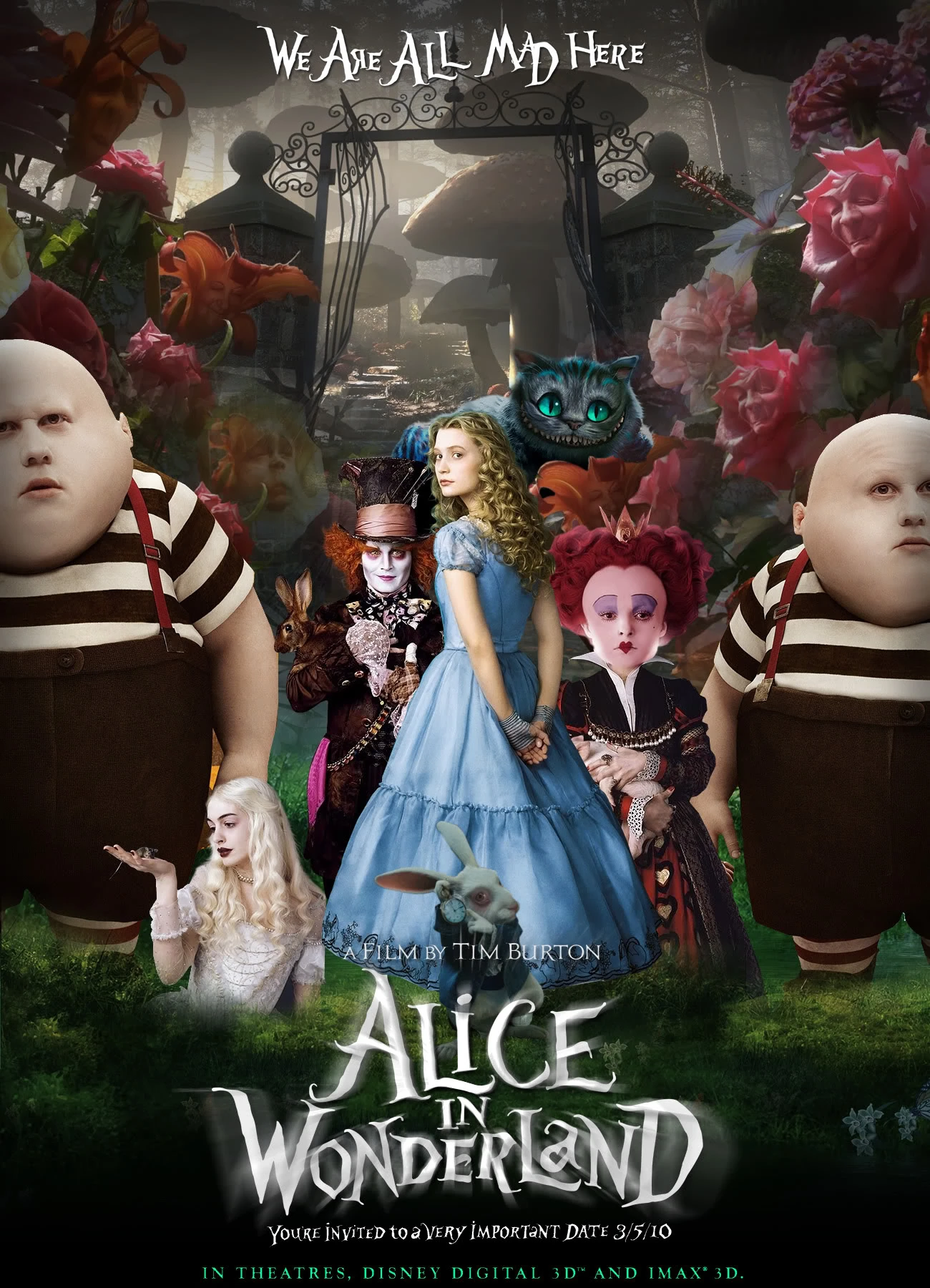
Alice in Wonderland (2010): A Review (Review #212)


ALICE IN WONDERLAND (2010)

A Carroll Out Of Tune...

You can't really call Tim Burton's film Alice in Wonderland for many reasons.  One: it's not strictly speaking an adaptation of the Lewis Carroll books Alice's Adventures in Wonderland or Through The Looking Glass.  Two: as many of the characters tell Alice, she really isn't in a place called Wonderland but actually called Underland.  

The film is therefore erroneously named.  It also is more a facsimile of the books, a remarkably joyless affair that has only name recognition going for it. 

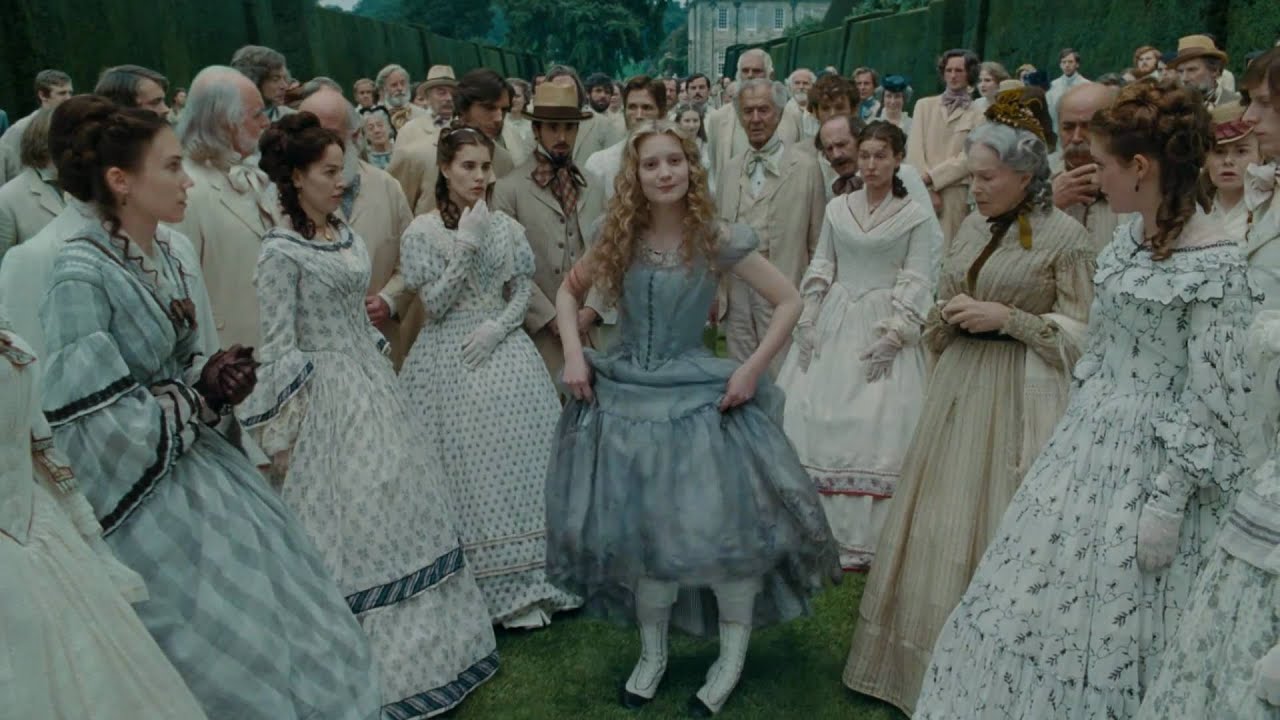
Alice (my not-so-secret love Mia Wasikowska) is now 19, and facing a most unhappy prospect of a proposal by the tweedy Lord Hamish Ascot (Tim Piggot-Smith).  She does not want to marry him, but alas, this may be the only way to restore her family's fortunes.  Instead, she leaves Hamish and everyone else watching them at her surprise engagement party to go chasing rabbits.  Once again, she tumbles down a hole and finds herself in a world vaguely familiar but she stubbornly insists is all a dream.  Here, Alice eventually finds the Mad Hatter (Johnny Depp) still in the middle of his tea party, but the world Alice enters is not a happy world.  

The Red Queen (Helena Bonham Carter) has usurped the throne thanks to the help of the Jabberwocky and pushed out her sister the White Queen (Anne Hathaway).  The White Queen is looking for a champion to fight the Jabberwocky, and Alice, according to the scroll called the Oraculum (I figure because it's an oracle of things past, present, and future) states Alice and only Alice can kill this beast. 

Alice, of course, doesn't want to kill the Jabberwocky or anything really.  She does feel an obligation to rescue the Mad Hatter, trapped in the Red Queen's castle.  She does so, aided by the hunt dog Bayard (voice of Timothy Spall), the Dormouse (v.o. Barbara Windsor), and even the mischievous Cheshire Cat (v.o. Stephen Fry).  Once rescued (being sure to take the Vorpal Sword with her), they are ready to take on the reign of terror of the Red Queen and her champion.  Finally, she emerges back to her world and decides to do the most anti-Victorian thing and go into business, sailing to the East to swindle the Chinese, I mean, bring business to the Orient.

Amazingly, in spite of its one hour and forty-eight minute running time, Alice In Wonderland feels far longer and both rushed and boring all at once.  I put it to the fact that while screenwriter Linda Woolverton had a great source of material to work with, she and I figure Burton decided that the best thing to do was to take out all the wit, the joy, and the fun out of it and turn it into a cross between Return to Oz and The Messenger: The Story of Joan of Arc.  

The film is dark and dreary, and more blasphemous, there really is no story here.  Other than the fact that she yells a lot and has a big head, we don't see the Red Queen as a new Gaddaffi.  Other than her fluttering about we never see why the White Queen wishes to return to power.  Even more peculiar, the Mad Hatter is actually rather sane, his hair notwithstanding.  It takes a great deal of courage to take one of the Great Books of Literature (my English teacher always said the majority of quotations emerged from three sources: the Bible, Shakespeare, and Alice In Wonderland) and reduce it to a story of a somewhat stupid girl who has to lead some sort of revolution. 

I never trust a film that has a continous score, and longtime Burton collaborator Danny Elfman never lets up on his music.  There might have been a minute or perhaps two where there was actual silence, but to my mind I believe having perpetual music in a movie is a sign that the film needs something to keep people interested or at least not drifting off to sleep.  Granted, the sets and costumes are excellent in bringing us into this unreal (and allegedly named Underworld--side note: why change the name of the place, or better yet, why not call it Alice in Underworld) world, but besides that, what interest do we have in seeing Alice and her side defeat the Red Queen and her Knave (Cripin Glover) since we don't care about any of them.


As much as Wasikowska enchants me in her films (The Kids Are All Right, Jane Eyre), she has also not (Defiance) and here, she is in the latter.  Alice is so flat, having a blank expression through almost the whole film.  I put it on the fact that there is no story to hold our interest.
  
As stated earlier, Bonham Carter consists of yelling and Hathaway (who sadly given her makeup job looked 300 years old) was all fluttery.  Now, I'll say that they played their parts correctly, but they never had any actual character traits that made us either fear/hate one or rally/care about the other. 

Depp doesn't go wrong playing oddballs but I'll say it again: the Mad Hatter isn't mad as in crazy; maybe mad as in angry.  When he finally performs his Futterwacken (a dance of joy), it doesn't look funny or fun, just so at odds with the somber tone of Alice In Wonderland.

The voice work is on the whole good.  Alan Rickman was perfectly cast as the Caterpillar, and his grand tones, while easily recognizable, lent that air of haughtiness to the role.  Windor's Dormouse is odd only in that it brought back memories of Reepicheep from the Chronicles of Narnia films.  Whether it was a conscious decision to do so I don't know (I doubt it) but you can't have a mouse flinging a sword without us thinking about how similar they are.  To his credit, I did not recognize Michael Sheen as the White Rabbit, though Stephen Fry was more recognizable as the Cheshire Cat (side note: given Sheen's best-known performance is as Tony Blair, wouldn't it have been more accurate to have had him play the Cheshire Cat).

I will say that I did laugh when I heard the Cheshire Cat tell Alice that he never gets involved in politics.  If only that were true.  I bet a lot of the British-viewing public must have been rolling in the aisles or rolling their eyes.  Yet I digress.  

The story itself doesn't make much sense: if all know Alice will fulfill 'the prophesy', why is everyone so clueless about what she is doing there?  How is it that the Red Queen doesn't recognize Alice if she has seen her before in the past when she was there as a child, or even stop to think that this large creature who appears in her garden might be the mysterious Alice?

I cannot get over the fact that all that is good about the two books the film is based on was sucked dry to create something that did not have any energy, any joy, or any originality.  Alice In Wonderland is very busy but very empty, remarkably bland.  Even Johnny Depp suffers: his makeup makes him look like Elijah Wood of all people.  As long-time readers know how I feel about 3-D, I need not waste your time going over that once more. 

Alice In Wonderland the 2010 film bears little resemblance to Alice In Wonderland the book.  It was an interesting idea: to take a director known for his interest in the dark and quirky nature of life and adapt a work of joyful nonsense.  Somehow, they didn't mesh.  It's in the end odd that in Alice In Wonderland, there is no real sense of wonder, only boredom.

How Can You Tell The Difference?

DECISION: D-