Tuesday, June 30, 2026

Dead of Winter (2025): A Review (Review #2185)

DEAD OF WINTER (2025)

When I first saw Dead of Winter, I thought that it might have made for a good short film but not that great for a feature film. Upon a second viewing, I think Dead of Winter makes for a good feature film. Strong performances and a smoothly flowing story make Dead of Winter a well-crafted film that is better than I initially remembered. 

Barb Lunquist (Emma Thompson) is driving to a remote Minnesota lake. It is winter here, but Barb has a mission that reveals itself in a series of flashbacks. A quick blizzard gets her a bit lost. The memories of her long love affair with Karl also distract her.

Barb comes upon a remote cabin and is concerned with some blood that she sees in the snow. The remote mountain man in the Camo Jacket (Marc Menchaca) quickly tells her where the lake she's looking for is and tells her that the blood is from an animal. Barb might not be convinced but won't get further involved. 

Things take a sudden turn when Barb does arrive at the frozen lake and begins ice fishing. She struggles with her memories of Karl. Even in her grief, however, she cannot ignore how Camo Jacket is chasing after a young girl whose arms are tied. Camo Jacket, oblivious to everything save this girl, doesn't see that he was watched. Barb now has to do something. 

Barb now finds this hostage at Camo Jacket's cabin. She assures the young girl that she will not abandon her but will get help. She also sees Purple Lady (Judy Greer), the brains behind the kidnapping. It becomes a cat-and-mouse game between Barb and Purple Lady/Camo Jacket (the former wearing a large purple parka). Each gets the upper hand from time to time, but time is running out for all concerned.

Why is the young girl named Leah (Laurel Marsden) being held prisoner? Purple Lady plans to harvest Leah's liver to save her own life. Others both directly and not directly involved in Purple Lady's deranged scheme will not live to tell their tale. The battle to save Leah will culminate at that frozen lake. Here, the Widow Lundquist will fulfill her late husband's final wish with his ashes, but who will live and who will die?


After initially seeing Dead of Winter with my family as a "mystery movie", our consensus was that it was not very good. After seeing it a second time, I thought better of the film. I think we were displeased with the dour nature and bleak ending. Dead of Winter is still a downer of a film. It also has those flashbacks between the young Barb Sorensen (Gaia Wise) and young Karl Lunquist (Cuan Hosty-Blaney) pop in more times than I think necessary. 

That being said, I appreciated more in Dead of Winter than the first time that I saw it. At the top of that list is Emma Thompson's performance. On both a technical and emotional level, Thompson does very well in the role of Barb. She maintains a solid American Midwest accent that would not be out of place in Fargo. She makes Barb into the embodiment of "Minnesota nice", with her not even cursing beyond a "heck" or "darn". I think that maybe she did use foul language once, but that was probably the extend of her vocal vulgarity.

Her performance works well throughout. She can express Barb's loss and emotional despair with just a glance. She can also show strength and common sense when having to comfort Leah or face off against Purple Lady. She even blends both when dealing with Camo Jacket, whom we discover is Purple Lady's henpecked husband.

Judy Greer is also quite strong as Purple Lady. She is villainous. However, we also see Purple Lady's desperation in doing all that she can to survive. Marc Menchaca is in turns frightening and sympathetic as Camo Jacket. He is as he says he is, which is not a bad man. He is just a very weak man. Laurel Marsden does well as the frightened Leah, desperate to live despite her own past troubles.

Credit should be given to director Brian Kirk for guiding his actors to strong performances. He also kept things flowing mostly well given that Dead of Winter is only 98 minutes long. Nicholas Jacobson-Larson and Dalton Leeb's screenplay also gives us a good deal of the various characters' backstories without it being forced. Again, I could argue that Barb's flashbacks do pop up a bit more than necessary. Still, that Dead of Winter did not slip into farce is a credit to everyone involved.

I think that Dead of Winter is a good albeit downbeat film. It is in some ways as sparse as the Minnesota winter it is set in. That downbeat manner might put some people off. It did my family when we first saw it. Overall, though, I think Dead of Winter is a strong but bleak film that should be given a chance. 

Saturday, June 27, 2026

Up Close & Personal: A Review


UP CLOSE & PERSONAL

Jessic Savitch was a pioneer in television journalism for women. She was also a highly troubled woman. Her story has been told in the television film Almost Golden: The Jessica Savitch Story. Savitch's story was also the basis for Up Close and Personal, allegedly. It is hard to think that a woman who struggled with chemical dependency and died in a car accident at age 36 was the same figure as that in Up Close and Personal. Glossy to the point of parody, Up Close and Personal may be now best remembered as being one of Diane Warren's seventeen (as of this writing) failed Best Original Song nominations.

Using the framing device of an interview that will feature in things later, we learn the story of Tally Atwater (Michelle Pfeiffer). She started as Sallyanne Atwater from Reno, with dreams of being a broadcast journalist. However, Sallyanne was poor, had no education beyond a few community college courses and no background to speak of. What she had was moxie. Sallyanne made a demo tape and sent it to every station that she could think of.

Only one station in Miami shows even a modicum of interest. With that, our plucky heroine heads off to WMIA to work under Warren Justice (Robert Redford). "Coming, sweetheart?", he tells Sally as she follows him around and learns the ropes of broadcast television news. Sally wants to be on camera, but for now, she serves coffee and answers phones. She finally gets her chance when Sally agrees to don a raincoat and be the station weathergirl. Unfortunately, she gets flustered, nervous and tongue-tied at her debut. She is so high-strung that she mumbles her own name as "Tally". Thus, Tally Atwater begins her climb to being Queen of Miami News.

Her on-air fight with experienced co-anchor Rob Sullivan (Scott Bryce) pushes her to seek greener pastures. That search leads to agent Bucky Terranova (Joe Mantegna). He gets Tally a new job in Philadelphia, which is a bigger market. Tally and Warren for their part finally indulge in the pleasures of the flesh, Because You Loved Me playing all around their romantic idyll. 

Now in Philly, Tally struggles with the new environment. She also struggles with Marcia McGrath (Stockard Channing). Marcia is the Queen of Philadelphia News, and she is not about to have a usurper taking her down. Tally is crumbling, so Warren sweeps in to save her and maintain being her mentor and lover. At last, Tally and Warren marry. Marcia, perhaps seeing the inevitable, moves on and Tally takes over. 

Things, however, come to a head when Tally and her loyal cameraman Ned (Glenn Plummer) go to a prison for a "day in the life" segment. Their interviewee is Fernando Buttanda (Raymond Cruz). He had been previously interviewed by Tally in Miami when his baby mama gave birth to the first baby born in the New Year. Fernando had also been the cause of the Tally/Rob on-air fight. During the recording, a prison riot breaks out, trapping Tally and Ned. Will Tally make it out alive? Will Warren end up living long enough to see Tally be interviewed Up Close and Personal?

Except for Warren's end not coming from suicide, Up Close & Personal might as well be a broadcast news remake of A Star is Born. I do not think that the film ends with her saying, "I am Mrs. Warren Justice", but I wouldn't have put it past screenwriters Joan Didion and John Gregory Dunne to have at least thought to do so. The interview that opens and closes the film is, we find, is part of a Warren Justice tribute. In many ways, Up Close & Personal follows the A Star is Born plotline. Eager, young and inexperienced female finds an older, experienced male mentor. They fall in love. Her career rises. He dies.

Granted, Warren's career did not slump unlike the male protagonist in all four A Star is Born versions. Apart from that though, both films veer pretty close to being the same story. We even get Michelle Pfeiffer sing, belting out The Impossible Dream at a high school football field to an amused Warren. As someone who unironically loves Grease 2, I do not object.

Up Close & Personal has almost nothing to make anyone think that it was even "suggested by Golden Girl: The Story of Jessica Savitch". In real life, it was Jessica Savitch that met an untimely and tragic end. Here, it is Warren who meets a safely distant end.

I do not mind sappy stories. I mind weak sappy stories. Michelle Pfieffer and Robert Redford are very pretty people. They are also twenty-two years apart in age (Redford was 60 and Pfieffer 38 at the time). I figure audiences at the time did not mind seeing them as a romantic couple. I found the idea that Tally would be enthralled with Warren a bit ludicrous. 

I will say that Michelle Pfieffer came out best given the material she had to work with. She brought a believability to Tally's hesitancy and unsure manner. I do object to how Tally was made into such a klutz that she literally could not pronounce her own name when the camera light hit her. I can also object that, for someone who prided herself on being bilingual, she made a ghastly mistake. When interviewing Fernando, she tells him "I'm short on practice" in Spanish when downplaying her language skills. She says, "Me falta practica". It should be pronounced "Meh falta practica" as the Spanish "E" is what in English would be a short E sound (as in "Bed" or "Red"). 

My guess is that Pfieffer and director Jon Avent read the word which is spelled "me" and pronounced it as they would in English for "myself". In Up Close & Personal, she pronounces it as "me", which is wrong. It is surprising that no one caught that. I figure people were too wrapped up in how beautiful our lovers were. Yet, I digress.

Michelle Pfieffer did well with what she had. Robert Redford frankly looked bored. For how much they were supposed to be in love, I did not see much if any chemistry between them. A particularly bad moment is when Warren goes to Reno to help Tally, who is there to help her sister Luanne (Deedee Pfieffer, Michelle's real-life sister). The drama, as played by Pfieffer and Redford and directed by Avent, was forced. It was like watching them rehearsing to learn their lines rather than being authentic.

Other elements, like Kate Nelligan as Joannan Kennelly, one of the ex-Mrs. Justice, felt added to the already punishing two-hour runtime. Joe Mantegna looked more amused than involved, as if he figured Up Close & Personal was not going to do much for him or his character. 

The big claim to fame that Up Close & Personal has is its love theme. Celine Dion sings Because You Loved Me during Tally and Warren's romantic interlude, which became a number one hit. The song is fine. It has stood the test of time. I am not a Celine Dion fan. However, I have to acknowledge that Because You Love Me works separate from Up Close & Personal. I think the lyrics are a bit grandiose for the story and the trysts the film sets it in. Overall, though, Because You Loved Me works well and I don't fault people for loving it so.

Up Close & Personal was a big hit, with audiences embracing its sappy manner. I found it long, slightly silly. The prison riot sequence looked tacked on to build suspense. It is a lovely coincidence how Fernando, the Florida prisoner whom Rob didn't want to give the layette to because of his background, ended up in a Pennsylvania prison. 

Other elements have not aged it well. One pitched story is how a "cross dresser" (their words) made it to the Miss Florida finals. The WMIA crew finds that story hilarious. Nowadays, that "cross dresser" would be considered a legitimate finalist. 

Up Close & Personal is longer than it needs to be. It is not well acted or written. It is a disservice to make Jessica Savitch's story into a sappy love story just because it stars two beautiful people. "I'm everything I am Because You Loved Me", Dion coos to us. What ultimately Up Close & Personal isn't is good, no matter how much it is loved. 

Wednesday, June 24, 2026

Reminders of Him: A Review

REMINDERS OF HIM

Apart from Regretting You (known in my family as "the adultery movie"), I am unfamiliar with the works of Colleen Hoover. Therefore, I cannot say if Reminders of Him is a good or bad adaptation. Nor can I say that the original novel is good or bad. I judge only what I see on the screen. Reminders of Him is awful. Sappy and insipid, with almost universally awful performances, Reminders of Him should best be forgotten.

Kenna Rowan (Maika Monroe) has returned to her hometown of Laramie, Wyoming after being gone for six years. Where was she in those years? Up the river, serving time for vehicular manslaughter. She was in a car accident that killed her boyfriend, Scotty Landry (Rudy Pankow). 

Scotty is also her baby daddy. Shortly after his death and her incarceration, Kenna discovers that she got knocked up. She gave birth to her daughter Diem in prison. Diem (Zoe Kosovic), unaware of any of this, has been raised by Scotty's parents Grace (Laura Graham) and Patrick (Bradley Whitford). Diem has also been raised, unofficially, by Scotty's best friend Ledger (Tyriq Withers). He has been devoted to Diem ever since Scotty's death, showering her with all the love and affection any father would have given her.

Let me pause for a moment here to point out that our character's names are Diem and Ledger. I might be the only one who thinks that they are incredibly stupid names. Kenna is barely hanging on in the not-oddball name department. 

Ledger was a Denver Brocos superstar until injuries forced him to leave the NFL. Now, he runs a bar at what used to be Scotty and Kenna's favorite coffeehouse/bookstore hangout. Ledger finds Kenna quite attractive. He also is unaware of who Kenna actually is. Despite being Scotty's BFF, he has seen only a mugshot of Kenna. Kenna, however, realizes who Ledger is when he tells her his name.

Kenna is desperate to see Diem. Grace and Patrick will have none of it. Kenna struggles to find work. Fortunately, grocery store assistant manager Amy Matthews (Lainey Wilson) helps her get a job as a bagger. She also finds an unexpected friend in Lady Diana (Monika Myers), another checkout girl who lives in Kenna's rundown apartment complex and has Down's syndrome.

Ledger struggles with both his growing attraction to Kenna and seeing her as a decent person who made a terrible mistake. Taking pity on her, Ledger gives her a part-time job and does his best to keep Grace and Patrick from finding out about Kenna. Eventually, they do consummate their relationship. The truth about Scotty's accident is revealed. The affair is also discovered. Will everyone be able to heal? Will our poor Diem finally meet her mommy?


Tripe. Reminders of Him is tripe. Do not get me wrong. I could accept some cinematic tripe if the premise or the performances are even halfway decent. Reminders of Him, however, has almost nothing to recommend it. 

As a side note, based just on the plots of both Regretting You and Reminders of Him, Colleen Hoover has an apparent fixation with women getting knocked up, car accidents killing those who knocked up said women and people connected to those killed in said car accidents having sex with each other. Make of that what you will.

Reminders of Him goes beyond the implausible to being ridiculous. Nothing, but nothing will convince me that Ledger had never seen a single photo of Kenna or vice versa. Apparently, Ledger was always too busy with the Denver Broncos to ever meet Scotty's great love. I suppose that Scotty could never text Ledger a photo or selfie of them. I figure that Scotty and Kenna never saw Ledger play on television. Just as Scotty never showed Ledger a single image of Kenna, I suppose that Scotty never showed Kenna a single image of Ledger. I suppose that Kenna was never curious enough to look up Ledger online, with him being a National Football League player. 

I might, might give a bit of leeway that Kenna and Ledger's appearances might have changed in the six years since her incarceration. That, to my mind, is stretching things beyond the plausible. I also know that Reminders of Him follows my Number One Golden Rule of Filmmaking: Something Will Happen if the Plot Requires it To

Does the plot, with the screenplay cowritten by Colleen Hoover and Lauren Levine, require that every man Kenna meets fall passionately in love with her? The "meet cute" for Kenna and Scotty is how he keeps buying items at the dollar store she works until she agrees to a date. The "meet cute" for Kenna and Ledger has him all but asking her out when she goes into the bar that first night. Kenna is catnip to all the young, eligible men in this small town. Reminders of Him makes Ledger, quite frankly, into a bit of a stalker.

Somehow, Reminders of Him made almost everyone unlikable, even Diem (which I still think is a simply frightful name). Ledger has no struggles schtupping the woman everyone blames for killing his bestest best friend. Patrick and Grace offer no grace (and part of me thinks that the name choice is meant to be ironic to symbolic). Is Ledger keeping score? Is Diem seizing the opportunity? 

Vanessa Caswill's directing of her actors does not help matters. Tyriq Withers showcased his taut body and no acting range in the horrendous Him. Reminders of Him does less of the former and more of the latter. Tyriq Withers cannot even run the gamut from A to B. It would be an acting miracle if he could show any emotion whatever. He speaks his lines as if almost drugged. No matter what the scene, no matter what the emotion, Withers is consistently comatose. At least he is pretty.

As another side note, I have seen Tyriq Withers in Him and Reminders of Him. Reminders of Him are the last thing that I need while watching Reminders of Him.

Rudy Pankow made Scotty less the lovelorn young man and more the irresponsible dolt who caused his own death. We see in the flashback that he gave Kenna something to make themselves high. As such, she was basically intoxicated thanks to him. While it is terrible that a simple pothole got her to lose control of the vehicle, it did get them to both stop singing Coldplay's Yellow, so there's that.

Both Bradley Whitford and Lauren Graham were one note as Patrick and Grace. I think Graham was miscast. She seemed to have only one expression throughout the film. I kept thinking that maybe Marcia Gay Harden would have been better in the role. Whitford, for his part, spoke his lines with slightly more conviction than Withers.


If anything makes Reminders of Him watchable, it is Maika Monroe. It is not a great performance. However, you can see that Monroe is expressing more of Kenna's conflict. She makes Kenna a flawed but basically decent person. Her anger at not being able to see Diem and slight amusement at Lady Diana's constant retort of "Jerk!" to Ledger make her performance one worth watching. She shows Kenna's regrets, hesitancy, doubts, guilt and genuine desire to improve things where she can. Monika Myers is a delight as Lady Diana. There is something amusing about how blunt she is. Lady Diana has no problem walking in and out of Kenna's apartment, nor any problem saying what she thinks. 

Lainey Wilson is mostly known for her country music. Her role in Reminders of Him is small. However, she acquits herself well as Amy, the compassionate assistant manager who wants to help Kenna back on her feet. 

Apart from Maika Monroe and Monika Myers, the only positives in Reminders of Him is the soundtrack. I enjoyed the use of Lord Huron's The Night We Met. I would get the soundtrack, as the film has many good songs. It does go into a bit of a cliche to have a hip soundtrack underscore the mood. However, I like to find some positives in a film, even one as weak as Reminders of Him.

Sappy, silly, but with a couple of good performances, Reminders of Him will pretty much be forgotten by the time the credits start rolling. 

Tuesday, June 23, 2026

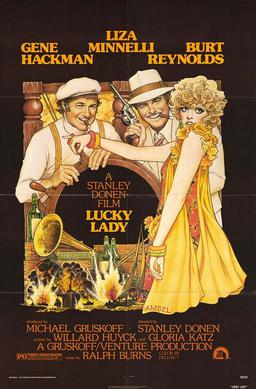
Lucky Lady: A Review

LUCKY LADY

Sometimes, what looks good on paper does not end up good at all. Such is the case with Lucky Lady. It has some great music, including two relatively unknown Kander & Ebb songs written for their unofficial muse. Unfortunately, a nice soundtrack cannot carry a film that tries too hard to end up nowhere. 

Tijuana, 1930. Down on her luck American chanteuse Claire (Liza Minelli) sings for her supper in a rundown dive. Her late husband Harry, who owned the bar, was also a human smuggler. Now, Claire's lover Ellison Walker (Burt Reynolds) will do "one last job" of smuggling Mexicans across the border. As is the case with all "one last jobs", Walker's coyote run ends disastrously. Adding to his troubles is Kibby Womack (Gene Hackman). He was one of the men Walker was going to smuggle despite Kibby being American.

Kibby forces himself on Walker and Claire on their newest venture. They will smuggle rum to thirsty Americans despite Prohibition. That does mean getting the booze away from Christie McTeague (John Hillerman). The mobster is not amused. Neither is Coast Guard Captain Aaron Moseley (Geoffrey Lewis). Our trio is attempting to smuggle the booze via sea on the Lucky Lady. Captain Moseley is on to them. He won't be bribed and comes close to killing them. 

Eventually though, thanks to help from the sole Lucky Lady crewman, Billy Weber (Robby Benson), Claire, Walker and Kibby manage to outwit and outrun the Coast Guard. Claire now has two lovers and she ain't ashamed. Arriving in San Diego, the three are going for their curious living arrangements and live together. The past, however, is never far behind. McTeague is set on getting them for getting the better of him. Not everyone will survive to see happy days again.

Lucky Lady has exactly one positive: its soundtrack. The film is filled with Jazz Age standards like Bessie Smith's Hot Time in the Ole Town Tonight and Young Woman Blues. There's a rendition of All I Do is Dream of You, sung deliberately badly by a lounge singer at the hotel our trio is staying in. I do not know if including All I Do is Dream of You was an in-joke by director Stanley Donen. His most famous film is probably Singin' in the Rain, and All I Do is Dream of You is prominently featured in that film. We even get Burt Reynolds belting out a little of Ain't Misbehavin'. I suspect that after listening to Reynolds warbling the Fats Waller standard, one can guess why his musical At Long Last Love bombed so spectacularly.  

The film also features two new songs written by John Kander and Fred Ebb. Kander & Ebb found their muse in Liza Minnelli. Their two songs for her, Lucky Lady and (Get) While the Getting is Good, are good numbers. Minnelli and Kander & Ebb were almost always in top form whenever they collaborated. 

Unfortunately, that was the only good collaboration Lucky Lady saw. You had three strong actors in the leading roles. You had a celebrated director. What you did not have was a good script. It is unclear of the Gloria Katz and William Huyck screenplay was what ultimately appeared on screen. What did end up on screen was a very jumbled affair. It aimed to be zany and a bit of screwball. However, there was no sense of timing. Take for example a scene where Kibby is taunting Captain Moseley about escaping. The mad captain starts shooting at Kibby but keeps missing hitting him. Walker jumps off the lifeboat while a supposedly oblivious Kibby keeps mocking him. The comedy comes from how apparently Kibby is unaware that he is literally sinking. 

As played by Gene Hackman, it looks forced. It does look like Hackman is aware that it is meant to be funny. He just cannot play it as funny. The boat chase between McTeague and our bootleggers is also meant to be a bit funny, and even perhaps exciting. However, the overall result in Lucky Lady is that it is neither. 


I do not necessarily fault the actors. I think Liza Minnelli, Burt Reynolds and Gene Hackman did try. It might be a case of them trying too hard. One senses throughout Lucky Lady that the three of them were too smart for the material. It is as if they knew all this was idiotic and were waiting for their checks to deposit. Minnelli, I think, tried the hardest to sell the premise. She was fine when she was singing. She was not bad when she was acting. She just couldn't make the menage a trois believable because she did not have much chemistry with Hackman or Reynolds.

Burt Reynolds, I think, thought that he would be best served by going broad. He wasn't. It looked forced and unnatural. The same with Hackman. Again, they were all good actors. They did their best. They just could not make things zany. Worse is when Lucky Lady shifts into some surprisingly dark drama. How else to explain that this comedy has a violent end to an innocent? 

Not that some part of the viewer would feel for Billy. Robby Benson is a curious player here. He was totally blank as this kid. Part of me found it almost amusing that his soft voice was not heard unless absolutely necessary. It was as if the filmmakers figured it would be best to keep Benson's dialogue to a bare minimum. Lucky Lady was released before another film of his, Tribute. When comparing his performances in both, somehow Robby Benson got worse as an actor. Geoffrey Lewis was too cartoonish as Captain Moseley. I figure that the character was meant to be ridiculous. Lewis never made him plausibly ridiculous. 

Only John Hillerman managed to make his character of McTeague a genuine menace. However, I would say that Hillerman acted as if Lucky Lady were a neo-noir drama and not a zany screwball comedy. 

Lucky Lady aimed for screwball hijinks with a daring suggestion of a threesome. The pacing, however, was a bit off. Things were played a bit too broadly or seriously. The balance was off. It would be better to listen to the soundtrack than try to figure out exactly what Lucky Lady is about. Lucky Lady is neither. 

Monday, June 22, 2026

Eternal Sunshine of the Spotless Mind: A Review

ETERNAL SUNSHINE OF THE SPOTLESS MIND

I think most if not all of us have had that one love whom we still pine for despite the hurt they caused us. That makes Eternal Sunshine of the Spotless Mind relatable despite its whacked-out premise and style. Well-acted, directed and written, Eternal Sunshine of the Spotless Mind will reward those who watch the film.

It is Valentine's Day, 2004. This, however, is not a joyful day for Joel Barish (Jim Carrey). It is a dark, satanic holiday, as he has no love of his own. Almost on a whim, he opts not to go to work but to take a different train. Here, he meets the very quirky Clementine Kruczynski (Kate Winslet). She seems a bit of a manic pixie dream girl. She is also assertive and aggressive. However, they seem to find themselves drawn to each other. 

There is a fly in the ointment to this budding romance. That would be Patrick (Elijah Wood), the man puzzled to find Joel waiting outside Clementine's apartment. Patrick appears to be Clementine's real boyfriend. However, not everything is as it seems. Joel finds that he and Clementine were involved in the recent past. She has opted to remove him from her memory. Now, Joel has opted to do the same. For that, he turns to the same company that Clementine used: Lacuna, Incorporated.

Dr. Howard Mierzwiak (Tom Wilkinson) appears to be a benevolent figure. He needs all of Joel's memories of Clementine to start the removal process. That process will require that Lacuna's operatives go to Joel's apartment at night to remove all those memories. One of the operatives, Stan (Mark Ruffalo) is seeing Dr. Mierzwiak's loyal secretary Mary (Kirsten Dunst). She comes during the procedure for some drinking, drugging and schtupping. Stan's right-hand man seems more interested in keeping his new girlfriend, whom he nicknames "Tangerine" from going off the deep end.

That right-hand man? Patrick. That new girlfriend? Clementine.

While Joel knows that Clementine had her memories of him removed, he is unaware that Patrick has been using them to get his own hands on our manic pixie dream girl. Joel also has a change of heart and wants to keep his memories. That requires a few mind tricks of his own, which the whacked-out Stan cannot figure out how to counter. This will require the personal intervention of Dr. Mierzwiak, who has a few secrets of his own. Will Mary be the key in getting our lovebirds together? Will Joel and Clementine find a tabula rasa for their bad romance? 

The title Eternal Sunshine of the Spotless Mind comes from a line from the Alexander Pope poem Eloisa to Abelard. Mary, who carries a torch for Dr. Mierzwiak, quotes it to him in an effort to impress her potentially unrequited love. In her efforts to impress, she mistakenly refers to the author as "Pope Alexander", with Dr. Mierzwiak gently correcting her. I mention this because the title Eternal Sunshine of the Spotless Mind now carries what I think was Pope's idea of the beauty of not remembering. It would, perhaps, be bliss. However, it would not be life. Eternal Sunshine of the Spotless Mind makes the case that love is not all rainbows and lollipops. It is enduring heartache. It is sadness. True love, however, is in going past that to find what it is about the other that both drew us to them and holds us to them. 

Eternal Sunshine of the Spotless Mind is wildly inventive thanks to director Michel Gondry and screenwriter Charlie Kaufman (with story credit by Gondry, Kaufman and Pierre Bismuth). The film carries a logic to its eccentric story. It trusts the audience to keep up, adding bits of details that will, in the end, make sense. It also carries humor outside the somewhat melancholy love story. That is provided by Stan and Mary. These two, in the throes of a clandestine affair, are delightful oblivious to Joel's plight as he internally rebels against his memory erasure.

The film also has exceptional performances all around. I admit that I am not a Kate Winslet fan. However, Eternal Sunshine of the Spotless Mind is an extremely strong performance from her. Clementine initially appears to be that manic pixie dream girl, quirky and whacky and flighty. However, as the film goes on, we see her as aggressive and assertive. She is not there to fix Joel's problems. She sometimes causes them. Clementine is a fascinating character, one who operates on her own logic yet is vulnerable and searching for love.

Jim Carrey too excels as Joel. This is a change of pace for the manic comic. He is morose and heartbroken. He also, though, carries a curious hope that despite the travails of love, Joel can still find someone. It is a bit of a surprise that while Winslet was singled out for Oscar consideration, Carrey was not. He was a major component of what made Eternal Sunshine of the Spotless Mind successful. Joel was a bit of an everyman. He was a bit down on himself. He was hurt and wounded by love. Despite that, he was still something of a romantic. It was as good a performance as Kate Winslet's. 

The rest of the cast was equally strong. Elijah Wood's Patrick, I would argue, technically committed medical malpractice by using Joel's files to use on Clementine. However, his bumbling was amusing. Mark Ruffalo and Kirsten Dunst played well against each other. Dunst in particular had a wonderful arc, shifting from efficient and somewhat dismissive of patients to a de facto whistleblower. Tom Wilkinson made the bad doctor's fake sincerity amusing and droll. 

Eternal Sunshine of the Spotless Mind has some arresting visual sequences and an effective Jon Brion score. All the elements blended well in making this bizarre love story surprisingly relatable. 

"Memories may be beautiful and yet, what's too painful to remember, we simply choose to forget. So it's the laughter, we will remember, whenever we remember The Way We Were". Eternal Sunshine of the Spotless Mind did not quote directly from The Way We Were. However, the lyrics to the Barbra Streisand song sum up what Eternal Sunshine of the Spotless Mind is about. Memories of love, too painful to remember, can be forgotten if one thinks that the love is worth it. Eternal Sunshine of the Spotless Mind is an eccentric love story. Then again, so many love stories are eccentric to begin with. 

Sunday, June 21, 2026

Howards End: A Review (Review #2180)

HOWARDS END

We might be giving our ancestors a bit of an unfair rap. We might look up the Edwardians as staid, emotionless, frigid figures. If one goes by Howards End, these were actually very lustful albeit more restrained individuals. This adaptation of the E.M. Foster novel stays true to the Merchant Ivory standard of repressed passion amidst the lavish production. Howards End, while I bit slow and long, still has enough to make it lush and insightful viewing.

A rushed, secret engagement between the wealthy Paul Wilcox (Joseph Bennett) and middle-class Helen Schlagel (Helena Bonham Carter) delights and surprises her family. They quickly call it off but are too late to stop the telegram informing Helen's family of that fact. Helen's Aunt Juley (Prunella Scales) unexpectedly arrives at the Wilcox retreat of Howards End to look over her prospective relations. She is shocked to find that no one knew of the engagement and is made to look foolish.

Some months later, the Wilcoxes take up an apartment across from the Schlagels. Despite their initial botched interactions, Helen's older sister Margaret (Emma Thompson) and Wilcox matriarch Ruth (Vanessa Redgrave) become fast friends. Ruth's family is not unkind towards the matriarch. They just live their lives and do not offer much in terms of company or intellectual enrichment. Margaret does. It is to where, on her deathbed, Ruth wills Howards End to Margaret. The note, however, is scribbled and barely legible. Ruth's husband Henry (Anthony Hopkins), with his children and their spouses' consent, burn the dubious will and agree never to speak of it again. 

Margaret and Helen are intellectuals who host salons with their brother Tibby (Adrian Ross Magenty). One of those is Leonard Bast (Samuel West). Helen and Leonard, who is less well-off than the upper-middle class Schlagels, meet somewhat cute when Helen takes Leonard's umbrella after a music recital/discussion. They quickly befriend Leonard, who works at an insurance company. They also have kept a connection with the Wilcox family. Turning to Henry for advice to help Leonard, he tells them that Leonard's company is in reality coming close to insolvency. He recommends that they advise him to leave and find a lower paying but safer job.

Henry and Margaret have by now married. They are content in their new relationship. Everyone else is not. Henry and Ruth's children Charles (James Wilby), Evie (Jemma Redgrave) and Charles' wife Dolly (Susie Lindeman) all find the Schlagels rather bourgeois. That does not bother Margaret or Helen as they are proudly that. Things come to a head at Evie's wedding. An enraged Helen arrives with both Leonard and his wife Jacky (Nicola Duffett). Leonard's former business did not fail as Henry told them. That left Leonard in worse financial shape, and Helen blames Henry for deliberately ruining them. Things grow more complicated when Jacky recognizes Henry and drunkenly reveals that she was his former mistress.

Despite that, Margaret forgives Henry's indiscretion. Howards End is a de facto storage for Margaret and Helen's property until everyone can decide what can be done. One thing that apparently won't be done is host Helen at Howards End. Helen and Leonard have indulged in the pleasures of the flesh. There is now clear-cut evidence of their liaison growing within Helen's body. Helen is not ashamed. Henry is enraged. Margaret is shocked by both Helen's actions and Henry's hypocrisy. Things, however, lead to murder and, after some time, Margaret ends up receiving Howards End as her own property, fulfilling Ruth's original directive.


I think that Merchant Ivory productions have a perhaps unfair stereotype of being all posh and grandiose settings that say nothing about today. Seeing Howards End, I think we see how the more things change, the more that they stay the same. The same issues of class, of the heart versus the head, are really not that different from the Edwardian era to today. Granted, the out-of-wedlock situation that Helen has might not carry the same stigma that it would in the early 1910s. However, it would still be something of a scandal since Helen did get knocked up by a married man.

Something that did surprise me about Howards End is how, under James Ivory's direction, the film played a bit like an Edwardian screwball comedy. This is particularly true when the thoroughly befuddled Mr. Bast crashes the Schlagel tea party. The dialogue has an amusing manner when the Schlagel siblings and Mr. Bast discuss scones. 

In the film, we see the conflicting worldviews of the Wilcox and Schlagel families. The former is proper, restrained. The latter is more informal and curious about the world. That is not to say that the Schlagel sisters see things alike. Margaret remains within the boundaries of Edwardian society. She is an intellectual, aware of the world. She also does not approve of Helen's indiscretions and is shocked when her sister crashes Evie's wedding with the Basts. She is obedient to her husband, but she is also quietly forceful in pointing out his hypocrisy and cruelty. "You had a mistress, and I forgave you. My sister has a lover, and you drive her out of the house. Why can you not be honest for once in your life. Why can't you say what Helen has done, I have done", she tells Henry.   

What makes this scene more impactful is more than just Margaret pointing out Henry's double standards. It is in Emma Thompson's Academy Award-winning performance. James Ivory, who was nominated for his directing, led Thompson to not make this a big, dramatic moment. Instead, as Thompson plays the scene, it is of a woman genuinely hurt, confused and determined to have things exact. She does not shout or rage at Henry. Her declaration is not one of fury. It is one of pain and puzzlement. Ruth tells Margaret, "You're so clever, yet so good". That is an apt a descriptor for Margaret as one can find. 

Margaret Schlagel Wilcox is a fascinating character. She is thoroughly Edwardian in behavior, yet far more progressive in outlook. She is direct but sensible. She supports suffrage but will not go against her husband on most matters. Emma Thompson gives a magnificent performance.

Everyone in Howards End gives excellent performances. That is a major credit to James Ivory as a director. Anthony Hopkins is not overtly cruel as Henry Wilcox. Instead, he is a man trapped by his own worldview, one where one can feel for the poor but think it is the way of the world. Vanessa Regrave, who was the other nominated performance (Thompson as pointed out winning), is moving as the dying matriarch who is seeing her world shift in ways that she does not understand. Helena Bonham Carter excels as the passionate Helen. She is moral outrage and morally outrageous. 

The film is appropriately sumptuous visually with its Oscar-nominated costumes and Oscar-winning art direction. Ruth Prawer Jhabvala's Oscar-winning screenplay adaptation has some wonderful mise-en-scene. When Leonard and Helen finally give in to the temptations of the flesh, it is as they row down the river. We see them metaphorically and literally flowing into dangerous waters.

Howards End might be a bit longer than some viewers may like, clocking in at almost two-and-a-half hours. It might also be a bit too posh for some. That, hopefully, is not something to keep viewers away from an intelligent, well-acted and well-crafted film. Howards End moves well and tells its story of repressed and open passions with great power. 

Saturday, June 20, 2026

Satan Met a Lady: A Review

SATAN MET A LADY

In 1941, director John Huston made one of the most auspicious debuts in film history with The Maltese Falcon. While considered now as the definitive version of the Dashiell Hammett novel and an early film noir, the 1941 Maltese Falcon is technically the third adaption of Hammett's novel. The novel had been first made in 1931. It was remade a mere five years later as Satan Met a Lady. Neither the original 1931 The Maltese Falcon nor Satan Met a Lady are much if at all remembered today. While I cannot say whether that fate is deserved for the 1931 original, it is more than earned for the abysmal Satan Met a Lady.

Ted Shane (Warren William) is a wheeler-dealer with a breezy manner and a way with women. He is ostensibly a detective working alongside Milton Ames (Porter Hall). Ames is a longsuffering fellow when it comes to Shane. He not only keeps drumming up lousy business for Ames. He also romanced Ames' now-wife Astrid (Winifred Shaw) in the past. His newest assignment is to follow the wealthy Mrs. R. Manchester Arden (May Beatty), whom Shane hoodwinks into thinking that jewel thieves are after her jewels. Meanwhile, the mysterious Valerie Purvis (Bette Davis) hires Shane & Ames to follow a man named Farrow, who has been following her.

It is a surprise when later both Ames and Farrow end up dead in a cemetery. Whodunit? Shane's frenemies Detectives Dunhill (Olin Howland) and Pollock (Charles C. Smith) think that maybe Shane himself bumped both off. Shane, ever breezy and amused by everything and everyone, is not the killer. He, however, is in the midst of a mystery over who done in Ames and Farrow. 

This case is tied in with Purvis, but how? Does it involve a rare horn supposedly owned by the legendary hero Roland? Roland's fabled horn is supposed to contain a treasure trove of jewels separate from its own historic value. It looks like everyone is after Roland's horn. There is the tall Englishman Travers (Arthur Treacher), the veddy proper muscle. There's Madame Barrabas (Alison Skipworth), the heavyset Queen of Crime. There's her wimpy nephew Kenny (Maynard Holmes), whose beanie irritates Shane. All of them are after Roland's horn. Ted Shane claims that he can get it for them. Each of them pays him handsomely for that promise. However, will Shane keep his word and his life? Double and triple crosses abound until the real killer is unmasked. There are, however, a few more twists until Ted Shane and his loyal secretary Miss Murgatroyd (Marie Wilson) can be together at last.

While watching Satan Met a Lady, I came to the surprising realization that the film is really a comedy. Either that, or someone forgot to tell everyone that the film was meant as a crime drama. The viewer should know this from the beginning when Bernhard Kaun and Heinz Roemheld's score began the film. The music is surprisingly jolly and upbeat for what one would initially think was a mystery. It soon becomes clear that almost no one in Satan Met a Lady is taking any of this seriously.

That, in and of itself, would not be a bad thing. No genre should be immune from a good spoof. However, Satan Met a Lady is not smart enough to be a spoof. I do not think it aimed to be a spoof or a lighthearted jaunt. Instead, I think everyone behind the camera was unaware of how awful Satan Met a Lady was. 

William Dieterle was a good director. Therefore, it is almost sad seeing how misdirected Satan Met a Lady was. One is unsure if Dieterle was aware of how awful to downright cringe everyone and everything was coming across. I think the main flaw is in how Dieterle directed almost all of his actors to play the situations as if they were not meant to be remotely serious. Take for example when Shane comes upon Ames' body. For reasons that I cannot fathom, Dieterle had everyone play this scene as if it were something one might find in a Mel Brooks film. You have no sense of suspense. You have Warren William's very breezy manner. You have Brown Holmes' screenplay giving awful puns.

When asked by one of the detectives, "Don't you want to take a closer look at your silent partner?", I simultaneously groaned and winced. Holmes seems dead set on giving the characters flat out idiotic things to say. Travers asks Shane about what he knows about Roland's horn, suspecting that he knows its whereabouts. Shane replies, "Well, they've pointed the finger at me for a lot of dirty tricks but never for a crime like playing the saxophone". 


I think a lot of Satan Met a Lady's failures come less from Dieterle's direction than from Holmes' adaptation. That is not to say that Dieterle is off the hook when it comes to blame. All but one, possibly two, of the performances looked slightly cartoonish and silly. When, for example, Kenneth gets hit in the hand, Maynard Holmes looks less menacing and more childlike. Overall, though, Brown Holmes' adaptation of The Maltese Falcon clearly was not interested in fidelity to the source material.

Instead, it was interested in showing how these characters were silly. Warren William was far too breezy and jolly to make Satan Met a Lady come anywhere close to looking serious. For the entirety of the film, William made Ted Shane look like someone who was a joke. His efforts to come across as unflappable sometimes made him look downright dumb. I think Marie Wilson did her best as Miss Murgatroyd. She was meant to be a dumb blonde, such as when she struggled to spell her own name. Her coos and flighty manner seemed more at home in a spoof than in an allegedly serious film.

That is what dooms Bette Davis' performance. In a sea of silliness, you see Davis making a sincere effort to be a femme fatale. There is nothing to hold her up. Not the screenplay. Not the directing. She tried. However, she was clearly attempting to be in a whole other movie than what Satan Met a Lady was. It looked like she at a certain point gave up too. While she was not hamming up it like so many were, Bette Davis' heart was not in the final product.

To be fair, I think Alison Skipworth did slightly better as Madame Barrabas. She could have plausibly been a good Queen of Crime. She did not embarrass herself but did not quite match Davis' determined efforts either. Interestingly enough, two actors from the film were recognizable. I struggled initially to place both Porter Hall and Olin Howland (the latter via his voice). Eventually, I remembered where I had seen them. Hall was the idiot psychiatrist from Miracle on 34th Street. Howland was the kooky diner owner on an I Love Lucy episode where he serenaded the Ricardos and Mertzes with an odd rendition of I'm Afraid to Come Home in the Dark

Satan Met a Lady to be fair has a great title. It is a misleading title. One thinks that it will be lurid and full of action, mystery and suspense. However, the tone is quickly established that it is an unintentional comedy. If nothing else, it would be worth watching to see Bette Davis making the best effort to save a film and her performance. Other than that, it is good that Satan Met a Lady is pretty much forgotten now. 

Friday, June 19, 2026

Masters of the Universe (2026): A Review

MASTERS OF THE UNIVERSE (2026)

There is something wonderful when a film embraces what it is. Masters of the Universe is such a film. Fully aware, throwing nice in-jokes and references, Masters of the Universe, while longer than necessary, is a fun film. 

Narrated in voiceover by Adam Glenn/He-Man (Nicholas Galitzine), we learn of the world of Eternia. It was a wonderful place, though perhaps not for Adam. Despite being the prince and heir, Adam is small and not a good warrior in training. This distresses Duncan (Idris Elba), the kingdom's Man-At-Arms. His daughter, Teela, is better and she enjoys both teasing and helping Adam. However, the evil Skeletor (Jared Leto) has invaded and conquered Eternia after a fierce battle. The fall of Castle Grayskull seems to doom the universe. Fortunately, the Sorceress (Morena Baccarin) was able to spirit Adam off to safety. The Queen Marlena (Charlotte Riley) sends Adam and the powerful Sword of Power to her home world of Earth.

Unfortunately, Adam cannot hold onto the Sword of Power in the escape. Adam is now a poor schlub in Oklahoma City. Enduring the drudgery of human resources, suffering the faux perkiness and toxic friendliness of his supervisor Suzie (Sasheer Zamata), Adam searches for the Sword. At last, he has a hit and races to a comic book shop where he, with some difficulty, pinches it off a display. That one act triggers a signal for Teela (Camila Mendes) to find him and bring him back to Eternia. That also, however, lets Skeletor know that Adam is still around.

Now back in Eternia, Adam must take his place as the mighty warrior he needs to be. Easier said than done. He has no training. He has always been a bit of a klutz. His father's warriors look on with disenchantment. Duncan is a shell of his former self and a bit of a lush. Adam also faces both Skeletor and his own Girl Friday, the powerful sorceress Evil-Lyn (Alison Brie). Adam discovers that with the Sword of Power, "I HAVE THE POWER!" and becomes the powerful warrior he knows is within. However, that power has a powerful foe in Skeletor.

The battle for Eternia begins. It will take many turns, and not all will survive. Will Adam discover the hero within to become He-Man? Who will triumph to take Castle Grayskull and rule Eternia?

Masters of the Universe, from start to finish, is a delight. We see and hear this right at the beginning with Nicholas Galitzine's opening voiceover. He has a nice, quippy, cheerful tone. It is as if he is fully aware of how downright silly the entire opening section is. We find that there is a reason for this. The opening narration, we discover, is him telling this story to a prospective date. 

Unsurprisingly, he finds that she leaves without saying goodbye. This whole section sets up a lot of Masters of the Universe's tone. It is filled with action and fantasy. It is also, thanks to Chris Butler, Dave Callaham and Aaron Nee's screenplay (Nee curiously billed twice), filled with humor and heart. The opening does a lot of things right. It sets up the world of Eternia. It sets up the various personalities and flaws of Adam, Duncan, Teela and Skeletor. We see that Adam, for example, is at heart a good kid who wants to be a capable warrior but also a caring and compassionate person. Teela, for her part, loves the action but also has a soft spot for Adam.

It has the requisite action for when Eternia falls. However, Masters of the Universe also has a slightly tongue-in-cheek manner. It is self-aware. Skeletor can be menacing, such as in his declaration to King Randor (James Purefoy), "There are no statues of losers". However, when Skeletor makes what he thinks is a clever quip, he is genuinely surprised that none of his henchmen laughed. He has to point out to them that he expects a response. At that point, Evil-Lyn starts the cacophony of chuckling that pleases Skeletor.

Masters of the Universe blends humor and action very well. It is an amusing film. Note that I said "amusing" and not "funny" because it embraces its own offbeat universe without mocking it. The film knows that it is meant as an amusing romp and a nice jaunt for Masters of the Universe fans. It does not ridicule either the source material or fans. Instead, it throws nice in-jokes that are in a positive spirit. The film uses 4 Non Blondes What's Up? which was the source of a popular He-Man gif. There's a nice cameo from Dolph Lungren, who starred as He-Man in the original Masters of the Universe. "You're taking my spot", he tells the unsure Adam when they are at the gym. The pun is clear, but it also works within the context of the scene. The film has a quick appearance from Orko, a cutesy, bumbling magician who gives us the moral of the story.

In short, Masters of the Universe is fully aware that it is meant as a nice tribute to the original animated series. It is not mocking it or sending it up. Instead, it is playing with elements while still giving viewers a good mix of action and fantasy.

The film is also well acted by the cast. Nicholas Galitzine is wonderful in the role of Adam Glenn/He-Man. What makes his performance so good is that he is able to balance these two figures. He makes Adam's initial clumsiness, insecurity and moroseness believable and relatable. When he holds up the sword and becomes He-Man, one can marvel at Galitzine's incredible physique. However, even when buffed up, Galitzine still keeps true to Adam's character. He still makes oddball mistakes, is clumsy and at times unsure. The Sword of Power does not make him all-knowing and/or all-powerful. At heart, Adam Glenn is still an unsure, hesitant figure who has to find the hero within. Galitzine balances Adam's humor and action with great skill.

His antagonist also does a wonderful balancing act. Jared Leto has been struggling in terms of his filmography post-Oscar for Dallas Buyers Club. He was not embraced as the Joker in the DC Extended Universe. His previous film, Tron: Ares, was a massive misfire. Here though, he made Skeletor both a figure of fear and a figure of fun. He could be menacing and dangerous. He could also be slightly goofy and not aware of how silly Skeletor came across. This, again, was a deliberate choice by both Leto and director Travis Knight. Skeletor was, if memory serves right, both. He was the villain, an embodiment of evil. He was also a bit silly and unaware of how goofy he could be.

The other performances keep to that balance of humor and sincerity. Idris Elba was probably the most dramatic in terms of acting and character. He needed to be as Duncan, the man whose sense of failure led him to drink but who now must rise to redeem himself. Camila Mendes too was excellent as Teela. The film mercifully forgoes turning her into a "girlboss" who dominates the other characters. She is quite strong and capable as a warrior. She is effective as a mentor to Adam. However, she is He-Man's right-hand woman, not his superior. Teela can hold her own against the others, but she is there to support Adam, not dominate him. I would say that Alison Brie was the one who leaned in the most into the camp manner as Evil-Lyn. However, as I think that was how the role was meant to be, I think it works within the film. 


Masters of the Universe has some nice visuals, making Eternia into that fantastical universe that it needs to be. Daniel Pemberton's score was rousing when it needed to be. So many of the elements in Masters of the Universe blended well that the overall effect was a positive one.

I do think, in the negative elements, that the film is longer than it needs to be. Master of the Universe runs almost two-and-a-half hours. I think that is around a half-hour longer than the original 1987 film (which for full disclosure I have yet to see as of this writing). That length, including mid and post-credit scenes, eventually starts wearing on the audience. Another character is not as well integrated as he could have been. Hussein (Christian Vunipola) is Adam's Oklahoma City roommate. His main characteristic is in crying at sappy television programs/movies. He humors Adam in his Eternia stories rather than openly disbelieving them. However, he does pretty much nothing to the plot and seems a throwback to earlier drafts. It is not a bad performance, and he is not totally unnecessary. He just seemed a bit of an odd duck among the goings-on. 

Those are minor points to an overall entertaining film. Masters of the Universe is a pleasant, fully aware, enjoyable romp. While it is unfortunate that the box office shows otherwise, in terms of entertainment and enjoyment, I would say that Masters of the Universe does have the power.

Wednesday, June 17, 2026

Athlete A: A Review

ATHLETE A

The phrase "go for the gold" takes an ominous and sinister turn in the documentary Athlete A. A shocking tale of moral corruption in pursuit of Olympic glory, Athlete A makes one wonder how adults can turn a blind eye to children in danger.

Maggie Nichols loves the sports of gymnastics. She shows great skill and hard work have made her a potential Olympian. However, during her training, Maggie is sexually molested by Dr. Larry Nassar. Nassar has been with USA Gymnastics for years as its physical therapist. USA Gymnastics oversaw the women's Olympic gymnastics program. Maggie, along with her mother Gina and father John, immediately reported the molestation to USA Gymnastics officials.

The officials turned a deaf ear to the Nichols' complaints. Then USA Gymnastics President Steve Penny did not seem alarmed at the accusations. He also did not report them to the police. By coincidence, the Indianapolis Star was doing investigative work on how sexual abuse accusations were being essentially ignored at USA Gymnastics. Coaches who had files on them were being shifted about rather than reported. Into the growing maelstrom came Rachel Denhollander. She was another of Nassar's victims. She was also willing to go on the record.

The sexual abuse charges were already disturbing enough. That the victims were minors made it more shocking. Children were placed in this situation due to a strange set of circumstances. In the 1976 Montreal Olympics, Romanian gymnast Nadia Comaneci took the world by storm. Comaneci was the first female to earn a perfect 10. She was also 14 years old. She, along with her coach Bela Karoly, inadvertently ushered in the era of younger athletes for gymnastics. 

Karoly and his wife Marta, who had defected from Romania, brought their Romanian style of training to America. It had results with Olympic gold. It also had an adverse effect on the female gymnasts. They were brutal with the girls. Jennifer Sey, a former gymnast herself, looked on in horror when Kerri Strug hobbled to victory in Atlanta. America cheered. Sey saw it as the end result of a "win at all costs" mindset. It eventually became a toxic mix. You had the Karolys' harsh manner on one hand. You then had Larry Nassar's faux friendliness on the other. He would give them secret treats to circumvent strict diets. He provided a sympathetic ear to the Karolys harshness. He was grooming them.

Meanwhile, Steven Penny was too intoxicated by the increase in publicity and marketing potential to focus on the abuse going on. The Indianapolis Star published their bombshell report. They had sources on record. The house of cards collapsed, bringing down both Larry Nassar and Steve Penny.


Athlete A is a distressing and disturbing look at how unqualified people can put the organization ahead of those it supposedly represents. There are, in my estimation, two villains in Athlete A. The first is Larry Nassar. He is the one who committed the crimes. The second is Steve Penny. He is the one who did not move to stop Nassar. One is shocked to learn that Penny seemed at minimum disinterested at what people kept reporting to him. Penny, we learn in Athlete A, started as the Vice President of Marketing at USA Gymnastics and eventually rose to become the organization's President.

That apparently influenced Penny's lack of action. Put aside how Penny had no actual background in gymnastics. It was his marketing background, rather, that blinded him to the growing crisis. Penny's focus was on how to "sell" the athletes. It was not to protect them.

Athlete A (the title coming from the pseudonym used to protect Maggie Nichols' identity) also covers how the overall culture at the Karoly Ranch brought about this sorry situation. A surprising detail is how Bela Karoly was selected by Romanian Communist dictator Nicolae Ceausescu to run the Romanian gymnastics program. The overall culture that Karoly brought to America was one where verbally abusing the athletes was commonplace. It worked in the Eastern Bloc. Why not the West?

That abuse, in turn, allowed Nassar to come across as the opposite to the Karolys. He could present himself as their friend. In reality, he was really grooming his victims.

Athlete A makes for sad and distressing viewing. The various gymnasts recounting their experiences is a hard watch. Jennifer Sey's perspective on Kerri Strug is interesting. We were as a nation too caught up in the sense of triumph to notice or give much thought to the physical and emotional toll the athletes paid?

Athlete A is a bit faltering when it attempts to channel All the President's Men with its coverage of the Indianapolis Star meetings. The Star did needed coverage. However, these meetings did not have as gripping a manner as hearing from those who lived through Nassar's actions. 

Overall, that is a minor point. Athlete A will have one questioning how far people were willing to go or do for those sixteen days of glory. It looks like it was simply too high a price. 

Saturday, June 13, 2026

Birdman of Alcatraz: A Review

BIRDMAN OF ALCATRAZ

The Beatles never formally reunited. Despite that, they released Free as a Bird fifteen years after John Lennon's murder. Blending his home demo with new tracks by the surviving Beatles, Free as a Bird became a Grammy-winning hit. Free as a Bird came often to my mind while watching Birdman of Alcatraz. Misnamed, curiously laudatory of its subject, and longer than necessary, the celebration of Birdman of Alcatraz puzzles me. 

Thomas Gaddis (Edmond O'Brien) narrates our story. He is in San Francisco to get a glimpse of Robert Stroud (Burt Lancaster). Stroud is leaving Alcatraz after seventeen years there. As Gaddis waits, standing by the dock of the bay, we hear Stroud's story. Stroud is on his way to Leavenworth Prison for murdering a man in Alaska. He is a bit of a noble rebel, smashing a train window to let some air in for his suffering fellow inmates. "Even a convict's got a right to breathe", he tells Leavenworth warden Harvey Shoemaker (Karl Malden). They grow to become bitter rivals. Stroud is very touchy about anyone so much as commenting or even touching his photograph of his mother Elizabeth (Thelma Ritter).

An innocuous comment about Mrs. Stroud has him attack a fellow prisoner, which leads to the first of many solitary confinements. Him not being able to see her because she came on the wrong day ends with Stroud murdering a guard. Elizabeth goes all the way to the White House to plead for her son to be spared the death penalty. Her audience with First Lady Edith Wilson (Adrienne Marden) saves Robert's life. Unfortunately, the technical reading of his sentencing means that he will have to stay in solitary for the rest of his life.

Robert reluctantly settles into his life without anyone. One stormy day while taking recreation, he spots an injured sparrow. With nowhere to go and nothing to do, he takes and nurtures the bird back to health. Stroud soon finds himself surrounded by other fine feathered friends but aviary and human. There is prison guard Bull Ransom, who becomes something of a frenemy. There is Feto Gomez (Telly Savalas), his next-door cellmate. Stroud soon becomes an expert on birds with a particular emphasis on septic fever. He begins experimenting with various treatments, much to Shoemaker's displeasure. 

Eventually, he finds a cure. That, along with his writings, brings Stella Johnson (Betty Field) into his life. She offers to sell Stroud's bird cures after he won second place in a bird magazine. From there, a romance blossoms. Elizabeth Stroud is extremely displeased by this, calling Stella "a common adventuress". Mother and son have a falling out, to where Elizabeth openly opposes parole for her Bobby.

Without notice, Stroud is transferred to Alcatraz, the most notorious and strict prison in the United States. Alcatraz will not allow him to keep birds. Shoemaker, now warden of Alcatraz, endures his thorn at his side. He does not despise Stroud. He also does not like him. As time goes on, Stroud reunites with Gomez, discourages Stella from following him to San Francisco and stays out of a prison uprising. Now back at the beginning, Gaddis finally sees Robert Stroud emerge from the Rock.


One can start looking at Birdman of Alcatraz by pointing out that technically the title is incorrect. Stroud kept no birds at Alcatraz, so I wonder if he could be the "Birdman of Alcatraz". I suppose that Birdman of Leavenworth does not have the same romantic feel to it. One should give credit to Guy Trosper's adaptation of Thomas Gaddis' book that this was not changed. Birdman of Alcatraz was very sympathetic to Stroud, portraying him in a light verging on divinity. His murders, his arrogance, his hostility to authority were either downplayed or made almost into virtues. 

This is helped by Burt Lancaster's Oscar-nominated performance. Lancaster was a blend of square-jawed rectitude and soft-spoken as Robert Stroud. His performance was not exactly one-note. For me, Lancaster was forever noble and gentle. Sometimes Lancaster's acting came close to almost silly. At one point, he lets his various birds out of their cages. Posing like a Greek statue, his face almost immoveable, Lancaster and director John Frankenheimer seem dead set on making Stroud almost heroic. I won't say that Burt Lancaster gave a terrible performance in Birdman of Alcatraz. I will say that Lancaster and Frankenheimer were so determined to make Stroud so good that they sapped whatever humanity there was in him. This version of Stroud had almost no flaws. He was portrayed more like either a gentle man or almost a victim of circumstances. When we see him arrive in San Francisco, it is treated almost as if he were Captain Alfred Dreyfus returning from Devil's Island. 

Curiously, I thought that Telly Savalas might have been better as Robert Stroud. Like Lancaster, Savalas earned an Oscar nomination for Birdman of Alcatraz in the Supporting Actor category. It is nowadays hard to overlook how the Greek Savalas was cast as "Feto Gomez". I grant a little leeway since the half-Mexican Anthony Quinn has become the embodiment of the larger-than-life Greek as Zorba the Greek. Unlike Lancaster's more noble and serious Stroud, Savalas' Gomez had greater emotions. He could be cheerful or angry depending on the situation. I cannot say that you miss him when he is not on screen. However, when he is on screen, you do notice and enjoy his presence. 

Birdman of Alcatraz was the sixth and final of Thelma Ritter's failed Best Supporting Actress Oscar nominations. She was good as Mother Elizabeth Stroud. She had few scenes, all but two with Lancaster if memory serves right. Ritter made Mrs. Stroud into a loyal and loving mother. It is a bit unclear if her objections to her Bobby marrying were due to jealousy or concern that Stella would bring him trouble. Her final scene where she is supposed to be brokenhearted about now opposing parole for her son fell a bit off the mark for me. Overall, though, Thelma Ritter acquitted herself well in the role.

Also doing good work was Karl Malden as Harvey Shoemaker. He was solid as someone who did initially want to help Stroud, but who ended up one of his bitterest foes due to Stroud's stubbornness and arrogance. Betty Field's Stella was pretty strong as well. She made the transformation from Stella's initial reluctance to be with Stroud to being the loyal spouse believable. Unlike Ritter, Field's final scene with Stroud was moving. 

Birdman of Alcatraz may have laid the metaphor of being free like a bird a bit too think. That is especially true with Elmer Bernstein's score, which was excessively gentle. I get that it was attempting to match the film's mood. It might have been a bit overboard in that department, having like Lancaster's performance the subtlety of a sledgehammer. 

Birdman of Alcatraz is not a bad film. However, I think the almost two-and-a-half-hour runtime is unnecessary. It takes close to two hours to move Stroud to Alcatraz. The prison riot known as the Battle of Alcatraz takes place two hours and ten minutes into the film. Granted, it is part of Stroud's life story (him dying a year after the film's release). However, it almost felt as if this was included to give the film any type of action. Even that was not done well, with the riot coming across as slightly boring.

While watching Birdman of Alcatraz, I had a very curious sense that the film was whitewashing to downright lionizing Robert Stroud. In real life, Robert Stroud was not the gentle, soft figure Burt Lancaster portrayed. He was a dangerous criminal who just happened to learn a lot about birds. Something about making Robert Stroud into this quasi-gentle soul simply did not sit well with me. It came close to being as if someone made a Charles Manson biopic and focused on his songwriting. A little longer than necessary, with a main performance more focused on being noble than delving into the complicated nature of the man, Birdman of Alcatraz was a slight disappointment. 

1890-1963