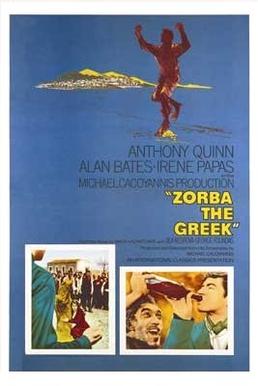
ZORBA THE GREEK
If anyone exudes a lust for life, it is the Greek bon vivant known as Zorba. Zorba the Greek is the story of two men who find love and loss in the wilds of Crete. Rather long and at times rambling, Zorba the Greek still has enough in terms of performances and music to make it worth watching.
Reserved half-Greek/half-British writer Basil (Alan Bates) has returned to his father's homeland. He wants to reopen a lignite mine in Crete that he inherited from his late father. On his way there, he meets the gregarious peasant Alexis Zorba (Anthony Quinn). Zorba quickly takes a shining to "Boss" and pretty much hires himself as his man Friday.
They arrive in the remote Cretan village where they first stay at the informal hotel run by Madame Hortense (Lila Kedrova). She is a French former cabaret star who stayed in Crete after the war, where she was wooed by all the Allied admirals. Zorba says that he is married, but that doesn't stop him from wooing his Boubolina. Basil, for his part, is extremely proper and reserved (except when he laughs at Madame Hortense's stories of her glory days). To his credit, Boss is repentant when he sees Madame genuinely hurt and in tears at this reception.
Zorba gets the local men to work on the mine. However, the mine is stubborn and eventually caves in. He needs good lumber to build the mineshaft. There is good lumber higher up on the mountain. That lumber, however, is owned by the local Greek Orthodox monastery. Leave it to Zorba to hoodwink the monks.
One person who is not hoodwinked is the local widow (Irene Papas). She has remained unmarried after her husband's death, much to the other men's displeasure. One young man is thoroughly besotted with her, much to her displeasure. This young man is the son of a local bigwig, but the widow will not yield. Zorba is convinced that the widow wants Boss. Boss, however, will not go along with Zorba's matchmaking.
Boss sends Zorba to buy material, but the temptations of the island are too strong for our lusty Greek. Madame Hortense faithfully waits for him. Boss is infuriated at Zorba's irresponsible manner with both his money and Madame's heart. He is also struggling with his feelings for the widow. Eventually, Zorba and Boss' ways with both women lead to brief love but great tragedy. Zorba's plans to bring the lumber down the mountain do work. They just work too well. With their plans pretty much in ruins, what is there to do but to dance?

Anthony Quinn found in Zorba one of his most defining roles. We forget that in real life, Anthony Quinn was of mixed Mexican and Irish heritage. He had no Greek heritage whatsoever. Despite that, Quinn seems tailor-made for this larger-than-life figure. Quinn makes Zorba into someone who sees life as one long exercise of joy and delight. That does not hide his less positive aspects. He openly admits to killing and violating others in war. He plays with Madame Hortense's heart. He plays with Boss' money.
However, Anthony Quinn gives Zorba genuine substance. He has a wonderful and moving moment when he gets drunk and breaks out into a dance. Boss is shocked and a bit angry (Zorba refers to him as that and I don't think anyone ever called Basil by his name). As he lies on the beach, Zorba recounts how dancing stopped the pain he felt after his firstborn's death at age 3. Quinn reveals that Zorba essentially laughs to stop crying. This is a man who will not give in to despair or hopelessness. "Boss, life is trouble, only death is not", he chides Basil when he refuses to pursue the widow.
Anthony Quinn was big and bombastic as Alexis Zorba. However, that is what the character was like. As such, Quinn gave an excellent performance in a role that could have gone into parody.
Matching him is Alan Bates as the reluctant Basil. He is appropriately more sedate, even frightened. Unlike Zorba who lives the life of the flesh, Boss lives the life of the mind. There is one time when he does break from his own constraints. However, it is surprisingly tame and almost chaste. When the widow is in danger, he acknowledges that he cannot bring himself to be more proactive. Boss is a more sensible man than Alexis. However, he lacks that madness that can make life bearable and even enjoyable. Like Quinn, Bates plays the role correctly.

While her role was smaller and almost mute, Irene Papas does well as the Widow. She has very little dialogue apart from a few words in Greek. However, she communicates much with her eyes. It could be defiance. It could be desire. It could be terror. Papas too will move and shock you in her dramatic albeit not graphic end.
A final highlight is in Mikis Theodorakis' score. This is what I think people who have never seen Zorba the Greek would recognize. It is like the title character itself, full of life and joy. While Zorba the Greek won for its Art Direction and Cinematography (with Kedrova's win totaling three Oscars out of its seven nominations), the film failed to be recognized for its score. I do not know the reason for this. However, the music, particularly Zorba's Dance, will still have people of all backgrounds attempt to keep up with its increasingly frenetic manner.

Here is where I would start taking issue with some parts of Zorba the Greek. The film is a punishing two-and-a-half-hours long. For a film that is often thought of as a life-affirming comedy, we get some quite tragic to horrifying moments. The two deaths in Zorba the Greek leave the viewer appropriately devastated. However, one wonders if the film is almost slightly misogynistic in how it looks on women.
Michael Cacoyannis received Best Director and Best Adapted Screenplay nominations for his work on the film. In terms of directing, Cacoyannis did well judging by the performances. In terms of adapting Nikos Kazantzakis' novel, I think that he could have made things a bit shorter. The film seemed to have a lot of plots, and perhaps it would have done well to cut some of Basil and Zorba's interactions with the villagers. In short, Zorba the Greek comes close to wearing out its welcome.
Ultimately though, I see why so many overlook some of Zorba the Greek's less-than savory elements. The film is like the main character itself. It is big, full of braggadocio but also aware of life's tragic side. "You've got everything a man needs except one thing: madness. A man needs a little madness or else...he never dares cut the rope and be free". These words from the lusty Zorba the Greek to the staid Basil the half-Greek capture the message of Zorba the Greek. When things go mad, the best thing to do is dance.


No comments:
Post a Comment
Views are always welcome, but I would ask that no vulgarity be used. Any posts that contain foul language or are bigoted in any way will not be posted.
Thank you.