Showing posts with label Comedies. Show all posts

Saturday, July 11, 2026

Divorce Italian Style: A Review

DIVORCE ITALIAN STYLE

Love and lust among the Mediterranean set can be murder. Divorce Italian Style is a surprisingly lighthearted black comedy of how one man managed to get what he wanted even if it meant leaving bodies all around.  

Ferdinando Cefalu (Marcello Mastroianni) may have the title of Count, but he does not have the resources of one. In his town of Agramonte, the Cefalu family has fallen on hard times. Ferdinando's father has been forced to rent half of the family home to his wealthier brother, who are slowly taking over. 

This is not so bad for Ferdinando, for he can look in on his luscious cousin Angela (Stefania Sandrelli). Unfortunately, the Count has a Countess, Rosalia (Daniela Rocca). Rosalia is generally sweet and devoted to Fernie. Fernie, however, finds her unattractive and would be happier without her. Divorce is illegal in Italy, so Ferdinando cannot get rid of his loyal wife. There is, however, a certain option that he can look into to find himself sans wife: Murder. 

He can't literally just kill her outright. He can fantasize about boiling her or seeing her drown in quicksand. Angela, whom he discovers is just as passionate about him as he for her, is sent off to a convent school. It looks like all Ferdinando can do is fantasize and endure his good wife.

Then, he like all of Italy, becomes engrossed in a criminal scandal. A woman has murdered her philandering husband in a crime of passion. The defense attorney manages to get the wronged wife a light sentence for her crime. What is sauce for the gander is sauce for the goose in Ferdinando's mind. Therefore, all he needs to do is find Rosalia a lover, catch them in the act, and shoot one or both dead.

Easier said than done. Rosalia is faithful and finding a suitable lover is hard. Then comes the perfect pigeon. Carmelo Patane (Leopoldo Trieste) was one of Rosalia's former suitors before the war. Carmelo, who had mistakenly been declared dead during the war, is now very much alive. He is now an art restorer, and it just so happens that the Cefalu mansion's murals need some work. 

This wicked plan has a few hiccups. There is Rosalia's stubborn but weakening resistance to her old flame. There's how Carmelo is himself married with three children. Getting a faithful wife to commit adultery is hard work. Things eventually start looking up for Ferdinando, culminating in a planned tryst for the painter and his girl while everyone goes to see the scandalous film La Dolce Vita. Things, however, do not go exactly as planned.

Things, however, do eventually turn Ferdinando's way. Admittedly, not as he had planned, but with the end results that Ferdinando and Angela can finally be together and be financially well-off. Ultimately, though, it looks like the new Countess may herself be looking to find Divorce Italian Style


There is a dark wit in Divorce Italian Style that makes the film if not flat-out funny at least very sharp. The Oscar-winning screenplay by Alfredo Giannetti, Ennio De Concini and director Pietro Germi know that the film is a farce. We see this through various visual and audio elements. Divorce Italian Style has Ferdinando's voiceover narration. He metaphorically welcomes us into his past (the film is mostly in flashback). We hear his frustration at having a loyal but to him, unappealing wife. We hear his yearning for that not-so-obscure object of desire. I do not know if he makes us part of his plan. However, it has the effect of making the viewer see Ferdinando as a gleefully amoral figure. 

We also see this in the various fantasies that Ferdinando has about seeing Rosalia meet her end. Seeing him dump her into boiling water and drowning her did not make me laugh out loud. It did, however, make me chuckle. This is because the various fantasies were played so broadly that they have the intended effect of looking farcical. Ferdinando may be planning to kill, but he shows himself as pretty inept.

As part of his scheme, he has secret audio recording equipment placed in the reception room where Carmelo is working. When he finally has a record of the now-lovers planning a second tryst, the tape cuts off before he can get the needed information. Seeing him rewind the tape to see if he can get more information is funny.

We also see the comedy through the performances. Marcello Mastroianni received a Best Actor nomination for his turn as the sleazy Count. Mastroinanni made Oscar history as the first man nominated for Best Actor for a foreign language performance. He was worthy of the nomination. Mastroianni plays Ferdinando as a mix of world-weary and selfish. His forlorn expression whether looking at Rosalia or Angela display how his mind and loins worked. He was wickedly funny in Divorce Italian Style. Mastroianni was not laugh-out-loud funny. Instead, he let the comedy come from a deliberately exaggerated manner. When, for example, he appears to have been a cuckold, he plays the part of the jilted and humiliated husband for the townsfolk. In that performance, however, it looks like he is overdoing the shock and shame of his position. 

In other hands, perhaps, it might come off as silly. In Marcello Mastroianni's hands, it comes off as someone more calculating. It is as if he knows that he has to play this role even though he is secretly delighted that Rosalia is out of his greased hair. In his faux sad expression and long cigarette holder, he makes Ferdinando a man unaware of how pretentious and absurd he is. 

The other performances balance the deliberately exaggerated tone Divorce Italian Style has. Daniela Rocca plays it mostly straight as the loyal and loving Rosalia. She, however, can slip into the farcical nature of Divorce Italian Style during the death fantasies. Leopoldo Trieste's Carmelo too kept within the deliberately farcical manner of the story. Director Pietro Germi kept a firm balance between showing these characters as exaggerated without anyone slipping into cartoonishly broad. They were absurd but everyone was in on the joke. 

Carlo Rustichelli's score kept to Divorce Italian Style's light, broad manner. The entire sequence of having the whole town desperate to watch the forbidden film La Dolce Vita was clever. It showed the townsfolk as quite desirous of scandal. It was also a nice in-joke since Marcello Mastroianni was the star of that look into the decadence of Rome's jet set. 

Divorce Italian Style is a wicked satire on the lengths people will go to circumvent the letter of the law by committing worse crimes. Divorce and murder may not be the funny business. Divorce Italian Style shows that they can blend for some good humor. 

Tuesday, June 23, 2026

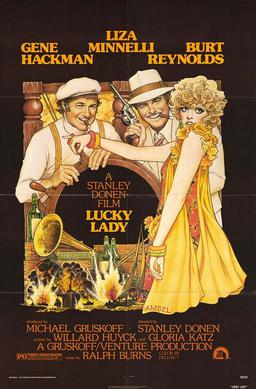
Lucky Lady: A Review

LUCKY LADY

Sometimes, what looks good on paper does not end up good at all. Such is the case with Lucky Lady. It has some great music, including two relatively unknown Kander & Ebb songs written for their unofficial muse. Unfortunately, a nice soundtrack cannot carry a film that tries too hard to end up nowhere. 

Tijuana, 1930. Down on her luck American chanteuse Claire (Liza Minelli) sings for her supper in a rundown dive. Her late husband Harry, who owned the bar, was also a human smuggler. Now, Claire's lover Ellison Walker (Burt Reynolds) will do "one last job" of smuggling Mexicans across the border. As is the case with all "one last jobs", Walker's coyote run ends disastrously. Adding to his troubles is Kibby Womack (Gene Hackman). He was one of the men Walker was going to smuggle despite Kibby being American.

Kibby forces himself on Walker and Claire on their newest venture. They will smuggle rum to thirsty Americans despite Prohibition. That does mean getting the booze away from Christie McTeague (John Hillerman). The mobster is not amused. Neither is Coast Guard Captain Aaron Moseley (Geoffrey Lewis). Our trio is attempting to smuggle the booze via sea on the Lucky Lady. Captain Moseley is on to them. He won't be bribed and comes close to killing them. 

Eventually though, thanks to help from the sole Lucky Lady crewman, Billy Weber (Robby Benson), Claire, Walker and Kibby manage to outwit and outrun the Coast Guard. Claire now has two lovers and she ain't ashamed. Arriving in San Diego, the three are going for their curious living arrangements and live together. The past, however, is never far behind. McTeague is set on getting them for getting the better of him. Not everyone will survive to see happy days again.

Lucky Lady has exactly one positive: its soundtrack. The film is filled with Jazz Age standards like Bessie Smith's Hot Time in the Ole Town Tonight and Young Woman Blues. There's a rendition of All I Do is Dream of You, sung deliberately badly by a lounge singer at the hotel our trio is staying in. I do not know if including All I Do is Dream of You was an in-joke by director Stanley Donen. His most famous film is probably Singin' in the Rain, and All I Do is Dream of You is prominently featured in that film. We even get Burt Reynolds belting out a little of Ain't Misbehavin'. I suspect that after listening to Reynolds warbling the Fats Waller standard, one can guess why his musical At Long Last Love bombed so spectacularly.  

The film also features two new songs written by John Kander and Fred Ebb. Kander & Ebb found their muse in Liza Minnelli. Their two songs for her, Lucky Lady and (Get) While the Getting is Good, are good numbers. Minnelli and Kander & Ebb were almost always in top form whenever they collaborated. 

Unfortunately, that was the only good collaboration Lucky Lady saw. You had three strong actors in the leading roles. You had a celebrated director. What you did not have was a good script. It is unclear of the Gloria Katz and William Huyck screenplay was what ultimately appeared on screen. What did end up on screen was a very jumbled affair. It aimed to be zany and a bit of screwball. However, there was no sense of timing. Take for example a scene where Kibby is taunting Captain Moseley about escaping. The mad captain starts shooting at Kibby but keeps missing hitting him. Walker jumps off the lifeboat while a supposedly oblivious Kibby keeps mocking him. The comedy comes from how apparently Kibby is unaware that he is literally sinking. 

As played by Gene Hackman, it looks forced. It does look like Hackman is aware that it is meant to be funny. He just cannot play it as funny. The boat chase between McTeague and our bootleggers is also meant to be a bit funny, and even perhaps exciting. However, the overall result in Lucky Lady is that it is neither. 


I do not necessarily fault the actors. I think Liza Minnelli, Burt Reynolds and Gene Hackman did try. It might be a case of them trying too hard. One senses throughout Lucky Lady that the three of them were too smart for the material. It is as if they knew all this was idiotic and were waiting for their checks to deposit. Minnelli, I think, tried the hardest to sell the premise. She was fine when she was singing. She was not bad when she was acting. She just couldn't make the menage a trois believable because she did not have much chemistry with Hackman or Reynolds.

Burt Reynolds, I think, thought that he would be best served by going broad. He wasn't. It looked forced and unnatural. The same with Hackman. Again, they were all good actors. They did their best. They just could not make things zany. Worse is when Lucky Lady shifts into some surprisingly dark drama. How else to explain that this comedy has a violent end to an innocent? 

Not that some part of the viewer would feel for Billy. Robby Benson is a curious player here. He was totally blank as this kid. Part of me found it almost amusing that his soft voice was not heard unless absolutely necessary. It was as if the filmmakers figured it would be best to keep Benson's dialogue to a bare minimum. Lucky Lady was released before another film of his, Tribute. When comparing his performances in both, somehow Robby Benson got worse as an actor. Geoffrey Lewis was too cartoonish as Captain Moseley. I figure that the character was meant to be ridiculous. Lewis never made him plausibly ridiculous. 

Only John Hillerman managed to make his character of McTeague a genuine menace. However, I would say that Hillerman acted as if Lucky Lady were a neo-noir drama and not a zany screwball comedy. 

Lucky Lady aimed for screwball hijinks with a daring suggestion of a threesome. The pacing, however, was a bit off. Things were played a bit too broadly or seriously. The balance was off. It would be better to listen to the soundtrack than try to figure out exactly what Lucky Lady is about. Lucky Lady is neither. 

Saturday, June 20, 2026

Satan Met a Lady: A Review

SATAN MET A LADY

In 1941, director John Huston made one of the most auspicious debuts in film history with The Maltese Falcon. While considered now as the definitive version of the Dashiell Hammett novel and an early film noir, the 1941 Maltese Falcon is technically the third adaption of Hammett's novel. The novel had been first made in 1931. It was remade a mere five years later as Satan Met a Lady. Neither the original 1931 The Maltese Falcon nor Satan Met a Lady are much if at all remembered today. While I cannot say whether that fate is deserved for the 1931 original, it is more than earned for the abysmal Satan Met a Lady.

Ted Shane (Warren William) is a wheeler-dealer with a breezy manner and a way with women. He is ostensibly a detective working alongside Milton Ames (Porter Hall). Ames is a longsuffering fellow when it comes to Shane. He not only keeps drumming up lousy business for Ames. He also romanced Ames' now-wife Astrid (Winifred Shaw) in the past. His newest assignment is to follow the wealthy Mrs. R. Manchester Arden (May Beatty), whom Shane hoodwinks into thinking that jewel thieves are after her jewels. Meanwhile, the mysterious Valerie Purvis (Bette Davis) hires Shane & Ames to follow a man named Farrow, who has been following her.

It is a surprise when later both Ames and Farrow end up dead in a cemetery. Whodunit? Shane's frenemies Detectives Dunhill (Olin Howland) and Pollock (Charles C. Smith) think that maybe Shane himself bumped both off. Shane, ever breezy and amused by everything and everyone, is not the killer. He, however, is in the midst of a mystery over who done in Ames and Farrow. 

This case is tied in with Purvis, but how? Does it involve a rare horn supposedly owned by the legendary hero Roland? Roland's fabled horn is supposed to contain a treasure trove of jewels separate from its own historic value. It looks like everyone is after Roland's horn. There is the tall Englishman Travers (Arthur Treacher), the veddy proper muscle. There's Madame Barrabas (Alison Skipworth), the heavyset Queen of Crime. There's her wimpy nephew Kenny (Maynard Holmes), whose beanie irritates Shane. All of them are after Roland's horn. Ted Shane claims that he can get it for them. Each of them pays him handsomely for that promise. However, will Shane keep his word and his life? Double and triple crosses abound until the real killer is unmasked. There are, however, a few more twists until Ted Shane and his loyal secretary Miss Murgatroyd (Marie Wilson) can be together at last.

While watching Satan Met a Lady, I came to the surprising realization that the film is really a comedy. Either that, or someone forgot to tell everyone that the film was meant as a crime drama. The viewer should know this from the beginning when Bernhard Kaun and Heinz Roemheld's score began the film. The music is surprisingly jolly and upbeat for what one would initially think was a mystery. It soon becomes clear that almost no one in Satan Met a Lady is taking any of this seriously.

That, in and of itself, would not be a bad thing. No genre should be immune from a good spoof. However, Satan Met a Lady is not smart enough to be a spoof. I do not think it aimed to be a spoof or a lighthearted jaunt. Instead, I think everyone behind the camera was unaware of how awful Satan Met a Lady was. 

William Dieterle was a good director. Therefore, it is almost sad seeing how misdirected Satan Met a Lady was. One is unsure if Dieterle was aware of how awful to downright cringe everyone and everything was coming across. I think the main flaw is in how Dieterle directed almost all of his actors to play the situations as if they were not meant to be remotely serious. Take for example when Shane comes upon Ames' body. For reasons that I cannot fathom, Dieterle had everyone play this scene as if it were something one might find in a Mel Brooks film. You have no sense of suspense. You have Warren William's very breezy manner. You have Brown Holmes' screenplay giving awful puns.

When asked by one of the detectives, "Don't you want to take a closer look at your silent partner?", I simultaneously groaned and winced. Holmes seems dead set on giving the characters flat out idiotic things to say. Travers asks Shane about what he knows about Roland's horn, suspecting that he knows its whereabouts. Shane replies, "Well, they've pointed the finger at me for a lot of dirty tricks but never for a crime like playing the saxophone". 


I think a lot of Satan Met a Lady's failures come less from Dieterle's direction than from Holmes' adaptation. That is not to say that Dieterle is off the hook when it comes to blame. All but one, possibly two, of the performances looked slightly cartoonish and silly. When, for example, Kenneth gets hit in the hand, Maynard Holmes looks less menacing and more childlike. Overall, though, Brown Holmes' adaptation of The Maltese Falcon clearly was not interested in fidelity to the source material.

Instead, it was interested in showing how these characters were silly. Warren William was far too breezy and jolly to make Satan Met a Lady come anywhere close to looking serious. For the entirety of the film, William made Ted Shane look like someone who was a joke. His efforts to come across as unflappable sometimes made him look downright dumb. I think Marie Wilson did her best as Miss Murgatroyd. She was meant to be a dumb blonde, such as when she struggled to spell her own name. Her coos and flighty manner seemed more at home in a spoof than in an allegedly serious film.

That is what dooms Bette Davis' performance. In a sea of silliness, you see Davis making a sincere effort to be a femme fatale. There is nothing to hold her up. Not the screenplay. Not the directing. She tried. However, she was clearly attempting to be in a whole other movie than what Satan Met a Lady was. It looked like she at a certain point gave up too. While she was not hamming up it like so many were, Bette Davis' heart was not in the final product.

To be fair, I think Alison Skipworth did slightly better as Madame Barrabas. She could have plausibly been a good Queen of Crime. She did not embarrass herself but did not quite match Davis' determined efforts either. Interestingly enough, two actors from the film were recognizable. I struggled initially to place both Porter Hall and Olin Howland (the latter via his voice). Eventually, I remembered where I had seen them. Hall was the idiot psychiatrist from Miracle on 34th Street. Howland was the kooky diner owner on an I Love Lucy episode where he serenaded the Ricardos and Mertzes with an odd rendition of I'm Afraid to Come Home in the Dark

Satan Met a Lady to be fair has a great title. It is a misleading title. One thinks that it will be lurid and full of action, mystery and suspense. However, the tone is quickly established that it is an unintentional comedy. If nothing else, it would be worth watching to see Bette Davis making the best effort to save a film and her performance. Other than that, it is good that Satan Met a Lady is pretty much forgotten now. 

Saturday, May 30, 2026

Dr. Strangelove: A Review

DR. STRANGELOVE

The Cold War was never so outrageous and outlandish than it was in Dr. Strangelove or: How I Learned to Stop Worrying and Love the Bomb. A brisk runtime, brilliant performances and a sharp, satirical screenplay make Dr. Strangelove simultaneously hilarious and horrifying.

Group Captain Lionel Mandrake (Peter Sellers) is part of an officer exchange program and currently stationed at the U.S. military base Burpleson. His commanding officer, Brigadier General Jack D. Ripper (Sterling Hayden) has ordered Mandrake to issue Wing Attack Plan R and seize all civilian radios. Unbeknownst to Mandrake, Wing Attack Plan R is an order to drop nuclear bombs over Soviet targets. Upon receiving the plans, Major Kong (Slim Pickens) is surprised and alarmed. He knows what the plan is. He also knows that he has received orders and will carry them through. 

News of the order takes the Pentagon by surprise. No such orders were issued by them or by President Merkin Muffley (Sellers). Holding an emergency meeting, Muffley allows the Soviet ambassador Alexi de Sadesky (Peter Bull) entry into the War Room. This does not sit well with General Buck Turgidson (George C. Scott), convinced that the entire thing is a Commie plot to destabilize the U.S. and look at the War Room's "big board".

Ripper has ordered the strike because the Communists have polluted his "precious bodily fluids". Mandrake now realizes that Ripper is totally bonkers. He also realizes that, owing to excessive planning, Ripper is the only one with the correct code to cancel the planned strikes. President Muffley orders the military to retake Burpleson. He also attempts to get in touch with Soviet Premiere Dimitri Kissov, who is currently drunk. 

General Ripper meets his own end. Fortunately, Mandrake has figured out the recall code. Unfortunately, Colonel "Bat" Guano (Keenan Wynn) is no help in helping Mandrake reach the President. Finally, all the planes are recalled, and the nuclear attack is avoided. Or so it seems. One plane, disabled and low on fuel, is still flying. That is Major Kong's plane. Will they reach their target? Will the secret doomsday device that the Soviets have created be triggered, ushering in total nuclear Armageddon? Will the mysterious German scientist Dr. Strangelove (Sellers) help his Fuhrer Muffley in surviving what now seems inevitable? Will we meet again some sunny day?

One of the many elements that elevate Dr. Strangelove is how everyone functions surprisingly fine despite all the lunacy going on around them. Take for example how Colonel Guano stubbornly refuses to help Mandrake get change needed to complete a call to the White House. He balks at giving him change and is extremely reluctant to use his weapon to get change from the vending machine. He eventually does but suggests that vandalizing private property will be the worst part of this ensuing crisis. 

Everything about this exchange is brilliant in its banality. One can imagine people having difficulty placing a telephone call when they do not have enough cash to pay. You add the need to call the President. You throw in how this call is what could decide the fate of the world. 

The blending of the bureaucratic with the urgent makes so much of Dr. Strangelove funny. Another example is when President Muffley and Premiere Kissov are attempting to locate the rouge plane. They suspect that the target is a facility near the city of Omsk. No one, however, seems to have the facility's contact information. Muffley, repeating what Kissov is telling him, says, "Just ask for Omsk Information". That alone, the idea of calling a general service for information at a critical moment, is funny. Add the element of the President being almost apologetic about things, and the moment becomes macabre humor.

Dr. Strangelove has more comedy thanks to the performances. Peter Sellers has a set of three bravura performances in the film. Each of his roles showcases Sellers' exceptional abilities. Group Captain Mandrake is almost a parody of the stiff-upper lip British officer. He is aware of the mad goings-on yet remains surprisingly unflappable. He does not become hysterical when he realizes how insane Ripper is. Instead, he tries to keep calm and carry on.

Sellers continues his excellent work with President Muffley. I figure that Sellers and director Stanley Kubrick were deliberately evoking then-United Nations Ambassador and two-time Democratic Party candidate Adlai Stevenson. Sellers, speaking with a solid American accent, showed Merkin Muffley to be decent but ineffective and a bit of a bumbler. This role, intentionally or not, also bring back the idea of Stevenson as an "egghead": bald and erudite, well-meaning but clueless.  

Despite being the title character, Sellers' third character of Dr. Strangelove is the smallest of his roles. Here, he has a bizarre not-quite-German accent and a high, nasal tone. However, that lends the character a more unhinged manner. We know that he once worked with the Nazis given that he accidentally refers to the President as "Mein Fuhrer" at least twice. Sellers' delivery of one line reveals Strangelove's love of death. As he discusses with Muffley the potential of living underground with a select group of people, he talks about what they would need. "Nuclear reactors could provide power almost indefinitely. Greenhouses could maintain plant life. Animals could be bred and slaughtered," extending the last word in an almost orgasmic glee. 

As Strangelove begins losing control of his body, Peter Sellers shows how his genocidal inclinations are finding a new outlet. Presumably, Strangelove participated in the Holocaust. Now, he gets a larger chance of worldwide extermination. 


All three roles are so brilliantly acted by Peter Sellers. The rest of his castmates are not far behind either. Sterling Hayden is calm and certain as the mad General Jack D. Ripper. He keeps things in an even tone when speaking with crazed certainty about the dangers his "precious bodily fluids" have faced. He tells Mandrake that he discovered this "Commie plot" during, as Ripper describes it, "the physical act of love". His calm but gruff manner reveals a man totally convinced that he is right, even if he is clearly insane. The two other roles that look exaggerated are not. I would say that Slim Pickens' Major "King" Kong and George C. Scott's General Buck Turgidson are meant to be over-the-top.

Pickens makes Major Kong into a man set to fulfill his mission. His final scene of Kong riding the bomb into certain death, whopping it up like a rider at a rodeo, is simultaneously funny and frightening. Scott, I understand, was hoodwinked into making Turgidson into a clownish figure. However, I think if this is true, Scott did not "understand the assignment". Turgidson was meant to be an idiot, one more fixated on going back to his mistress than on his job. He is the embodiment of the witless bureaucrat focused on nonsensical minutia than on the big picture, even if it is on the big board. The delight that he expresses when describing "low casualties" of this impending disaster is, like much of Dr. Strangelove, chilling and amusing. Dr. Strangelove also has the good fortune of featuring James Earl Jones in his film debut as Lieutenant Zogg, one of the bomber pilots. 

"Mr. President, I'm not saying we wouldn't get our hair mussed. But I do say that no more than ten to twenty million killed, tops, depending on the breaks". His efforts to spin this into a positive add the element of the bizarre into an already loony situation. Buck's obliviousness to those deaths makes him just as crazy as General Jack D. Ripper.

Director Stanley Kubrick drew excellent performances out his entire cast. His filming was also well-executed. The film breaks from a cinematic feel when the troops are attempting to retake Camp Burpleson. Here, Kubrick decided to make it look like actual war footage. It is a credit to him that this break does not affect how the film works.

Kubrick co-adapted Peter George's novel Red Alert along with George and Terry Southern. The film has a lot of wit and dark humor. One of the film's most famous lines is, "Gentlemen, you can't fight in here. This is the War Room!", a line that underscores Dr. Strangelove's sharp irony. The film's closing of the optimistic We'll Meet Again as nuclear bombs go off all over the world also underscores the black humor mixed in with the terrible tragedy of total destruction. However, Dr. Strangelove is filled with sharp wit and bitter irony. Almost all the characters' names add to the wit and sarcasm.

Brigadier General Jack D. Ripper. Major "King" Kong. Dr. Strangelove, as in a strange love of mass murder. Perhaps Colonel "Bat" Guano is a bit too much. However, it is not a major factor. It also helps that Keenan Wynn made a good impression in his brief role. 

It is to the film's immense credit that Dr. Strangelove runs a shockingly short 94 minutes. One does not notice how quickly the film goes in terms of runtime. Perhaps brevity really is the soul of wit.

Dr. Strangelove is amusing and terrifying in how it makes the end of the world look almost like farce. Everything in the film works to a brilliant level. Dr. Strangelove can certainly more than walk.

Sunday, May 17, 2026

A Royal Scandal (1945): A Review

A ROYAL SCANDAL

Who better to portray the lusty Czarina of All the Russias than the outrageous Tallulah Bankhead? A Royal Scandal makes a good go of trying to be a screwball comedy amidst the Czarist Court. It did not quite hit the mark. However, it barely squeaked by. 

There is perpetual intrigue within the palace halls. Chancellor Nicolai Ilyitch (Charles Coburn) wants nothing but a firm treaty with France. General Ronsky (Sig Ruman) wants to install his idiot nephew Boris (Grady Sutton) as the new head of the Palace Guard. Captain Sukov (Mischa Auer) wants nothing more than to have the West Gate secured. 

Czarina Catherine II (Bankhead) is a bit mercurial when it comes to everything and everyone. She has only one friend, her lady-in-waiting Countess Anna (Anne Baxter). A surprise friend is the dashing Lieutenant Alexie Chernoff (William Eythe). Fanatically loyal to "Mother Russia" (a term that Her Majesty winces at), he storms his way into a private audience to warn her of a plot. Fortunately, Catherine and Nicolai already knew of the plot. However, the lusty Kate takes a shine to the luscious officer. That he and Countess Anne are engaged is not important to Her Majesty.

The poor French diplomat (Vincent Price) is kept forever waiting while Alexei and Catherine find themselves working on very intimate terms. Eventually, Anne becomes so enraged that she defies Catherine to her face, bringing about an exile. Alexei, full of youthful vigor, proposes a series of reforms to the empire. These reforms appall the Chancellor. However, Ronsky, no longer tied to his dimwit relation, looks to Alexei to seize the throne. Catherine has elevated him higher and higher, and now is the head of the Palace Guard. Who will Alexei side with? Will Catherine keep her crown and her head?

A Royal Scandal was originally meant to be directed by Ernst Lubitsch. He, however, became ill and had to withdraw from directing the film. Lubitsch is listed instead as the producer. A Royal Scandal, this intended screwball comedy, was directed instead by Otto Preminger. I struggle imagining that there could have been a worse choice to direct a fast-paced witty film than the man who brought us such films as Laura, Anatomy of a Murder and Exodus. Granted, the last two were far into the future. However, Preminger seems wildly out of place directing what I figure was intended as some kind of madcap romp.

Edwin Justus Mayer and Bruno Frank's adaptation of the play The Czarina gives the actors a lot of lines that are meant to be funny. "That's the trouble with France, too many Louis!" Chancellor Nicolai observes early on. Later on, Nicolai takes umbrage at Alexei's offer to give him access to Catherine in exchange for money. "You can't bribe the Chancellor of Russia!" he exclaims. Doing a quick double take, Nicolai adds, "Not with fifty rubles". 

Alexei and Catherine discuss his ideas for improving the lot of the peasants. "They are the backbone of the nation", he says. "Yes, I know. There's nothing like a good peasant", Her Majesty replies. Catherine is astonished to find one of Alexei's proposed reforms in the trash. Commenting on this "Edict 52", she asks what it is about. "I don't know, Your Majesty. I didn't read it". "You didn't read it?! They when did you throw it away?" she exclaims. He replies instantly, "I read the other fifty-one".


These lines, and others, indicate that A Royal Scandal was intended to be fast-paced, zippy and full of quips. The actors delivered them the best way that they could. However, it was always a bit off. The pacing was just a beat off. Somehow, it played as if it were a play. One almost suspects that Preminger expected laughter from the audience and made room for them on the screen. However, the efforts to be a bit deadpan ended up making A Royal Scandal a bit dead itself. 

This is reflected in some of the acting. Vincent Price had a small role as the French ambassador. Sporting a French accent that makes Inspector Clouseau sound like Alain Delon, it leaned way too heavily on farce. It was a good thing that Price was not much in A Royal Scandal. He was not terrible. Instead, he seemed rather forced in his efforts to make the ambassador funny.

More surprising is how Anne Baxter leaned into the broadness that pushed A Royal Scandal down. She seemed forced and exaggerated in her scenes with Eythe. She was much better when working with Bankhead and Coburn. There did not seem to be that much stiffness there.

William Eythe was pleasant enough and handsome enough as the courtier who turns Catherine's head. He was fine. He was not great. He was not terrible. 

The two standouts were Charles Coburn and Tallulah Bankhead. Coburn made a great effort to make the Chancellor funny. Preminger did not direct him or anyone well, but Coburn acquitted himself respectfully. Tallulah Bankhead never became a film star. Here, however, she made Catherine into this somewhat scatterbrained figure. She was no bellowing tyrant. Instead, she was haughty, sometimes unaware of how things sounded. She came as close as anyone to capturing the attempts to make A Royal Scandal witty and fast-paced.    

A Royal Scandal has nice sets and costumes befitting this type of film. It also has a very jolly score from Alfred Newman. In many ways, everything in A Royal Scandal is there to make it a sparkling comedy. However, something was missing. Maybe it was the Lubitsch Touch. The film ended up playing like a weird imitation of a Lubitsch film. 

A Royal Scandal is not bad. Tallulah Bankhead and Charles Coburn do lift the project, however, slightly. It is barely passable and leaves one wondering what could have been if it had a better director. 


CATHERINE II FEATURE FILMS & TELEVISION PRODUCTIONS


The Great (2020-2023)

Monday, March 30, 2026

How to Make a Killing: A Review (Review #2140)

HOW TO MAKE A KILLING

Family can be such a bother sometimes, especially when they keep you from getting a vast fortune. How to Make a Killing gives us a dark tale of one young man's rise to the top only to fall through no fault of his own.

Told mostly in flashback from death row, we hear from Becket Redfellow (Glen Powell). Becket is speaking to a priest, presumably his last confession before being executed. Becket recounts his tale of woe.

Becket Redfellow, had there been true justice, would have grown up in wealth. He is the scion of the incredibly wealthy Redfellow family. However, as his mother Mary (Nell Williams) got knocked up by a cellist who promptly dropped dead, she and Becket are exiled from the Redfellow family.

Fortunately, the Redfellow trust precludes any Redfellow descendant from being excluded from the family fortune. Theoretically at least, Becket does have a chance to inherit everything provided that he is the sole living heir. Unfortunately for him, there are seven people ahead of him in terms of inheritance. A chance encounter with his poisonous object of desire Julia Steinway (Margaret Qualley) pushes him over the edge. He has desired the more affluent Julia since they were children. Now, with his job lost to the owner's nephew and no real prospects, Becket decides that he has one course open.

He must kill all seven Redfellows who outrank him to gain his rightful fortune.

Easier said than done given that Becket, at heart, is a nice guy. Not a nice guy is his cousin Taylor (Raff Law), an obnoxious finance bro and first victim. At Taylor's funeral, he meets Taylor's father Warren (Bill Camp). Uncle Warren is genuinely guilt-stricken over how Mary and Becket were treated. Warren, who is genuinely kind to his nephew, gives Becket a job at his trading firm, where Becket soon masters the art of the deal. 

He also masters the gentle art of murder. Next on the hitlist is another cousin, faux-photographer Noah (Zach Woods). All it takes are some chemicals mixed with Noah's smoking to have him smoked. Noah leaves a surprising gift for Becket in his girlfriend Ruth (Jessica Henwick). She finds Becket attractive as he does her. Becket killing other Redfellows becomes both easier and harder. It is easier because the other Redfellows are mostly a lousy lot. It becomes harder because the FBI is starting to note how so many Redfellows seem to be dropping dead at an alarming rate.

Soon, his cousin, fake evangelist Steven (Topher Grace), along with society doyenne Aunt Cassandra (Biana Amato) and Uncle McArthur (Adam Lennox) all meet untimely deaths. Becket's relationship with Ruth blossoms. Becket's relationship with Julia keeps butting in. She is determined to put the squeeze on Becket to get money for her financially strapped husband Lyle (James Frecheville). Becket won't play dice no matter how many times Julia thrusts her shapely legs at him. How can he kill Uncle Warren, who is a decent man? How can he get to his reclusive grandfather Whitelaw Redfellow (Ed Harris)? Will Becket get away with all his crimes? Will he be brought down by his own actions or by the most unexpected set of circumstances not of his own making? 


How to Make a Killing is supposedly "inspired" by the Alec Guiness film Kind Hearts and Coronets. Judging by the end results, the only thing that separates the two is that the various victims were not played by the same person. How to Make a Killing seems pretty much a remake in all but name. I do not know if writer/director John Patton Ford ever opted to just declare How to Make a Killing as a remake/updated version. Perhaps another time I will look over the two versions. However, for now, let us look at How to Make a Killing.

I think there are a couple of issues that push How to Make a Killing Down. The first is Glen Powell. Powell is not a bad actor. Powell, however, is a very likeable actor. As such, his various kills and growing ruthlessness seem so out of character for him. I understand that is probably why Powell was cast as Becket Redfellow. Initially, his bumbling manner early on in the first few kills could be plausible. However, as How to Make a Killing goes on, Powell keeps being almost too nice to be this cold-blooded person. Becket is motivated by a sense of anger and entitlement. Glen Powell, as competent as he is, never seems to make Becket into this merry murderer.

The second major issue is in the actual killings. How to Make a Killing makes it pretty easy to get rid of the other Redfellows because for the most part, they are rather loathsome. Ford's screenplay does not give us people. He gives us caricatures. Taylor, Noah and Steven are such awful people that we feel nothing when they are dispatched. The runtime, admittedly, does not give us much time to get to know them. They are nothing more than cannon fodder. The end results, unfortunately, are that the various victims are nothing more than quick cameos. Topher Grace in particular comes to mind. It is easy to paint Steven as a huckster. However, there is no buildup to how he is swindling people. When you plan to kill someone, even someone that you dislike, one figures that there would be a bit of a moral struggle. There would not be if you have no moral compass.

Becket, however, does. You therefore end up with a curious situation. The killer, who is actually a pretty nice fellow, has no struggle killing people who are pretty awful. Add to that how the film has to rush through things. Aunt Cassandra, for example, is popped off so quickly that I do not think that she was in the film for even five minutes. 

The performances kept to the broad manner that How to Make a Killing was going for. Margaret Qualley was the standout. She just had to prop up her legs and deliver her dialogue in a sharp manner to show herself as the alluring, slightly bored, temptress. Qualley made Julia into this selfish and shrewd figure, able to get what she wanted. Jessica Henwick was also strong as Ruth, the woman that Becket loved and lost. It does seem a stretch to see how or why Ruth would be with Noah. However, it is not outside the realm of possibility. Ed Harris seemed to be having a hoot as the loony, murderous patriarch.

How to Make a Killing made an effort to be wry and satirical. It however got a bit lost. It did not have the sharp enough edge to be either as ruthless or as comic as it aimed for. Attempting to be both, it ended up being neither. How to Make a Killing is too nice to slay. 

Saturday, January 24, 2026

The Farmer's Daughter (1947): A Review

THE FARMER'S DAUGHTER

Immigrants add so much to the uniqueness of American life. Everything from American cuisine to American vernacular has been enriched by foreign-born people. Politics is no different. In America, a naturalized citizen can rise to high positions of power except for President of the United States. One such success story is chronicled in The Farmer's Daughter. Charming and surprisingly contemporary, The Farmer's Daughter delights in its blend of homespun wisdom and political romance. 

Swedish American Katrin "Katie" Holstrom (Loretta Young) leaves her family's farm to study nursing in Capitol City. Crooked barn painter Adolph (Rhys Williams) offers her a lift to save bus fare but instead hoodwinks her into spending all her money for car repairs. These repairs, caused by his incompetence and efforts to force his attention on the not-so-dumb blonde, leave her penniless. 

Still, Katie is a resourceful Scandinavian. She quickly finds employment as a maid to the politically powerful Morley family. Katie does not initially win over the Morley's cranky butler Joseph Clancy (Charles Bickford). However, she is a good worker who manages to survive Mr. Clancy's cantankerous ways. She also charms Agatha Morley (Ethel Barrymore). Mrs. Morley is the widow of a respected Senator and something of a kingmaker for her political party. She is also the mother of Glen Morley (Joseph Cotten), who is on his third term in Congress. 

Katie has made clear that she will work for the Morleys only temporarily. Her plan is to be their maid just long enough to raise the funds needed to go back to nursing school. However, Katie has become indispensable to the family. Mrs. Morley and Mr. Clancy also see what Glen will not admit: he has fallen in love with Katie. Katie feels the same way, but neither can say it out loud.

One thing that Katie can say out loud are her views on politicians and politics. The Morleys and their party seek out a replacement for a fellow Congressman who has just died. Reluctantly settling on Anders J. Finley (Art Baker), Katie is appalled at the selection. He is thoroughly unsuitable in her eyes. She confronts Finley on his record at his first political rally, much to Agatha and Glen's embarrassment. Katie's open and honest manner inspires the opposition to field their own candidate for Congress: Katrin Holstrom! She agrees to be their candidate, driving a wedge between herself and the Morleys. Her open and honest campaign is at odds with Finley's dirty tricks, culminating in lurid suggestions on her reputation by Adolph to the Finley campaign. Will Agatha and Glen go along with smearing Katie's good name to hold on to power? Will her Swedish brothers help her out of this jam? Will Glen and Katie find that politics do make the strangest but happiest of bedfellows?

The Farmer's Daughter has a special place in Academy Awards history. It is not because of the number of nominations that it received (only two, for Loretta Young as Lead Actress and Charles Bickford as Supporting Actor). It is not because of the film's historical significance. In fact, save for being the inspiration for a television series of the same name, The Farmer's Daughter is not well-known. No, the film has that special place because it has one of the biggest upsets of all time in terms of Oscar winners. 

At the 20th Academy Awards, the odds-on favorite to win Best Actress was Rosalind Russell for her performance in Mourning Becomes Electra. Russell was on her third nomination in six years and a back-to-back nominee this year. She was well-liked and respected by her peers. She had also hired publicist Henry Rogers to run her Oscar campaign. Rogers had guided Joan Crawford and Olivia de Havilland to their successful Oscar wins the previous two years. Mouring Becomes Electra was a rich, juicy lurid melodrama meant to showcase Russell's range. She had won the Golden Globe for Best Actress for Mourning Becomes Electra. At the Oscar ceremony, all of that year's Golden Globe winners matched the eventual Oscar winners for Picture, Director, Actor and Supporting Actor/Actress. It stood to reason that Rosalind Russell had the Oscar in the bag.

Russell was so sure that she would win that she literally stood up just as Fredric March announced the winner. The winner, however, was not Rosalind Russell. To audible gasps, the winner was Loretta Young. Young's win seemed to come out of nowhere. This win is more stunning given that all her competition was in heavy dramas, and the Academy then and now is very resistant to comedies. Perhaps another time we can discuss how Loretta Young pulled off one of the greatest surprise Oscar wins in Academy history. For now, let us look at the film.


The Farmer's Daughter is a breezy 97 minutes long. In that runtime, we get a great deal of story that showcases the various actors. Loretta Young maintains solid Swedish accent. It is never cartoonish or exaggerated, a credit to her and her dialect coach. She also shows Katie to be much shrewder than everyone gives her credit for. Early on, she and Adolph are forced to stay in a motel. He pretends to have trouble starting the car. Katie, with a look that shows she is fully aware of Adolph's schemes and intentions, cooly gets the car started. Katie is a smart cookie despite the blonde hair and foreign accent.

Young also shows that Katie is blunt but polite, almost guileless, in her manner. She is serving at a victory party for Glen and his fellow Congressman Wilbur Johnson (Thurston Hall). Johnson asks her if she voted for him. She replies that she had just moved and had not registered to vote in his district. He boasts that she would have voted for him if she could have. "If I could have voted, I wouldn't have voted for you", she replies in a perfectly sweet and matter-of-fact manner. Young says this with such innocence but directness that one laughs. Katie did not tell Johnson this to insult him. She told him this because she is honest. Earlier, she piped in when Morley's cronies deride a former Congressman whom the Holmstrom family knows. When he was described as a second-rate Congressman, Katie says, "Mr. Schmidlapp was first-rate with a second-rate party". 

The Farmer's Daughter does not mention either the state or which party is which. However, I think that the Morleys were Democrats given how Katie was given a speech by the late Senator Morley to practice her English with. The speech was a eulogy for President Woodrow Wilson which criticized the failure to enter the League of Nations. This particular scene is well-shot and directed by H.C.  Potter. As Katie speaks, we see her absorbing the thoughts, reflecting on the meaning. Unbeknownst to her, Mrs. Morley is overhearing her late husband's words. Mr. Clancy is aware of this, but Mrs. Morley silently shushes him. The scene is surprisingly moving.

The film does not skimp out on the love story. Loretta Young plays Katie's growing love for Glen softly and effectively. A glance, a softness in her facial expression, her fainting when she mistakenly thinks that Glen and not Wilbur had died all show how she had fallen in love without overtly saying so. Joseph Cotten is not often thought of as a romantic lead. However, he does a nice job in The Farmer's Daughter. There is a particularly amusing scene when Glen is attempting to impress Katie with his skating prowess. As played by Cotten, he comes across as a lovestruck teen attempting to show off to the girl. There is something almost childlike in Cotten's manner that makes the scene cute. The conclusion will have you smiling if not laughing the way that Katie was.

Glen, as played by Cotten, is a good man. He can be a political creature, willing to pick someone electable versus someone who would be best for the constituents. However, we see that Glen eventually does the right thing by both his morals and by Katie. Charles Bickford was nominated for his performance as the crabby but secretly lovable Joseph Clancy. He is efficient and brooks no foolishness. He also appreciates Katie's solid work ethic and ultimately becomes her friend and ally. As she tearfully leaves the Morley home when starting her campaign, Clancy tells her that he's been with the Morleys for over twenty years. He has supported them and their candidates all these years. This time though, he's going to vote for her. 

Ethel Barrymore is wonderful as the shrewd Agatha Morley. She has great rapport with Bickford's Clancy. While most people refer to them as "Mrs. Morley" and "Mr. Clancy", in their scenes they refer to each other as "Agatha" and "Joseph". This reveals a greater connection than that of employer and employee. There is no hint of romance between them. Rather, it is more one of respect and personal affection.

The Farmer's Daughter is surprisingly contemporary when it comes to politics. Katie comes out in favor of a living wage. When Morley asks her to explain what that is, she replies that a living wage depends on whether you're getting it or receiving it. She also is unafraid to call out politicians who work for their donors rather than their constituents. Katie openly confronting Finley about his past corrupt bargains of giving government contracts to family and friends is something we rarely see now. Such a scene will have the viewer cheering.

The film also targets not just political but moral corruption. While never overtly stated, it is clear from Allen Rivkin and Laura Kerr's screenplay that Adolph is a Ku Klux Klan member. As he tells a clearly displeased Agatha about his "organization", she fills in the information about this organization's goals and memberships. It wants an America that is white, with no foreign born and with "the right kind of religion". This group would therefore not want someone like Katrin Holmstrom due to her immigrant Swedish background. However, Agatha sees that Finley would have no problem not only associating with someone like Adolph but would smear Katie's reputation. Agatha would, very reluctantly, go along with the insinuations of impropriety. The connection to open bigotry, however, is a bridge too far. at the end, she has Adolph thrown out. Clancy, in fury, throws Adolph's hat at him. "YOU FORGOT YOUR HOOD!" he shouts.   

Still, The Farmer's Daughter is not a political film. It is a romantic comedy that involves politics. Charming, sweet and with strong performances all around, The Farmer's Daughter is a film that people should know more of. Raise a cup of glogg for the delightful The Farmer's Daughter, and we'll just pretend that it is Christmas.   

Sunday, January 4, 2026

Moonstruck: A Review

MOONSTRUCK

The words "lunacy" and "lunatic" stem from the Latin word for "moon" (luna). "Luna" is still the word for "moon" in Spanish and Italian. Being in love is a bit like being insane, I suppose. The lunacy of love is delightfully captured in Moonstruck, a charming romantic comedy with standout performances all around.

Italian American widow Loretta Castorini Clark (Cher) is a mistress of bookkeeping but at 37 figures that she will never love nor marry again. The Castorinis are a superstitious lot, convinced that good or bad luck follows them. Loretta agrees to marry her nebbish, bumbling boyfriend Johnny Cammareri (Danny Aiello). She is not in love with Johnny but thinks that this is for the best.

Loretta's engagement is not welcome news to her father Cosmo (Vincent Gardenia). He balks at her getting married again and especially at paying for the wedding, tradition or no tradition. Loretta's mother Rose (Olympia Dukakis) is not enthusiastic either but quietly accepting. Johnny has left for Palermo to see his dying mother and has asked Loretta to invite his estranged brother, Ronny. Her initial efforts are rebuffed, but determined to see it through, she goes to Ronny's bakery. 

Despite her common sense, Loretta does more than mend fences with Ronny (Nicolas Cage). She goes to bed with him. He now declares his love for, to which she responds by slapping him and yelling, "SNAP OUT OF IT!". Cosmo and Rose, unaware of any of this, continue believing that Loretta and Johnny will be married a month from now. Rose's brother Raymond Cappomaggi (Louis Gus) and sister-in-law Rita (Julie Bosavvo) recall when Raymond claims to have seen a giant Moon when Cosmo was courting Rose. To almost everyone's surprise, "Cosmo's Moon" has returned.

Cosmo is the only one not to see it. More than likely, it is because he has a mistress, Mona (Anita Gillette). Loretta agrees to go with Ronny to the Metropolitan Opera to see La Boheme, his other great passion, on condition that he drop any romantic ideas and go to her upcoming wedding. The romantic entanglements continue when both Loretta & Ronny and Cosmo & Mona end up at the Met. Rose, meanwhile, has dinner alone until she invites jilted professor Perry (John Mahoney) to join her. Rose suspects that Cosmo is cheating on her, unaware that Loretta has inadvertently confirmed her mother's suspicions. Things come to a head when Johnny unexpectedly returns, his mother having made a "miraculous" recovery. How will these tangled romances end? 

Moonstruck is a love letter to love in all its crazy, charming and confusing forms. Screenwriter John Patrick Shanley in his Oscar-winning screenplay builds a logic to the increasingly eccentric situations. He builds up the story slowly, allowing for both the characters and their predicaments to flow. Moonstruck does a masterful job in showing how the various characters evolve and how they see the world. 

For example, early on we see Loretta appear to dismiss someone ordering roses, commenting on how so much money is spent on something that will be tossed into the trash. However, when the florist that she is working the books for presents her with a single rose, we see Loretta genuinely charmed and moved by the gesture. This reveals that despite the "bad luck" that got her husband killed by a bus, Loretta at heart still believes in love. 

We see the characters in all their delightful eccentricity throughout Moonstruck. It is when Cosmo hoodwinks a couple into spending more money on plumbing. We see it when Rose is awakened to be told Loretta's news. "Who's dead?", Rose asks in a quizzical but deadpan manner. It is in their insistence that some other force controls both the positive and negative events in their lives.

One thing that I do not think people have focused on is a key moment. After Raymond tells the story of Cosmo and his Moon, we see all the characters react when a massive moon appears to them. Loretta looks on this "love moon" with wistfulness, soon joined by Ronny who asks her to come back to bed. Raymond gets frisky with Rita, who delights in the renewed attention. Cosmo's father or Pop (Feodor Chaliapin) encourages his dogs to howl with delight. Rose looks at it with longing and sadness, underscoring how Cosmo has strayed. It is telling that Cosmo, passed out drunk, is the only one not to see it. I think it suggests that Cosmo is the only one not in love anymore. He is blind to true love, something that everyone else is not.


Moonstruck has excellent performances from the entire cast. Both Cher and Olympia Dukakis won Oscars for their performances, with Gardenia receiving a Supporting Actor nomination. Cher has a strong manner to her Loretta Castorini. Blunt, sometimes exasperated, Loretta is also a woman emerging into her own. She is resigned to things, to a settled life. Once she encounters the wild Ronny, it is as if Loretta has allowed herself to come out and embrace life. 

Cher has wonderful comedic timing with her castmates. She can bemoan her father's obstinacy and Ronny's brutish and self-pitying manner. She can also show compassion and tenderness. Her disbelief that Cosmo could be stepping out on Rose, coupled with her shock and disappointment when she discovered Cosmo's infidelity, showcases Cher's acting strengths. While most people remember her "SNAP OUT OF IT!" reaction, there are other moments that showcase Cher's strong performance. A quiet moment is when she returns home after the opera. Just by kicking a can down the street, we see Loretta contemplating all that she has gone through and wondering if her luck has finally turned.

Dukakis is wise and loving as Rose, the Italian mother who knows more than she lets on. Her continued search to find why men chase women is comic gold. However, we also see the genuine love and pain she feels about Cosmo. She loves him and knows that love hurts. Beneath Rose's wisdom, there is warmth, compassion and understanding. Dukakis balances humor and heart. 

As a side note, it is curious that despite neither of them being of Italian heritage, Cher and Dukakis are so perfect in their roles as these Italian Americans.

The actual Italian Americans in Moonstruck also do wonderful work. Danny Aiello is hilarious as Johnny, the weak, bumbling and befuddled beau. I would use nebbish, a good Yiddish term, to describe Johnny. Vincent Gardenia is wonderful as Cosmo, the man who lost love and ultimately found it again. We see that, at heart, he does love his wife and daughter, even if he has to struggle with his fear of death to show that love. 

Nicolas Cage makes Ronny's crazed manner almost rational. He is a bit cartoonish, but I think that is how Ronny is. A great bit of directing, either from Cage or director Norman Jewison, is when Ronny scratches his face while Loretta calls him "a wolf". It is a sly nod to Loretta's perception and Ronny's true nature. 

It would be unfair to not mention John Mahoney, the only non-Italian character in Moonstruck. His role is small, but it is important. It serves as a counterpoint to the various romantic entanglements of the Castorinis. While they pursue love, the non-Italian Perry pursues affirmation. Yet, in his own way, Perry also has a little bit of moon magic. While reflecting on his life with Rose, he expresses a belief that love is like "moonlight in a martini". 

Moonstruck is a charming and logical story, even if its logic is broad. That, I suppose, is how love is: charming and with its own curious logic. Love has never been so amusing and delightful as it is when one is Moonstruck.

Saturday, December 13, 2025

Tootsie: A Review

TOOTSIE

Struggling, temperamental actors find that life can be a drag in Tootsie. Blending satire and sincerity, Tootsie works as a strong dramedy.

Michael Dorsey (Dustin Hoffman) considers himself a great actor. Unfortunately, few people consider him for any Broadway or even off-off Broadway roles. It is not his talent that is in question. Rather, it is his temperament. As his frustrated agent George Fields (director Sydney Pollack) points out, Dorsey held up filming for a commercial and caused filming to go over schedule because he did not believe that his character would sit down.

Dorsey's character in said commercial? A tomato.

Dorsey stumbles into an opportunity thanks to Sandy Lester (Teri Garr), one of his acting students. He has been training her to audition for the soap opera Southwest General. Sandy is quickly dismissed. Michael Dorsey, in desperation for work and a chance to earn money to help his roommate Jeff Slater (Bill Murray) fund a play, auditions for the part. Now in full drag as "Dorothy Michaels", Michael Dorsey gets the role of hospital administrator Emily Kimberly.

Michael as Dorothy soon starts embracing the woman within. He does not like what he sees. Ham actor John Van Horn (George Gaynes) is bumbling and insists on hitting on all his female costars. Southwest General's director Ron Carlisle (Dabney Colman) is not much better. Van Horn at heart is merely clueless. Carlisle is downright sexist. He is also romantically involved with Julie Nichols (Jessica Lange), who refers to her character as "the hospital slut". Julie, a single mother to a toddler, is quite sweet off camera. She loves both her daughter and her father Les (Charles Durning). 

"Dorothy" soon takes America by storm for her portrayal of a stronger female role than usually seen on television. She starts bonding with Julie, which is complicated for several reasons. One reason is that Michael has fallen in love with Julie. Another is that he is attempting a romantic relationship with Sandy owing to his need for a dress. A third is that Les, a widower, has fallen in love with Dorothy. In all this, Julie ends up thinking that Dorothy is a lesbian, Sandy ends up thinking that Michael is gay, and Les (real name Leslie) ends up thinking that Dorothy would make for a good fiancée. As if all that were not enough, Southwest General wants to extend Dorothy's contract. That would force him to keep his cross-dressing act even longer. Will an unexpected live taping of Southwest General give Dorothy Michaels a chance to show his masculine side? What will the fallout of Michael coming out as a man be?


Prior to this, my second viewing of the film, my only real connection to Tootsie was how at one job that I had, our manager was nicknamed "Tootsie" by her very frustrated staff. Said manager was a woman by the way. She just bore an unfortunate resemblance to a taller Dustin Hoffmann in drag. Make of that what you will.

Tootsie is an intelligent comedy. It balances the farcical elements of a man playing a woman with more serious issues like sexism. Michael Dorsey sees this sexism on many fronts. He sees it in Southwest General's writing, where his character is asked to be more docile and willing to take the sexual advances of Van Horn's doctor. He sees it also in how Ron Carlisle uses the male crew's names but will refer to actresses like "Dorothy Michaels" as sweetheart, toots or "tootsie". 

This is not to say that Tootsie, written by Larry Gelbart and Murray Schisgal from a story by Gelbart and Don McGuire, is a screed. Far from it. Somehow, Carlisle came across at times almost as delightfully flustered. The film is certainly kind to George Gaynes' John Van Horn. Van Horn is not a bad man. He, I am tempted to say, isn't even sexist or chauvinistic. Instead, he is just dumb. 

George Gaynes is an underappreciated element in Tootsie. His efforts at wooing Dorothy are hilarious. He calls himself an untalented has-been. "Were you ever famous?", Dorothy asks. "No", he replies, slightly befuddled. "Then how could you be a has-been?" Dorothy replies. He, in his defense, stops his efforts to woo Dorothy when Jeff comes home to their apartment. George, thinking that Jeff is Dorothy's boyfriend, sheepishly leaves. Later in Tootsie, his reaction to Dorothy exposing himself as Michael is a perfect punchline.

After Emily Kimberly unmasks herself as Emily's twin brother Edward, the Southwest General cast and crew are absolutely flabbergasted. Ron, in the directing booth, feels vindicated. "I KNEW there was a reason she didn't like me!", he exclaims joyfully. Julie reacts by punching Michael in the stomach. As everyone looks around in confusion and shock, Gaynes' John Van Horn looks around and innocently asks the now-unmasked Michael, "Does Jeff know?". 

It is the perfect way to punctuate this wild scene. I think it is comparable to Joe E. Brown's closing line from Some Like It Hot, another gender-bending comedy.

Tootsie is filled with top-notch performances all around. Dustin Hoffmann received an Oscar nomination for his role as Michael Dorsey and Dorothy Michaels (in something of a joke, Hoffmann is billed twice as both characters). He is good all-around, playing the temperamental Michael Dorsey, Michael Dorsey playing "Dorothy Michaels" and Dorothy playing Emily Kimberly. Hoffmann has to play essentially several roles, sometimes simultaneously. He is wonderful when working with the equally strong Pollack as Michael's frustrated and flustered agent George Fields. 

Dabney Colman, like George Gaynes, was so terribly underappreciated in his career. His Ron Carlisle was arrogant and at times dismissive. However, Colman made him almost likeable. I said "almost", for he still was not a pleasant or kind person. Still, it is a credit to Colman's skills that this can be seen as different from a previous male chauvinist pig role he played in 9 to 5. Bill Murray brought the right amount of eccentricity and sarcasm to Jeff, who is fully confident in his play Return to the Love Canal, no matter how oddball that play's actual premise is.

Charles Durning might have been nominated for Best Supporting Actor for Tootsie if he had not been nominated that same year for The Best Little Whorehouse in Texas. He balanced Les' sincerity of affection for Dorothy with genuine shock and eventual forgiveness for the deception. Michael, appearing in Return to the Love Canal in regional theater, encounters Les at Les' favorite bar. Charles Durning's facial expressions are great. He shifts from pleasant to angry effortlessly. 

Both Jessica Lange and Teri Garr were nominated for Best Supporting Actress, with Lange winning. The former brought a genuine sweetness and almost innocence to her character. Julie is her father's daughter: loving, caring and kindhearted. She, however, has a gentle vulnerability that eventually shifts to a quiet strength. Garr is wacky and amusing as Sandy Lester, the acting student hoodwinked repeatedly by Michael. 

We also see another future Oscar winner in a small role. As April Paige, another Southwest General starlet, Geena Davis has fun moments putting Michael/Dorothy in uncomfortable situations. Dorothy first sees April in her underwear while sharing a dressing room, putting the cross-dressing Michael in an awkward position. Later on, Dorothy tells April that "she" sees the younger cast members as daughters. She adds that she wants to give her daughters "tits". April looks up, perplexed, with Dorothy attempting to correct herself by saying "tips" repeatedly. The Freudian slip adds to the humor.

One of Tootsie's nine Oscar nominations was for the song It Might Be You, heard during a montage of Dorothy, Julie and Les spending time at Les' country home. It Might Be You is a nice, gentle song that is pleasing and delightful. More in keeping to the comedy is the title song, heard during a montage of "Dorothy Michael" becoming a star. Long before it became a musical, Tootsie had at least two good songs.

I do think that the extended section of "Uncle Dorothy" babysitting went on too long. I also wonder if Dustin Hoffmann was in a way playing a spoof of his public persona as the ultimate "brilliant but difficult actor". I struggled believing that Michael could fool Sandy into thinking that he wanted them to become lovers or that Sandy would willingly put up with his repeated failures to show up for their dates. 

Those are minor issues. Tootsie is a strong, amusing film that will have one laughing and give people pause for thought. There's no "toot, toot, tootsie, goodbye" here.