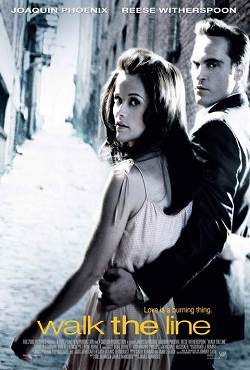
WALK THE LINE
"We got married in a fever, hotter than a pepper sprout". So begins Jackson, the duet by the country music legends Johnny and June Carter Cash. That song, along with others like Ring of Fire and Walk the Line, is a good chronicle of their at-times tempestuous lives, careers and marriage. Walk the Line, the biopic of this legendary musical figure and his better half, is a long film. However, it is also highly effective, with strong performances and a committed story.
Starting and almost ending with his 1968 concert at Folsom Prison, Walk the Line covers the life and times of John R. Cash (Joaquin Phoenix). As his band, the Tennessee Three, are playing his introductory music, Johnny seems lost in thought as he looks on a saw. That saw sparks memories of his early years in rural Arkansas. He has an abusive father, Ray (Robert Patrick), a faith-centered mother, Carrie (Shelby Lynne) and a beloved brother, Jack (Lucas Till). Times are tough and the Cash family struggles. Things get harder when Jack dies in a sawmill accident. Johnny or J.R. is guilt-stricken as he goes off to Germany to serve in the Air Force. Here, Johnny sneaks in a little songwriting, working on songs like Folsom Prison Blues.
Upon returning from his tour of duty, Johnny marries Vivian (Ginnifer Goodwin) and has four daughters. He also continues pursuing his music dreams. Vivian endures his efforts, barely hiding her irritation that Johnny isn't successful in door-to-door sales. Johnny finally, albeit shyly, goes to Sun Records to audition for its owner, Sam Phillips (Dallas Roberts). His efforts at singing gospel flop, but when he breaks out Folsom Prison Blues, Johnny and his-then Tennessee Two players get a record contract.
It also gets him touring with a group of other Sun Records singers. There's wild man Jerry Lee Lewis (Waylon Malloy Payne). There's the quieter Elvis Presley (Tyler Hilton). One person not on Sun Records who is part of the tour is country music royalty June Carter (Reese Witherspoon). She is one of the members of the Carter Family, whom Johnny and Jack would listen to on the radio. June is more comedienne than singer, though she does sing. June, like Johnny, is married. He is clearly attracted to June. For her part, she is pleasant but, to use modern parlance, puts him in the friend zone.
Johnny's continuing success and touring strain his marriage. His growing fixation for the now-divorced June do not help. She agrees to keep performing and touring with Cash despite his on-stage antics. He for example humiliated her (though I think unintentionally) when he pressured her into performing Time's A-Wastin' with him. That song had been a duet between her and her first husband. Johnny's growing pill-popping did not help.
Despite common sense, June does once succumb to the temptations of the flesh. She is also irritated by the behavior of not just Johnny but of the other tourmates. June works out her feelings by writing Ring of Fire. Johnny works out his feelings by getting arrested for bringing prescription drugs from Mexico and ultimately divorcing Vivian. He buys a secluded home and attempts to break generational curses. Mother Maybelle Carter (Sandra Ellis Lafferty) gets June to see that Johnny and June need each other. Will Johnny reconcile himself to God and his own past?

Nevertheless, Walk the Line is a love story. For as awful as Johnny Cash was to others and to himself, we see in Joaquin Phoenix's performance a man driven by his own doubts and talent. In some ways, Phoenix's Cash is very tender, sweet, and deeply hurt. In other ways, he is petulant, arrogant, and self-absorbed. Phoenix plays Cash with no mimicry or impersonation. Instead, his performance is more evocative of the man.
This goes into whenever Phoenix sings. Johnny Cash had a distinct voice, his bass-baritone rumbling through the very core of him. Phoenix was not able to sing as low as Johnny Cash could. His voice is slightly higher than Cash's. That being said, Phoenix sounds similar to Cash. That lends a strong sense of authenticity whenever he performs either with June or by himself. Physically, Phoenix does an exceptional job. He gets Cash's distinct movements and guitar playing pretty much perfectly.
As a figure, Joaquin Phoenix shows Johnny Cash as troubled but also searching, be it for redemption, forgiveness or June Carter. He has wonderful moments when showing Cash's hesitancy and nervousness when first performing before a paying audience. Phoenix also does well when auditioning for Sam Phillips. I am dubious that Cash improvised Folsom Prison Blues after his gospel number failed to impress. That might be a little dramatic license. However, Cash's mix of frustration, fear and arrogance all came through quite well.

She brings June's insecurity and struggles over her relationship with Cash. There are many positive moments in Walk the Line for Witherspoon. She can handle the comedy parts that June would perform on stage. She can also handle the musical parts just as well as Phoenix can. Witherspoon shows equal vocal dexterity when dueting with Phoenix's Cash on such songs as It Ain't Me Babe or Jackson. When she performs solo, such as with Wildwood Flower or working out Ring of Fire, Witherspoon is just as capable of holding the audience.
I should say that I am not as familiar with June Carter Cash's voice as I am with Johnny Cash's. However, I trust that Witherspoon did a strong approximation of it.
What makes Witherspoon's performance great is that she makes June Carter a woman in full. She does this with small moments, such as when she apologizes to a shopper for her divorce. June did make a full effort to live out a Christian life but, like all of us, stumbled. The hurt and embarrassment that she shows is gentle. June Carter, however, is no shrinking violet. She comes from a performing family with decades of experience. As such, June is incensed when she sees Johnny, Jerry Lee Lewis and others boozed up before a matinee. Staring them down like an irate mother, she lets them know clearly that they are not professional. She culminates this by launching the empty beer bottles at the startled men.
Reese Witherspoon makes June Carter that blend of strong and vulnerable. She is, to quote another country song, a good-hearted woman in love with a good timing man.

Overall, I think all the performances were good. Robert Patrick's Ray is cruel and hard, but he also sees his son disappearing into failure. I am of a mixed mind when it comes to Ginnifer Goodwin as Vivian Cash. She was good in the role and played the role as directed. However, I wonder if perhaps Walk the Line leaned too far into trying to make her something of a villain. More than once, she came across as almost shrewish and pretty much non-supportive of her husband.
James Mangold does wonderful work in directing his cast. He also does well with some of the visuals. He films Johnny Cash's on-stage meltdown in a frenetic, chaotic way, reflecting the tumult in his life. In a film about two musicians, it is not surprising to have many musical numbers. Part of me thinks that these numbers lengthen Walk the Line. Part of me, however, asks what songs or performances I would cut.
Perhaps some of the tour artists' offstage antics. I might also have cut out Shooter Jennings' cameo as his father Waylon Jennings.
Those are minor points. I do not know if Johnny and June Carter Cash were ever called or thought of as Country Music Royalty. It would not surprise me if they were considered as such. Walk the Line is a moving, well-acted and well-sung tale of this great love story. The Man in Black and the Wildwood Flower made for a great duo. Walk the Line makes for a great film.
 |
| Johnny Cash: 1932-2003 June Carter Cash: 1929-2003 |


No comments:
Post a Comment
Views are always welcome, but I would ask that no vulgarity be used. Any posts that contain foul language or are bigoted in any way will not be posted.
Thank you.