Athlete A is a distressing and disturbing look at how unqualified people can put the organization ahead of those it supposedly represents. There are, in my estimation, two villains in Athlete A. The first is Larry Nassar. He is the one who committed the crimes. The second is Steve Penny. He is the one who did not move to stop Nassar. One is shocked to learn that Penny seemed at minimum disinterested at what people kept reporting to him. Penny, we learn in Athlete A, started as the Vice President of Marketing at USA Gymnastics and eventually rose to become the organization's President.
Wednesday, June 17, 2026
Athlete A: A Review
Athlete A is a distressing and disturbing look at how unqualified people can put the organization ahead of those it supposedly represents. There are, in my estimation, two villains in Athlete A. The first is Larry Nassar. He is the one who committed the crimes. The second is Steve Penny. He is the one who did not move to stop Nassar. One is shocked to learn that Penny seemed at minimum disinterested at what people kept reporting to him. Penny, we learn in Athlete A, started as the Vice President of Marketing at USA Gymnastics and eventually rose to become the organization's President.
Sunday, July 27, 2025
Truman & Tennessee: An Intimate Conversation. A Review
Had the term existed in their time, Truman Capote and Tennessee Williams would have probably referred to each other as a frenemy. These two openly gay Southern writers respected and detested the other. They both loved and hated in equal measure. Truman & Tennessee: An Intimate Conversation, puts these two titans of American literature as friends, rivals, and what one was to the other.
The documentary uses archival footage and off-screen interviews. We also have their personal writings read by Jim Parsons as Truman Capote and Zachary Quinto as Tennessee Williams. Tennessee Williams and Truman Capote were more alike than merely their shared heritage. Both of them, for example, had drunk parents: Williams his father, Capote his mother. Both of them found inspiration in the writings that they discovered early in their lives: Moby Dick for Capote, the works of Chekov for Williams.
Their lives continued to have parallels as they built up their literary careers. Despite being Southern to their core, their great success came once they hit New York City. Capote loved the Big Apple and loathed Gore Vidal. Williams was the opposite: have great respect and admiration for Vidal but finding New York less to his liking. The two wordsmiths soon hit the big time with their works, celebrated and feted by high society and critics.
Those critics, however, would eventually, perhaps inevitably, turn against them. Capote and Williams were left slightly dumbfounded on how they went out of fashion. Things got worse when both lost their long-term partners and started flitting from one pretty young thing to another. They also fell into their separate addictions to booze and pills.
Truman and Tennessee had a curious relationship, part admiration, part irritation. Through their letters and words, we find that they could be very bitchy about the other. Williams had no issue referring to his frenemy as "Miss Capote". Tennessee, according to Truman, "is not intelligent". To be fair, Tennessee unlike Truman was wise enough to not try and break into his frenemy's home and get caught. Eventually, the adoration both public and private faded from view for these two figures. Truman Capote outlived Tennessee Williams by merely a year and a half, Capote dead at 59, Williams at 71.
I wonder, in retrospect, if Truman & Tennessee: An Intimate Conversation went a bit overboard in painting a portrait of parallel lives. Director Lisa Immordino Vreeland certainly wants to show how they both were almost twins. Everything from their family histories to their eventual fall into addiction is shown as being similar and happening at similar times. I do not think that Capote and Williams were mirroring the other person. These two were different and distinct people. As such, I wonder if Truman & Tennessee: An Intimate Conversation is less about what one thought of the other. It is more like it is trying to make a case that somehow, Capote and Williams are almost the same because they lived the same series of situations.
A major flaw is the voiceover work. Jim Parsons sounded like a thinner-voiced Jim Parsons. He sounded nothing like Truman Capote. Especially in the beginning, Parsons felt too forced in trying to come across as Capote. I can see how Truman & Tennessee was not attempting to do mimicry. However, I think Parsons struggled to sound like Capote. As such, I never heard Capote's distinct voice both artistically and vocally. Quinto was better as Tennessee Williams, his Southern drawl closer to Williams' voice.
It was easier to hear Williams' words than Capote's words because Quinto sounded better than Parsons. That is not to say that Zachary Quinto sounded exactly like Tennessee Williams. He just sounded better than Parsons.Truman & Tennessee: An Intimate Conversation at times is a bit too fixated on making their lives parallel ones. This is especially true when we see both of them interviewed by David Frost on separate occasions. I do not think that it would be surprising that both of these writers would be interviewed on the same program. Again, whether Truman & Tennessee wanted to push the idea that they were going through the same situations I cannot say for certain. It just looked that way.
I hope that people do not think that I disliked the documentary. On the contrary, for I thought that Truman & Tennessee: An Intimate Conversation is a well-crafted documentary that will give viewers good insight into these figures. I just do not think that because both were gay Southern writers that they are parallels. Each was his own man. Each was creative. Their friendship, at times their cattiness towards the other, is an interesting subject. Truman & Tennessee: An Intimate Conversation does much to bring their own stories to the viewer. It is a conversation worth listening in on.
Monday, December 2, 2024
Sonic the Hedgehog: A Review
I start my Sonic the Hedgehog review by admitting that I have never played the video game on which the film is based on. I admit great puzzlement over why Sonic the Hedgehog as a movie exists at all. Despite that, I was completely won over by Sonic the Hedgehog's mix of straight and silly, heart and humor.
In voiceover, our intergalactic alien Sonic the Hedgehog (Ben Schwartz) tells us that he is an exile from another world, finding his way to Earth through a magical portal ring. He enjoys his adopted home outside Green Hills, Montana and its residents from whom he hides from. His personal favorites are a man he calls "Donut Lord" and his wife, "Pretzel Lady".
One night, his loneliness gets the better of him, and he inadvertently causes a major power outage. Reluctantly, the military high brass brings in eccentric to downright bonkers Dr. Robotnick (Jim Carrey) to find the source of the outage. Dr. Robotnick quickly traces things to a foreign entity. Fearing for his life and safety, Sonic is about to go into exile again when he encounters "Donut Lord".
That would be Green Hills sheriff Tom Wachowski (James Marsden). Tom, who is getting ready to leave Green Hills to be a San Franscico cop, is shocked to discover that the legendary "Blue Devil" is real. He reluctantly agrees to help Sonic go to San Fransisco, find the bag of rings that Sonic accidentally sent there, and avoid the mad Robotnick. Will the immature but loveable Sonic win Tim and his wife, Pretzel Lady Maddie (Tika Sumpter) to his side? Will Robotnick be stopped?
Sonic the Hedgehog does something incredibly rare in films: take the premise seriously while simultaneously giving audiences a slight wink that all this is not meant to be taken seriously. Everything about Sonic the Hedgehog is absurd. However, it is a credit to especially James Marsden and Tika Sumpter that they play the scenario straight. To be fair, there were a couple of occasions when both tried to be a bit exaggerated in their delivery. However, it was brief and not enough to remove all the goodwill that they had made.
Marsden in particular has a hard task in the film. As the straight man to Sonic's mix of naivete and childlike enthusiasm, he has to be the adult. He manages things quite well, showing him to be a decent man trying to do the right thing while never behaving as though a speedy talking blue hedgehog is a bit bizarre. Perhaps a bit bizarre, but so long as he is around Marsden never exaggerates his reactions or makes out like he is too smart for all this.
The cartoonish, wildly over-the-top part is handled by Jim Carrey. This, however, was the correct way of handling things. Dr. Robotnick is cartoonish and wildly over-the-top. He is never meant to be a serious antagonist to Sonic. He is meant to be so grandiose in his manner that trying to make him a more grounded villain would have come across as idiotic. In Carrey's performance, Dr. Robotnick delights in being big but behaves as though none of this is wrong.
Of particular note is whenever he plays something with his right-hand man, Agent Stone (Lee Majdoub). Stone suffers greatly under Robotnick, but both play their scenes as if this is how both would behave: Robotnick doing something that causes Stone mental or physical injury, Stone being initially hurt but then quickly moving on. As odd as the comparison may be, I am reminded of how Groucho Marx would insult Margaret Dumont in a film, only for her to give a quick startled look before moving on.
The broadness of Carrey allows for Marsden's more straightforward manner to balance each other out. Had both played them the same way, it would have been disastrous. Had Marsden been exaggerated and Carrey restrained, things would have looked odd. Jeff Fowler as a director made a wide choice to let Carrey go all-in on the cray-cray while having Marsden be a bit more rational. Actually, Carrey's Dr. Robotnick being so cartoonishly over-the-top allows everyone else to look rational, even when they are not.
Schwartz as the voice of Sonic makes him a likeable creature. He makes Sonic a bit like a child, energetic, cute and innocent. He is well-meaning and not meanspirited in any way, but unaware of how things are. Who else would find a biker bar so enticing enough to go there despite the dangers he faces?
Pat Casey and Josh Miller's screenplay makes this premise plausible without insisting on being totally realistic. Sonic the Hedgehog is deliberately silly, but it does not insult the audience by having everything played for laughs. In fact, there are moments that are surprisingly moving, such as when Tim looks at Sonic's bucket list and sees "Make a real friend" as one that he has not scratched off.
The film has good visual effects in bringing this super-fast blue creature to life. It soon looks as if Sonic is a real creature, making one care about him. We can also laugh at how he manages to get into a barfight. I do wonder though, if smaller children will have to have things like biker barfights explained to them.
While Sonic the Hedgehog is surprisingly short, clocking in around a little over an hour-and-a-half, it never feels either rushed or lethargic. The only part that perhaps might have been rushed is the opening, when we get a very brief glimpse of Sonic's mentor and protector, the owl Longclaw. It was a bit quick, but I found that a minor detail.
On the whole, however, Sonic the Hedgehog work because it knows how to have fun with the premise while not making things too silly. I think families will enjoy the first adventures of our title hero and fans of the video game will be pleased with it too. Sonic the Hedgehog has a warmth, a sweetness and a deliberately light humor that delighted me. While I probably will not play the game, I would have no issue sitting through Sonic the Hedgehog another time.
Saturday, September 7, 2024
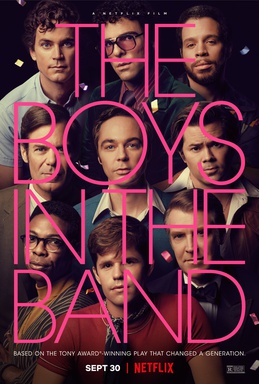
The Boys in the Band (2020): A Review
The bitch boys are back. The remake of The Boys in the Band attempts to outdo the original film from fifty years earlier. In some ways better than the 1970 adaptation, in some ways weaker, will The Boys in the Band stand on its own or pale next to its counterpart?
New York City, 1968. Michael (Jim Parsons) is getting things ready for his frenemy Harold's birthday party. Arriving early is his friend Donald (Matt Bomer), with whom he is having a casual relationship. Michael gets a surprise call from his college friend Alan (Brian Hutchinson), who tearfully asks to come over. Reluctantly, Michael agrees to see him for a quick drink during the party even though Alan is straight and unaware of Michael's homosexuality.
Soon the other guests start arriving. There's Emory (Robin de Jesus), overtly flamboyant. There's Hank and Larry (Tuc Watkins and Andrew Rannells), a couple who are going through a rough patch. Bernard (Michael Benjamin Washington), the only black man at the party, brings some books for Donald to enjoy. At first, Alan calls again to say he can't make it, and the party commences. To everyone's surprise, Emory's gift to Harold of street kid Cowboy (Charlie Carver) arrives early. To everyone's horror, Alan arrives after all.
He does not say what happened to cause his breakdown. He also takes umbrage at Emory's suggestion that he is closeted, causing a fight to break out. Into this comes the guest of honor, Harold (Zachary Quinto), as bitchy and pithy as they come. With the party pretty much in shambles, they still manage a nice meal until they get rained out. Now, an increasingly drunk Michael, who has fallen off the wagon due to the overall stress and chaos of the night, forces everyone to play a simple party game.
They have to call the one person whom they have truly loved. Alan wants to leave but Michael won't let him. As the various guests make their calls, secrets are revealed until Michael gets confronted by both Harold and Michael himself. Will everyone get out in one piece emotionally or even physically?
At another time, I will do a comparison between the 1970 and 2020 version of Mart Crowley's play (which here, he coadapted with Ned Martel). One thing that both versions have in common is that every actor who appeared in the Broadway version of The Boys in the Band recreated their roles for the film adaptation. The film even has the same director from the Broadway play: Joe Mantello.
Was Mantello the right choice to direct the film version? I'm leaning towards no. He did a good job with most of his cast, though to be fair he had worked with them for months on Broadway. What makes me lean no is that at least early on, Mantello loved moving the camera. I also felt some of the flashback scenes, particularly with Bernard's reminiscence of a one-night stand with a high school friend, were too artsy for my tastes. Add to that the idea that they were a bit distracting, and I felt overall unnecessary. This remake runs a mere two minutes longer than the original film yet felt longer. I think the reason for that was, in part, due to those flashbacks. I get the aim was to make it more cinematic, but it did not quite work for me.
One stumbling moment was when Donald and Larry see each other at the party. Perhaps it was meant to be clear that they had also been sexually involved. However, with that being the case, the revelation of their dalliance does not have the impact and shock that I think it should have had.
In terms of performances, I think they were hit and miss. A standout was de Jesus as Emory, who was flamboyant without being unbearably silly. His monologue about his great lost love was quite moving. Watkins and Rannells did not convince me as lovers caught in a tiff. Instead, they were actors speaking lines. Their fight over a menage a trois as a compromise for Larry's need for sexual freedom was rough to watch.
Carver as Cowboy and Bomer as Donald were fine in every sense of the word (audiences of both genders got an appreciation for the physical beauty of Matt Bomer). I also think that both Parsons and Quinto were trying too hard to be both dramatic and sarcastic. Neither was terrible, but I never thought I was watching two people who both loved and hated each other. Quinto's final takedown of Michael seemed, again, like he was delivering a monologue versus Harold speak almost spontaneously from his heart. Parsons worked hard to be the mean, drunk, bitchy Michael to others, and he did have some good moments. Other times, though, Michael's anger felt forced. Had I been Alan in this production, I would have pushed Mikey out of the way and left.
The Boys in the Band feels a bit like a period piece. I am aware that it is set over fifty years ago. However, despite it being a relatively new production, there is still something almost creaky about its presentation. By no means a horrible film, with some good performances in it, The Boys in the Band still feels long. I might not turn down the invite to Harold's party, but I am not enthusiastic about it either.
Friday, July 9, 2021
Greenland: A Review
For better or worse, Gerard Butler is now the default guy for a disaster movie, intentional or not. Greenland is beyond Butler's usual work of battling the elements in that it tries for a more grounded approach. Whether he or anyone involved in Greenland is really up to the task is up to the viewer.
Scottish structural engineer John Garrity (Gerard Butler) receives a strange text message saying he and his immediate family have been selected to be sheltered. Sheltered from what? More than likely from "Clarke", a massive comet that the government assures the public will cause minimal if any damage when bits of it enter our atmosphere.
In reality, Clarke's chunks will destroy whole cities, with one of them being an extinction-level piece that will destroy most Earth life as we know it. Only a chosen few however will be safely tucked away in secret mines. Clarke's arrival comes at the worst time though: John and his estranged wife Allison's (Morena Baccarin) birthday party for their son Nathan (Roger Dale Floyd).
Forced to leave their friends and neighbors behind, the Garritys soon enter a maelstrom of epic proportions. Separated when Nathan accidentally leaves his insulin in their truck, they are separated more when the military base is overrun by desperate people. Even more separation occurs when misguided good Samaritans kidnap Nathan and leave Allison stranded on the highway.
Eventually they all reunite and head to Allison's father's ranch, where her father Dale (Scott Glen) provides provisions for them to go to Canada. John on his travels that flights there are headed to their original destination: Greenland. John must take the originally assigned group there to make it, even though Nathan had been denied their original flight because of his diabetes. More struggles ensue until they reach the safety of Greenland.
Greenland moves away from the usual sci-fi/action films Butler's limited acting can do, so one gives him begrudging respect for at least attempting to move for something that gives his character more than a weapon to fight with. We don't get much daring-do with his John Garrity, but we also don't get much introspection from him either. Butler manages to hit the required beats (loving father, repentant husband) with some surprisingly muddled action sequences.
Why exactly rednecks would declare this Scottish brogued man "unqualified" for rescue is I suppose some commentary about "immigrants" getting things "regular" Americans can't, but perhaps that is giving Chris Sparling's screenplay too much credit.
Sparling however does set himself up for a peculiar scenario. If those with any kind of diseases were rejected for rescuing, why then did they initially include Nathan in the selected group? Was the government unaware that Nathan had diabetes? Surely they would have done massive background checks on the Garritys, so if Nathan's diabetes was a reason for exclusion, why pick them at all? Why wouldn't they just select a structural engineer with either no family or one that didn't have any diseases?
His script also can't shift away from certain clichés, such as the rocky marriage that can be fixed apparently only by an extinction-level meteor. Then there's the matter of the insulin being lost, and you sense that Greenland isn't even trying to find new ground.
In certain ways, Greenland teeters towards parody due to situations like those, which are stabs at character development but don't go deep or far. The various separations look they were cribbed from the Pomp & Circumstance section of Fantasia 2000, making John and Allison the Donald and Daisy Duck of Greenland.
A great deal of the acting is also unsteady. To be fair, Baccarin didn't have much of a character to play, the neglected/cheated-on wife who eventually finds love again. Again, the performances pushed Greenland into being almost a spoof of disaster films: seven minutes in and I was rooting for Clarke.
Butler has almost never bothered to act in his career, letting his massive frame and Scottish growl build his cinematic career for him. Greenland isn't an exception, though at least he made that effort to make John less action hero and more "ordinary man caught up in extraordinary circumstances". It didn't quite work, but he gets a B for effort.
The special effects weren't grand or imposing given the situation. Serviceable is the best word for them.
However, as the film progressed I found if not interest in Greenland as much as a mild respect for them at least making the effort for a more realistic scenario of a world spinning into chaos. Moments such as the Garritys farewell to Dale are effective. The sequence where Allison and Nathan go into a looted pharmacy to find insulin and both observe and are caught up in the nightmare of looting and killings is chilling, perhaps more so given both the pandemic and the Antifa/Black Lives Matter lootings and killings.
It may be that Greenland found itself released at the worst time possible, the story of a world in total disarray and destruction coming in a year where we've seen nothing but total disarray and destruction.
Greenland wasn't terrible. It wasn't good either, but again I'd go back to the word "serviceable". It isn't something to seek out but neither something to reject.
Thursday, June 10, 2021
Fatale: A Review
It takes a certain amount of courage to try and make a clearly psychopathic murderess the heroine of a film. Fatale tries, bungles it in at times hilarious ways, but bless it for trying.
Successful sports agent Derrick Tyler (Michael Ealy) worries his wife Tracie (Damaris Lewis) is fooling around. Therefore, it seems almost rational that he has a one-night stand in Las Vegas with Val (Hillary Swank). Val enjoys the fling to where she forces him to go another round so he can get his cell phone, which she's locked in the hotel safe.
If that already doesn't scream "psycho", I don't know what does.
So after this indiscretion Derrick attempts to work on the marriage and it looks like things are going well, until an intruder comes and nearly kills him. The lead investigator is none other than Val, displeased to find "Darren from Seattle" is neither.
Now Derrick has to deal with both the attempt on his life and a woman scorned. As if to add to his troubles there's the fact that Tracie is indeed having an affair, with none other than Derrick's business partner Rafe (Mike Colter), a relationship Val is more than happy to reveal. Is it to warn him that Rafe and Tracie were the ones who tried to kill Derrick off? Is it to get Derrick to help her get custody of the daughter she permanently disabled when she was an alcoholic? Is it not just to help her get custody of said daughter but to get rid of her ex, District Attorney Carter Haywood (Danny Pino)?
As bodies keep piling up and more people get involved in the myriad of crimes, Derrick has to use all his wits to save himself from being framed and from Val's increasingly whacked-out schemes.
Fatale is so close to a "so bad it's good" film, one that could have embraced its loonyness and been so much camp. It, to be fair, could also have decided to take things seriously and be the psychological thriller it aimed at.
Instead, Fatale decided to tie itself into knots by becoming totally unhinged if not irrational, not unlike Val. David Loughry's screenplay attempted to make Val sympathetic through her efforts to get back her daughter, but trying to force Derrick to reenact a weird version of Strangers on a Train is an odd way of doing it.
If I understand things correct, Tracie and Rafe hired a hitman to ice Derrick, but Val decided to kill them both so that Derrick could then kill Cole, thus granting her sole custody. Add to that the idea that a police detective could keep working when she has a restraining order against her from the District Attorney, who is himself embroiled in some kind of scandal. Guess if Cole's killed, his current wife has no rights to her stepdaughter against a woman who caused said daughter's paralysis and who is certifiably bonkers?
Yes, it's a bit muddled, but Fatale decides it needs to go all over the place just to go somewhere.
Fatale in many ways is an unintentional comedy. From when Derrick discovers Tracie and Rafe are humping around to when Derrick's cousin Tyrin (Tyrin Turner) and his fellow hitman Bumpy (Compton Menace) get blown away, these scenes elicited howls of laughter from me.
Perhaps it isn't surprising how badly Fatale plays, as director Deon Taylor apparently told everyone to look bored. I generally like Ealy and Swank, but Fatale is among their worst performances. Everyone bar none looks so blank, so empty, almost forcing the words to come out with no sense of conviction or even apparently interest. No matter what happened, or what really crazy turns the plot took, everyone in Fatale acted as if they were aware how awful it all was and weren't about to bother trying to make it realistic.
In retrospect, I'm going to walk this back slightly. Pino had one mode: perpetual anger. Even when Derrick comes to try and tell him of a plan he has to catch Val in her own trap, Cole is simply too triggered by Val's name to show an inch of common sense.
I said to myself, "Derrick, report her psycho ass to her superiors" and if he had he would have spared himself so much misery. However, you can count on people in films to do the dumbest thing possible to keep the story rolling, logic be damned.
I can't say I hated Fatale or that it isn't worth the time to see if there isn't anything else. I can say that Fatale is poorly acted and poorly written, a case of the two going together. "I don't go after something unless I know I can get it," Val tells Tracie and Derrick when she first arrives to lead the break-in investigation. Subtle Fatale is not, but in the right mood it can find a future as less psychological thriller and more camp comedy.
Monday, May 3, 2021
The High Note: A Review
Sunday, April 4, 2021
Mulan (2020): A Review
I am at a unique position to review 2020's much-delayed Mulan in that I have yet to see the original animated version. As such, apart from the absence of Mushu the dragon I cannot note what differences there are between the animated and live-action version. Mulan has many positive qualities but it's a bit hard divorcing its qualities from some of its production.
Hua Mulan (Yifei Liu) is the elder daughter of Hua Zhao (Tzi Ma), a once great warrior who now is infirm with old age and a war injury. The Rourans, headed by Bori Khan (Jason Scott Lee) are invading China and the Emperor (Jet Li) orders all families to provide one male for his Imperial Army.
At first Zhao plans to go, but in the dark of night Mulan steals his armor and sword to take his place. Now disguised as "Hua Jun", Mulan channels her "chi" to become a mighty warrior. She also reluctantly makes if not friendships at least comradeship with her fellow troops. Chief among them is Huanhui (Yoson An), who sparks curious feelings.
However, the Rourans continue their war, and the Chinese are unaware that Bori Khan has a secret weapon: the sorceress Xianniang (Gong Li). She not only is a shapeshifter but a powerful witch who can command great resources against Bori Khan's enemies. Xianniang sees a kindred spirit in Mulan, the light to her darkness, but Mulan will not betray her people. Mulan is forced to reveal herself and gain both her fellow warriors trust and family honor as she and her friends confront the Rourans in a final battle.
As I have yet to see the original Mulan, I certainly can't compare. What I saw in this Mulan was a beautiful looking film that had some issues in terms of character. The various sets and costumes were quite well-crafted, with the scenes of the Imperial Throne Room exceptionally dazzling visually.
However, I think Mulan suffered from being overly serious and stern, as if wanting to erase any suggestion that past versions had any sense of lightness. Even the few times the characters try to crack wise, particularly at the expense of chubby recruit Cricket (Jun Yu) or some comedy bits with Mulan's bungled tea ceremony, it falls flat.
Yes, war is a serious subject, but the lack of joy in any of their lives makes it hard to enjoy.
As for Mulan herself, her "chi" is essentially the equivalent of the Star Wars universe's "The Force". She does not grow to become a mighty warrior as she is a mighty warrior from birth. At the opening, we see her effortlessly float down from the highest roof in her circular village. By making Mulan essentially perfect from the get-go, you lose a sense of her growth as a warrior and a woman. Liu is fine as Mulan, able to do the warrior part but less confident when called upon for a hint of comedy.
The other roles are surprising in that Jet Li and Jason Scott Lee are almost unrecognizable. It would have been nice to have seen them fight each other, but also Li in particular didn't seem to be important enough to feature. I also think Hollywood has done Gong Li wrong by having her vamp it up to full force as this sorceress. She shows hints of wanting to be more fully-rounded but the script pushes her down again and again.
I do wonder about how the closing song Loyal, Brave and True works. It wasn't a bad song but for some reason both the delivery and the visuals made it look like it was a Bond theme.
Mulan is not a bad film, but it could have been more. As it is, it's entertaining enough.
Friday, April 2, 2021
Downhill (2020): A Review
Downhill comes to us thanks to the American idea that Americans would rather watch a remake of a foreign-language film than the original foreign-language film itself. Adapting the Swedish film Force Majeure, Downhill might have forgotten something in the translation.
As the Stantons continue their own cold war, Billie is tempted by hot Italian ski instructor Guglielmo (Giulio Berruti) and Pete tries to overcompensate by attempting to ingratiate himself to the boys. Ultimately though, Pete and Billie reach a certain rapprochement, not happiness.
Friday, March 19, 2021
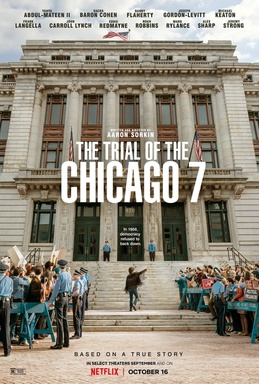
The Trial of the Chicago 7: A Review
In these heady days where every Antifa or Black Lives Matter protester dreams of being the next great revolutionary, perhaps it is no surprise that people look back in nostalgia at the tumult the United States faced in another election year: 1968. The Trial of the Chicago 7 is well-acted, well-written and exceptionally laudatory towards the seven defendants.
A year after the 1968 Chicago Democratic Party Convention erupted in violent protests, the Nixon Administration decides to charge nine men with conspiracy to incite a riot. The lead prosecutor, Richard Schultz (Joseph Gordon-Levitt) insists that the case is unwinnable because there is no case, but the Administration insists the case must go on.
The trial gathers a motley crew that is essentially four groups. There is the Respectable Revolutionary duo of Tom Hayden (Eddie Redmayne) and Rennie Davis (Alex Sharp), who are committed to progressive politics via elections. There is the Counterculture Clowns of Abbie Hoffman (Sasha Baron Cohen) and Jerry Rubin (Jeremy Strong) who enjoy the theatrical nature of mocking the Establishment. There's David Dellinger (John Carrol Lynch), the square peacenik who looks like the Establishment but whose antiwar, nonviolent beliefs border on fanatical. There's Bobby Seale (Yahya Abdul-Mateen II), the lone black man who is affiliated with the Black Panthers.
There's also John Froines (Danny Flaherty) and Lee Weiner (Noah Robbins), whom judging from the film are like the description Young Mr. Grace from Are You Being Served? gave Mr. Rumbold when the latter protested he hadn't been featured in a This is Your Life-type tribute to his boss. "I expect you were probably too boring".
Under the court of the eccentric Judge Julius Hoffman (Frank Langella), who at times seems openly hostile to the defendants, at other times genuinely senile if not flat-out bonkers, the trial becomes part-circus, part-protest. Defense attorneys William Kunstler (Mark Rylance) and Leonard Wineglass (Ben Shenkman) keep coming up with roadblocks from both Hoffmans in terms of their distinct behaviors. As the case continues we get the backstory of the demonstrations, ones involving Chicago Police informants masquerading as love interests, grammatical errors that led to wholesale violence, and overall loopyness. At the end, we learn the various fates of the most important characters, which range from elected office to suicides.
The Trial of the Chicago 7, written and directed by Aaron Sorkin, is squarely on the defendants side in the same way Judge Hoffman was on the prosecution's side. You have in the film a sharp split between the overtly antagonistic Hoffman/Rubin, who treat this "political trial" as a farce and the equally radical but more square-like Hayden/Davis, who also think the trial is a farce but are more observant of norms. The yin and yang is primarily Hoffman and Hayden, as in the film Davis comes across as essentially a radical nerd and Rubin an early version of Cheech & Chong.
At times Rubin seems so thoroughly whacked-out it's a wonder he can function. When talking to Schultz, Rubin appears convinced the female undercover cop and he were on the cusp of a genuine affair. He seems more distressed that he was dumped than that he was duped, and it's debatable if Rubin is actually aware that he was duped or aware of anything resembling reality.
This is as close to an insight into the men that we get, and it's not much of one. Essentially, their manner is their defining trait: buttoned up (Hayden/Davis), clowns (Hoffman/Rubin), the older man who blends between them (Dellinger), the angry black man (Seale) and "the rest" (Froines/Weiner). Their motivations, their joint radicalism, their fiery antiwar views, exist but The Trial of the Chicago 7 seems more a portrait of conflicting behaviors than a group of men united by their rage at a system they see as awry.
Historical accuracy aside, The Trial of the Chicago 7 also goes a bit overboard at times. There's a very romantic vision of Grant Park protests, with happy hippies singing while some burn their draft cards and others their bras. Having swelling music as Hayden reads off a list of troops killed in Vietnam as their trial dragged to 151 days was a touch too much, drenching the film in faux-inspiration that I think would be criticized in other films regardless of topic.
I can't fault The Trial of the Chicago 7 for being well-acted as it is. Of the ensemble cast, I would put both Hoffmans at the top. Langella's Judge Hoffman was in turns arrogant and oddball, where one didn't know whether he was merely hostile to these crazed individuals or crazy himself. Cohen's Abbie Hoffman is a clown but a thinking one, taking on a generally mocking tone towards everything but unlike the drugged-out Rubin aware of things.
Other performances, such as Rylance, were equally strong. Rylance's Kunstler not only kept to the defense attorney's voice but also showed him to be the rare adult in the room.
The weaker performances were Redmayne and Gordon-Levitt. With regards to the latter, I never believed he was Schultz, a man who knew he had no case but decided to try and win. Instead, I saw Joseph Gordon-Levitt, not Richard Schultz. I can't say whether Redmayne's nasally voice mirrored Hayden's, but he struck me as more interested in the mechanics of his performance than in the character himself. To be fair, this is common for Redmayne, but there it is.
The Trial of the Chicago 7 also has a surprising bad closing song, Hear My Voice, that I found grating both in terms of lyrics and singing.
I waver a bit on The Trial of the Chicago 7, but that swelling music at the end was what turned me against the film. That and the fact that I found myself mostly siding with the prosecution, which I don't think was the intended result. It's good not great but not something I would rush to see.
Thursday, March 18, 2021
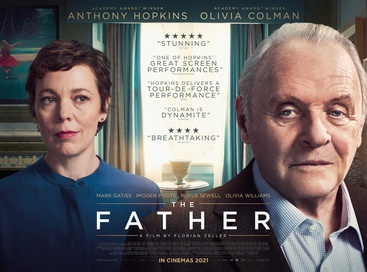
The Father (2020): A Review
The Father is a quiet, moving film about one man's slow decay into dementia. It plays with the audience, perhaps a bit too cleverly, but with two standout performances The Father envelops you in its tale about the burden of mental disintegration for both the afflicted and those around them.
Anthony (Anthony Hopkins) is convinced that he does not need a caregiver, while his daughter Anne (Olivia Colman) is. Anthony also won't leave his flat (apartment) and give up his independent retired life. It would mean not just losing his freedom but also the painting his other daughter Lucy made for him. He wishes Lucy, whom he openly prefers over the fussy Anne, would visit.
Things, however, soon start taking bizarre turns. Anthony sees strange men in his flat, both claiming to be Anne's husband Paul. He also briefly sees another woman as Anne, and while he likes Laura (Imogene Poots), she reminds me greatly of Lucy. The man who most of the time is Paul (Rufus Sewell) consistently urges Anne to put her father in a home, but Anne keeps resisting.
Ultimately though, we find that the blending of reality and fiction gives us what perhaps we should already know: that Anthony's dementia is such that things are not as he thinks, and that while he knows the truth about everything things have gotten so muddled the various bits and pieces are melded into a tragic jumble.
The Father never completely loses its theatrical roots, though to his credit Florian Zeller never makes it look like a filmed play. Zeller, who wrote the play The Father is based on and cowrote the screenplay with Christopher Hampton, makes The Father a bit of a mystery by introducing these strange situations. Of particular note is when "The Man" (Mark Gatiss) appears, insisting that the flat is really his and his wife Anne's flat, not Anthony's.Other directors and adaptations might have played this for some kind of gimmick, a twist that makes things a bit opaque. Here however, it is the first hint that Anthony's dementia may be more pronounced than he or the audience is aware. It allows us to see things through his mind without having to delve into it or have outside explanations. Zeller manages the balance between the mystery and tragedy of Anthony's situation, making the final moments all the more emotionally impactful.
That impact is carried by the two main performances. For better or worse, once actors get to a certain age they find themselves playing people with diminishing capacities. Sometimes played for laughs, sometimes for tears, it seems almost inevitable for older actors to reflect the circumstances many in their age group face. Sir Anthony Hopkins at 83 has reached such an age, and his Anthony is a tour de force performance.
His Anthony is not dotty or funny, but a man attempting to make sense of a world that is slipping from his grasp. At times almost jolly (his impromptu tap dance almost makes one chuckle) at times terrifying (Paul slapping a terribly distressed Anthony), one just feels for this good, ordinary man who is aware of something amiss but cannot sort it out fully, even when the truth is quietly but firmly presented.
He is equaled by Colman as Anne, who with just a glance communicates the push-and-pull she faces. Whether it's enduring Anthony's casual comparisons to Lucy or Paul's more aggressive push to put her father away, Colman shows Anne's visible anxiety about the tough situation she faces with no real support.
As a side note, I figured what the truth about Lucy was, so it shouldn't be a surprise.
The other supporting cast of Poots, Sewell and Olivia Williams as "The Woman" whom Anthony sees as others also did fine work. If there is a flaw it is Gatiss, who didn't quite blend in as well and whose ultimate reveal didn't really suggest as to why he played that much of a role in Anthony's confused mind. The Father also has a strong, mournful Ludovico Einaudi score that while sparing adds to the tragic nature of the situation.
The Father is a fine film, showing the tragedy of dementia affects more than just the one afflicted with that. Again people might come away thinking the folding of truth and illusion may be playing fast and loose with things, and the film is not completely free of its stage roots. On the whole though, the well-acted and directed The Father moves well towards its inevitable and heartbreaking end.
"Who exactly am I?", Anthony asks. It's a question that tears at him and the audience. It's easy to like Anthony and sympathize with Anne. It's a hard film to watch but a deeply moving one.
Monday, March 8, 2021
Minari: A Review (Review #1466)
Minari is a quiet film, sometimes to its detriment. However, in its simple, no-frills story of quiet strength and endurance despite the struggles around the characters, Minari draws you in.
Korean immigrants Jacob and Monica Yi (Steven Yeun and Yeri Han) move from California to Arkansas with their children Anne (Noel Kate Cho) and David (Alan S. Kim). Despite Monica's fierce misgivings, Jacob sees an opportunity to enter the Korean food market by growing Korean fruits and vegetables to sell in Dallas. He and Monica will pay for their new farm by working at a local chicken harvesting plant to sort out baby chicks.
Monica is especially concerned for David, who has a heart condition. As the Yis attempt to acclimate to Arkansas, they find they need help with the children. Enter from Korea Monica's mother Soon-ja (Youn Yuh-jung), whom David takes an instant dislike to, insisting she does not look or behave like a real (read: American) grandmother.
Soon, however, Grandma wins David over, and unlike the others believes he is not the weakling he's encouraged to be. He helps her plant minari, but this is the rare bright spot in the Yi household. Jacob's stubbornness about water brings a great crisis to the family, as does Grandma's sudden stroke. Things ebb and flow between triumph and tragedy, where the Yi's marriage is sorely tested. Ultimately though, the Yis are now going to integrate into this new world, even if it means bringing a water diviner to locate new sources to grow Jacob's crops.
Minari is a very quiet film, from its performances to Emile Mosseri's score. Even at what could be considered its somewhat shocking climax there isn't a big push for drama. There are no thunderous performances or bombastic music to pound the distressing situation the Yis now face. The loudest performance, for lack of a better word, is Will Patton as Paul, an eccentric figure who helps Jacob and carries a cross on Sundays to deepen his faith. Even he though is not loud, merely a bit off-kilter.
Writer/director Lee Isaac Chung creates an almost documentary-like manner with Minari, foregoing big dramatic moments for quiet, simple scenes of family life. The Yis are a pretty insular family. We do meet another Korean woman at the chick sorting facility who is friendly with Monica, but the few scenes of the Yis interacting with people are with their Southern neighbors.
Chung also resists the temptation to make whatever culture clashes the Yis encounter either the center of the story or one filled with hostility. On the contrary, the Yis get genuine Southern hospitality. Only David's eventual friend Johnny (Jacob Wade) says anything close to racist, asking David why his face is so flat. This, however, is not done out of malevolent intent but more out of plain curiosity. It should be noted that as American children of immigrants Anne and David speak English and Korean fluently. Even Grandma picks up a few English words.
The performances in Minari are all universally excellent. Yeun's Jacob is a driven but not hostile man, one who wants to be successful both for his children and himself. This drive to succeed does blind him to his family's need for a father and husband, but we know his heart is in the right place. Han's Monica is not silent but reserved, one who does express her frustrations and fears but who also fears for her family.
Alan S. Kim is delightful and charming as David, playing him as direct but generally not malicious. Even when he serves Grandma a surprising drink and not the "mountain water" (their code for Mountain Dew) she thought it was, we see he was more naughty than monstrous. The interplay between him and Youn works so well. Cho sadly was a bit lost in the shuffle and at times comes across as a bit blank but in her defense Anne at times seems an afterthought.
The clear standout is Youn as Grandma. She is delightful, loving and caring for David, aware that he can do more than even he thinks. She has common sense, such as when chiding Monica when she breaks down over gifts Soon-ja brought her daughter. "You're crying, over anchovies?" she asks. At times she is a bit oblivious, such as when she mishears David's complaint that she isn't like a real Grandma by saying, "You like Grandma? Thank you", but throughout her scenes we see a wise, caring woman. Youn's Grandma is the type we either were blessed with or wish we had.
Again though sometimes the quiet nature of Minari works against it. Sometimes the children seem blank to catatonic, particularly when seeing Grandma in her stroke-stricken condition. They show little panic or worry and not much puzzlement. Even at the climatic scene there is a slight remoteness that I found a bit hard to believe. Granted, this is a minor issue, but it does remove me slightly from the situation.
Minari is a true immigrant story and an uniquely American one too. With beautiful performances and a simple story it will win over audiences who either can relate to this story or maybe even lived aspects of it.
Tuesday, February 23, 2021
Birds of Prey: A Review
I genuinely don't know what to make of Birds of Prey, this addition to the DC Extended Universe. It's colorful, loud but it is also repetitive and unnecessarily long despite being less than two hours long.
Our unreliable narrator Harley Quinn (Margot Robbie) tells us that after her breakup with the Joker, she finds herself hunted by everyone whom she has wronged now that she is no longer under his protection. That's a lot of people in Gotham, but it ultimately narrows down primarily to two. One is Renee Montoya (Rosie Perez), a Gotham City Police Detective who despite cracking major cases always loses credit to her male partner.
The other is Roman Sionis (Ewan McGregor), criminal kingpin who also goes by Black Mask. His psychopathic nature gives Harley a run for her money, but now she is the one on the run. To save herself she offers to return a teen pickpocket, Cassandra Cain (Ella Jay Basco), to him. She stole the Bertinelli Diamond from Roman's right-hand man Victor Zsasz (Chris Messina), unaware of how important the diamond is.
Etched in the diamond are the account numbers of the exterminated Mob family, which will give the owner a mass fortune. Sionis wants it to rule Gotham, but his plans are now up against not only an unstable Quinn and relentless Montoya but Helena Bertinelli aka The Huntress (Mary Elizabeth Winstead), who seeks revenge for her family's execution. Into the mix is also Dinah Lance aka Black Canary (Jurnee Smollett), a singer at Sionis' club who has been shanghaied into being his driver.
With Sionis now after all of them for various reasons, it's up to this ragtag group to join forces.
I figure Birds of Prey screenwriter Christina Hodson was attempting to echo Harley Quinn's voice through the rambling narrative, flashbacks and eccentric worldview. However, she and director Cathy Yan didn't know when to rein things in. The lengthy stream-of-consciousness manner to Quinn's voiceovers takes on less of a demented manner and more of a dull one. It takes a full eight minutes before we actually start the film, and that's after a three minute self-consciously cutesy animated opening where we hear Harley talk about her abusive childhood and bad romance with Joker.
Birds of Prey soon takes on a convoluted manner where things seem to spin wildly out-of-control. We have Harley for example about to raid the police station to get Cassandra, then pause to get her narrating of what happened prior involving the stolen diamond and Dinah's rescuing of Harley from being taken advantage of. Yes, I know it comes from Quinn's crazed point of view but soon it becomes rather repetitive. I felt taken for a ride as I had to sit through yet another tangent.
Add to that a certain repetitive nature in the fight scenes. It seems that every time someone was about to get into a brawl, it had to be accompanied by a song and slow-motion. Yes, at times it was visually arresting, such as a deliberately cinematic fight at the police station with the sprinklers going off and the battle at the theme park ride The Booby Trap (which I figure was a pun). However, again it becomes rote and predictable. One or two fight scenes with this kind of set-up would be fine, but why did almost all of them have to have them?
In terms of performances, they vary wildly. Robbie knows Quinn well and delivers a strong performance as our unhinged yet weirdly peppy criminal. Anyone who can shout "YOU KILLED MY SANDWICH!" with intense sincerity is going for gold. You can also see flashes of Harleen Quinzel pop out, particularly whenever she adopts a calm tone to psychoanalyze the person's motives or actions. On the opposite end is McGregor, unleashing his inner camp demon as the wildly theatrical Roman Sionis. With no filter to hold him, McGregor is relishing the outlandish over-the-top cartoonish nature of his villain.
I would think McGregor was playing a spoof version of a villain, but there it is.
The other Birds of Prey were on the whole well-acted, even if Winstead's mob version of Grand Duchess Anastasia seemed a bit blank. Perez did well in her acting, taking all this mostly straight (and no that's not a bisexual joke).
I think a major issue with me is that for a film called Birds of Prey, the actual creation of the Birds of Prey seemed almost an afterthought. As I have little to no knowledge of comic books, I was surprised that the Birds of Prey were a vigilante group which Harley has contempt for. I thought it would be her own Legion of Doom, but the mixing of the anticrime Birds of Prey and the master criminal of Harley and her new apprentice Cassandra seems a curious mix.
Birds of Prey is a bit too violent for my tastes and while one can appreciate the effort to be that mix of wacky and whacked-out, it didn't quite pull it off for me. It's a bit of a letdown, especially as it takes over an hour for all of them to finally come together. Lots of noise, lots of color, lots of tangents but not a lot there.


.png)


_poster.jpg)


.png)


_poster.jpg)


.png)