Showing posts with label LGBTQ. Show all posts

Sunday, November 30, 2025

The Wedding Banquet (2025): A Review (Review #2078)

THE WEDDING BANQUET (2025)

One might not think that the 1993 film The Wedding Banquet would be remake material. Apparently, the comedy that blended gay and culture clashes needed updating. Thus, we get 2025's The Wedding Banquet, a wild and misguided effort that plays like tragedy.

Seattle is awash with gay Asians. There is lesbian couple Angela (Kelly Marie Tran) and Lee (Lily Gladstone). They are struggling to conceive via invitro fertilization. There is gay couple Chris (Bowen Yang) and Min Hyun (Ha Gi-Chan). Chris and Min are staying in the shed in Lee's backyard. Chris and Angela met in college, where they had a one-night stand. Now, our foursome is committed to their partners and each other.

Things become complicated when artist Min feels pressure from his wealthy Korean grandparents to take a greater role in the company.  Min's grandmother Ja-Young (Youn Yuh-jung) puts gentle pressure on Min to return to Korea. He, however, does not for a few reasons. One, he likes his artistic life in Seattle. Two, he is deeply in love with Chris, even though Chris will not commit. Three, he is still closeted to his traditional Korean family.

Chris, forever hesitating on everything, turns down Min's marriage proposal. Despite having been together five years, Chris protests that Min just wants to stay in America. The solution to Min's dilemma is simple: he will have a quick marriage to Angela. In turn, he will pay for a third round of IVF treatment. Angela did not count on her PFLAG waving mother, May Chen (Joan Chen) to be flummoxed by all this. Our four couples permit themselves a bachelorette party. The end results are Angela and Chris going at it again in a drunken state. 

Min, however, did not count on Grandmother Ja-Young coming to Seattle. Everyone will have to try and keep up the rouse. Ja-Young, however, is no fool and quickly figures things out. She will go along with the rouse so that there be no scandal back in Korea. How will things work out for our potentially expecting mothers and thwarted lovers?

I confess that as of this writing, I have not seen the original The Wedding Banquet. I do know a little bit about it and its overall plot, though. As such, I think I have some idea of differences between the two. However, a comparison between 1993 and 2025 is for another time. Right now, I should focus on this version. 

It is terrible. It is like seeing highlights from a bad sitcom played out. Director Andrew Ahn cowrote The Wedding Banquet with Andrew Schamus. Schamus cowrote the original. Judging by the final product, I think Schamus got a little muddled. 

The Wedding Banquet thinks that by expanding things to two couples, one lesbian and one gay, it improves things. It does not. Whatever conflict Min may have about staying closeted get watered down by Angela and Lee. It is almost as if The Wedding Banquet was made up of two separate stories that were welded together.

You have the Angela and Lee relationship. We have to see their dramas. There is Angela's barely enthusiastic support for Lee being a mother. There is Angela's barely concealed anger at how May is showing wildly enthusiastic support for her lesbian daughter. 

You then have to shift to Chris and Min's story. There is Chris' total lack of commitment. It is not just a lack of commitment to Min. Chris is a birder who guides birdwatchers rather than finish his almost decade-long dissertation. There is Min's fear of coming out. There is Min's concerns about having to go back. 

That is a lot of material already. That, however, does not touch that The Wedding Banquet is supposed to be a comedy. There was very little comedy in The Wedding Banquet, which is odd. It is odder when we do see some stabs at comedy. They fall horrendously flat. Of particular note is the elaborate Korean wedding scene itself. I figure many of the audience members are not Korean. As such, things like the best man having to carry a duck (or in this case, duck figure) and having the bride hop on the groom as he gives her a piggyback ride look bizarre. 


Granted, all of these things may be part of the Korean wedding ceremony. They should be given respect. However, it is hard to make that case when we are treated to Angela vomiting over Min as he carries his bride around on his back while both are wearing traditional Korean clothes.

You do get some chuckles. Min, seeing Angela's wedding ensemble for the first time, says that she looks like Queen Amidala from Star Wars. Learning that Grandmother Ja-Young referred to Angela as "a lesbian snake" is amusing. Angela and Chris' discovery of their second one-night stand did make me chuckle. Yes, it was more out of embarrassment than actual amusement. However, The Wedding Banquet treated things with such seriousness that it failed to be amusing. 

The overall performances do not help. Ha Gin-chan was probably the worst. His line delivery at what I presume were meant as humorous lines were uncomfortable to watch. After having his marriage proposal turned down, Ming says "This is all very hard on my ego". I figure the line was meant to be funny. The end result was anything but. Earlier, Ming rails against Chris' suggestion that he wants to marry him just for the green card. "Your trains are so slow, and I never know how much to tip! I don't even want to be an American!" he exclaims. Again, as written, they were meant to be funny. As delivered, they were not.

I figure that it might be an uncomfortableness with English. Gin-chan was more relaxed when speaking in Korean. He had to spend many scenes with an online Youn Yuh-jung, speaking to her via laptop or large screen. However, Gin-chan was more expressive and less hesitant.

Ha Gin-chan has the language to explain his weak performance. None of the others save Yuh-jung have that excuse. She was good in her role both in Korean and English. Her last scene where she talks about how surprisingly similar her marriage circumstances are to her grandson's is effective.

The rest of the cast though failed to rise above sitcom level. That might be expected out of Bowen Yang. He seems to play the same type of parts: obnoxious, gay, requisite Asian or a combination thereof. He was not funny when he was supposed to be. He was not dramatic when he was supposed to be. To use dialogue from the film, he was a dick with a duck. 

Kelly Marie Tran's Angela just came across as a surly, obnoxious bitch. Forever scowling, Angela was a terrible character. To be fair, the dialogue does not help. When she and Lee contemplate a future child, Angela comments that they can live it up when the brat is at summer camp. That reveals Angela to see a child as a burden rather than a blessing. What kind of person would feed her partner's desire for a child in such a fashion.

Lily Gladstone was better than the material. She could play the drama well. She just did not have anything when attempting comedy. Bobo Le as Chris' quippy cousin Kendall is a thoroughly useless character. She contributes nothing to the plot. The few times that she is there, it is bad.  

At one point in The Wedding Banquet, the lesbian couple and Chris are scurrying around the house. They need to remove everything that suggests sapphic love. "Everything in this house is gay!" one of them shouts. This keeps to the sitcom level of The Wedding Banquet. Unfortunately, it fails to be a comedy or a drama. 

Saturday, April 26, 2025

Our Son: A Review

OUR SON

Luke Evans is a rarity in Hollywood. He is an openly gay actor who for the most part has stayed clear of playing gay characters. He tends to play characters who are either straight (such as his turns in Dracula Untold and the live-action Beauty and the Beast) or where his sexuality is unimportant (such as in the live-action Pinocchio or Fast & Furious 6). As such, Our Son is outside Evans' normal filmography. Perhaps Our Son is well-intentioned. I just would have liked it to have been better.

After thirteen years of marriage, book publisher Nicky (Evans) and his partner, former actor and now stay-at-home dad Gabriel (Billy Porter) are finding themselves drifting apart. They have different parental philosophies when it comes to raising Owen (Christopher Woodley), who is Nicky's biological son but whose surrogate mother is black. Poppa Gabriel is very nurturing, while Daddy Nicky is stricter when it comes to things like letting Owen sleep in their bed despite him being eight. 

Now things come to a head when Gabriel confesses two things: desire for another man and how he no longer loves Nicky. They openly though calmly fight about Owen in front of their friends, including lesbian couple Claire (Liza J. Bennett) and Judith (Gabby Beans), who are about to have a gender-neutral baby of their own. Nicky now has to try and raise Owen by himself, no easy feat given how he has pretty much shunted child raising to his spouse Gabriel. For his part, Gabriel has no real way of supporting Owen, though there is the possibility of working for their mutual friend Matthew (Andrew Rannells). 

As the custody battle between Gabriel and Nicky begins, both men struggle with their feelings of whether he will be the best choice for Owen or not. Nicky also begins exploring the world of clubs again (Gabriel already having strayed into a brief extramarital affair with the object of his desires). Who will end up having primary custody of Our Son, Owen?

Our Son is the gay version of Kramer vs. Kramer, with Luke Evans playing the Dustin Hoffman part and Billy Porter playing the Meryl Streep part. There are so many similarities between Our Son and Kramer vs. Kramer that one is within his/her rights to think that screenwriters Peter Nickowitz and Bill Oliver (who also directed) watched the latter and took notes to see how to adapt it to a gay setting. I am not saying that Nickowitz or Oliver actually or literally stole from or used anything from Kramer vs. Kramer

I am saying that for me, there were scenes and situations from Our Son that reminded me of Kramer vs. Kramer. Daddy Nicky, like Dustin Hoffman's Ted, cannot make breakfast for his son. Poppa Gabriel, like Meryl Streep's Joanna, leaves his spouse because he does not love him anymore. Owen, like Justin Henry's Billy, can be a bit insufferable where I thought he would be better off being put up for adoption. To be fair, Our Son makes both Nicky and Gabriel at times so awful as parents that Owen would probably be better off being raised by Isabella (Nuala Cleary), the very sensible and patient babysitter who comes around every so often.

Perhaps I am being too harsh, as Our Son makes the case that Nicky is a pretty clueless and absentee dad, and Gabriel is almost the perfect mother. Nicky is not, for example, overly devastated that Gabriel confesses to desiring another man. He seems more perturbed that Gabriel did not ask permission to pursue an extramarital affair, suggesting to the audience that they have an open marriage. That, at least, was the impression that I was left with, which is a very bizarre one. 

In terms of performances, Our Son had me at times laughing at what were meant as serious, somber moments. A fight between Nicky and Gabriel which was meant to be devasting in the emotional revealing had me chuckling. I think it has to do with how earnest everyone was playing the scene. Despite everyone's best efforts, it came across as parody. More laughable was when Judith was giving birth to their gender-neutral Sheila. Granted, I have never witnessed or given birth myself, but Judith's facial expressions coupled with her stating, "IT HURTS!" made me wonder why either of them did not think that it would not. Haven't they invented drugs to dull the pain? 

I think highly of Luke Evans, who is very skilled in almost everything that I have seen. I think that he gave it his all in Our Son. It is unfortunate that the end result made Nicky into a total wimp. Evans was nothing but weepy and forlorn in the film. I understand that Nicky was upset about the prospect of losing Owen, but he was not that involved prior to the breakup. As such, his reaction seems to be more out of character. He was even a bit bitchy when the subject of Gabriel's career came up, dismissing his former spouse's claims of an acting career as being nothing but upstate summer stock. The only thing that I got out of Evans' performance was my surprise at how tatted Evans is. 

This is, I think, one of the first projects where I have seen Billy Porter take a major role (I remember him from 80 for Brady, which was traumatic enough without him). I think he too tried to match what he thought of as a major drama. It never worked for me, though, as if Porter was trying too hard. 

I will say that I thought Woodley as Owen did a decent job, even if at times he came across as whiny and obnoxious. 

"It must be hard fighting for the right to marry and then just ending up in a divorce court like everyone else", Nicky's nephew Max (Will Coombs) essentially scolds his uncle when Nicky finally tells his religious family about the breakup. I am perplexed on the thinking that, once same-sex marriage was legalized, such relationships would be permanent and immune from things like a breakup and now custody battles when only one parent could be biologically related to a child. I think Our Son came with noble and sincere efforts. It just did not work for me. 

DECISION: D-

Sunday, February 16, 2025

Desert Hearts: A Review (Review #1940)

DESERT HEARTS

Desert Hearts takes a potentially salacious topic and treats it with a gentleness that makes it if not universal at least less shocking than it might have been, especially in the mid-1980s. Simply told, with no great flashes, Desert Hearts does not dance around its subject but does not exaggerate it either.

Reno, 1959. 35-year-old college professor Vivian Bell (Helen Shaver) has come to Nevada to fulfill the six weeks required residency to have a quick divorce. She stays at a ranch owned by rustic pioneer woman Frances Parker (Audra Lindley). Frances lives with her son Walter (Alex McArthur) while in a nearby home is Walter's half-sister Cay (Patricia Charbonneau). Frances was the long-term mistress of Cay's father, who has recently passed away. Frances and Cay, a sculptress who works in a local casino, get on well though Frances is a bit clingy with her and Walter.

Cay is also open about her lesbianism though not overt about it. Cay is fond of flings and has a BFF in aspiring singer Silver (Andra Akers), who may be more than a friend despite Silver's engagement to the very tolerant Joe (Antoni Ponzini). Cay is drawn to Vivian, a woman of culture, letters and thoughts but who also wants to be as far away from everyone as possible. Despite this, Vivian's need for friendship allows her to begin going around town with Cay.

It is purely platonic for Vivian, until after Silver's engagement party. Going to see a nearby lake, Cay kisses a slightly tipsy Vivian, who returns the kiss and then withdraws. When they arrive the next morning to the ranch, Frances kicks Vivian out but arranges for a hotel so Vivian can complete her residency. Cay, enraged and hurt, leaves the ranch. As the clock ticks down to Vivian's impending divorce and Silver & Joe's wedding, will Vivian and Cay consummate their relationship? Will they consider a life outside Nevada? Will Cay and Frances make peace with each other and their ideas of love paternal and carnal?


Desert Hearts might now be seen as tame, especially since there is no true love scene between Vivian and Cay until over an hour into the film. Given that Desert Hearts runs a brisk 96 minutes, anyone looking to the film for just woman-on-woman may be in for a surprise. The one scene is surprisingly tender and still, perhaps a bit more explicit than audiences at the time were used to. Nowadays, I think modern viewers would say that it is not graphic enough, but I found it gentle and restrained. I was more shocked by seeing Cay and Silver in a bathtub together than I was at seeing Vivian and Cay indulge in the pleasures of the flesh.

I think this is due to Donna Deitch's directing of Natalie Cooper's screenplay. Cooper, adapting Jane Rule's novel Desert of the Heart, made clear that Cay was a lesbian, but this was never treated as something either shocking or ordinary. In reality, I do not remember the word "lesbian" being used. I did see that a lot of Desert Hearts made Cay's orientation clear while not going into detail. Instead, we can see that Cay is a lesbian by how she relates to women and men like Darrell (Dean Butler) who is open about his affection for her. She does not dislike him, but she makes clear that she has other interests.

What I did find curious is that prior to the love scene, there is little to no indication that Vivian has ever thought of being with another woman. We never hear her speak about any sapphic longings. In fact, she seems a bit put off by Cay's more open manner. Desert Hearts, looking at it now at a distance of forty years, might actually come across as lesbian wish fulfillment, a case of seducing a straight woman. Again, to be fair, apart from her being married to a man and a mild flirtation between her and the younger Walter, we get no real suggestions that Vivian is anything other than straight. She may have repressed any same-sex desires. She may be bisexual. Desert Hearts is a bit opaque on that matter. As such, it runs the risk of being seen as fantasy.

Perhaps, thinking on it now, it might be that Vivian is looking for love and wants to break free from the constraints that she has. "Have you realized your ambitions?", Cay asks when they go on a horse ride. "No," Vivian replies, "just my plans". It is hard to say, but I do not come at this from a lesbian perspective.


I can say that Desert Hearts is an extremely well-acted film. Shaver brings a cool, patrician manner to Vivian. She is by no means cold, but rather lonely and hurt. She makes the transformation from the aloof soon-to-be-divorcee to the more open and affectionate woman quite well. Deitch not only guides this transformation through her directing but on other choices. We see Vivian first in very formal attire, far too serious for the Nevadan desert. As the film goes on, we see, slowly but surely, Vivian dressing more casually, enhancing the transformation.

Desert Hearts was Charbonneau's film debut. While there are hints that reveal her inexperience on camera, she made Cay into a very open, unashamed woman who like Vivian, wanted a life of her own. Her last scenes with both Lindley and Shaver are moving. Charbonneau and Shaver worked very well together, making it a double act worth taking the time to look at.

For much of Desert Hearts, I wondered if I had seen Audra Lindley before. The voice sounded familiar, as did the face, yet I could not place it. It was not until I saw the credits again that my memory started jogging. It took a while, but I finally realized that Lindley's greatest claim to fame was as the outrageous perpetually sex-starved Mrs. Roper on Three's Company. Desert Hearts is a showcase for Lindley's rarely tapped talent, as Frances Parker is as far removed from Helen Roper as can be imagined. She is a standout as the woman who is cooly tolerant of Cay's lifestyle until it begins to draw her away from Frances. It is not strictly any anti-gay feeling that pushes Frances away. Rather, it is a fear of abandonment. Frances is loving but flawed, someone who does care for and about others but who can also push others out if they begin living apart from her. 

The film moves deliberately but not fast. It is well-directed, using a natural soundtrack of songs that would fit into the time and place. One hardly notices that the time goes by fast or that at times the low funds come through.

On the whole, I found Desert Hearts respectful, surprisingly lush at times. It may not have used minor characters well and still be a bit hard to know if Vivian was gay or bisexual when we began. However, with strong performances and an involving story, the Desert Hearts beat strongly.

Friday, December 27, 2024

Queer: A Review

QUEER

Once the word "queer" meant "strange" or "eccentric". Later on, it was seen as a slur against gay men. Now, some gay men have embraced the term to mean either as a source of Pride or a way to describe a more expansive definition to gay. I do not know in what way writer William S. Burroughs meant the word to be taken when his novella Queer was finally published. I can imagine that, after seeing the film, all three definitions of "queer" would fit.  

Queer is divided into three chapters: How Do You Like Mexico?, Traveling Companions and The Botanist in the Jungle, with an Epilogue of Two Years Later. In its story, we see American expatriate writer William Lee (Daniel Craig), who spends his days in Mexico City boozing, shooting up heroin and seeking the company of pretty young boys. On one night, he spies pretty American Eugene Allerton (Drew Starkey), who may or may not be queer. Lee and Eugene start what can qualify as a friendship with benefits, though Eugene again insists that he is not gay.

Despite the warnings of his friend and fellow gay expat Joe Guidry (Jason Schwartzman), Lee takes greatly to Eugene and asks him to travel with him to the Amazonian jungle in search of a plant that will give them the power of telepathy, a particular obsession for Lee. After some issues, they arrive to find the mysterious and eccentric Dr. Cotter (Leslie Manville) and her husband. Lee and Eugene partake of the plant, which gives them telepathy and some strange visions of them vomiting their hearts out and weird ballets where they meld into each other. They do part, and Lee dies old and alone, with visions of Eugene Allerton coming to him one last time.

Had Queer opted to not be as faithful to Burroughs' work as I think it is (again, I have not read Queer), I think we might have had a strong dramatic film about lost same-sex love, if a bit eccentric on its visual style. However, once Lee and Allerton go off into the Amazon and have their strange, quiet visions, Queer goes so far off the rails that it never recovers. I saw a couple walk out after Lee and Allerton vomit their literal hearts out. 

They missed the strange naked ballet that Craig and Starkey performed with each other, as oddball a vision that director Luca Guadagnino has given us as I can think of. Guadagnino has taken us through a same-sex May-December romance in Call Me by Your Name, though at least in Queer both of them were of perfectly legal age of consent. I imagine that Guadagnino and screenwriter Justin Kuritzkes wanted to stay true to Burroughs' book. That, however, may be the problem.

The film becomes so oddball, so self-important, that it ends up turning most people off. It shifts from an eccentric but interesting drama of a man, lost in his haze of booze and drugs, attempting to find genuine love versus mere sex with a pretty young thing who may be toying with him. It turns into some weird, almost goofy production that delights in its own overt strangeness. One already gives Queer a lot of leeway by its use of contemporary songs for 1950s Mexico (the film begins with Sinead O'Connor's cover of Nirvana's All Apologies and Come as You Are plays when Lee and Allerton first set eyes on each other). Once we get to The Botanist in the Jungle, the film is done, and nothing can bring it back.

I figure that Queer reflects the drugged-out mind of William S. Burroughs and is at least semi-autobiographical. It does not make it any more approachable. On the contrary, it makes it more distant even I figure to a gay audience that might be turned off by how comical the third act becomes.

It is a shame as the fatal Chapter Three kills off whatever good, if a bit odd, goodwill Queer had built up. Daniel Craig, I think, is attempting to build a post-James Bond career by delving into this troubled man, lost in his feeding his vices carnal and chemical. It could have made for an interesting exploration of desire, even as Craig continues to struggle shaking his Foghorn Leghorn accent off whenever playing Americans. It could have been a good performance, but it went off late in the film. Better was Starkey as Allerton, who was not as infected with the strangeness of Queer's narrative and seemed to play someone who was closer to reality.

Two big surprises were Manville and Schwartzman. Both were unrecognizable in their roles, the latter more so under his makeup. They went all in and made for interesting viewing. I cannot say great viewing, but interesting. 

Wandering between esoteric and downright looney, Queer is indeed that.

DECISION: D-

Wednesday, December 25, 2024

The Holiday Sitter: The Hallmark Television Movie

THE HOLIDAY SITTER

Welcome to Rick's Texan Reviews' annual Christmas movie review, where I review a Christmas-themed film. This year, I look at the first openly-gay Hallmark Television Christmas movie.

The Hallmark Channel is donning its gay apparel for Christmas with The Holiday Sitter. I figure The Holiday Sitter was something that everyone behind the project patted themselves on the back for. Sadly, The Holiday Sitter will not make anyone's Yuletide gay, as it is probably the worst Hallmark movie that I have seen, which is saying a lot. 

Perpetual bachelor Sam Dalton (Jonathan Bennett) has no interest in much of anything outside his high finance career. He certainly is not interested in either having a family or his current family. Sam is looking forward to his Hawaiian holidays when his sister Kathleen Walker (Chelsea Hobbs) calls. She and her husband Nate (Matthew James Dowden) have to rush out of their New York suburb of Braydon to pick up the baby they have just ordered and hurriedly need a babysitter for their teen son Miles (Everett Andres) and tween daughter Dania (Mila Morgan).

Actually, they have to be there at the birth of their new child born via surrogate, and the birth mother went into early labor. The who, what and why of all this is irrelevant. The Holiday Sitter just needs an excuse to get the parents out and Sam in. 

Sam, who is so removed from his family that he does not know what Nate & Kathleen's house looks like and is I think unaware of his niece and nephew's names, does not tell his sister and brother-in-law that his flight leaves that very day. He just goes, and there meets Jason DeVito (George Krissa). He is the Walker's contractor, comes from a big Italian family and, like Sam, is openly gay. While Sam is totally inept with children, Jason is working to adopt rather than wait for Mr. Right, especially if Mr. Right does not want to start a family.

In the ensuing three days before Christmas, Sam and Jason find that opposites attract, both of them mentor Miles as he pursues Jason's niece Arabella (Bella Leonardo) in a local theater production and cater to Dania's vegan whims and hissy fits. Sam finds the joys of parenting and is even rewarded with his new niece being named Angelica Samantha in his honor. Will Sam and Jason find themselves in each other's arms by the end?

A good way to judge the success of a same-sex romance such as The Holiday Sitter would be if it would work with a heterosexual couple. Judging by that standard, it is possible for it to work, but there are outside factors that make The Holiday Sitter a disaster from the word go. Sam is really a horrible person. He is a bit shallow, clumsy (a running gag involves when he accidentally set the kitchen on fire the last time he babysat) and so bad with kids that when Dania calls him, "Uncle Sam" he responds with "Niece Dania" in a puzzled manner. He appears to not understand why he would be called "Uncle" by a minor. It is as if Sam is not a person or even a character but some odd audio-animatronic figure that is attempting to pass itself as human.

As a side note, he is "Uncle Sam" and there is not one joke about that. 

Had it been Samantha and Jason, The Holiday Sitter would still stink. At the top of the list is Morgan as Dania. I think she gave a bad performance, though to be fair every performance in The Holiday Sitter was hopelessly broad and cringey. What sets Morgan apart is how whiny and obnoxious Dania is. She is a vegan, which is already a sign that this tween girl is insufferable. Kathleen, who herself is also obnoxious when Sam finds a long list of dos and don'ts as well as a super-tight schedule for the kids, has given permission for Dania and Miles to have pancakes. Sam, whose cooking skills are already a source of mockery, tries to order out but has no luck. Dania, who wants her vegan pancakes, will not be denied and starts whining and making faces about it. If memory serves right, when Jason comes in to do his "uncle consulting" work, he finds Dania face down on the counter, making moaning noises.

I think that is meant to be funny. It only makes Dania into a little monster.

It takes a lot to make audiences actively hate children, but I hated Dania. Kathleen has promised her little girl that she and Nate will be there for Christmas. That means they have to ride through heavy snowstorms with a newborn to please this little brat. Sure, everyone has to go through hoops and ladders, even put a baby's life at risk, to please one little girl rather than tell her she can't get her way. Dania is perhaps the most awful character in The Holiday Sitter, which made the case that Sam is right in not wanting to be around any of his family.  

Not that anyone else in The Holiday Sitter gave a good performance. It is just that Morgan stood out because her character was so insufferable that part of me wishes she had been left out in the cold. As a side note, given that it is New York in winter, the weather seemed almost tropical in Braydon, the suburban Fire Island with its many gay couples.

Bennett is thoroughly hamming it up as Sam, never bothering to make the character into a real person. In some ways, Sam is a walking gay stereotype, the type of man who knows another man is gay because that man recognizes what type of loafers he wears.

In The Holiday Sitter, Jason tells Sam that he got some baking powder on his Rossini loafers. At first, Sam barely seems to notice what Jason said. As soon as it dawns on him that Jason knows what a Rossini loafer is, he asks him how he knows. Jason only smiles and walks away. Jason silently mouths his delighted reaction. To be fair, at least The Holiday Sitter answers the question on why Kathleen never bothered to hook up Jason and Sam (she knows that Sam, unlike Jason, does not want a family). Credit should be given for probably the only logical point in The Holiday Sitter

It is curious that Legally Blonde is now retroactively seen as homophobic because a gay character recognized Elle Woods' shoe brand, but The Holiday Sitter, which has a similar gag, is not. That Krissa and Bennett (the latter who also has a story credit with co-screenwriter Greg Baldwin, writing with Tracy Andreen) are both openly gay makes this bit more curious. They are diving into a gay stereotype which falls horrendously flat. 

As yet another side note, I know a few gay men who have no idea about shoe or clothes brands. That makes me think that The Holiday Sitter was not about moving past the "novelty" of a same-sex romantic comedy but about checking off boxes. Jason is a contractor, and here it would have been a nice change of pace to see someone who moves away from such stereotypes into more "manly" pursuits. That, however, would have required some thinking, which The Holiday Sitter was not about to do.

Jason's subplot about wanting a family is there to show the contrast to Sam, but being an acceptable uncle to his large group of Italian-American nieces and nephews does not show anything about his future parenting skills. I would have suggested making him Arabella's foster father, or even biological one. He could have been a divorced father, accepting his homosexuality after having married a woman and having a child with her. It is, I suppose, easier to keep him childless and giving him this vague goal of adoption, but his desire for a family never rings true and just comes and goes whenever the plot needs it.

I have digressed from the performances, which are all universally awful. Krissa is so blank as Jason, and even when playing against others, Krissa seems so robotic in his delivery. There is no chemistry between him and Bennett. Bennett did nothing but show Sam to be a near-moron, his performance being so broad as to almost transcend camp. When he is told that his new niece will be named after him, I think he is meant to be seen as genuinely moved. As performed by Jonathan Bennett, I genuinely could not tell if he was pretending to cry in an alleged humorous manner or not. That is bad: when what is meant to be moving ends up doubtful about its sincerity. 

Even in their small roles both Hobbs and Dowden were embarrassing as Kathleen and Nate. They were just dull and flat when separate from the central story. Andres probably was the best of the lot, but only when he performed in the Christmas play The Life and Adventures of Santa Claus. We'll leave aside the question as to why there was a Christmas pageant on Christmas Eve itself. 

The Miles/Arabella subplot went nowhere, was resolved quickly and was surprisingly the only heterosexual romance in the film. 

The Holiday Sitter was terrible, with director Ali Liebert being the most to blame. Not only were the performances pretty much awful, but The Holiday Sitter drowned in cutesy sitcom music that is annoying and shows the low level of production it flourishes in. 

Bros, with its claims of being the first gay romantic comedy released by a major studio, had a lot of fun mocking the Hallmark Channel romcoms, particularly its Christmas movies. Not to be outdone, Hallmark decided the same year Bros came out (no pun intended) that it was time for its first gay Christmas romantic comedy. While there have been gay and lesbian romances in one or two Hallmark movies, The Holiday Sitter is the first to have a same-sex romance as its central plot. It will probably not the last, but one can only hope that future gay Hallmark movies are better than The Holiday Sitter.

0/10

2023 Christmas Film: Journey to Bethlehem

2022 Christmas Film: Santa Claus (1959) 

2021 Christmas Film: It Happened on Fifth Avenue 

2020 Christmas Film: Roots: The Gift

2019 Christmas Film: Last Christmas

2018 Christmas Film: Christmas with the Kranks

2017 Christmas Film: The Man Who Invented Christmas

2016 Christmas Film: Batman Returns

2015 Christmas Film: A Madea Christmas

2014 Christmas Film: Prancer

2013 Christmas Film: A Christmas Carol (1951)

2012 Christmas Film: Arthur Christmas

Monday, December 23, 2024

Emilia Perez: A Review (Review #1915)


EMILIA PEREZ

I wonder if those involved with Emilia Perez genuinely believe that it is not just a great film but an important, even necessary one. As I watched Emilia Perez, I genuinely wondered if it was some kind of parody, like a Saturday Night Live short film that someone decided to expand to a two-hour-plus musical film.

Frustrated Mexican female lawyer Rita Mora Castro (Zoe Saldana) finds her desires to move upwards nearly impossible due to her being a black Latina woman. That is, until she agrees to meet a mystery figure so hidden that she has to be basically kidnapped to meet him. That person is feared drug lord Manitas Del Monte (Karla Sofia Gascon). 

At this point, I would like to stop to say that "Manitas" translates as "Little Hands". Most Mexican drug lords go for or are given tough sounding names like "El Jefe de Jefes" (The Boss of Bosses), "King Kong", "El Ingeniero" (The Engineer) or "La Muerte" (Death). With the possible exception of Edgar Valdez Villareal, whose blonde hair and blue eyes earned him the nickname "La Barbie", a drug lord named "Manitas" seems the least threatening nom de guerre in drug cartel history. To be fair, La Barbie was ruthless, and I would argue that it should be El Barbie, but I digress.

Manitas needs Castro for a very specific assignment for which she will be well compensated if she is successful. She must find a specific surgeon outside of Mexico or the United States for a very special operation. Manitas Del Monte, fearsome and feared drug lord, wants to become a woman. It takes a lot of flying around the world, but Castro finally finds an Israeli doctor willing to give Manitas the surgery. To complete his transition, Manitas fakes his death after sending his wife Jesi (Selena Gomez) and their children to exile in Switzerland, Jesi unaware of the deception.

Four years later, a seemingly chance encounter between now-successful lawyer Rita and a tall woman named Emilia Perez reveals that Emilia is the former Manitas. Rita initially fears for her life, afraid that the former Manitas is killing anyone who knows her secret. Instead, Emilia reveals that she is happy after finding the woman within save for one thing. She wants to be around her children and tasks Rita to make it happen. Talking a very reluctant Jesi into returning to Mexico, Jesi is told that Emilia Perez is a distant cousin to Manitas who wants to help her raise his children. Jesi takes this as an opportunity to reunite with Gustavo (Edgar Ramirez), a former lover.

At first things seem well if a bit off with Jesi and Emilia until Emilia runs into a mother searching for her son, one of Mexico's many drug war victims. Feeling guilty about Manitas' past, Emilia creates La Lucecita (The Little Light), an organization that helps find victim's bodies. She also starts a romance with Epifania (Adriana Paz), another victim's mother. Emilia, however, is incensed when Jesi decides to move with Gustavo and take her kids with her. This triggers a series of events that lead to tragedy and death for so many. Will Emilia reveal her past identity to Jesi? Will the drug wars claim other victims?

I look at the great praise Emilia Perez has received among my brethren and am left genuinely puzzled by it all. It is a musical about a drug lord who has a sex-change operation and the various women in said drug lord's life pre-and-post surgery. If it had been played as a straight drama, it already would be stretching believability. The fact that it is a musical, where the various characters break out into song, pretty much shifts it into farce. Even if one could roll with such a whacked-out premise and even wackier presentation, something about having Emilia sing a song to Jesi during the final shootout would, I imagine, elicit one of two reactions: howls of laughter or eyerolls. 

I like musicals, but Emilia Perez is a musical that fails in both execution and presentation. I know that sometimes musical numbers look forced and thoroughly unnatural to the surroundings. Here however, the presentations are exaggerated even for a musical. Sometimes the musical numbers seem so wildly out-of-place. Bienvenida, where Gomez's character muses on coming back to Mexico, is hilarious as she thrashes about in her bed and then slips into some odd Flashdance like dance with other dancers. El Mal, which is currently shortlisted for Best Original Song is not only a bad song on its own but is dreadfully sung when Gascon inserts Perez into things. I would argue that El Mal is more a rap than a straightforward song, more focused on its oddball presentation than in anything else.

Mi Camino, the other Emilia Perez song shortlisted for Best Original Song, is probably the only decent song in the film. Even here though, the shift from a karaoke-like performance to bigger one kind of drowns the good aspects of the song.

A viral clip of the song La Vaginoplastia is bad for two reasons. One is that the song itself is bad, more talked than sung, and with terrible lyrics. "Man to woman or woman to man? Man to woman. From penis to vagina" are bad. They are also poorly delivered. Second, the entire sequence is irrelevant given that the surgeon does not even take the job, so that adds to the running time.

As a side note, the song Papa has the lyric "hueles como papa" (you smell like Dad). If you drop the accent from the second "A", it then becomes "you smell like a potato".  

Director Jacques Audiard's screenplay is muddled on certain aspects. It is never established whether Josi is Mexican or Mexican American. She mentions something about potentially moving with her sister in the States and on occasion slips into English. However, it never makes clear whether she is an American who married to a Mexican or is a Mexican with relatives in America. 

There have been many who have bashed Selena Gomez for her Spanish. I will not. I know that Spanish is Gomez's second language, and I suspect her parents did not grow up speaking Spanish either. As such, she is three generations removed from a Spanish background. Her lack of a Spanish-speaking background is audible, but again that is not her fault, and I give her credit for making an effort. However, the fact that it is clear that at times she struggles makes the issue of whether Josi is a Mexican or Mexican American more muddled. 

I don't have much to say about Gascon as the title character. Emilia Perez's transformation into a repentant person is one that I did not believe. I think the film actually is less about Emilia Perez and more about Saldana's Rita as she appears to be the dominant figure. Saldana did well, not great, but well. 

Emilia Perez is a film that one looks at and thinks, "are they serious?". A musical about a transgender drug lord? I imagine that if the other drug lords found out about Manitas' desire to find the woman within, those who would not be laughing their heads off would be cutting Manitas' head off. I struggle believing any of this, particularly how Manitas' men would follow such a person. Yet I digress. 

Many of the song presentations look more as if they were made for the stage than for a film, let alone something that would appear acceptable as real in a musical film. The stylized nature of the various musical numbers ironically works against Emilia Perez. The film is too long for the story it is telling. Perhaps if Manitas/Emilia were an underling to a drug lord or a poor person, without musical numbers, we could have had a genuinely moving drama. What we ended up with Emilia Perez was something that veers if not crosses into parody that I find wildly overpraised. 

Emilia Perez no es una santa. Es una payasa. 

DECISION: F

Saturday, September 7, 2024

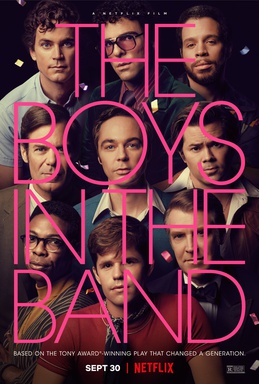
The Boys in the Band (2020): A Review

 THE BOYS IN THE BAND (2020)

The bitch boys are back. The remake of The Boys in the Band attempts to outdo the original film from fifty years earlier. In some ways better than the 1970 adaptation, in some ways weaker, will The Boys in the Band stand on its own or pale next to its counterpart?

New York City, 1968. Michael (Jim Parsons) is getting things ready for his frenemy Harold's birthday party. Arriving early is his friend Donald (Matt Bomer), with whom he is having a casual relationship. Michael gets a surprise call from his college friend Alan (Brian Hutchinson), who tearfully asks to come over. Reluctantly, Michael agrees to see him for a quick drink during the party even though Alan is straight and unaware of Michael's homosexuality.

Soon the other guests start arriving. There's Emory (Robin de Jesus), overtly flamboyant. There's Hank and Larry (Tuc Watkins and Andrew Rannells), a couple who are going through a rough patch. Bernard (Michael Benjamin Washington), the only black man at the party, brings some books for Donald to enjoy. At first, Alan calls again to say he can't make it, and the party commences. To everyone's surprise, Emory's gift to Harold of street kid Cowboy (Charlie Carver) arrives early. To everyone's horror, Alan arrives after all.

He does not say what happened to cause his breakdown. He also takes umbrage at Emory's suggestion that he is closeted, causing a fight to break out. Into this comes the guest of honor, Harold (Zachary Quinto), as bitchy and pithy as they come. With the party pretty much in shambles, they still manage a nice meal until they get rained out. Now, an increasingly drunk Michael, who has fallen off the wagon due to the overall stress and chaos of the night, forces everyone to play a simple party game.

They have to call the one person whom they have truly loved. Alan wants to leave but Michael won't let him. As the various guests make their calls, secrets are revealed until Michael gets confronted by both Harold and Michael himself. Will everyone get out in one piece emotionally or even physically?

At another time, I will do a comparison between the 1970 and 2020 version of Mart Crowley's play (which here, he coadapted with Ned Martel). One thing that both versions have in common is that every actor who appeared in the Broadway version of The Boys in the Band recreated their roles for the film adaptation. The film even has the same director from the Broadway play: Joe Mantello.

Was Mantello the right choice to direct the film version? I'm leaning towards no. He did a good job with most of his cast, though to be fair he had worked with them for months on Broadway. What makes me lean no is that at least early on, Mantello loved moving the camera. I also felt some of the flashback scenes, particularly with Bernard's reminiscence of a one-night stand with a high school friend, were too artsy for my tastes. Add to that the idea that they were a bit distracting, and I felt overall unnecessary. This remake runs a mere two minutes longer than the original film yet felt longer. I think the reason for that was, in part, due to those flashbacks. I get the aim was to make it more cinematic, but it did not quite work for me.

One stumbling moment was when Donald and Larry see each other at the party. Perhaps it was meant to be clear that they had also been sexually involved. However, with that being the case, the revelation of their dalliance does not have the impact and shock that I think it should have had. 

In terms of performances, I think they were hit and miss. A standout was de Jesus as Emory, who was flamboyant without being unbearably silly. His monologue about his great lost love was quite moving. Watkins and Rannells did not convince me as lovers caught in a tiff. Instead, they were actors speaking lines. Their fight over a menage a trois as a compromise for Larry's need for sexual freedom was rough to watch.

Carver as Cowboy and Bomer as Donald were fine in every sense of the word (audiences of both genders got an appreciation for the physical beauty of Matt Bomer). I also think that both Parsons and Quinto were trying too hard to be both dramatic and sarcastic. Neither was terrible, but I never thought I was watching two people who both loved and hated each other. Quinto's final takedown of Michael seemed, again, like he was delivering a monologue versus Harold speak almost spontaneously from his heart. Parsons worked hard to be the mean, drunk, bitchy Michael to others, and he did have some good moments. Other times, though, Michael's anger felt forced. Had I been Alan in this production, I would have pushed Mikey out of the way and left.

The Boys in the Band feels a bit like a period piece. I am aware that it is set over fifty years ago. However, despite it being a relatively new production, there is still something almost creaky about its presentation. By no means a horrible film, with some good performances in it, The Boys in the Band still feels long. I might not turn down the invite to Harold's party, but I am not enthusiastic about it either.

DECISION: C+

Wednesday, September 4, 2024

Liberace: Behind the Music. The Television Movie

LIBERACE: BEHIND THE MUSIC

Liberace, once hailed as Mr. Showmanship, is now hardly remembered, his larger-than-life persona fading away like the last notes of a piano. His museum in Las Vegas, once a must-stop on any visit to Sin City, is closed. Liberace: Behind the Music was made a year after the entertainer's death. A bit opaque on Liberace's private life, and with some unintentionally funny moments, Liberace: Behind the Music is still entertaining viewing.

Bookended with his long-desired performance at Radio City Music Hall, Walter Valentino Liberace (Victor Garber) is driven by a desire for success. Lee as everyone calls him comes from the humblest of backgrounds. In his early days, he supports himself not by playing piano at weddings like he tells his beloved Mama Frances (Maureen Stapleton) but by playing whorehouses and dive bars. Lee is a surprisingly shy man despite his on-stage flamboyance. He is, for example, very upset when he loses his virginity to a female singer that he met at one of the clubs he performs.

This ambivalence and insecurity are something that his older brother George (Michael Wikes) does not struggle with. He manages Lee's career, but steps aside for Seymour Heller (Saul Rubinek), who takes him to great heights. Mama Frances likes Seymour, but she detests Joanne (Macha Grenon), a local girl who goes to their church and appears to take a shine to Lee. A stumbling romance between them starts, much to Mama Frances' displeasure. Eventually, she turns out to be something of a gold-digger, breaking Lee's heart.

Also breaking Lee's heart is his fraught relationship with his father Salvatore (George Touliatos), who walked out on them years before. Add to that his other fraught relationship with Scott Thorson (Michael Dolan). Lee loses his father to dementia, his beloved mother to old age, and his male friend to drugs. He also loses, despite his misgivings, Seymour, though they do reconcile, and Seymour rebuilds his friend's career. Facing his own health troubles, Lee has only his newest partner Glenn (Shawn Levy) and Seymour to tend to him before Liberace's death.

Liberace went to his grave either denying or hiding his homosexuality. Given his speaking voice, his mannerisms, his flamboyance and overall demeanor, I doubt anyone would have been shocked if Liberace had come out. He was a case of knowing without having to openly say it. Behind the Music does not spell out Lee's sexuality in neon lights, but it does not hide it either. I do wonder though if David Lambert's screenplay leaned in on some stereotypes. 

You have for example the domineering mother disapproving of her favorite child's relationships with women. Every time Joanne comes around, Frances has this look of almost jealousy. There is another quick scene where Seymour reads to Lee angry letters from fans suggesting that his marrying Joanne is tantamount to betraying his mother. It might have been true, yet having people openly object to a man marrying a woman because it would mean leaving his mother is a strange reaction from people who thought Liberace was straight.

Victor Garber was himself closeted when he played this almost openly gay man. His performance is curious insofar as his voice was fine but he looks nothing like Liberace. It comes across more as an impersonation than a performance. He does have a good, quiet moment near the end when he learns of Rock Hudson's death. Removing the wig that hides his thinning hair, Garber gives Liberace a look of horror at the news. "Why would he tell people?", he tells Glenn. That statement could be read as Lee's shock that Hudson would reveal his AIDS diagnosis, his homosexuality, maybe both. There is just a mix of sadness and despair in this scene that is quite moving.

However, for most of Behind the Music, Garber seems more focused on capturing the mannerisms and voice than in showing the man behind the music. In one particularly and I figure unintentionally creepy moment, Lee has a lecherous look on his face when Thorson comes to his house that is quite off-putting. I figure Garber and director David Greene were going for conflicted. They ended up making Lee look almost as if he is about to force himself on the allegedly naive young man. 

Stapleton made Frances Liberace into a loving though misguided figure. She has a great moment when she faces her former husband, the look of horror and anger blending well. Whether cooly dismissing Joanne or comforting Liberace after his first sexual encounter, Stapleton never made Frances into a villain. She was just a mother who loved deeply if not well. Rubinek, through no fault of his own, ended up looking like Jiminy Glick at the end of the television movie. That was a bit distracting, but on the whole he did a good job as the loyal agent. Dolan probably had the worst of it. He went from lost, almost innocent figure to a drugged-out loon rather quickly. 

I understand that Behind the Music used actual footage from Liberace's Las Vegas performances. It does give one a taste of how over-the-top these shows must have been. To be fair, Liberace never shied away from being delightfully ostentatious. One of his famous quotes, after all, was, "Too much of a good thing is wonderful". 

Liberace: Behind the Music is not the definitive take on the life of this piano man. What made him so insanely popular, what made him memorable enough to have at least three biopics made about him, is not present in Behind the Music. Still, Liberace: Behind the Music may serve as a good primer to this most flamboyant of figures. 

1919-1987

6/10

Monday, September 2, 2024

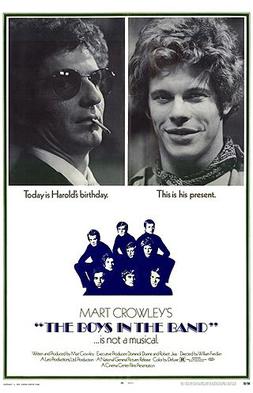
The Boys in the Band (1970): A Review

THE BOYS IN THE BAND (1970)

Being gay was once "the love that dare not speak its name". The Boys in the Band, the adaptation of Mart Crowley's off-Broadway play, shouts it out for all the world to hear. This collection of openly gay men, ranging from the straightest acting to the most flamboyant, goes into the dark recesses of the human heart. With the original cast recreating their roles for the film, The Boys in the Band is a bitchy tour into fear and loathing.

Michael (Kenneth Nelson) is preparing a birthday party for his frenemy, Harold. Michael is in the early days of sobriety from alcohol, so he might be a bit on edge. His friend Donald (Frederick Combs) comes after his therapist cancels an appointment and helps with the birthday preparations. Out of the blue Michael receives a call from Alan (Peter White), who tearfully asks to see his old college friend. Michael does not want Alan to come for one reason: Michael is gay but has never come out to Alan. The ultimate straight square coming up to see Michael and his group of gay friends is something he is not ready for.

The various mutual friends to Michael and Harold run the gamut of sexual discretion. Emory (Cliff Gorman) is as flamboyant as they come, maybe even more flamboyant than possible. Hank (Laurence Luckinbill) is the straightest acting man there, so straight that he is in the middle of a divorce from his wife due to his relationship with photographer Larry (Keith Prentice). Hank is pretty much a square, while Larry has no issue playing the field despite his relationship with Hank. Another friend, Bernard (Reuben Greene), the only black man in this group, is not out to others, just to this group.

At first, Michael is relieved when Alan says that he won't be stopping by and pulled himself together. He can get all his gay friends to be themselves and kick up their heels, quite literally when they recreate an old dance routine. Things take a turn though when a couple of uninvited guests show up. First is Cowboy (Robert La Tourneaux), Emory's "gift" for Harold. The second is Alan, who did show up after all. Emory's suggestion that Alan is closeted causes a fight between them.

Into this maelstrom enters Harold (Leonard Frey), bitchy and pithy and ready to take anyone on. Michael, who has unwittingly started drinking again, now finds himself as master of ceremonies at the party from hell. Everything from trying to push Alan out of the closet to making the guests play a game where they have to call the person they loved. Old secrets and new resentments come out until the frenemies Harold and Michael confront each other about their separate issues. Will Michael learn to accept himself? Is Alan gay? Will this birthday party end in chaos or comfort?

The Boys in the Band is unique for at least two reasons. First, it is the rare time when an entire cast recreates their original roles from stage to screen. Second, it is one of the first mainstream films where gay men were not portrayed as either victims or villains. Yes, there were stereotypes, particularly with the lispy, limp-wristed Emory. However, there was also his counterpart in Hank, a man who smoked pipes and drank beer. He could be a "man's man" without the usual flamboyance and effeminate mannerisms usually (and probably still) associated with homosexual men. The Boys in the Band, therefore, allowed a variety of males that were also gay.

It is not as though The Boys in the Band, adapted by Crowley from his play, did not give these men nasty things to say to each other even before the booze starts flowing. Most of that comes from Emory, whispering his dialogue in cutting barbs and delighting in antagonizing everyone within sight. However, Crowley's screenplay also gives us surprisingly moving moments from Emory. As he talks about Delbert Botts, the high school classmate that he was madly in love with, there is a deep sense of longing for that obscure object of desire that he still yearns for. It is interesting that despite his sniping manner, Emory ended up the most compassionate of the bunch. When the party ends, Emory takes the despondent and drunken Bernard home, tenderly walking him out.

William Friedkin manages to keep things focused on the actions to where you almost do not notice that The Boys in the Band is almost a filmed play. The film is not opened up save for the opening titles where we see the various men living out their lives before Harold's party. We see Emory looking for Harold's gift, Hank playing basketball, Larry working at his photographic studio, Donald driving like a maniac. Apart from that and scenes of Alan calling though, everything in The Boys in the Band takes place at Michael's apartment and patio. 

The film is really a two-part film: pre and post Alan. Before Alan's arrival, the various men trade insults and compliments, affording themselves this space for themselves. Once Alan arrives, and especially when Harold shows up, The Boys in the Band takes that dark turn. Michael's mix of drunken anger and self-loathing fights with Harold's arrogance and his own insecurities. The conflict between the more strait-laced Hank, committed to Larry, and Larry, determined to be free to have flings with whomever he pleases (even a revealed one-night stand with Donald) adds to the troubled manner the various men go through.

Friedkin kept things flowing remarkably well, guiding the actors to strong performances throughout. Nelson's Michael is troubled, fearful but also mean and ultimately tragic. Frey holds his own as Harold, able to push back and make sharp observations while also revealing his struggles with his appearance. Gorman is particularly good, going from stereotype to more nuanced as Emory. The interplay between Luckinbill as the more traditional Hank and Prentice as the man he loves despite himself also works well and makes for a good subplot. Le Tourneaux's Cowboy convinces you that this young kid is terminally naive to dim.

It is interesting that most of the actors in The Boys in the Band were themselves openly gay. Out of the cast, only Luckinbill was openly straight. Gorman was married to a woman, and both White and Greene to my knowledge were at least not known to have male lovers. Nelson, Frey, Combs, Prentice and La Tourneaux were all openly gay. 

While today there is a strong push to cast only openly gay actors in gay roles, The Boys in the Band did that when being openly gay was still a source of controversy. It is possible that their lived experiences shaped their performances to be more authentic; it is also possible that they were acting, playing gay characters far removed from their own experiences. The actors' sexual orientations should not color the views of how well they performed, one way or another. The strong performances of openly straight Luckinbill and probably straight Gorman shows that one does not need to be gay to play gay. 

Sadly, Nelson, Frey, Combs, Prentice and La Tourneaux all died of AIDS-related illnesses.  

If there is a flaw with The Boys in the Band, it is that it is essentially a filmed play. It cannot fully escape from the confines of what someone might see on the stage. There is only so much that can be done on that level. Credit to Friedkin and Crowley for keeping things moving to where one almost never notices the stage bound nature of the film. 

The Boys in the Band allows the various men to be all sorts. Petty, honest, bitchy, heartfelt. The issue that caused Alan to break down, or even if he was gay or perhaps bisexual is never directly answered. It is not important to the overall plot. Instead, The Boys in the Band keeps its focus on this group of friends, lover and rivals. That makes it all come together as they all come out.

DECISION: B+

Saturday, April 20, 2024

Notes of Autumn: The Hallmark Television Movie

NOTES OF AUTUMN

It is a curious thing that out of the four Hallmark movies that I have seen so far, two of them have a gay love story. Given that the target audience for these films tend to be straight women, do straight women like seeing movies about male same-sex romances? 

I do not think that people would accuse Hallmark movies of being deep or particularly good. They seem to be the television version of comfort food: something filling for the feelings. Notes of Autumn, my latest sojourn into this world of sappiness, makes me genuinely wonder why I put myself through all this. Poorly acted, poorly written, at times veering on cringey, Notes of Autumn is not so much a disaster as it is brain-melting.

Ellie Matthews (Ashley Williams) was once an aspiring pianist who now works as a flustered and somewhat frustrated events planner. Leo Carrington (Luke Macfarlane) is a highly successful writer of the Parkington Manor book series which, judging from the reenactments he sees, is a vaguely Regency-era romance series. Ellie just got fired from her latest job due to constant distractions and a scatterbrained manner. Leo is struggling with his latest Parkington Manor book, his fifteenth book in fifteen years.

As a side note, the dialogue states that Leo has written fifteen Parkington Manor books in 15 years. That makes it at least a book a year for a decade and a half. No wonder he's bereft of ideas. Moreover, I don't think even James Patterson can knock his books out that fast, though to be fair, Patterson does have coauthors, but I digress.

To get away from their troubles and find new sources of inspiration, lifelong BFFs Ellie and Leo decide to swap homes for two weeks. This will give Ellie a chance to recharge and reevaluate what she needs to do to move on. It will give Leo a chance for a long-delayed vacation from British Columbia and perhaps break his writer's block.

They cross paths ever so briefly at an airport, so briefly that they cannot let the other know about each other's living situations. In rural Pinewood, Leo fails to make clear to Ellie that she will be helping Sam Perkins (Marcus Rosner), a nature guide who is organizing the local Piano Ball. He needs help with both organizing the charity event as well as the amateur chamber quartet trying to learn Vivaldi's Autumn section of his Four Seasons concertos. Similarly, Ellie fails to make clear to Leo that she has let her friend Matt (Peter Porte) use her large kitchen as a testing ground for new dishes to interest investors for his hoped-for restaurant. In those two-plus weeks, Ellie & Sam and Leo & Matt will find inspiration and romance from and with each other.

After enduring Notes of Autumn, I had exactly one question: what the hell are gourds? Ellie goes on about gourds and their decorative powers for fall-themed events, but I simply kept wondering what gourds were.

Rick Garman's screenplay was hellbent on Ellie and Leo having mirror situations. I am not talking about the swapping homes situation. After all, Notes of Autumn relies on this as the engine that drives the plot forward.

I am talking about, instead, the dual couples having simultaneously similar situations that I think are among the television movie's many low points. For reasons I simply cannot fathom, both Ellie and Leo essentially have to break into each other's home where they will meet their love interest. Ellie cannot find the keys to Leo's lavish rustic retreat, so she tries to shimmy up to the second floor when Sam happens to pass by. Leo does have a key, but he sees that someone else is already inside, so he grabs a figure of a giraffe as protection against the probable burglar. Hilarity and hijinks are supposed to ensue.

These duo disasters rely on an implausible if not impossible set of circumstances. Not once does it occur to Ellie to let Leo know that she gave Matt permission to use her kitchen? Not once did Leo make clear that he was volunteering Ellie to be his substitute? This oddball situation is explained away by both having to share these vital pieces of information as they pass each other at their connecting airports. However, a more sensible thing would have been to talk about it with each other or even texted. The television film starts with them calling each other often, but that soon is forgotten and they rarely if ever check on each other until they again cross paths at the airport. 

Adding to the overall idiocy of Notes of Autumn is over why couldn't Matt use Ellie's kitchen. Leo tells Matt that he needs privacy to work. However, all Leo and Matt had to do was call Ellie or come to an agreement between them to where Matt could use the kitchen (which the owner already gave him permission to do) when Leo was out, say for a walk or a visit to whatever tourist trap the big city of Westerhaven had.

As a side note, the degree of ruralness between Westerhaven and Pinewood is almost nil. The latter looked the former's suburb. 


There is just so much that is astonishingly dumb about Notes of Autumn. While Ellie knows that Leo is gay (it is about a good ten minutes before we get a quick mention about him not having had a boyfriend in a while), she apparently didn't know Matt was. Either that, or she did know and never thought that the two gay guys she knows might hit it off. I think she did, but if so, why she never thought Leo and Matt could make a connection one can't figure out. 

Leo, newly inspired by his feelings for Matt, has started writing, but not the newest Parkington Manor novel that his editor Karen (Lucia Walters) wants. Instead, he submits the first three chapters of Cornerstones, about two male architects in love. Karen at first rejects it for unnamed reasons but later tells Leo and Matt that she will push to publish Cornerstones. My question is, why can't he publish it under a pseudonym as J.K. Rowling has under her pen name of Robert Galbraith? Nothing prevents him from publishing Cornerstones, which sounds infinitely better than anything in the Parkington Manor series.

To be fair, this series led to probably the only intentional laugh I got from Notes of Autumn. Matt, vaguely aware of Leo's books, told him that Ellie had mentioned that Leo had written the "Parking Lot Mansion" books. I think Garman may have been inspired, unintentionally or not, by Misery. The Parkington Manor series reads like the fictional Misery books, and Matt tells Leo that his Italian mother may hold Leo hostage if he cannot finish another Parkington Manor book.

Truth be told, from the deliberately overacted sections of Leo's thwarted Parkington Manor: Part 16 book, they look like terrible reads. I understand two stars of Hallmark's When Calls the Heart series appear in the sepia-toned reenactments. I guess that is nice for Hallmark viewers, not so much for anyone unfortunate enough to give Notes of Autumn the time to watch.

Yes, I am probably overthinking all this. I had to do something to combat the boredom and mind-numbing stupidity of Notes of Autumn.

Ellie and Sam's story is no better. As played by Williams, Ellie comes across as a near-total idiot, mistaking perky for insipid. She comes across as irritating, dim, and the type of woman whom men should flee from. Rosner can best be described as "Hallmark hot": a bland character but an attractive man, complete with woodsman beard. Yes, we know that they will eventually fall in love. However, Notes of Autumn never makes the case as to why either would genuinely want to.

I do not know if coming out was the best career choice for Porte or Macfarlane. Good for them if they want to be open about their lives, but I wonder if they will ever play it straight, so to speak. Porte comes close to being a stereotype of a gay man. Macfarlane plays it straight (again, no pun intended), playing Leo as someone who does not even want a friendship with Matt, let alone see him as a potential love match. He is not so much closeted as he is detached. It is to where when Leo initially pulls away from Matt's effort to kiss him, it comes across as a straight man pulling away from a gay man's mistaken impression, not a gay man's overall reluctance at romance. 

Oddly, I saw things that Notes of Autumn may not have intended with some of the lesser characters. When meeting the quartet, Sam introduces each by name. "Beau is playing the violin," he says. I literally asked myself, "Was that a pun?" 

Beau is playing the violin. Bow is playing the violin. 

Maybe that is giving Notes of Autumn way too much credit.

Somehow, "Beau playing the violin" is one of the best parts in Notes of Autumn. His jazzier take on the fiddle reminded me of Nickle Creek. I'd rather follow a romance between Aidan Kahn's Beau and Kelsey Lopes' Wendy than either Ellie & Sam or Leo & Matt. 

The split stories did not mesh well. We get more of Ellie than of Leo, and the quartet does try to give each a personality. It might have worked better to split the stories into two separate films (Notes of Autumn and Notes of Autumn 2: Parkington Manor's Revenge).

I can forgive the "she doth protest too much" when the quartet keeps asking her to accompany them on piano. The television film needs this faux-conflict (faux-flict?) that will be resolved in the end. However, one would think that Ellie's almost incessant whining about how she can't do XYZ would drive Sam away from her. Again, as played by Williams, this woman is somewhat whiney and dim. He could do much better. Despite Sam's heterosexuality, Leo is a better prospect for him than Ellie.


It is curious that Sam mentions how he has to drag Leo to a nearby farmers' market when we see how Leo seems to actually be enjoying going to a farmers' market with Matt. OK, it might be due to a potential attraction. However, why did director Troy Scott not make Leo more reluctant to go to the farmers' market so as to show consistency. 

That simultaneously similar farmers' market visit, I might add, was before Leo found out that Matt was "single" when Matt mentions how Leo sounds like his ex-husband. For all the celebration Notes of Autumn and Hallmark gave themselves about representation, Leo could only say that Matt was "single". The film metaphorically went "don't say gay". Yet, I digress again.

Sam tells Ellie that Leo helped him craft beautiful words for his Pinewood Nature Tours brochure. However, when Sam and Ellie are at a Pinewood farmers' market and earlier on a nature hike, Sam was so eloquent by himself that Leo would have done better to walk in the woods with this hunky man than go off to the more cosmopolitan Westerhaven. The Matt & Leo romance felt forced. To be fair though, it is hard to make some of the dialogue sound anything less than cheesy.

"Ellie says it's because of me and I know it's because of you", Matt tells Leo about him sparking new life in him to pursue his dreams. Leo replies, "I think it's because of us". There might not have been great or even good acting in Notes of Autumn. However, no actor could work with such an awful script and make it sound anything other than laughable. 

To be honest, I can no longer remember if it was Matt who said that to Leo or vice versa. I don't think it really matters, it's still awful. 

Notes of Autumn, even by the surprisingly low standards of a Hallmark Television movie, is bad. Uninteresting characters poorly acted with a pair of at times flat-out stupid stories, it has nothing to offer viewers not addicted to the Hallmark formula.  

One last point about Notes of Autumn. Matt is the only major character to not have a last name. I do not know why that detail stuck out, but it did. 

1/10