Monday, June 22, 2026
Eternal Sunshine of the Spotless Mind: A Review
Wednesday, August 20, 2025
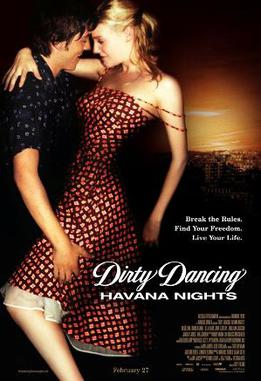
Dirty Dancing: Havana Nights. A Review
I think that one can enjoy a film that is not good. Such is the case with Dirty Dancing: Havana Nights. I was expecting a disaster, yet Havana Nights ended up being pleasant. I did not say good. I did not say Havana Nights is anywhere close to the original Dirty Dancing. I said, "pleasant", which is in the end works at least for me.
It is November 1958. Katey Miller (Romola Garai) is unhappy about having to move to Cuba. She is there because her father Bert (John Slattery) is working there. As such, the entire Miller family has to move to the tropical paradise: Katey, Bert, his wife Jeannie (Sela Ward) and Katey's younger sister Susie (Mika Boorem). Susie easily fits into the other young American expatriates like James Phelps (Jonathan Jackson), whose father is Bert's boss. Katey, more intellectual, does not mix well in this circle. She especially does not fit in with mean girl Eve (January Jones).
Katey does have an easier time with hotel waiter Javier Suarez (Diego Luna). They meet when she accidentally knocks out his tray and gets berated for "his" clumsiness". Javier, who does speak English, is the son of an opponent to the current Batista regime. Javier's brother Carlos (Rene Lavan) is a supporter of Fidel Castro and the revolution. Javier is nominally sympathetic, but he would rather be at La Rosa Negra, where he can free himself in sultry Latin dancing.
As Bert and Jeannie were once skilled dancers themselves, Katey has some background in the art of movement. She also finds Javier's world more exciting than the WASPish world people like James and Eve live in. A dance competition piques her interest, especially with a chance for the winners to go to America. Taking the advice of the hotel dance instructor (Patrick Swayze), Katey eventually talks the now-fired Javier into being her partner.
How much of a partner will the erotic Latino become? Will the Millers find the prospect of a Cuban boy squiring their daughter a pleasant one? Will the impending revolution upend all their lives? Will Katey and Javier win the dance contest?
As I reflect on Dirty Dancing: Havana Nights, I think that Boaz Yakin and Victoria Arch's screenplay (from a story by Kate Gunzinger and Peter Sagal) pretty much drew from the original Dirty Dancing. It is almost a surprise that Javier didn't go up to the Miller table and say, "Nadie pone Bebe en una esquina". You have the opening voiceover. You have the parents and two sisters, one bookish, one flirtatious. You have the luxurious hotel setting. You have the guy from the wrong side of the tracks with the moves. You have the young man that the parents would prefer for their older, bookish daughter. You have a dance rehearsal montage. You have a climatic dance.Granted, there are some differences: you did not have revolutionaries attempting to kill people at Kellerman's Resort. Overall, though, Havana Nights is a bit of a Dirty Dancing clone.
Things get more complicated when you see Patrick Swayze in Havana Nights. Technically speaking, he is not recreating his role as Johnny Castle. He is not billed as "Johnny Castle" but as "Dance Class Instructor". He appears briefly in the film, giving Katey a pep talk and cheers our dancers on the sidelines. I think people assume that Swayze is playing Johnny Castle, but he is strictly speaking not. I do not know exactly why Swayze could not be Johnny Castle. He could have served as a mentor to both Javier and Katey. Instead, his character, whatever he was, was just there and could have been cut out.
In terms of performances, Havana Nights does not ask much from our cast. Romola Garai makes a valiant effort, but sometimes her British accent slips through. It would have been easier to have made her an American who grew up in Britain with her family having lived there before being transferred to Cuba. That way, she could speak in her natural voice versus trying to sound like an American. To be fair, Garai's American accent was serviceable, though not always convincing. She was fine as the hesitant young girl who discovers the rhythm of the island.
I cannot say that Garai and Diego Luna had chemistry, but they were fine with each other. I find it slightly amusing to see Luna in something like Havana Nights. I do not know if in retrospect, he is particular about being a Mexican playing a Cuban. He was fine in the part of this working-class man who found freedom in the steamy Havana clubs. I think he did as well as he could with what he was given.
Both Jonathan Jackson and January Jones early in their careers were all right in their roles. I think it might have been better if Jackson's James had not taken a particular action against Katey and been more a dupe than a semi-villain. Jones' efforts to be the mean girl were again, fine, but she was not given much to do.
The real crime is against Sela Ward. She is a talented and beautiful actress who somehow just did not become the star that she I think could have and should have been. While she has done well on television, Ward has never fully broken into film. Havana Nights misused her. I would not go so far as to say that she is miscast. I will say that her efforts to be snobbish and hostile towards Javier and Katey fell a bit flat. It is as if Ward was trying too hard to be harsh. Slattery looked slightly sleepy in the role, but in fairness when he and Ward take to the dance floor, they do look nice.
A major compliment that I can hand Havana Nights is in its soundtrack, full of good Latin music. I cannot extend that to the dance sequences. Guy Ferland filmed some of them poorly, using many midlevel shots and spins, sometimes cutting excessively. While we did get some good numbers, the training montage felt choppy. Worse, we did not get Garai and Luna in full-form shots.
I did find the ending curious. It is ostensibly a happy ending, with everyone going to La Rosa Negra shortly after Batista flees. Are we supposed to believe that everyone is celebrating Castro's takeover of Cuba? Maybe Luna in real life thinks this is a wonderful thing. I would have thought it would be more realistic to think that the Millers would have fled in terror versus hitting the clubs.
I did not end up hating Dirty Dancing: Havana Nights. It is inoffensive. Yes, it has no reason for being, coasting on the Dirty Dancing name and being a prequel in name only. Still, if you go into Dirty Dancing: Havana Nights, you could end up Havana good time.
Sorry, I could not resist.
Friday, March 7, 2025
Exorcist: The Beginning. A Review (Review #1950)
I have never understood why The Exorcist inspired an entire franchise. I think the first film works well on its own, with every succeeding film unnecessary. If that is not bad enough, The Exorcist managed somehow a most curious situation. It apparently has not one but two prequels that serve as origin stories. Another time I will look in at 2005's Dominion: Prequel to The Exorcist. For now, I will look at Exorcist: The Beginning, which came out a year prior. I do not understand the hate that Exorcist: The Beginning gets. It is a serviceable albeit flawed opening to this franchise which maybe tries too hard to be graphic, but which worked well for me.
Cairo, 1949. Archaeologist and former priest Lancaster Merrin (Stellan Skarsgard) has been hired by the mysterious Semelier (Ben Cross) to find a rare artifact in British Kenya: a figure of a demon hidden within a Byzantine church that was buried and recently unearthed. The strange thing is that this church should not be there, as it predates the introduction of Christianity to the area. How did it come to be there, and why is it so well-preserved that it looks as if it has never been used?
Arriving in the Turkana region, Merrin is joined by eager young priest Father Francis (James D'Arcy), the chief archaeology overseer Jeffries (Alan Ford) and Dr. Sarah Novak (Izabella Scorupco). They begin looking into the church but find blasphemy and mystery within. The angels point their weapons downward rather than towards Heaven. More shocking is how the crucifix is deliberately inverted. The evil within it has escaped to infect figuratively and literally two Turkana boys. Older brother James (James Bellamy) is torn to pieces by hyenas as his younger brother Joseph (Remy Sweeney) watches. Joseph soon becomes infected with something, which might require the Turkana people to perform their own version of exorcism.
Merrin and Sarah, a concentration camp survivor who had been imprisoned for her anti-Nazi activities, soon begin to bond. Merrin too is traumatized by the war, forced to select people to be shot by a sadistic Nazi officer. This was what broke him from God and the priesthood, but now he will need those resources to fight a greater evil. Eventually, Father Francis reveals the shocking history of the region. Here, it is believed, is the place where Lucifer fell from Heaven as well as the sight of a major battle between Crusaders. The Vatican had attempted to keep all this from ever being discovered, but a recently unearthed letter in the Vatican Archives written in 1893 have enough of a mention that it sparked interest to find this lost church.
Merrin now must find and fight the demonic being that will claim many lives before it is sent back to hell. Not all will survive, but will Merrin find both strength and faith to fight Satan's minion?
After watching Exorcist: The Beginning, I am at a loss to understand why it is seen as such a bad film. I thought it was miles ahead over both Exorcist II: The Heretic and The Exorcist III. One of Exorcist: The Beginning's great flaws is in the visual effects department. Some effects within the film are almost laughably bad. The hyenas were not convincing. The worst one was when a demon-possessed person attempted to get to Merrin to kill him. The overall look was more comical than frightening. The storm that overwhelmed the hospital too was something that a bad Syfy show would find a bit lackluster.
I also was not particularly fond of some of the graphic violence in Exorcist: The Beginning. Of particular note is the gruesome end of Dr. Bession (Patrick O'Kane), the French chief archaeologist who went bonkers and offed himself in what I thought was a particularly gruesome way. This is strange given that some other deaths were more restrained. Also, I have a strong reaction against seeing children killed regardless of how visual or not it is. James getting torn to pieces may have been obscured, but it still bothers me.
I figure that some of the graphic nature to Exorcist: The Beginning was director Renny Harlin's way of giving audiences what he thought they wanted: lots of gore. I think that such things were not needed. However, I found more positives than negatives in Alexi Hawley's screenplay from a story by William Wisher and Caleb Carr.
Some of the performances were quite good. Stellan Skarsgard did well as Merrin, this haunted man who must rise to embrace his faith against this ultimate evil. D'Arcy in a smaller role did well as Father Francis, making him a more youthful and inexperienced priest who actually knows more than he lets on. Scorupco had an interesting backstory that she worked with, though she was a little more blank as Dr. Novak. Alan Ford as Jeffries was a bit over-the-top for my tastes, and I loved how Ben Cross had basically two scenes and got paid for it.
Overall, I found Exorcist: The Beginning an acceptable prequel to this franchise. I wrote at least twice in my notes how I did not hate the film as much as I was supposed to. Is it a great film or even a good film? I would say no, but nowhere as abysmal as many insist that it is. Serviceable, with some good performances and efforts at frights, Exorcist: The Beginning was fine, and I can't fault a film for meeting my expectations.
THE EXORCIST FILM SERIES
Dominion: Prequel to The Exorcist
THE EXORCIST TELEVISION SERIES
The Exorcist
Saturday, October 8, 2022
Catwoman: A Review
Catwoman became notorious right after its release, a film derided and despised by both public and critics alike. Many "me-ouch" and variations on "catastrophe/catastrophic" were tossed around with glee. I think those kinds of puns are tacky, but given how Catwoman ended up, they kind of fit.
Mousy Patience Phillips (Halle Berry, and no pun intended on the "mousy" bit) aspires to be a painter but is now relegated to working as an in-house advertising artist for the Hedare Corporation, which specializes in beauty products. CEO George Hedare (Lambert Wilson) is unhappy with Patience's work, though to be fair he's just a crabby person.
He's dumped his wife Laurel (Sharon Stone) as the face of Hedare after 15 years, opting for a literal younger model. This does not sit well with Laurel, but there is evil at work. The new Beau-Line beauty products have a curious side effect: they will turn the users into disfigured monsters if they stop using them.
Unfortunately for Patience, she accidentally overheard Laurel and the reluctant Dr. Slavicky (Peter Wingfield) about the Beau-Line products. As such, she is "killed", but Patience has secret allies: mystical cats who have chosen her as the new Catwoman.
Now, despite her growing romance with police officer Tom Lone (Benjamin Bratt), Patience must embrace her feline feminine side to stop Laurel and become the crimefighter Catwoman.
Perhaps it is not surprising that Catwoman has three credited screenwriters (John Brancato, Michael Ferris and John Rogers) with two of them having a story credit (Theresa Rebek being the third). I sense that more hands went into the script, which is cliched, unintentionally hilarious and groan-inducing. It is as if Catwoman never decided to be serious or camp.Instead, it opted to try and straddle both sides, making for a most confused final product. You take up a lot of screen time with Patience's wacky BFF Sally (Alex Borstein) but she comes across as grating and irrelevant to the plot.
The fact that "Beau-Line" is pronounced at least two different ways but the second word is never pronounced as "lyne" but as "leen" is one of the lesser oddball elements.
You have seen this "kill the woman who ends up coming back as Catwoman" in Batman Returns, and I'm astonished no one commented on the similarity. That Catwoman wants to be separate from the Batman mythos makes this all the more strange.
One of Catwoman's greatest issues story-wise is that it gives Patience very little time to build up from this shrinking violet to frisky vixen. Trying to tie her in to a long line of vixens kind of just sits there. To be fair though, poor Halle Berry clearly does her best with what she is given. We see this when Catwoman and Laurel have their final confrontation: at one point Berry puts her hands up like paws as Laurel is beating her with a pole.
I do not question Berry's commitment to the role. She again was given a pretty thankless job and worked her behind off to make any of this work. Berry, however, was doomed from the start by things outside her control. Her costume was tawdry, not slinky. It would be something better suited to a furry dominatrix.
Her director, billed as "Pitof" (Jean-Christophe Comar) was probably the worst choice to helm what was meant as a major action film/franchise starter. For reasons unclear the producers gave the directing job to a man who had made only one film prior to Catwoman and whose said sole film was in French. Even that could be forgiven if not for some of the performances.
Benjamin Bratt looked utterly bored, even at times drugged throughout. He has no connection with Berry in what are meant as love scenes, and after getting shot, Lone seems more confused than in pain. Despite being shot however, he is still able to, later on, punch out a few hitmen, so I'm curious to understand that.
Lone also has to be among the dumbest cops in history. At a robbery crime scene, we see a box of cupcakes and a note reading "Sorry" prominently displayed. Yet it takes what appear to be hours if not days for him to see that the "Sorry" matches the same "Sorry" Patience wrote on a coffee cup that she sent him after missing a date. Her feline agility when saving a kid from a crazed Ferris wheel (already a silly set up) again seems to escape him.
Stone probably thought she was in another film altogether, closer to the campy 1966 Batman than the darker 1989 Batman. She vamps it up to the Nth degree, refusing to take any situation seriously. It's almost admirable how crazed it comes across, even if the end result is laughable.
Catwoman also has some ghastly visual effects that make Catwoman clearly animated. I think it also does not help matters when Pitof appears more fixated on showcasing Halle Berry's ass than on I figure more important matters.
I think Catwoman is a terrible film, but I did not end up hating it. Rather, I felt almost sorry for everyone and everything revolving around Catwoman. I am, however, surprised that Catwoman is not a cult film, one where audiences can laugh together at people trying desperately to make things good and failing spectacularly.
Cats can land on their feet. Catwoman just fell on her face.
Tuesday, April 14, 2020
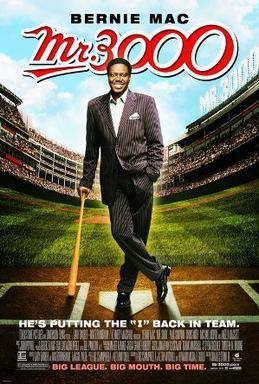
Mr. 3000: A Review
*While the Minor League Baseball season did not open on April 14 due to Coronavirus, I opted to keep to this date.
Welcome to Rick's Texan Reviews annual Opening Day film, where I review a baseball-related film to coincide with the Minor League Baseball Opening Day for the El Paso Chihuahuas. This year, I am looking at Mr. 3000, a pleasant if not particularly deep film.
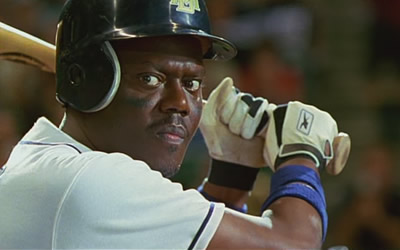
Arrogant Milwaukee Brewers first baseman Stan Ross (Bernie Mac) has achieved a lofty achievement: 3,000 hits as a professional Major League player. However, while popular with fans everyone else that's near him hates him for his obnoxious manner and inability to be a true team player. So irritated is he with the negative press coverage and what he considers a losing team that he retires immediately after gaining his 3,000 hit.
Nine years later, Ross has parlayed his on-field success to a lucrative business empire, using his "Mr. 3,000" nickname for a variety of businesses, even a Chinese restaurant (Mr. 3,000 Woks). Normally, his record would be enough to ensure induction into the Baseball Hall of Fame, but the writers essentially hate him so much that Ross keeps coming up short (a more humorous version of the Curt Schilling situation).
After his number is retired by the Brewers as a way to drum up ticket sales, it is discovered that "Mr. 3,000" is really "Mr. 2,997" due to a clerical error. Ross is humiliated while the press delights in pointing out how his tally went from 4 votes to 147 votes short. Determined to get his 3,000 record back, Ross talks his way into coming out of retirement at 47 to get those three hits.The current Brewers players, in particular hotshot Rex "T-Rex" Pennebaker (Brian J. White) are dismissive of Ross, but Brewers executive Schriembri (Chris Noth) sees the chance for larger attendance to see both history and a return of a fan favorite. As Ross continues a quixotic pursuit of three hits, he not only starts to grow as a person but reignites a romance with ESPN reporter Maureen Simmons (Angela Bassett). In the end, Ross both gets and does not get what he wants, but becomes a true team player and genuine fan favorite.
Mr. 3,000 has as a major plus the late Bernie Mac, who died far too soon. He balances being so arrogant and nasty that you almost want him to fail with a genuinely insecure man who somehow needs validation. You start hating him, sometimes cringing at how awful he is with his teammates and even fans. As Mr. 3,000 continues though, we see that change into someone who knows more than his younger teammates, even softening and maturing.
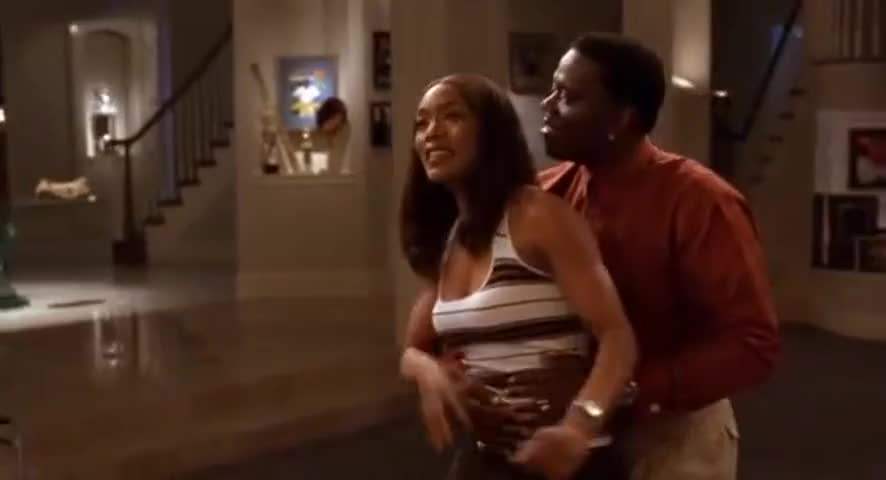
He softens when we see him with Bassett, perhaps underused but still in top form, more than able to hold her own and make us believe someone as bright as Mo would fall again for Ross. He matures when he sees his older self in Pennebaker, who is just as cocky and egotistical as Ross was when he was "Ross the Boss".This was probably Paul Sorvino's most enjoyable performance insofar as he had only one real moment of dialogue. He essentially just glared and glowered at Ross until the end, when he stood up for him when he was called out (and I think he was clearly in).
As I saw Mr. 3,000, I could see that it by no means great material. Eric Champanella, Keith Mitchell and Howard Michael Gould's screenplay follows predictable beats (the arrogant man brought down who is both reformed and redeemed), and flows surprisingly well. Some things were underdeveloped, such as his mentor role to a variety of players and the good-natured bickering between two players on a variety of topics.
The voice-over ending was not only "corny" but openly called "corny", wrapping up the story almost in a hurried manner despite a short running time.
However, Mr. 3,000 is a nice, generally sweet story that I found enjoyable.
DECISION: C+
2017 Opening Day Film: Eight Men Out
2018 Opening Day Film: Fear Strikes Out
2019 Opening Day Film: Ladies' Day
Tuesday, December 25, 2018
Christmas With the Kranks: A Review
Welcome to the Annual Rick's Texan Reviews Christmas Special. For seven years I review a Christmas-themed movie to celebrate the festive Yuletide season. For this year, it's Christmas with the Kranks.
I confess to never having read a John Grisham novel. I do have vague memories of when Third Rock from the Sun spoofed the repetitiveness of his oeuvre. Each of the Solomons mentioned how they were reading "a great John Grisham novel" about "a young Southern lawyer who fights an evil corporate giant". The joke was that while each book was a different title, they all had the same plot.
I figure that Grisham must have already locked down his fanbase by the time he wrote Skipping Christmas, on which Christmas with the Kranks was based on. Otherwise, I imagine that if he had tried selling Skipping Christmas as his debut, it would have been dismissed for the SH-IT that it is. As I have not read Skipping Christmas, I cannot vouch for how faithful Christmas with the Kranks is to the original.
St. Nicholas help us if the film is like the book.
Luther and Nora Krank (Tim Allen and Jamie Lee Curtis) sadly see their 23-year-old daughter Blair (Julie Gonzalo) fly off to Peru for a year to join the Peace Corps the Sunday after Thanksgiving. Luther is shocked when he makes his calculations of the family Christmas spending: $6,120. He decides that since Blair is no longer at home, he and Nora can 'skip Christmas' and take a Caribbean cruise costing on $3,000. Nora, who generally enjoys decorating and hosting a lavish Christmas Eve party, is reluctant but soon agrees.
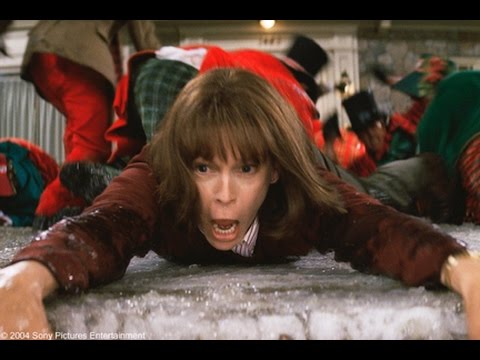
Bad idea, for as soon as their friends, neighbors and Luther's employees learn of this plan, they all essentially turn into Christmas fascists. Their neighbors, particularly Vic Frohmeyer (Dan Ackroyd) literally stage protests in front of the Kranks' home, demanding they put up lights and especially a Frosty the Snowman figure on their roof. "Nora Krank! We're here for Frosty!" he yells in front of their house with what looks like a mob about to lynch the Grinches.The various shops and organizations they normally order from during the holidays all but berate them for not 'doing Christmas', and Nora's friends are appalled they won't be having their party.
Their 'protest' even makes the local newspaper!
Nora is buckling under the pressure: no surprise given that Frohmeyer at one point chases her down in her car. Luther gets the cold shoulder from employees, who make sarcastic remarks about getting 'cheap gifts' because he won't put in any. Luther, for his part, stubbornly holds to his Caribbean holiday.
Then they get an unexpected call from Blair. She's in Miami, with her new boyfriend/fiancée Enrique (Rene Lavan) (she states that Enrique has proposed but for the rest of the film she and everyone else calls him her 'boyfriend'). Blair is flying to Chicago to see her parents and show our Peruvian hunk 'a traditional Christmas'.
At this point, both before and after watching Christmas with the Kranks, I asked 'why could they not tell their 23-year-old daughter that they were not going to celebrate Christmas and decided to go on their own holiday'? I also asked, 'how does someone who joined the Peace Corps manage to wrangle leaving within a month of her assignment to fly up for Christmas?'
Oh, me and pesky logic.
Nora, pushing Luther, scrambles to put the house in Christmas order in less than two days. After a series of chaotic events that lead to Luther hanging precariously off the roof of his house, the whole neighborhood rushes to help the Kranks get their house to be a winter wonderland.
Because in this universe, 23-year-old children have to be placated.
I laughed only once at Christmas with the Kranks. It was when Nora attempted to make Luther's skin paler after his pre-vacation tanning by applying far too much creme. He looked like he was auditioning for kabuki theater. That was funny.
Apart from that, Christmas with the Kranks is not so much misguided (though it is that) as it is nasty and unpleasant, trying to be jolly and even uplifting when it really is a cautionary tale of suburban fascism.
God help any non-Christian families who live on the appropriately named Hemlock Street. Can you imagine if the Rothsteins or Singhs lived here? Would their neighbors subject them to harassment and intimidation to get them to decorate their house?
Moreover, I cannot get over how the premise of Christmas with the Kranks is built around the idea that a 23-year-old bimbo has to be coddled to an almost infantile level. First, it's really outlandish that a Peace Corps volunteer would arrive at her assignment in late November and then get permission to leave within a month. Second, it's even more insulting that her parents simply could not tell her that they had made other plans, were leaving the country and could not change them at the last minute just to accommodate her childlike whims.
Did they never speak to Blair in that month to tell her, 'Hey, we've decided since you're not here there's no reason for us to decorate the house and decided to take a holiday instead?'
If this is the kind of plotting John Grisham is proud of, how did he ever get to be the literary powerhouse he is (and I say this as one who liked The Firm and The Client).
Blair mentioned that she had met Enrique before while at Brown (a school she clearly does not have the intellectual prowess to have attended), so Luther and Nora should have already had experience living without her, albeit not at Christmas. Still, the entire Krank family is so categorically stupid one wonders why Enrique would want to join it (unless it is for the sex).
Christmas with the Kranks really pushes a false idea that the film is about 'community' and caring. Nora says as much when she thanks everyone for pulling together to 'save Christmas'. This is extremely psychotic given that less than 24 hours prior, this same 'loving community' was all but terrorizing her into faux-festive submission.Director Joe Roth really went out of his way to make everyone give horrible performances. At the top of that list is Curtis, who was not acting so much as she was embarrassing herself. Curtis was trying much too hard to try and make Nora funny but ended up going for dummy. In her exaggerated hysteria and whimpering over every little thing Nora was so unpleasant I would advise Luther to divorce her immediately.
Allen, to his credit, at least made Luther somewhat rational. He at least looked like he was taking the premise and situations seriously as the besieged man. The script made one bad mistake in having be totally absolute about their 'Christmas boycott'. He wouldn't give in to Nora's request to give $600 to charity and their church before leaving, which I consider a reasonable request. Eventually he gave in, but why he was made to be so hostile was a misstep. Nora was a wimp and Luther a bully, two things they should not have been.
Ackroyd came across as a literal Christmas terrorist, and just about everyone in the neighborhood came across as insane. Having the cops escort Blair and Enrique is bad enough (as if these cops spelling it as "N. Reeky" didn't already do that). Having said cops take a burglar they caught with the to the Kranks Christmas bash is straight-up insulting to everyone.
John Debney's score made things worse. It was one of those 'look at how cutesy and whimsical everything is' types of scores, where the music tries to push the humor where there is none.
If one thinks on it, Christmas with the Kranks is really a celebration of conformity, an ode to the power of bullying. Essentially, Chris Columbus' screenplay (and Grisham's book) is saying, 'how dare Luther think of himself and his wife and put them first over groupthink? Better to buy a tree they won't use, get personalized Christmas cards and throw a party they don't want to rather than make plans by themselves for themselves'.
That is not a true Christmas message, and Christmas with the Kranks is not a true Christmas movie.
2017 Christmas Film: The Man Who Invented Christmas
Saturday, October 27, 2018
Sky Captain and the World of Tomorrow: A Review
There has been some revisionist history when it comes to Sky Captain and the World of Tomorrow. The film is being held by some as a forgotten piece of cinema history, a movie that was a harbinger for the effects-driven blockbusters of today.
I remember seeing Sky Captain with my late friend, Fidel Gomez, Jr., with me being the more enthusiastic of the two. Fidel was rather cold to the film before we went in. Afterwards, we left with a sense of immense disappointment (and Fidel with a small sense of triumph).
Now, nearly 15 years after its debut, and with Sky Captain receiving belated reevaluations, I figured it was about time for me to revisit the film.
My views have softened a touch, but not enough to recommend it despite the film's best efforts.
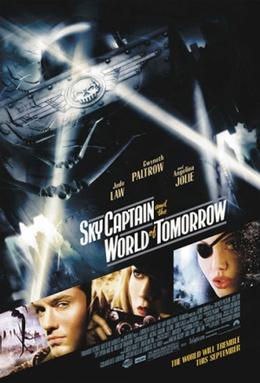
In an alternate 1939, a spate of scientists have disappeared. This story comes to Chronicle reporter Polly Perkins (Gwyneth Paltrow). She gets a tip from the last scientist about a nefarious being named 'Totenkopf', some kind of mad scientist bent on doing evil. It is eleven minutes into Sky Captain that giant robots attack New York City, and only 'Sky Captain' aka Joe Sullivan (Jude Law) can stop the onslaught.
Joe and Polly have a past, but right now that has to take a metaphorical and sometimes literal back seat against this menace. An attack on Sky Captain's base leads to the disappearance of plucky sidekick Dex (Giovanni Ribisi), but not before he leaves a clue for 'Cap' and Polly.
Now they gallivant the world to find Dex and stop Totenkopf from whatever he plans to do. They go to Tibet, where they barely survive some of Totenkopf's minions and Polly loses her roll of film. That leaves her with only two shots left on her camera.For reasons known only to the filmmakers, this is meant as a running gag.
They manage to get to Totenkopf's lair with help from "Franky" Cook (Angeline Jolie), a British air-naval officer who seems a rival for Joe's affections. We then find Dex, some of the missing scientists, and Totenkopf's evil scheme: to send a rocket as an ark where he intends to 'begin' again.
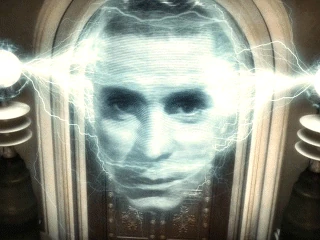
That rocket, however, will also destroy the world. Oh, and Totenkopf himself (Sir Laurence Olivier) has been dead for over twenty years. Joe, with help from Polly, must stop this mad plan and fight against "The Mysterious Woman" (Bai Ling), a menacing figure who has been thwarting their plans.
One almost feels awful bashing writer/director Kerry Conran. This was not just his feature film debut, but a true passion project, beginning as a short film and with a mix of hard work and a little luck, expanded into this homage to movie serials and pulp comic books.
Conran perhaps should be given credit for indeed seeing 'the world of tomorrow', one where computer-generated imagery and reliance on technology to create fantastical worlds would eventually become standard.
The love and affection Conran has for early action/adventure stories and thrilling serials in the Flash Gordon/Buck Rogers style is evident throughout Sky Captain, from the names of the characters (Sky Captain, Polly Perkins, Dex) to their manner of being (daring-do action hero, intrepid reporter/femme fatale, plucky sidekick).
However, Sky Captain and the World of Tomorrow may be a textbook case of loving something so much you end up killing the thing you love. Conran, in retrospect, might have been the worst person to have made the film. It is not a lack of talent or ambition that set him on a course for catastrophe. It is too much passion and affection to where he could not divorce himself from actual filmmaking.
Conran had never directed a movie before, and it shows primarily in how the performances were. When the best performance comes from a man who has been dead for 13 years, you know you have major issues.
No one in Sky Captain had any actual personality. Everyone bar none appeared blank and emotionalless. It really is a race to see whom can act the worst, and one is spoiled for choice. Law showed no range as what is meant to be a swashbuckling hero. In Sky Captain, he came across as almost bored. Yes, he was acting to nothing apart from his fellow costars, but whether flirting with Polly or seeing strange new worlds, Law had the same dull expression and tone.
If this is not his worst performance it's awfully close to one.
Paltrow, whose stock has been going down since her Oscar win for Shakespeare in Love, appeared never to decide if Polly was a comic character or some kind of femme fatale. I kept referring to her as a comic femme fatale, as she sometimes appeared to be going for some 'alluring' woman and sometimes more comic overtones. No matter what, however, she only ended up matching Law in the blank manner.
For years afterwards, Fidel and I laughed at Ribisi's 'PLUCKY SIDEKICK', down to his allegedly endearing use of 'Cap' for 'Captain'. He might have been that homage to the 'plucky sidekick', but he was neither. He was as emotionalless as the others, with the only distinct characteristic of chewing gum. It is laughable to think Dex as this wunderkind when he comes across as almost an idiot.
Despite getting top billing (albeit third), Jolie was on screen for a total of nine minutes. I think Ribisi was on screen longer. This was when Jolie was still trotting out her 'British' accent, but I found Franky more hilarious than interesting. To her credit she seemed like the only one trying to make her character vaguely realistic, but when she commands, "ALERT THE AMPHIBIOUS SQUADRON!" I burst out laughing.
One of Sky Captain's great issues is how despite again its best efforts the audience really was not involved in this world. Again, I appreciate what Conran was going for: a throwback to the zippy, thrill-a-minute serials with lots of action, some 'witty banter' and a mad scientist scheme.However, one feels like one is watching a story that is for 'insiders' only. It's as if the Conrans (Kerry's twin brother Kevin designed the production and costumes*) had a mythology they know but didn't bother telling us about. The story so floated in their heads for so long that they could thrill to it, but they never paused long enough to let us immerse ourselves into that world.
Add to that some wild leaps of logic. We're supposed to believe the robot attack, Polly's easy access to Sky Captain's island, and a return trip to New York could all happen within twenty-four hours.
As I've pointed out, it was eleven minutes between the opening and the robot invasion. That gives us precious little time to inhabit this world, to get to know or care about these characters. Perhaps in retrospect, less daring-do and more discovery of this universe would have done Sky Captain a world of good.
What also would have done Sky Captain a world of good would be to tone down Edward Shearmur's score. Yes, it kept to the spirit of the feel the film was going for, but it also went on endlessly and announced itself at every opportunity. Again, too much of not-such-a good thing.
Visually, one admires the world it created, and at times the film is lovely visually. However, even here sometimes the film would have been wiser to have pulled back. It's as if the film were genuinely more interested in what they could put on the screen than what they ended up putting on the screen.
Sky Captain and the World of Tomorrow is meant as a love letter to the movie serials that also inspired people like Steven Spielberg and George Lucas. However, despite the technological innovations and pioneering Sky Captain created, the film shows that there genuinely is no substitute for a good script and a strong director to guide the actors.
Computer wizardry can get you only so far.
*The only costumes not designed by Kerry Conran were for Law and Paltrow, whose costumes were designed by Stella McCartney.
DECISION: D-
Saturday, August 4, 2018
Million Dollar Baby (2004): A Review
MILLION DOLLAR BABY (2004)
This review is part of the Summer Under the Stars Blogathon. Today's star is Clint Eastwood.
Given how rarely if ever I hear people talk about it or remember how it won four Oscars including Best Picture, I find I'm not the only one who doesn't remember it.
Told in voiceover by Scrap (Morgan Freeman), we learn of Frankie Dunn (Clint Eastwood): a cut man and trainer, who runs a boxing gym. He is an isolated man, his daughter Katy returning all his letters and having no other family or friends save Scrap, whom he's known for thirty years and works at the gym. Dunn attends Mass almost every day but seems to go more to pester the priest (Brian O'Byrne) than true spiritual clarification.
The gym has a collection of oddballs, but there is one who comes in to take charge. That's Maggie Fitzgerald (Hillary Swank), a hillbilly refugee from the backwoods of Missouri who wants to be a boxer. Dunn is outwardly a sexist, refusing to train girls, which he sees as a freak show. However, she's scrapped up enough money to pay for a six-month membership, and she works with the silent help of Scrap to get Dunn to modify his views.
Eventually, his love of boxing overrides his hesitation and he becomes part mentor, part father figure to Maggie, especially since his former protégé has left him to pursue a shot at a title which the overly cautious Dunn keeps delaying. Maggie, despite being at 31 rather old to begin her career, soon starts winning bout after bout, usually in the first round.
Maggie soon starts making a name for herself, especially after a very successful European tour where she is given a new name, "Mo Cuishle", a Gaelic term Dunn had sewn onto Maggie's robe and whose meaning he won't tell her. With this success comes Maggie's hope to be Somebody and help her uber-white trash family. Maggie buys her Mama (Margo Martindale) a nice home, but Mama ain't happy. In fact, she's appalled: her new house might mean her welfare and Medicare might get cut off.
Eventually, having risen in rank, Dunn finally agrees to put Maggie up against Billie "The Blue Bear" (Lucia Rijker), a former East Berlin prostitute who is known as the dirtiest boxer in female boxing. The fight seems to be going Maggie's way, until she is literally sucker-punched, causing her to fall onto the stool and breaking her neck.
Now paralyzed from the neck down and unable to breathe, Maggie at first seems to think this might be another fight to take on. That is, until she starts suffering from bedsores, then having her uber-white trash family finally come. Although they've been in town for at least six days, they haven't rushed to Maggie's side. Instead, when they finally do come to the hospital, they are dressed in garish Universal Studios t-shirts, clearly showing they went to amusement parks rather than the disabled Maggie.
Making things worse, Mama and her brood brought a lawyer with them so that Maggie can sign her property over to them, Mama putting a pen in Maggie's mouth so she could sign. Maggie orders her white trash family out, then later asks that Frankie 'help her die'. Frankie struggles with this: at first flat-out saying no, then softening when he learns Maggie bit off her tongue to bleed to death. He consults the priest, but in the end becomes Maggie's Angel of Death and revealing what 'mo cuishle' means: my blood, my pulse.
We learn that the voiceover dominating Million Dollar Baby was a letter Scrap had or was writing to Katy explaining what kind of man Frankie Dunn is, along with learning Frankie was never seen or heard from again. That, however, is not entirely true, as we catch perhaps a glimpse of him at a diner he and Maggie went to out in the Ozarks, where they serve the best lemon pie he's ever had.
Let's cut to the chase here: Million Dollar Baby touches on a fiery issue, or issues. The first is euthanasia, and how one sees the subject most likely will inform how one ultimately receive the film. I am firmly opposed to euthanasia. If Million Dollar Baby was meant to change my mind, it didn't, because there wasn't much in Paul Haggis' adaptation of Rope Burns, the short story collection by F.X. Toole, that provided much of a counterpoint.
We saw a brief discussion with a priest, but that didn't delve into any actual aspects beyond 'this is wrong'. The Golden Girls episode Not Another Monday was more balanced, and ultimately more optimistic. Granted, as a sitcom it had to be, and there were other differences such as the person's age and 'disability'.However, I never got the sense that Million Dollar Baby was intended as a paean to assisted suicide. It can be seen that way, but that's up to the viewer.
A more troubling aspect is what it might say about those who are disabled and the idea that if one does not have full mobility, especially after losing it, it would be better if that person died. That is a more dicey element, one that makes me very uncomfortable, and one worthy of greater debate than can be given here.
Million Dollar Baby right off the bat is clearly not an optimistic picture. You can tell right off the bat from the music, which is somber throughout. There's just a pervading sense of gloom, of hopelessness throughout Million Dollar Baby, which makes its embrace by others puzzling to me.
The performances were solid, as can be expected from a craftsman like Eastwood, but they were also similar to what they've done before. Eastwood can do surly in his sleep, though here he does show a greater vulnerability than we've seen in previous films. As the narrator/conscience, Freeman does not stretch from what we've seen him do in other films. Swank was lauded to an Oscar for her Maggie, but I wonder if her 'hillbilly with a heart of gold' performance holds up now.
My biggest problem after seeing it again is with Haggis' screenplay. It is surprising to find Jay Baruchel, Anthony Mackie and Michael Peña all in small roles here (as a side note, wonder if we could get Baruchel into the Marvel Cinematic Universe to complete the set). However, could their subplots have been trimmed or removed without affecting the film? After Baruchel's dimwitted "Danger" leaves only to come back at the end, one wonders what ever happened to him.
I also have a big issue with voiceover, which I have always had. If this is a letter Scrap is writing to Katy, it's the size of a novel. I think in Million Dollar Baby, voiceover was used too much.
Finally, I disliked the constant foreshadowing in the film. We had constant shots of the ringside stool coming up, and it is interesting that when Maggie's neck was broken, it was when we saw the stool placed sideways rather than upright as it had been each time prior. Moreover, when we hear Maggie recall a story about how her beloved Daddy put his dog down, we are forced into seeing the future.
I was once dismissive of the uber white trash family, but having seen some of the boorishness of other families, I can see it isn't far from the truth, if not particularly subtle about things.
Maybe it's the overt call-outs to Catholicism that make me question of perhaps Million Dollar Baby was going slightly over-the-top. There's Maggie's actual name of "Mary M.", which suggest more Mary Magdalene than Mary Margaret. There's Dunn's visits to the Church, but no sense of salvation. Something did not quite fit for me.
I don't think the film, looking back at it now, is as good as it was proclaimed to be. It is not a terrible film on a technical level. It is well-acted, well-directed, well-shot, if not particularly well-written. I just felt cold after watching Million Dollar Baby. Cold and somber. I think that was what it was aiming for. It does not mean however, that I have to love it because it met its goals.
DECISION: C-
2005 Best Picture: Crash
Monday, July 2, 2012
Spider-Man 2: A Review
From my experiences with the fans, Spider-Man 2 is a remarkably divisive film. Some think it is equal to if not better than Spider-Man. Some think it's an unmitigated disaster. I took an informal poll of all my Spidey fans, and I found that while they are of basically uniform decision with Spider-Man and Spider-Man 3, it is Spider-Man 2 that is the demarcation line. One said it was the best of the series, while another called it one of if not the worst of all Marvel films (let alone Spider-Man film). My friend Fidel Gomez, Jr. (who may or may not be dead) detested Spider-Man 2, and we were in sharp disagreement over it when we first saw it. I don't know of any other comic-book based film that so splits fans.
As for myself, when I first saw it, I thought it was good but not in the same league as Spider-Man. Seeing it again, I don't think it's a disaster, but I see one too many flaws, flaws that sadly would be expanded in the next film. However, I'm getting ahead of myself.
Picking up from Spider-Man, Peter Parker (Tobey Maguire) is having a hard time balancing life as a crimefighter with that of a college student and his love for Mary Jane Watson (Kirsten Dunst). He's been trying to have that balance, but he cannot do it. Fighting crime has caused him to lose several jobs and miss Mary Jane's performance in The Importance of Being Earnest. Even worse, he is occasionally losing his powers: he can't keep it up (his ability to release...spider-webs), his poor eyesight comes and goes, and even his crawling abilities fail him.
Pete does have one bright spot. Thanks to his best friend Harry Osborn (James Franco), who still blames Spider-Man for his father's death, has been bankrolling one of Peter's heroes: Dr. Otto Octavius (Alfred Molina). The kindly doctor has taken a shining to Peter, as has Mrs. Octavius, Rosalie (Donna Murphy). Dr. Octavius has come up with a way to work fusion, which will provide limitless energy (and limitless profits for Oscorp). As is always the case, things go horribly wrong: the experiment goes out of control, the mechanical arms Octavius has created to help him are now fused to his body, and his beloved Rosalie is pretty much gutted in the ensuing chaos.
Now Spidey has a new villain: one Doctor Octopus, or Doc Ock.
Spider-Man/Peter Parker, however, now wants a normal life: one where he has a steady job, can concentrate on his studies, help his widowed Aunt May (Rosemary Harris), and more importantly, be with Mary Jane. Too bad she got herself engaged to John Jameson (Daniel Gillies), astronaut, American hero, and more importantly, son of Parker's editor boss J. Jonah Jameson (J. K. Simmons). With all these pressures, Peter hangs up the Spidey outfit.
Alas, New York needs him now more than ever. Doc Ock and Harry make a bargain: Harry will give the bad doctor all the tritium he can get his hands on in return for Doctor Octopus getting his hands on Spider-Man. Spider-Man is captured, but Harry makes the shocking discovery and just cannot bring himself to kill his best friend. Still, we have more important matters to take care of: Doc Ock's experiments again go wildly wrong, but this time on a more massive scale. It's up to Spider-Man to stop him.
As I reflect on Spider-Man 2, I get a strange sense of having to praise this film, on having to call it The Godfather Part II of superhero movies (in Aragonesque, that means the second film being better than the original). I might have called it that the first time I saw it in the theaters. I certainly remember having a powerful and overwhelming emotional reaction to having Harry remove Spider-Man's mask. HOWEVER...
...when I watched it again, I felt rather cold about it, as if something in my warm memory about Spider-Man 2 was no longer there. I kept thinking that Spider-Man 2, rather than being The Godfather Part II of comic book films, was starting instead to be the Superman II of comic book films (something which I enjoyed, found good things within, but was slowly sinking into kitsch and heading towards a disaster of unimaginable proportions.
I think it starts with Alvin Sargent's screenplay (from a story by Michael Chabon, Miles Millar, and Alfred Gough). I should mention that even though one person got credit for the screenplay, there were a total of four people working on the story, and this is a violation of one of my Golden Rules of Filmmaking: There Should Be A Maximum of Three Screenwriters. With so many hands, things start losing focus. There were a few scenes in Spider-Man 2 that could have easily been cut without affecting the overall flow and which add nothing to the story.
Case in point is when Spidey starts losing his powers. As a result of not being able to swing his way across town, he is forced to take the elevator. Who happens to be waiting for the elevator but Hal Sparks! Hal WHO? you might ask. Well, Mr. Sparks is best known for being in the cast of the American version of Queer As Folk (which was running at the time of Spider-Man 2) and who has been in more video games than in films since then. Back then, it might have played funny to see Spidey be so, shall we say, domestic, discussing how uncomfortable his costume was.
Now, it comes off as slowing the film down and thinking the whole thing cut, no, should be removed. In a second viewing, it isn't funny (then again, I think the same about Sparks himself, but I digress).
Another problem with Spider-Man 2 is that there is a deliberate effort to quote from Spider-Man, which might have been Raimi et. al.'s effort for balance but that now, on a second viewing, just is groan-inducing. In Spider-Man, the Green Goblin fights Spidey inside a burning building where our webslinger has rescued a child. Spider-Man 2...you guessed it, has ANOTHER child rescued from a burning building. Granted, there was no epic battle between the villain and the hero, but that was about the only difference.
Certain scenes are even all but ripped off from our first story. As in Spider-Man, we have yet another reluctant villain in our Doc Ock. I confess I don't know enough of the Spider-Man mythos to say whether Doctor Octopus was really evil or just misunderstood, but we are now facing off against someone who really doesn't want to be bad.
At this point I notice that I keep going back to Spider-Man when discussing Spider-Man 2, something that I am loath to do. I am a firm believer that a sequel should stand up on its own apart from what came before or after, but Spider-Man 2 is apparently goading me to make the comparisons. Yet I digress.
From what I see Spider-Man 2 doesn't so much build on Spider-Man so much as it crips from it, then takes those pieces and throws in more bits that don't have a follow-through. For example, Mary Jane's relationship with John doesn't have any real build-up (I think the first time we see them together is at their engagement, which is also the first time we ever see John), and then he pops in one or two more times and then, is no more.
As I've mentioned the comedy in Spider-Man 2 with Hal Sparks' cameo on second glance isn't funny, and neither is the entire first five to ten minutes where poor Pete has to deliver pizzas. I can appreciate why it was thought to have some moments of levity (and oddly, the almost obligatory Bruce Campbell cameo works, though it did make me wonder if he was the same guy...odds are the snooty usher was not the grandiose M.C. from Spider-Man), yet I think a sharper focus on the story would have benefitted the film tremendously.
In another curious trail for Spider-Man 2, the entire twarted romance between Mary Jane and Peter didn't quite come together (no pun intended). From what I gather, M.J.'s biggest complaint (and the fact that she won't bother with Petey now as opposed to when she declared her love in the first one) is because he has never seen her perform in The Importance of Being Earnest. Why, even Aunt May has come to the show, she pouts. I love Oscar Wilde as much as the next guy (and yes, I know that sounds odd, but go with me on this), but I imagine the show had been running for some time. She could have left a ticket at the box office for him, and I'm pretty sure he could have caught a matinee. Therefore, I fail to see why his inability to make her show would be a deal breaker.
Yes, I know it goes to the underlying theme of "Peter can't be trusted" in her mind, but somehow it all seems rather convoluted to pass muster.
I'd argue that Spider-Man 2 in retrospect is a little convoluted. In its sprawling running time we shift from Pete vs. Doc Ock to Pete wooing Mary Jane that our villain disappears for what seems hours on end. There is a long stretch from the time we see Doctor Octopus abducting Aunt May (and it HAD to be Aunt May, didn't it) to when we see him again, going to Harry for their unholy bargain. What was he doing all that time? Was he keeping up with his plans to rob banks so as to bankroll (no pun intended) his lab experiments? It isn't as if a guy with six arms (four of them mechanical) wasn't going to stand out in a crowd.
Other story threads didn't quite work second time round. His performance anxiety issues (the things that were affecting his superpowers) came and went as the story required them to, and once he focused on saving Mary Jane, he was the old Spidey again. I don't know if I buy that now.
The constant unmasking of Spider-Man was beginning to wear on my nerves. He was unmasked when he had to stop a train from going over. He was unmasked by Harry. He even removed his mask as to appeal to Doctor Octavius' good side (and thus reveal himself to Mary Jane, who was being held hostage by Doc Ock). The cynic in me thinks this was done to accomodate Maguire's need to show it really was him in the Spidey suit, not some stuntman or animated figure (and to show off how built up he was). My problem with this is that it almost looked like Spider-Man didn't want a secret identity.
I digress to say that the biggest thing that irritated Fidel was the idea of Doctor Octopus turning good at the end. He was livid at seeing how Doc Ock sacrificed himself to save New York. Truth be told, that didn't bother me all that much then, but now it does seem a rather easy way for the villain to be defeated: he defeats himself. Thus, Spider-Man doesn't really have to do anything, he doesn't have to confront this evil (who really isn't all that evil), he just has to appeal to the better angels of his nature.
Finally, I was displeased to see Peter Parker in a musical montage. Raindrops Keep Falling on My Head was playing when he first felt the freedom of NOT being Spider-Man. Why it bothers me now and didn't bother me then I can't explain, except to say that there is almost a sillyness attached to using this rather cute song as a way to show how much fun he's having not saving lives. There's almost a perverse sense of glee that I now find odd rather than delightful.
Now, there are good things in Spider-Man 2. It is always nice to see Joel McHale pre-The Soup (and pre-all those crappy movies he feels he has to be in), and there are good performances (in particular a scene between Maguire and Harris is especially touching, more due to her than to him but he manages to hold his own). Molina also had some good moments (although I don't think now that the script allowed him to make Doc Ock as evil as he could have been, more the "I really don't want to but I have to be bad" style of villain).
However, besides a story that seemed to be spinning in two different directions and rarely if ever met, other factors in Spider-Man 2 worked against it now. The constant unmasking of Spidey, the bits of comedy that aren't as funny the second time round, Danny Elfman's music which now just seemed to be trying too hard to cue the emotions rather than support whatever emotions I did end up feeling.
As I stated, Spider-Man 2 is thought of highly by critics, but I find that the fans I know are split. I heard the following, "Awesome," "I thought it was the best of the Spider-Man movies," "Great action and fun but not my favorite portrayal of Peter Parker," and "One of, if not the worst Marvel movie to date".
And this is the SAME MOVIE we're talking about.
As for myself, on initial viewing I loved it. On the second viewing I started feeling, "when will this end?". I lost some of my enthusiasm for Spider-Man 2 watching it again that I didn't with Spider-Man. In the latter, I loved it the first time, I loved it the second time. In Spider-Man 2, I loved it the first time, I didn't love it the second. I didn't hate it by any means, but I didn't think it was as good as the first, let alone better. Allowing Doc Ock to be so good (especially at the end) was an easy way out for both the characters and the audience. We don't have to be asked to side against Doc Ock because he isn't all that bad, and Spidey doesn't have to actually fight him, just wait for him to listen to reason.
I struggled long and hard about what to rank it. When I first saw it, it was in the B range. Watching it again, I knew we were headed to a C, but would it be a passable C+ or a weak C-. After giving it much more thought, I knew it was not as good as Spider-Man, and it just had one too many negatives to trump the positives. This web is a little too thin to hold together.
DECISION: C+
Sunday, April 29, 2012
Finding Neverland: A Review (Review #377)
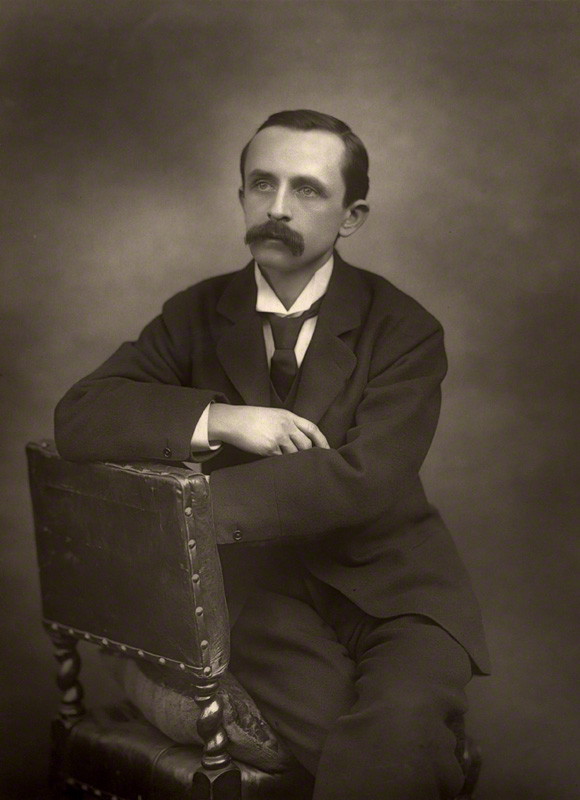
After all the joy that the Peter Pan story has brought to the world, it seemed appropriate to bring the life story of his creator, Sir James M. Barrie, to life. Finding Neverland is not strictly speaking either a biopic on the life of the author nor about the creation of his most famous character. Instead, it is a mixture, well-done, well-acted, but highly fanciful in more ways than one.
James Barrie (Johnny Depp) is a playwright whose latest work has flopped. His wife, Mary (Radha Mitchell) doesn't understand him. She would rather try to climb society than deal with his artistic frustrations. One day whilst walking and writing in the park, he comes upon a group of boys. It is the Llewelyn Davies children, who are in the park with their widowed mother, Sylvia (Kate Winslet). James soon enchants them: George (Nick Raud), Michael (Luke Spill), and Jack (George Prospero). However, one of them he cannot win over: young Peter Llewelyn Davies (Freddie Highmore), who sees things as they are, not as he would like them to be. In short, he has no imagination, much to Barrie's sadness.
In any case, there are many who disapprove of Barrie lavishing so much attention on the Widow Davies. There's Mrs. Barrie (who due to a mixture of this and her own evil starts an affair). There's the Widow Davies' mother, Madame DuMarier (Julie Christie), who thinks it's idiotic that a grown man should be at play. However, Barrie appears more interested in the Davies boys than in anything close to romance with the Widow Davies. The boys, having endured the trauma of having lost their father, become worried when their mother begins coughing incessantly.
However, thanks to the Davies boys, Barrie is now inspired to write the story of a boy who wouldn't grow up, much to the puzzlement of his producer Charles Frohman (Dustin Hoffman) and the cast of his new play (who don't understand the idea of dogs as nannies and being who can fly and all this about Indians and pirates). Despite his misgivings, Frohman produces this Peter Pan, and with a little help from children in an orphanage whom Barrie has brought in, the play is a hit.
Unfortunately, the Widow Davies could not attend. She is deathly ill and on the night of the premiere has to be confined to bed (although she insists the boys go). Madame DuMarier, having been put in her place by George (who insists "Uncle Jim" be allowed to visit), is not moved, but when Barrie brings Peter Pan to her, she does appear to melt...ever so slightly. That is, until her daughter finally dies. In her will, Sylvia has made James the co-guardian of her boys, and while Madame DuMarier isn't happy about it, she decides to respect her daughter's wish. Finding Neverland ends with James offering comfort to Peter, who now knows he can believe...
Finding Neverland as I've stated, is not about J.M. Barrie. It also isn't about the creation of Peter Pan per se. Rather, Finding Neverland tells both stories, a mixture of both a point in Sir James' life and how his most famous work came to be--two stories running parallel but rarely if ever intersecting. Director Marc Foster has moments where the rehearsing for Peter Pan is connected to what's going on the Davies boys' lives and gives hints about the confusion the actors have over the material. He also has bits of when his involvement with the Davies family is far more important than his career. However, I never got the sense that both stories connected.
We get little hints of how his interactions would bear fruit. A little light glowing at the tail end of a kite looked awfully like a fairy, and how Grandmama DuMarier menaces the children with a coat hanger (which looked suspiciously like a hook) would signal where Barrie's imagination was spinning. This wasn't a bad idea, but it didn't make one think, "Oh, so THAT'S where Tinker Bell came from", more like, "Oh, we're getting hints about Peter Pan". For a film about the magic of imagination, these little bits were a little too forced.
I also had issues with the deliberate whimsy in Finding Neverland. In one scene, as Barrie entertains the children by dancing with his dog while pretending it is a bear, we see the world transformed into a circus where he is, indeed, dancing with a bear (or rather an obvious man in bear costume). Near the end, when Sylvia is introduced to Neverland, we do literally walk into that fantasy world.
I don't object to this (after all, film is allowed some creative license), but somehow these flights of fancy do take away from the serious issues the Davies family is facing. The fact that we don't really know what is killing Sylvia almost makes the thing come close to melodrama (I thought she had good old consumption, but since I saw she coughed no blood it might not have been).
I finally question the intelligence of Barrie and Sylvia. How in Edwardian times both Barrie and Sylvia wouldn't think the idea that a widow going around with a married man might raise eyebrows makes them either totally innocent or totally dim. I vote for innocent. As portrayed by Depp and Winslet, they did not have a passionate yearning for each other. In fact, it appeared that the Widow Davies was more a chum to Barrie than a potential lover. He appeared to appreciate that he had new playmates more than anything else.
This isn't to say that David Magee's adaptation of Allan Knee's The Man Who Was Peter Pan didn't have some good things going for it. Chief were the performances. I am not a fan of accents on film, but Depp made his Scottish brogue into something so natural one would almost think Ewan McGregor had done dubbing work. His accent was flawless, never intrusive or exaggerated, but one that sounded authentic. He also made Barrie into a gentle soul, and it is nice to see a writer who doesn't appear to be insane.
Winslet is someone whom at times I am not fond of as an actress. I think she is a better actress whenever she is asked to keep her clothes on, and here she doesn't make her dying heroine into a figure of pathos and grand drama, but simply a mother who misguidedly thinks she is protecting her sons. It's unfortunate that Christie is reduced to the role of the heavy, and this is a flaw in the script: it never makes the case as to how SHE was the one leading the applause to save Tinker Bell.
One also congratulates the young cast for making the Davies boys come alive. Freddie Highmore, with the plum role of Peter, conveys excessive maturity with vulnerability as the boy who grew up too fast. He holds an audiences' attention in his stubborn refusal to be a child until he finds that despite his best efforts, he still feels pain.
A side issue: somehow, I didn't fully take the idea that Mrs. Barrie had to be such a cold, unfeeling bitch. I find that this convention of film usually happens to justify a spouse leaving someone for someone else (someone better, nicer, kinder). The real Mary Barrie may have been a terrible person, but somehow Mitchell's one-note performance makes her a caricature and less a person.
On the technical matters, Finding Neverland does a fine job recreating the Edwardian theater world in the costumes and sets (all which appear real and authentic rather than excessive). Jan A.P. Kaczmarek's score is gentle and magical, a credit to the film.
Finding Neverland is a good film, with good performances, especially from Depp and Highmore. However, it is fantasy in so many ways. We can leave aside certain liberties the film takes with historical accuracy (such as the fact that Mr. Llewelyn Davies was still alive in 1903 when the film begins). The real story of the Davies boys post-Peter Pan is far darker and depressing.
George was killed in World War I, Michael drowned at age 20 with his best friend (and possible lover), and Peter committed suicide at age 63 in 1960, plagued by alcoholism and the notoriety/burden of being the inspiration for Peter Pan.
Perhaps, given the sorry situation the boys had afterwards, the fantasy/fiction of Finding Neverland might be better. It is better to see the boys sad but comforted rather than truly lost...
![]() |
| 1860-1937 |
DECISION: B-