Showing posts with label Thelma Ritter. Show all posts

Saturday, June 13, 2026

Birdman of Alcatraz: A Review

BIRDMAN OF ALCATRAZ

The Beatles never formally reunited. Despite that, they released Free as a Bird fifteen years after John Lennon's murder. Blending his home demo with new tracks by the surviving Beatles, Free as a Bird became a Grammy-winning hit. Free as a Bird came often to my mind while watching Birdman of Alcatraz. Misnamed, curiously laudatory of its subject, and longer than necessary, the celebration of Birdman of Alcatraz puzzles me. 

Thomas Gaddis (Edmond O'Brien) narrates our story. He is in San Francisco to get a glimpse of Robert Stroud (Burt Lancaster). Stroud is leaving Alcatraz after seventeen years there. As Gaddis waits, standing by the dock of the bay, we hear Stroud's story. Stroud is on his way to Leavenworth Prison for murdering a man in Alaska. He is a bit of a noble rebel, smashing a train window to let some air in for his suffering fellow inmates. "Even a convict's got a right to breathe", he tells Leavenworth warden Harvey Shoemaker (Karl Malden). They grow to become bitter rivals. Stroud is very touchy about anyone so much as commenting or even touching his photograph of his mother Elizabeth (Thelma Ritter).

An innocuous comment about Mrs. Stroud has him attack a fellow prisoner, which leads to the first of many solitary confinements. Him not being able to see her because she came on the wrong day ends with Stroud murdering a guard. Elizabeth goes all the way to the White House to plead for her son to be spared the death penalty. Her audience with First Lady Edith Wilson (Adrienne Marden) saves Robert's life. Unfortunately, the technical reading of his sentencing means that he will have to stay in solitary for the rest of his life.

Robert reluctantly settles into his life without anyone. One stormy day while taking recreation, he spots an injured sparrow. With nowhere to go and nothing to do, he takes and nurtures the bird back to health. Stroud soon finds himself surrounded by other fine feathered friends but aviary and human. There is prison guard Bull Ransom, who becomes something of a frenemy. There is Feto Gomez (Telly Savalas), his next-door cellmate. Stroud soon becomes an expert on birds with a particular emphasis on septic fever. He begins experimenting with various treatments, much to Shoemaker's displeasure. 

Eventually, he finds a cure. That, along with his writings, brings Stella Johnson (Betty Field) into his life. She offers to sell Stroud's bird cures after he won second place in a bird magazine. From there, a romance blossoms. Elizabeth Stroud is extremely displeased by this, calling Stella "a common adventuress". Mother and son have a falling out, to where Elizabeth openly opposes parole for her Bobby.

Without notice, Stroud is transferred to Alcatraz, the most notorious and strict prison in the United States. Alcatraz will not allow him to keep birds. Shoemaker, now warden of Alcatraz, endures his thorn at his side. He does not despise Stroud. He also does not like him. As time goes on, Stroud reunites with Gomez, discourages Stella from following him to San Francisco and stays out of a prison uprising. Now back at the beginning, Gaddis finally sees Robert Stroud emerge from the Rock.


One can start looking at Birdman of Alcatraz by pointing out that technically the title is incorrect. Stroud kept no birds at Alcatraz, so I wonder if he could be the "Birdman of Alcatraz". I suppose that Birdman of Leavenworth does not have the same romantic feel to it. One should give credit to Guy Trosper's adaptation of Thomas Gaddis' book that this was not changed. Birdman of Alcatraz was very sympathetic to Stroud, portraying him in a light verging on divinity. His murders, his arrogance, his hostility to authority were either downplayed or made almost into virtues. 

This is helped by Burt Lancaster's Oscar-nominated performance. Lancaster was a blend of square-jawed rectitude and soft-spoken as Robert Stroud. His performance was not exactly one-note. For me, Lancaster was forever noble and gentle. Sometimes Lancaster's acting came close to almost silly. At one point, he lets his various birds out of their cages. Posing like a Greek statue, his face almost immoveable, Lancaster and director John Frankenheimer seem dead set on making Stroud almost heroic. I won't say that Burt Lancaster gave a terrible performance in Birdman of Alcatraz. I will say that Lancaster and Frankenheimer were so determined to make Stroud so good that they sapped whatever humanity there was in him. This version of Stroud had almost no flaws. He was portrayed more like either a gentle man or almost a victim of circumstances. When we see him arrive in San Francisco, it is treated almost as if he were Captain Alfred Dreyfus returning from Devil's Island. 

Curiously, I thought that Telly Savalas might have been better as Robert Stroud. Like Lancaster, Savalas earned an Oscar nomination for Birdman of Alcatraz in the Supporting Actor category. It is nowadays hard to overlook how the Greek Savalas was cast as "Feto Gomez". I grant a little leeway since the half-Mexican Anthony Quinn has become the embodiment of the larger-than-life Greek as Zorba the Greek. Unlike Lancaster's more noble and serious Stroud, Savalas' Gomez had greater emotions. He could be cheerful or angry depending on the situation. I cannot say that you miss him when he is not on screen. However, when he is on screen, you do notice and enjoy his presence. 

Birdman of Alcatraz was the sixth and final of Thelma Ritter's failed Best Supporting Actress Oscar nominations. She was good as Mother Elizabeth Stroud. She had few scenes, all but two with Lancaster if memory serves right. Ritter made Mrs. Stroud into a loyal and loving mother. It is a bit unclear if her objections to her Bobby marrying were due to jealousy or concern that Stella would bring him trouble. Her final scene where she is supposed to be brokenhearted about now opposing parole for her son fell a bit off the mark for me. Overall, though, Thelma Ritter acquitted herself well in the role.

Also doing good work was Karl Malden as Harvey Shoemaker. He was solid as someone who did initially want to help Stroud, but who ended up one of his bitterest foes due to Stroud's stubbornness and arrogance. Betty Field's Stella was pretty strong as well. She made the transformation from Stella's initial reluctance to be with Stroud to being the loyal spouse believable. Unlike Ritter, Field's final scene with Stroud was moving. 

Birdman of Alcatraz may have laid the metaphor of being free like a bird a bit too think. That is especially true with Elmer Bernstein's score, which was excessively gentle. I get that it was attempting to match the film's mood. It might have been a bit overboard in that department, having like Lancaster's performance the subtlety of a sledgehammer. 

Birdman of Alcatraz is not a bad film. However, I think the almost two-and-a-half-hour runtime is unnecessary. It takes close to two hours to move Stroud to Alcatraz. The prison riot known as the Battle of Alcatraz takes place two hours and ten minutes into the film. Granted, it is part of Stroud's life story (him dying a year after the film's release). However, it almost felt as if this was included to give the film any type of action. Even that was not done well, with the riot coming across as slightly boring.

While watching Birdman of Alcatraz, I had a very curious sense that the film was whitewashing to downright lionizing Robert Stroud. In real life, Robert Stroud was not the gentle, soft figure Burt Lancaster portrayed. He was a dangerous criminal who just happened to learn a lot about birds. Something about making Robert Stroud into this quasi-gentle soul simply did not sit well with me. It came close to being as if someone made a Charles Manson biopic and focused on his songwriting. A little longer than necessary, with a main performance more focused on being noble than delving into the complicated nature of the man, Birdman of Alcatraz was a slight disappointment. 

1890-1963

Saturday, January 30, 2010

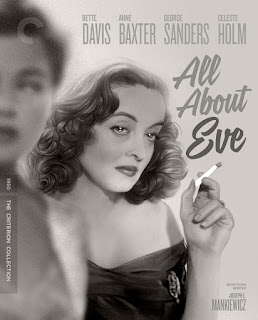
All About Eve (1950): A Review (Review #41)


ALL ABOUT EVE (1950)

There are few things as flat-out pleasurable as seeing people at the top of their game. It is a joy to behold people who know what they are doing and do it so well. This is the case with All About Eve, a malicious yet truthful look into human nature and folly. The setting may be the theatrical world of Broadway, but the line between theater and theatrical is a thin one.

The Sarah Siddons Awards dinner is the gala where three narrations tell their interconnected stories. Theatre critic Addison DeWitt (George Sanders), playwright's wife Karen Richards (Celeste Holm) and Broadway diva Margo Channing (Bette Davis) each take turns narrating. 

Eager young theatergoer Eve Harrington (Anne Baxter) finds herself in the heady world of Broadway lights. Eve soon charms everyone in Margo's circle save for Margo's maid Birdie (Thelma Ritter), who senses something is off. Soon, Eve reveals she is much more than the sweet, always eager-to-please war widow. You see, she's also an aspiring actress, one with burning ambition, and one who thinks she'd be perfect for a part written with someone else in mind.

It isn't long before wool starts falling over and off people's eyes, but while some are ensnared in the evil schemes, others are not. Ultimately, we find that there are other Eves waiting to take their turn.

What makes All About Eve stand out is that everything in it works so smoothly it looks almost effortless. Writer/director Joseph Mankiewicz creates a world where people use words as weapons and a single put-down can cut to the core. The script is witty, sharp and shrewd, capturing the way people can be self-interested even when not meaning to.

Mankiewicz has the patience to let the story tell itself. Rather than rush everything or worse, have everything explained to us, he allows the dialogue to carry the film and give us an insight into the characters. He trusts that we will be able to keep up with the story. 

He also has a great ear for dialogue and attention to how intelligent people speak. During a verbal fight that playwright Lloyd Richards (Hugh Marlowe) and Margo have over Eve and even after he leaves, Margo continues to use the phrase "fire and music", which Lloyd used to describe what Eve had done. I find it is human nature to repeat certain words and phrases that get at people, and here, Mankiewicz makes the dialogue both intelligent and realistic.

Take, for example, the opening. We hear the cynicism of Addison and the sincerity of Karen not just by what they say but in how they say it, their voices and choice of words mirroring their personalities. 

Mankiewicz also directs the actors to say so much with just their reactions. All the praise being heaped on Eve is counter-set by the reactions of DeWitt, Margo's beau/director Bill Simpson (Gary Merrill), Karen and Lloyd. Here, we quickly establish that it's not what others might think about Eve that is the truth, but what this particular group knows and says about her. 

There are brilliant bits of dialogue throughout the film, such as when Margo confesses (albeit a bit drunkenly) about her fears on turning 40, or the fight between Margo and Lloyd, or when Margo discusses (this time sober) what it's like to be a woman with a career, between the persona of Margo Channing and the person who is Margo Channing.


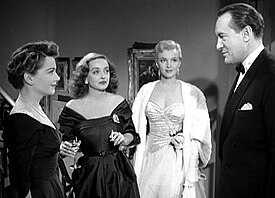
The meatiest dialogue goes to Addison DeWitt. His name alone explains what kind of person he is: a sharp man who is far too smart for himself and those around him. Few people have been so gleefully malicious and snide, contemptuous of people and also understanding of how people's need for applause or love can make them do all sorts of terrible things to others. He also is cynical of almost everything and everyone. When his protégé Miss Casswell (Marilyn Monroe in one of her earliest roles) bombs the audition, he encourages her to go into television. "Do they have auditions in television?" she asks. "That's all television is. Nothing but auditions", he tells her. 

If you listen to all the characters speak, you find that they all have something clever to say about each other, or themselves, or their various situations. All About Eve has an incredible screenplay, among the best ever written for film.

Another aspect of All About Eve that sets it apart from most films is the acting. It's rare when you get one or two great performances in the same film, but here every performance from the headliners to the smaller roles are brilliant. George Sanders brings a vocal sneer to DeWitt, someone who has a great opinion of himself because he knows who he is and is entirely unapologetic about it. Marlowe makes Lloyd the perfect dupe in Eve's machinations, and Merrill brings a realistic approach to Bill Simpson as someone who isn't impressed or taken in by the subterfuge of the theater and its world but who sees it as a job like any other.

As the title implies, All About Eve is dominated by the fair sex. Karen could have come off as stupid or naïve, but Holm makes her a sincere friend to everyone she meets but one unafraid to tell people what she thinks. Even she, however, is not above a touch of cynicism, as when she assures Eve that she'll get Lloyd and Bill to let her be Margo's understudy by telling her, "They'll do as they're told".

Baxter's Eve makes her metamorphosis from sincere, sweet, kind, girl to one of the great screen villains. She holds the audience in wait, making us wonder who Eve really is, perhaps even up to the end of the film. In her surface kindness that hides a heart of mud, Baxter holds our attention, devouring anyone who stands in her way until she meets her match in DeWitt, nobody's fool.  It's a truly pitch-perfect performance.

The highlight, however, has to be Bette Davis as Margo Channing. One can make a case that Davis was playing a version of herself: the temperamental yet vulnerable actress who fears she might lose everything and have nothing left except a book full of clippings. However, she embodies this well-written character and make her real. We know Margo as a woman who loves being an actress, who loves Bill, but who while knowing she is a great star and great actress is still a woman who wants a man she fears may leave, especially now that she's hit a critical age of 40. Her discussion about this to Lloyd is a remarkable dramatic turn, one where Davis lets her guard down and has us totally sympathize with a person as opposed to the persona she may come off as. Margo Channing, however, is no wimp. She knows how to take it, and when she says good-bye to Eve it's one of the finest kiss-offs in film.

There are a few odd bits in All About Eve. For example, there's Thelma Ritter's Birdie Coonan. There is nothing wrong with her performance, but curiously she disappears completely after Bill's birthday party with no explanation for her departure. There is also the scene where Addison and Eve leave the Shubert Theater in New Haven, which is obviously fake. The latter is a minor detail, a bit of 50's filmmaking, while the former is something not so easily dismissed.

At the end of All About Eve, we get the sense that Eve may eventually get what she deserves, but we also get the sense that Mankiewicz is making a commentary about celebrity. Margo, for whatever her faults, is both an actual actress and a genuine person, someone who while at times difficult can always be counted to be professional where it's important and who knows it's her job to be good. Eve, on the other hand, appears to want a theatrical career for the applause serving as a substitute for love. She wants to be a star but has the talent to back it up. 

As for the minor but important character of Phoebe, it appears that fame for fame's sake is something that didn't originate with reality television and YouTube.

You have great acting in All About Eve. You have great dialogue in All About Eve. You have a story that has recognizable people in All About Eve. In short, you have an extraordinary film. All About Eve is not just a landmark film. It is also a very good one.

DECISION: A +

1951 Best Picture: An American In Paris

For the complete Best Picture Winners reviews, please visit the Best Picture Winners Catalog.