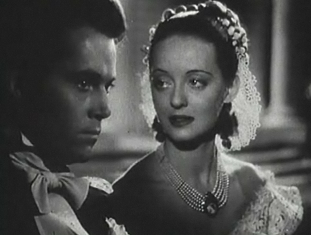
Jezebel, as a song of the South, might startle people with a scene where the slaves come up to Halcyon and sing, We're Going to Raise a Ruckus Tonight. The sight of happy slaves singing might now raise eyebrows. I found it illogical that all these slaves would be up at such a late hour for a hoedown. It does not help that Davis as Miss Julie joins in and pronounces the word as "Roo-kus" versus "Ruck-us" that I am more familiar with. Is it a Southern version. Wyler also films the panic of the plague very effectively.
Monday, October 27, 2025
Jezebel: A Review (Review #2060)
Jezebel, as a song of the South, might startle people with a scene where the slaves come up to Halcyon and sing, We're Going to Raise a Ruckus Tonight. The sight of happy slaves singing might now raise eyebrows. I found it illogical that all these slaves would be up at such a late hour for a hoedown. It does not help that Davis as Miss Julie joins in and pronounces the word as "Roo-kus" versus "Ruck-us" that I am more familiar with. Is it a Southern version. Wyler also films the panic of the plague very effectively.
Thursday, August 22, 2024
The Star (1952): A Review
This review is part of the Summer Under the Stars Blogathon. Today's star is Bette Davis.
We had the "comeback" of a silent film star in Sunset Boulevard. Now it is the sound era's first generation of film actresses longing for a return with The Star. Earning the penultimate Oscar nomination of her career, The Star is a respectable Bette Davis vehicle.
Film legend Margaret Elliot (Bette Davis) has an Oscar to her name, but that is really about all she has to her name. Margaret has fallen on hard times. Her agent cannot get her work, she has endured the humiliation of a public auction of her belongings and faces eviction from her small apartment. She also had to essentially farm out her daughter Gretchen (Natalie Wood) to her ex-husband, who has a happy second marriage and more successful career. The final indignity is when her sister and brother-in-law come asking for a monthly allowance, uninterested that she is broke.
Despondent, Margaret takes her Oscar and says, "Come on, Oscar. Let's you and me get drunk!". An arrest for DUI yields an unexpected source of help: Jim Johansen (Sterling Hayden), a former costar who left the industry and is now happy as the owner of a boatyard. He encourages her to start a new career as a saleswoman, but that ends in disaster when she's recognized and mocked. The DUI arrest, ironically enough, gets her publicity, which in turn gets her a chance to be in The Fatal Winter, a role she has coveted for years.
Therein lies the problem. She had optioned The Fatal Winter years ago when she was an ingenue, but now she is offered a screen test for the older sister. Determined to get a part she is far too young for, she vamps up her screen test. Watching it later, she realizes her disastrous mistake. Is it too late for her to make a comeback? Will she realize that a post-career life with Jim and Gretchen is better than trying to keep being The Star?
Bette Davis was 44 when she made The Star, and I think that reveals how difficult it was for older actresses to have roles that were not positive portrayals of older women. Her prior Oscar nomination for All About Eve touched on a similar theme of actresses of a certain age needing to move past their glory days to more domestic matters. I do not know if it was a reflection of 1950's America, but there it is.
The Star has a standout performance by Davis as Margaret Elliot. She is strong whenever she has to endure some kind of humiliation due to her faded career. The quiet expressions of either sadness or rage whenever her status is brought up works. Davis even manages to be funny in some of her line delivery of Dale Eunson and Katherine Albert's screenplay. One cannot help but smile when she looks at her Oscar and tells him to join her on going on a bender. Later, she goes off on two old women who look horrified when Elliot throws lingerie at them for pushing her on whether she was Margaret Elliot.
"Call the manager! Call the President! Call the fire department!" Elliot bellows when one of them says she will call the manager on her. I don't know how Margaret went from "the President" to "the fire department", but I found it funny. I also found it true-to-life, this stream-of-consciousness that led from one group to another. She is effective, if perhaps slightly mannered, when working with Wood as her daughter. The efforts to push these devoted mother scenes was a bit forced in my view.
Davis' best moments are when she is auditioning for The Fatal Winter. In her efforts at the screen test to be coquettish when the role is meant to be frumpy, we see an actress (Davis) fully aware that her actress character (Margaret) is not fully aware of how ridiculous and contradictory she is. When she sees the footage, the genuine horror and realization of her grave error comes through. Margaret Elliot is not so much self-destructive as she is self-sabotaging.
Wood, in a smaller role, was strong as Gretchen, the devoted daughter who loved Margaret through thick and thin. I did feel for Wood on a personal level, however, when she has to have a scene while sailing, aware of her great terror of water. Hayden did well as Jim, Margaret's rescuer. I did find their love scenes stretched believability, but not to where they were ludicrous.
We had a great score from Victor Young, who always brought excellent music to whatever film he worked on.
The Star is entertaining and keeps your attention. The ending may be a bit pat and perhaps not the most original or affirming (no comebacks for Margaret or acceptance of time going by). On the whole, however, The Star is worth looking up.
Thursday, May 2, 2024
Dangerous (1935): A Review (Review #1810)
In 1934, a scandal broke out among the Hollywood set when Bette Davis was not nominated for her performance in Of Human Bondage. The response to this snub was so ferocious that the Academy of Motion Picture Arts & Sciences allowed for write-in voting to let the non-nominee Davis into the race. She ultimately lost to Claudette Colbert in It Happened One Night, though where exactly she ultimately placed in the overall voting is an unsolved mystery. Come the next year, Davis was going to win the Oscar come hell or high water. That hell or high water mark was Dangerous, a win which even Davis felt was a consolation prize for the Of Human Bondage snub. Dangerous, if remembered at all, is for Davis' Oscar win. While the film is a little dated and creaky, it is passable.
Joyce Heath (Davis) once ruled the Great White Way. However, a series of personal and professional tragedies led her to think she was a jinx to both people and Broadway shows. One person intrigued by Joyce is Don Bellows (Franchot Tone), who was inspired by her turn in Romeo and Juliet that he gave up a safe career and follow his dreams to be an architect.
A chance encounter with Joyce has him bringing her to his country retreat so she could dry out and pull herself together. At first, she is fine with being a lush but soon starts recovering and hopes for a comeback. She also falls for Don, who likewise is drawn to this tempestuous star despite being engaged to wealthy society debutante Gale Armitage (Margaret Lindsey). He, reluctantly, breaks off with Gale and soon mounts her comeback production of Forever Ends at Dawn.
He proposes marriage, but she declines. Why? It is because Joyce has a terrible secret that makes marriage to Don or to anyone impossible. Will Joyce continue being an "evil star" and bring misery to all who cross paths with her? Will Don and Joyce find happiness?
Dangerous might be the first time an actor would win an Oscar for reasons outside the nominated performance, though this certainly would not be the last time such a thing happened. Oscars have been won by people for "the wrong movie" or because they were "overdue" or as a de facto Lifetime Achievement Award. Ask everyone from Joan Fontaine to Leonardo DiCaprio to Jamie Lee Curtis. I think even Davis would say that, if not for her Oscar win, no one would remember Dangerous, let alone bother to see it.
As a film, Dangerous is not terrible. It does have a somewhat awkward manner of early sound films where you think people are being placed in relation to where the microphone is. It is also a bit of a stretch to believe that Don would take Joyce to his country retreat or that Joyce, in her early condition, would stay.
However, you do have a good performance from Davis as this troubled woman. In the middle of the film, she reads to Don a play, But to Die, from his library. It is not until the end that he realizes that she was making the whole thing up as she went along. That she was able to fool people showcased a committed actress to a part. Davis at times did appear a bit theatrical, such as when she drunkenly recites Shakespeare when Don first finds her. I put that down to her still developing as a film actress. Throughout Dangerous, we see an actress giving the part her all. Davis made good work out of Joyce Heath. She did not come across as some drunken harpy or pathetic lush but as an angry, bitter but terrified woman.
Davis even has a bit of comedy when dealing with Don's housekeeper, Mrs. Williams (Alison Skipworth). Surprised to find herself in strange surroundings and with an unknown woman, Joyce is naturally startled. Informed about her host's artistic abilities, Joyce snaps at the woman, "I suppose you're Mrs. Bellows, or are you just one of his sketches?". Davis does veer close to over-the-top when searching for more alcohol shortly afterwards, but I can forgive the somewhat overblown manner to things.
I cannot say much for the supporting cast. Tone had a curiously breezy manner for most of Dangerous, as if he was not taking this seriously. It works well in the early moments when he is a young, mostly carefree lad, but even when things are meant to be serious, Tone still seems a bit too jolly. Lindsey had a nothing role, so I won't belabor her dull manner. Skipworth was better, though underused. Late in Dangerous, we are introduced to Gordon (John Eldredge), who holds the key as to why Joyce and Don cannot get married. He too had little to do and is a bit of a bore.
Dangerous came at the start of the Code era, meaning that a tacked on happyish ending was made. I was not convinced things would work out the way they did. That, however, was more the constraints Laird Doyle had on his screenplay than on the actors or director Alfred E. Green.
Dangerous is a film that has possibilities and might be worth a remake. I doubt, however, that whoever takes the female leading role will replicate Davis in winning a Best Actress Oscar. Sadly, Dangerous does not make the case that Davis should have won for this role.
Friday, August 28, 2020
Now, Voyager: A Review (Review #1415)
This review is part of the Summer Under the Stars Blogathon sponsored by Journeys in Classic Film. Today's star is Paul Henreid.
Few films have the reputation for unabashed romance as Now, Voyager, and fewer films have more than rightly earned that reputation. With beautiful performances and a brilliant score, Now, Voyager is the weepiest but also among the most beautifully romantic of tales.
Friday, May 12, 2017
What Ever Happened to Baby Jane? A Review (Review #910)
Now that Feud: Bette and Joan has ended, it is time to look at the product at the heart of that sad and sordid story. An equally sad and sordid story, What Ever Happened to Baby Jane? might be the low-rent version of Sunset Boulevard, another tale of how Hollywood discards former 'stars' and how those people let their past destroy them. Part camp horror, part psychological thriller, What Ever Happened to Baby Jane? joined forever two strong actresses whose total loathing for each other, as we saw, made for great drama.
As for the film itself, it still is delightfully creepy, a Gothic horror tale with some macabre humor.
Jane Hudson (Bette Davis) was once a vaudeville child star billed as "Baby Jane" or "Baby Jane Hudson". Adored for her Shirley Temple-like persona (complete with Baby Jane dolls), she was actually a mean little girl: spoiled and uncaring. Her older sister Blanche (Joan Crawford) endured being ignored by her showbiz father until the 1930s, when it was Blanche, not Jane, who found success on film. Jane became a hopeless drunk, and one fateful night Blanche suffered a paralyzing injury in a car accident involving both sisters.
Now, they live together in virtual seclusion and isolation, shut off from the rest of the world. Jane, bitter, angry, alcoholic, vindictive and a lot bonkers, 'cares' for her crippled sister Blanche more out of guilt and necessity (Blanche's checks keep them solvent) than out of genuine love for the more successful Blanche. They have no visitors save Elvira (Maidie Norman), a housekeeper who constantly warns "Miss Blanche" of "Miss Jane" and her cruelties.
Those cruelties go up now that Blanch Hudson is having a bit of a comeback with her films airing on television, but Blanche is unaware of it since Jane throws out all the fan mail. That's not the only thing she throws out: Jane now is aware that Blanche is about to sell the house and perhaps put Jane away in a home/institution.
To counteract Blanche, Jane plans her own comeback, and in comes Edwin Flagg (Victor Buono), a second-rate pianist/composer living with his mother. Edwin sees the ad for an accompanist and goes to see Jane. He's shocked at this old woman still dressing like a six-year-old girl (complete with curls), but his need for money outweighs any qualms he might have.
Blanche now lives in terror of Jane, and with good reason. Baby Jane has served her sister both her pet parakeet and a dead rat for dinner and is showing signs of slipping further into insanity (though I figure the dead rat thing would be proof enough). Blanche is desperate for help: attempting to attract the attention of the neighbors or even crawling downstairs to get to a phone. Nothing doing: Jane always finds out her sister's plans and deals with them, sometimes brutally.
The most brutal is when Elvira forces her way into the house after being fired by Jane and finds Blanche bound and gagged. Jane takes a hammer and kills Elvira. She knows she has done something awful, but now cannot find a way to fix any of it. Edwin, for his part, won't hear anything Mama has to say, determined to get his meal ticket (and his money). It isn't until he stumbles, drunk, to the Hudson house and discovers Blanche himself in her sorry state that he flees. He also informs the police, and by now Jane is completely out of it. Dragging her sister out, she decides to make a run for it.
Jane takes Blanche to the beach and their memories of happier times, by now Jane totally divorced from reality. The police have found Elvira's body and are now searching for the famed Hudson Sisters. As Blanche lays dying, she makes a final, shocking confession to Jane. The police finally find them, and Jane, now totally immersed in her own fantasies of being a child star again, performs a little dance for the beachgoers, who gawk at this freakish sight.
What Ever Happened to Baby Jane? revels in its creepiness and macabre nature. When Baby Jane recreates her signature song, I've Written a Letter to Daddy, for Flagg to accompany her with, there's something psychotic and eerie about the whole spectacle, a mixture of mirth and madness that creates both a shocked and oddly humorous reaction.
Part of you might see it and be horrified at how ghoulish it is: a woman in her fifties attempting to be a girl of six, with garish makeup, hair and clothes. Part of you might also be highly sympathetic, almost sad, for Jane Hudson the woman who still sees herself in a way as Baby Jane (unless its to drink, when she sees she's all woman).
Baby Jane is one of Bette Davis' greatest screen performances. In the almost grotesque nature of Baby Jane, she manages to make her a monster (Baby Jane was voted one of the 50 Greatest Screen Villains), but also make her tragic, almost sympathetic. There are times when she sees how far off the deep end she's gone, and in those moments of lucidity, Davis just about breaks your heart.
As much as Davis might not want to have seen it, Joan Crawford is certainly her acting equal in this film. Her Blanche was one of great sympathy. While Davis had the creepier (and showier) role, Crawford is just as effective as the concerned Blanche, trapped in a nightmare. She comes across as actually very gentle and sweet, which is why you want her to escape this horror, and which makes the actual truth revealed at the end all the more shocking but understandable.
I mentioned that What Ever Happened to Baby Jane? could be the low-rent version of Sunset Boulevard, and that's not just because it covers similar territory (faded stars living out their lives in isolation and delusion, holding on to what was and refusing to see what is and wanting to make 'a comeback'). At one point, Edwin looks around the house's parlor and is flooded with pictures of Baby Jane in her prime. That evokes memories of how Norma Desmond had her own parlor in Sunset Boulevard: a tribute to herself in her glory days.
In his small but breakout role, Buono is slightly creepy himself as the hanger-on Flagg, mean towards his tottering old Mum while not ashamed to take advantage of someone's borderline senility to benefit himself. He finds the humor of being presented with an authentic Baby Jane doll, and his use of it causes Jane one of the few frights she suffers.
The title is a shrewd pun: it both asks generally 'what ever happened to Baby Jane?' in terms of how a once-hot career faded (an equivalent to those "Where Are They Now" features of formerly famous people) as well as a more specific 'what ever happened to Baby Jane?' in terms of this woman's psychological state.
Director Robert Aldrich never got as much credit as he should have for putting this freak show together. He got great performances out of his two divas, and managed to skirt around censors by using the doorbell to cover up a certain b-word Davis uses to describe her sister.
There are a few faults within What Ever Happened to Baby Jane?. One can clearly see in the final scene which shots were made on location and which were made in the studio. Elvira must have been pretty stupid to have taken so long to open the door to Blanche's room (for if she had just smashed the lock with the hammer, she would have found Blanche sooner and gotten to the police). She was also pretty dumb in leaving the hammer unattended (and it was pretty obvious what was going to happen, though perhaps it was meant to be obvious).
Still, on the whole What Ever Happened to Baby Jane? can be enjoyed as straight horror or slightly camp. It has strong performances from both Bette Davis and Joan Crawford and a macabre story that will surprise and even shock with the twists it takes. Horror and hysterics never mixed so well.
DECISION: A-
Saturday, August 31, 2013
Of Human Bondage (1934): A Review (Review #563)
Beware Those Bette Davis Eyes...
Of Human Bondage is thought of as one of the great English novels, so naturally I have not read it yet. The adaptations of the W. Somerset Maugham's novel appear to not tell the whole story but on one aspect of it: the twisted affair between clubfooted dreamer Philip Carey and tawdry gutter queen Mildred. This adaptation of Of Human Bondage is a little creaky, showing its age. However, it is elevated by Bette Davis' performance as Mildred, a vile woman who gets her comeuppance in the end, but which still makes it rather sad in the end.
Phillip Carey (Leslie Howard) dreams of being a painter, but upon being told he has no talent for it he opts to go back home from Paris to London, where he attends medical school. His clubfoot puts him at arms length from most of his fellow classmates, but not all of them. He makes friends with Griffiths (Reginald Denny), who in turns is fascinated by waitress Mildred (Davis). While she enjoys flirting with older (and wealthier) patron Emil Miller (Alan Hale), she doesn't reject Phillip, even if she doesn't care for him.
Phillip falls madly in love with her, but she is very dismissive of him. "I don't mind," she replies whenever he asks her out or declares love for her. He becomes more obsessed with her, so much so that a good girl that loves him for who he is, Norah (Kay Johnson) is no match for the vile Mildred. Mildred runs off with Miller, but despite what she tells Phillip he didn't marry her. He was already married, and she is with child. Phillip puts her up (and puts up with her), even after she wanton flirts with Griffiths.
Phillip eventually sees the futility of his position and leaves Mildred, who unleashes her fury at him. Eventually, Phillip has surgery for his clubfoot and finds love and fulfillment with Sally (Frances Dee), while Mildred succumbs to tuberculosis (in the novel, I understand it is syphilis, but censorship being what it was in the early days of the Production Code).
It is strange that Of Human Bondage makes you wonder not what the 'hero' sees in 'the tramp', but why 'the tramp' would ever bother with 'the hero'. I won't fault Howard for making Phillip this hopeless milquetoast of a man, perpetually weak-willed and downright stupid (I wondered why he would give up Norah given how vile Mildred is). I figure that was the role, and he played it well. Credit should be given to him for making Phillip's obsession complete and all-consuming.
However, Of Human Bondage is clearly Bette Davis' film. Her failure to receive a Best Actress Oscar nomination so outraged the members of the Academy the lofty organization was forced to abandon its standards and allow write-in votes to allow Davis a chance at an Oscar nomination she rightly earned through her performance. First, Davis maintains a convincing Cockney accent. Second and more important, Davis is never afraid to make Mildred a monster. Shrewish, manipulative, and selfish to the bitter end, Mildred is not only a tramp, but unapologetic about it. She never asks for forgiveness or absolution, but despite the end one might expect she deserved, one still feels a pang of sorry for the woman who would destroy so many lives (especially her own and her child's) for a quick and momentary satisfaction.
However, age has ravaged Of Human Bondage (and I don't just mean the film quality, which shows the importance of film preservation given that in the best available copy was highly scratched and worn down). The film itself, despite its 88 minutes, drags and feels so much longer (particularly whenever Davis isn't on-screen). When we spend time with Phillip and Sally's romance, to be honest I lost interest and barely paid attention, which is something I did when Davis entered the picture.
Of Human Bondage now is a bit dated and slow (dare I say, creaky), but for those who admire great performances, Bette Davis' turn as the tawdry Cockney should be something to feast on.
DECISION: B-
Saturday, January 30, 2010
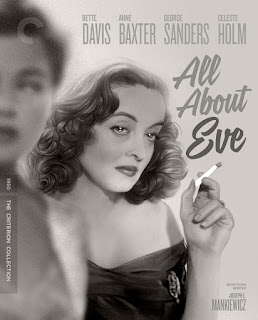
All About Eve (1950): A Review (Review #41)
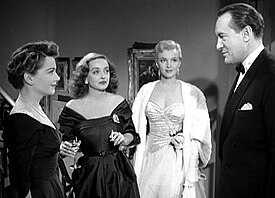
Baxter's Eve makes her metamorphosis from sincere, sweet, kind, girl to one of the great screen villains. She holds the audience in wait, making us wonder who Eve really is, perhaps even up to the end of the film. In her surface kindness that hides a heart of mud, Baxter holds our attention, devouring anyone who stands in her way until she meets her match in DeWitt, nobody's fool. It's a truly pitch-perfect performance.
DECISION: A +
1951 Best Picture: An American In Paris
.jpg)