Showing posts with label Joseph Mankiewicz. Show all posts

Monday, August 12, 2019

A Letter to Three Wives: A Review (Review #1250)


Image result for a letter to three wivesA LETTER TO THREE WIVES

This review is part of the Summer Under the Stars Blogathon sponsored by Journeys in Classic Film and Musings of a Classic Film Addict. Today's star is Ann Sothern.

A Letter to Three Wives is dated only by the fact that few people communicate via written letters sent by post. I do not see An Email to Three Wives ever being made. A Letter to Three Wives starts out slowly, almost haltingly, but once we get to the core we find such a rich and beautiful film about the struggles of womanhood, role expectations and that mysterious nature of love.

Three different women from three social levels who however still interact meet up for a daylong excursion chaperoning children on an island. Deborah Bishop (Jeanne Crain), Rita Phipps (Ann Sothern) and Lora Mae Hollingsway (Linda Darnell) get a joint message from Addie Ross (an uncredited Celeste Holm in voiceover). The letter to these three wives from their mutual frenemy tells them quite simply that Addie has run off with one of their husbands.

As they are incommunicado on this the first Saturday in May, they each reflect and remember their marriages, wondering whether its Brad Bishop (Jeffrey Lynn), George Phipps (Kirk Douglas) or Porter Hollingsway (Paul Douglas) who has absconded with the mysterious Addie.

Deborah married Brad right out of the Navy when both served in their respective naval branches. A country girl, she felt adrift in the posh surroundings of the wealthy Brad and his society friends. Insecure about herself, she feels inadequate compared to Brad and his old flame Addie.

The middle-class Rita writes radio shows and earns more than her schoolteacher husband. While she doesn't lord it over him, George still feels a bit emasculated and worse has contempt for the radio shows that appeal to lower classes.

The working-class Lora Mae not only came from the wrong side of the tracks, she lived right next to them. She married up when she got in with her hardware store king boss Porter, but they seem to always be taking shots at each other.

As the day ends, each wife learns which one will be sans husband, and those who find themselves still married discover that there is still love between man and wife.
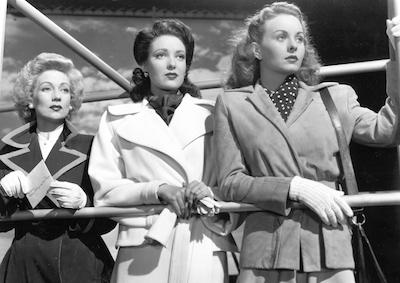
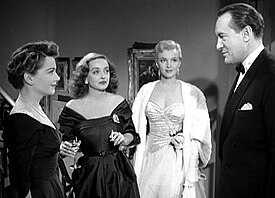
Image result for a letter to three wives 1949A Letter to Three Wives is interesting in one way that is not connected to the movie itself and that is because of writer/director Joseph L. Mankiewicz. Mankiewicz won the Best Screenplay and Best Director Oscar for A Letter to Three Wives and the next year won the same awards for All About Eve. If one saw them back-to-back, one would see similarities between them.

Both revolve around female friendships, a villainous femme fatate who wreaks havoc on their lives, and have multiple voiceovers. They even share a few performers (Holm and Thelma Ritter, though Holm was only in voiceover). I don't know why this detail so struck me, but it would be something worth exploring.

Mankiewicz is brilliant in how he has a very simple setup and then spins his story right from there without excessive details. In each flashback we get not just their own unique stories that led each to wonder about their marriages and their roles in them, but also strong character development. We see each of their insecurities, fears and motivations along with their distinct strengths.

They became individuals whose dilemmas we genuinely care about. He kept the mystery going right up to the end, and even with one twist proving false we got a somewhat happy ending, at least for one of the couples. We get a beautiful buildup to their crises in each section, seeing how they came to this particular point.

There are moments of comedy, such as Rita's flustered efforts to appear more elegant to her haughty sponsor and her henpecked husband. There are also moments of raw emotion as when Lora Mae and Porter finally see the truth about how they feel for each other.

What is fascinating about A Letter to Three Wives is how the flashbacks never feel forced or unnatural. In fact, I think the distortion used to modulate each of their voices as the enter or leave their memories is quite revolutionary. There's almost a musical quality to whenever they go back to the past, and it's aided by Alfred Newman's score.

Image result for a letter to three wives 1949
Out of all the performances from the women I would say that Crain was the weakest. She seemed a bit too forced and dramatic as the insecure Deborah, sometimes slipping into almost total hysterics when a softer touch would have worked. Sothern was so excellent as Rita, who could be quite compassionate and understanding while also thoughtless, depending on who she was with. Darnell could fire off quips and looks to show disdain or cynicism, but you also saw what motivated her to crawl her way out of the slums into respectability.

With the men, Lynn probably fared the worst as Brad is probably the smallest role. Douglas wasn't as intense as he normally is but was not as strong as Sothern. Douglas had a great mix of irascibility and insecurity as the older husband to Lora Mae, but he had a wonderful moment where he let his guard down just enough to reveal the scared man behind his bluster.

I go back to the screenplay to note that Mankiewicz had a very sly manner that revealed more than what was said or scene. In one scene, Lora Mae holds off Porter's advances, closing the door that has a "We Gave" sticker prominently displayed. There's a delightful double-meaning here in that "we" (Lora Mae) didn't give despite the sign.

Earlier, the haughty radio sponsor Mrs. Manleigh (Florence Bates) starts talking about how radio commercials are 'penetrating' people like Sadie. "After penetration comes saturation", she continues, and it's a wonder the censors did not pick up on such a daring line even if it is used in an appropriate context.

In another scene, Lora Mae's mother Ruby (Connie Gilchrist) is walking in to tell her daughter she's about to leave for a New Year's Eve game. She stops in mid-sentence to see Lora Mae and Porter in a passionate embrace and when told they're getting married, Ruby completes her sentence, "Bingo!" before fainting.

Again, a double-meaning between what was said and what was implied or suggested. Even when nothing is said we can get the message. When Lora Mae sees a picture of Addie at Porter's house, she essentially tells him he won't be a mistress but instead wants to be 'the girl in the silver frame'. On the fateful night we discover who Ms. Ross went off with, we see Lora Mae's picture in a silver frame.

A Letter to Three Wives is filled with such rich and deep subtext, a credit to Joseph L. Mankiewicz's mastery of writing and directing.

I would argue that the voiceover was perhaps the worst element: Holm was a bit too haughty and early on prone to make quips. Fortunately, the voiceovers died down. Perhaps the last shot too was a bit overdone. However, A Letter to Three Wives, while dated, is still a strong film with standout performances and a story that moves one. It makes one mourn that people no longer write letters to each other.

DECISION: A-

Wednesday, July 10, 2013

Sleuth (1972): A Review (Review #544)

SLEUTH (1972)


Murder is the Name of the Game...

Sleuth shows its theatrical roots in that there are only two characters (more or less) in the entire film.  Given the film is over two hours, would they be able to pull it off?  While Sleuth starts a bit slowly, by the end the wild twists and turns in it make it highly compelling viewing.  One soon is drawn into this double-act by two extraordinary actors, holding us at full attention with only a brilliant adaptation and their individual talent at their disposal.

Mystery writer Andrew Wyke (Laurence Olivier) invites Milo Tindle (Michael Caine) to his country estate.  Andrew and Milo are connected: Milo is Andrew's wife's lover.  A hairdresser by profession, this half-Italian son of a working-class watch repairman has, in the aristocratic Wyke's view, moved above his station.  Wyke has nothing but contempt for Milo, but he appears willing to let his wife go to him (the fact that Wyke has a mistress helps ease the pain).  However, Wyke warns Milo that the wife has grown accustomed to the good life, so a man of Milo's means may not hold her for long.  He makes Milo an offer he can't refuse: fake a robbery of the jewels, hock them to a friendly fence of Wyke's, and keep the money (while Wyke keeps the insurance money).  After some hesitation, Milo eagerly agrees, going so far as to don a clown outfit as part of an elaborate disguise.

However, at this point we get the first of many twists that leave the audience constantly wondering about what happened and what will happen?  WAS there a murder?  WHO was murdered (if there WAS a murder)?  Inspector Doppler (Alec Cawthorne) and Wyke match wits, with still more twists and turns leading to a super-surprise conclusion.

Already in my summation of Sleuth, I too have played a trick on the reader.  To give an actual and accurate description would be to give away far too much.  Normally, on the issue of 'spoilers', I try to either observe the silence or give warning, but with Sleuth there is simply too much within it to reveal more of the story.

What can be said is that the film is dominated by two brilliant performances by two brilliant actors.  Olivier was the haughty upper-class Wyke, a man thoroughly convinced by his own brilliance and superiority over everyone, especially over the 'dago wop' Milo.  In turns enthusiastic, prickly, and frightened, Olivier astounds the viewer with his mastery of his performance.

Caine is more than a match for Olivier as the younger man.  He goes through all the emotions: casual flippancy, anger, fear.  His confrontation with Wyke when it looks like the older man has the upper hand makes you sympathize and fear for him, but Milo is also able to turn the tables on Wyke, showing he is just as capable of playing Wyke's game.

Anthony Shaffer, adapting his play, makes the twists and turns in Sleuth logical (always a high point for me).  He keeps us guessing as to who is who, what is what.  The story matches the opening scene where Milo is wandering a labyrinth garden while we hear Wyke reciting the plot of his latest mystery novel starring his aristocratic detective. 

Sleuth is also filled with witty dialogue between Milo and Wyke.  Commenting on how far the half-Italian Milo has risen, up to living in a Georgian-era house, Wyke quips, "From Genoa to Georgian in a single generation."  At a critical point in Sleuth, when it looks like murder is the actual objective, we hear this line, "Property's always been more highly regarded than people."  When Inspector Doppler asks Wyke about how a divorce would cost much, Wyke responds, "Sex is the game.  Marriage is the penalty."

As a side note, either Wyke or Doppler make a comment about a "jumped up pantry boy who doesn't know his place."  It might just be me, but this line is also heard in The Smiths' song This Charming Man.  I do wonder whether Morrissey or Johnny Marr saw Sleuth and opted to take this line for their song, but it did strike me curious. 

Sleuth is not just a detective film, but a sharp social satire on the arrogance of the aristocracy and the ascendancy of the working class to middle class respectability.  Throughout the film the old-school snob Wyke has to match wits with those whom he would look down on. 

This was Joseph L. Mankiewicz's final film, and he couldn't have ended his career with a better project.  He kept things going in a firm, thrilling manner (even though I found the beginning a trifle slow).  Mankiewicz brought a sense of tension whenever one or the other character faces some kind of threat and keeps our attention until the last moment, when we get one last twist that appears just and right.

Sleuth has wit, humor, extraordinary acting, and a riveting story.  There is a great joy in seeing two great actors play against each other, using words and their wits as weapons against each other.  Sleuth, after a bit of a slow start, throws so much at you one marvels at how a movie with a very small cast can keep one in rapt attention. 

Two Sirs, With Love...


DECISION: A-

Saturday, January 30, 2010

All About Eve (1950): A Review (Review #41)


ALL ABOUT EVE (1950)

There are few things as flat-out pleasurable as seeing people at the top of their game. It is a joy to behold people who know what they are doing and do it so well. This is the case with All About Eve, a malicious yet truthful look into human nature and folly. The setting may be the theatrical world of Broadway, but the line between theater and theatrical is a thin one.

The Sarah Siddons Awards dinner is the gala where three narrations tell their interconnected stories. Theatre critic Addison DeWitt (George Sanders), playwright's wife Karen Richards (Celeste Holm) and Broadway diva Margo Channing (Bette Davis) each take turns narrating. 

Eager young theatergoer Eve Harrington (Anne Baxter) finds herself in the heady world of Broadway lights. Eve soon charms everyone in Margo's circle save for Margo's maid Birdie (Thelma Ritter), who senses something is off. Soon, Eve reveals she is much more than the sweet, always eager-to-please war widow. You see, she's also an aspiring actress, one with burning ambition, and one who thinks she'd be perfect for a part written with someone else in mind.

It isn't long before wool starts falling over and off people's eyes, but while some are ensnared in the evil schemes, others are not. Ultimately, we find that there are other Eves waiting to take their turn.

What makes All About Eve stand out is that everything in it works so smoothly it looks almost effortless. Writer/director Joseph Mankiewicz creates a world where people use words as weapons and a single put-down can cut to the core. The script is witty, sharp and shrewd, capturing the way people can be self-interested even when not meaning to.

Mankiewicz has the patience to let the story tell itself. Rather than rush everything or worse, have everything explained to us, he allows the dialogue to carry the film and give us an insight into the characters. He trusts that we will be able to keep up with the story. 

He also has a great ear for dialogue and attention to how intelligent people speak. During a verbal fight that playwright Lloyd Richards (Hugh Marlowe) and Margo have over Eve and even after he leaves, Margo continues to use the phrase "fire and music", which Lloyd used to describe what Eve had done. I find it is human nature to repeat certain words and phrases that get at people, and here, Mankiewicz makes the dialogue both intelligent and realistic.

Take, for example, the opening. We hear the cynicism of Addison and the sincerity of Karen not just by what they say but in how they say it, their voices and choice of words mirroring their personalities. 

Mankiewicz also directs the actors to say so much with just their reactions. All the praise being heaped on Eve is counter-set by the reactions of DeWitt, Margo's beau/director Bill Simpson (Gary Merrill), Karen and Lloyd. Here, we quickly establish that it's not what others might think about Eve that is the truth, but what this particular group knows and says about her. 

There are brilliant bits of dialogue throughout the film, such as when Margo confesses (albeit a bit drunkenly) about her fears on turning 40, or the fight between Margo and Lloyd, or when Margo discusses (this time sober) what it's like to be a woman with a career, between the persona of Margo Channing and the person who is Margo Channing.


The meatiest dialogue goes to Addison DeWitt. His name alone explains what kind of person he is: a sharp man who is far too smart for himself and those around him. Few people have been so gleefully malicious and snide, contemptuous of people and also understanding of how people's need for applause or love can make them do all sorts of terrible things to others. He also is cynical of almost everything and everyone. When his protégé Miss Casswell (Marilyn Monroe in one of her earliest roles) bombs the audition, he encourages her to go into television. "Do they have auditions in television?" she asks. "That's all television is. Nothing but auditions", he tells her. 

If you listen to all the characters speak, you find that they all have something clever to say about each other, or themselves, or their various situations. All About Eve has an incredible screenplay, among the best ever written for film.

Another aspect of All About Eve that sets it apart from most films is the acting. It's rare when you get one or two great performances in the same film, but here every performance from the headliners to the smaller roles are brilliant. George Sanders brings a vocal sneer to DeWitt, someone who has a great opinion of himself because he knows who he is and is entirely unapologetic about it. Marlowe makes Lloyd the perfect dupe in Eve's machinations, and Merrill brings a realistic approach to Bill Simpson as someone who isn't impressed or taken in by the subterfuge of the theater and its world but who sees it as a job like any other.

As the title implies, All About Eve is dominated by the fair sex. Karen could have come off as stupid or naïve, but Holm makes her a sincere friend to everyone she meets but one unafraid to tell people what she thinks. Even she, however, is not above a touch of cynicism, as when she assures Eve that she'll get Lloyd and Bill to let her be Margo's understudy by telling her, "They'll do as they're told".

Baxter's Eve makes her metamorphosis from sincere, sweet, kind, girl to one of the great screen villains. She holds the audience in wait, making us wonder who Eve really is, perhaps even up to the end of the film. In her surface kindness that hides a heart of mud, Baxter holds our attention, devouring anyone who stands in her way until she meets her match in DeWitt, nobody's fool.  It's a truly pitch-perfect performance.

The highlight, however, has to be Bette Davis as Margo Channing. One can make a case that Davis was playing a version of herself: the temperamental yet vulnerable actress who fears she might lose everything and have nothing left except a book full of clippings. However, she embodies this well-written character and make her real. We know Margo as a woman who loves being an actress, who loves Bill, but who while knowing she is a great star and great actress is still a woman who wants a man she fears may leave, especially now that she's hit a critical age of 40. Her discussion about this to Lloyd is a remarkable dramatic turn, one where Davis lets her guard down and has us totally sympathize with a person as opposed to the persona she may come off as. Margo Channing, however, is no wimp. She knows how to take it, and when she says good-bye to Eve it's one of the finest kiss-offs in film.

There are a few odd bits in All About Eve. For example, there's Thelma Ritter's Birdie Coonan. There is nothing wrong with her performance, but curiously she disappears completely after Bill's birthday party with no explanation for her departure. There is also the scene where Addison and Eve leave the Shubert Theater in New Haven, which is obviously fake. The latter is a minor detail, a bit of 50's filmmaking, while the former is something not so easily dismissed.

At the end of All About Eve, we get the sense that Eve may eventually get what she deserves, but we also get the sense that Mankiewicz is making a commentary about celebrity. Margo, for whatever her faults, is both an actual actress and a genuine person, someone who while at times difficult can always be counted to be professional where it's important and who knows it's her job to be good. Eve, on the other hand, appears to want a theatrical career for the applause serving as a substitute for love. She wants to be a star but has the talent to back it up. 

As for the minor but important character of Phoebe, it appears that fame for fame's sake is something that didn't originate with reality television and YouTube.

You have great acting in All About Eve. You have great dialogue in All About Eve. You have a story that has recognizable people in All About Eve. In short, you have an extraordinary film. All About Eve is not just a landmark film. It is also a very good one.

DECISION: A +

1951 Best Picture: An American In Paris

For the complete Best Picture Winners reviews, please visit the Best Picture Winners Catalog.