Showing posts with label Werner Herzog. Show all posts

Thursday, January 5, 2012

Cave of Forgotten Dreams: A Review


CAVE OF FORGOTTEN DREAMS

The Chauvet Cave complex profiled in Cave of Forgotten Dreams is one of the great wonders of man  but not open to the public due to potential damage to its fragility.  Now Werner Herzog, in his first 3-D film, has been granted rare access into the caves to explore one of the great wonders of the dawn of man.

We begin with a bit of background: in 1994 three scientists come into a previously unexplored cave.  Within it, a miraculous discovery: the earliest cave paintings ever discovered, brilliantly preserved, along with fossilized remains and footprints of long-lost animals.  The cave itself is highly restricted: it is not open to the public and Herzog and his crew were highly restricted in how they filmed.  They could only film for four hours a day, could not depart from an established, narrow walkway, had to wear special clothing and the crew was watched at all times.

However, the footage inside the cave itself is simply remarkable.  The cave paintings appear so fresh and new that if one did not know, one might have thought they were recently made.  Moreover, the fossils, including footprints of a child, bring a great connection between us and our distant ancestors.  We also get some beautiful imagery of the natural world within the Chauvet Cave: the light reflecting appears so beautiful and otherworldly.

However, Cave of Forgotten Dreams doesn't just deal with the Chauvet Cave itself.  We also get interviews with those who work at documenting the cave and who study the times of those who created the paintings.  Among the highlights is the interview with Wulf Hein, an "experimental archaeologist" who appears on screen in full caveman garb, which may be historically accurate but adds that bizarre Herzogian touch on things. 

As is his want, Herzog digs deeper (no pun intended) about the world of the Chauvet Cave painters, including the idealization of the female form as they would have seen it. 

If there is one simply extraordinary line in Cave of Forgotten Dreams, it's spoken by Herzog in his distinctly soft, Teutonic accent, it's this one when mentioning the Willendorf Venus:


"There seems to have existed a visual convention extending all the way beyond Baywatch".

One wouldn't have even imagined Herzog would even have heard of Baywatch, let alone know what it was best known for.  Then again, he is German and Baywatch star David Hasselhoff is a big star there.

We learn near the end of Cave of Forgotten Dreams that there are plans to recreate the Chauvet Cave as a theme park for tourists, even to attempt to recreate the odors within the cave.  In one way, it makes sense: the Lascaux Cave has been closed since the 1960s because the constant stream of visitors damaged the paintings.  However, there does appear to be something odd about the need to recreate locations, perhaps bordering on kitsch.  Perhaps Herzog could have explored that aspect (no pun intended).

He might also have done without the coda in the post-script: at the Rhone River Nuclear Power Plant, there is a greenhouse that contains albino crocodiles.  Herzog speculated on how the crocodiles would think of the Chauvet Cave paintings, and I think about how alien it would look to them.
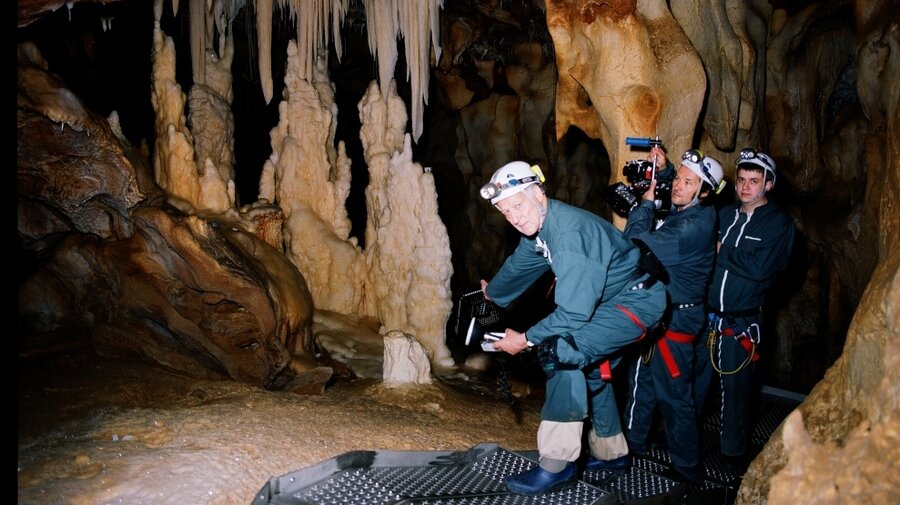
Image result for cave of forgotten dreamI don't think those are flaws per se, but how the albino crocodiles tie into the earliest known cave paintings of extraordinary craftsmanship he doesn't seem to answer.

Where Cave of Forgotten Dreams excels is when we can see not just the paintings themselves, but when we are reminded that these were individuals with life, not dusty shadows from a long-lost past.  We see this when our attention is drawn to a series of hand marks in red.  We know these hand prints were from the same person because of the "crooked little finger" the prints have in common.  We find that this unknown figure was attempting to create something, and that makes him similar to a Herzog, a man who also attempts to create art.

Sadly, I was not able to see Cave of Forgotten Dreams in 3-D.  However, one of the glories of the film is that nothing appears lost in 2-D, so the film stands on its own. 

Cave of Forgotten Dreams does I think tie in with Herzog's fascination with creativity and with obsession, this time about leaving a mark for the future, with the child's footprint inside the cave, in a literal sense.  The film explores the need to create, to express one's world to the best of one's ability.  It has beautiful imagery of a world we will never know, and a place we will never be able to go into. 

Man creates, man endures, Herzog seems to say, and Cave of Forgotten Dreams is our entry into this lost underground world.

DECISION: B-

Wednesday, February 2, 2011

Beware The Director's Wrath. Werner Herzog: The Great Directors Retrospective

Born 1942

WERNER HERZOG

Obsession. That has been the persistent theme, consciously or subconsciously, of the films of Werner Herzog. The obsession of finding the legendary city of gold El Dorado in Aguirre, The Wrath of God with longtime collaborator/nemesis Klaus Kinski right down to an animal rights activist's obsession with living with the bears that will eventually kill him (Grizzly Man), it is man's unique desire to go beyond the point of rationality that appears to draw Herzog's interest.

One can wonder if Herzog himself is drawn to obsessed characters because he himself is obsessed: with perfection, with crafting a great film, with going beyond what appears to be achievable.

I was extremely reluctant to approach Werner Herzog. It was only at the enthusiastic insistence of my friend Fidel Gomez, Jr. (who may or may not be dead) that I approached his first film with Klaus Kinski: Aguirre, The Wrath of God. It took a while for me to 'get around' to watching it, but once I did, I wondered to myself what kept me from this genius.

Aguirre doesn't appear to be a fictional film. Rather, it appears to be almost a documentary. Herzog did not have flashy effects or costumes because he couldn't afford them and it was brilliant to film on location in the Andes. All that gave it an air of authenticity which made it all the more real. After Aguirre, I went and purchased the Herzog/Kinski Box set, and was thoroughly amazed at both their craft.

Take Woyzeck for example. For most of the film, I thought it was oddly slow, almost glacial, in its pacing. However, I think that was all a trick on Herzog's part to lull me into a false sense of security, because the shocking moment in Woyzeck, while filmed deliberately more slowly, is even more shocking to where it almost comes out of nowhere. In reality, it doesn't come out of nowhere because everything has been leading up to it, but the emotional impact is still intense.


The most perfect example of Herzog's eternal fascination with obsession is Fitzcarraldo. Only a man thoroughly obsessed with a character thoroughly obsessed with the impossible would dare to do what Herzog did: move a ship over a mountain. It is speculation as to Fizcarraldo himself was a substitute for Herzog, but the fact that both the character and the director were determined to do the impossible and would not let anything stand in their way andeven more amazingly, succeed so brilliantly, to me is reflective of what kind of man Herzog is.

As for what kind of director Werner Herzog is, the answer is quite simple: brilliant. He is one of the last film-makers who trusts his audience by not having to spell anything out for them. Moreover, he doesn't rely on flashy imagery or effects. His images aren't created to draw attention to themselves but to serve the story. Sometimes, like in Fitzcarraldo, when a particular image does become iconic: a ship going up a mountain, it still is in service to the story which makes the image even more arresting.

Now, Herzog hasn't abandoned fictional films all together: Bad Lieutenant: Port of Call New Orleans was released in 2009. However, in recent years he's become more interested in documentaries. Who could blame him: here, he can discover real-life obsessions rather than fictional, although another 2009 film, My Son, My Son, What Have Ye Done? is based on a real-life event, which kind of blends both fiction and non-fiction together.

In fact, his only Oscar nomination (as of today) is in the Documentary Feature feature (for Encounters at the End of the World, which lost to Man on Wire).


Of the documentaries of Herzog's I've seen, the one I remember the most is Grizzly Man. The true story of Timothy Treadwell, the amateur student of bears who was eventually eaten by the same creatures he believed were his friends, is an extraordinary film. Herzog manages to make even silence chilling. In one of the most intense moments of Grizzly Man, he is listening to the audio of Treadwell and his girlfriend being mauled by the bear (Treadwell would often videotape himself with the bears and in his last moments he had the camera running but he left the lens cap on). We can only imagine the awful sounds of two people being killed.

At the end of the scene, Werner Herzog tells the woman who owns the tape in his soft German voice to destroy it immediately. We can only imagine how horrifying something must be if Werner Herzog thinks it's too horrifying.

Another lesser-known documentary is Wheel of Time. This one is about the Dalai Lama and his teachings, along with the creation and ultimate destruction of the mandalas the Tibetan Buddhist monks create. Curiously, at least to me, it goes against Herzog's usual motif of obsession. Rather, the fact that it is about contemplation shows he can take on different subject matter. It is a fine crafted film, as most of his are.

I would love for Werner Herzog to win an Oscar: competitive or Honorary. He may have a chance with the upcoming Caves of Forgotten Dreamsyet again another documentary. It is also, curiously, his first 3-D film. There we have a curiosity most unique: a 3-D documentary. He and I have the same view of 3-D: neither of us are big fans of it. However, his use of it isn't a sell-out (let's face it: documentaries, even in 3-D, aren't exactly big draws). I think the subject matter to him lent itself to the possibilities of third dimension, and I wonder if I will be able to watch it in 3-D.

In a sense, the painters in the Chauvet Cave all that long ago may have preceded Werner Herzog in the realm of obsession. Just as the long-lost creators of the cave paintings may have been determined to capture moment on the walls, Werner Herzog now appears determined to capture their images.

Obsession. It's what Werner Herzog lives for.

Visit the Great Directors for the monthly retrospective on this geniuses of cinema.

Saturday, January 9, 2010

Aguirre: The Wrath of God. A Review


AGUIRRE, THE WRATH OF GOD

Andean Insanity...

Aguirre: The Wrath of God is how Joseph Conrad's Heart of Darkness would have been like if it had taken place in South America, for has at its core an insane quest led by an insane man. The first collaboration between director Werner Herzog and actor Klaus Kinski, the film is a quiet journey into madness, chaos, destruction, and death.

Aguirre purports to tell the story of a doomed expedition into the Amazon. Spanish conquistador Gonzalo Pizarro sends a small group, led by Don Pedro de Ursua (Ruy Guerra), to search for El Dorado, a fabled city of untold riches. Over Pizarro's objection, two women join the expedition: Don Pedro's mistress, Doña Inez (Helena Rojo), and Flores (Cecilia Rivera), daughter of Ursua's second-in-command, Don Lope de Aguirre (Kinski).

It isn't long before Aguirre leads a coup against Ursua and places Don Pedro de Guzman (Peter Berling) the titled nobleman of the expedition as his puppet, naming him "Emperor of El Dorado". As they go further down the river, the members of the expedition grow more and more tired, hungry, and delusional. Yet they press on, driven by fear of Aguirre and their own gold-lust. Ultimately, the members slowly go mad and/or end up dead, with the now-totally insane Aguirre declaring himself ruler over all he surveys, with only monkeys to rule over.

The simultaneously massive and minimal nature of Aguirre, The Wrath of God is seen right at the opening. Accompanied by the brilliant music of musical group Popol Vuh. After a brief prologue, you slowly focus in on this group going down a mountain, these Spanish conquistadors and their Incan slaves, going further down the valley. 

There is no dialogue in the opening save for the voiceover from monk Brother Gaspar (Del Negro), but Herzog's visuals capture more than what is spoken. We see the smallness of man against unconquered and perhaps unconquerable nature, the prospect of vast rewards blinding the expedition to their metaphorical and literal descent into a beautiful hell. 

Aguirre, The Wrath of God showcases how a deranged drive will cause men to abandon reason. A brilliant example of this is after Don Fernando is proclaimed Emperor. Though he has no power whatsoever the expedition treats him as if he were an actual monarch. He is fed elegant food on the makeshift raft while the rest of the crew starves. Rational men would have forced a return to the main Spanish group, but greed and the fierce nature of Aguirre push them forward. This is as frightening a portrait of how men can delude themselves through a mixture of fear and in this case greed.

At the heart of Aguirre is Klaus Kinski's intense performance as the film's title character. His Aguirre is a methodical, plotting man, one who by his force of will forces everyone into line. He has a peculiar style of standing and walking which to me was reminiscent of Shakespeare's Richard III. Kinski never goes into histrionics, doesn't rave or foam at the mouth. 


In the beginning, he seems almost rational, if somewhat heartless. It's only as he forces everyone to go further downstream that he loses all grips with reality despite his belief he is the only one seeing reality. It might have been possible to have Aguirre rave like a madman, but the fact that when he's spouting dangerous nonsense he's speaking in a normal tone of voice that makes him even more terrifying.

It's doubtful director Werner Herzog would have allowed Kinski to go into hysterics. The sparse style of Aguirre gives it almost a documentary feel, as if you are really there with the expedition, bringing you into the story and almost making you a part of it as opposed to being a mere observer. In some ways, Aguirre is a calm yet intense film, one that quietly lures you in the same way Aguirre lured the men into abandoning all reason.  

Popol Vuh's score evokes otherworldly sounds that mix excellently with the Andean region and its native people. While there isn't much music in Aguirre, the music that there is provides the haunting atmosphere of men sinking into a madness of their own creation.

When I finished watching Aguirre: The Wrath of God a second time, I was reminded of Pete Seeger's Waist Deep in the Big Muddy, both telling the tale where despite all reason and chance to escape the journey goes further down into death. A haunting, dark film, anchored by a fiery performance by Klaus Kinski and the cool but sharp direction of Werner Herzog, Aguirre: The Wrath of God will continue to show us the darkness within all men.