Showing posts with label 2011. Show all posts

Tuesday, December 25, 2012

Arthur Christmas: A Review (Review #480)

ARTHUR CHRISTMAS


Welcome to Rick's Texan Reviews annual Christmas movie review. This, our first year, we look at an animated film that looks at the family life of dear Saint Nick.

I wondered about Arthur Christmas, whether the story which by the trailers looked obvious, would be able to work for me.  However, the performances and story worked so well and moved so quickly (with perhaps one or two stumbles) that by the end I was charmed by Arthur Christmas and found that it will be yet another delightful holiday film all can enjoy.

For centuries, the ability of Santa Clause to travel the world in one night, dropping off gifts to all the good boys and girls has vexed the world.  How is it possible?  Well, Arthur Christmas begins with exactly how that's done now: with the latest technology.  Our current Santa (Jim Broadbent), who to be honest is a bit dotty, is now the nominal head of operations.  The true brains behind things is his eldest son, Steve (Hugh Laurie), who runs Christmas with military precision, aided by a group of highly trained elves who serve as paratroopers (para-elves?), ensuring that as much territory is covered in as brief a time as possible.  Everything runs like clockwork.

While Steve sees Christmas as a military-type exercise and is more interested that everything go right than whether kids actually enjoy the holiday, this isn't the philosophy of his younger brother Arthur (James McAvoy).  He LOVES Christmas with all the lights and glitter and happy children opening their gifts.  However, Arthur is not seen as the heir apparent to the long legacy of Santas (we learn that the title of Santa is passed on from father to son in a line stretching all the way to St. Nicholas).  As it stands, Santa doesn't see Steve as his heir either, at least not for next year's Christmas.  Steve is displeased, and there is tension in the Christmas home: Grandsanta (Bill Nighy) is dismissive of Steve's more automated serviee, while Steve is irritated both by Grandsanta's antiquated view and Santa not relinquishing his title.

(There is something almost Shakespearean about this, isn't there?)

Only Arthur, while aware of the tensions, is still filled with holiday joy.

After the celebration of yet another successful Christmas, one of the elves, Bryony (Ashley Jensen) discovers that...horror of HORRORS!...ONE gift was left undelivered.  Steve is not interested in rectifying this: his plan worked save for this one glitch w/this particular child whom he knows as a number.  Arthur, however, is horrified that this little girl will be left without a gift.  Steve won't give him the S-1 (a spaceship-type sleigh that was used) but Grandsanta managed to hold on to the old sleigh.  From that, Arthur Christmas spends the rest of its brief 95 minute running time between Arthur and Grandsanta (with the former attempting to overcome his various fears: flight, reindeer, etc.) and Steve attempting to fix the problems they are causing.

As can be expected based on Peter Baynham and co-director Sarah Smith's screenplay (co-directed by Barry Cook), Arthur Christmas has a sweet and simple story of what the true meaning of Christmas is (apart from that Jesus' birth deal).  In Arthur's view, Christmas is when children are made to feel loved, something that he himself doesn't quite have.  While Arthur loves everyone, not everyone loves or appreciates Arthur. Arthur Christmas then becomes the story of someone learning that greatest love of all: to love himself and see the worth he has. 

What makes Arthur Christmas work is the attention to detail in almost all aspects of the story.  The personalities of the characters, in particular the Christmas brothers, comes in their choice of wardrobe.  Steve favors a military-style uniform with the traditional Christmas colors intertwined in them, while his younger brother has the loud Christmas sweaters and slippers with glowing eyes. The stiffness of Steve versus the kitsch of Arthur tells us so much about them.

In terms of performances, it's rare when I dislike something McAvoy does, and Arthur Christmas is no exception.  McAvoy makes Arthur a sweet, loving individual, not perhaps bright but not an imbecile either.  Laurie equally exudes Steve's self-confidence and remarkably uncaring attitude towards children (as in the scene when he goes to 'apologize' for not leaving a present, his formal manner is comic enough).  It's a credit that of all the voices, only Broadbent decided to keep his own (when I heard Santa, I instantly recognized it was Jim Broadbent), but in his slightly tottering manner Santa is also delightful.

I would be remiss to leave out Nighy, who is fast becoming one of my personal favorites.  His antagonistic Grandsanta gives Arthur Christmas some of its funniest moments in his ego and barely lucid moments.  When Arthur tells Grandsanta that something was impossible, Grandsanta responds, "They used to say it was impossible to teach women to read."  Make what you will of such funny lines.  Another time, Grandsanta tells Arthur that he likes travelling through Canada because, "there's no one in Canada.  It's so peaceful and quiet".

If I were to criticize anything in Arthur Christmas, it is that perhaps the story was stretched out a bit (a sequence in Africa in particular feels almost tacked on to make this short film a bit longer).  While the film is already short, I thought at times (particularly in Africa) the story was padded.

That, however, is a minor flaw.  Arthur Christmas and Arthur Christmas only want to please with their eagerness and general sweetness, and both do so splendidly. The elves were funny (comparable to the Minions in Despicable Me, only with more personality) and Arthur Christmas has an intelligence and cleverness that works so well.       

While it's too soon so say Arthur Christmas will become a Christmas classic, Arthur will always be welcome at every home he visits. 

DECISION: B+

Saturday, June 2, 2012

The Wicker Tree: A Review

THE WICKER TREE

Whether The Wicker Tree is a sequel, a prequel, or a 'reimagining' of The Wicker Man (which itself got the remake treatment) depends on where you stand in regard to The Wicker Man itself.  If you've never seen it, it might make you think it's a prequel.  If you do know 'the Citizen Kane of horror', then you might think The Wicker Tree is a sad sight, a poor imitation of The Wicker Man that besmirches on its legacy. 

Beth Boothby (Britannia Nicol) is a rising country story, now a devout believer, who is sent to Scotland to spread the Gospel of Jesus Christ to those heathen Celts.  Going with her is her chaste love, country hick Steve (Henry Garrett), for a two-year missions trip (which is more Mormon than evangelical, but I digress).   They are hard-core: complete with Chastity Rings (which I know as 'Promise' rings) to signify their purity and virginity until their wedding day. 

In Scotland, our young, virginal, devout couple are being set up by Lord Lachlan and Lady Delia Morrison (Graham McTavish and Jacqeline Leonard).  They are, in their words, "perfect" for their needs...whatever they may be.  They do not get a warm reception in the large city, but among the lochs, the Morrisons welcome them.  In fact, they are to be their special guests...

In this village, we have Detective Orlando (Alessandro Conetta), who is schuttping Lolly (Honeysuckle Weeks), the Morrison's groomswoman.  In this rustic village, all sorts of strange goings on occur.  Lolly bathes openly in the nude in the pool of the local goddess Sulis and makes quick work of Steve, deflowering him with mutual delight. 

Lolly is desperate to have a child, but cannot.  Unbeknown to her (and I figure the rest of the population) an accident at a nuclear plant has left the women infertile.  Still, there is cause for celebration: Bethany has accepted to being the May Queen with Steve as the Laddie of the Festival.  Steve wants out of the preaching business, having fallen so hard into temptation and not wanting to hurt Bethany. 

While Lolly is all but raping Orlando, he is pumping her (pun intended) for information about some cult activities: information she won't give until she receives endless amounts of orgasms.  Now, we at last have the May Day celebration.  Steve as the Laddie is chased like a fox with him thinking its a race to make it to the castle without getting captured.  Bethany, for her part, is prepared like a goose for some rite.  At long last, the village of Tressock has the perfect sacrifices to make the women fruitful again.  We end The Wicker Tree with Lolly having her longed-for child and the hope of finding more. 

While watching, I couldn't shake the sense that writer/director Tom Hardy has nothing but contempt for evangelicals (well, in fairness, contempt for the audience but we'll get back to that).  Perhaps it is because I've been around them, know them, on occasion AM one of them, but the Christians I know are nowhere near as stupid and unsophisticated as Steve and Bethany are. 

Our couple does not appear to be aware of anything really, and while one can forgive Americans not knowing the history of May Day pagan rites, but our heroes seem simply ignorant about anything (even apparently, how to turn off televisions, something Bethany was unable to do after watching a report that included her racier pre-salvation material). In their minds, the Scots not only have not heard of Christ, but also think the Scots can relate only to Rob Roy, Braveheart, and 'the great Mr. Bell' of telephone fame. 

It isn't just that.  It's that all the villagers speak to Beth and Steve about their faith with barely concealed contempt for the aspects of Christianity: the virgin birth, the destruction of all non-believers.  Their behavior is one where they are so brazen about finding Christian theology so foolish as compared to worship of Sullis--in short, paganism is more rational than Christianity.  One can believe whatever one wants, but when one sees how hostile the villagers are to the missionaries, one wonders how stupid Bethany and Steve must be to not notice it.

The big problem in The Wicker Tree is that everything is so obvious.  I hate comparing films, even remakes with originals, but what makes The Wicker Man so brilliant and shocking (even after repeated viewings) is that the final twist is both logical and stunning because it is so unexpected.  Everything that built up to that moment works both in the story we're being led to believe we're being told and to where the film ultimately ends.  In The Wicker Tree, it's pretty clear straight from the beginning that there are ulterior motives and that everyone is in on it.  There's no mystery to anything, and thus, no real fear for our dimwitted duo.

Furthermore, the film doesn't make any sense.  It's obvious that Sir Lachlan knows that the reason for the the infertility in Tressack is because of his factory, so why does he bother with this pretense of the sacrifice when he knows it will not work?  The subplot of Detective Orlando (who, except for his Italian grandfather is as Scottish as anyone) is totally irrelevant since the character served no purpose except to give Honeysuckle Weeks a couple of good sex scenes (one with English subtitles).

As a side note, I figure that Honeysuckle Weeks would make a brilliant Bond Girl name because it just sounds so flat-out curious.  She is having a lark playing the town nympho, but a late turn to make her sympathetic not only goes wrong but has no basis for it.

The acting is some of the most idiotic I've come across in a long time.  Nicol is so flat and out-of-it as Bethany, never shifting in her one-note performance.  Likewise, Garrett's hick on a rampage just seemed so exaggerated as the cowboy for Christ.  McTavish perhaps was told to overcompensate by overacting, trying so hard to be menacing when it just came off as silly.  The same goes for Leonard's Lady Delia, or for David Plummer's crazy-man Jack routine.

Conetta's Scots-Italian detective has no reason for being there save to give Lolly some jollies.  What he is trying to do in the village no one knows. 

It might be that Hardy's screenplay gave no one anything to work with.  It's a clunky story that tries so hard to bring menace with its crows, its crazy men spouting gibberish, and the literal "bird's eye view" which is not only bizarre but distracting. 

It just seems that nearly everything goes wrong with the film.  John Scott's score is almost comical in its efforts to build suspense.  The Wicker Tree is also saddled with hopeless silly dialogue, such as  "Where is my bowl of eyes?", delivered in a way that is more suited for a comedy routine than a suspense film.  When the villagers strip off and sing There Is Power In the Blood before coming upon Steve, one is close to breaking out into laughter than into horror.    

There are some good and clever moments, such as when Steve uses playing cards as witnessing tools (for those who don't speak Christianese, 'witnessing' is whenever one talks about Jesus in order to share the message of salvation).  Allow me a digression.  Steve says he doesn't play cards anymore after he got saved (Christianese for becoming a Christian), but I know several Christians who gamble.  It is up to the individual whether he/she believes gambling is sinful or a problem enough to be morally wrong, but I do wonder whether Hardy actually bothered to find out anything about evangelicals. 

It is also nice to see Christopher Lee in just about anything, even if it a cameo that could easily be cut without affecting the flow. 

However, The Wicker Tree is a lousy film and a terrible disservice to those who love and admire The Wicker Man (in case it isn't obvious, I'm referring to the 1974 original, not the 2006 remake--another ghastly film).  This is one tree that needs to be cut down for its (and the audience's) own good.

DECISION: F

Friday, June 1, 2012

Albert Nobbs: A Review (Review #398)

ALBERT NOBBS

After I finished watching Albert Nobbs, I wondered if the fact that the main character was a woman passing as a man would have made any difference to the story itself.  In other words, if Albert really HAD been a man, would it had made the story more tragic?  I think if we got rid of the gender-bending aspect of the story, Albert Nobbs would have been a somber character study of a deeply repressed man.  However, because the main issue is that Albert is really a woman in drag, it gives the story an added but not overwhelming twist.

Albert (Glenn Close) is the model of efficiency and discretion as a waiter at a Dublin hotel which I imagine has seen better days.  While its clientele has the occasional Viscount, it isn't exactly the Irish version of the Ritz or Waldorf (or my idea of posh, the Doubletree--what can I say, I'm middle-class).  Albert is a quiet man who keeps to himself a lot, but he is secretly squirreling away his money.  He dreams of opening up a tobacco shop and is coming closer to having enough to buy one.

However, there is a hitch, one that we discover when painter Hubert Page comes late one night and is told to share a room with Albert.  Hubert (and the audience) discovers that Albert is really a woman!  Hubert appears more amused than shocked by this discovery, but Albert is all but falling apart.  Hubert's nonchalant manner is quickly uncovered (no pun intended): he shows Albert that he has larger breasts than he does.  That's right: Hubert is ALSO a woman!

Albert is both horrified and intrigued by Hubert's successful cross-dressing.  However, there are other things going on at Morrison's Hotel.  Maid Helen Dawes (Mia Wasikowska), a vivacious, flirtatious young thing, has fallen for Irish rogue/handyman Joe Mackins (Aaron Johnson).  He is a man who lives by his wits and loves in a fly-by-night manner, and soon Helen falls under his spell.  Joe wants to go to America but doesn't have the money for voyage even in steerage.  With the promise of taking her with him, Joe gets Helen to agree to be courted by Albert.

Albert, becoming entranced with the idea that he might have a new life with a new wife (not unlike Hubert, who amazingly is married to a biological woman), had settled on Helen.  Helen isn't at first keen on any of this, but she can be bought with nice things.  Albert also has an ulterior motive: marriage will keep his cover. 

Helen, however, gets knocked up.  Despite this, she still rejects Albert's proposals, and we end Albert Nobbs with him gone, Hubert's wife dead of typhoid, and Helen an unwed mother.  Still, we do end with a faint glimmer of hope. 

If anything, Albert Nobbs is a showcase for the formidable acting talents of both Glenn Close and especially Janet McTeer.  Close plays Albert as a person (it is hard to say 'man' or 'woman') who is so afraid of being discovered that he decided long ago that it was best to work at being inconspicuous.  Sometimes, I will grant, that Close's blank, almost mummified facial expression forces one to suppress the giggles, but I will say that this might have been the intention.  Close's performance is excellent: she plays Albert as not just a woman passing for a man (and being mostly successful), but as a person who has locked herself into a fantasy world.  When we see how she imagines the tobacco shop, there is a light in the eyes that expresses so much of the yearning for happiness she as Albert has long denied herself.

It really is McTeer who runs away with the film.  She is more mannish in her behavior as Hubert.  While Close's Albert at times both physically and vocally on occasion appears to be a woman, McTeer's body movement and voice is more convincing in her efforts to be masculine.  She moves with no feminine grace but with the confidence of a working man, and while it is clear she's a woman, McTeer never drops the pretense that in Hubert's mind, she is a man. 

We see this perfectly after Hubert has lost his wife.  Nobbs goes to their home to see if they are still alive.  To see what being a woman is like, they don dresses for probably the first time in years if not decades.  The scene plays almost as if they, dressed as women, are in drag then rather than wearing trousers. 

It is also in this scene where McTeer, describing the loss of his Cathleen, gives Hubert a sadness that makes the scene more powerful.  It is a simply brilliant performance.

As one who reads this site knows, my love for Mia Wasikowska knows no bounds.  She is simply one of if not the best young actress working today, and in Albert Nobbs we see more of her range.  Her Helen is a shameless flirt, a bit of a gold-digger, but one who is also not immune from falling for the wrong guy when the better prospect is staring her in the face (sometimes literally).  I've heard her with an American accent (The Kids Are All Right), a British accent (Jane Eyre), and now an Irish accent.  She IS our generation's Meryl Streep and hope she soon has a star-making breakout role her talents demand.   She has us run through a range of emotions: fondness at her joie de vivre, dislike at how she manipulates Albert, sadness at how she is manipulated, and sorrow seeing her with a child, no husband, and close to being thrown out.

Johnson has earned my dislike for Kick-Ass (though I congratulate him for getting the accent right--like Wasikowska).  Still, we knew from the get-go that Joe was going to be nothing but trouble, and his performance was exactly what was needed: someone who could charm the pantaloons off a girl but whom we should have known was simply too selfish to be any good.

Director Rodrigo Garcia kept the story flowing (even if at times the film could have benefited from having a little bit more lightness rather than being so heavy in its somber tone).  In the technical aspects the set designs and costumes were good in the Downton Abbey-like atmosphere they created, but given how Morrison's was, I did wonder whether the Viscount (Jonathan Rhys Meyers) was slumming it a bit to be staying at a place that didn't look all that posh. 

Albert Nobbs is a sad film, and I think it was meant to be that way.  This tale of woe of a woman who has dived into her 'role' as a man so deeply that she thinks of herself as "Albert" and "Albert" only does have one or two curiosities.  For example, how is it that no one ever wondered how Albert might be a little strange?  Furthermore, the character of Cathleen is confusing.  How did Mrs. Page NOT realize Hubert was a woman?  She either was a lesbian, extremely understanding, or just incredibly stupid to never know or realize that Hubert had bigger breasts than she did.  The character of Viscount (who to put it delicately, appears to be a fan of Oscar Wilde) appears to be more a nice cameo than anything important to the plot. 

However, I found Albert Nobbs entertaining and a thought-provoking film about a person's true identity: their gender or how they see each other.  Granted, whether "Albert" actually fell in love with Helen or with the idea of Helen is never answered, but despite the flaws it has, Albert Nobbs is a great showcase for talented actresses Close, McTeer, and Wasikowska--no matter what they wear.

DECISION: B-

Saturday, May 19, 2012

W.E.: A Review (Review #389)

W.E.
 

W.E. Are Not Amused...

This is a legendary story, that of His Royal Highness Edward, Duke of Windsor and his wife, Her Grace Wallis, Duchess of Windsor (under normal circumstances it would be Her Royal Highness, but we'll get to that in a minute).  Here are the facts: then-King Edward VIII abdicated the British throne in order to marry Wallis Simpson, a twice-divorced American.  They lived out their post-Abdication years in exile, mostly in France both pre-and-post World War II. 

One can look at their life together one of two ways.  The romantic would look on this the story of a man who gave up everything to be with "the woman I love" and spent the rest of their lives in lavish settings and in love.  The cynic would see two dillentantes with entitlement complexes who, in the words of a conteporary, lived this "uttery trivial life" who went to parties, the theater, and on holiday "when their whole life was one big holiday".  W.E., the feature film directed and co-written by Madonna (alongside Alek Kekishian), would on the surface appear to be right up the Material Girl's street.  Who better to know the frivolity of fame than our pop star?  However, W.E. ends up being a vanity project about a remarkably vain woman by a remarkably vain woman.

W.E. has parallel stories.  There is the actual story of Wallis Simpson (Andrea Riseborough), her first two marriages, then her meeting, romancing, marrying, and living out her life with His Majesty Edward VIII (James D'Arcy).  The Duke of Windsor's brother, now George VI, refused to confer the title "HER Royal Highness" or HRH to "that woman", and from what I understand it was hers by right of marriage (hence the use of "Her Grace" to refer to the Duchess of Windsor).  Then there is the story of Wally Winthrop (Abbey Cornish), married to William (Richard Coyle).  She is desperate for a child but so far they have yet to have one, and she turns to in-vitro fertility treatments despite her suspicions of her husband's infidelity.  It is the 1998 auction of the Duke and Duchess' possessions, and Wally (whom we learned was named after Time Magazine's Woman of the Year of 1936) has become obsessed with their story.  She goes to the public viewing of their items (she has some pull given she used to work at Sotheby's and still has friends there), and soon an attraction builds between Wally and Russian security guard Evgeni (Oscar Isaac). 

The stories bound around back and forth between Mrs. Simpson and Mrs. Winthrop with nary a reason to connect one with the other.  If seeing both stories collide with each other wasn't already bad enough, Wallis and Wally meet, as in literally interact with each other.  Once or twice one could make the case that it is part of Wally's fevered imagination, but at least once W.E. makes it appear as if Wally had somehow entered the past to get brushed off by Wallis

Madonna is simply incapable of making the stories make any sense.  The Wally and Wallis stories don't flow naturally from one to the other.  Instead, they collide and crash without much sense of where Wally's desire to have a child connects with Wallis' desire to...what exactly?  Marry the King?  Get rich and famous?  Perhaps have a child of her own?  In short, there is nothing to bring these two women's separate stories together. 

The jumping around between the stories entre Wally et Wallis is just one of the myriad of problems W.E. gleefully indulges in.  It's bad enough that Madonna simply cannot balance the stories.  She apparently can't balance the picture either.  Madonna 'accomplishes' this by having absolutely no control of the camera: the picture zooms in and out in a haphazard, almost deranged manner.  We have no real reason or understanding why we are given close-ups of eyes or lips. Add to that sound effects that are either exagerrated (such as having crashing sounds when Wally injects herself) or that are simply never explained.  In one point, we hear the sound of cars crashing, but we never see any cars crashing and can't connect it with anything else on screen.

In short, as I kept watching W.E., I kept getting the idea that this style of filmmaking is what a first-year film student imagines to be 'artsy', rather than say...coherent.

If all that weren't enough to make W.E. a disorganized mess, the director failed to actually direct her actors.  Almost everyone on screen appears to have been given the same stage directions: appear completely blank, almost bored, speaking in soft voices, even while in the midsts of arguings.  Particulary bad are the men: Isaac appears bored as the supposedly lovelorn Evgeni, Coyle similarly bored and perhaps perplexed as William (the issue of an affair is never firmly established), and D'Arcy doesn't inspire much passion as the torn monarch.  On the last point I will cut D'Arcy some slack, given His Majesty was not the brightest of men.

The women, in fairness, were better.  Particular praise is reserved for Riseborough, who managed her American South accent excellently and more importantly, she played Wallis as a complex woman.  She was brittle and haughty one moment, deeply scared and scarred in another, and actually willing to show love to her dying husband by breaking out into a Twist to fulfill his request she dance for him.  Cornish also has some good moments as Wally (in particular when she expresses her desire for a child).  It's unfortunate that Cornish had a thin character to play and was directed to be one-note.

A stronger director and a better script could have made Cornish's character and her plight better.  A stronger director and a better script (perhaps one that focused on Mrs. Simpson herself rather than being unsure whether she was the main or secondary character) would have showcased Riseborough's strong performance as the Duchess.  If there were any justice, she would be allowed another crack at the role of Wallis in a better movie.

If anything good can be said about W.E., it is that it is if anything else a pretty picture to look at.  Arianne Phillips' costumes are beautiful, bringing all the chic that the Duchess was known for.  The cinematography of Hagen Bogdanski at times is equally lovely (whenever Madonna allowed him to keep things steady rather than indulge her passion for Steady-Cam, which I think was used in W.E. slightly more than in any Bourne film).  That's a plus: the overall look of W.E.  However, when one is reduced to say, "well, the costumes were nice", then the film has serious problems. 

W.E. is a frustrating film because it seems determined to waste so many opportunities with parallel stories that never mesh, performances that cannot rise above the bored and lazy material (with the exception of Riseborough and perhaps Cornish), and because in its mad desire to be artsy it fails to be interesting or good.  Near the end, we see how with more thought W.E. could have been worth it.  Wallis in voiceover says to Wally (who is reading her private letters), "It is hard to live out the Greatest Love Story of the Century".  If we could have seen how/why Wally was so obsessed with this love story, how it did not live up to her own life, and how in truth this love story is really a tragedy about two empty lives tied together by the fantasies of people like Wally, W.E. would have been a beautiful film about the falsity of those romantic idealizations other have.  We could have seen a film about how the images of Wallis and Edward, together in love, were really images of two people condemned to live out their lives in shadow with nothing to do and nowhere to go.

Instead, we saw a pretty picture with nothing to offer either in insight or intelligence.  I leave up to you whether in that case, W.E. is a perfect film reflecting either or both the subjects of the film and/or of its maker. 


His Royal Highness Edward,
Duke of Windsor: 1894-1972
Her Grace Wallis,
Duchess of Windsor: 1896-1986


DECISION: D+

Tuesday, May 15, 2012

Crazy, Stupid, Love: A Review

CRAZY, STUPID, LOVE

As much as one may see how hard everyone in Crazy, Stupid, Love tries to play it cool (like the character of Jacob), one can see that the story fails them because it tries to do two things: have a whole host of stories in one film and attempting to tie them all together in remarkably far-fetched ways.  There's a good story in CSL.  It just doesn't know which one.

Cal (Steve Carell) and Emily (Julianne Moore) are in a bit of a rut.  Well, at first it looks like a rut, until Emily tells Cal she wants a divorce, and that she had an affair.  Devastated, Cal resorts to drowning his sorrows at a local bar, ruled by swinging single Jacob (avant-garde actor Ryan Gosling).  More irritated by Cal's constant whining than anything else, Jacob decides to take Cal under his wing and make him the man he should be (namely an older version of the cocky, self-assured Jacob).  With some new clothes and pick-up lines, Cal is ready to find the chick magnet buried within.  To his surprise, Cal is able to get the girls, starting with school teacher Kate (Marisa Tomei).

MEANWHILE, Cal and Emily's son Robbie (Jonah Bobo), age 13, has fallen passionately in love with he and his sister's babysitter Jessica (Analeigh Tipton).  She is, in his mind, his soul mate, even if she doesn't return his affection.  Her eyes are set on an older man, one Cal Weaver.  Things are getting messy about here aren't, they?

MEANWHILE MEANWHILE, while Jacob is playing the field, there is one girl who finds him resistible.  She is Hannah (Emma Stone), a law student who finds him more irritating than attractive.  She is in a sort-of relationship with Richard (assault-on-the-ears singer Josh Groban), who calls her "Hannah Banana" (other nicknames for our heroine will play a part in all this).

Now, here is where things start getting convoluted.  Emily and Cal married right out of or in high school (they've been married 25 years and she's 44, so that puts her wedding age at 19).  They both worry how their impending divorce will play with "Nanna".  Jessica, following some bad advice, poses for some nude pictures which she intends to give to the newly-single playa Cal.  Kate, meanwhile, is a teacher and Robbie went on a cursing rampage at his school.  Hannah had decided to give in to Jacob out of frustration with Richard, but we find that Jacob has a soul and is really lonely.  Jessica, following some terrible advice, poses for nude pictures to present to man-whore Cal.

Put two and seven together.

It goes like this:  Cal and Emily had to get married because she got knocked up by him in high school.  This gives them a child in the 20s...who couldn't pronounce her name of...HANNAH, thus, we get "Nanna".  What ARE the odds that Hannah is their daughter, and that she has started a romance with Jacob, who tutored Cal in the ways of picking up broads?  Even better, what are the odds that Jessica's father and mother come across nude photos of their daughter addressed to their friend Cal, or that Robbie find out that his 'soulmate' has been carrying a torch for his father?

ALL AT THE SAME TIME?

It was at this point that Crazy, Stupid, Love lost me, not in terms of plot, but in terms of believability.  One truly begins to wonder whether any of these people actually speak to each other.  I was amazed at how little they knew about what was going on in each other's lives.  How is it that Cal and Emily are completely unaware that their daughter (Nanna/Hannah) is seeing someone? 

I'm trying to imagine the conversation between either Nanna and her father or mother.  Granted, it's a short amount of time between when Jacob DOESN'T sleep with Nanna/Hannah, but in none of the conversations she doesn't say, "Oh, Dad/Mom, I'm seeing someone.  He's really hot.  Great abs.  His name?  You don't have to know that."

I also think that it is a cheat to have "Nanna" turn out to be Hannah.  Here's where I fault Dan Fogelman's screenplay.  We are never given any indication that "Nanna" and "Hannah" are the same person.  In fact, the script almost makes it to where the Cal/Jacob story and the Hannah/Jacob story are two different films mashed together.

Allow me a short digression.  A smarter and more clever script would have let us in on the fact that Hannah was Nanna and Nanna was Hannah and we are all together coo-coo-ca-choo.  A scene where she gets together with her parents would have done what great screenplays do: put US the audience ahead of the characters.  Thus, we would have been in anticipation of what we knew was bound to happen.  Instead, when we get this 'twist', it seems so forced and quick and easy. We were never introduced or even had the suggestion that "Nanna" (seriously, we would have thought this was an old lady they were talking about) was Hannah (not even a scene of them together).  I can't shake the notion that this was cheating on the part of Fogelman.

I also want to go into what I consider how illogical the whole thing is.  Emily tells Cal (and us) they've been married for twenty-five years and that she is 44.  This would make her 19 when they got married (or at least eighteen).  However, Cal tells us they had to get married while in high school because he was 17 when Hannah was born.  Leaving aside the fact that if Emily was 18 and Cal 17 this might have been statutory rape, she would have been of legal age at her wedding.  It would have been a shotgun wedding for him, not her.  Having someone marry at 18/19 isn't a scandal (and a minor one for a man at 17), so I wasn't buying this "Hannah is our daughter we never indicated we had but threw in for a good twist" bit.

Going on another point, it is puzzling how eager Hannah was to "bang" Jacob (and what woman, perhaps even lesbians, wouldn't want a crack at avant-garde actor Ryan Gosling) but the script keeps delaying and delaying any suggestion that they actually had sex to where I began to wonder whether Nanna was a virgin and remained so.  The evangelical Christians I know have put up less of a fight to indulge in the pleasures of the flesh than these two as they continue having a long discussion about all sorts of things, of cabbages and kings. 

I do give props to Fogelman to at least admitting that his story is cliched.  When Emily discovers that Cal had slept with Kate and that he'd had nine other women since (given he was separated and that Emily had been the first to schtupp someone else, why this is a bad thing will have to be explained to me), he is left alone in the parking lot, and it begins to rain.  "What a cliche," Cal says. 

We couldn't agree more.

Let me take some time to address how creepy a 'comedy' that has as one of its plot points having a 17-year-old pose for nude photos is.  Who was the technical advisor: Roman Polanski?  The fact that she at the end gives her pictures (or at least the audience is lead to think she did) to a 13-year-old is downright criminal (something about possessing child pornography).  I do wonder how a 'sweet' romantic comedy can be built on such things, but then I confess I'm old-fashioned. 

I don't think minors should pose nude.

In terms of performances, Carell is remarkably quiet as the weak and wimpy Cal.  Even when he is suppose to be furious (as when he discovers his daughter is going with the ultimate player), his voice and body is quite controlled to where it's almost emotionalless.  One gets he's supposed to be very wound-up, but Carell is oddly blank in all this.  Moreover, his Cal is almost a copy of Andy from The 40-Year-Virgin that Crazy, Stupid, Love might just as well have been a sequel.  At times, he is remarkably unlikeable (what is suppose to be witty comes across as passive-aggressive).

Avant-garde actor Gosling makes a rare turn in comedy with CSL (this and The Notebook being his only concessions so far for more commercial fare and not those dark roles that he so nakedly yearns for as an 'artist' and not a former "Mouseketeer").  Somehow, I wasn't buying that he was this cocky, self-assured player.  Rather, I got the sense that avant-garde actor Golsing was playing at playing a cocky, self-assured player.  In other words, he appeared to make a stab at comedy but not feeling all that comfortable with it, a bit aloof from it all. 

Moore remains one of my favorite actresses and she kept a balance between drama and comedy in CSL.  Tomei continues to be wildly underused as an actress in general, and her scenes were the only ones that had me laughing (and I will say that having her be Robbie's teacher is actually a good twist).  Stone is a good actress as well, but her Hannah did come across as a bit whiny (more her father's daughter than her mother's). 

Crazy, Stupid, Love really seems to be a host of stories tied together by the thinnest of threads.  It doesn't push the actors (in particular Carell and avant-garde actor Ryan Gosling) to try anything new.  Somehow, a story where Cal finds that he isn't a player (and for that matter, neither is Jacob) or one about Hannah the smart girl turning the tables on smooth but dim Jacob or even one about Mrs. Tafferty would have made fun stories.  Having them all collide (sometimes literally) never really worked.  There aren't a lot of laughs to be found in Crazy, Stupid, Love

Oddly, the film didn't live up to its title: I wasn't crazy over it, didn't think it was too stupid, and definitely didn't love it. 

DECISION: C-

Saturday, May 12, 2012

Being Elmo: A Puppeteer's Journey. A Review


BEING ELMO: A PUPPETEER'S JOURNEY

Elmo is a monster.  People forget that.  He's a cuddly, sweet, even daresay adorable monster, but he's a monster nonetheless.  Still, when we see him, all sweet and child-like, who can resist that face?  Elmo has become a beloved figure beyond Sesame Street.  He is at least to my mind the only Sesame Street character to have his own spin-off show/segment (Elmo's World).  The Tickle-Me-Elmo doll created a frenzy, with parents in fights to get their hands on the giggling little toy (and I suspect making the adults think of Elmo AS a monster, but I digress).  Being Elmo: A Puppeteer's Journey, goes behind (or should I perhaps say, beneath) the iconic character to get the story of the man who gives Elmo voice and movement: Kevin Clash.

Mr. Clash's story is an extraordinary and fascinating one.  He grew up in the poor side of Baltimore, no different from any other young black child in his neighborhood.  That is, until he caught sight of the Muppets on Sesame Street.  He became fascinated, not just by the characters (like me, his favorite was Grover), but in how they came to life.  HOW did they bring them to life?  How did they manage to not show the stitching needed to create them?  Where did they get the materials to create the Muppets?

In short, Clash wasn't just enchanted by the Jim Henson's magic, but in Henson's methods.  Clash was so inspired he began to pursue puppeteering.  He read up on the Jim Henson workshop creators like some read sports or fan magazines.  He learned to sew (a most curious activity for a young black man), and he learned the craft of bringing the creations that came from his mind to life.  Eventually, his study of the art of puppetry and persistence in working at his dream to join this company reaped rewards.  Kermit Love, the avuncular Santa Claus-like puppeteer, was contacted by Mr. and Mrs. Clash and soon the elder Love took Clash under his wing, serving as a mentor and friend.

Being Elmo goes into how Clash, both a lover of Love and Henson's work, found himself working alongside his idols, soon joining the hallowed ranks of Sesame Street puppeteers.  The poor black kid from Baltimore now found himself being part of the magic he so loved. 

Eventually, we learn how he and his most popular creation came to meet.  Richard Hunt, another respected Muppeteer, did not like the furry red monster he was given, making him an almost caveman type.  Frustrated, he tossed the puppet at Clash (literally dropping him on his lap), telling him to find something with it.  Soon, the perfect marriage of man and Muppet came to be.

The fame that Elmo brought Clash was unexpected and surprising to him, but not without certain sacrifices.  Although Clash had a daughter of his own, he found himself spending more time with other children than his own, leading to a divorce.  The love Clash has for his daughter is evident, as is his puzzlement over the popularity of Tickle-Me-Elmo (he points out that since Elmo never refers to himself in the first person, he figured it would have been simply "Tickle Elmo").  He also reflects on how the sudden passing of Jim Henson and his memorial service affected him, and we now see the Kevin Clash, once the starry-eyed boy who grew up admiring the Muppeteers, is now himself seen as both an icon and a mentor.  In Being Elmo, we see him inviting a child who like himself, makes puppets.  Clash gives him a tour, and we see that the wheel has turned...

Being Elmo is a great example of not just the uniquely American creation known as the Muppets (which like almost all things American, are adapted and adopted by the world, Clash helping choreograph the French version of Sesame Street), but also about how persistence and diligence and hard work is rewarded.  Clash is the embodiment of the American Dream, a Horatio Alger story come to life.  Clash did not permit the naysayers to get in the way of his goals and passion to create.  He gave no quarter to those who thought his puppet-making was odd at best (especially for an African-American).  Instead, he kept pursuing with a combination of work and study that which so fascinated him until he found himself at the forefront of his chosen profession, having the privilege of working with his idols and in turn becoming an idol to the generation following him.

We also see that behind the cuddly puppet is a man equally pleasant and endearing.  Being Elmo doesn't exactly shy away from the negative aspect that Clash's fame and career have had on his private life (although the fact that he divorced and the effect his fame, and Elmo's, has caused for his home life) is barely hinted at.  One has to draw from the context clues the film gives us to see that Elmo has an alter ego whose life hasn't been all lemon drops and sunshine. 

Still, what we see in Being Elmo is a man driven by his love to create, who was persistent in improving in a craft and was rewarded for it, who did not allow unimportant things such as background, race, or economic level to dictate what his life, career, and passion would be, and who is a genuinely sweet and pleasant person.  We see that there is an art and skill to manipulate the Muppets, not just a matter of putting your hands up a puppet.  Clash worked hard to get to where he is, and now he is being rewarded in ways that go beyond fame and fortune.

Kevin Clash has the reward of millions of children loving because Elmo loves.  He has the rewards of millions of smiles.  He has the rewards of being seen as an icon and inspiration to future generations in the same way Love and Henson and Frank Oz were to him.  In short, we can easily love Kevin Clash as easily as we can love Elmo.

Being Elmo is short and sweet (not unlike Elmo himself).  The portrait we get of the man under the monster is of a good man, who decided to follow his passion and was inspired and who in turn became an inspiration. 

Adorable, Isn't He...


DECISION: A-

Friday, May 11, 2012

Pina: A Review (Review #383)

PINA

I don't want to be thought of as a Philistine.  Although I can't say that I am well-versed in the worlds of ballet/modern dance, I am aware of certain choreographers.  There's Agnes DeMille, Martha Graham, Jerome Robbins, Alvin Ailey, and Twyla Tharp.  Granted, I couldn't tell you the difference between something DeMille created or something Tharp created, but at least I know OF them.  I, however, had never heard of the late choreographer Pina Bausch, so I went into Pina, the 3-D documentary about her life and works, with a curious mind. 

I found a lot of her work but very little of her life. 

Fraulein Bausch died just as Pina was about to begin, so director Wim Wenders opted to continue the film despite this.  In many ways, Pina would be entertaining if one enjoys watching a series of modern dance numbers (some quite inventive, even spectacular).  However, what could have been a celebration of dance and of the creative force behind it turned into a dry series of presentations that will leave some wondering, "when will it end?"

We start off with a spectacular opening: Fraulein Bausch's dance to Stravinsky's Rite of Spring.  After that, the film goes downhill, presenting more dance numbers without giving us an idea as to when/where/how they came to be.  Moreover, we get a strange version of the interview: a series of her dancers are seen, looking around while we hear their voices in various languages (I heard French, German, English, Spanish, and I think Japanese).  They all talk about how great Bausch was, what an inspiration she was, and yet...

and yet we never actually get the sense as to how/why they were so enraptured by her.  We don't know what drove her, her creative well, or how she came to find herself at the forefront of contemporary choreography.  For all the love, even passion Bausch inspired among her dancers, we never get to know who Bausch is, or anything about her either personally or creatively (apart from her dances).

I am willing to accept that perhaps Wenders didn't want us to know her as a person but instead simply her creations.  If that's the case, why not just present Pina as a concert film rather than a documentary?  For the longest time, I thought Pina was her last name. 

The woman, both public and private, was nowhere to be seen in Pina, to where she might not have bothered to have existed.  Therefore, when we see her great dances, we soon become lost as to what exactly is going on.  For example, in the Cafe Muller number, I thought it was taking place in an insane asylum given how the dancers were removing chairs (I figured to protect the 'patients').  Somehow, while watching this sequence, I started drifting unawares until my own body had done some movement of its own and I jolted myself back to consciousness.  Although both my eyes were fully open and I was conscious of watching the screen, my mind had drifted to where I was barely awake.

My biggest complaint about Pina is that we have no idea of who the woman was.  So many times in voiceover we hear how inspirational she was, how she shaped the various dancers' lives, but just how exactly did she do that?  The essence of the woman, the power she had to inspire, is all lost.  In short, we are never given a reason to care about her journey, her creativity, her vitality (even after her death).  If we can't care about the subject of any film (feature or documentary), why would we invest time in watching?

What saves Pina from being a total disaster is in some of the dance routines.  The opening Rite of Spring is a breathtaking spectacle (right down to where we hear the dancers' breathing), an amazing example of Bausch's creativity (having Stravinsky's music--always one of my favorite composers--doesn't hurt).  What can be called the 'plot' of Le Sacre du Printemps is actually quite easy to follow in her choreography (if one pays attention).   The closing number, Vollmond, is likewise wildly inventive, with the choreography coming alive (and where the 3-D is not a hindrance). 

The dance numbers in and of themselves are quite good.  It's everything that comes between them that's the real bore.

Pina the choreographer is brilliant (The Rite of Spring is a brilliant way to open, and Vollmond a brilliant way of closing).  Pina the film is frankly a little too artsy for me and I figure the casual viewer will become puzzled as to what exactly one is watching.  Is it a recital?  Perhaps, since it certainly doesn't want to bother exploring Bausch's creative process or Bausch as a woman or a person.  If you like to watch modern dance, Pina could be of interest.  If one wants to know the process behind the dances (such as what compelled her to create a dance involving a woman and a hippopotamus), Pina will be no help.  If you want to stay awake, good luck.

1940-2009
DECISION: D-

Wednesday, May 2, 2012

The Sitter: A Review (Review #378)

THE SITTER

IF you found The Sitter, the latest work from OSCAR NOMINEE Jonah Hill, to be remotely funny or entertaining, you sir/madam, have no business voting.  Even by the remarkably low standards The Sitter with OSCAR NOMINEE Jonah Hill sets, it is such a waste that its short running time does not make it worth it.

Noah (OSCAR NOMINEE Jonah Hill) is your typical slacker with a brain (allegedly), a guy who doesn't seem interested in nothing except getting some and possibly a rare astronomical sight.  One night, his mom (Jessica Hecht) is going to attend a lavish benefit but might have to cancel (and thus lose a chance to meet someone) because someone else's sitter cancelled.  Enter Noah.

His charges are in short: a loon, a bitch, and a psycho.  There's Slater (Max Records), who suffers from a host of anxiety issues.  There's Blithe (Landry Bender), a little girl obsessed with being a celebrity and going to the coolest clubs (even if she is about 6).  There's Rodrigo (Kevin Rodriguez), a recent adoptee who loves to blow things up. 

We get the set-up real quick: Noah expects them to behave but obviously they are going to create chaos for him.  If that weren't enough, Noah's "friends with benefits" Marisa (Ari Grayson) wants him to bring some cocaine in exchange for actual sex.  Noah being Noah, he puts the kids in the minivan and goes straight into Manhattan.

While picking up drugs, he encounters drug kingpin Karl (Sam Rockwell).  To get more complications into the plot, Rodrigo takes an egg filled with cocaine, which breaks.  Now Noah has to get $10,000 to pay off the drug debt.  Crashing a bat mitzvah where girls throw themselves at Slater but he appears insecure about it doesn't work. Asking Noah's wealthy diamond dealer dad doesn't work.  Breaking into Noah's father's diamond shop almost works, but corrupt cops take it. 

In all this the minivan is stolen and recovered, Karl is dealt with thanks to some thugs Noah made amends to, and Noah passes on some words of wisdom: helping Slater accept his homosexuality, Blithe to not grow up too fast, and Rodrigo to accept that he'll be loved.  Oh, and he gets a potential love interest in Roxanne (Kylie Bunbury).

Yes, The Sitter I know isn't going for anything called intelligence or wit.  It is suppose to be moronic, with people one doesn't like and we are just suppose to take all that it gives us without thinking.  However, as I see it Brian Gatewood and Alessandro Tanaka's script isn't just lazy, but so wildly misguided. 

It makes the common mistake of trying to mix the raunch of a Judd Apatow production with sensitive insights and life lessons.  We are suppose to believe Noah has grown as a person by seeing that these kids have issues (as opposed to just being obnoxious and perhaps crazy).  We are also given some insight into his own issues with the daddy that doesn't love him.  Hence, the reason he dropped out or was suspended from college (despite being 'brilliant') and is a general screw-up is because his father left him.

It doesn't work because Noah goes out of his way to be unpleasant.  His father leaving him is no reason to sit on the couch and not answer the phone when his mother asks him to. 

Furthermore, the screenplay goes through all the motions of having the three children have their 'touching moment' in a method that appears to come from a how-to guide.  Each child has his/her issue, and we expect each issue to be addressed. 

In regards to Slater, at first I thought it was just excessive anxiety to where he was a little hypochondriac.  What pre-teen boy doesn't get a little anxious around girls?  Well, I had one friend in middle school who was basically a player back then, but I digress.  It isn't until we see Slater interact with his classmate Clayton that we get the first full sense that he may be Slater's unrequited love. 

Maybe it's me, the fact that I'm old-school when it comes to sex among the junior set, but when I was around Slater's age (between twelve and thirteen, given he was in the same class as the girl celebrating her bat mitzvah), I wasn't even aware there was such a thing as homosexuality.  I also when I was Blithe's age (I figure around six to ten) I was not obsessed with being famous and wouldn't know what a 'hot club' would be. 

The Sitter, I take it, is set in a world that asks kids to grow up too fast, and I think because of that I didn't fully accept it as being real.  Leaving that aside, the film was far too rushed to get into the problems all our characters appear to have. 
I also disliked what I considered to be rather racist and stereotypical characters which were there for 'laughs'.  Giving Rodrigo a peculiar accent struck me as dumb (even if he came from El Salvador, it sounded too excessive).  The black characters (minus Roxanne) appear to be thugs and ganstas; seriously, do all black people speak like they are in rap music?   Again and again I wouldn't put it as deliberately racist but more as a cheap way to try to get laughs.

A comedy should make you laugh, and I didn't laugh.

If I went over the performances, I can say there weren't any.  Not even from OSCAR NOMINEE Jonah Hill (how close they were to give him an Oscar they never gave to such "no-talents" like Claude Rains or Montgomery Clift) or Sam Rockwell, who was obviously slumming here for quick cash.

Look, we know The Sitter is a stupid movie.  We know it just by the clips.  We know it just by the plot (although you can make a good movie out of this set-up: Adventures in Babysitting being the prime example), and we know it even by the plot summary.  Even if you know it's stupid (and it is), it should be known it is a complete waste of time.    

Seriously, there are better things to watch than The Sitter, things that are more entertaining and intelligent...like a colonoscopy.

DECISION: F-

Tuesday, April 24, 2012

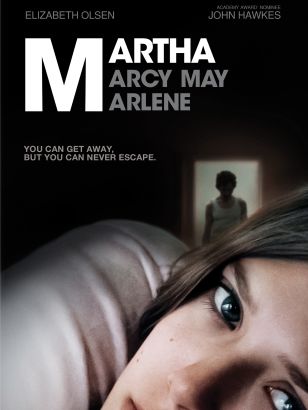
Martha Marcy May Marlene: A Review


MARTHA MARCY MAY MARLENE

Martha Marcy May Marlene is a quiet film.  There isn't much in terms of music, and there is almost a documentary-like feel to how the story is shot.  However, this is part of what makes MMMM a brilliant and chilling study of a woman either emerging from a shocking experience or sinking into insanity. 

We get glimpses into the world of Marcy May.  It's a commune where the men are the rulers and the women the workers and virtual sex slaves (the women, for example, have to wait until the men are finished eating for them to have their meal).  She then is seen running into the woods, and there she calls her sister, who calls her Martha.  Martha and Marcy May are the same person. 

Martha/Marcy May (Elizabeth Olsen) now finds refuge in the home of her sister Lucy (Sarah Paulson) and her husband Ted (Hugh Dancy).  However, it's clear that something's wrong with Martha: she casually swims in the nude in the clear presence of others and even climbs into bed while Lucy and Ted are having sex.  Lucy and especially Ted are perplexed, even angry at her behavior, but as MMMM goes on we get glimpses of how what appears irrational flows from her time in the cult.

Flowing back and forth between the present as Martha and the past as Marcy May (the name she was given at the commune), we see how her actions are a reaction to what has come before.  We see how she came to be in this cult, and the power the cult leader Patrick (John Hawkes) had over all.  Martha tries to become more 'normal' but her worldview has been so warped that she cannot help behaving bizarrely.  We see some of the horrors she has seen and endured, but Lucy continues to believe Martha's story that she had lost contact with her while living with 'a boyfriend'. 

Finally, Ted and Lucy know that they are simply unable to care for Martha.  Reluctantly, Lucy agrees to take Martha to treatment (we suspect a hospital but it's never fully established).  As the three drive on, they are interrupted by someone on the road.  We don't see who it is.  Is it members of the cult, determined to get Marcy May back (perhaps to stop her from revealing a horrifying secret)?  Was it just a random person?  Is Martha really crazy?  Martha Marcy May Marlene then cuts to black.

Normally, I'm not a fan of open endings, but it works with Martha Marcy May Marlene (the 'Marlene' by the way comes from the name the women in the cult use whenever they answer the phone).  It leaves the audience wondering whether the figure Martha encounters really is from the cult or not.  This is just one of the great steps writer/director Sean Durkin takes to make MMMM a brilliant film.

Durkin first keeps the pacing strong and steady.  As I've stated earlier, MMMM has something of a documentary feel to it, primarily in the fact that the film has a natural look to it.  As part of how the cult feeds itself, they steal from the wealthy homes nearby.  The camera work by Jody Lee Lipes is never flashy in these scenes when others might have gone for fast movements and pulsating music to emphasize the tension of breaking and entering.  Instead, there is a quiet aspect to this work. 

This emphasis of keeping things still works to great effect near the end of MMMM when we the audience are given information that a character doesn't have.  Durkin keeps the tension intense, counterbalancing the quiet stillness of the setting and the actors with the potential for violence.  When the tension is finally broken in a shocking act, it makes the scene even more stunning.

It should be mentioned that there is music in MMMM (from Saunder Jurriaans & Danny Bensi) but it is used sparingly.  There is a song in MMMM which appear as part of the scene and one in the closing credits (both written by the late Jackson C. Frank: Marcy's Song and Marlene respectively) which are blended beautifully into the film, and Marcy's Song in particular is a beautiful song that adds to how Frank could have so bewitched Martha into becoming Marcy May. 

A surprise is that John Hawkes isn't a bad singer, but I digress.

The performances from the cast are all brilliant.  Olsen delivers an absolute stunner of a turn as the conflicted and battered Martha/Marcy May.  Olsen shifts from damaged to almost hostile to paranoid to deeply frightened, a full range of emotions that shock you and break your heart.  Paulson is equally brilliant as Lucy.  While other scripts might have been tempted to make the sister unsympathetic, Durkin opted to make Lucy someone who wants to help her sister but has a hard time understanding her behavior.  The fact that Lucy is kept in the dark about Martha's time in the cult makes her confusion more understandable.  Dancy also does excellent work as the husband who also wants to be supportive but begins to become irritated by his sister-in-law's actions.

Hawkes in particular needs to be commended for turning in another brilliant performance so soon after coming off his Best Supporting Actor nomination for Winter's Bone.  His Patrick is a dangerous and evil man, but he isn't one who ever really rages and rules by intimidation.  In fact, I cannot remember Patrick ever raising his voice.  The fact that he rules his cult by being so soft-spoken makes him even more terrifying and evil.  In one scene, he asks Marcy May to kill a kitten.  Marcy May refuses, but in Patrick's soft tones and words he exudes the pressure for her to do something horrifying, which not only gives insight into what an evil man Patrick is but how he could get people to do even worse things. 

In one technical aspect, Martha Marcy May Marlene deserved special recognition (which sadly, it did not get).  Zac Stuart-Pontier's editing flowed seamlessly between the past and present without ever stopping the action.  It shifted back and forth so well one never became jarred when we would go from her time as Marcy May to her time as Martha.  On occasion the screen would fade to black, but even this signals of shifting times didn't stop or hinder how smoothly MMMM went on screen. 

Martha Marcy May Marlene is a thrilling and heartbreaking film of a woman who has been beaten up emotionally, in certain ways quite innocent and in other ways well aware of the brutality of others.  Save for Patrick none of the characters are either all good or all evil.  The performances are all so pitch-perfect, where again it almost looks as if we were watching a documentary rather than a feature film. It's a brilliant film with brilliant performances.  Each M in the title is reflective of the stars I'd give it.

DECISION: A-

Wednesday, April 11, 2012

We Bought A Zoo: A Review

WE BOUGHT A ZOO


I love animals...they're delicious.  I actually do love animals, and cute children, and I can even go for the cute love story.  I am going to imagine that We Bought a Zoo, the film version of Benjamin Mee's non-fiction book, is on the whole close to the source material (and close to the truth).  Be that as it may, Cameron Crowe's latest effort goes by the numbers, from Plot Point A to Plot Point Z in a nice and gentle way that will please those that want familiarity and predictability.

Benjamin Mee (Matt Damon) is a recent widower with two children: 14-year-old Dylan (Colin Ford) and 7-year-old Rosie (Maggie Elizabeth Jones).  As one can expect, the ladies are all eyeing the newest catch (lots of lasagna plates) and Dylan is 'troubled'.  "Troubled" enough that in order to make a new start, Benjamin quits his newspaper job and decides to start out in a new home.

With Rosie's help, they find what appears to be a perfect home, but with one catch: it's a literal zoo.  The house and property is a wildlife park that opens to the public in the summer.  He decides that it is worth the asking price, and with the zoo staff, headed by Kelly (Scarlett Johansson), make all the necessary repairs and restorations to pass inspection.  The staff is a quirky lot, primarily the almost always drunk Scotsman MacCready (Angus Macfadyen).  Rosie is thrilled to be surrounded by all the animals, but Colin hates it there, even if Kelly's niece Lilly (Elle Fanning) is obviously infatuated with Colin (side note: I've had one or two of those infatuations, and they can be a bit spooky, so I can relate, only his infatuation appeared to be sane, but I digress).

The repairs, improvements, feeding of the animals and paying of staff is a pretty penny fast burning through Mee's accounts.  His older brother Duncan (Thomas Haden Church) thinks the whole thing is bonkers, and bookkeeper Rhoda (Carla Gallo) soon gets the staff against him because he has no money.

Don't be surprised that money comes to him magically via his dead wife (gotta love those Deus Ex Machinas). 

All this is backdrop to Benjamin's continuing struggle to get over the death of his wife, his struggles with his son (who is going through his own brand of mourning), and the dreaded Inspector Javert...I mean Ferris (John Michael Higgins).  Ferris is not a fan of anyone, a petty bureaucrat who delights in frightening the staff, and whom MacCready so despises he has to be at one point locked in a room to stop them from meeting.

Eventually father and son see how much they love each other, Kelly and Benjamin see how much they love each other, Duncan sees how much his brother was right, and all is well.

Again, I figure that since We Bought A Zoo is based on Mee's memoirs, a lot of what occurred happened.  I figure Crowe and fellow screenwriter Aline Brosh McKenna changed a few things, so the fact that I have never read (or until the movie, heard of) the book shouldn't prejudice me against the film.  However, as I watched We Bought A Zoo, I kept finding that the film was amazingly predictable in where the plot was going.

It wasn't just that one excepted the widower was going to be pursued by almost every woman he met (which makes me wonder if what I need is a wife in order to get a girlfriend), that the male and female leads to eventually find they were in love, that there was going to be at least ONE complication at the Big Inspection, that the son was going to be angry and the cute little girl precious and adorable.  It was that there were one or two things that We Bought A Zoo didn't quite answer. 

How Mee solves his financial situation is a curious thing.  As the single greatest character in River Song (formerly known as Doctor Who) would say, "SPOILERS".  He's just about out of money, but he suddenly discovers that his wife has had a secret account she'd been saving up for her family because she knew she was dying.  The proof of this is in the pocket of the hoodie Mee simply cannot part with, which he slipped on that one time to remember his wife.

I was not only troubled at just how easily Mee's financial problems were resolved (far too cinematic), but in retrospect I kept thinking how in all the time he had the hoodie he never once sensed the paper detailing her secret account inside the pocket.  Morevoer, does it strike anyone else as mean that Mrs. Mee never mentioned this secret account?  Yes, I'm aware that she was dying (I think it was cancer), but couldn't she have left instructions or even a message to be read upon her death mentioning over $80,000? 

I also fault Crowe for making what I think was a terrible mistake with the character of Ferris.  I know he's suppose to be the antagonist, but as played by Higgins, he was far too cartoonish to be taken seriously.  I figure this was done purposefully, to perhaps have some comic foil in what is essentially a family-geared film.  However, I couldn't take Ferris seriously enough to think he could shut down the park, nor could I take him seriously in thinking he was an actual official.  This is where I would have advised Crowe to pull back a bit, make Ferris more of a stickler for rules but to make him less ridiculous and more sympathetic, someone who is just doing his job and not so obviously an idiot or an insensitive man.

There were other things in We Bought A Zoo that made me resist its efforts to charm me.  Besides the "finding money in the most unexpected place at the exact right time" business and the "Ferris the Menace" business, we have standard film fare: the angry and neglected son, the cute little girl, the male and female finally coming together, and the overt symbolism of an old tiger that has to be put to sleep (and the widower who fights so passionately against the reality of it).  I wonder how the last two relate...Such symbolism is a touch too heavy for my tastes, and I'm not fond of things being so overt.  I have nothing against symbolism, or even overtness, but about heavy-handedness, I do.

The efforts of comedy (primarily from Macfayden's MacCready) never really worked because Crowe never allowed almost any of his characters to be anything but stock figures and cliches rather than real people with real flaws, real hurts. 

Still, I don't think there was anything particularly awful in We Bought A Zoo.  Damon was acceptable, though whenever he fought with his son one could tell he was reaching for something that didn't quite make it.  Johansson is an actress who frankly hasn't been given enough credit.  Too often I think people dismiss her actual acting abilities simply because she is so beautiful.  Granted, she hasn't always done good work (The Spirit, The Island--although the latter is one of my guilty pleasures, while the former is just hideous) but in We Bought A Zoo, she was sympathetic and believable as an efficient zookeeper.  Church was there to be the Bonnie Hunt-type character (the wisecracking, disapproving older sibling Hunt perfected--and should have been nominated as Best Supporting Actress for--in another Crowe film, Jerry Maguire).  If Cameron Crowe ever made a mash-up, these two would make a great comedic team in giving one-liners to all the proceedings. 

I think I've already gone over how Macfayden and Higgins were too silly to be believed and I found their parts to be distracting. 

On the whole, We Bought A Zoo is simply meant to be a sweet little film with a cross of indie and intelligent songs (always a Crowe signature) that is meant to make us cheer and raise our spirits.  I won't begrudge them that.  The fact that it didn't have that power to move me in the way it wanted to is something I won't begrudge either.  Is it a cutesy little film?  Yes.  Is it a good film?  It's passable.  We Bought A Zoo...but we didn't quite buy the premise (even if it is based on reality). 

DECISION: C+

Friday, April 6, 2012

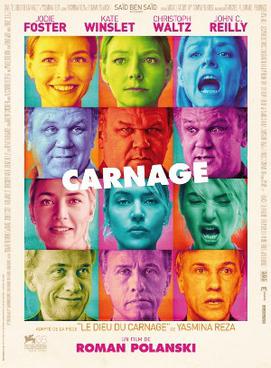
Carnage: A Review (Review #365)


CARNAGE

The Myth of Sticks and Stones...

I imagine Carnage is the type of film that would appeal to those it mocks: the touchy-feely lefty intellectual who thinks that dialogue will lead to a peaceful resolution.  With Carnage, we see that words uttered by even the most 'civilized' people can become weapons against even those who are ostensibly on their side.  It is a comedy but the laughs come less from the situations than the participates; in other words, we laugh AT these people, not with them, because underneath the veneer of rational discussion they are all brittle, self-righteous, even vindictive.

The whole of Carnage (based on the play The God of Carnage by Yasmina Reza) takes place at the apartment of the Longstreets save for the opening which sets up the entire story.  We see the Longstreet child, Ethan, whacked pretty hard by Zachary Cowan.  We then shift to the Longstreet flat where Penolope and Michael Longstreet (Jodie Foster and John C. Reilly) are writing out a letter about this unfortunate incident with Nancy and Alan Cowan (Kate Winslet and Christoph Waltz). 

The Longstreets and Cowans are doing their best to be civil and respectful, to discuss this like adults, to try to sort out the responsibilities of their children.  As the 80-odd minute film continues, we see that one wrong word, one seemingly innocuous gesture, builds on itself to where one adult reacts in a way different than what might have been intended.  Apple cobbler offered in friendship causes Nancy to vomit, which cause the Longstreets and Cowans to discuss how much they dislike the other for actions both accidental and deliberate. 

As the afternoon goes on, with the Cowans appearing desperate to leave, the Longstreets appearing desperate to stay justified, and both groups starting to snipe at each other, we see the shifting alliances, from the spouses to the genders and back again.  Each of the four in Carnage comes off as rather horrid: the uptight Nancy, the on-the-edge Penelope, the accommodating Michael, the disinterested Alan.  By the time they finally part company, we have enjoyed (or endured) a comedic version of Who's Afraid of Virginia Woolf? with slightly less booze and no sex.

Carnage is amusing in that it is funny seeing all these allegedly bright, intelligent, well-off people go at each other and come apart, revealing that under their veneer of liberal thinking (liberal in every sense of the word) they are just as petty and small-minded as the 99% can be. 

The performances are remarkably true and understanding of gender roles.  Men, especially Michael and Al, are oftentimes more casual about things like fights among boys (the husbands have no problem sharing drinks and being slightly more nonchalant about their children's altercation).  Women, in particular Nancy and Penelope, are more quick to see their children's actions as reflective of something wrong: in society, in the family, in the way the world is. 

Each of the actors is allowed a moment in Carnage where they can have their moment, whether it's to look foolish or come apart.  Foster reminds us of what a strong actress she is in her Penelope (aka Penny), a woman so determined to do the right thing she ends up becoming more and more angry that things aren't being seen the way she sees them.  Winslet manages to hold her own as the uptight Nancy, who finds her husband's constant distractions via his cell phone so impossible that at one point she takes action that will both surprise and make one laugh. 

At times I confess to wondering why Winslet is considered this brilliant actress (finding her ability to be naked on screen neither a turn-on or a point of her 'brilliance').  Some of her work appears to be her playing at playing a great character (and I will be one of the few who thought both The Reader and her work in it was rather awful).  However, she did a great job in Carnage as the high-strung Nancy.

The men were equally excellent.  Reilly is the go-to guy for lovable schlubs and here his desire to be accommodating to everyone soon begins to take on at times a desperate air, at times a frustrated one.  Waltz's Al makes it clear by his actions that he is really not interested in anything going on, but even he allows the cracks within him to rise, in particular when he takes offense at something Penelope says about his son.

I think the fact that Carnage is a well-acted film is both the blessing and curse of Carnage as directed by Roman Polanski (whom I'll always have a moral distaste for and wouldn't allow my wife, daughter, or mother around--for his safety, not necessarily theirs).  The adaptation of The Gods of Carnage by Reza and Polanski makes the film Carnage no more than what it is: a filmed play. 

We see that as good as the cast's performances are, that is exactly what they are: performances.  None of the characters come to life because Carnage is very conscious of the fact that the screenplay is very actor-friendly.  The film allows good actors (and Winslet, who can be a good actress at times) to show how good they are on a technical level. 

However, as I watched Carnage, and enjoyed it, I could not help thinking I wouldn't get anything different if the four of them did a theatrical version of The God of Carnage on the stage.  I think this is where my admiration for Carnage dives into my separation from Carnage.  In short, the performances were great, but there was an artifice to it all, as if they knew we knew they were acting.  To my mind, theater acting and film acting are different (I learned that from Mary Pickford and Lillian Gish--not from them personally but by watching how both toned down the exaggerated theatricality of the stage for the more intimate nature of film).  Yes, each of the actors were good, but they weren't real people, just characters.

Still, this isn't to say that Carnage is bad.  It isn't even to say the film isn't something that people cannot relate to.  That is one of the chief positives of Carnage: the fact that it draws on a common human experience, that of saying the wrong thing or saying things wrong.  I am a witness that something said one way can be interpreted another, leading to nothing but trouble.  As I watched Carnage, I was able to go back into moments in my life where I said something that turned out wrong and made people mad, but when they responded I was the one that got mad even if they did not necessarily mean to be hurtful. 

Just ask anyone who has heard me on the subject of Occupy Wall Street or the Tea Party movement.  What I meant as a joke turns into a fiasco of hurt feelings and self-righteous posturing, where I cannot make amends because they "know" whether I'm sincere or not and can even inform me as to the sincerity of my sincerity (thus granting them greater wisdom over my heart, soul, and mind than I myself possess over my heart, soul, and mind).

Yet I digress.

Carnage is well-acted.  Check.  Carnage draws on common human emotions and frailties to portray even the most civilized and open-minded people as petty, with grievances that lead to explosions over trivial matters.  Check.  Carnage is efficient and quick, just like a play.  Check and check again. We do see that indeed, words hurt.

It's just like seeing the play.  That's the good and bad of seeing the end results of this Carnage

DECISION: B-

Saturday, March 24, 2012

The Three Musketeers (2011): A Review


THE THREE MUSKETEERS (2011)

Daring Don't...
 
The Alexandre Dumas swashbuckler The Three Musketeers has been adapted numerous times (I counted at least four film adaptations from 1921, 1948, 1973, and 1993).  Not having seen any of the others (though I did try to watch the 1973 version but started to nod off and decided it wasn't worth continuing) nor the variations of the Dumas novel (such as the Mickey Mouse version or any television adaptations) and never having read the book (but aware of the plot), the 2011 version of The Three Musketeers is my first actual encounter with Athos, Porthos, Aremis, and D'Artagnan.  I have to imagine the book is much, much better than this adaptation.

It is Venice, and Athos (Matthew Macfayden), Porthos (Ray Stevenson), and Aramis (Luke Evans) are breaking into a secret vault where DaVinci kept many private papers.  Aiding our trio is Milady De Winter (Milla Jovovich).  Once they pass many traps, Milady gets the papers, but to the trio's surprise, she betrays them to the Duke of Buckingham (Orlando Bloom).  The plans are for a flying war-machine, and the Duke, the trio's enemy,  is delighted.

We move on to three years and one day later.  D'Artagnan (Logan Lerman), a kid from the French countryside, goes to Paris to join the fabled Musketeers, the King's personal guards.  Alas, that group was disbanded by the villainous Cardinal Richelieu (Christoph Waltz).  He is plotting to seize power from King Louis XIII (Freddy Fox), a bumbling boy interested only in being a fashion plate.  The plan involves framing the Queen (Juno Temple) as an adulteress, with incriminating letters supposedly from Buckingham (whom the King hates) and the prized jewels His Majesty gave her in Buckingham's possession deep within the Tower of London.  

By this time D'Artagnan has both irritated and joined the Three Musketeers, who are loyal to the King and want Richelieu out of power.  Thanks the Constance (Gabriella Wilde), the lady-in-waiting for whom the brash and cocky D'Artagnan has fallen for, the Musketeers have five days to which go from Paris to London, break into the Tower, steal back the diamonds, and return them to the Queen.  How else but by airship?

Somehow, I don't want to blame director Paul W.S. Anderson for trying to appeal to modern tastes by throwing in a lot of contemporary effects to his update of The Three Musketeers.  Allow me a slight digression in that while I didn't finish the 1973 version, I got the idea that that version was played for laughs, more as a comedy than a straight adventure.  Here, we get a lot of sequences that on paper might look good, full of action and such, but which on screen are drowned by their sheer excess. 

The opening scene in Venice starts out The Three Musketeers in a bizarre fashion, making Athos into some underwater samurai and being both excessively elaborate and rather cliched (seriously, a booby-trapped hallway?).   Jovovich (who is coincidentally Mrs. Paul W.S. Anderson) has to move in such a way that the movie ends up as Resident Evil: Renaissance (they haven't made that movie yet, have they?).  A couple of fight sequences (actually, almost all of them) are slowed down Matrix-style, which doesn't add anything to the scenes.

Even worse, comes what is suppose to be the climatic moment: the air battle between the Musketeers' stolen airship and the surprise ship the Cardinal had constructed.  The sight of it didn't elicit excitement, more a "seriously?" reaction.  It's an air battle that appears dragged out, and yes, ridiculous.

If one could put that aside (a tall order), what can't be put aside is the fact that the actors in The Three Musketeers appear to be in two different films altogether.  Macfayden as the stalwart leader plays Athos in a totally serious manner, straight, without a drop of irony (I could argue a little too seriously and humorless).  Bloom, on the other hand, is totally camp to the point of parody.  I have long argued that Orlando Bloom is completely incapable of playing a contemporary character and is only suited for costume pictures.  However, his Buckingham in The Three Musketeers makes me wonder whether that still holds.  He was totally vamping it up throughout the film.  Even in his first scene he appeared to have been directed to ramp up the ham factor so high the movie bordered on being declared un-kosher. 

At one point, Buckingham declares "Double everything". Apparently he meant the acting.

Stevenson as the tough Porthos and Evans as the more pious Aramis were a little more balanced than Athos or Buckingham.  Waltz did better than his ridiculous turn in The Green Hornet, but part of him couldn't resist making the Cardinal a touch of camp. 

I digress to say that Anderson (along with screenwriters Alex Litvak and Andrew Davies) couldn't resist throwing in overtly symbolic touches (such as when the Cardinal is playing chess while overlooking a grand map of Europe).  Anderson's camera work of constantly circling the characters was becoming both repetitive and nauseating, not to mention distracting.

Now, going on the Lerman, while he may yet be a good actor, he is not enough of a screen presence to carry the film.  I don't think his facial expression changed and no one could imagine D'Artagnan as he played him to be inspirational.  Instead, he's just a brainless kid who is pretty but pretty bland as well.  If he was suppose to be comedic, he didn't make me laugh; if he was suppose to be serious, I couldn't take him seriously.  It would have been slightly more believable to have cast Michael Cera as D'Artagnan (given that in his goofy wig, Lerman looks like Cera in a goofy wig). 

At first, when I first thought the movie was over, I says to myself, "It was pretty lousy, and the movie does hint at a sequel (always a death knell for me), but it was so idiotically goofy I could forgive a great deal".  It isn't until we get a scene after the screen goes black that I turned on the film.  We get a scene that is not only illogical to the point of stupidity (I'm suppose to believe a character who had jumped off a dirigible into the English Channel ended up alive and merely wet), but a blatant statement that said "We Are Going to Make ANOTHER ONE!" 

"NO, NO, NO!" says I. 

I don't mind it being all for one, but I do mind if it's all for one more.