Sunday, February 21, 2016

Supergirl: Red Faced Review


SUPERGIRL: RED FACED

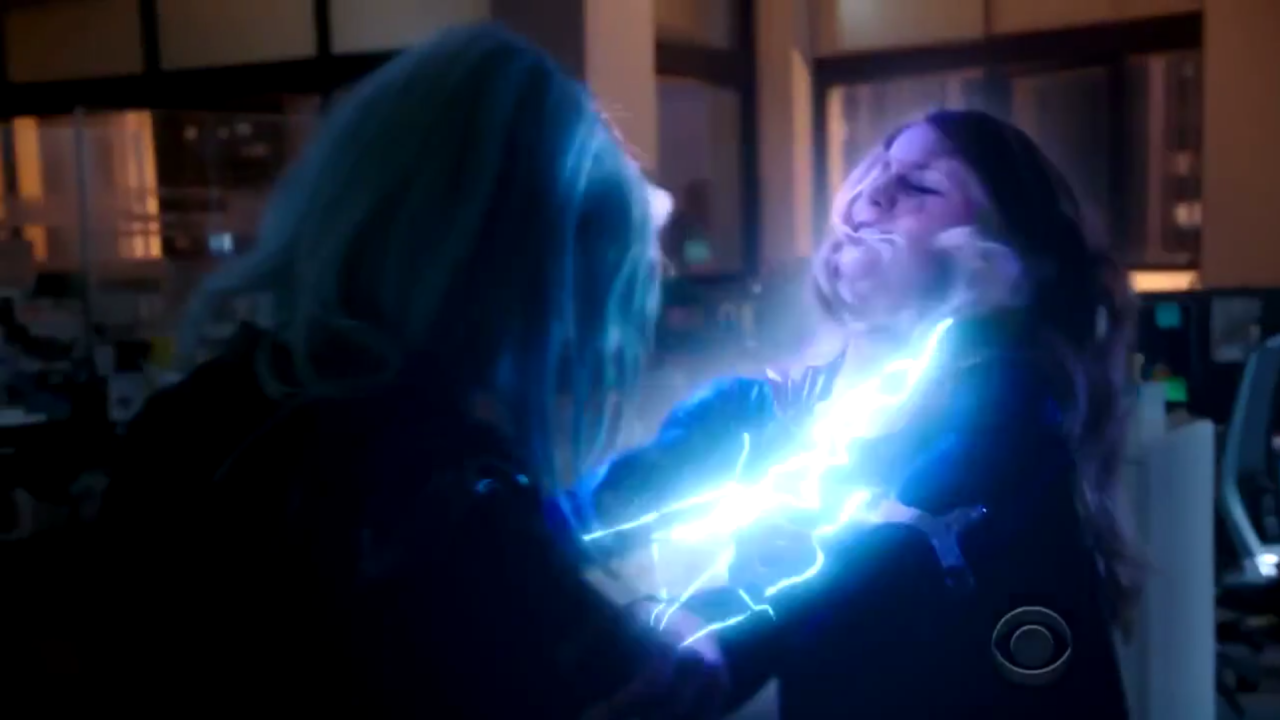
As we have, for the moment, skipped How Does She Do It?, we move on to Red Faced, a Supergirl episode that left me almost despairing at how the series is going.  If it weren't for Melissa Benoist's still magnificent turn as The Girl of Steel, I would have ranked Red Faced lower than I already did.  SHE made the episode.  SHE was worth watching.  Everything else was kind of blah.

Kara Danvers/Supergirl (Benoist) is having major anger-management issues.  She finds that trying to balance both lives, and the issues that come with those, are making her more short-tempered, down to in a shocking moment, actually snapping back at her boss, uber-bitch Cat Grant (Calista Flockhart).  Oddly, Cat is actually not insulted when Kara tells her off.  Instead, she takes her to a bar where Cat get sloshed and tells Kara that she has to 'find the anger behind the anger'.

Kara and her alter ego has a lot to be angry over.  Supergirl has been corralled into doing the military's business by testing Red Tornado, the new military machine created by 'mad scientist' T.O. Morrow (both played by Iddo Goldberg).

As a side note, through the episode I kept inadvertently referring to him as "Red Tomato".  Take that as you will.

Neither Supergirl or DEO officers Alex Danvers (Chyler Leigh) or Hank Henshaw (David Harewood) want Supergirl involved in this, but the blustery General Sam Lane (Glenn Morshower) has a Presidential order, and if they object, they can take it up with her (hard to NOT see that as a Hillary Clinton for President plug, but let's leave it at that).  Also involved in these war games is his daughter, Major Lucy Lane (Jenna Dewan Tatum), who just happens to be the girlfriend of Kara's crush James Olsen (Mehcad Brooks).  Talk about anger issues.  Well, Supergirl IS able to defeat Red Tomato, but he gets huffy and runs off.  Adding insult to injury, General Lane is angry at Supergirl and blames her for essentially doing what she was asked to do.  Granted, she was highly angry when she did it, but there it is.  Morrow is dismissed for HIS incompetence.

Running around is Maxwell Lord (Peter Facinelli), who continues to see Supergirl as a menace and plays hot and cold with Alex about helping track down Red Tomato.  No worries, as he appears to have become sentient and is going on a rampage (which by the way, is spoiling the dinner between James, Lucy, and General Pandemonium).  We learn that Red Tomato is actually not sentient, but being controlled by Morrow, who is out to finish his job with his machine.  However, Henshaw makes the announcement that Red Tomato was actually created to destroy Kryptonians, the General still suspicious of Supergirl's more famous cousin.

At the end of all this mayhem, with Supergirl using all her powers to defeat Red Tomato with help from the DEO, she finds that for the first time in her life, Kara is bleeding and pervious to pain...


Frankly, I'm not buying just about anything in Red Faced.   Lucy Lane, a Major?!  Since when did THIS pop up?  I don't think we got any indication that she was involved with the military, and while I never served I was unaware that the Army allowed General's daughters to be so involved in Daddy Projects.  It also makes me wonder how she never let on to this development all the time she was with James.

Maybe it's me, but I really cannot see Lois Lane being the General's daughter, but again, I'm not well-versed in Superman lore.

Red Tomato a.) seems a weak villain and b.) is yet another 'freak-of-the-week' enemy that is dispensed with quickly (and I was a bit puzzled by whether Alex actually killed Morrow, let alone whether she shot him in the head).  It was a little blurry and confusing.

Further, the difficultly between Lucy, James, and General Pandemonium seemed like it came from another show altogether (Olsen: The Series).  Isn't this whole 'military man disapproves of his daughter's boyfriend' business something we've seen before, or again, it is me?  It doesn't help that Morshower played Sam Lane as the stereotypical military character: bossy, blustery, bullying. 

And I am STILL not sold on "Major Lucy Lane".

About the only real good things in Red Faced were some of the cast and the general theme of 'the rage within'.  Benoist is still the best thing about Supergirl: her dual role really going to a higher level.  It was shocking but empowering to see her finally tell Cat to stop being so mean to her, and even more empowering when we see her using a car for a punching bag, releasing the 'anger behind the anger'.  Flockhart still has that "Devil Wears Prada" manner to Cat Grant, but a.) that's how the character is written, and b.) Flockhart does allow the human side to slip through.  The interplay between Flockhart's Cat and Joan Juliet Buck's Katherine Grant, Mother from Hell, was amusing without being too outlandish.  Flockhart allows a very slight sense of hurt when her mother cancels a dinner to go slum it with Toni Morrison at the last minute. 


Another highlight is Jeremy Jordan as Winn Schott, who here is roped into helping the Danvers Sisters investigate the story of their father's disappearance & death.  His role is small this episode, but he makes the most of it. 

In fact, Jordan's performance makes it clear that Schott is not only truly in love with Kara, not Supergirl, but that he is the far better choice than the hunkier (and taller) Olsen.  It's almost a frustrating puzzle to understand why Kara continues to make googly-eyes at Olsen when Winn is on many levels better.  He, unlike James, is actually available and not ambivalent about his feelings for Kara.  Winn is also someone who would have no or little problem living with Kara/Supergirl.  In fact, he would be more encouraging and supportive to Supergirl's career as a superheroine than any other man.

Part of it I imagine would be a bit of fanboying, but most of it is because he actually is in love with her.  Therefore, Kara's constant inability to appreciate how good Winn would be for her is now more than frustrating.

This is especially true given how patient he is with Kara's near-obsession with James. Even Cat tells Kara point-blank that the whole office sees how Kara throws herself at James (and this despite James' on-again relationship with Lucy). I actually wrote in my notes "Choose Winn, Choose Winn". 

I am officially #TeamWinn.

I was not impressed by Red Tomato.  I was bored by the Lucy/Sam/James story.  I was intrigued by the Maxwell Lord aspect (we're getting a mystery with his parents, and while he is still a guest star my sense is that Facinelli is going to be more recurring than guest star).  Again, apart from Benoist (who excelled in the episode), I found a lot about Red Faced that I could easy leave.


6/10

Next Episode: Human For A Day

Friday, February 19, 2016

Spotlight (2015): A Review

SPOTLIGHT (2015)

Separation of Church and Fifth Estate...

They all knew. 

The scandal of child abuse by Catholic priests in the United States would not have come to light if not for a group of journalists determined to get at the truth.  Spotlight, the film based on the Boston Globe investigation of the Church's handling of pedophile priests, is sparse, direct, and straightforward.  It is a sharp film that does not sensationalize the issue, and which gives an intelligent version of the events as they occurred.

The new Boston Globe editor, Marty Baron (Liev Shrieber) is not a native Bostonian or a Catholic, two things that make him stand out in a community where the Church is a powerful entity. He looks at what all the various departments are doing, and one story catches his eye: that of a lawyer who says that Cardinal Bernard Law, head of the Boston Catholic Church, knew that disgraced priest Father John Geoghan was abusing children and did nothing about it.  Despite misgivings and a thinly veiled hostility to the outsider, Baron instructs the Spotlight team (the in-house investigative reporting team known to spend months on one story) to look into the case.  One Spotlight member, Mike Rezendes (Mark Ruffalo) goes to that lawyer, Mitchell Garabedian (Stanley Tucci) to see if he will cooperate, up to letting them interview survivors.  The Spotlight head, Walter Robinson, better known as Robby (Michael Keaton), along with Spotlight member Sasha Pfieffer (Rachel McAdams) work another angle, looking into how outside lawyers helped keep things hush-hush.  The final Spotlight member, Matt Carroll (Michael D'Arcy James), also investigates the case.

As the investigation goes on, the Spotlight team puts various pieces together.  The survivors tell their stories, and the head of a survivor's support group, Phil Saviano (Neil Huff) who had gone to the Globe years before but essentially dismissed as an angry man with an ax to grind, helps point them in the right direction.  Soon, Spotlight starts seeing a particularly ugly pattern: priest who were put on 'sick leave' or were 'unassigned' were actually the same ones being moved around or sent to 'treatment centers', and more perniciously, the same ones whom survivors named as abusers.  The Catholic Church, in order to protect itself, would hear reports of sexually abusive priests (who would go after boys and girls), tell the families this was just a 'bad apple' and rather than dismiss them or go to the police, simply take them out of circulation for a while and put them in another parish, where the perverts would strike again.  This shady shifting had been going on for decades, and not only did the Church know, but so did the police, the attorneys, and even the newspapers (the Globe publishing reports but not following up or making the connections).

After a lot of hurdles, reluctance to take on the Church, and September 11th drawing attention away from this story, the Spotlight team, with the approval of both Baron and editor Ben Bradee, Jr. (John Slattery), finally publish the first of a series of articles on the Catholic Church in Boston knowing about the pedophile priests and not only not doing anything about it, but being complicit in the cover-up and ongoing abuse.  The Globe expects massive pushback from the Catholic community in Boston, but instead is astonished to be flooded with calls to the Spotlight tip-line for those who have information on the case.


What makes Spotlight such a good film is director Tom McCarthy's decision to focus squarely on the story in a deliberately paced and unflashy manner.  Comparisons to All the President's Men are warranted, as both films do not delve into other matters outside the workplace.  You had little hints about the character's private lives: Sasha taking her Nana to church, ending that part with Nana asking for a glass of water while reading the Globe story, her granddaughter visibly nervous about her reaction, Rezendes' potentially failing marriage.  However, those things played on the sidelines and never interrupted the flow of the story. 

Also, there is not a big dramatic moment where everyone realizes everything.  Instead, the story builds on itself, each piece of the puzzle being put together and things starting to come to them piecemeal.  Even when they get shocking news (such as when Sasha finds one of the abusive priests, who bizarrely keeps repeating that he never got any pleasure out of it and that he never raped any boy because HE had been raped and 'knows the difference'), there is no big dramatic performance or overwhelming music to give us the emotional cues. 

As a side note, there is a score by Howard Shore, but this was piano-based, in keeping with the minimalist nature of the film, which was both a good score and a good decision by director/co-writer McCarthy (writing with Josh Singer).

McCarthy got great performances out of a great cast.  McAdams' Sasha is not a crusader, but a pound-paving reporter who sees her job and does it, while showing the appropriate compassion to one of the adult survivors (a man who as a boy knew he was gay and who was taken advantage of due to that by a priest).  Keaton is solid as Robbie, who realizes too late he too had a piece at least a decade earlier but did not do a folo. 

Another side note: one of the great things about Spotlight is that people can use in-house lingo like 'folo' (short for "follow-up") or "Lake Street" (a euphemism for the Catholic Church) without getting lost or not understanding what's being said.

Even Schriber, whom I'm seeing as the wooden actor my friend Fidel Gomez, Jr. (who is very much alive), lets his usual stiff manner work on his behalf as the main editor who sees things more clearly as the outsider than the natives do.

Ruffalo is good though when he becomes insistent that they run the story sooner than Robbie or Bradlee want I thought that was a trifle too much.  I also thought the scene where we hear children sing Silent Night while they continue getting interviews and evidence was also a trifle much, a bit of gilding the lily. I get the connection between innocent children singing about silence and the birth of the Savior as this group digs into the sins of the Mother Church, but a little symbolism goes a long way.  Too much of it...not so much.

Spotlight is an incredibly sharp and intelligent film about the evils an entity can do, and about how the willing silence of the community kept it going.  It speaks to how diligence and dogged tenacity get the job done.  It is about how important the press and newspapers in particular still are.  The Fourth Estate continues to be a vital force, a necessary force, and Spotlight does it immense credit.

Yes, they all knew, but when truth was spoken, the truth set them free.

DECISION: B+

2016 Best Picture: Moonlight

Thursday, February 18, 2016

Supergirl: How Does She Do It? Review


SUPERGIRL: HOW DOES SHE DO IT?

Author's Note: Due to the Supergirl schedule switch How Does She Do It?, which would have been the fourth episode, was broadcast fifth after Livewire, which would have followed it if things had stayed the same.  This confusion I think led to How Does She Do It? NOT being recorded on my DVR, the system thinking it was a repeat and as such skipping it.  I am working on finding a way to watch it without paying (as it is not available on the CBS website).  For the moment, there is no official review for How Does She Do It? and we will be moving on to the succeeding episode Red Faced.  I am posting this brief note which will be amended once the episode is actually seen.   RA: 2/18/16

Next Episode: Red Faced

Supergirl: Livewire Review


SUPERGIRL: LIVEWIRE

If the Thanksgiving-themed Supergirl episode Livewire confused you, believe me, it wasn't just you.  Blame ISIS.

When I caught up to this episode, I was a bit lost by some of the dialogue, especially since the DVR had another episode listed (How Does She Do It?), and Livewire did not match the story synopsis at all.  Furthermore, one of the characters discussed another character that, if we went by what we'd seen before, we hadn't met yet.  The reason for this confusion is simple: Livewire was substituted for How Does She Do It? after ISIS launched the Paris attacks.  Supergirl producers felt the plot of How Does She Do It? was too similar to the attacks to air so close to them, so a switch was made with How Does She Do It? airing later.  This in a certain way is understandable: Doctor Who did something similar with Robot of Sherwood, when a quick shot of someone's head getting cut off was itself cut after ISIS video of another of their beheadings was released.

Supergirl's decision to air another episode in place of How Does She Do It? I think was a bad one.  Continuity is so important on this show, and while Livewire doesn't wreck it, it does have the effect of making things slightly confusing.  I think it might have been better just to air a repeat or not aired anything at all, but the decision was theirs.  As for Livewire itself, we're still stuck in the 'freak-of-the-week' mode, but with some new character development and a mystery that will make things more interesting.

Kara Danvers aka Supergirl (Melissa Benoist) and her sister Alex (Chyler Leigh) are facing perhaps their greatest challenge ever: Thanksgiving with their mother, Eliza (guest star and original Supergirl Helen Slater).  Alex is very worried that she will get blamed for Kara's identity being revealed, while Kara just worries.  Kara also invites her platonic friend Winn (Jeremy Jordan) to join them for Thanksgiving dinner after learning he is going to be alone.  She would have invited the hunky James Olsen (Mehcad Brooks), but he's going with his former ex Lucy Lane (Jenna Dewan Tatum).  So much for that idea.

Kara's good spirits are also tested by shock-jock Leslie Willis (Brit Morgan), a former protégé of Kara's boss Cat Grant (Calista Flockhart) who is openly hostile to the 'adorkable' Supergirl.  Unbeknown to Kara, Cat has gone to Leslie and made it specifically clear she is not to criticize Supergirl on-air.  When Leslie refuses, Cat immediately demotes her to a helicopter traffic reporter until she learns her lesson.

As it happens, on her first flight Leslie's helicopter gets trapped in a thunderstorm.  Supergirl saves the pilot first and then goes for Leslie, but a thunderbolt strikes her as she is pulling Leslie, causing electricity to run through her body.  Leslie is in a coma, but when she awakes, she discovers she has new powers, powers she will use to enact a terrible revenge.


Thanksgiving dinner is like all Thanksgiving dinners: a disaster.  The Danvers fight over both Supergirl and Alex's work with the DEO, which Eliza was unaware of.  For better or worse, Kara gets called away to work by Cat, who finds her Internet all down.  It's down because Leslie, now calling herself Livewire, is attacking.  Attempting to kill Cat, Supergirl manages to intervene.  She even gets help from Hank Henshaw (David Harewood), DEO head masquerading as an FBI agent.  Supergirl and Cat join forces to draw Livewire out and capture her, which they do though not without a struggle.

Back now at home, Alex and Eliza reconcile and Eliza makes a shocking revelation: their father Jeremiah (guest star Dean Cain, one of our most recent Supermen from Lois & Clark) took Kara's place when DEO agents came to their home.  The agent seeking Kara?  A certain Hank Henshaw.  Now the girls want to know what is going on....


What more me made Livewire a good, almost great episode is Flockhart of all things.  In the past episodes, Cat Grant has veered towards to if not actually become a cartoonish character, the bitch whose sole purpose is to look down on all.  However, Livewire clearly gave us a whole new Cat.  She was still outwardly mean and dismissive, but we saw that she does have a heart, and a soft one at that (and a wounded one too). 

First, we see it in her lecture to Leslie that she does see Supergirl perhaps as a champion for women's equality, someone able, like her, to stand on equal terms with the boys.  She does not want her disparaged (or at least not let anyone else do the disparaging).  Second, we see it when she reluctantly goes to visit her former protégé in the hospital.  Out of Kara's earshot, Cat whispers words of encouragement, urging Leslie to come out of her coma.  Third and most important, we see it in her long scenes pre-and-post Livewire attack.  Cat expresses a loneliness, what with Carter with his father and her mother mercifully out of the way.  When she learns that Kara's parents died in a fire (well, technically true but...), we see Cat has actual genuine concern over this.

I find it incredible and wonderful that Livewire took the time to soften Cat Grant into someone actually human, her brusque manner a shield to guard herself against all.  It's clear her "Devil Wears Prada" persona is a bit of an act (I say bit because she still is somewhat unpleasant), but that she can be toned down.

I am glad that Slater and to a lesser degree Cain are allowed to be part of the Supergirl mythos rather than just clever in-jokes to cameo on the show.  We forget that we are seeing the original Supergirl and one of the recent Superman actors.  Instead, we see the characters, and Slater in particular does a wonderful job as the flawed mother.  Her scene with Leigh as Eliza and Alex reconcile, with Eliza telling her natural daughter that to her, she was her 'supergirl' is so moving and wonderful and well-acted by both.  Cain had a smaller role as we saw him only in flashbacks, but he was the strong father both girls needed.

Speaking of flashbacks, the scenes with the younger Alex and Kara were equally wonderful, giving us insight into the love & sibling rivalry both girls had.  We got a real family dynamic that works so well. 

With regards to the other performers, Jordan's take on Winn makes one wonder why Kara would make googly-eyes at James when Winn is obviously perfect for her. He is wonderful and funny and genuinely in love with Kara (not Supergirl), yet here she is, almost painfully oblivious to it.  In this bizarre love triangle, I'm firmly on #TeamWinn.  Morgan is having the time of her life vamping it up as Livewire, one of those deliciously evil characters.

Which is why I register mild disappointment that she was defeated so quickly.  I would have liked it if she had been defeated, but managed to escape.  It all seemed to rush so quickly, and I for one am getting tired of seeing pretty much the same thing: villain pops up, Supergirl fights him/her, gets knocked down, has rematch and wins. 

The fact episodes were switched did make one or two things confusing, particularly when Cat talks about 'Carter' (who we will find is her son).  Given we have yet to technically be introduced to Carter, it's hard to understand.  We can fill in things, but it still is a bit puzzling.

I'm knocking a point off merely because of the somewhat repetitive nature of the threats Supergirl has been facing.  However, with a new mystery coming at us and an especially impressive turn by Flockhart, Livewire continues to make Supergirl great television.


7/10

Next Episode: How Does She Do It?

Brooklyn: A Review


BROOKLYN

Who would figure that good, old-fashioned romances were still being made in Hollywood?  Brooklyn, based on the novel, could with some minor alterations have fit in perfectly in the same era where another New York-based love story (The Clock) took place.  Brooklyn, technically, takes a place approximately a decade after the Judy Garland/Robert Walker tearjerker, but it follows The Clock's method of making the city (or in this case, the borough) into the centerpiece of a true love story. The brilliance of Brooklyn is in its simplicity and universality, for whether native-born (as I and my father were) or immigrant (as my mother was) everyone can relate to someone starting over, finding love, and struggling between their roots and their wings.

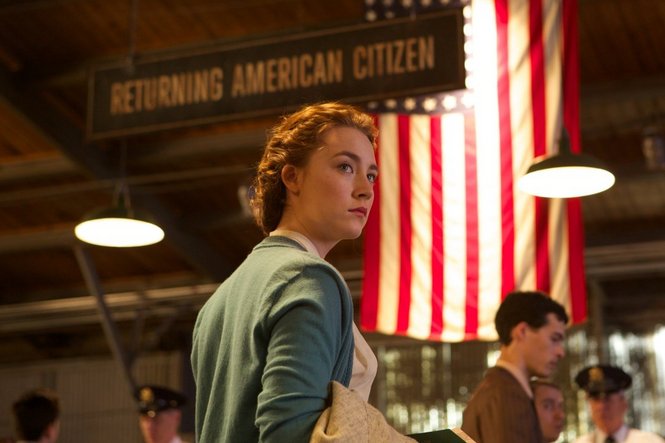
Eilis (Saoirse Ronan), pronounced "Ellish", is an Irish girl with a generally unhappy future to look forward to in the Emerald Isle.  Working at a small shop run by the disagreeable Mrs. Kelly (Brid Brennan), she finds prospects dim.  However, there is hope in that she has been sponsored to work in America, New York specifically.  This upcoming journey however, fills her with more sadness than joy, as it means leaving her recently widowed mother (Jane Brennan) and sister Rose (Fiona Glascott), who helped get her that sponsorship from the Catholic Church.  Despite the intense loneliness and sadness over leaving her loved ones and everything she knows, Eilis sails to the New World.

Finding new digs at a home for single girls run by the stern but loving Mrs. Keogh (Julie Walters), Eilis is the only girl who is respectful, efficient, and not prone to scandal: in short, not Americanized.  However, she is not adjusting well to her new job at Bartocci's, the upmarket department store she is a salesgirl atE.  Her sadness and openly sad manner worries and despairs the management, and to help comes Father Flood (Jim Broadbent), who was instrumental in helping Eilis come to America.  He helps her by enrolling her in a bookkeeping course to advance and inviting her to the Irish community center the Church runs.  The center hosts a Christmas party for other Irish immigrants, where a Gaelic song breaks her heart. 

The center also hosts dances, and soon Eilis starts adjusting to her new American life, though she still struggles.  At one of these dances, a new young man catches her eye as much as she has caught him.  Tony (Emory Cohen) is unlike the other boys at the Irish community center.  The fact that his name is Tony Fiorello should be a clue.  He's at least a second if not a third-generation Italian-American, a real Brooklyn guy from a big Italian family who is a plumber.  He likes Irish girls, and he likes Eilis.  Soon, they start courting, and I say courting because they are taking things very slow, with Tony being gentle about his approach.  They agree to movies on Wednesdays and dances on Saturday, and eventually he invites her to meet his very large family, down to his youngest brother Frankie (James DiGiacomo), who is the definition of 'precocious'.

They fall in love, and Eilis even manages to write to Rose with a more positive view.  She's no longer homesick, and she manages to enjoy Brooklyn Dodgers games at Ebbets Field (being Italian and from Brooklyn, Tony OBVIOUSLY loves baseball & the Dodgers).  However, just as Eilis is adjusting to life and finding that perhaps she can bridge Ireland and America, she gets simply horrible news: Rose has died suddenly.  Before she goes to comfort her mother and pay her respects, she gives in to the pleasures of the flesh and agrees to marry Tony in secret.  She sails back home as Mrs. Eilis Fiorello (though no one back in Eire knows this, well, almost no one).

Now back in Ireland, she extends her stay to see her best friend married.  There, she is introduced to Jim Farrell (Domhall Gleeson), the Irish rugby player she vaguely knew before she left.  At first cold and dismissive (which puzzle the town), Eilis slowly starts to warm to Jim, who is not a rough-and-tumble jock but a shy, gentle man who is from a wealthy family.  They do see each other socially, but Eilis has given no indication of being unfaithful or even of being untrue to Tony (completely unaware).  Soon, she is volunteered to take over Rose's job, and despite herself finds she is slipping into a comfortable life in the Emerald Isle.  Eilis soon begins to wonder what she is to do.  She is ambivalent and unsure where her heart truly lies: Ireland or Brooklyn.  Where IS home?  It isn't until Mrs. Kelly returns, attempting to blackmail Eilis for reasons unknown that settles things for Eilis.  With some fear, she declares herself Mrs. Eilis Fiorello of Brooklyn, tells her mother the truth, and leaves for Tony...and home.


I think the best way to describe Brooklyn is that it is a love letter.  It is a love letter to America: the opportunity to begin and move forward despite your background.  It is a love letter to the immigrant experience: the struggles of leaving everything you know and slowly finding your place in the New World.  It is a love letter to romance: the joys of finding love despite the differences in background.  Brooklyn is about love in so many forms, of finding your place and being true to yourself.

What makes Brooklyn such a beautiful and remarkable film is, well, everything.  We start with the performances.  Saoirse Ronan is simply breathtaking and beautiful as Eilis, letting her eyes and face reveal so much.  When she hears the Gaelic song at Christmas, Ronan displays the longing and heartbreak of Eilis without having to say anything.  Same goes for her scenes at the shop: early on when she tries to be happy and cannot be, and later when she finds that love lifts all moods.  When she learns of Rose's death, your heart just breaks for Eilis. 

Ronan gives such a beautiful performance throughout that she makes us not just care about Eilis, but understand why she struggles with the decision of whether to go with Tony or Jim.  It never feels like she is quick to drop Tony or be cruel to Jim.  Instead, we see just how the pull of home and security can draw her away from the insecurity of Brooklyn.  We fall in love with her.

Same goes for both Cohen and Gleeson.  I was amazed at how well Gleeson played Jim, this gentle, good man who falls for Eilis.  I thought he was pretty exaggerated in Star Wars: The Force Awakens, but here we get to see Gleeson as an actual actor, not a virtual cartoon.  We can see how Eilis could be drawn to him.  Cohen as the small, scrappy Italian-American came across as endearing and gentle but also a regular guy, one we can relate to.  He never pushes Eilis, and in his own way is hesitant about his romance.  The scenes between Cohen and Ronan are filled with great love and romance that just moves you.

Brooklyn also allows moments of comedy, courtesy of DiGiacomo's openly honest Frankie.  He's brash, outspoken, and delightful.  Director John Crowley balances the comedy and drama, and this is from allowing the story to carry things.

Perhaps the only real flaw I can find is that Rose's death is a bit confusing.  It took a while to figure out it was due to an undisclosed illness, but it came across perhaps as a suicide.  Further, when we saw Rose, we got no indication that Rose was in any way ill, at least that I noticed.  That is a small detail though, as Brooklyn is such a beautifully made film that it will make one fall in love: with America, with your roots (whatever they may be), with the one you're with or want to be with. 

I love Brooklyn: a lush romance that makes one joyful about the state of cinema.                  

DECISION: A-

Wednesday, February 17, 2016

Ordinary People (1980): A Review

ORDINARY PEOPLE (1980)


All Unhappy Families Are Alike...

Ordinary People is a curious film, curious in that in many respects, it is pretty, well, ordinary.  This family drama about death and guilt and emotion is by no means a great film, but it isn't a lousy one either.  It has at least two if not three excellent performances, but apart from that what I saw was if not a Lifetime Movie Channel production at least something that the Hallmark Hall of Fame could have done with equal respectability (if not with any swearing as Ordinary People has).  Ordinary People is a film that I think has lost some of the shock it might have had in 1980 (the biggest being the sweet image of Mary Tyler Moore as a cold, brittle mother), and again, it is so ordinary, so simple, that in retrospect it begs the question, "Why?"

It also doesn't help that they are hardly 'ordinary'.

The Jarrett Family is a cold little family, but with reason.  These WASPs have endured over the course of a few years the death of their oldest son, Buck, in a boating accident, and the attempted suicide of their younger son, Conrad (Timothy Hutton).  As far as Conrad's parents Beth (Mary Tyler Moore) and Calvin (Donald Sutherland) are concerned, things should go as normally as they can.  Beth especially is firm on her belief that things are fine, no problems, Conrad's act more an odd eccentricity that should not be discussed.  Calvin for his part wants nothing BUT emotion, to get things out in the open.  Conrad, who after Buck's death and his suicide attempt has lost pretty much the passion for living (and for the swim team that no longer brings him joy) feels condemned to move on in a zombie-like state, living but not alive.

Into Conrad's life enter two people: a fellow student, Janine (Elizabeth McGovern) to whom Conrad is attracted to, and Dr. Berger (Judd Hirsh), the psychiatrist who is the most un-psychiatric psychiatrist ever.  The Jewish Berger must seem from another world to the WASP Jarrett clan, and soon the good doctor works to get Conrad to understand that Buck's death isn't his fault.


Of course, this doesn't help Beth at all.  It's clear she favored Buck (to where one suspects that if it had been Conrad and not Buck who died, she would have been fine with that).  Beth works to show a good front over all this: Buck's death, Conrad's troubles, attempting to be the perfect family.  Calvin is caught in the middle: trying to understand his son while keeping peace with his wife.  Beth is obviously angry at the world for her favorite son's death, and for Conrad's 'weakness'.  The two of them then begin a cold war: her frigidness and wound-up persona to his deep emotional turbulence. 

Eventually, things come to a head when Conrad is finally able to let go of the guilt over Buck's death, but now Calvin confronts Beth after they return from a trip to visit family in Houston.  Calvin wonders whether Beth truly loves him, or Conrad, or anyone.  She decides she needs to leave the family she's worked so hard to present as perfect, but in the privacy of her bedroom, the façade she had cracks just a tiny bit, a tear bursting out.  She leaves Chicago, with Calvin not loving her anymore, but Father and Son tell each other they do love each other, hugging it out long before the term was used.

Again, I can't fault Ordinary People for being well-made, well-acted, and well-directed.  Robert Redford expanded his abilities to guiding three extremely strong and powerful performances.  There is something brilliantly sad about Hutton's Conrad, the young man struggling with the mix of guilt and anger.  Hutton's angry young man is also a very deep and mournful one, one who is overwhelmed not just with survivor's guilt but with the sense (not without evidence) that his own mother genuinely does not love him.  Hutton gives us Conrad's anger and fear and growing sense of hope with his relationship with Jeannine.

The real standout of the film though it Moore as Beth.  This is Laura Petrie.  This is Mary Richards.  This is the girl who can turn the world on with her smile as we've never seen her before: as the cold and mostly heartless bitch.  I say mostly because Redford, in his directing, gives us little clues that Beth in her own way is a very broken woman.  In the film Conrad comes into the Buck's room to discover Beth there, and it is clear she is not happy about her other son coming in unannounced at what is obviously her private grieving.  By the end of the film, we do get the sense that Beth truly hates her own son: for the weakness of his suicide attempt (which she is sure her other son would not have done) and perhaps with the fact that that it was Buck and not Conrad who had died.  Maybe she blames Conrad for his death and has never verbalized it.  Maybe Buck's death has killed all love within her, a silent rage about the injustice of it all. 

What is brilliant about Moore's performance is that despite how awful she is, we see that Beth does attempt to be human.  She, however, is too bound up by appearances to do so, until the end, when we see the breakdown, ever so small, when she decides to leave.  It's more than Moore just breaking away from her sunny persona.  It's her showing what an amazing talent she is.

Yes, let me say Mary Tyler Moore more than merits a Kennedy Center Honor.  Sorry, Led Zeppelin.

Joining her as a strong KCH candidate is Donald Sutherland, who for reasons no one will be able to explain was the only major cast member NOT nominated for an Oscar in Ordinary People (for the record, as of today he has yet to receive an Oscar nomination...while Jonah Hill has two.  Think on that for a moment).  His Calvin is the confused, slightly flummoxed father and husband, attempting to understand these two different and warring sides and realizing that he cannot remain neutral.


Given how good all the performances were, why then am I as cold towards Ordinary People as the Jarretts are towards the world?  Perhaps it is because sometimes the symbolism is openly heavy-handed (such as when Beth insists that a broken family plate can be fixed when it clearly cannot, the very nature of her inability to fix her broken family so, SO clear).  Perhaps it is how talk-heavy the film is.  All these people ever want to do is TALK, and while I'm not opposed to talking for goodness' sake, sometimes people can bore others with all their talk of how they feel. 

I will admit that not being a particularly emotional person myself I am not the first to get all touchy-feely about things.

Perhaps it is how the story is really clichéd and melodramatic, going through all its predictable beats in an orderly fashion.  Not having read Guest's novel, I figure this story of WASP suffering is not one taught along with Huckleberry Finn or Murder on the Orient Express.  It was meant to be a tearjerker, but really: Bucky?  Conrad?  Somehow, despite the film's best efforts, I still was a little removed from the suffering of the Jarretts (especially since they themselves refused to acknowledge it save for Conrad).

Again, after seeing Ordinary People, the story itself is I think predictable and something a bit melodramatic, something you'd find in a Lifetime Movie (at least not one involving a 'woman in peril').  It's not a bad movie by any means.  It's well-acted, well-directed, and moves, a bit glacially at times but at least towards a conclusion.  However, in the pantheon of GREAT FILMS, its very plainness makes it nothing particularly special and...yes, ordinary.

BUCKY LIVES!


DECISION: C+

1981 Best Picture: Chariots of Fire

Monday, February 15, 2016

Julius Caesar (1970): A Review (Review #790)

JULIUS CAESAR (1970)

Yep, the poster has it right: Julius Caesar can rightly boast a stellar cast!  Think of it: Charlton Heston!  Jason Robards! John Gielgud!  Diana Rigg!  Robert Vaughn!  OK, maybe we're stretching things now, but one can't argue with the impressive collection of actors rounded up for this stab at Shakespeare (no pun intended).  As longtime readers know, I LOVE The Bard, so any adaptation (even contemporary ones like 10 Things I Hate About You) get my attention.  Julius Caesar has some impressive cinematic decisions, and one very bizarre performance (one of the reasons explaining as to why the film failed in its release).  I think time has been kinder to this Julius Caesar and that a major reevaluation should be taken.   Granted, I have not seen the 1953 version and suspect it is better, but I'm not judging the 1953 version.  I'm judging the 1970 version, and that version is pretty good (though not without one of its most infamous flaws).

The mighty Julius Caesar (Sir John Gielgud) has returned in triumph from the wars in Spain.  His loyal friend Marc Antony (Charlton Heston) urges the crown of a king, but Caesar will not take it.  However, Casca (Robert Vaughn), who witnessed this, informs Caesar's best friend Brutus (Jason Robards) and Caesar's enemy Cassius (Richard Johnson) that each time he seemed more and more reluctant to refuse it.  As far as Cassius is concerned, Caesar plans to be made King, an affront to the idea of the Roman Republic.  He soon gathers himself a conspiracy to assassinate Caesar, but pushes for Brutus to join in.  Eventually, Brutus does so to save the Republic from tyranny.

Caesar meanwhile, will not listen to the warnings of his wife Calpurnia (Jill Bennett) nor the Soothsayer who calls out to Caesar to 'beware the Ides of March'.  At first, Calpurnia's dreams dissuade Caesar from going to the Senate, but he is persuaded back into going.  There, Great Caesar falls after a volley of stabs, with Brutus' being 'the most unkindest cut of all'. 

After the assassination, the conspirators do not hide.  In fact, they claim to have done it for the most noble of reasons.  Over Cassius' objections, Brutus allows Marc Antony to speak at Caesar's funeral, but cannot speak against them.  Brutus at first gets the crowd on the conspirators' side with his speech, but when Marc Antony takes his turn with his "Friends, Romans, Countrymen" monologue, the crowd becomes so enraged that they pursue the conspirators.  Now forced to flee, they attempt to make war, with Marc Antony and Octavius Caesar (Richard Chamberlain) joining forces. 

At war, Cassius 'betrays' the cause by taking bribes, and only Brutus maintains his morality of his actions.  All the conspirators are vanquished, but Brutus (being an honorable man) commits suicide by falling on his sword, and Marc Antony mourns the loss of this, "the noblest Roman of them all".

If anything sinks Julius Caesar from being as good as it could be, it is Jason Robards inexplicably bad performance as Brutus (whom I think the play is really about). As far as I read the play, it is Brutus' internal conflict between his personal love for Caesar and his beliefs about the evils of tyranny that should be the driving force.  With that, why was Robards allowed to give such a cold, unemotional performance?  He is exactly the same whether he is being drawn into the conspiracy or attempting to hide it from his wife Portia (Diana Rigg).  Brutus is more blank than conflicted, and given that Robards was an extremely good actor (one of a handful of people to win back-to-back Academy Awards, both for playing real people), it is breathtaking to see how bad, how wooden, how emotionally removed he is from everything.

There is simply no sense of passion of any kind in Brutus, and it is a failure of both Robards and director Stuart Burge that Robards was allowed to be so frightfully bad.  Jason Robards' performance in Julius Caesar should be watched if only in a 'Don't Let This Happen to You' type of study.


Fortunately, Burge managed to do other things right that offset the Robards bungle.  Julius Caesar I think should permanently put to rest the idea that Charlton Heston was in any way shape or form a bad actor or worse, someone who could not act.  Sure, Heston gave bad performances, but what actor has not?  It takes a great deal of skill to hold our attention for as long as Heston does with the "Friends, Romans, Countrymen" speech, and one is amazed at how well Heston holds the screen through a very long performance.  Antony's fury at seeing Caesar's corpse rises slowly, until he finds himself determined to 'cry havoc and let slip the dogs of war' is quite impressive.  Let's face it: Charlton Heston outacted Jason Robards.

There are also fine performances from Sir John Guilgud as the haughty but betrayed Caesar.  His farewell to his friend, "Et tu, Brute?" is heartbreaking.  I imagine that Richard Johnson and Charlton Heston became friends, for this is their third collaboration that I have seen (the TNT presentations of A Man For All Seasons and The Crucifer of Blood coming years later). His turn as Cassius is brutal and harsh and quite effective as the man consumed with anger.

I also have to give Burge credit in certain images that give Julius Caesar a better thought-out imagery than it has been given credit for.  The opening sequence where we look over the skeletons of those killed in the Roman civil war make it almost look like the dead are calling out "Hail, Caesar!" in an almost mocking or condemning tone, and Calpurnia's dreams were quite freaky.  Sometimes these images (like when Caesar's Ghost appears to Brutus by flickering candlelight) might be bit more hit-and-miss, but on the whole they work well.    

What I find fascinating about Julius Caesar is that for me, it is about the power of speech as a tool of persuasion.  The battle between Brutus and Marc Antony boils down to which one can persuade the crowd to join them.  Julius Caesar to me is not about the moral conflict of Brutus or the historic accuracy of the play itself.  Instead, it is about how the mob, the common folk, can be ruled or manipulated by oratory.  As a side note, we see this now, with so many people flocking to support The Donald in his bid for the Presidency.  It is his 'tell it like it is' style that makes so many rally to his cause (whatever it might actually be).

This version of Julius Caesar may almost be brought down by Jason Robards' simply astonishingly bad performance, but if you forgive that, and decide to focus on Charlton Heston's powerful performance, along with the rest of the cast, this is a pretty good version of Shakespeare's work. 

DECISION: B-