Showing posts with label Shakespeare. Show all posts

Thursday, August 29, 2024

King Lear (1971): A Review (Review #1855)


KING LEAR (1971)

I am a lifelong lover of Shakespeare, yet King Lear has never really been one that I have ever delved deeply into. I love RAN, Akira Kurosawa's adaptation, but I have yet to find a King Lear that I care about. The 1971 film version, sadly, is not going to convert me to this play. I appreciate some of its qualities, but after a while it became so much white noise. 

Old King Lear (Paul Scofield) has decided to divide his kingdom among his three daughters: Goneril (Irene Worth), Regan (Susan Engel) and Cordelia (Anne-Lise Gabold). The two eldest daughters praise their father and his decision, but Cordelia loves her father too much to offer false flattery. With that act, Lear banishes her, gives what would have been her part to Goneril and Regan, and unleashes hell. 

Goneril and Regan renege on their promise to host Lear, making the enraged and elderly king wander the countryside and eventually going insane. Seeing a way to take more power, the sisters soon start a war, and loyal Cordelia, returning with her husband from France, does her best to restore her beloved father. It, however, is not meant to be, with bloodshed and horror all around.

On a certain level, there is nothing wrong with this King Lear. It has an excellent performance from Paul Scofield in the title role. Scofield was one of the greatest yet least known and/or remembered actors of his generation. Despite being an Oscar winner in A Man for All Seasons, Scofield was not a film star and had no interest in being one. We see Scofield in full form as Lear: quietly in control, raging without going bonkers, overwhelmed by tragedy. King Lear showcases Paul Scofield's tremendous range and power as an actor.

King Lear also has fine performances from Irene Worth and Goneril, the cold, angry, arrogant woman who now will pursue her own ambitions. The scenes between Worth and Scofield are effective and strong.

I do not think there are bad performances per se in King Lear.  It is a credit to director Peter Brook to gather all these actors and give them a chance to show their skills. I was not also particularly bothered by the black-and-white cinematography or lack of score. There are some, I understand, who were bothered by these elements. I was not thrilled with them, but they were not dealbreakers for me. 

I say "particularly" for a reason. I think my problem with King Lear is that while everything is fine, that is all it is. King Lear is fine. It is not great. It is not overwhelming. It is also not welcoming to those who find The Bard boring. King Lear starts to feel its two-hour-plus runtime. There is something of stilted nature to this King Lear. 

The words are spoken. Sometimes you have beautiful imagery, such as during the rainstorm that reflects Lear's fall into madness. After a while, however, you stop paying attention to what is going on. It soon becomes background noise, and you can imagine doing anything from reading a book to putting up your laundry as the actors continue on. I kept thinking that this adaptation of King Lear would work magnificently as a radio or audio production, less so as a film.

I think that comes from how there was no sense of urgency or passion in it. Perhaps it is unfair to compare King Lear with Orson Welles' adaptation of the Falstaff plays in Chimes at Midnight. However, I cannot help but think that Chimes at Midnight was welcoming and alive, full of life and able to bring the viewer into the world of Shakespeare. King Lear opted to be more reverential, perhaps even retrained, keeping viewers at a bit of a distance. 

This King Lear is worth for the performances, particularly Scofield and Worth.  I confess to after a while, I stopped watching King Lear and started listening to King Lear. It would be great as an audio play. As a filmed play, it does not have much to offer apart from some good performances and a unique visual style. "I know when one is dead, and when one lives," Lear cries when he carries Cordelia's corpse. This King Lear is not dead, but it is not alive either.

DECISION: C-

Monday, November 1, 2021

Aaron Loves Angela: A Review (Review #1541)


AARON LOVES ANGELA

Romeo and Juliet inspired our urban ghetto story of young love, Aaron Loves Angela. It's a bit underdeveloped in some ways, but its sweet story and tackling of then-current issues, along with a new twist on interracial relationship, makes it worth the time.

Talented basketball player Aaron (Kevin Hooks) has eyes only for Angela (Irene Cara), which proves a distraction on the court. There is, however, a major hitch in that Aaron is black and Angela is Puerto Rican. He also has to contend with his troubled father Ike (Moses Gunn) and Beau (Robert Hooks, Kevin's real-life father), the local pimp/drug kingpin trying to make a major score.

Beau loves throwing it in Ike's face that Ike's football career did not come to fruition. Despite running a successful diner Ike still struggles with his failed gridiron dreams and his wife's abandonment, sometimes taking it out on Aaron. Aaron and Angela continue their romance but their bliss is interrupted by Beau's latest scheme. Beau's efforts to pull a fast one costs him his life and end up putting Aaron and Angela's lives in danger. Will our star-crossed lovers manage to survive those after Beau's loot?

Aaron and Angela works for various reasons. One is the work of screenwriter Gerald Sanford and director Gordon Parks, Jr., both of whom bring a reality to the film. This is a gritty world, one that openly shows the dilapidated and dark conditions our characters live in. Sanford blends the blossoming romance with Aaron's home life quite well. Of particular note is when Ike drunkenly berates Aaron for being there, quickly turning around to apologize and acknowledge it is his anger at his wife's abandonment that causes his reaction.

Sanford and Parks, Jr. do not attempt to either sanctify or vilify Ike. Instead, he is presented as a whole man: flawed, hurt but desperate to see his son achieve what he could not. Almost all the characters are similarly showcased: the hooker next door Cleo (Ernestine Jackson) may have deflowered Aaron in his efforts to be ready to give himself to Angela, but she is also wise and genuinely caring. Even Beau, as over-the-top as he may have been in his pimp manner, has a sad moment. He tells Aaron, who has come upon him when the failed drug deal takes place above his and Angela's love nest, that his life choices led him here.

There is a flaw that Angela's private life is almost forgotten with Aaron taking a more prominent role. Perhaps this is due to Aaron Loves Angela being Cara's debut, but it's a credit to Parks, Jr. that he coaxed strong performances out of his cast. That it is Cara's first major role works in her favor, as her hesitancy and naivete makes Angela a more endearing character. How she discusses the magic of art is quite impressive for a new actress.

Another aspect to Aaron Loves Angela that makes it a strong film is Jose Feliciano's music. From his opening song Salsa Negra to the romantic ballad Angela, the music is authentic and appropriately lush.

Aaron Loves Angela may have limitations in terms of budget and some of its 1970s manner is dated. However, it's a sweet, simple story that works well. 

DECISION: B-

Thursday, August 5, 2021

Chimes at Midnight: A Review (Review #1505)

CHIMES AT MIDNIGHT

This review is part of the Summer Under the Stars Blogathon. Today's star is Margaret Rutherford.

Orson Welles, post-Citizen Kane, seem to forever wander in the cinematic universe, plying his acting wares to make ambitious films that managed to mostly come together despite always being short on funds to make them to the level he would have liked. Despite the limited budget, his Shakespearean adaptation Chimes at Midnight (aka Falstaff) rises to one of the great versions of Shakespeare's work.

Freely adapting from Henry IV, Henry V, The Merry Wives of Windsor and Richard II, the film centers on the relationship between the wastrel Sir John Falstaff (Welles) and his equally dissolute protégé, Prince Hal, also known as Henry, The Prince of Wales (Keith Baxter). Henry's father, Henry IV (John Gielgud) despairs for the future of both his realm and his heir. Hal is too involved in the pleasures of the flesh and the merry decadence of Falstaff's world than in taking up his duties as the next King of England.

Henry IV also has pretenders to the throne to contend with, but at last Hal soon starts becoming the monarch he is meant to be. First, he fights for his father at the Battle of Shrewsbury to secure Henry IV's hold on the throne, where he takes down the rebellious Henry Percy (Norman Rodway). Despite his love for Falstaff, Hal sees his mentor is not above trying to take credit for Hal's actions, and Hal now is divided between his love for his father figure and his duty to his father and monarch.

With Henry IV now fully in control, the heavy weight of his rise and his poor health finally are catching up to him. Hal now finally transforms into Henry V, determined to be the King his father and nation want and need him to be. Falstaff, however, now dreams of great riches and power with his dear boy as King. However, Falstaff is in for a rude shock when Henry V literally turns his back on his old friend, declaring "I know thee not, old man". As Henry V prepares to fight in France, the old jolly man dies of a broken heart, mourned only by the Hostess of the Inn, Mistress Quickly (Margaret Rutherford).

As Orson Welles continued to try and cobble his cinematic visions, I think audiences can see why Falstaff was a character so much like Welles. His almost decadent disinterest in the truth, his delight in mocking those in power unless useful to his own ambitions and the tragedy of rejection somehow make Chimes at Midnight seems closer to being a portrait of Welles than of Falstaff. Perhaps that is reading too much into things, but in this elegy for a con man the viewer can see that interpretation.

As a director, we see just how strong Orson Welles was. Visually, Chimes at Midnight uses the budgetary limitations to its advantage; the large cavernous sets give the film an almost epic feel, these figures dwarfed by their grand surroundings. The big set piece is the Battle of Shrewsbury sequence, one of the most bravura battle scenes in film. It's a strange thing that one can see the limited budget here in that it is not filled with massive armies or expansive vistas. 

However, Welles uses those very limits to his advantage. Using a variety of techniques: various speeds, fast cutting, Angelo Francesco Lavagnino's score, Welles creates this grand and tense battle. From the mist arising across the field to the closeups of the chaos of war, the Battle of Shrewsbury sequence is an intense and gripping battle that leaves the viewer enraptured.

At times, yes one can see that there was not a lot of money spent (one can for example, see the armies are surprisingly small, and Henry Percy is shown quickly closing his mouth postmortem), but on the whole one feels the brutality of the battle.


In terms of acting, Orson Welles shows his deft touch in the performances he gets from his cast. The double act between Welles and Baxter is pitch perfect. Welles gives a mirthful yet ultimately heartbreaking performance as Falstaff. He can be rakish and foolish, lumbering about in his armor and avoiding as much fighting as he can at Shrewsbury. However, the final encounter between Falstaff and Henry V is devastating, the look on Welles' face mixing fatherly pride with deep pain at the loss of their relationship.

Baxter too excels in his transformation from the foolhardy Hal to the noble Henry. You see how he enjoys the company of this court of fools, but as he matures and comes to accept his place the regal nature of Henry emerges. In that final farewell, Baxter shows a that bit of sadness at the parting, knowing he must now be a man but also having a tinge of regret at having to dismiss his former friend.

In smaller roles, Gielgud's Henry IV is commanding if perhaps appropriately stiff as the despairing monarch, Rutherford as the put-upon but ultimately mournful Hostess and Jeanne Moreau as Doll Tearsheet, Falstaff's loyal mistress.

Chimes at Midnight takes the rapscallion Shakespearean figure and gives him his due as both a delightful fool and an ultimately tragic figure. Featuring strong performances and some astonishing sequences, Chimes at Midnight is a monumental film built from a miniscule production.

DECISION: A+

Saturday, July 17, 2021

Cymbeline: A Review


CYMBELINE

I'm always up for a Shakespearean adaptation, especially if it goes beyond the more popular plays. Cymbeline attempts to bring to life a more obscure Shakespeare play with simply disastrous results that are almost astonishing to watch in the wrong way.

Cymbeline (Ed Harris) is leader of the Britons Motorcycle Gang, in an uneasy peace with the Rome Police. His new Queen (Mila Jovovich) has hopes that her son Cloten (Anton Yelchin) marries Cymbeline's daughter, her stepdaughter Imogen (Dakota Johnson) to keep power within the family. She also wants Cymbeline out of the way. 

Imogen, however, has eyes only for Posthumus (Penn Bagley), Cymbeline's poor protégé. Their secret marriage forces Posthumus' exile. Here, he wagers that Imogen will remain loyal when Iachimo (Ethan Hawke) wagers otherwise. Iachimo makes both Imogen and Posthumus believe at points that the other has been unfaithful, with only Pisanio (John Leguizamo) loyal to both. Imogen goes to Milford Haven to look for Posthumus, who is convinced Iachimo has successfully seduced Imogen through false evidence.

Now as "Fidel", Imogen finds Belarius (Delroy Lindo) and his sons, with whom "he" has taken refuge. Through a series of tragic events, Cloten is beheaded, "Fidel" is mistaken for dead, and a war erupts between the Bike Club and the corrupt Rome Police, leading to a fiery conclusion and more deaths.

There are three ways to adapt Shakespeare. You can stick with the traditional version, you can update the time and place but keep the language or you can update the plot and move it to another time and place. The Richard Burton/Elizabeth Taylor version of The Taming of the Shrew is a good example of the first, 10 Things I Hate About You is a good example of the third. Cymbeline attempts the second, and while I'm one of the few who does not think Romeo + Juliet is this unimpeachable masterpiece, it is miles ahead of Cymbeline.
 
The problem, the main problem, the central problem, the dominant problem in Cymbeline is the sheer lack of emotion throughout. The actors appear too focused on reciting the lines than on giving the characters any believability. The vast fault lies with writer/director Michael Almereyda, who apparently directed everyone to speak in near total whispers. Perhaps he was afraid of waking audiences from the inevitable sleep Cymbeline will induce as they slog through it.

Perhaps only once did Cymbeline allow anyone to show anything beyond mere stillness, and even then it was almost sad to watch. Cymbeline is surprisingly miscast and misdirected, where actors with little to no range attempt Shakespeare and actors with great talent are forced to restrain themselves to almost catatonic levels.

Dakota Johnson simply has no range or business attempting to act. Her Imogen was totally blank and acted as though Shakespearean English was untranslatable. Same goes for Penn Bagley, who looks lost attempting to decipher all this. Conversely, Anton Yelchin and Ed Harris are exceptional actors who are forced to show no emotion and just speak the words in a bizarre hushed tone. Jovovich straddles those two worlds, though she is quite beautiful.

As a side note, perhaps because of Jovovich's beauty it seems almost implausible for her to be Yelchin's mother; the fact that there's a mere thirteen year age difference between them making things more odd.

This, to be fair, is how everyone says their lines, making what should be fiercely dramatic moments so unnaturally still and restrained. Everyone is wasted in Cymbeline, even the few who stumble into passable performances that if not for poor directing could have done wonders. Lindo in his too-brief role was better than what ended up on screen. Leguizamo is the best, for he managed to show something of human emotion.

Curiously, he and Hawke are no strangers to contemporary Shakespearean films having starred in Romeo + Juliet and 2000's Hamlet respectively. Leguizamo was much better than Hawke, who was similarly hampered by attempting to match everyone else's hushed, quiet manner. It is bad enough when actors recite Shakespeare versus living out the words. It's worse when they have to speak them so hush-like that it sounds as if they have to whisper.

Cymbeline's one good aspect is David Ludwig's score, which has a pulsating tone that is missing from the film.

I hope that there is a better adaptation to Cymbeline in the future, because while the idea of shifting the story from Celtic Britain to biker America is not without promise, this version failed. One hopes that this Cymbeline soon comes to dust.  

Monday, May 31, 2021

Hamlet/Horatio: A Review (Review #1490)

HAMLET/HORATIO

Hamlet/Horatio opts to try something new with its version of Shakespeare's great tragedy. Some elements may scandalize purists, but with exceptional performances from the cast Hamlet/Horatio becomes a mesmerizing visual and artistic work.

While sticking close to the source material, Hamlet/Horatio's concept has it that Horatio (Themo Melikidze) is making a biopic of his dear friend Hamlet (Andrew Burdette). Hamlet is tormented by the death of his father (T.J. Mannix) and quick marriage of his mother Gertrude (Anna Maria Cianlucci) to her brother-in-law Claudius (Michael Elian). Struggling to honor his father's plea for vengeance with his own sense of right and wrong, it not only drives him to despair but his love interest Ophelia (Phage Nolte) to madness.

Horatio stays ever-loyal to the Melancholy Prince of Denmark, but soon things come to a head when Hamlet's actions lead to the deaths of both Ophelia and her father Polonius (Joe Menino). Polonius' son Laertes (Wayne Stephens) now swears revenge, an act that Claudius is only too happy to help with. It is a consuming tragedy, with only Horatio left to tell the tale.

I think Hamlet/Horatio may be a bit too artsy for some due to its concept of Horatio acting as a director, complete with staging. However, once the viewer focuses on the actual story and acting Hamlet/Horatio becomes a rich experience. 

At the brilliance of Hamlet/Horatio is the double-act of Burdette and Melikidze as Hamlet and Horatio respectively. Andrew Burdette is starting out his acting career, but already one sees exceptional promise in his performance. His is one of the best Hamlets I have seen on both stage or screen.

He is youthful enough to convince you that he is a conflicted teenager and blessed with extraordinary looks. Beyond the superficial though, Burdette's Hamlet makes the character come alive, as a real person who thinks these tormented thoughts. Unlike far too many versions of Hamlet and Hamlet, Burdette makes Shakespeare's verse sound authentic versus theatrical.

When, for example, he tells Horatio the line "There are more things in Heaven or Earth, Horatio, than are dreamt of in your philosophy", Burdette has it sound almost like he's adlibbing, shaping the thoughts in his mind and speaking them as Hamlet, not as dialogue. Far too often, actors take these lines and force the recitation, attempting to make them sound grand and glorious.

Burdette, aided by director Paul Warner, speaks them naturally, with no embellishment. It's not only a refreshing to see and hear an actor perform Shakespeare with naturalism versus theatricality. It is also a credit to the actor to make Hamlet's torment, doubt and conflict real. Throughout Hamlet/Horatio, Andrew Burdette never rages or devours the scenery. Instead, he brings a humanity to the role, a calmness that makes his tragedy all the more sad. A case in point is the "Get thee to a nunnery" scene. Many actors, even good ones, go all-in on the crazy (real or faked) as they torment Ophelia. Burdette, conversely, is eerily calm, albeit clearly conflicted.

If one is put off by the concept of Hamlet as almost a student film by Horatio, another director would be wise to allow Burdette to play Hamlet in a more straightforward production, where he would be instantly successful if he taps into the same manner.

He is matched beat for beat by Melikidze, whose Horatio is the loyal friend and perhaps something more. Hamlet/Horatio has a bath steam-room scene where Hamlet is clearly hitting on his BFF. Melikidze's performance makes clear he understands Hamlet's none-too-subtle overtures, but he takes no position on the subject. Melikidze does not reciprocate but does not demure, showing less a conflict and more confusion over what Hamlet means to him.

I think more people might be scandalized that Horatio makes the "To Be or Not to Be" soliloquy a duet, with him reciting some of the lines alongside Hamlet in what is a dream sequence. I do not remember ever seeing a Hamlet where Horatio joins Hamlet in his doubts, but Hamlet/Horatio makes it work. It's a credit to screenwriter David Vando (who also has a small role as the Cinematographer on Horatio's film) that it does work without being showy or ridiculous.

As a side note, the real cinematographer, Hernan Toro, does exceptional work again with a limited budget. While some sequences are more stage-bound, other sequences such as the graveyard scene and Hamlet's dream sequence are atmospheric and visually splendid.

This element of Hamlet and Horatio being more than friends may be new, but hardly scandalous compared to what I took to be the suggestion of incest between Ophelia and Laertes. Intentional or not, I saw Laertes as being both too fond of his sister and him slightly jealous over Hamlet's attention to her. 

The rest of the cast is on the whole equal to the task. Cianciulli's Gertrude is an innocent, loving towards her son and husband yet terrified of both. Elian's Claudius has moments of strong villainy but also a humorous moment when the monarch is clearly bored by the play-within-the-play. 

Some scenes may be a bit too artsy, such as when The Ghost appears and reappears digitally, or when Hamlet is caked in whiteface, lost in his thoughts. Other moments, such as when the Player King and his Troupe perform, is exaggerated and distracting. There's also the film's curious decision to punctuate Polonius' idiocy with sound effects, which I thought were unnecessary.

Hamlet/Horatio still has a few kinks to work out in terms of music, and the concept of Horatio being a film director that is making a quasi-Hamlet biopic may be a bit off-putting. However, Hamlet/Horatio has more positives than negatives, Andrew Burdette's performance at the very top of them, one of the best I've seen this year. Exceptional performances elevate Hamlet/Horatio from artsy film to strong albeit abridged Shakespearean adaptation.    

DECISION: B+ 

Tuesday, April 27, 2021

All Is True: A Review (Review #1481)

ALL IS TRUE

The play may be the thing, but All Is True dives into the man behind The Bard. As William Shakespeare comes to terms with his legacy artistic and familial, All Is True is a pleasant homage to him, albeit one that was a bit dry.

After the Globe Theater burns to the ground its owner, William Shakespeare (director Kenneth Branagh) goes home to Stratford-upon-Avon to rejoin his family. His years of absence, coupled with the early death of his only son Hamnet, has alienated him from the survivors. His wife, Anne (Judi Dench) has him sleep in the best bed rather than their formerly shared second-best one. His spinster daughter Judith (Kathryn Wilder) is bitter towards her father for favoring her dead twin. His married daughter Susanna (Lydia Wilson) is stuck with the Puritan John Hall (Hadley Fraser), whose forced piety makes her extremely unhappy.

William soon starts tending a garden, contemplating his life along the way. Visits from patrons and friends, such as the Earl of Southampton (Ian McKellen) and Ben Johnson (Gerard Horan) give him pause to think that perhaps he won't be forgotten. He also manages to stand up to Stratford bully Sir Thomas Lucy (Alex Macqueen), who has stomped upon the Shakespeares for two generations, and made amends with his family and its past. Judith finds happiness with rakish Tom Quinley (Jack Colgrave Hirst) and at last the Sweet Swan of Avon can put aside the cares and troubles of his soul before he too like chimneysweepers comes to dust.

Perhaps the biggest issue with All Is True is in how the film is staged. Good or bad, right or wrong, Branagh decided to have little cutting within scenes. As such, we get essentially a filmed play. There's a bit of unimaginative visuals in All Is True, which is surprising given how much freedom film can bring.

Take for example when Southampton pays a call to Shakespeare. We go from McKellen to Branagh to McKellen to Branagh and back and forth. It just feels so dry visually.

There are very few scenes that have any genuine passion in them. Instead, for most of All Is True there is a sense of excessive, almost stiff formality. Up to a point that can work given how tightly wound up the family dynamics are. However, even when Judith finally lets herself go with Tom it feels a bit remote, as if it was more acting than being.

The only genuine moment All Is True perks up from this somewhat somber tone is when McKellen rides up to pay a call on one he considers the son of Apollo. There's a wit and joy and veiled sarcasm as Southampton puts Sir Thomas in his place. This was a moment where Ben Elton's screenplay gave the film a spark, a life, but it was sadly a brief respite from the rather formal structure of All Is True.

This does take away a bit from some strong performances. Quibble about the illogic of casting people of the wrong age for the roles, but Dench and McKellen were delightful as Anne and Southampton. Dench kept to the formal manner the film had, but she also showed a warmth that came as she slowly reconciled with her husband. McKellen clearly stole the show in his much too brief role of Southampton, forever hedging on whether he was the handsome man of the sonnets.

Branagh, perhaps the most vocal Shakespearean champion of our age, brings the conflict of William Shakespeare the man. His Will is haunted, sad, but also made aware that he has brought real magic to people. Standing up to Sir Thomas shows now a man in full, not afraid of his legacy or his future.

All Is True is a bit too formal in its telling of the Artist as an Old Man. However, it has just enough in it to make one wonder about the man who gave us so many brave new worlds.

1564-1616


DECISION: C+

Thursday, April 16, 2020

The King (2019): A Review

THE KING

I'm always up for a good Shakespeare adaptation. Unfortunately, The King, a loose adaptation of Henry IV Parts 1 & 2 and Henry V, is not a good adaptation. It thinks it is, but after watching The King, I could not find one thing I genuinely liked about it.

Young Prince Hal (Timothee Chalamet) is in the words of one of his many opponents, "a whoring fool". He also is, unfortunately, the Prince of Wales and heir to the English crown, held tenuously by his father King Henry IV (Ben Mendelsohn). Henry IV and the future Henry V would rather have the crown pass to Prince Thomas (Dean-Charles Chapman) but that was not to be.

With Hal now King Henry V, his youth and inexperience make him prey for enemies internal and external. His only genuine friend is Sir John Falstaff (co-writer Joel Edgerton), a wise counselor and adviser to our unmerry monarch. His major external enemy is France, on whom he makes war after King Charles VI sends an assassin.

Henry V faces off against the Dauphin (Robert Pattinson) at the Battle of Agincourt, where he makes the Dauphin look a fool. Also, Henry V wins. In exchange for peace Charles offers his daughter in marriage, but thanks to her Henry realizes there is another Court Fool: himself, and he makes quick work of the charlatans who got him into a needless war.

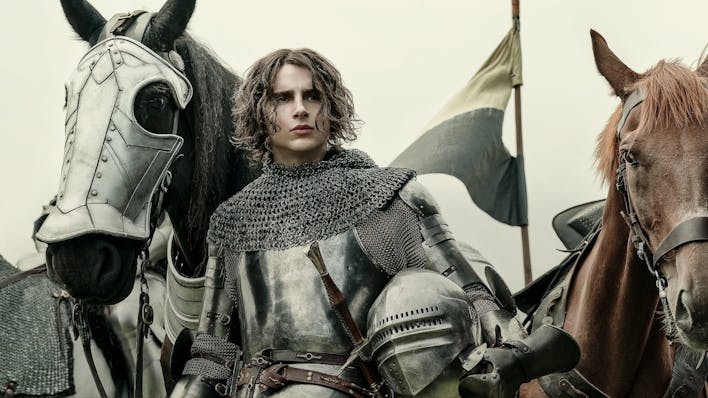
Timothée Chalamet bombs in weak Netflix biopic 'The King' | The ...The film may be titled The King, but for all intents and purposes it might as well have been titled Falstaff: The Untold Story given the prominent and surprisingly ennobling role our rotund knight had. I freely confess that I do not know the history plays as well as I should or could. However, as weak as my knowledge of the Henriad is, I do not remember Falstaff being the source of wisdom or of deep thoughts on war. In fact, what shifts the character from the wastrel Hal to the noble Henry is his very rejection of Falstaff and the past he represents, turning away from his former carousing buddy to accept his destiny as monarch.

In The King, this Hal/Henry would never tell Falstaff, "I know thee not, old man". On the contrary: Henry thinks of Falstaff as the embodiment of nobility and wisdom. Even more surprising, Falstaff IS the embodiment of nobility and wisdom. Again, while the Shakespeare history plays are not my forte, I don't remember Falstaff being this boring or Hal/Henry this wimpy.

Netflix drama The King reimagines Shakespeare's Henry plays with ...
This is the second Joel Edgerton script that I have seen after Boy Erased, where he also played a major character (Edgerton cowriting The King with director David Michot). Both times he has failed to win me over, but The King is even worse in that it takes a particularly great source material and butchers it. The King is a slog to sit through: boring, endless, lifeless, with no action, no motivation, a terrible sense of self-importance where everyone is "acting" versus "being".

It is a poor sign when your allegedly main character's greatest character development is signaled by a haircut: emo-like threads for Hal, short hair for Henry.

Worse, The King has some of the most ghastly performances of the year. There is not an ounce of life in any of the characters, almost everyone speaking in this faux-important whisper that almost suggests they weren't sure of their lines and tried to compensate by speaking them softly.

Chalamet is wildly miscast as Hal/Henry. He does not display either a wild and reckless life of debauchery or his evolution to the noble and powerful monarch he became. Instead, Chalamet seems like a little boy thrust into some kind of oddball epic trying to figure it out along the way. Chalamet is more willowy than imposing, and it beggars belief that this scrawny kid shifts into the muscular monarch (muscular in every meaning of the word).

Part of his failure is not Chalamet's fault; he was poorly directed by Michod, who made everyone "act" so serious. In fact, all the seriousness in The King drowns out any chance for drama or emotion. Part of his failure lies with co-writer Edgerton, who gave himself the plum role of Falstaff, now as Action Hero versus Drunken Buffoon. He too whispers, but in one of those "whispering = deep thoughts" acting styles that plagues many a faux-epic. Thomasin McKenzie as Henry's sister and Chapman as Prince Thomas are wasted in essentially cameos who might as well have been cut out altogether.

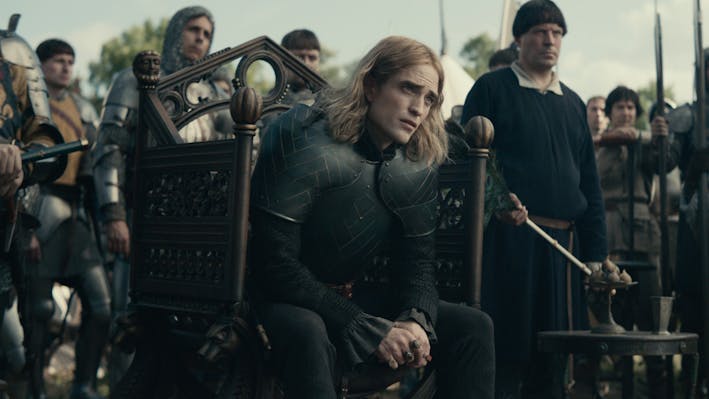
Timothée Chalamet bombs in weak Netflix biopic 'The King' | The ...Faring worse, however, is Robert Pattinson as the Dauphin of France. Looking like Dracula's grandson and sporting a French accent that Monty Python would reject as too over-the-top, his Edward Cullen-Meets-Inspector Clouseau shtick confirms for me that Pattinson cannot act. I keep getting told he's his generation's Peter O'Toole, some titanic force of cinematic brilliance that transcends sparkling vampires. However, even he cannot claim pride in The King for his inevitable Honorary Oscar or Kennedy Center Honors tribute.

The King also is saddled with nearly indecipherable cinematography where you feel like calling for a flashlight to see what is going on and a score that thinks better of itself than it should be. It is absolutely astonishing that the Battle of Agincourt, which should be the climax of the film, looks almost boring.

As I think back on The King, I genuinely wonder why any of them decided that their version of the Henriad would be something people would want to watch over other versions. It has no action. It has no romance. It has no humor. It has no drama. It has no emotion. It has no character development. Apart from bad performances and a dull narrative, it has nothing.

May The King never reign.   

DECISION: F

Monday, February 4, 2019

West Side Story (1961): A Review (Review #1178)

WEST SIDE STORY (1961)

West Side Story, a musical updating of Shakespeare's Romeo & Juliet, not only translates well from the dusty streets of Verona to the gritty streets of New York City but makes the idea of rival street gangs being proficient in ballet plausible. With incredible music and masterful directing, its few sins can be masked.

The Anglo street gang of The Jets face a rival for control of the streets in the Puerto Rican gang The Sharks. Their leaders Biff (Russ Tamblyn) and Bernardo (George Chakiris) hate each other, with the hatred seeping to all their members. Biff has had enough of Bernardo and decides to challenge the Sharks to a rumble for ultimate control. This challenge will be offered at the gym dance despite the gym itself being neutral territory.

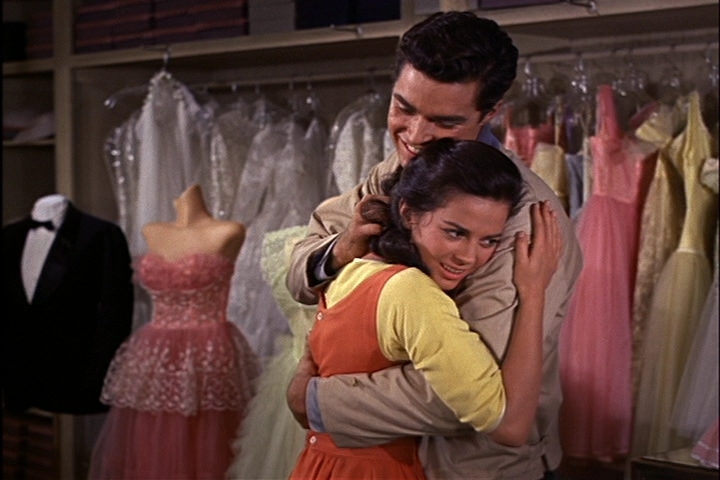
At the dance Bernardo brings his girlfriend Anita (Rita Moreno) and his younger sister newly-arrived from the island, Maria (Natalie Wood). Biff has asked his BFF Tony (Richard Beymer) to side with him at the challenge, even though Tony is an inactive member. Tony and Maria see each other and fall instantly in love.

This love cannot be for a variety of reasons, but true love will not be denied. Tony thinks he can bring peace between the Jets and Sharks, but in the rumble he tries to stop Biff is accidentally killed by Bernardo. Shocked and angered, Tony ends up killing Bernardo. Both groups are horrified at how things have spun so out of control, and despite her love killing her brother, Maria understands and stands by Tony. Even Anita grows to understand that love does irrational things.

The hatred and mistrust between both groups, however, still continues. Tony hopes to leave the West Side with Maria, but a series of misunderstandings, along with an attack on Anita by the other Jets, lead to his death. Maria, devastated and now filled with hate herself, threatens them all, but in Tony's death and Maria's genuine heartbreak, there is the hope that these two houses can reconcile.

Image result for west side story movieWhen you look at the songbook West Side Story has, you marvel at just how extraordinary, even revolutionary the music was.

The Jet Song 
Something's Coming
Maria
Tonight
I Feel Pretty
One Hand, One Heart
Somewhere
Cool
A Boy Like That

That is a testament to the true musical genius of composer Leonard Bernstein and lyricist Stephen Sondheim, as almost each West Side Story song does what good musical numbers do: further the plot or give character insight. We have the playfulness of I Feel Pretty, the swagger of The Jet Song, the intensity of Cool. We also have a group of intensely romantic songs from the love-struck ode to Maria to the almost mystical One Hand, One Heart and hopeful Somewhere.

As a side note, I find that West Side Story is about the only Sondheim musical where the lyrics are not as esoteric and extravagant as most of his other work, though to be fair I don't know the entire Sondheim catalog.

I think the only song that doesn't work at all is Gee, Officer Krupke, which the Jets sing while waiting for the Sharks to negotiate terms of the rumble. Given that most of the West Side Story songs are generally emotion-driven (hope, anger, passion), this comical piece seems wildly out of place. It doesn't move the plot at all as does the Tonight Quintet (where various characters sing of their plans) or give us insight into their thoughts as does Maria or I Feel Pretty.  It just sits there, a diversion that isn't that diverting.

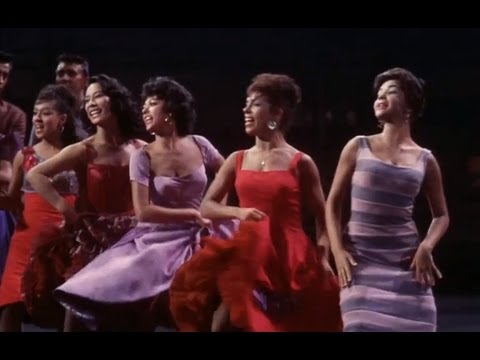
West Side Story has brilliant use of jazz, particularly in the Gym Dance scene and its astonishing 15-minute ballet opening with almost no dialogue from co-director and choreographer, Jerome Robbins. Even within this sequence, we establish story and character through the Jets and Sharks interactions. The film's other director, Robert Wise, showed his own prowess in the Gym Dance scene when he isolates Maria and Tony visually amid the wild Mambo number, and it's a credit to his background as editor that the shifts from the Mambo to the romantic interlude to the ending all flow smoothly.

Image result for west side story movie
There is one number that has never sat well with me, though I understand it's one of the most popular ones, and that is America. I've always been ill at ease with America, and a large part of it stems from the fact that I, unlike Bernardo, Anita and Maria, am a son of an immigrant versus an immigrant. As such, while I can respect the song's mix of upbeat music and downbeat lyrics, I never had such a dark view of America as expressed by Bernardo.

Speaking of dark, I think one of Wise's worst decisions involved the makeup. Chakiris, of Greek descent, has an olive completion that would have worked well as the Puerto Rican Bernardo. However, in keeping with a bad tradition he along with the other Sharks was made up to look much darker, so much so that the actual effect looks both unnatural and obvious. We can't quite set aside the fact that most of the Puerto Ricans were not played by actual Puerto Ricans or even by Hispanics, but by using such dark makeup on them the overall effect is cringe-inducing.

As an actual Hispanic, I find the dark makeup on Chakiris and the other Sharks (even the handful of Hispanics) to be insulting. Moreno and the other Puerto Rican women's makeup was not as exaggerated, making them more natural-looking. It was par for the course in these years to paint Hispanic characters with wildly exaggerated dark skin: Giant and Touch of Evil also literally paint Hispanics in excessive and unnatural skin tones.
Image result for west side story movie

There is also the issue of casting. This goes beyond the casting of the Russian Wood and Greek Chakiris as Puerto Ricans, shaky accents and all. It goes to actual performances. Rita Moreno is the clear standout as Anita, who transcends any notions of a 'Latina Spitfire' to make her into yes, a passionate character, but also a very wise and understanding woman. Anita is aware of people's natures, so while she is displeased with Maria consorting with the enemy, she also knows Maria is a girl who likes a guy.

Chakiris, struggling accent aside, is also good as Bernardo from the moment his intense eyes signal the anger he carries as a macho but marginalized man. He also has good moments where he is the caring brother and slightly put-upon boyfriend.

Most everyone else though struggles. Wood did her best but sometimes her Maria, bad accent and all, struggled to make Maria into an authentic young woman discovering life and love in America. She was dubbed by Marni Nixon, and while I've been critical of Nixon's posh delivery here she also goes along with the Puerto Rican accent, sounding less realistic. In Somewhere, Nixon's stab at sounding Puerto Rican is just about comical.

Beymer's Tony was not bad but not great. Tamblyn was embarrassing as Riff: one never knew if his put-upon 'Nuw Yawk' accent was meant to be comic or serious.

Tucker Smith as Riff's lieutenant Ice out-shined him so much on all levels: singing, dancing and acting, that one wondered why Riff and not Ice was the Jets' leader. His big number in Cool showed him take full command, and he was the only one not participating in the silliness of Gee, Officer Krupke. Eliot Feld was also delightful as Baby John, the sweet and naive Jet who still read comic books and was oblivious to the erotic nature of the Gym Dance number, happily hopping along with his date while everyone else did the PG version of a bump and grind.

Looking at it now, I think West Side Story might be seen as slightly dated, almost comical with its lingo of "Daddy-O" and faux accents. It might make people not willing to surrender to the idea of musicals chuckle at how these somewhat clean hoods could dance through the mean streets on New York. However, as a film and as a musical, West Side Story really towers over so many now-forgotten musical films. It's mix of romance, action and drama, coupled with a nearly perfect songbook and score, brilliant directing and choreography all shape West Side Story into being a brilliant film.

DECISION: A+

1962 Best Picture: Lawrence of Arabia

Wednesday, January 23, 2019

Othello (1952): A Review

Image result for othello orson wellesOTHELLO (1952)

Author's Note: this review is for the 1952 European release, not the 1955 recut version.

When it comes to the Orson Welles adaptation of Othello, there are two tragedies. The first is the actual story itself: a tale of jealousy, madness and murder most foul. The second is in how Welles essentially had to stumble his way through production, with numerous starts and stops in the filming. One, however, would mostly not notice all the oddities and jumbled nature of Othello. The film itself, though rather short, has some extremely inventive visuals, proving that necessity really is the mother of invention.

We open Othello with a funeral and a man chased and caged, so we already know there will be death and retribution. We then go in a more straightforward manner of Shakespeare's tale.

Iago (Micheál MacLiammóir) has a burning hatred for his Moorish general Othello (Welles) for being passed over as second-in-command for Cassio (Michael Laurence). Iago's frenemy Roderigo (Robert Coote) dislikes Othello for 'stealing' the beautiful Desdemona (Suzanne Clotier) from him. Her father Brabantio (Hilton Edwards) is displeased too, but is resigned to her 'disobedience'.

Sent to Cyprus to stop the Turks, Othello has a victory, but Iago starts his elaborate plot to bring down both Cassio and Othello. His plot involves disgracing Cassio, then getting him to try and have Desdemona plead for his case. The interactions between Desdemona and Cassio are then used by Iago to plant seeds of doubt in Othello about her fidelity, and soon Othello becomes ensnared by that 'green-eyed monster'.

Convinced now that Desdemona is Cassio's mistress, with a damning evidence of Desdemona's handkerchief as proof, Othello's rage grows murderous and tragic. With so much death and horror, Othello ends where we began.

Othello has a visual style that belies its cobbled together financing. Despite the limited resources we have some excellent moments where we don't notice the economic limitations. Welles has many moments where we do not see the actors deliver their lines, but instead we see the backs of them. It actually lends an air of mystery and suspense, giving the viewer a sense that there is greater torment or fury we can imagine.

A shot that Welles uses where we see him reflected in a mirror as Iago fills his mind with false evidence is meant for subtext about how Othello is now a reflection of himself, of his dividing mind before he becomes filled with murderous jealousy. It may be cliched, but it is effective.

Welles captures that sense of doom and tragedy and foreboding right at the beginning. It comes not just from the fact that we Othello and Desdemona's bodies carried for burial, but in Angelo Francesco Lavagnino's music. The music is dark, heavy, with a Gregorian chant style that pulsates with menace, even horror. Welles has several shots askew, again subliminally signaling the chaotic nature of this Moorish tragedy.

The economic nature of Othello works even when it deviates from the literal text or setting. The attack on Cassio and subsequent killing of Roderigo takes place in a Turkish bath, which is not from Shakespeare's text. It was set in a Turkish bath because the costumes were not ready and a logical place for men to be lightly clothed was needed to have the scene. Here, it works: the steam lending a greater menacing air.

In short, visually speaking Othello uses what resources it has at its disposal to lend the story a darker, heavier manner.

I cannot say I was particularly overwhelmed by the performances. As much as I like Othello I have never shaken the idea that Desdemona is a weak character, a blank almost dim woman. Clotier's performance does not enhance that idea. Even her final line, "Kill me tomorrow! Let me live tonight!" seems said less in the frantic, terrified manner I think of it in and more as a passive statement.

Welles similarly seems more theatrical and not in a good way. He seems surprisingly controlled in his rages. It's hard to mess up Iago, and MacLiammóir is appropriately cold and villainous as our false friend. One can believe his duplicity can deceive so many.

Othello is a visually arresting film, though sometimes the economical manner of it is obvious (a few times it looked like a still photograph was used rather than straight film). I think though that the lack of financing helped lend the film a more frantic quality, matching the Moor's growing desperation and rage. Perhaps it is not the best adaptation, and I leave it to you if Welles in dark makeup is a hurdle (though to be fair, it seems less outlandish than Laurence Olivier's version). It may also not be strictly true to the text.

On the whole, however, the visuals more than make up for any of its flaws, making Othello a truly sumptuous and tragic spectacle.

DECISION: A-

Thursday, December 13, 2018

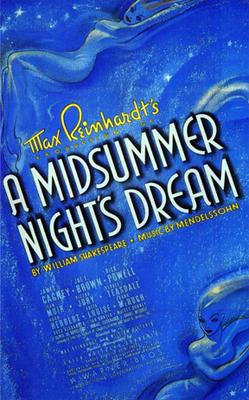
A Midsummer Night's Dream (1935): A Review


A MIDSUMMER NIGHT'S DREAM (1935)

A Midsummer Night's Dream is one of my favorite Shakespearean plays. Given I love this and The Tempest, it seems I gravitate more to his fantasies than the comedies, tragedies and histories though I love them too. This version of A Midsummer Night's Dream is interesting in that it came from Warner Brothers, a studio best known for gritty gangster films. You even have one the quintessential gangsters cutting loose as a literal ass. Posh, lavish, imaginative albeit at times a bit slow and with curious casting choices, A Midsummer Night's Dream may have more ambition than success, but said ambition certainly goes a long way.

Just before the marriage of Theseus, Duke of Athens (Ian Hunter) to Amazonian Queen Hyppolita (Verre Teasdale), we find ourselves in a love quadrangle. Young Hermia (Olivia de Havilland) is in love with Lysander (Dick Powell), and he with her. However, young Demetrius (Ross Alexander) is also in love with Hermia. She does not return his affection one whit, but her father favors Demetrius over Lysander. Helena (Jane Muir) is passionately in love with Demetrius, but while he's toyed with her, he is not interested.

Lysander persuades Hermia to run away with him, otherwise she will either be forced to marry Demetrius, be forever unwed or maybe even killed. Both Demetrius and Helena pursue them into the forest.  Into the forest also is a group of 'actors', really lower-class workmen, who are working to perform a romantic comedy/tragedy, Pyramus and Thisbe, in order to gain royal pensions for the wedding revels.

The leads are played by Bottom the Weaver (James Cagney) and Flute the Bellows-Mender (Joe E. Brown). Bottom is a total ham, desiring to play every part. Flute just wants to eat his seeds.

Our two groups are unaware of the fairies that dominate the woods. Soon Oberon, King of the Fairies (Victor Jory) and his Queen Titania (Anita Louise) begin quarreling over a changeling child. Through trickery and magic, Oberon casts a spell on Titania to fall in love with Bottom, who has been given the head of an ass.

Oberon's efforts to help our mortal lovers goes a bit haywire thanks to the puckish Puck (Mickey Rooney), who accidentally uses magic on the wrong males, causing both Demetrius and Lysander to fall in love with a shocked and flummoxed Helena, leaving poor Hermia fending for herself.

Over the course of this long night, Oberon gets the changeling from Titania but, feeling some guilt, reverses the spell and restores Bottom. Eventually Puck sorts out the romantic tangles with Lysander & Hermia and Demetrius & Helena falling in love (or in love again). They now join the royal wedding, where our comical players entertain the Court thanks to their ineptness.

With all loves restored and all mended, Puck bids us farewell.

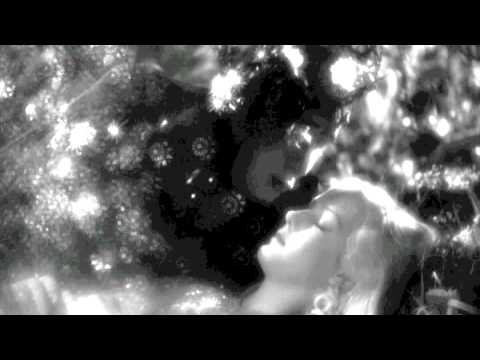
Related imageIf anything, A Midsummer Night's Dream is very lavish and artistic. I figure this was a way for Warners to add 'a touch of class' to their reputation. I think it is one of the most elaborate adaptations bordering on beautiful.

Part of me feels it's a pity it was not in color, but the overall look of the film is still highly impressive. Hal Mohr's cinematography captures the ethereal world of A Midsummer Night's Dream, particularly when we see the Fairy Court. The shimmering lights when we see the fairies, particularly with Oberon and/or Titania, makes the film literally sparkle.

Interestingly, Mohr was not nominated for an Oscar but ended up winning anyway for his cinematography. He was the first, and I believe only, write-in Oscar winner, which makes one wonder both why he wasn't officially nominated and why the Academy dropped the write-in votes.

The film is very poetic and artistic thanks to co-directors Max Reinhart (who had done the original Hollywood Bowl production it was based on) and William Dieterle, who had more film experience. Of particular note are the various ballet numbers from the fairies, which today may look a bit curious and over-the-top. However, whenever Oberon and Titania literally take flight, you are impressed at how well that works.

The special effects are also quite impressive and have stood the test of time.  The performances, not so much.

Image result for a midsummer night's dream movie 1935
A Midsummer Night's Dream was the film debut of Olivia de Havilland, who was discovered in the original Hollywood Bowl production and was brought on board to recreate her performance. While you can see that she was a bit more mannered than those who had more film experience, you can instantly see her talent as the lovelorn, spurned, and re-loved Hermia.

Rooney, also recreating his role, is ideal as the rakish Puck, delighting in the misadventures of these foolish mortals. Adopting a quirky tone, Rooney has an exuberance in his Puck, thrilling in the outlandishness of it all.

Similarly, Cagney cut loose and dove into his ham Bottom. This wild, over-the-top performance must have been a surprise to his fans, who were used to seeing him as the gritty gangster. Cagney's talent had been largely untapped, and here we see that he is more than able to do great comedy as this literal ass. Whether it is stumbling through the forest, being wooed by a Fairy Queen or giving a comically bad performance as 'Pyramus', Cagney was certainly in on the joke.

Other performers, however, seemed a bit lost. Anita Louise, while beautiful, was perhaps too dramatic as Titania, though given she was a Fairy Queen, I can cut her some slack. Joe E. Brown seemed so uncomfortable in Shakespeare, as if he just wanted to get it over with. Victor Jory as the Fairy King looked odd and sounded odder.

The worst was Dick Powell. Powell had two phases in his career: the boyish crooner and the hard-nosed gumshoe, who went from charming kid to cynical film noir antihero with surprising ease. A Midsummer Night's Dream was during his boyish crooner phase, but the breezy manner he used to great success in musicals like 42 Street and Gold Diggers of 1933 felt so wildly out-of-place in Shakespeare. Just about everything in his performance was so off.

Still, despite some offbeat casting A Midsummer Night's Dream is quite lavish and entertaining, elevated with Erich Wolfgang Korngold's adaption of Felix Mendelssohn's incidental music. Not without flaws it is still an elegant adaptation. 

DECISION: B-

Tuesday, June 12, 2018

Romeo and Juliet (2013) Broadway Review

ROMEO AND JULIET

I am aware that Romeo and Juliet is a tale of woe, but that does not excuse the 2013 Broadway production from being so woeful.  Apart from one performance this production is shockingly bad, appealing to tweens all thrilled with the flattest, dullest Romeo to strike the Great White Way.

The conceit of this version is that the Capulets are black and the Montagues are white.  How having a black Prince of Verona does not affect his relationship with the Capulet/Montague feud given how they opted to make race an issue we know not.

Romeo Montague (Orlando Bloom) falls passionately in love with Juliet Capulet (Condola Rashad), and she reciprocates.  The problem is that their families are in a blood feud.  Despite this, they opt to secretly marry with the help of Juliet's Nurse (Jayne Houdyshell) and Friar Laurence (Brent Carver), the latter in the hopes that their union will end the bitter feud.

However, things cannot be as such, as Juliet's cousin Tybalt (Corey Hawkins) fights with Romeo's best friend Mercutio (Christian Camargo), Romeo's efforts to stop this lead to Mercutio's death, then Romeo kills Tybalt in anger.  From there, cascades our cycle of sadness on both these noble houses.

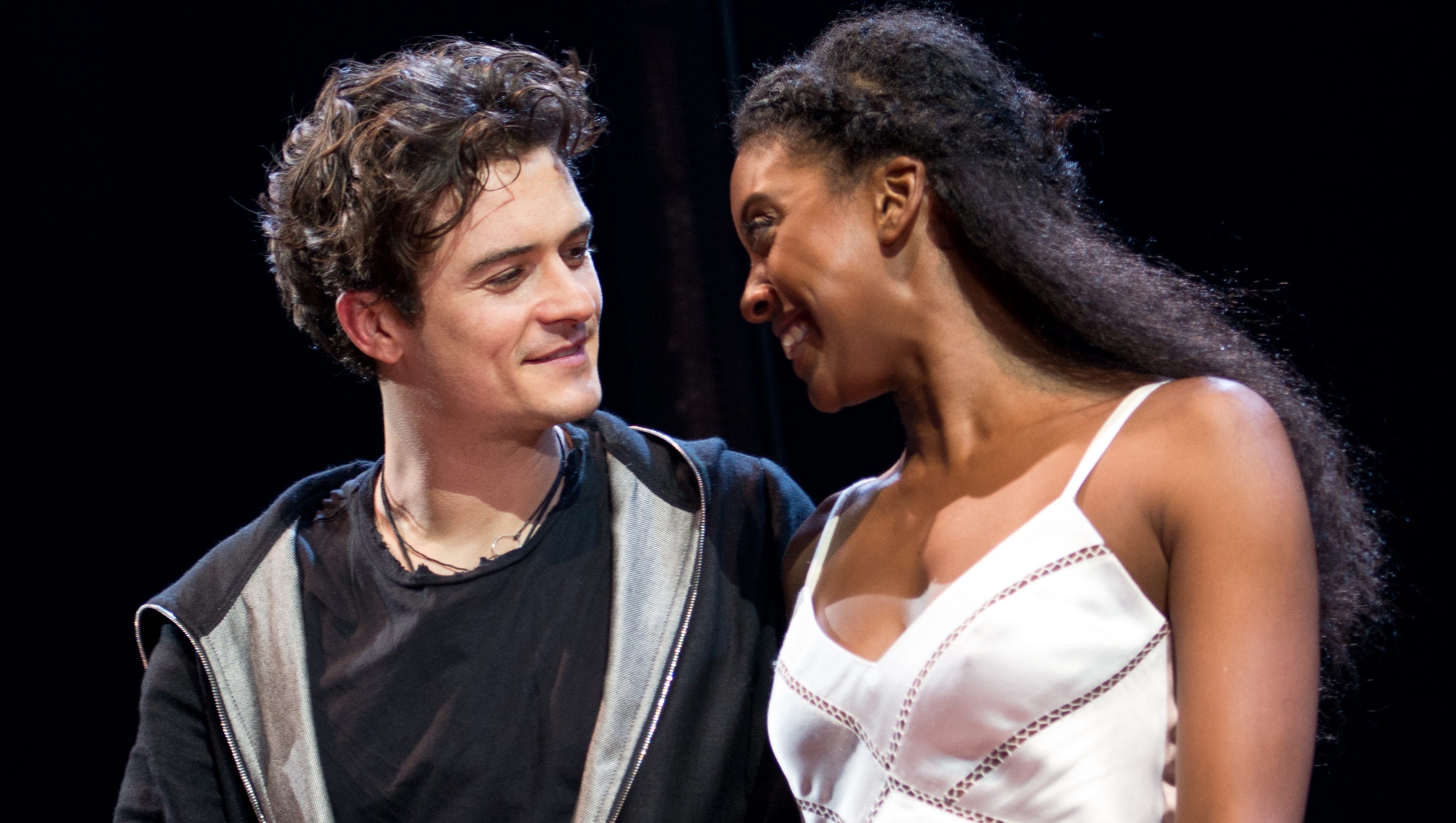
Related imageYou know the target audience of Romeo and Juliet straight from Romeo's entrance.  Channeling a bad James Dean impersonator trying to do Shakespeare, Orlando Bloom rides atop a motorcycle in this 'contemporary' version.  When he removes his helmet to reveal the ethereal beauty that is Bloom, you could hear cheers and I think squeals of delight from teen girls, aroused at seeing Legolas so close.

It's a curious thing in a production when you see pretty quickly that this is going to be a disaster.  I saw it from the moment we heard the rumble of the bike.  I figure director David Leveaux wanted us to think of Romeo as this classically cool figure, smooth and charming, even hip.

His entrance, however, ended up making it look like Romeo and Juliet had slipped into Grease 2, with everyone about to start singing Who's That Guy.  I happen to like Grease 2, a guilty pleasure I admit, but it's sad when something as bad as Grease 2 is actually on a higher level than Romeo and Juliet.

I'm not such a purist that I cannot have a contemporary production of Shakespeare, but there has to be a reason for it.  There was no reason for it, apart from appealing to Bloom's squealing groupies.  Oddly, I have always thought that Bloom is competent only in period and fantasy films, floundering whenever he tries to play contemporary.

Note I said 'competent', not 'good', because Romeo and Juliet showcase just what a lack of acting talent he has, with nothing to recommend a career apart from his beauty.  His Romeo is an embarrassment, good only for spoofing.  Bloom has a really amusing tic in Romeo and Juliet: thrusting his right arm out in many of his line readings.

I did not keep count, but that might make for a good drinking game: a shot every time Bloom thrust his arm out to show he is ACTING.  That, however, is the least of his theatrical sins.

Image result for romeo and juliet 2013 broadway
Bloom's 'call to arms' is part of a larger issue: how he is not the character but the star.  He constantly performs to the audience, as if the other actors were not actually there, not even Juliet.  Bloom's performance appears to come from a mind that think they are all props for his one-man show.  In many scenes, he is speaking directly to the audience and seems to barely recognize his other actors.

Add to that his line reading is hilariously bad.  In the Balcony Scene, his declarations of love sound as if he were stoned.  As he pushes through "It is The East...", he makes this not the romanticizing of the fair Juliet, but pretty much a declarative statement, with no sense of love or passion.

His only bright spot, it appears, is in his Obligatory Shirtless Scene.

I wish I could say that his cast pushed Bloom to at least try to up his game, but it looks like they were all trying to act as badly to keep up with him.  Rashad was slightly better as Juliet, but she came across as insipid instead of love-struck.  She also seemed to be rushing through her dialogue, almost in an effort to get this over with the faster.

In my notes, the only complimentary thing I could say about Rashad as Juliet is 'she plays dead very well'.

Hawkins was overdoing things as the angry Tybalt and Camargo never got the humor of Mercutio.  Houdyshell didn't make the Nurse into the salty character I remember from Romeo and Juliet, but more of a scold to where I wondered why Juliet would think of her as a confidante.

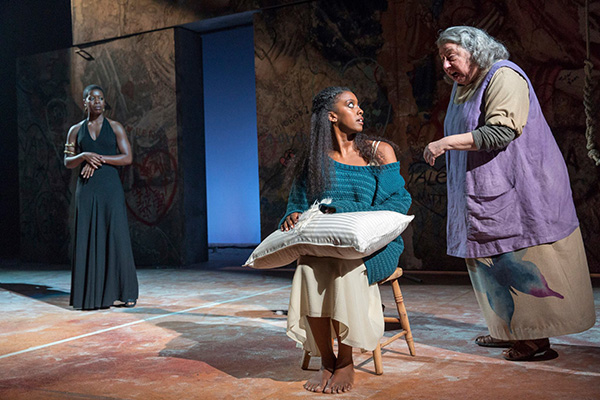
Related imageThe only bright spot was Chuck Cooper as Lord Capulet, who brought a bit of whimsy and humor to his interpretation.

A massive surprise is finding former American Idol first first-runner up Justin Guarini as Prince Paris.  Even more astounding is that Guarini in his small role actually manages to out-act almost everyone, even if his Paris came across as an idiot.

Again, I'm not saying he did a great job.  I'm saying he did a better job than those who have or are alleged to have most experience acting on stage or screen.

I put this in part on Leveaux, who could not get his actors to make the characters real.  I cut him some slack given he had some poor material to work with in Bloom, but other aspects are inexcusable.

This Romeo and Juliet did one thing that I detest in any Shakespeare production: it rhymed.  For reasons I cannot fathom Leveaux let the actors rhyme the lines.  For example, there's this line, spoken by Lord Montague (Michael Rudko) upon discovering their children's bodies:

"That while Verona by that name is known, there shall be no figure as such rate be set, as that of true and faithful Juliet".

"Set" and "Juliet" rhyme, nothing wrong with that.  However, for nearly the whole of Romeo and Juliet, the actors emphasize that their lines rhyme.  In this case, Rudko put force on 'set' and 'Juliet' to enhance the rhyme, but he wasn't the only one doing it.  In fact, I think everyone in Romeo and Juliet did it.  It was only in terms of degrees.

I find that such a pet peeve when watching any Shakespearean production.  Shakespeare's language should sound natural, as if it comes from actual speech and not the force theatricality that many productions are plagued with.  It needs to sound real, and in this version, they seem to almost enhance and emphasize how unreal it sounds when spoken.

Truthfully, I've seen high school productions that have better acting and directing.  I've never wanted these two characters to actually die so much as I did after this monstrous rendition of Romeo and Juliet.


2/10

Sunday, May 27, 2018

Throne of Blood: A Review


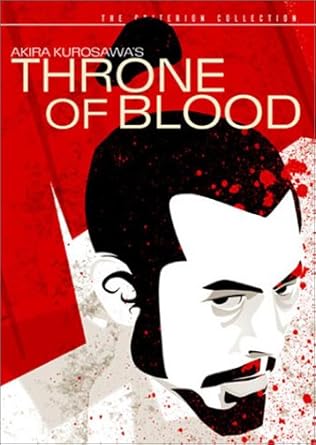
Image result for throne of bloodTHRONE OF BLOOD

Shakespeare works in all languages and all settings.  That is part of his genius.  Akira Kurosawa took the plot of Macbeth, transporting it to feudal Japan in Throne of Blood (original title Spider's Web Castle).  With a powerful performance by its lead, Throne of Blood may be the best cinematic Macbeth of all time.

General Washizu (Toshiro Mifune) and his compatriot Miki (Minoru Chiaki) are returning from having put down an uprising against the Great Lord.  As they go through the Spider Web Forest, they come upon a spirit who makes predictions to them: that Washizu shall become the new Great Lord and ruler of the Spider's Web Castle, and that Miki's son shall inherit the throne after Washizu.

Both men, loyal to the Great Lord, laugh this off as hallucinations.  However, when the Great Lord grants them the titles and honors the spirit predicted they would receive, both men now begin to wonder.

Washizu's ambitious wife Asaji (Isuzu Yamada) pushes her husband to kill the Great Lord and usurp the throne, but he wavers, especially given he has no heir.  He has already agreed to make Miki's son his heir until Asaji tells her she is pregnant.  Now Washizu finds himself in a quandary.

He kills the Great Lord and takes Spider's Web Castle, then has Miki killed, feigning to invite him and his son to a feast to celebrate their successions.  Miki's son, however, escaped the assassination attempt, and now the Great Lord's son and others have joined in a rebellion.

Lady Asaji has a stillborn child, and is now insane, attempting to wash the imaginary blood off her hands.   Washizu is not afraid, however, since Spider's Web Castle has never been taken.  Moreover, in his hysteria he has returned to the Spider Web Forest, seeking out the spirit.  The spirit tells him that he will not be defeated until the trees rise up against him.  Deciding no such thing will ever occur, he is confident of victory.

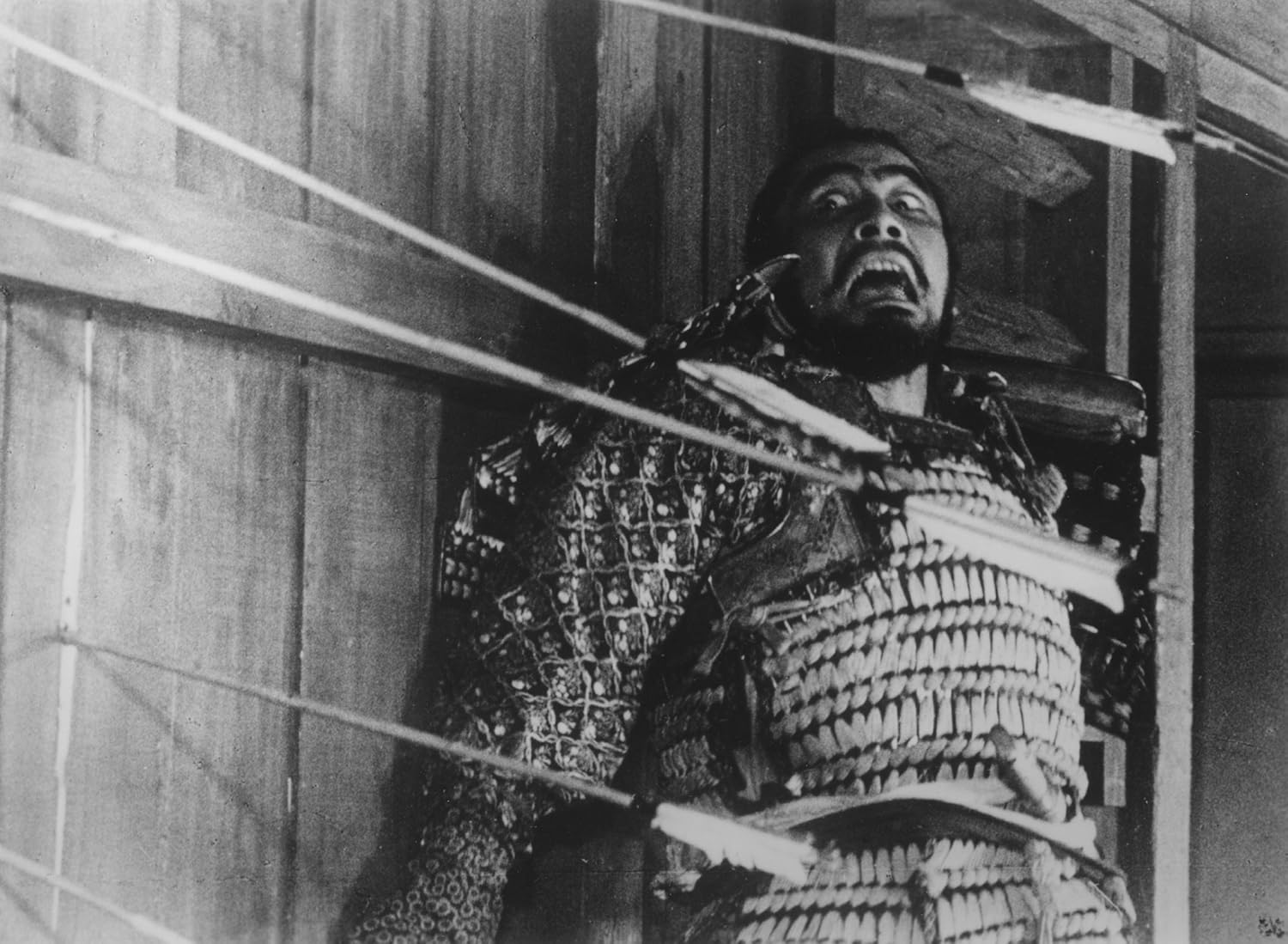
He shares this prophesy with his troops, who cheer on their leader.  The next day, however, they begin to flee in terror, for they see the forest move against the castle.  Washizu himself is stunned to see the forest appear to advance towards the castle.  Chastising his troops, they at first are silent until an arrow flies at him from within the ranks.  In turns enraged and terrified, Washizu attempts to avoid a barrage of arrows, with some managing to hit him.

Finally felled, he falls, and Throne of Blood ends as it began: a mournful male choir singing of the folly of man.

Image result for throne of bloodThere are several elements that make Throne of Blood a rich, vibrant piece of art.  One of them is the performances, particularly by Mifune.  His Macbeth-Washizu is like an almost unhinged wild animal, fierce and dangerous.  Whether he is raging or responding to his monstrous downfall, Mifune is a force of nature.  The intensity of his performance makes Washizu into a compelling figure, frightening in its ferocity.

You see in Mifune's face so much: tension, fear, shock, regret, devastation, arrogance, sometimes in the same scene.  This is not a surprise given that Kurosawa crafted Throne of Blood to be close to the Japanese Noh theater style of acting, one where the face or masks in Noh are meant to express much.

I can see why some people might find some of the acting perhaps exaggerated, but Kurosawa meant it to be a bit theatrical.  To his credit, Mifune never came across as over-the-top and kept a strong balance between the traditions of Noh and a film acting manner.

Kurosawa also brought a strong performance from Yamada as the Lady Macbeth-like Asaji. She is closer to Noh in that she is mostly very still and slow, but in her calm demeanor she displays the cold and calculating nature of this wicked lady.

Another aspect that makes Throne of Blood a masterwork is in Asakazu Nakai's breathtaking cinematography.  The Spider's Web Forest is extremely eerie, and the perpetual sense of gloom and foreboding is enhanced with the scenes set in fog and mist.  In a curious way, they echo the Scottish Highlands that Macbeth is set in.

If one studies Kurosawa's camera movements, you see an economic way to build suspense and surprise.  For example, in the dinner scene the camera moves towards Washizu as he looks upon the empty mats where the doomed Miki and his son were to be at, then the camera moves back and we are all astonished to find the ghost of Miki sitting there.

Image result for throne of blood
If there is a highlight of Throne of Blood, it is in the final scene of Washizu's execution by his troops.  The barrage of arrows coming at him intensifies, with Mifune as a wild animal clawing desperately to escape his fate.  The madness and fury of this, down to the final arrow that fells him, so shocks that it becomes a brutal but fascinating thing to see.

Now, at this point, I think I may be reading too much into Throne of Blood or any symbolism it might have, but I think the film might be a critique of the rise and fall of dictators, perhaps with subtle commentary on Japan's wartime actions.  I thought this when I saw Washizu's speech rallying his troops before the final battle.

We see the great leader, drunk with power and arrogance, standing alone on his balcony, looking down over the faceless troops.  He makes bold predictions, but when his predictions backfire on him, he faces his troops as an emperor without clothes, and is forced out in violence.

I could not help think of people like Mussolini or Hitler or even Tojo, men who led their people into needless wars and in the end were brought down.  In Mussolini's case, strung up by those who a few years earlier shouted 'Duce! Duce!', and in all their cases, came to violent ends.

Again, this might be just me reading too much into things, but that too is part of Kurosawa's genius: to allow for such interpretations.

With breathtaking cinematography, a fast-moving story, and powerful performances particularly by Toshiro Mifune, Throne of Blood is a triumph.  It is my favorite Macbeth interpretation so far, and I doubt it will be equaled, let alone surpassed.

DECISION: A+ 

Friday, March 9, 2018

Hamlet (2015): National Theater Review

Image result for hamlet national theatre liveHAMLET

Benedict Cumberbatch was the big draw for the newest production of Hamlet, primarily due to the squeeling Sherlock fans who find him so scrumptious.  If I were asked to rank the Great Sherlocks, Cumberbatch would probably come in 5th Place, after Jeremy Brett, Basil Rathbone, Vasily Livanov, and Cumberbatch's Frankenstein costar, Jonny Lee Miller.

When it comes to ranking the Great Hamlets, I am pleased to report that despite his enormous talent, Cumberbatch will never outdo Olivier, Burton, Gielgud or Branagh. At this point, I think he might not even outrank Mel Gibson.

Prince Hamlet of Denmark (Cumberbatch) is highly distressed that his mother Gertrude (Anastasia Hille) has quickly married her brother-in-law Claudius (Ciaran Hinds) shortly after the death of Hamlet's father.  He hears from his friend Horatio (Leo Bill) that guards have seen a specter about Elsinore, and this is discovered to be The Ghost of Hamlet's Father (Karl Johnson).  The Ghost tells Hamlet that he was murdered by Claudius and tasks him to avenge him.

Hamlet feigns insanity, but this takes a bad effect on Hamlet's love interest, Ophelia (Sian Brooke), who finds herself both repelled and confused by Hamlet's contradictory manner.  Her father, Polonius (Jim Norton) and brother Laertes (Kobla Holbrooke-Smith) warn her against Hamlet, but she is a woman in love.  Polonius performs an informal examination of Prince Hamlet and despite his general idiocy surmises that there is method in his madness.

Hamlet's 'insanity' continues, but there is method in it with the arrival of the Players, whom he gets to perform a play that recreates King Hamlet's murder.  Claudius rises in shock and anger, and the Court is in chaos. Gertrude summons Hamlet to her chamber where he reprimands her, then hearing someone behind the curtains, stabs the spy believing it is Claudius.  Instead, it is poor Polonius, and Hamlet is shocked both at this and at The Ghost coming to him again, making Gertrude's innocence clear.

By now, Ophelia is, unlike Hamlet, genuinely bonkers, and she drowns.  Claudius' plan to have Hamlet killed when he is sent to England fails, and Hamlet is now back in Denmark.  So too is Laertes, screaming for vengeance.  Laertes and Claudius cook up a scheme to kill Hamlet in an arranged fencing match, which comes after Hamlet and Horatio have come across Ophelia's burial.  The merriment and philosophy that Hamlet had with the Gravedigger comes to an end at Ophelia's burial, and now the plot thickens.

Sadly, everything goes disastrously wrong.  Gertrude drinks from the poisoned chalice, Laertes nicks Hamlet with the poisoned rapier but in the confusion over Gertrude, Hamlet stabs Laertes with his own weapon, then stabs Claudius with it, ensuring they all die.  At the end, Fortinbras (Sergo Vares), Prince of Norway, arrives on this unhappy scene.

Image result for hamlet national theatre live
I have to admit I'm pretty much a traditionalist when it comes to Shakespearean adaptations.  That isn't to mean I oppose updating the time of a Shakespeare play or that it cannot work.  A nice example is 10 Things I Hate About You, which managed to make The Taming of the Shrew both contemporary and less troublesome for today's audiences. 

As a side note, has anyone ever opted to update The Merchant of Venice to Fascist Italy?

As such, I wonder about director Lyndsey Turner's decision to make Hamlet take place somewhere in time.  It's a bit hard to gauge exactly when, for while I'm tempted to say it takes place today some of the elements make it look more like post-World War II.  We start Hamlet with our Dour Dane listening to Nat King Cole's Nature Boy, and the Gravedigger sings All of Me as he tosses bones out to make way for Ophelia.

Part of me 'gets' what Turner was saying when she included Nature Boy to apply it to Hamlet: to speak of many things, fools and kings (of which Hamlet and Claudius were), and how Hamlet may be this 'strange enchanted boy'.  I can even see the dark, wry humor of All of Me with the Gravedigger, for those dead won't use them. 

Part of me does not take kindly to ramming elements that were not intended for one work and apply it to another. It's not a deal-breaker, but part of me thinks this is a case of trying to be too clever.  It's not something I won't protest but something I'm a bit leery about.

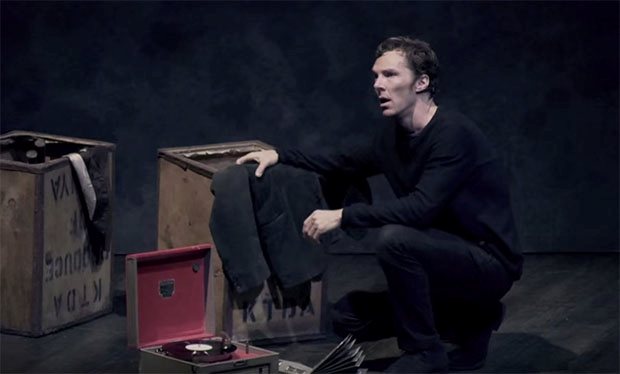
For me, however, the oddest decision was to make Hamlet's faux-insanity almost comical.  To show how bonkers our Prince of Denmark was, we had dress up like a toy soldier and bang on his drum, then play in a toy fort with more large-sized toy soldiers.  Perhaps it is because all my visions of Hamlet involved his madness to be threatening, not laughable.  Yes, there is humor in Hamlet, such as when Hamlet is telling Polonius off, but I was surprised at how funny Hamlet was made to be.

Image result for hamlet national theatre live

One aspect that may have worked both for and against Hamlet was the production design.  Certainly the set was massive, almost overpowering the performers.  It was so large that after the intermission, the set doubled as both the graveyard and Elsinore.  There were big moments, beautiful moments, such as when Claudius sends Hamlet off to what he hopes is his death: a massive burst of wind seems to echo Claudius' rage and plot, with the thundering drumbeats echoing it.

However, because of the massiveness of it all, the stage set for the Players doubles as the curtains for Polonius, which took me slightly out of things as I could not suspend disbelief enough to see it as the Players' set, not Gertrude's curtains.

In terms of performances, I was surprised at how Cumberbatch, despite being the title character, was actually outdone by just about everyone else.  Of particular note is Hinds, who is the most sympathetic Claudius I've ever seen.  I spent most of the play on his side, versus Hamlet, and I'm not sure that was Shakespeare's intent.  Norton's Polonius too was wonderful, his daffy, daft manner a delight.  In the dual role of The Ghost and The Gravedigger, Johnson was powerful and comedic, a credit to his talents.

I could not get a true handle on Gertrude, for Hille was to my mind not well-directed, making the Queen of Denmark almost a non-entity. Same for Brooke's Ophelia, who struck me more as a simpleton than a young girl in the confusion of love brought down to insanity.

As much grief as some productions get for cutting out Rosencrantz and Guildenstern, I don't think they added much here, though Matthew Steer and Rudi Dharmalingam were good in their roles.

Related image
As for Prince Hamlet himself, I was surprised at how different Cumberbatch's voice was.  I didn't hear the resonant baritone of Sherlock or Dr. Strange, but a higher voice, one that spoke the words well. 

For me though, there was something missing.  I could not see the inner conflict, the vacillation, the agony within.  I note when he dismissed Ophelia with a command to 'get thee to a nunnery'.  His delivery of this scene did not communicate whether he had genuine anger at the world or any sense of pain at having to make her, the woman he loved, an innocent victim of his overall plan to take down his wicked uncle.

At times he seemed more petulant than melancholy, and while I can give some leeway when he looks on Claudius' reaction to the Players, I cannot quite get the idea that Cumberbatch is a definitive or even memorable Hamlet.

He is nowhere near bad, but nowhere near as memorable as others who have taken the role before.

If anything pushes Hamlet down, it is the massiveness of it all, in its efforts to be truly cinematic and give audiences bang for its buck.  It was not a bad go, but I could not get as involved with it as I have with others.  It might also be my reluctance to embrace a contemporary version of Shakespeare; why Horatio had to have all those tattoos on his arms and neck, or almost always look as if he were coming or going to a hostel I don't know (unless he was getting ready to play Chester Bennington in a biopic).

Again, not horrible, but not wonderful. 

6/10