Showing posts with label Live Theater. Show all posts

Monday, December 8, 2025

Merrily We Roll Along: The 2023 Broadway Revival

MERRILY WE ROLL ALONG

"Here's to us. Who's like us? Damn few". 

The fall and rise of a friendship and collaboration is given the musical treatment in Merrily We Roll Along. When the musical premiered in 1981, it met with almost vicious reviews and closed after only 16 official performances. This was a stunning turnaround for the creative team behind Merrily We Roll Along. Its composer was Stephen Sondheim. Its director was Harold Prince. These were two Broadway titans. To have any show of theirs flop in such spectacular fashion was almost unheard of. However, Merrily We Roll Along slowly started getting reevaluated. Eventually, it was brought back for a 2023 revival. The show that became one of Sondheim's most notorious disasters returned in triumph, winning four Tony Awards out of seven nominations. Now the filmed version of the Broadway musical has brought Merrily We Roll Along to a wider audience. With some wonderful performances and a good songbook, Merrily We Roll Along should please Sondheim fans and most general audiences, though I can see why some audiences might not embrace it.

Merrily We Roll Along chronicles in reverse order the various lives and collaborations of three individuals, staring in 1976 and ending in 1957. Franklin "Frank" Shepard (Jonathan Groff) is at the top of the Hollywood game. His newest film, an adaptation of Musical Husbands, is the toast of the West Coast. That Frank, everyone says. While married to Broadway diva Gussie Carnegie (Krystal Joy Brown), he is giving great attention to the film's ingenue, Meg (Talia Robinson). Frank's quippy friend Mary Flynn (Lindsay Mendez) can only drunkenly comment on how Frank is not the same man who loved music and musical theater. A ghost from the past is revived when someone mentions Frank's former musical partner, Charlie Kringas. They had a falling out in 1973.

Here, Charlie (Daniel Ratcliffe) is shocked to discover that Frank has more than optioned their big Broadway hit Musical Husbands for film. Charlie, already bitter and upset about that, is more bitter and upset when he learns that Frank has a three-picture deal. It is not so much that Charlie has been cut out of the process as he has no interest in film. It is that he learned about it just before a live joint interview. Charlie openly humiliates Frank in Franklin Shepard, Inc. Frank, understandably enraged at being humiliated so openly, cuts Charlie out of his life forever. As time goes back, we see that Frank and Charlie had a good working relationship, starry-eyed dreamers who with Mary recognize the specialness of Old Friends. Frank, unlike Charlie, is struggling with the aftereffects of his divorce caused by his affair with Musical Husbands star Gussie. 

That divorce from Beth (Katie Rose Clark) cost him more than a happy marriage. It cost him a closer relationship with Frankie, Jr. However, the divorce may be the best thing that ever could have happened, as Now You Know. What they do know in 1964 is that Musical Husbands is a surprise hit for Franklin Shepard and Charles Kringas, their generation's Rodgers & Hammerstein. They can now turn to their passion project, Take a Left, their Leftist political musical. Musical Husbands producer and Gussie's husband Joe (Reg Rogers) urges them to wait on Take a Left until they are more established. 

In 1960, the trio of music by Frank Shepard, lyrics by Charlie Kringas, and up-and-coming singer Beth do a cheerful revue of the incoming Kennedy Administration. The revue delights Broadway producer Joe, who is squiring his secretary and aspiring Broadway diva Gussie Carnegie (not her real name). Frank is too excited and distracted by his impending marriage to Beth, whom he knocked up, to care much about anything other than a chance to write for Joe with his bestie Charlie by his side. At last, our trio of Frank, Charlie and Mary meet up on the roof in 1957. They see in Sputnik a new beginning both for the world and for themselves. Mary compliments Frank's music. A casual comment from him about "having met the girl he's going to marry" prompts a lifetime of unrequited love and devotion. For them, this is Our Time.

Having some familiarity with Sondheim, I found Merrily We Roll Along to fit within his style musically and thematically. The title alone is quite ironic as there is nothing merry about the Frank, Charlie and Mary triumvirate. I have found that Stephen Sondheim loves two things in music: irony and a rapid-fire patter in the lyrics. Two strong examples of his penchant for both are in Franklin Shepard, Inc. and Now You Know. In the former, you have Daniel Ratcliffe's Charlie almost rush through the lyrics, pouring out Charlie's anger to rage at how Frank is focusing on business deals instead of creating. If one merely reads the lyrics of Franklin Shepard, Inc., one wonders when anyone singing it (or sing-talking it) can find time to breathe. In the latter, you have a good number of the surprisingly small cast advise Frank about how this divorce might be ultimately for good. Now You Know has that rhyming pattern that Sondheim so loves.

"I mean 'big SUPRISE'/People love you and tell you LIES/Bricks can tumble from clear blue SKIES", Mendez's Mary sings rapidly (emphasis mine). I have found that Sondheim has many songs where rhyming words flow at an almost frenetic pace. The ultimate example is Company's Getting Married Today. Merrily We Roll Along, however, does have quite a few songs where this rapid-fire manner appears. A case in point is the 1960 revue, where we are treated to Bobby and Jackie and Jack, a celebration of John F. Kennedy's election and upcoming Administration. Here, Ratcliffe, Jonathan Graff's Frank and Katie Rose Clarke's Beth cram in every member of the Kennedy family. Sondheim even manages to have Charlie, Frank and Beth struggle and stumble over "Sargent Schriver", constantly guessing different military ranks until they stumble on "Sargent". 

That patter fixation of Sondheim's does allow for the slower songs to stand out. I think the one song that has filtered through from Merrily We Roll Along is Old Friends. The song appears twice. The second time it is a more upbeat rendition, reflecting how despite their growing distances they still value each other. The first one though is slower, more reflective. It is mostly Mary with Charlie, attempting to smooth the fraying relationship between Charlie and Frank. Unlike other Stephen Sondheim songs, Old Friends is dare I say more optimistic. It does reflect how this trio has a bond that they do genuinely want to hold.  

Another standout is Not a Day Goes By. Like Old Friends, it is sung twice. The first time is a solo from Beth, the second a duet by Beth and Frank, with Mary joining in off to the side. Not a Day Goes By is first a deep song of lament as Beth sees her marriage end. The second time around, it has a tinge of optimism for a new life as a married couple, while Mary recognizes that she has lost her secret love. 

Two of Merrily We Roll Along's three nominated players won Tonys for their performances. Jonathan Graff in his Tony-winning role is a standout as Frank. The play allows us to see that Franklin is not a bad man. He just makes bad choices, over and over again. Graff gives him a solid transformation because he shows Frank's moments of regret. Graff makes Frank sympathetic even as he goes upstairs to sleep with Gussie. Vocally, Jonathan Graff is strong, keeping a firm grasp on Sondheim's music.

Daniel Ratcliffe won Best Featured Actor in a Musical for his Charlie Kringas. His voice is higher, and I think a bit thinner, than Graff. However, it worked for the character, whom I found slightly nebbish. A standout section for Radcliffe is Franklin Shepard, Inc., where he has to not just go through Sondheim's patter number but also add vocalization and physicality. He does a strong job as well.

Lindsay Mendez was the only Merrily We Roll Along cast member who lost her nomination (the musical also losing in the Directing and Sound Design categories). I thought she was fine as Mary Flynn, the quippy former teetotaler who is in love with the unaware Frank. I do not know though if Mary ever really fit into the overall story. I felt that she was just there. I simply never understood why she wasted her time with Frank. Yes, he's attractive. However, I never saw a great bond between Mary and Frank that justified her hanging around.  

I would have substituted Krystal Joy Brown's Gussie for Lindsay Mendez's Mary for a Tony nomination. As this Broadway diva who starts out as a secretary, Brown was delightfully over-the-top when needed, alluring when needed, even meek when needed. She also has a standout number in Act Two Opening. Slinky, coquettish and amusing, I found myself impressed by Brown's number and her massive high kick.

I think that Merrily We Roll Along please a bit of Stephen Sondheim's ego on his self-perception. I can picture him imagining both It's a Hit and Opening Doors speak to him about himself. That creative process in Opening Doors, down to how people found his songbook "not hummable. The triumph of It's a Hit both struck me as how Stephen Sondheim struggled to get numbers to the general public and would want all his shows to be hits. That Merrily We Roll Along was an initial disaster must have been a strange irony for him given those two songs.

I do not understand why Merrily We Roll Along was so hated at its premiere, though this version may not be what 1981 audiences saw. This revival is pleasant, with strong performances from the cast. The structure of reverse storytelling might still put people off. The fact that despite the optimism of the conclusion Merrily We Roll Along is still a bit of a downer might also put people off. On the whole though, Merrily We Roll Along is both a good revival and a good way to introduce people to Stephen Sondheim, both his melodic mannerisms and lyrical quirks. 

8/10

Wednesday, October 6, 2021

Diana: The Musical

DIANA

I have long thought that any subject could be turned into a musical. Diana: The Musical sorely tests that idea. Songs that veer from the merely comical to the downright gaudy, with some simply ghastly moments and dumbfounding performances that will elicit either shock or outright laughter, Diana: The Musical sets musicals back at least ten years.

Diana covers the life of the late Princess of Wales (Jeanna de Waal) from her romance with His Royal Highness Charles, Prince of Wales (Roe Hartrampf) through their tempestuous marriage and ultimate divorce. Diana wants more than anything for Charles to love her, not his longtime mistress Camilla Parker Bowles (Erin Davie), but that is a struggle for all concerned.

Watching and commenting (and singing) on all this is Her Majesty Queen Elizabeth II and romance novelist/Diana's step-grandmother Dame Barbara Cartland (Judy Kaye in a dual role). As Charles has a lover, eventually Diana has one too, in the form of very hunky Major James Hewitt (Gareth Keegan). However, all fairy tales, even ones as disastrous as that of the Waleses, must come to an end, though for the Princess, one that ends in terrible tragedy.

Diana, like everything in the world, was impacted by COVID-19. Set to debut on Broadway, the show had to be delayed, and even the filmed version shows the impact the pandemic caused (photos of the masked crew attending the naturally unmasked cast end the presentation). Had it premiered on the Great White Way, Diana would have either closed in days or run for years for the same reason: near total ineptness.

Audiences either would have walked out in shock and anger, or sat in near stunned disbelief at it's "so bad it's good" manner. I don't think anything has come close to showcasing the woefully, wildly misguided efforts of a cast and crew since Springtime for Hitler.

In many ways, Diana plays like parody, almost trying to outdo Springtime for Hitler in tackiness and terribleness. The music and lyrics by David Bryan and Joe DiPietro (book by DiPietro) soon start stumbling over themselves attempting to ram as many rhymes into them as possible, sometimes with shockingly bad results. It becomes almost a running game to find which song has the worst lyrics, especially since Diana is hellbent on forcing rhymes at every opportunity.

I got tired trying to chronicle every bad rhyme in Diana, but the show loses no time trying to make every song almost comically bad even without rhymes. "Nineteen and naïve, shy and insecure, thinking princes never lie, believing love is pure" Diana sings about herself in the show's opening number Underestimated. My main question is "why is Diana singing those words about herself"? I could see others singing that about her, but it seems odd that she would express herself to be that way.

This is How Your People Dance, chronicling the Prince and Lady Diana Spencer's date, is one for the record books. "And then there's Charles, who's happy when/He hears music by dead white men/Perhaps his girl can turn him into a rocker", Lady Diana sings before everyone starts rocking out. This comes after Diana expresses a desire "to sock her" when thinking of Camilla Parker Bowles. 


Again and again Diana's lyrics come at you in an almost unhinged manner. In She Moves in the Most Modern Ways, which in part looks at her impromptu Royal Ballet dance, we're treated to such lines as "Every move was on point, she electrified the joint". I think though in terms of garish, gonzo musical numbers the most outlandish is Here Comes James Hewitt.

As Barbara Cartland describes the dream man, we see the muscular shirtless Hewitt rise from the stage on a mechanical bull belting out in almost rock-star glee "JAMES HEWITT!". If you're not howling with laughter at this, you then would be staring in total stunned silence at the spectacle of it all (or at the least, admiring Gareth Keegan's physique and bravery at this spectacle). 

"Ladies if your life has gone off course/You don't need no messy divorce/All you need is a man on a horse!" he rocks out to the swooning ladies keeping him company. "I can take you for a ride/All your troubles cast aside/You'll dismount satisfied", he goes on, and by now you have a respect for Keegan for getting through all this without breaking out in laughter himself.

Or at least for his physique.

Diana is flooded with songs: 25 without reprises, as if it was determined to be a wall of sound. With so many songs forcing many rhymes, you can't hold on to any great musical moments. The songs are not allowed to breathe, mellow in the mind. Instead, they are rammed through the nearly two-hour show.

Even here, the songs don't make sense to what we are seeing. Here Comes James Hewitt has the Major as some sleazy gigolo, but the show then shifts to present him as a lovelorn soldier. In Pretty, Pretty Girl the Princess sings "This pretty, pretty girl/was raised to strike a pose/perhaps she should fight/the only way she knows", but Diana makes the case that she was actually raised the be demure, not to "strike a pose". 

The only songs I think were actually good were two slower numbers: I Miss You Most on Sundays and An Officer's Wife sung by Camilla and Queen Elizabeth II respectively. They allowed for character development versus merely chronicling the situations that most viewers would already know. An Officer's Wife might have worked better if director Christopher Ashley had allowed for greater movement as Her Majesty remembers her brief time of freedom in Malta but there was such a stiffness in the presentation that it took away from a potentially good moment.

I Miss You Most on Sundays and Diana in general surprisingly made Camilla a sympathetic character. It almost makes one long for a Charles & Camilla musical, and it curiously diminishes the Princess of Wales. It comes close to being a musical version of the television movie Whatever Love Means

As a side note, we do have a song that uses that famous misquote, Whatever Love Means Anyway. What the Prince of Wales actually said was "whatever in love means", but by now the misquote is so ingrained that it isn't worth arguing about. 

De Waal looks like the late Princess of Wales, and like the rest of the cast does her best, but she has little to work with. That transformation from "Shy Di" to Confident Woman isn't there. Hartrampf does better as Charles: not bothering to sound like His Royal Highness and actually making him sympathetic even as he rages over Diana behaving like a showgirl. Davie's Camilla makes me like her down to where she and Diana confront each other in The Main Event, I was on Team Camilla.

Kaye did better as the outrageous Dame Barbara Cartland than as the stiff Queen Elizabeth II, as she has a role in the former and nothing in the latter. Keegan suffers from how his character is made out to be: sometimes cad, sometimes caring. 

Sometimes Diana can be too much. A case in point: the Snap, Click number, where a group of extremely enthusiastic paparazzi follow the then-Lady Diana in an admittedly exuberant dance number. Again, while Snap, Click has some ghastly lyrics, the choreography is big. 

Ultimately, the best way to describe Diana: The Musical is if Bialystock & Bloom decided to mount another Broadway show after finding something more astonishing that Adolf & Eva's gay romp. If one wanted truth in advertising, it should have been titled not Diana: The Musical but rather Springtime for Spencer

1/10

Tuesday, February 5, 2019

Shen Yun 2019 in El Paso: A Review


For many years, I can recall the glowing comments and praise for Shen Yun, a presentation of Chinese dance and music that tours on a regular basis. Before my late friend Fidel Gomez, Jr.'s death he expressed if not a desire at least a curiosity about seeing a Shen Yun performance. In that spirit I decided that this year I would splurge on a ticket costing $100 including those damn service fees to see what Shen Yun was all about.

What I found was a show that was interesting in spots, a bit oddball in others but that underneath its veneer of traditional Chinese music and dance harbored a semi-open agenda, one that did not sit well with me.

Shen Yun has a Disney-type feel to it, something I could easily see at EPCOT's Chinese Pavilion, full of spectacle yet a bit routine and mannered.  I understand that Shen Yun changes its actual dance numbers and songs every year, but for the most part as I also understand it the program itself stays pretty much the same. Broken down into a series of brief dance numbers accompanied by a mixed Asian-Western orchestra and two songs performed by a baritone and soprano, Shen Yun is overseen by a duo Master and Mistress of Ceremonies consisting of an Anglo Master of Ceremonies and an Chinese Mistress of Ceremonies.

Image result for shen yun master of ceremoniesThis duo serve as our guides and narrators through the various performances, with the Anglo speaking primarily English and the Asian speaking primarily Chinese (I cannot guess whether it is Mandarin or Cantonese). I say 'primarily' because on occasion each is able to speak the other language if not fluently at least respectfully.

Our Master of Ceremonies, Perry Uzunoglu, and our Mistress Nancy Zhang mostly stayed within the confines of the program. They do try for some banter that falls a little flat and forced. In the dance number The Queendom, a comical male character ends up pregnant after drinking from the Lake of Fertility. Afterwards, in English if memory serves correct, Nancy asks what the moral of the story is. Perry replies, "When on a long journey, bring bottled water". Another time in the first half, Nancy and Perry try to get us to say "I love Shen Yun" in Chinese. Somehow, it's explained that 'Wo' is 'I', so Perry says, "Wo is Me".

I guess that's what passes for quips.

The Shen Yun dance numbers are mostly set either in Chinese history or mythology where we see a series of dances choreographed to military precision, the dancers exact in their movements. There were some quite impressive numbers. The Sleeves of the Tang Palace number had our bevy of beauties use the sleeves of their costumes as props. Porcelain in the Balance is exactly that: the women balancing porcelain jars on their heads. To its credit this dance number did allow them to hold the jars with their hands, but it's still impressive.

Just as one watches figure skating to see if the skaters fall, one watches to see if the jars fall off and shatter into a million pieces. They held firm.

Image result for perry uzunoglu
Our Master of Ceremonies
Leads the Way
The Charming Ladies of the Yi number had our dancers wear elaborate costumes that reminded me of the Mexican 'China Poblana', which according to legend is based on a Chinese woman who found herself in Mexico.

Other numbers had a mix of comedy and acrobatics in them. Restaurant Cheer takes the Chinese restaurant theme and has laughs with it, our waiters balancing their dishware while trying to avoid the owner. The Dimwitted Monk has almost a Jackie Chan-type manner with its mix of action and comedy.

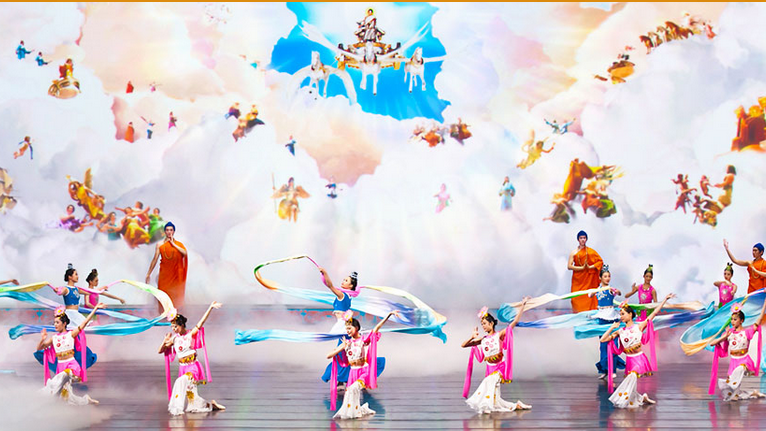
For me, the clear standout was Fairies of the Clouds, where the female dancers seem to emerge from the clouds. It was a beautiful number, enhanced by their matching blue gowns.

When our dancers took us into myth and the past, things went well. It is only when we are brought into the present that things take a peculiar turn.

There are two 'contemporary' dance numbers: Goodness in the Face of Evil and The Final Moment. They are quite freaky and jarring for a show billed and presented as a celebration of traditional Chinese arts.

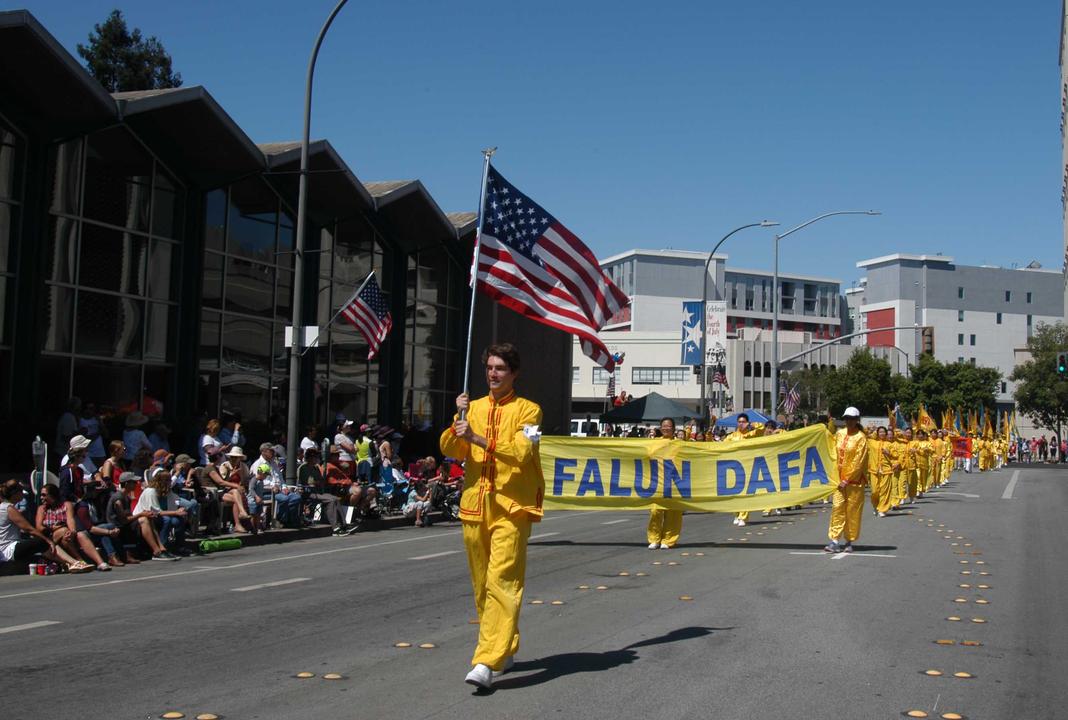
Image result for shen yun master of ceremoniesGoodness in the Face of Evil involves a nice little girl innocently reading her Falun Dafa* book when the Commies come sweeping in, stealing her from her mother and blinding her. Eventually, our little girl manages to be released from prison and if memory serves correct her eyesight is restored thanks to the Divine.

The Final Moment is probably more bonkers. Here, our Falun Gong practitioners are again just doing their own thing with their 'Big Yellow Books' when they are threatened. If I understand the dance number, the Communists are swallowed up by the Earth after a massive storm sweeps to metaphorically and literally clean up after Karl Marx. In the end, a deity seems to bring peace and love to the world, the same way Mr. Burns did right after he got his booster.

On the giant screen where our dancers sometimes appear to leap into/out of, I am not kidding: a giant Karl Marx with rolling eyes who looks like he escaped from a Monty Python animation bit seems close to devouring everyone.

Perhaps this is why Shen Yun has the strictest 'No Photography' policy I've ever seen: to stop people from marveling at such curious sights for posterity. It's standard for most shows to say 'no pictures', but more often than not performers know they will be recorded for private use or for the YouTube.

Shen Yun, however, takes it to a whole new level. A giant "Photography Strictly Prohibited" spotlight is on the curtain. We are told repeatedly that no recording or pictures are to be taken as it affects the performers and is a copyright violation. Before the curtain opened, I saw at least one Shen Yun official walk up and down the aisles, seeing to see if anyone had an errant camera out.

Hard core.

Image result for shen yun
The two songs that cut into the show: Heaven Awaits and Of Truth I Sing, are not particularly good, the latter less so because of the bass singer. The lyrics, which are on the screen in English and Chinese as well as printed on the program, make clear that Shen Yun is not wholly divorced from a little Falun Gong/Dafa promotion.

For Heaven Awaits, we hear "The Great Way of Dafa is now taught/The truth is close at hand". For Of Truth I Sing, we get even more blatant lyrics. "We fallow Dafa, the Great Way/Let not the oppression confuse/And hide the truth from view". As if to cap off some of the nuttiness, we get this bit: "Atheism and evolution are deadly ideas/Modern trends destroy what makes us human".

Let me be clear: I'm not a Marxist, I'm not an atheist, and I'm not into evolution. However, I did literally cringe when I saw and heard all this because at this point I felt Shen Yun was less an innocuous dance show and more a propaganda tool. Everyone involved with Shen Yun can believe what they want, I don't care.

I do care however, if I'm being played for a sucker, if I'm being sold a bill of goods and am somehow being tricked or deceived. Shen Yun does not necessarily hide its Falun Gong roots, but it does not promote them either. It presents itself as a celebration of Chinese music and dance, but does not tell us that everyone involved in Shen Yun is a Falun Dafa follower or that it using Shen Yun as a promotional tool.

I do not think it is used to recruit new members, though I'm sure they won't object if it did. To its credit we don't have Hare Krishna-types roaming the aisles passing out their own 'little yellow books'. It, however, does use Shen Yun to bring their persecution and theology to a literal stage. Even that I might overlook if it did it without doing so in such a blatant and almost over-the-top way.

Seriously, that Monty Python Karl Marx is going to haunt me for some time.

There is a way of working allegory into stories while making them work on their own apart from the message behind the story. Shen Yun hasn't gotten there yet.

As a show itself, I think Shen Yun has been wildly overpraised. As I said, while some dance numbers work quite well and are lovely on the whole I found something mannered in them. I found that they are very rote in how they present the dances. The songs just don't seem to fit in anywhere are are just tacked on. Worse is when the 'modern' numbers pop in: Goodness in the Face of Evil is sandwiched between the jolly Restaurant Cheer and the lusty Mongolian Spirit, the rare number to feature all men.

I think Shen Yun is a one-and-done deal despite Perry's invitation to return. He may end the show with "Even if you've seen it once, you haven't seen it all", but I think I'll stay with EPCOT's version of the Middle Kingdom, no matter what Perry or Confucius says.


Image result for karl marx monty python

*Falun Gong and Falun Dafa are used interchangeably.

Tuesday, June 12, 2018

Romeo and Juliet (2013) Broadway Review

ROMEO AND JULIET

I am aware that Romeo and Juliet is a tale of woe, but that does not excuse the 2013 Broadway production from being so woeful.  Apart from one performance this production is shockingly bad, appealing to tweens all thrilled with the flattest, dullest Romeo to strike the Great White Way.

The conceit of this version is that the Capulets are black and the Montagues are white.  How having a black Prince of Verona does not affect his relationship with the Capulet/Montague feud given how they opted to make race an issue we know not.

Romeo Montague (Orlando Bloom) falls passionately in love with Juliet Capulet (Condola Rashad), and she reciprocates.  The problem is that their families are in a blood feud.  Despite this, they opt to secretly marry with the help of Juliet's Nurse (Jayne Houdyshell) and Friar Laurence (Brent Carver), the latter in the hopes that their union will end the bitter feud.

However, things cannot be as such, as Juliet's cousin Tybalt (Corey Hawkins) fights with Romeo's best friend Mercutio (Christian Camargo), Romeo's efforts to stop this lead to Mercutio's death, then Romeo kills Tybalt in anger.  From there, cascades our cycle of sadness on both these noble houses.

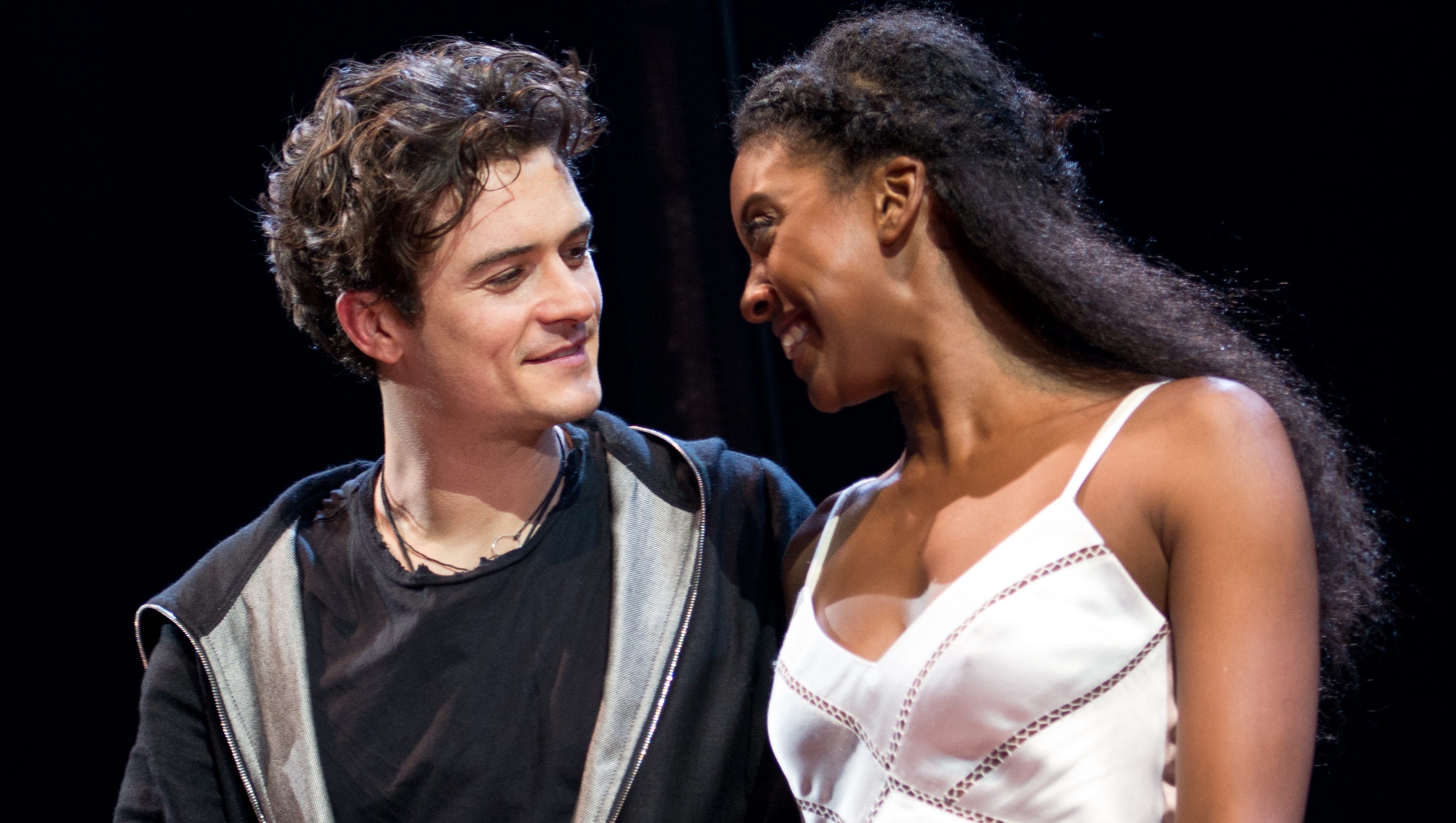
Related imageYou know the target audience of Romeo and Juliet straight from Romeo's entrance.  Channeling a bad James Dean impersonator trying to do Shakespeare, Orlando Bloom rides atop a motorcycle in this 'contemporary' version.  When he removes his helmet to reveal the ethereal beauty that is Bloom, you could hear cheers and I think squeals of delight from teen girls, aroused at seeing Legolas so close.

It's a curious thing in a production when you see pretty quickly that this is going to be a disaster.  I saw it from the moment we heard the rumble of the bike.  I figure director David Leveaux wanted us to think of Romeo as this classically cool figure, smooth and charming, even hip.

His entrance, however, ended up making it look like Romeo and Juliet had slipped into Grease 2, with everyone about to start singing Who's That Guy.  I happen to like Grease 2, a guilty pleasure I admit, but it's sad when something as bad as Grease 2 is actually on a higher level than Romeo and Juliet.

I'm not such a purist that I cannot have a contemporary production of Shakespeare, but there has to be a reason for it.  There was no reason for it, apart from appealing to Bloom's squealing groupies.  Oddly, I have always thought that Bloom is competent only in period and fantasy films, floundering whenever he tries to play contemporary.

Note I said 'competent', not 'good', because Romeo and Juliet showcase just what a lack of acting talent he has, with nothing to recommend a career apart from his beauty.  His Romeo is an embarrassment, good only for spoofing.  Bloom has a really amusing tic in Romeo and Juliet: thrusting his right arm out in many of his line readings.

I did not keep count, but that might make for a good drinking game: a shot every time Bloom thrust his arm out to show he is ACTING.  That, however, is the least of his theatrical sins.

Image result for romeo and juliet 2013 broadway
Bloom's 'call to arms' is part of a larger issue: how he is not the character but the star.  He constantly performs to the audience, as if the other actors were not actually there, not even Juliet.  Bloom's performance appears to come from a mind that think they are all props for his one-man show.  In many scenes, he is speaking directly to the audience and seems to barely recognize his other actors.

Add to that his line reading is hilariously bad.  In the Balcony Scene, his declarations of love sound as if he were stoned.  As he pushes through "It is The East...", he makes this not the romanticizing of the fair Juliet, but pretty much a declarative statement, with no sense of love or passion.

His only bright spot, it appears, is in his Obligatory Shirtless Scene.

I wish I could say that his cast pushed Bloom to at least try to up his game, but it looks like they were all trying to act as badly to keep up with him.  Rashad was slightly better as Juliet, but she came across as insipid instead of love-struck.  She also seemed to be rushing through her dialogue, almost in an effort to get this over with the faster.

In my notes, the only complimentary thing I could say about Rashad as Juliet is 'she plays dead very well'.

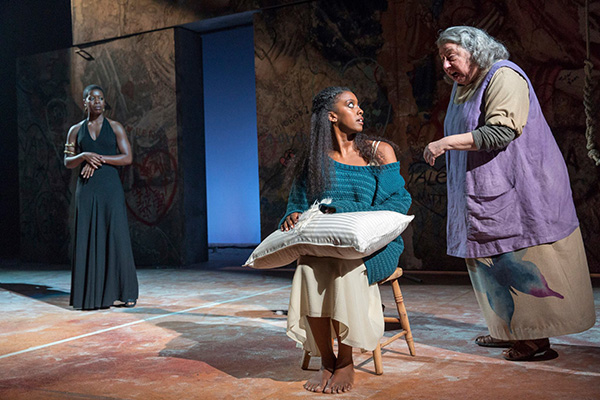
Hawkins was overdoing things as the angry Tybalt and Camargo never got the humor of Mercutio.  Houdyshell didn't make the Nurse into the salty character I remember from Romeo and Juliet, but more of a scold to where I wondered why Juliet would think of her as a confidante.

Related imageThe only bright spot was Chuck Cooper as Lord Capulet, who brought a bit of whimsy and humor to his interpretation.

A massive surprise is finding former American Idol first first-runner up Justin Guarini as Prince Paris.  Even more astounding is that Guarini in his small role actually manages to out-act almost everyone, even if his Paris came across as an idiot.

Again, I'm not saying he did a great job.  I'm saying he did a better job than those who have or are alleged to have most experience acting on stage or screen.

I put this in part on Leveaux, who could not get his actors to make the characters real.  I cut him some slack given he had some poor material to work with in Bloom, but other aspects are inexcusable.

This Romeo and Juliet did one thing that I detest in any Shakespeare production: it rhymed.  For reasons I cannot fathom Leveaux let the actors rhyme the lines.  For example, there's this line, spoken by Lord Montague (Michael Rudko) upon discovering their children's bodies:

"That while Verona by that name is known, there shall be no figure as such rate be set, as that of true and faithful Juliet".

"Set" and "Juliet" rhyme, nothing wrong with that.  However, for nearly the whole of Romeo and Juliet, the actors emphasize that their lines rhyme.  In this case, Rudko put force on 'set' and 'Juliet' to enhance the rhyme, but he wasn't the only one doing it.  In fact, I think everyone in Romeo and Juliet did it.  It was only in terms of degrees.

I find that such a pet peeve when watching any Shakespearean production.  Shakespeare's language should sound natural, as if it comes from actual speech and not the force theatricality that many productions are plagued with.  It needs to sound real, and in this version, they seem to almost enhance and emphasize how unreal it sounds when spoken.

Truthfully, I've seen high school productions that have better acting and directing.  I've never wanted these two characters to actually die so much as I did after this monstrous rendition of Romeo and Juliet.


2/10

Friday, March 9, 2018

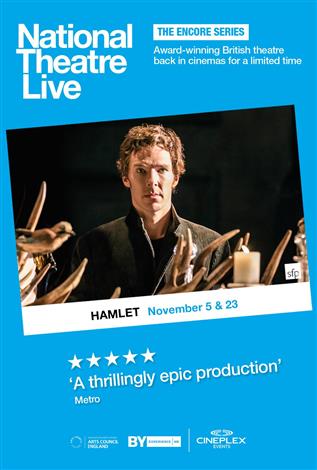
Hamlet (2015): National Theater Review

Image result for hamlet national theatre liveHAMLET

Benedict Cumberbatch was the big draw for the newest production of Hamlet, primarily due to the squeeling Sherlock fans who find him so scrumptious.  If I were asked to rank the Great Sherlocks, Cumberbatch would probably come in 5th Place, after Jeremy Brett, Basil Rathbone, Vasily Livanov, and Cumberbatch's Frankenstein costar, Jonny Lee Miller.

When it comes to ranking the Great Hamlets, I am pleased to report that despite his enormous talent, Cumberbatch will never outdo Olivier, Burton, Gielgud or Branagh. At this point, I think he might not even outrank Mel Gibson.

Prince Hamlet of Denmark (Cumberbatch) is highly distressed that his mother Gertrude (Anastasia Hille) has quickly married her brother-in-law Claudius (Ciaran Hinds) shortly after the death of Hamlet's father.  He hears from his friend Horatio (Leo Bill) that guards have seen a specter about Elsinore, and this is discovered to be The Ghost of Hamlet's Father (Karl Johnson).  The Ghost tells Hamlet that he was murdered by Claudius and tasks him to avenge him.

Hamlet feigns insanity, but this takes a bad effect on Hamlet's love interest, Ophelia (Sian Brooke), who finds herself both repelled and confused by Hamlet's contradictory manner.  Her father, Polonius (Jim Norton) and brother Laertes (Kobla Holbrooke-Smith) warn her against Hamlet, but she is a woman in love.  Polonius performs an informal examination of Prince Hamlet and despite his general idiocy surmises that there is method in his madness.

Hamlet's 'insanity' continues, but there is method in it with the arrival of the Players, whom he gets to perform a play that recreates King Hamlet's murder.  Claudius rises in shock and anger, and the Court is in chaos. Gertrude summons Hamlet to her chamber where he reprimands her, then hearing someone behind the curtains, stabs the spy believing it is Claudius.  Instead, it is poor Polonius, and Hamlet is shocked both at this and at The Ghost coming to him again, making Gertrude's innocence clear.

By now, Ophelia is, unlike Hamlet, genuinely bonkers, and she drowns.  Claudius' plan to have Hamlet killed when he is sent to England fails, and Hamlet is now back in Denmark.  So too is Laertes, screaming for vengeance.  Laertes and Claudius cook up a scheme to kill Hamlet in an arranged fencing match, which comes after Hamlet and Horatio have come across Ophelia's burial.  The merriment and philosophy that Hamlet had with the Gravedigger comes to an end at Ophelia's burial, and now the plot thickens.

Sadly, everything goes disastrously wrong.  Gertrude drinks from the poisoned chalice, Laertes nicks Hamlet with the poisoned rapier but in the confusion over Gertrude, Hamlet stabs Laertes with his own weapon, then stabs Claudius with it, ensuring they all die.  At the end, Fortinbras (Sergo Vares), Prince of Norway, arrives on this unhappy scene.

Image result for hamlet national theatre live
I have to admit I'm pretty much a traditionalist when it comes to Shakespearean adaptations.  That isn't to mean I oppose updating the time of a Shakespeare play or that it cannot work.  A nice example is 10 Things I Hate About You, which managed to make The Taming of the Shrew both contemporary and less troublesome for today's audiences. 

As a side note, has anyone ever opted to update The Merchant of Venice to Fascist Italy?

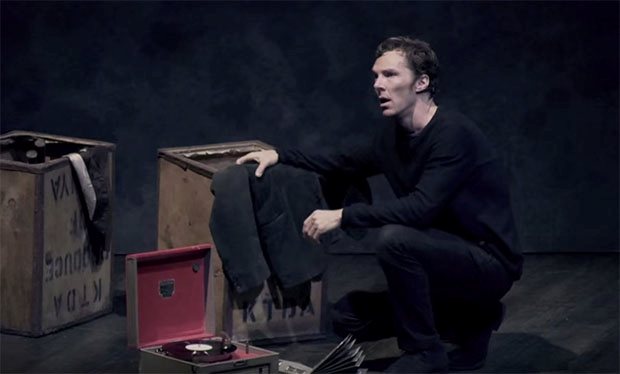
As such, I wonder about director Lyndsey Turner's decision to make Hamlet take place somewhere in time.  It's a bit hard to gauge exactly when, for while I'm tempted to say it takes place today some of the elements make it look more like post-World War II.  We start Hamlet with our Dour Dane listening to Nat King Cole's Nature Boy, and the Gravedigger sings All of Me as he tosses bones out to make way for Ophelia.

Part of me 'gets' what Turner was saying when she included Nature Boy to apply it to Hamlet: to speak of many things, fools and kings (of which Hamlet and Claudius were), and how Hamlet may be this 'strange enchanted boy'.  I can even see the dark, wry humor of All of Me with the Gravedigger, for those dead won't use them. 

Part of me does not take kindly to ramming elements that were not intended for one work and apply it to another. It's not a deal-breaker, but part of me thinks this is a case of trying to be too clever.  It's not something I won't protest but something I'm a bit leery about.

For me, however, the oddest decision was to make Hamlet's faux-insanity almost comical.  To show how bonkers our Prince of Denmark was, we had dress up like a toy soldier and bang on his drum, then play in a toy fort with more large-sized toy soldiers.  Perhaps it is because all my visions of Hamlet involved his madness to be threatening, not laughable.  Yes, there is humor in Hamlet, such as when Hamlet is telling Polonius off, but I was surprised at how funny Hamlet was made to be.

Image result for hamlet national theatre live

One aspect that may have worked both for and against Hamlet was the production design.  Certainly the set was massive, almost overpowering the performers.  It was so large that after the intermission, the set doubled as both the graveyard and Elsinore.  There were big moments, beautiful moments, such as when Claudius sends Hamlet off to what he hopes is his death: a massive burst of wind seems to echo Claudius' rage and plot, with the thundering drumbeats echoing it.

However, because of the massiveness of it all, the stage set for the Players doubles as the curtains for Polonius, which took me slightly out of things as I could not suspend disbelief enough to see it as the Players' set, not Gertrude's curtains.

In terms of performances, I was surprised at how Cumberbatch, despite being the title character, was actually outdone by just about everyone else.  Of particular note is Hinds, who is the most sympathetic Claudius I've ever seen.  I spent most of the play on his side, versus Hamlet, and I'm not sure that was Shakespeare's intent.  Norton's Polonius too was wonderful, his daffy, daft manner a delight.  In the dual role of The Ghost and The Gravedigger, Johnson was powerful and comedic, a credit to his talents.

I could not get a true handle on Gertrude, for Hille was to my mind not well-directed, making the Queen of Denmark almost a non-entity. Same for Brooke's Ophelia, who struck me more as a simpleton than a young girl in the confusion of love brought down to insanity.

As much grief as some productions get for cutting out Rosencrantz and Guildenstern, I don't think they added much here, though Matthew Steer and Rudi Dharmalingam were good in their roles.

Related image
As for Prince Hamlet himself, I was surprised at how different Cumberbatch's voice was.  I didn't hear the resonant baritone of Sherlock or Dr. Strange, but a higher voice, one that spoke the words well. 

For me though, there was something missing.  I could not see the inner conflict, the vacillation, the agony within.  I note when he dismissed Ophelia with a command to 'get thee to a nunnery'.  His delivery of this scene did not communicate whether he had genuine anger at the world or any sense of pain at having to make her, the woman he loved, an innocent victim of his overall plan to take down his wicked uncle.

At times he seemed more petulant than melancholy, and while I can give some leeway when he looks on Claudius' reaction to the Players, I cannot quite get the idea that Cumberbatch is a definitive or even memorable Hamlet.

He is nowhere near bad, but nowhere near as memorable as others who have taken the role before.

If anything pushes Hamlet down, it is the massiveness of it all, in its efforts to be truly cinematic and give audiences bang for its buck.  It was not a bad go, but I could not get as involved with it as I have with others.  It might also be my reluctance to embrace a contemporary version of Shakespeare; why Horatio had to have all those tattoos on his arms and neck, or almost always look as if he were coming or going to a hostel I don't know (unless he was getting ready to play Chester Bennington in a biopic).

Again, not horrible, but not wonderful. 

6/10

Friday, December 8, 2017

Allegiance: The Musical Rebroadcast


ALLEGIANCE

Allegiance, a musical about Japanese Americans interned in camps during World War II, was rebroadcast to theaters on the 76th anniversary of the Japanese attack on Pearl Harbor. This is an important topic, one that one might not lend itself naturally to a Broadway musical.  Allegiance is a noble work, one that has great intentions and strong performances.  However, I got the sense that it could have been better, richer, more developed.

Isamu 'Sam' Kimura (played as an old man by George Takei, a young man by Tommy Leung), is getting ready for an annual Pearl Harbor Day commemoration in what I presume is the present day when he receives news.  His sister Keiku 'Kay' (Lea Salonga) has died.  Allegiance then goes into the past to show how these siblings eventually broke apart.

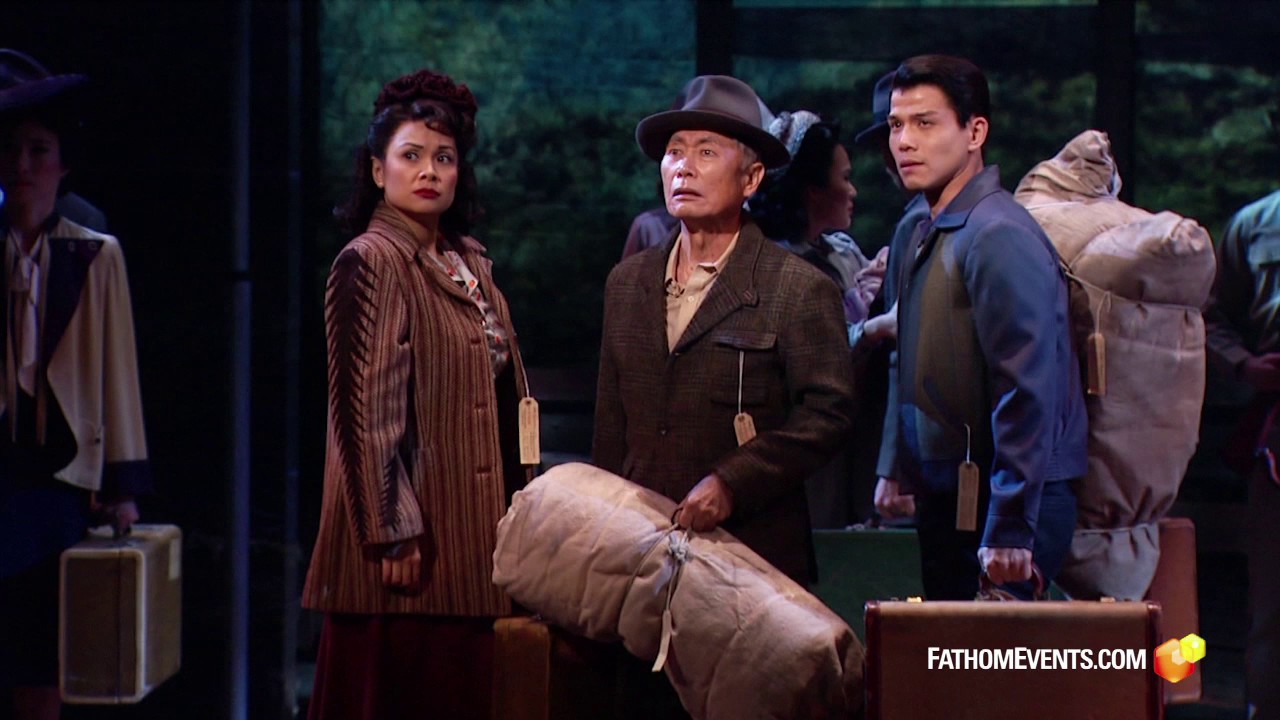
Things were idyllic when Sam and Kay were growing up with their father Tatsuo (Christopheren Nomura) and their Grandfather or Ojii-chan (Takei in a dual role) in California.  Then came December 7, 1941, and that Day of Infamy shook the family. Tatsuo remembers how back in the first World War, mobs burned down a German shopkeeper's home. Sam wants desperately to enlist but being of Japanese descent, the Army wants nothing to do with him or 'his kind'. It isn't long before all Americans of Japanese descent are rounded up and herded to various camps. The Kimura family is sent to Heart Mountain in Wyoming, forced to sell their valuable farm in a hurry for a ridiculously low price.

At Heart Mountain, the Kimuras are doing their best in this strange and miserable world.  Sam tries to be proactive in getting better conditions for his community with petitions and showing his American pride.  Tatsuo is disheartened by his treatment and displeased by Sam's 'rebellious nature'.  Kay, who has been Sam's mother-figure since their mother died in childbirth, tries to be the mediators between these two.  Ojii-chan tries to keep everyone's spirits up with card tricks and a more upbeat personality and encouraging all to keep a spirit of Gaman (to carry on).

We see Mike Masaoka (Greg Watanabe), a self-appointed spokesman for the Japanese American community, float in and out of Allegiance, trying to balance between accommodating the government and pushing to improve Japanese American internees' lives, with the ultimate goal of getting them out of the camps and back home and in the service.  We also see Sam and Kay finding romance: Sam with Hannah (Katie Rose Clarke), an Anglo nurse, and Kay with Frankie Suzuki (Michael K. Lee), who unlike Sam has nothing but contempt for the situation and is not willing to fight for a country that has locked him up and had his parents arrested (Mr. and Mrs. Suzuki ran a Japanese-language school in Los Angeles).

Eventually, the divide between Sam and Kay becomes too great; Sam sees joining the Army once the ban against Japanese-Americans is lifted as a way to both show his real patriotism and get the Americans to see his community as loyal Americans.  Kay sides more with the draft resisters within the community, particularly their leader Frankie, who is the father of her unborn child.  Frankie's attempted escape caused Hannah's death, which Sam, fighting in Italy, knows nothing about.  Neither does he know that Ojii-chan too has died, though his death at least was a happy one: working in his beloved garden where a flower (which in Japanese sounds like 'Hannah') miraculously sprouted.  Tatsuo's refusal to say 'Yes' on two questions on a loyalty questionnaire gets him locked up, with any privileges coming from his connection to the hero Sam.

Finally, the war ends, the internees are released and Sam comes home.  He comes home to find his grandfather dead, his sister with a daughter and worse, married to Frankie, whom he considers a coward and a traitor.  Worse is when he finds out that Hannah is dead and who had an accidental hand in it.  Sam finally believes Tatsuo favors Frankie over Sam, the son he always wanted versus the one he had.  With that, Sam joins Masaoka in Washington and breaks with his family forever.

Now, back to the present, Sam goes to Kay's funeral, where the executrix of Kay's will give him an envelope.  Inside is the Life Magazine that featured Sam on the cover, with the words 'My Hero' written in Japanese by Sam's father, and the Purple Heart he lost when Kay ripped it off him in their final fight.  We then learn that the executrix is really Kay's daughter.  Her name: Hanako, named for Nurse Hannah. 


Allegiance has surprisingly upbeat moments for a musical built on a shameful part of American history.  The opening number, Wishes on the Wind, is as lovely an opening as one can find from a show where we know there will be great tragedy.  I would argue though, that here is where we have a problem with Allegiance: the actual musical numbers and how they are structured.

Wishes on the Wind, for example, gives us an almost bucolic world, where there is not only peace and harmony but true absence of bigotry, more Imagine than You've Got to Be Careful Taught.  As such, once we're thrown into the war and the hysteria mixed with racism, why and how the Anglo farmer who was so pleasant and happy to join in at the traditional Japanese festival turned into the greedy land-grabber making a killing off his former friends.

Perhaps the oddest moment in Allegiance is with Frankie's big number, the intentionally ironic Paradise.  As Frankie lists the injustice and miserable conditions of their 'paradise', much to Sam's displeasure, the dialogue tells us this was specifically created for the Heart Mountain dance they had organized.  Paradise is a good song, but I was not convinced that it fit in the way Allegiance placed it.  This number of mockery of their subservience and resentment I think would have worked better if it were structured as a response to Sam in conversation at the dance versus a 'special surprise performance'.

It might have even served as a counterpoint to Sam's earlier big number, Get in the Game, where Sam rallies the Heart Mountain internees to organize baseball games as a way to show their true Americanism.  Sadly, we never saw them actually play a game, but the contrast between Get in the Game and Paradise could have worked well for Allegiance, even though I can see that maybe having two peppy numbers back-to-back might not have worked.

Oddly, I never believed in either the Sam/Hannah or Kay/Frankie romances despite the show's best efforts.  Perhaps it was because one knew they were coming.  When Sam and Hannah have their love ballad, With You, it sounded like a typical showtune ballad versus a 1940-style torch song in the style of a Vera Lynn or Doris Day.  The music and lyrics by Jay Kuo had several numbers that had that World War II-era feel (especially the 442 Victory Swing, where part of it is almost deliberately dismissing the misery the U.S. put their citizens through as the internees were finally released during the number).  Why therefore, at this crucial moment, Kuo did not try to find something closer to Sentimental Journey or We'll Meet Again instead of something closer to some Taylor Swift or Katy Perry ballad I don't know.

Kuo's book, written with Marc Acito and director Lorenzo Thione, I think rushed through things a bit.  The rush from the lovely pre-war world of Wishes on the Wind to the camps enduring Gaman.  The romances especially seemed rushed, and not helped by some of the performances (I thought Clarke was the weakest, showing no real change from what was meant to be disinterest to deep passion for Sammy).

There were good lines in Allegiance that underscored the hypocrisy of the internees' plight.  "We're at war with Italy but they're not locking Joe DiMaggio up," one of the men angrily remarks. As Sam struggles between his sense of duty to his father and his country, Ojii-chan gives his take on things: "A boy always obeys his father, but a man does not". 

However, one line stuck out to me that if for a word change, could have made Allegiance much better.  As Sam talks about joining once he can, he tells his father "I'm an American citizen with a chance to prove our loyalty," or something to that effect and emphasis mine.  I could not help being displeased by the use of 'citizen': to me, it still suggests 'foreignness' and 'separateness'.  I wish he had said, "I'm an AMERICAN," to make his true nature clear.


While I though Clarke was the weakest, I have nothing but love for Salonga, Leung, and Takei, who were wonderful in their roles.   Higher is a showcase for Salonga, and she is spot-on both in the delivery of all her songs and as Kay, who finds that love does tear them apart. Leung is commanding and pleasant as the more America-loving Sam save for the Hannah romance, which I felt was the weakest part.

We can go beyond the fact that Salonga and Leung are not actually of Japanese descent.  Their performances are integral to Allegiance's success.

Takei takes on double duty, most of it as Ojii-chan, and he brings a nice touch of humor.  When asking in a soft Japanese accent, 'Where are we?', Kay answers, "Wyoming".  "I didn't ask 'why?'", he gently scolds.  "I ask 'where'?"  Ojii-chan's efforts to find 'the right card' and getting it wrong twice was also amusing. He also delivers as the older Sam, a man filled with anger but who in the end is able to find peace with all that he has endured as both a prisoner and soldier of the United States.

Allegiance has good intentions and draws important attention to an important story.  It might find new life with some changes in structure, but for now, without a 'big number' and with a somewhat melodramatic story (what are the odds that Nurse Hannah would be killed as an indirect result of Frankie), Allegiance is a show that is good but could have been better.

6/10

Tuesday, September 30, 2014

A Streetcar Named Desire (2014) National Theater Review


A STREETCAR NAMED DESIRE

There's crazy, there's psychotic, and then there's Blanche DuBois crazy, and when Blanche goes bonkers, she goes BONKERS!  The National Theatre's production of the Tennessee Williams' masterwork A Streetcar Named Desire, which was broadcast in movie theaters on September 16, goes in two directions: both contemporizes the setting and keeping a more 'timeless' feel of the seamy goings-on in the Big Easy.  With four great performances this version is not without its flaws, but still makes for compelling viewing.

There may be people who genuinely don't know the plot, so here goes.  Blanche DuBois (Gillian Anderson), having lost her family's plantation, goes to visit her sister Stella (Vanessa Kirby), who lives in New Orleans with her husband, Stanley Kowalski (Ben Foster).  Stanley is as uncouth as Blanche is elegant, and there is thinly veiled contempt for the other.  Stanley sees Blanche as an uppity phony, Blanche sees Stanley as an abusive brute.   Certainly there is truth to both perceptions, and Stella is put in the middle of their frosty war.  Hope comes to Blanche courtesy of Mitch (Corey Johnson), Stanley's best friend who is not as harsh as Stanley.  Mitch certainly is enamored of the sophisticated lady-like Blanche, and Blanche in turn sees Mitch as perhaps her last chance at happiness, as her first marriage ended with the young man's death by suicide early in their relationship.

However, things slowly disintegrate.  Stanley learns through people at work that Blanche, far from being this respectable widow, was a virtual nymphomaniac and forced to resign when her attentions went to a seventeen-year-old boy in her school.   This news, which Stan eagerly shares with Mitch, causes a disaster at Blanche's birthday party.  Mitch doesn't show up, leaving Blanche devastated and confused.  When he does appear, she's already slipping into total insanity as her carefully constructed world of 'magic' comes ripping apart at Stanley's hand.  Despite now being a father, Stanley takes advantage of a clearly unhinged Blanche and rapes her.  Stella cannot bring herself to believe Blanche's story (though one suspects she thinks her sister is telling the truth), and the decision is made to send her to an asylum.  As she is collected, Stella is devastated, Stanley does not want to recognize anything's wrong, Mitch is torn, and Blanche, completely divorced from reality, accepting the Doctor's hand, telling him, "Whoever you are, I have always depended on the kindness of strangers". 


I think Blanche DuBois is one of the hardest roles for an actress to play.  First, no matter how many revivals and interpretations of our mad Southern belle there will be, all of them will be in the shadow of Vivien Leigh's iconic portrayal of Blanche in the film version of A Streetcar Named Desire (as she had originated the role on the London stage, Jessica Tandy having originated the role on Broadway).  Second, the role is so meaty that a bad actress can amp up the psycho and be so over-the-top it ends up turning Streetcar into a comedy. 

Certainly the exaggerated genteel nature of Blanche lend themselves to the possibility of an actress being excessively fluttery and a smelling salt short of getting 'the vapors'; throw in the fact that some actresses simply cannot do Southern accents and Blanche becomes too hot to handle.  I'm from Texas, so Southern accents are not too familiar (Texans having our own manner of speaking), but I have watched The Dukes of Hazzard, so I'm familiar with the dialect.

Anderson, fortunately, did not go for a broad caricature of a grande dame of the Confederacy.  Her Blanche was believable in her delusions, a woman who deep down KNEW the truth but as she put it, didn't want reality but magic, things as they SHOULD be rather than how they were.  I found Anderson's Blanche to be highly vulnerable, someone who yearned to be the belle she wanted to but found that those things were long gone.

As a side note, I never believed she truly was a nymphomaniac or a slut.  Rather, how I see Blanche is as a woman who had her dreams of love crushed by her husband Allen.  I think it wasn't overtly spoken, but Allen, this great love of Blanche's, was homosexual and killed himself over the fact that he was gay and married to a woman but having an affair with another man.  Her late husband she describes as 'the boy who 'wrote poetry'', which is as odd a euphemism for 'homosexual' as I've ever heard, and given it was created by Tennessee Williams (who was openly gay), that's saying something.

This destruction of her romantic ideals, I think, destroyed Blanche, and all those sexual encounters were not because she wasn't this refined woman or because she was being hypocritical.  I think being with so many men, down to the seventeen-year-old boy she seduced as a teacher, was a way for her to drown her sorrow (as if the booze wasn't drowning her sorrows already).  She yearned for that company, for MEN, for validation as a woman, and I've always thought her numerous affairs were a way to empty the loneliness. 

To rely on the kindness of strangers.


Anderson is sensational as Blanche, bringing a painful vulnerability when she's completely lost it, but she is also arrogant and snobbish in regards to Stanley.  In turns flirtatious and refined, Anderson controls herself even when she's cuckoo.  She's not hypocritical, but honestly critical.

In a similar vein, any actor playing Stanley has to face Marlon Brando's long shadow.  Here too one runs the risk of being excessively brutal without a hint of humanity.  Foster, with his small eyes and muscular frame to offset his short height (at 5'9", the same height as Daniel Craig I should point out), gives Stanley a great vulnerability masking his harsh behavior.  When Blanche is going on about how Stanley is something like an ape, we see a bit of genuine hurt and confusion about Blanche's summation of his character.  As he crawls towards Stella after their fight, we see that perhaps Blanche's ideas are not far from the truth: he looks and behaves like a dejected animal, surrendering to the bestial part of his nature.

Foster even manages to bring in a bit of lightness whenever he keeps declaring he has an expert 'friend' who can examine whether something is accurate and on the level of the Napoleonic Code he's going on about.   Foster is simply an actor who should act more and personally I blame the failure of X-Men: The Last Stand (where he was Warren Worthington III aka Angel) for the bad turns in his career.  It would have been his breakout role, but it didn't, and somehow he's been relegated to 'tough guys', which is a shame since his performance in Ain't Them Bodies Saints showed he could play soft effectively.  His ability to bring softness with that tough exterior is what makes his Stanley Kowalski a fine turn. 

What I really enjoyed were Kirby and Johnson as Stella and Mitch respectively, particularly Johnson.   He makes Mitch someone who is taken by Blanche and genuinely cares for her, but who is also devastated by her shocking past so at odds with his own idealization of Miss DuBois.  Still the intense conflict raging within him about his feelings towards Blanche, coupled with his ability to be both working-class and slightly above the mire of the world he lives in makes Johnson a great version of Mitch, about the only character with redeeming values.


I think director Benedict Andrews did a great job in how he helped the actors craft their roles, and in some of his musical choices.  We hear Wicked Game when Mitch and Blanche end their date, and I think it suggests that they were intimate, but the lyrics to Chris Isaak's song are fitting: Blanche was playing a 'wicked game' in how she was with Mitch. 

If I were to find some faults with the production it would also relate to the music.  Sometimes the music is too loud to where I had to cover my ears, and the balance between the traditional slow jazz of 1940-50s South and a more contemporary sound doesn't always hold up. 

I also wasn't a big fan of the spinning stage, which at times blocked the performers.

However, on the whole this production of A Streetcar Named Desire is a showcase for Anderson, Foster, and Johnson, who have found success in the U.K. despite being Americans.  They'll never be able to knock out the versions of Leigh and Brando, but Anderson and Foster give us excellent portrayals of these two iconic figures. 

8/10

Sunday, September 21, 2014

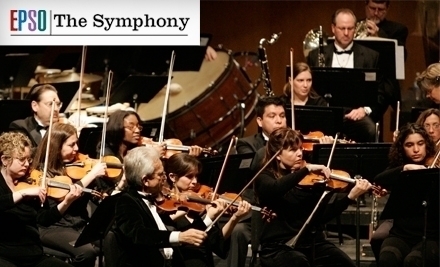
El Paso Symphony Orchestra September 2014 Review


Yesterday, I went to my first El Paso Symphony Orchestra concert in somewhere between fifteen to twenty years.  I had promised myself many times to go, but it wasn't until I put it into my planner that I finally went.

I'm so glad I did, because I got to enjoy great music and find that the EPSO is something that is really enjoyable.

One that that wasn't enjoyable was the prices.  I was taken aback at how expensive they were.  Granted, I could have sat up way high for $17, and in some ways this is logical.  Not only are the prices acceptable, but the music rises.  However, I didn't want to climb all those stairs at the Plaza Theater, so it was the 'cheap' back-row seats at $22. 

Given that many of the $42+ seats further up were sold, I guess there are more patrons of the arts in EP than I thought. 

The audience attendance was to me predominantly old and predominantly white.  While the U.S. Census Bureau reports that only 14% of El Paso is white non-Hispanic, the audience at the EPSO concert was in my estimate around 60% white non-Hispanic.  This, however, may not be entirely accurate if one goes by images alone.  I suspect that there were quite a few wealthy Mexicans from Juarez, who tend to 'look' white but are Hispanic (who can be of any race).

The fact that the EPSO appears to be supported by an older, whiter audience to me bodes poorly, for classical music should be something for everyone, and this 'elitism' I think does more damage to the 84-year-old's institution than anything else.  We should remember the El Paso Symphony Orchestra is the oldest symphony orchestra in Texas...so, screw you, San Antonio!


The program, called First Impressions, consisted of Rachmaninoff's Piano Concerto Number 2 sandwiched between two Debussy pieces: Prelude to The Afternoon of a Faun and La Mer.   Performing the concerto was Natasha Paremski, an up-and-coming pianist of powerful virtuosity.  I am a passionate Debussy fan.  For me, life without Claude Debussy's music is simply not worth living.   Conducting was EPSO Musical Director Bohuslav Rattay. 

We began with The Star-Spangled Banner, and after the drumroll out popped Maestro Rattay, like a kid who suddenly became aware where he was and was about to start late.  As the audience soon began singing the lyrics, I was reminded of the El Paso Baseball games, where people start singing along to the actual singer.  Normally I don't sing at baseball games since there is someone there to do it, but at the symphony I gladly and eagerly sang along.

Prelude to The Afternoon of a Faun was beautifully performed, as was La Mer.  Curiously, the only real issue appeared to be the horn section: in both pieces it looked like the trumpets went slightly off-key.  I enjoyed Rattay's conducting.  He had no podium to hold a score, and it's a delight to see the enthusiasm he has.  When he conducts, it looks almost as if he's dancing, with a lightness and joy in the beautiful music.

Paremski's recital was mesmerizing and inspirational.  As she kept adjusting her seat Paremski pounded the keys in a wild yet passionately controlled performance.  Her dexterity is incredible, and I was so thrilled with her recital that I've decided to pick up playing the piano myself...after I graduate.  For an encore, she played the third part of a sonata but because she had no microphone most people could not hear what or who the sonata was/was by.  Still, it was enthusiastic and delightful, leading to the first of at least three or four curtain calls to a standing ovation.


During the intermission, I got Ms. Paremski's CD and autograph, and as I was going back to my seat I heard a voice with a faint Czech accent say, "Well, it's time to go back to work".  I found myself walking alongside Maestro Rattay!  I was quite surprised at finding the Maestro happily mingling with the audience, and in his not-so-formal attire (no bow tie but still in black, something more in line of what the 12th Doctor wears). As we walked back to our respective places I mentioned that this was the first symphony concert in twenty years (a rough estimation), and he replied,  "She can REALLY play, can't she?" 

I replied that yes, and that I was so glad I came.  I mentioned that I love Debussy.  "Me too," he said, before someone else came up to him. 

I really enjoyed the El Paso Symphony Orchestra concert and was so glad that I went.  I think I will go to every monthly concert because the music and the orchestra itself was so excellent, classy yet casual. 

It was a great evening.