Showing posts with label Romeo & Juliet. Show all posts

Monday, November 1, 2021

Aaron Loves Angela: A Review (Review #1541)


AARON LOVES ANGELA

Romeo and Juliet inspired our urban ghetto story of young love, Aaron Loves Angela. It's a bit underdeveloped in some ways, but its sweet story and tackling of then-current issues, along with a new twist on interracial relationship, makes it worth the time.

Talented basketball player Aaron (Kevin Hooks) has eyes only for Angela (Irene Cara), which proves a distraction on the court. There is, however, a major hitch in that Aaron is black and Angela is Puerto Rican. He also has to contend with his troubled father Ike (Moses Gunn) and Beau (Robert Hooks, Kevin's real-life father), the local pimp/drug kingpin trying to make a major score.

Beau loves throwing it in Ike's face that Ike's football career did not come to fruition. Despite running a successful diner Ike still struggles with his failed gridiron dreams and his wife's abandonment, sometimes taking it out on Aaron. Aaron and Angela continue their romance but their bliss is interrupted by Beau's latest scheme. Beau's efforts to pull a fast one costs him his life and end up putting Aaron and Angela's lives in danger. Will our star-crossed lovers manage to survive those after Beau's loot?

Aaron and Angela works for various reasons. One is the work of screenwriter Gerald Sanford and director Gordon Parks, Jr., both of whom bring a reality to the film. This is a gritty world, one that openly shows the dilapidated and dark conditions our characters live in. Sanford blends the blossoming romance with Aaron's home life quite well. Of particular note is when Ike drunkenly berates Aaron for being there, quickly turning around to apologize and acknowledge it is his anger at his wife's abandonment that causes his reaction.

Sanford and Parks, Jr. do not attempt to either sanctify or vilify Ike. Instead, he is presented as a whole man: flawed, hurt but desperate to see his son achieve what he could not. Almost all the characters are similarly showcased: the hooker next door Cleo (Ernestine Jackson) may have deflowered Aaron in his efforts to be ready to give himself to Angela, but she is also wise and genuinely caring. Even Beau, as over-the-top as he may have been in his pimp manner, has a sad moment. He tells Aaron, who has come upon him when the failed drug deal takes place above his and Angela's love nest, that his life choices led him here.

There is a flaw that Angela's private life is almost forgotten with Aaron taking a more prominent role. Perhaps this is due to Aaron Loves Angela being Cara's debut, but it's a credit to Parks, Jr. that he coaxed strong performances out of his cast. That it is Cara's first major role works in her favor, as her hesitancy and naivete makes Angela a more endearing character. How she discusses the magic of art is quite impressive for a new actress.

Another aspect to Aaron Loves Angela that makes it a strong film is Jose Feliciano's music. From his opening song Salsa Negra to the romantic ballad Angela, the music is authentic and appropriately lush.

Aaron Loves Angela may have limitations in terms of budget and some of its 1970s manner is dated. However, it's a sweet, simple story that works well. 

DECISION: B-

Monday, February 4, 2019

West Side Story (1961): A Review (Review #1178)

WEST SIDE STORY (1961)

West Side Story, a musical updating of Shakespeare's Romeo & Juliet, not only translates well from the dusty streets of Verona to the gritty streets of New York City but makes the idea of rival street gangs being proficient in ballet plausible. With incredible music and masterful directing, its few sins can be masked.

The Anglo street gang of The Jets face a rival for control of the streets in the Puerto Rican gang The Sharks. Their leaders Biff (Russ Tamblyn) and Bernardo (George Chakiris) hate each other, with the hatred seeping to all their members. Biff has had enough of Bernardo and decides to challenge the Sharks to a rumble for ultimate control. This challenge will be offered at the gym dance despite the gym itself being neutral territory.

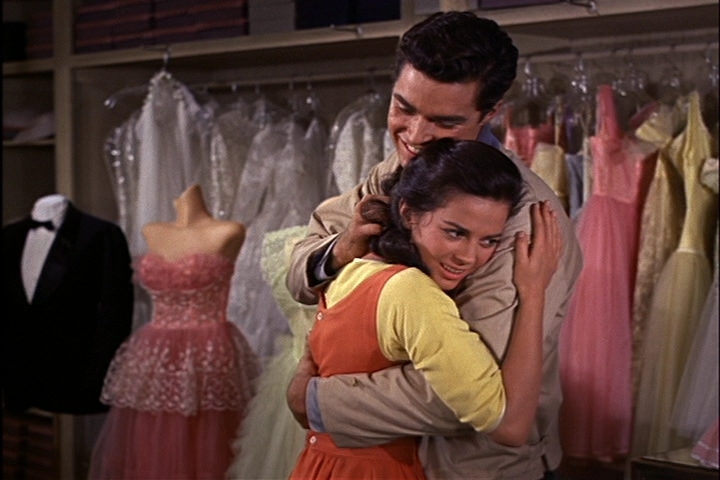
At the dance Bernardo brings his girlfriend Anita (Rita Moreno) and his younger sister newly-arrived from the island, Maria (Natalie Wood). Biff has asked his BFF Tony (Richard Beymer) to side with him at the challenge, even though Tony is an inactive member. Tony and Maria see each other and fall instantly in love.

This love cannot be for a variety of reasons, but true love will not be denied. Tony thinks he can bring peace between the Jets and Sharks, but in the rumble he tries to stop Biff is accidentally killed by Bernardo. Shocked and angered, Tony ends up killing Bernardo. Both groups are horrified at how things have spun so out of control, and despite her love killing her brother, Maria understands and stands by Tony. Even Anita grows to understand that love does irrational things.

The hatred and mistrust between both groups, however, still continues. Tony hopes to leave the West Side with Maria, but a series of misunderstandings, along with an attack on Anita by the other Jets, lead to his death. Maria, devastated and now filled with hate herself, threatens them all, but in Tony's death and Maria's genuine heartbreak, there is the hope that these two houses can reconcile.

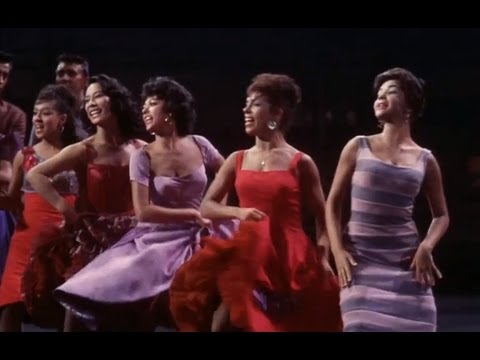
Image result for west side story movieWhen you look at the songbook West Side Story has, you marvel at just how extraordinary, even revolutionary the music was.

The Jet Song 
Something's Coming
Maria
Tonight
I Feel Pretty
One Hand, One Heart
Somewhere
Cool
A Boy Like That

That is a testament to the true musical genius of composer Leonard Bernstein and lyricist Stephen Sondheim, as almost each West Side Story song does what good musical numbers do: further the plot or give character insight. We have the playfulness of I Feel Pretty, the swagger of The Jet Song, the intensity of Cool. We also have a group of intensely romantic songs from the love-struck ode to Maria to the almost mystical One Hand, One Heart and hopeful Somewhere.

As a side note, I find that West Side Story is about the only Sondheim musical where the lyrics are not as esoteric and extravagant as most of his other work, though to be fair I don't know the entire Sondheim catalog.

I think the only song that doesn't work at all is Gee, Officer Krupke, which the Jets sing while waiting for the Sharks to negotiate terms of the rumble. Given that most of the West Side Story songs are generally emotion-driven (hope, anger, passion), this comical piece seems wildly out of place. It doesn't move the plot at all as does the Tonight Quintet (where various characters sing of their plans) or give us insight into their thoughts as does Maria or I Feel Pretty.  It just sits there, a diversion that isn't that diverting.

West Side Story has brilliant use of jazz, particularly in the Gym Dance scene and its astonishing 15-minute ballet opening with almost no dialogue from co-director and choreographer, Jerome Robbins. Even within this sequence, we establish story and character through the Jets and Sharks interactions. The film's other director, Robert Wise, showed his own prowess in the Gym Dance scene when he isolates Maria and Tony visually amid the wild Mambo number, and it's a credit to his background as editor that the shifts from the Mambo to the romantic interlude to the ending all flow smoothly.

Image result for west side story movie
There is one number that has never sat well with me, though I understand it's one of the most popular ones, and that is America. I've always been ill at ease with America, and a large part of it stems from the fact that I, unlike Bernardo, Anita and Maria, am a son of an immigrant versus an immigrant. As such, while I can respect the song's mix of upbeat music and downbeat lyrics, I never had such a dark view of America as expressed by Bernardo.

Speaking of dark, I think one of Wise's worst decisions involved the makeup. Chakiris, of Greek descent, has an olive completion that would have worked well as the Puerto Rican Bernardo. However, in keeping with a bad tradition he along with the other Sharks was made up to look much darker, so much so that the actual effect looks both unnatural and obvious. We can't quite set aside the fact that most of the Puerto Ricans were not played by actual Puerto Ricans or even by Hispanics, but by using such dark makeup on them the overall effect is cringe-inducing.

As an actual Hispanic, I find the dark makeup on Chakiris and the other Sharks (even the handful of Hispanics) to be insulting. Moreno and the other Puerto Rican women's makeup was not as exaggerated, making them more natural-looking. It was par for the course in these years to paint Hispanic characters with wildly exaggerated dark skin: Giant and Touch of Evil also literally paint Hispanics in excessive and unnatural skin tones.
Image result for west side story movie

There is also the issue of casting. This goes beyond the casting of the Russian Wood and Greek Chakiris as Puerto Ricans, shaky accents and all. It goes to actual performances. Rita Moreno is the clear standout as Anita, who transcends any notions of a 'Latina Spitfire' to make her into yes, a passionate character, but also a very wise and understanding woman. Anita is aware of people's natures, so while she is displeased with Maria consorting with the enemy, she also knows Maria is a girl who likes a guy.

Chakiris, struggling accent aside, is also good as Bernardo from the moment his intense eyes signal the anger he carries as a macho but marginalized man. He also has good moments where he is the caring brother and slightly put-upon boyfriend.

Most everyone else though struggles. Wood did her best but sometimes her Maria, bad accent and all, struggled to make Maria into an authentic young woman discovering life and love in America. She was dubbed by Marni Nixon, and while I've been critical of Nixon's posh delivery here she also goes along with the Puerto Rican accent, sounding less realistic. In Somewhere, Nixon's stab at sounding Puerto Rican is just about comical.

Beymer's Tony was not bad but not great. Tamblyn was embarrassing as Riff: one never knew if his put-upon 'Nuw Yawk' accent was meant to be comic or serious.

Tucker Smith as Riff's lieutenant Ice out-shined him so much on all levels: singing, dancing and acting, that one wondered why Riff and not Ice was the Jets' leader. His big number in Cool showed him take full command, and he was the only one not participating in the silliness of Gee, Officer Krupke. Eliot Feld was also delightful as Baby John, the sweet and naive Jet who still read comic books and was oblivious to the erotic nature of the Gym Dance number, happily hopping along with his date while everyone else did the PG version of a bump and grind.

Looking at it now, I think West Side Story might be seen as slightly dated, almost comical with its lingo of "Daddy-O" and faux accents. It might make people not willing to surrender to the idea of musicals chuckle at how these somewhat clean hoods could dance through the mean streets on New York. However, as a film and as a musical, West Side Story really towers over so many now-forgotten musical films. It's mix of romance, action and drama, coupled with a nearly perfect songbook and score, brilliant directing and choreography all shape West Side Story into being a brilliant film.

DECISION: A+

1962 Best Picture: Lawrence of Arabia

Tuesday, June 12, 2018

Romeo and Juliet (2013) Broadway Review

ROMEO AND JULIET

I am aware that Romeo and Juliet is a tale of woe, but that does not excuse the 2013 Broadway production from being so woeful.  Apart from one performance this production is shockingly bad, appealing to tweens all thrilled with the flattest, dullest Romeo to strike the Great White Way.

The conceit of this version is that the Capulets are black and the Montagues are white.  How having a black Prince of Verona does not affect his relationship with the Capulet/Montague feud given how they opted to make race an issue we know not.

Romeo Montague (Orlando Bloom) falls passionately in love with Juliet Capulet (Condola Rashad), and she reciprocates.  The problem is that their families are in a blood feud.  Despite this, they opt to secretly marry with the help of Juliet's Nurse (Jayne Houdyshell) and Friar Laurence (Brent Carver), the latter in the hopes that their union will end the bitter feud.

However, things cannot be as such, as Juliet's cousin Tybalt (Corey Hawkins) fights with Romeo's best friend Mercutio (Christian Camargo), Romeo's efforts to stop this lead to Mercutio's death, then Romeo kills Tybalt in anger.  From there, cascades our cycle of sadness on both these noble houses.

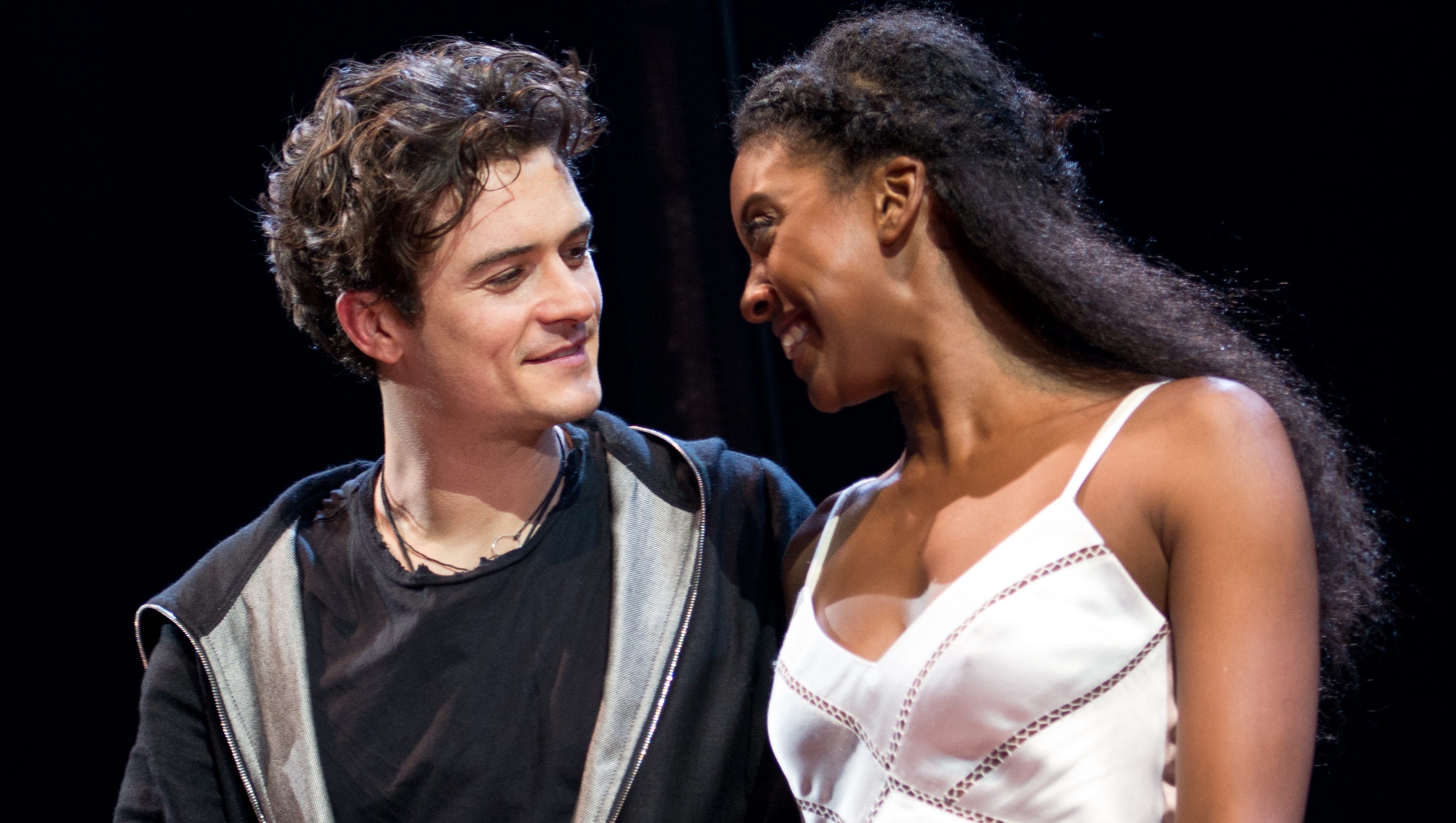
Related imageYou know the target audience of Romeo and Juliet straight from Romeo's entrance.  Channeling a bad James Dean impersonator trying to do Shakespeare, Orlando Bloom rides atop a motorcycle in this 'contemporary' version.  When he removes his helmet to reveal the ethereal beauty that is Bloom, you could hear cheers and I think squeals of delight from teen girls, aroused at seeing Legolas so close.

It's a curious thing in a production when you see pretty quickly that this is going to be a disaster.  I saw it from the moment we heard the rumble of the bike.  I figure director David Leveaux wanted us to think of Romeo as this classically cool figure, smooth and charming, even hip.

His entrance, however, ended up making it look like Romeo and Juliet had slipped into Grease 2, with everyone about to start singing Who's That Guy.  I happen to like Grease 2, a guilty pleasure I admit, but it's sad when something as bad as Grease 2 is actually on a higher level than Romeo and Juliet.

I'm not such a purist that I cannot have a contemporary production of Shakespeare, but there has to be a reason for it.  There was no reason for it, apart from appealing to Bloom's squealing groupies.  Oddly, I have always thought that Bloom is competent only in period and fantasy films, floundering whenever he tries to play contemporary.

Note I said 'competent', not 'good', because Romeo and Juliet showcase just what a lack of acting talent he has, with nothing to recommend a career apart from his beauty.  His Romeo is an embarrassment, good only for spoofing.  Bloom has a really amusing tic in Romeo and Juliet: thrusting his right arm out in many of his line readings.

I did not keep count, but that might make for a good drinking game: a shot every time Bloom thrust his arm out to show he is ACTING.  That, however, is the least of his theatrical sins.

Image result for romeo and juliet 2013 broadway
Bloom's 'call to arms' is part of a larger issue: how he is not the character but the star.  He constantly performs to the audience, as if the other actors were not actually there, not even Juliet.  Bloom's performance appears to come from a mind that think they are all props for his one-man show.  In many scenes, he is speaking directly to the audience and seems to barely recognize his other actors.

Add to that his line reading is hilariously bad.  In the Balcony Scene, his declarations of love sound as if he were stoned.  As he pushes through "It is The East...", he makes this not the romanticizing of the fair Juliet, but pretty much a declarative statement, with no sense of love or passion.

His only bright spot, it appears, is in his Obligatory Shirtless Scene.

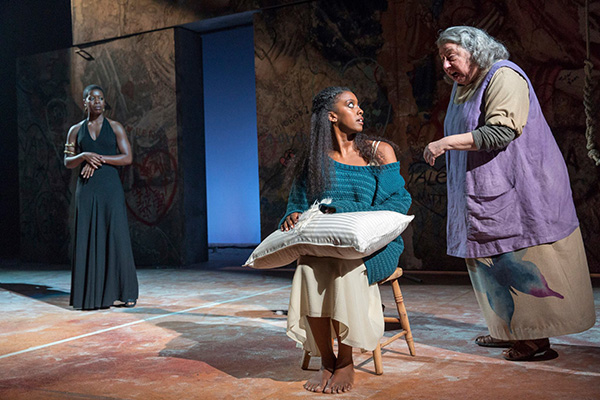
I wish I could say that his cast pushed Bloom to at least try to up his game, but it looks like they were all trying to act as badly to keep up with him.  Rashad was slightly better as Juliet, but she came across as insipid instead of love-struck.  She also seemed to be rushing through her dialogue, almost in an effort to get this over with the faster.

In my notes, the only complimentary thing I could say about Rashad as Juliet is 'she plays dead very well'.

Hawkins was overdoing things as the angry Tybalt and Camargo never got the humor of Mercutio.  Houdyshell didn't make the Nurse into the salty character I remember from Romeo and Juliet, but more of a scold to where I wondered why Juliet would think of her as a confidante.

Related imageThe only bright spot was Chuck Cooper as Lord Capulet, who brought a bit of whimsy and humor to his interpretation.

A massive surprise is finding former American Idol first first-runner up Justin Guarini as Prince Paris.  Even more astounding is that Guarini in his small role actually manages to out-act almost everyone, even if his Paris came across as an idiot.

Again, I'm not saying he did a great job.  I'm saying he did a better job than those who have or are alleged to have most experience acting on stage or screen.

I put this in part on Leveaux, who could not get his actors to make the characters real.  I cut him some slack given he had some poor material to work with in Bloom, but other aspects are inexcusable.

This Romeo and Juliet did one thing that I detest in any Shakespeare production: it rhymed.  For reasons I cannot fathom Leveaux let the actors rhyme the lines.  For example, there's this line, spoken by Lord Montague (Michael Rudko) upon discovering their children's bodies:

"That while Verona by that name is known, there shall be no figure as such rate be set, as that of true and faithful Juliet".

"Set" and "Juliet" rhyme, nothing wrong with that.  However, for nearly the whole of Romeo and Juliet, the actors emphasize that their lines rhyme.  In this case, Rudko put force on 'set' and 'Juliet' to enhance the rhyme, but he wasn't the only one doing it.  In fact, I think everyone in Romeo and Juliet did it.  It was only in terms of degrees.

I find that such a pet peeve when watching any Shakespearean production.  Shakespeare's language should sound natural, as if it comes from actual speech and not the force theatricality that many productions are plagued with.  It needs to sound real, and in this version, they seem to almost enhance and emphasize how unreal it sounds when spoken.

Truthfully, I've seen high school productions that have better acting and directing.  I've never wanted these two characters to actually die so much as I did after this monstrous rendition of Romeo and Juliet.


2/10

Friday, December 18, 2015

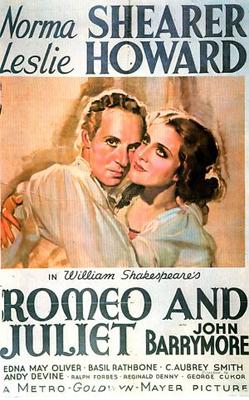
Romeo and Juliet (1936): A Review (Review #770)

ROMEO AND JULIET (1936)

*Author's Note: This is my 1500 published post, and I'm thrilled that it was for my beloved Shakespeare.

The 1936 version of Romeo and Juliet was up till now one of the few versions of this oft-told tale I had not seen.  I had seen three film versions of the Shakespearean tale of the two lovers of Verona before this one finally came my way.  There was the 1968 version (which to me is the definitive version), the 1996 Romeo + Juliet Baz Lurhmann bastardization that attempted to dumb down everything by being "current", and the 2013 version that no one ever talks about.  I'm also not counting West Side Story, though essentially it is Romeo and Juliet transposed to New York City (where street gangs are surprisingly adept at ballet).  Well, now we come to an early version of this Shakespeare work.  I found this Romeo and Juliet to be lavish, beautiful-looking, and did I mention lavish?  It's a pretty good picture, save for at least two things.

Romeo and Juliet.

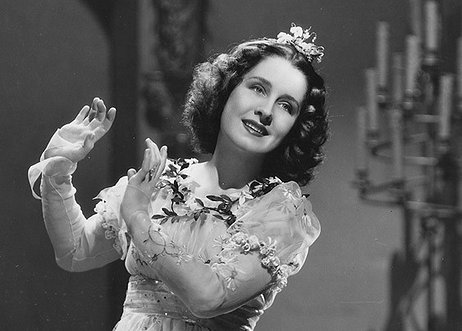
The Montagues and Capulets are bitter rivals who constantly get into fights.  The Prince of Verona (Conway Tearle) has tired of their constant brawling, so he issues a decree saying the next group to cause a disruption will henceforth be banished.  This doesn't matter much to either Juliet (Norma Shearer), daughter of Capulet, or Romeo (Leslie Howard), son of Montague.  Juliet is content in her life with her Nurse (Edna May Oliver), while Romeo is besotted with fair Rosaline.  Egged on by his best friend Mercutio (John Barrymore), they crash a Capulet dance, where Romeo, ever fickle, forgets all about his great love Rosaline when he sets eyes on Juliet.  Juliet, in turn, is passionate about Romeo.  This passion doth not extend to Juliet's cousin Tybalt (Basil Rathbone), who detests ALL Montagues.  If it were up to him he'd kill Romeo on the spot, but his uncle orders him not to.

The two lovers pledge themselves to each other and with the machinations of Friar Laurence (Henry Kolker), they marry. 

Of course, this is secret, and after Tybalt kills Mercutio (though Romeo inadvertently caused Mercutio to be a 'grave man'), Romeo kills Tybalt and he is banished, his life forfeit if he is found in Verona.  Juliet is beside herself with grief: her cousin dead at the hand of the husband she cannot name.  Even worse, her father pushes her to marry the Prince Paris (Ralph Forbes), which would mean renouncing both her one true love AND commit bigamy.  Friar Laurence comes up with a plan to save them all by giving her a drug that will fake her death, and while the family mourns, Laurence sends message to Romeo to collect her and they run off together. 

Unless you are really, REALLY ignorant, you know how all this turns out.


I really don't have a beef against this version of Romeo and Juliet.  The film is sumptuous to its very fingertips, with beautiful sets and costumes.  We even get a couple of elaborate dance numbers choreographed by the legendary choreographer Agnes de Mille (niece of the legendary director Cecil B. DeMille). 

Even some of the acting is pretty good.  Rathbone earned one of the film's four Oscar nominations for his supporting role of Tybalt, and he was one of the few to appear to understand what the film needed was life.  His Tybalt was all haughty fury at the Montagues, his eagerness to exterminate them insatiable.  Oliver was delightful as the Nurse (though not as bawdy as I remember her from the stage productions I've seen...I figure even Shakespeare couldn't get much past the Hays Office).  Andy Devine, who is best known for being comic relief in Westerns, actually acquitted himself well, his whiny pitch-altering voice working well as a dim-witted servant.

The problem with Romeo and Juliet is not the performances or the artistic spectacle of it all.  It's in our two leads (and another performer we'll discuss briefly a bit later). Norma Shearer at 34 and Leslie Howard at 43 (!) are simply far too old for their parts.  It comes across as more and more laughable as the movie rolls on to see these middle-aged people apparently unable to make decisions for themselves.  The sight of this matronly-looking woman being rocked by her old Nurse is downright bizarre, as if Juliet were an idiot.  Seeing Shearer and Howard speak or have lines spoken about them, Shakespeare or not, makes things more unintentionally hilarious.

Juliet's mother tells her daughter, "You are of a pretty age," (which makes one wonder what age she is referring to: Juliet's age of 13 to 15 or Shearer's age of mid-thirties) and when reproaching Friar Laurence, Howard utters, "Were thou as young as I?"  I can imagine that 1936 audiences would have burst out laughing at that last one, given Howard and Kolker look almost like contemporaries than generations apart. 

I get that they are supposed to be the teenage lovers, and while they could have gotten away with this in a stage production, there is no way in a film people wouldn't look at them and wonder why these two grown people are acting (and Acting) so irrationally.

Barrymore made a wonderful Mercutio: witty, amusing, and a bit of a rake.  The only problem is that he is far, far, FAR too old for the part (even for a theatrical version).  He looks like he's every bit his 54 years (and then some), and it just looks so bizarre, almost laughable (which is a shame given Barrymore could have done a radio version and made that work).

I'll ALWAYS be Daddy's Little Girl...

George Cukor deserves a lot of credit for his directing of Romeo and Juliet in terms of the pacing, the production, and the smaller performances.  However, I found his directing of Barrymore, Howard, and Shearer positively disastrous.  I never found Mercutio's curse "A plague on both your houses" to be a comic line (though that was how Barrymore was directed to deliver it).  Howard's Romeo was a bit of a wet blanket.  I never sense the fury at Tybalt for Mercutio's death or the passion he felt for Juliet.  He didn't seem all that mad that his best friend had been killed.

Shearer, despite her Best Actress Oscar nomination, came across as the worse of the lot.  It was genuinely hard to escape the thought that this Juliet was essentially an idiot, unaware of anything really.  She was less impassioned teen and more unhinged spinster, as if Shearer was doing Miss Havisham doing Juliet. Shearer is so shockingly mannered, posing and reciting her lines in what I call "Shakespearese".

Shakespearese is when you deliver Shakespeare as if you were reciting rather than attempting to speak them as if it were regular speech.  This is something that afflicts many a production, both amateur and professional: this inability to speak as if the words were flowing from the characters and instead putting excessive emphasis in how the words come out versus come across.  Howard, who as a stage actor really should have known better, was worse than Shearer in his Shakespearese, but at least he wasn't perpetually posing like Shearer was.

Romeo and Juliet is a good film DESPITE OF, not BECAUSE OF, Howard and Shearer.  It's a beautiful-looking film, has strong supporting performances, and is entertaining and pretty faithful to the original.  Try as one might one can't really divorce oneself from the lunacy of these middle-aged people attempting with no success to pass as the star-crossed lovers who were not yet twenty.  While a good and lavish version, it should have ended as "For never was a story of more woe, than this of Old Juliet and even Older Romeo". 

DECISION: B-  

Sunday, October 13, 2013

Romeo & Juliet (2013): A Review


ROMEO & JULIET

Longtime readers know I love Shakespeare, the Citizen Kane of writers.  I don't understand why people insist Shakespeare is difficult to understand.  I'll grant that the language is a little arcane to our ears, but I've never had difficulties following the plots or words spoken from a Shakespeare play or adaption.  I am a man of average intelligence, and I consider the language on the whole pretty straightforward.  What is difficult is seeing people perform Shakespeare because there is this dreadful tendency to treat it all as something quasi-divine.  Shakespeare is the Secular Holy Writ, held in such lofty regard as something so above us rather than the tender, tense, or even raunchy entertainment for the masses it started out as.  Due to this, Shakespearean performances today tend to make things so grand, to be taken so seriously.  It's a great disservice to audiences because Shakespeare is a lot of fun, but one wouldn't know it given how stern everyone is with it (sometimes even with the comedies).  The biggest flaw is that many actors (and those who laughingly use the term) are more obsessed with reciting Shakespeare's iambic pentameter than in giving life to the words within said rhyme scheme. 

Yet I digress.

There are two ways to go about tackling a film version of Shakespeare: you can go for a straight adaptation and keep the setting, or you can contemporize it in some way (such as West Side Story).  This has both good and bad results.  In regards to Romeo & Juliet, I've seen only two of the three versions made prior to the 2013 version; the 1968 Franco Zeffirelli is the pinnacle of the former, while Baz Luhrmann's Romeo + Juliet went all-in in the latter*.  I didn't like the 1996 version (too frenetic for the material), but at least it kept the language and attempted to make it more accessible to its target audience.  The 2013 version tries to straddle the fence: keeping the setting but altering the language somewhat. Romeo & Juliet is by no means dreadful.  It has very pretty people in pretty costumes, walking in pretty sets.  It tries to stand on its own, but it stumbles along the way.


In fair Verona, the Capulets and Montagues are in bitter rivalry.  Lord Capulet (Damien Lewis) wants his daughter to marry Count Paris (Tom Wisdom).  However, after a tournament that the Prince of Verona (Stellan Skarsgard) organized to settle matters which didn't, hotheaded Capulet nephew Tybalt (Ed Westwick) begins a fight with Romeo's friend Mercutio (Christian Cooke) and Montague Benvolio (Kodi Smit-McPhee).  Benvolio reports all this to Romeo (Douglas Booth), who is too involved in his passion for Capulet relation Rosaline to care of feuds.

Benvolio, Mercutio, and Romeo sneak into a Capulet ball, where our fickle Montague abandons Rosaline and falls madly in love with Juliet (Hailee Steinfeld).  She too falls in love with Romeo and in their passion wish to marry despite their family's bitter feud.  In all this, Friar Laurence (Paul Giamatti) sees a way to bring the warring families together, and agrees to marry them.  With the help of Juliet's Nurse (Leslie Manville) Romeo & Juliet are secretly united in holy matrimony.

Unknown to all, the war between Montague and Capulet continues.  Tybalt, still in a rage at the sight of Montagues within his presence, challenges Romeo to fight.  While Romeo will not fight, Mercutio is more than willing.  In the ensuing fight Tybalt kills Mercutio, and in his 'rage' Romeo kills Tybalt.  This causes Romeo to be banished from Verona, but with Laurence and the Nurse's help he goes to a grief-struck Juliet and they spend the night together.

Capulet informs Juliet she is to marry Paris, horrifying the already married teen.  She will not marry and her father rages.  Laurence concocts a plan to save all: he will give Juliet a potion that will cause her to appear dead but only be sleeping.  Once she awakes, she and Romeo (who will be informed of all this) will run off together and live out their lives in peace.  The plan starts going well, but alas two things go wrong: Benvolio, witnessing Juliet's funeral, beats Laurence's messenger to Romeo to tell his cousin of his wife's death, and thus, Romeo procures poison, goes to her tomb, kills Paris (still mourning the death of his intended), and swallows it before she awakens.  Laurence, seeing the lover's reunited too late, can only mourn as Juliet takes Romeo's dagger to join her beloved. 
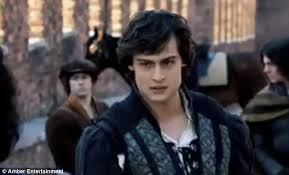
Romeo & Juliet is the type of film that people will say, 'well, the costumes were pretty'.  Actually, they may say 'the cast is pretty' too, since both leads are extremely attractive physically.  We get this immediately, when we first see Booth's Romeo, all heaving chest and pursed lips, bringing to mind Verona's version of EDWARD CULLEN.  I can't blame Booth for being so unbearably beautiful, given the former model is barely starting out his career (and I understand his Pip in the television adaption of Great Expectations is pretty good).  At one point, even the Nurse waxes rhapsodic on his body.  However, in terms of performance I can't say that Booth is particularly good, all soft and whimpering.  When he begins with, "I dreamed a dream last night," for a moment I though Booth was going to break out in song.   However, whatever rage burned within Romeo at Mercutio's death, whatever passion he had for Juliet, is not communicated via Booth.  He isn't all at fault (more on that later).

Booth's Romeo, however, is above Steinfeld's Juliet, who is shocking in her weakness.  The girl who astounded all in True Grit makes Juliet a non-entity.  Steinfeld is blank, boring, and at times almost amateurish.  It's like watching high school students try so hard to get a passing grade in their assigned production.  The balcony scene is shocking but in the wrong way.  Juliet's soliloquy (Romeo, Romeo, wherefore art thou Romeo?) is delivered in a rushed manner, as if Steinfeld wanted to get through it all as fast as possible.  Both Booth and Steinfeld never communicated the passion that these two felt.

In terms of others, Ed Westwick came off the worst.  His Tybalt was hilarious in his one-note sneering and fuming, with the same expression throughout (his long hair/wig did not help matters).  I have never been convinced that Westwick is an actual actor based on his work on Gossip Girl (he too has a stiff manner and one facial expression there).  Romeo & Juliet may earn him a Worst Supporting Actor Razzie: it's that inadvertently comic performance.  Oddly, the more comic Mercutio came off a bit stiff (pun intended) but I put this on the direction than on Cooke, who could have made his final scene more moving if it had been treated with some sense of pathos rather than just recitation.  Smit-McPhee had little to do as Benvolio, but he acquitted himself well.

It was the adults that showed up the children.  Paul Giamatti's Friar Laurence at least seemed to understand what Romeo & Juliet was about (even if the spectacles he wears in the opening did make him a bit more comic).  His performance in a better version of Romeo & Juliet is a highlight of the film, as is Manville's Nurse, who was less comic than previous incarnations but had a warmth within it.  Same goes for Lewis' Lord Capulet: he is a strong actor and it is nice to hear him in his native accent, and from this we can see that Lewis can lift a poor screenplay.


Here is where we have one of Romeo & Juliet's primary flaw.  Julian Fellowes has earned praise, rightly, for Downton Abbey, but here he decided to 'simplify' Shakespeare's text.  He kept certain passages (the balcony scene, Mercutio's last moments), but others he either reshaped or just flat-out cut.  My favorite passage (Friar Laurence's rebuke of Romeo, the 'there are thou happy' monologue) was reduced to a mere 'There, you are happy'.  Juliet's soliloquy about Romeo's beauty (And when he shall die, Take him and cut him out in little stars, And he will make the face of heaven so fine
That all the world will be in love with night And pay no worship to the garish sun) is reduced to a voice-over.  Fellowes either does not trust the text or trust his audience to follow, which is a poor choice either way.  Even worse, he has Romeo and Juliet briefly reunite in the end rather than have Juliet come upon Romeo's corpse as she awakens.  Given she's seen him alive (albeit for a minute or two), why then does she wonder why his lips are still warm when she kisses him before she stabs herself? 

Director Carlo Carlei didn't give his actors much to work with.  It seems his main task was to tell them to look pretty (which they did) and to show off the beauty of the Italian countryside.  The rushed delivery of the dialogue (in particular for Steinfeld) and the dreamy, soft delivery of the dialogue (in particular for Booth) were I imagine Carlei's handiwork, so it seems a terrible waste.  Even in something as rushed as Romeo & Juliet (they fall in love and marry the next day, remember), this version speeds along so quickly one never fully appreciates how dangerous this was to everyone. 

It is all really pretty, and there are a couple of good performances in it (though not the shockingly bad Steinfeld and the gorgeous but blank Booth).  I think everyone gave it a good go, and I can't blame them for trying, but somehow the magic, the power of Romeo & Juliet escaped us.  Again, I didn't hate this version, but given that A.) I've seen better on stage and screen, and B.) it had one too many alterations for anyone to appreciate, it is undone by its own ambitions.

It is too easy to say that never was a tale of more woe than this adaption of Juliet and her Romeo.  Let us just say it was a good try, but like Juliet, it came all a bit too late to revive.

What doth thou meaneth,
HE'S prettier than I?

DECISION: C-


* I have not been able to bring myself to watch the 1936 version.  The idea of watching 34-year-old Norma Shearer and 43-year-old Leslie Howard as the doomed teenage lovers, despite their genuine acting talent, is still too much for me take seriously.  It's hard enough imagining 36-year-old Orlando Bloom as Romeo in the Broadway production (and that's considering that A.) he is not a particularly good actor in general, B.) he's good only in period pieces, and C.) he's in a theatrical production where such things as age can be forgiven).  People old enough to be my parents should not play people old enough to be my children.