Showing posts with label 2013. Show all posts

Monday, July 7, 2025

Anita: Speaking Truth to Power. A Review

ANITA: SPEAKING TRUTH TO POWER

In 2018, accusations against then-Supreme Court nominee Brett Kavanaugh became a fierce battle fought in the halls of Congress and in public spheres. Caught up in the maelstrom of the Me Too movement, then-Judge Kavanaugh was accused of sexual assault. The Congressional hearings had a woman accuse a man nominated to sit on the highest court of a sex crime. 

We have been here before. Twenty-seven years prior, another woman accused another man nominated to sit on the highest court of a sex crime. Anita Hill, the subject of the documentary Anita: Speaking Truth to Power, never accused now-Supreme Court Justice Clarence Thomas of sexual assault. Instead, it was sexual harassment. Anita is a sympathetic portrait of the woman who nearly brought down a Supreme Court appointment. Perhaps therein lies the problem.

Anita opens with a surprising voicemail from Ginny Thomas, Justice Thomas' wife, asking Anita Hill for an apology. From here, Professor Hill tells of her experience pre-and-post testimony. She speaks on how she thought that the confirmation hearings and her own hearing would be nonpartisan. New York Times reporters Jane Mayer and Jill Abramson, authors of Strange Justice, a book about the hearings, are also interviewed. 

Professor Hill speaks about her family, who moved to Oklahoma to escape racism (her grandfather threatened with lynching). She also talks about the longest day when she gave her testimony. She found Pennsylvania Senator Arlen Specter very adversarial and Delaware Senator Joe Biden unhelpful. According to other interviewees in Anita, Utah Senator Orrin Hatch used race to get Judge Thomas angry about his treatment. This was all part of a Republican plan to shift the narrative from sex to race. Ultimately, Justice Thomas was confirmed, and both he and Professor Hill have moved on.

Hill's testimony was the catalyst for electing more women to the Senate, the sight of old white men questioning both Hill and Thomas about pubic hairs and "Long Dong Silver" too incendiary for some. Hill now continues her advocacy for women, with her long-term companion Chuck Malone beside her. 

One should watch Anita with an open mind. A whole generation has passed since now-Justice Thomas faced serious accusations that still haunt him and his reputation. However, Anita does not pretend to be even sided. Everyone speaking in the Freida Lee Mock documentary is clearly on Professor Hill's side. As such, Anita will not make a case that Hill's accusations were false or politically motivated. That is understandable in that Anita is about Hill's perspective. 

At times though, Anita seemed too worshipful of the subject. Near the end of the documentary, we hear actress Anika Nomi Rose recite a poem about Hill. I cannot remember if Professor Hill was in attendance. Even if she wasn't, including adoring poetry about the documentary's subject did strike me as both pretentious and grandiose. 

Anita, I think, should also be seen through new eyes. With the contentious Kavanaugh hearings now in the history books, I cannot help but wonder whether something John Carr, a longtime Hill friend and supporter, said. "This wasn't about the truth. It was about winning". Clearly this statement was meant to define the Thomas supporters who wanted to see him on the Court.

However, could that not equally apply to those who were determined to stop Thomas and later on Kavanaugh from interpreting legislation? Such an idea, as distasteful and shocking as it is, cannot be summarily dismissed. While I have not seen the two films based on the Thomas hearings (Strange Justice and Confirmation), I figure that they take the position that Clarence Thomas is guilty. Any accusation should be investigated, but an accusation is not proof that said accusation is true no matter who makes the accusations.

A great film can hopefully be made about the machinations behind political appointments. Anita is not that film, though I do not think that it aimed to be. Instead, it is about Anita Hill, catalyst for one of the biggest political fights of the twentieth century. I do not think we learned much about the person or about the hearings themselves. Anita is not as insightful about the subject as I had hoped. It is one-sided, though it all comes from her perspective, which her supporters agree with. 

I don't know if there will ever be a truly balanced take on the Clarence Thomas hearings. We have their own books (those from their supporters and champions are in my view suspect to bias). We have various documentaries: this and Created Equal: Clarence Thomas in His Own Words (which I have not seen as of this writing).  Each deserves his or her own chance to state their case. It is the proper way.

DECISION: C- (4/10)

Wednesday, August 18, 2021

All Is Lost: A Review

ALL IS LOST

This is part of the Summer Under the Stars Blogathon. Today's star is Robert Redford.

It's Man versus Nature in All is Lost, an almost silent film that puts one man against the great sea itself. With a strong performance from Robert Redford, All is Lost may try some viewers patience.

Our Man (Redford) in voiceover expresses regret for what he has failed to do, and then we go back eight days prior to where he's awakened when his sailboat collides with a shipping container. The gash leaves the ship, the Virginia Jean, damaged, including the radio equipment.

Making impromptu repairs, Our Man sails on, unwittingly into a storm that nearly kills him. Even after surviving despite being knocked out, he's forced to abandon the Virginia Jean and into a raft. There is hope in that he's near commercial shipping lanes, but will he be able to attract any passing ship and survive, or will the ocean claim another lost soul?

Writer/director J.C. Chandor does an admirable job in keeping things flowing (no pun intended). There's very little dialogue and only one cast member (Redford), so All is Lost has to rely on how the story moves and how the actor is. Fortunately, both are quite strong.


As Redford has no one to act with and/or little to say, he is forced to act with his face and body. All is Lost is a showcase for his skills in this autumnal role. Our Man reacts to the growing danger, with the agony and fear mixed with anger and at times resignation. His worn, weather-beaten face expresses so much of his suffering and will to survive. Redford brings not so much a gravitas but a realism to Our Man, who takes all things as they come and works with what he has.

I would say though that perhaps becomes he has no one to work with or external/internal dialogues to speak, audiences may not find much interest in Our Man's journey. All is Lost does have something of a remoteness, a distance because we know nothing about him. We don't know his name, we don't know his past or his journey physical or metaphysical, so whether Our Man lives or dies may not interest some viewers. As he's a stranger to us, his ultimate fate is not something that some kill care about.

Add to that the length of All is Lost. At about an hour and forty-five minutes one thinks that perhaps this scenario could be shortened (perhaps having only one commercial ship pass by). Despite the simple plot All is Lost feels padded out somewhat.

All is Lost, however, has other positives, in particular Alex Ebert's score. Sparing but elegant, the music is a vital part of the film's overall success.

All is Lost will try some viewers, wondering when it will all end. However, with a strong performance from Robert Redford and a scenario that mostly works, it should engage others. 


Wednesday, May 31, 2017

The Saratov Approach: A Review (Review #915)

THE SARATOV APPROACH


When it comes to The Saratov Approach (in my mind, a clunky title since I'm not sure exactly what the 'approach' refers to, though I have my ideas), two things stick to my mind.

The first is that it is based on a true story, so it isn't hard to respond emotionally to the story.

The second is that behind it, there is a bit of proselyting behind it, and for better or worse it can be used as a tool to promote the Latter-Day Saints (aka Mormons).  These two elements combine, don't necessarily clash, but still tug at my mind after watching.

Elders Propst (Maclain Nelson) and Tuttle (Corbin Allred) are LDS missionaries in Russia (I should note that for the most part, members of the Church of Jesus Christ of Latter-Day Saints dislike the term 'Mormon', so I'll try to be respectful of their beliefs but will on occasion refer to them as Mormon).  They are surprised when Nikolai (Nikita Bogolybov) asks them to come to his apartment to hear the message.

Propst and Tuttle go on the appointed day, accidentally forgetting the Book of Mormon.  Propst suggests coming back another day, but Tuttle insists on pushing on.  Poor choice: as Nikolai and another man, Sergei (Alex Veadov) brutally beat them and hold them for ransom, believing that as 'rich Western Christians' they will get them a nice bounty.

To their surprise, neither the U.S. government, the LDS Church in Salt Lake, or the Tuttle and Propst families are going to pay the ransom (though the families would do it in a heartbeat if it got them their sons back).  The government and Church do what they can, but their hands are as tied as the two Elders.

Tuttle is a crying wreck, but Propst thinks that Nikolai might be the key to help them escape.  He begins a charm offensive with Nikolai, which pays dividends: he moves the Elders to more comfortable settings, feeds them and gives them drinks (juice of course, the Elders turning down offers for beer, coffee and tea).  Sergei is displeased that no ransom will be paid, but the Elders continue to hold onto their faith, and in the dramatic week reveal things about themselves as they have never had a particularly close relationship, having differing views on how to reach the Gentiles.

Eventually, Propst and Tuttle come to believe they are in God's hands and that their Heavenly Father has a plan for them.  Despite having a chance to escape, they opt not to, and just before Sergei takes them out, with a fearful Nikolai helplessly watching, he has a sudden change of heart and leaves.  Propst had marked his hand with the same tattoo Sergei has: one that Sergei got in the Russian Navy in honor of a fallen comrade saying "Forever Loyal". 

The Elders safe, they decline the Church's offer to end their Service early and go to another undisclosed European city, returning to testify against their captures.  Sergei gets four years in prison, Nikolai two years probation.


It is difficult if not impossible to divorce the action and spiritual aspects of The Saratov Approach, true story or not.  It is almost as if the horrible circumstances our two Elders are in were used to show the strength of their Mormon faith.  I'm not dismissing that their faith did help them endure this horrifying ordeal, but at the same time there was something vaguely propagandistic about it all.  It was as if I can imagine having Elders come to my house and offer The Saratov Approach to show how Mormonism gave them the hope in their Heavenly Father and thus, I should really consider the truth of the LDS Church. 

This is what brings some division to me with regards to the film.  On a technical level The Saratov Approach, though limited with a small budget, is on the whole a good film.  As portrayed by Allred and Nelson the Elders were not painted as saints but as people with flaws, with fears (especially Allred's Tuttle, who came across as almost perpetually fearful versus the more muscular, masculine, macho Propst).  We can put aside the fact that they both look to be in their 30s and thus a decade too old to be actual Elders (Allred was 34 when The Saratov Approach was made, but I could find no age for Nelson but figure he was similarly in his 30s).

Nelson was the de facto lead as Propst was the Elder who seemed to keep his head and be in charge (down to drawing the tattoo as a subliminal way to reach out to Sergei).  That doesn't take away from Allred, who gave a strong performance, particularly when he has a monologue about how he changed his decision about serving on a mission.  It was a quiet moment, but well-acted.


Writer/director Garrett Batty even allowed for moments of levity, as when the Elders distract themselves from their situation by discussing the merits of the Utah Jazz versus the Chicago Bulls.  We also get a couple of flashbacks to their time in Russia, which allows us a brief respite from the ordeal and a chance to see how they differ in reaching out to people.  A final flashback by Propst on his whole life and how it might have led to this moment of trusting in the Heavenly Father is beautifully filmed.

If there was an issue with things, it might be those flashbacks and a dream sequence, which at times felt long and which didn't quite work out because we already could figure it was a dream sequence and undercut some tension (though to be fair, it was effective and frightening). 

As a non-Mormon, one who knows that their declaration of being Christian is a subject of debate among my evangelical brothers and sisters, I am still slightly wary with regards to the idea that The Saratov Approach is just a movie with no desire to promote Mormonism whatsoever.  It isn't straight-up propaganda like Meet the Mormons was since it was based on a true story.  It had good performances, some effective moments of tension, and a positive message.  Even the low budget didn't get in the way.

I can't fault a film for being good, though again I'm still a bit hesitant to not think that films like these and Freetown (another 'Mormon Elders in Danger' film) have a dual purpose to those of us not in the Mormon faith.  It seems Mormon cinema is built around a lot of films revolving around Elders, be it "Mormon Elders in Danger" movies like Freetown or The Saratov Approach, or comedies ranging from the goofy The R.M. to the more serious but still light The Best Two Years.  Yet I digress.

Ultimately, I'd recommend The Saratov Approach for its performances and its story of fear versus faith, but with a slightly jaundiced eye towards the proceedings, suspicious that its true-life story serves more than one purpose.   

DECISION: B-

Tuesday, May 30, 2017

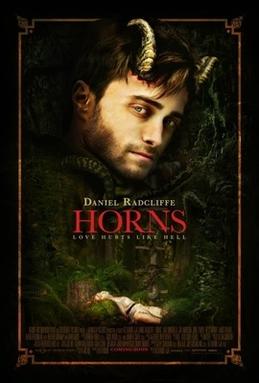
Horns: A Review

HORNS

I had no interest in watching Horns.  Apparently, this is something I share in common with the majority of Americans, who did not flock to see the film adaptation of the novel by Joe Hill (aka Stephen King's son).  A King fan at work insisted I watch it.  With that recommendation, I set out to see Horns, with also a curiosity to see how Daniel Radcliffe could sound as an American (his Harry Potter co-star Emma Watson doing OK but not completely convincing). 

Ratcliffe sounded fine.  It was the rest of Horns that was horrible: a film tonally deaf with characters I didn't care for, an almost monstrous view of humanity, and one that simply never decided what it was going to be.

Ignatius "Ig" Perrish (Radcliffe) is accused of murdering his girlfriend Merrin (Juno Temple). He protests his innocence but no one, not even his family, believe his claims of innocence. Despondent over her death and his town's reaction, he turns to drink and lives a dissolute life.  After one particular night of boozing, culminating in Ig urinating on Merrin's memorial and being beyond angry with God, he wakes up to find he has two small horns growing out of his head.

These horns are an embarrassment to him, but they also now give him strange powers.  The horns give him the power to release the darkness within others, not only by revealing other's deepest darkest secrets to him but making others act out their hidden desires, usually sexual.  Ig now sees this as a chance to clear his name.

He seems to delight in getting other people to do all sorts of wicked deeds (burning down buildings, indulging in forbidden sex), but he also remembers his time with Merrin and the bond he has with his friend/lawyer, Lee (Max Minghella).  One of the people who might know more than he says is Ig's brother Terry (Joe Anderson), who drove Merrin away on the night in question, that fateful night when she broke up with Ig. 

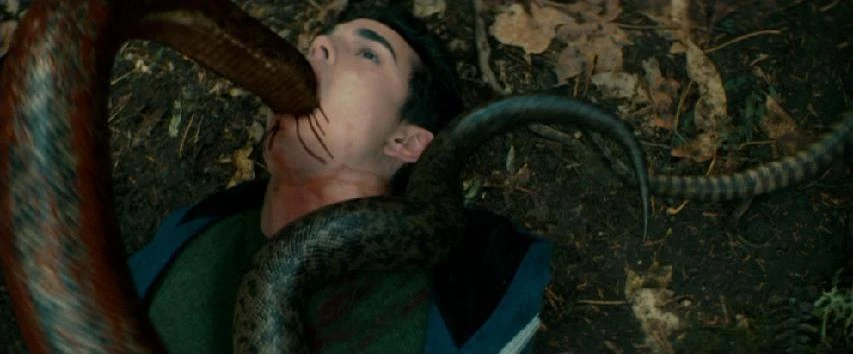
Did Terry do it?  Ig and his snakes believe he had something to do with it, and Ig has his own brother overdose on drugs.  Things take an ugly turn when Ig meets up with Lee again, who has been wearing Merrin's necklace (one that has a cross on it).  Once the necklace is removed, the truth is revealed at last: Lee killed Merrin after raping her, for he has always lusted after her and was jealous of her and Ig's relationship.  In the struggle, Lee attempts to kill Ig by having his car jump into the bay, but the only result is Ig being horribly burned.

Ig now seeks total revenge, and all hell breaks loose.  In the end, Lee is brutally killed himself, and Ig is too, but in some afterlife, he and Merrin are together again.


For me, Horns biggest flaw was that it never knew what it wanted to be. Director Alexandre Aja and screenwriter Keith Bunning never settled on whether Horns was a comedy or a horror film.  They never even committed to trying both because one element would end up undercutting the other.

You have horror when you see Ig horribly disfigured, his face burnt, even at one point holding court with snakes and a pitchfork.  You then try to shift to an odd comedy when he goes to Merrin's father, who has no reaction to seeing Ig with horns and a burnt-out face.

You have comedy at a bar fight, and then horror when the bar owner burns down the place (can't remember if there were people inside it).  You have real horror when Lee literally blows the head off Eric (Michael Adamthwaithe), a scene so ghastly, so grotesque that it isn't funny but downright revolting.

Though shortly after, seeing a snake go into Minghella and blow him up gives that a good run for its money.

Horns doesn't have anyone to root for.  As played by Radcliffe, Ig is a pretty horrible person, one you almost want to believe raped and murdered his girlfriend because his general demeanor is so unpleasant.  No one in town appears to be close to good (hence how just about everyone in town goes all bonkers whenever he shows up).  Ig is dumb (both smoking and using an inhaler) and unpleasant (urinating on the memorial of the woman he was passionately in love with).

The closest person to appear semi-kind is Merrin, and she is romanticized to an almost laughable manner with seemingly endless flashbacks to their long and lush romance.

I can't say that the mystery is all that mysterious, given that it is pretty obvious who killed her (even with a few false clues thrown in to try and implicate poor Terry). 

Horns also tries to be too clever with all the Biblical references (such as Eve's Diner, down to the apple).  It all conspires to make Horns clumsy, grotesque, and foolish in its efforts to be witty, sharp, and good.

There really is nothing in Horns that would be good: not the performances, not the story, not the effects, nothing.  Delighting in its own grotesque nature, Horns is not clever or funny enough to be witty and its efforts at comedy cut away from its efforts to be straight up horror.

It's a waste of everyone's time: those watching and those who made it. 


DECISION: F

Sunday, January 8, 2017

Great Expectations (2013): A Review (Review #885)

GREAT EXPECTATIONS (2013)

My curiosity with Great Expectations began when posters for the 2013 version began showing up at my local theater in El Paso, Texas. I was intrigued by what looked like an elaborate, sumptuous feature. Yet, despite mass promotion, Great Expectations never actually played here. I was puzzled by that, and as I waited, I began my exploration of this story.  Now, we've come full circle. 

After the original, Oscar-winning adaptation of Great Expectations, and the 'updated' version that set our oft-told tale of a young man's total education to current times, we go back to the source for our third adaptation of the Dickens masterwork.  Great Expectations is steady, respectable, beautifully filmed.  Why then is it yet another bungled adaptation?

This version sticks very close to the original novel (or at least the parts I remember, seeing as I have never been able to get through it despite three times trying).  Pip (Toby Irvine as a child, his older brother Jeremy as the adult) is caught by an escaped convict who terrifies the child into bringing him food and a file from his uncle, the local blacksmith.  Said criminal is caught and sent up the river, but he doesn't forget Pip's kindness.

A few years later, Pip is summoned to Satis House, the home of recluse Miss Havisham (Helena Bonham Carter).  She has locked herself away since she was jilted on her wedding day, still wearing her wedding gown and leaving everything untouched since that fateful day, her wedding feast rotting away.  She has Pip be a playmate to her adopted daughter, the beautiful but haughty and cold-hearted Estella.

Some time later, after Pip decides he would be happier as apprentice to his kindly but dimwitted Uncle Joe (Jason Flemyng), the lawyer Mr. Jaggers (Robbie Coltrane) arrives to tell Pip that he has a strange inheritance from a mysterious benefactor.  It's off to London for young Pip, who indulges in being a gentleman and all that entails: membership in a club for spoiled men, racking up debts, dressing well, and sharing rooms with Herbert Pocket (Olly Alexander), whom he met years before at Satis House and with whom he becomes friends with.

Over the rest of Great Expectations, Pip's story is intertwined with others, particularly Estella (Holliday Grainger), who has grown beautiful but cold.  She toys with him, rebuffing him and yet dangling him.  Pip learns that his benefactor is not Miss Havisham, as he believes, but that same criminal from long ago, Abel Magwitch (Ralph Fiennes).  Despite the dangers of his returning to England, where he will be returned to prison, he wants to see if his unofficial wards 'great expectations' were met.

In those coincidences that Dickens so loves, in short order we find that Magwitch was part of the conspiracy to defraud Miss Havisham (and which involved leaving her at the altar), that Estella was the daughter Magwitch thought dead and whose adoption was arranged by Jaggers, that Estella's mother was Jaggers' maid, and that the man whom Magwitch wants to kill was the same one who destroyed both his and Havisham's lives.

Eventually, Pip finds that life at the top isn't what it's cracked up to be, and Joe, kindly as ever, has paid off all his debts.  With what little he has, Pip gives it to Herbert in secret, who then employs him as a clerk.  At the end, Pip and Estella reunite after she becomes a widow, sad at how her life is.  Poor Miss Havisham died years earlier when she accidentally set herself on fire after realizing what she'd done to Pip.  Whether Pip and Estella can truly be together, we know not...

As I said, this version of  Great Expectations is a straightforward version, sticking very close, if not slavishly close, to the original text.  That, I think, is the main problem.  David Nicholls' adaptation is very proper, but very dry.  The characters, for all their eccentricity, their tragedy, their education, never come across as actual people.  It is all very dry, very proper, but like Estella herself, very remote.

It's almost as if director Mike Newell and screenwriter Nicholls decided that Great Expectations should combined the ossified world of Miss Havisham with the coldness and aloof nature of Estella.  As such, the film suffers from a variety of ailments.  It is very slow, it is very mannered, and in some cases, it is very forced.

There are three good performances in this version.  Fiennes is better than the material as Magwitch, his strange nature hiding a great tragedy, the mixture of revenge and desire to do good being interesting to watch.  The best performance is that of Coltrane, whose shifty lawyer is the master puppeteer, forever pulling strings and knowing more than he lets on.  Not far behind is Alexander's Herbert, who is the only one who has any sense of joy and doesn't behave on screen if THIS IS ALL SERIOUS.

Curiously, I thought Bonham Carter would have been better as Miss Havisham, one of the most legendary of characters.  I found her a bit mannered and theatrical as this sad, bitter recluse, forever tortured by her heartbreak. 

It's the leads that are leaden and dull.  Granted, Jeremy Irvine is particularly beautiful to look at, as is Grainger, but Irvine is never able to bring any emotion to Pip, and it was curious that when Pip is supposed to show snobbery towards Joe's more country manners, he looked as if he were trying too hard to make him snobbish.  It was very forced, and Grainger was very mannered in her performance (showing she really was adopted by Bonham Carter).

It's one thing to portray a woman with a cold heart.  It's another to show virtually no emotion.

I can't complain about the sets and costumes and cinematography, all beautiful and elegant and posh.  I also give credit to Nicholls in making the various twists of Dickens (which I have found a bit too convenient whenever I think of the novel) more plausible and making things a bit more clear for me.  That is good.

There's nothing horrible in it, but there's nothing in it that makes it anything more than a good companion piece to the end of a reading assignment to Dickens' novel. I think on the whole though, this version of Great Expectations is a bit empty and hollow, nice looking but mummified...like Miss Havisham's wedding feast. 

DECISION: C-

Sunday, December 11, 2016

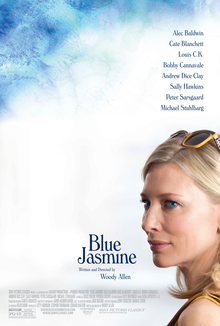
Blue Jasmine: A Review


BLUE JASMINE

When I saw Cate Blanchett win Best Actress for Blue Jasmine, I was a bit perturbed.  I had favored Amy Adams for American Hustle, but I also had not seen Blanchett's performance.  Therefore, I couldn't outright rule that the Academy had done wrong.

Having seen Blue Jasmine, I have to say...sorry, Amy.  You're among our best American actresses working today.  You also have a terrible ability to give great performances in years when other actresses give equally great or at least more popular performances, and 2013 was no exception.

And for the record,  Amy Adams should have won Best Supporting Actress over Anne Hathaway.  I didn't like The Master, but I don't think you should get Oscars for singing ONE song either (and I say it as someone who opposes Hatha-Haters).

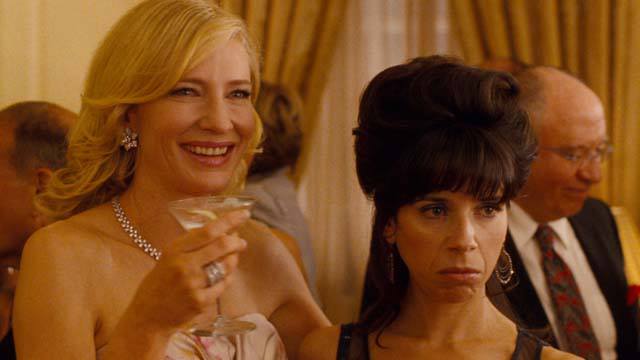
Blue Jasmine is essentially Woody Allen's version of A Streetcar Named Desire.  Wealthy socialite Jasmine Francis (Blanchett) now finds herself in dire straits (over the course of the film, we see it is because her husband was a Bernie Madoff-type who fleeced several people, including the former Jeannette-now-Jasmine's family).  It's to this family that Jasmine returns to for shelter, so it's off to San Francisco to crash with her sister Ginger (Sally Hawkins), who is no wealthy woman herself.

Ginger and Jasmine have almost always had a difficult relationship, made more so by Ginger's newest boyfriend, mechanic and all-around gauche Chili (Bobby Cannavale).  The elegant and sophisticate yet dirt-poor and inept Jasmine finds Chili a boor, and isn't too keen on the guy Ginger and Chili set her up with as part of a double-date, Eddie (Max Casella), as loutish as Chili.  Jasmine attempts to put her life together by working at a dentist's office, but Dr. Flicker (Michael Stuhlbarg) is a leech and she quits in disgust.


A woman of breeding and refinement, she does catch the eye of up-and-coming politician Dwight (Peter Sarsgaard).  Passing herself off as an interior decorator and recent widow (things that are technically true if wildly misleading), Jasmine uses her cultured manners to woo Dwight, and the two do fall in love.  Ginger finds a new beau as well: Al (Louis CK), a seemingly better choice than the lowbrow Chili.

However, the two sisters are bound for heartbreak.  Ginger finds out that Al is married, so she goes back to Chili.  Dwight discovers Jasmine's true history, courtesy of a run-in with Augie (Andrew Dice Clay), her ex-brother-in-law who was bilked out of his lottery winnings by Jasmine's late husband.  Dwight calls off the engagement, leaving Jasmine devastated and a little more unhinged.  The final break from reality is when Ginger and Chili reconcile, and Ginger sides with Chili over Jasmine. 

Jasmine, now basically bonkers, walks out of the apartment and onto a park bench, carrying on a conversation only she can follow or understand.

Blue Jasmine has at its core Blanchett's brilliant performance.  She runs through every aspect of Jasmine's persona: the wealthy woman who wants to leave what must have been a more poverty-stricken early life behind, a woman lost in more ways than one, the elegant sophisticate wooing and being wooed by Dwight, the furious scorned wife who tips off the government about her husband's malfeasance, someone attempting to hold on to some form of dignity despite all the indignities placed on her, and a probably-now completely unhinged woman past her wit's end.

Blanchett makes Jasmine into the new Blanche DuBois (though not completely as flat-out bonkers as Blanche was).  There is something almost naïve and endearing about how Jasmine wants to be elegant and sophisticated, how she wants the world to be and cannot make it be that way.  She doesn't want real, she wants magic...and this is her undoing.  It isn't that she is evil: she does have affection for Ginger and does come to care for Dwight.  She has a mixture of anger and sincerity that makes fascinating watching.

Hawkins is her equal as the Stella to her Blanche (let's face it: it is almost impossible not to see Blue Jasmine as a variation on the Tennessee Williams play.  It might as well be called a remake of Streetcar).  Her Ginger is generally sweet and without airs or pretense, and while she loves Jasmine she also sees that Jasmine is nothing but trouble.  As boorish as Chili may be (and the double-date is one of the moments where I sided with Jasmine), Ginger appreciates his loyalty to her.

Blue Jasmine is one of the best-acted films in the Woody Allen oeuvre, from the Mitch-type Dwight (only wealthier) to the working-class Augie, showing that Clay is more than the foul-mouthed comic who caused Saturday Night Live castmember Nora Dunn and scheduled musical guest Sinead O'Connor to not appear on Saturday Night Live when Clay hosted.

There were a few missteps.  A part of the story involves Jasmine's inability to use a computer at all (she wants to take online courses, but finds the use of a mouse or keypad a total mystery).  This did seem a bit too much for a woman in her forties (a man in his seventies, perhaps).  The subplot with the dentist comes and goes rather quickly, and I'm not too sure why Al had to be married and have Ginger set up for disappointment.

These are not major issues that sink the film.  Blue Jasmine is a well-acted, well-written film that has moments of humor but also moments of drama.  It is one of Woody Allen's best films and one that shows why at least that year, Amy Adams was denied.

Maybe Amy should work with Woody Allen...

DECISION: B+

Wednesday, November 30, 2016

Grace Unplugged: A Review (Review #865)

GRACE UNPLUGGED

Grace Unplugged is a rarity in Christian films: a movie that touches on sin and temptation that comes to both believers and non-believers.  The film isn't too afraid to acknowledge that outside the safe confines of the Church, even the strongest believer can be lured to leave the Cross when 'crossing over'.  It isn't perfect, but it is in terms of Christian cinema a firm step in the right direction.

Grace Trey (AJ Michalka) is the daughter of Johnny Trey (James Denton).  Johnny had a big hit song, Misunderstood, which catapulted him to the top of the charts.  Misunderstood, however, was Johnny's first and only hit, his career sinking soon after.  Johnny had a religious conversion and embraced Christianity.  Now a music director at a church, he is content in the Lord and has no desire to branch out of the safe confines of worship music.  In fact, despite what I imagine are offers to venture into the Christian music market, Johnny won't go beyond his own home church.

Grace, however, does want to go and venture into The World.  She also might be wanting to get away from Johnny's more strict world, chafing under his benevolent control (for example, going after her for not filling the car up).  Her own variations on worship music (such as belting out praise & worship during service) doesn't sit well with Johnny either.

As it so happens, Grace somehow manages to do her own cover of Misunderstood (my memory is a big vague as to whether she was talked into it or did it on her own).  Regardless, Misunderstood 2.0 attracts attention from the secular music scene, particularly Johnny's old producer, Frank 'Mossy' Mostin (Kevin Pollack).  The idea of getting the daughter to do a cover of her father's hit song is too enticing for Mostin, and the lure of success on her own is too strong for Grace too.

If you recognize the song,
You Might Be A Christian
It's off to sunny (and I imagine, sinful) California to go and cut Grace's debut record.  She finds aspects of California liberating, though she has trepidations about how fast the fast life is.  As she finds the world a bit harder to navigate, she really has no one to be accountable to.

She finds herself enthralled when a date is set up with Jay Grayson (Zane Holtz), star of the teen soap Thunder Falls.  Already she is starting to compromise her beliefs: though there is no intimacy (and to be honest I don't remember what the exact reason she didn't was), just the idea of her going to his place is already enough to raise eyebrows.  Grace is talked into this and a lot of other things by Mostin, insisting that being seen with Grayson will be good for her career.

One thing that might not be is with regards to her songwriting: namely, she has no experience in songwriting despite whatever impressions she may have left.  At the recording company, the only person who can understand her plight is Quentin (Michael Welch), an intern who is about the only Christian at the company.  He's not just a Christian, he's a committed Christian (he does tell Grace that it's so nice to have someone else there who can be a light to this world, an idea which Grace isn't too preoccupied with).

Another member of Mostin's bevvy of pop stars, Renae Taylor (Kelly Thiebaud), gives Grace a most curious bit of advice: your body is your biggest asset.  Grace now appears more lost in this world, with Quentin being the only one she can open up to.

With regards to Quentin and Grace, you know where it's going.

Mostin keeps pushing Grace to sing a more risqué song, One Fast Night, whose lyrics aren't overtly questionable but that to Grace seem a bit too much.  Despite the money Mostin has laid out (down to having a crew all ready to both record and go on tour), Grace leaves it all behind for the safe confines of Birmingham, where she and Johnny reconcile, even singing a new song for the congregation: All I've Ever Needed

Two Years Later, Grace finds that Mostin found a new girl to be his new pop-queen (and sing One Fast Night), while she, now engaged to Quentin, performs as the opening act for Christian singer/songwriter Chris Tomlin, where she's also joined by Johnny Trey, dueting on a wider stage.


I thought more and more on Grace Unplugged and began to wonder whether the various messages behind it were good or not. Allow me to get a little theological here.

In contemporary Christian thought there is the struggle between being IN The World but not PART OF The World.  In other words, while Christians cannot (and perhaps should not) separate themselves wholly from the culture around us, Christians should not be active participants in aspects of that culture that would go against Biblical principles.  For example, a Christian would be encouraged to participate in sports, but not to go to a bar or strip club after the game.  Maintaining that balance between The Word and The World is what causes many Christians various dilemmas.

Grace Unplugged touches on those aspects with Grace; for example whether she should sing songs that while not overt calls to sin are perhaps skimming the edges of sin.  There is a rich source of drama here, and we need only look at some figures in Contemporary Christian Music (CCM for short) to see how their own decisions affect their careers and personas.

Michael W. Smith and Third Day have had 'crossover' hits, but they've been pretty happy to stay within CCM.  Amy Grant, once the darling of the CCM scene, has ventured further out to where she's almost all 'secular' (and endured controversy when her first marriage collapsed under accusations of infidelity). Another music group linked with CCM, Jars of Clay, had a hit song in the 'mainstream' music world with Flood. They have come under fire over whether their lead singer, Dan Haseltine, appeared to come out in favor of same-sex marriage, a volatile issue within Christian circles. 

I won't even go into my own divided views on Switchfoot. 

In any case, this push-pull between the confines of The Church and The World are I think great sources of conflict. Grace Unplugged, as written and directed by Brad J. Silverman, I think went closer to the 'the World isn't a place for the Christian' worldview because rather than have Grace grow as both a woman and a Christian, she opted to essentially run back to her parents and the safety and security of the more sheltered/bubbled-in Christian world. 

I think they could have delved more into that conflict rather than have a safe way out, robbing the viewer (Christian and non) a chance to see that conflict grow and how someone brought up in the Church would handle this pressure.

Grace comes across a bit too naïve to be real, as if she wasn't sure what went on out in the world.  Johnny, for his part, did himself no favors, coming across as perhaps too strict and overprotective.  Part of me wants a film where Christians understand the world they live in is full of sin, temptation, darkness, and that they are not immune from falling into sin, temptation, and darkness.  If they didn't, what would be the point of grace and redemption?

Still, I think this is more the blame of the screenplay than of Michalka and Denton, who gave very good performances of the parts written.  Michalka in particular was adept at showing Grace's genuine fear at performing in public without the safety net of the church band. Yes, she was naïve, but she was also filled with anger at the restrictions placed on her, doubtful whether she was doing the right things.  Michalka showed herself a very good actress in bringing these conflicts to the forefront.

Another standout is Welch as Quentin.  His character comes across as someone who is genuine in his faith without being an idiot or unaware of how the world works.  In turns sweet and caring but also honest in his assessments of the industry and those it swallows up, it's a pity that Welch (best known as Mike the Human in the Twilight Series...excuse me, SAGA) hasn't broken out more.

Grace Unplugged is a strong calling card for Welch, who I imagine can do more, as well as for Michalka. The film is better than most of the Christian genre, but the fact that Grace ultimately went back to safety rather than try and fight for herself and her Lord, to me, struck a bit of a sour note, which is why I'm downgrading it just a touch. 

Still, I thought well enough of Grace Unplugged to recommend it to people who are forgiving of a flawed film that has some good acting, good songs, and doesn't treat Christians as either idiots or bigots.  All in all, again a good step forward.         


DECISION: C+

Friday, December 25, 2015

A Madea Christmas: A Review

A MADEA CHRISTMAS

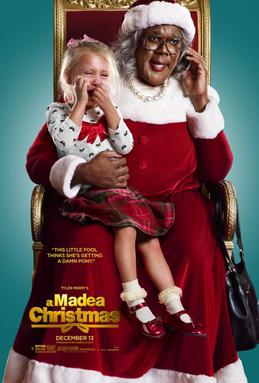
Welcome to Rick's Café Texan's annual Christmas film review, where on the day we commemorate the Birth of Christ, we examine a Christmas-centered film.  This year, I've selected A Madea Christmas, starring Tyler Perry as the blunt, gun-toting wisdom-spouting black woman who tells it as it is.  In that same spirit, I will do the same with this review.

Good thing Tyler Perry is very, very rich.

A Madea Christmas has a Christmas setting, but apart from a minor subplot the film could have been set at any time.  In retrospect, it is not a good film (certainly not in the same league as one of his best Madea-centered films, Diary of a Mad Black Woman), but as mindless Yuletide fare, this isn't the worst you could choose.   

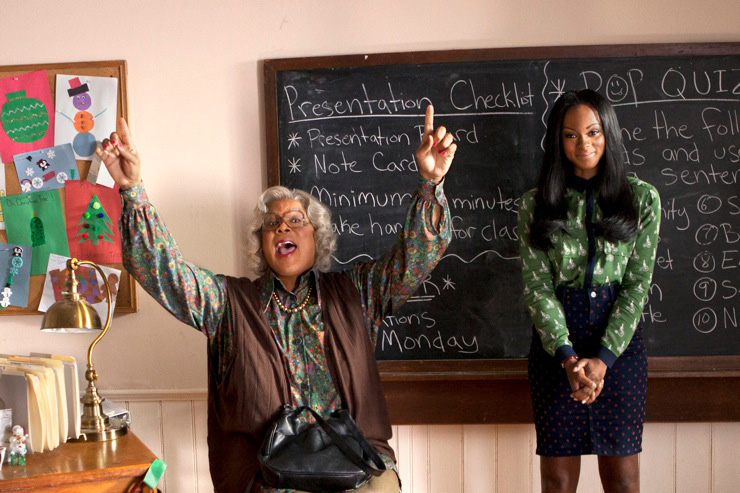
Madea (Perry) gets talked into working as a department store guide for Christmas by her friend/great-niece Eileen (Anna Marie Horsford), complete with a "Mrs. Claus" wardrobe.  No surprise: Madea fails spectacularly in her one day of work.  She ignores customers asking for assistance, takes personal calls while on the floor, and talks badly to just about anyone who comes her way.  She suggests to one customer that she is too fat for lingerie and leaves another in the middle of her inquiry to take her break.  No surprise that she's fired, but no matter: Madea expects to be paid for her hard work instantly.  When she isn't, she boldly goes to the register, takes out what she thinks she's owed, and takes a dress without paying as part of her 'salary' before storming out of the department store, horrifying everyone including Eileen.
Eileen, a hypochondriac, is upset that her daughter Lacey (Tiki Sumpter) isn't coming home to Atlanta from her teaching job at a small Alabama town for Christmas.  Madea suggests it's to get away from her overbearing mother, but Eileen won't believe that.  However, a chance to surprise her comes her way when Oliver (JR Lemon), an old boyfriend of Lacey's, is going to see her.  Lacey has asked for his help.  Her school is facing a financial crisis that might cancel the Christmas Jubilee celebration, and Oliver's PR firm is handling a mysterious client that needs good publicity.  This client is offering a $10,000 sponsorship in exchange for good publicity, and Lacey and the City Council eagerly accept.

Lacey doesn't want to come home for Christmas for another reason.  Eileen is displeased that Lacey lets her farmhand Conner (Eric Lively) live with her.  What she doesn't know is that Lacey and Conner are secretly married.  Oh, and did I mention Conner is white?


Falcons Touchdown is Good!


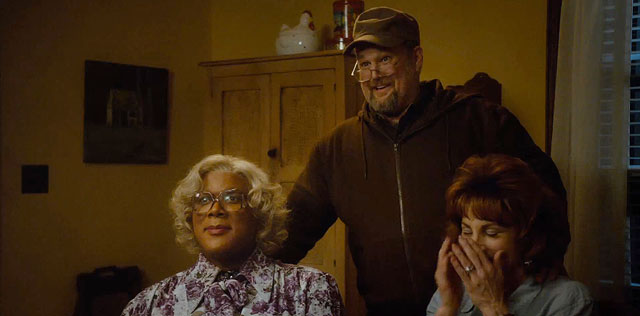
Lacey doesn't want to tell her mother, and the very gentle Conner goes along with this ruse.  However, Conner's parents Buddy and Kim Williams (Larry the Cable Guy and Kathy Najimy) do know, and in fact are coming back to the family farm to visit for Christmas.  Lacey and Conner also have to deal with their own work issues.  For Lacey, that is helping Bailey (Noah Urrea), a poor farmer's son, overcome bullying and achieve more than the life his father Tanner (Chad Michael Murray) wants.  For Conner, that means working on a new corn that requires less water while being bullied by his old frenemy (the same Tanner).

Well, as can be expected, once Eileen, Madea, and Oliver come around slowly but surely things are revealed.  Madea, perceptive as ever, realizes Lacey and Conner are involved, but isn't aware they are married until Buddy sets her right.  Through implausible circumstances Eileen is convinced the sweet-natured Buddy and Kim are Ku Klux Klan members and is unbearably horrid with them.  Once the truth about Lacey and Conner comes out, Eileen is enraged and won't stay there.  More circumstances bring Eileen to save Tanner, who has gotten Lacey fired (thus getting rid of his son's favorite teacher) because she inadvertently got Sheldon Construction to a.) sponsor the festival which they want all references to Christ removed, down to changing the event from a "Christmas" to a "Holiday" Jubilee, and b.) built the dam that caused the drought for the farmers.  It's up to Madea and her brand of tough love to sort all this out.


What is curious about A Madea Christmas is how essentially unimportant the Christmas setting is to the overall story.  There is a little bit tacked on about a Christmas Jubilee in town about to be degraded to a mere "Holiday Jubilee" but on the whole A Madea Christmas has fewer laughs and less...charm than other Madea films because she is more wisecracking bystander than the dispenser of tough love.  Moreover, what was once charming, even amusing about Madea in other films has turned into a meanness and pettiness that is more cringe-inducing than laugh-inducing.

Madea comes across as a nasty bitch more than a blunt but wise elder.  The way she is with the customers isn't funny, it's downright unpleasant.  If the customers had been nasty, short-tempered, or rude, having Madea respond in kind would have been funny.  However, the two people who dared bother Madea were quite pleasant and nice and rational.  Asking a guide for help in locating a watch is not an irrational request, but Madea behaves as though they have interrupted something more important (her calling for lottery tickets).  Madea then leaves them in midsentence while she storms off, screaming about her break and is oblivious to being called rude as she pushes her way towards the staff area.

It makes Madea someone you don't want to be around, and why Perry opted to do make his most famous character into a horrible figure in the opening I can't say.  It also doesn't help that Eileen is both unsympathetic and stupid.  She is perpetually nasty and rude to all the Williamses right to their face.  A bully in her own right, she is unconcerned that she took down a tree Kim planted as a memorial to her late father to make into a Christmas tree that no one in the household asked to have there.  Moreover, she doesn't even bother to remember Conner's name, let alone use it, referring to him as the farmhand (don't remember is she called him a field hand, but it wouldn't surprise me).

In other aspects, A Madea Christmas is badly structured.  We get a reason as to Eileen's hostility (her husband was killed by a white man on Christmas) only to have this sudden piece of information torn down immediately (Madea telling everyone Lacey's father wasn't dead when he disappeared but instead merely run off with a white woman).  Why didn't Perry introduce this element in the beginning?  If he had, we would have had at least an understanding over Eileen's hostility to the Williamses, which would have made some sense.  Instead, we get this 'shocking' information thrown at us real quickly, then get opposite information negating all this immediately after. 

It's just a mess.

The last-minute "have to save Christmas" subplot seems to come from another film altogether, and again and again circumstances and situations are rather implausible if not impossible.  Eileen's unwavering belief in the KKK membership of Buddy and Kim (who are actually quite happy with their daughter-in-law), Eileen coming across Tanner's overturned truck, Oliver's company having to keep their name and motives secret until after the contracts are signed (making this City Council more stupid than the one in El Paso...and that's saying quite a lot). 

Implausible upon implausible makes things worse than they already are.


Now, it isn't as if there aren't some funny moments.  Seeing the redneck styling of Larry the Cable Guy (whom I admit to liking) with the blunt chitlin' circuit comedy of Tyler Perry's Madea has some good moments (a plug for Prilosec OTC by Buddy is a nice in-joke, if a bit obvious).  A few moments (such as when Madea inadvertently crashes a KKK meeting or shouts out "I'm Gone With the Wind fabulous" in her department store tirade) are funny. 

It's a pity that even in parts where the comedy could work, Perry as director/writer chose to trim them.  The scene where Madea attempts to explain the Nativity story of the Virgin Mary...J. Blige and Joe....Mangianello ending with her tying up the little snobbish girl to a cross with Christmas lights had potential but no payoff.  Same for the KKK meeting.

In terms of performance, I think professionals like Najimy tried their best and came away the least scathed.  Urrea too as the kind, smart, and talented Bailey under a somewhat abusive father also was a highlight.  However, when Larry the Cable Guy can be seen as one of the better performances, you are in deep trouble.  Sumpter was almost always so blank and Lively came across less as a gentle, kind man, and more as a wimp.  Murray's one-note performance as the villain says it all, and even seeing Lisa Whelchel (Blair from The Facts of Life) as the school director didn't help make this an enjoyable romp. 

A Madea Christmas is a bit of a lump of coal for the holidays.  A few moments of actual humor came across almost by accident.  Terrible characters, terrible performances, and little connection to the holidays makes this a rather poor choice for a holiday feature.  Still, I can't say I hated it or that it is completely horrible.

It just isn't very good.


Christmas 2014 Film: Prancer
Christmas 2013 Film: A Christmas Carol (1951)
Christmas 2012 Film: Arthur Christmas

Friday, December 26, 2014

The Lost Medallion: The Adventures of Billy Stone. A Review

THE LOST MEDALLION: THE ADVENTURES OF BILLY STONE

I freely admit to being the most flawed and wavering of Christians.  At times, I'm passionate about Christ.  At other times, I carry an intense cynicism and suspicion on all matters involving God.  I bring this up because The Lost Medallion: The Adventures of Billy Stone is made for a Christian-based audience.  I can tell partially because Alex Kendrick (who is fast turning into a filmmaker I don't respect) is involved in this (albeit in a small role).  I can also tell thanks to the story, which has subtle and not-so-subtle Christian themes.  I am a reviewer who isn't going to knock down a film because of its worldview or praise it because I happen to agree with said worldview.  The fact that The Lost Medallion is geared towards tweens and younger set make it serviceable and keep it from sinking into another debacle of Christian cinema.

Just barely though.

Daniel Anderson (Kendrick) arrives at a foster home to drop off some things before heading out to a big baseball playoff game.  There, he is told about three kids: Huko, a child prone to bullying, Allie, who asked the guardian if God ever made people accidentally, and Billy, the quiet one who has no sense of worth.  He is corralled into telling all the foster kids a story, and he begins to spin his tale.

Billy Stone (Billy Unger) is an archaeologist's son who has recently lost his mother.  He's desperate to join dad Michael (Ken Streutker) on his latest dig searching for a powerful mythical talisman, but dad wants nothing to do with Billy on the dig.  Unbeknown to any of them, they are being watched by a mysterious Mr. Cobb, who with his two bumbling henchmen suspect that Billy is a threat to their own search for the medallion.  Billy has one friend, Allie (Sammi Hanratty), an orphan who wants to run away from the orphanage.  However, Billy convinces her to stay, and together they work to solve the mystery of the medallion.

Good news: they actually find it!  Bad news: they are pursued by henchmen threatening Billy's dad.  Even worse news: the stone his late mother gave Billy is the missing jewel in the medallion, and it grants wishes.  Billy, while wearing it, wishes none of this had happened, and he and Allie are swept back into the past! 

Here, they meet the arrogant Prince Huko (Jansen Panettierre) and his wacky friend Anui (William Corkery).  Huko believes the medallion is his by right, but Billy won't give it up.  Allie does find Huko cute (and I suspect she finds Billy cute too, but hasn't said it out loud).   Well, thanks to circumstances the wicked Cobra (Mark Dacascos) who either eerily looks like Mr. Cobb or may in fact BE Mr. Cobb, has taken the medallion but he cannot use its powers.  Only those with pure hearts can use it.  Therefore, he needs Billy.  Billy, Allie, Huko and Anui now must work together to recover the medallion.  For this, they need eccentric wise man Faleaka (James Hong) to guide them, and while he dies at least he gives them enough to help defeat Cobra.  In the end, all things are restored and Billy and Allie return to the present day, where he helps his dad find the medallion and they are united.

We end up back at the foster home, where Daniel has missed the game but doesn't care, for the three targets of his story now see they are special, and that their medallion is their own heart.  And why wouldn't he have stayed, as we find out in the end he had once been at the same foster home at their age?


There is a certain Indiana Jones feel to The Lost Medallion, and I believe intentionally so.  I could certainly see The Lost Medallion being an episode of The Young Indiana Jones Chronicles, down to the supernatural/time travel aspects.  The Lost Medallion also is blessed to have a group of relatively competent child actors to anchor this.  Of particular note is Unger as Billy Stone.  While the film was released in 2013 (making Unger 17 years old at the time), I find it hard to imagine that he actually was 17 because he looks more 13.  I also suspect the film was made before its release date because a 17 year old having these adventures and not thinking about Allie in any romantic way seems a wild stretch.

Then again, it IS a Christian film where sex apparently doesn't exist, which would be a surprise to all my Christian friends, particularly the ones who wear promise rings but end up losing their virginities faster than those who don't, but I digress.

Unger makes Billy a believable figure most of the time, at least once we get away from the present day and travel into the past.   He's almost excessively mature emotionally to play naïve, but credit should be given where it is due.  Harritay is also strong as Allie, who is both smart (maybe smarter) than Billy but still a good ol' damsel in distress.  Corkery lends comic relief as the fat, bumbling but sweet Anui, and the highlight of The Lost Medallion was in seeing Allie and Anui reach the mountaintop hom of Faleaka faster than Billy and Huko, who insisted on climbing up a steep mountain while ignoring Allie's suggestion that they walk up the path both failed to see in their mad competitiveness.

Hong was a delight as the odd Faleaka, sometimes spouting off nonsense that in the end made sense and serving as a distraction to guards by making weird noises and dances.  Dacascos was appropriately evil as Cobra, and perhaps this is why I am not finding much fault with The Lost Medallion: it is in essence, a cartoon which we're not suppose to take all that seriously.   This is reinforced with the bumbling henchmen, who appear in both the present and past. 

The henchmen were cartoonish, but again, it's a kids movie so I have to give them a little leeway.


If anything, the push to make this overtly religious is what I think gives The Lost Medallion a few points down.  When Faleaka is arrowed down (is that a term?), Billy asks him, "Why would you die for me?"  Faleaka's answer?  "Because a great king once died for me!" 

Talk about laying it on a bit thick.

In an animated montage we learn of a great king who became one with his people, insisting that they were all worthy of love.  Again, wonder if that could mean anything.

Now, don't get me wrong: I'm not opposed to having symbolism in a film, even one specifically geared towards the Christian market, but I like the types of films that trust ME to get it rather than insist on spelling it all out for me.

I would recommend The Lost Medallion: The Adventures of Billy Stone to tweens and younger kids who don't ask too much in their entertainment.  Families concerned about violence should know there is some, but mercifully not bloody (though Faleaka's death might be a touch scary).  To the film's credit, it does address that in the few narration scenes with Kendrick (who shows he isn't terrible when he comes in small doses).  It delivers its message, not too ham-fisted but still pretty clearly.

On the whole, it's serviceable, though I would have thought as it is now The Lost Medallion would be better served as a pilot or television movie than as an actual feature-length theatrical release.   I imagine Unger's television show Lab Rats might be wittier and better-made than The Lost Medallion, but not being the target audience for either I cannot say. 

In the end, The Lost Medallion isn't horrible.  It's for kids, and I'll leave it at that.   

DECISION: C+

Sunday, May 18, 2014

The Hobbit: The Desolation of Smaug. A Review


THE HOBBIT:
THE DESOLATION OF SMAUG

Smaug Alert...

When last I visited the world of J.R.R. Tolkien in The Hobbit: An Unexpected Journey, I commented that for all the madness and mayhem, something got lost.  What got lost was Bilbo Baggins, The Hobbit's main character.  The Desolation of Smaug is the second part of a trilogy based on a book that is 305 pages long (at least my copy is that length). 

By comparison, I found a copy of Gone With the Wind that is 1,037 pages long, a copy of Ben-Hur that is 564 pages, a copy of 12 Years a Slave that is 198 pages, and a copy of All Quiet on the Western Front that is 295 pages long.  Each film version of the mentioned books (all Best Picture winners) managed to tell their stories within one movie.  Granted some were long movies (including Overture, Intermission, and Exit Music), but they all managed this feat because the filmmakers made the decision to cut the text.  Peter Jackson, the Lord of The Lord of the Rings franchise, along with his minions, decided to go the opposite route and ADD material from other Tolkien writings to made a trilogy out of a slim novel, in order to tie this story to the massive The Lord of the Rings trilogy that came a decade prior.

If one can find any justification (apart from greed) that makes making a trilogy out of a book whose story could be told in two hours (or less) on film, I have yet to hear it but would be eager to.

I thought DOS was better than AUJ, but again, there is simply so much thrown at it one might just as well cut the rather unimportant Bilbo character and focus on more important things (like an elf/dwarf love triangle).

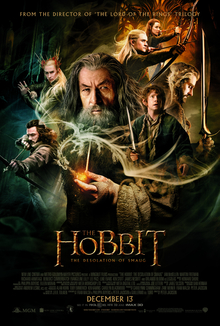
We go back to the journey Bilbo Baggins (Martin Freeman), hobbit and burglar to a group of dwarves, as they continue onwards to the Lonely Mountain, where Bilbo is expected to steal something from Smaug the dragon (voiced by Freeman's Sherlock costar, Benedict Cumberbatch).  Somewhere in all that, we have to have a series of escapes for our dwarves, led by Thorin Oakenshield (Richard Armitage), their fearless leader.  Along the way they encounter the skin-changer Beorn (Mikael Persbrandt), they travel through the Elf forest of Mirkwood, where they survive spiders and escape from Elven King Thranduil (Lee Pace), his son Legolas (Orlando Bloom) and the elveness Tauriel (a new character not found in the novel, played by Evengeline Lilly).  Tauriel and Kili are drawn to each other, much to the silent irritation of Legolas.


After their escape and despite still being pursued by the Orcs, the dwarves convince/bribe Bard the Boatsman (Luke Evans) to smuggle them into Lake-town, at the foot of the Lonely Mountain.  The greedy Master of Lake-town (uber-snob Stephen Fry) and his minion Alfrid (Ryan Gage), when they discover the dwarves, welcome them as a way to get the treasure Smaug is holding hostage.  The dwarves go to the Lonely Mountain where once in a duel of wits occurs between Bilbo and Smaug, with in the end Smaug bursting from the mountain to attack Lake-town. 

Bilbo says, "What have we done?" and film ends.

The most curious thing happened at the precise moment The Desolation of Smaug went black.  That very moment, at the precise moment the screen went black, I just dropped off.  It was for a few seconds, but I had to rewind it to see if somehow I'd missed anything.   What I missed was the whimsy and joy of Tolkien's slim novel, instead replaced by this massive epic that drowns out what we had before. 

Also missing (again) was Bilbo.  Throughout the plot summary notice that the novel's main character was almost written out of the story altogether.  That isn't to say Bilbo wasn't in the movie or that he wasn't important, but the screenplay by director Jackson, previously-assigned director Guillermo Del Toro, and LOTR veterans Fran Walsh and Philippa Boyens reduced his role to where he was present only when necessary (facilitating the escape from Mirkwood or having a word duel with Smaug).  Apart from that he disappears for long stretches of DOS, where we are treated to really unimportant tales.

Do we really need this dwarf/elf love triangle?  Are Ian McKellen's Gandalf or Sylvester McCoy's Radagast necessary?   The former takes up such a large part of the story and the latter so little one wonders why they were there.   Adding more confusion/frustration is that The Hobbit is being used to tie in to the larger LOTR narrative when even Tolkien didn't have that idea per se.  Tolkien, if memory serves correct, didn't include any suggestion of Sauron's presence in The Hobbit, nor of Galadriel (Cate Blanchett in a 'blink-and-you'll-miss-it' cameo).  Unless Beorn plays a larger role in There and Back Again or Battle of the Five Armies or Peter Jackson Wants More of Your Money or whatever new title the third film goes by, his whole scene could have been cut without affecting the story. 


Do we really need the Halfling in this?
Isn't this OUR story?
Same for the Mirkwood spiders.  Same for the love triangle. Same for the internal Lake-town politics. Same for Legolas being shoehorned into this for no reason other than to give the one-note Bloom a job and LOTR fans a tie-in to a story he has no business being part of.

How can one justify spending an hour and a half of this second part BEFORE the dwarves even get to Erebor, their lost kingdom?

Perhaps the biggest failure of Desolation of Smaug for me is that it takes things so, so, DEADLY serious.  There is simply no joy in The Hobbit.  I suppose this comes from the fact that The Lord of the Rings was this epic and very serious trilogy, but even The Fellowship of the Ring had lightness in its scenes in the Shire (and Merry and Pippin as somewhat comic relief in the other films).  None of that for both An Unexpected Journey and Desolation of Smaug: EVERYONE has to play things as if this were SO IMPORTANT, so DEATHLY DULL.

Because everyone treats DOS with the solemnity of a state funeral, the performances pretty much are the same: dry, serious, and pretty lifeless.  Why are elves so self-important?  Why are dwarves so grouchy?  Why are humans so serious?  Why are wizards so opaque?  Why do we get nothing but a series of foreshadowings?

Sadly, the smallest parts, the hobbit and the dragon (now THERE'S a title) are the best parts.  Freeman still excels as Bilbo, his befuddlement and sense of awe still worth attention.  Cumberbatch's Smaug is slitheringly evil (though his voice, mercifully, is not so exaggerated in drawing out the wickedness in his baritone).

I would add that the self-importance of DOS extends to the visuals: almost all universally dark, full of blacks and greys with little light.  Even in the Elven Kingdom of Mirkwood, there is a heaviness that hangs over it.

For me, The Desolation of Smaug is better than An Unexpected Journey, but all the baggage from the first film still remains: a highly problematic sense of self-seriousness, an unmanageable narrative that sprawls with little to no sense, and a diminution of the main character in exchange for something larger, sacrificing the charm of the original. 

DECISION: C-


If you have a microscope,
you might find Bilbo.


Thursday, May 15, 2014

The Secret Life of Walter Mitty (2013): A Review (Review #635)

THE SECRET LIFE OF WALTER MITTY

I've read some James Thurber.  Funny stuff.  I haven't seen the original version of The Secret Life of Walter Mitty because I have such an antithesis towards Danny Kaye (finding him hopelessly annoying in his cutesy mannerisms, though I respect his work for UNICEF).  Therefore, I can't call this version a remake. 

Sadly, what TSLOWM ends up as is predictable, weak, and a terrible, terrible disappointment.

Walter Mitty (director Ben Stiller) is a meek little man, one who gets no winks on his eHarmony page (welcome to MY world, Zoolander).  He loves his coworker at Life Magazine, Cheryl (Kristin Wiig), but can't find the courage to ask her out, let alone contact her through her own eHarmony profile.  Ever since his dad died Walter has been afraid of life, hiding within his own fantasies of adventure and romance.

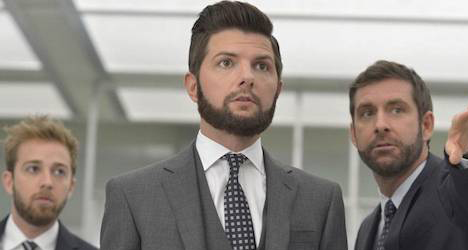
Life, however, has taken a bad turn.  It is going out of business, bought by corporate lackey Ted Hendricks (Adam Scott).  As the negatives assets manager at Life, Walter holds the negatives for the magazine's vast collection.  This is an important job despite the rise of digital because one of their legendary photogs, freelancer Sean O'Connell (Sean Penn), stubbornly refuses to use anything other than film.  He sends his last batch of photographs and within them is 'Negative 25' the one he all but demands be used as the final cover.  Ted constantly asks for Negative 25, but Walter keeps stalling him because Negative 25 is not found within Sean's latest package (though a wallet to Walter is).

With that, Walter now must use the jumbled clues (along with Cheryl's help) to track down Sean to locate Negative 25.  This means flying almost on a whim to Greenland, Iceland, and after getting fired by Ted, Afghanistan, where Sean tells him where Negative 25 has been.  In all this, Walter keeps getting calls from Todd at eHarmony (Patton Oswalt), who helps him out with his profile and at one point, is the only person in Los Angeles that can vouch for Walter's identity.  Eventually, despite having been fired, and despite Cheryl having been laid off, Walter turns in Negative 25 (though he doesn't see it until the end).


I think The Secret Life of Walter Mitty is already crap when we find how helpful Todd from eHarmony is (wonder if he's related to Jake from State Farm).  As a side note, we have nods to eHarmony, Papa John's, and even KFC: product placements that would make Adam Sandler proud.  In ALL the times I have been on eHarmony (yes, plural), I have NEVER known that a.) you could call someone to help you with your profile, and b.) that they would be almost a personal assistant to you to find a woman.  If that were the case, I would have found someone by now.  Yet I digress.

For a movie about living life and taking chances, The Secret Life of Walter Mitty ironically plays it all so safe.  It plays it safe by the clichéd moments (Shirley MacLaine as Walter's mother plays a bizarrely important role in the story, bizarre in that it makes Sean almost stalker-like regarding Walter). Further going into Edna Mitty's role, at a certain point I wrote "If his mom (does something) then I hate this film".  What happens in Steve Conrad's screenplay and story?  Exactly what I thought would happen...hence, I HATE THIS FILM.

I don't really hate The Secret Life of Walter Mitty, but again, it took few if any chances, an ironic situation given the theme of it was being open and brave. 

It plays it safe by having Walter find Sean up in the Himalayas in a patently absurd manner (not to mention that even with a backpack and two Sherpa guides he still looks ill-prepared for the journey).  It plays it safe by having Walter not really open up to the world, but almost stumble onto things.

Furthermore, it plays it safe by making the title character appear almost insane.  In the film, Walter slips into fantasies and it takes a lot to bring him out of them (a particularly cruel moment is when Ted flicks a paperclip to his head, but then that's the type of person Ted is).  All I kept thinking was, "You know who else blacks out?  Norman Bates."  When you start comparing Walter Mitty to Norman Bates, you have major problems.


One thing I particularly hated about Walter Mitty was Scott and his character.  Now, this isn't to say that it succeeded in making me dislike the character I was suppose to dislike.  It's that Scott and Stiller make that fatal mistake of making your antagonist a blithering idiot, yet again another cliché.  This is the second film at least that I have seen where the person who fires people thinks its all so funny (the other one: the abysmal Larry Crowne).  Now, I have been fired more times than I care to remember, but at no time have I ever seen or known someone to fire a person (let alone a group) and have them not only laugh in their faces, but treat the thing without any sense of seriousness.  I know, I know, it's suppose to show how clueless and cruel they are, but I never believe these scenarios.  I remember distinctly writing that Adam Scott has a face of someone I don't trust.  I wrote that for Leap Year, a worse film than Walter Mitty.  Now, maybe Scott is great in Parks & Rec and Party Down and is some sort of artistic genius, but to me, he looks like a rat. 

I'm not talking metaphorical.

I kept thinking about how the film could have been better, say for example if Walter, this meek man, was assigned to track down O'Connell, requiring him to live out his fantasies.

Now, in the 'good things' department, Stiller and Wiig worked beautifully together, with their scenes providing much emotional resonance.  Stuart Dryburgh's cinematography was especially beautiful.  Other than that, not much to recommend.

The Secret Life of Walter Mitty failed because it didn't take chances and gave us scenarios and characters we generally couldn't feel for.  So it looks like poor Walt is 0 for 2 in the adaptations department.  What can I say...that's NOT Life.       

DECISION: D+

Friday, May 9, 2014

The Book Thief: A Review

THE BOOK THIEF

Where, oh where did it all go wrong? 

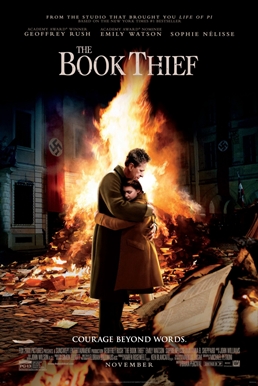
We have innocent children. We have Nazis. We have literary pedigree. In short, The Book Thief should have been this great film that is sweeping and epic and intimate.  Instead, we see a film that went off the rails: in turns sappy and insipid, it even veers into horror.  Good intentions do not a good film make.

Germany, 1938.  Liesel Meminger (Sophie Nelisse) has been left abandoned after her mother has fled (I think something to do with Communism).  She is taken in by Hans (Geoffrey Rush) and Rosa Hubermann (Emily Watson).  Rosa is strict, dour, and curt (in other words, Angela Merkel), while Hans is sweet, tender, and kind.  Liesel immediately attracts the attention of Rudy (Nico Liersch) who tries to get her to give him a kiss.  As Nazism grows, the children are brought up to love Hitler.  Among those acts of love is to burn books. 

As Liesel starts out as illiterate, her love of words now comes in conflict with this situation, so she steals a smoldering book.  With that, she rescues The Invisible Man.  This attracts the attention of the burgermeister's wife, who allows Liesel use of her vast library.  Meanwhile, Max Vanderburg (Ben Schnetzer), a young Jewish man, is being hidden by the Hubermanns.  Max's father had saved Hans in the first war, and Hans pledged to protect his family.  The rest of the movie goes between Rudy's inability to get Liesel to kiss him (or understanding why it is wrong to admire Jesse Owens despite Rudy's love of racing) and trying to keep Max alive.

Oh, and Death narrates the film, putting in his two cents every so often.

As I understand it, The Book Thief is true to Markus Zusak's novel with Death taking a central role.   That's too bad for two reasons.  First, Roger Allam's narration makes Death come off as idiotically smug and pretentious.  Second, it distracts from the story whenever we are reminded that he is coming. 

Of course, the story itself seems to go on for far longer than its two-hour plus running time.  We go through so much through Max's endless illness to where Liesel's love of literature is kind of drowned out.  The growth of Nazism seems almost in the background, and while it is nice to see Rudy going through hoops to get Liesel to like him it is almost sad to know she is so utterly reluctant. 


I question director Brian Percival's decision to go all-out with the German accents.  I understand that it makes it all so authentic, but perhaps they went overboard with the neins and dummkopts being spread around.  Even the children had to carry these Teutonic tones (begging the question, why does Death sound like an Englishman?) and it becomes a bit distracting bordering on comedy. 

The performances don't help.  Watson and Rush I think did what they could with the script, but not only are their accents ready-made for comedy skits but they are mostly one-note (Watson as harsh, Rush as gentle).  There was later on a thawing from Watson, but by then it was too late to really be believed.  Schnetzer was the lone standout in that he gave Max a believable character (his excursion during an air raid when he could leave the house without fear of being caught is a beautiful moment).

It is pretty to look at, and the music is lovely (though perhaps a bit schmaltzy for my tastes).  However, the film's greatest failure is in that it tries too hard to move me emotionally.  Rather than trusting us to care about the people, it pushes us and pushes us to be moved that we almost have a contrary reaction. 

In short, The Book Thief tried really hard to have us care, but it goes on for far too long and it is a victim of its own ambitions. 

DECISION: D+