Showing posts with label Tolkien. Show all posts

Tuesday, October 8, 2019

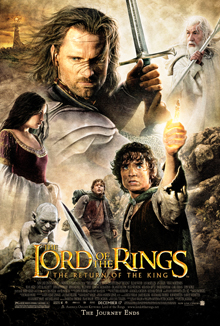
The Lord of the Rings: The Return of the King (2003). A Review


THE LORD OF THE RINGS: 
THE RETURN OF THE KING (2003)

Editor's Note: This review is of the theatrical version.

And thus, this massive Rings cycle concludes with The Lord of the Rings: The Return of the King. The concluding part of The Lord of the Rings trilogy was richly rewarded come Oscar-time, winning eleven Academy Awards out of eleven nominations. As such, it not only tied the record for most Oscar wins with Ben-Hur and Titanic but holds the record for the biggest sweep in Academy history.

Exactly how much its 11-for-11 record is due to the film itself versus that it was the last chance to reward this epic series is a subject of debate. Now, more than fifteen years after it concluded a massive epic, we can look on The Return of the King with a slightly clearer eye. The Return of the King is a massive film that perhaps throws in more than it can carry, but one that moves quite fast for its running time and concludes things on a strong note.

Keeping to the story established in The Fellowship of the Ring and continuing in The Two Towers, The Return of the King follows two intertwined stories. The first is the continuing journey of hobbits Frodo Baggins (Elijah Wood) and Samwise Gamgee (Sean Astin) into the forbidding land of Mordor to destroy The One Ring, a powerful object that will allow its former owner Sauron to rule over all Middle-Earth and plunge it in darkness and evil. They must go into Mordor for the One Ring can be destroyed only by being thrown into the fires of Mt. Doom. Guiding them is the creature known as Gollum (Andy Serkis), whose loyalty is dubious at best, with Sam thoroughly opposed and Frodo more accepting of.

The second story involves the actual war of conquest Sauron is fighting against Men. Aragorn (Viggo Mortensen), heir to Gondor's throne, calls upon Denethor, Stewart of Gondor (John Noble) to join with neighboring Rohan to fight against Sauron's forces. Denethor, however, is a bit bonkers at the moment: mourning his son Boromir and having little interest in his other son Faramir (David Wenham), sending him on a suicide mission then despairing over both Faramir's apparent death and the massive army besieging his city.

Image result for the return of the kingAs the massive armies fight, two little hobbits and their conflicted guide push further on, facing many dangers including a crazed Gollum, set on retaking his 'Precious' from Frodo. Things culminate in massive battles involving an Army of the Dead, massive creatures, a warrior Princess defeating the Witch-King himself, and at long last the quest completed.

Now with Middle-Earth firmly in the Age of Men our four Hobbits return to their home in The Shire, though for at least one of them and his Uncle Bilbo (Ian Holm), one last journey awaits into the West.

I remember going to see The Return of the King in theaters and the reaction was enthusiastic, at least until the first 'ending'. By perhaps the time the hobbits got back to the Shire and the film seemed to not know if it would end, the audience turned hostile, with members shouting for it to be over. Perhaps in retrospect we see how director Peter Jackson, along with his co-screenwriters Fran Walsh and Phillipa Boyens, could not find a way to formally and finally end this massive concluding chapter of this massive trilogy. Just as one thought the film ended, something else popped up again and again, and the audience by this point was exhausted.

As I look back on The Return of the King, I thought that perhaps it could have been shorter and perhaps more blasphemous, both it and The Two Towers could have been shorter. This came to me when we had a brief visit to the ruins of Isengard, which played a large role in The Two Towers but added nothing in The Return of the King. It's as if by now Jackson really wanted to put in as much as possible and didn't know when to stop.

As a side note, the creeping bloated nature of The Hobbit trilogy prequels released a decade later seem to have a precedent in The Return of the King.


However, to its credit The Return of the King did an excellent job pushing the stories forward and an especially excellent job in pacing. The film moves quite well to where you barely notice how long it is, at least until after the fall of Sauron where it finally started lurching from one thing to another.

As another side note, the audience I saw The Return of the King burst out laughing when Arargon started his hymn, as if the King belting out a musical number was just too much to take.

The performances are exceptional. High credit goes to Serkis as the damned Gollum, with the film even giving him a chance to appear on-camera versus motion-capture. In his performance Serkis gave his character a mix of horror and pathos, where one felt sorrow for and anger at him. Wood had to carry so much on his shoulders as the main character, and in Return of the King he comes into his own. His Frodo is a haunted figure, driven nearly insane by both The One Ring and the arduous journey.

Frodo's darkness as portrayed by Wood is brilliantly countered by Astin's portrayal of the ever-loyal Samwise. He despairs but never gives into despair and hopelessness, maintaining a sense of hope however dim, in this painful journey.

It's both a good and bad thing that the rest of the cast from both Fellowship of the Ring and Two Towers keeps to how they started out. Credit should be given to Billy Boyd, Dominic Monaghan and Miranda Otto as Pippin, Merry and Eowyn respectively. Each had their 'warrior' moment where he/she showcased courage under fire. Mortensen too had bravura moments whenever he rallied armies living and dead to his cause.

However, Ian McKellen as the wizard Gandalf, Orlando Bloom as Elf warrior Legolas and John Rhys-Davies as Dwarf warrior Gimli basically did as they have before: either spout off words of wisdom or keep some running tab of kills. To be fair I did enjoy the softening of relations between Legolas and Gimli to where they were genuine friends versus adversaries due to their separate ethnicities for lack of a better term.

Image result for the return of the king sam frodo

I think now that part of my issue with Return of the King, on seeing it again, revolves around a certain repetitiveness that stems from The Two Towers. Both Two Towers and Return of the King have leaders on thrones mourning their dead sons. Both Two Towers and Return of the King have massive battles as their centerpieces, with battering rams and storming hordes. Return of the King even has two characters who appear dead but are not (Faramir and Frodo).

And then there are the various 'endings', a major point of criticism then and now. One friend wisecracked that the Academy gave Return of the King an Oscar for each ending it had, and one of the film's major flaws is that it kept going long after the war was over. It didn't seem to know how to end, so it kept ending, throwing in one apparent conclusion after another until audiences grew frustrated. This series of unfortunate finales hampers the film.

However, on a visual and emotional level, with the craftsmanship and performances elevating it, The Lord of the Rings: The Return of the King is an epic and exceptional, if albeit excessively lengthy, conclusion to one of the grandest epics in cinema.

DECISION: A-

2004 Best Picture Winner: Million Dollar Baby

Tuesday, September 10, 2019

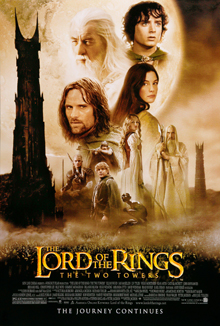
The Lord of the Rings: The Two Towers. A Review (Review #1280)

THE LORD OF THE RINGS: THE TWO TOWERS


Editor's Note: This review is of the theatrical version.

The Two Towers occupies a curious space in the Lord of the Rings trilogy as the midsection of this massive epic series. Neither beginning or end, The Two Towers has to serve as a bridge between The Fellowship of the Ring and The Return of the King. The questions become whether it stands on its own and whether it holds as said bridge while also working as a film independent of them. On the whole, The Two Towers holds up well, though it does give in at times to both some ill-placed comedy and a loss of focus.

Essentially picking up from The Fellowship of the Ring's ending, The Two Towers has two stories. The main story is of hobbits Frodo Baggins (Elijah Wood) and Samwise Gamgee (Sean Astin) continuing their journey to Mt. Doom in the forbidding world of Mordor to destroy The One Ring. That destruction would ensure the Dark Lord Sauron would be defeated and not destroy all Middle-Earth.

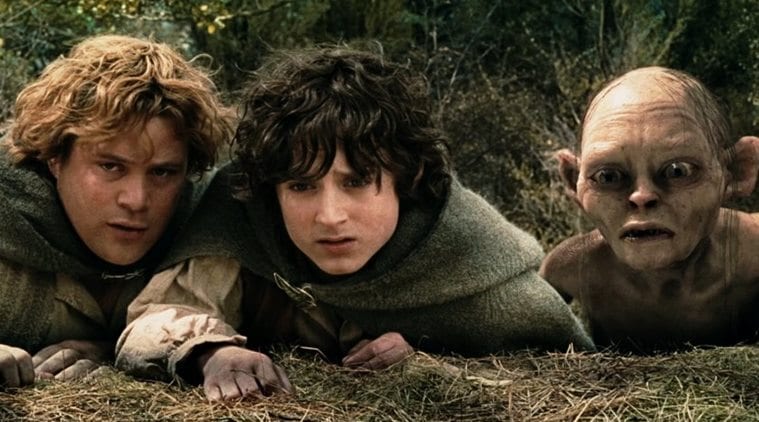
Frodo and Sam are lost, but an unlikely ally comes in the form of Gollum (Andy Serkis), the One Ring's former possessor who is himself possessed by his 'Precious'. He knows the way into Mordor, but Sam does not trust him. Gollum's motivations are as conflicted as the creature himself, for he struggles between seeing 'Master' Frodo as a friend and as his enemy keeping him from his 'Precious'. On their journey, they are captured by Faramir (David Wenham), who takes them to Gondor to gain his father's approval. Faramir happens to be brother to Boromir, killed in The Fellowship of the Ring, but unlike Boromir, Faramir has the strength of character to eventually let Frodo, Sam and Gollum continue on to Mordor, where Gollum may be more foe than friend.

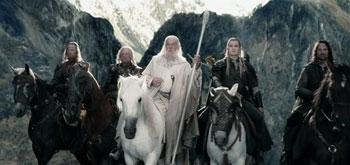
Image result for the lord of the rings the two towersThe other story involves the continuing search for two other hobbits: Merry (Dominic Monaghan) and Pippin (Billy Boyd). Aragorn (Viggo Mortensen), the dwarf Gimli (John Rhys-Davies) and elf Legolas (Orlando Bloom) search for them, encountering Orcs and The Rohirrim, fabled Riders of Rohan sent into exile by their king. In their search, they encounter the wizard Gandalf (Ian McKellen), now restored to life as Gandalf the White. The search ended with Merry and Pippin accounted for, they all now press on first to save Theoden (King of Rohan) from the power of Saruman (Christopher Lee), then to fight off Saruman's army at the stronghold of Helm's Deep.

Merry and Pippin, having encountered Gandalf previously, find themselves with Treebeard (voiced by John Rhys-Davies), a wise Ent (a sentient tree), who with his brother Ents does not appear interested in joining this war until he sees what Saruman has done to his fellow trees. Enraged, he lays siege to Isengard (one of the two towers).

Unbeknownst to both groups of hobbits, the Men at Helm's Deep, now joined by Elves in a last-ditch alliance, fight on. The only Elf that Aragorn thinks of is Arwen (Liv Tyler), the love of his mortal life who reluctantly agrees to join her fellow elves in exile at the urging of her father Elrond (Hugo Weaving). This causes a bit of a complication for Theoden's niece Eowyn (Miranda Otto), who has developed feelings for Aragorn. However, this Shieldmaiden of Rohan is conflicted both by her emotions and her efforts to save her people.


That's a lot of story for one film, yet the curious thing is that for all the Sturm und Drang in The Two Towers, story-wise we really don't move far. Frodo and Sam are closer to Mordor but not yet within it. The other members now move on to more pressing matters but are essentially in a prelude to the final confrontation with their enemy. Moreover, The Two Towers has a major issue: simultaneous stories.

It's interesting that Frodo and Sam disappear in a 35-minute gap, that gap filled by the Battle at Helm's Deep. That there is a gap of that length for ostensibly the main character isn't the problem. It's that when he does return one is almost surprised to remember he was there to start with. I found that a lot of The Two Towers has this jumping about that mostly works well but that also has us forget characters and situations until they come back.

Probably the worst was the transition between when Sam and Frodo avoid capture at Mordor's Black Gate and Merry and Pippin travelling with Treebeard. That jump jolted me, but at times The Two Towers seemed a bit unwieldy in trying to balance so much. For example, all of Arwen's scenes, though beautiful and tragic, did not seem to really fit well within the story. It wasn't wildly out-of-place but seemed a bit of a tangent.

Image result for the lord of the rings the two towersAdd to that that this is the first time I thought things did not look authentic. The dream/love scene between Aragorn and Arwen looked like a stage. A couple of the visual effects looked inauthentic. Then there was seeing Legolas essentially skateboard down a flight of stairs during the Battle. I figure viewers chuckled at that at the time but now, nearly twenty years on, it looked a bit too humorous.

I could have done without this little bit of levity as well as Gimli being the 'comic relief'. Again, it's not that comic relief couldn't work or even that Gimli could not be a funny character. It's just that too often Gimli's height was used as a source of comedy and it felt a bit forced for me.

I also think The Two Towers was far too fond of 'cliffhanger' moments when perhaps cutting them or changing them about could have worked better. At least twice did Legolas think a character was dead when he wasn't, and you can only suggest something so many times before people start questioning whether said character really is dead.

As a side note, I wondered if I was the only one who thought The Black Gates of Mordor looked like The Wicked Witch's Castle from The Wizard of Oz, down to its marching army all but singing "oh-WEE-oh, E-O-UM!"

To be fair The Two Towers has more positives than negatives. It introduced the entire Norse-like world of Rohan well, from its politics to its characters. Composer Howard Shore introduced a new theme for Rohan and what is exceptional about it is that while it's the same melody it can be both triumphant and tragic. When fully orchestrated the Rohan music can be stirring, but when left to a lowly violin it is deeply sad.

It also was a fantastic showcase for Gollum, this poor, sad creature so brilliantly performed. Serkis makes Gollum a creature of deep tragedy and sympathy, a fully realized and complex character. In turns frightened and frightening, Serkis' work is a credit to both his skills and Peter Jackson's directing.

It's a much better and stronger performance than Wenham's Faramir, who was almost blank to boring. Otto was strong as Eowyn, and Bernard Hill's Theoden too was strong in a wider performance: from the weak and defeated old man to a more vigorous (albeit slightly pompous) warrior king. I won't fault Rhys-Davies for making Gimli into a bit of a joke but I do wonder why he voiced Treebeard as well.

The Lord of the Rings: The Two Towers is a very good film that sadly suffers from a bit too much weight and from being that bridge. It is not that it does not work but I would say that some things might have been better left off or reworked.

DECISION: B+

Wednesday, September 4, 2019

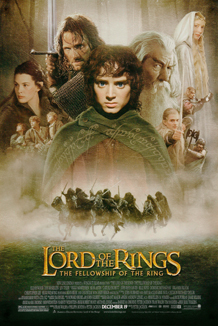
The Lord of the Rings: The Fellowship of the Ring. A Review (Review #1275)

THE LORD OF THE RINGS: THE FELLOWSHIP OF THE RING

Editor's Note: This review is of the theatrical version.

The Lord of the Rings is perhaps one of the Twentieth Century's most enduring literary epics, a sweeping tale of a fantasy world filled with extraordinary creatures. As such, a cinematic adaptation of this massive work would be daunting. The Lord of the Rings: The Fellowship of the Ring is the first part of a cinematic trilogy to J.R.R. Tolkien's masterpiece, and to its credit it more than meets the challenge of creating this universe while keeping to the novel's themes of loyalty and courage despite great dangers and odds.

After a prologue explaining the history of The One Ring and how it came to a Hobbit named Bilbo Baggins (Ian Holm), the film begins at Bilbo's 111th birthday. His nephew Frodo (Elijah Wood) and the entire of The Shire is waiting for this event as well as the wizard Gandalf (Ian McKellen), with whom Bilbo had an unseen adventure.

Bilbo's party is a wild success, culminating in his 'disappearing act' via the Ring, whose power he is unaware of. Gandalf fears it is The One Ring, and when he discovers that it is he urges a reluctant Frodo to journey to Rivendell, home of the powerful and ethereal Elves to see what can be done to destroy it. If it returned to its master, the Dark Lord Sauron, it would destroy all Middle-Earth.

Off Frodo goes with his gardener/friend Samwise Gamgee (Sean Astin), later joined by two other hobbits, Merry (Dominic Monaghan) and Pippin (Billy Boyd). Sauron's minions are hunting Frodo down, putting all their lives in danger. Gandalf is temporarily held prisoner by his frenemy, Saruman (Christopher Lee), another wizard who has fallen under Sauron's power.

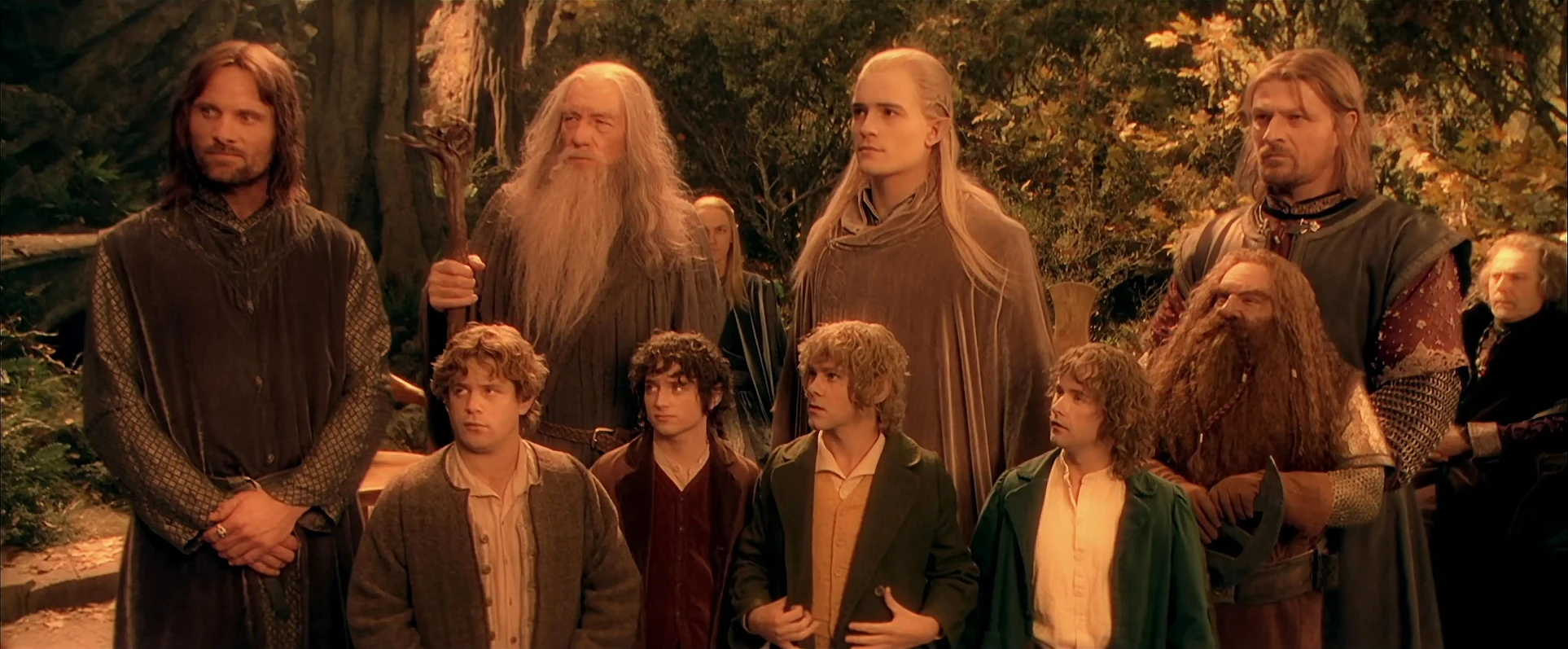
Image result for the lord of the rings the fellowship of the ringIn their journeys to both Rivendell and later Sauron's land of Mordor, where the One Ring can be destroyed by being cast into the fires of Mount Doom, the hobbits are joined by others to form 'the fellowship of the ring' created at a Rivendell council by Elrond (Hugo Weaving). There is Gimli the Dwarf (John Rhys-Davies), Legolas the Elf (Orlando Bloom) and two humans, Boromir (Sean Bean) son of the Stewart of Gondor, and Aragorn (Viggo Mortensen), a wanderer who is the true heir to the Gondor throne and descent of Isildur, the man who defeated Sauron ages ago only to weaken at the thought of destroying the Ring.

Passing through several lands including that of the Elf Queen Galadriel (Cate Blanchett), the Fellowship falters before Gandalf falls at the mines of Moria. Boromir nearly kills Frodo to get at the Ring but pulls himself together long enough to save Merry and Pippin before he is killed by Sauron's minions. They take the two hobbits as instructed by Saruman, and Aragorn, Gimli and Legolas follow to rescue them, leaving Frodo and Sam to take the arduous journey to Mordor, quietly pursued by the Ring's former owner, the creature known as Gollum (Andy Serkis).

It's extraordinary that The Fellowship of the Ring has such a massive plot just in the first film, so much so that the theatrical release runs nearly three hours. However, it is to the credit of director Peter Jackson along with his co-screenwriters Phillipa Boyens and Fran Walsh that the film rarely if ever lags. Jackson keeps the film flowing smoothly to where one does not notice how lengthy the film is.

For example, the first seven minutes serve as a de facto history lesson about the One Ring, and the following half hour is devoted purely to the bucolic world of The Shire. This is a pretty substantial time taken up before getting to the main gist of The Fellowship of the Ring. However, the care that the film takes in setting up this world allows us to more than just see this fantastical world.

Image result for the lord of the rings the fellowship of the ring
It allows us to immerse ourselves fully in it, allows us to essentially be part of it. It also allows us to get to know these characters, and this is an element where Jackson really excelled. There is not a bad performance anywhere in Fellowship of the Ring. Each actor who plays an Elf is rather ethereal and mystical, punctuated by a slow and graceful speaking pattern. Liv Tyler as Arwen, Elvish princess and Aragorn's love interest, has a predominantly breathy delivery but here it makes sense. Even when in warrior princess mode her delivery is still in keeping with her Elvish roots.

Though their roles are smaller both Weaving and especially Blanchett are phenomenal. Galadriel comes across as a very mysterious figure: wise yet dangerous but ultimately helpful, not the feared Elf-Witch of terrible power Gimli imagines.

Lee is sensational too as Saruman, the wise and powerful wizard brought down by his own lust for power, matched by McKellen's more tender yet still fearsome Gandalf. Holm, while also in a smaller role, does wonderful as Bilbo: part bumbling innocent, part dangerous when tempted to keep The One Ring.

Bean's line about "one does not just walk into Mordor" may be the source of endless gifs but he too brings Boromir's basic decency mixed with the weakness of men into his performance. Mortensen's Aragorn has that mix of anger, fear and regret. Whether playing a fierce fighter or a tender lover with Arwen he does exceptionally well.

Image result for the lord of the rings the fellowship of the ringThe four hobbits are in a class by themselves. So much rests on Wood as Frodo, and with his large expressive eyes and quiet manner he makes Frodo this reluctant warrior, decent, honorable and appropriately scared. Astin more than matches him as Samwise, loyal friend. Their double-act of the upper-class Frodo and working-class Sam complement each other.

So does the double act of Monaghan and Boyd as Merry and Pippin: the latter being the naive, somewhat dimwitted fellow and the former the straight man forever putting the oblivious fellow down.

The Fellowship of the Ring also has some simply brilliant work on all technical levels. The visual effects still hold up nearly twenty years later. The set and costume designs do create this magical world that feels authentic and lived-in despite the fantastical nature of Middle-Earth. Andrew Lesnie's cinematography captures all aspects of Middle-Earth: the lushness of The Shire, the darkness of Saruman's stronghold of Isengard and of Mordor, the mystical worlds of Rivendell and Galadriel's Lothlorien. Howard Shore's score is almost brilliant in showcasing the innocence of the Hobbit's world in the Shire to the ethereal Elvish lands and the dangers the travelers face.

While the closing song May It Be got the lion's share of attention, I would say that the other Enya contribution of Aníron is better: the love theme between Aragorn and Arwen enhancing a beautiful moment and complimenting Mortensen & Tyler's performance along with Lesnie's visuals.

The Lord of the Rings: The Fellowship of the Ring is a massive undertaking and breathtaking in scope. It also manages an excellent cliffhanger and keeps the themes of love, loyalty and perseverance against overwhelming odds. I confess I got emotional at the end as the fellowship breaks up but in particular Frodo and Sam hold on. Quibble if you must about things being left off but on the whole the film more than manages to capture Tolkien's universe as well as could be thought possible.

The Lord of the Rings: The Fellowship of the Ring is an excellent way to begin this fantasy epic.

DECISION: A+

Wednesday, September 2, 2015

The Hobbit (1977): The Television Special


THE HOBBIT (1977)

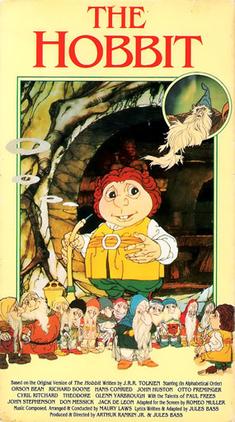
For those of us who came before Peter Jackson's massive adaptation of The Lord of the Rings, the animated telefilm of The Hobbit was our introduction to the world of J.R.R. Tolkien.   I figure that future generations (including, perhaps, my own kids) will skip The Hobbit animated film and slip into Jackson's The Hobbit Trilogy as their source for all things Middle-Earth.  That is a real shame, as The Hobbit, while more a condensed version of Tolkien's novel than a solid adaptation, still holds up remarkably well.  It also mostly managed in about 80 minutes what three films could not accomplish in 6 hours and 14 minutes: tell Tolkien's brief story without going overboard.

Bilbo Baggins (Orson Bean) is a hobbit, not interested in adventures or in anything outside his beloved homeland of The Shire.  To his surprise, the wizard Gandalf (John Huston) comes to his hobbit-hole, bringing along a group of dwarves who are going to hire the shocked Bilbo to be their 'burglar'.  Leading the dwarves is their exiled king, Thorin Oakenshield (Hans Conried).  Now Bilbo must travel with the dwarves, with Gandalf popping in every so often, to the Lonely Mountain where the dwarves' kingdom and gold is held by the dragon Smaug (Richard Boone).  Bilbo, using a magic ring he "won" from the creature Gollum (Theodore), he enrages Smaug enough to have him leave the mountain and attack Lake-Town, a world of men.  Smaug is killed by Bard (John Stevenson), or Bard the Bowman.  Thorin and his dwarves will not share the treasure with either men or the elves, who under the rule of The Elvenking (Otto Preminger) come to claim part of it, even if it means a battle of Three Armies.  Bilbo, already chagrined to be finding himself in a battle at all, now sees it grow to Four Armies when goblins come to get at the treasure, creating an elven/dwarf/man alliance, then it builds to FIVE Armies when the eagles come to serve as an unofficial air force.  Thorin, mortally wounded, begs Bilbo's forgiveness, saying that it was Thorin, not Bilbo, who did not understand war.  Bilbo takes a small share of the treasure as payment for all his services, and keeps the ring in a glass jar, a reminder of the time this humble hobbit went off on The Greatest Adventure.


The Hobbit may be rightly criticized for leaving things out of its adaptation or in having Gandalf serve as a deus ex machina, bailing out the dwarves constantly whenever they fall into danger (which is often).  Actually, apart from when Bilbo uses the ring to hide from the woodland elves, I pretty much am sure Gandalf would magically pop in at the most opportune moment.

Actually, I could find that The Hobbit can be rightly criticized for having the Elves as rather ugly creatures versus the lush, beautiful, ethereal beings of Tolkien's imagination.  We won't even touch why The Elvenking has a German accent.

However, I found The Hobbit to be quite charming and effective in serving as a great way to introduce the opening chapter of Tolkien's expansive epic to a young audience.  The animation is quite effective and well-crafted, no doubt since it was created by the precursor to the legendary Japanese animation Studio Ghibli. 

Of particular note is the confrontation between Bilbo and Gollum, which in this animated version is quite good as they match wits to see who will survive.  Theodore's Gollum is reflective of the frog-like appearance to our poor Smeagol, all croaking and sinister.  It is I think the best performance of all in The Hobbit, despite its brevity.  The resignation, the madness, and the fury of Gollum is reflected in Theodore's rendition.

This is matched by Bean's take of Bilbo as a simple being who reluctantly finds himself in the midst of extraordinary events.  He never shifts from playing Bilbo as an ordinary hobbit, who sees no sense in fighting and watches the Battle of the Five Armies with a mixture of puzzlement and sadness.

Dwarves look different in my time...

The other voices I wasn't too keen on.  Huston's voice is so distinctive that it looks as if he didn't try to play Gandalf as anything other than John Huston reading the text.  Conried sounded a bit hysterical as Thorin (who by the way, was in no ways made to look 'hot').  Worse perhaps was the Teutonic tones of Preminger, making the already odd-looking Elvenking sound so bizarre.

A strong criticism could also be that the dwarves themselves had no real personalities.  I don't even think dwarves that did have something to say, like Bombur or Balin, were memorable.

As this was an animated version, we got something that I don't remember from the book: talking animals.  Yes, Smaug spoke, but does anyone else remember either the spiders or eagles speaking?  Again, it is curious that The Hobbit opted to make the Woodland Elves not the ethereal, almost magical beings I recall, but rather ugly drunks. 

Still, while the story is a bit truncated and we're allowed some curious puns (Gandalf, after hearing Bilbo's story of his escape from the goblins, comments "Your story rings true", hinting he knows about the ring), The Hobbit as a film is entertaining, brief, with great animation and a wonderful soundtrack.  I found it charming, sweet, simple...like Bilbo himself. 

This adaptation serves as a wonderful introduction to Tolkien's story.  It may not be the purest or even the best adaptation to The Hobbit, but I would rather watch this version than say, another that went way, WAY too long...


8/10

Saturday, March 7, 2015

The Hobbit: The Battle of the Five Armies. A Review (Review #700)


THE HOBBIT: THE BATTLE OF
THE FIVE ARMIES

You Don't Know the Hafling of It...

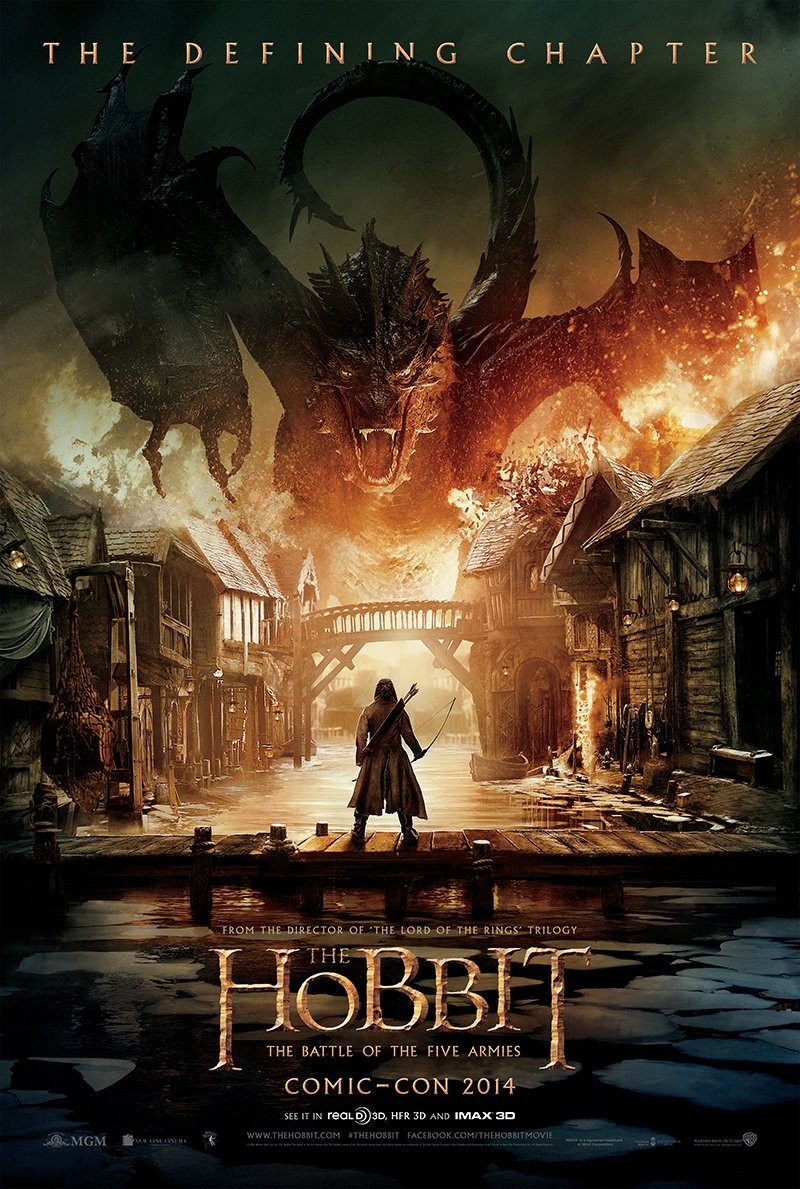
At long last, I have seen the third and final film of a short novel that can be read in a day or two, a week at the most. The Hobbit: The Battle of the Five Armies I think could be a very good film.  It just needs to cut something completely irrelevant to both this particular film and the epic trilogy.

They need to cut out the character of Bilbo Baggins. 

If they do that, I figure they'll have a more streamlined film that cuts out all the unnecessary fat from the bloated trilogy.  In this case, the 'fat' is the main character, who plays virtually no role in this story.  I seriously wonder whether a recut Hobbit trilogy where Bilbo is all but excised from the three films would be a good idea.  It certainly is plausible, given the final product I saw.

Picking up from where we left off, the Dragon Smaug is rampaging through Lake-Town.  The citizens are fleeing the enraged dragon, with only Bard the Bowman (Luke Evans) to stop Smaug.  He manages an escape from prison in the chaos and smites the mighty dragon.  Bard becomes the reluctant leader of the survivors, constantly suffering the comical machinations of the late Mayor of Lake-Town's minion, Alfrid (Ryan Gage).  Bard decides to lead the survivors to the Lonely Mountain, where a ruined city can offer some refuge.  He can also get part of the treasure promised to him by the dwarves who got provisions in Lake-Town. 

Meet the real star of
The Hobbit 3


Unfortunately, the dwarf king Thorin Oakenshield (Richard Armitage) has pretty much gone insane.  Infected with lust for gold, he drives everyone away, brooding with his treasure while still searching for the Arkenstone, the King's Jewel.  He suspects one of his dwarves has taken it, but this is not the case.  Thorin will not receive Bard, or give up one bit of his gold.  Bard wants to keep the peace, but the Elven King Thranduil (Lee Pace), who has his own need to get at particular parts of the treasure, has brought his Elven Army to take his share by force.  Outnumbered, the dwarves appear to be totally powerless, but Thorin has a few tricks up his sleeve.  He secretly called upon his cousin Dain (Billy Connolly), who brings his own army.

OK, so you have Dwarves, Elves, Men.  That's three armies.  We then get two armies of Orcs,  who are determined to wipe out all their enemies (dwarves, elves, and men).  They attack from two fronts, and the rest of the movie is taken up by the massive battle of these five armies, with a little time left over to resolve the odd (and non-canonical) romance between Elf Princess Tauriel (Evangeline Lilly) and dwarf Kili (Aidan Turner), which is frustrated by the fact that Legolas (Orlando Bloom) is also in love with Tauriel.  Tragedy comes to them all, and to Thorin.  However, in the end the unlikely alliance of men/dwarves/elves defeats the dual Orc armies, and peace reigns.

It's amazing that in the recap of The Battle of the Five Armies, I could go throughout it without once mentioning Bilbo Baggins (Martin Freeman), the hobbit from The Hobbit.   I cheated a bit because it is Bilbo who took the Arkenstone and delivered it to Bard and Thranduil, joined by Gandalf (Ian McKellen) in an effort to prevent war.  However, such is the case with The Battle of the Five Armies that one could go the whole movie without mentioning him without affecting the flow.

In fact, I would argue that Bilbo has such a small role (no pun intended) that would it have mattered if one of the dwarves (perhaps the hunky Kili) performed whatever part Bilbo played?  I would say 'no', which is disastrous for a movie like The Hobbit.

As I watched the film, I felt very overwhelmed by its sheer monstrous length.  That's rather curious because The Battle of the Five Armies is actually the shortest of the three films. However, after a while a bit of fatigue set in for me, and I confess to nodding off for perhaps a few seconds to maybe a full minute.

Can't keep the Pace up.

However, it's pretty easy to do when the film drags and drags, insisting on pumping me up with massive battles that are impressive but that gave me virtually no one to really care about.

Why would I care about the elves, who here are so otherworldly they become boring?  Why would I care about the dwarves, who suffer under Thorin's greed and paranoia but don't really do much to snap him out of it? 

When it comes to the men, that's a bit of a mixed bag too.  Peter Jackson decided to make things again so serious that people like Bard become less human and more caricatures, rather glum creatures.  OK, part of me gets it: their homes have burned down, they are being thrust into a war they'd rather not fight, and have to deal with the more dull elves and irritating dwarves.  That's enough to make anyone lose their sense of humor.

However, like with certainly Desolation of Smaug, everything in Battle of the Five Armies is given such lofty THIS IS SERIOUS manner to the proceedings that when Jackson and his scribes do try to inject a smidge of humor (through Ryan's sleazy Alfrid) it comes off as idiotic.  At one point, to save his life, Alfrid grabs a child and literally says, "Think of The Children!  Won't someone please THINK OF THE CHILDREN?!"  I burst out laughing at this.  When the cowardly Alfrid is caught in drag to avoid fighting, it isn't funny.  It isn't even sad.  It's dull and a wasted opportunity since Bard's son finds him, then pretty much leaves him there with some of the women, as far as I know never to be seen or heard from again.

I say 'some of the women' because there is a call among them to fight alongside their men, but truth be told I don't remember the women doing any actual fighting.  Maybe they did and I nodded off longer than I thought.  I can't say for sure, but if in a movie that is this long (nearly two-and-a-half hours in the theatrical version, a punishing and downright Satanic two-hours-fifty-four minutes in the Extended Edition), you can't be bothered to show the brave Women of Lake-Town fighting, why bother mentioning it at all?

I'd like to take this opportunity to mention that both The Fellowship of the Ring and The Two Towers are a mere four and five minutes longer than the extended edition of Battle of the Five Armies.  They at least have the excuse of being part of a massive, massive book, so large that it is sometimes split into three separate books.  No one in their right minds has ever split The Hobbit into three books.   Unless of course, you want to milk the source material for every cent you can and denigrate the source material.  In that respect, Peter Jackson and Company have managed to outdo themselves in that ambition.


It is this uber-serious nature that makes Battle of the Five Armies such a slog.  This romance between the elf and the dwarf (which doesn't exist in the novel or even in the addition Tolkien material Jackson raided to make The Hobbit fit into The Lord of the Rings prequel films he so desperately wants us to see them as) is such a waste of time.  Here's a spoiler: they don't end up together.  That's all the more a shame because seeing what a half-elf/half-dwarf child would have looked like might be real fascinating...or as freakish as the abandoned idea for a half-man/half-ape child considered for the Planet of the Apes sequel that became Beneath Planet of the Apes.  Still, it would have made for a more interesting movie. 

It's extraordinary that for all the sound and fury of Battle of the Five Armies, so little actually happens.  Even what does happen is so hopelessly clichéd as to be embarrassing.  One of the many 'climatic' moments (when Legolas is leaping about a crumbling tower that has been knocked down to form an impromptu bridge like he was in a Tetris game) is almost funny.  The final battle between not-Aragorn (aka Thorin) and the Main Orc (I don't care what he's called) is equally dumb.  If he falls into the ice, the logical thing to do is to follow his floating 'corpse' and we're all suppose to be shocked, SHOCKED that the 'dead' Orc comes roaring back to life.

That went out in bad horror films, but in this?

It's as if Jackson decided, 'Screw it...I already got my Oscar and I have to get through this, so I'll make the fanboys who know The Lord of the Rings only through the movies happy by giving them what they think they want'.  I imagine fans of the LOTR movies may like all three Hobbit films, but for myself, who likes both book and films, I found this last chapter more than a disappointment.  I found it dull, uninteresting, and a waste of time.

 I can't say anything about the performances because none of them are memorable.  Thanks to Jackson's decision to give Freeman virtually nothing to do in Battle of the Five Armies, the only real bright spot in the two previous Hobbit films ended up pretty much marooned in a story that didn't need him.  Pace comes across as more insufferable than as ethereal, and the romance between Lilly and Turner had no real rooting interest.  Bloom does his best to prove my theory about him wrong: that he is good only in costume or fantasy films, but at least it kept him out of other films. 

Evans I think did the best of the lot as the stoic Bard, but then again The Hobbit: The Battle of the Five Armies is about his character, right?

In all the goings-on in Middle-Earth, Bilbo Baggins serves no role, no purpose.  It's as if he was left over from a previous draft...say, the original J.R.R. Tolkien novel.  With Peter Jackson, the new authority on all things Middle-Earth, running the show (into the ground), The Hobbit: The Battle of the Five Armies has a lot of nifty action, some pretty visuals, but at its core is a hollow, empty affair.

All I can say is, 'Thank Heaven THAT'S all over!' 

How'd I end up here?


DECISION: C-


Sunday, May 18, 2014

The Hobbit: The Desolation of Smaug. A Review


THE HOBBIT:
THE DESOLATION OF SMAUG

Smaug Alert...

When last I visited the world of J.R.R. Tolkien in The Hobbit: An Unexpected Journey, I commented that for all the madness and mayhem, something got lost.  What got lost was Bilbo Baggins, The Hobbit's main character.  The Desolation of Smaug is the second part of a trilogy based on a book that is 305 pages long (at least my copy is that length). 

By comparison, I found a copy of Gone With the Wind that is 1,037 pages long, a copy of Ben-Hur that is 564 pages, a copy of 12 Years a Slave that is 198 pages, and a copy of All Quiet on the Western Front that is 295 pages long.  Each film version of the mentioned books (all Best Picture winners) managed to tell their stories within one movie.  Granted some were long movies (including Overture, Intermission, and Exit Music), but they all managed this feat because the filmmakers made the decision to cut the text.  Peter Jackson, the Lord of The Lord of the Rings franchise, along with his minions, decided to go the opposite route and ADD material from other Tolkien writings to made a trilogy out of a slim novel, in order to tie this story to the massive The Lord of the Rings trilogy that came a decade prior.

If one can find any justification (apart from greed) that makes making a trilogy out of a book whose story could be told in two hours (or less) on film, I have yet to hear it but would be eager to.

I thought DOS was better than AUJ, but again, there is simply so much thrown at it one might just as well cut the rather unimportant Bilbo character and focus on more important things (like an elf/dwarf love triangle).

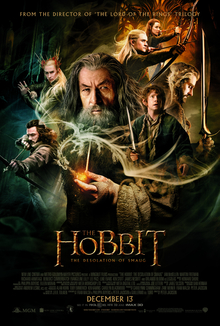
We go back to the journey Bilbo Baggins (Martin Freeman), hobbit and burglar to a group of dwarves, as they continue onwards to the Lonely Mountain, where Bilbo is expected to steal something from Smaug the dragon (voiced by Freeman's Sherlock costar, Benedict Cumberbatch).  Somewhere in all that, we have to have a series of escapes for our dwarves, led by Thorin Oakenshield (Richard Armitage), their fearless leader.  Along the way they encounter the skin-changer Beorn (Mikael Persbrandt), they travel through the Elf forest of Mirkwood, where they survive spiders and escape from Elven King Thranduil (Lee Pace), his son Legolas (Orlando Bloom) and the elveness Tauriel (a new character not found in the novel, played by Evengeline Lilly).  Tauriel and Kili are drawn to each other, much to the silent irritation of Legolas.


After their escape and despite still being pursued by the Orcs, the dwarves convince/bribe Bard the Boatsman (Luke Evans) to smuggle them into Lake-town, at the foot of the Lonely Mountain.  The greedy Master of Lake-town (uber-snob Stephen Fry) and his minion Alfrid (Ryan Gage), when they discover the dwarves, welcome them as a way to get the treasure Smaug is holding hostage.  The dwarves go to the Lonely Mountain where once in a duel of wits occurs between Bilbo and Smaug, with in the end Smaug bursting from the mountain to attack Lake-town. 

Bilbo says, "What have we done?" and film ends.

The most curious thing happened at the precise moment The Desolation of Smaug went black.  That very moment, at the precise moment the screen went black, I just dropped off.  It was for a few seconds, but I had to rewind it to see if somehow I'd missed anything.   What I missed was the whimsy and joy of Tolkien's slim novel, instead replaced by this massive epic that drowns out what we had before. 

Also missing (again) was Bilbo.  Throughout the plot summary notice that the novel's main character was almost written out of the story altogether.  That isn't to say Bilbo wasn't in the movie or that he wasn't important, but the screenplay by director Jackson, previously-assigned director Guillermo Del Toro, and LOTR veterans Fran Walsh and Philippa Boyens reduced his role to where he was present only when necessary (facilitating the escape from Mirkwood or having a word duel with Smaug).  Apart from that he disappears for long stretches of DOS, where we are treated to really unimportant tales.

Do we really need this dwarf/elf love triangle?  Are Ian McKellen's Gandalf or Sylvester McCoy's Radagast necessary?   The former takes up such a large part of the story and the latter so little one wonders why they were there.   Adding more confusion/frustration is that The Hobbit is being used to tie in to the larger LOTR narrative when even Tolkien didn't have that idea per se.  Tolkien, if memory serves correct, didn't include any suggestion of Sauron's presence in The Hobbit, nor of Galadriel (Cate Blanchett in a 'blink-and-you'll-miss-it' cameo).  Unless Beorn plays a larger role in There and Back Again or Battle of the Five Armies or Peter Jackson Wants More of Your Money or whatever new title the third film goes by, his whole scene could have been cut without affecting the story. 


Do we really need the Halfling in this?
Isn't this OUR story?
Same for the Mirkwood spiders.  Same for the love triangle. Same for the internal Lake-town politics. Same for Legolas being shoehorned into this for no reason other than to give the one-note Bloom a job and LOTR fans a tie-in to a story he has no business being part of.

How can one justify spending an hour and a half of this second part BEFORE the dwarves even get to Erebor, their lost kingdom?

Perhaps the biggest failure of Desolation of Smaug for me is that it takes things so, so, DEADLY serious.  There is simply no joy in The Hobbit.  I suppose this comes from the fact that The Lord of the Rings was this epic and very serious trilogy, but even The Fellowship of the Ring had lightness in its scenes in the Shire (and Merry and Pippin as somewhat comic relief in the other films).  None of that for both An Unexpected Journey and Desolation of Smaug: EVERYONE has to play things as if this were SO IMPORTANT, so DEATHLY DULL.

Because everyone treats DOS with the solemnity of a state funeral, the performances pretty much are the same: dry, serious, and pretty lifeless.  Why are elves so self-important?  Why are dwarves so grouchy?  Why are humans so serious?  Why are wizards so opaque?  Why do we get nothing but a series of foreshadowings?

Sadly, the smallest parts, the hobbit and the dragon (now THERE'S a title) are the best parts.  Freeman still excels as Bilbo, his befuddlement and sense of awe still worth attention.  Cumberbatch's Smaug is slitheringly evil (though his voice, mercifully, is not so exaggerated in drawing out the wickedness in his baritone).

I would add that the self-importance of DOS extends to the visuals: almost all universally dark, full of blacks and greys with little light.  Even in the Elven Kingdom of Mirkwood, there is a heaviness that hangs over it.

For me, The Desolation of Smaug is better than An Unexpected Journey, but all the baggage from the first film still remains: a highly problematic sense of self-seriousness, an unmanageable narrative that sprawls with little to no sense, and a diminution of the main character in exchange for something larger, sacrificing the charm of the original. 

DECISION: C-


If you have a microscope,
you might find Bilbo.


Friday, December 21, 2012

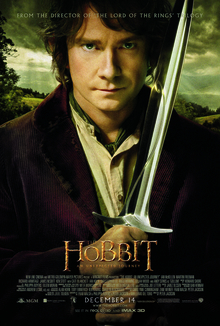
The Hobbit: An Unexpected Journey. A Review


THE HOBBIT:
AN UNEXPECTED JOURNEY

A Long Time Ago, In A Shire Far, Far Away...

Does anyone remember when certain fans of The Lord of the Rings were upset that the first part of the trilogy film adaptation, The Fellowship of the Ring, didn't include the character of/adventures with Tom Bombadil, or when the final part, The Return of the King, didn't have the battle at the Shire with Saruman having enslaved the hobbits?  No, and the film versions don't suffer none the worst for it.  At the time, The Lord of the Rings trilogy director Peter Jackson got away with it by saying that they weren't saying there were no adventures with Bombadil or other things from the source novel(s), but that it wasn't relevant to the larger story they were trying to tell.

Well, it looks like Jackson and Company have all but forgotten that when tackling author J.R.R. Tolkien's first foray into Middle-Earth, The Hobbit.  Here, they decided not just to include every adventure Bilbo Baggins has on his journey with the dwarves, but throw in a few more that came from outside The Hobbit itself but instead are connected to the narrative by means of other writings of Tolkien's fantasy world.  The Hobbit itself may be a remarkably short book (especially compared to the massive work The Lord of the Rings is) but now it finds itself the subject of a trilogy of its own.  The Hobbit: An Unexpected Journey has received unkind comparisons to The Phantom Menace, the first prequel to the Star Wars series.  While it's nowhere near as bad as all that (and yes, Phantom Menace was pretty awful--thanks Jar Jar), there is a case to be made comparing the two.  The first part of The Hobbit Trilogy, like the first Star Wars prequel, goes through a lot of material, takes a long time going through it, and ultimately ends up saying very little.

Bilbo Baggins (Ian Holm, reprising his role from The Lord of the Rings trilogy) tells us that while he may have told us (or rather, Frodo, with Elijah Wood making a cameo) the truth about his previous adventures, he didn't tell us all.  He now proceeds to do so, first with a story of how the Dwarf Kingdom of Eredor came to be lost to a dragon named Smaug. 

Around fifteen minutes after we get this background story, we go 60 years prior, to where we meet a young Bilbo Baggins (Martin Freeman).  He is visited by the wizard Gandalf (Sir Ian McKellen, again reprising his role...there's a lot of reprising in The Hobbit).  Gandalf is known to the Shire-folk, but Bilbo is none too pleased to hear he's been selected for an adventure.  Bagginses are not the adventurous sort.  Soon, however, Bilbo finds his comfortable hobbit hole invaded by 12 dwarves, last but not least, their leader, Thorin Oakenshiled (Richard Armitage, making for lack of a better word the hunkiest dwarf in history).

It's another twenty-five minutes of boorish dwarf behavior, a flustered Bilbo trying to be a good host despite this invasion, and a dwarf song before despite himself Bilbo sets off to catch up with them, having agreed to become their burglar.   From there, An Unexpected Journey goes from the borders of The Shire to eventually Rivendell, the home of the dwarves' enemy the Elves, led by Elrond (Hugo Weaving, reprising).  There is a council called (six minutes long) between Gandalf, Elrond, the Elven Queen Galadriel (Cate Blanchett, reprising), and the powerful wizard Saruman the White (Sir Christopher Lee, reprising). 

The dwarves have gone on their way while the big-wigs do a lot of talking about some growing power or something and they are captured by the Great Goblin (Barry Humphries), who is going to give Thorin's head to Oakenshield's bitter foe,  Azog (Manu Bennett), whom he has fought before.  Meanwhile, Bilbo got separated from them, and here he not only encounters the mysterious figure of Gollum (Andy Serkis, reprising), but finds a peculiar ring...

Eventually, the dwarves and Bilbo escape thanks to a little help from Gandalf, and after a confrontation with Azog, the dwarves and hobbit are spirited away on literal wings of eagles, reaching a peak not too close or too far from the Lonely Mountain, where Smaug lies dormant.

There is simply no excuse (apart from naked greed) why The Hobbit HAS to be a trilogy.  There's barely enough of a case to excuse it being being a two-film adventure.  That could be tolerated, but not extending and adding foreshadowing to The Hobbit from The Lord of the Rings that won't tie things in as much as Jackson and his co-writers Philippa Boyens, Fran Walsh, and Guillermo Del Toro think it will.   It almost seems a betrayal of Tolkien's original book to suggest that The Hobbit had the early rumblings of Sauron's rising. 

The entire Council at Rivendell scene (which really is irrelevant to The Hobbit overall and serves only to connect it with The Lord of the Rings...as well as lengthen the film) could easily have been cut without affecting the story.  In fact, it might have made An Unexpected Journey flow more smoothly. 

The same can be said for everything involving another wizard, Radagast the Brown (Sylvester McCoy).  Now, I love Doctor Who as much as the next guy, but unless he is going to play a VITAL role in both The Desolation of Smaug and There and Back Again (Parts II and III), there is simply no reason for him to be in An Unexpected Journey at all.  Perhaps he was there for comic relief, or to provide the dwarves another fortuitous way out with his wabbit-drawn sleigh (yes, I said WABBIT), but it just seemed to be too much.  Not to mention also, Radagast is a really creepy being: dirty, stuffing birds under his hat with a bird nest in his hair, having what appear to be bird droppings dried in his hair. 

I can't say McCoy wasn't good or right for the part: he plays unhinged better than anyone I can think of, but given he didn't do much in the story (and from what I remember, is barely mentioned in The Hobbit), why get distracted with a whole scene involving spiders when he disappears to let Cockney trolls menace our dwarves for another twenty minutes and then pop in again?

Let me go on about those trolls.  TWENTY MINUTES of the trolls arguing about how to eat first the horses, then Bilbo, then the dwarves who couldn't rescue him.  Now, I do remember THIS being part of the Tolkien work, but again, TWENTY MINUTES!  I simply do not understand why Jackson and Company didn't decide that it would be worth our time to trim this whole sequence. 

Again and again things felt unnaturally stretched out and added which had the effect of making this nearly three hour spectacle far longer than it should have been.

This isn't to say one doesn't get one's bang for one's buck.  Certainly there are moments that are genuinely thrilling.  There is a short sequence with Stone Giants that is visually impressive and the final confrontation between Azog and Thorin (along with his dwarves) is exciting, but a lot of the in-between is what causes us to pause and wonder if perhaps the overenthusiam of LOTR fans pushed its prequel to give more than it could.    

The unfortunate thing about An Unexpected Journey is that in all the madness and mayhem, something gets lost.  What that something is turns out to be...Bilbo Baggins himself.

For a story that is so centered around how this very domestic hobbit finds himself in the midst of all these adventures, the character of Bilbo is remarkably not a central part of An Unexpected Journey.  It's a sad commentary on how epic this first part of the created trilogy is when the main character could have been almost completely removed from the film without affecting the story as a whole. 

That is an even greater shame in that Foreman is actually quite good in An Unexpected Journey: his perpetually flustered, befuddled, and genuinely shocked Bilbo, experiencing all sorts of adventures when he is the most domestic of beings, has a strong mix of comedy with some genuine sense of wonder and awe at the situations he finds himself in.  Freeman's real showcase is in his Game of Riddles with Andy Serkis' Gollum, and for those minutes, away from the mayhem and battles, the tension as to who will win out shows both how Serkis, even in animated form, dominates the entire Lord of the Rings series and Freeman's ability to play the every-hobbit in dangerous encounters.

I should point out now that Bilbo has come into possession of the ring (which didn't play as much of a role in The Hobbit as it would in The Lord of the Rings), Gollum should in theory not reappear in Desolation of Smaug or There and Back Again.  Should he make a return appearance, we will have MAJOR issues with how Jackson went from Champion of Tolkien to Bastardizer of the Same.

Armitage's Oakenshield also does well with his mix of disdain for his burglar and derring do.  If it weren't for the shots of him looking small one would not imagine this was a DWARF but a mighty warrior, more Aragorn than Gimli.  And again, Armitage is by no means someone who looks as comical as say Bombur (the fat dwarf) or any of the other dwarves.  Instead, he is shown as a mighty warrior, especially with the make-up work enhancing Armitage's look rather than drowning them.  However, in many ways An Unexpected Journey makes OAKENSHIELD, not Bilbo, the lead character, which is not a slam on Armitage but on how Jackson et. al. geared the film.

If I may digress a bit, the focus on Oakenshield than on Bilbo is like how Doctor Who focuses more on River Song than on the Doctor himself.  Ostensibly the star of the show, Doctor Who sometimes not only centers an episode on the supporting character of River, but makes HER the smarter and more important character (at times even in a series of stories).  Similarly, it is a sad commentary on how far An Unexpected Journey and those behind it fell when the character of Bilbo, on whom the story is suppose to center around, could almost be entirely cut from An Unexpected Journey without affecting the film we've been presented.    

Due to the nature of An Unexpected Journey, the other dwarves don't really stick in the memory; that isn't to say they weren't individuals: you had the wise elder one, the fat one, the funny pair, but they never became individuals.  Rather, the dwarves were a collection whom we didn't get to know.

All the other cast, returning to familiar ground, were adequate but perhaps too wrapped up in how 'important' this all was versus how 'relevant' they were to the actual plot.

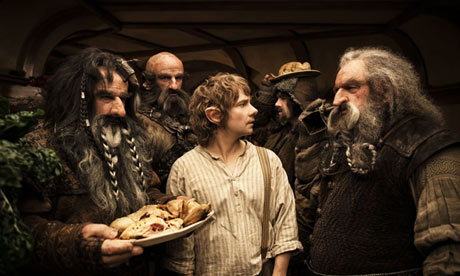
Going on to some technical matters, it is amazing what a leap back The Hobbit is to The Lord of the Rings.  A whole sequence of the dwarves comically 'cleaning up' the Baggins family plates (to Bilbo's great fear) was patently fake-looking, almost as if were done on the cheap.  Moreover, when we come upon Rivendell, this mythical and mystical home of the Elves, there really is no sense of awe, of wonder, of magic upon entering a fabled land.  Instead, Rivendell looks like a high-end version of Medieval Times. 

Ultimately The Hobbit: An Unexpected Journey is, to quote my beloved Shakespeare, a tale 'full of sound and fury, signifying nothing'.  It is long, expansive, and stretches beyond anything that the source material can hold for three films.  The central character gets lost in all the Sturm und Drang of trying desperately to make more out of The Hobbit than it is.  The Hobbit IS a story that precedes The Lord of the Rings, but it is not exactly a prequel to that epic.  It is the story of a simple hobbit who has an adventure involving dwarves and elves, fights battles, and in the midst of all that finds a ring that has powers but which ultimately is only a part of Bilbo's story.             

This is pretty much what I imagine Tolkien's reaction would be if he knew what was going on with The Hobbit's film adaptation...


DECISION: C+