INTERIORSThis review is part of the Summer Under the Stars Blogathon. Today's star is Diane Keaton.
Few people live lives of quiet, existential desperation as Yankee WASPs. We see this in Interiors, Woody Allen's first serious drama. Drawing heavily from Ingmar Bergman's various portraits of quiet despair, Interiors manages to be both an homage to Bergman and an original Allen story.
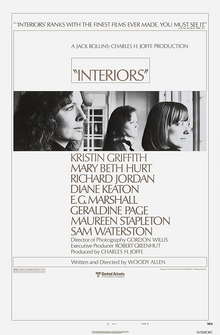
Eve (Geraldine Page) and Arthur (E.G. Marshall) appear to have a placid life. They have three adult daughters who have made artistic successes to varying degrees. Renata (Diane Keaton) is the oldest and a somewhat successful poetess. She is married to Frederick (Richard Jordan), a not-successful writer. Renata is the only one of the three sisters with a child. Flyn (Kristin Griffith) is the youngest. She is an actress who has found a niche in low-rent television movies. Flyn seems aware that she has little acting talent and that her looks carry her forward in her career.
There is the middle child, Joey (Mary Beth Hurt). She is floundering personally and professionally. Joey has gone from photographer to potential book editor. She is in a long-term relationship with Mike (Sam Waterston), a radical political activist. Joey and Renata are at loggerheads often. Joey is convinced that Eve, a decorator, has perpetually favored Renata. Rennie, for her part, thinks that successful attorney Arthur keeps downplaying Joey's lack of direction.
Things come to a head when Arthur, quite calmly and dispassionately, tells Eve that he wants a trial separation. This does not go over well with Renata and Joey, who are having dinner with their parents when Arthur drops this bit of news. Eve, already a fraught woman before this, attempts suicide. Arthur is concerned, but he also needs what would now be called "me time".
The sisters and their partners all attempt to navigate this strange new world. Joey continues to lash out at everyone and everything. Renata thinks that a reconciliation is possible. Flyn is filming out of the country often, so she is not much in the loop. One person who is most definitely in the loop is Pearl (Maureen Stapleton). She is the bon vivant who will make Arthur her third husband. Each daughter comes to their Long Island family home for the wedding. The various men and women attempt to adjust to the situation, again with varying degrees of success. Someone who does not adjust to the situation is Eve. She has entered the house after the wedding. Only Joey sees her, and she takes the opportunity to tell Eve of her inner conflict. There is death in the end, but perhaps a chance to find life amidst the interiors of the old, empty home.
It is a curious thing that
Interiors came out the same year as
Autumn Sonata. Both
Interiors' Geraldine Page and
Autumn Sonata's Ingrid Bergman faced off for Best Actress that year (losing to Jane Fonda's performance for
Coming Home). I say this because
Interiors draws heavily from
Autumn Sonata in its theme of the sometimes-fraught relationships between mothers and daughters. Woody Allen, who wrote and directed Interiors, made his own version of an Ingmar Bergman film.
Interiors, with its overtly symbolic title, does not come across as parody, intentional or otherwise.
Instead, Interiors leans into the dour, somber, serious tone of a Bergman film. Allen even got a shot of Page as Eve in her bedroom that looked strikingly similar to a shot of Ingrid Bergman in a hospital room in Autumn Sonata. Interiors also has a similar, albeit shorter, scene where the daughter reproaches her mother.
There are differences between Allen's Interiors and Bergman's Autumn Sonata. Allen's characters are capable of shouting and being less somber and despairing. I do not know if Bergman would have any of his characters attempt a sexual assault. Overall, though, I think Interiors is Woody Allen's take on making a sincere effort at being Bergmanesque. To his credit, he does manage that well.
Allen also guides his actors to solid performances. Geraldine Page's Eve is a much-tortured woman. I would argue that much if not all of that torture was self-inflicted. Eve attempts to be unobtrusive and helpful. However, over and over again, Eve seems unable to not make drama. There is early on in
Interiors a scene where she quietly scolds Mike and Joey for how they have moved furniture and lamps about their apartment. As written by Allen and performed by Page, Eve attempts to make this a cross of helpfulness and use of her decorating experience. It comes across as I think it was intended: Eve's passive-aggressive manner and determination to create a space of power over them.
Jean Stapleton, like Geraldine Page, received an Oscar nomination for her supporting turn as the vibrant Pearl. She is also something that would probably not be seen in an Igmar Bergman-like film: the fun-loving, passionate older woman who embraces life. We can see in her scenes with Marshall how Arthur would turn to Pearl. She is different from the troubled Eve. Pearl has no troubles. She enjoys life, while Eve wants to take shelter from it. One can see why, after he moves out, he would gravitate towards her.
It is a credit to Allen's screenplay that Arthur does not come across as a villain or as selfish. He tries to help Eve with the transition in their lives. He shows genuine concern after her suicide attempt. He cares for his daughters, even when they show that that care is not reciprocated. The one time he becomes slightly angry is when Joey goes after him when he tells her and Renata that he and Pearl will marry. Arthur is a man who has made sacrifices for his family, putting them ahead of himself. Now, he wants to live out his final years with someone who will put him ahead.
The three daughters also do excellent work. Diane Keaton has a wonderful monologue with her unseen therapist about how her poetry does not satisfy her. She talks about her own issues with her mother, despite being the most optimistic and supportive daughter to her. Keaton also has strong moments with Richard Jordan's Frederick. She is in turns frustrated and supportive of her husband. Renata attempts to encourage him but also grows irate at how self-pitying he can be. Keaton does fine work throughout the film.
Mary Beth Hurt is equal to the task as the angrier Joey. Her endless frustrations about her life, her career, her relationships all make Joey somewhat unlikeable. However, we also see that her manner is built out of her own sense of inferiority towards Eve, Renata and Flyn. It should not be startling to see how Joey shouts at her new stepmother when, in a bit of dancing, Pearl accidentally knocks down a vase. However, it is a credit to Hurt that it is, as is her quiet revelatory scene when she lets out her own frustrations over her mother's "interiors" (design and heart).
Kristin Griffith did not give a bad performance as Flyn. She does have a wonderful scene where she and Keaton's Renata are walking along the beach, talking about Flyn's acting career (or lack thereof). Griffith, however, just was not in much of Interiors. Jordan and Sam Waterston did well as the men who endure these women.
Interiors does have a bit of a flaw in how the characters doth protest too much. Many times, they will tell each other how they do not want to talk about something. Yet, for people who never want to talk, talk a lot is what they do.
Interiors shows that Woody Allen could do drama. It might be a bit heavy-handed. It might be too much in the shadow of Ingmar Bergman. However, I found Interiors to be a respectable film about the dark and bleak world of love.


No comments:
Post a Comment
Views are always welcome, but I would ask that no vulgarity be used. Any posts that contain foul language or are bigoted in any way will not be posted.
Thank you.