Showing posts with label Woody Allen. Show all posts

Thursday, August 6, 2026

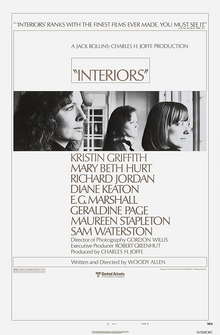
Interiors: A Review

INTERIORS

This review is part of the Summer Under the Stars Blogathon. Today's star is Diane Keaton.

Few people live lives of quiet, existential desperation as Yankee WASPs. We see this in Interiors, Woody Allen's first serious drama. Drawing heavily from Ingmar Bergman's various portraits of quiet despair, Interiors manages to be both an homage to Bergman and an original Allen story.

Eve (Geraldine Page) and Arthur (E.G. Marshall) appear to have a placid life. They have three adult daughters who have made artistic successes to varying degrees. Renata (Diane Keaton) is the oldest and a somewhat successful poetess. She is married to Frederick (Richard Jordan), a not-successful writer. Renata is the only one of the three sisters with a child. Flyn (Kristin Griffith) is the youngest. She is an actress who has found a niche in low-rent television movies. Flyn seems aware that she has little acting talent and that her looks carry her forward in her career.

There is the middle child, Joey (Mary Beth Hurt). She is floundering personally and professionally. Joey has gone from photographer to potential book editor. She is in a long-term relationship with Mike (Sam Waterston), a radical political activist. Joey and Renata are at loggerheads often. Joey is convinced that Eve, a decorator, has perpetually favored Renata. Rennie, for her part, thinks that successful attorney Arthur keeps downplaying Joey's lack of direction.

Things come to a head when Arthur, quite calmly and dispassionately, tells Eve that he wants a trial separation. This does not go over well with Renata and Joey, who are having dinner with their parents when Arthur drops this bit of news. Eve, already a fraught woman before this, attempts suicide. Arthur is concerned, but he also needs what would now be called "me time".

The sisters and their partners all attempt to navigate this strange new world. Joey continues to lash out at everyone and everything. Renata thinks that a reconciliation is possible. Flyn is filming out of the country often, so she is not much in the loop. One person who is most definitely in the loop is Pearl (Maureen Stapleton). She is the bon vivant who will make Arthur her third husband. Each daughter comes to their Long Island family home for the wedding. The various men and women attempt to adjust to the situation, again with varying degrees of success. Someone who does not adjust to the situation is Eve. She has entered the house after the wedding. Only Joey sees her, and she takes the opportunity to tell Eve of her inner conflict. There is death in the end, but perhaps a chance to find life amidst the interiors of the old, empty home.


It is a curious thing that Interiors came out the same year as Autumn Sonata. Both Interiors' Geraldine Page and Autumn Sonata's Ingrid Bergman faced off for Best Actress that year (losing to Jane Fonda's performance for Coming Home). I say this because Interiors draws heavily from Autumn Sonata in its theme of the sometimes-fraught relationships between mothers and daughters. Woody Allen, who wrote and directed Interiors, made his own version of an Ingmar Bergman film. Interiors, with its overtly symbolic title, does not come across as parody, intentional or otherwise. 

Instead, Interiors leans into the dour, somber, serious tone of a Bergman film. Allen even got a shot of Page as Eve in her bedroom that looked strikingly similar to a shot of Ingrid Bergman in a hospital room in Autumn Sonata. Interiors also has a similar, albeit shorter, scene where the daughter reproaches her mother. 

There are differences between Allen's Interiors and Bergman's Autumn Sonata. Allen's characters are capable of shouting and being less somber and despairing. I do not know if Bergman would have any of his characters attempt a sexual assault. Overall, though, I think Interiors is Woody Allen's take on making a sincere effort at being Bergmanesque. To his credit, he does manage that well. 

Allen also guides his actors to solid performances. Geraldine Page's Eve is a much-tortured woman. I would argue that much if not all of that torture was self-inflicted. Eve attempts to be unobtrusive and helpful. However, over and over again, Eve seems unable to not make drama. There is early on in Interiors a scene where she quietly scolds Mike and Joey for how they have moved furniture and lamps about their apartment. As written by Allen and performed by Page, Eve attempts to make this a cross of helpfulness and use of her decorating experience. It comes across as I think it was intended: Eve's passive-aggressive manner and determination to create a space of power over them.

Jean Stapleton, like Geraldine Page, received an Oscar nomination for her supporting turn as the vibrant Pearl. She is also something that would probably not be seen in an Igmar Bergman-like film: the fun-loving, passionate older woman who embraces life. We can see in her scenes with Marshall how Arthur would turn to Pearl. She is different from the troubled Eve. Pearl has no troubles. She enjoys life, while Eve wants to take shelter from it. One can see why, after he moves out, he would gravitate towards her.

It is a credit to Allen's screenplay that Arthur does not come across as a villain or as selfish. He tries to help Eve with the transition in their lives. He shows genuine concern after her suicide attempt. He cares for his daughters, even when they show that that care is not reciprocated. The one time he becomes slightly angry is when Joey goes after him when he tells her and Renata that he and Pearl will marry. Arthur is a man who has made sacrifices for his family, putting them ahead of himself. Now, he wants to live out his final years with someone who will put him ahead. 

The three daughters also do excellent work. Diane Keaton has a wonderful monologue with her unseen therapist about how her poetry does not satisfy her. She talks about her own issues with her mother, despite being the most optimistic and supportive daughter to her. Keaton also has strong moments with Richard Jordan's Frederick. She is in turns frustrated and supportive of her husband. Renata attempts to encourage him but also grows irate at how self-pitying he can be. Keaton does fine work throughout the film.

Mary Beth Hurt is equal to the task as the angrier Joey. Her endless frustrations about her life, her career, her relationships all make Joey somewhat unlikeable. However, we also see that her manner is built out of her own sense of inferiority towards Eve, Renata and Flyn. It should not be startling to see how Joey shouts at her new stepmother when, in a bit of dancing, Pearl accidentally knocks down a vase. However, it is a credit to Hurt that it is, as is her quiet revelatory scene when she lets out her own frustrations over her mother's "interiors" (design and heart).

Kristin Griffith did not give a bad performance as Flyn. She does have a wonderful scene where she and Keaton's Renata are walking along the beach, talking about Flyn's acting career (or lack thereof). Griffith, however, just was not in much of Interiors. Jordan and Sam Waterston did well as the men who endure these women. 

Interiors does have a bit of a flaw in how the characters doth protest too much. Many times, they will tell each other how they do not want to talk about something. Yet, for people who never want to talk, talk a lot is what they do. 

Interiors shows that Woody Allen could do drama. It might be a bit heavy-handed. It might be too much in the shadow of Ingmar Bergman. However, I found Interiors to be a respectable film about the dark and bleak world of love. 

Sunday, December 11, 2016

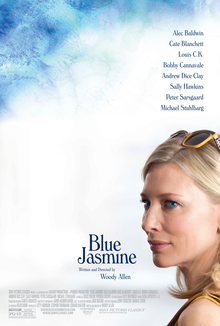
Blue Jasmine: A Review


BLUE JASMINE

When I saw Cate Blanchett win Best Actress for Blue Jasmine, I was a bit perturbed.  I had favored Amy Adams for American Hustle, but I also had not seen Blanchett's performance.  Therefore, I couldn't outright rule that the Academy had done wrong.

Having seen Blue Jasmine, I have to say...sorry, Amy.  You're among our best American actresses working today.  You also have a terrible ability to give great performances in years when other actresses give equally great or at least more popular performances, and 2013 was no exception.

And for the record,  Amy Adams should have won Best Supporting Actress over Anne Hathaway.  I didn't like The Master, but I don't think you should get Oscars for singing ONE song either (and I say it as someone who opposes Hatha-Haters).

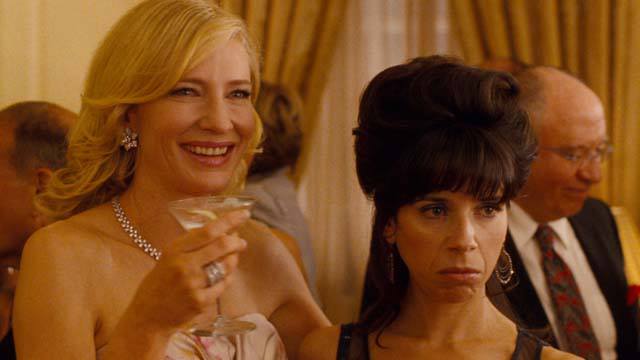
Blue Jasmine is essentially Woody Allen's version of A Streetcar Named Desire.  Wealthy socialite Jasmine Francis (Blanchett) now finds herself in dire straits (over the course of the film, we see it is because her husband was a Bernie Madoff-type who fleeced several people, including the former Jeannette-now-Jasmine's family).  It's to this family that Jasmine returns to for shelter, so it's off to San Francisco to crash with her sister Ginger (Sally Hawkins), who is no wealthy woman herself.

Ginger and Jasmine have almost always had a difficult relationship, made more so by Ginger's newest boyfriend, mechanic and all-around gauche Chili (Bobby Cannavale).  The elegant and sophisticate yet dirt-poor and inept Jasmine finds Chili a boor, and isn't too keen on the guy Ginger and Chili set her up with as part of a double-date, Eddie (Max Casella), as loutish as Chili.  Jasmine attempts to put her life together by working at a dentist's office, but Dr. Flicker (Michael Stuhlbarg) is a leech and she quits in disgust.


A woman of breeding and refinement, she does catch the eye of up-and-coming politician Dwight (Peter Sarsgaard).  Passing herself off as an interior decorator and recent widow (things that are technically true if wildly misleading), Jasmine uses her cultured manners to woo Dwight, and the two do fall in love.  Ginger finds a new beau as well: Al (Louis CK), a seemingly better choice than the lowbrow Chili.

However, the two sisters are bound for heartbreak.  Ginger finds out that Al is married, so she goes back to Chili.  Dwight discovers Jasmine's true history, courtesy of a run-in with Augie (Andrew Dice Clay), her ex-brother-in-law who was bilked out of his lottery winnings by Jasmine's late husband.  Dwight calls off the engagement, leaving Jasmine devastated and a little more unhinged.  The final break from reality is when Ginger and Chili reconcile, and Ginger sides with Chili over Jasmine. 

Jasmine, now basically bonkers, walks out of the apartment and onto a park bench, carrying on a conversation only she can follow or understand.

Blue Jasmine has at its core Blanchett's brilliant performance.  She runs through every aspect of Jasmine's persona: the wealthy woman who wants to leave what must have been a more poverty-stricken early life behind, a woman lost in more ways than one, the elegant sophisticate wooing and being wooed by Dwight, the furious scorned wife who tips off the government about her husband's malfeasance, someone attempting to hold on to some form of dignity despite all the indignities placed on her, and a probably-now completely unhinged woman past her wit's end.

Blanchett makes Jasmine into the new Blanche DuBois (though not completely as flat-out bonkers as Blanche was).  There is something almost naïve and endearing about how Jasmine wants to be elegant and sophisticated, how she wants the world to be and cannot make it be that way.  She doesn't want real, she wants magic...and this is her undoing.  It isn't that she is evil: she does have affection for Ginger and does come to care for Dwight.  She has a mixture of anger and sincerity that makes fascinating watching.

Hawkins is her equal as the Stella to her Blanche (let's face it: it is almost impossible not to see Blue Jasmine as a variation on the Tennessee Williams play.  It might as well be called a remake of Streetcar).  Her Ginger is generally sweet and without airs or pretense, and while she loves Jasmine she also sees that Jasmine is nothing but trouble.  As boorish as Chili may be (and the double-date is one of the moments where I sided with Jasmine), Ginger appreciates his loyalty to her.

Blue Jasmine is one of the best-acted films in the Woody Allen oeuvre, from the Mitch-type Dwight (only wealthier) to the working-class Augie, showing that Clay is more than the foul-mouthed comic who caused Saturday Night Live castmember Nora Dunn and scheduled musical guest Sinead O'Connor to not appear on Saturday Night Live when Clay hosted.

There were a few missteps.  A part of the story involves Jasmine's inability to use a computer at all (she wants to take online courses, but finds the use of a mouse or keypad a total mystery).  This did seem a bit too much for a woman in her forties (a man in his seventies, perhaps).  The subplot with the dentist comes and goes rather quickly, and I'm not too sure why Al had to be married and have Ginger set up for disappointment.

These are not major issues that sink the film.  Blue Jasmine is a well-acted, well-written film that has moments of humor but also moments of drama.  It is one of Woody Allen's best films and one that shows why at least that year, Amy Adams was denied.

Maybe Amy should work with Woody Allen...

DECISION: B+

Tuesday, February 9, 2016

Annie Hall (1977): A Review

ANNIE HALL (1977)

One New York Love Story...

Before Woody Allen became notorious for his private life, culminating in a scandal that shocked even blasé New Yorkers, he was seen as this brilliant comedic genius.  Annie Hall is a love story about two very different people, who meet, fall in love, and fall out of love.  After watching it, I thought it clever, sometimes amusing, but not this great comedy I was led to believe it was.  Then again, I've never been particularly amused by The Woodman, finding him a bit of an acquired taste.

In a non-linear story structure, we see the relationship between Jewish writer Alvy Singer (Allen) and WASP actress/singer Annie Hall (Diane Keaton).  Alvy is a neurotic Borsch Belt comic, one who finds sex has burdens and with two failed marriages.  Hall doesn't have all the hang-ups Alvy has, a bit of a free spirit.  They meet while playing tennis with mutual friends, and they begin a romantic relationship.  Things don't go smoothly: her family (particularly her grandmother, whom to Alvy's amusement she refers to as Grammy Hall) look on him as this odd figure, and their differences eventually lead to a break-up.  Alvy wants to understand why his relationship with Annie failed, and he delves into his past to try and work things out.

There is a reconciliation but still things don't work out for our pair. She finds romance with record producer Tony Lacey (Paul Simon...yes, THAT Paul Simon), and while he sees other women, he is still neurotic about it all.  Eventually, he accepts that 'love fades' and is if not happy (as he can never be happy) at least at peace with the rise and fall of his romance with Annie Hall.


Annie Hall is the type of film people talk about to death.  Let me try to explain that.  The film has earned a reputation as being this unimpeachably brilliant film, one that is hilarious, touching, intellectual, and above all else, perfect.  Perhaps all the build up around Annie Hall will inevitably lead some people to find it a bit of a letdown.  I don't think many films can survive this type of reputation, making them a bit remote to people.  Casablanca and Citizen Kane are good examples: how many have not touched them BECAUSE of their reputations as 'the greatest films ever made'?

When I went into Annie Hall, perhaps this idea that this was THE love story of ALL love stories made me think it was going to be hilarious.  It was funny, with certain moments that are extremely clever and insightful.  The sequence where an adult Alvy is in a room with his elementary school classmates as children with them describing how wrecked their future lives became is intelligent and sadly true-to-life, a mixing of innocence and despair that works very well.

A particularly great moment is when Alvy and Annie are on her rooftop garden.  Ostensibly a conversation about her photographs, the 'translations' that appear on-screen give what they are really saying: their flirting with each other.  This is such a true moment because it is a real moment, one that people can relate to and understand.  It's exaggerated for comic effect, but it is true: people do flirt by saying one thing when the subtext is another.

The moment when Alvy, Annie, and their mutual friend Rob (Tony Roberts) end up in Alvy's past is also quite clever and inventive, as is the dual therapy sessions of Annie and Alvy as they discuss with their respective therapists their different views on the same subjects.

However, some things in the course of almost forty years do date the film.  As Alvy and Annie stand in line for a Fellini or Ingmar Bergman movie if memory serves correct, Alvy gets extremely irritated by the person behind him, attempting to tell his companion what is wrong with the director in pseudo-intellectual terms. 

As a side note, you can't imagine HOW many times I've endured such a scenario myself.

Allen breaks the fourth wall to address us directly, kvetching about how moronic this man is, culminating with him pulling intellectual Marshall McLuhan from almost out of thin air to lecture the man about how wrong he was on just about every level.

Two or three things about this.  First, who is Marshall McLuhan?  That's a bit of a rhetorical question, in that perhaps McLuhan may have been a wildly popular figure in the 1970s and among a certain circle of people, but let's face it: he isn't exactly a big name among the hoi polloi that Allen has barely a nodding acquaintance of.  Second, something about this particular scene struck me as terribly smug and self-satisfying.  Sure, the man behind Alvy may be a moron, but was it really Alvy's burden to put him in his place and show him what a doofus Alvy knew him to be?  I know that when people attempt to sound intellectual within my earshot I tend to either make caustic remarks to my own companions only or simply keep those views to myself.  I can't remember a moment when I told someone how dumb they were about a particular topic...unless I was asked.  Third, while it's a clever scene I did wonder how it connected to Alvy and Annie's relationship.  Fourth and finally, it does have the negative effect of dating the film, and with the passage of time one I think would watch this and wonder not so much what is going on but why we should take McLuhan's word for it.

I will say that Keaton is entirely winning as the title character, a mixture of ditzy and endearing in her joys and own particular hang-ups.  She's so good in the film where we can find ourselves falling in love with her too.  Charming, sweet, but true to herself, her Annie is a delight.  It's hard to judge Allen's performance given that when he is in front of the camera he usually is the same nebbish, neurotic character almost to where there appears to be no difference between Alvy the character and Allen the real person.  Come to think of it, I can't recall the last film of his I saw where he was the main character.  I'm sure there are differences between the on-screen and off-screen Allen (I don't think he's a nebbish at all), but given he's done that shtick for so long I can see why Annie Hall is seen as autobiographical. 

I figure it is partially autobiographical (a lot of his films I think are), but I wouldn't read Annie Hall as completely true-to-life.

In a certain way, I did like Annie Hall: the steady handling of one love story in a low-key and realistic manner, with memories flowing in and out.  I'll be frank: I prefer Love & Death and Sleeper over Annie Hall.  I think those two are funnier.  However, I wonder whether Annie Hall was meant to be hilarious (and as a side note, the voice-over here wasn't a big deal-breaker for me as it is for most other films).  It wasn't a spoof like the other two.  It was a love story and a good one.  It not a film I would necessarily go back to but not I will reject either.  Perhaps if it hadn't been so built up I would have appreciated it more.  As it is, Annie Hall is a good film, a bit dated now perhaps, a trifle too intellectual for some I imagine, but on the whole, not a bad time.  Maybe it even Seems Like Old Times...   


DECISION: B-

1978 Best Picture: The Deer Hunter

Monday, June 13, 2011

Midnight in Paris Review (Review #225)


MIDNIGHT IN PARIS

I confess that the first few minutes of Midnight in Paris made me smile.  However, I am prejudiced in this regard: seeing all the sights of the City of Lights brought back all the joyful memories of my trip there barely a year ago.  Even though I had only a day and a half to see Paris (a half-day was spent at Versailles), I still saw so much that by the end of my time there, I too had fallen under its spell and became enchanted with the city by the Seine.  Therefore, Midnight In Paris served as a bit of nostalgia for me, and it is accurate to say that since nostalgia was at the heart of Woody Allen's film.

Gil (Owen Wilson) is a Hollywood screenwriter/script doctor who years to write the Great American Novel.  He finds inspiration in Paris, while his fiancee Inez (Rachel McAdams) and her parents (Kurt Fuller and Mimi Kennedy) most certainly do not.  She and her family are boorish, self-centered, devoid of respect for culture, perplexed why the French don't speak English, and find Paris a wasteland: in other words, typical Republicans as imagined by Woody Allen.

Gil, however, yearns to live in Paris rather than return to Hollywood, and more than anything would have loved to have lived in 1920's Paris and be able to rub shoulders with Hemingway, Fitzgerald, and all the artists who flocked there in the inter-war era.  Inez would much rather spend time with friends who happen to be in Paris at the same time, her old flame Paul (Michael Sheen) and his current flame Carol (Nina Arianda).

One night, after a bit too much to drink, Gil walks about alone in Paris.  At midnight, an old-style car comes and beckons Gil to enter.  Once there, he is given more champagne and taken to a party, where the piano is being played by Cole Porter (Yves Heck) and his novel is of interest to F. Scott Fitzgerald and his wife Zelda (Tom Hiddleston and Alison Pill).  They take Gil to gain the insight from Ernest Hemingway (Corey Stoll) who refuses to read Gil's novel but promises to take him to Gertrude Stein and have her judge it. 

However, right after leaving Hemingway Gil finds himself back in his own time.  Inez of course refuses to believe Gil did anything with his literary heroes (and also makes it clear that she thinks he's wasting his time both in Paris and in pursuing his novel when he should go back to swimming pools and movie stars, making real money for them).  Gil takes Inez to the same spot to show her this miracle, but of course it doesn't happen and she leaves.  Once midnight rolls around, however, we take another jolly jaunt.


Back to the 1920's, where Gertrude (Kathy Bates) tells Picasso (Michael Di Fonzo Bo) that his newest painting is all wrong.  The subject of this painting is there, a beautiful girl named Adriana (Marion Cotillard).  She and Gil have an immediate attraction, and she tells him how she so admires the Belle Epoque era of Paris.

Soon, Gil starts bouncing back and forth between his ideal time and his real time.  Gil is now torn between his growing interest in Adriana and his loyalty to Inez.  Who better to discuss this romantic conundrum than with Salvador Dalí (Adrien Brody), Man Ray (Tom Cordier), and Luis Buñuel (Adrien De Van)? 

Eventually, thanks to the help of a Rodin Museum tour guide (The First Lady of France, Madame Sarkozy, aka Carla Bruni), Gil realizes with whom he should be with.  However, there's a hitch: just as the relationship between Gil and Adriana is blossoming, a carriage takes them to the Paris of the Moulin Rouge, where she becomes entranced with the world of Toulouse-Lautrec (Henri Menjou Cortes), Edgar Degas (Francois Rostrain) and Paul Gauguin (Olivier Rabourdin).  Gil learns his lesson: the time one lives in will always appear boring to those living in it and that there is no need to romanticize the past because the present is what you make of it.  The good news is that Gil finally sees what will make him truly happy in the Twenty-First Century both in terms of his career and his life.


Allen is nothing if not blatant about both what he is trying to say both personally and politically in Midnight in Paris.  In short, we learn that as much as we may imagine a particular time and place as being "the ideal time" in the "I was born too late" mindset, the past is just that: the past, a time that we cannot go back to.  It is one thing to fantasize about living in a certain time, but truth be told, the time we live in is where we should devote ourselves to.  Even Gil's novel about a Nostalgia Shop reflects the character's belief in the power of the past, but, Allen would argue, it is a place that does not exist and perhaps never existed, not in the way we would imagine it. 

We see this in its most obvious terms with the relationship between Gil and Adriana.  Each has romanticized a particular era, and each has found himself visiting that era.  However, their reactions and decisions to actually abandoning their own time for their "dream time" shows how Gil has grown to understand that his time is his time, and that it is there where he has to live.

This isn't to say that Midnight in Paris is not without a sense of humor.  It might be amusing to see how Buñuel himself is confused by the plot Gil gives him for a movie: about a group of people who just cannot leave the room they find themselves in. I imagine more than a few people would find The Exterminating Angel confusing, so it's nice to imagine Buñuel puzzled by why they just didn't walk out through the door. It is also amusing to see the "pedantic" Paul shown up by the less-cultured Gil.  (Side note: the Buñuel joke would be amusing to only those who know of The Exterminating Angel, so it might be a bit highbrow for some viewers).


However, there were certain things within Midnight In Paris that might puzzle viewers.  It's clear that Inez is a hopeless shrew/harpy, so one wonders why Gil would date her, let alone be engaged to her.  She clearly doesn't have anything in common with him and worse, ridicules his hopes and tastes: deriding him for loving to walk in Paris in the rain for example, so we already know from the get-go they ain't staying together. 

I find this to be a certain stock character/plot device: a wife/fiancee so horrid that no intelligent man would want to be with her, let alone plan to marry her.  Strange, but while I was trying to think where I had seen a similar character, I suddenly remembered Something Borrowed, where again another woman so hopelessly unsuitable for the male lead is supposed to be inches from being his wife.

McAdams' one-note performance of this ugliest of Ugly Americans doesn't help matters.  She was never sympathetic or interesting, just wailing about all over the place, always whining and being dismissive of Gil while being in rapt attention for the pompous deliberations of Paul.  One would think Allen would have given her at least something to do besides complain about everything, but I think in a larger sense not only was Allen relying on a tried-and-true method of film-making (make the woman ugly so as to allow our hero to romance another woman without a bit of shame) but to take a few shots at Republicans. 

On two occasions Inez's parents are held to ridicule for their politics: did we really have to hear the father respond to his similarly-minded wife that Tea Party people were not "crypto-Fascist zombies".  It was those moments that felt false and forced, as if Allen wanted less to have dialogue than to make a point.  When that happens, it takes you out of the movie, which is ironic given the theme of nostalgia and of imagining living in the past that Midnight In Paris so deftly delves in.

The other performances were much better.  It was quite interesting to hear Sheen try his hand at an American accent though I wonder if he'd kept his British tones it would have made him sound more snobbish, but I digress, and while he basically disappeared near the mid-point of Midnight he still did a good job in making Paul both pompous and believable in his cluelessness about how little he actually knew.  One normally wouldn't think of Owen Wilson, with his laid-back persona, as being a Woody Allen-type: neurotic hyper-intellectual, but in Midnight In Paris, Wilson's drawl and sometimes sleepy-eyed appearance actually works with Gil's slightly bumbling nature and enthusiasm for 1920's Paris and the world of the Lost Generation. 

Those who were in the 1920's world fared the best.  In what is basically a cameo Brody reminded us that he does have a sense of humor by making Dalí obsessed with his own fame, and those rhinoceroses he constantly brings up.  Hiddleston (one of the best parts of Thor) had a practically pitch-perfect American accent and enthusiasm mixed with a bit of innocence as Fitzgerald, and Stoll got Hemingway's machismo perfectly. 


The women are not to be forgotten: Bates was delightful as that patroness of the arts Stein, offering straight talk and advice to Gil.  Pill, to my hearing, had a bit too-thick Southern accent, but showed in her few scenes the emotional and mental issues that the deeply-troubled Zelda would eventually be overwhelmed by.  Cotillard was the best as the generally sweet Adriana, who falls for Gil but who knows that an engaged man is not for her even though the clueless Gil apparently doesn't think any girl would be troubled by being told he's engaged to someone else.  Cotillard is coy, charming, innocent, optimistic and even naive: in short, a lovely performance of a flapper trapped in a time she doesn't really care about.

Even the First Lady does well as the tour guide flustered by Paul's pomposity but who helps Gil by translating the memoirs of one Adriana he happened to pick up. 

Of course, the highlights of Midnight In Paris are of the beautiful sights of the city itself: Paris, that belle ville, has been filmed many times in many movies, but Darius Khondji and Johanne Debas' cinematography make the city even more beautiful and romantic, which makes the boorish American family's disinterest in Paris even more bizarre, but I digress. 

The big problem I find in Midnight In Paris is in the fact that from time to time, Allen's dialogue doesn't sound natural.  Instead, it sounds as if he's giving the characters, and the audience, plot points and speeches, rather than making them sound like they are making it up as they go along, to quote a film.  This happens at least twice: at the very beginning of the film at at Versailles.  However, any film that shows just a glimpse of the Citizen Kane of palaces can be much forgiven.  

There are also little things, such as having an accordion playing: I figure it's required that every movie set in Paris have an accordion, but on the whole Midnight In Paris is a delight from start to finish.

By no means is Midnight in Paris a laugh-a-minute feature.  The laughter comes in fits: one scene involving Gil trying to leave his room while trying to keep his activities a secret from a surprise visit by his horrid fiancee and future in-laws just was not funny, but the charm of Paris and the story make up for it.  In that, it is beautiful.

Mon Paris, comment je t'aime...

DECISION: B-
Thursday, November 18, 2010

You Will Meet A Tall Dark Stranger: A Review

YOU WILL MEET A TALL DARK STRANGER

If you've never been to Disneyland or Disney World, in the Tommorowland section there is a ride called The Carousel of Progress. It tells about how technology has evolved from the turn of the century until today. Ostensibly, you are moving from scene to scene, where we see the same family talking about how life has improved since the previous scene.

I admit I enjoy that ride very much, but I got the similar feeling while watching You Will Meet A Tall Dark Stranger: I was watching a series of scenes flowing one after the other, with barely a connection between them, as if I were being rotated while in my seat.

We are in London, and the stories revolve around a group related only by family. You have Helena and Alfie (Gemma Jones and Anthony Hopkins). You have their daughter and son-in-law, Sally and Roy (Naomi Watts and Josh Brolin). Into the mix you have Sally's lust interest, Greg (Antonio Banderas), who is her boss at the art gallery she works at, and you have Roy's lust interest, Dia (Freida Pinto) a beautiful musician who lives next door or thereabout, at least far enough to let us get a looksy through the window.

Now, Alfie is going through a post-middle life crisis: he's divorced Helena, started working out feverishly, got a hot new car, and is now with Charmaine (Lucy Punch), a girl near Sally's age who dresses like a hooker because she is a hooker, who at least now has moved up to plain gold digger. To cope, Helena goes to quack psychic Cristal (Pauline Collins), who helps Helena cope with all her troubles and gives her advice on not just her life but on her family's as well.

Roy, who's written one successful novel but has dried out creatively since, not only pursues Dia with abandon but steals a far better novel from a poker buddy who is in a coma, while Sally never consummates her desire for Greg because, even though he's married, Greg begins an affair with the artist friend she introduced him too. All this is told by narration by Zak Orth accompanied by a uptempo jazz/Dixieland score which should indicate it's a comedy. Unfortunately, it's one bereft of laughter.


Frankly, the narration (which sound like it was spoken by a nicer-sounding David Sedaris), always got in the way. Allen, it seems, doesn't trust the audience to be able to follow the story of who's zooming whom. You Will Meet A Tall Dark Stranger doesn't work because Allen doesn't seem to populate his plays with real people. In fact, throughout the film, it looked as if we were watching a filmed play rather than a film itself. He hits things that either he or other writer/directors have already hit: the old man with a younger woman, that younger woman as a tramp, the beautiful woman across the way. Nothing seemed original or interesting.

The acting was at times embarrassing. Hopkins was attempting to do a Woody Allen impression, but the scene where he's waiting for the Viagra to kick in was painful to watch, almost sad. The same goes for Punch as the hooker with the heart of brass. Her coarseness wasn't funny, there was nothing endearing about her vapid nature.

Brolin didn't come off as a charmer because he was always so cranky. It seems unbelievable that Dia would fall for him. Then again, Pinto is remarkably flat and dull in every scene she is in You Will Meet A Tall Dark Stranger. When she tells her parents and her fiancee's family she's ending the engagement no one on screen appears to be genuinely upset or angry. Pinto herself seems disengaged (no pun intended) from anything going on. Worse off, she actually appears physically unattractive at times, something that appears impossible on the surface but which Allen somehow accomplishes.


It may be due to his decision to always have her wear red. She might as well been labeled The Lady In Red (in fact, I wonder if he took part of You Will Meet A Tall Dark Stranger from that film). From the very beginning, when Helena goes for her first consultation with Cristal, it appeared as if the people on screen were 'acting' as opposed to 'being', and while you have a collection of relatively good actors, the material could never hold up. The fact that the Greg & Sally subplot went nowhere to the point where it was superfluous and thrown in just to give Banderas a chance to appear is an indication of how weak Woody Allen's script is.

Certain decision by Allen/the characters made no sense. If I were told that someone had been watching me constantly from their window I would not be flattered: I would find that creepy. However, Dia seems curiously unaware of how bizarre it is to be told that a man you've never met has been watching your every move.

Roy, almost always angry (and few actors do angry as well as Young Brolin), never bothered to check which of his poker buddies had actually been killed and which ones were still in a coma? You would think Roy would have gone to the funeral of the one that died, but apparently he didn't, otherwise he would have known that the man who survived (and who could come out of the coma) was the one he had plagiarized. Again, another subplot that went nowhere, along with Helena's new romance with a New Age bookshop owner.

All these stories should or could have been connected by the framing device of the false psychic, but Collins (who probably gave the only real good performance in You Will Meet A Tall Dark Stranger) was not a major part of the film. In fact, her presence wasn't even necessary. Helena could easily have gone to a therapist (although from what I understand, she'd already been to several to deal with Alfie walking out on her). Also, given how Alfie and Charmaine met, it is amazing that she would ask him what kind of woman he thought she was, especially after he caught her with one of his fellow (and younger) gym members on top of her. There's a scene between the three of them where they do literally pull their punches.

I also go back to Allen's script. In the last scene between Banderas and Watts (who like most everyone, seemed detached from whatever character he/she was playing) it looked and sounded as if they were speaking two different conversations, and not to each other. Sally was all but begging Greg for sex (and given that it's Antonio Banderas, that seems like what a lot of women would do), but he didn't seem to be hearing either the subtext or the actual words, prattling on instead about the new woman in his life. It's this kind of detachment: from the performances to the story to the directing, that sinks the film to where it doesn't work as either comedy or drama.

That seems an apt description of You Will Meet A Tall Dark Stranger: a film that tried to be a comedy but where the jokes (if any) are obvious and uninteresting, where the acting was almost all around flat, where the narration was pointless, where the music was at odds with the story, and where we don't care either about any of the characters or what happens to them.

I say to Woody: get back to being funny, or at least meet us halfway.