Showing posts with label 2014. Show all posts

Tuesday, March 31, 2026

Cesar Chavez: A Review (Review #2141)

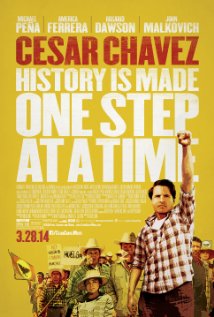
CESAR CHAVEZ

Today was Cesar Chavez Day. March 31, 1927, was when the United Farm Workers cofounder was born. His memory would have been celebrated. More than likely, his centennial next year would have been a major production. Now, his name is verboten after allegations of sexual assault, grooming and rape were made against him 33 years after his death. Literally days after the accusations were made, various Cesar Chavez murals and statues were removed. Chavez had been "cancelled" faster than Robert E. Lee. What the future holds for Chavez's legacy remains to be seen. The same fate of expunging from history might not befall Chavez's biopic. Cesar Chavez, however, would have faded on its own. Now, it will serve as a time capsule of sorts, recalling when Chavez was seen as heroic versus demonic. 

Cesar Chavez (Michael Peña), in his words, went from owing the land to working the land. This change in status, however, allows Cesar to move away from the union office to the fields. Here, he can get up close and personal with the migrant farmworkers. Their lot is especially hard. They get low pay for long, backbreaking work. They get no bathrooms (the wealthy white landowners suggesting that as Mexicans and Filipinos, the farmworkers would not know how to use them).

Into this comes Cesar, his wife Helen (America Ferrera) and their eight children. The oldest, Fernando (Eli Vargas) loves baseball more than anything. His first question when told that they are moving to Delano, California is what team plays for them. Fernando, however, resents how much time and energy Cesar gives to "La Causa" (The Cause). Fernando is bullied and beaten for being both Mexican and the scion of the union organizer.

Chavez's biggest opponent is landowner John Bogdanovich, Sr. (John Malkovich). He, unlike the other landowners, both speaks Spanish and is an immigrant from Croatia. Like his fellow growers, however, Bogdanovich is leery of these Commies. Cesar Chavez now must fight them with both labor and hunger strikes. He gets an unexpected ally in Senator Robert F. Kennedy (Jack Holmes). He gets an unexpected antagonist in Fernando Chavez, forever angry at being neglected. Will Cesar balance out the Huelga with being a good father?

Now that more than a decade has passed since Cesar Chavez was released, parts of it can be oddly comical. Fernando tells his dad that the kids called him a "beaner". "I've been called worse", Cesar comforts him with. I thought, "I bet you and Fernando were never called "rapists"". That is looking at Cesar Chavez through the current denouncing of his memory. Had I seen Cesar Chavez prior to the maelstrom of controversy, I would probably have still laughed at what are meant to be serious moments.

Take for example the very lengthy sequence of his hunger strike. I put aside how there did not seem to be much thought into it. His various dreams and struggles looked a bit exaggerated. Cesar, all but emaciated, is supposed to be helped to a Catholic mass where he will finally break his fast. Michael Peña did not look worse for wear. In fact, he looked downright silly attempting to play someone on the brink of starvation. His performance, his mannerisms, all looked too theatrical. In short, it looked fake.

Add to that how director Diego Luna did not build up what could have and should have been a very serious, somber moment. This man is finally about to break his long fast with the bread of Christ. It does not have any effect. Luna opted not to make this a major moment. No stirring music. No focus on the significance. Nothing.

Perhaps Luna and screenwriters Timothy J. Sexton and Keir Pearson (story by Pearson) expected us to be in awe of Chavez the same way that everyone in Cesar Chavez was. This Cesar Chavez had basically no flaws. The closest that he came to one was when he balked at having Helen arrested for violating court orders to not mention the word "huelga" (strike in Spanish). "You can't get arrested!" he tells her. "Why not?", she replies. "Who'll take care of the kids?" is his curt reply. 

This little display of machismo is the only suggestion that Cesar Chavez is less than ideal. 

For most of Cesar Chavez though, the main character is pretty much a great man. Cesar Chavez falls into an unfortunate trap that capture many biopics. We are presented with a symbol and not a person. The film attempts to give us domestic drama with Fernando. It just never goes anywhere. Oddly, Cesar Chavez does not even give us big speeches from the now-disgraced union leader. He is just...there.  

Cesar Chavez is also both poorly cast and acted. Michael Peña did not do a bad job. He just never had any charisma to make people believe that he could lead a conga line, let alone a picket line. Rosario Dawson was completely miscast as Dolores Huerta. She looks nothing like the real-life person. Dawson, it should be pointed out, is of Cuban, Puerto Rican and African roots. Huerta is none of those. It is worse given that she was pretty much a shadow, having nothing to do in Cesar Chavez. It is so rare that Dawson' character is referred to as "Dolores Huerta". Most of the time, she was just "Dolores" and could have been any random Dolores.

America Ferrera would have been a better choice as Dolores Huerta than she was as Helen Chavez. Granted, Ferrera is not of Mexican descent either. However, she is closer in appearance to Huerta than the taller, thinner Dawson. Cesar Chavez wastes Ferrera in a nothing role. She is there to provide domestic drama. Ferrera has nothing to work with. Wes Bentley as UFW lawyer Jerry Cohen just popped in there. Jack Holmes' RFK was just bad. It is hard to sound like Robert F. Kennedy. It is harder to sound like Robert F. Kennedy. Holmes failed on both counts. 

John Malkovich is pretty good as the not-so-harsh antagonist. Hearing him speak Spanish, however, is oddly hilarious. You have Malkovich's distinct cadence and voice coupled with his efforts at a foreign language. That ought to make for interesting watching.

Speaking of languages, Cesar Chavez has a lot of Spanish dialogue. That is correct but it also was to where I initially thought that I had hit the dubbed button by mistake. 

Cesar Chavez will, I figure, no longer be screened on this or any other day. It was already bad on its own. Now, it is forever tainted with association to someone damned to be hated on all sides. No one could have foreseen that a mere twelve years after Cesar Chavez was released, and over a quarter-century after his death, this biopic's subject would be tossed out like rotten grapes. 

1927-1993

Sunday, July 20, 2025

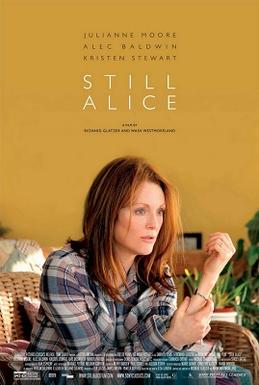
Still Alice: A Review

STILL ALICE

Sometimes, you just want to get things over with. This thought came to me after finishing Still Alice, the film for which Julianne Moore won an Academy Award on her fifth nomination. Moore felt overdue for a win, especially given that she is the rare person to receive a Lead and Supporting nomination in the same year (2003). Still Alice is fine, I suppose. That, however, may be the problem. It is fine. It is not good.

Dr. Alice Howland (Moore) is a brilliant linguistics professor at Columbia University. She has just turned fifty and is approaching the zenith of her academic career. Alice is happily married to her husband John (Alec Baldwin) a successful surgeon. She also has three children: Anna (Kate Bosworth), Tom (Hunter Parrish) and Lydia (Kristen Stewart). Lydia is the one causing Alice something of a headache, her acting aspirations at odds with Alice's ideas of success.

One day, Alice struggles through a presentation. She jokingly plays it off as the aftereffects of too much wine. However, other troubling elements start emerging. She gets lost jogging in familiar areas. She forgets more words. She confuses her daughter for her sister. What is the matter with Alice?

It is not a brain tumor, as she initially suspects. It is early-onset Alzheimer's disease. Alice takes the news surprisingly well, showing no emotion to the diagnosis. She also starts slipping further into the disease. She greets a guest twice, unaware that they have met at the most a half-hour prior. She forgets dinner dates and meetings. She gets lost more often. Alice will not let the disease defeat her, though it does inevitably cost her the loss of her job.

She starts speaking publicly about her diagnosis, requiring a marker to note what she has previously said. It is time for the Howland family to make tough decision. Will John decline an offer from the Mayo Institute to keep Alice in familiar territory? Will Alice and Lydia reconcile their differences? Will Lydia put aside her own acting dreams to care for her mother? Will Alice make a difficult choice about her life if she finds that she can no longer care for herself?


I imagine that Alzheimer's disease is an extremely difficult diagnosis, not just for the person afflicted but also for that person's family. It is painful to see someone fade out into a shadow world, unable to help your loved one in any way. It is painful too to know that you are doomed to fade out yourself, condemned to losing your very identity and ability to function. Each person handles these things differently: denial, anger, sadness. 

What did surprise me about Still Alice is an emotion that I did not expect: dispassion. I suppose that I can give co-directors/writers Richard Glatzer and Wash Westmoreland credit. They opted to not make Still Alice into a sensational or overly sentimental adaptation of Lisa Genova's novel. They did not give the actors big moments of emotional outbursts or histrionics. Instead, I think that they went the opposite way and made the whole thing rather cold and remote. 

It is one thing to be eerily calm when you are given an Alzheimer's diagnosis. It is, I find, quite another to be almost disengaged when you are told that it might be a brain tumor. Alice as played by Moore at times never seemed to display any emotion. I found this surprising given that the character was, I presume, meant to be seen as intellectual and strong. 

I can concede that perhaps that was how Alice Howland was supposed to be: disengaged, remote, dispassionate about her declining health. However, I found her too remote, removed and almost inhuman. To be fair, she did display a little prickliness when dealing with her doctor. That prickliness seemed more for his own calm manner than from any struggle she had.

I cannot shake the idea that Still Alice was going to get Julianne Moore her long-awaited Oscar no matter how good or bad her performance was. Do I think that it was a bad performance? No, but I did find it very "actory". To me, that means calculated, methodical, planned out. Her performance was professional but distant. I never saw the character of Alice Howland. I saw Julianne Moore.

There were times when I thought that Alice was using Alzheimer's as an excuse to get out of things like dinners that she was not keen on. It is strange that what I figure was meant as an emotionally devasting scene where she cries because she can't find the restroom, I thought that it was veering towards parody. 

Her insistence on continuing to try and teach despite her growing inability to do so did not come across as courageous. It came across as arrogant. For someone who is meant to be highly intelligent, she came across as stupid in not seeing that her class was a muddle. 

The rest of the cast save one made Still Alice, well, still in their actions. I found very little emotion in every actor except Kristen Stewart. Again, I was not looking for big moments where people throw things and go into shouting tirades. I was also not expecting the exact opposite: no emotion, no reaction to what I figure would be a difficult thing to live through. 

Stewart, as noted, was the exception. That, however, is not a good thing. She played a struggling actress. I saw an actress struggling. I have never thought that Kristen Stewart is a good actress. Still Alice did not convince me to change my mind.

One of Still Alice's greatest flaws is Ilan Eshkeri's score, which was syrupy and getting on my nerves. Perhaps Eshkeri's score was meant to make up for the lack of emotion that the characters had. That's as good a guess as to why I found it unbearable to listen to.

None of this is to say that the attention that Still Alice brings to Alzheimer's disease is not a good thing. Alice in her speech to an Alzheimer's Association group tells them, "I am not suffering. I am struggling", which is a good way of phrasing things. However, I still would have liked to have seen there be any emotion, even overdone ones, to none at all.

Still Alice, I think, will be remembered for being the film that finally got the talented Julianne Moore an Oscar. It should be noted that Moore has not received an Oscar nomination since Still Alice as of this writing. That makes me think that the Academy figured that they got that over with and could move on. Still Alice is not terrible. It is fine. It also could have been more.

DECISION: C- (4/10)

Wednesday, August 28, 2024

Human Voice: A Review

HUMAN VOICE (VOCE UMANA)

Human Voice (Voce Umana) is a simple story held together by Sophia Loren in if not a farewell performance at least a strong yet quiet one.  

Naples, 1950. War widow Angela (Loren) waits for her lover, known as the Signore (Enrico Lo Verso), to come for their usual Tuesday dinner. She calls close to dinner to find that he is not coming. As she recalls the day and her five-year romance that came after the end of the war, Angela also recalls seeing another woman coming out of Signore's home. 

It is clear that their affair is over. Devastated, she makes another call telling him as much while tearfully confessing she loves him.

Edoardo Ponti's adaptation of Jean Cocteau's play (cowritten with Erri De Luca) is very sparse and simple. He does open it up a bit by having the lovers stroll through the streets and Angela see the other woman (Alessandra Bonarota) leaving Signore's home. Ponti, interestingly, never shows us Signore's face. It is almost as if he is taking pains to not show him. We also get some interaction with Giuseppina (Virginia Da Brescia), Angela's cook who prepares the meal.

Human Voice gives us just a touch on a story that could be lengthened into a feature film. The film, at a brisk 25 minutes, tells its story through some voiceover but mostly through Loren holding court. Apart from dialogue with Giuseppina, Loren is the only human voice we hear.

Loren is called upon to give a wide variety of emotions in Human Voice. There is the joy of the anticipation, the mundane of talking to someone else about Signore, the anger at the betrayal, the hurt of her loss. Loren does a strong job playing all these emotions to herself, as she has no one to act against her. 

One marvels how she was eighty years old when she performed in Human Voice, her son's directing debut. While she does look like a mature woman, she still maintains some of the extraordinary Neapolitan beauty that has enraptured the world for decades. She also shows that she is a competent and able actress. From her first moment in voiceover reflecting on her romance to the final moment when she is weeping her love out, Loren keeps your attention.

Ponti, however, was wise to not give Loren a running monologue in Human Voice. He gives us little breaks with Angela's flashbacks and with Giuseppina in the kitchen, letting viewers breathe a little. It also makes the story less play-like had it been a single scene, which I figure the play would look like.

Human Voice is seeing an actress in winter still able to give a strong performance. Keeping a somber tone with William Goodrum's score and Rodrigo Prieto's cinematography, Human Voice gives everyone a good and short film to enjoy.  

DECISION: B-

Saturday, October 1, 2022

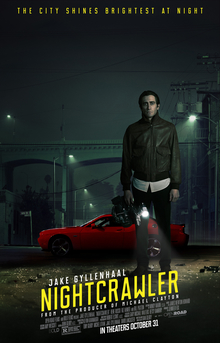
Nightcrawler: A Review (Review #1652)

NIGHTCRAWLER

In the dark of the night, all sorts of strange creatures come out. The strangest may be the lead in Nightcrawler, an effective and haunting portrait of a soulless man in a soulless world. 

Lou Bloom (Jake Gyllenhaal) scrounges a life in Los Angeles until he comes upon an accident, where he sees Joe Loder (Bill Paxton) filming the crash. Lou learns that there is money to be made in selling the footage to television news shows. He then dives into this world of "nightcrawling" in the hopes of making his fortune.

Easier said than done given his early stumbles. Lou soon gets some good footage, which he sells to eager news director Nina (Rene Russo) with the promise of more. He also hires Rick (Riz Ahmed), a man severely down on his luck, to be his assistant.

Lou does not shrink from unethical to illegal activities, such as altering crime scenes and even moving bodies if it will make for better footage. He also forces Nina into a relationship to keep his footage coming. Things come to a head when he gets to what appears is a home invasion with three dead before the police. His footage is graphic but also the perfect material for Sweeps Week. Now under the auspices of his "Video Production News", Lou calls the shots over Nina. He also wrangles his way out of dealing with the police, though at the cost of people's lives.

Nightcrawler paints a dark portrait of Lou, a man whose lack of empathy is cool and logical but sad and depressing. It may be that Lou has either Asperger's or ADHD given how cold, almost robotic he is. In his treatment of Rick and Nina, in how he can record people dying in front of him, Lou has no compassion.

I'm going to walk back a bit from an Asperger's/ADHD diagnosis. Lou is closer to an amoral being, someone who cares only about himself. It is doubtful that he does not know right from wrong (the film starts with him stealing material to sell for scrap and we see that he held on to the watch he beat a security guard for). 

Jake Gyllenhaal gives perhaps his best performance as Lou. We see him as a gaunt, hollowed out man, who uses people living or dying as commodities to serve his own needs and gains. He does not shrink from making Lou monstrous (such as when he films Loder's car accident which Lou more than likely played a role in causing). He is cold to everyone, and we see Lou as monstrous and amoral at every turn.

His staccato delivery, his thin, almost crumbling physicality, the blankness behind the eyes all contribute to making Lou a figure of horror. "I can't jeopardize my company's success to retain an untrustworthy employee," he calmly tells Rick as the latter nears his end. Gyllenhaal does not build up this moment. He does not deliver this line with glee or a villain's cackle. Instead, it is delivered in a remote, cold manner, matter-of-fact, aware of the logic and perhaps aware of the cruelty. It is a chilling yet mesmerizing performance.


Gyllenhaal is matched by the two other main characters. Russo is equally cold but rational as Nina, the woman who feeds the public's need for sensationalistic stories. One of her last scenes with Lou where they negotiate terms for Lou's footage of a police shootout he essentially engineered plays out almost like a seduction scene. Russo has a breathless manner to her delivery, as if she and Lou are coming close to making love (Nightcrawler strongly suggests Lou had already pressured Nina into a sexual relationship to keep the footage coming). Nina is equally amoral, and Nightcrawler draws parallels between those filming death and those putting it out there.

Ahmed as Rick is equal to both Gyllenhaal and Russo. His Rick (who maintains a flawless American accent) comes across ostensibly as the most decent of the group, a man who needs a job so desperately he works with someone like Lou. However, even he can get sucked into pressuring Lou for an equal share of money despite his misgivings. To be fair, Rick had been wildly underpaid and very much abused by Lou for those months. However, it does not absolve him of being a participant, reluctant though he may have been.

The film also has a surprisingly strong electronic score from James Newton Howard.

Nightcrawler, written and directed by Dan Gilroy, is a solid film portraying a man taking advantage of a cruel market. With excellent performances, a strong script and firm direction, Nightcrawler is a film that is haunting and effective, a portrait of a dark man living of society's dark side. 

DECISION: B+

Tuesday, August 10, 2021

Elsa & Fred: A Review

ELSA & FRED

This review is part of the Summer Under the Stars Blogathon. Today's star is George Segal.

It is a curious thing that despite a litany of failing, American filmmakers repeatedly attempt to remake foreign-language films and expect the exact same results. With very few exceptions (The Departed, The Birdcage, Victor/Victoria) most English-language remakes fail to translate from their source material. From Dinner with Schmucks to Shall We Dance? and to The Loft, foreign-language films just can't get it right. Add to that sad list of failed remakes Elsa & Fred, which took good actors and a good plot and ended up doing nothing with it all.

Recent widower Fred (Christopher Plummer) is forced to move into an apartment by his somewhat shrewish daughter Lydia (Marcia Gay Harden) and her obnoxious husband Jack (Chris Noth). Fred wants to be left alone, but has a soft spot for his grandson Michael (Jared Gilman) and his friend John (George Segal), both of whom he tolerates. Next door is his more ebullient neighbor Elsa (Shirley MacLaine), who thinks nothing of hitting Jack's car and has a more bon vivant attitude to life, no doubt thanks to her love for the film La Dolce Vita.

The damage to Jack's car starts the interplay between Elsa & Fred, with their children in varying degrees of interest. Jack pushes Lydia to get Fred to finance his newest moneymaking scheme to manufacture glasses that can't get lost, while Elsa's older son Raymond (Scott Bakula) frets over his secretly ailing mother and her insistence on secretly helping her younger son Alec (Reg Rogers) financially (usually with his money). Despite the myriad of tall tales and outright lies Elsa spins, she manages to charm Fred out of his crabby manner and embrace life.

However, Elsa's fibs and health issues eventually catch up to her, though not enough to prevent Fred from gifting her the one great joy she has always yearned for: to recreate the Trevi Fountain sequence from La Dolce Vita with her as Anita Ekberg and him as Marcello Mastroianni.  

While I have not seen the original Argentine version of Elsa & Fred, I have to imagine that it is better than this dull adaptation, though through no fault of the actors. MacLaine and Plummer did their absolute best to sell the autumn romance, and to be fair there were moments of brief sparkle where you could imagine the film could have been more. The scene where Elsa gets Fred to "dine-and-dash" is funny, but like her car, the rest of the film stalls and sputters.

I think Elsa & Fred's failure stems from Anna Pavignano and director Michael Radford's screenplay. The film just lurches from one scene to another, and you wonder how things will end up tying together. Alec, a starving artist whose paintings range from the grotesque to the bizarre, exists only to expose one of Elsa's lies. None of the characters are interesting, and our leads make one question the logic of their existences.

It seems extraordinary how quickly Fred forgives Elsa no matter how hurtful or bizarre the lies are. One would think he would have been better off without her, or at least without making Elsa such a habitual liar. One or two lies about her past to mask a painful truth can be understood, but endless lies make her unlikeable and him an idiot. 

The germ of the idea is there, and in some moments Plummer and MacLaine can be charmingly sweet as our lovebirds. It's just that the screenplay gives them little to work with.

Harden and Noth played caricatures of people, the former full-on hysterical and the other mugging for the camera and not bothering to try and make Jack remotely real. Bakula was much better as Raymond, but he was in the film too briefly to note. Same goes for Segal and Gilman, who in their scenes drew attention to themselves in a good way to where you wish John and Michael had more to do with Fred.

The score attempted to push the cutesy and try to make it sound Felliniesque but stumbled, and despite its short running time Elsa & Fred felt endless.

Elsa & Fred might work if someone opted to take the bones of the story and make Elsa more a free spirit than a somewhat crazed loon. However, for what we have, it's unfortunate that by the end of Elsa & Fred you almost want them to fall into the Trevi Fountain and not come up.

DECISION: F

Saturday, July 17, 2021

Cymbeline: A Review


CYMBELINE

I'm always up for a Shakespearean adaptation, especially if it goes beyond the more popular plays. Cymbeline attempts to bring to life a more obscure Shakespeare play with simply disastrous results that are almost astonishing to watch in the wrong way.

Cymbeline (Ed Harris) is leader of the Britons Motorcycle Gang, in an uneasy peace with the Rome Police. His new Queen (Mila Jovovich) has hopes that her son Cloten (Anton Yelchin) marries Cymbeline's daughter, her stepdaughter Imogen (Dakota Johnson) to keep power within the family. She also wants Cymbeline out of the way. 

Imogen, however, has eyes only for Posthumus (Penn Bagley), Cymbeline's poor protégé. Their secret marriage forces Posthumus' exile. Here, he wagers that Imogen will remain loyal when Iachimo (Ethan Hawke) wagers otherwise. Iachimo makes both Imogen and Posthumus believe at points that the other has been unfaithful, with only Pisanio (John Leguizamo) loyal to both. Imogen goes to Milford Haven to look for Posthumus, who is convinced Iachimo has successfully seduced Imogen through false evidence.

Now as "Fidel", Imogen finds Belarius (Delroy Lindo) and his sons, with whom "he" has taken refuge. Through a series of tragic events, Cloten is beheaded, "Fidel" is mistaken for dead, and a war erupts between the Bike Club and the corrupt Rome Police, leading to a fiery conclusion and more deaths.

There are three ways to adapt Shakespeare. You can stick with the traditional version, you can update the time and place but keep the language or you can update the plot and move it to another time and place. The Richard Burton/Elizabeth Taylor version of The Taming of the Shrew is a good example of the first, 10 Things I Hate About You is a good example of the third. Cymbeline attempts the second, and while I'm one of the few who does not think Romeo + Juliet is this unimpeachable masterpiece, it is miles ahead of Cymbeline.
 
The problem, the main problem, the central problem, the dominant problem in Cymbeline is the sheer lack of emotion throughout. The actors appear too focused on reciting the lines than on giving the characters any believability. The vast fault lies with writer/director Michael Almereyda, who apparently directed everyone to speak in near total whispers. Perhaps he was afraid of waking audiences from the inevitable sleep Cymbeline will induce as they slog through it.

Perhaps only once did Cymbeline allow anyone to show anything beyond mere stillness, and even then it was almost sad to watch. Cymbeline is surprisingly miscast and misdirected, where actors with little to no range attempt Shakespeare and actors with great talent are forced to restrain themselves to almost catatonic levels.

Dakota Johnson simply has no range or business attempting to act. Her Imogen was totally blank and acted as though Shakespearean English was untranslatable. Same goes for Penn Bagley, who looks lost attempting to decipher all this. Conversely, Anton Yelchin and Ed Harris are exceptional actors who are forced to show no emotion and just speak the words in a bizarre hushed tone. Jovovich straddles those two worlds, though she is quite beautiful.

As a side note, perhaps because of Jovovich's beauty it seems almost implausible for her to be Yelchin's mother; the fact that there's a mere thirteen year age difference between them making things more odd.

This, to be fair, is how everyone says their lines, making what should be fiercely dramatic moments so unnaturally still and restrained. Everyone is wasted in Cymbeline, even the few who stumble into passable performances that if not for poor directing could have done wonders. Lindo in his too-brief role was better than what ended up on screen. Leguizamo is the best, for he managed to show something of human emotion.

Curiously, he and Hawke are no strangers to contemporary Shakespearean films having starred in Romeo + Juliet and 2000's Hamlet respectively. Leguizamo was much better than Hawke, who was similarly hampered by attempting to match everyone else's hushed, quiet manner. It is bad enough when actors recite Shakespeare versus living out the words. It's worse when they have to speak them so hush-like that it sounds as if they have to whisper.

Cymbeline's one good aspect is David Ludwig's score, which has a pulsating tone that is missing from the film.

I hope that there is a better adaptation to Cymbeline in the future, because while the idea of shifting the story from Celtic Britain to biker America is not without promise, this version failed. One hopes that this Cymbeline soon comes to dust.  

Saturday, March 28, 2020

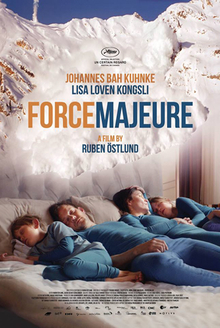
Force Majeure: A Review

FORCE MAJEURE

Into every marriage there will be found a few bumpy moments. Granted, not all of them will involve avalanches. Force Majeure looks at one seemingly happy family and finds that little things like life and death have a curious way of altering a relationship. Apart from its length Force Majeure is a strong, witty tale of a marriage in distress.

Swedish couple Tomas (Johannes Bah Kuhnke) and Edda (Lisa Loven Kongsli) are with their children Harry (Vincent Wettergren) and Vera (Clara Wettergren) in the Swiss Alps. It's a good way for the family to bond given how Tomas works too hard. Ski Day One of the five-day holiday went well.

Then came Ski Day Two.

A controlled avalanche at lunch appears to be anything but, causing panic among the hotel guests. Edda tries to both calm and protect the children. Tomas manages to flee the incoming chaos with only his cell phone, and from there comes all the trouble. Edda cannot comprehend why or how Tomas ran away in his ski boots, while Tomas insists it did not happen the way she tells it.

For the rest of the holiday, Edda and Tomas struggle through their own reactions and responses to this unfortunate incident. Edda is in turns distressed, unforgiving and passive aggressive. Tomas is in turns miffed, defensive and remorseful. Oddly, this incident and their reactions to and about it affect their friends Mats (Kristofer Hivju) and his much-younger girlfriend Fanny (Fanni Metelius), who equally struggle with what it all means and how they would react.

Eventually, the last day is one where in the words of Tomas, "We made it". If only not for that little issue of inept bus drivers on the way back from the ski lodge.

Force Majeure' Director Ruben Ostlund on His New Film 'The Square ...
It's at the very end of Force Majeure where it lost me, not completely, but enough to want this thing to finally end. It is about two hours long, and part of me thought that there could have been some cutting out of it. The long dialogue between Mats and Fanny, the oddball clubbing Tomas found himself in, the bus hijinks. At times it felt as if writer/director Ruben Ostlund didn't know when to stop. It did feel as if there were moments when we lurched from one point to another.

Again, the entire bus back bit made me wonder why this was added.

Apart from that though Force Majeure was both entertaining and intelligent. Ostlund did a wise thing in not making the actual avalanche into this massive moment. In fact, there is almost a clinical, documentary-like take on it, without commentary as the storm is about to engulf everyone. Ostlund, for example, does not cut from one shot as the avalanche comes at them (and us) closer and larger. He does not shift this cold point of view, and moreover, does not take sides. He leaves it up to the viewer to draw his or her own judgments.

Force Majeure,' a Dark Swedish Comedy - The New York TimesForce Majeure is elevated with fine performances from our very tried couple. Both Kuhnke and Kongsli balance the drama with some moments of humor as Tomas and Edda respectively. Kunhke's best moments are the quiet ones, such as his stillness when he does see via his own cellphone video that he did run off. Afterwards, he has a scene where he crumbles and acknowledges his failings and it is a very moving piece of acting.

Kongsli for her part makes Edda into a woman who does love her husband but who also is perplexed by him, the sense of responsibility for the family falling hard on her. Whenever she recounts this incident, we can see the growing anger and numbness of it all but she never makes Edda into an unforgiving harpy. Instead, she too is flawed in her own way.

Force Majeure is a movie that has humor and heart, whether it's Tomas mistakenly thought of as "the best looking guy at the bar" or when he and Edda have their reconciliation on their distinct faults, flaws and failings. A bit too long for my taste, it still is worth the time to see how sometimes even the best of us fail in the most difficult of moments.

DECISION: C+

Sunday, October 21, 2018

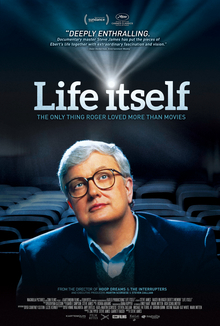
Life Itself (2014): A Review


LIFE ITSELF (2014)

There is not one film reviewer/critic who does not hold Roger Ebert as the standard to whom they measure themselves against. On his death in 2013, I wrote my own Remembrance to this giant of film history and criticism. Now, I revisit his life and work with Life Itself, the documentary based on his memoir that chronicled both his life and his ultimately losing battle with cancer. I confess I was also inspired because of the film of the same name.

One wonders what he would have made of Life Itself or whether he would be displeased it shared the same title. Life Itself, the Ebert story, is to its credit not a hagiography, allowing for some of Ebert's more negative aspects to appear. However, one also sees why so many, both high and low, thought so well of this highly intelligent and fierce man.

Life Itself chronicles Ebert's life, starting with his passion for writing and journalism. As a child, he published his own version of a newspaper, and at his hometown university in Urbana, Illinois, he became the university's editor, known for his professionalism, devotion to the craft and his arrogance.

The bright lights of Chicago beckon, where he joins the staff of the Chicago Sun-Times and essentially has the film review thrown at him. He brings his thoroughness and dedication to this section, but still hangs with the other newspapermen, a rowdy crowd with their regular hangout at O'Rourke's Bar. Here, Ebert holds court, a raconteur as well as a nasty drunk.

He's not shy about touting his own greatness, especially after becoming the first film reviewer to win a Pulitzer Prize. He also dabbles in film-making once, where his admiration for schlock director Russ Meyer leads him to write Beyond the Valley of the Dolls.

Related imageIf there is one thing Ebert hated, among many, it was the rival newspaper, the Chicago Tribune. The Tribune had its own film critic: Gene Siskel. Siskel was different than Ebert in some ways apart from merely physical. Ebert may have written about life 'beyond the valley of the dolls', but Siskel came close to living in that world, palling around with Hugh Hefner and taking dips with topless girls in the infamous Grotto.

Soon, these two forces were brought together for a local public television program, Coming Soon to a Theater Near You, later retitled both Sneak Previews and finally Siskel and Ebert.

That last aspect perpetually rankled the at times petulant and egotistical Ebert, but he had lost the coin toss, a way they settled many of their issues. There was strong antagonism between them, yet they found themselves as an unlikely pair. It cannot be said they were friendly, let alone friends, until much later in their association. They became as famous as the subjects they covered and their 'thumbs up/thumbs down' reviews gained a strong influence both in Hollywood and among the general public.

Over time, if not a friendship a genuine respect for each other developed, where they could even laugh at the things that used to irritate one about the other. Siskel's daughters even served as flower-girls at Ebert's wedding at 50 to Chaz, a woman he met at AA (Ebert giving up alcohol in 1979).

Siskel, however, kept his own illness a tightly-held secret. When Siskel died in 1999, it affected Ebert's decision to not keep his own health issues secret as Siskel had. As such, his battle with cancer years later was public, including the surgery that cost Ebert his jaw as well as his ability to speak and eat.

Life Itself intercuts Ebert's life with his battle, where the audience is given the realities of the thyroid cancer such as the feeding via suction, with Chaz always at his side. As he got weaker due to his myriad of health issues, his interaction with the film's director, Steve James, became weaker. Ebert simply did not have the energy to conduct the planned series of email interviews.

Life Itself ends with Ebert's death and the tribute he received at the Chicago Theater, mourned by his family, friends, colleagues and fans.

Image result for life itself 2014Life Itself does not shy away from Ebert's illness as was his wish, but it might be jarring to viewers to see Ebert not just in such a feeble position but in his actual appearance. The lost jaw creates an almost ghoulish visage that might startle viewers or make them uncomfortable. The feeding via suction, along with the obvious physical toll it took on Ebert and the stress of living through this may put people off.

However, I find that while perhaps a warning to the physical sight of the ravaged Ebert may be necessary, it enhances to my mind Ebert's personal courage in not hiding the ravages his illness inflicted. He was unafraid and honest, even witty and humorous despite the toll.

We do sense that as his illness progressed, he was weakening to a point that if not a desperation at least an exhaustion had finally set in. He could not answer even the slightest question via email, let alone deeper ones. He simply had run his course.

Life Itself has many interviews from current filmmakers such as Martin Scorsese and Werner Herzog, both of whom Ebert championed. We also see Ava DuVernay, who met him as a little girl and for whom he was encouraging in her early film, I Will Follow

The film does not just shy away from showing us at Ebert's physical worse but also at times at his nastiest and confrontational. Outtakes from Siskel & Ebert show how both of them could be sharp-tongued, insulting, almost hateful towards the other. We can also see that at times Ebert did not take criticism of himself. There was the time Richard Corliss, a fellow film critic, wrote a scathing piece, All Thumbs, disparaging the Siskel & Ebert method. Ebert struck back with his own take, All Stars.

Life Itself is not a hagiography, but it also is not going to delve much into finding much fault with its subject. I found Beyond the Valley of the Dolls a horror, extremely distasteful, but both that film and Ebert's admiration for Meyer were barely if actually touched on. I don't know if it was too late to talk on Ebert's take-down of Ben Lyons, the 'hipper, cuter' (and I would argue, dumber) film critic who eventually took a spot on At the Movies

Whether Ebert, Siskel or any of those following them in At the Movies (such as Richard Roeper) did in fact get too cozy with their subjects is also left pretty much untouched.

However, this does not take away from both the skill and affection Life Itself has both in terms of filmmaking and the subject himself.

Here, I offer my own take on Roger Ebert.

I disagreed with him, sometimes on films, more often on politics.

I also deeply respect him for his enthusiasm, his genuine love of cinema, the wit and fire he brought to his reviews, good and bad.  I share his view that a film should be viewed and remarked on based on what its trying to do.

Roger Ebert was one of the voices that got me into writing about film. You have to love movies to write about them, but you also have to balance emotion with intellect.

We all stand in his great shadow, and Life Itself is a great tribute to one of the leading lights of film reviewers.

Image result for life itself 2014
1942-2013

DECISION: B+

Wednesday, July 22, 2015

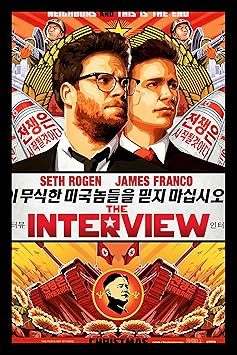
The Interview: A Review

THE INTERVIEW

The Interview is terrible. 

There's just no getting around that.  Separate from the scandal and misery the film caused Sony in terms of leaked e-mails and hacking from a terrorist regime so paranoid and devoid of humor, The Interview as a film is unfunny, insulting to the audience, crass, immature, and just terrible. Terrible, Terrible, Terrible.

In other words, it's a Seth Rogen production.

Dave Skylark (James Franco) is the host of nightly talk-show Skylark Tonight, which while popular is not respected, which goes double for Skylark himself.  Dave is a vapid moron who is so witless that his only points of references to just about anything is Lord of the Rings (the movies, not the books, since Skylark is the type of dimwit who thinks To Kill A Mockingbird is a hunting manual).  His best friend/producer Aaron Rapaport (Rogen) pretty much goes along with everything Skylark does, though at a party to celebrate their 1,000th episode he sees a former friend who sneers at Skylark Tonight and everything to do with it (his friend works at 60 Minutes).  This needles Rapaport, but it doesn't bother Skylark since, in his words, "They hate us cause they ain't us".

These are the types of inane oddities Skylark dishes out often.

Skylark, however, gets surprising news.  He comes upon a profile of North Korean dictator Kim Jong-un, and discovers that the fat pig of a despot is a fan of all things, Skylark Tonight.  More shocking than North Korean nuclear missiles coming at us, Rapaport manages to negotiate a live interview with the reclusive leader of the Hermit Kingdom.  This news stuns the entire universe: an idiot like Dave Skylark gets a sit-down with Kim Jung-un?!  Even Bill Maher in a cameo mocks this, suggesting Dave is such a moron that when Skylark gets to Pyongyang (which Dave can't pronounce), he'll end up thinking he's interviewing the guy from Gangnam Style.

Dave and Aaron, for their part, want a little street cred, but being Dave and Aaron, go on a drug-and-alcohol fueled bender.   Enter Agent Lacey (Lizzy Caplan), the sexy CIA agent who gives these two an assignment: take out Kim Jung-un.  Dave and Aaron, being Dave and Aaron, at first don't get what she means by 'take him out' until it's made perfectly clear she means assassinate.  With some training in applying a specific poison, the dysfunctional duo go off to the Socialist Paradise (or what the United States will look like in the second term of President Bernie Sanders). 

At last they meet Dave's number one fan, Kim Jung-un (Randall Park).  Dave is easily smitten and taken in by all the greatness of the North Korean paradise and ends up thinking Kim is a really cool guy.  He's so taken with his little buddy, who shoots hoops with him, shows him his tank (complete with Katy Perry blasting in the tank's sound system) and the hot chicks he decides Kim is just a misunderstood player like himself.  Kim just suffers from a bad rep, and thus, Dave won't kill him.

Aaron is appalled at this, and with a little help from the sexy North Korean official Sook (Diana Bang), decides they will do the deed during the scripted interview.

I'd like to point out that Skylark, with a very reluctant Rapaport, had agreed to ask only the questions Kim supplied them with.  Like everything in North Korea, the whole thing is staged. It's only when Skylark a.) sees Kim lose it and drunkenly plot nuclear war, and b.) discovers the grocery stores are fake and filled with fake food, does he finally agree to go along with this caper.  In the end, while they bungle the plans they do end up killing Kim and return to a pleased America...complete with puppy. 

Yes, he IS cute...

Obviously, a satire on Kim Jung-un is possible, and certainly an intelligent one.  The Interview is not such a satire.  It tries too hard in so many ways to be funny when it ends up cringe-inducing.  Dave Sterling's screenplay (based on a story by Sterling and co-directors Rogen and Evan Goldberg) has nothing in it that is funny apart from the first scene, where Eminem in a cameo 'comes out' as gay.

That's right: Slim Shady on Skylark Tonight calmly and casually says he's gay, then says "I'm a homosexual" later on, and ends with "I like men".  What makes that funny is a.) the fact that Marshall Mathers III says it, and b.) the fact that Marshall Mathers III says it so calmly and matter-of-factly. 

Even here, though, we can see why The Interview is so horrendous as a film.  Dave Skylark as portrayed by Franco and as created by Rogen/Goldberg is such a complete and total moron that he can't come up with any follow-up questions without Aaron speaking into his ear.  Throughout The Interview the yin and yang of Franco & Rogen's characters never appears realistic.  That 'struggle' Rapaport has about being a 'real news producer' are thrown out there, but never explored (unlike Rogen's anus, which was the subject of a particularly ugly sight gag).  Skylark, for his part, is such a total dimwit that he cannot identify a tiger, referring to it as a 'big striped dog'.  His character is shown as such a moron again and again to where one wonders whether he is not actually stupid but downright insane.

They are given the task of assassinating Kim via a poison given through a strip placed on the palm of a hand.  When Skylark and Rapaport leave for North Korea, a reporter snidely asks if Skylark will kiss Kim's ass.  "No, but I'll give him something special with my hand," is what is suppose to be his witty comeback.  Skylark apparently doesn't realize that he's not just giving away the assassination method, but is suggesting that he will physically masturbate Kim Jung-un as well.

Again and again Rogen & Company are obsessed with this kind of juvenile humor that those Freaks and Geeks would have left in high school.

A big problem is the pacing.  Oftentimes it feels like we're rushing through things in order to get to the next orgy, the next penis joke, the next example of Skylark's idiocy or Aaron showing off what a flabby body he has.

At this point, the question as to why Seth Rogen has a career in film should be brought up, because apart from a few films (maybe Superbad, probably This Is the End, maybe Neighbors...though I haven't seen that one yet), Rogen has done the same shtick again and again and it just isn't funny.  Not that it was then, but why are people still paying money to see this over and over again?

More surprising to me is how violent The Interview gets at the end, particularly with Rogen's character.  It's played for laughs, but I think the actual reaction one has is revulsion , not revelry.

This takes away from Park's Kim Jung-un, who comes across almost sympathetic: more needy and spoiled than bonkers or even evil.  As played by Park, Kim is just a messed-up kid trying hard to live up to Daddy Dear Leader's expectations.  His performance (and Eminem's cameo) are the only good things in the film.

IF the screenplay had bothered to make Skylark slightly more intelligent than the gibberish-spouting loon/nitwit he was, or if it had bothered to make Aaron the more sensible of the two (well, it actually did try, and failed spectacularly in those efforts), or even attempt to make fun of the situations and characters rather than rely on "I have a hard on, let's look at it" style of humor, The Interview might have been worth something. 

It's a sad commentary that the North Koreans went into fits over this dribble.  Obviously, they are sheltered and humorless.  If they had any sense, they would have done what the rest of us should have done: ignored it and watch it die a quick death.  Instead, it sent its Guardians of Peace after The Interview and Sony, giving this horror much more publicity than it deserved.

Though, in fairness, how else would we have learned about Angelina Jolie being a 'talentless spoiled brat', or about "Johnny Madrid" aka Tom Hanks, or how the industry leading the charge against a 'war on women' goes out of its way to pay the broads less than the bros. 

The fact that the G.O.P. targeted The Interview is a funnier pun than anything the film itself came up with.           

DECISION: F      

Monday, June 15, 2015

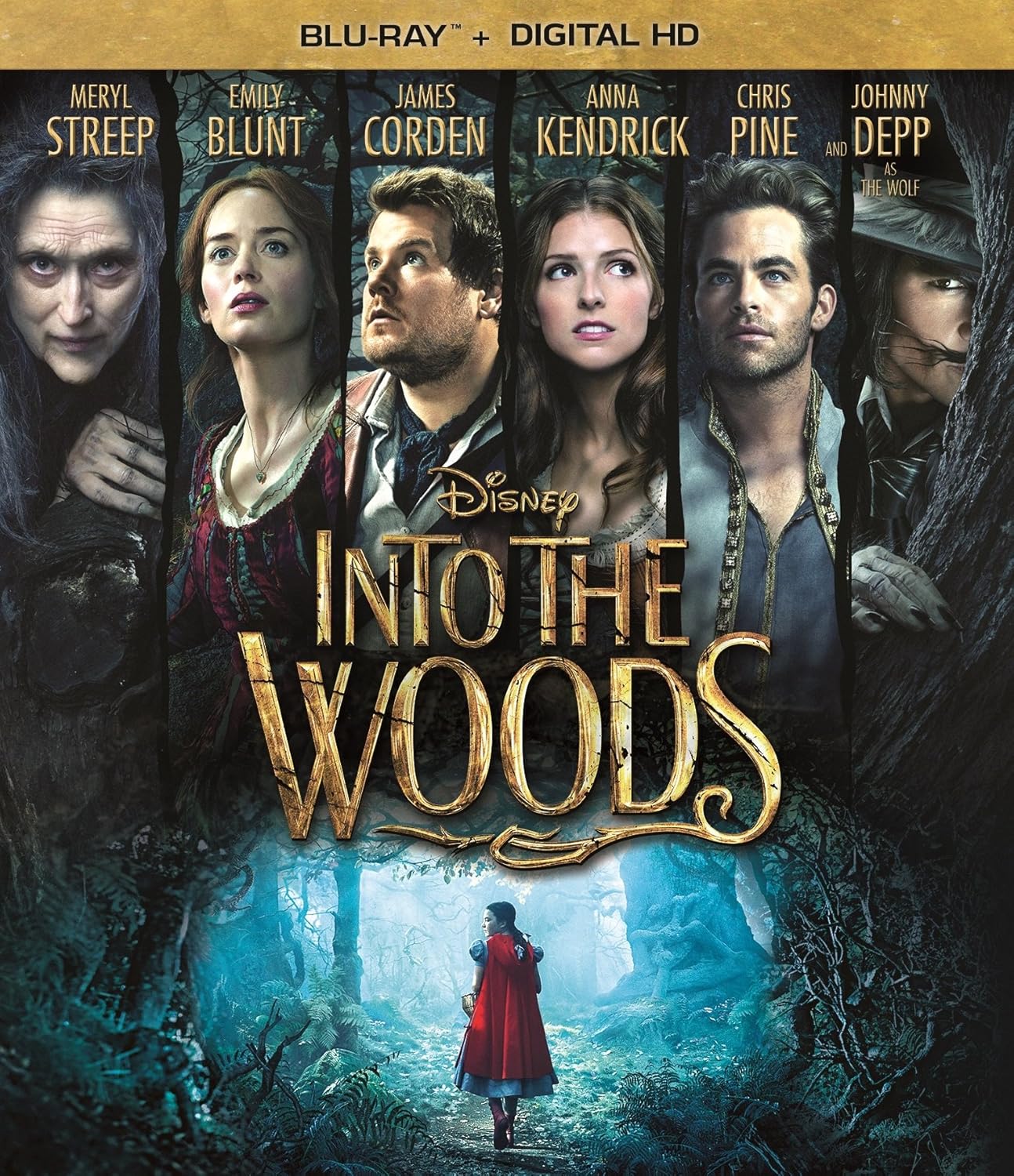
Into the Woods: A Review (Review #720)


INTO THE WOODS

The Golden Age of the musical, both Broadway and movie, is no more.

Long gone are the days when people like Irving Berlin, Cole Porter, or teams like Rodgers & Hammerstein or Lerner & Lowe could create hit songs that would play on radio, where numbers from My Fair Lady or Camelot were known across the land, when Broadway stars like Mary Martin and Zero Mostel ruled the Great White Way.  About the only semi-contemporary Broadway composers who have achieved crossover status have been Kander & Ebb, and in my view the reason is that the film versions of their musicals Cabaret and Chicago are probably better known than the original productions.  If you were to ask a group of people on the street to name ANYONE from Broadway, perhaps you could get "Andrew Lloyd Webber", but I'm willing to wager few people outside New York or theater circles would have the name "Stephen Sondheim" pop up.

In a similar vein, about the only recent musical to have big-name recognition would be Wicked.  Other recent musicals that were thought to be extremely popular and sure-fire hit film adaptations, like Jersey Boys and The Producers, flopped in their film versions.  Somehow, the good folks at Disney decided the musical's big comeback would be courtesy of Into the Woods, a show that has some name recognition but which also has typical Sondheim music and lyrics (highly complex and unorthodox).  Sondheim has rarely written a musical with songs that are hummable.  His songs don't have standard song structures (verse, chorus, bridge).  They flow all over the place, collide with other melodies to form a larger whole.  I (and many others) can sing numbers like My Favorite Things or All That Jazz.  Can anyone with little or no training belt out On the Steps of the Palace with equal ease?  About the only Sondheim songs one can perform easily would be from West Side Story or Gypsy, and that's only because he was working with others. 

Therefore, the idea that a film version of Into the Woods being greeted with virtual dancing in the streets is a bit curious to say the least.  That isn't to say Into the Woods is a bad film per se (though I do wonder why Bernadette Peters wasn't allowed to recreate her role as the Witch given Peters is only two years older than Meryl Streep, who played the Witch).  Into the Woods is in fact, an OK film, but one that drags to where you pretty much start forgetting what you are watching.

A Witch (Meryl Streep) has caused the Baker (roly-poly James Corden) and his wife (Emily Blunt) to be barren because the Baker's father stole some magic beans from her garden, which in turn caused the Witch to become ugly.  She tells them that the curse can be lifted if they gather four items: a cow as white as milk, hair as yellow as a corn's ear, a cape as red as blood, and a slipper as pure as gold.  They have little time to gather all those objects, so off HE goes (with her trailing after). 

As it so happens, their task has them collide with all sorts of fairy creatures (points for you if you figured the Baker and his Wife would encounter Jack of Beanstalk fame, Rapunzel, Little Red Riding Hood, and Cinderella).   There are more complications than that of course: Rapunzel happens to be the Baker's long-lost sister (whom the Witch took as payment for the father raiding her garden), and the search for Rapunzel leads her Prince (Billy Magnussen) to collide with Prince Charming (Chris Pine), whom the indecisive Cinderella constantly flees from.  Little Red Riding Hood is temporarily waylaid by The Wolf (Johnny Depp in a glorified cameo), and soon all the stories start intertwining.

Eventually, the Bakers are able to gather all their materials, and all wishes appear granted: Jack is with his best friend the Cow, Cinderella and Rapunzel find their Princes, Mrs. Baker gets knocked up pretty quick, Red emerges from the Wolf's belly, and the Witch becomes beautiful.  Complications arise, however, when the widow of Jack's Giant comes demanding he be turned over to her.  It's a decision to whether to hand Jack over, and from that we learn Prince Charming is just that, Charming, not clever (or loyal), and that wishes are a dangerous thing.


It's rather curious that the film version is already two hours long (and feels longer) but in reality, is shorter than the actual Broadway production, the film having cut out several songs and subplots.  Not that it would have helped any given how disjointed the thing felt.  The shifts from one part to another weren't so much jarring but a bit curious.  It is a bit difficult to gain a full appreciation for the differences between stage and screen given I've never seen either, but then again, I've never seen a stage version of either Cabaret or The Sound of Music and I love them both.  They felt like they told one story, but Into the Woods feels like two stories in one film, one LONG FILM. 

Once the people got all their wishes granted, we get basically a new story.  Nothing wrong with it I suppose (after all, Sondheim is a genius) but I can see why the child-friendly version ends with Part One.  Even that perhaps can be overlooked if not for the fact that director Rob Marshall and James Lupine (adapting the musical he wrote with Sondheim) watered down the text to where fans of the original probably weren't thrilled with it and those unaware of what was cut might be forgiven for being a bit puzzled.

In the original as I understand it, Prince Charming and Mrs. Baker had a full-on affair, but in the film, all they do is kiss (with Mrs. Baker protesting all the way).  I don't care one way or the other, and I think this sums up why Into the Woods was a disappointment for me...I just didn't care.

There was no one I was actively rooting for.  The Baker was pretty inept and sexist (and let's face it, Corden might just as well have been called "Craig Owens" in this thing too).  I am probably one of the few people who has not fallen for the charms of Anna Kendrick, finding her neither cute or particularly brilliant.  That isn't to say that perhaps she is not either cute or brilliant, but I wasn't overwhelmed or underwhelmed by Kendrick.  I wasn't even whelmed. 

I did have some concerns about Depp (who looked like he was attempting to channel David Bowie and make the Wolf into a virtual child rapist).  Hello, Little Girl may now take the place of Thank Heaven for Little Girls as the go-to theme for all pedophiles.  

There were a few standouts.  I was surprised that Pine could carry Prince Charming off without really slipping into farce (though I confess that during his and Magnussen's duet of Agony, as they describe the pain of not being able to find their princesses, I was falling asleep and didn't fully recover until near the end as I drifted in and out during the run of the film).  Streep is also brilliant as the Witch, giving her an almost tender side when with Rapunzel. 

Still would have preferred to see Peters' take on it myself. 

Frankly, I would just say to skip Into the Woods altogether.  I wouldn't even really go for the soundtrack.  The Woods are Not So Lovely but They Are Very Dark...and Very Deep...Deep Sleep...

DECISION: D+

Saturday, June 13, 2015

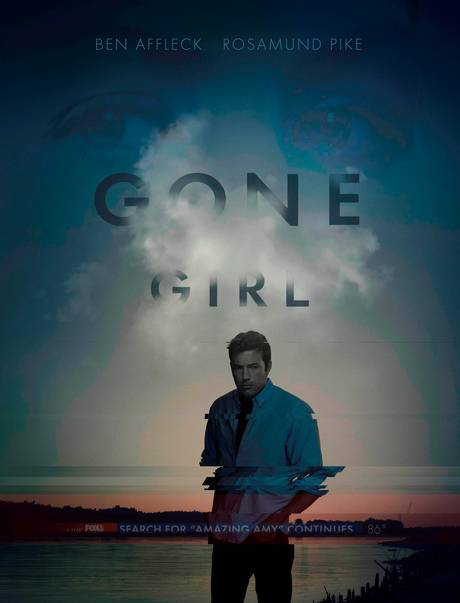
Gone Girl: A Review

GONE GIRL

The novel Gone Girl was rapturously praised.  It was obvious that there would be a film version, and when David Fincher was announced as the director, with the novel's author Gillian Flynn adapting the novel, it was sure to be not just a hit but a major Academy Award contender. Hollywood was stunned Nomination Morning to find that the much-touted and critically beloved Gone Girl received exactly one Oscar nomination.  That was for Rosamund Pike as Best Actress, whom everyone knew was going to lose to Still Alice's Julianne Moore (as would every Best Actress nominee NOT named 'Julianne Moore').  I went into Gone Girl a little concerned, given that I have a reaction against something so highly praised.  Sometimes, all the lavish feedback for a film pushes one's expectations so high you'd think something like Gone Girl had discovered the cure to AIDS, the way certain of my brethren and filmgoers speak of it.  I found Gone Girl has one extremely positive aspect, but in almost other ways, it's a long drag to get to its inevitable conclusion.

On the day of their fifth wedding anniversary, Nick Dunne (Ben Affleck) comes home from The Bar, the bar he co-owns with his sister Margo (Carrie Coon), to find his wife missing, and some signs of a break-in.  His wife, Amy (Rosemund Pike), has some level of celebrity attached to her, as she was the inspiration for a series of children's books called Amazing Amy.  Needless to say, the real Amy not only was not on the same level as Amazing Amy, but is highly resentful and bitter about being connected to this fake version of herself.  Concerned, he contacts the police, and the lead investigator, Rhonda Boney (Kim Dickens) has a cynical view of events.

The nature of Amazing Amy creates media interest that soon turns to frenzy.  Nick does himself no favors by doing dumb things for the press (like smiling next to his wife's Missing poster for the cameras, or taking selfies with people helping in the search, or sneaking his mistress into the house for a tryst).  His actions, particularly in trying to uncover the mystery himself by following the clues his wife loved to leave him for anniversary gifts, also make things worse.  Eventually, Nick is suspected of having murdered Amy and attempting to cover it up.  All the details spill out as the days drag on...and on...and on...


Until we in the audience get a bit of a surprise: Amy is alive and well.  Amy has been heard through voice-over, and we discover that her 'death' was a long and carefully planned scheme to frame her cheating husband for murder, and then for her to commit suicide.  I'm a little unclear if she changed her mind or not, and I think she did.  Anyway, as she is hiding out in a trailer park, part of her story is uncovered by two unsavory characters, who rob her of the vast cash reserves Amy had.  Upset and momentarily thrown for a loop, she turns to an old boyfriend still obsessed with her, Desi Collins (Neal Patrick Harris).  Desi cheerfully agrees to shelter her, believing her story that she faked this to escape a violent man. 

By now though, Nick has put two and two together and realized that Amy is setting him up, but of course he has no way of proving it.  In desperation, he turns to powerful lawyer Tanner Bolt (Tyler Perry), who excels in making sleazy husbands escape prison after being accused of murdering their wives.  His cost is high, but he is intrigued by the lengths Amy has gone through, finding her a fascinating and devious creature.  Bolt sets up an interview with journalist Sharon Schrieber (Sela Ward), where he does a little manipulation of his own.  Amy and Desi see the interview, and she knows he's on to her.  Now comes her most risky move: to make her miraculous and dramatic return to life, even if it means Desi's life has to come to an end.  Once she returns, only Boney, once suspicious of Nick, has doubts to Amy's own version of events.  Amy, for reasons known only to her, wants to stay married to Nick and have a baby.  He despises her by now, but he cannot prove what he knows to be true.  They stay together, for the sake of appearances.


If there is one thing I thought was singularly fantastic about Gone Girl, is it Pike, who rightfully earned her nomination.  Manipulative, deceitful, and pretty much insane in a genius type of insane, Pike is brilliant as Amy: bitter and determined to get her way, contemptuous of everyone but a woman who manages to get her own even when her plans get slightly derailed.  That was one point I wondered about: how, given she had thought everything out, she could have been so foolish as to carry her money on her rather than leave it hidden somewhere where she could get at it later.  In the scene that tipped the two thieves off, a large wad of cash falls from her body.  I was surprised that she did not think to keep smaller amounts on her, or at least find nicer digs.

I think my difficulty with Gone Girl comes from something that maybe people aren't thinking while watching: despite claims to the contrary, it isn't an original story.   I was reminded of the biggest mystery of Agatha Christie: her own disappearance.  On December 3, 1926 (curiously, December 3 is my birthday), Christie disappeared from her home.  For ten days the public was gripped with the mystery, eventually suspecting her cheating husband Archie of murdering her.  She was found in a hotel under an assumed name (having checked in under the name of her husband's mistress).  Christie never revealed exactly what happened, and speculation still runs rampant (everything from her plotting out a new mystery to attempting to frame her husband for 'murder').  Given that I know of the Christie case, Gone Girl seems too eerily similar to that for me to be wildly overwhelmed with it.

There were other things that bothered me tremendously about Gone Girl.  One is David Fincher's direction.  I know many people love him as a director.  I personally have no great love or hatred for his work, but here, I kept thinking how a.) slow everything was (it's a very long film, and it felt longer to me), and b.) the sepia tones were getting on my nerves.  I know it was to set the mood, but sometimes I wondered whether he was going overboard with the 'gloom' of everything.  I kept seeing endless shades of brown.

More concerning though is the entire plot.  Granted, I've not read the novel, but I do wonder whether a film that suggests a woman faked being violently raped and assaulted is good.  Here, Amy viciously murders a yes, dumb man (why Desi would want to help her given how cruel she was to him before her marriage I don't understand, nor why Nick would go along with all this and stay with her...since I would have divorced that bat-shit crazy bitch negative feedback be damned), claiming he held her hostage and raped her.  What good does it do to all those women who were real victims of violent crimes?  Can we now say, 'oh, it's a Gone Girl situation...she faked it'.  One must tread lightly on stories that suggest women lie about sexual assault.  Just my view.

I thought Nick was a particularly weak man, emasculated to the core.  His wife held the money strings, the lead investigator was a woman, and he had no real conscience given how he had no problem sleeping with his student (he taught writing at a local community college).  Affleck I figure was OK in the role (he's never been one of my favorites). 

There is no such thing as the perfect crime.  Every big scheme has at least one or two flaws that if poked long enough, will bring it all down.  Gone Girl doesn't have that.  I found that a bit of a stretch.  I found its length a major turn-off (at one point in my notes, I wrote "When will this end?")  Pike I think would have had a chance to win almost any other year, and she is worth watching.  In regards to everything else, by the end of the film I too wished that the girl would go. 

DECISION: C-


Tuesday, June 2, 2015

Foxcatcher: A Review (Review #717)

FOXCATCHER


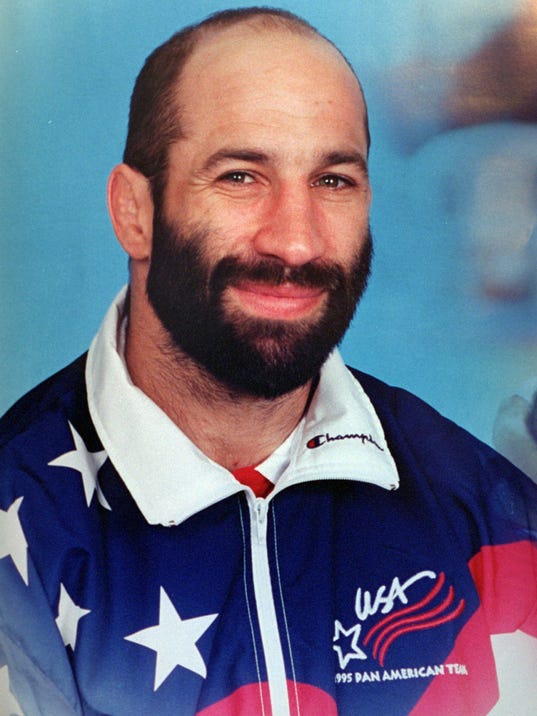
Despite their massive wealth, the du Pont family makes an art out of staying out of the public eye.  In recent memory only two du Ponts have really made an impact.  One of them is the former Governor of Delaware, Pierre "Pete" du Pont, an oddity due to the family's general avoidance of politics.  The other is John E. du Pont, who in 1996 murdered professional wrestler Dave Schultz at his estate, Foxcatcher.  This too was odd given the family's general avoidance of scandal, but killing someone does qualify as scandal par excellence.  Foxcatcher is the fact-based film of this shocking act, and director Bennett Miller goes to great lengths to make the incoming doom obvious.

That may be part of the problem.

Mark Schultz (Channing Tatum) is an Olympic gold medalist in wrestling, but he is also living under the shadow of his older brother Dave (Mark Ruffalo), an Olympic gold medalist in wrestling as well.  Mark quietly wanders through life, unsure if he will ever be as good as Dave or be seen as anything other than "Dave's brother".  Enter into his life John du Pont (Steve Carell), an eccentric wrestling enthusiast to say the least.  Beak-nosed and with a particularly odd manner, du Pont offers Mark a golden opportunity: to train at du Pont's personal expense at his estate for his Team Foxcatcher. Du Pont wants to build champions, and something about restoring American greatness or something equally nutty.  Pretty soon, the weak Mark goes head-first into the weird world of John E. du Pont, being seduced (perhaps in more ways than one) into a world of wealth, drugs, and a need to be valued.

Dave for his part turned down du Pont's initial offer, deciding to stay at home with his wife and children.  As du Pont gets further entangled into Mark's life, we see the strain on his life.  He let's his hair grow, he has no problems taking on more cocaine, and he doesn't give wrestling the full attention it deserves.  After a spat, du Pont declares Mark an 'ungrateful ape' and manages, despite his moral rectitude, to get Dave to join Team Foxcatcher.  Watching all this with a very disapproving eye is Mama Jean du Pont (Vanessa Redgrave), who values horses over the low sport of wrestling her wittle boy loves.  As time goes on we find the far from the champion du Pont envisioned, Mark pretty much collapses under the strain.  He barely makes the 1988 Seoul Olympic team and there, he bombs big-time.  After the fiasco at Seoul, Mark leaves Foxcatcher but Dave decides to stay on and serve as a coach to the other wrestlers.  On January 26, 1989, after du Pont finishes watching a documentary about what would have been his triumphant molding of Olympic wrestlers, du Pont drives to Dave's house in his estate, finds Dave working on his car radio, and asks, "Do you have a problem with me?"  Before anyone can answer, du Pont pulls a gun and shoots Dave three times, leaving Dave's wife Nancy (Sienna Miller) and du Pont's security man Jack (Anthony Michael Hall) horrified.  Du Pont for his part, calmly drives away, arrested a couple days later.  Foxcatcher ends with Mark Schultz, still in disarray, about to enter a MMA fight.


If I were to put a specific reason as to why I didn't think as highly on Foxcatcher as my brethren, it would be because director Bennett Miller made what I consider a fatal decision.  He made it clear from the get-go that THIS was a tragedy, giving Foxcatcher a pervading sense of doom that sucked out any real sense of tension.  Perhaps this was Miller and screenwriters E. Max Frye and Dan Futterman's intentions, but for me, from the moment we hear Rob Simonsen's score echoes Barber's Adagio for Strings the film all but ANNOUNCES the darkness and tragedy of Foxcatcher, these figures are condemned to: Dave's death, John's mental disintegration, and Mark's moral corruption. 

Again and again while watching Foxcatcher the word "obviously" kept cropping up.  It's OBVIOUS du Pont is bonkers.  It's OBVIOUS Mark is weak.  It's OBVIOUS Mamma du Pont disapproves.  That isn't just the 'obvious' of the obvious.  There are moments visually when we get told more than dialogue does.  Sometimes this works wonderfully (such as when du Pont wins a seniors wrestling tournament with Mark as his coach while we observe one of du Pont's lackeys slipping the competitor an envelope).  Sometimes, though, one wonders whether Miller was going a bit overboard.

At one point, du Pont wakes Mark to have some 'training' in the gallery of his lavish estate.  Visually, it looks like du Pont is all but raping Mark.  The very creepy du Pont is all but looking down on Mark as he metaphorically sodomizes Mark.  That could have passed as mere artistic license, but du Pont does it again, culling another wrestler named Roberto Garcia (Daniel Hilt, whom I suspect is not Hispanic) and all but having sex in front of Mamma du Pont, who leaves the wrestling facility in disgust.  Whether he meant to disgust her or not we can guess (I figure he did), but sometimes one can gild the lily a touch too much.

I kept wondering why Mark, despite being OBVIOUSLY dimwitted, would not have seen that du Pont was flat-out bonkers.  One can't fire a gun into the ceiling of their training facility without making someone wonder whether he is playing with a full deck.  I kept wondering how someone as overtly creepy as John du Pont could talk the formerly stalwart Dave to join Team Foxcatcher (which we never got an answer to).  I kept wondering how du Pont managed to create his little worshipful coven on Foxcatcher Farms.  I think because Miller and Company were so intent on making it...OBVIOUS, that Foxcatcher is this deep, dark, tale, that subtlety pretty much went out the window.  The music, the cinematography, the pervading sense of doom even during what should have been happy moments (like Mark finding a patron who apparently believed in him), it all takes away from what could have been a growing sense of doom and despair.


Anyone seen my cigarette holder?

It doesn't help that Carell, in his naked bid for an Oscar nomination (richly rewarded at the expense of David Oyelowo's Martin Luther King, Jr. for Selma), decided he was going to play Oswald Chesterfield Cobblepot, Sr.  I made a comment that it was no surprise John E. du Pont liked birds, given his beak-like nose.  Carell didn't so much act as pose, a lot, cocking his head and striking a pose at every opportunity.  Perhaps the real du Pont was this freakish looking (making how he lured the Schultz Brothers more bizarre), but it certainly added to the generally bonkers style to du Pont.

It wasn't just his Penguin looks that makes the performance a touch showy, but it's his mannerisms, his obvious discomfort with people, his faux-patriotic speeches (and that shooting fixation) that makes one wonder again why people didn't just run from him in sheer fear.  One would expect that he could lure people to his side, but because Carell was playing du Pont as obviously insane and creepy we never got the sense of charm slipping into possessive maniac.  Instead, from the moment we start we see du Pont is either evil or dangerous, making everyone else's choices seem rather irrational.

To me, Steve Carell's entire performance can be wrapped up in one word: posing.  He poses, a lot, determined to show off how his nose and waddle are more impressive than Burgess Meredith, Danny DeVito or Robin Lord Taylor combined!

Faring much better are Rufallo and Tatum as the Schultz Brothers.  Foxcatcher is really a struggle for Mark's soul, and we did sense that Dave loved his brother (though how he got into du Pont's clutches we don't know).  I am no fan of Tatum, but at least here he again tries to bring depth to Mark's self-loathing and insecurity.  Maybe because Tatum is playing a dimwitted character I figure it isn't a stretch, but again, he does try.

Foxcatcher is above all else, obvious in how it handles this bizarre story.  It isn't that Foxcatcher is a bad film.  Some moments are quite well-formed, but by and large because it would not let up on THE DOOM all around, Foxcatcher goes overboard where subtlety would have made it better. 

1959-1996

DECISION: C+