Showing posts with label Orson Welles. Show all posts

Tuesday, April 23, 2019

F For Fake: A Review

Image result for f for fake criterionF FOR FAKE

Deceit. Sleight of hand. Fraud. To a certain point, people enjoy being fooled if they know ahead of time that there are tricks up one's sleeves. F For Fake is not so much a documentary about fraud but a meditation on deception in a myriad of forms. It's a fascinating portrait of professional shysters, not least of which is director Orson Welles.

F for Fake is ostensibly about infamous art forger Elmyr de Hory and his biographer Clifford Irving with Welles serving as guide, narrator and commentator on a story simply too outlandish to be plausible. Welles tells us that for at least the first hour everything he tells us will be absolutely true.

Truth here however is wilder than fiction in this cascading story of liars and the liars who lie about liars. Elmyr's forgeries were well-known to where he became a celebrity for his fakes, able to not just imitate the styles of painters like Picasso and Modigliani but fool the experts and even the painters themselves. Irving's Elmyr biography, Fake!, chronicles his story, but it looks like Irving picked up a few tricks of his from the legendary bon vivant forger.

Irving himself later claimed to be collaborating with famously reclusive billionaire Howard Hughes on his autobiography. He produced letters purportedly from Hughes, which were authenticated by experts. It wasn't until Howard Hughes himself, via a telephone press conference denied meeting or even knowing Irving, let alone working with him, that the jig was up.

Image result for f for fakeMixing in the footage of these deceptions upon deceptions is Welles' views on the nature and truth of 'art' and of receiving credit. He meditates on Chartres Cathedral, noting its architect is unknown. He mentions his own career starting in Ireland where he hoodwinked a theater company to letting him act by claiming to be 'a big American stage star' and his own act of fraud with his infamous War of the Worlds broadcast.

"That's how it got started. Began at the top, and have been working my way down ever since," he says.

F for Fake ends with the story of Oja Kodar, a beauty who so bewitched Pablo Picasso that he did what he'd never done with any other of his muses: surrender the twenty-one paintings he'd done of her to Kodar. When Picasso learns that a small art museum is hosting an exhibition of 'new Picassos' he's enraged and confronts Kodar, only to learn that the paintings are her grandfather's forgeries. In confronting her grandfather, he discovers an unrepentant old man who delights in his deception.

That delight extends to Welles himself, who informs us that the hour of truth has passed and he's created the entire Picasso/Kodar story.

Image result for f for fake
I think of F for Fake as an amusement park ride where we know it's not real but go along with it for the enjoyment of fantasy. You should go into it knowing that you are going to be fooled, that things are not as they are presented. As such, F for Fake more than lives up to its title.

This is a film where you must simultaneously accept and reject the truth of what is presented because the show show is About Fakes (which is the title Welles presents us in the credits). Everything is a fake: Elmyr's paintings, Irving's Hughes biography, the Picasso/Kodar story. What is to say that Welles' own stories of Irish sojourns or the claim that Citizen Kane was originally going to be about Howard Hughes before switching to William Randolph Hearst are true?

Most viewers take narrators, particularly in documentaries, as oracles of truth. Welles shows that this may not be truth but a selective truth.

I confess part of my enjoyment of F for Fake comes from my knowledge that Kodar was Welles' mistress and muse, so I knew the Kodar/Picasso story was a sham. However, knowing as such I could roll with the fantastical and outrageous story, especially given how well Welles and co-editors Marie-Sophie Dubus and Dominique Engerer put the film together. Wildly spinning from one oddity to another and yet more F for Fake goes all-around, but in a most delightful way.

As a side note, F for Fake does reveal truths about Welles: his erotic fixation on Kodar, which the film lavishes nude shots of her (as he did to a greater extent on The Other Side of the Wind), and his observation about his career's downward trajectory post-Citizen Kane. Even among professional charlatans the truth can emerge.
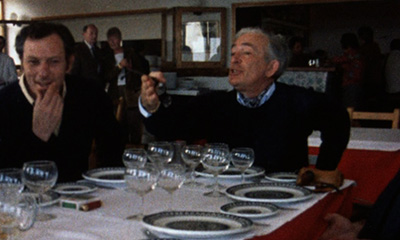
Image result for f for fakeWhile the Clifford Irving/Howard Hughes story has been made into a film (The Hoax), curiously no film has been made of the fascinating and enigmatic Elmyr, who outdid Welles in the Art of Deception. Here we see him give glimpses of his story, along with some rather curious observations. On his living on the Spanish island of Ibiza he comments, "It's not a place for snobbish society. It's not London. It's not Paris. It's not Omaha".

How our fair Midwestern city became a hotbed for the elites is left unexplained.

Seeing the forger's biographer explain Elmyr's life while a monkey pecks at his hair lends a touch of the bizarre to an already bizarre story. The whole Elmyr/Irving stories seem to delight Welles to where his wild yarn of the temptation of Picasso by Kodar seems his own contribution to delightful yarns.

If anything, F for Fake has as an unmentioned subject the contempt for 'experts'. Experts were fooled by Elmyr's work. Experts were fooled by Irving's work. Experts essentially condemned Welles to live in Citizen Kane's shadow. "God's own gift to the faker", Welles remarks on experts.  The lesson of "don't be spooked by the experts" that Elmyr worked under apparently inspired Irving when he tried it with the Hughes 'autobiography'. Perhaps even the reclusive Hughes himself, Welles speculates, pulled off his own deception by forever hiding.

If you go into F for Fake expecting a straightforward narrative on a couple or maybe trio of conmen you might be disappointed. The wild stories of Elmyr's forgeries and Irving's fake autobiography are covered but not the central premise. As a side note, Welles' pronunciation of 'biography' as 'bee-ography' may throw viewers off. Instead, go into F for Fake knowing that the wool will be pulled over your eyes and enjoy the deceptions.

It's like that game Two Truths & A Lie. Here is my version:

I was on a Broadway stage.
I once got five bowling strikes in a row.
I built my own house.

Which version of the truth would you like?

DECISION: A-

Wednesday, January 23, 2019

Othello (1952): A Review

Image result for othello orson wellesOTHELLO (1952)

Author's Note: this review is for the 1952 European release, not the 1955 recut version.

When it comes to the Orson Welles adaptation of Othello, there are two tragedies. The first is the actual story itself: a tale of jealousy, madness and murder most foul. The second is in how Welles essentially had to stumble his way through production, with numerous starts and stops in the filming. One, however, would mostly not notice all the oddities and jumbled nature of Othello. The film itself, though rather short, has some extremely inventive visuals, proving that necessity really is the mother of invention.

We open Othello with a funeral and a man chased and caged, so we already know there will be death and retribution. We then go in a more straightforward manner of Shakespeare's tale.

Iago (Micheál MacLiammóir) has a burning hatred for his Moorish general Othello (Welles) for being passed over as second-in-command for Cassio (Michael Laurence). Iago's frenemy Roderigo (Robert Coote) dislikes Othello for 'stealing' the beautiful Desdemona (Suzanne Clotier) from him. Her father Brabantio (Hilton Edwards) is displeased too, but is resigned to her 'disobedience'.

Sent to Cyprus to stop the Turks, Othello has a victory, but Iago starts his elaborate plot to bring down both Cassio and Othello. His plot involves disgracing Cassio, then getting him to try and have Desdemona plead for his case. The interactions between Desdemona and Cassio are then used by Iago to plant seeds of doubt in Othello about her fidelity, and soon Othello becomes ensnared by that 'green-eyed monster'.

Convinced now that Desdemona is Cassio's mistress, with a damning evidence of Desdemona's handkerchief as proof, Othello's rage grows murderous and tragic. With so much death and horror, Othello ends where we began.

Othello has a visual style that belies its cobbled together financing. Despite the limited resources we have some excellent moments where we don't notice the economic limitations. Welles has many moments where we do not see the actors deliver their lines, but instead we see the backs of them. It actually lends an air of mystery and suspense, giving the viewer a sense that there is greater torment or fury we can imagine.

A shot that Welles uses where we see him reflected in a mirror as Iago fills his mind with false evidence is meant for subtext about how Othello is now a reflection of himself, of his dividing mind before he becomes filled with murderous jealousy. It may be cliched, but it is effective.

Welles captures that sense of doom and tragedy and foreboding right at the beginning. It comes not just from the fact that we Othello and Desdemona's bodies carried for burial, but in Angelo Francesco Lavagnino's music. The music is dark, heavy, with a Gregorian chant style that pulsates with menace, even horror. Welles has several shots askew, again subliminally signaling the chaotic nature of this Moorish tragedy.

The economic nature of Othello works even when it deviates from the literal text or setting. The attack on Cassio and subsequent killing of Roderigo takes place in a Turkish bath, which is not from Shakespeare's text. It was set in a Turkish bath because the costumes were not ready and a logical place for men to be lightly clothed was needed to have the scene. Here, it works: the steam lending a greater menacing air.

In short, visually speaking Othello uses what resources it has at its disposal to lend the story a darker, heavier manner.

I cannot say I was particularly overwhelmed by the performances. As much as I like Othello I have never shaken the idea that Desdemona is a weak character, a blank almost dim woman. Clotier's performance does not enhance that idea. Even her final line, "Kill me tomorrow! Let me live tonight!" seems said less in the frantic, terrified manner I think of it in and more as a passive statement.

Welles similarly seems more theatrical and not in a good way. He seems surprisingly controlled in his rages. It's hard to mess up Iago, and MacLiammóir is appropriately cold and villainous as our false friend. One can believe his duplicity can deceive so many.

Othello is a visually arresting film, though sometimes the economical manner of it is obvious (a few times it looked like a still photograph was used rather than straight film). I think though that the lack of financing helped lend the film a more frantic quality, matching the Moor's growing desperation and rage. Perhaps it is not the best adaptation, and I leave it to you if Welles in dark makeup is a hurdle (though to be fair, it seems less outlandish than Laurence Olivier's version). It may also not be strictly true to the text.

On the whole, however, the visuals more than make up for any of its flaws, making Othello a truly sumptuous and tragic spectacle.

DECISION: A-

Sunday, December 30, 2018

The Other Side of the Wind: A Review (Review #1162)


THE OTHER SIDE OF THE WIND

The Other Side of the Wind was a legendary 'lost film', the uncompleted 'comeback' for Orson Welles, a man simultaneously admired and abused by Hollywood. After his death in 1985, it looked like The Other Side of the Wind would never be seen. The legend around the incomplete film grew with its various twists and turns (Lawsuits! Embezzlement! The Shah of Iran?!)  I doubt anyone expected Netflix, seen by some as a plague on cinema, would be the one to finally provide the resources needed to have The Other Side of the Wind finally released, long after most of the participants have died.

With The Other Side of the Wind finally released, I am of two minds on it. For those who love cinema, we can see elements of Welles' genius and of his bitterness and anger towards the film industry. However, for the casual film-goer, it will probably prove confusing and frustrating.

J.J. 'Jake' Hannaford (John Huston), a legendary film director, is celebrating his 70th birthday and working on his new film, The Other Side of the Wind, which is his response to the avant-garde overtaking cinema. He is trying to get finances to complete the film and the birthday party is an informal viewing party/fundraiser.

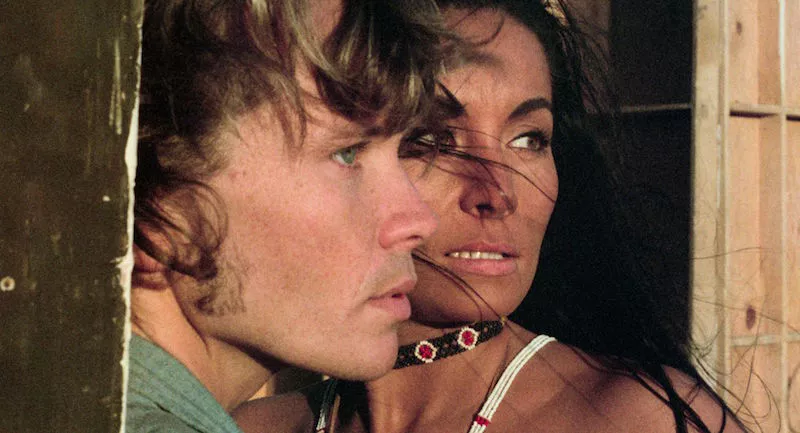
Image result for the other side of the windThere are a wide variety of cineastes and film students who have come to the party to record him, a precursor to YouTube and Instagram. At the head of his unofficial court is Hannaford's successful protégé Brooks Otterlake (Peter Bogdanovich), a master of mimicry. Hannaford has his regular crew which has been with him for years. He also has critics, in particular Julie Rich (Susan Strasberg), who has no love for Hannaford.

She also suspects that Hannaford, despite his macho persona may be a closeted homosexual who has fixations on his newest actor. That new find is "John Dale" (Bob Random), a beautiful young man whom he rescued from a suicide attempt while vacationing in Mexico. John Dale and a woman known only as "The Actress" (Oja Kodar) are the leads in this film-within-a-film, where they are mute and in various stages of undress (she almost wholly nude).

As the party goes on, and the power cuts out to stop people from seeing the unfinished film, the guests get drunker and nastier. A drive-in is quickly found to finish seeing the film, but Hannaford finds that his protege will not rescue him financially or creatively, and with all that he takes a swing at Rich for all but calling him a homosexual. He manages to get home, where he sees John Dale, whom he discovered had faked his suicide attempt to get his attention and is a professional actor. Hannaford invites him into the car he intended to give him as a gift after filming wrapped, but Dale silently declines.

As we know from the beginning that Jack died in an auto accident on his 70th birthday, we know where the story ends.

Image result for the other side of the windWhen seeing The Other Side of the Wind, a viewer has to keep some things in the back of his/her mind. Essentially, this is still an 'incomplete' film in that Welles, for a variety of reasons, never formally finished it. One should also keep in mind that because of all the troubles he had, particularly in finding finance, he shot The Other Side of the Wind in a variety of forms: black-and-white to color, high-speed film to traditional film stock, shifting wildly between them. Bogdanovich's opening narration explains in essence how this came to be (the pseudo-documentary culled from a wide group filming on their own individual cameras of varying abilities).

As it stands, the wild shifts in style flowed surprisingly well to where you soon forgot how things went from one to the other. Apart from the film-within-a-film footage (which was all the same) the movie's rapid shifts, sometimes within the same scene, weren't so jarring as to take one of the film.

As you watch The Other Side of the Wind, you gain a greater respect for the type of gonzo filmmaking Welles was creating, even if one is never sure this is exactly how Welles would have wanted the film presented. As he is not here to tell us if this is his definitive version (outside of a seance), one works with what one actually has.

The Other Side of the Wind has some truly hypnotic sequences, almost all of them involving the film-within-the-film. A love scene between 'the Actress' and 'John Dale' is particularly visually arresting. The final sequence where Kodar is walking in the desert, nude (she is almost always nude) and essentially deflating a giant penis is also very avant-garde.

However, one person's 'hypnotic' could be another's 'sleep-inducing', and I fear that The Other Side of the Wind is not 'commercial'. In many ways, The Other Side of the Wind may leave people puzzled by those rapid cuts and rather opaque film-within-the-film. I understand and respect that, and wonder if a more 'orthodox' manner would have worked if Welles had ever been given the option to create under more ideal circumstances.

Image result for the other side of the wind
Still, we see in The Other Side of the Wind how much Orson Welles was personally respected. You have a variety of actors who had worked for him before in small parts, such as Paul Stewart (who worked with him on Citizen Kane), Edmond O'Brien and Mercedes McCambridge. It's a credit to Welles that despite the hodgepodge the film is, he got them to act in a way that seems to make things cohesive.

There are other performances were also quite well-done. Bogdanovich plays Otterlake as an eager 'apostle' but one aware he has left the master behind. Norman Foster is tragic as Billy, Jake's worshipful aide who falls off the wagon in spectacular fashion. It is hard to judge John Huston's performance (Huston being the only other director apart from Welles to have a successful acting career, at least to my knowledge). He seems to be playing a version of himself: the 'director-as-god' type who slowly descends as the boozy night continues. Kodar, who was Welles' longtime mistress, has an enigmatic quality though she never speaks and is curiously referred to as "an Indian" despite Kodar being in reality Croatian.

The Other Side of the Wind has been released, and I find that it is a flawed but fascinating piece of art. Be forewarned: the rapid-fire editing and at times opaque plot (particularly of the fictional The Other Side of the Wind) may end up frustrating people who just want to be entertained. It does not make it a bad film or those who find it all rather odd dumb people. It is, as I said, a flawed but fascinating film, making one wonder about how Welles could have and should have done more work.

In his love-hate relationship with Hollywood, which had a love-hate relationship with Orson Welles, The Other Side of the Wind is both swan song and poison pen letter, his simultaneous send-up of New Hollywood and plea to be let in.

DECISION: B+

Friday, January 8, 2010

Orson Welles' Don Quixote: A Review


DON QUIXOTE
(AKA ORSON WELLES' DON QUIXOTE)

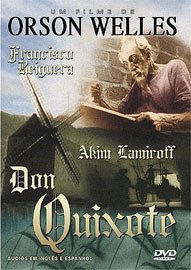
Don Quixote was the dream project for Orson Welles, and one could see similarities between the mad would-be knight and the journeyman filmmaker. Working on his own film version on and off for fourteen years, Welles scraped what funds he could whenever he could to continue his own version of battling with windmills. He would never finish Don Quixote, nor would it be finished in the lifetime of Francisco Regueira, who played the title character. 

With the aid of assistant director Jesse Franco and Welles' longtime companion Oja Kodar, Don Quixote now has something of a shape, but it's a disformed one. The footage itself shows Welles was still an extraordinary craftsman. The film shows he was unlucky and undisciplined in planning, with the end result a dull, convoluted effort. One can cut Welles some slack given the chaotic production, but it doesn't make Don Quixote any more bearable to view.

Don Quixote makes little to no sense plot-wise. Parts of the film appear to be a straightforward narrative of the Cervantes novel. A man becomes so enthralled with tales of knights and their ladies fair that he goes mad. Believing himself to be a great knight errant, the newly-christened Don Quixote De La Mancha (Reguira) goes to pursue his dreams of glory, aided by his "squire", a fat man named Sancho Panza (Akim Tamiroff). Quixote fights windmills thinking they are giants, slaughters herds of sheep thinking they are great armies, and attacks religious processions believing the penitents are being enslaved by cruel masters.

Somewhere along the line though the film shifts hodgepodge like from Don Quixote and Sancho Panza  not in 16th Century Spain but 20th Century Spain. There, primarily Sancho Panza is shocked by what he sees: television, a parade, a running of the bulls, and a film crew, one where Orson Welles is both director and star of a film project about Don Quixote.

As Welles died long before the various pieces could come together, what we have is a confusing production where everything seems jumbled with the hope of putting something together. The sloppiness of Don Quixote I believe is a result of the fact that Welles had no script to begin with. Welles also was hampered by by shoddy financing. One gets the impression he was forced to create two films and then try to mash them into one. The end results are a bit bonkers but endlessly fascinating. 

Viewers frankly don't know what's going on. If Don Quixote and Sancho Panza both came from the past, how did they get to the present? If they are from the present, how do they not understand present-day inventions? The audience is lead both ways, one moment with Quixote and Panza clearly not understanding the world they are in during some scenes, other times with Panza recognizing people in the present world as his relatives. 

It's obvious that the footage is a mix from various sources. The quality of the prints shifts, sometimes in the same scene. Scenes involving Welles look like a cross between outtakes and vacation movie footage. The worst moment of the production chaos comes when Quixote charges a religious parade. It's obvious that Quixote is charging them in daylight but it's equally obvious that the parade is taking place in nighttime. 

In a similar vein, it soon becomes clear that there is voice dubbing all throughout Don Quixote. The words heard on the screen don't seem to come from the lips of the actors on the screen. You have much narration in an attempt to disguise the fact the film was made with no real soundtrack. 

All that isn't to take away from what good things there are in the film. Francisco Regueira is a perfect Don Quixote: his gaunt face and lean frame seemingly tailor-made for the description of the character. Some of the footage shot is absolutely marvelous to behold, the fight with the windmill especially so. Daniel J. White's score is also excellent and helps make many of the silent scenes visually splendid.

Don Quixote and Don Quixote both capture the career and vision of Orson Welles himself. They are both dreamers, seers of visions but trapped by fortune and reality, forever charging at windmills and getting knocked off their horse. 

It is a terrible loss for cinema that neither of Welles' ideas for Don Quixote either as a straight retelling or shifting the characters to the modern world, ever came to be finished. A documentary about the failed, perhaps doomed Don Quixote project would have been good, with some effort at restoration.  Ultimately, I think the final product, though given the best effort possible, will leave few satisfied. 

If you are the type to love watching incomplete projects and don't mind taking an hour or two to see some brilliant footage, Don Quixote is worth your time. However, if you want to see an actual movie, you might be better to read the book.