Friday, August 18, 2023

Mr. & Mrs. Smith (1941): A Review

MR. & MRS. SMITH

This review is part of the Summer Under the Stars Blogathon. Today's star is Carole Lombard.

While Alfred Hitchcock was the Master of Suspense, there is one outlier in his oeuvre that still puzzles people today: the romantic comedy Mr. & Mrs. Smith. Short and breeze, Mr. & Mrs. Smith works well despite its questionable logic. 

David Smith (Robert Montgomery) and his wife Ann (Carole Lombard) are a battling but ultimately couple. After their last three-day fight ends, Ann asks a rhetorical question: if he could do it over again, would he marry her?

David goes for the honest route and says No. While he loves her, he would keep his freedom first and for a bit longer. This is an exceptionally dumb answer, but it turns out to be prophetic. The clerk from where they got married comes to New York and tells David that, due to a legal technicality, their marriage is invalid. Unfortunately for David, the clerk is an old family friend of Ann's, and he stops by to see her and tells her the same.

David thinks he'll get a mistress first, then a wife. He did not count on Ann's rage at his attempted seduction. Soon, Ann is living the single girl life while David is relegated to living at his club. She also is wooed by Jefferson "Jeff" Custer (Gene Raymond), a Southern gentleman who is also David's law partner. As David continues his efforts to win his wife back, Ann has growing and conflicting feelings for her potentially former husband. Will our cuckoo lovebirds find each other's love nests?

I figure many would be astonished at the idea that Alfred Hitchcock could make a straightforward screwball comedy. However, Mr. & Mrs. Smith proves that Hitchcock was capable of working in this genre. The movie moves quite quickly to where one is surprised that so much can fit into a breezy 94 minutes. 

One can see how well Hitchcock could work within this genre in certain scenes. For example, there is a great moment when both David and Ann end up in a swanky nightclub. A clearly embarrassed David is already aghast at the girls his club friend Chuck (Jack Carson) whipped up for them. His first attempts to fool Ann by miming a conversation with the more attractive female next to him is amusing. That is followed by his disastrous efforts to get out of the club by giving himself a bloody nose.

Not to be outdone, Lombard has a great moment herself when Ann and Jeff go to the World's Fair and are stuck on a ride where they must endure the rain. Seeing the elegant Ann all wet and flustered, followed by her efforts to be coy with a courtly but drunk Jeff show Lombard's skills as a comedienne. She has another great moment when she expresses some puzzlement over why her wedding suit no longer fits three years later. The gag works, and Lombard sells her mix of embarrassment and attempted befuddlement well.

Mr. & Mrs. Smith has not only amusing comic bits but a surprising amount of risqué moments. Early on, Ann is playing a version of footsie with David, pulling away as soon as he says he would not remarry her. David at one point writes, "Miss Krausheimer" when thinking about his unexpected situation with Ann. He then crosses it out and substitutes "Mistress" for "Miss". While "mistress" is technically used correctly, the implications around "mistress" are all but poking at the censors. The film ends with her skis crossing each other, which is as overt a suggestion of sex as the censors would allow (or miss).

Lombard and Montgomery work well together as this oddball couple. Lombard had an exceptional ability to be simultaneously glamourous and silly. Here, she does wonderfully as Ann, who has something of a childlike innocence when it comes to David but who is also understandably angry at his behavior. She has a wonderful moment late in Mr. & Mrs. Smith when she attempts to hoodwink him by pretending to be with Jeff by making a lot of noise and carrying a one-sided conversation with him. 

Montgomery too does great work as David. To be fair, it is hard not to see David as a jerk, forever doing or saying idiotic and insensitive things. That we like him at all is a credit to his abilities as an actor. In smaller roles, Gene Raymond and Jack Carson were amusing. Raymond's Jeff had a great moment when playing drunk. The Southern accent was not overdone, and even allowed for some humor at his expense. David, upon learning that Jeff has asked Ann out, calls him a "hillbilly ambulance chaser". Not to be outdone, Jefferson's parents are horrified when learning of the Ann/David situation. "What kind of white trash are your going around with?", Jeff's parents angrily ask.

Carson's more genial and randy Chuckie was equally amusing and almost stole the film in his few scenes. His telephone call to one of his girls, complete with blowing kisses, was light and enjoyable.

Norman Krasna's screenplay flows well, even if the logic of the plot is extremely thin (it's highly dubious that the marriage would be invalid due to a geographical dispute over who could perform the ceremony). Still, a film like Mr. & Mrs. Smith does not exist out of logic. In fact, it is the illogic that makes it more amusing.

Finally, Mr. & Mrs. Smith was the final film released in Carole Lombard's lifetime. Her tragic early death in an airplane crash is still one of the greatest losses to film. One can only imagine how, had she lived, she might have become one of Hitchcock's cool blondes in a more dramatic role. 

Alfred Hitchcock had comedy bits in some of his films and at least one other film, The Trouble With Harry, is more comedic albeit of a black variety. As the only pure comedy in his filmography, Mr. & Mrs. Smith more than stands on its own as a nice, pleasant film. 

Hitch, we hardly knew you...

DECISION: B+   

Tuesday, August 15, 2023

A Double Life: A Review (Review #1740)

A DOUBLE LIFE

This review is part of the Summer Under the Stars Blogathon. Today's star is Ronald Colman.

Long before the Method style of acting became embraced, if not abused, by generations of actors, the idea of getting too much in character was brought to life in A Double Life. With eerie effectiveness both in front and behind the camera, A Double Life weaves its story of madness and murder exceptionally well.

Anthony John is a Broadway legend best described by others thus: "he's a good actor but he's no good". No one questions his talent. It is his inability to separate himself from his roles that makes him both brilliant and maddening. He's fine when playing comic roles such as in his latest hit, A Gentleman's Gentleman. However, John is now offered the lead in Othello, which has him worried.

Also worried is his ex-wife and acting partner Brita (Signe Hasso). They've maintained a good working relationship on stage and are friends off. She, however, knows that John can get too involved in his performances to where fact and fiction blend into his reality. Despite some misgivings, John agrees to play the Moor of Venice, much to the delight of his press agent, Bill Friend (Edmond O'Brien). John, for his part, has taken to Pat (Shelley Winters), a pretty, somewhat tartish waitress he is starting a romance with.

It is not long before Anthony John has another triumph on the Great White Way, with Brita as his Desdemona. It's such a wild success that the show is extended going on two years. However, John is slowly becoming Othello to a dangerous degree. Growing more jealous of Bill's not-so-secret love for Brita, John once comes close to literally murdering Brita on stage to an unsuspecting audience and a terrified ex-wife. Will John's growing inability to separate stage from self in turn lead to murder? 

There is a story about the making of Marathon Man. Dustin Hoffman, very versed in the Method, allegedly stayed up awake for days to replicate what a deeply sleep-deprived man would experience. His costar, the anti-Method actor Laurence Olivier, reported told him, "My dear boy, why don't you try acting?". One might imagine an actor like Anthony John being more from the Laurence Olivier school. He would unlikely be so into character that he would run around murdering people to experience what Othello went through.

However, Anthony John is already a troubled person who has managed to channel his mental health issues on the stage. A Double Life reveals that for some, reality and fantasy can easily blend dangerously close together. We see this both in George Cukor's directing and Ronald Colman's performance. More than once does Cukor show Anthony John facing his reflection, an overt symbol of John's growing split with himself. Cukor also uses sound effects and voiceovers exceptionally effectively in the film. Both reflect John's growing instability along with his understanding that he is losing his grip on reality.

We see this when during a montage of John fleeing into the night after a row with Brita, he hears his own thoughts mixing with his Othello lines. Soon to John, he is no longer able to tell which ideas are his and which are his character's. It is not often that someone acting via voiceover works. Here though, Colman and Cukor did brilliantly in bringing that to life. Colman's voice, separate from his mouth, but also coupled with his face show the man coming apart. As he himself says in a long montage of how Othello is coming together, "You're two men now, grappling with control".

A Double Life is surprisingly modern in its take on actors giving themselves too much to their roles. The scene where John is so lost in character that he starts to literally strangle Desdemona/Brita is a fine piece of acting from both Colman and Hasso. To be fair, I think Hasso at times was more theatrical than I think she should have been. However, as she played a theater actress, I can allow for a little leeway.

A Double Life is certainly a showcase for Ronald Colman, who won the Best Actor Academy Award for his performance. He not only plays the disintegrating Anthony John, but also plays both Othello and the lead in the faux comedy A Gentleman's Gentleman. He does exceptionally well in all the roles he plays, his face and voice working to bring the viewer fully in. 

The Ruth Gordon and Garson Kanin script has a little bit of this comedy performed on the stage, and it's a curious thing that the fake play looks rather good. Here, Colman is light and amusing as the manservant who manages to elegantly run off with an elegant lady. Colman and Cukor did an interesting thing when Pat is in danger. As John's grip is undone, he does not rage or go on a tirade. Instead, it is a quiet madness that overtakes him. Colman's performance and Cukor's direction make this sequence effective and terrifying.

Shelley Winters for years claimed to have been nominated for Best Supporting Actress for A Double Life until future Turner Classic Movies host Robert Osborne corrected her on the Dinah Shore daytime show Dinah!. A slightly dotty Winters replied, "Are you sure?". While I would have said her part was rather small, she did well as this somewhat trashy but ultimately tragic figure. 

The film also even allows for a bit of comedy, such as when actresses are auditioned to impersonate someone else. It's amusing to see how these three women despite the seriousness of the situation are concentrating only on selling their abilities to those trying to prove John is dangerous. Another scene with cynical reporters reporting on crime also reveals that A Double Life does have elements of black comedy.

A last point is Miklos Rosza's Oscar-winning score. In turns moody and modern, shifting from traditional pseudo-Elizabethan music to almost noir like, the score worked in tandem with the sound effects brilliantly.

A Double Life is a brilliant film on the dangers of going full Method when acting. 

DECISION: A-

Monday, August 14, 2023

Random Harvest: A Review

RANDOM HARVEST

This review is part of the Summer Under the Stars Blogathon. Today's star is Greer Garson.

Some films suffer from their reputation. Citizen Kane, for example, has been so mummified as "one of the greatest films ever made" (at least until Spider-Man: Across the Spider-Verse overtook it in the pantheon of cinematic triumphs) that people forget that Citizen Kane is also a really good movie. I feared the same thing about Random Harvest, a movie held as one of the greatest love stories that I worried it would not live up to its reputation. At long last, I took the plunge and found that the rumors are all true. Random Harvest is a beautiful love story, with two exceptional performances that move the audience. 

A shell-shocked and amnesiac World War I veteran slips out of the asylum he's been in ever since he was transported back to Britain in the celebrations of the Armistice. Coming across him in his confusion is Paula (Greer Garson), a dance hall girl with a traveling troupe. She takes pity on him and begins to nurse him back to health. Soon, the man she calls "Smithy" (Ronald Colman) starts gaining confidence, but not his memory.

Eventually, they fall in love and marry, shortly afterwards blessed with a son. Smithy begins a writing career and becomes successful, so much so that he is asked to interview for a permanent position in a Liverpool newspaper. While Paula recovers from her difficult pregnancy, Smithy goes on his own, taking his luggage and the key to their cottage. In Liverpool, he meets with a car accident. This accident simultaneously revives his old memories as Charles Rainier and erases the last three years of his life with Paula.

Now back in the Rainier family fold and having inherited both the family business and the estate of Random Hall, he assumes his place in business. His step-niece Kitty (Susan Peters) openly flirts with her "uncle" and he soon is charmed enough to squire her around town. As he becomes an industry tycoon, he finds himself relying more and more on his loyal secretary, the widow Miss Hanson. Miss Hanson was married but her husband and young son died, leaving her alone.

Miss Hanson is also Paula. She recognized him from a newspaper photograph after he disappeared and managed to get close to him. As Charles has no memory of his life between his World War I experience and the Liverpool accident, he would not remember Paula. Every so often though, he plays with the key he had with him on the day of the accident. What is that key? Will Charles and Kitty marry? Will Paula manage to get Charles to remember Smithy? Will Paula and Smithy end up reaping their Random Harvest? 

Random Harvest is a quiet film, and that quietness is what makes it so moving. There are no big dramatic moments or chances for hysterics. In fact, apart from an early moment where Paula is entertaining the audience with a slightly randy Scottish-centric song and dance, Random Harvest is pretty gentle and tender. That is exactly what Random Harvest should be, as the movie is focused on the tragedy that our lovebirds experience. 

Random Harvest has four elements that make it the beautiful love story that it is. The performances from Colman and Garson are just beautiful. Colman's demeanor changes from the halting, hesitant, almost fearful Smithy to the strong, confident and secure Charles. Colman uses his beautiful voice to show the difference between pre-and post-amnesia. When he is Smithy, he stumbles over words, looks unsteady and confused. Once he falls in love with Paula, we see him a joyful man. After his accident, we see the confident figure that Charles was. Each transformation works in an exceptional performance. Colman has a wonderful silent performance when he stares off into the distance while listening to the hymn O Perfect Love while selecting songs for his impending wedding. As he and Peters stare at each other, they do not have to say anything. All that is needed to be said is done with their looks. 

Garson has a harder task because she does not change. Showing a surprisingly lighthearted side when singing about her bonny Daisy, Garson is deeply moving in the film. As "Miss Hanson", Paula repeats her story of how her child died to Charles. The heartbreak of both reliving this painful moment and telling the oblivious father that his child is dead while controlling herself is so clear in Garson's face. In her caring for Smithy and her inability to reveal herself to Charles Rainier, Garson simply gets to the viewer emotionally. 

The third element is director Mervin LeRoy. Using the Claudine West, George Froeschel and Arthur Wimperis adaptation of James Hitlon's novel, he not only directs his actors to these moving performances but also uses subtext to reveal story. That scene where Charles and Kitty look at each other and realize that Charles is in love with someone he cannot remember is so beautifully directed. "I am so nearly the one," Kitty observes, a painful admission to herself and him that while he would make a good husband, his heart belongs to a woman he does not know. Near the end, as Charles' memory of his three years comes slowly back, we see Garson's face emerge from a fog. It is a beautiful and intelligent moment of symbolism of Charles' own fog lifting to reveal the true love of his life, who happens to be his own wife.

Finally, Herbert Stothart's score fits so well into Random Harvest. It lifts the moments of love and loss, echoing the tragedy and triumph of this O Perfect Love. 

One must have a heart of stone not to get at the least misty-eyed at the tragic circumstances of the Charles/Smithy and Paula romance. Greer Garson and Ronald Colman work so well together in Random Harvest. If there are some complaints, it might be that Colman might have been too old to play Smithy/Charles (he was 51 at the time to Garson's 37). The film at a bit long at a little over two hours may also be a tough watch for some; on the whole though, Random Harvest will still move the viewer with its story of love found, lost and found.  

DECISION: A+

Sunday, August 13, 2023

Somebody Up There Likes Me (1956): A Review

SOMEBODY UP THERE LIKES ME

This review is part of the Summer Under the Stars Blogathon. Today's star is Paul Newman.

Paul Newman's first film, The Silver Chalice, was a lifelong embarrassment for him. So horrified was he by the experience, he turned down the lead in 1959's Ben-Hur by saying he would never again act "in a cocktail dress" (meaning Roman-era period costumes). His film career seemed pretty much over before it began. However, like the central character in Somebody Up There Likes Me, Newman's third film turned out to be the charm. 

Growing up unloved and abused by his father, young Rocco Barbella is forever fighting the world. Running with a group of Lower East Side New York hoods, Rocco goes from juvenile hall to reform school to Riker's Island, with only his mother (Eileen Heckart) to care and worry about him. Rocco eventually appears to finally be going straight; however, he is immediately drafted into the Army upon his release.

Rocco, still too stubborn or stupid or both to understand, gets into fights with his Army superiors and eventually goes AWOL. Remembering an old prison mate who told him he could help him out if he did a little boxing, Rocco goes to the gym and immediately impresses trainer Irving Cohen (Everett Sloane). Adopting the name Rocky Graziano (Paul Newman), Graziano's raw talent makes him a standout. Cohen is puzzled by Rocky's refusal to train and his insistence on leaving right away. Eventually found out, Rocky is sent to Leavenworth for a real and dishonorably discharged.

Rocky, however, goes back to boxing, with Cohen eager to welcome back his protege. He soon starts making a name for himself, and even marries Norma (Pier Angeli), a nice Jewish girl with whom he builds a life. Rocky, however, can't outrun his past, where his old frenemy threatens to blackmail him if he does not throw a fight. Rocky refuses, but it still costs him. Will Rocky rebuild his life and career to become the middleweight champion of the world?

While Newman forever bore a grudge against The Silver Chalice, he appears not to have held one against his The Silver Chalice costar Pier Angeli, with whom he reunited for Somebody Up There Likes Me. In a curious turn, Angeli's former lover, James Dean, was originally set to play Graziano before Dean's unexpected death. That tragedy allowed Dean's contemporary Newman to take the role. One can only wonder what James Dean would have done with the role of this volatile boxer.

I imagine that Dean would have been better than Newman. I think Newman went wildly overboard in his portrayal of Graziano, more focused on Graziano's mannerisms and cadence than in finding the man himself. Newman came across as a walking Italian American stereotype: the goombah who was always angry and quite dim. I could never shake the idea throughout Somebody Up There Likes Me that Newman was simply trying too hard to be this tough-talking, brawling, uneducated guy. In a montage between Rocky's rising career and family life, he tells an acquaintance, "Can I help it if she's pregnant?", to which he can only sheepishly raise his shoulders and give an equally sheepish look when he realizes what he said. 

As I said, Newman was forever making Graziano a total goombah. That might be how the real Graziano spoke and moved, but I found Newman's performance too calculated to be natural, which is ironically what I figure Newman was going for. 

Newman veered dangerously close to parody with his Graziano. At one point, an officer says, "I gather from your records that you are from New York City". I asked myself why Barbella's massively thick and broad "Nuw Yawk" accent did not clue him in to that fact. To my mind, it was as if Newman's physicality and mannerisms were so overt that Graziano the man got lost. Over and over again, I kept seeing a young actor playing a part, not being the character. To be fair to Newman, he was still very immersed in the Method style of acting and was still finding his sea legs in film. As such, it is not surprising that Newman focused more on his accent and body language than in a character.

This style of acting affected a few others, particularly Sal Mineo as Rocky's running partner. He too seemed more interested in affecting the Nuw Yawk accent and being a bit more deliberate in his performance. To be fair to Mineo, at least he was from New York versus Ohio's own Paul Newman. I found those who did not go all-in on the Method were more believable in their performances. A standout was Heckart as Ma Barbella. Forever worried about her wayward son, she seemed genuine in her agony versus Newman, who was acting very anguished. Sloane too did well as the confused but ultimately supportive trainer. 

Angeli did well as Norma, the woman who loves her man despite his struggles. She was more authentic than Newman, which says more about the level of Newman's Method manner with Graziano than about her. 

Somebody Up There Likes Me does well in the boxing matches and in getting the gritty world Graziano lived in. Once we get past the constant brawls Graziano got into, we got a good story. On the whole, Somebody Up There Likes Me is not bad, but it feels long. It also has a central performance that seems too calculated to appear real. Still, it is an acceptable introduction to both Paul Newman and Rocky Graziano.

1919-1990


DECISION: C+

Saturday, August 12, 2023

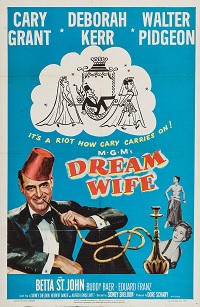
Dream Wife: A Review

DREAM WIFE

This review is part of the Summer Under the Stars Blogathon. Today's star is Deborah Kerr.

Deborah Kerr (rhymes with "star") was on screen a woman of elegance. As such, it seems a curious fit to see her in what is meant as high romantic farce. Dream Wife certainly tries to be that, but somehow it does not come off.

The Khan of Bukistan is the key to a major oil concession, one that the State Department would love to negotiate on favorable terms. For his part, His Majesty is pleased with businessman Clemson Reade (Cary Grant). Clem for his part finds the beautiful Princess Tarji (Betta St. John) equally pleasing, even if he speaks no word of Bukistani.

Clem's great goal is to marry "Effie" Effington (Deborah Kerr), a high-ranking State Department official. Effie however, is simply too wrapped up in her work to be even remotely interested in Clem. She thinks nothing of delaying their wedding and seems to almost go out of her way to ignore him. Surprising to Effie, Clem breaks off their engagement and turns his eye to the Princess. Perhaps as a joke, Effie sends the telegram Clem had thought of sending to Tarji to propose marriage.

To the shock of all, the Khan accepts! Making matters worse, Effie's boss McBride (Walter Pidgeon) assigns her to be Tarji's minder (apparently, she is the only American who speaks Bukistani fluently). As Clem attempts to bridge the cultural divide almost blind, Effie trains the Princess in the ways of the Western woman. Will the Princess find women's lib? Will Clem get anywhere close to a kiss? Will Effie reveal more than her real name of "Priscilla" to her ex-fiancé?

Dream Wife was not only cowritten by Sidney Sheldon (along with Herbert Baker and Alfred Lewis Levitt) but directed by him. Perhaps this is why Dream Wife feels curiously sluggish and somewhat forced. So much of Dream Wife feels forced, as if the cast and crew is dead set on making things funny that it ends up almost never being funny. 

There were, to be fair, a few moments where I did laugh. Both of them involved Cary Grant, who was a master at being simultaneously elegant and silly. The first is when dancing to various styles of music to set the mood for his dinner date with Effie. The second is when, on his wedding day, he sees Effie pass by and asks, "Priscilla, what are you doing tonight?".

Grant is very determined to sell Clem's constant frustration at being essentially prostituted for the Khan's oil; as a side note, this plot element reminded me of Protocol, which also had an American sold to a foreign potentate. Unlike Protocol though, Clem was fully aware of what was going on, but seemed incapable of finding a way out of it. 

I can see why Cary Grant appeared in something like Dream Wife. Sheldon had won an Oscar for his screenplay to The Bachelor and the Bobby-Soxer, a big hit for Grant. Grant certainly works hard to sell the premise. However, the premise makes Clem look like a total idiot with no ability to think. It also takes a curious tactic in suggesting that somehow, he is the bad guy for being in the situations he finds himself in.

Perhaps Dream Wife was making a case for how American women were the equals to men, but Clem's frustrations at being ignored were quite valid. Here he is, eager to marry Effie, but she is the one who puts business before pleasure. She keeps letting work get in the way, up to where she openly ignores Clem for McBride at what is meant to be an intimate dinner. From my perspective, Clem was absolutely right for being irritated at being ignored. Moreover, he was if not right at least within his rights to be upset about being denied even a simple kiss due to Bukistani customs.

That does not take away from how dumb Clem is. In all the time he is with Tarji, he very late in the film appears to finally learn even simple Bukistani words. To be fair, it seems hopelessly ridiculous to think no one apart from Effie spoke Bukistani. She appears to lord that fact and ability over everyone, which does make her look good. 

Like Grant, Kerr at least was game for trying to be light. Also, like Grant, Kerr could not pull it off. To be fair, she did have a great scene when, using her feminine wiles, she hoodwinks the Khan to keep both the wedding and the treaty going. She was actually better when with St. John, and here Dream Wife appears to find a better angle for a story. Their scenes together, when Effie is educating our foreign princess on the ways of modern woman, work well. You almost long for a film focused on Tarji's awakening, with Clem being the object of her misguided affection. Again, this suggests a precursor to Coming to America: the foreign royal who adopts a more Western worldview. 

Still, underneath what is meant to be lighthearted, Dream Wife has a pretty cynical view of the world. The fictional Bukistan, vaguely Middle Eastern, vaguely Indian, is a place that would make Barbie's "Kendom" look positively progressive, with its sexual segregation and women who are trained to only please men. The Khan wryly observes, "American women are not mothers. They are fathers". How that would play now one can only guess.

Dream Wife is really a B-picture with A-level talents. There is a germ of an idea here, one that might benefit from a remake. As it is now, it is not a nightmare, but no sweet dream either. 

DECISION: D+

Friday, August 11, 2023

Zero Hour!: A Review

ZERO HOUR!

It is now hard, if not impossible, to watch Zero Hour! without some laughter. Now remembered most notoriously as the inspiration for the spoof Airplane!, Zero Hour! lends itself to open mockery in its sincerity. 

Royal Canadian Air Force pilot Ted Stryker (Dana Andrews) once led men on aerial combat runs at the end of World War II. A botched mission however has gotten some of his men killed, which leaves Stryker guilt-ridden. 

His post-traumatic stress disorder has left him a shell of a man, forever haunted by his wartime experience. Now eleven years after the end of the war, he's had twelve jobs in ten years. However, things appear to finally turn around for him thanks to an old friend. It is unfortunate that when he goes to tell his wife Ellen (Linda Darnell) and son Joey (Raymond Ferrell), they've bolted. She left a note telling Ted they are moving clear across Canada.

Ted hurriedly books their flight to intercept them and try to win Ellen back. A crisis, however, emerges when the in-flight meal causes food poisoning among the passengers and crew, including Joey. As flight attendant Janet (Peggy King) is told, "The lives of everyone on board depends on one thing: finding somebody back there who not only can fly this plane, but who didn't have fish for dinner". 

Ted, aided by Ellen at the controls, must now overcome his PTSD to land the plane safely. He is guided by Captain Mike Treleaven (Sterling Hayden), who coincidentally was his commanding officer and still blames Stryker for killing his men. While Trevleaven muses, "Looks like I picked the wrong week to quit smoking", he must join forces with his frenemy Stryker to save the passengers from certain death.


It is difficult for anyone who has seen Airplane! to judge Zero Hour! objectively. Minus a few plot changes (Zero Hour! has Ted and Ellen married with a child), Zero Hour! is pretty much Airplane! with a straight face. Even the original film's exclamation point in the title is ripe for parody. 

As a side note, I think the exclamation point in Zero Hour! unintentionally adds to the ridicule factor that the Airplane! writing/directing team so effectively mocked. Even if Airplane! had never been made, Zero Hour! adding that exclamation point opens the film up to mockery in its dogged determination to be a gripping drama only ending up looking laughable.

Whole bits of dialogue and scenes from Airplane! are lifted verbatim from Zero Hour! leading to at the least suppressed giggles, at most outright howls of laughter. Perhaps the most notorious section is when Joey goes to the cockpit and marvels how he's never been in one before. Another scene has a female passenger going into hysterics as others try to calm her down. Perhaps intentionally, perhaps not, while Airplane! features basketball great Kareem Abdul-Jabbar at the controls, Zero Hour! has football player Elroy "Crazylegs" Hirsch copiloting the endangered flight. 

I ask though, would people who have never seen Airplane! laugh if they watch Zero Hour! instead? While it would require someone who actually has never seen either, my sense is that the answer is yes. I think it has to do with the earnestness of the actors. By playing EVERYTHING so serious, it has the opposite effect and makes things unintentionally funny. Hayden and Andrews in particular came across as overdoing the acting: tough in the former, shell-shocked in the latter. Their combined efforts came across as more hilarious than gripping.

I think a major flaw in Zero Hour! is when we get the stock footage when Stryker has his flashbacks. Coupled with Andrews' stoic face, the result is if not laughable at least curious. Over and over again, the determined efforts to make Zero Hour! into this gripping domestic drama went so overboard that one can only marvel at the unintentional humor of it all.

Dana Andrews, Sterling Hayden and in her all-too-brief career Linda Darnell did their best to make Zero Hour! what it was intended to be. I cannot blame them wholly for the end results. That would be director Hall Bartlett, who opted to not let his actors move beyond a certain level of performance. The few times Bartlett and his fellow screenwriters Arthur Hailey and John Champion tried to inject a little bit of levity via either Stewardess Turner's comic boyfriend or a tipsy Scotsman end up not being amusing. There was more fun to be had at the hysterical passenger (hysterical in every sense of the word).

As a side note, Zero Hour! was the last film released in Darnell's lifetime before her tragic and untimely death. 

Zero Hour! has become famous or infamous as the source of one of the greatest comedies and spoofs every made. It is not terrible but now forever lives in the shadow of the film that mocks it. 

Thursday, August 10, 2023

Out of the Past: A Review (Review #1735)


OUT OF THE PAST

This review is part of the Summer Under the Stars Blogathon. Today's star is Rhonda Fleming.

Out of the Past is a lurid tale of betrayal and immorality. In short, it is a perfect film noir, with excellent performances and a strong story.

Seemingly straight-arrow mechanic Jeffrey Bailey has a sordid past. It is one he eventually reveals to Ann (Virginia Huston). His real name is Jeff Markham (Robert Mitchum), a shady private investigator whose last assignment came courtesy of mobster Whit Sterling (Kirk Douglas). Jeff and his partner Fisher (Stevie Brodie) are to look for Whit's moll, Kathie Moffat (Jane Greer), who both shot him and ran off with $40,000.

Jeff tracks her down to Acapulco, but it is not long before he too falls under the spell of the fatal beauty Kathie. They conspire to run off together and shake off Whit and his goon, Stefanos (Paul Valentine). While Whit does catch up with Jeff, Kathie is able to get away back to America. Their idyll comes to an end when Fisher, still angry about being cut out of the reward money, tracks both of them down. Kathie is not above a little murder, though, to keep herself out of trouble.

Now, moving to the present, Whit has a new assignment for Jeff. He is to procure tax records held by crooked lawyer Leonard Eels (Ken Niles), which Eels has been using to blackmail Whit. Kathie appears to have reunited with Whit, but is she on the level? What about Eels' secretary, Meta Carson (Rhonda Fleming)? There are more double-crossings and murders before almost everyone gets their just desserts, but will Ann and Jeff's deaf/mute friend The Kid (Dickie Moore) live to have a happy ending themselves?

Out of the Past, even at a brisk 97 minutes, moves surprisingly fast. A good amount of credit should go to director Jacques Tourneur and screenwriter Daniel Mainwaring, who adapted his novel Build My Gallows High for the screen. Oftentimes flashbacks stop a film cold. At the very least, they tend to slow down a film, but not here.

I think it is because Out of the Past has only one extended flashback and has it early in the film. The film also has a sense of logic to the flashback in the form of Jeff telling his story to Ann. It does not use the trope of having the individual drift into memory. Instead, he recites it, so it makes sense. Fortunately, once we leave the past, it stays there. 

Out of the Past also has strong dialogue and scenes that reveal more than what the censors would allow. As Stefanos talks to a local townsperson about how he "accidentally" came across Jeff Bailey's garage, she says, "It's a small world". Stefanos replies, "Or a big sign". Ostensibly referring to the sign advertising Bailey's garage, there is a subtext about how in reality Stefanos saw his "sign". 

Jeff remarks that he and Kathie did everything "at night", a curious suggestion about their relationship. A more overt but still subtle reference to their torrid affair is when Jeff tosses a towel that knocks a lamp out, followed by a door swinging open during a storm. They had sex, but we weren't about to show that. Audiences then and now should figure that Out of the Past was saying enough without having to spell it out. 

Mainwaring's dialogue again reveals a lot more than what is actually said. Shortly after seeing Kathie again, Jeff tells her, "You're like a leaf blown from one gutter to another," and I think the use of "gutter" is apt for someone as wicked as Kathie.

Each performance, large or small, is pitch perfect. Jane Greer is brilliant as the femme fatale of femme fatales. Alluring, able to play all the men she meets for fools, Greer plays Kathie as ambiguous as well as devious. One never really knows if she genuinely loves Jeff or is just using him as a means to an end. As Jeff and Fisher fight in front of her, Greer gives Kathie a cold, almost aroused look. Kathie does not look terrified or afraid but excited to see former friends battle it out. It's a wicked look, revealing so much about Kathie.

Mitchum here has one of his most definitive roles as Jeff. He is a center of what little morality there is in Out of the Past. One senses that Jeff does want to start fresh with Ann, but he is also capable of ruthlessness. A tearful Kathie tells him, "I don't want to die", to which Jeff replies coldly, "Neither do I, baby, but if I have to, I'm going to die last". Smart enough to outwit Whit, but perhaps dumb enough to keep getting pulled by Kathie, Mitchum makes Jeff both antihero and sap.

Douglas was starting out in films with Out of the Past, and while not physically imposing as Mitchum, his quiet confidence as the ruthless Whit works well. Paul Valentine's Stefanos was menacing with a smirk, and Rhonda Fleming's perhaps duplicitous, perhaps innocent secretary also makes one guess where on the moral scale she fits in.

Out of the Past is one of the great film noirs made, its reputation highly earned. Fast, efficient and effective, Out of the Past works on every level possible.

DECISION: A+