Showing posts with label David Lynch. Show all posts

Wednesday, January 7, 2026

The Elephant Man: A Review


THE ELEPHANT MAN    

The story of Joseph Merrick*, better known as The Elephant Man, is strange and tragic. Perhaps that is why David Lynch would be the ideal director for this story. The Elephant Man is a deeply moving, sympathetic portrait of a man disfigured in body but magnificent in soul. 

Dr. Frederick Treves (Anthony Hopkins) visits a Victorian sideshow featuring all sorts of human exhibits. There is one, however, so shocking that the police close the whole thing down. Nevertheless, he persisted. Treves bribes Mr. Bytes (Freddie Jones), who owns this particular human exhibit to have a private showing. Dr. Treves has seen the figure dubbed by Bytes as "the Elephant Man".

This unfortunate soul, however, is not seen by the viewing audience for some time. Treves takes the Elephant Man to London Hospital. Despite the misgivings of head nurse Mrs. Mothershead (Wendy Hiller) and hospital director Mr. Carr Gomm (John Gielgud), the Elephant Man now has a home. Treves at first thinks that the patient is as mentally crippled as he is physically. In reality, we find that the patient is kind and a man of faith. 

He is also John Merrick (John Hurt). To everyone's shock, Merrick quotes the whole of the 23rd Psalm and not just what Treves has taught him. News of the Elephant Man intrigues two distinct people. The first is noted British stage actress Mrs. Kendal (Anne Bancroft), who sees the gentle, elegant soul beneath the horrifying exterior. The other is corrupt hospital porter (Michael Elphick), who sells access to Merrick without the London Hospital's knowledge.

Things look to be improving when none other than Her Royal Highness Alexandra, Princess of Wales (Helen Ryan) uses soft power to keep Merrick at London Hospital on a permanent basis. However, Bytes has managed to use the hospital porter to spirit Merrick away to Europe to return to the freak show. Will John be able to find his way back to the safety and security of London Hospital? Will the Elephant Man find peace?

David Lynch is on his second film with The Elephant Man. Yet, his directing has such confidence coupled with Lynchian eccentricities that it feels like the work of a mature filmmaker. The Elephant Man opens with a strange scene of a woman screaming in panic as elephants go by. The film holds back on revealing what John Merrick actually looks like until almost a half hour into its runtime. We get hints of his appearance, but The Elephant Man continues to keep things mysterious. This builds up both suspense and anticipation. Lynch is teasing us, almost as if he is doing what Bytes did.

The film blends a certain theatricality that matches its Victorian setting. We see this in the various moments of theater ranging from the freak shows that Merrick performs in down to the elaborate, dreamlike royal command performance that Mrs. Kendal presents. Mr. Merick is the guest of honor. 

The Elephant Man adds to that sense of vague otherworldliness with Freddie Francis' black-and-white cinematography. Francis keeps to that shadowy, dreamlike quality of the film while also still keeping to a more realistic tone when in a boardroom or the clinic. Surprisingly, the film's cinematography was not singled out for recognition among The Elephant Man's eight Academy Award nominations. 

Other aspects of The Elephant Man were curiously overlooked for recognition. The most infamous of these oversights was for its makeup work. The Academy did not have a separate Makeup category at the time. However, the lack of even an Honorary Oscar for The Elephant Man's makeup work when it had done so for both The 7 Faces of Dr. Lao and Planet of the Apes caused such an uproar that the Academy created Best Makeup (now Best Makeup and Hairstyling) the next year. The exceptional element in The Elephant Man's makeup work is that it soon becomes if not unnoticeable at least not jarring. It, in that sense, reflects how the hospital staff and caring individuals like Mrs. Kendal looked passed the appearance and into the heart.

The elements that did receive nominations were more than warranted. John Hurt, in an Oscar-nominated performance, makes John Merrick into a fully formed person. He is not a freakish creature nor an object of pity. Most people, even those who have never seen The Elephant Man, will probably know the "I AM NOT AN ANIMAL! I AM A HUMAN BEING! I AM A MAN!" line. I think, though, that a better, stronger scene is when Merrick and Kendal first meet. 

Mrs. Kendal presents Merrick a gift. It is the works of William Shakespeare. He begins reading from Romeo & Juliet. Kendal soon begins an impromptu scene with Merrick. Excellently played by Ann Bancroft, complete with British accent, this is a beautiful and moving scene. Both Bancroft and Hurt play the scene with elegance and grace. 


David Lynch with The Elephant Man made probably his least eccentric film. Perhaps The Straight Story is the only other Lynch film that would not be a bit opaque to bizarre to an average filmgoer. He treats the scenario with dignity and restraint. Lynch, who cowrote the screenplay with Eric Bergren and Christopher De Vore, had excellent counterpoints that told the viewers much about how people saw Merrick. In one scene, Mrs. Kendal reads an article about Merrick and thinks that she would like to meet him. Right after, the hospital porter reads the exact same article to his fellow bar patrons. He too expresses a desire to see Merrick, but we know that it is for sinister reasons versus Mrs. Kendal's sincere ones.

Anthony Hopkins, who was not nominated, was very quiet as Dr. Treves. His one true moment of anger, as such, has greater power. We see Dr. Treves genuine kindness and concern. The film does allow him a moment of doubt, whether he too is exploiting Merrick despite Treves' good intentions. Freddie Jones is appropriately theatrical as Merrick's brutal "owner". Their roles may be small. However, both Wendy Hiller and John Gielgud were excellent as the hospital head nurse and administrator who shift from hostile to caring.

John Morris' score, which did receive an Oscar nomination, fits into the various scenes brilliantly. It shifts from a carnival-like score to an almost lush and romantic one when needed. The film does end with music not written for the film. The use of Samuel Barber's Adagio for Strings lends the final scene an added element of tragedy. It should be noted that using the Adagio for Strings came long before Oliver Stone used it as a motif for Platoon.

The Elephant Man does not sensationalize or treat the subject with ridicule or shock value. Instead, it gives Joseph Merrick's life story a grace and dignity befitting how he was in real life. It is a Gothic tale in its look and atmosphere. However, I think that The Elephant Man does show us the very human and graceful figure behind the shocking facade. The film is quiet and contemplative, with excellent performances from the cast and strong work from the crew. It is a beautiful film of the man behind the deformity.

1862-1890

*The Elephant Man changed Mr. Merrick's name to John. His real first name was Joseph.

Wednesday, November 17, 2021

Dune (1984): A Review

DUNE (1984)

In the filmography of David Lynch, his adaptation of Frank Herbert's massive science-fiction epic Dune is a curiosity. Loved by some, loathed by others, disowned by Lynch, perhaps now we can look at Dune again with new eyes, fresh eyes. It is time for the sleeper to reawaken. 

The planet Arrakis, also known as Dune, is the source of major conflict between two grand intergalactic Houses. One noble family, House Atreides, has taken over Arrakis from their bitter rivals, House Harkonnen. 

Baron Vladimir Harkonnen (Kenneth McMillan), secretly in league with Padishah Emperor Shaddam IV (Jose Ferrer) will eliminate House Atreides and retake Dune. Standing in his way is Duke Leto Atreides (Jurgen Prochnow) and his son, Paul (Kyle MacLachlan). The Duke's concubine, the Lady Jessica (Francesca Annis), once a member of the nun-like Bene Gesserit order, has trained her son in the ways of the order. 

Could Paul be the Kwisatz Haderach, a long-prophesied Messiah-like figure? Reverend Mother Gaius Helen Mohiam (Sian Phillips) fears as much. She too joins in the plot against the Atreides, but despite everyone's best efforts the now-Duke Paul and the Lady Jessica survive. They also join the native Arrakis Fremen people, who will stop the spice production and bring total war against the Harkonnen and Emperor, where Paul's sister Alia (Alicia Roanne Witt) and the Baron's bloodthirsty nephew Feyd Rautha (Sting) will involve themselves in this epic battle.

At a certain point, one gets the sense that even David Lynch (who adapted the novel as well as directed) thinks all this is so much patent silliness. You can't have the Emperor of the Known Universe shout out "Bring in that floating fat man!" and not expect people to burst out laughing. One thinks that even if Dune kept elements from the book to the film, the idea that anyone could take seeing a cat milked seriously boggles the imagination more than the sandworms that threaten Arrakis.

Dune is filled with oddball moments that they astonish the viewer, not in amazement but in stunning incomprehension. When the Harkonnen army is attacking the Atreides Arrakis fortress, military leader Gurney Halleck (Patrick Stewart) leads his troops with "LONG LIVE DUKE LETO!" while holding the noble family's pet pug. As to why Gurney is cradling the pug one simply has no idea. When Gurney reappears to the now Fremen-like Paul, the questions of exactly how Gurney survived for an unknown amount of time and especially what happened to the dog are not answered. 

To be fair to Lynch, he was given an impossible task in trying to fit in what is a grand epic story into one film. So much of Dune has to be explained to the viewer that the film buckles under the massive weight. With endless characters and plots the film eventually becomes incomprehensible. I imagine that even those who read Herbert's novel would find Dune near gibberish with things going so fast that it becomes a muddle. For those who have never read Dune, things simply become too convoluted to try and sort it all out.

Take Paul's romance with the female Fremen Chani (Sean Young). The film has them going from meeting to passionately in love in what seems minutes. As Dune tries to move on from one thing to another, things have to either be rushed or forgotten. The Fremen servant Shadout Mapes (Linda Hunt) says some kind of warning to herself in voiceover, pops in to see Paul, and then is seeing dying during the Harkonnen attack. 

It's simply astonishing that experienced filmmakers could have a character apparently meant to be important (or at least relevant) pop in and out with nary a rhyme or reason.

This leads us to perhaps one of Dune's most disastrous elements: the infamous voiceovers. As the plot is so thick, Lynch resorted to voiceovers to try and fill in plot points and details. Dune literally opens with a voiceover from Princess Irulan (Virginia Madsen), which to be fair worked well. It is only later that the viewer keeps hearing the thoughts of endless number of characters that it slips into farce. 

While this is probably not a definitive count of  Dune's voiceover use, I counted five times when Madsen's Irulan explained plot details or moved the plot forward through dialogue. That Irulan literally figured in no way to Dune's plot apart from being de facto narrator makes the choice of having her explain things more puzzling.

Even that perhaps could be forgiven, but not Dune's endless voiceovers from so many other characters that it becomes maddening. I counted, give or take, a stunning FIFTY-FOUR times when a character spoke his/her thoughts. While MacLachlan's Paul carried the bulk of the mind-thoughts, we also literally heard the thoughts of the Lady Jessica, the Reverend Mother, the Baron Harkonnen, Fyed, Mapes, Fremen expert Doctor Kynes (Max von Sydow), the Atreides' loyal servant Thufir Hawat (Freddie Jones) and perhaps the Emperor and Duke Leto. 

It is more than likely I missed a few, but the endless "softly speaking my thoughts" grew so incessant that the audience could probably guess correctly when someone would start whispering their inner thoughts to themselves.

This, for whatever reason (desperation, disinterest) was how Lynch both moved the plot forward and tried to give backstory. It simply didn't work, causing nothing more than frustration and puzzlement.

Dune was also hampered by a poor production design. It wants us to look upon the leaders of the Spacing Guild as these powerful, albeit mutated beings pulling the strings behind the scenes. However, as my late friend Fidel Gomez, Jr. observed, they look like giant talking penises.

And he actually liked Dune!

The world of Dune looks like massive sets from a foreign production: in turns gaudy and fake. Nothing looks real and the efforts to make things seem real make Dune look more fake. Perhaps credit can be given to certain moments where Dune looks like a low-grade acid trip, but so much of it looks and feels bonkers. 

In terms of performances, I don't think even the actors knew what was going on. Bless actors like Ferrer, who were forced to try to make massive info dumps sound rational. However, Dune's screenplay damned them into nearly-impossible situations. Almost every actor appears stiff in a misguided effort to make Dune appear serious versus silly, but the near-uniformity of blankness helps no one.

MacLachlan went on to better collaborations with Lynch (Blue Velvet, Twin Peaks), but Dune shows him weak, stumbling through bad dialogue and showing his lack of experience. As if to compensate for the stiffness of almost everyone else, McMillan's Baron Harkonnen embraced the sheer insanity of things by being unapologetically wildly over-the-top, devouring every scene with almost manic frenzy. Sting was apparently having a grand old time as Feyd, the murderous crazed villain determined to kill the potential Messiah.

I think only Sian Phillips managed to come across as remotely sensible as the Reverend Mother, though her "GET OUT OF MY MIND!" cry has become a gif.

If I find any good in Dune, it is in Toto's score, which sounds like an early-80's rock concept album. Curiously, the one track not written by Toto was The Prophecy Theme. That was written by Brian Eno, and with its vaguely New Age/Music From the Hearts of Space manner it is surprising Eno didn't score the whole of Dune versus just one excellent number.

Despite its myriad of flaws, I cannot help but if not love David Lynch's Dune, at least find it entertaining. Whether I find it entertaining due to its whacked-out nature or not I cannot say for certain. It may be crazy, maybe even awful, but Dune is never nothing short of weirdly fascinating. 

DECISION: C+

Wednesday, August 5, 2020

Mulholland Drive: A Review

Mulholland Dr. (2001) | The Criterion Collection
MULHOLLAND DRIVE

This review is part of the Summer Under the Stars Blogathon sponsored by Journeys in Classic Film. Today's star is Ann Miller.

Does Mulholland Drive actually make sense? It is pretty indecipherable to many people, even acolytes to its writer/director David Lynch. If you go into Mulholland Drive expecting a film with a beginning, middle and end that tells a straightforward narrative, you may leave it in total disgust. Even going into it with some idea of the surreal nature of it all may not be enough to comprehend it. However, I fond that Mulholland Drive has logic within it: the logic of dreams, fitting for a film built around dreams metaphorical and literal.

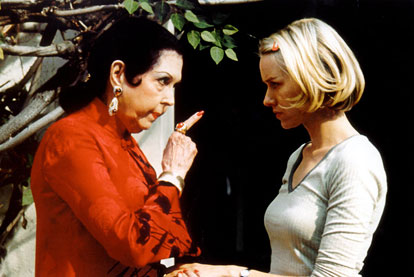
A mysterious woman survives both an attempted assassination and a major car crash but suffers amnesia as a result. Sneaking her way into an apartment, she is discovered by Betty Elms (Naomi Watts), a cheerful aspiring actress just arrived from Deep River, Ontario whose aunt rents that apartment from eccentric Coco (Ann Miller). The mysterious woman calls herself "Rita" (Laura Elena Harring) from a Rita Hayworth poster, but she has no idea who she is, let alone what thousands of dollars or a blue key are for in her purse. Betty, just starting out her acting career, decides to help Rita uncover her mystery.

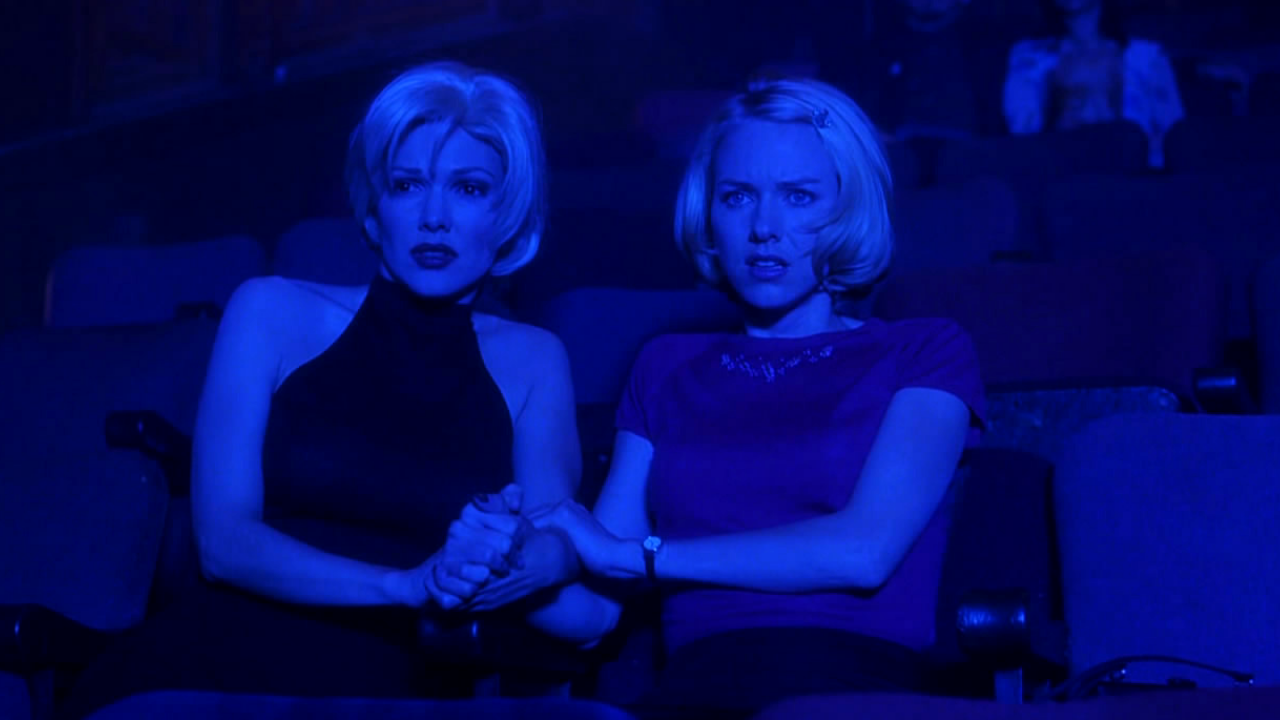
As they continue their investigation, Betty also has her acting career to take care of. She nails an audition, but there is nefarious work afoot. Hotshot director Adam Kesher (Justin Theroux) is being pressured to cast a Camilla Rhodes for his feature, The Sylvia North Story, told "This is the girl". Adam at first resists, but forces beyond his control get him to do as he's told. Eventually, Betty and Rita become lovers, and after a tryst Rita takes Betty to Club Silencio, where a strange stage show sends them both into fits of shaking and crying. Back at Betty's apartment, Rita opens a blue box Betty found in her purse with the blue key and both essentially disappear.

Mulholland Dr. – IFC CenterAt about the two-hour mark, things take a wild turn. We find ourselves now in perhaps reality or a dream, with the disheveled Diane Selwyn (Watts again). She's a bitter, angry woman, having lost her lover Camilla Rhodes (Harring again). Camilla is in a relationship with her director, Adam (Theroux again). At a Hollywood party on Mulholland Drive, Diane witnesses silently and angrily Camilla and Adam's relationship, while Adam's mother Coco (Miller again) is equally not amused. Diane hires a hitman to kill Camilla, the hitman telling her she's find a blue key when the job's done. There is a blue key at her apartment, but visions of crazed old people drive Diane to the brink and she shoots herself.

In the end, a woman seen at Club Silencio whispers "Silencio" (Silence).

Yes, trying to give a narrative overview to Mulholland Drive is a difficult thing because it has many elements. In this overview, I had to leave out subplots of Adam's marriage, seemingly random people discussing their own dreams, clumsy hitmen and figures coming and going with nary a sense of reality. So, what to make of Mulholland Drive?

I think it bears remembering that Mulholland Drive started out as a television pilot that was rejected. As such, I think David Lynch put in potential story threads that in the planned series might have tied together. Once the pilot was killed, Lynch reworked it into a feature film, giving it his usual surrealistic touches.

Cast: Coco Lenoix
The general theory is that the first two-thirds of Mulholland Drive is Diane's dreams where she recasts those around her, including herself as the sweet, upbeat Betty who is destined for success versus the failed Diane. Diane failed at love and a film career, but "Betty" is on her way both professionally and personally, with "Rita" madly in love with her. I think this is as good a theory as possible to explain most of Mulholland Drive, with other elements (The Cowboy, the dark forces pushing Adam to say "This is the girl") being integrated from the hoped-for series.

That being said, I think Mulholland Drive is really about Diane, this lost angel in this City of Dreams. The film is about dreams, all kinds of dreams. It is about literal dreams where the most random things appear to make sense but wouldn't in reality. It is about metaphorical dreams: dreams of stardom, of love, of being able to change things for our better. It is about dark dreams, those desires carnal and murderous that we can live out safely within fantasy. As much as I can gather, Mulholland Drive is about how we can or do make our dreams come true, for good or ill.

In the Betty section, Betty herself marvels about how she is in this "dream place". A seemingly random section where a man discusses a recurring frightening dream to someone says "You're in both dreams, and you're scared". Dreams rarely make sense when we awaken but appear totally real and logical when we are in them. I think Mulholland Drive speaks to that idea of the unreal reality of dreams, extending it to aspirational dreams.

David Lynch to open Mulholland Drive-style nightclub in Paris ...Lynch extends this idea of unreal reality to the movies themselves. We accept the reality of the situation despite knowing, as the Club Silencio sequence openly declares, "No hay banda! (There is no band)". Everything is an illusion, the bizarre Master of Ceremonies declares, showing us how the "trumpet player" is mimicking playing but that it is a recording. It is all fake. The Betty/Rita story is fake. Betty herself is fake. Mulholland Drive itself is fake. It is all unreal, yet because we see it, we accept it as "real".

We see this brilliantly when we see what at first appears to be an argument between Betty and Rita. "You're still here?" Betty asks angrily. "I came back. I thought that's what you wanted," a somewhat puzzled Rita replies. "Nobody wants you here," Betty snaps. At first, we accept that there is some kind of falling out, but then Lynch pulls back the camera to show that Rita is merely reading lines from a script. Here, Lynch circumvents our original expectations and reveals that "it was an illusion". Our preconceived notions led us to one conclusion, but then more information changed it completely.

Later on, "Betty" delivers the same lines at the audition, differently, erotically, again revealing the unreality of acting. In those moments, the audience gets caught up in the performance it is soon forgotten that it is a performance. It becomes "real". I think Mulholland Drive was crafted to be Lynch's take on cinema: the falseness of it all both with what audiences are presented and what it takes to make one. Perhaps the "dark forces" pushing for a particular performer and crazed meetings were his subtle dig at studio interference?

Mulholland Drive was Naomi Watts' breakout role, and she is absolutely extraordinary in the dual roles. Even as Betty, we sense there is still something a bit off, something a bit too cheerful, upbeat and innocent. Her various transitions from the perky Betty to the sultry Betty in the audition to the bitter Diane show an exceptional range. Laura Elena Harring holds her own as Rita, this tormented and confused woman who shifts into the cold, selfish Camilla Rhodes. Theroux's Adam manages a wry humor when presented with odd situations but is able to show a slightly darker side when with "Camilla".

Curiously, I think Ann Miller in her final role has the most radical change. She is eccentric but caring with Betty, but dismissive and disinterested with Diane. While her role is small she makes the most of it, in turns almost endearing and slightly creepy.

Mulholland Drive should be seen as a dream and a meditation on dreams and film. I won't take away from people who think it might all be incomprehensible rubbish (I feel that way about Twin Peaks: Fire Walk with Me). Having seen Mulholland Drive again, I find that it is not as crazed or incomprehensible as I once thought.

The logic of dreams.

DECISION: A+

Monday, October 29, 2018

Twin Peaks: Fire Walk With Me. A Review


TWIN PEAKS: FIRE WALK WITH ME

There was a time when I was intensely passionate about Twin Peaks. I stuck by the show through so many sinking moments and really idiotic turns until Joan Chen's soul was stuck in a doorknob or some silliness. At that point I gave up.

I then made the ghastly mistake of seeing Twin Peaks: Fire Walk with Me with my mother. I don't think she has yet to forgive me for this. It was not something I expected, even from the sometimes-bonkers world of David Lynch. 

It looks like Fire Walk with Me has achieved cult status, and with Twin Peaks: The Return now part of the mythos, this film might be in need of reevaluation.  Having now seen it again, my position has not changed: it's a horrible film.

Sorry, David...still love you and might name a son after you, but Fire Walk with Me is just bad.

The first part involves the FBI murder investigation of Teresa Banks, who is seen floating on the water, wrapped in plastic. FBI Regional Bureau Chief Gordon Cole (Lynch) assigns two agents to the case: Chester 'Chet' Desmond (Chris Isaak) and Sam Stanley (Keifer Sutherland) to the case. Desmond is not a man to suffer fools, especially the local sheriff who is highly uncooperative. Then, after going to Deputy Cliff Howard's (Rick Aiello) trailer, which is near Teresa's trailer, Chet finds a ring...and disappears.

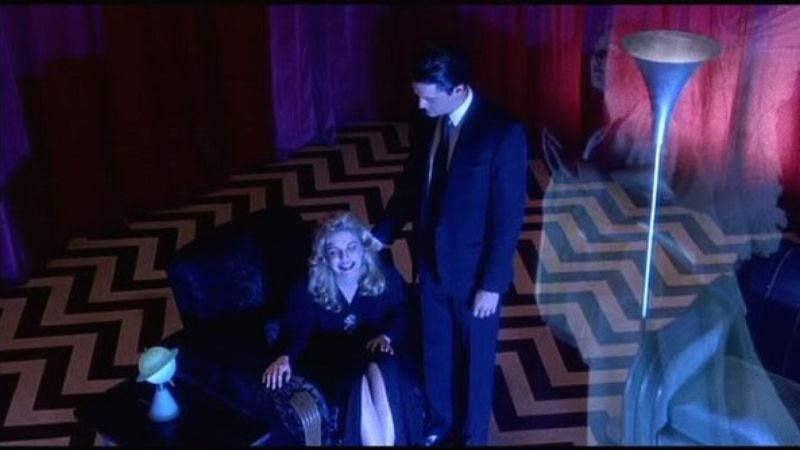
Related imageThis is tied into the vision that Special Agent Dale Cooper (Kyle MacLachlan) has, one involving yet another Agent, Phillip Jeffries (David Bowie), who is rambling he has been to some supernatural world inhabited by dancing dwarfs and weird old ladies with grandsons.

We quickly see that Jeffries was never there...or was he. We then go dark...

Or rather the screen goes black, to jump a year later to Twin Peaks itself. Here, Laura Palmer (Sheryl Lee) is a beautiful homecoming queen, but one with many secrets. She has at least two boyfriends: football star Bobby Riggs (Dana Ashbrook) and sensitive biker James Hurley (James Marshall), keeping the latter a secret from the former. She also has her best friend Donna (Moira Kelly, filling in for Lara Flynn Boyle).

Donna knows that something is amiss with Laura, but she cannot pin it down. Laura uses cocaine in part to self-medicate due to having a mysterious figure named "Bob" (Frank Silva) come into her room and essentially rape her, which she says has been happening since she was 12. "Bob" is some kind of demon, but it may be that "Bob" is her way of disassociating incest committed by her father, Leland (Ray Wise). It is suggested that Laura's mother Sarah (Grace Zabrinski) may be aware of what is going on.

A lot of Fire Walk With Me is muddled, to be polite.

Laura finds herself unwillingly immersed in the supernatural world but willingly immersed in prostitution and drugs. Her 'pimp', Jacques (Walter Olkewitz) has her come to his bar, where Donna has followed her. Laura takes her to The Black Lodge, which I think is across the Canadian border, and Laura indulges in evil until she sees Donna being led into darkness too. She rescues Donna but cannot rescue herself.

Leland, apparently possessed by "Bob", is shocked to find her in a cabin with men and he takes both Laura and Ronette Pulanski (Phoebe Augustine) into the woods, where despite the best efforts of a one-armed man who is also connected to the supernatural world, Laura is killed.

At the end though, Laura finds herself in that otherworldly world, and she releases her pain when her Guardian Angel and Cooper come to comfort her.

Image result for twin peaks fire walk with meFrankly, I feel I have not given Fire Walk with Me justice in terms of plot synopsis, but I put that down to the fact that it is very hard to make much sense of it. If it makes little sense to someone who has seen Twin Peaks, I can imagine how someone who had never seen the show would find essentially all of it incomprehensible.

Perhaps this is why Fire Walk with Me fails. Lynch appears to have little to no interest in inviting strangers into this peculiar Lynchian world. This is particularly true if you think on the first third of the film.

You get a long segment with Agent Desmond, then not only does he disappear but we never learn what happens to him. In fact, the other FBI agents seem more concerned about Banks' murder than their fellow agent. For a casual moviegoer, this seems almost a bait-and-switch. For a more knowledgeable viewer, it still leaves one wondering whatever happened to Desmond.

This is especially true given how well Chris Isaak was in the film. I actually would follow a case where he and the more literal and somewhat naive Stanley were involved. I think the Isaak section was the best probably because it was the closest the film got to a more conventional film while still having those Lynchian touches. It was eccentric, while the rest of Fire Walk with Me was just baffling and even deranged.

Opaque is the order of the day in Fire Walk with Me. After being treated to a bizarre 'dance' from a woman named Lil that was meant as code for Desmond, we are told about 'the Blue Rose' she was wearing but the film was not about to even tell us what that was about. It never brought it up again. We got Jeffries thrown in there without rhyme or reason, and I won't even go into the weirdness of the little boy in a suit and mask hopping around.

It's hard to judge performances given how one didn't know what one was supposed to see. For myself, I go back to Isaak, someone who really should be given more acting roles. I think he's a great singer, and I think he's proven himself a most competent and compelling actor, so his lack of fame is puzzling to me.

Image result for twin peaks fire walk with me
Kelly made Donna an innocent and caring person, about the only sane person in a totally insane world. It's a credit to this similarly underused actress that she did a good job in the role, though one wonders how Boyle would have done. MacLachlan keeps to that eccentric Agent Cooper even if his role is limited.

Wise was in a difficult position as Leland. One is never quite sure if he was actually demon-possessed or was a willing and knowing agent to his raping of his daughter. The film seems to want it both ways: one point he essentially forces Sarah to 'finish the milk' (which is probably drugged). At another point he is seen split with Bob, almost unconsciously unaware of things. Wise plays him as both malevolent and slightly comically crazed.

Lee, I think, is a good actress, but again I genuinely wondered what she was doing. Like Leland, Laura Palmer seemed split: sometimes gleefully indulgent in her orgies, sometimes almost a little girl. Sometimes she'd be equally unaware that her father was naked on top of her, sometimes she was fully aware. A case could be made that she disassociated the abuse via "Bob", but Fire Walk with Me is dead set on bringing in supernatural elements that suggest Bob is real.

As a side note, I felt great discomfort in the killing of Laura Palmer, even if it was not graphic. Killing and torturing women, particularly if it is their father, just seems so awful.

It's pretty crazy in Twin Peaks.


If there is anything to recommend in Fire Walk with Me, it's in the technical aspects. Longtime Lynch collaborator Angelo Badalamenti created a fantastic score, from moody mournful music to frighteningly decadent in the "Pink Room" section. Ron Garcia's cinematography enhances the terrifying nature of this sequence in all its mad glory.

Singer Julee Cruise, who has also worked with Lynch, sings a song written by Badalamenti with lyrics by Lynch. Questions in a World of Blue is a beautiful, haunting number that should have been nominated for Original Song.

Cruise's ethereal voice adds to Questions in a World of Blue's beauty.

Twin Peaks: Fire Walk with Me really is for that hardcore Twin Peaks fan who feels the need to see everything connected with the series. It is for me distasteful and nonsensical.

It does have a great soundtrack though...


DECISION: D-