Showing posts with label The Women. Show all posts

Saturday, September 5, 2015

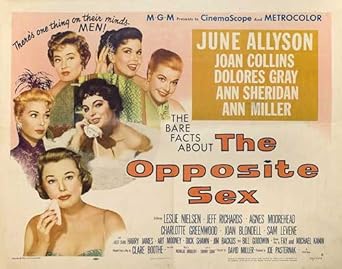
The Opposite Sex: A Review (Review #747)


THE OPPOSITE SEX

What we have in The Opposite Sex is technically speaking, a remake of the 1939 film The Women, with one minor change...

MEN appear in it!

The entire premise of The Women was that there were no men on screen or even in voice-over.  Even the animals and books in the film were female.  The Opposite Sex, however, could not avoid having men be in the picture.  Essentially the same plot as The Women, The Opposite Sex allows for some musical numbers to slip in, and while sadly not in the league of The Women, The Opposite Sex is not a bad way to spend a dull afternoon.

Kay Hilliard (June Allyson), a retired singer better known as Kay Ashley, has been married for ten years to Stephen Hilliard (Leslie Nielsen), a Broadway producer.  As far as she's concerned, she couldn't be happier in retirement.  Unbeknown to her, Stephen has begun an affair with one of his showgirls, scheming vixen Crystal Allen (Joan Collins).  It isn't long till her Kay's frenemy Sylvia Fowler (Dolores Gray) 'helps' Kay discover the affair, but it isn't until Crystal throws it in her face that not only has she been seen Stephen, but even spent time with their daughter Debbie, that Kay strikes back.

Literally: the slap Allyson lays on Collins would have shocked even Alexis Carrington.  It was so hard that Collins' earring flew off her ear!

It's off to Reno on the Divorcee Express, where Kay meets among others, the Countess de Brion (Agnes Moorehead), wry wisecracking Gloria (Ann Miller), and to her surprise later on, Sylvia herself!  Sylvia is none-too-pleased to see that Gloria is about to be the new Mrs. Fowler.  She, however, has found new arms: that of hunky ranch-hand Buck Winston (Jeff Richards), who uses his Western charms and "Ma'am" deference to win the randy Sylvia.  Sadly, Stephen marries Crystal right after the divorce is final.

A year passes, and Crystal is making everyone's life miserable.  Kay has made a comeback, and has learned to let go.  Her Reno friends have been a great support, as has her steadfast ally Amanda Penrose (Ann Sheridan), a noted playwright.  Sylvia, so besotted with Buck she's determined to make him a country & Western singing star (down to funding his club act), is unaware that Crystal now has designs on Buck herself (though Sylvia knows Crystal is now fooling around on Stephen).  Kay discovers this herself, and plots her revenge on both Crystal and Sylvia by casually letting tidbits slip out at Buck's debut.  Crystal, thinking she's managed to pull another fast one, dumps Stephen, only to find Buck isn't the marrying kind, and Stephen and Kay reconcile.


I confess to not being a June Allyson fan.  I was reminded that Allyson did Depends Adult Diaper commercials, which I find oddly amusing.  I never got why exactly she was so popular, particularly as a singer, finding her voice rather rough and reminding me of a foghorn.  Actually, I think the same about her speaking voice too.  I also thought that she never was fully able to convince me that she was this changed woman, from the somewhat docile wronged woman to the clever and shrewd avenging angel.

This, if Joan Collins is to be believed, was her first 'bad girl' role, and I think she tried a bit too hard to be this smarmy bitch.  She wasn't going to be a pleasant person, but I don't think Collins was completely convincing at even faking being pleasant (her scene with Debbie oozes insincerity when perhaps a softer touch would have worked).

A lot of the women I think tried too hard to play up their respective roles.  Allyson I think did, and so did Collins, and so did Gray as the forked-tongue Sylvia (which made her catfight with Gloria not as funny or vicious as it could have been).  Granted, I LOVE a good catfight, so I'm not complaining too much.

One thing I just don't get about The Opposite Sex (well, there's a lot I don't get, but that's for another day) is why they opted to put in big musical numbers that don't really help the story.  Sure, we get moments that highlight Allyson's singing (if you want to call it that), but what was the point of the title number with Dick Shawn and Jim Backus.  Not only was it a bit irrelevant to the movie (though it was integrated as being for a big benefit the Hilliards were throwing), but if you thought about it, the number was simply too big to fit on a Broadway stage.

It IS surprising to see Nielsen, who in his later career was all about broad comedy, as the straight lead.  He did a pretty solid job at playing the at-times conflicted husband, though his disillusionment with Crystal wasn't, again, completely convincing.

The supporting players of Miller and Moorehead had a ball playing broad broads, and Richards was effective as the hunky, sleazy Buck (his aw-shucks persona notwithstanding).  There was one funny moment when Buck attempts to seduce Kay, and even though it's clear where it's going (she swims to safety, leaving him stranded on his canoe without a paddle), both played that rather well.

In fairness to Allyson, while she won't make my Favorite Actresses List, she did handle the dramatic moments well.

I found The Opposite Sex to be a bit confused about what it wanted to be.  The opening title cards (Manhattan Island--a body of land consisting of four million square males--completely surrounded by women) made it look like a broad comedy, and Sheridan's voice-over began the story.  However, that was dropped pretty quickly, leading one to wonder why it was introduced to begin with.

On the whole, while I like The Opposite Sex, I prefer The Women.


DECISION: C+

Friday, August 15, 2014

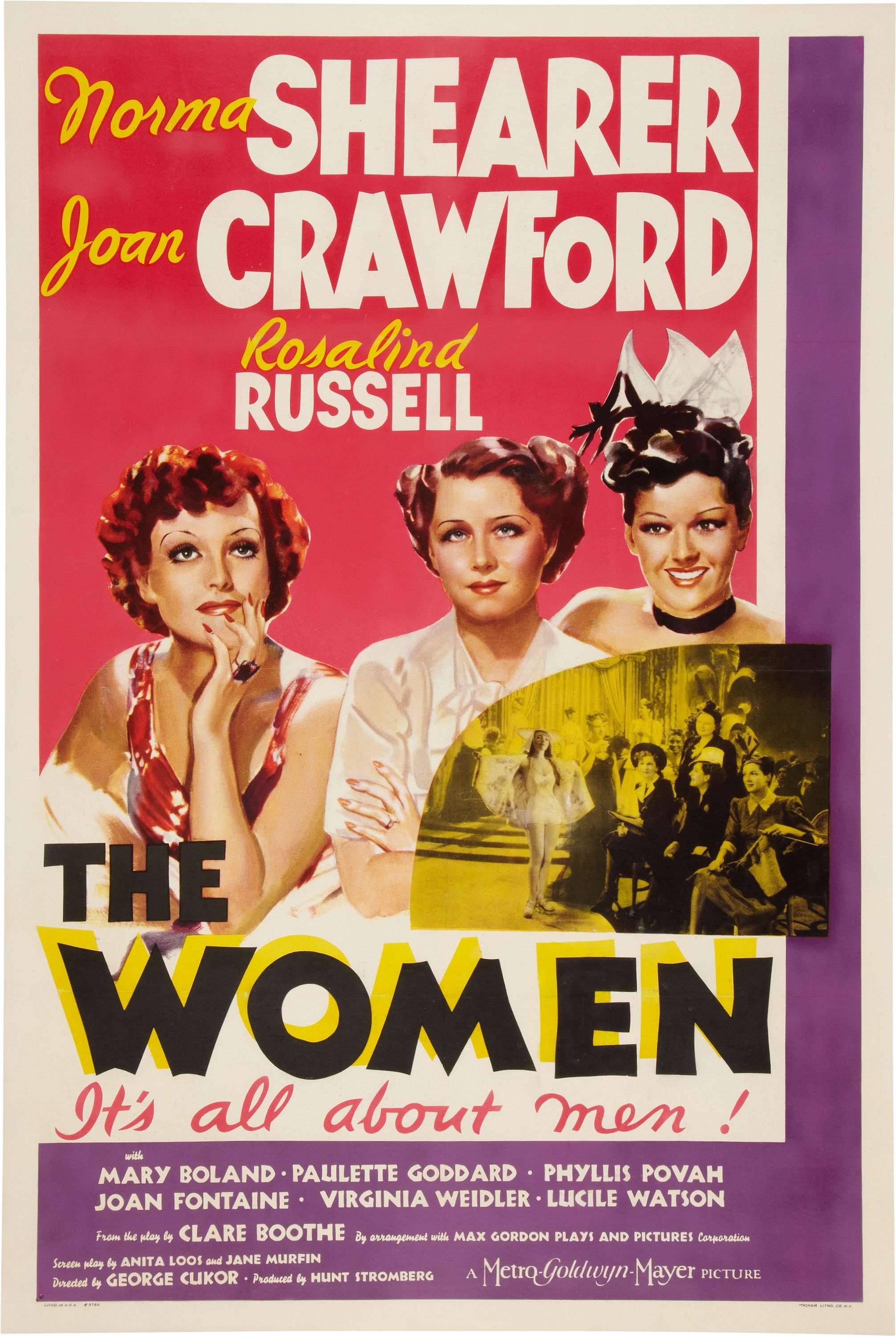
The Women (1939): A Review

THE WOMEN (1939)

Here's to The Ladies Who Lunch...

The Women is a catfight from beginning to end, as this collection of women in all their shameful glory: their cattiness, their innocence, their viciousness, their wit, and their double-crossing and dealing, battle it out for supremacy.  As sharp as their fingernails (Jungle Red), The Women plays out among an unreal world of elegance where our characters can dress so well and be so horrid.

Mrs. Stephen Haynes (Norma Shearer), or Mary, believes she is in bliss: a daughter, Little Mary (Virginia Wiedler) and a happy marriage.  Little does she know that her best frenemy, Mrs. Howard Fowler (Rosalind Russell), or Sylvia, has come across some delicious gossip thanks to the manicurist.  Stephen Haynes has been stepping out on Mary.  Vicious to her core, she is dying to tell Mary but decides it's best to let Mary find out for herself...by suggesting Mary go to the same manicurist and ask for the new color, Jungle Red. 

The manicurist unwittingly spills the beans to a devastated Mary.  Soon, she finds herself competing with Crystal Allen (Joan Crawford), whom Sylvia and her gruesome pal Mrs. Phelps Potter (Phyllis Poovah), or Edith discover is a perfume counter shopgirl.  After going on a Bermudan vacation with her mother Mrs. Morehead (Lucile Watson), Mary decides she doesn't want a divorce but won't stand for Stephen having a mistress.  Therefore, at a fashion show, Mary, egged on by Sylvia, confronts an unrepentant Crystal.  The war is on.

Despite herself, Mary decides on a divorce.  Off to Reno she goes, where she finds another friend, Mrs. John Day (Joan Fontaine), or Peggy, a shrinking violet of a girl, and meets two other women going to Nevada for a divorce: the Countess de Lave (Mary Boland), or Flora, and Miriam Aarons (Paulette Goddard).  The much-married Countess begins a romance with a cowhand named Buck Winston, whom she will turn into a music star.  In a twist, Sylvia herself arrives later for her own divorce, only to discover that her husband's soon-to-be new wife will be...Miriam!  Peggy calls off her divorce when she finds she's pregnant and she and John settle their differences, but Mary isn't so lucky.  Despite a pep talk by the wise (and wisecracking) Miriam, Mary discovers that Stephen married Crystal. 

Two years pass, and Mary has contented herself with her new life and friends (much to Mrs. Morehead's disapproval on both counts), while Crystal, still as scheming as ever, has secretly embarked on a new affair, with none other than Buck Winston.  Sylvia discovers this and opts to hold back this delicious information, but no matter. Little Mary has inadvertently revealed this to Mary, who decides to go to a party and turn the tables on Crystal and Sylvia, telling her mother she's had two years to grow claws: Jungle Red.

At the party Sylvia can't help reveal things, and Mary traps both her and Crystal (in Sylvia's case, quite literally) and vanquishes her foe, but not before Crystal gives the best kiss-off lines in film.  "Well, I guess it's back to the perfume counter for me.  And by the way, there's a name for you ladies, but it isn't used in high society...outside of a kennel.  So long, ladies".  And now at last, Mary can be reunited with Stephen.


What The Women has in spades is a total collection of all manner of personalities who with the exception of Allen and Aarons has one thing in common: they are all rich.  Part of The Women's pleasure is in seeing this world of lavish wealth where all these women doing terrible things can get away with it.  Before any Real Housewives came our way, The Women gives us everything people love about broads behaving badly, down to catfight, name calling, wife-stealing, and even a fashion show.

The big surprise in The Women is an elaborate fashion show that precedes Crystal and Mary's face-to-face.  Over director George Cukor's objections, this fashion show was put in and while he I think was right in objecting (since it slows the film down considerably) it is quite lavish, with the added bonus of being in glorious Technicolor (which must have been a great delight for 1939 audiences).  However, I found all that fashion business pretty but pointless.

Minus that, The Women has to be one of Cukor's best directed films, as everyone in the all-female cast delivers excellent performances.  Norma Shearer, a name not well-remembered today, was the big star on the MGM lot (her marriage to MGM wunderkind producer Irving Thalberg being of some help in that department, I suppose).  I think her performance is remarkably strong given that she is either forgotten or dismissed: she makes Mary into the sympathetic person she's suppose to be, staying within the boundary between weak and weepie and growing as a woman. 

While she's suppose to be the star and has a great chunk of screentime as befits her character, her two other main costars steal the show.  This was Crawford's real big breakout, and in The Women we can see her star rising while Shearer's star falling. There had been a fierce rivalry between Shearer and Crawford at MGM (Crawford complaining publicly about how she couldn't get good parts if her rival was sleeping with the boss) and the intense hatred the two had complements their performances.  As the bitch with the heart of brass, Crawford is unapologetic in how she plays this venomous being.

Curiously, while Mary is the sympathetic one, a certain part of you prefers the gleeful malevolence and determination of Crystal, who will claw her way to the top everyone else be damned. 

Finally, there is Russell, who is so comedically malicious and handles both body movements and rapid-fire line delivery, sometimes at the same time, as when she attempts to get back at Crystal when they first meet.  As Sylvia and Edith walk away from the counter as the store is closing, Crystal cattily refers to her as "Mrs. PROWLER", infuriating Mrs. FOWLER.  So determined is Sylvia to get back at Crystal that she and Edith didn't notice a bin in which they crashed and fell into.  We laugh at how horrid Sylvia is.

The other performances were their equal: Fontaine's meek Peggy, Goddard's brassy Miriam (I can imagine a Barbara Stanwyck being her equal), Boland's optimistic Countess (who still believed in 'amour, amour, amour').  We laugh at their antics and marvel at both their duplicitousness and bonds of sisterhood.  The Women has been remade twice: as a musical in 1956 (The Opposite Sex) which got away from the original's total absence of men by including them in the film, and again in 2008 with an all-female cast. 

Neither film is remembered today, with the 2008 version particularly reviled.  I think both were probably mistakes, and in the end it's this version that still holds up.

The Women drags a bit, but apart from that it has a witty script and some simply pitch-perfect performances from the whole cast.  In 1939, there were simply too many brilliant films for one year.  The Women takes its illustrious place among all those greats.

Ladies, chapeaus off to you.


DECISION: A+