Friday, December 26, 2014

The Lost Medallion: The Adventures of Billy Stone. A Review

THE LOST MEDALLION: THE ADVENTURES OF BILLY STONE

I freely admit to being the most flawed and wavering of Christians.  At times, I'm passionate about Christ.  At other times, I carry an intense cynicism and suspicion on all matters involving God.  I bring this up because The Lost Medallion: The Adventures of Billy Stone is made for a Christian-based audience.  I can tell partially because Alex Kendrick (who is fast turning into a filmmaker I don't respect) is involved in this (albeit in a small role).  I can also tell thanks to the story, which has subtle and not-so-subtle Christian themes.  I am a reviewer who isn't going to knock down a film because of its worldview or praise it because I happen to agree with said worldview.  The fact that The Lost Medallion is geared towards tweens and younger set make it serviceable and keep it from sinking into another debacle of Christian cinema.

Just barely though.

Daniel Anderson (Kendrick) arrives at a foster home to drop off some things before heading out to a big baseball playoff game.  There, he is told about three kids: Huko, a child prone to bullying, Allie, who asked the guardian if God ever made people accidentally, and Billy, the quiet one who has no sense of worth.  He is corralled into telling all the foster kids a story, and he begins to spin his tale.

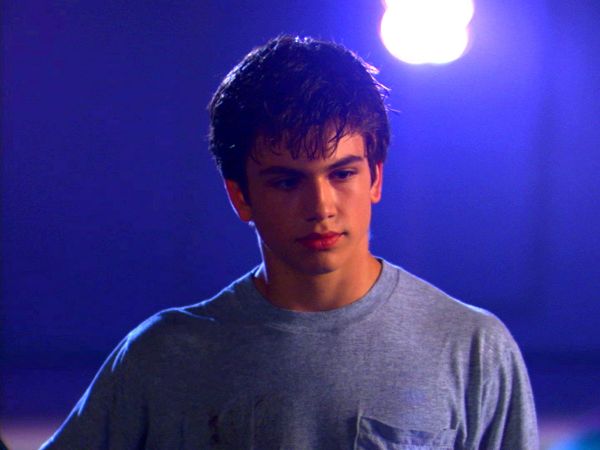
Billy Stone (Billy Unger) is an archaeologist's son who has recently lost his mother.  He's desperate to join dad Michael (Ken Streutker) on his latest dig searching for a powerful mythical talisman, but dad wants nothing to do with Billy on the dig.  Unbeknown to any of them, they are being watched by a mysterious Mr. Cobb, who with his two bumbling henchmen suspect that Billy is a threat to their own search for the medallion.  Billy has one friend, Allie (Sammi Hanratty), an orphan who wants to run away from the orphanage.  However, Billy convinces her to stay, and together they work to solve the mystery of the medallion.

Good news: they actually find it!  Bad news: they are pursued by henchmen threatening Billy's dad.  Even worse news: the stone his late mother gave Billy is the missing jewel in the medallion, and it grants wishes.  Billy, while wearing it, wishes none of this had happened, and he and Allie are swept back into the past! 

Here, they meet the arrogant Prince Huko (Jansen Panettierre) and his wacky friend Anui (William Corkery).  Huko believes the medallion is his by right, but Billy won't give it up.  Allie does find Huko cute (and I suspect she finds Billy cute too, but hasn't said it out loud).   Well, thanks to circumstances the wicked Cobra (Mark Dacascos) who either eerily looks like Mr. Cobb or may in fact BE Mr. Cobb, has taken the medallion but he cannot use its powers.  Only those with pure hearts can use it.  Therefore, he needs Billy.  Billy, Allie, Huko and Anui now must work together to recover the medallion.  For this, they need eccentric wise man Faleaka (James Hong) to guide them, and while he dies at least he gives them enough to help defeat Cobra.  In the end, all things are restored and Billy and Allie return to the present day, where he helps his dad find the medallion and they are united.

We end up back at the foster home, where Daniel has missed the game but doesn't care, for the three targets of his story now see they are special, and that their medallion is their own heart.  And why wouldn't he have stayed, as we find out in the end he had once been at the same foster home at their age?


There is a certain Indiana Jones feel to The Lost Medallion, and I believe intentionally so.  I could certainly see The Lost Medallion being an episode of The Young Indiana Jones Chronicles, down to the supernatural/time travel aspects.  The Lost Medallion also is blessed to have a group of relatively competent child actors to anchor this.  Of particular note is Unger as Billy Stone.  While the film was released in 2013 (making Unger 17 years old at the time), I find it hard to imagine that he actually was 17 because he looks more 13.  I also suspect the film was made before its release date because a 17 year old having these adventures and not thinking about Allie in any romantic way seems a wild stretch.

Then again, it IS a Christian film where sex apparently doesn't exist, which would be a surprise to all my Christian friends, particularly the ones who wear promise rings but end up losing their virginities faster than those who don't, but I digress.

Unger makes Billy a believable figure most of the time, at least once we get away from the present day and travel into the past.   He's almost excessively mature emotionally to play naïve, but credit should be given where it is due.  Harritay is also strong as Allie, who is both smart (maybe smarter) than Billy but still a good ol' damsel in distress.  Corkery lends comic relief as the fat, bumbling but sweet Anui, and the highlight of The Lost Medallion was in seeing Allie and Anui reach the mountaintop hom of Faleaka faster than Billy and Huko, who insisted on climbing up a steep mountain while ignoring Allie's suggestion that they walk up the path both failed to see in their mad competitiveness.

Hong was a delight as the odd Faleaka, sometimes spouting off nonsense that in the end made sense and serving as a distraction to guards by making weird noises and dances.  Dacascos was appropriately evil as Cobra, and perhaps this is why I am not finding much fault with The Lost Medallion: it is in essence, a cartoon which we're not suppose to take all that seriously.   This is reinforced with the bumbling henchmen, who appear in both the present and past. 

The henchmen were cartoonish, but again, it's a kids movie so I have to give them a little leeway.


If anything, the push to make this overtly religious is what I think gives The Lost Medallion a few points down.  When Faleaka is arrowed down (is that a term?), Billy asks him, "Why would you die for me?"  Faleaka's answer?  "Because a great king once died for me!" 

Talk about laying it on a bit thick.

In an animated montage we learn of a great king who became one with his people, insisting that they were all worthy of love.  Again, wonder if that could mean anything.

Now, don't get me wrong: I'm not opposed to having symbolism in a film, even one specifically geared towards the Christian market, but I like the types of films that trust ME to get it rather than insist on spelling it all out for me.

I would recommend The Lost Medallion: The Adventures of Billy Stone to tweens and younger kids who don't ask too much in their entertainment.  Families concerned about violence should know there is some, but mercifully not bloody (though Faleaka's death might be a touch scary).  To the film's credit, it does address that in the few narration scenes with Kendrick (who shows he isn't terrible when he comes in small doses).  It delivers its message, not too ham-fisted but still pretty clearly.

On the whole, it's serviceable, though I would have thought as it is now The Lost Medallion would be better served as a pilot or television movie than as an actual feature-length theatrical release.   I imagine Unger's television show Lab Rats might be wittier and better-made than The Lost Medallion, but not being the target audience for either I cannot say. 

In the end, The Lost Medallion isn't horrible.  It's for kids, and I'll leave it at that.   

DECISION: C+

Facing the Giants: A Review

FACING THE GIANTS

I'm open about the fact that I'm the most wavering Christian.  When it comes to films, I am an 'art before theology' critic.  I will not give a 'Christian' film a pass merely because the people in front and behind it are fellow believers.  Facing the Giants is another of Pastor Alex Kendrick's determined efforts to marry theology with cinema, and his track record has been pretty hit-and-miss.   I was no fan of Courageous, but felt something like The Lost Medallion was tolerable.  The fact that the latter was made for children and the former for adults may be a reason for my views on both those films. 

Pastor Kendrick, bless him, at least is determined to use film to share, if not strictly his faith, his worldview where positive, faith-affirming stories can be seen by fellow believers.  Facing the Giants is if nothing else, sincere and open about where it's coming from.  I cannot trash it for that. 

It also comes from the Kendrick Brothers, who show that in their second feature (Courageous being their fourth but surprisingly similar in almost every way) they still live in a shockingly insular world, one that is almost all-white, unaware of anything approaching human frailties, stubborn in its heavy-handedness, and determined to get in as many clichés as possible, both Christian and secular.

Coach Grant Taylor (writer/director/editor Kendrick) is facing yet another tough football season.  He is in danger of being replaced by a growing number of irate parents and alumni, and his wife Brooke (Shannen Fields) cannot conceive.  Certainly Grant is not having a good life already, but with a faulty car that dies often and players that leave their senior year it looks like Grant is besieged. 

It doesn't help that we find that the reason the Taylors haven't had children yet is because Grant can't produce. He's not a man, he's not a coach, he's an all-around failure.

Grant then does what perhaps he should have done a long time ago: let go and let God (see, I can speak Christianese).  He's come up with a new team philosophy: the team at Shiloh Christian Academy will now play for the Glory of God.  If they win, the team will praise Him.  If they lose, the team will praise Him.

Allow me to stop for a moment to observe that the football team at a Christian school apparently never prayed before a game, or attended Bible studies, or even apparently attended church.


Christian Cinema's Orson Welles, or Ed Wood?

Well, as soon as the team starts playing with a new attitude and focus,  all sorts of wonders begin occurring.  There is a revival among the students, with kids coming to Christ left right and center.  Among those kids is angry Matt (James Blackwell), who now has respect for his father.  Also affected is David Childers (Bailey Cave), a former soccer star who is the hesitant kicker and who has a wheelchair-bound father. 

The Shiloh Eagles also start winning games, a lot of them, enough to get to the playoffs.  Rather than be satisfied that he now has a winning season (and I figure has silenced his critics), through some bizarre series of circumstances Grant and the Eagles now manage to go to State, where they will, you guessed it, Face the Giants and their bull-like coach.

In a nice twist, following the advise of not just planting the seed but preparing for rain, guess who is about to be a father?

Will Coach Grant and the Eagles truly defeat the Giants? Will the 145 pound kicker named David be able to slay the mighty Goliaths and win one for the team? 

Can a wheelchair-bound man be able to stand on his own two feet?

When I first finished Facing the Giants I wasn't prepared to write it off completely.  Yes, it had problems (which I'll get into in a bit) but at least it was sincere, a product of a particular vision that if nothing else, I respected for working to present it to the world.  However, as time went on I found Facing the Giants kept stumbling on itself, in ways both large and small.

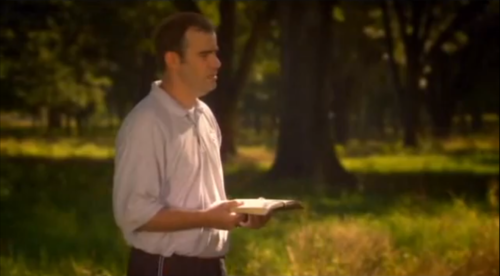
Let's start with the performances.  Alex Kendrick, despite himself, finds it difficult to 'act'.  Of particular note is when he goes out into the fields, Bible in hand, and decides to fully rely on God (FROG).  His monologue with God was curiously so flat because it was almost totally devoid of real emotion.  I wouldn't say it wasn't sincere, but it was forced and obviously fake.  'Acting' requires one to behave as if he/she were the character, not themselves.  Kendrick, here and in Courageous, stubbornly refuses to 'act'.  He will not 'become' the character.  Instead, he will speak the words he and his brother Stephen wrote almost by rote, as if he has to get them in one take or lose film.  Alex Kendrick, as actor and director, shows why any film, even a Christian film, needs professionals who know what to do in front and behind the camera.

There wasn't a single good performance in Facing the Giants.  Fields in particular was appallingly bad, her Brooke not being able to muster anything to have us care, let alone believe her situation.  I did think nicely of Cave, who while still being amateurish at least made a stab at playing his fearful character.   

On a side note, I think it is remarkably narcissistic of Kendrick to focus all his films on himself/his characters.  Facing the Giants I think would have been improved dramatically if the story focused on David (apart from the obvious parallels to the story of David and Goliath). Here was a new kid to Shiloh, who lost his mom, who had a wheelchair-bound dad, and who kept doubting himself due to his lack of football skills and small stature.  Certainly seeing a film where a young man struggles to become better I think would make a more interesting movie than about a middle-aged balding man who is facing a career and personal crisis FROG his way to success (and even grow stronger sperm).

Why Alex Kendrick insists on making almost all his films center around his characters I'll never quite understand. I have my own theories (he is too shallow to see beyond his own worldview), but for the moment almost every Kendrick Brothers feature will make Alex Kendrick the star, despite his inability to act or draw realistic performances from his 'actors'.

Facing the Giants has other issues, greater issues.  For one, despite the title the Giants were never a real threat because they didn't appear until the last game.  We never saw the Eagles see how good the Giants were, or the Giants wonder about these up-and-comers.  We were merely told early in the film that the Giants had won three state championships in a row, and then we forgot about them until the end.  Truth be told, I had completely forgotten about this fearsome football team until the end, when we were reminded that they existed. 

The final confrontation therefore was immediately left without any sense of urgency or interest because the didn't appear to be real threats to Shiloh.


However, the most appalling thing about the well-meaning but bumbling Facing the Giants, or at least the thing that made me cringe, was how Kendrick treats minorities.  Kendrick's world both in 2006 and 2013 is almost all-white.  In Courageous, there is a Hispanic character who is asked by the Kendrick character if he has 'permission to work'.  If Kendrick had asked ME that, I'd have bitch-slapped him, pastor or no pastor, told him to shove his 'permission' up his ass, and then walked away. 

As a Hispanic, I don't find some balding white man suggesting that I'm an illegal amusing.

With Facing the Giants, we had exactly ONE minority in the entire film.  That would be Chris Willis as assistant coach J.T. Hawkins, Jr.  When I say "exactly one minority in the entire film", I don't mean one minority with a speaking part.  I mean exactly that: in a film that takes place in Georgia, there is apparently only one black person in the entire STATE!  All the football players at Shiloh Christian Academy are white.  I think all the fans watching (and SCA alumni) are all-white.  All the opposing team members, up to the Giants, are all-white.

How do you have an all-white team in Georgia?  How do you have an all-white school in Georgia?  I don't mean 'almost all-white', with a few minorities.  I mean literally ALL WHITE?!

If that just wasn't bad enough, Willis is saddled with the most clichéd and stereotypical role this side of Birth of a Nation.  Willis' major scene involves him slipping into 'preacher' mode to motivate David, right down to the other assistant coach virtually shouting, "Preach it".  The music did not help matters in making this scene particularly regressive.  When Coach Taylor gets a new pickup truck to replace his dying car (which looks like it was cribbed from Stand and Deliver), Willis actually utters, "Somebody done gave you a new truck".  I swore I thought he was going to add, "Yassa Massa Grant". 

I know no African American who speaks like that.  It brings to mind how Denzel Washington in Malcolm X mocked blacks who disagreed with them by invoking what the 'house negro' would sound like. 

Seriously, if Alex Kendrick wants to be taken seriously and lift his filmmaking to sensible levels, he needs to acknowledge that the whole world is not like his house: white, Christian, and virtually free from sin.  Kendrick will never acknowledge that Christians, especially young ones, are aware of the world outside church, one with sin, with drugs, with premarital sex (or the word 'sex'), violence, anger, and all sorts of assorted evils.  

Facing the Giants, if nothing else, comes from the heart.  Again, I won't condemn it for that.  Was I entertained?  Yes.  Do I know it could have all been better?  Yes, and it didn't have to be condescending either.  It was OK, not terrible, but one hopes that the Kendrick Brothers work towards making actual films versus what they do no: cinematic versions of sermons.

The Good Book deserves a Good Script...

DECISION: C- 

Thursday, December 25, 2014

Prancer: A Review


PRANCER
Welcome to Rick's Texan Reviews' annual Christmas movie review. This year, I look at a Christmas movie that looks at the holiday through the eyes of a child. 

Prancer is a film where we see things from the child's perspective, and that allows us not just to identify with the main character herself but accept her world, one where Santa Claus is very real.  More on that later.

Jessica (Rebecca Harrell) is a typical eight-year-old who sings loudly and believes in Santa Claus.  She believes because she has to: her mother died and she told Jessica about Santa, and her mother wouldn't lie.  She has been pretty much isolated in her mourning, her father John (Sam Elliot) too busy working to keep the farm going (perhaps to hide his own grief), her brother Steve (John Duda) a bit of a bully, and her best friend Carol (Ariana Richards) being a bit wishy-washy.  Carol tells her she doubts whether Santa is real, and by extension God.  If God isn't real and neither is Heaven, then where is her mother, Jessica reasons?  Jessica and Carol have a friendship that goes up and down.

In any case, Jessica sees signs that Prancer, one of Santa's reindeer, might be in trouble.  She herself is in trouble, for John has decided Jessica needs a woman's touch, and has decided to send her to live with his sister-in-law Sarah (Rutanya Alda).  Jessica is horrified by this and won't go.  Wandering in the forest, she reencounters a wounded reindeer and decides that it IS Prancer.  She decides to secretly nurse him to health and have him ready for Santa to pick him up before Christmas.

From this, Jessica encounters people who are affected by Jessica's total belief in Santa.  There's the crabby veterinarian Benton (Abe Vigoda), the local rich 'witch' Mrs. McFarland (Cloris Leachman), and a cynical department store Santa (Michael Constantine).  Jessica gives the store Santa a letter, asking him to deliver it to the REAL Santa for her.  It has a picture of Prancer and a note telling Santa where to pick Prancer up.  He's so charmed by it that he gives the note to the local paper, and after it's published, Jessica's family (who except for John were attending Christmas services) were literally the last to know about this.  John's furious about how Jessica has kept Prancer a secret, but opts to sell him, horrifying Jessica.

In the end, Steve helps Jessica try to spring Prancer free, and after she's injured in the attempt, the town goes to her home to sing to her.  John convinces Jessica to go keep her appointment with Santa and tells her he's decided not to send her to Sarah.  Prancer runs free and disappears off a cliff.  What exactly happened?  John and Jessica hear sleigh bells in the distance and a quick streak of light in the sky...


What sells Prancer is to total sincerity.  It is not cynical in any way.  Instead, Prancer treats Jessica's total belief in Santa honestly.  You could argue that her insistence on the reality of Santa is partially a reaction to dealing with her mother's death, but Prancer deals with her child's world view of the reality of Santa realistically.  It isn't hard to believe that a child would believe in Santa Claus and proceed logically. 

Jessica isn't dumb.  She for example knows that the Santa at the mall isn't the REAL Santa.  However, she is also innocent in that she believes all store Santas are hired by the REAL Santa to sit in for him and that they have a personal connection to the big guy.

Prancer is intelligent in how it has typical child fears and ideas and doesn't talk them down or mock them, even gently.  Take when Mrs. McFarland comes out to try and chase Carol and Jessica away.  She looks something like a witch, but there is a logic to her appearance (a long coat flowing wildly in the winter).  The visual cues of her as a 'witch' is logical and not overblown.

There's a sweetness, a kindness, an innocence in Prancer that is hard to resist.  It may not be a great stretch to think that Jessica's total sincerity and innocence may melt hearts, but even when tackling familiar motifs Prancer integrates them so well that we hardly notice that the 'little girl changes stone hearts' has been seen before.  The fact that it is integrated and done so well in the story shows how well Prancer works.

Harrell totally sells Jessica as this sweet girl, still haunted by her mother's death, who accepts the reality of Santa as a mere fact of life.  Harrell is so sincere and real, with natural reactions to her arguments with Carol or Steve, her real fear of losing her father, and her total love for Prancer that you soon start not just identifying with her but in a sense believe she is telling the truth.  It's a beautiful performance.

In fact, everyone's performances are wonderful.  Elliot's tearful scene with Harrell when he talks about how important she is to him is beautiful.  Leachman's character starts out as harsh (not evil) but her slow melting is handled well.  The side effect of having Mrs. McFarland attend church and be slightly puzzled by the goings-on (such as when candles are lit) is handled realistically but we can see how the story shows how Jessica's total honesty changes lives.

A great highlight is Maurice Jarre's score, which adds to the childlike, sweet, innocent feel to the film.  Greg Taylor's script is also smart in not making people evil or harsh.  Being sent to Aunt Sarah's is the threat, but Sarah herself is by no means harsh or cruel.  In fact, she's actually kinder and more compassionate than John was.  Similarly, Carol's doubts and Steve's big brother bullying are handled well: in the end Carol and Jessica are still friends, and Steve shows he genuinely loves his sister despite how harsh he's been to her.

We also have an extended comedy scene as John continuously misses both Prancer and the article detailing what has been going on right underneath his nose.  Cut between the shots of Prancer walking behind John as he reads the paper and the church service, where everyone knows about Prancer except for Jessica, Steve, and Sarah (who hadn't read the paper). 

Now, Prancer does have a darkness in it.  It is about a girl who has lost her mother, in danger of losing her father, and death is lurking in the shadows.  These themes are handled well, and it lends a deeper level to the story than if it were just a mere fantasy about the reality of Santa. 

Prancer is about a child's world versus the cynical, harsh reality of adults.  It's a sweet and tender story about the power of belief.   It is a great family film, and I think a generally undiscovered Christmas classic.  Prancer is a beautiful film that I think will charm and melt hearts.  It is a great film to see with the family after eating turkey and/or ham, the gifts are opened, and everyone wants to curl up with some cocoa. 

In a word, beautiful.

DECISION: A-

2012 Christmas Movie: Arthur Christmas  

2013 Christmas Movie: A Christmas Carol


Monday, December 22, 2014

NO INTERVIEW FOR YOU!

The Original Fat Bastard

So SONY has capitulated to a remarkably thin-skinned fat guy.  Score One for Democracy!

The entire brouhaha over The Interview has reached Monty Python-esque proportions as SONY has decided to pull The Interview from theaters over threats to the public should any theater screen dare show it.  This was after "The Guardians of Peace" or GOP (where's Sarah Palin when you need her?!) hacked SONY and released all sorts of material; some of the leaked information proved embarrassing to the writers (such as when company executives mocked President Obama, strange given they all voted for him).  Some of it was amusing (from now on, loveable All-American Tom Hanks will be henceforth be known as "Johnny Madrid". Better than "Johnny Football" I figure).  Some of it was curious (pseudo-intellectual Aaron Sorkin having no idea who Michael Fassbender was, despite Fassbender being an Oscar-nominated actor and part of the lucrative X-Men franchise) and even flat-out bizarre (a 21 Jump Street/Men in Black crossover?  Makes SuperWhoLock sound downright Shakespearean).  However, while it is good to see that certain things have been confirmed (such as that Channing Tatum, apart from being a stripper who blundered into acting, is a genuine idiot), there are deeper questions that The Interview fallout  raises.

They are questions of security and intellectual freedom, of how dangerous the Hermit Kingdom really is to the world, and on how to respond to all these matters.  For the moment, I'll give my own reflections on how The Interview turned from another dreadful Seth Rogen project into a rallying cry for freedom.


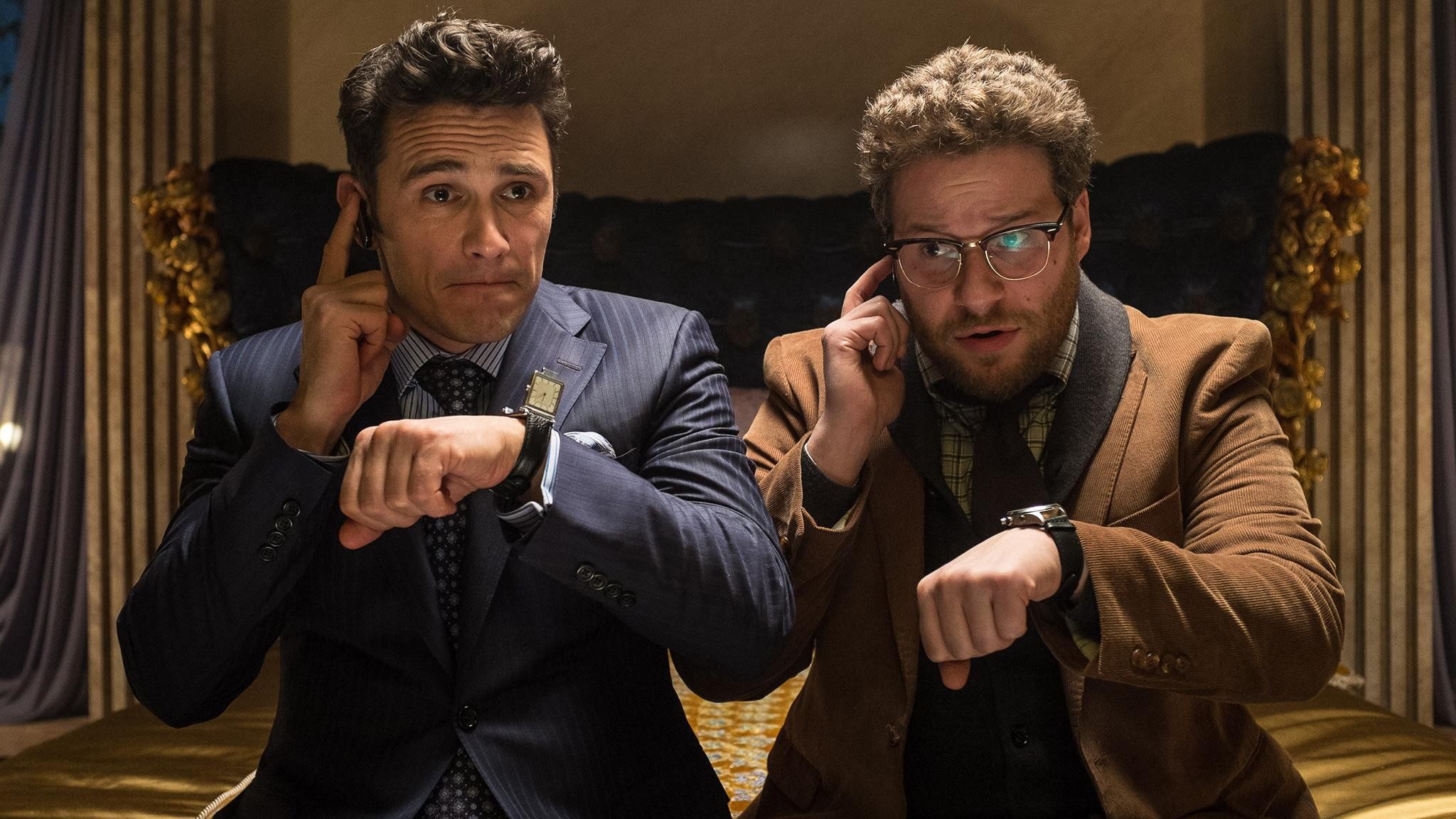
The first mistake was in the film being made, but not for the reasons one might think.  One of the greatest political satires was Charles Chaplin's The Great Dictator, where the Little Tramp spoofed Adolf Hitler.  The Interview was no Great Dictator.  The latter had a true comedic genius behind it.  The former had Seth Rogen, a man who is nowhere near either 'comedic' or 'genius', and James Franco, who veers from being a great actor to being a deliberate spoof of himself.  Chaplin had a few things going for him. 

One, no one in 1940 fully realized how dangerous and demonic Hitler was. Two, Chaplin was clever enough to mock Hitler without actually USING the name.  The character may have been called "Adenoid Hynkel", but we all knew who he REALLY was.  Rogen, his writing/directing partner Evan Goldberg, Franco, et.al. opted for the more direct approach. 

They COULD have gone a more clever route (one that would also have allowed 'plausible deniability') by making it a North Korean-TYPE dictatorship, but let's face it, clever is not something that Seth Rogen is known for (and seriously, Rogen was paid $8.4 MILLION?!  Is this the same guy that sunk The Green Hornet? How can he make more than all those unfortunate souls who paid to see that thing?  SONY thinks Seth Rogen is worth $8.4 MILLION?!  Talk about failure to return your investment). 

Here is where Rogen/Franco/SONY botched it.  They all collectively showed how uninformed they were (insert 'liberal Hollywood joke' here).  I'm a man of average intelligence, but even I would figure that North Korea, which is not a real country but a massive cult writ large, a virtual mega-Jonestown, would not be amused by having their Outstanding Leader not just mocked, but shown as being assassinated. 

The thing is I figure The Interview, which has been receiving generally bad reviews (something the $8.4 Million Dollar Man should be used to by now), is not truly centered around Kim Jong-Un.  It's centered on the two idiots who are hired to 'assassinate' him (the Franco and Rogen characters).  Just by the trailers we see them being remarkably uncreative and unoriginal in how they make their characters into total Tatums.   The North Koreans, who are not known for their sense of humor, might not have actually have heard of James Franco and Seth Rogen, and thus their screen personas may have eluded them prior to them thinking The Interview truly was about a plot to assassinate Lil' Kim.

Maybe Pascal is right.  Jolie isn't talented enough
to not fake being angry at the person who ridiculed her.

Of course, here is the difficulty and the second mistake in this whole nutty situation.  We won't get to see The Interview, at least in theaters, because SONY has gone beyond being hacked and into being cracked.  Threats were issued to create "9/11" style attacks in theaters that dared showed The Interview, so theater chains began dropping The Interview, in the words of Dorothy Zbornak, faster than CBS dumped Jimmy the Greek.  With chains deciding it was too hot to handle (and probably fearful that an Aurora-type, rather than September 11th, incident could occur), SONY really had nowhere else to go with The Interview...except for Video on Demand and DVD.  However, those are still up in the air. 

Seriously, do major corporate heads expect Pyongyang to be so unhinged that they'll blow up some Wal-Mart that puts The Interview in their bargain bin?  Bet you wish you still had Blockbuster Video now, don't you? 

We have two overreactions: one from North Korea (which again, isn't a country so much as it is a suicide cult that makes the Branch Davidians at Waco look like Mayberry), and one from SONY.  I find it bizarre that a multi-billion dollar corporation (and American theater owners) seriously think there are large fifth columns of Kim-sters waiting for the signal to storm some megaplex with bombs and guns a'blazin'.  I feel pretty safe here in The EP: I've got the whole of Fort Bliss that has my back.  Do the North Koreans really want to take on the men and women at one of the largest military bases in America?  If there were such an attack, I think Pyongyang would see their clean capital turned into ashes within 24 hours. 

Just a thought.

Theater chains, I think, feared litigation SHOULD something happen at a screening.  However, the idea of having police standing inside a theater to protect the audience from foreign agents seems beyond surreal and slips into theater of the absurd.  We really need protection to watch something as lowbrow as The Interview?

We seriously need protection to stop Seth Rogen from making more movies, but that's another matter.

We now have a very bizarre but ironically thought-provoking situation.  The North Korean regime has forced a major studio to drop not just something as patently foolish as The Interview, but also for Pyongyang, a drama about North Korea which would have been a vehicle for Steve Carell (who looks like an also-ran for Best Actor for Foxcatcher, which so far hasn't caught on). 

This really isn't new.  The remake of Red Dawn had the Chinese invaders changed to North Koreans (ironically because the filmmakers didn't perceive North Korea as a threat and they wanted to cull favor with the large Chinese market).  Hollywood has recently made these big-budget films not for Americans, but for foreign markets.  This is why we had films like Pacific Rim and Godzilla, things that sell outside America.  The insanity of The Interview is a rather extreme example of how Hollywood has been kow-towing to Communists for years.  Now they find themselves shocked, SHOCKED that you really can't make dictators happy.  Rogen and Franco were just dumb enough to stumble into this situation, but somehow their idiocy may be the catalyst for a serious examination of Hollywood itself. 

How The Mighty Dumb Have Fallen...

Now that with a few keystrokes a powerful industry is thrown into chaos, one wonders what will happen if there were to be an Islamic State comedy, or a nonfiction film about the Myanmar/Burma regime of terror.  Will Hollywood resort to instituting a Hays Office in Beijing, Pyongyang, Havana, and/or Damascus?

My personal view is that Pyongyang should not have been cancelled.  Say what you will about Richard Gere's intellectual prowess, but at least he stood by his convictions that Communist China was dangerous when he made Red Corner.  It might have been a lousy movie (like The Interview) but at least he stood for his convictions rather than run off.

My personal view is that The Interview should be released through video on demand and DVD.  I'd gladly pay $3.99 to stick it to Fat Bastard.  I think that most Americans don't see this as an effort to praise Franco and Rogen for being Tatums.  I think we see this as an affront, that we can be held hostage by a regime that totally controls every aspect of people's lives. Now we are in a situation where the United States is being dictated to, told what we can and cannot see by people who don't shrink from killing their own people for the thinnest of reasons.

For many years Hollywood insisted the greatest threat to American democracy came from crazed Christians (as if there were any other kind).  Now they've found themselves taken aback that those who thought Noah was insulting to their faith were remarkably tame compared to a despotic regime that starves its own people while the leaders drink cognac and caviar.
      
This industry and the country has a chance to think about what The Interview really is.  It's gone beyond being a bad, dumb movie.  It's now whether the film industry and filmgoers will now have to stifle themselves in order not to cause 'offense'.  Being offended is part of a true democracy.  Cody Decker offended me when he referred to Gone With the Wind as a 'KKK recruitment film'.  I offended him for daring to criticize him about it to his face.  He's not used to being contradicted, though perhaps shouting "Scarlett's Revenge" or "Scarlett Strikes Back" whenever he strikes out might be a tad much.

Pseudo-intellectual jock.  Yet I digress.

Will Hollywood grow a backbone and defy the Dear Leader?  Certainly Americans would flock to The Interview if only as a form of protest.  Americans don't like being told what to do, especially when it comes to movies.  North Korea attacked us via cyberspace.  Dress it up any way you want, but this was an act of war.  It was the act of a tyranny that brooks no opposition, no matter how inane, even from something that would have been forgotten in two weeks if not for North Korea's lunacy.  If they had just ignored it, The Interview would have flopped and they could go back to their gulags and torture chambers.

Instead, they made things worse by attacking a corporation and threatening anyone who saw the film.  SONY and the theater chains made things worse by giving in to threats and bullying.  I'm not going to say Americans are the losers because we may never see The Interview.  Americans would be the losers though, if we continue to give in to crackpots and tyrannies by having them act as de facto censors.   


We may never see The Interview.  We may see it next year.  We may see it when the Kim Dynasty finally falls.   This is a dangerous precedent, to have a film virtually banned by order of another country.  We as Americans, and filmgoers, need to support our freedoms.  The Interview may be lousy, but Rogen, Goldberg, Franco et.al. have the right to make it.  The Book of Mormon may be deliberately insulting to LDS members, but Trey Parker and Matt Stone have the right to present it in the same way the LDS Church can present screenings of Joseph Smith: Prophet of the Restoration in Temple Square.  The Last Temptation of Christ may be blasphemous, but Martin Scorsese has the right to make it.  I wouldn't see any of them, but that is my right.  It is no one's right to tell me that I am forbidden to see, to read, to hear, or speak something merely because it causes offense to another.  If this were to incite violence, that is another matter (hence my support to ban a film like The Eternal Jew). 

Appeasement never works.  We tried to have 'peace in our time' and that gave us World War II and the Holocaust.  Giving in on The Interview only emboldens not just Fat Bastard and his Court, but anyone else who thinks he/she can bully the nation on all matters large and small.   We cannot give in to Kim Jong-Un.  We cannot give in to fear. 

I was told at church that FEAR stands for False Evidence Appearing Real.  It is false evidence that North Korea will launch massive attacks on theaters that host The Interview screenings.  It is false fear that has made Hollywood cower and Washington buckle to a group of crazies.  If we keep retreating, eventually we will be to our backs against the wall, and that wall might be in front of a firing squad.

I'm not ready to submit freedom for security.

However, I am willing to welcome any chance to sabotage Magic Mike XXL.  Kim Jong-Un, how about a trade: I'll give you Channing Tatum for your nukes.  You know, one bomb for another...


Which is scarier: President Channing Tatum or Academy-Award winner Channing Tatum?

Sunday, December 21, 2014

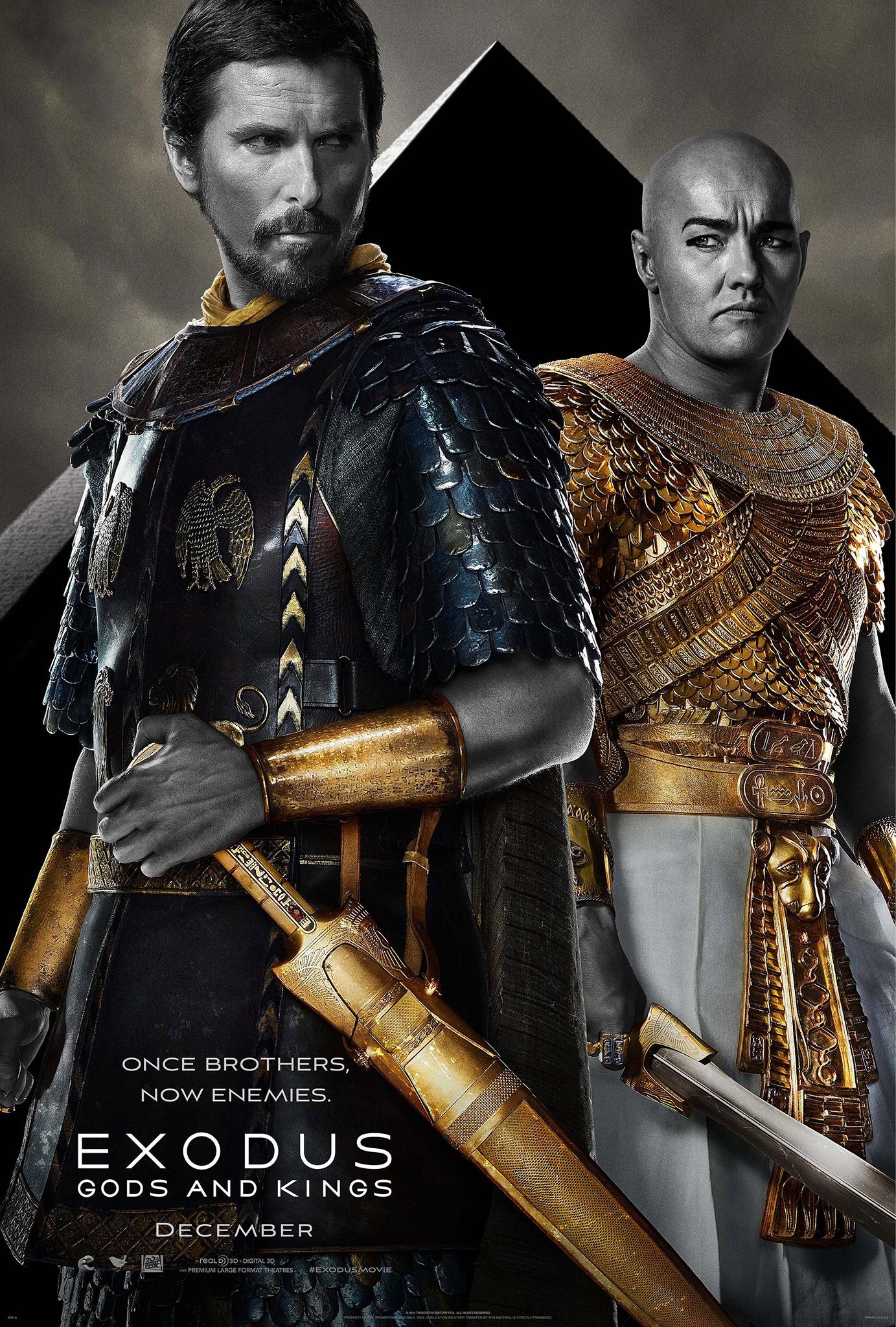
Exodus: Gods and Kings: A Review (Review #680)

EXODUS: GODS AND KINGS

There appears to be genuine fear running rampant in Hollywood.  No, it isn't fear of Kim Jung-Un, or as I lovingly call him, Fat Bastard.  That discussion is for another time.  No, the fear in Hollywood is on a more fearsome deity: the Judeo-Christian God.  Exodus: Gods and Kings is the second Bible-based film released this year.  While Noah was bad, at least it could be enjoyed in a loopy way (and had pretty colors).  Exodus, on the other hand, is simply an absolute disaster: boring, self-important, badly acted, badly written, badly directed.

About the only thing both Exodus and Noah have in common is the absolute determination of the people involved both in front and behind the camera to divorce their films from the source material, as if the idea of 'God' is so foreign that He is apparently in no way connected with any Biblical stories.  Why Hollywood raids Scripture while simultaneously insisting that God plays no part in the Bible stories is again, a topic for another time.  For the moment, let us concentrate on Exodus, a film that feels longer than the Hebrews wandering through Sinai and probably less fun. 

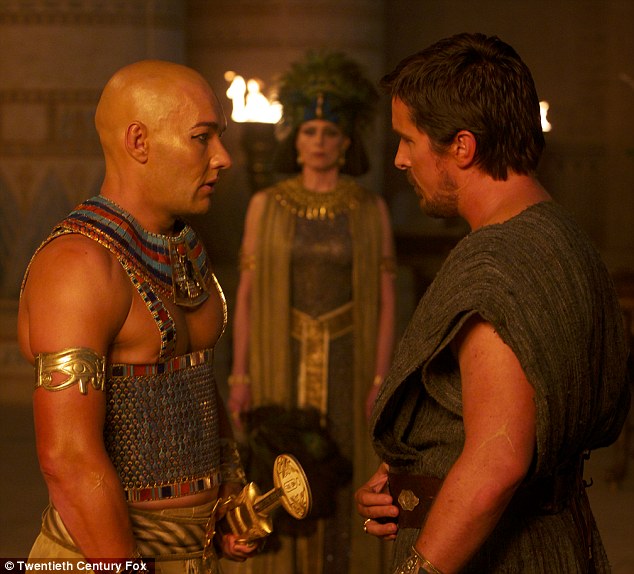
Moses (Christian Bale) and Ramses (Joel Edgerton) are Egyptian generals and kin to Pharaoh Seti (John Turturro).  Moses soon either finds or is convinced that he is Hebrew, and is sent into exile after Seti's death and Ramses' ascension to the throne.  Moses finds a home with Zipporah (Maria Valverde), but when climbing a sacred mountain during a storm, a rock slide hits him on the head and he encounters a burning bush, and God (in the form of a child). 

Well, it's back to Egypt to free the Hebrews, but Ramses isn't going for that.  He won't negotiate with Moses, even less when Moses and his fellow Israelites turn domestic terrorists. Little Boy God then tells Moses that He'll take over now, and sends the plagues, but Ramses is less hardened and more clueless.  It isn't until the Angel of Death takes the first-born of the Egyptians that Ramses finally throws the Hebrews out.  In a fit of anger, Ramses decides to go after them and wipe them out, but Moses throws his Egyptian sword into the Red Sea and in a while the waters recede, allowing the Hebrews to go.  Despite having lost many men already, Ramses decides to pursue Moses, even if it means going at it alone.  The waters return, and while both Moses and Ramses survive, the Hebrews are beyond the Egyptians' reach.  Moses goes up to the mountains to carve the Ten Commandments, ostensibly under Little Boy God's direction, and we end Exodus with Moses, old, but still with the Hebrews as they wander about.


No, Batman, I don't know what
Ripley's doing here either...

Exodus: Gods and Kings is credited to four screenwriters, but after watching the film a legitimate question can be raised as to whether any of the four official screenwriters ever bothered to read the Book of Exodus in the Old Testament.  I say this because apart from the names, Exodus itself seemed to come from another world altogether.  Moses never asked Ramses to 'let my people go', he never kills an Egyptian that causes his eventual exile from both Court and Egypt, and Pharaoh, rather than have his heart hardened, appears more inept and dithering, someone who can't seem to figure out that these situations are either supernatural or naturalistic. 

Plot ideas introduced in Exodus were either not followed through or dragged on and on.  Joshua at one or two points sees Moses argue apparently with no one, but he never asks Moses about it or tell others, 'Hey, our leader talks to himself a lot. Think we really should be following him?'  Exodus, however, is obsessed with Ramses' dead child, so much so that we get many scenes of Ramses either watching his son sleep or cradling his dead child or burying his dead child.  To me, it looked like director Ridley Scott and whoever ultimately wrote this were more determined to show people "God's bad because He kills babies" rather than say, "Pharaoh's hard heart brought misery to his people and ultimately his own house".  It's easy to blame God, even if He's in the form of a child (which begs the question, which did they think was more logical: a burning bush giving Moses directions, or Moses suffering from hallucinations and perhaps being clinically insane?).

I am not concerned with the casting of white actors in the roles.  I am more concerned with Scott's idiotic decision to give his leads a wide swath of accents that appear to make them sound more ridiculous than the already dull and heavy script they have to read.  Maybe Bale can get away with sounding British, but why does Edgerton start spouting an accent that might be British, might be Australian (it sure ain't American).   Why have them sound so deliberately foreign when they didn't need to?  It's not as if I'm opposed to accents, but there was really no need to have such a variety which only served to draw attention to the fact we were hearing English spoken in a variety of ways.

Turturro's brief role as Seti was probably the worst offender of this, as he appeared to be trying to sound more British than Sir Cedric Hardwick (or at least I THINK he was trying to sound British, because it was unclear whether Turturro even ever fully knew what he was suppose to sound like).

Does this robe go with this hat?

Adding to the overall horror of things was the decision to reduce other actors to almost cameos.  Sigourney Weaver must have loved making Exodus because I figure she was paid millions of dollars for having at most ten lines in the entire film before disappearing, never to be heard from again.  Faring even worse were Aaron Paul and Andrew Tarbet as Joshua and Aaron respectively.  They played virtually no part in the story.  I'm going to walk that back a bit.  They played NO part in the story whatsoever.  We meet Joshua when he's getting a whipping, then Paul decides that in the few scenes he was in, his sole purpose was to look insane.  You seriously could have cut him out of Exodus completely and it would not have affected the film.  Given the major role Joshua has in the Exodus story and that a whole film could be made about his story, it takes an extraordinary filmmaker to remove a major character from a story and reduce him to crazy eyes and bad wig.

Given Aaron Paul's father was a Baptist minister, you'd think at least HE would have heard the Exodus story and be familiar enough to tell the writers, 'this isn't how I remember it...'

Bale had no sense of humor, which isn't a bad thing given the seriousness of the story.  However, he also had no other attributes that would make Moses someone worthy of following: he was not wise (at times appearing genuinely bonkers), he was not kind, he was not pleasant, he was not particularly angry, he was not motivated or motivational.  I've already addressed Edgerton's accent-wandering, but let me delve a bit deeper into Ramses as a character.  His Ramses was basically an idiot.  He seemed almost resigned to be living with the plagues rather than do anything, even rage at anyone.  Edgerton's Ramses never had a hard heart.  However, he never had much of a brain either.  He was more indecisive than enraged, and while you'd think he'd have a great motivation with his dead child (which the film trotted out almost perversely), he seemed to be pursuing Moses more because he had to do something. 

And I'll say it: Edgerton's efforts to outdo Elizabeth Taylor's Cleopatra eyeliner does NOT help matters.

I only have eyeliners for you...

Even the parts that SHOULD be exciting (a battle sequence that opens Exodus, and the parting of the Red Sea that closes it) were shockingly dull and lifeless (like that baby Ramses kept showing off). In fact, the Red Sea really didn't even part.  Instead, it kind of just opened up by having the waters recede.  The throwing of the sword did not help.  I seriously expected The Lady of the Lake to emerge with Excalibur raised above the waters, and I'm not kidding...I was actually waiting for that to happen.  Certainly would have livened up a dull film.

Exodus: Gods and Kings is far beyond a mess which takes itself so seriously you really can't help laugh at its own sense of importance.  It's dull, it's lifeless, it has no energy or reason for being.  It strays too far from Scripture to be considered respectful of the three monotheistic religions that hold Moses as a prophet, and not independent enough to be an original take on the original story.      

Somewhere, both Charlton Heston and Cecil B. DeMille must be laughing their heads off.

DECISION: F


Saturday, December 20, 2014

Casablanca the Series: An Obituary


CASABLANCA THE SERIES:
 THE COMPLETE SERIES

Where to begin to describe why the television adaptation of Casablanca failed.

Let's start with the concept.  You start your show at least a year before the events of the movie, and what you decide to do with what could be a great idea is to hamper it with an episodic structure.

What I mean by 'episodic' is that each week, we get a new set of minor characters that interact with the leads, who then basically do the same thing over and over.  For comparison, let's look at another prequel television series, Gotham.


Gotham is also starting from a particular point which will lead, eventually, to the first appearance of Batman.  As such, like Casablanca it is basically 'on the clock'.  Gotham, like Casablanca, has minor characters appearing every week to have separate stories.  However, unlike Casablanca, Gotham is smart enough to understand you have to progress your characters bit by bit alongside the other plots.  Thus, you get bits of the Penguin's story, bits of Edward Nygma's story, bits of Bruce Wayne's story, even bits of Harvey Bullock's story interwoven to the particulars of the episode.

Casablanca didn't do that.  Instead, it opted for a "Love Boat" style of television, where each week we'd get new people who were tied someway or another to Rick, then they'd do something, Major Strasser would get involved, then Rick would get them out of danger (and end up kissing the girl of the week) and back again.  Rather than try for a long game where we had one or two unfolding stories for a season, Casablanca put its energy into doing one story per week.  That has problems because you can get repetitive, but it made things worse by refusing to give the main characters anything to do other than serve as catalysts for the minor characters.

When you have Rick Blaine around, why would you want to watch the story of the cafe's cashier?!

Casablanca could have had an interesting story to tell if it had done one or two Rick-centered stories (especially over the season), but since it didn't we were stuck with a lot of downers.

Second thing that doomed Casablanca was in execution. It never decided whether it was a prequel or a continuation of the film.  Imagine if you saw Casablanca the television show without having seen Casablanca the movie.  In the premiere episode, you'd have no real idea who Rick, Renault, Sam, or even Strasser were.  Casablanca expects you to know them.  Now imagine if you HAD seen the movie prior to seeing the series.  IMMMEDIATELY you'd wonder why there were so many changes.   What's Major Strasser doing here?!  Why is the formerly Russian bartender Sasha now American?

Casablanca in many ways, was lazy.  It expected you to both know who everyone was and not know who everyone was at the same time, to both introduce and be aware simultaneously.  Bad, bad decision.

Finally, Casablanca failed because of its cast.  Bless David Soul...I have nothing against him (not even Starsky & Hutch, which I know only through the film version of the television show, which I thought was funny at the time).  Soul was no Bogart, and therein lies the trouble.  Soul was either directed to or encouraged to continually try for a Humphrey Bogart impersonation, which was just deadly.  It came across almost as parody.  It didn't help matters that to make sure everyone figured this was THE Rick Blaine, every week Soul was forced to wear a white tuxedo jacket through most of Casablanca. 

I seriously began to wonder a.) how he kept the white jacket clean, and b.) if he had nothing but white jackets in his closet.  It could work in the film because Casablanca takes place over three days and we don't have to think too much on costumes.  When you have a weekly series though, the repetitiveness of the white jacket soon becomes idiotic and laughable.  It might make sense for SAM to wear the same outfit: he's the piano player and it could be considered his 'uniform'.  However, why does RICK have to wear the same thing over and over again?  It might even inspire a perverse drinking game...a shot every time you see Rick in a white jacket.

More bad decisions in casting.  Elizondo I figure would have made a great Strasser, with his mustache and soft manner.  However, his Renault wasn't the charming yet sleazy friend to Ricky, but a footstool for Strasser.  Given how Paul Horgan's Nazi major came across as cartoonish, almost comically bumbling in his efforts to get to/at Blaine, you'd think he'd be replaced by someone smarter and more capable...say, Colonel Klink.  It doesn't help matters that Major Strasser has his own Sergeant Schultz in Kai Wulff's Lieutenant Heinz. 

Actually, I think Casablanca comes off as a bigger spoof of World War II than Hogan's Heroes, which is sad given Hogan's Heroes was MEANT to be funny and Casablanca wasn't.

On the whole, Casablanca: The Series was a misfire because it was so poorly conceived and executed.  It wasn't a prequel because it included characters that technically didn't appear until the movie begins.  It wasn't adding to the backstories because they were so dull and actually served to undercut the premise of the source material.  In Casablanca, we see the evolution of Rick Blaine from someone who truly has isolated himself from everyone and his own lost ideals to one who rallies to join the fight once again.  In the series, this Rick sticks his neck out every week, which is so against the somewhat misanthropic Rick of the film.   It grows tiresome to keep seeing Rick, who allegedly hates everyone and stays out of things, constantly getting into things.

Maybe if they'd integrated Peter Lorre's Ugarte and shown the back-dealings at Rick's Café Americain rather than deal with Rick's perpetual (and antithetical) 'hero complex', Casablanca: The Series might have worked.  In the final analysis, Casablanca: The Series tried to have it both ways.  It wanted to depend on the legend and be independent of it simultaneously. 

Fortunately, Casablanca: The Series is long dead and gone, a curious side note in the annals of television and film tie-ins.  If anyone thinks of trying this for a THIRD time (Casablanca having already bombed as a television show in the 1950s), maybe they'd out to rethink it just once before deciding they can improve on perfection.   


Friday, December 19, 2014

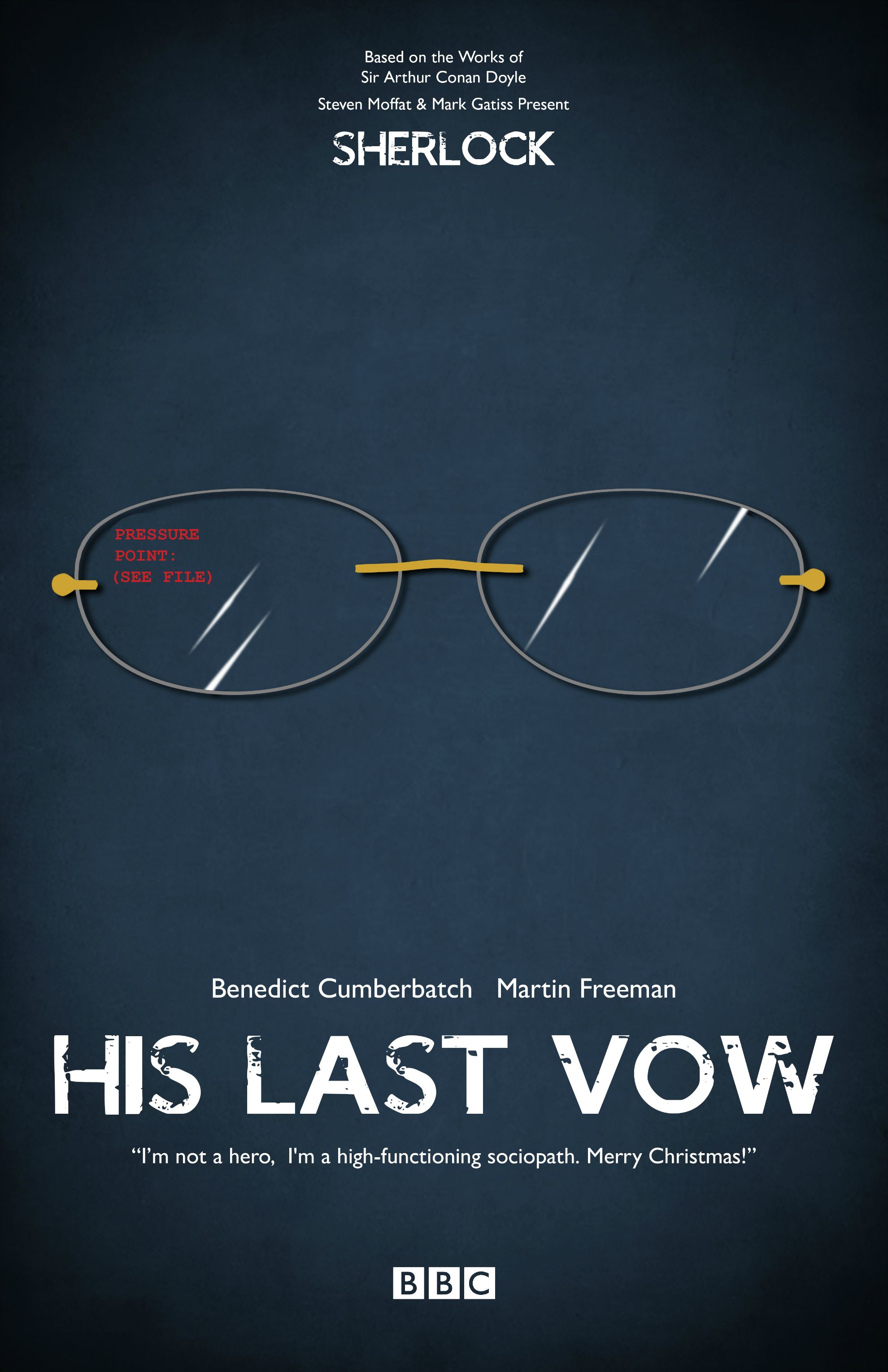
Sherlock: His Last Vow Review


SHERLOCK: HIS LAST VOW

Vows Are Made To Be Convoluted...

I honestly don't know where to begin. 

His Last Vow, the final mega-episode of Sherlock, won seven out of eleven Primetime Emmy Awards, including for its two stars, Benedict Cumberbatch as Sherlock Holmes (Lead Actor), Martin Freeman as John Watson (Supporting Actor), Cinematography, Editing, Music, Sound, and most difficult for me to accept, Outstanding Writing for a Miniseries, Movie, or Dramatic Special for Steven Moffat. 

Tom O'Neill, proprietor of Gold Derby (an awards prediction site), a man who in the past was a passionate defender of the Emmys somewhat bizarre choices (read What Were They Thinking? by David Hofstede for a revelatory interview with O'Neill on how the Emmys work), was apoplectic that The Normal Heart, a gay/AIDS-centered television movie, lost to what he considered a particularly bad Sherlock episode*.  He was especially enraged that Larry Kramer, who adapted his own play, lost to of all things His Last Vow (which he thought was inferior to The Sign of Three).

His reasoning for what he considers outrageous victories?  Homophobia.  He apparently wasn't the only one who thought His Final Vow and Moffat benefitted from Hollywood hypocrisy about gays.  I find that hard to believe given Moffat has given us the virtues of same-sex bestiality with Doctor Who's Madame Vastra & Jenny.  I haven't seen The Normal Heart, so I can't share O'Neill's passion for it. 

I have seen His Last Vow, and I have the same question O'Neill has.  THIS won?  You can see his smackdown of his fellow Gold Derby cohorts below.


I found His Last Vow to be sprawling, not terrible, but hardly anything that says, "This is unimpeachably brilliant". 

Charles Augustus Magnussen (Lars Mikkelsen) is a master blackmailer.  The Rupert Murdock-like figure who controls a vast media empire has valuable and embarrassing information on all figures public and private safely stored away in a vault at his palatial estate, Appledore (which makes me wonder if Moffat was consciously or not ripping off another writer for whom I care little for, one J.K. Rowling and her "Dumbledore", but I digress).  In any case, into this sordid web comes one Sherlock Holmes (Cumberbatch), who has been asked by Lady Elizabeth Smallwood (Lindsay Duncan) to get letters written by her husband to a teen/pre-teen girl.  In order to get to Magnussen, Holmes has to attract negative media attention.  What better way than to have people think Sherlock has a drugs problem?

However, there is a small hitch to that plan in the form of John Watson (Freeman), who just happens to come across Holmes while searching for a neighbor's son in a drug den (shades of The Man With the Twisted Lip).  John and his wife Mary Morstan (Amanda Abbington, Freeman's real-life mistress), are concerned and nonchalant about the whole matter.  Watson, for his part, is thrilled to discover Sherlock's new hobby.  It's in the form of Janine (Yasmine Akram), one of Mary's bridesmaids whom he met at John & Mary's wedding.  Sherlock has a girlfriend.  John is so hung up on this that he continuously keeps missing the point about Magnussen's danger.

Virgin No More...

Magnussen for his part is nonplussed about Holmes, particularly since big brother Mycroft (Mark Gatiss) is either afraid of Magnussen himself or willing to give him free reign so long as he doesn't cause too much trouble.  Baby Brother Sherlock, for his part, detests Magnussen for preying on the weak and different.  He attempted to negotiate with the only man he openly hates but has to resort to other methods.  Janine, we find, was a pawn in Sherlock's master plan, for Janine just happens to be Magnussen's private secretary.  Holmes and Watson go to his private office when they come across a wounded Janine.  They also smell the scent of Claire de la Lune, a particular perfume.  Watson observes that Mary wears that.

Typical of John Hamish Watson to put things together but still be clueless.  Sherlock comes into the room to find Magnussen being held at gunpoint...by MARY MORSTAN WATSON!

Allow me to pause here for a brief point of logic.  Sherlock Holmes in The Empty Hearse can correctly deduce from merely looking at a maitre'd that said maitre'd's wife is about to give birth, but despite being with her for months and months, the great Sherlock Holmes could NEVER see that Mary Morstan was a former CIA assassin!  Let's repeat: this man could figure out a man is about to be a new father just by looking at him, but could not see that the woman his 'best friend' married and who will be the mother of his children had a license to kill.  I personally find the whole thing idiotic and convenient plotwise, but I'd like the reader to chew on that.

In any case, Mary finds herself in a particular dilemma.  She is obviously there to kill Magnussen, but she'd have to kill Holmes, and possibly Watson.  What to do?  Well, in an extended sequence, she shoots Sherlock enough to injure him, and he at one point dies, but in a dream-like state with Jim Moriarty (Andrew Scott), Holmes' love for John Watson literally brings him back to life.

Well, John and Sherlock are having an issue with Mary, and slowly her story is revealed.   It's a sorry Christmas to say the least, as John comes to grips with both his wife's sordid past and how he's addicted to people who are dangerous.  Eventually he forgives his wife, and good thing too since Sherlock has basically sold out his brother 'Mike': the secrets of Mary and entry to Appledore in exchange for Mycroft's treasure trove of state secrets.  However, Sherlock has been fooled again (not particularly bright for a genius is our cerebral Holmes, is he). 

There is no 'vault'.  It's all in Magnussen's mind, quite literally, as he keeps all his secrets in his own 'mind palace'.  Holmes appears to be trapped: once Big Brother Mycroft wakes up from the sleeping drug Sherlock slipped into the family drink, he and Watson may be charged with high treason.  How to get out of this?

Simple: Sherlock shoots Magnussen in the head.  Problem solved.

Well, Sherlock simply has too many fans to have him executed (his brother Mycroft not caring very much for him in any case).  With that, it's decided it's time for exile, but it turns out to be surprisingly brief one, since who happens to have invaded television screens around Britain but, you guessed it, Jim Moriarty, who asks the nation, "Miss me?"

Masters of Smokes & Mirrors
I found His Last Vow to be an episode that hung on some pretty outlandish elements, which I figure would be typical of a Steven Moffat script (even one that managed to win a writing Emmy to the shock of Emmy watchers who predicted a Normal Heart sweep with an outside chance for Fargo).  To these 'experts',  His Last Vow's various wins is comparable to How Green Was My Valley trouncing Citizen Kane in various categories.  I don't think I would go that far, but I can say some things about His Last Vow were if not flat-out ridiculous, at least rather deranged.

I've already pointed out the entire subplot of having Mary end up being some sort of Jason Bourne/Annie Oakley mix.  That was already pretty wild to begin with, but to undercut the entire idea of Sherlock Holmes, master deductionist, and his brother Mycroft, as being shockingly unable to deduce Mary was a hitwoman makes a total mockery of how amazingly brilliant Sherlock Holmes is suppose to be.  Again, I've yet to hear how it is possible Sherlock Holmes can deduce minutiae about someone by how they breathe but can't figure out that Mary is a master assassin.

We also have the entire "Sherlock comes back from the dead because Moriarty taunts him that Watson is in danger".  Now, it's a familiar plot device with Moffat to always suggest his characters will die but then bring them back to life in pretty insane and idiotic ways, and that Moffat puts the idea that 'love' is capable of all sorts of deus ex machina, but this one brings them together in a bonkers way.   I'm no expert on getting shot, but somehow once you die (complete with a flatline), no power apart from God will bring you back. 

It is also something that Moffat or the Sherlockians/NuWhovians never seem to understand.  If Steven Moffat continuously pulls this trick, it always cuts the tension out because I KNOW as a viewer no one ever dies.  If I KNOW he/she will survive, why should I worry whenever their life is 'in danger' because they never really are 'in danger'? 

We also have the really bad way to get Sherlock and John out of their dilemma: just shoot the bastard.  One wonders why Holmes didn't do that, or Lady Smallwood didn't do that, or really ANYBODY didn't do that.  Magnussen wasn't all that powerful where someone else couldn't hire a hitman to take him out.

Perhaps that is one reason I found His Final Vow less than compelling.  Magnussen never came across as a threat to me.  I thought the same about Scott's very camp & looney Moriarty, but Mikkelsen at least had the plus of not being overtly silly.  Well, not withstanding when he licked Lady Smallwood's face, or when he urinated in Holmes' fireplace with neither him or Watson saying a word against it. 

Going back to Mary for a bit, why couldn't Moffat simply make her another victim who decided to take things into her own hands?  Why give her this patently idiotic backstory of 'she's ex-CIA'?  Can't he ever keep things to a semi-rational level?

Why is Year of the Cat playing in my Mind Palace?

Now, let's move on to other things.  His Last Vow won an Editing Emmy.  I can't figure WHY given that at least once (Sherlock's hallucinatory semi-death and resurrection) I thought the editing went bonkers to the point of incoherence.  Maybe I was suppose to be impressed with how nutty it all was, but I wasn't.  In fact, I was highly irritated by it all.

His Last Vow won an Acting Emmy for Martin Freeman.  I can't figure WHY given he was still the bumbling idiot he's been before, and this time even more so.  Is Freeman's take on Watson to make him perpetually flummoxed and befuddled by everything?  How can anyone think this particular performance was brilliant when his Watson came across as an even bigger (or smaller) idiot than usual?  At least twice I wrote that John Watson kept missing the big picture.  He was so thrilled by the concept of Sherlock Holmes having a girlfriend (or at least getting some) that he kept failing to understand how dangerous Magnussen was.  I genuinely think Watson wasn't even listening to everything Holmes was telling him for he was so myopic about Sherl & Janine, dreaming of having a double date with him and Mary. 

Also, is it me, or is there something almost dumb at reducing John Watson to Sherlock Holmes' 'damsel in distress'? 

Mark Gatiss went being his usual snooty self (I maintain that Gatiss is not acting in Sherlock, merely playing himself as he is in real life) and into being a joke (but then I think that of Gatiss in general, so I won't belabor the point).

His Last Vow won an Acting Emmy for Benedict Cumberbatch.  This one I won't belabor too much, because I think Benny gave a solid performance as he does in almost everything he does.  Now I think he's gunning for an Oscar for The Imitation Game, and he has a chance for it (biopic--check, playing a person with a 'disability', read 'closeted homosexual'--check, British--check), but in this case (unlike The Imitation Game) I think the Academy might have picked the right choice (this of course, is without seeing the other nominees).

Abbington to make came across as comical more than menacing as this ex-CIA agent.  I didn't care for her all that much when she was just Mrs. Watson, but this twist makes me think LESS of her. 

His Last Vow won a Writing Emmy.  Plot holes, nonsensical twists (Mary KNEW Janine worked for Magnussen) that were easy to predict (I predicted Janine would be a mere pawn, though that was staying within Canon), repetitive tricks from his other scripts.  He introduced Mary's past through the A.G.R.A. flashdrive she gives John, but in a thumbing to Chekov's gun, John burns the flashdrive without ever having bothered to read it; yes, it shows he doesn't care about her past, all well and good.  However, why introduce A.G.R.A. if it won't be important...unless we'll be treated to more of this in a future Sherlock episode.  Well, at least he's British the Emmy voters thought (and if dark whispers are to be believed, is a straight white male), which to the American artistic community means he's 'better'. 

That isn't to say there weren't things in His Last Vow that I didn't find to admire.  It was the quiet moments, the ones where the difficulties between the Holmes Brothers, when Sherlock appears to have human (or at least sexual) emotions, when John and Mary are finding the road to reconciliation tough, that the show became more believable.  The scene when Sherlock tells John "William Sherlock Scott Holmes", apparently as a good name for John and Mary's child but I figure giving John his full name, worked better than most.  Not the greatest  "farewell" scene (and sorry Sherlockians, His Last Vow won't rival the end of Casablanca despite your proclamations that Sherlock is 'the greatest show of the Twenty-First Century').

As a side note, I think I found the perfect name for the Watsons baby girl...

How does "JOAN Watson" suit you?

I also admire the effort to at least give Sherlock a 'childhood trauma' as some sort of motivation, though when we see "little Sherlock" as the one being hunted down by Mike I thought it all a bit overblown and silly.  I didn't care for it in Get On Up, and don't care for it here.  Too easy cinematically to use the child version of our character to 'say something'.

His Last Vow wasn't terrible, but I found it a story that was too outlandish and too simplistic at the same time for me to think it was somehow this turning point in television history.  And I speak from my heart, my normal heart if you will...         

There IS Something About Mary...


5/10

*Rob Licuria, one of the commentators in the video said that Steven Moffat was 'an openly gay writer'.  This is inaccurate to say the least.  Steven Moffat has been married twice, to women, is married to a woman (Sue Vertue), has two children, and is openly heterosexual.  Steven Moffat loves women sexually.  In terms of how he writes women, he is somewhere between merely sexist to downright misogynistic, but that is another matter.