Showing posts with label 2006. Show all posts

Saturday, June 14, 2025

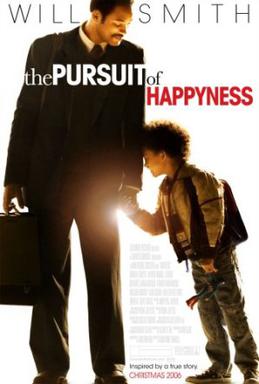
The Pursuit of Happyness: A Review


THE PURSUIT OF HAPPYNESS

Inspirational tales do not come more inspirational than The Pursuit of Happyness, the biopic of Chris Gardner. Time has softened the film's impact, but it still holds up relatively well.

Chris Gardner (Will Smith) has put all his family's savings into portable bone-density machines that he is convinced will be great sellers. Unfortunately, in 1981 San Francisco these bulky devices are seen by many doctors as an unnecessary extravagance. To make ends meet his wife Linda (Thandie Newton*) works double shifts at a hotel. This puts a strain not just on their finances but on their marriage, with only their son Chris, Jr. (Jaden Christopher Syre Smith*) holding them together.

The Gardners continue struggling, though, until Chris notices a sign for interns with the Dean Witter Brokerage Firm. He through sheer will makes a positive impression on Jay Twistle (Brian Howe), a partner at the firm, with a little help from a Rubik's Cube that Gardner is able to solve. This internship, which can lead to getting hired at Dean Witter, may be a way out of the Gardner family financial struggles. Chris, however, is devastated when he learns that it will not only be unpaid, but that there is no guarantee that he will get a job there if he makes it through.

Despite this, he agrees to enter the internship. This is the end for Linda, who leaves him for a job in New York. Eventually conceding to Chris' insistence, Chris, Jr. stays with him instead of his mother. Now, Chris Sr. and Jr. continue struggling to keep body and soul together. It is not that Chris, Sr. does not work. It is that unpaid parking tickets, poor bone-density machine sales (including the theft of two of them) and the unpaid nature of the internship continue to wreak havoc. It is to where Chris Sr. and Jr. are made homeless, having to sleep in BART restrooms and homeless shelters.

Chris, however, will not give up. He boldly goes to the home of a potential client whom he barely missed an appointment with: Walter Ribbon (Kurt Fuller). Gardner never lets on to his potential clients or fellow interns that he is living in a homeless shelter or that he is beyond broke. Will Chris Gardner earn that coveted job post-internship and save his son from poverty?

I remember watching The Pursuit of Happyness  (the spelling of "Happyness" coming from a misspelled mural at Chris, Jr.'s daycare) and being deeply moved at the time. Perhaps I have grown more cynical in the almost twenty years since The Pursuit of Happyness premiered. Perhaps the antics of Smith pere et fil in the ensuing years now colors somewhat my view of them in the film. I was surprised that I did not have the same reaction to the film now. 

What I mostly thought was how dumb Gardner was at times. Why could he not bring in that bone-density machine to his initial internship interview? Certainly, it would have made more sense than to leave it with some hippie street singer. Granted, he did say in voiceover that "this part of the story is called Being Stupid", so credit where it is due. However, he also seemed genuinely surprised that the police would come for him over unpaid parking tickets or that the IRS would raid his banking account. 

I will leave aside how he probably should not have invested everything into those bone-density machines. I kept thinking that Gardner kept making one lousy decision after another. 

Another element that now has me less enthusiastic about The Pursuit of Happyness is on the portrayal of the homeless. I figure that there are such cases like the Gardners, who through poor economic choices and circumstances do end up in homeless shelters. However, I think this is more the exception than the rule. Many homeless have mental health issues, some downright delusional and with various chemical dependency problems. I could not shake the idea that The Pursuit of Happyness was attempting to suggest that homelessness was strictly and purely financial when it is a very complex issue. To be fair, the film is not about homelessness but about Chris Gardner's personal story. As such, I may be reading too much into things, but I digress.

I think that one element that pushes The Pursuit of Happyness down is Will Smith's voiceover. I understand what Steven Conrad's screenplay was going for whenever he had Chris Gardner tell us his thoughts. I just thought that there was too much of it to where it veered close to parody. It did give Will Smith a nice Oscar clip when he tells Chris, Jr. to never let anyone tell him he cannot do something. Oddly, this was not the clip that was used at the Academy Awards presentation when Smith was nominated for Best Actor. Perhaps the overt nature of the "Follow your dreams" speech was too much even for the Academy. 

I think the film would have done better to cut back on the voiceovers. Again, I think it wanted to suggest a more intimate conversation with Gardner. I just found it distracting and excessive. This is not to take away from a good performance from Will Smith as Chris Gardner. His best scenes were when playing off against his real-life son Jaden. There was a natural manner to those scenes which made them effective. His last scene, when he learns that he did get the job, is quite good in its understated manner. We see only the tears forming, but it is the quite manner that gets the viewer more than if he had broken down and had a big dramatic moment. He was less effective when he was working with others. His scenes with Newton seemed a bit more forced, as if they wanted to push the drama but were pushing too hard.

Speaking of Newton, I felt that The Pursuit of Happyness portrayed Linda Gardner in perhaps an unfair light. She came across as almost irrationally angry when in reality she had every right to be frustrated at Chris' poor decision making. Here she is, attempting to keep a steady job and care for her son, and her husband continues to struggle to have an even income. I did not think that she was wrong in her frustrations or worry or anger. I think the film did.

Jaden Smith was precocious as Chris, Jr., with some good moments. Of particular note is when he and Chris, Sr. are pretending to have gone back in time and see dinosaurs. In retrospect, we can see that Jaden Smith is good when he is not the central character. 

It is nice to see that the stockbrokers in The Pursuit of Happyness were not portrayed as Gordon Gekko types who celebrate greed. Instead, they were decent people who cared for their own families and in a nice moment, showed both gratitude and respect for past kindnesses. 

Again, I was surprised that The Pursuit of Happyness did not hit me as hard as it did the first time. It is still a pretty good movie. It is appropriately inspirational and with a good performance from both Smiths. Time may have diminished some of its power, but I think people will still get something out of The Pursuit of Happyness.

DECISION: C+

*Mr. Smith was billed as "Jaden Christopher Syer Smith" and Ms. Newton was billed as "Thandie" at the time they appeared in The Pursuit of Happyness. Smith now goes by his first and last names and Newton has since returned to her original name of "Thandiwe". To avoid any potential confusion, I used the names used at the time of the film's release.  

Wednesday, May 14, 2025

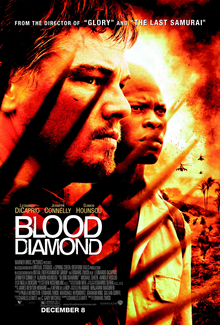
Blood Diamond: A Review (Review #1979)

BLOOD DIAMOND

I have found that, on occasion, filmmakers will couch a message in their films. Blood Diamond uses a lot of action as a way of informing us to the evils of illegal diamond trading to finance wars. A bit heavy-handed and far longer than it should it, Blood Diamond has one particularly good performance and one serviceable one to make it worth seeing.

Sierra Leone, 1999. Humble fisherman Solomon Vandy (Djimon Hounsou) lives quietly with his wife, two daughters and son Dia (Kagiso Kuypers). Things are peaceful until the Revolutionary United Front, an armed group attempting to overthrow the government, storms into his village. They kill and maim the population, with Solomon being spared due only to him making for a good slave.

His task, along with other men, is to search for diamonds. These diamonds, known as conflict or blood diamonds, will be smuggled from Sierra Leone to Liberia, where they can be certified as conflict-free and thus legal for sale. Diamond companies, aware of the deception, will then buy them and either keep them in vaults to increase demand or create jewels for the international market. Solomon has found a very rare pink diamond and attempts to escape with it, hoping to use it to buy his family's way out of Africa. Caught by the evil Captain Poison (David Harewood), Solomon has the first of many fortunate escapes when government troops find the rebel camp and is arrested.

In jail, Poison's loud revelation of Solomon's find catches the attention of Rhodesian mercenary David Archer (Leonardo DiCaprio). Archer, a gun and diamond smuggler, gets Solomon out of jail and is desperate for him to tell him where Solomon buried the pink diamond. Solomon wants nothing to do with Archer or that cursed diamond. When Sierra Leone's capital of Freetown falls to the RUF, however, Solomon agrees to work with Archer in exchange for Archer helping locate Solomon's family and get them out.

Easier said than done, for Archer is under pressure from his former commander and frenemy Colonel Coetzee (Arnold Vosloo) to get the diamond too. Archer wants the diamond to finance his own way out of Africa and plans to betray both Solomon and Coetzee. He, however, had not counted on American journalist Maddy Bowen (Jennifer Connelly). Investigating the connection between blood diamonds and the powerful Van De Kaap family/diamond corporation, the beautiful Vital Affairs Magazine reporter has Archer slowly questioning his life choices. 

Solomon and Archer, having joined forces, now go to find the pink diamond. Solomon, horrified that Dia has been brainwashed into being a RUF child soldier, attempts to rescue his son. That ends in disaster, but luck is still with Solomon and Archer. Will Solomon and his family escape this nightmare? Will Maddy expose the evil Rudolph Van De Kaap (Marius Weyers) and his aide Mr. Simmons (Michael Sheen)? Who will live and who will die?


I am sure that I saw Blood Diamond when it was released. I, however, do not remember it being as long as it is. At nearly two-and-a-half hours, Blood Diamond is a surprisingly long film. This is a major flaw in Blood Diamond (no pun intended). Charles Leavitt's screenplay (with story by Leavitt and C. Gaby Mitchell) has a curious habit of going on either going on tangents or attempting almost to make two films. For the former, there is when Archer, Solomon and Maddy stumble onto the school of Benjamin Magai (Basil Wallace). Magai has rescued child soldiers and provided refuge and education for them. When looking for Dia, Magai goes with them and ends up getting shot but not killed by child RUF soldier Dead Body. Magai's cheerful, almost naive manner is bizarre given how he should know how traumatized and indoctrinated the child soldiers are.

He does survive, but once he's helicoptered to the hospital, we never see or hear from or about him again. Was he there just to remind us how amputations of African de facto slaves began under the Belgian King Leopold II? Leopold exploited Africa for his own gain, but how he is responsible for creating RUF child soldiers or the RUF leaders using alcohol, drugs and mental manipulation to both terrorize and indoctrinate children no one answers. 

As stated, Blood Diamond also seems to want to make a whole film about child soldiers. A surprising amount of time is taken up by Dia's turn into a RUF zombie. In a very curious choice by director Edward Zwick, the film cuts between a group of journalists coming across the aftereffects of a RUF/government battle and the training and manipulating of Dia and the other children. This decision to go from the journalists to the child soldiers and then back to the journalists undercuts both stories.

In fairness, Blood Diamond did precede Beasts of No Nation, which is also about African child soldiers, by almost a decade.

Both Leonardo DiCaprio and Djimon Hounsou received Oscar nominations for their performances in Lead and Supporting Actor respectively. This was DiCaprio's third nomination out of a current six (one win) and Hounsou's second and currently final nod. Hounsou's nomination was well deserved. 

His performance is exceptionally strong as the father caught in these terrible circumstances. Hounsou brings Solomon's continuous shock and determination to survive to life with great compassion. I questioned both his stubborn insistence on total honesty even when it harmed him and his apparent stupidity in trying to rescue Dia with only a vague plan. However, one can sympathize with Solomon, who is put in terrible circumstances and attempts to do the best that he can.

DiCaprio is a bit hit-and-miss. This was a banner year for DiCaprio who had a nomination for Blood Diamond while also starring in that year's Best Picture winner The Departed. Perhaps the Academy gave him a nomination for Blood Diamond over The Departed because his Afrikaner accent was slightly more believable than his Boston accent. Technically, Danny Archer was Rhodesian (what is now Zimbabwe) and not South African, but he did grow up in South Africa. DiCaprio is an actor who apparently went through an "accents showcase my versatility" period. While his Afrikaner tones were not awful, they did at times feel a bit forced and mannered. It comes across as an actor trying too hard. I think we are meant to focus on Archer's evolution from merciless mercenary to more compassionate person. He did a good job of that, good not great. However, his accent is again someone trying too hard. 

This is especially the case when DiCaprio shares scenes with Arnold Vosloo, who is South African. While he is best known as Imhotep in 1999's The Mummy, Vosloo was quietly effective and menacing as Colonel Coetzee. It is a shame that Vosloo was not given the Archer role. I understand why: Leonardo DiCaprio can open a film, Arnold Vosloo cannot. However, I think Vosloo would not have struggled with the accent the way that DiCaprio did. 

I wonder if the Connelly character was even necessary. Was she there to provide Archer with something of a love interest (the film does have them appear to be interested in each other)? Would it have made the film better if Bowen had been a man? Out of the three leads, this was probably the weakest.

The subject of blood diamonds seems to have been pretty much forgotten now. Whether it is due to the various conflicts no longer ongoing, the overall market being more effective in monitoring conflict diamonds or a lack of interest I cannot say. It is not a totally lost opportunity to mix a serious message with a lot of action. Blood Diamond did a serviceable job, but it is far too long to reach the levels it aspired to. 

Tuesday, April 15, 2025

Half Nelson: A Review (Review #1970)

HALF NELSON

It seems an inevitable part of being a teacher, that of students being shocked that the women and men that they see only in the classroom have lives, sometimes quite debauched, beyond the chalkboard. Half Nelson tells one such story, where teacher and student switch roles with each other. With strong performances throughout, Half Nelson is less cautionary tale and more portrait of those struggling between their ideal and true selves. 

Daniel Dunne (Ryan Gosling) wants to inspire his young students to think of history as more than people, places and dates. He stands out in his inner-city Brooklyn school as the rare young white man in a predominantly black area. When he is not teaching or coaching the girls' basketball team, he is either hitting the bars or smoking crack. After his ex-girlfriend and recovering addict Rachel (Tina Holmes) shows up, he hits the coke in the girls' restroom. He is so out of it that he seems rather unaffected that one of his students has come upon him in his sorry state.

That student is Drey (Shareeka Epps). She is no stranger to the drug trade, her beloved brother Mike (Collins Pennie) doing time for selling drugs for local kingpin Frank (Anthony Mackie). Frank, minus the drug running, is not a bad man, going so far as to provide for Drey and her mother as a thank you for Mike taking the fall for Frank. Drey, who likes both Dunne and Frank, now feels the push and pull from both of them.

Despite his addiction, Dan wants Drey to stay clear of Frank. For his part, Frank wants Drey to help him sell drugs. Eventually, Dan's life spins close to unmanageable, causing him to start crumbling. While the Dunne family, with whom Dan is distant from, seem unaware of his condition, Drey and Dan's fellow coworkers know something is amiss. Eventually, the tangled lives of Dan, Drey and Frank connect through the matter of supply and demand. However, there is still some hope for Dan and Drey, that they might escape their own troubles and help the other out.

Half Nelson is no To Sir, With Love.  Told in a straightforward, non-flashy style by director and co-writer Ryan Fleck (writing with Anna Boden), Half Nelson takes a unique twist on the "inspirational teacher" trope to show a flawed, troubled man behind the casual veneer. Daniel Dunne does care about his students and is committed to social change. At one point, he agrees with his students that he, as a white man, is part of the machine but opposed to a lot of the machine. He, however, is actually part of the problem not due to what I suspect in the future would be called "white privilege". Rather, it is because his addiction is in a way responsible for Frank's business, Mike's imprisonment and Drey potentially entering this dark world.

Dan may be an idealist (or a Communist, which Drey suspects due to the books in Dan's apartment). He is also an addict who rationalizes his issues. There is a good moment when Rachel and Dan are at the park, talking about their pasts. Rachel has dealt with her past addiction. Dan won't. It is not that he cannot deal with them. It is that he does not see the problem. Denial can be a harder drug than cocaine.

For her part, Drey does see that Mr. Dunne is a good man, but so is Frank. He stands by her as she forces a bully to return her bike to him. In some ways, Frank and Dan are playing father figures to Drey. That one is a pusher, and the other is an addict does not bode well for Drey's future. It does, however, show Frank and Dan to be more than their business and addiction.

Half Nelson earned Ryan Gosling his first Oscar nomination at the age of twenty-six, one of the youngest men to have done so. He is exceptional in the role. You see the haunted man who wants to be a good man. That split between his ideal and true self comes across often. Gosling lets his eyes do a great deal of the acting. He looks lost, fearful, and sometimes angry. Generally gentle as he goes Looking for Mrs. Goodbar, the few times that Dunne becomes angry are still not rage-filled moments. At one point, he becomes angry at a basketball referee, down to throwing a ball at him. Even here though, it is not intense but calm mixed with a tension and edge.

This is a very controlled performance, but in a good way. In his struggle, Gosling makes Daniel Dunne a deeply flawed man who can still find his way out. He can be a bit sanctimonious, but he is also very troubled. Near the end of the film, Drey and Daniel see each other at his most vulnerable. Gosling does not show Dunne as shocked, or upset, or ashamed. Instead, he gives her a look of almost quiet resignation and acceptance of his situation. It is a deeply moving performance.

He is matched by Shareeka Epps as Drey. She is a smart girl who looks on Daniel not as the cool teacher, but as a good man who does a bad thing. Her relationship with both Frank and Mike give her a better perspective. She knows the suppliers of the drug trade. Now she sees the customers. It is her evolution and realization of what this world is that makes Half Nelson a stronger film than if it were just about Daniel Dunne. 

Anthony Mackie has charm and even wisdom as Frank. Never downplaying the reality of his business, Mackie still makes a case that Frank has some good intentions when it comes to both Mike and Drey. We don't see Frank as evil. He is just working in a business that is illegal and harmful.

Half Nelson is a well-acted and written film. It shows that those who teach have sometimes deeply troubled, secret lives. Teachers are just as much in need of learning as their students. 

DECISION: B+

Thursday, March 27, 2025

Venus (2006): A Review (Review #1960)

VENUS (2006)

I start my Venus review with a curious observation: whoever chose this poster to advertise the film ought to be publicly horsewhipped. It is downright frightening, this disheveled old man staring back at me, almost dead-eyed. Moreover, it tells us absolutely nothing about what Venus is about. HE can't possibly be the goddess of love. Venus, Peter O'Toole's eighth and final failed Best Actor nomination, probably would not be remembered save for that sad distinction. That is a shame, as Venus is a good film about mortality and a mutual great awakening to the joys of life.

Relatively successful actor Maurice Russell (O'Toole) has become adept at playing corpses, finding fewer roles in his seventies. He exchanges pills and reminiscences with his acting friends and colleagues Ian (Leslie Philips) and Donald (Richard Griffiths). Ian is at first delighted that his great-niece is coming to London to care for him. He soon finds Jessie (Jodie Whitaker) a boorish nightmare. Ian begs Maurice to take her off his hands. The ever-rakish though secretly ill Maurice agrees.

As Maurice and Jessie start to know each other, they find the generation gap pretty large. Jessie, uncultured, uncouth and unsophisticated, is opening up to Maurice about her life. She occasionally teases him about looking and touching her, which he finds delightful. For his part, Maurice finds new vim and vigor despite his growing illness owing to his prostate. He does wine and dine her, but he also gets her a modeling job, posing for art classes. Maurice also brings art and culture into her life. 

Still, Ian, who still dislikes his tart of a great-niece, finds their relationship, whatever it is, distasteful. As they all push and pull away and at each other, will Jessie grow in life as Maurice fades away from it? Will the lifelong friends reconcile before it is too late? 


The title Venus comes from Maurice's nickname for Jessie, partially inspired by the Diego Velazquez painting Rokeby Venus at the National Gallery in London which Maurice shows her. Venus is a very brisk 95 minutes long, and in that time director Roger Michell guides his actors to very good performances.

At the top of the list is Peter O'Toole, who as stated earned a Best Actor nomination for the film. He handled the comedy well, such as when he does a pratfall attempting to see Jessie's first nude modeling. After accidentally barging in and causing a ruckus, Maurice attempts to play it cool by asking, "Is everything all right?". 

O'Toole has a droll manner as the knowing rascal Maurice. Speaking about the nightmare that his great-niece is, Ian tells his friends, "Martha said there is no job in the countryside". Maurice observes in O'Toole's magnificent voice, "There must be some demand for barmaids and prostitutes". When persuading Jessie to go to a theater performance, he observes, "It won't be as good as Celebrity Love Island, but it'll be live". 

However, in O'Toole's performance, we see the vulnerable, even regretful aspects of him. Some of his best scenes are with Vanessa Redgrave as his ex-wife Valerie. Here, just the two of them, we see Maurice coming to terms with his failures in love and more importantly, with his own mortality. 

There is poignant moment where he and Ian go to a small church which contains memorial plaques to their fellow thespians, some of whom they knew, some whom they did not. As a chamber orchestra begins to play, these two BFFs begin an impromptu waltz, finding joy and acceptance that they too will eventually find their names here. 


An aspect of O'Toole's performance that may go unnoticed is how Maurice, as a still-working actor, has a few scenes where he is acting in two roles: Maurice and whatever character Maurice is performing. In a clever bit of editing, we first see Maurice fall in Ian's apartment after essentially hitting the clubs with Jessie immediately followed by him in a hospital, surrounded by family begging him not to die. We soon quickly establish that the hospital is a studio, and Maurice is playing yet again another dying man. It was a clever twist in screenwriter Hanif Kureishi's script. Later, Maurice takes Jessie to a location shoot, where Maurice is acting in a Georgian drama. Made up in full Georgian makeup and costume, one briefly gets caught up in that story, showing O'Toole's range.

Peter O'Toole is a standout in Venus, bringing Maurice's joie de vivre as he accepts his impending death with grace, though not perhaps with a lot of dignity. This is a man who loves life but who also faces his mortality with a mix of fear, regret and acceptance. 

It is hard to judge Jodie Whitaker in Venus, which was her film debut. She was fine as the tawdry but evolving Jessie. In fairness, she has a wonderful, quiet moment when she, while bathing, talks about a forced abortion to Maurice, waiting outside. Earlier, Maurice told Jessie that the sight of a beautiful woman would be the most beautiful thing that a man would see. When she asks what would be the most beautiful thing that a woman would see, after a pause Maurice says, "Her first child". It was not clear why that caused Jessie to become upset, but this scene explains that. We also see how, by the end, Jessie had changed for the better, the woman who terrorized her great-uncle by just lying about eventually became a responsible young woman. 


In their smaller roles, Philips, Griffiths and Redgrave also did well. The interplay between O'Toole and Philips revealed a longstanding bond right from the start, where these two old men exchange medication and tell each other the pros and cons of red or white pills. Griffiths has some of the funnier moments, such as when he expands on Maurice's skills with women. Maurice, lover of words, assures his friend that he is "a scientist of the female heart" who can get Jessie off his back. Donald adds on that Maurice is "a professor of pussy", which shocks Ian and amuses Maurice. 

Venus also features Corrine Bailey Rae's Put Your Records On, which dominated the airwaves back in the day. It does describe Jessie's evolved character, and lends Venus a nice, casually upbeat ending and chill vibe. 

Venus is a short, simple story well told, with good performances all around. People who might worry that the May-December relationship is sordid I think might misread it. I do not see it as a sugar daddy-pretty young thing situation, though there are elements of that. It is, however, not exactly a grandfather and granddaughter type either. I put it as a strange dance between people who may not have sought each other out, but who ended up in better places thanks to their interactions. 

Thursday, June 6, 2024

The Omen (2006): A Review

THE OMEN (2006)

When you have the date 06/06/06 on the calendar, it does seem a waste to not try and capitalize on it by bringing us the tale of The Beast whose mark is also 666. Thus, we get The Omen, a remake of the 1976 Academy Award-winning film. So, what if it happens to fall on a Tuesday when most films are released on a Thursday or Friday. The temptation was too strong to not release it that day. Unoriginal, slightly boring and toothless, The Omen is too much under the original's shadow to have been remade. 

Career diplomat Robert Thorn (Liev Schreiber) has received the devastating news that his newborn is dead. This will be beyond what his unsuspecting wife, Katherine (Julia Stiles) will be able to endure. However, there is hope from a Catholic priest who tells him that another baby boy, born at the same time as his own, lost his mother in childbirth. Thorn agrees to take the baby, whom they name Damien.

Many years later, Robert finds himself Ambassador to the Court of St. James when his mentor meets a somewhat gruesome end. Katherine is delighting in their new home and child to care about Robert's rise. The suicide of Damien's nanny in front of everyone on his birthday, however, is alarming. The new nanny, Mrs. Baylock (Mia Farrow) should be more alarming to the unsuspecting Thorns. There is also Father Brennan (Pete Postlethwaite), a priest warning Robert that his child is dangerous. Finally, there is Keith Jennings (David Thewlis), a photographer who finds his pictures can predict the subject's demise.

Katherine begins having disturbing dreams about Damien and begins to fear him. She also wants an abortion when she discovers she's pregnant. No worries on that department, however, as Damien has caused an accident which in turn caused a miscarriage and Katherine's near death. Robert now begins to suspect Damien may indeed be the Antichrist. What role does Mrs. Baylock have in these evil games? Who will live and who will die as the spawn of Satan is shepherded into his malevolent rise?  

I remember well a coworker who was highly excited to see The Omen on June 6, 2006, which is when I first saw the film. I marvel that it is now eighteen years since then. I think of the long, strange trip my life has been since then, but I digress. I do not know if that coworker, with whom I have lost touch since, had ever seen the original. For those who had, I think the 2006 The Omen would be a pale imitation.

A good way to measure if this or any remake of a film is good is if you can see it without thinking or remembering the original. The 2006 Omen does not because, for the most part, it does not venture away from what came before. Almost all the same beats are hit, which makes one wonder why anyone even bothered. The Omen's cast and crew simultaneously wanted to make the film reverential to the original and more frightening. It failed in the latter, struggled in the former. The Omen did what many failed films have done: mistake stillness for suspense. 

Those of us who have seen the 1976 version can tell where some of the differences are. Those differences, however, reveal how much better the original was. A change is when Damien is with the animals. The 1976 version had Karen and Damien driving in their car among the monkeys, who sensed the evil to such a degree that they attack their car, with an understandably terrified Karen fleeing in horror. Here, Katherine is at a zoo on a school field trip. The simians start going berserk, but the glass stops them from going ape.

Director John Moore could not bring any sense of terror or tension to this scene or any. There was a detachment from things, coupled with an over-seriousness to everything, as if everyone was aware that The Omen was a remake to a horror classic and should treat things with almost reverence. It does not help that the acting is equally bad. Stiles observes during the ape frenzy, "They're afraid", but her delivery is almost bored. She might as well have said, "We'll have two ice cream sundaes," for all the alleged tension and terror of this moment.

It does not help that it is slightly unclear if her comment was referring to the various chimps or the screaming children fleeing in panic.

My late friend Fidel Gomez, Jr. and I disagreed on Liev Schreiber. He always thought he was wooden, while I thought he could, on occasion, be good. In The Omen, it is clearly in the former. This is probably the worst performance of Schreiber's career. Schreiber had the exact same expression throughout the entire film. I do not think that in the history of cinema, we have had someone not change his expression once on camera as Liev Schreiber did (or did not) in The Omen. The closest he came was when he learned that his newborn was dead. However, that small moment was not good.

Julia Stiles also seemed detached from things. It was only at her end that Stiles shows any emotion, and to be fair, it was good. However, that came too late to save her performance. I think, however, that the screenplay failed to give her much to do. Farrow's casting was stunt casting. Who better than Rosemary as the literal nanny from Hell? She was acceptable, though not great. She was better than Postlethwaite or Thewlis. The former was too serious to almost bored as the renegade priest fighting to save the world from the Antichrist. The latter tried too hard to be a casual observer.

The Omen also had moments of unintended hilarity. When Robert learns of Katherine's death, why they opted to have thunderstorms rolling in the background does not make things more serious. It makes them sillier. Same for when Katherine plunges three floors thanks to Damien. If that fall didn't kill her, why would a Satanic nanny? 

The film also suffers from a rushed to chaotic ending, with the editing going pretty much bonkers in a failed effort at tension. 

The Omen was cashing in on two elements: the date of 6/6/06 and the reputation of the original. If the original did not exist, The Omen would have been dismissed as so much schlock. As the original does exist, The Omen is just dull. 

DECISION: D+

THE OMEN FILM SERIES

The Omen (1976)

Damien: Omen II

The Final Conflict: Omen III

Omen IV: The Awakening

The First Omen 

THE OMEN TELEVISION SERIES

Damien

Tuesday, January 4, 2022

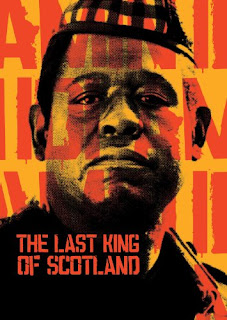
The Last King of Scotland: A Review

THE LAST KING OF SCOTLAND

Can one make a film where the villain is almost sympathetic, while the protagonist is almost monstrous? The Last King of Scotland manages to do exactly that. The film can rightly claim to be Oscar-winning, but I am not convinced people remember it or its subject.

Scottish doctor Nicholas Garrigan (James McAvoy) finds the prospect of being partners with his doctor father depressing. Looking for adventure and escape, he settles on Uganda to start his medical career. 

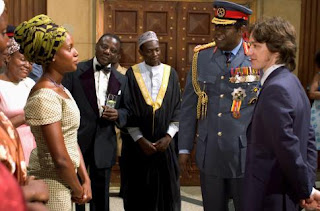
He starts working with Dr. Merrit (Adam Kotz) and his luscious wife Sarah (Gillian Anderson). Nicholas can easily tempt Sarah, but she resists halfheartedly. Uganda is in the throes of a coup d'état, and Nicholas finds the whole prospect exciting. He sees the new President, Idi Amin (Forest Whitaker) and Nicholas thinks Amin may be a good guy.

That joy grows when he and Amin meet, and he finds that the General loves Scotland and all things Scottish. Now as Amin's personal physician, Nicholas finds himself in a life of luxury, even having an affair with Kay (Kerry Washington), one of Amin's wives. However, the shadowy British diplomat Stone (Simon McBurney) and Amin's former physician Dr. Junju (David Oyelowo) give Nicholas hints that Amin is not a good man.

Nicholas does not take the hint, and he finds himself immersed in Amin's paranoia and terror. He also finds that Kay is not safe now that Nicholas knocked her up. Things culminate when the PLO hijacks an Air France flight that lands at Entebbe. Here, Amin soaks up the limelight while simultaneously torturing Garrigan for his betrayal. Ironically, Garrigan is able to escape Uganda thanks to Amin, whose release of non-Israeli hostages lets Garrigan mingle among the other white people.

The Last King of Scotland won Forest Whitaker a Best Actor Oscar for his portrayal of Amin, the film's sole Academy Award nomination. It is rare when a film wins a major Academy Award when it is the only nomination it has, and Whitaker is exceptional in the role. He switches easily from Amin's joie de vivre to his unhinged fury. Many times, Whitaker can shift from Amin raging about accusations of cannibalism to laughing at the prospect of showing his cleverness to the world.

There are, however, two issues with Whitaker in The Last King of Scotland. First, I think Amin is a supporting character, so his winning in Lead versus Supporting strikes me as a bit of category fraud. The bulk of the film, indeed the entire story, does not revolve around Amin but on Garrigan. As such, it seems that McAvoy was the lead, Whitaker the secondary.

Almost everything around The Last King of Scotland revolves around McAvoy's Garrigan to where the title could be more about him than Amin. I grant that McAvoy is an attractive man and gets his obligatory shirtless scene, but even for a film based on a fictional novel there seems something almost comical about how Garrigan is sexual catnip to every woman he meets.

As the film really is around him, I think director Kevin Macdonald wanted the viewer to see the growing horror of Amin's reign of terror through an innocent's eyes. That was difficult enough given that Garrigan was no innocent but almost arrogant in his manner to where when Amin has him hanging on hooks, we root for Garrigan to die. It gets worse when Macdonald is adamant about zooming in and out various shots within the same scene. He also moves the camera all over the place, disorienting the viewer, making things pointlessly artsy and confusing.


Second and perhaps more concerning, The Last King of Scotland seems almost sympathetic to Amin. I was surprised at how Amin was shown not as a tyrant but as almost more eccentric to slightly bonkers than cold and calculating. He was irrational at times such as when he berates Garrigan for not being supportive. "And you call yourself my closest advisor?" he scolds Garrigan, obviously shocked to have this title foisted on him when he never made such a claim.

Almost all of Amin's actions seem more misguided than malevolent. Sometimes they seem rational, a dangerous thing given that Amin was not the cartoonish buffoon the Western press caricatured him as. He could be oddball, but he was also cruel, murderous and tyrannical. His anger at an assassination attempt seems understandable even if The Last King of Scotland meant for Amin's violent retribution to those taken prisoner to be shocking. Even his literal butchering of Kay appears to be more the overreaction to a wife's betrayal than a small taste of Amin's evil.

Curiously, the Entebbe hostage situation seems more a plot device than a real story. I am puzzled as to why, despite the danger the hostages face, Amin seems willing to show them his own brutality so openly. 

The Last King of Scotland might read better as the novel it is. As a film however, it went wrong in its portrayal of Idi Amin apart from Forest Whitaker's performance. I think two films that touch on both Amin himself and the Entebbe raid are better. For the former, there is the documentary General Idi Amin Dada: A Self Portrait, and for the latter, the 2018 film 7 Days in Entebbe (also known as Entebbe). Overall, it is not a good sign when your hero comes across as worse than a murderous dictator who destroyed his country.

Circa 1925-2003


Wednesday, October 30, 2019

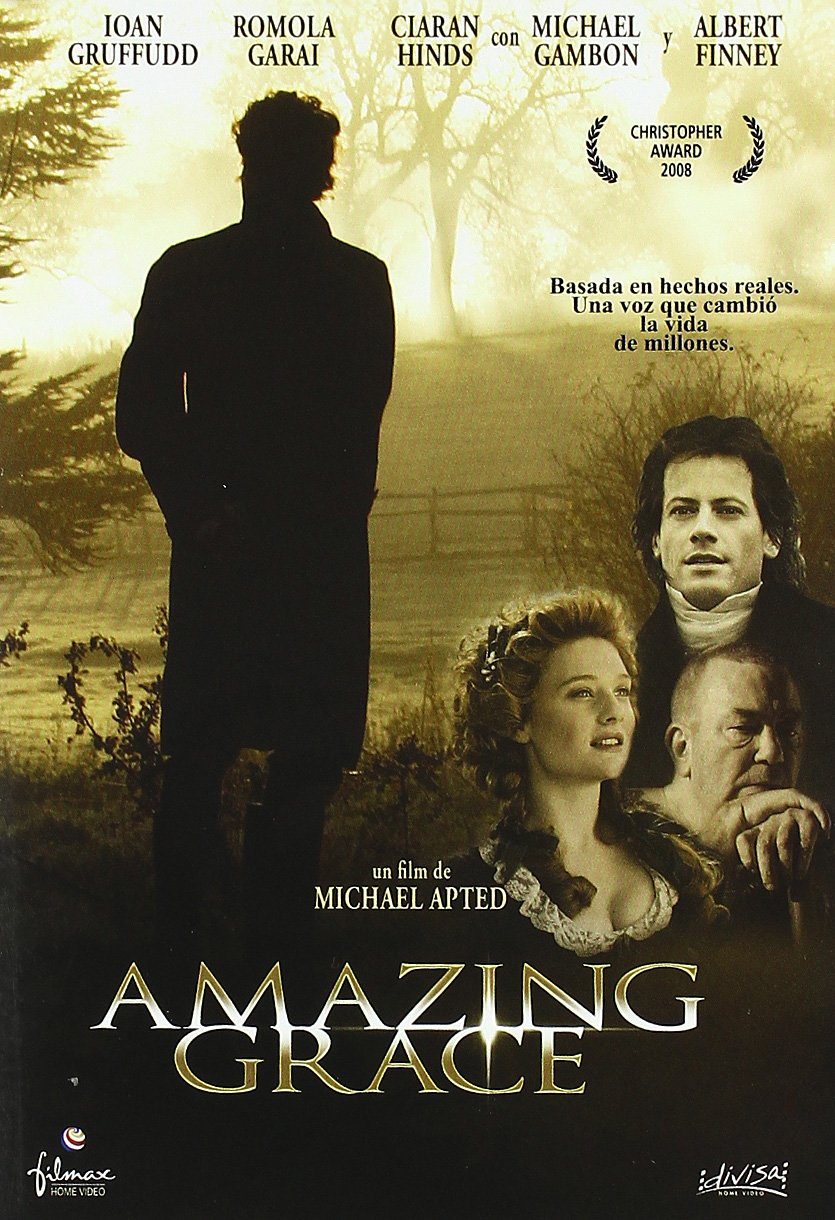
Amazing Grace (2006): A Review (Review #1294)

Image result for amazing grace 2006
AMAZING GRACE (2006)

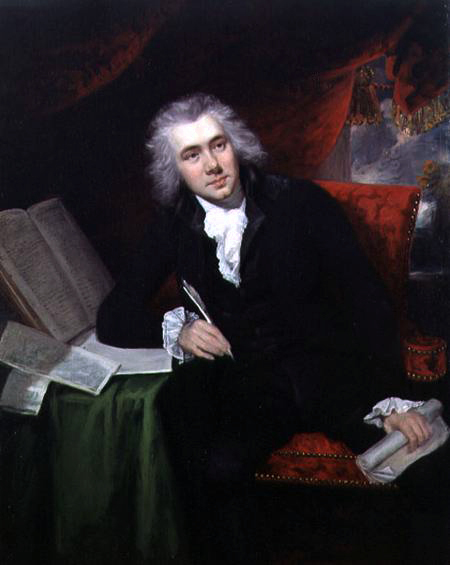
William Wilberforce is a relatively little-known figure, but his importance cannot be understated. His eventually successful efforts to abolish the slave trade throughout the British Empire merits more than praise. It should be a better-known story. Amazing Grace, a biographical film that deals mostly with Wilberforce's life and work, is perhaps a bit disjointed and could have done better in telling his story. On the whole though, Amazing Grace works exceptionally well, with strong performances that elevate the at-times jumbled narrative.

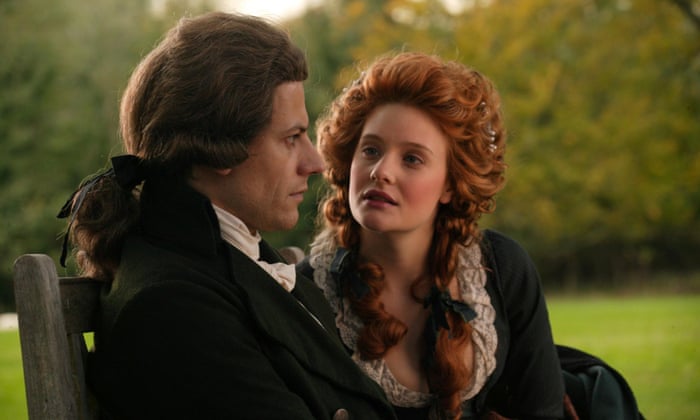
Shifting between 1791 England, fifteen years prior and two years after the opening, Amazing Grace chronicles the life of William Wilberforce (Ioan Gruffudd), Member of Parliament best known as 'Wilber' to his friends. Two friends in particular, Henry and Marianne Thornton (Nicholas Farrell and Sylvestra Le Touzel) think young Barbara Spooner (Romola Garai) would be perfect for our somewhat serious Wilber. Barbara and William are not amused at first, but find they are kindred spirits, and Wilberforce tells her his story.

Image result for amazing grace 2006Wilberforce is a powerful orator in Parliament, forever tussling with his opponents while aiding his fellow young MP William Pitt (Benedict Cumberbatch). However, Wilber is undergoing a spiritual transformation, embracing Christianity and contemplating retiring from politics. It's at the urging of Pitt and Wilberforce's old mentor, friend and pastor John Newton (Albert Finney) that he stays in office, convinced by them and others that he can lead a crusade against the evils of slavery.

Wilberforce is a powerful abolitionist campaigner, yet continues to be frustrated in ending this evil due to the political machinations of Lord Tarleton (Ciaran Hinds) and His Grace the Duke of Clarence (Toby Jones). Wilberforce however, has allies, including itinerant preacher Thomas Clarkson (Rufus Sewell) and Olaudah Equiano (Senegalese singer Youssour N'Dour), a former slave whose narrative bring attention to the 'peculiar institution'. Wilberforce also receives unexpected help from Lord Charles Fox (Michael Gambon), an old political hand who switches sides to join Wilberforce's abolitionist movement.

Wilberforce has secret health issues that cause him intense pain, but his spiritual strength, coupled with the love of Barbara and the encouragement of Newton, push him on until through some clever political maneuvering the Act for the Abolition of the Slave Trade finally passes. 

Image result for amazing grace 2006Perhaps Amazing Grace's greatest flaw is in the structure of Stephen Knight's screenplay. I am puzzled as to why the film opted to start in 1797, then jump back fifteen years, then return to 'present day'. This creates a sense of unsteadiness to make a viewer wonder where he/she is in terms of story. I think a more straightforward telling of Wilberforce's moral and especially spiritual transformation would have worked better. At least there could have been a structure where Wilberforce meets Spooner and tells her his story in a lengthy flashback before going back to them.

I think this is what Amazing Grace was going for, but it did not quite pan out.

Knight's screenplay, to its credit, does have wonderful moments of both wit and insight. When Fox crashes Wilberforce's meeting, shocking everyone, he calmly takes the head seat and wryly asks, "Any of you saints drink?" After a momentary silence, Clarkson replies, "Well this one bloody does", whereupon he takes a swig and offers the bottle to Fox.

Later, as a now-blind Newton meets Wilberforce one last time before the crucial vote, he tells William of his deep pain, regret and shame at having been a slave trader. "We were apes. They were human", he concludes, and the impact of his whole monologue hit us powerfully.

Michael Apted got extraordinary performances from his whole cast. While his role was small, Albert Finney shows why he was among the best actors of his generation as John Newton, the repentant and guilt-ridden man who wrote Amazing Grace and was set free. Gruffudd was exceptional as Wilberforce, this man driven by a commitment to his God to do good works for His Glory. There were a few moments of lightness that I wish had been explored more but on the whole Gruffudd reminded people that he has great skill. Garai made Barbara a much more modern woman, sharp and shrewd and unwavering in her own convictions and passions.

Amazing Grace was an early film for Cumberbatch, and to be honest I preferred him when he was an actor versus when he was a 'star', relying less on the power and timbre of his baritone to make Pitt into a young man in a hurry. His final scene is quite moving and effective as he looks upon death and wishes he had his friend's firm faith. Sewell showed he could be sympathetic as Clarkson, firm abolitionist and radical who liked a bit of liquor from time to time.

While their roles too were small, Jones, Gambon and Hinds were excellent as the politicians locking horns and playing a high-stakes game on the issue of slavery. High praise should also go to N'Dour, who in a rare acting performance made Equiano a man of quiet dignity after all he endured.

Amazing Grace is a strong film on an exceptional figure. Perhaps not the biopic William Wilberforce merits, but a good portrait of a man who did so much good for the Glory of God and His very fallible creation.

1759-1833


DECISION: B+

Saturday, April 20, 2019

The Departed (2006): A Review

THE DEPARTED (2006)

The Departed got director Martin Scorsese his long-sought Best Director Academy Award. Scorsese's remake of the Hong Kong film Internal Affairs keeps to some excellent moments, some wobbly Boston accents and a good though not great film.

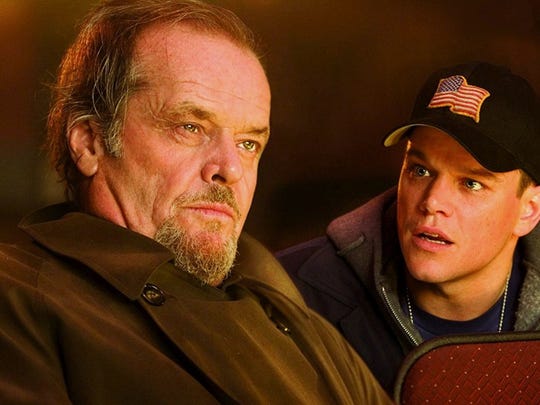
Boston crime lord Frank Costello (Jack Nicholson) grooms preteen Colin Sullivan to eventually become his mole inside the Boston State Police. Colin (Matt Damon) rises through the ranks and his information keeps Costello one step ahead, but there's a hitch. Another department stubbornly refuses to give Sullivan the name of the mole in Costello's organization who like Sullivan has worked his way up.

That mole is Billy Costigan (Leonardo DiCaprio), himself a scion of a Boston crime family who wants to break away from his family's past. Under Captain Queenan (Martin Sheen) and his right-hand man Sergeant Dingam (Mark Wahlberg), Costigan uses the family name to work his way to Costello's side.

It soon becomes a game of Spy vs. Spy to find who is the rat. The subterfuges of Sullivan and Costigan isn't the only deception going on, as both of them become romantically involved with the same woman: psychiatrist Madolyn Madden (Vera Farmiga), though the former has a longer and deeper relationship to where she moves in.

As both groups start figuring out who is on the level, things start going haywire. Costello himself is unmasked as an FBI informant, which does not help his increasing paranoia. The investigations cost lives until both rats find their corresponding figure, leading to an orgy of death, deception and fierce retribution.

Image result for the departedNot having seen Internal Affairs, I cannot say how close or far The Departed is from the source material. I can say that The Departed kept that balance between the separate moles rather well until the climatic drug bust, with still at least half an hour to go. That perhaps is one of the film's weak points: it seems to go on much longer than it should. Granted, we needed to wrap up the story but some things felt a bit off.

The subplot with Madolyn seems not just absurd but unnecessary, at least the idea that she would end up sleeping with both rats. It's as if William Monaghan's screenplay wanted to make the parallels between Sullivan and Costigan be a bit too exact.

You also had a rather odd denouement where Madolyn discovers Sullivan's deception. Rather than turn the information to the police, she just locks the door after confronting Sullivan. Even more bizarre is the whole ending: Costigan's fellow officer was apparently contacted by him but he still struggles to accept Sullivan is the traitor. Add to that the end of both a second and never-hinted-at mole and Sullivan's own end and things just felt rather rushed.

As if the rat crawling on the ledge of Sullivan's posh apartment at the end of The Departed was not an exclamation point enough.

Other elements, such as Costigan's growing prescription pill addiction or Costello's FBI protection were dropped in but not made much of.

Image result for the departed
Monaghan's script, however, did have some positives. Costello calls Sullivan 'Collie', subliminally pointing out that for all Sullivan's intelligence and the faux-paternal manner between them Costello considered him essentially his dog. The younger men are tasked to essentially become what their 'father' Costello wants them to be. As such, both deny their true natures (rotten for Sullivan, dutiful for Costigan).

The Departed is a film drenched in Catholicism, particularly in a sense of guilt that comes from betrayal. Both Sullivan and Costigan betray their fathers be it biological (Costigan's decision to be a cop versus a hood) or spiritual (Sullivan causing Queenan's death to take attention away from himself).

Scorsese has some excellent visual moments, such as Costigan's pursuit of Sullivan (though he cannot see Sullivan's face), Queenan's death, an attempted bust on Costello and the climatic drug bust that brings them all into conflict. He also gets strong performances out of his cast.

Damon and Wahlberg, both Massachusetts natives, handle the Boston accent best. I'm surprised that the latter was the one singled out for his performance given that playing a foul-mouthed hair-trigger tempered working-class Bostonian is not exactly a stretch for Wahlberg. As the false cop, Damon was better though by the end he seemed surprisingly dim and detached. DiCaprio was hampered primarily by his efforts to drum up a convincing Boston accent. I found his character a bit one-note but on the whole I think he did well.

As much as Nicholson may be criticized for being over-the-top as the arrogant and increasingly bonkers Costello, I thought well of his performance and thought he played the part as it was written. Farmiga was given a somewhat thankless job as the only female character of note who serves as little more than the bedmate to both men. The standouts were Ray Winstone as Mr. French, the ever-loyal second to Costello who brought menace even when calm and Sheen as the moral Queenan, the only untouched man in this sleazy business.

The Departed is a strong crime drama that keeps the audience within the loop to the game of cat-and-rat. I don't think it's Martin Scorsese's best film, but it is a good film if a bit too long in my view.

DECISION: B-

2007 Best Picture Winner: No Country For Old Men

Tuesday, March 5, 2019

Basic Instinct 2: A Review

BASIC INSTINCT 2

Nearly 15 years after Basic Instinct shocked America with its graphic sexual and violent content, we're treated to the continuing adventures of our favorite bisexual murderess with Basic Instinct 2. The sequel, I was told, was horrible, with more obscene sexual content, bad performances and an illogical story.

All that is true, but goodness did I find it all hilarious.

Catherine Tremell (Sharon Stone) is involved in the death of football star Kevin Franks, who died when the car they were in plunges into the River Thames. Detective Ray Washburn (David Thewlis) is absolutely convinced she's a coldblooded killer, but they have to have a psychological evaluation. Assigned this task is Dr. Michael Glass (David Morrissey), who has his own issues.

A previous patient killed his pregnant girlfriend and Glass blames himself. Whether he knew said patient was dangerous is a subject of debate that hangs over the film and is mentioned repeatedly. Despite any common sense Glass agrees to take Catherine on as a patient.

There's a lot of 'despite any common sense' in Basic Instinct 2.

As more people start dying off (a nosy reporter, Glass' ex-wife, Tremell's drug dealer), Washburn is convinced Tremell is the murderess while Glass finds himself slowly seduced into her wicked sex games. And yet, who is the killer? The "shocking" ending leaves one person in a psychiatric hospital, with a hint that maybe even the master player got played.

Image result for basic instinct 2Basic Instinct 2 requires a great deal of stupidity by just about every character, even the waitress with whom Glass has a one-night stand and is never seen or heard from again. The film is filled with outlandish coincidences and leaps of logic that will provoke one of two reactions: puzzlement or laughter.

Glass' mentor, Dr. Milena Gadosh (Charlotte Rampling), despite talking with Glass about the highly-covered Tremell case, has no idea who Tremell is when she talks to her at a party. More outlandish, the highly respected and literally wigged-out Dr. Gerst (Heathcoate Williams) has Tremell as his guest at said party and at Glass' informal interview for "the Douglas Chair" despite her connection to a murder case. Even more outlandish, Milena and Catherine have some 'girl-talk' while Gerst tells Glass that he cannot recommend him for "the Douglas Chair" because of the past patient who killed his pregnant girlfriend.

It's not because Glass (and Gerst) are running around with a woman who has been and is currently a murder suspect. It's because there are whispers that Glass may have known the past patient was dangerous, whispers that came via a sleazy tabloid reporter who was sleeping with Glass' ex-wife before the reporter was bumped off in some kind of kinky S&M death.

I wonder if "the Douglas Chair" was a tongue-in-cheek reference to the missing Michael Douglas from the original, though perhaps that is giving Basic Instinct 2 far too much credit.

Anyone else think this whole setup is already bonkers?

Image result for basic instinct 2
Leora Barish and Henry Bean's screenplay has a cacophony of stupidity that astounds. At the top is how it is almost at the end of the film that Glass discovers Tremell's connection to the original story, which astoundingly was not brought up or apparently discovered by either the sleazy reporter or the sour detective.

Over and over you keep thinking 'these people (Catherine included) must be stupid'.

The performances are of no help. Stone is trying too hard to be vampy and ends up campy. Her efforts of playing the femme fatale make her come across as overtly over-the-top, making her scenes with Morrissey come across as more hilarious as he tries desperately to play things straight. I sensed that Thewlis was suppressing giggles whenever he had to perform as the gruff detective who seems totally clueless. I could not suppress giggles, however, at Washburn's end. I flat-out howled with laughter.

Hugh Dancy as Adam Towers (said sleazy tabloid reporter) and Indira Varma as Denise (Glass' ex-wife) were not in the film long enough to leave any impressions, though here it may be a blessing.

Rampling somehow managed to come out of this disaster with her dignity intact as she, despite Milena's own idiocy, seems to be the closest person with reason.

The actual sex scenes are, apart from Glass' tryst with fellow doctor Michelle (Flora Montgomery) who also disappears from the film after he gets too rough with her, are hilarious. As a critic who tends to get lost in details, I kept wondering how Glass managed to keep breathing and thrusting with a belt tightly wound around his neck.

Worse of all, it takes an hour and sixteen minutes before Glass finally gives in to the pleasures of Catherine's flesh, with only forty minutes left in the film.

The film also has simply horrible camera work. If you notice, you can see the camera literally shaking at times, though perhaps the cameraman was struggling not to laugh as Catherine went for another "Would you like me to seduce you?" scenes.

Basic Instinct 2 is not a good film. However, it is a surprisingly funny one.

DECISION: D+

Sunday, February 18, 2018

An Inconvenient Truth: A Review

AN INCONVENIENT TRUTH

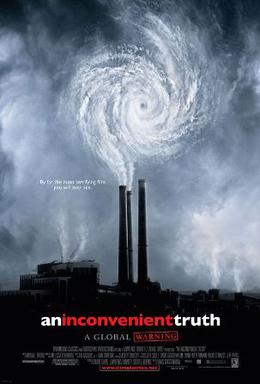
I am not going to argue whether or not An Inconvenient Truth, the documentary on global warming, is accurate or not.  My job as a reviewer is not the verify the accuracy of advocacy films.  It is, rather, to detail how well or not well a film worked.  An Inconvenient Truth was not set up to be a debate on global warming, let alone be equal in presenting an alternate to its views; rather, it was set up to convince people of what the film's host, former Vice President Al Gore, believes is an impending crisis. As an advocacy film, it does the job of presenting its case well, even if at times Gore comes across as an environmental Cassandra: the truth-teller ignored.

Essentially a slide show presentation mixed in with Gore's memories ranging from his upbringing on his father's Tennessee farm to his sister's death from cancer, his son's near-fatal car accident, and his loss in the 2000 Presidential election, An Inconvenient Truth presents Gore's findings on the increase of the Earth's temperature caused by human action, particularly the United States as the primary culprit.

Gore presents the viewer with many charts and images, drawing connections between the rise of Hurricane Katrina to the rise of the Earth's temperature.  He goes on to discuss his views on how there are three factors involved that have transformed our relationship to the Earth: the population increase, the growth in science and technology, and the politics of global warming.

Gore also touches on three misconceptions about global warming: the idea that there is no full scientific consensus, that the issue is one of economics vs. environment, and that the issue is simply too big to handle.  The former Vice President insists that this is not a political issue but a moral one and ends with a somewhat hopeful note: that by taking immediate, simple actions now and by becoming more politically involved, the Earth can be saved from our own actions.

Image result for an inconvenient truth
Again, An Inconvenient Truth is not an actual documentary in that it does present both sides.  If you want to call it one-sided, you'd be correct in a certain sense.  Its mission is not to say, 'here's what one side thinks, here's what another side thinks, now you make your own decision'.  Its goal is to convince you that it is the absolute, unvarnished, whole, inconvenient truth. 

As such, one has to judge the film based not on how one feels on the subject or even if one agrees with the premise.  Instead, if you judge An Inconvenient Truth based on presentation, you come away with the sense that it is well-crafted by director Davis Guggenheim.  It was a wise decision to use photos and video of the chaos that global warming is blamed for, and An Inconvenient Truth presents its case with passion and sincerity.

At times, Guggenheim goes a touch overboard when presenting Gore as an almost messianic figure.  All politicians to a certain point see themselves in quasi-divine terms, President and Presidential candidates even more so.  It is at times almost amusing to see shots of Gore almost looking down on the Earth and the devastation within it, like a silent deity looking down on His Creation with dismay and worry.  As Gore looks down on this troubled world, He has the answers, and whether intentional or not it does have a very curious effect of making one wonder whether He is a prophet crying out in the wilderness or just a mad prophet.

Suggesting that his warnings on global warming are similar to Winston Churchill's warnings on Hitler does appear to be gilding the lily a touch.

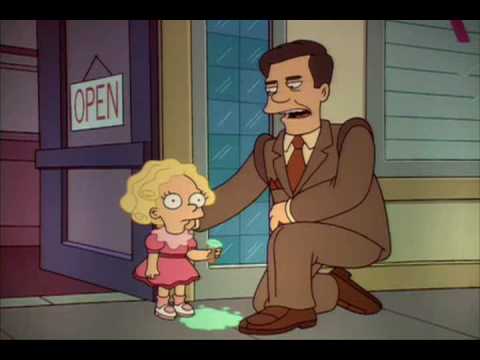
Related imageIn terms of information, Gore presents his case ably, with perhaps one misstep.  It is in the inclusion of a cartoon, None Like It Hot! which while I get the attempt at humor to my mind is slightly flippant, even patronizing.  It runs the danger of undercutting a serious subject by trying to be too cute and witty.

It plays almost as spoof when the last thing An Inconvenient Truth needs to look like is spoof.

Here is the important detail I think people need to remember when looking at An Inconvenient Truth: it is an advocacy film.  It has a point of view, and like most advocacy films, asks the audience to perform tasks: everything from the mundane (recycle) to the extraordinary (run for office to push for legislation).

An Inconvenient Truth presents its case for the impending global crisis exceptionally well, if perhaps a little wonky for some viewers.  Whether one believes in global warming or not is not the issue.  It is instead the opening up of the debate.  An Inconvenient Truth is not that debate because at no point would it ever concede to being wrong on any point. 

However, it is a film that makes its case, and if anyone wants to take it apart, then they should make their own slide show.  An Inconvenient Truth is a well-crafted argument that makes no room for counterarguments.  I cannot fault it for that. 

It might not have completely convinced me that it is right, but it has made me wonder whether it is right, and that is to my mind, a very positive step.

DECISION: B+

Monday, June 19, 2017

The Beales of Grey Gardens: A Review (Review #920)

THE BEALES OF GREY GARDENS

It's not often that documentaries become cult films and inspire passion among a group of devotees, let alone inspire musicals and a television movie. Grey Gardens, however, is no ordinary documentary.  This cinema verité look inside the demimonde of Mrs. Edith Bouvier Beale and her daughter, also named Edith, aunt and first cousin of former First Lady Jacqueline Kennedy Onassis, with all its eccentricities and opulent poverty, shocked many when it was released.

It also delighted many, seeing in "Big" and "Little" Edie both fashion mavens and upper-class rebels, living their lives their way free from societal and class expectations. They were seen as wise, delightful women who were unashamed to be themselves.  Thirty years after Grey Gardens, the Maysles Brothers, who made the original, cull their archives for The Beales of Grey Gardens, the follow-up to their portrait of women in the twilight of faded glory.

Whether it is a tribute to them or another round of shameful and shameless exploitation of them is up to the viewer.

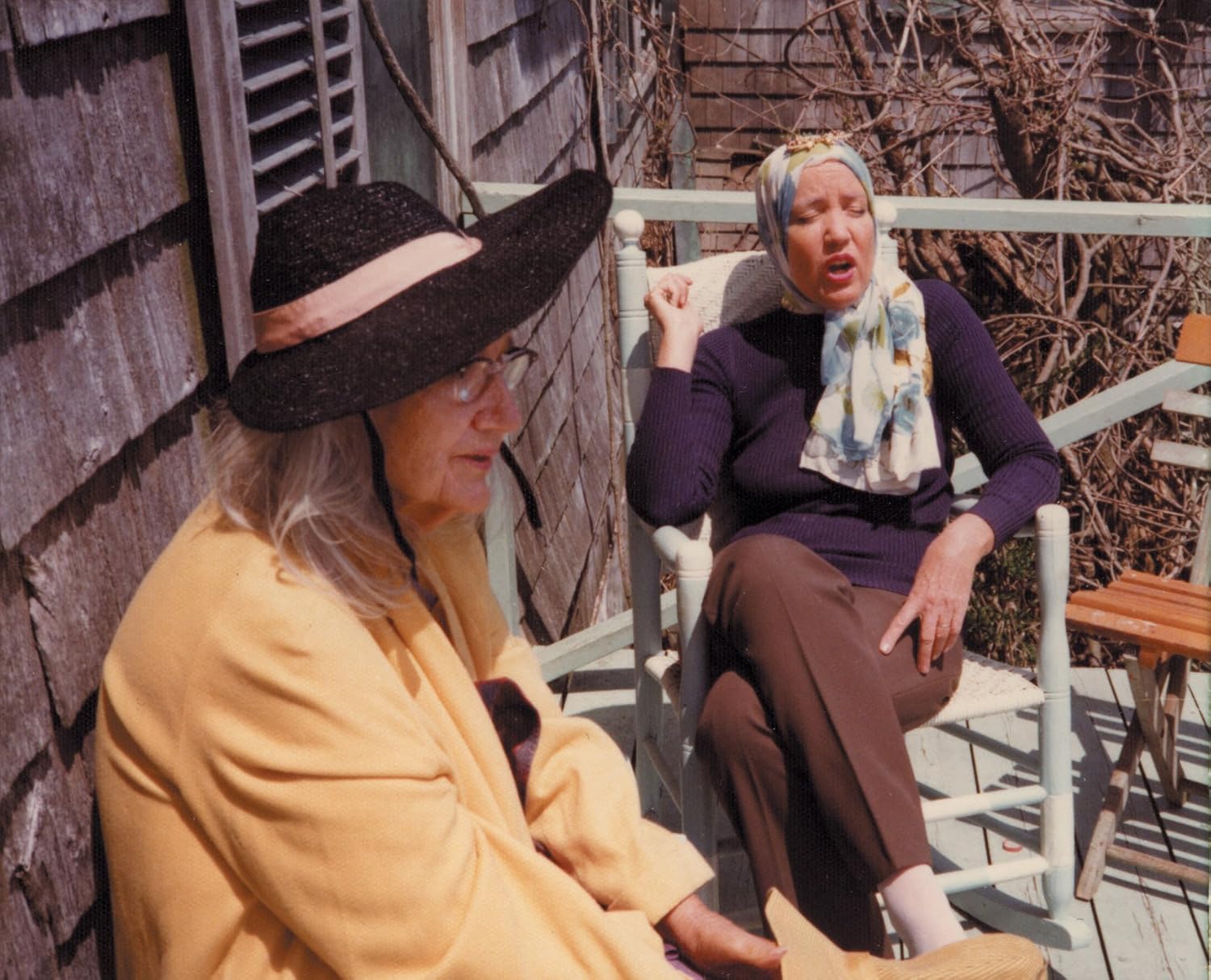
We get more of the eccentric lives of the Beales: Miss Beale, better known as "Little Edie" continues to sing and dance for the camera while Mrs. Beale, also known as "Big Edie" recites poetry and appears to flirt with the handyman, Joe Torre, who behaves as though a lot of this is perfectly normal.  Little Edie also gives us her take on politics, astrology and the Catholic Church, and we get a visit from Lois Wright, whom Little Edie first refers to as East Hampton's 'psalmist' until Lois corrects her, saying she's a 'palmist'.

Psalmist, palmist, potato, potato...

The elder and younger Beale continue to squabble in their squalor.  At one point there's a small fire caused by an overheated run-down pipe setting the dry wood aflame, which causes Little to be in virtual panic and thankful that the Maysles Brothers are there.  In this small fire, we see a brief glimpse of a surprisingly agile Mrs. Beale, who manages to scurry rather quickly for a hunched-over 79-year-old who appears to barely ever leave the second floor of her decaying mansion.

We even see that Little Edie does actually leave Grey Gardens at least once when we see her briefly attend Mass.  We end our second visit to this netherworld with Big Edie singing a song and Little giving a fashion show of sorts, a montage of her various outfits to entertain us with.


The Beales of Grey Gardens appears to make a firmer case for the insanity of at least Miss Beale, whom we see for the first time coming out singing You Ought to Be in Pictures and apparently flirting with the Maysles (David more than Albert).  It also makes the case that either she was shamelessly milking Grey Gardens to get her the fame she was so, in her mind, wrongfully denied, even if it meant appearing in a film that showed how dilapidated her home and wardrobe were (this is the first time I really noticed how ratty and worn down her fur coat was: the sleeve in desperate need of mending).

Besides flirting with the Maysles, she one occasion mugs for the camera, fully aware that her reactions are being caught on camera for all the world to see.  Maybe one of those people would be her famous cousin, whom she apparently wasn't fond of.  When Lois brought a magazine, Edie looks it over with her magnifying glass.  "Not another article on Jackie!", she fumes as she gives the cover the once-over before tossing it.

Mrs. Beale, for her part, has her own oddball behavior: forever hinting at romance with Jerry, occasionally joining in on her daughter's sing-alongs and encouraging them.  However, she actually appears to be slightly more rational, chastising Little Edie for trying to put out the fire with "Jacqueline's $300 blankets".  She also seems more aware of things, such as how her niece's husband "Mr. Onassis" paid for them to keep the house after it was raided by the health department.

I do say 'slightly', in that Mrs. Beale seemed more than comfortable lying in bed or out on her balcony, surrounded by cats, old newspapers, and general filth.

The Beales of Grey Gardens does give us more insight into these very bizarre women.  Little Edie, for example, explains that she wants her story told but not on film, saying that no one can or should play her (although after her death, there was a television movie with Drew Barrymore playing Little Edie, a curious turn given that one of the Maysles suggested Ethel Barrymore could play Mrs. Beale).  We also see some of the haughtiness and envy of Little Edie: she dismisses talk that she's schizophrenic by stating that "NO Beale is schizophrenic" and that only people with no convictions are.  Her general disdain at more stories on Jackie also show she had an envious streak.


This film is more Little Edie-focused, giving her a chance to really strut her stuff.  The sight of her going out to Mass is probably the most shocking moment in The Beales of Grey Gardens only because it shows that they were capable of leaving their twilight-infested ramshackle of an estate and do things that most people could do.  In short, they were capable of functioning.

Perhaps that is the lesson of The Beales of Grey Gardens: that they were capable of functioning, of living within society but for their own reasons refused, choosing to be the younger and older versions of Miss Havisham from Great Expectations, locked away in their home in squalor but having no interest in repairing things physical or mental. 

I think people who are fans of the Beales might find the extra singing, dancing, and fashion show from Little Edie highly entertaining, but what I saw was a life ruined by free will.  Two lives really, as both Mrs. and Miss Beale chose to be garbage-surrounded recluses, shut off from the world and apparently with no intervention from Mrs. Beale's sons or other relatives.  Then again, they could only do so much for people who wanted to live like this, and not be ashamed to let the world see them in these conditions.

Some of the footage is interesting, but I had a hard time staying awake through a second round of this garish freak show.  I found Grey Gardens to be a sorry spectacle, well-made but gaudy.  The Beales of Grey Gardens is a second go-round on this freak fest, slightly less shocking, less amusing, but in its way, perhaps more exploitive. 

Whether exploitive from the Maysles or the Beales no one can ever truly know.


DECISION: C+

Friday, December 26, 2014

Facing the Giants: A Review

FACING THE GIANTS

I'm open about the fact that I'm the most wavering Christian.  When it comes to films, I am an 'art before theology' critic.  I will not give a 'Christian' film a pass merely because the people in front and behind it are fellow believers.  Facing the Giants is another of Pastor Alex Kendrick's determined efforts to marry theology with cinema, and his track record has been pretty hit-and-miss.   I was no fan of Courageous, but felt something like The Lost Medallion was tolerable.  The fact that the latter was made for children and the former for adults may be a reason for my views on both those films. 

Pastor Kendrick, bless him, at least is determined to use film to share, if not strictly his faith, his worldview where positive, faith-affirming stories can be seen by fellow believers.  Facing the Giants is if nothing else, sincere and open about where it's coming from.  I cannot trash it for that. 

It also comes from the Kendrick Brothers, who show that in their second feature (Courageous being their fourth but surprisingly similar in almost every way) they still live in a shockingly insular world, one that is almost all-white, unaware of anything approaching human frailties, stubborn in its heavy-handedness, and determined to get in as many clichés as possible, both Christian and secular.

Coach Grant Taylor (writer/director/editor Kendrick) is facing yet another tough football season.  He is in danger of being replaced by a growing number of irate parents and alumni, and his wife Brooke (Shannen Fields) cannot conceive.  Certainly Grant is not having a good life already, but with a faulty car that dies often and players that leave their senior year it looks like Grant is besieged. 

It doesn't help that we find that the reason the Taylors haven't had children yet is because Grant can't produce. He's not a man, he's not a coach, he's an all-around failure.

Grant then does what perhaps he should have done a long time ago: let go and let God (see, I can speak Christianese).  He's come up with a new team philosophy: the team at Shiloh Christian Academy will now play for the Glory of God.  If they win, the team will praise Him.  If they lose, the team will praise Him.

Allow me to stop for a moment to observe that the football team at a Christian school apparently never prayed before a game, or attended Bible studies, or even apparently attended church.


Christian Cinema's Orson Welles, or Ed Wood?

Well, as soon as the team starts playing with a new attitude and focus,  all sorts of wonders begin occurring.  There is a revival among the students, with kids coming to Christ left right and center.  Among those kids is angry Matt (James Blackwell), who now has respect for his father.  Also affected is David Childers (Bailey Cave), a former soccer star who is the hesitant kicker and who has a wheelchair-bound father. 

The Shiloh Eagles also start winning games, a lot of them, enough to get to the playoffs.  Rather than be satisfied that he now has a winning season (and I figure has silenced his critics), through some bizarre series of circumstances Grant and the Eagles now manage to go to State, where they will, you guessed it, Face the Giants and their bull-like coach.

In a nice twist, following the advise of not just planting the seed but preparing for rain, guess who is about to be a father?

Will Coach Grant and the Eagles truly defeat the Giants? Will the 145 pound kicker named David be able to slay the mighty Goliaths and win one for the team? 

Can a wheelchair-bound man be able to stand on his own two feet?

When I first finished Facing the Giants I wasn't prepared to write it off completely.  Yes, it had problems (which I'll get into in a bit) but at least it was sincere, a product of a particular vision that if nothing else, I respected for working to present it to the world.  However, as time went on I found Facing the Giants kept stumbling on itself, in ways both large and small.

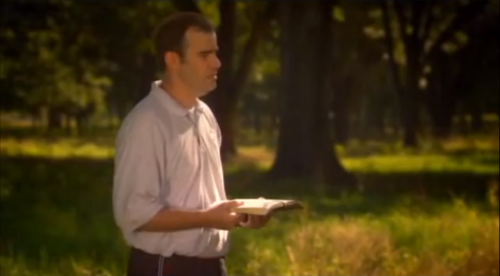
Let's start with the performances.  Alex Kendrick, despite himself, finds it difficult to 'act'.  Of particular note is when he goes out into the fields, Bible in hand, and decides to fully rely on God (FROG).  His monologue with God was curiously so flat because it was almost totally devoid of real emotion.  I wouldn't say it wasn't sincere, but it was forced and obviously fake.  'Acting' requires one to behave as if he/she were the character, not themselves.  Kendrick, here and in Courageous, stubbornly refuses to 'act'.  He will not 'become' the character.  Instead, he will speak the words he and his brother Stephen wrote almost by rote, as if he has to get them in one take or lose film.  Alex Kendrick, as actor and director, shows why any film, even a Christian film, needs professionals who know what to do in front and behind the camera.

There wasn't a single good performance in Facing the Giants.  Fields in particular was appallingly bad, her Brooke not being able to muster anything to have us care, let alone believe her situation.  I did think nicely of Cave, who while still being amateurish at least made a stab at playing his fearful character.   

On a side note, I think it is remarkably narcissistic of Kendrick to focus all his films on himself/his characters.  Facing the Giants I think would have been improved dramatically if the story focused on David (apart from the obvious parallels to the story of David and Goliath). Here was a new kid to Shiloh, who lost his mom, who had a wheelchair-bound dad, and who kept doubting himself due to his lack of football skills and small stature.  Certainly seeing a film where a young man struggles to become better I think would make a more interesting movie than about a middle-aged balding man who is facing a career and personal crisis FROG his way to success (and even grow stronger sperm).

Why Alex Kendrick insists on making almost all his films center around his characters I'll never quite understand. I have my own theories (he is too shallow to see beyond his own worldview), but for the moment almost every Kendrick Brothers feature will make Alex Kendrick the star, despite his inability to act or draw realistic performances from his 'actors'.

Facing the Giants has other issues, greater issues.  For one, despite the title the Giants were never a real threat because they didn't appear until the last game.  We never saw the Eagles see how good the Giants were, or the Giants wonder about these up-and-comers.  We were merely told early in the film that the Giants had won three state championships in a row, and then we forgot about them until the end.  Truth be told, I had completely forgotten about this fearsome football team until the end, when we were reminded that they existed. 

The final confrontation therefore was immediately left without any sense of urgency or interest because the didn't appear to be real threats to Shiloh.


However, the most appalling thing about the well-meaning but bumbling Facing the Giants, or at least the thing that made me cringe, was how Kendrick treats minorities.  Kendrick's world both in 2006 and 2013 is almost all-white.  In Courageous, there is a Hispanic character who is asked by the Kendrick character if he has 'permission to work'.  If Kendrick had asked ME that, I'd have bitch-slapped him, pastor or no pastor, told him to shove his 'permission' up his ass, and then walked away. 

As a Hispanic, I don't find some balding white man suggesting that I'm an illegal amusing.

With Facing the Giants, we had exactly ONE minority in the entire film.  That would be Chris Willis as assistant coach J.T. Hawkins, Jr.  When I say "exactly one minority in the entire film", I don't mean one minority with a speaking part.  I mean exactly that: in a film that takes place in Georgia, there is apparently only one black person in the entire STATE!  All the football players at Shiloh Christian Academy are white.  I think all the fans watching (and SCA alumni) are all-white.  All the opposing team members, up to the Giants, are all-white.

How do you have an all-white team in Georgia?  How do you have an all-white school in Georgia?  I don't mean 'almost all-white', with a few minorities.  I mean literally ALL WHITE?!

If that just wasn't bad enough, Willis is saddled with the most clichéd and stereotypical role this side of Birth of a Nation.  Willis' major scene involves him slipping into 'preacher' mode to motivate David, right down to the other assistant coach virtually shouting, "Preach it".  The music did not help matters in making this scene particularly regressive.  When Coach Taylor gets a new pickup truck to replace his dying car (which looks like it was cribbed from Stand and Deliver), Willis actually utters, "Somebody done gave you a new truck".  I swore I thought he was going to add, "Yassa Massa Grant". 

I know no African American who speaks like that.  It brings to mind how Denzel Washington in Malcolm X mocked blacks who disagreed with them by invoking what the 'house negro' would sound like. 

Seriously, if Alex Kendrick wants to be taken seriously and lift his filmmaking to sensible levels, he needs to acknowledge that the whole world is not like his house: white, Christian, and virtually free from sin.  Kendrick will never acknowledge that Christians, especially young ones, are aware of the world outside church, one with sin, with drugs, with premarital sex (or the word 'sex'), violence, anger, and all sorts of assorted evils.  

Facing the Giants, if nothing else, comes from the heart.  Again, I won't condemn it for that.  Was I entertained?  Yes.  Do I know it could have all been better?  Yes, and it didn't have to be condescending either.  It was OK, not terrible, but one hopes that the Kendrick Brothers work towards making actual films versus what they do no: cinematic versions of sermons.

The Good Book deserves a Good Script...

DECISION: C-