Monday, December 23, 2013

The Mortal Instruments: City of Bones. A Review


THE MORTAL INSTRUMENTS:
CITY OF BONES

You'll Rune the Day You Watch This...

When I was in middle school, I read such books as Gone With the Wind, Murder on the Orient Express, To Kill a Mockingbird, Bridge to Terabithia, A Day No Pigs Would DieJacob Have I LovedJohnny Tremain,  and The Lion, The Witch, and The Wardrobe.  Looking over the tween/young adult reading catalog, I see such things as Twilight, Beautiful Creatures, and The Mortal Instruments, which to me indicates yet another Sign of The End of Western Civilization. 

These titles are very similar: romantic angst buried within supernatural elements that can't be told in one volume.  No, they have to be a series (or in Twilight's case, A SAGA), where there is an effort to expand things to this grand mythology.  There are a whole group of these types of books, with only the Harry Potter and The Hunger Games novels emerging to respectability (though I confess I think little of both The Boy Who Lived and The Girl on Fire).   With the glut of these supernatural bodice-rippers, film producers have been searching for the next Twilight (a cash machine made from mud).  Grabbing anything they could lay their hands on, the effort to turn straw into gold continues.  The most recent example is The Mortal Instruments: City of Bones, the first in a threatened series of film adaptations of Cassandra Clare's novels.  Judging just by the film adaptations not just of The Mortal Instruments but all those of their ilk, the books teens read today are intellectually empty, obsessed with supernatural/occult elements, place a vapid girl at the center of universe-shattering love triangles, and would be laughed out of an eight-grade English class with their silly dialogue and nonsensical plots.

Instead, we are condemned to films that constantly threaten to tell more of these terrible stories.  That City of Bones is a simply dreadful film goes without saying.  That it is derivative of other films altogether (particularly in one plot point that is flat-out horrifying) makes City of Bones not just a disaster, but downright obscene. 

Clary (Lilly Collins) is your typical teenage girl, with a platonic best male friend, Simon (Robert Sheehan), who is obviously in love with her but Clary is too oblivious to notice.  On her birthday, she gets Simon to go into a club, intrigued by a strange symbol only she can see.  Someone notices that she can see these symbols and they manage to get in.  Here, she sees a man getting murdered, but only she can see the crime.  This alerts the assassins, but she gets Simon and flees.

Shortly afterwards, her mother Jocelyn (Lena Headley) is attacked by a group of other assassins, going on about a Cup.  Rather than let it fall into their hands, she takes some sort of potion that renders her in a state of animated suspension.  Clary comes in and finds their apartment in shambles, and she reencounters the assassin, who calls himself Jace (Jamie Campbell Bower).  Soon they and Simon are spirited to a building invisible to Mundanes (read Muggles), and here Clary learns the first of many secrets: she is a from a line of Shadowhunters, not unlike Jace and his crew, brother and sister team of Alec (Kevin Zegers) and Isabelle (Jemima West).  What the men who took Jocelyn were after was The Mortal Cup, one of three objects sacred to Shadowhunters, descendants of angels who battle demons. 

Jace and Clary:
closer than they think?

Now she must come and help find The Mortal Cup (which I think can transform humans into Shadowhunters) and keep it from the man her mother warned her about, a mysterious Valentine.  This endeavor takes most of The City of Bones' plot, which involves saving Luke (Aidan Turner), whom Clary has always assumed was her mother's long-term boyfriend but is really a werewolf who protected them both.  It also means going up against next-door neighbor/witch Madame Dorothea (C.C.H. Pounder), who has unwittingly held the cup all these years, and rescuing Simon, who was taken by vampires to draw the Shadowhunters so they can get their turn at Cup.

I know...when you see it on paper it's hard not to laugh.

As poor Simon continues to pine away for Clary, she is too attracted to Jace to give much thought to anything else.  This puts her in a love square: Simon, Jace, Clary, and Alec, whom Clary has deduces is gay and in love with Jace.  Jace and Clary share a strong kiss, so powerful it sets off the sprinklers!  However, through a portal in the sanctuary Hodge (Jared Harris), a Shadowhunter who cannot leave the sanctuary, allows entry to Valentine (Jonathan Rhys-Meyers), exchanging The Mortal Cup Clary has discovered for his freedom.  With Valentine and his minions about to overrun the sanctuary, we get not just a large battle involving the werewolves (who masquerade as mechanics) and the Shadowhunters but a big twist:  Valentine is Clary AND Jace's father! 

This would make the romance and sexual attraction between the two problematic, I imagine.  Simon's looking better all the time.

In any case, in the end the Mortal Cup is secured, Jocelyn is safe albeit still in a coma, and now it's off to the Institute with Jace, who senses in The Force (I mean, in his heart) that they are NOT brother and sister. 

Why, oh why, do I condemn myself to these terrible films?  As the Pet Shop Boys once said, "What have I done to deserve this?"  The Mortal Instruments: City of Bones is not just a mess overall, in many ways it is a pastiche of other films, some awful (Stephanie Meyer is a fan of the series, which should tell you all there is to say about the quality of Clare's work) and some among the greatest ever made (anyone who sat through this nightmare and DIDN'T think when Valentine told Jace that he was his father and offered him a chance to join him, 'Empire Strikes Back'-knockoff simply doesn't know movies).

It is not just Jessica Postigo Paquette's adaptation that is wrong.  Granted, I imagine the source material already is idiotic and there isn't much anyone can do with something so dimwitted.  It is that there are moments that are so hilariously bad that it makes a viewer go from mere smiles at the inanity of it all to chuckles and finally out-and-out laughter. 

Take for example after Dorothea has apparently defeated Jace, Alec, and Isabelle (putting Alec in mortal danger in the process).  Leaving aside the stupidity that Johann Sebastian Bach was apparently a tattooed Shadowhunter whose music was created especially to smoke demons out (Bach: Demon Slayer in a theater near you!), we are asked to take seriously that after this great battle where another apartment was decimated that this transformed witch would close a half-destroyed door.  I laughed out loud at this idiocy, and there was still more to come. 
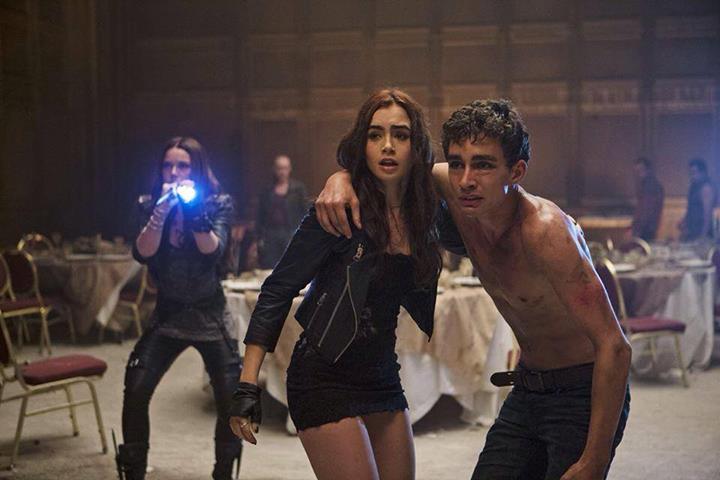


Let me address this whole 'Jace/Clary' romance thing.  It is horrible on so many levels.  First, even if they are NOT brother and sister (I suppose anyone stupid enough to make a sequel will leave that question unanswered until they wrap this series up), the suggestion that they might be leaves a very sick feeling.  Maybe Valentine is lying to them both for his own nefarious reasons (although how someone who is suppose to be hundreds if not thousands of years old could have hooked up with a woman who claims to have not seen him for centuries and give birth to TWO children who were either themselves born many centuries ago and not know it or really are in their teens/early twenties is left unanswered).  However, while Clare apparently was NOT influenced by Star Wars, at least in the Original Star Wars Trilogy there really wasn't any sense that Luke and Leia were passionately in love with each other, in The Mortal Instruments Jace and Clary are built up to be an epic romance.  Therefore, if they ARE brother and sister, it's really flat-out disgusting.

Another level is that frankly Bower and Collins don't have any chemistry between them.  Their romance is rather rote, and there is more connection between Simon and Clary than there is between Jace and Clary.  Finally, I think that Sheehan is just more attractive physically than Bower.  Just like I think Harry Styles is a rather ugly-looking fellow despite the constant push to make him a tween/teen sex symbol, I think Bower is not good-looking.  As much as Bower is being thrust at me as the guy I should be rooting to get together with Clary, I kept hoping she would be sensible enough to go with the more pleasant and physically attractive Simon. 

It doesn't help that no one apart from Sheehan actually 'acted'.  He looked like he was the only one who tried to make his character believable, so he's the only one who shouldn't be embarrassed by this whole mess.  Rhys-Meyers took this Bartha role and didn't bother to try to tone down the camp aspect of this 'evil' ex-demon hunter. Even if he had tried, how do I fear a fallen demon hunter named 'Valentine Morgenstern?' A little anti-Semitism there, Cassandra?  Even worse, the main proof Mr. Morgenstern (seriously?) has to show Jace and Clary are little Morgensterns is by altering the ring Jace's parents gave him.  The ring which has a W for 'Wayland' is merely turned around to show that it is really M for Morgenstern. 

Really, you DON'T want me to laugh at that?

Everyone else save Collins was hopelessly flat and uninteresting.  Collins I think did the best she could with lousy material, and after all, what can any actress do with a role that requires a supposedly strong girl to faint a lot?

Let me digress to offer that the whole 'Alec in love with Jace' business is bizarre only in that a.) there is very little to suggest either in Zegers' performance or the screenplay that Alec does pine for Jace and b.) this plot point is mentioned but never explored.  That being the case, why introduce it in the first place? 

When you have a story that throws in vampires for no real reason except to have some sort of battle, along with protective werewolves and warlocks and demons, you can't ask a sensible audience to take this seriously.   However, I never understood how arbitrary so much of City of Bones was.  How was it that Simon could see what Mundanes like himself cannot?  How was it these Shadowhunters never realized that Clary had a daughter, or that their neighbor was a witch?  The mythology The Mortal Instruments is trying for is not complex as it thinks it is.  It's just convoluted and a mess, like the film itself.  

The Mortal Instruments: City of Bones (anytime a film has a semicolon in its title, it's either a promise or threat that there will or may be more) is a laughably bad movie that is too long and too boring to believe, let alone enjoy except as almost camp.  If it were a spoof of the Twilight-inspired crap that has flooded the teen/tween market, it might have been serviceable.  As it is, this film makes me think that the next generation really is stupid and that we are indeed approaching the End of Western Civilization if people prefer to read things like The Mortal Instruments over something like Stephen Lawhead's Byzantium or Brave New World or even The Catcher in the Rye.

Finally, to all those Mortal Instruments fans, I just want to let you know there was another group obsessed with runes.  Congratulations, you now have something in common with Nazis.   

DECISION: F   

Sunday, December 22, 2013

Planes: A Review (Review #595)

PLANES


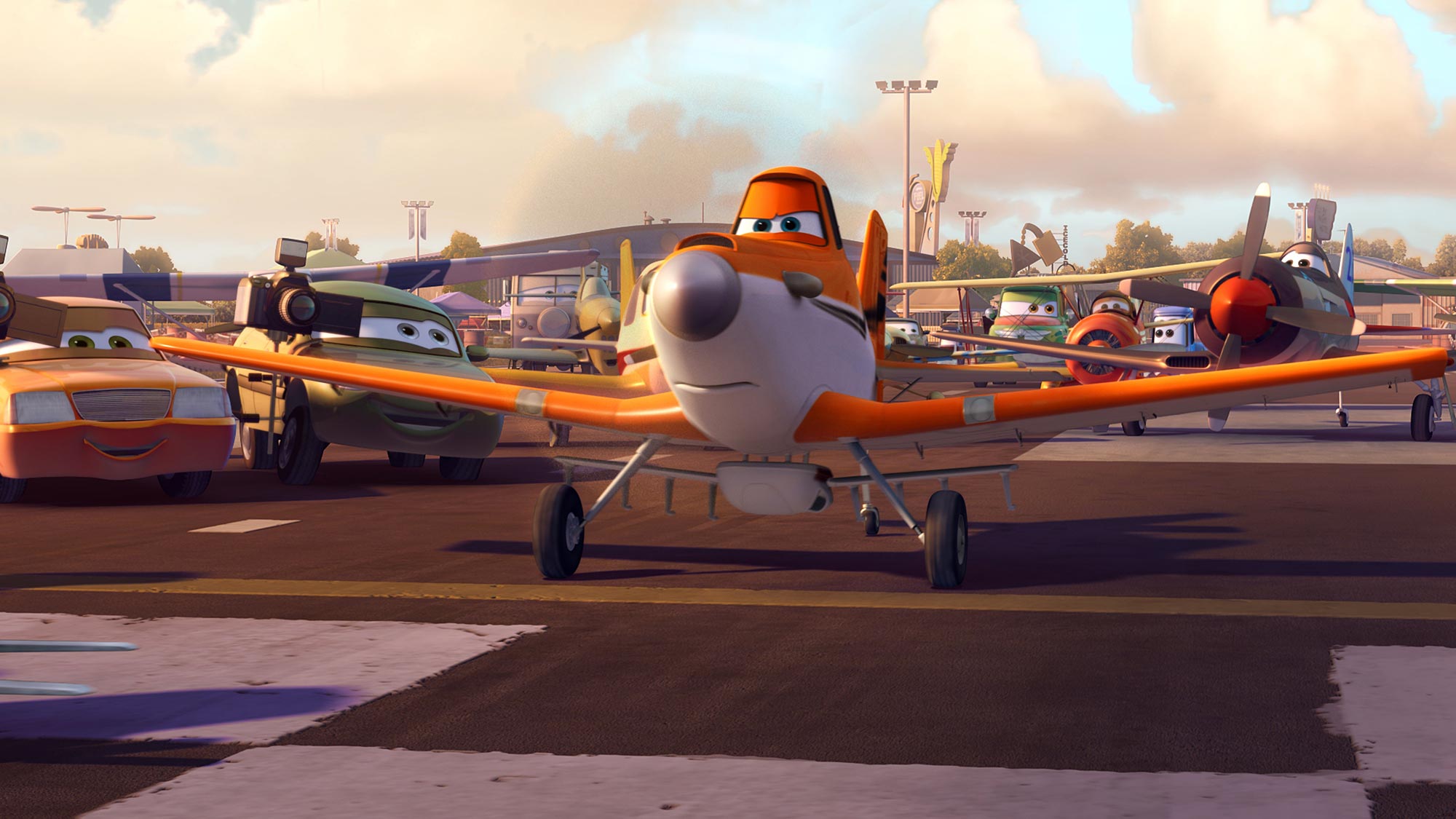
I find nothing particularly wrong or offensive with Planes.  It's a cute and whimsical little film, which will entertain little children, from toddlers on down.  The unfortunate thing about Planes is that in many ways, it resembles something that really would have worked better as either a straight-to-video release or maybe even a television special on Disney Junior. 

Dusty Crophopper (Dane Cook) dreams of competing in the Wings Around the World aerial race.  However, he's a crop duster, which are not built for the kind of flying a competition would call for.  While his crop-dusting mentor Leadbottom (Cedric the Entertainer) and mechanic truck Dottie (Teri Hatcher) try to dissuade him, his fuel truck friend Chug (Brad Garrett) encourages him.  Dusty goes to legendary war plane Skipper (Stacy Keach) to ask for his help in coaching him.  Skipper at first refuses but watching how persistent Dusty is, Skipper takes him under his wing (pun intended).

Circumstances now work to Dusty's favor and Dusty Crophopper now is the first crop-duster to enter the Big Race.  He now goes up against a slew of great flyers.  There's Bulldog (John Cleese), the snobbish British plane.  There's El Chupacabra (Carlos Alazraqui), the passionate Mexican plane.  There's Rochelle (Julia Louis-Dreyfus), the cool Quebecer femme.  Then there's Ishani (Priyanka Chopra), a beautiful Indian airplane.  However, as good as all these planes are, they are going up against the legendary Ripslinger (Roger Craig Smith), three-time champion.

Now they all race around the world to be the champions, and it's going to take all of Dusty's strength and courage to win.  Dottie, Chug, and Skipper must stay behind, so Dusty has only forklift Sparky (Daniel Mann) to help him.  El Chupacabra, hopelessly in love with Rochelle, is constantly rebuffed.  Ishani and Dusty are somewhere between friends and romantic partners, but Ripslinger, at first dismissive of Dusty (as is the world entire) soon starts discovering that slowly but surely, Dusty is pulling ahead.  This despite Dusty's secret: he's afraid of heights!  Cropdusters, who don't have to fly fast or high, are not used to either.

As they go around the world, Dusty makes choices.  He loses his sprayer to allow him to go faster, a decision that basically makes him less of a cropduster.  Eventually, to the shock of the world, Dusty pulls ahead when he is the first to arrive in Nepal.  Ripslinger gets his henchmen to disable Dusty's antenna as he flies over the Pacific, but he is rescued by the U.S.S. Dwight D. Flysenhower.  Here, he discovers that Skipper's war record consists of one battle, and the truth comes out: Skipper led his squadron to total decimation, and the shock left him unable to continue.  Due to Dusty's acts of kindness throughout the race, all the other planes join to help him get fixed up, and in the last leg from Mexico to New York it becomes a propeller-to-propeller race between the underdog Dusty and the arrogant Ripslinger for the championship, and Skipper gets a chance at redemption.


I have to be honest: I found nothing really horrible about Planes.  It was cute enough and I imagine little kids will like the bright colors and predictable story.  There are a couple of sequences that I think might be a bit frightening to the target audience (the World War II aerial recreation and Dusty's plunge into the Pacific).  I was surprised to see that these scenes, rather intense for any child still watching Planes, were not toned down.

In many ways, Planes is predictable: a little plane who dreams of reaching the sky has to overcome all kinds of adversity to reach his goals and finds a pretty girl in the process, plus that being good is more important than winning.  Yet, anyone watching Planes should remember that it is suppose to be predictable.

Oddly, what I will criticize Planes on is on the stereotypes of the various nationalities, particularly the hot-blooded lucha libre-mask wearing El Chupacabra.  I was not amused he had to both speak and look like that, but he also is someone who is about Dusty's only real friend from the get-go, so that's a plus.  It is also nice to see Indians represented in a generally positive light (and made the love interest).

In terms of performances, again they didn't go out of their way to be innovative.  Cook, the most untalented comic to achieve cult popularity (I think my friend Fidel Gomez, Jr., who may or may not be dead, said it best when after watching Cook's stand-up, said what Cook really needs is some good Prozac), acquitted himself decently as the eager young cropduster.  Alazquiri did what he could with the stereotype El Chupacabra, and a credit to Louis-Dreyfus in that I didn't recognize her as the somewhat haughty Rochelle.  Cleese, sadly, is underused, but I am not going to be persnickety about that.  Keach was much better as Skipper, bringing a sense of world-weariness and regret to a part that needed such. 

While the story itself isn't the greatest, I confess to getting a kick out of Dwight D. Flysenhower.  It was cute, it was amusing, and it's nice to see the military portrayed in a positive light (something we should all get behind). 

Is Planes a great film?  No.  Is it a landmark in animation?  Certainly not (Planes is not the reason Hayao Miyazaki is retiring).  However, Planes is cute enough, and I imagine it's a good way to get attractions, merchandise, and inevitable sequels off the ground. 

I do have one last confession.  I would so much like to get a Dusty Crophopper mug.  Poppa wants one for Christmas.  Do you think when I go to Disneyland or Disney World I could get one? 

DECISION: C+

Wednesday, December 18, 2013

Frozen: A Review

FROZEN

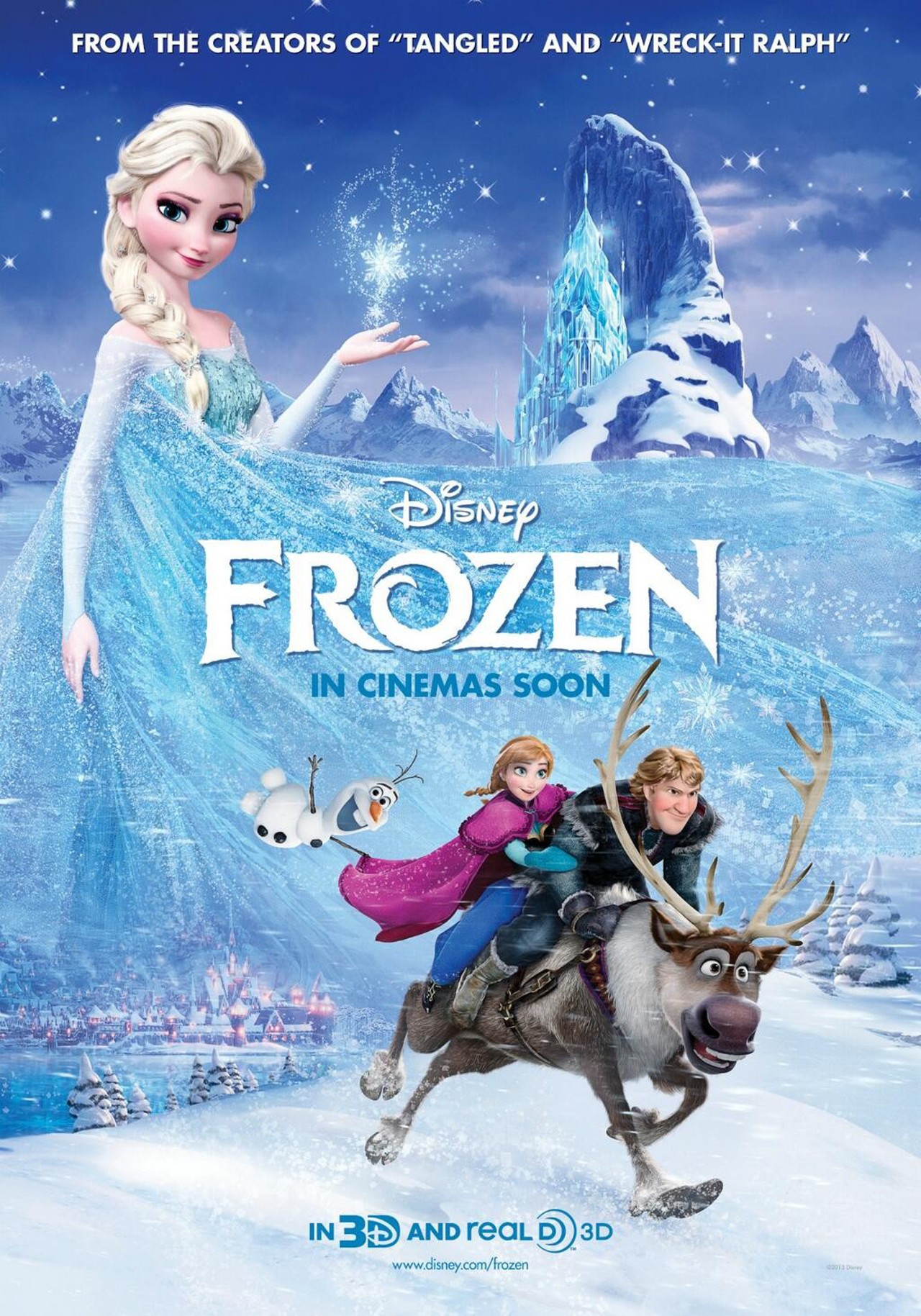
It's been a good long time since the Disney Animation Studio made a film that could not only give its property Pixar (in its glory days) a run for its money, but could also be a truly great film.  While the once-unstoppable Pixar struggles to find itself again after working to appeal to a lower denominator, Disney has opted to make Frozen, a sheer delight from start to finish which reminds us that they are just as good at animation as any other studio in town.

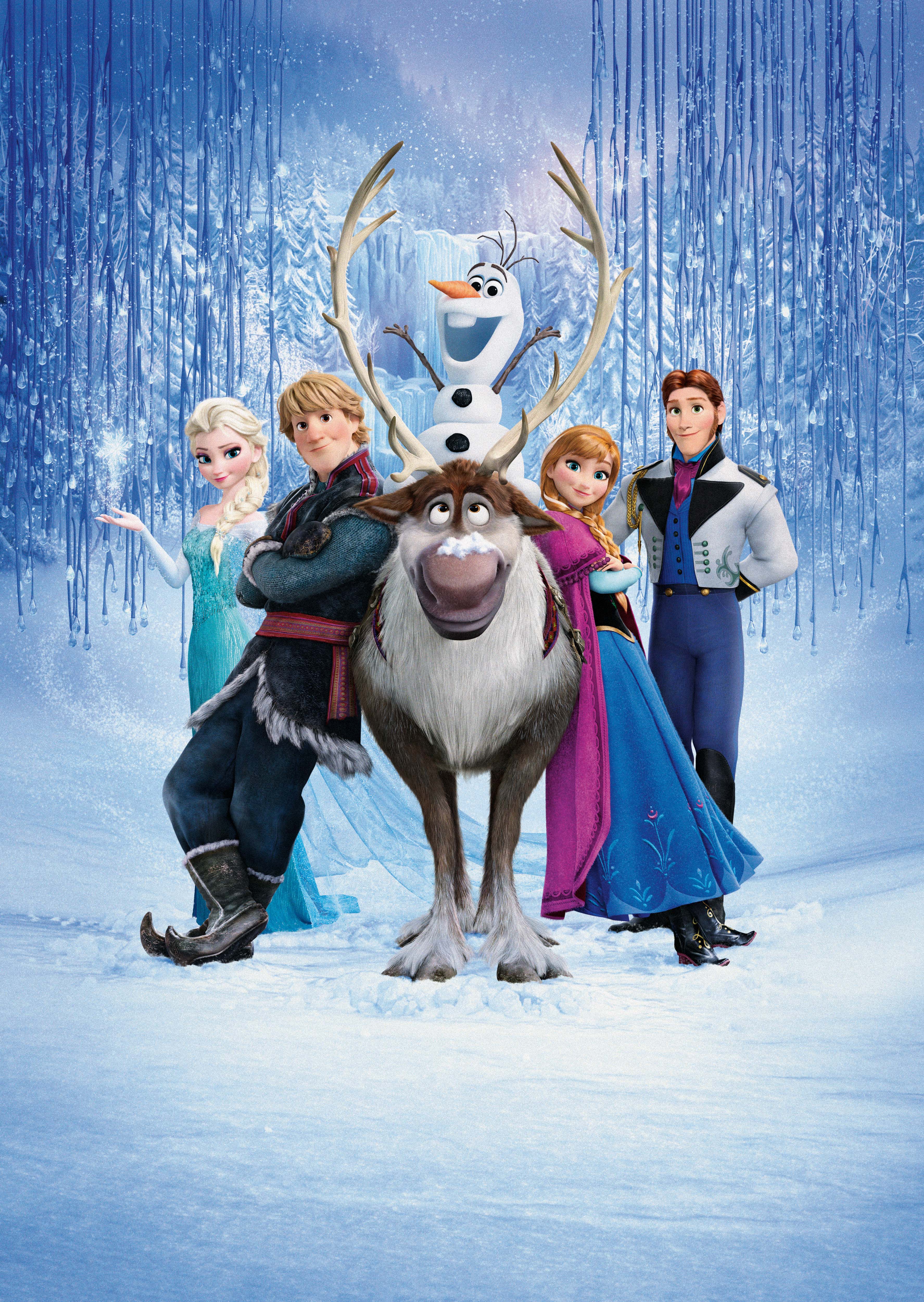
There are two princesses, the elder Elsa (Idina Menzel) and the younger Anna (Kristen Bell).  Elsa is heiress to the throne, but she has a secret: she can create a winter setting (ice and snow) with the touch of her hand.  As children she accidentally hit Anna with ice and nearly killed her.  In desperation, the King and Queen go to the trolls for help, and secretly observing this is young ice seller Kristoff, who is 'adopted' by the trolls.   The Troll King can save her, but warns the King and Queen that ice in the heart is more deadly than one to the head.  After this, it is decided to keep the sisters separated, upsetting both, especially the more high-spirited and enthusiastic Anna.

Three years pass.  The King and Queen have died at sea by now, and after a period where the Castle was closed it is time to both reopen the gates and crown Elsa as Queen.  At long last she and Anna can see each other and perhaps become close like they once were.  Elsa, however, is terrified that her powers will be exposed, powers which Anna has now no memory of.  Arriving for the coronation is the Duke of Weselton (Alan Tudyk), who is eager for more trade, and Prince Hans (Santino Fontana), who hits it off immediately with Anna.  Knowing them less than a day, he asks her to marry him, and she says yes.   This is so troubling to an already on-edge Queen Elsa that she loses control of her powers and in terror flees the kingdom.  Anna, upset that she caused all this, goes after Elsa, leaving Hans in charge until her return.

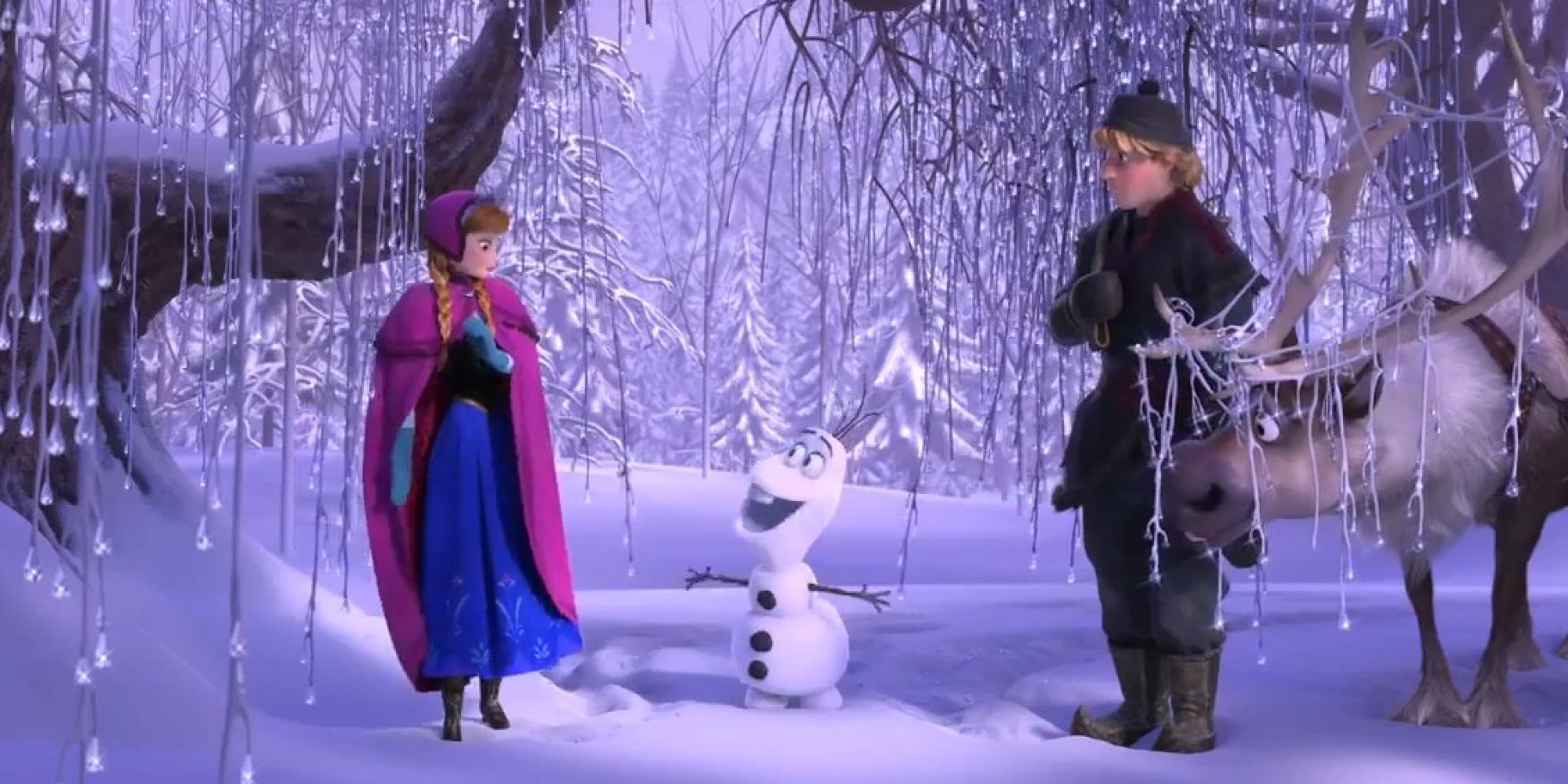
Now while Elsa makes for herself a castle of ice, Anna joins with an adult Kristoff (Jonathan Groff) and his sidekick/reindeer Sven, to help find her.  They are later joined by Olaf (Josh Gad) a snowman from Elsa and Anna's memories who dreams of what summer would be like.  After some mishaps, Kristoff and Anna do find Elsa, but in her fear of hurting anyone she does indeed strike Anna in her heart.  In mortal danger, Kristoff spirits Anna away to the Troll King, where he is told that 'an act of true love can thaw a cold heart'.  Believing the key is Hans, a reluctant Kristoff leaves Anna in his care.

Bad move, as we get a twist in this tale.  Elsa is captured by Hans, but before real harm can come to either, Kristoff and Anna come to rescue, and with the villains captured and Anna's act of 'true love' restoring things, Elsa is now able to restore the kingdom to more temperate weather (while leaving a permanent flurry for Olaf to enjoy summer).  All's Well that Ends Well in this Winter's Tale.


Frozen was a sheer delight and total pleasure from beginning to end.  I was completely taken by both the story (and elements within it) and its complete visual beauty.  The opening, where we get Scandinavian-sounding music to an amazing opening scene is breathtaking.  The story itself moved remarkably fast (even with a large number of musical numbers), and there were aspects of Jennifer Lee's screenplay (who also co-directed with Chris Buck) that I thought highly intelligent.

I admit I was taken by surprise to see that Anna quickly (but kindly) rejected Hans' offer to help lead the search party.  It is a rarity for a Princess, especially a Disney Princess, to not let the man take the lead and go it alone, leaving the Prince (even one as hunky as Hans) behind.  While I wasn't surprised that Anna and Kristoff would eventually find their way to each other, the big twist regarding one character (which I'm not telling) did surprise me.

Also, the balance between the tension of searching for Elsa, who is inadvertently dangerous, and the humor from Olaf and Sven is kept throughout.  We don't get an oppressively dark story but we also don't get the comedic moments of the snowman who dreams of summer or the silent reindeer who has a fondness for carrots overwhelm the story either. 

As I mentioned, Frozen has many songs within it, but the man-and-wife team of Robert Lopez and Kristen Anderson-Lopez have crafted some beautiful songs that are both family-friendly AND intelligent.  Who knew someone like Mr. Lopez, who brought us Avenue Q and The Book of Mormon (neither of which are 'family-friendly'), could craft such appropriately Disney-like songs?  While the obvious big number is Elsa's solo Let It Go (which was fantastic), the songs go through all ranges, from the cute In Summer (where Olaf sings about his dreams of what summer to a snowman would be like), the endearing Love Is An Open Door (the love duet between Hans and Anna), the funny Fixer Upper (where the trolls attempt to convince Anna of Kristoff's virtues), and Do You Want to Build a Snowman?, which goes from upbeat to almost heartbreaking while telling its story. 


In terms of performances Frozen is excellent in that instead of getting a 'big name' to lend their voice we get actors who fit the characters.  About the only 'big names' in Frozen are Kristen Bell and Josh Gad, and both are such joys as the ever-upbeat and optimistic but still courageous Anna and the goofy but lovable Olaf.   It helps to have Broadway veterans performing both the big songs and the straight dialogue.  Respected theatrical performers Groff does well as the reluctant hero Kristoff, but the big showstopper is Menzel as Elsa.  She not only can belt out the big numbers like she did with the Oz-inspired Wicked but also make the fear Elsa has real.

Christophe Beck's Nordic score fits within the winter wonderland of Frozen (I wonder whether the Norway Pavilion at Disney World will be tweaked to insert more of Frozen within it).  The visuals were beautiful, the story excellent, the ultimate lesson of how 'an act of love can thaw a cold heart' a positive one. 

Frozen will entertain children (Olaf is destined to be beloved) and adults as well (the story of family and the songs being so well-done as to be pleasing). 

In terms of animation, it is good to see the Disney Studios back on their game, showing that their resurgence which began with The Princess and The Frog through Tangled continues unabated with Frozen.    

On a final note, this is my 1,000 post, and I can't think of a better way to mark it than with a truly great film such as Frozen.  

I am so thankful to all my readers who have visited to take a gander at what I think of as one of my great passions: films.  It is almost five years since I opened Rick's CafĂ©, and in those years I have heard and seen the good, the bad, and the ugly.  I've been reprimanded and praised, scorned and lifted up. 

I know that I will continue to work to talk about movies, good and bad.  You may not always agree with my conclusions, and on occasion I may make a mistake or three.  However, know this: I appreciate the fact that I am allowed to write about something I genuinely love, and hope that in my small way, I have led people to good movies, away from bad ones, and learned from each other.

To All of You, From Me, a Most Humble Thank You.

DECISION: A-

Tuesday, December 17, 2013

Joan Fontaine: A Personal Remembrance


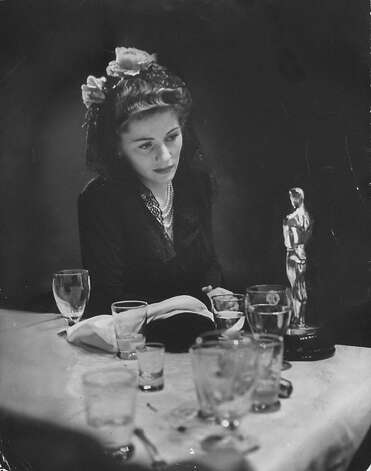
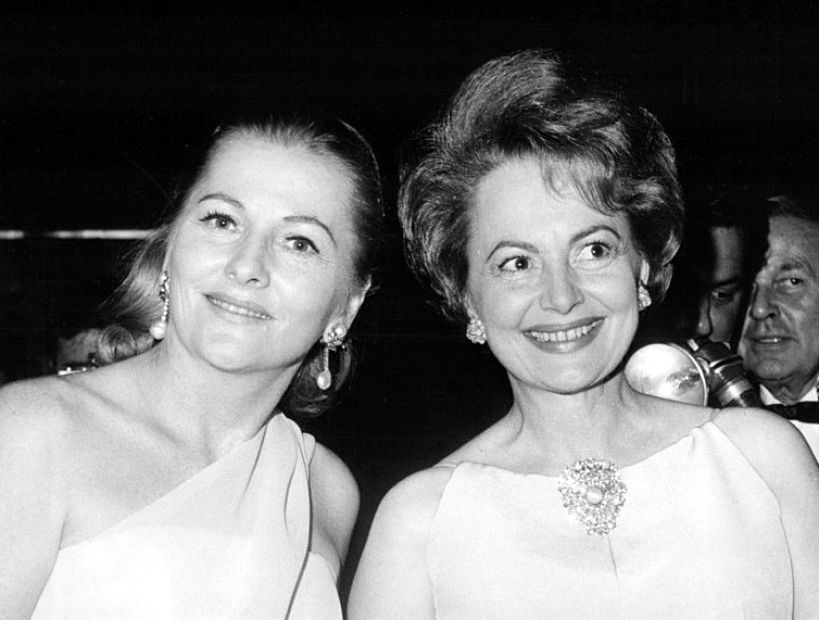
In the annals of fierce sibling rivalry, NOTHING will match the eternal grudge match between Olivia de Havilland and Joan Fontaine.  While they are considered grande dames, the last of a long-ago vanished Hollywood, their bitter nearly-century running hatred one towards the other is a permanent stain on both their reputations.  Both Fontaine and de Havilland are Academy Award-winners, both highly respected actresses whose public behavior has been above reproach. 

In regards to each other, both in public and private, they have behaved like two alley cats, making a spectacle out of their inability to mend their relationship and maintaining a feud that lasted over ninety years. 

The word 'feud' is actually too mild, too gentle a word for how the sisters have behaved towards each other.  "Cold War" is likewise too soft.  The best way to describe how they held on to their hatred is "total warfare".

I actually have theorized that the reason they stayed alive for so long was the final mark of their bitter hatred toward each other, a last contest to see who would drop dead first and have the privilege of dancing on the other's grave.  In short, Fontaine and de Havilland were determined to outlast each other. 

Now one of the last true links to 'The Golden Age of Hollywood' has passed on with the death of Joan Fontaine at 96.  Let us focus on Fontaine's career.

She came to attention as the second Mrs. de Winter in Rebecca.  Her performance was excellent: the frightened, timid woman who comes close to collapsing under the phantom of Rebecca and the machinations of Mrs. Danvers to eventually struggle to strength.  She lost the Best Actress Oscar to Ginger Rogers in Kitty Foyle, and I've always thought that when she did win the Best Actress Oscar the following year for Suspicion, it was kind of a payback for having lost for a better performance.


These Golden Gods can devour us...

I'm not a fan of Suspicion, thinking it one of Alfred Hitchcock's weaker entries.  Still, Fontaine became the only actor/actress to win for one of his films.  It's an astonishing fact, given some of the great performances in Hitchcock films: Cary Grant, James Mason, and Eva Marie Saint in North By Northwest, James Stewart and Kim Novak in Vertigo, Janet Leigh and Anthony Perkins in Psycho

After her win, Fontaine specialized in demure, respectable women, particularly the long-suffering ones like Jane Eyre (though I shall always love Mia Wasikowska's interpretation in the most recent version of the Bronte novel).  As times and tastes changed, Fontaine seemed perfectly willing to let her career slip into genteel retirement, but not her long-lasting antagonism towards Olivia.

Here is where our story takes the ugliest turn.  Despite the successes of Fontaine and de Havilland, despite their great careers and legendary performances, it is their undying hatred towards each other that may remain their most depressing legacy. 

Sisters who last spoke to each other in 1975.
For most of us, that's over a lifetime.

They maintained a long list of grievances; some of the accusations were large (such as Fontaine's allegation that her sister had not invited her to their mother's memorial service versus de Havilland's contention that she did tell Fontaine but that the latter was not interested in attending).  Some were shockingly petty; de Havilland stated that Fontaine rebuffed Olivia's congratulations for beating her for the Best Actress Oscar, the former having lost for Hold Back the Dawn.  When de Havilland won for To Each His Own, she 'returned the favor' by rejecting Joan's outstretched hand. 

This very public display of two grown women, sisters, fighting over something like Oscars and mutual careers should have embarrassed them both. 

However, if it is to be believed, the rivalry started almost from birth.  De Havilland, the older of the two, apparently ripped the hand-me-downs Joan was given to stop her from wearing them.  In an interview, Fontaine mentioned something about a 'broken collarbone' as a child, and frankly I don't want to imagine Melanie Wilkes trying to murder anyone, let alone a young girl who is her own sister. 

The thought is simply too gruesome. 

Get away from me, you BITCH!

Now that Fontaine is gone, I hope that for the de Havilland, it was worth all the trouble, all the bitterness, all the antagonism, all the hatred.  Regardless of all their great work in film, television, and stage, their reputations will not recover from their near-century long rivalry.  I, for my part, if given the chance, would have told these two old ladies, "Grow up and get over it".

The more cynical side of me imagines that upon hearing the news, the 97-year-old de Havilland kicked up her heels, opened a bottle of champagne and shouted, "She's DEAD!  She's DEAD!  I WON!"  Knowing the bitterness that can coarse through the veins of anyone who has let simmering hatred seep to the surface, even at my most generous I cannot imagine Olivia de Havilland mourning the death of her younger sister, let alone attending the funeral.  Away in Paris, Olivia de Havilland has nothing more but to wait for her TCM Remembers montage, and the knowledge that her obituary will carry at least four things: Gone With the Wind, her two Oscars, her onscreen coupling with Errol Flynn...and her bitter nearly century-old rivalry with her sister, Joan Fontaine. 

One last note.  De Havilland commented that after seeing The Adventures of Robin Hood once, she started writing to Flynn to say that she thought he was wonderful in the role.  However, she opted against sending the letter, and Flynn died shortly afterwards.  De Havilland said she always regretted not sending the letter.  She couldn't have done the same with her own sister?

What kind of women were they?

Taking the 'I'll hate you till I die' thing too far...
Art thou not happy, Olivia?
Was it worth it, Olivia?

IN MEMORIAM

Monday, December 16, 2013

Peter O'Toole: A Personal Remembrance

1932-2013
He Was An Actor AND A Movie Star...

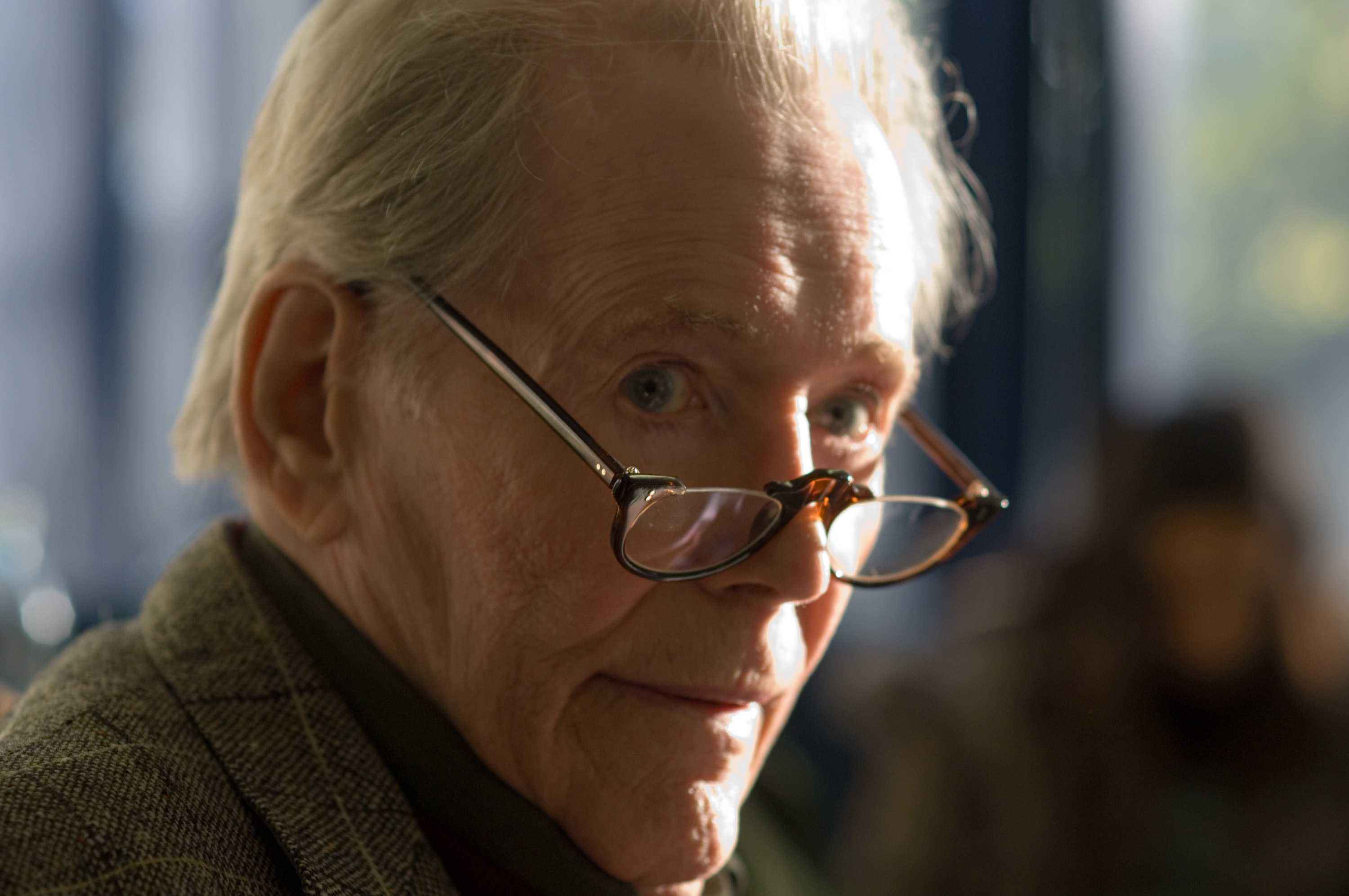
Of all the actors that I have seen on screen, few had the range of Peter O'Toole.  He played drama, he played comedy, he played epics and intimate features.  Yet for all the acclaim and genuine acting talent O'Toole had, he is not just remembered for those iconic screen roles (Lawrence of Arabia being enough to ensure a place in film history, but also Becket, The Lion in Winter, The Last Emperor, My Favorite Year, Venus).

He is remembered for having lost the Best Actor Academy Award EIGHT times, a record that looks unlike to fall within our lifetime.

Sometimes he lost to truly great performances.  I don't think anyone would say that Gregory Peck as Atticus Finch in To Kill A Mockingbird was not worthy of recognition when O'Toole shook the film world with Lawrence of Arabia.  Same for Marlon Brando for The Godfather (versus O'Toole's turn in The Ruling Class) or Robert DeNiro for Raging Bull (over O'Toole in The Stunt Man). 

Sometimes we wonder whether the actual loss was to a better performance.  I don't object to Ben Kingsley in Gandhi.  I always found it a respectable performance, and given that O'Toole was nominated for a comedy (My Favorite Year), comedic performances rarely win.  There were also three other great performances (Dustin Hoffman in Tootsie, Jack Lemmon in Missing, and Paul Newman in The Verdict) to battle with. 

Sometimes though, I flat-out wonder how he could have possibly lost.  Rex Harrison didn't even do his own singing in My Fair Lady (merely talking on pitch to simulate singing), and that Harrison beat out his Becket co-star Richard Burton (a seven-time loser himself) AND Dr. Strangelove's Peter Sellers is one of the baffling moments in Oscar history.  Cliff Robertson, bless him, but who really remembers Charly to O'Toole's Henry II in The Lion in Winter?  OK, so the musical version of Goodbye, Mr. Chips may not have be his finest hour, but John Wayne's True Grit has been bashed since his win (for the record, I haven't seen either film, so I'm not going to comment on the worth of Wayne's win).  I DID see Venus, and thought he was much better than Forest Whitaker in The Last King of Scotland


Still, it isn't the number of Oscars people win (or even one) that gives them true immortality.  Paul Muni in The Story of Louis Pasteur beat out William Powell in My Man Godfrey; Paul Lukas in Watch on the Rhine beat out Humphrey Bogart in Casablanca. Lee Marvin in Cat Ballou beat out Richard Burton for The Spy Who Came in From the Cold (oddly, one of the few times a comedic performance won).  Al Pacino for Scent of a Woman beat out Denzel Washington's turn in Malcolm X (let's face it, Pacino has given brilliant performances, but who really thinks Scent of a Woman was Pacino's finest hour?). 

We can go on about odd Oscar choices in almost any category (You Light Up My Life is better than Nobody Does It Better?  Seriously?).  However, Peter O'Toole should NOT be remembered for having lost the most number of times.  Instead, the true legacy of his should be the sheer brilliance of his performances.

Again, Lawrence of Arabia would have been enough to cement his status.  In many ways, he was wrong for the role: at 6'2" the gregarious Irishman who loved wine, women, and song did not match the real T.E. Lawrence physically (who was 5'5", possibly homo/asexual, and struggled with his fame).  However, O'Toole so embodied this contradictory figure who loved literature and killing that he held us in rapt attention.  When the conflicting rages within him between satisfying his bloodlust and maintaining his humanity that when he shouts, "No Prisoners.  NO PRISONERS!" it becomes a frightening moment.

Yet in almost every other performance O'Toole could bring the majestic and the intimate.  He played kings and crazies, egoists and humble men, all with equal believability.  This isn't to say there weren't some awful films within his CV.  As Lawrence of Arabia stands as one of the great moments in cinema, Supergirl stands as a sheer embarrassment.   No actor goes through a career without some turkeys in the lot.


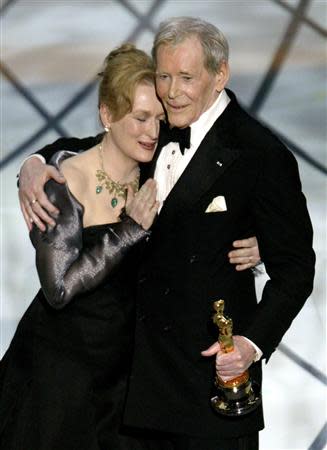
What can one say about an actor who, upon being given a Lifetime Achievement Oscar, could have basically told the Academy that had snubbed him so often to go blank themselves, but instead spoke of his gratefulness towards the United States, which had been so generous to him?  In an industry that so often uses the Oscars to bash the United States and push their own politics, O'Toole's elegant and dignified acceptance speech is a mark of the man: one who loved acting, one who was grateful for all the opportunities that he had been presented with. 

It is important to note that for O'Toole, acting was not just reciting lines or standing on your mark.  It was about 'being'.  He insisted on study, he insisted on training, he insisted on working on the craft of acting via the stage.  So many of today's 'actors' (such as my bĂŞte noire Channing Tatum) do not have that.  They instead rely on audience approval.  People like Tatum are 'movie stars'.  People like O'Toole are 'actors', and there is a difference.

While My Favorite Year's Alan Swann was a comedy that has one of my favorite lines, "I'm not an actor.  I'm a MOVIE STAR!", in truth Peter O'Toole really was both.  His name could open a movie or a theatrical production, but he was also extremely capable of becoming the character, be he a bon vivant or an angry young/old man.  People admired his performances, but also, above all else, people who love film respected him, respected his talent, respected his immense creativity and output. 

Peter O'Toole was AN ACTOR, a true ACTOR, a standard to which other actors should be measured against.  His life may have been outrageous at times, riddled with odd films, but in the end, we have the films, and there lies the greatest of Peter O'Toole.

His legacy is assured, Oscar or no Oscar.  

IN MEMORIAM

Sunday, December 15, 2013

Burton and Taylor: A Review


BURTON AND TAYLOR

Private Lives, Public Lives...

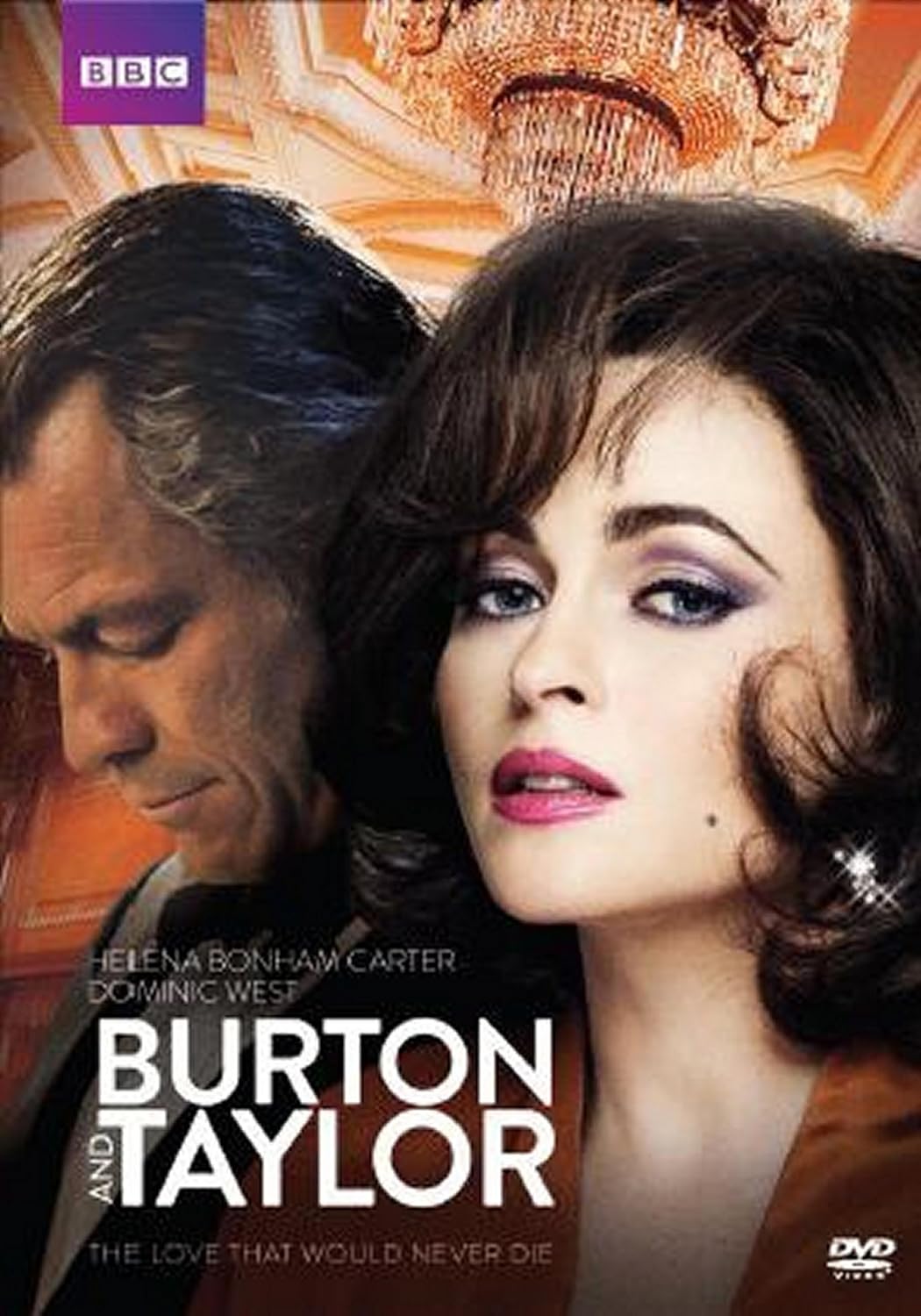
Burton and Taylor, the second television production based on the tempestuous and tumultuous lives of Richard Burton and his second/third wife Elizabeth Taylor, is already steps ahead of Liz & Dick.  First, rather than attempt to give us the entirety of their lives together, Burton and Taylor focuses only on one part, their critically panned, publicly adored revival of Noel Coward's Private Lives.  Second, the female lead in Burton and Taylor (Helena Bonham Carter) is a more respected and established actress than Liz & Dick's Lindsay Lohan.

And she's better overall too.

As a side note, Dominic West is a good actor, but I think so is Grant Bowler, who had the unfortunate fortune to find himself working with LiLo/La Lohan/An Embarrassment to Western Civilization.

As for the production itself, Burton and Taylor has a story that does not mock, ridicule, or humiliate the characters or turn them into parodies.  Instead, we get two individuals who both love and loath themselves and each other, who truly can't live with and can't live without the other.  Burton and Taylor don't caricature Mr. Burton or Miss Taylor, nor does it sanctify them either.  Instead, they come across as talented but troubled people, who don't mean to do harm but end up doing so any. 

It is 1983.  Elizabeth Taylor and Richard Burton have been divorced (for the second time) for seven years, but the public was still fascinated with the legendary couple.  Therefore, when they decide to team up for a Broadway run of Private Lives (a comedy about battling exes who meet again while both are on respective honeymoons with their new spouses), it all was simply too tempting to resist.  Box office was spectacular with tickets pre-sold far in advance.

As the cast and crew get ready, La Taylor has a few tricks up her sleeve.  She comes into first rehearsal cold, insisting she 'never reads something until she starts.  This lack of preparation horrifies the professional thespian Burton, for whom 'the theater' is sacrosanct.  He wonders whether Taylor is taking this seriously.  When Private Lives premieres, Taylor is 25 minutes late, having been held up to sign autographs.  However, when she makes her entrance, Taylor gets a standing ovation. 

Still, one can't argue with success, as Private Lives becomes a smash hit commercially.  Who wouldn't want to see a play that might have been retitled The Battling Burtons: Live!  Critically, however, it is generally reviled.  Burton attempts to comfort Taylor, saying that being a critic is like being a eunuch at an orgy.


OUCH!

Still, the pressures of how close Private Lives mirrors the Burton/Taylor 'private lives' start wearing at both of them.  Taylor begins to mug for the audience, playing up the similarities between characters and actors.  To the cries of "Keep going, you too," and "We love you, Liz" (a version of audience participation), Taylor blows kisses and seems to be having a grand time.  Burton, who values his reputation as a serious actor and his craft above all else, is furious at this.  Yelling at Taylor and her assistants, he makes his fury clear.  Taylor, in turn, slaps him for his bullying behavior to her entourage.  "I'm unprofessional, but you're rude, which is worse!" she bellows. 

To show him up, she becomes 'ill' and can't go on.  When the audience is told Taylor is not coming, the theater all but empties out.  Burton does NOT play to empty theaters, he says.  In his mind, this is a way to show him SHE is the star they are coming to see, not the actual Tony winner. 

To show her up, he takes the break Liz's 'indisposition' causes to go to Las Vegas and get married.  Taylor cannot bring herself to fully express just how conflicted she is over the great love in her life now being off the market.

However, by the time his and her theatrics are over with Closing Night, they figure that despite everything, these two will always somehow be in each other's lives, so why not laugh a bit about it all?

Kiss me, before your body rots...

Burton and Taylor made one good choice after another.  It first kept its focus on that one point in their lives, when both were available, both had a long history, and both were basically coming to the end.  Burton and Taylor has a couple of flashbacks, but on the whole stays strictly within the run of Private Lives, and so instead of getting a sprawling and chaotic story William Ivory's screenplay is an exercise in restraint (something Burton and Taylor were not).  We don't have to have a great knowledge about their long and stormy/storied love affair to know what kind of people they are.  Taylor's arrival to rehearsal unaware of the script, her lateness with her dogs and parrots in tow, her blowing kisses to the audience and breaking character: that tells us all there is about how Taylor saw both Private Lives and the goings-on: it was both a lark and the signs of a pampered star.  Burton, his need to be the consummate professional onstage, his struggle to maintain his sobriety with this maelstrom whipping all around him equally says enough for someone not aware of the Burton/Taylor affair to know what's what.

Burton and Taylor also made wise casting choices.  I was curious as to how Bonham Carter would handle both Taylor as a person and an American accent in particular.  Bonham Carter (for whom the word 'kooky' would have been created for) does what she does best: give a tremendous performance.  It is the highest compliment to say an actor 'becomes' someone, and Bonham Carter captures Taylor's voice, mannerisms, and persona (both the self-absorption and the fragility) brilliantly.  West is her equal, not just doing a good Richard Burton vocal impersonation (though I doubt anyone will ever really capture his brilliant baritone) but also in his desire to do his best work while it looks like people are coming to see a spectacle, not a play.


What West and Bonham Carter also do is show great respect to these two characters.  They never overplay the more outrageous elements of either Private Lives or their own private lives (there are remarkably few shouting matches or anything resembling exaggerated behavior).  Instead, they seem fully aware that behind the legends and scandals there are two people, a man and a woman, who love each other but are poisonous as well.  Taylor and Burton can't hold on to each other or let go of each other.  They are allowed to be human, such as when they interact with their children or when they are not 'on stage' (Burton complaining loudly that Taylor's rented apartment hasn't got a single book). 

The respect West and Bonham Carter have for Burton and Taylor and the respect the characters have for each other is another brilliant move on the production's part.  Twice in Burton and Taylor, Burton tells people that he KNOWS Taylor is a brilliant actress (though sadly, he never tells her that in the telefilm).  It reveals both what he thinks of Taylor as a performer (she's good) and what he thinks of Taylor as a professional (she's bad). 

I can't find much to fault Burton and Taylor, except perhaps for some confusion at the end where they are in a hotel room doing exercises (which I figure was a flashback) and for a film that is suppose to take place in 1982-83, there is an odd amount of disco music.  At what is Taylor's 50th birthday party, she danced the night away with Burton to Donna Summer's Love to Love You Baby and Sylvester's You Make Me Feel (Mighty Real).  What, the rights to New Order's Blue Monday (among the greatest songs ever written) weren't available? 

Still, minus that Burton and Taylor is well-acted, well-written, well-directed (Richard Laxton doing the honors), and does the legendary figures in the center of this drama right.  Neither crazy or ridiculous, Richard Burton and Elizabeth Taylor came across as troubled, self-absorbed, but ultimately passionate for each other despite their inability to truly be good for each other. 

8/10

Saturday, December 14, 2013

G.I. Joe: Retaliation. A Review

G.I. JOE: RETALIATION

CHANNING TATUM DIES! 

I don't really wish the wooden, blank, non-talented stripper any actual ill, but seeing his character meet a most unhappy end elevates G.I. Joe: Retaliation to a much better film.  Sadly, I never saw the body, the rotting corpse, so that took a bit of the joy away for me.  Channing Tatum's Duke was never intended to be a big part of Retaliation, but after the wild success of Magic Mike, 21 Jump Street, and The Vow all made people think he was a star (he certainly has never been an actual actor...can't wait to see Channing Tatum as George in a remake of Who's Afraid of Virginia Woolf?).  That, along with a desire for more 3-D (sadly, not for more cowbell) pushed Retaliation's release.

One thing that perhaps should have pushed the released date, the concept of an actual story, was, given the final product, not on the agenda.  G.I. Joe: Retaliation, to its own shock I suppose, is better than its prequel The Rise of Cobra, but I think that has to do with the fact that Retaliation knew it was pretty much junk so it didn't even bother.

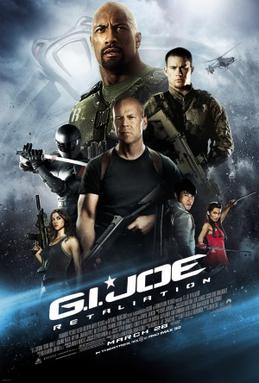
The Joes (a group of elite military operatives) have made a daring raid in North Korea.  After some R&R with Duke, his friend and co-Joe Roadblock (Dwayne Johnson) again take to the field, along with Flint (J.D. Cotrona) and Lady Jaye (Adrianne Palicki).  However, evil is afoot: Cobra, still masquerading as The President (Jonathan Pryce), launches an attack on the Joes and frame them for stealing warheads.  All the Joes are killed (CHANNING TATUM DIES!) but Roadblock, Flint, and Lady Jaye all survive.  Now it's up to them to avenge their friends, clear their names, and stop Cobra from taking over the world.

For this, they need to go to the original G.I. Joe, General Joseph Colton (Bruce Willis).  Also brought along is Snake Eyes (Ray Park), who with his apprentice Jinx (Elodie Yung), take Storm Shadow (Byung-hun Lee), who works with Cobra and has yet to answer for the murder of Snake & Storm's master.  The Blind Master (RZA) helps them discover that Cobra deceived Storm Shadow into killing the Grand Master, and Storm Shadow joins the attempt to stop Cobra.  Cobra's plan is to destroy all nuclear weapons by threatening the world's nuclear powers with annihilation, and when they blink Cobra has the only nuclear arsenal.

Frankly,  in a movie like Retaliation, plot is irrelevant.  It presumes a.) that you've seen Rise of Cobra, and b.) you care about the 'twists' (such as the revelation of the truth over the Grand Master's murder.  It's a lot of noise and action, which I guess is what you're looking for you could do worse.  However, even the action that is suppose to be thrilling (such as the mountain fight) is rather boring.  I didn't care.

That is what I found Retaliation's real crime: I didn't care.  I didn't care about the characters (I didn't know enough of them to develop any interest), I didn't care about the situations (because the stakes never felt high), I didn't care about anything in Retaliation.

I guess it was like watching a video game, like the one Duke and Roadblock were playing.  Since I didn't know the characters, I figured the performances en masse weren't interesting or believable. 

As I watched and finished G.I. Joe: Retaliation, a constant note on my page is 'why should I care about any of them or it?'   It's a boring movie with nothing really worth recommending it.

Except for the fact that CHANNING TATUM DIES!

That, if nothing else, is what saves the film from being total mediocrity.

Would that his career meet a similar fate...

DECISION: D-


Future Kennedy Center Honoree?