Wednesday, January 7, 2015

Personal Reflections on Sherlock vs. Elementary

Illustration by Kyle Burles

Sherlock, Elementary And Me

I have now seen every Sherlock and Elementary episode up to Elementary's second season (the third waiting patiently for me).  I have attempted to steer a steady course in the war between the Sherlockians (fans of Sherlock who have declared Sherlock to be 'the greatest show of the 21st Century) and the Elementarians (fans of Elementary who for the most part don't appear as obsessed as their counterparts).  I'm a firm believer that people are free to enjoy anything they like. 

HOWEVER, now that I have seen everything Sherlock & Elementary, after some debate, I have concluded that Elementary is better than Sherlock.   Now let me be clear (as The President often says): this isn't to say that Sherlock is terrible or lacking in quality or that Elementary is the best Canon adaptation.  This isn't even to say that Sherlock doesn't have positive qualities. This merely says that I simply prefer Elementary to Sherlock due to the following six factors.


1.) A More Believable Holmes 


As I look at The Two Sherlocks (to be referred to as BBC for Sherlock and CBS for Elementary to distinguish between them), I see that both are played by first-rate actors: Benedict Cumberbatch and Jonny Lee Miller.  Again, let me be clear.  I am not, repeat NOT saying that Miller is BETTER than Cumberbatch either as an actor or as Sherlock Holmes.  I find that Cumberbatch is one of the strongest qualities in Sherlock, and he is a fine, fine actor.  However, CBS has a more realistic, dare I say, human quality to Sherlock Holmes that BBC doesn't have thanks to the scripts he performs.

CBS' Holmes is one who is flawed both personally and professionally.  He is not god-like in his deductive powers to where he can tell a maitre'd that his wife is about to give birth just by looking at him for about ten seconds (that little bit in The Empty Hearse has bothered me endlessly).   Instead, CBS is capable of getting things wrong.  He did with Irene Adler.  Sherlock Holmes was a reasoning being who had extraordinary powers of deduction, but he wasn't above making mistakes or being fooled.  Adler is the best example, for she outwitted him (hence his fascination with The Woman).  I'm not sure BBC could tolerate that. 

As a side note, BBC is god-like only when it is convenient.  He couldn't figure out that Mary was a master assassin, and he couldn't figure out that Irene's code was to be "SHER-locked", which let's be honest, I had figured out long before A Scandal in Belgravia ended.  I'd figured it out when it was Christmas in the episode, so what does THAT say about how powerful BBC is?

One can argue about the various intellectual powers, but the fact that CBS is human in his faults, flaws, and failings, as well as his reactions, is what makes CBS a more believable SH.  Of particular note is that CBS addresses the fact that SH is a drug addict.  Elementary strays from Canon in making SH's addiction heroin rather than cocaine, but apart from the Granada Television series with Jeremy Brett, Holmes' drug addiction has never been addressed in a television adaption.  Brett, if memory is correct, insisted that Holmes address and remove the cocaine addiction in The Devil's Foot when he realized that children were looking up to Holmes.  CBS is taking a page from them by making his addiction and recovery something to acknowledge and work with.

He attends NA meetings (reluctantly, unhappily perhaps, but nonetheless).  He has both a sober companion and a sponsor.  He even sponsors someone else.  Granted, these threads are not as big a part of the stories as perhaps they should be, but that we have them at all is a realization that SH is a person with issues.  BBC doesn't have that, using nicotine patches and making his addiction smoking (a cop-out if one asks me).

Moreover, CBS allows for something BBC doesn't: the genuine need for people.  CBS is one who has regrets and who sees he isn't above all others.  His relationship with Detective Bell in particular is of note.  CBS acknowledges that Bell may be an actual friend, and he respects Bell's abilities as a detective.  CBS in his way is pained that his arrogance nearly costs someone he genuinely (if perhaps grudgingly) respects his future, and Bell for his part has provided more than just a soundboard for Holmes. 

BBC, for his part, rarely if ever acknowledges that he might need people or that his cruelty requires anything close to an apology.  If memory serves correct he was all but shamed into recognizing that his behavior towards Molly at Christmas in A Scandal in Belgravia might have been wrong.  He also pulled a very nasty joke on Watson, perhaps the only person who has tolerated his antics and genuinely mourned him. 

That may be the key as to why CBS is more believable (not better) than BBC.  CBS I doubt would ever perpetrate such a mean-spirited (and out-of-character) prank on Watson.  CBS behaves like an actual person (albeit with a healthy dose of arrogance).  BBC can't function.  He'd never apologize to Anderson or suggest they could or should be friends. 

CBS is flawed.  BBC is allowed no real flaws.  BBC needs worshippers.  CBS needs people.  The fact that one can't recognize it and the other can lifts CBC over BBC.


2.) A More Sensible Watson


There are two types of Dr. Watsons: the Nigel Bruce and the Jude Law.  Now, the Nigel Bruce is the bumbling, blundering, bubble-brained buffoon, a person so stupid he couldn't find his way out of room if all the doors and windows were open.  The Jude Law Watson is someone who is bright on his own, loyal, a brawler and one who isn't above telling his best friend off.

It's clear that Martin Freeman's John Watson is squarely in the Nigel Bruce mode.  Let's take a look at his Watson through the three seasons.  He's been almost immolated, abducted, nearly executed at least twice, and emotionally tortured by and for Holmes.  Sherlock put him through an emotional ringer by having his best friend think they were about to get blown up just so that Watson could tell Holmes that he admired him.  He also endured a very mean prank where Holmes showed up alive but pretending to be a waiter. 

Through all that, John Watson seems almost oblivious to how much of a moron he's being made out to be. 

If that weren't enough, BBC focuses on idiotic things, like how Watson is so enraptured by SH having a girlfriend that he keeps missing the point about Charles Augustus Magnussen's danger.  Add to that the idea that John Watson continues to prefer being with Sherlock and appears to be both extremely forgiving and willing to hold him up as the genius Holmes believes himself to be and I think you have a potentially great character reduced to someone almost worst than Bruce.

Lucy Liu, on the other hand, has a different relationship to Holmes than Freeman has to Holmes.  CBS is by no means stupid.  In fact, in a few cases she has been able to put things together (though not as fast as SH).  At one point, she grew so frustrated at how quickly Holmes could figure things out she snapped some random and illogical conclusions of her own about a case that startled SH.  She did this to show him how it felt to be left out, adding that she just wanted to know HOW he did it (put the clues together).

Curiously, this is something BBC NEVER does.  In fact, the whole point of Freeman's Watson is that he DOESN'T CARE HOW he did it, only why.  That to me suggests Freeman is more interested in emotion than in thought, which puts him at odds with Liu's Watson.  Joan has gone from mere bystander to equal partner, serving as a protégé rather than a stooge.  It allows Joan to be something John isn't: to have a functioning brain.

The other big difference between CBS and BBC is that Joan wants to pull away from Holmes.  She is not satisfied with being in Holmes' shadow.  She respects Holmes, but she wants to be her own person.  When SHE is abducted, there are ramifications.  When HE is abducted, he almost casually brushes it off as 'Sherlock being Sherlock'.  BBC wants to keep his connection to Sherlock.  CBS wants to move away from his orbit, not completely but to be in it on her own terms.

Yes, John can handle a weapon, but apart from A Study in Pink I don't think he's been called on to do so.  Joan, for her part, is largely able to take care of herself.  I defy even the hard-core Sherlockians to imagine Sherlock being a mentor to John, showing him how he too can solve mysteries.  John on Sherlock serves as something of an avatar to its fans: someone who will worship the lead, holding him as infallible.  Joan on Elementary serves as something of an avatar to its fans: someone invited to solve the mystery alongside Sherlock, a flawed person.

The fact that the Sherlockian I talked to said that while she had never read Canon (and didn't care to), she had been told Canon Watson was a bumbling idiot like Martin Freeman plays I think says all there is to say about Sherlockians connection to the truth.

3.) A More Realistic Moriarty


Calling A Moriartorium on the
Sherlockian/Elementarian War
We have a tale of Two Moriartys.  Now, I know a lot of Sherlockians love the wild, camp, over-the-top take of Andrew Scott, but for me, I never could believe he was a threat.  I think Charles Augustus Magnussen from His Final Vow was more believable (even if he wasn't all that great either).  For me, someone screaming indicates someone out of control, and one thing a master criminal needs is to be in full control.

James Cagney said it best when discussing how to play villains.  Bad guys don't see themselves as bad guys, I believe he said.  This is how Natalie Dormer plays her Moriarty (and yes, making Moriarty a woman...and Irene Adler to boot...was and is still extremely divisive in the Holmesian universe).  Dormer's Moriarty is a cold, calculating, shrewd individual.  She is methodical and intelligent, and I think a closer portrayal of Canon Moriarty as Holmes' intellectual equal.

That is something I never got from Scott.  I never thought he was Holmes' intellectual equal.  He just struck me as a megalomaniacal Bond-like villain, with some pretty outlandish ideas that seemed destined to be too grandiose to be believed.  I never took him to be a threat.  I took Dormer to be a threat to Sherlock Holmes. 

I stand by my view that Natalie Dormer's Moriarty is a better and more sensible and more realistic antagonist than Andrew Scott vamping it up for all its worth in a harebrained scheme too stupid to be believed...except by Sherlockians.

4.) More Believable Plots
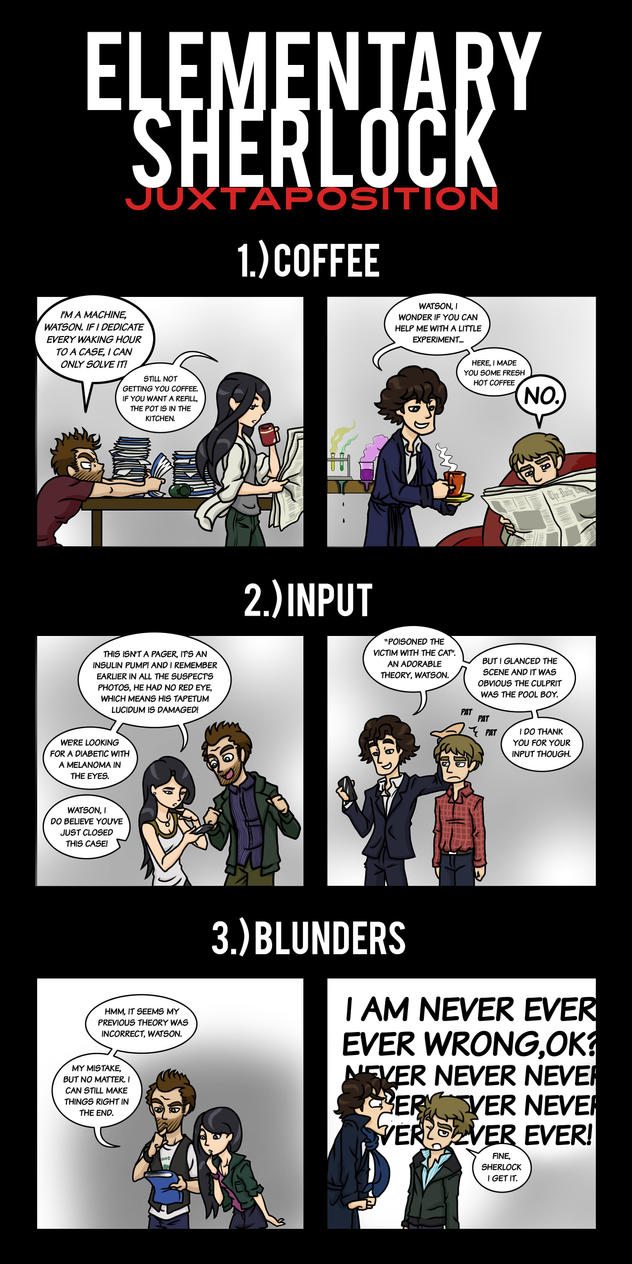


One of the big digs against Elementary is that it is a CBS police procedural.  You've got a mystery, suspects, one or two red herrings, and a resolution, all within an hour.  Well, two points on that.  First, so what if it's a police procedural?  Is there anything really wrong with that?  Second, what the hell then is Sherlock?  Hamlet by way of Steven Moffat and Mark Gatiss?

Sherlock isn't this unimpeachable work of art, this epic of television history that cannot be questioned for plot holes and continuity errors.  Sherlock, I'm sad to tell the Sherlockians, IS a police procedural as well.  You've got a mystery, suspects, one or two red herrings, and a resolution, all within an hour and a half.  The only real difference is that Elementary has to keep things within an hour unless it's a two-part story.  Sherlock can keep things going (sometimes to its detriment, to where some episodes appear to drag and be patted). 

If we look at the plots to Sherlock and Elementary, we can see the former is more sprawling that it allows for a longer mystery, we also see that sometimes the stories are so outlandish that they slip from reality (even Sherlock's own reality) and into fantasy.  The biggest example is The Empty Hearse.  We get a lot of teases about how Sherlock Holmes survived his 'death' but never a definitive, logical answer.  The same Sherlockian who stated that she knew Canon Watson was suppose to be stupid also stated that she didn't care if his death and resurrection were NEVER explained.  She compared it to a magician's trick.

Well, Sherlock isn't a magician (The Doctor on Doctor Who may be turned into one, but that's another matter).  Sherlock is a detective.  He is there to solve crimes.  If he isn't solving crimes, then what good is he? 

Elementary may be standard in terms of presenting a new case every week and, unlike Sherlock, rarely going for long story arcs.  However, at least their plots are almost always logical and I'm pretty sure sane.   If CBS faked his death, it wouldn't be left to 'well, we really don't care but we're glad he's alive'.  There would be repercussions and moreover an actual answer. 

One last part, but a major one about the difference between Sherlock and Elementary, which ties in to the next point.  We have in the latter actual character development for the characters.  Even Sherlock evolves and changes.  "I'm better with you, Watson," CBS tells her at one point.  It's an acknowledgment that Sherlock Holmes needs people.  In Season Two his relationship with Mycroft was one fraught with tension but also with genuine love between them.

Can either of those, Sherlock acknowledging he's better with his Watson or needs him, or a sincere love between Mike and Sherl, ever really appear on Sherlock? 


5.) A Stronger Supporting Cast

This is an obvious point.  On BBC, the characters of Anderson, Lestrade, Donovan and Molly are pretty much dimwits who serve only to show how much more clever Sherlock is.  It got to the point that with the exception of Molly they could believe that Sherlock was himself a criminal, perpetrating crimes to make himself the hero.  I never believed this plot device in The Reichenbach Fall, that someone especially like Lestrade would be so quick to accept that Sherlock was behind the cases he solved.

If you think about it, the secondary characters in Sherlock don't have lives outside working with Sherlock.  Apart from the fact that he likes football and pubs, what does anyone really know of Lestrade?  What's he like as a person?  Why would he consider Sherlock a friend when a.) Sherlock is so cruel to him, and b.) he was quick to believe he was some sort of crazed criminal?  I can't remember seeing much of Donovan in Season Three and I never got why Anderson went from a Sherlock Hater to the President of The Empty Hearse Club.

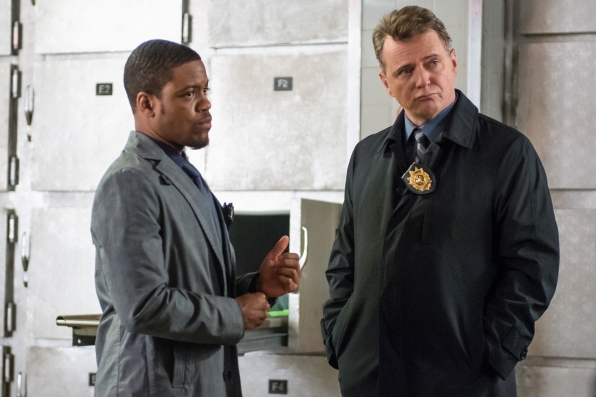
On CBS, the two main secondary characters of Captain Tobias (now known as Thomas) Gregson and Marcus Bell are an important part of Elementary.  They aren't there just to praise famous men.  In fact, sometimes they don't praise Sherlock Holmes.   Gregson once actually punched Holmes and Bell has told Holmes off more than once.  They do what the Sherlock supporting characters never do: stand up to Holmes and tell him where to stuff it.

Furthermore, they have lives outside Holmes.  We've seen Gregson's troubled marriage and Bell's struggle to return to the force after Holmes' actions led to him being shot and nearly losing use of his arm.  They have lives, they have issues, and best of all, they have intelligence.  

One of Sherlock's selling points is that no one is smarter than Sherlock Holmes...period.  One of Elementary's selling points is that no one is smarter than Sherlock Holmes...but that others aren't stupid either.   They are an integral part of Holmes solving the crimes, and CBS has a respect for Gregson and Bell that BBC never has. 
6.) A Stronger Irene Adler


This one perhaps is the weakest, but still one worth examining briefly. 

At the end of the day BBC's Irene Adler is a hooker.  Yes, she's a dominatrix (paging Moffat as Sexist), but essentially someone paid to have sex with.  That's a hooker.  CBS gave their Irene a backstory (an art restorer who is also a master thief/forger), but also allowed in a remarkable hour to let a real, human, and natural romance to blossom between Adler and Holmes.  In nearly two hours we didn't see much that would suggest the "lesbian" Irene could genuinely feel love for Sherlock.  In less than an hour, we could believe that of CBS. 

CBS had a career and life outside Holmes.  BBC's whole purpose was to be a foil for Holmes, nothing more or less.  Why should I really care if her head is cut off (and how did Sherlock manage to get there to rescue her in time)?

It's not as if Elementary is perfect.  I think it could do a better job with some of its mysteries, and certainly with the characters like Ms. Hudson and Alfonso (both wildly underused).  I'd also like to see Clyde more often, but that's a personal thing.

I think the fact that Sherlock Holmes HAS a pet turtle shows CBS has a functioning human as a character, while BBC wouldn't dare put in something so wryly humorous to spoil its more 'serious' tone. 

I now confess that I simply prefer Elementary over Sherlock, not just for the above reasons, but for one more. 

SHERLOCKIANS.

Few fanbases have been so irritating and obnoxious in their demeanor.  Sherlockians, who believe Canon is rubbish and not as good as Sherlock.  Sherlockians, who think Sir Arthur Conan Doyle should watch Sherlock to see how the character should really be written as.  Sherlockians, who think Steven Moffat and Mark Gatiss created the characters.  Sherlockians, who think Benedict Cumberbatch is the first, last, and only Sherlock Holmes.  Sherlockians, who think any other version of Holmes, be it Jonny Lee Miller or Robert Downey, Jr., or even Jeremy Brett, Vasily Livanov, or Basil Rathbone, either don't exist or are lousy because they aren't Benny.   Sherlockians, who think their show is the height of intellectual television but don't care if it doesn't make sense.  Sherlockians, who will verbally assault those who disagree with them be in about Elementary or any non-Sherlock version.  Sherlockians, who ship John and Sherlock but are disgusted by the idea of a Joan/Sherlock romance. 

Few fanbases have been as irritating as Sherlockians.  Few fanbases have made me dislike what they are passionate about as Sherlockians.  They had already poisoned the well before I approached A Study in Pink, and while I have found things to admire in Sherlock, I have also found thinks to criticize.  This they take as a personal affront to "the greatest show of the 21st Century".

If there is such a thing as an Elementarian/Sherlockian war, it started with the Cumberbitches. 

Yet in all this, there is still hope.  I for one will probably lean more Elementary than Sherlock, though I'm the first to admit I'm not a full-fledged Elementarian or a total Sherlock hater. Sometimes Elementary will be bad, sometimes Sherlock will be good.  I can only hope that Sherlockians will truly go beyond their show and look at Canon, at Brett and Livanov, to see different and perhaps better takes on the character they claim to love.

It's your choice: you either love all of Sherlock Holmes, or you love only Sherlock.  You can love both, but you can't claim to love just one. 

Let's follow the good example of the Reigning Holmeses: Mr. Benedict Cumberbatch and Mr. Jonny Lee Miller and have Sherlockians and Elementarians hug it out...


If THEY can embrace each other, why can't Sherlockians and Elementarians too?  Yes, I like Elementary better than Sherlock, but I respect certain aspects of Sherlock.  Perhaps in time, I too will learn to love Sherlock, once the fans have calmed themselves down.  I'm willing to reexamine things and work to remove my own prejudices.  In return, I urge Sherlockians to do likewise and embrace the full Holmesian universe: Canon, Rathbone, Brett, the non-Canon novels from Enola Holmes to Mary Russell. 

There's more to Sherlock Holmes than Sherlock.  There is room for all.

I've said my piece, and now, let us embrace one another: lion and lamb, Jew & Gentile, Protestant and Catholic, Sherlockian and Elementarian.

Tuesday, January 6, 2015

The Americans: A Little Night Music Review

THE AMERICANS:
A LITTLE NIGHT MUSIC

Spies Keeping and Breaking the Faith...

Most children go through a rebellious stage, and what greater way to rebel for the daughter of sleeper Soviet agents than in finding religion?  A Little Night Music continues The Americans strong second season of mixing the main characters business (spying for the Soviet Union) and family issues (their daughters flirtations with Jesus).  We even have the extra bonus of having Margo Martindale's brilliant Granny return.  Friend? Foe? Something in between?

There's fallout from two earlier killings.  For Philip and Elizabeth Jennings (Matthew Rhys and Keri Russell), there's the murders of their co-workers/friends Emmett and Leann.  Claudia aka Granny wants them to find out who did it, and she has a prime suspect.  He is Andrew Laric, a military official who was being blackmailed by Emmett and Leann due to his homosexuality.  Laric is about to start a covert training program in Nicaragua and the Soviets believe, the only one who could have pulled off this targeted killing.

The Jennings also have to deal with Anton Baklanov (Michael Aronov), a Soviet Jewish Refusenik who is using his clout as a physicist and exile from the Soviet Union to draw attention to the plight of the Jews in the U.S.S.R.  They are ordered to forcibly expatriate him back to the motherland.  They split the assignment: Philip will tail Baklanov, while Elizabeth will use her feminine wiles to gain the sympathy of Brad Mullen (Jefferson White), who can get information on Laric as a Navy recruit with access to Laric's files.  Elizabeth appears to share with Brad a similar passion for Mozart, who is different than most of his Navy buddies in that he has a strong appreciation for culture, and is probably either a virgin or extremely inexperienced with women.


Laric must be deeply closeted, as Elizabeth convinces Brad that Laric raped her but has escaped prosecution.  She, however, has a mild freakout when attempting to seduce Brad, and Claudia believes that Elizabeth is not yet fully recovered emotionally from her shooting.  She and Philip have greater problems however: their daughter Paige (Holly Taylor) has found religion.  She has started secretly reading the Bible and attending the Reed Street Church and its Youth Group (as a side note, simply the squarest Youth Group I've ever seen, and I've seen my fair share of YG though I was never asked to attend one as a youth myself...not that I'm still bitter about that all these years later).  Paige's growing fascination with Christianity horrifies her parents, who hold the Marxist doctrine that religion is the opiate of the masses. 

However, they can't take their eyes off the ball, as they must kidnap Baklanov.  They discover that he has a mistress, whom he sees frequently.  It's decided to grab him as he leaves one of his liaisons, but for once the Jennings are thrown for a loop when they themselves are attacked by another pair of trained agents.  In the ensuing chaos one of the other agents speeds off with a dazed Baklanov, while the Jennings find themselves stranded with a wounded agent.

In a subplot, the Rezidentura is having an undeclared war between the head officer Arkady (Lev Gorn) and the upstart Oleg (Costa Ronin) as to who will decide what.  Oleg has used his connections in Moscow to get a higher security clearance, which worries Nina (Annet Mahendru), concerned that her own double-agent status and romps with FBI agent Stan Beeman (Noah Emmerich) will be revealed to someone she genuinely dislikes.

A Little Night Music does what The Americans does best: put a domestic family drama in the midst of the nefarious dealings of the Soviet agents.   The best scene in the episode is right before Philip and Elizabeth try to grab Baklanov.  There, they discuss Paige's secret life as a potential born-again Christian.  The interplay between Rhys and Russell is oddly natural given the somewhat bizarre situations.  Philip is not taking Paige's religiosity all that seriously, suggesting that she will skip praying over her meal if they eat at a later hour (hunger will force God out, he reasons).  Elizabeth for her part is irritated at her husband's reaction to all this, as she is herself is a True Believer: in Stalin, Socialism, and the State.  Despite being Soviet agents about to try and kidnap someone, they also are in a lot of ways like other American parents, wondering whether they are good parents.

A Little Night Music doesn't hold back on other elements.  We see in Russell's performance a woman who has, at a certain level, proven Claudia right in that she is still struggling with the physical.  Russell also excels when she recounts her 'attack' to Brad, making it quite believable that she really was the victim of a violent crime.  It was a quiet, understated performance, and seeing Russell balance all these different roles showcases what a strong actress she is.  Rhys is her equal in the episode, displaying no emotion when hearing of the Refuseniks' struggles in the Soviet Union but having an unhinged moment when as "Clark", the husband of the unsuspecting Martha (Alison Wright), he becomes shockingly aggressive.  It's as if the masks he's been wearing are finally wearing on him, and through Clark, Philip can unleash some of the pent-up rage he has been forcing down.

It is also excellent to see Martindale back, even if it was only for a guest turn.  Her scene with Rhys and Russell as she talks about Emmett and Leann might show a woman who is herself haunted by what has happened throughout her time as their minder: the killings and what has happened to Elizabeth.  However, as Granny continues on, we never fully know if she truly feels something or is using the very human nature of being sympathetic to get people to do her work.  One never knows where one stands with Granny, and Martindale in her quiet manner makes things so mysterious.  She was one of the best parts of The Americans, and it isn't surprising that Martindale received two Emmy nominations for her work on the series (as both Supporting Actress and Guest Actress).

It's also good to see that Holly Taylor really holding her own against two excellent actors in Rhys and Russell as Paige.  She is still somewhat moody (as most teenagers are) but we see that she is slowly starting to seek answers about life.  The Bible is one method of trying to make sense of the world around her, and her growing curiosity about her parents is another. 

Getting the wild twist of the Jennings getting attacked themselves is a great ending to A Little Night Music, throwing things we weren't expecting. 

I have been too long away from The Americans.  It's good to be back, for this tale of the perfect American family who happen to be working to destroy America continues to hold a mirror to the issues of trying to balance work and home...even if work involves bringing down our government. 

Bless Me, Lenin, for I have Sinned...

7/10

Next Episode: The Deal

Monday, January 5, 2015

The Librarians: And the Apple of Discord Review


THE LIBRARIANS:
AND THE APPLE OF DISCORD

You've got dragons.  You've got a Conclave of Mythical Beings.  You've got Noah Wyle returning as the original Librarian Flynn Carsen.  What's not to like about The Apple of Discord, which gives the cast a chance to play with their characters while giving us a great mix of comedy and fantasy with a hint of drama and even romance. 

There's a rash of earthquakes going about, but Jenkins (John Larroquette), Librarian in charge, knows better.  These are dragons awakening, and this is due to the theft of a mystic pearl.  The Eastern Dragons blame the Western Dragons, and this could lead to war.  It's similar to the East Coast/West Coast rap war, Jenkins explains, and the fact that someone as fussy and old-fashioned as Jenkins is fully aware and fluent in the war that killed both Notorious B.I.G. and 2Pac stuns the Librarians in Training: art expert/cowboy Jake Stone (Christian Kane), professional thief Ezekiel Jones (John Kim), and math pixie Cassandra (Lindy Booth), as well as their Guardian, Eve Baird (Rebecca Romijin).  Into this comes Flynn, who is surprised they got the back door working again. 

It's now up to the Librarians to find the Pearl and return it to its proper dragons.  Unfortunately, Jones, who would be the best person for this job, cannot go with them.  Thanks to his idiocy, he is mistaken for the Intercessor, someone who must mediate a gathering of magical beings.  In his rush to get his pizza, Jones welcomes Mr. Drake (Cary-Hiroyuki Tagawa), a dragon in a lawyer's suit (which doesn't surprise the L.I.T.).  The remaining Librarians must go to Rome, where Flynn suspects the pearl has been taken.


Finding the Pearl, oddly, is the easy part.  It's what happens once they find it that causes all the trouble.  Unbeknown to them, inside the Pearl is the Apple of Discord, the object that the goddess Eris tossed at the Wedding of Peleus and Thesis that caused a fight between Athena, Aphrodite, and Hera which instigated the Trojan War.  The Apple brings out the worst version of oneself to whoever holds it. 

Jake's worst version is willing to, in his words once the apple is no longer in his possession, "break someone's skull over misinterpreted landscapes".  A rather harmless act compared to Cassandra, whose use of math powers brings her close to wiping out Europe (and has her shed her genteel clothes for something more sexual and aggressive).  Similarly, the more mild Flynn becomes power-mad and aggressive.  Cassandra and Flynn are so violent that the Brotherhood's henchwoman Lamia (Leslie Ann-Brandt) becomes genuinely frightened by these formerly meek beings. 

Eventually, the Apple finds its way into the Conclave, where an unhinged Flynn starts becoming bossy to everyone, even Duloque (Matt Frewer), who is using the Conclave to end the Librarians' tenure.  Jenkins, despite his unwillingness, does his best to delay matters and try to stop Jones from making more mistakes, but Jones is simply too good at it.  Jenkins, however, uses Jones to steal the Apple from Flynn, and for once the apple doesn't affect someone.  Why?  In short, Jones is ALREADY the worst version of himself.  The Conclave ends with the motion to close the Library not passing, Drake quietly walks away when the subject of the Pearl's disappearance is brought up again, and we see that Jenkins and Duloque have a history.

The Apple of Discord has a great time playing against the roles of the regular cast, particularly with Booth who figuratively and literally gets to let her hair down and show a different side to Cassandra.  She is not the weak, meek, sweet girl, but a sultry siren bent on total destruction.   Seeing Wyle return as Flynn is both a plus and minus.  He certainly gets in on the fun (the highlight is when he says, "I'm not processing Papal possibilities while we peruse the perimeter looking for puzzles", a delightful turn of alliteration that is, given the episode, also logical).  However, it does take away slightly from the idea that the show works best with just the core group.  It's understandable that Wyle will make appearances now and then, and I for one welcome them.  I just wonder if Flynn will end up working as a deus ex machina whenever we need some way out. 

Was his appearance in The Apple of Discord necessary?  I'd say yes: Wyle lent a great bit of comedy in Flynn's befuddlement and power-mania.  He wasn't a big distraction, but him searching for the Library and popping in like this...not sold but not opposed either.   Wyle was fun as Flynn, mastering odd turns like the "Papal possibilities" and his general demeanor.  It was a welcome return, though again, not sure if it will work if done more and more.

Brandt had her moments too as Lamia, who herself is befuddled by how strong Cassandra and Flynn have grown.  If it had been Jake fighting her, she might have thought it reasonable: Jake is a brawler.  However, with Cassandra and Flynn being the least aggressive of the bunch, seeing a trained assassin brought down by these two is amusing.  Brandt's reaction to it all is even more amusing.  Kane is similarly amusing in how his aggression is channeled through his passion for art. 

I confess being a bit puzzled by all the Conclave talk, but it is nice to see The Librarians finding teams within the general team to work with.  Seeing Booth and Kane work together is a delight, and Kim and Larroquette make for a great double-act: Jones' cluelessness and Jenkins' shock and inability to control him lending more humor to it all.

Perhaps I was not wild about the Jones/Jenkins subplot or the Jenkins/Duloque backstory, but apart from that The Apple of Discord allows for the actors to change up their characters and gives us another breezy and fun Librarians story. 

Truly, this series is "For the Fairest"...      

8/10

Next Episode: And the Fables of Doom

Saturday, January 3, 2015

The Librarians: And Santa's Midnight Run Review


THE LIBRARIANS:
AND SANTA'S MIDNIGHT RUN

In the world of guest stars and casting, having Bruce Campbell as Santa Claus has to be among the most unique and intriguing.  Santa's Midnight Run was a sharp, witty, thoroughly original take on both the Santa myth and a nice confection of Yuletide cheer.  We got both a fun and heartwarming story where we find that dreams really do come true if you believe.

Santa Claus (Campbell) is at a London soup kitchen, not just feeding the homeless but talking a thief out of taking from the poor.  Unfortunately, the Serpent Brotherhood has nabbed Santa and plan to kill him at the stroke of midnight Christmas Eve.   Jenkins (John Larroquette) informs the Librarians of the Santa-napping and that it is up to them go rescue The Claus.  The news that Santa's real surprises Cassandra (Lindy Booth), who was told at age three that Santa didn't exist.  She so wished to be able to believe in Santa.  This rescue isn't exactly something Jake Stone (Christian Kane) is looking forward to either.  He'd much prefer a good old-fashioned Christmas bar-fight.  Ezekiel Jones (John Kim) believes he is the best person to re-steal Santa, though it would go against his own wish to know what it was like to be good, just once.  I figure Jones has been on the Naughty List for quite some time.

Eve (Rebecca Romijin) for her part, refuses to believe in Santa Claus.  This is due to having had the awful experiences of having spent many Christmases in war zones.  Her great wish to have a peaceful Christmas was constantly denied.  The fact that Santa does Ho-Ho-Ho through life doesn't help matters.  The rescue actually goes over well and cleverly: showing up in London, Eve and Jake distract both Dulaque (Matt Frewer) and his henchwoman Lamia (Lesley-Ann Brandt) while Jones and Cassandra spirit Santa away.  They must get him to the North Pole by Christmas, for we learn Santa's real purpose.

Santa does not so much deliver gifts as he delivers hope.  Santa is an avatar of goodwill.  He travels the world throughout the year to collect the goodwill of others and releases it via the magical channels that cross the Earth on December 24/25, giving people The Gift...the gift of goodwill and hope.  The Serpent Brotherhood wants to use that gift for their own nefarious plans, and if it means killing Santa, so be it.


In an effort to deceive the Brotherhood, Jones slips on Santa's hat as Stone and Cassandra drive in one direction while Eve and the real Santa go in the other.  There must have been some magic in that old silk hat he wore, for Jones soon starts adopting a more cheerful and selfless demeanor (much to his horror).  He even goes so far as to bake cookies for everyone! 

Trying to keep Santa safe is not easy, especially since Eve discovers that the hat is what keeps Santa's current persona from slipping into other versions of Sinterklass.  At one point Santa (whose habit of referring to himself in the third person drives Eve bonkers) becomes Nicholas the Wonderworker, a prankster who is having too much fun with people sent out to kill him.  Another time he takes on the persona of the Norse god Odin, who can outdrink anyone at a bar and whose war-like aggression causes a bar fight.  They finally get Father Christmas aboard a plane, though Eve has to pilot it herself (thanks to Jones, who in a Christmas spirit tells the sad Canadian pilot to go home to his fiancée, which shocks Cassandra and Jones himself).  Santa's flight C-XMA45 is heading towards Alaska but is attacked by Duloque and Lamia, who manage to get Santa's sleigh.  The Librarians manage to get rid of the Brotherhood thanks to getting Duloque to wear the hat.  While it doesn't overtake him completely, it weakens him enough to be more generous, but no fear...he manages to fly out of the airplane without worries.

Once in Alaska, Santa is too weak to be a good avatar.  It requires someone who is born on the day, say, a girl named "Eve".  Santa and Eve join forces and she is spread throughout the world simultaneously, where she sees the good in people.  Santa leaves, apparently going home to his wife Gretchen (aka Mrs. Claus), and with that, the Librarians throw a surprise birthday party for Eve.  There, they see that each received a gift: Cassandra learns Santa is real,  Stone got into a bar-fight, Jones saw himself as a good person, and Eve has a nice, peaceful Christmas surrounded by friends.

What I really enjoyed about Santa's Midnight Run was that it played with all the ideas about Santa and turned them around.  First, rather than the fat, jolly old elf, Santa came in the form of Bruce Campbell, and it can't get any more inspired than that.   Campbell is excellent as Santa, who can bring the genuine compassion he has for people in despair (his opening scene with the gunman was excellent) and the playful Santa.  His scenes with Romijin where he can't help going ho-ho-ho despite her obvious displeasure were also spot-on.  Campbell can play it both serious and humorous, which isn't surprising given that I've always felt Campbell was a better actor than even he gives himself credit for.


The other highlight was that Santa's Midnight Run was not afraid of being funny.  It was a light, frothy episode that was meant to amuse the viewer with a fantastical tale with humor, and it delivered.  It's been brought to my attention that Christian Kane has a hardcore fan base which dubs itself "Kane Nation" (Kaniacs, I understand they're called).  Would that make one a "Citizen Kane"?  In any case, I'm very close to joining the Kane Nation myself, as Kane was wonderfully wry and witty as the art-loving tough guy.  When he quickly identifies what building Santa is being held in due to the architecture, he seems genuinely surprised no one appreciates buildings (by the way, I'm a member of the National Trust for Historic Preservation, which I'm sure Jake would appreciate).  "Architecture is just art we live in," he says to himself.  What a delightful way of revealing Stone's great (and secret) love.

Kane and Romijin also have a wonderful moment as they terrify the Brotherhood by playing around with priceless works of art as their diversionary tactic, and as the Brotherhood rush out to try and stop Jones and Cassandra from rescuing Santa, Stone leaps to catch a rare Asian sculpture he was tossing around.  Jake Stone, man's man extraordinare, couldn't bear the thought of seeing a thousand-plus year old piece of history in danger.

Kim and Booth were also delightful as the unnaturally cheerful and upbeat Jones and the naturally cheerful and upbeat Cassandra.  In particular was Kim, who made both the cheerful master thief hilarious and his horror at his own cheeriness even more hilarious.  The Librarians now has a solid core whose interactions will be, if handled correctly, something wonderful to watch.  As the group's mentor, Larroquette is dryly humorous (as he wheels around a portable payphone in talking with Gretchen Claus, he brings laughs and also reveals how old-fashioned Jenkins is).   Even Frewer gets into the act, as Duloque is gleefully and unapologetically evil.  Any man who can leap out of an airplane without worrying in the least has a few more tricks up his sleeve.

Santa's Midnight Run was both light-hearted and touching, a nice way to explore the characters and a good old-fashioned lark from start to finish.  It's a lot like The Librarians as a whole: fun, breezy, unapologetically delightful and spinning its own mythos.

I can only hope that Bruce Campbell will make a return guest appearance in a future Librarians episode.  Maybe he could bring the good Mrs. Gretchen Claus with him.  Of course, this is deviation from the tradition about Santa's other half.

I always thought her name was Mary Christmas...

I DO Believe in Santie Claus...I DO, I DO!


9/10

Next Episode: And the Apple of Discord 

The Racket: A Review (Review #686)

THE RACKET

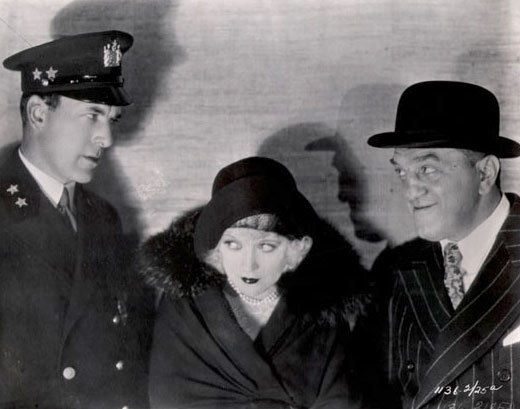
It's a strange thing that a silent film could have dated dialogue, but there it is.  The Racket was among the first films to be nominated for Best Picture by the Academy of Motion Picture Arts and Sciences (losing to the epic Wings).  Speaking of losing, The Racket was thought to be a lost picture, until a copy surfaced in the vaults of the film's producer, eccentric tycoon and movie mogul Howard Hughes, after his death.  I believe this is the only copy of The Racket known to be in existence, and it's a good thing we have this film beyond the historic significance of its Oscar nomination.  The Racket has a 'you-are-there' immediacy to its tale of bootleggers, speakeasies, corruption and one honest cop fighting the system. 

Police Captain McQuigg (Thomas Meighan) is a rare breed on the mean streets: an honest cop.  He has an interesting relationship with Nick Scarsi (Louis Wolheim), a major bootlegger.  They know each other, and it could be said they are not personally antagonistic to the other.  Their rivalry is purely business.  We know this because despite McQuigg's constant arrests of Scarsi's men, Scarsi invites McQuigg to his little brother Joe's birthday/homecoming party.  More surprising, McQuigg accepts, even though the party is taking place at a speakeasy.

Joe (George Stone) admires his brother, but Nick makes it very clear he wants Joe to be a college kid and stay out of the racket.  This involves Joe not getting involved with any women, whom Nick considers poison.  Joe, however, takes an instant shine to a jazz baby with the improbable name of Helen Hayes (Marie Prevost).  Helen Hayes is a flirt who takes a bit of a shine to Joe, but is non-committal to him.

After Nick guns down a rival at the speakeasy, he uses his influence on the corrupt public officials to send McQuigg to a quiet precinct away from the city proper.  Here, McQuigg is queried by three journalists: the enthusiastic Pratt (Lee Moran), the lackadaisical and slightly inebriated Miller (Skeets Gallagher) and the new cub reporter Ames (John Darrow).  The first two know McQuigg was sent into exile and want the exclusive, but they also know that McQuigg is planning his comeback and takedown of Scarsi.  Fortunately for him, Joe inadvertently helps him.

Joe, despite Nick's stern warnings, starts taking Helen Hayes out.  After he gets fresh with her, she walks out of his car, and in his pursuit of Helen Hayes he causes the death of a pedestrian.  The police quickly apprehend him and her and take them to the 28th Precinct, which just happens to be McQuigg's new beat.  McQuigg at first doesn't realize who Joe is (as he had never actually met Nick's brother and didn't see him at the party).  Pratt and Miller however, do know, and it's the hottest story in town.  Ames for his part is actually part of the story.

Nick finds out what Joe has done and wants to break him out, but in his efforts he ends up shooting a cop Nick tried to bribe, which both Ames and Helen Hayes (whom Ames is attracted to) witnessed.  The police soon get Nick, and for once McQuigg will ignore the lawyers who always get Nick out and decides to take a stand.

Things come to a head when McQuigg tells Nick that his influence can't get him out of this.  Nick thinks he can get out of this by escaping, with his gun nearby, unaware that it's been emptied.  An aide to the corrupt District Attorney kills Nick, and despite Ames' pleas Helen Hayes decides to stay in the seedy world, telling him, "No kid.  I'm not going your way." 


The Racket has one drawback, and that is its use of slang.  When McQuigg finds that he cannot get at Nick and has been fooled, the title cards read "This time, it's a horse on you".  I take it this is the equivalent of "Backfire on You", or "Joke's on me".  This does read rather odd today though I imagine back in 1928 it would have been part of the vernacular.

There's another title card that now reads funny, and that's when McQuigg asks if Nick has been searched for any weapon.  "Did you fan him?" McQuigg asks one of his deputies, and I figure this means if Nick was frisked.  The use of 1920s slang puts it squarely in the right timeframe, but it also might make it hard to figure out exactly what is being said.  Fortunately, the lines the reporters use ("First he plugs 'em, then he plants 'em") isn't that confusing.

This is a minor point, as The Racket is not afraid to be a tough look at the underbelly of the city and tackle the issue of corruption.  The Racket also has incredible moments of visual wit that tell things expressively.

At the rival mobster's funeral, we see Nick observe a group of seated men with their hats on their laps.  Director Lewis Milestone then fades to show us that underneath the hats are pistols, which shows how creative and inventive silent film directors could be with their visual flairs.

The performances were also quite strong.  Meighan's honest cop was strong and secure, and Wolheim was dastardly yet almost wryly humorous with his Nick.  For me, however, it was the supporting roles that were the most impressive.  Prevost has a beautiful face and her Helen Hayes was an excellent performance, from the tough cookie to the love-struck girl who knows she'll never change her wicked, wicked ways.  Darrow was also equally strong as the honest and lovelorn Ames.  We had comic relief with the pairing of Moran and Gallagher as the intrepid reporters, in particular with Gallagher who seemed to stumble through the situations with a shrug and a bottle. 

The script had strong moments of comedy and irony (such as Nick being a member of the Anti-Liquor League) and also subtlety.  When Helen Hayes (still a strange name given the theatrical legend who shares it) tells Ames she's not going his way, the double meaning is clear.

It's good that The Racket has survived, as it is an excellent picture.  The dialogue is a little dated, but the story is easy to understand, the film is well-acted and visually clever, and a fan of both silent and gangster films will find much to enjoy and admire. 

Who knew the First Lady of the American Stage
started out as a gangster's moll?

DECISION: B+

Friday, January 2, 2015

Franklin & Bash: The Complete Fourth Season Review


FRANKLIN & BASH:
THE COMPLETE FOURTH SEASON

And The Misses Just Keep Coming...

In the back of my mind I imagine Mark-Paul Gosselaar to be a genuinely nice guy.  I also imagine Breckin Meyer to be a total jerk.  This may be my own imagination and the truth may be completely different.  I say this because I truly cannot imagine Franklin & Bash being renewed for another season of two 'heterosexual' men in their forties continuing with juvenile hijinks.  As someone who loved Season One of F&B I can't shake the idea that the show continues to slide downwards in terms of stories and audience respect. 

I was proven right: Franklin & Bash was mercifully cancelled, with only Season One ever released on DVD.  Thus, the public will be left with only ten episodes to remember a show that started out well and almost as quickly not just fell apart but descended into rank idiocy and delighted in insulting our intelligence.  Is it fair to bash Franklin & Bash now that at least Freckin Meyer is unemployed (since both Gosselaar and Malcolm McDowell have rebounded quickly)?

Sure, why not.  That's what the boys would do if they were in our situation.

Looking at the series as a whole, Season One (so far) has been the best.  It was only after Season Two that the whole thing went chaotically down.  Let's take a look at the average score for the ten episode-seasons.

Season Two: 4.6
Season Three: 4
Season Four: 3.2

Again, for three seasons they couldn't muster even an average score.  Still, I hung on, hoping that the ship would right itself.  It didn't, and I think the reason was that F&B's co-creators Kevin Falls and Bill Chais forgot that it was the mix of wit and silly that was the show's main selling point, not the idiocy of the two leads or their vaguely homoerotic relationship. 

I think His Royal Highness Elmo, Duke of Landingshire waking up in bed with his partner Peter Bash would be more realistic than HRH waking up in bed with Peter Bash's MOTHER.  Talk about transference...

The First Thing We Do,
Let's Kill All the Lawyers...


Well, let's look over the episodes, from Best to Worst.

Deep Throat: 6
Good Cop/Bad Cop: 4
Spirits in the Material World: 4
Dance the Night Away: 4
Falcon's Nest: 3
Red or Black: 3
Love is the Drug: 3
Honor Thy Mother: 2
Kershaw v. Lincecum: 2
The Curse of Hor-Aha: 1

Only ONE story was above-average, an appalling record. 

Here, let's look at WHY Franklin & Bash so spectacularly crashed to where a formerly fun show grew to be a repulsive piece of trash.  Here's an idea: the stories were dumb, the leads played it as if it were beneath them (given what they were working with, that's saying a lot), the secondary characters were either terrible (Danny Mundy made a poor Pindar/Carmen mix, despite Anthony Ordonez's best efforts) or underused (Reed Diamond really should have a career more worthy than what he has).  However, above all else it is Mark-Paul Gosselaar and Breckin Meyer's Jared and Peter who grew from fun but intelligent to simply horrible, nasty, narcissistic idiots that killed what had been a fun, breezy show into an exercise in horror.

Maybe that's why Franklin & Bash not only crashed, but grew to be genuinely hated.  These two guys started out as hip but with a heart.  Then came Season Two, and they just became mean-spirited, narcissistic, emotionally sterile, entitled, self-absorbed, mentally immature asses.  Each season they grew dumber and dumber, nastier and nastier, more shallow and simply unpleasant.  I felt bad for not just the actors but the characters, who were by the end so repulsive that you wanted them to fail. 

It was hubris all around, of the writer/producers and the characters that killed Franklin & Bash.  It's a shame really, because if it had kept the breezy fun of Season One we would have had more seasons.  Instead, we were treated to two stupid men-child obsessed with sex (with others and perhaps with each other), drugs, and rock & roll to make them either likeable or relatable.

I grew to hate everything about Franklin & Bash.  I'm glad to see it cancelled.  One thing is certain: the douche nature of Jared Franklin, aka Elmo Franklin, aka His Royal Highness Elmo, Duke of Landingshire, won't help dispel the douche reputation of Breckin Meyer.

Good riddance, Jared and Peter. 

PERSONAL REFLECTIONS ON FRANKLIN & BASH'S CANCELLATION


Oh look, Zack.  The Kennedy Center Honors are calling...

Thursday, January 1, 2015

Kennedy Center Honors 2014: A Review


2014 KENNEDY CENTER HONORS:
A REVIEW

Hanks A Lot for These Honors Sting

In terms of honorees the 2014 Kennedy Center Honors at least weren't as disastrous as when they suggested Led Zeppelin was in the same musical universe as Lerner and Lowe, or put forth that David Letterman was at the same level as Bob Hope or Johnny Carson.   Back when these things started, they were meant to be a serious tribute to artists who had spent a lifetime contributing to American and world culture.  Now, they seemed to have been, like almost everything else today, dumbed down to where we have a celebration, not of the performing arts, but of people whose name we still (mostly) remember. 

The Kennedy Center has chickened out with regards to actual performing arts.  The last composer honored was in 2004, and that was John Williams, who is known primarily for his film scores.  You have to go way-back to 1998 to find anyone close to writing non-pop music, that being Andre Previn.  That is a good sixteen years since anything close to concert music composition has been recognized.  By the way, aren't both Philip Glass and John Adams still alive? 

The 2014 Kennedy Center Honorees are Al Green, Johnny Madrid (formerly known as Tom Hanks), Patricia McBride, Sting (aka Gordon Sumner), and Lily Tomlin.  Two pop music stars, a comedienne, a film actor, and a prima ballerina.  Out of that group, only one can be considered as being from the traditional arts.  The others, mostly more well-known (Tomlin being the outlier) are perhaps if not more dubious at least just as able to appear at the People's Choice Awards than at the Kennedy Center. 

Now, I'm not suggesting the KCH should select only those who perform on the stage, but somehow it's been a running thread that the KCH will select at least one 'cultural' honoree and everyone else is more a popular selection.  Let's go to the last five years: 2014-2010:

Bill T. Jones:
New Meaning to "Token"

2014: ballet dancer McBride
2013: opera diva Martina Arroyo
2012: ballet dancer Natalia Makarova
2011: cellist Yo-Yo Ma
2010: dancer/choreographer Bill T. Jones

Compare this to the first five years, 1978-1982.

1978: opera diva Marian Anderson, actor/dancer Fred Astaire, choreographer George Balanchine, composer Richard Rogers, and pianist Arthur Rubenstein
1979: composer Aaron Copland, jazz singer Ella Fitzgerald, actor Henry Fonda, dancer/choreographer Martha Graham, and playwright Tennessee Williams
1980: composer/conductor Leonard Bernstein, actor James Cagney, dancer/choreographer Agnes de Mille, stage/screen actress Lynn Fontaine, and opera diva Leontyne Price
1981: jazz composer Count Basie, actor Cary Grant, stage/screen actress Helen Hayes, dancer/choreographer Jerome Robbins, and pianist Rudolph Serkin
1982: Broadway impresario George Abbott, silent film actress Lilian Gish, jazz composer Benny Goodman, actor/dancer Gene Kelly, and conductor/violinist Eugene Ormandy.

Barbara Cook: the last Broadway-connected Honoree

In its first five years, the KCH recognized two opera singers, five composers, four choreographers, three classical musicians, two conductors (and this isn't including people like Basie and Goodman, who conducted their own compositions with their jazz groups) and one playwright.  In its last five years, the KCH has recognized one choreographer, one classical musician, no conductor, no composer, no playwright,  and one opera singer.

It's like the KCH has a quota: one "artist from the classical world" to give it a veneer of prestige, and then people whose careers, while remarkable, may not be as culturally impactful as previous honorees (and I say this as someone who supported Billy Joel as a Kennedy Center Honoree, which puts me squarely in the minority). 

Steve Martin?
David Letterman?
Oprah Winfrey?
The Who?
LED ZEPPELIN?
LED ZEPPELIN???

Isn't someone missing?

Led Zeppelin isn't even a band anymore.  They disbanded the moment John Bonham drank himself to death, so technically, the Kennedy Center Honors honored a dead entity, which is against their own rules that only living people who must be present may be honored. Granted, a little technical but still a point of debate. 

What I'm driving at is that the Kennedy Center Honors no longer takes risks.  They dare not really honor people from Broadway or the classical world in large numbers, merely a token representation.  It's easier to get attention for honoring Elton John than for Merce Cunningham, to recognize a Diana Ross than an Alexander Schneider.  The Kennedy Center Honors, rather than be a true 'celebration of the performing arts', has devolved to yet another awards show desperate for attention and ratings, bringing out people who may or may not be worthy of the lofty aspirations the Kennedy Center touts itself to have. 

It is failing, miserably, in its task of finding artists from all branches: music (not just what you hear on the radio today that DOESN'T involve NPR), THEATER, DANCE, and screen (large & small) to both salute and draw attention to.  It's also failing, miserably, in drawing the ratings it so nakedly wants.  I think the Kennedy Center hopes that by honoring 'big/popular names' like Sting, Green, and Madrid, people will watch. 

They aren't.

We also should consider the age issue.  This year's honorees average age is 67 (Madrid at 58 is the youngest, Tomlin at 75 the oldest).  Compare that to the first year of the KCH, where the average age was 80.   Let's dig deeper and compare the ages of both groups when they were feted.

2014 Honorees: Green: 68, Madrid: 58, McBride: 72, Sting: 63, Tomlin: 75.
1978 Honorees: Anderson: 81, Astaire: 79, Balanchine: 74, Rogers: 76, and Rubenstein: 91.

Richard Rogers would die within a year of his honors.  Every honoree since 2006 is still alive.

Is it me, or do you think the majority of those honored this year could have been honored five or even ten years from now?  It's not like the Center is starved for people to salute: 94-year-old Maureen O'Hara, 84-year-old Gene Hackman, 93-year-old Betty White, 72-year-old Harrison Ford, 77-year-old Philip Glass, 83-year-old Rita Moreno, 80-year-old Maggie Smith, 70-year-old Tim Rice, 86-year-old Martin Landau, or 100-year-old Norman Lloyd.   Even 67-year-old classical guitarist Christopher Parkening or 66-year-old Broadway veteran Bernadette Peters might be better choices than Madrid or Sting (who are both younger than the last two recommendations, I might add). 

Now, this all isn't to say I dislike the honorees.  I like Al Green.  I like Sting.  I even like Madrid and remember Tomlin fondly for The Incredible Shrinking Woman, which as a child I found hilarious (and any social commentary mercifully went over my head).  However, this year's selections seemed oddly out-of-touch with actual culture or relevance.  Richard Rogers' music still impacts people today.  Marian Anderson's performance in front of the Lincoln Memorial as a form of protest against racism will live on in history.  Fred Astaire will always be emulated.

Can that really be said about Madrid or Sumner?


Out of all the honorees, for me the highlight was the one for Patricia McBride, perhaps the least known to the general public.  It shows that being exposed to things outside our general experiences can be fascinating. 

A Fascinating Rhythm, if you will.

Despite how ballet might be thought of as silly, I think it takes a great deal of athleticism and physical strength to perform these routines.  The ballet performances were beautiful and entertaining, revealing a world few of us really venture into but which has more to offer than we might all think.

Al Green was the weakest in terms of making a case for his inclusion.  Sure, he had great songs, but has really had that great of an impact on music?  However, his musical tribute was awesome, as was Lily Tomlin's somewhat perplexed reaction to it all.  Usher's rendition of Let's Stay Together was phenomenal and the Mavis Staples/Sam Moore duet of Take Me to the River brought the house down.

Johnny Madrid's career highlights, oddly, didn't include Turner & Hooch (apart from an appearance by 'Hooch', which even I, not Madrid's biggest fan, found in poor taste), Dragnet, or a little-known but actually good film, Punchline.  However, the whole thing had the feel of a farewell.  Hanks isn't as big a star as he was two decades ago, where he was collecting Oscars like Cracker Jack prizes.  Today, Madrid is not a good return on an investment.  Let's look at the highlight reel:

Saving Mr. Banks (not a big hit)
Captain Philips (not a big hit)
Cloud Atlas (flop)
Extremely Loud & Incredibly Close (flop)
Larry Crowne (flop deluxe)
Angels & Demons (I'd say flop)
Charlie Wilson's War (flop)

In between all these films I found only one real hit, and that was Toy Story 3.  This might explain why the former biggest star in the world now is listed as one of the most overpaid stars of 2014.  Certainly not a position a man known best for his likeability and average-American persona to be.


Oh, and there was that matter of when he suggested racism was at the heart of America's war against Japan (Pearl Harbor I figure not having much to do with the war).  Hanks has grown nastier and more partisan as the years have gone by, eroding the loveable all-American quality that is his best selling point.  I still think he's a great actor and probably a nice guy, but he's not as big as he once was, and he now thinks he's a historian and political expert, indifferent to how he can be isolating his audience.

His tribute was perhaps the worst of the five.  The inclusion of the title song to That Thing You Do! was nice (though not a fan of the acapella version though).  Everything else seemed a bit nutty.  A big tap dance number from a child?  Martin Short's excruciating long and unfunny salute that culminated in a reworked version of Yankee Doodle Dandy to fit Johnny Madrid?  A trio performing They Can't Take Away from Me (another odd choice, given his much-vaunted Broadway debut denied him a Tony Award)?   How all this goes with Philadelphia, Forrest Gump, Apollo 13 or Saving Private Ryan I don't know.  Seriously, they couldn't even put in "Houston, we have a problem" as part of the film portion of Madrid's tribute?

I saw Colin Hanks, a respected actor in his own right, in the audience, but I don't know why he didn't speak at his father's tribute.  Mary Martin's son, Larry Hagman, spoke at her Kennedy Center Honors tribute.   Maybe Hanks fils wanted to keep stepping away from the shadow of Hanks pere, but still...

Tomlin, well, at least she's funnier than the person who introduced her: Garrison Keillor, who always looks a bit unkempt and has the power to put me to sleep.  Woe, would HE be gone...

Sting's musical tribute was great (songs about stalking always go over well), but again, Sting?  The performances were fine: Bruce Springsteen, Lady Gaga, and best of all Bruno Mars with his cover of Message in a Bottle were all excellent. 

Still, STING?


Again, the 2014 Kennedy Center Honors weren't a disaster, and a case can be made for all of them (albeit with varying degrees of success).  However, as Reba McEntire, Jane Fonda, Jane Lynch, and Kate McKinnon from Saturday Night Live were saluting Tomlin and her 'wife' (I still can't bring myself to say that the female partner of a woman is a wife, sorry.  Companion, domestic partner or partner, but 'wife'...a bridge too far), how I wish they'd shown this instead...


It might even have been more fun if I (Heart) Huckabee's director David O. Russell could have had a few laughs on Tomlin's big night...


Certainly more entertaining than Martin Short and the child tap dancer.