Wednesday, December 11, 2024
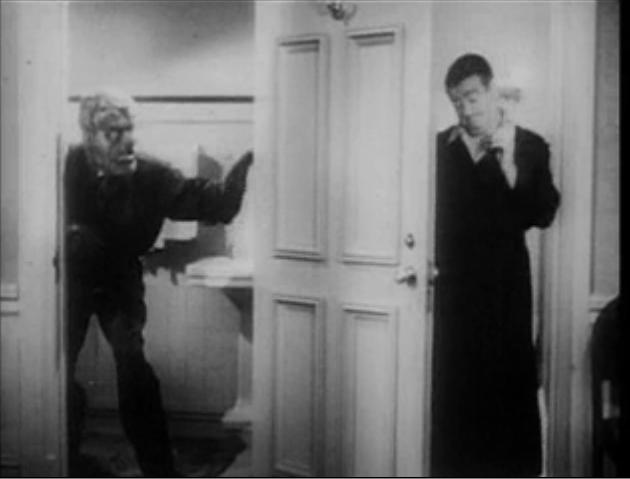
Abbott and Costello Meet Frankenstein: A Review
Tuesday, December 10, 2024
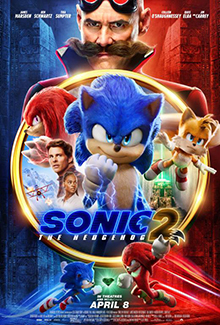
Sonic the Hedgehog 2: A Review (Review #1910)
SONIC THE HEDGEHOG 2
When last we saw our titular hero, his nemesis was stranded on a desert planet and a new creature had popped up. Unsurprisingly, Sonic the Hedgehog got a sequel. Sonic the Hedgehog 2 is a pale shadow of the first film, disorganized, bloated and rambling. While it does have some good things in it, Sonic the Hedgehog 2 is something that should have worked but did not quite.
The evil Dr. Robotnick (Jim Carrey) has found a way out of his forced exile on the Mushroom Planet. He has also found an ally in Knuckles (Idris Elba), the last of the Enchidas who wants to go after Sonic (Ben Schwartz). Sonic, for his part, is thrilled to have the Green Hills, Montana home of his informal parents Tom "Donut Lord" Wachowski (James Marsden) and his wife Maddie "Pretzel Lady" (Tika Sumpter) to himself. Tom and Maddie are off to Hawaii for the wedding of Maddie's sister Rachel (Natasha Rothwell) to Randall (Shemar Moore).
Sonic is struggling with keeping his powers to himself, yearning to be a great hero but making a mess of things when he tries. Fortunately, he now has a distraction when Robotnick and Knuckles come storming onto Earth. Sonic, however, has a new ally in Tails (Colleen O'Shaughnessy), a fox with two tails who is a massive Sonic fan.
Now it becomes a quest to find the Master Emerald, a jewel of great power that Sonic's mentor, the owl Longclaw, has hidden on Earth. It's a race between Sonic & Tails vs. Robotnick & Knuckles to find the Emerald and unleash its powers. That race drags in Tom & Maddie, eventually, along with Rachel and Randall, the latter who was a secret agent who catfished Rachel as part of a plan to capture Sonic. Now the Wachowskis and their in-laws join to stop Robotnick and Knuckles. There are more betrayals before the final confrontation, but is there a Project Shadow to worry about?
Sonic the Hedgehog 2 is close to a half hour longer than the first Sonic film and it shows. As I watched the film, a sense of disappointment started creeping in. I thought that the entire Siberian section, where Sonic and Tails have a dance-off with disreputable Russians, went on too long for no payoff. I was surprised at how Sonic the Hedgehog 2 pretty much forgot about characters and plots, unable to have a cohesive whole.
The entire Seattle sequence, where Sonic shows how his self-assuredness ended up making things worse, could have been shorter. So could the Siberian Pivonka sequence, where I sat not so much confused but wondering why we had to go through this.
For stretches of the film, I had forgotten about Rachel and Randall, and to be honest, about Tom and Maddie. When the film turned from Siberia to Hawaii, that story dominated Sonic the Hedgehog 2. Once we uncovered the truth about Operation Catfish and everyone moved on, I do not think we saw or heard from Rachel and Randall again.
That is not to say that there were not funny moments even in this part. Hearing military Commander Walters (Tom Butler) tell Rachel, "Party's over, Bridezilla" was funny. The dreadful name the secret military organization had: Guardian Units of Nations or GUN, was eye-rolling to where even Rachel thought it was daft. I figure that either that GUN is part of the Sonic videogames or screenwriters Pat Casey, Josh Miller and John Whittington were going for dumb laughs. I cannot explain, separate from that, anyone thought that was funny.
As side notes, it strikes me as a bit cruel to have Rachel be a victim of catfishing, Randall's protestations of being sincere not believable. I also wondered why Marsden's Tom was held up as some kind of wimp compared to Randall or his groomsmen. There's a quick scene of Randall flexing his biceps which Tom reciprocates. I think the scene was meant to suggest that Tom was not in the same league as Randall or Randall's friends. To a point, I can believe that Shemar Moore would be more attractive than James Marsden. However, Marsden showed off an enviable set of guns that made it a very odd moment. Yet I digress.
One of Sonic the Hedgehog 2's greatest flaws is whenever Jim Carrey is not on the screen. His Dr. Robotnick is still delightfully crazed, able to rattle off quips and puns with a malevolent glee. Carrey's scenes with the ever-devoted Agent Stone (Lee Majdoub) were a highlight: the balance between Robotnick's crazed and over-the-top manner with Stone's oddball devotion. Majdoub and Adam Pally as the dimwitted Deputy Wade also worked well together. The idea of Stone hiding out in plain sight by running Green Hills' coffeeshop is amusing, as is his code for revealing to his master the secret technology that Stone has been hiding. At the words, "Latte with steamed Austrian goat milk", we see not only the massive network that has been waiting for the bad doctor. We see how devoted, even hero worshipful Stone is by naming the code after Robotnick's special coffee order.
Sonic the Hedgehog 2 to be fair had some good lines which Carrey, Majdoub, Pally and Schwartz's Sonic were able to deliver. Hearing Sonic call Robotnick "Professor X meets the Monopoly Man" when they face off or Sonic calling Knuckles "Clifford the Big Red Rage Monster" was funny. Credit should also go to Elba and O'Shaughnessy who got into the spirit of the vengeful, serious Knuckles and the more lighthearted Tails respectively. There was also some beautiful animation, such as when we see the Master Emerald for the first time.
Sonic the Hedgehog 2 will, I think, entertain those who do not ask much from the film. I wanted a little bit more, particularly a little more thought and a little more editing. It is fine, but not as good as it could have been or as good as the first adventure. Sonic the Hedgehog 2 did not quite measure up to speed.
Monday, December 9, 2024
Of Human Bondage (1964): A Review
Thirty years after the first adaptation of Somerset Maugham's tale of twisted love hit the screens, we have our third and so far, final version to Of Human Bondage. With some surprisingly good performances, Of Human Bondage is a strong way to end the various adaptations.
As a child, Philip Carey was always bullied and self-conscious about his club foot. When he grew older, Philip (Laurence Harvey) thought of becoming a painter until he found that he had skill but no talent for it. Philip was prodded into going into medicine, where he did better albeit not as the most enthusiastic of medical students. Trained and bullied by stern Dr. Jacobs (Robert Morley), Philip does reasonably well.
That is until he meets Cockney waitress Mildred Rogers (Kim Novak). She had caught the eye of many a male admirer, including some of Philip's fellow students. Philip, however, has become slowly besotted with our working-class wench, a flirt who is not above sleeping with men whom she knows are engaged. Philip soon begins a relationship with Mildred, but she does not see it as exclusive and eventually goes after a wealthier admirer.
Philip forges a new romance with writer Nora Nesbitt (Siobhan McKenna), but it is not long before Mildred comes back, knocked up and tossed out by her husband. Philip, like a moth to a flame, takes her in and moves away from Nora. Mildred is still up to her old tricks, fooling around with his best friend, stealing Philip's money, treating him like dirt and pretty much forgetting her child. Philip, now a full-fledged doctor, has finally forced himself away from this luscious monster. They do meet once more, under tragic circumstances brought about by Mildred's wanton and wasted life.
It is interesting that Of Human Bondage had three adaptations in 1934, 1946 and 1964 but has never been brought back since. I wonder why that is. I cannot say that the 1964 adaptation is the definitive version of the Maugham novel. I do think that Of Human Bondage is a strong film, with some good performances that work well.
I do not know if Kim Novak has been given enough credit for being a capable dramatic actress. In Of Human Bondage, she is a very good Mildred. She kept a convincing Cockney accent and initially came across as fun, slightly flirtatious and appealing. Novak made her into less a shrew and more a thoughtless albeit selfish creature. I do think that perhaps she was at times a bit too soft-spoken. On the whole, though, I think Novak did quite well in the role.
Laurence Harvey is also good as Philip. He makes Philip into someone you can believe became so possessed by this tramp that he would forsake so much for her. Again and again, no matter what abuse Mildred heaped on him, Philip would go back to her. Harvey manages that elegance that I think Philip would have, a more upper-class manner. For good or ill, he and Novak had at times somewhat soft voices. I think that did help when either of them finally started raging.
A big surprise is Robert Morley as Dr. Jacobs. While his part was small, he dominated his scenes, showing a gruff manner that is a surprise. Morley had a jollier public persona and in Of Human Bondage, he did have a blustery and slightly comical manner. However, Morley also showed that behind that bluster was someone who could be harsh, even downright cruel, to his students. Belittling them in order to get them to work harder, Of Human Bondage picked up more in Morley's brief moments.
The film is also helped by Ron Goodwin's lush score, which gives the film that sense of doomed romance.
I think that despite the more open manner that the times had, Of Human Bondage still pulled some of its punches. The film closes with Philip seeing the effects of Mildred's moral and physical decay, but it is filmed in such a way that most of it is in shadow. Granted, even in shadow the effects are still ghastly, so that is not too bad. However, I think that perhaps we could have seen Mildred's thoroughly wasted state rather than focus on keeping Kim Novak still a bit appealing.
I also think that despite its hour-and-forty-minute runtime Of Human Bondage skimped out on Philip's other romances with Nora and Sally (Nanette Newman). I won't say that they were rushed through, but perhaps underdeveloped.
Still, this Of Human Bondage adaptation works well and I think makes for good viewing.
Wednesday, December 4, 2024
BlackBerry: A Review
Technology, trends, things that seem to be eternally ubiquitous have a strange way of fading away into history. Once, the nation had Blockbuster Video stores seemingly on every corner to where the expression "Make it a Blockbuster night" was as dominant as the company that spawned it. Now, it is a relic of a lost world. The same can be said for the BlackBerry device. None other than former President Barack Obama seemed to never be without his "Crack Berry". Now, a BlackBerry device is fit for a museum, relegated to the same historic section one would find typewriters or rotary telephones. BlackBerry chronicles the rise and fall of both the device and the minds behind it. While it has some good performances, its length and one specific performance push it ever-so-slightly down.
Out in the wilds of Waterloo, Ontario, the nerds of startup company Research in Motion (RIM) are tinkering away with their PocketLink device that will put communication within people's pockets. The pitch meeting is a disaster, with RIM heads Mike Lazaridis (Jay Baruchel) and Doug Fregin (cowriter/director Matt Johnson) making a poor impression on financier Jim Balsillie (Glenn Howerton). Fortune, however, smiles on the duo when, owing to his belligerent manner, Jim is now able to provide his own financing in exchange for a stake in the company.
Balsillie, for all his bullying, knows a good thing when he sees it, and the PocketLink is a good thing. What is not is RIM's rather laidback manner, which he finds immature. There is a sense of arrested development among the RIM employees, where they will break for video games and Movies. RIM appears more like an afterschool STEM program than a serious company. If there is one thing that Balsillie is, it is serious. Eventually, he gets Lazaridis to bring a prototype to New York, but Mike manages to bungle this effort too by forgetting the prototype back at the hotel. Despite this, Balsillie and Lazaridis manage to bring investors to the newly dubbed BlackBerry.
Balsillie is always pushing Lazaridis to do more despite Mike's objections on technical grounds. Balsillie is also alarmed at an attempted hostile takeover of RIM, forcing him to come up with more BlackBerrys that the system can handle. The chaos eventually has Balsillie bring in the pushy network engineer Charles Purdy (Michal Ironside), a terror to the RIM engineers but who to be fair does whip them into shape.
By this time Balsillie, who is hockey-crazed, becomes fixated on buying the Pittsburgh Penguins NHL team and moving them, secretly, to Hamilton, Ontario once he purchased the team. Lazaridis, no pitchman, is forced to try to drum up support to counter the new threat of Steve Jobs' iPhone. Totally lost, Lazaridis promises a better device he calls "The Storm" even though he knows no such product is even in development. Now, it has to be, forcing RIM to outsource things to China over Fregin's very loud and vocal opposition. Balsillie, for his part, is MIA in the oncoming Storm fiasco, so focused on getting the Penguins that he forgoes a chance to save the company by meeting with Penguin officials over AT&T officials.
The meetings for Lazaridis and Balsillie are disasters. Worse, when the Storms finally arrive, Lazaridis, technician at heart, hears a strange buzzing and begins attempting to fix each Storm phone. With that, the BlackBerry finally collapses.
BlackBerry, at heart I think, wants to be something like The Social Network, a tale of the rise and fall of both a company and a long friendship. Granted, Facebook, unlike BlackBerry, has not fallen, but my sense is that BlackBerry wanted to paint a similar story. What BlackBerry has as a major positive are many of its performances.
I have sensed that Jay Baruchel has more to him than just Hiccup from the How to Train Your Dragon films. BlackBerry allows him a chance to show that untapped range with his performance as Mike Lazaridis. He is still something of a nebbish, which Baruchel has played more often than not. However, he also shows Lazaridis to be totally committed to the product, one who loves the technology and wants it to be the best. Lazaridis' fears and struggles with people are well-played by Baruchel. Of particular note is when he has a break with Fregin over Lazaridis' impromptu declaration of the Storm device. Baruchel plays the mix of paranoia, anger and genuine loss that the situation forced him into.
The real standout in BlackBerry is Howerton as Jim Balsillie. Best known for the comedy It's Always Sunny in Philadelphia, Howerton makes Balsillie into a coldhearted, ruthless but efficient businessman. There is nothing funny about Balsillie, a driven, hard-headed and hard-hearted man who let power go to his head. Balsillie was not afraid to cut down the jolly atmosphere at RIM if it meant getting things done, but he also let his hubris and delight in machinations get the better of him. Seeing him so utterly enraptured by owning an NHL team to the point where he would skip an important meeting to try and finalize the deal already makes for great viewing. Seeing Balsillie deflate when the Penguins organization informs him that they learned about his scheme to relocate the team and as such, deny his offer makes for greater viewing.
BlackBerry is Howerton's picture, and he makes the most of his time. One almost sympathizes with Jim, a man who put himself in the hands of bright morons. However, Howerton shows how Jim could be ruthless, bullying and downright cruel.
In smaller roles, Ironside's Purdy and Cary Elwes as Carl Yankowski, the man who tried to take over RIM, also do strong work. Ironside in particular makes Purdy into a no-nonsense figure who does not give a damn that making the core RIM staff work late upsets their routine. "It's bad luck to work on Movie Night," one of them tells him when Purdy orders them to start creating Storm. The look of disbelief to anger Ironside has does much to convey Purdy's mix of contempt, irritation and fury at the immaturity that he sees.
My one caveat, the one aspect of BlackBerry that does bother me, is its director/cowriter and costar Matt Johnson. As the goofy Doug Fregin, the yang to Mike Lazaridis' yin, I think Johnson perceived himself to be the real star of BlackBerry. I would not be surprised if Johnson saw himself that way given that he directed, cowrote (with Matthew Miller, adapting the nonfiction book Losing the Signal: The Untold Story of the Extraordinary Rise and Spectacular Fall of BlackBerry) and was the third costar of BlackBerry. I get what Johnson was going for in making Fregin this total goofball who was still a technical whiz. I just never bought it. Moreover, I found Johnson quite annoying as Fregin. Try as I might, I could never shake the sense that Johnson was trying too hard to make Fregin into this loveable eccentric when he ended up being someone I wanted to see fired.
BlackBerry, which I understand was reedited into a three-part miniseries, is a good film that could have been better. In that sense, it is a bit like a BlackBerry Storm: something that had a lot of potential but was brought down by an infernal and incessant buzzing.
Tuesday, December 3, 2024
Flamin' Hot: A Review
Does a biopic have to be completely accurate? No, I think many biographical films take liberties with their subjects. Flamin' Hot, the biopic of former Frito-Lay executive Richard Montanez, however, has met with especially ferocious criticism on its accuracy. Is it fact? Is it fiction? Is it a mix? Flamin' Hot works on a certain level if it meant to be crowd-pleasing. It does not, however, work if you find its efforts too hard.
Told in voiceover by its main character, Flamin' Hot tells the story of Richard Montanez (Jesse Garcia). Despite being the son of migrant workers, Montanez is endowed with fierce pride in his name and his Mexican heritage. He also is a firm outsider amidst the WASP world of California, finding comradery and companionship with the pretty Judy (Annie Gonzalez).
Unsurprisingly, Richard and Judy go from friends to lovers and cholos, doing all they can both legal and illegal to keep themselves afloat. Richard is determined to move upwards and eventually hoodwinks his way into being a janitor at a Frito-Lay plant, the first honest job he's had. Determined to move above the strict culture of Frito-Lay caste system, he nudges his way to being a protege to crabby engineer Clarence Carter (Dennis Haysbert).
Carter shows him all that he knows about the machinery, but Richard still cannot move up. More troubles come his way due to the evil Reagan Administration, whose economic policies endanger the plant's survival. Eventually, thanks to his cultural background, Richard sees that the Latino market is both massive and untapped. As he puts it, the reason Frito-Lay is struggling is because of "Brown neighborhood, white flavors". Why not create specific flavors for his community? Using his sons as guinea pigs, Richard Montanez creates the Flamin' Hot Cheetos.
Showing pluck, determination and gumption, Montanez goes to the very top, directly calling Frito-Lay CEO Roger Encino (Tony Shalhoub). Encino is surprisingly enthusiastic about the Flamin' Hot Cheetos, but apparently no one else is. With no marketing and poor sales, it takes Montanez's barrio background to come up with guerrilla marketing to get the Flamin' Hot Cheetos noticed. Will it be enough to save his job and the plant?
Flamin' Hot has had, from what I understand, major reporting questioning the accuracy of the story. The veracity of Montanez's claims to have essentially invented Flamin' Hot Cheetos is extremely doubtful. Director Eva Longoria used the expression "his truth" to paper over the truth on the matter. Personally, any variation of "your truth" is a term that I detest.The truth (as opposed to Montanez's truth) on the matter is not something that I hold against Flamin' Hot. The film, while fudging the facts, is meant as an inspirational tale of someone overcoming great odds to become an American success story. As such, Flamin' Hot works well. The problems come from how Flamin' Hot stubbornly refuses to concede that it takes great creative license with the truth (vs. "his truth"). I accept that biopics are not one hundred percent accurate. There are composite characters, shifting timelines and even invented scenes that deviate from the facts. Flamin' Hot, for its part, may have gone into almost straight-up fiction and try to pass it off as fact. That is more troubling since, again from my understanding and I may be wrong, Montanez proclaims himself a devout Christian. How a devout Christian can perpetrate an alternate reality is something I cannot reconcile.
I am more puzzled by any suggestion that Montanez is a man of deep faith given how Flamin' Hot makes evangelical Christians less than pleasant people. This is captured by Richard's troubled relationship with his father, Vacho (Emilio Rivera). Vacho, if memory serves right, is a nickname stemming from "boracho", Spanish for "drunk". In voiceover, Richard informs us that Vacho has traded in booze for Jesus, but he is still portrayed as gruff, hostile and dismissive of his son's efforts. For someone whose life was supposed to have been changed by a personal relationship with Christ, Vacho hasn't changed save for his sobriety. Yet I digress.
Flamin' Hot, as I said, is meant more as a crowd-pleasing film than a straightforward narrative. It works on that level thanks to Jesse Garcia's performance. I could have done without the constant voiceover from Garcia, who seems determined to tell us all of Montanez's inner thoughts. That being said, I get where Lewis Colick and Linda Yvette Chavez's screenplay was going for with these narrations. They are peppered with Chicano lingo and the California Mexican-American worldview. When, for example, Montanez first starts working at the Frito-Lay plant, he struggles with the disrespect that he felt. "I had to mind my gangster," he tells us. Later on, he imagines how a Frito-Lay board meeting went by putting it in cholo terms. Referring to the board as "gangsters with money", Flamin' Hot shows these very white men speaking and behaving as though they were all cholos from the barrio.
As a Hispanic myself, I got the jokes and quips. I related slightly more only because I know people like Richard and Judy Montanez and the world they live in. I'm not completely of that world: I'm closer to a WASP than a cholo, one who prefers the white flavors of regular Fritos than the spicy Flamin' Hot Cheetos. Yet again, I digress.
Garcia is winning as the enthusiastic Montanez, a hustler who won't take "No" for an answer. His enthusiasm for all things makes Montanez an interesting character. At one point, he tells a job interviewer that he has a Ph.D.: poor, hungry and determined. Garcia also shows us Montanez's genuine anger at being held back over and over. He finds it frustrating to be overlooked, and Garcia makes that struggle relatable. As his pachuca girl, Annie Gonzalez does well as Judy, who supports her man even when she finds him difficult. In their smaller roles, Haysbert and Shalhoub also do good work as the cantankerous engineer and Frito-Lay CEO respectively.
If Flamin' Hot will be remembered for anything, apart from the controversy over the film's accuracy, it will be because Diane Warren received her 15th Best Original Song Oscar nomination for The Fire Inside. Warren has yet to win a competitive Oscar, and The Fire Inside is her first nomination after receiving an Honorary Oscar. The Fire Inside is like Flamin' Hot Cheetos: spicy, with the hint of Hispanic kick to it. It was never going to win, but unlike her nomination for Tell It Like a Woman, few people doubted Flamin' Hot was a real movie.
Flamin' Hot has the atmosphere of the California Chicano world down well. It makes its protagonist a pleasant, positive figure. Its accuracy may be in doubt, but there is a sincerity to it that makes it passable.
![]() |
| Born Circa 1958 |
Monday, December 2, 2024
Sonic the Hedgehog: A Review
SONIC THE HEDGEHOG
I start my Sonic the Hedgehog review by admitting that I have never played the video game on which the film is based on. I admit great puzzlement over why Sonic the Hedgehog as a movie exists at all. Despite that, I was completely won over by Sonic the Hedgehog's mix of straight and silly, heart and humor.
In voiceover, our intergalactic alien Sonic the Hedgehog (Ben Schwartz) tells us that he is an exile from another world, finding his way to Earth through a magical portal ring. He enjoys his adopted home outside Green Hills, Montana and its residents from whom he hides from. His personal favorites are a man he calls "Donut Lord" and his wife, "Pretzel Lady".
One night, his loneliness gets the better of him, and he inadvertently causes a major power outage. Reluctantly, the military high brass brings in eccentric to downright bonkers Dr. Robotnick (Jim Carrey) to find the source of the outage. Dr. Robotnick quickly traces things to a foreign entity. Fearing for his life and safety, Sonic is about to go into exile again when he encounters "Donut Lord".
That would be Green Hills sheriff Tom Wachowski (James Marsden). Tom, who is getting ready to leave Green Hills to be a San Franscico cop, is shocked to discover that the legendary "Blue Devil" is real. He reluctantly agrees to help Sonic go to San Fransisco, find the bag of rings that Sonic accidentally sent there, and avoid the mad Robotnick. Will the immature but loveable Sonic win Tim and his wife, Pretzel Lady Maddie (Tika Sumpter) to his side? Will Robotnick be stopped?
Sonic the Hedgehog does something incredibly rare in films: take the premise seriously while simultaneously giving audiences a slight wink that all this is not meant to be taken seriously. Everything about Sonic the Hedgehog is absurd. However, it is a credit to especially James Marsden and Tika Sumpter that they play the scenario straight. To be fair, there were a couple of occasions when both tried to be a bit exaggerated in their delivery. However, it was brief and not enough to remove all the goodwill that they had made.
Marsden in particular has a hard task in the film. As the straight man to Sonic's mix of naivete and childlike enthusiasm, he has to be the adult. He manages things quite well, showing him to be a decent man trying to do the right thing while never behaving as though a speedy talking blue hedgehog is a bit bizarre. Perhaps a bit bizarre, but so long as he is around Marsden never exaggerates his reactions or makes out like he is too smart for all this.
The cartoonish, wildly over-the-top part is handled by Jim Carrey. This, however, was the correct way of handling things. Dr. Robotnick is cartoonish and wildly over-the-top. He is never meant to be a serious antagonist to Sonic. He is meant to be so grandiose in his manner that trying to make him a more grounded villain would have come across as idiotic. In Carrey's performance, Dr. Robotnick delights in being big but behaves as though none of this is wrong.
Of particular note is whenever he plays something with his right-hand man, Agent Stone (Lee Majdoub). Stone suffers greatly under Robotnick, but both play their scenes as if this is how both would behave: Robotnick doing something that causes Stone mental or physical injury, Stone being initially hurt but then quickly moving on. As odd as the comparison may be, I am reminded of how Groucho Marx would insult Margaret Dumont in a film, only for her to give a quick startled look before moving on.
The broadness of Carrey allows for Marsden's more straightforward manner to balance each other out. Had both played them the same way, it would have been disastrous. Had Marsden been exaggerated and Carrey restrained, things would have looked odd. Jeff Fowler as a director made a wide choice to let Carrey go all-in on the cray-cray while having Marsden be a bit more rational. Actually, Carrey's Dr. Robotnick being so cartoonishly over-the-top allows everyone else to look rational, even when they are not.
Schwartz as the voice of Sonic makes him a likeable creature. He makes Sonic a bit like a child, energetic, cute and innocent. He is well-meaning and not meanspirited in any way, but unaware of how things are. Who else would find a biker bar so enticing enough to go there despite the dangers he faces?
Pat Casey and Josh Miller's screenplay makes this premise plausible without insisting on being totally realistic. Sonic the Hedgehog is deliberately silly, but it does not insult the audience by having everything played for laughs. In fact, there are moments that are surprisingly moving, such as when Tim looks at Sonic's bucket list and sees "Make a real friend" as one that he has not scratched off.
The film has good visual effects in bringing this super-fast blue creature to life. It soon looks as if Sonic is a real creature, making one care about him. We can also laugh at how he manages to get into a barfight. I do wonder though, if smaller children will have to have things like biker barfights explained to them.
While Sonic the Hedgehog is surprisingly short, clocking in around a little over an hour-and-a-half, it never feels either rushed or lethargic. The only part that perhaps might have been rushed is the opening, when we get a very brief glimpse of Sonic's mentor and protector, the owl Longclaw. It was a bit quick, but I found that a minor detail.
On the whole, however, Sonic the Hedgehog work because it knows how to have fun with the premise while not making things too silly. I think families will enjoy the first adventures of our title hero and fans of the video game will be pleased with it too. Sonic the Hedgehog has a warmth, a sweetness and a deliberately light humor that delighted me. While I probably will not play the game, I would have no issue sitting through Sonic the Hedgehog another time.
Sunday, December 1, 2024
Juror #2: A Review (Review #1905)
Justice may be blind, but can it be actually served impartially? Juror #2, the latest and perhaps final film from Clint Eastwood, takes us through a very tragic story in a straightforward manner, making the multiple layers of tragedy all the more impactful.
Justin Kemp (Nicholas Hoult) is a magazine writer, recovering alcoholic, and future father. His wife, Allison Crewson (Zoey Deutch), is in her final month of a high-risk pregnancy, having already suffered a prior miscarriage. Justin has no desire to serve on a jury, as do almost all the potential jurors in a Savannah courthouse. District attorney Faith Killebrew (Toni Collette), in a tough reelection race, is personally handling the high-profile case against James Sythe (Gabriel Basso), accused of murdering his girlfriend Kendall Carter and dumping her body in a remote creek. Public defender Eric Resnick (Chris Messina) has rejected, at his client's request, to accept any plea deal and go to trial. Justin, along with the other jurors selected, may not be thrilled to be there, but they will do their best to render a judgment.
Over the course of the trial, Justin finds to his horror that he is connected to Kendall's death. He knows that James Sythe is not guilty, but revealing this will then bring him into legal trouble. This is confirmed by Justin's AA sponsor, attorney Larry (Keifer Sutherland), whom Justin quietly hires to have that attorney/client privilege. Justin does his best to sway the jurors, almost all of whom voted to convict, to reverse their decision without revealing his own involvement in the case. Only one juror, former cop Harold (J.K. Simmons) is on Justin's side, albeit for different reasons. Another juror, Marcus (Cedric Yarborough), is dead set against Sythe, also for his own reasons.
As the trial goes on, Justin keeps that delicate balance between trying to guide the other jurors to acquit while not revealing all that he knows. Will he succeed in saving both himself and James Sythe? Will Faith stumble onto the truth in time?
Juror #2 was initially intended to be released as a streaming-only film. I find this an absolutely shocking to downright horrifying decision given how Juror #2 is one of if not the best film of 2024. After seeing the film, I downright question the sanity and/or intelligence of Warner Brothers executives who showed little to no faith in Clint Eastwood or Juror #2 to appeal to audiences.
Perhaps Juror #2 was too quiet for them. There is nothing flashy or grand or epic about the film. Apart from a few moments that have a subtle nod to the proceedings, such as a breeze swinging the scales of justice on an outdoor statue or a quick shot of Justin behind metaphorical bars, Juror #2 never calls attention to itself or its style. Clint Eastwood has a very quiet directing manner in Juror #2. Everything is on a surface level, with no great theatrical moments or thunderous score to underline the growing crisis.
That, however, is nowhere near a flaw. It enhances Juror #2, giving it not so much a documentary-like feel, but something that feels relatable and close to life. Jonathan Abrams' screenplay is very subtle in its symbolism and effective in giving us complex characters and situations. Justin's very name is an ironic one: the man who, unintentionally, created the situation that is bringing about a miscarriage of justice as he is trying to avoid a literal miscarriage.
The more I think about Juror #2, the more I am impressed with its world-building and structure. We are not told things right off the bat but have Justin's life revealed in pieces. We, for example, don't learn of Justin's alcohol struggles immediately. We also, over the course of the film, see how the jurors and Faith can reach their conclusions both pro-and-con.
Juror #2 does something so rare in films today: it respects its audience and our intelligence. It gives us both information that other characters are not privy to (such as how Justin was at the bar where James and Kendall had their fight, albeit him unaware at the time that he was selected) but also gives us the backstories of even minor characters. One juror, for example, wants the case over with quickly so she can go back to her children. Another is personally prejudiced against Sythe due to Sythe's criminal past. Both, however, do take their job as jurors seriously and find the evidence against Sythe strong.
One brilliant aspect in Juror #2 is that there are no villains, but a collection of good yet flawed people, bringing their own experiences to the case. We know, for example, that Justin is a good man despite his actions. The film, however, also does not portray Faith as merely interested in getting a conviction that will boost her polling numbers. She too cares about justice and believes that she is doing the right thing. Once she begins to doubt whether Sythe did commit the crime, she begins to investigate herself. Us knowing that Sythe is not guilty makes us sympathize with him, even if he is less than an upstanding citizen. Marcus, however, is hostile against James precisely due to Sythe's past. The film also portrays Faith and Eric not as fierce adversaries or as one good, one bad. Instead, they are friends, both doing their best for their respective clients and aware of the legal system's virtues and flaws.
Juror #2 is reminiscent of 12 Angry Men in how it looks at the jury system, though with the added twists of jurors' personal involvement. Unlike 12 Angry Men, Juror #2 does not suggest that the process works. Instead, it suggests that like all systems, it is flawed and capable of tragic errors despite everyone's best and sincere intentions.
This is an exceptionally well-written film. It is also an exceptionally well-acted film. Nicholas Hoult has built up an impressive career in both drama and comedy and has transitioned well from child to adult actor. Here, his Justin is a man in full: decent yet flawed, aware of all the facts but struggling between doing the right thing. None of the options presented to him are good, but the audience sympathizes with Justin. This is a very quiet performance, where we see Justin's struggles through his eyes. Yet we also see Justin as loving husband and father, a regular man.
Collette, unlike Hoult, may struggle with her American accent a bit (Hoult did not have a pronounced Southern accent like Collette did). However, that is a very minor flaw in her Faith, someone who balances a desire to win her election with a genuine desire to do right. Her scene with Basso's Sythe (who is equally good) reveals that she may not like the suspect, but she also suspects that she may have the wrong man. Faith, through Collette's performance, shows someone who does care about Kendall. We see this in quick moments, such as her reaction when she reads a thank you card from Kendall's family. We also see the shock when she realizes that Allison Crewson and Justin Kemp are connected.
Juror #2 is so exceptionally well-acted by everyone, even those with smaller roles. There is a substitute juror who has to go in late into the trial. In other hands, the director might have played up the new juror's love for true crime podcasts for laughs. However, Eastwood and Abrams make this a strength, showing that the new juror understands how things may not always be as simple as they appear. That is one of Juror #2's greatest strengths. It takes things seriously without being somber or dramatic. It plays things naturally, showing us people who are no different than the audience.
The strength of Juror #2 goes to Mark Mancina's score. Never dominating the scene, it is like the film itself: quiet, simple, but effective, sparingly used but more impactful when it does come.
Juror #2 should never have been considered for a streaming-only release. This is not a streaming film. It is a well-crafted, well-acted, well-directed piece of filmmaking that is probably the best film of 2024. At a time when pretentious gibberish like Conclave or outright junk like Gladiator II: Judgment Day are being promoted for Best Picture, there is this little film that does what those films fail to do. Juror #2 manages to entertain while making the viewer think and care about the story and its characters. How anyone can come to a conclusion that those other films are better than Juror #2 is a mystery to me.


.jpg)


.jpg)