Dear Readers,
As you know, I love writing Rick's Café Texan as well as my spin-off sites Gallifrey Exile (Doctor Who reviews) and The Index of Forbidden Books (book reviews).
However, it has become apparent that because I spend so much time writing for my sites I have neglected my own fiction writing for far too long. Having a computer that is starting to show its age by going painfully slow does not help matters.
For too long I have avoided tackling my writing assignments, always hoping that I could find time for them. However, I always found time to review films, television programs, and books, and those hours could have been devoted to turning in my assignments on time. That isn't to say I could not have balanced my time better then, but I'm not one to see the point of 'could of would of should of''. What's done is done, no point of crying over the mistakes of the past. The fact was I either could not or would not balance the reviews with the writing.
Therefore, I have come to the conclusion that the sites are taking far too much time away from my own non-review creative efforts. With that, I am going on a two-week sabbatical from all three sites, using that time to finally force myself to devote those hours I spend here and there to shaping the story I should have turned in well over half a year ago.
This short period, from April 7 to April 21, is surprisingly painful to me since I derive great pleasure out of discussing film, television, and literature. However, if I am to ever get my own work done, something's got to give.
Now, let me be clear (as our President is fond of saying): I am by no means retiring from or quitting my reviews. Two Sundays from now, I will reevaluate where I stand on my works. If I think I need more time, I will extend it another two weeks. If not (the ideal scenario), I will return a'blazin' and with a song in my heart.
Also, I will not stop watching films or television programs. I will continue to make notes on the television shows I watch (Bates Motel, Golden Boy, Elementary, Doctor Who) in preparation for my comeback...no, return! (If you get the reference, then you're on my team). Same goes for the movies.
I do hope to return to you quickly, as I have scheduled a Superman retrospective to coincide with the Man of Steel release set for June. Even that was scheduled to be at a leisurely pace: a film a week starting with Superman & The Mole-Men, an unofficial theatrical 'pilot' for the George Reeves Superman television series.
If by some miracle I find that I can finish my assignments before the two weeks are up, I will jump in with wild abandon. However, I must force myself to stay away from the sites, because once I get distracted by them, I all but forget my writings.
As it stands, I know that I have to pull back from my reviews to give time to my writings. Until I learn to balance my schedule to where it will allow me to do more, I have to do less.
Until April 21, hopefully...
Sincerely,
Rick
Sunday, April 7, 2013


Saturday, April 6, 2013
Bates Motel: What's Wrong With Norman? Review
BATES MOTEL: WHAT'S WRONG
WITH NORMAN?
Bates Set To Go Off...
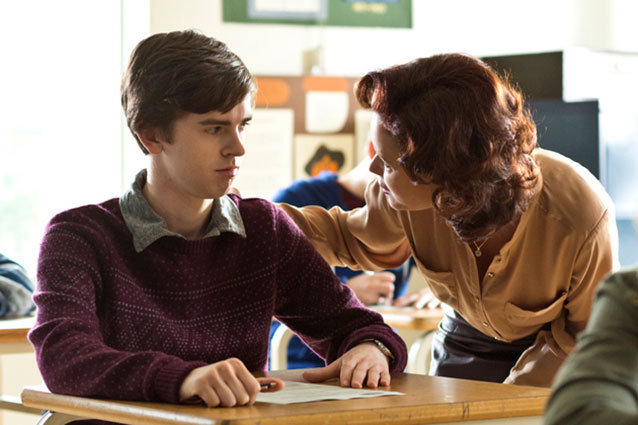
The growing mental break within Norman Bates (Freddie Highmore), where a mixing of sexual desire and repression are blending with murder and emotional confusion are growing, which leads one to ask What's Wrong With Norman, our third episode of Bates Motel. What's Wrong With Norman mixes the inner conflict within our main character with the odder goings-on in his new home of White Pine Bay.
Norman's half-brother Dylan (Max Thieriot) has found himself with a new job: guarding the pot fields discovered by Norman and Emma (Olivia Cooke), where a shed nearby might hold the key to a white slavery ring. Norman, however, along with his mother Norma (Vera Farmiga) have problems of their own. First, Norman is having erotic fixations based on the bondage drawings in that journal he found, fixations that cause him to black out in class. Second, after the obsessed Sheriff Romero (Nestor Carbonell) follows through on his threat to get a search warrant to search the Bates Motel and house, Norman confesses that he kept Keith Summer's tool belt, as a souvenir he says. Finally, when Dylan returns to the house, he is shocked and/or confused that Norman tells him he has no memory of ever trying to kill his older half-brother.
While Norma uses her feminine wiles with Deputy Shelby (Max Vogel) to get information on that belt (which Shelby found but has not turned in to the department), Norman becomes obsessed with retrieving it (he also isn't too pleased with the idea of Shelby and Mother Bates, suggesting that they might become beholden to Shelby but the subtext suggesting something more insidious). Eventually, Norman begins to crack completely: he imagines a conversation with his mother, where she now agrees with him that the belt must be retrieved. Norman breaks into Shelby's home, where he makes a horrifying discovery: the Deputy is a sex slaver, holding that Chinese girl prisoner in his basement, and worse, at the end, Deputy Shelby has just arrived home...

Now with What's Wrong With Norman, we get the beginnings of the dark side of Norman and Norma Bates, two of the most twisting characters on television. I say 'twisting' rather than 'twisted' because in Bates Motel, they are both slowly and surely evolving into horrifying creatures.
Mrs. Bates is someone who loves her son but who is also committed to control him, either unaware or uninterested in what it does to him. She is completely unsympathetic when he tearfully tells her he kept the belt, but not above attempting to seduce the deputy (which does result in some success) to protect them both. Even stranger is Mrs. Bates' inability to see that someone holding on to a souvenir of a killing is a hallmark of serial killers.
The strange undercurrent of an unhealthy relationship between is openly stated by Dylan, the most rational of the three (even if he is no pillar of the community). In the opening scene, he addresses his mother and half-brother who are having breakfast together as "Mr. and Mrs. Bates". It is technically correct but the underlying and unspoken suggestion that they are more like a married couple than a mother/son is there, obvious to Dylan but almost oblivious to both Norma and her namesake.
If anything, What's Wrong With Norman is Highmore's showcase where he mixes a certain innocence and naivete to something darker, uglier, even evil. Highmore's Norman knows there is something wrong within him (at one point he plainly asks himself, "What's wrong with me?"), and now the sexual desires all seventeen-year-old boys have are becoming confused in his mind with a strong sense of impropriety. In the opening, he imagines his teacher being bound like the drawings that he has become both fascinated and appalled by, and in a 'blink-and-you-miss-it' you see that Mother Bates is quickly seen as also blending into his erotic fantasies. This confusion about his desires causes his fainting spell.
The other aspects, such as casually insisting that he never attacked Dylan or his 'dream' of seeing Norma come to his room to talk about the Shelby situation is laying the groundwork for the darkness that is slowly taking over Norman. Highmore continues to make this shy, soft-spoken individual both a growing menace to himself and others and yet almost sympathetic, someone who is slowly being taken over by impulses he does not understand and cannot control.
Farmiga for her part is still oddly compelling as Mother Bates: caring mother, shrewd and manipulative when she needs to. Alluring yet dangerous when needed, determined to meet her goals but also to control things (and people), her performance makes for compelling viewing. We watch as this woman continues to attempt to fix things for her favored son while also attempting to keep him within her grasps. Farmiga does not make Norma evil, but she is clearly a woman who doesn't shrink from doing what she thinks needs doing to protect herself and her interests.

Oddly, it is Thieriot who is almost lost in the dynamics of the two other main characters. I don't hold Thieriot in particular to blame: his character still strikes me as the clichéd 'bad boy', and just exactly what is the interest of seeing two people sit around the forest on what looks like a camping trip (even if it is to watch a marijuana field)? I hope that Dylan will not become a distraction in Bates Motel (it would be deadly to focus the stories on him rather than on the actual Bateses). However, the exchange between Norman and Dylan where the former sincerely denies ever coming close to trying to kill the latter is a fascinating exchange.
It does come with the established idea from Psycho and its sequels that Norman suffers from black-outs. By introducing this element (whether Norman genuinely believes he didn't come at Dylan with a meat cleaver or whether he is attempting to cover it up), I believe Bates Motel is laying the groundwork for how Norman Bates will turn out to be the madman he ends up becoming.
Another standout is Cooke, who with Emma makes her the voice of sanity in a town clearly bonkers. The 'oddity' of her illness is all but forgotten because now we can see that her mind is the most powerful weapon, and Cooke is an excellent actress in her efforts to make us see beyond Emma's cystic fibrosis and into her genuine heart and mind. In fact, she blows the other secondary characters out of the way (the gruff Romero, the duped deputy, and especially the hesitant but attractive Bradley, who comes across as pretty but flat...and with simply hideous pants that she should burn. Seriously, those are some UGLY pants).
If anything in What's Wrong With Norman, the Jeff Wadlow script does two or three things. First, it continues building shocking twists in the story (who could imagine that the slightly dippy deputy was part of a white slavery ring?). Two, it starts building the characters along with the growing nature of the corruption of souls (theirs and the town's). Three, it still has those Twin Peaks elements (weird town, weirder denizens). It's a good thing I liked Twin Peaks (at least for a season and a half, until it got too silly even for me).
Bates Motel is becoming a strong series, with excellent and gripping performances and a storyline that is both true to the original source material and its own creation.

Master Bates is clearly more than a troubled young man: he is a man coming into a slow and deadly break from reality.
9/10
Next Episode: Trust Me
Friday, April 5, 2013
Bates Motel: Nice Town You Picked, Norma...Review
BATES MOTEL: NICE TOWN
YOU PICKED, NORMA...
The Bates Will Fit Right In...
Nice Town You Picked, Norma has some pluses and minuses. It builds up the mysterious our fair village of White Pine Bay has for the Bateses, but it also brings in new characters that are a little clichéd, particularly the newest addition to the Bates family, one Dylan Massett (Max Thieriot).
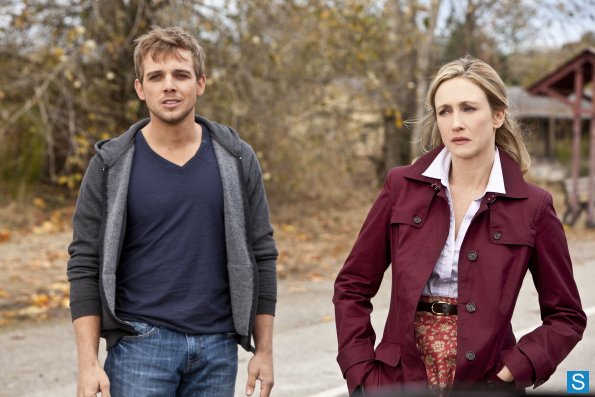
Dylan is Norma's son by a previous relationship and thus, Norman's half-brother. He's also your traditional 'bad boy' (five o'clock shadow, serious attitude). He doesn't care for Norma (whom he identifies as "The Whore" on his cell phone) and is disgusted by how close she and Norman are, convinced she is a control freak domineering his half-brother. Dylan also doesn't shrink from being involved in criminal activities, which in White Pine Bay are abundant.
The criminal underbelly beneath the small-town veneer is known to nearly everyone, including Deputy Shelby (Mike Vogel). Shelby, who is attracted to Norma, basically tells her that crime keeps the town going. If only he knew that the man he and Sheriff Romero (Nestor Carbonell) are searching for is the same one his newest gal-pal bumped off...
Norman, meanwhile, finds himself in a series of terrible situations. His erotic fascination with the mysterious journal he found comes in conflict with both his growing attraction to Bradley Martin (Nicola Peltz), whose father was set afire, and the attraction felt for him by Emma (Olivia Cooke), the girl with cystic fibrosis. Discovering his journal, Emma comes to a shocking conclusion: it is the journal of a Chinese girl who is kept as a sex slave. Emma believes she can find the shack where according to the journal a girl was buried.
As Norman and Emma search for the shack, they find a huge marijuana field. They manage to flee the men guarding it, but they also find the shack. That, however, is tame to what Norma encounters at the end...as she drives through town, there is a literal man on fire, the sight of a burning flesh drawing the town's attention.

Now the struggle between Dylan's overt hostility to Norma and Norman's passionate devotion to his mother will be driving so much of series. In one particularly brutal and shocking scene the brothers fight. Being older and stronger than the thin Norman, Dylan is quickly able to take him down, warning him not to fight him or he will kill him. Not dissuaded, Norman picks up a meat cleaver and attempts to strike Dylan down. Dylan, however, probably saw Norman's reflection and dodged him, then knocked him down.
This scene is vitally important because it shows so much about their relationship and behavior. Dylan hates his mother, while Norman defends her with passion. One is the child conceived by a teenager who dumped the father quickly, while the other is the highly-favored son who has an intensely close relationship with the mother. Dylan and Norman, more importantly, both have murderous tendencies: one motivated by hate, the other by love.
We also see that Norma and Norman have a strong but strange relationship. Norma is dressing in front of her son, which embarrasses him but brings a frustration in the mother only in what she sees as his prudishness. "Does this top look like I'm trying too hard?" she asks. "That depends on what you're trying," he replies.
The performances, including new lead Thieriot, are all strong. Thieriot may be the 'bad boy', the one who is always up to trouble, but he also is the conscious of the family he finds himself in. He sees that the relationship between his sibling and parent is not normal, far too attached and with "The Whore" domineering and controlling his impressionable half-brother.
Vera Farmiga continues to make Norma a fascinating character, one who is not evil but not good either. Her interrogation of Emma over her illness shows a mixture of caring, curiosity, and suspicion. Even someone who is seen as not remotely a threat to the Norma/Norman relationship, a girl who does not have a long lifespan without a lung transplant, is met by Norma with barely concealed hostility.
Cooke is also becoming a strong character, both with her intelligence and her humanity. She is open about her attraction to Norman, but she is also someone who appears to not be corrupted by all the evil overtaking White Pine Bay.
Highmore plays the growing insecurity and confusion of the young man. The excitement of discovering such things as bondage along with his curiosity over both Bradley and Emma is coming into conflict with his loyalty to Norma, loyalty that confuses the love one has for one's mother into one that submits to her will, drowning himself into the idea that there is them, and then there is the rest of the world, where no one, not even her other son, can enter.
Bates Motel, however, continues to keep the Twin Peaks style going: odd characters, a small town filled with secrets beneath the pleasant veneer, the constant intrusion of dark desires. What can one say about a town where white slavery, illegal narcotics, and murder are what goes on BEFORE the main characters kill someone?
Also, like another David Lynch creation, Blue Velvet, Bobby Vinton's music is used to make someone oddly creepy. The gentle confrontation between Norma and Dylan is underscored by This Guy's In Love With You, a most curious song selection for him, even if it was from the previous owner.
Bates Motel is growing to a strong show serving up murder and mayhem, building up the Norman Bates story while expanding his world to where he's pretty much average in a town filled with killing, a slave ring, and pot growing: all the things that make a good home.
 |
| My Mother, My Son, Oh My... |
8/10
Next Episode: What's Wrong With Norman
Thursday, April 4, 2013
Roger Ebert: A Personal Remembrance
| 1942-2013 |
I always considered Roger Ebert the Dean of Film Criticism, the one whom all of us who write about film, either in print or online, looked to as a model of what a great film critic should be. Again and again I am loath to call myself a film critic; the term implies that I seek out things to dislike, that I take a negative view of film in general. I believe that film reviewer (giving my views of the film in question and what worked and/or didn't for me as a viewer) is closer to the truth, and I think it applied to Ebert. Neither of us would say we go into a movie to hate it. Rather, we wish to find something wonderful, or entertaining, or intelligent, and just wanted to tell the world about it.
More than anything, Roger Ebert loved film. He loved all kinds of films: foreign-language, silent, documentaries, as well as popular fare. He was as enthusiastic about The Hangover as he was about Vertigo. Ebert popularized those films that might have been seen as a bit too avant-garde, too artistic, too out-of-the-mainstream for the general public. He (like myself) believe that in terms of movies, we should not be afraid of the dark.
In short, he followed the maxim that there are two kinds of film: good films and bad films. His enthusiasm or condemnation of a film was expressed clearly and directly, all things we who write about film attempt to do. He put great intelligence to his reviews, stating his case. Sometimes his case didn't hold, but however that famous thumb went, you knew this is how Roger Ebert felt, without subterfuge or arrogance.
We who write film criticism all owe a debt to Roger Ebert. We stand in his shadow. His convictions on a film (whether to love or loath it), was spoken straight from the heart and without fear of whether it met with approval. Some of my fellow film critics sadly are what are dubbed 'quote whores': people who for a good meal or trinkets might give praise to bad films, whose comments will then be used to promote the film as good. Ebert was not like that. When he loved something he loved it, when he hated it he did not mince words. How he felt is how he put it on the page or spoke it on the screen. He was unbought and unbossed.
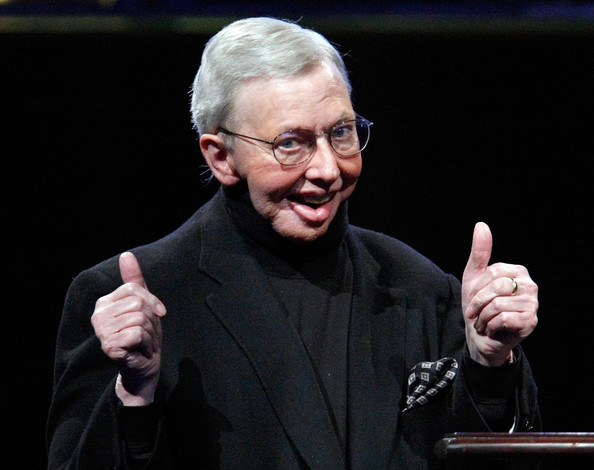
When he became ill with cancer, he did not hide from it or its effects. Instead, Ebert kept going, determined not to be silent. The voice was gone, but the fingers could still fly across the keyboard, the mind was still sharp, and the eyes could still see the beauty and the garbage that is thrown at us. Ebert refused to let cancer slow him down, let alone stop him. He was limited in what he could do but he kept at it. That is what I call courage: facing serious illness, acknowledging it, and continuing to live despite it.
I did not always agree with Ebert in terms of films and politics. Sometimes I thought him mad. However, few of us who write on film, argue about films, champion certain movies or condemn others, would be here without the powerful influence of Roger Ebert. He was THE film critic that most of us grew up with and the one we would attempt to immolate in some way or other. His love for movies and his desire to bring a wider perspective to audiences to think of movies not just as entertainment or even art but as something to bring pleasure to life itself will be one of his great legacies. He used his voice to speak his mind about movies, and now thanks to him, all of us who write about film are proud to follow his example.
We Film Critics/Reviewers owe so much to Roger Ebert. He was our guide, our unacknowledged mentor, our role model, and for a brief time and in the thinnest of ways, he was a colleague. It's a safe bet most of us Film Critics/Reviewers would not be here without him.
Thank you, Mr. Ebert.
My condolences to his wife Chaz and his family.
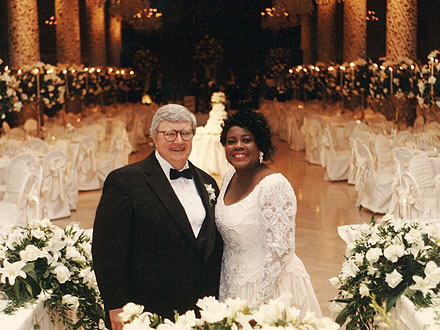
The Balcony will now be a little lonelier...
IN MEMORIAM
Olympus Has Fallen: A Review (Review #521)
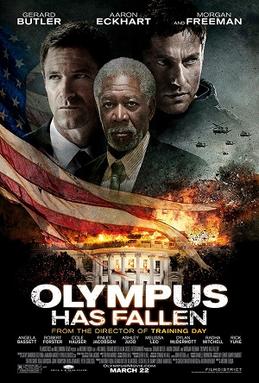
In the vein of Hollywood groupthink, we have yet another example of two movies with a similar plot being released close to each other. We've had two "meteor is about to destroy Earth so we have to send astronauts to stop it" movies released near each other (Deep Impact and Armageddon). We've had two "volcanoes come out in Los Angeles" movies (Dante's Peak and the appropriately named Volcano). Last year or two, we had two "we're friends but are going to have casual sex without romantic entanglements but end up falling in love" movies (No Strings Attached and Friends With Benefits). We also had two Snow White-based films: the cutesy Mirror Mirror) and the gritty Snow White and the Huntsman.
And WHO says Hollywood is out of ideas?
Now we have the "White House in under siege and only one man can stop it' movies. While we eagerly await White House Down, let us turn to Olympus Has Fallen, which beat it by at least three months. As a film, Olympus Has Fallen is goofy but entertaining, a trifle despite the grand violence we're treated to. It also doesn't stray far from a formula: the wounded warrior in need of redemption finds his cause, so I can't say it was terrible. However, I don't think it is memorable either.
Secret Service Agent and former Army Ranger Mike Banning (Gerard Butler) is a haunted man. Once close to his boss, President Benjamin Asher (Aaron Eckhart) and the First Son Connor (Finley Jacobsen), Banning is still mourning his failure to protect the First Family. During a heavy snowstorm en route from Camp David to the White House, the motorcade suffered a car accident on a bridge. Banning was able to rescue the President, but a badly injured First Lady (Ashley Judd) plunged into the river when the car fell. Eighteen months later, the widowed President carries on, but Banning has banished himself to the Treasury Department.
His fellow Secret Service Agent Dave Forbes (Dylan McDermott) has retired from government work, but now returns to the White House as part of a security detail for the South Korean Prime Minister. However, there is treachery afoot: an airplane is headed towards the White House, and soon, chaos erupts in the streets of the capital. A massive North Korean fifth column has burst into the White House, slaughtering agents and Army left right center. Through the carnage, only Agent Banning is able to shoot back and enter the besieged Presidential residence. The President, Vice President Charlie Rodriguez (Phil Austin), Defense Secretary Ruth McMillan (Melissa Leo), and others are taken prisoner inside the protective bunker when the South Korean entourage (except for the poor Prime Minister) turns out to be North Korean agents...including Forbes. The ringmaster...leader, of this nefarious takeover is Kang (Rick Yune), a rogue terrorist who wants the U.S. troops out of Korea (partly for personal reasons as his family was somehow a victim of the Demilitarized Zone).
Now with Banning inside the White House unbeknown to Kang and Forbes, he is the only person who can return the President to safety. Meanwhile, Secret Service head Lynn Jacobs (Angela Bassett) and House Speaker Trumbull (Morgan Freeman) must help coordinate Banning's actions while attempting to stop Kang from acquiring a code from three sources (all of them his hostages) that will bring a nuclear holocaust on America (his true aim). Banning must also rescue not just the hostages, but Connor, who is somewhere hidden in the White House.

Honestly, I don't know why so many people appear willing and eager to trash Olympus Has Fallen. This is the type of film one watches for lots of violence, lots of action, and little in terms of logic. Take for example the confrontation between Banning and Forbes. We all know Forbes is the bad guy, and we also know that when he 'finds' Banning eventually the good guy will be able to figure out (usually through a slip of the tongue) that Forbes is with the enemy. However, as Forbes is dying (after all, we know he's not going to get out alive), he suddenly reverses course and gives Kang false information. This sudden turnaround in his nature is almost unbelievable (why would someone who joins the North Koreans for the vaguest of reasons then suddenly turn patriotic at the end).
Oh but in a film like Olympus Has Fallen, we pretty much have to throw logic out the window. Yes, I'll say that Creighton Rothenberger and Katrin Benedikt's screenplay has some pretty set pieces (the long warrior fighting an army when the regular army and Secret Service detail proves shockingly inept, said lone warrior finding in this mission a sense of redemption for failing the first time, even the terrorist has a wounded past as some sort of motivation), but in fairness, Olympus Has Fallen takes all this very seriously.
Bless the cast for playing all this seriously. Truth be told, I have great admiration for Aaron Eckhart, an actor who just ought to work more. Given how good he was in Battle: L.A. (a film I enjoyed), I think Eckhart could easily have switched roles with Butler and played the lone warrior convincingly. Whether anyone would have bought Butler as the Commander-in-Chief is highly doubtful (especially if his Scottish brogue slipped out), but on the whole, Butler does his best Bruce Willis in Die Hard impression (right down to the quips).
In smaller roles, both Bassett and Freeman (obviously demoted from President to mere Speaker of the House) did solid work, which they almost always do even when doing Bartha roles as these clearly are. They play things seriously, and for that I cannot fault them. Same goes for McDermott, although I sensed he knew this was all a waste of his time. I almost feel for Yune, an actor who always plays the bad guy. Would be nice to see him try something new...
Antoine Fuqua manages to keep things going briskly, never pausing long for things to get bogged down. It's a credit to him that the more ludicrous the situations or actions (such as Banning being able to not only escape a hail of bullets when the terrorists are shooting at him through a wall but him being able to shoot THEM down through said wall while firing without looking) it all manages to appear almost rational.
One thing that can be said for Olympus Has Fallen: we have now officially left a 9/11 mindset. The audience either doesn't connect or think about just how horrifying the images we get are: you have a plane heading towards the White House, you have people in Washington, D.C. running for their lives, you even have the Washington Monument collapsing onto itself and tourists dumb enough to be there in the middle of the chaos. Maybe I was the only one still trepidatious about such sights, but no one in front of or behind the camera, or the audience for that matter, took any of that in mind. It was just a good action scene, not something reminiscent of a horrifying event that still shapes the world today.
Another aspect is in how Banning doesn't shrink from torturing two North Koreans he holds prisoner for information. Whoever said torture, real torture (such as stabbing someone in the leg and cutting his throat) would not give results?
However, the flaws in Olympus Has Fallen are pretty evident: the effects are television-level, and at one point the headline in a faux-report is "Terrorist Attack Whitehouse", failing to note two grammatical errors. Then again, it IS MSNBC...
As I see it, Olympus Has Fallen is not to be taken seriously (which the movie certainly does). It has a little too much torture and gore for my tastes, and certain subplots that seem not only clichéd but a waste of time (Banning's nurse wife tending to the wounded...another 9/11 flashback...and the Connor story: once he's rescued we can get on to the main action of taking down North Koreans and kicking some ass). However, for what it is, Olympus Has Fallen certainly has some entertainment value, nothing more.

We all know this is fiction: Olympus Has Fallen as a whole and the idea that Lawrence O'Donnell is a real journalist. Therefore, while Olympus Has Fallen isn't the best film around, it has enough to make it worth a couple of hours of free time if nothing else is on. Don't know if I'd say the same about The Last Word...
DECISION: C+
And WHO says Hollywood is out of ideas?
Now we have the "White House in under siege and only one man can stop it' movies. While we eagerly await White House Down, let us turn to Olympus Has Fallen, which beat it by at least three months. As a film, Olympus Has Fallen is goofy but entertaining, a trifle despite the grand violence we're treated to. It also doesn't stray far from a formula: the wounded warrior in need of redemption finds his cause, so I can't say it was terrible. However, I don't think it is memorable either.
Secret Service Agent and former Army Ranger Mike Banning (Gerard Butler) is a haunted man. Once close to his boss, President Benjamin Asher (Aaron Eckhart) and the First Son Connor (Finley Jacobsen), Banning is still mourning his failure to protect the First Family. During a heavy snowstorm en route from Camp David to the White House, the motorcade suffered a car accident on a bridge. Banning was able to rescue the President, but a badly injured First Lady (Ashley Judd) plunged into the river when the car fell. Eighteen months later, the widowed President carries on, but Banning has banished himself to the Treasury Department.
His fellow Secret Service Agent Dave Forbes (Dylan McDermott) has retired from government work, but now returns to the White House as part of a security detail for the South Korean Prime Minister. However, there is treachery afoot: an airplane is headed towards the White House, and soon, chaos erupts in the streets of the capital. A massive North Korean fifth column has burst into the White House, slaughtering agents and Army left right center. Through the carnage, only Agent Banning is able to shoot back and enter the besieged Presidential residence. The President, Vice President Charlie Rodriguez (Phil Austin), Defense Secretary Ruth McMillan (Melissa Leo), and others are taken prisoner inside the protective bunker when the South Korean entourage (except for the poor Prime Minister) turns out to be North Korean agents...including Forbes. The ringmaster...leader, of this nefarious takeover is Kang (Rick Yune), a rogue terrorist who wants the U.S. troops out of Korea (partly for personal reasons as his family was somehow a victim of the Demilitarized Zone).
Now with Banning inside the White House unbeknown to Kang and Forbes, he is the only person who can return the President to safety. Meanwhile, Secret Service head Lynn Jacobs (Angela Bassett) and House Speaker Trumbull (Morgan Freeman) must help coordinate Banning's actions while attempting to stop Kang from acquiring a code from three sources (all of them his hostages) that will bring a nuclear holocaust on America (his true aim). Banning must also rescue not just the hostages, but Connor, who is somewhere hidden in the White House.
Honestly, I don't know why so many people appear willing and eager to trash Olympus Has Fallen. This is the type of film one watches for lots of violence, lots of action, and little in terms of logic. Take for example the confrontation between Banning and Forbes. We all know Forbes is the bad guy, and we also know that when he 'finds' Banning eventually the good guy will be able to figure out (usually through a slip of the tongue) that Forbes is with the enemy. However, as Forbes is dying (after all, we know he's not going to get out alive), he suddenly reverses course and gives Kang false information. This sudden turnaround in his nature is almost unbelievable (why would someone who joins the North Koreans for the vaguest of reasons then suddenly turn patriotic at the end).
Oh but in a film like Olympus Has Fallen, we pretty much have to throw logic out the window. Yes, I'll say that Creighton Rothenberger and Katrin Benedikt's screenplay has some pretty set pieces (the long warrior fighting an army when the regular army and Secret Service detail proves shockingly inept, said lone warrior finding in this mission a sense of redemption for failing the first time, even the terrorist has a wounded past as some sort of motivation), but in fairness, Olympus Has Fallen takes all this very seriously.
Bless the cast for playing all this seriously. Truth be told, I have great admiration for Aaron Eckhart, an actor who just ought to work more. Given how good he was in Battle: L.A. (a film I enjoyed), I think Eckhart could easily have switched roles with Butler and played the lone warrior convincingly. Whether anyone would have bought Butler as the Commander-in-Chief is highly doubtful (especially if his Scottish brogue slipped out), but on the whole, Butler does his best Bruce Willis in Die Hard impression (right down to the quips).
In smaller roles, both Bassett and Freeman (obviously demoted from President to mere Speaker of the House) did solid work, which they almost always do even when doing Bartha roles as these clearly are. They play things seriously, and for that I cannot fault them. Same goes for McDermott, although I sensed he knew this was all a waste of his time. I almost feel for Yune, an actor who always plays the bad guy. Would be nice to see him try something new...
Antoine Fuqua manages to keep things going briskly, never pausing long for things to get bogged down. It's a credit to him that the more ludicrous the situations or actions (such as Banning being able to not only escape a hail of bullets when the terrorists are shooting at him through a wall but him being able to shoot THEM down through said wall while firing without looking) it all manages to appear almost rational.
One thing that can be said for Olympus Has Fallen: we have now officially left a 9/11 mindset. The audience either doesn't connect or think about just how horrifying the images we get are: you have a plane heading towards the White House, you have people in Washington, D.C. running for their lives, you even have the Washington Monument collapsing onto itself and tourists dumb enough to be there in the middle of the chaos. Maybe I was the only one still trepidatious about such sights, but no one in front of or behind the camera, or the audience for that matter, took any of that in mind. It was just a good action scene, not something reminiscent of a horrifying event that still shapes the world today.
Another aspect is in how Banning doesn't shrink from torturing two North Koreans he holds prisoner for information. Whoever said torture, real torture (such as stabbing someone in the leg and cutting his throat) would not give results?
However, the flaws in Olympus Has Fallen are pretty evident: the effects are television-level, and at one point the headline in a faux-report is "Terrorist Attack Whitehouse", failing to note two grammatical errors. Then again, it IS MSNBC...
As I see it, Olympus Has Fallen is not to be taken seriously (which the movie certainly does). It has a little too much torture and gore for my tastes, and certain subplots that seem not only clichéd but a waste of time (Banning's nurse wife tending to the wounded...another 9/11 flashback...and the Connor story: once he's rescued we can get on to the main action of taking down North Koreans and kicking some ass). However, for what it is, Olympus Has Fallen certainly has some entertainment value, nothing more.
We all know this is fiction: Olympus Has Fallen as a whole and the idea that Lawrence O'Donnell is a real journalist. Therefore, while Olympus Has Fallen isn't the best film around, it has enough to make it worth a couple of hours of free time if nothing else is on. Don't know if I'd say the same about The Last Word...
DECISION: C+
Wednesday, April 3, 2013
I'd Like to Thank the Academy, But I Can't Part 2

Having looked over the Bottom Nine Worst Oscar Moments, it is now time to look over the Top (for lack of a better word) Nine Worst Oscar Moments. The speeches and production numbers get worse, the egos get larger, and the audience gets more and more moments of laughter, usually of the unintended variety.
 |
| Num. 9 85th Academy Awards |
09.) The Boob Tube (2012)
Yes, we've managed to find a moment from the most recent Academy Awards to rank as a low point in the entire history of the Oscars. Seth MacFarlane is hailed as a comedic genius. Now granted I have seen one or two Family Guy episodes and stubbornly refused to watch Ted, so I cannot vouch for that. Then again, my idea of 'comedic genius' is a Jack Benny, Lucille Ball, George Carlin, Carol Burnett, Richard Pryor, all of Monty Python, even perhaps The Kids in the Hall.
In any case in his excruciatingly long opening number (around fifteen minutes), we were treated to such relevant matters as the talented Charlize Theron doing a little dance with the talentless Channing Tatum, and two or three songs from the crooner MacFarlane sees himself as. The first musical number, an ode to Mr. Skin called We Saw Your Boobs, was I imagine meant to mock the perception that he's a low-brow comic. However, it came off as just low. I always marvel how a forty-year-old man could be called a genius for having an obsession most teenage boys leave after high school. I wasn't bothered by his takedown of Kate Winslet, but when he takes cheap shots at Scarlett Johanssen's nude photo hacking, then it shows him to be tactless at best.
 |
| Num. 8 71st Academy Awards |
08.) Debbie Does D-Day (1999)
God Bless Debbie Allen. She's a talented dancer/actress/choreographer, and no matter how often her dance numbers for the Academy Awards are derided, she keeps giving it her all. It isn't her fault that she is given a difficult task: attempting to create dance numbers to music that does not call for it.
However, in retrospect attempting to build a tap dance routine to Saving Private Ryan might not have been the best decision. Here is a violent, gritty, graphic, overwhelming recreation of the Allied D-Day Invasion...with Savion Glover tapping his way through the accompanying music. The two never meshed, and it just came off looking bizarre.
 |
| Num. 7 74st Academy Awards |
07.) Cops and Roberts (2001)
Denzel Washington is like his hero Sidney Poitier in so many ways. Like Poitier, Washington is one of a handful of black actors who can open a film. Even when playing a loathsome character like in Training Day, Washington is still held as a dignified actor and person...exactly like Poitier. Finally, both won Oscars the same night. Poitier, the first black man to win a Best Actor Oscar for Lilies of the Field, was awarded an Honorary Oscar. That same night, Washington was the second black man to win a Best Actor Oscar for Training Day. Coming on the heels of Halle Berry being the first black woman to win Best Actress for Monster's Ball (and basically declaring the end of racism at the Academy Awards), it was a good night for African-American performers.
However, while Washington gave a dignified speech (saluting Poitier, acknowledging that win or lose, he was going to celebrate with his wife and kids), it was the presenter who looked foolish and smeared his moment. Julia Roberts' behavior was one for the ages, giving Roberto Benigni a run for his money. First, she took a cheap shot at the conductor Bill Conti who had almost played her off the year prior when she won for Erin Brokovich (although she mistakenly called him "Tom Conti", mixing the Oscar-nominated composer with the Oscar-nominated actor). Then when she opened the envelope, she declared, "I love my life...Denzel Washington", thus begging the question as to whether she would have hated her life say if, Russell Crowe had won. Finally, after giving his speech, Roberts leapt onto Washington and clung to him like a deranged groupie. Washington gamely carried HER off the stage (he must be a strong man), but her overenthusiasm was embarrassing to both of them.
Almost makes me wish Tom Wilkinson had won for In the Bedroom...trying to see her jump on him would have made for amusing television.
 |
| Num. 6 15th Academy Awards |
06.) The War Was Shorter (1943)
Bad Oscar Speeches Part IV
This is the most legendary Oscar speech in history...because it captures the worst tendencies of stars: to see this occasion as a turning point in film history. Greer Garson had won the Best Actress Oscar for Mrs. Miniver, and I'm sure when she spoke, she spoke from the heart. Unfortunately for the audience, her heart really would go on, and on, and on, and on...
Reports vary as to the actual length of Miss Garson's speech, ranging from five to eight minutes long. Even if it was a mere five minutes, that's an extremely long time to thank any group of people for giving one a plaster figure of a naked man (gold being a rare material during World War II). Let us recall that her speech was longer than the entire performances of Beatrice Straight, Judi Dench, and Anne Hathaway, who each won Supporting Actress Oscars for Network, Shakespeare in Love, and Les Miserables respectively. Some people have been nominated for performances shorter than Garson's pronouncements. Think on that: there are film performances that have won Oscars that are SHORTER than one almost-forgotten actress' whole speech.
Ironically enough, Greer Garson's speech began with, "I'm practically unprepared."
 |
| Num. 5 48th Academy Awards |
05.) She Is Big.
It's The Pictures That Got Sound. (1976)
Mary Pickford is not remembered today by the general public, which is a terrible disservice to one of the true pioneers of cinema. Mary Pickford, the first America's Sweetheart (her Canadian birth notwithstanding), was the first real movie star and the only other actor to rival Charlie Chaplin in popularity. The Girl With the Golden Curls wasn't just a great silent film actress, but a strong businesswoman. She got the best of Adolph Zukor, head of Paramount, and with Chaplin, director D.W. Griffith, and Douglas Fairbanks, created United Artists, a company to distribute their films and allow greater artistic control. For all that she had done for the industry, an Honorary Oscar was the very least the Academy she also helped found could do.
However, what they did not do was give her dignity in her declining years. Instead, in their efforts to be kind they treated audiences to a rather ghoulish spectacle, inadvertently humiliating one of the great stars of early cinema.
Pickford was too weak to attend the ceremony. Rather than present her with the Oscar privately or at least pre-record the event, the Academy decided that it would be best to take us on a trip to her home, dubbed Pickfair (after Pickford and her second husband, Douglas Fairbanks). Two minutes of us driving up the driveway and taking a look 'round her house lends a certain Sunset Boulevard quality to this Grand Tour. As we go up the stairs and past her dining room and salon, where we are shown a portrait of herself in much younger days, one almost expects to find a dead monkey lying around.
At long last, we get a view of America's Sweetheart, and it's a ghastly one. Looking far older than her 84 years, she looks in turns frail and out-of-it, almost drunk. I'm not even sure she knew who this Walter Mirisch was who was giving her this Oscar. Even worse, Mirisch in a rare lapse in judgment tried to have some small-talk with the real-life Norma Desmond (minus the crazy), a woman long forgotten by the Hollywood dragging her into the spotlight which had long passed her and whom audiences probably, despite Gene Kelly's intonations, did not remember 'that face'.
Laura Linney, narrator of Mary Pickford and one of my favorite actresses, summed it up best when describing Pickford's Honorary Oscar presentation: "Her appearance horrified viewers."
At least in this instance the Academy appears to have learned from its mistake. When the never-nominated Myrna Loy was awarded an Honorary Oscar in 1991, she was alone, with one camera in her apartment, and gave a two-sentence speech, "You've made me very happy. Thank you very much." The entire presentation for Loy lasted under two minutes (minus clip film), versus Pickford's horrifying five minute spectacle.
 |
| Num. 4 50th Academy Awards |
04.) Zion Too Much (1978)
Bad Oscar Speeches Part V
Vanessa Redgrave is one of the great actresses. She's also someone I simply loath. I make no secret that I admire the actress but detest the woman. However, even by those who agree with her (the entire MSNBC organization), her Best Supporting Actress Oscar speech was less speaking truth to power and more 'I'm a genius and you're a bigot if you disagree with me'.
Mad Van, who put the Red in Redgrave, decided we all needed her great insight and wisdom on the thorny and sad issue of the Arab/Israeli crisis. Miss Redgrave had produced a film (I won't call it a documentary...unless I can call Triumph of the Will a documentary) called The Palestinian. A love letter to the Palestinian Liberation Organization (which advocated the destruction of Israel, which apparently did not bother Redgrave), it sparked the ire of certain members of the Jewish community.
Oh but those Jews who supported such rubbish as Israel did not count on the genius of one self-important actress who felt people voted for her, not because they thought she gave the best performance, but because they were sending a message! It was that phrase, 'Zionist hoodlums', which got the normally liberal crowd booing her. It was the ultimate mark of deranged ego, to imagine that she and only she could light the way to piece...I mean, Peace with Israel (which to her meant all Israelis must go drown in the sea and let the Arab Palestinians do your country better).
Paddy Chayefsky, no conservative by any stretch, got his own when he appeared a short time later. I think Chayefsky, proudly Jewish, took Redgrave's remarks as a smear on all Jews, and the kid from the Bronx wasn't about to kow-tow to this snooty British bitch. The writer of Network gave the best comeback to our Commie Countess.
"Before I get on to the writing awards, there's a little matter I'd like to tidy up--at least if I expect to live with myself tomorrow morning. I would like to say, personal opinion, of course, that I'm sick and tired of people exploiting the Academy Awards for the propagation of their own personal propaganda. I would like to suggest to Miss Redgrave that her winning an Academy Award is not a pivotal moment in history, does not require a proclamation and a simple 'thank you' would have sufficed."
SMACKDOWN!
 |
| Num. 3 75th Academy Awards |
03.) The Moore The Angrier (2003)
Bad Oscar Speeches Part VI
Oh, if Chayefsky had been around to listen to this! While I believe Chayefsky would have opposed the Iraq Intervention, I think he would have been appalled at Michael Moore's grandstanding, but then again, it is Michael Moore, someone who plays fast and loose with facts and who makes no bones about how his films are less documentaries in the traditional sense and more op-ed pieces.
Let's leave aside for a moment that he had just been given an Oscar for Bowling for Columbine, which featured Moore browbeating a clearly ill Charlton Heston. The increasingly partisan Hollywood audience gave him a standing ovation for his propaganda film (which I understand, blames in part, George W. Bush for the Columbine High School massacre). One he got started on his 'fictitious' laundry list, even some in the audience couldn't stand it. It takes a lot to get a liberal crowd booing you when they agree with you most of the time. I'm sure the stagehands and crew working the Oscars (who can't afford to be liberals) were in on the booing, but the footage clearly shows some in the audience booing as well. Besides, if he was always right on everything, why then did ANYONE boo?
As our rotund lefty continues hijacking the Academy Awards for his own political bromides, he ends with one of the more perplexing comments in acceptance speeches. "And anytime you've got the Pope and the Dixie Chicks against you, you're time is up." Now, what the connection between the Holy Father and a defunct pseudo-country group is or why both being in agreement on something means the end of a government has been left unexplained. Obviously the 'time is up' comment was about the effort to drown him out with music, but note that in his speech he never made comment about those who worked with or for him, or those who were murdered in Columbine. Curious that.
Moore's speech was not a heartfelt commentary on the immorality of the Iraq Intervention. It was a self-serving, egocentric exercise as to his own perceived genius. However, in fairness, it might be the only time he exercised, period, so that's a plus.
 |
| Num. 2 59th Academy Awards |
02.) Fugue For Tin-Ears (1987)
In an age of Youtube, nothing remains hidden...except for this: Fugue For Tinhorns from the musical Guys and Dolls as performed by Pat Morita, Dom DeLuise, and Telly Savalas. Let's see: to sing a great but complicated song where three voices singing different parts while blending them together seamlessly you get Mr. Miyagi, Kojak, and Caesar from History of the World Part I.
Having three people definitely NOT known for their singing performing a complex number is bad enough. Having three people definitely NOT known for their singing performing a complex number as the OPENING to the show is disastrous. Just attempting to imagine any of them alone attempting to carry a tune is rather bad, but attempting to hear all three of them is just horrifying.
As I said, while it was certainly broadcast on television, no footage (either film or photo) of this Trio from Hell has ever been seen since the telecast. Somewhere Out There someone must have recorded that year's Academy Awards, and that tape will be analyzed more than the Zapruder film, but the fact that we've never seen this musical debacle speaks volumes about the misguided, atrocious moment it must have been.
 |
| Num. 1 61st Academy Awards |
01.) Oscar's Lowe Point (1989)
It's just too easy to pick the opening number from the 61st Academy Awards as the worst moment in Oscar history. Despite their best efforts, the Academy has never been able to erase the memory of this disaster from the public. It takes a lot to cause a scandal so large that respected Academy members like Gregory Peck, Julie Andrews, and Billy Wilder write in protest against their organization being so publicly humiliated.
From the moment respected entertainment journalist Army Archerd introduced "Snow White" (Julie Bowman) and advised her to "follow the Hollywood stars" (who were dancers dressed like giant stars), the whole eleven minutes of this was a nightmare. You had Merv Griffin singing I've Got A Lovely Bunch of Coconuts at a mock-up of the Coconut Grove! You had legendary stars like Roy Rogers and Dale Evans, Vincent Price, Cyd Charisse and Dorothy Lamour used as so much stage dressing!
Then comes Rob Lowe, introduced as Snow's 'blind date', and then the disaster just grew and grew. Singing reworked lyrics to Proud Mary (Sample lyrics: Used to work a lot for Walt Disney/Making cartoons every night and day...), the whole thing just kept going and going. Even after Lowe left his date at the Chinese Theater, the production number kept going.

However, as infamous as the "Rob Lowe/Snow White" number is, and as disastrous as it was, we forget that there was ANOTHER musical number equally horrifying. Twenty 'triple threats' (actor/singer/dancer) were showcased in an elaborate musical number called I Wanna Be An Oscar Winner.
I digress to point out that 'triple threat' is exactly how former N*Sync member Lance Bass was described in his autobiography, where he admitted being gay just not admitted to having sex with other men. Therefore, I take that triple threat lightly.
In any case, this whole spectacle had performers such as Corey Feldman (doing a Michael Jackson impersonation), Ricki Lake singing her hopes to work with Meryl Streep, Tyrone Power, Jr. engaging in a sword fight (yes, there IS a Tyrone Power, Jr.), and Patrick Dempsey doing a little soft-shoe (who knew McDreamy could trip the light fantastic?). Almost TEN minutes of this showcase where, for the record, none of the featured performers have been nominated for Oscars, let alone won any.
And it HAD to end with a damn kick-line! OF all the asinine things, a KICK-LINE!
If Fischer Stevens had been in there, then we could say the number was prophetic...even if he won for producing the documentary The Cove.
What is extraordinary about I Wanna Be An Oscar Winner is that you had three greats involved in the song: music by Marvin Hamlisch, lyrics by Fred Ebb, and choreography by Kenny Ortega. I guess they did the best they could and couldn't be held responsible for the horror it ended up being.
In a curious way, it is nice to see I Wanna Be An Oscar Winner as a time capsule. It isn't as if none of the performers haven't gone on to have careers. Blair Underwood, Holly Robinson (Peete), Joely Fisher, and Dempsey have had strong careers on television, turning in good work. Christian Slater still works, but is not the draw he once was. Melora Hardin, who appeared briefly, is not a big name but has worked steadily since her declaration that she would join the ranks of Louise Rainer and Roberto Benigni.
Keith Coogan, Patrick O'Neal, Jr., D.A. Pawley, Matt Lattanzi, and Corey Parker...well...I hear Jay Underwood is a pastor, so at least he has joy in his life.
As for a Lowe point, Chad Lowe (Rob's younger brother) was in the number as well, telling us how he was a 'serious actor'. He's an Emmy winner, so that's not too bad. Still, the whole number is at times almost sad, to see so many young people build up their hopes only to end up either failing to meet that goal of winning Oscars or languishing in obscurity.

The only thing people remember from this number is that it was Lucille Ball's final public appearance before her death less than a month later. She and Bob Hope introduced the number, and they are the fun part. Ball showed a lot of leg in a dress where the slit was dangerously high, but for a woman of 77 she had amazing legs. Ball and Hope joked with each other with ease, laughing through their presentation (when Hope pointed out they'd made four films together, Ball quipped, "Talk about Dangerous Liaisons". When Ball later suggested they get on with the presentation, Hope said, "No, we're on a roll. Why stop?"). Their standing ovation was well deserved and a highlight of an abysmal show.
Well, that's settles it: the Academy Awards have had some shockingly bad moments, showing that even professionals can fail to put on a good show. As they say, "Better luck next year..."
Monday, April 1, 2013
I'd Like to Thank the Academy, But I Can't Part 1
In the 85 years of the Academy of Motion Picture Arts & Sciences' Award of Merit, we've had some wonderful moments in terms of winners. This is not a reflection of said moments. Rather, it's a reflection of those rather odd moments, or worse, moments of sheer self-importance, that have made the Oscars at times into a sad, silly spectacle. It seems that bad Oscar moments are relegated to one of two categories: bad acceptance speeches or bad production numbers.
I look upon our Eighteen Worst Oscar Moments as varying in degrees, from the grotesque to the bizarre. Sometimes, the people involved simply did not appear to understand how strange it all looked. Other times, they knew perfectly, and makes it all the more horrifying.
This little retrospective isn't about winners per se: I'm not going into whether Person or Film A should have won/lost to Person or Film B. Rather, it is a fond look back at those moments where the phrase "avert your eyes" would have been better than "the envelope, please".
 |
| Num. 18 51st Academy Awards |
18.) Laurence Olivier Sees Stars (1979)
Bad Oscar Speeches, Part 1.
Sir Larry is one of the great thespians of the age. He has defined classic stage and screen acting, a true actor's actor. It therefore made sense to vote an Honorary Oscar to Lord Olivier for his body of work (in particular for bringing his beloved Shakespeare to popular attention).
The award was not in question. Rather, it is his speech that tries so hard to be poetic but that in the end sounds in turns both confused and nonsensical. It started out all right, with him describing the Oscar as a beautiful star in the firmament of America's generosity, dazzling him a little. So far, so good. Then it shifts into a halting, slightly incoherent rhapsody about "the euphoria that happens to so many of us at the first breath of the majestic glow of a new tomorrow." Then he goes on about the solace that is charging his soul, that lends him such a splendid part on this glorious occasion.
It all sounds very nice, but it also shows that when one has a voice like Laurence Olivier (who at the time was best known to the viewing audience as either the voice of Polaroid commercials or in a few years as Zeus in Clash of the Titans) one can utter nonsense and make it sound grand. It certainly convinced Jon Voight, whose reaction to it puts a smiling coda on that shimmering light of America's firmament that breathes new life into the generous euphoria of the solace in tomorrow's soul...
| Num. 17 46th Academy Awards |
17.) Presenting A New
Academy Member (1974)
There has always been speculation that the streaking incident, where a man ran across the Oscar stage completely naked, was staged as a publicity stunt. If it was, the woman following David Niven, Elizabeth Taylor, wasn't let in on the joke. Before announcing the nominees a flustered Taylor said that the event really upset her (never mind the number of men she'd seen naked). Then, being the slightly bawdy broad that she was, she quickly added, "I think I'm jealous."
Niven was there to introduce Taylor, who would then announce that year's Best Picture. In the middle of Niven's intro one Robert Opel ran behind him with no clothes, flashing a peace sign as he dashed behind the Brit. The camera that was on Niven was a medium shot: angled in such a way that he was shot from the waist up. Therefore, when Opel ran behind him it was done so quickly that you could not really see everything (though both the audience and the orchestra could, with the latter breaking into Sunny Side Up).
Niven, in what has to be one of the Best Oscar moments, then quipped, "Isn't it fascinating to think that probably the only laugh that man will ever get is by stripping off and showing his shortcomings." I don't think the streaking was staged. The Academy is a pretty staid group, and something like that wouldn't fit in to their M.O. Sadly, Opel lost more than his fifteen minutes of fame: a mere five years later, Opel was murdered in his San Francisco sex shop, victim of a robbery. It is a sad and tawdry end to a comical tail.
 |
| Num. 16 45th Academy Awards |
16.) Light As A Littlefeather (1973)
I can't call this a bad Oscar speech, because given the bizarre and almost unfair position Sacheen Littlefeather was placed in, she gave quite an eloquent speech...much more eloquent than Marlon Brando's rather pompous and bloated (no pun intended) manifesto he'd thrust on her a day or two prior and expected her to take television viewer's time with.
Marlon Brando had made a spectacular comeback in The Godfather, and he was the prohibitive front-runner for Best Actor. However, Brando had developed a passion for Native American rights, and he figured THIS was the perfect setting to send a message. However, as my one-sided nemesis Richard Roeper put it, what (the conditions of Native Americans) has to do with Brando winning a trophy for playing a gangster has never been explained.
It's a bad moment for the following reasons; it opened the floodgates for stars hijacking the Oscars to promote their own pet causes (be it AIDS-infected Haitians, Tibet, Zionist hoodlums, the Iraq Intervention, what have you), which in turn showed them as sanctimonious fools so elevated from the hoi polloi that is too stupid to realize just how all-knowing the stars are (but don't mind taking their money for the crappy films they make). It also ended the practice of having proxies accept awards on people's behalf. Well, maybe that isn't such a bad thing (cuts down on speeches). Finally, whatever the motive, the lot of Native Americans has still not improved (casinos notwithstanding), which makes this moment a failure if it was meant to elevate their circumstances.
 |
| Num. 15 72nd Academy Awards |
15.) Less "Who's the Man" and More "Where's the Man..." (2000)
2000 was just a bad year for the Oscars, plagued by one bizarre occurrence after another. First, the Oscar ballots were literally lost in the mail. 4/5th of ballots (all the ones going to California-based members) were piled under third-class junk mail (there's more than poetry in that coincidence), thus forcing the U.S. Postal Service to rush additional ballot delivery (next time, try UPS). Next, the Oscar statues themselves were stolen, only to be found in the garbage by Willie Fulgear (a name tinged with irony), who discovered boxes containing 52 of the missing Oscar while searching for discarded items to use for tinkering. "I've got more Oscars than any of the movie stars," Mr. Fulgear quipped. The Academy invited him as a special guest, which was the least they could do for Mr. Fulgear.
Perhaps it was fitting that after stolen Oscars and missing ballots, we would then conclude this trifecta with a disastrous musical medley, which was capped off by Isaac Hayes' performance of his Oscar-winning Theme From 'Shaft'. In their efforts to be spectacular, Hayes was to emerge from fog to his brilliant song. However, there was so much fog used that Hayes became obscured, making it almost appear as if a disembodied voice was singing. No one could see him through the fog. Billy Crystal in mock-horror called out immediately afterwards, "Oh my God! We lost Isaac Hayes! First the ballots, then the statues, and now Isaac Hayes!"
 |
| Num. 14 83rd Academy Awards |
14.) Franco My Dear,
I Don't Give A Damn (2010)
It SEEMED like a good idea at the time. In an effort to bring up ratings, the Academy opted for two new hot (and more importantly, YOUNG) stars: 32-year-old James Franco (also a nominee that year), and 28-year-old Anne Hathaway. I don't doubt that Franco and Hathaway are talented ACTORS, and they were certainly in on the joke. One of their first quips was after Franco complimented Hathaway's dress and beauty, she said that Franco looked 'very appealing to a younger demographic as well'. If given the right mix, their youthful irreverence and genuine talent might have made the show more breezy and fun.
However, as the show continued it became clear that only one was mentally there. Throughout the telecast Franco seemed curiously disengaged, lethargic, even at times unsure of where exactly he was. Speculation began to emerge that our favorite thespian/student/soap opera villain/Renaissance man had taken a ride on that Pineapple Express during the show. I was watching with a few friends at what is laughing called my Big Oscar Bash, and most of them flat-out asked me if James Franco was high. How they expected ME to know whether James Franco was using the wacky tobaky I'll never figure out. It's not as if he's ever asked me to come over to his house. I know I'm Hispanic, but that's a bit too much.
While Franco was a little too laid-back for the gig, Hathaway appeared to try to overcompensate by being manic to where one figured she was auditioning for a Prozac commercial in the 'before' side. She was trying her best, but she was trying too hard. The mismatch was not a disaster as has been reported, but I expect neither will have their Oscar hosting appear in any Kennedy Center Honors tribute film.
 |
| Num. 13 71st Academy Awards |
13.) Benigni There (1998)
Bad Oscar Speeches Part II.
I don't want to hear any whining about Life Is Beautiful being a terrible film or Roberto Benigni being one of the worst choices for Best Actor (beating out Saving Private Ryan's Tom Hanks, Gods and Monsters' Ian McKellen, and American History X's Edward Norton...and Nick Nolte too). Back then, the world (particularly Americans) were taken by Life Is Beautiful's whimsy, its charm, and its joie de vivre's star and director. In short, most everyone thought it was all so cute. It is only since Benigni's win that the backlash against sentimentalizing the Holocaust has picked up steam. In fairness, I have not seen Life Is Beautiful since its debut, so I'm in no position to argue its merits or lack thereof. Not even the 'dignity' of the Academy Awards (or the subject matter really) however, was enough to keep the ever-ebullient Benigni under control.
Let us turn now to our tiny ball of Italian energy. While most people might think his overenthusiastic reaction was when he won Best Actor, his infamous "seat-jumping" (which predates Tom Cruise's Oprah couch meltdown) was when he (or more correctly, Italy) won Best Foreign Language Film. Sophia Loren simply said, "ROBERTO!" and the Italian answer to Jerry Lewis leapt, not to his feet, but onto the back of a seat (using Billy Bob Thornton's head for balance). Walking a few seat-backs forward (it's a brave man who will walk all over Steven Spielberg), he kept cheering both the audience and himself. Finally bunny-hopping to the stage, he butchered what English he knew before leaving, and America figured we'd seen the last of Roberto Benigni. Oh, contraire...
Again, you have only yourselves to blame. You encouraged him. You all thought his movie was cute and precious and lovely...a Holocaust comedy. It's really all y'all's fault. Stop blaming the Italian nut and turn those fingers towards yourselves...
 |
| Num. 12 70th Academy Awards |
12.) Drown and Drink (1997)
Bad Oscar Speeches Part III.
James Cameron has never been a shrinking violet. He certainly has talent (Terminator 2: Judgment Day is one of the greatest action/sci-fi films ever made, and certainly among the greatest sequels in film history). Therefore, when his turd of a film Titanic (which I lovingly call Trashtanic) won a record-tying 11 Academy Awards out of its record-tying 14 nominations (losing only the Best Lead and Supporting Actress categories along with Best Make-Up...to which I will always be grateful to Men in Black for) Cameron had every cause to crow over those who didn't take him seriously.
However, in his exuberance at now finding himself a recipient of an award that such lousy directors as Alfred Hitchcock, Stanley Donen, Charlie Chaplin, King Vidor, Erich Von Stroheim, Ernst Lubitch, Stanley Kubrick, Federico Fellini, Ingmar Bergman, or Cecil B. DeMille never won, he forgot that with great power, comes great responsibility. Upon winning his Best Director, he concluded his speech by quoting from the non-nominated Leonardo DiCaprio's Jack Dawson, "I'm the KING of the world."
It's not when he won Best Picture that he uttered that ode to his own vainglory. When he went up a second time for that award, it then turned James Cameron from merely a show-off into basically an out-of-touch, insensitive bastard. He asked the audience to observe a moment of silence for all those who died on the Titanic. If he had stopped THERE, closing with a gentle 'good night', it would have been classy. Instead, our raging megalomaniac could not go gentle into that good night. Having his moment of silence observed, he called out "Now let's go party till dawn". Somehow, the inappropriateness of boozing it up and dancing after recognizing the deaths of thousands of men, women, and children escaped Cameron.
 |
| Num. 11 71st Academy Awards |
11.) Un-American Activities (1998)
This time, it's not the recipient who was the embarrassment, it was the audience. Elia Kazan had been voted an Honorary Oscar for his body of work. The announcement was barely out when howls of protest emerged. I don't think people were objecting to the honor because he made lousy movies. Far from it: Kazan's work as a director brought not only some of the greatest films made but also the Method style of acting. Stars such as James Dean, Warren Beatty, and Marlon Brando owed their careers to Kazan (as did their disciples Al Pacino, Robert DeNiro, and Edward Norton among others). He was influential to such giants as Martin Scorsese.
It wasn't because he made lousy movies...it was because he was seen as a lousy human being. Forty years earlier he had given the House Un-American Activities Committee the names of people he worked with who were or had been members of the Communist Party. It was an ugly time in Hollywood: the blacklist ruined careers and lives. Kazan's act was seen as betrayal at the least, down and out evil and opportunistic at the worst. Nearly half a century had passed and he had still not been forgiven for being a 'friendly witness'. The fact that the names he gave were already known to HUAC was either lost or irrelevant: he had sold out 'innocent' people to save his own skin and career. You could not give a guy a prize for that. He wasn't being given a prize for that, but such things are unimportant.

In all that time the wounds had still not healed. People who were clearly not affected by the blacklist had not forgiven someone who had never injured them personally, just their sense of justice. When a tottering ninety-year-old Kazan took to the stage, the audience showed their division. Some, like Lynn Redgrave, Beatty, and Kathy Bates gave him a standing ovation. Others, such as Holly Hunter, Ed Harris, and Nick Nolte showed their displeasure by sitting down and withholding their applause. They had been asked to do so as a protest against his actions in the Red Scare era. A third group, led by Steven Spielberg, applauded but did not stand. Personally I find the third group the most cowardly: at least those who showed their displeasure by not applauding made their feelings to the 'stool-pigeon' known.
If one goes by the work, Kazan merited the award. Their silent act of protest did not heal the wounds of the blacklist. It only intensified them. Kazan was too pugnacious to give them what the blacklisted victims and their sympathizers wanted: an apology for giving names to a group who already had them. I can understand the lingering anger and hatred the Blacklist caused to those whose careers were ruined while others like Kazan flourished. I cannot say that one was a direct result of the other, but given that today it is worse to be a Republican than it is to be a Communist in Hollywood, perhaps it is time for us to move on. Picking on old wounds never allows for healing.
 |
| Num. 10 67th Academy Awards |
10.) Stupid Hosting Tricks (1995)
Oprah...Uma...Uma...Oprah. That little 'running gag' has become the bane of Kennedy Center Honoree David Letterman (who, ironically, should be the bane of the Kennedy Center Honors themselves, but I digress). Letterman's hosting of the Academy Awards has become notorious as a disaster. The jokes not only fell flat (Oprah...Uma...) but by the time he hauled Tom Hanks on stage for a Stupid Pet Trick (after giving us a Top Ten List) the Academy Awards had turned into a Late Show in Primetime Special.
Letterman, like Franco, appeared to not be interested in being there. In Steve Pond's well-researched book The Big Show, he observed that Letterman didn't do much rehearsing. Letterman didn't take to the stage until three days before the ceremony, and then things went badly. Letterman wanted rim shots for his jokes, the Late Show and Academy production crews were not working in tandem, and in rehearsal Letterman slipped into a Late Show mindset, treating the show as one of his own rather than a one-night special event. If he'd had Farah Fawcett there, dear GOD...
At the rehearsal, Keanu Reeves, there to present Best Picture nominee Pulp Fiction, asked Academy Awards head writer Bruce Vilanch what Letterman was like. Pressing for more info, Reeves asked Vilanch if Letterman was going to do his Late Show schtick. An incredulous Reeves kept saying, "No," when told more and more about Letterman's plans for the Oscars. When finally told Letterman was going to do a Stupid Pet Trick, a horrified Reeves responded angry (according to Pond, who had been granted rare access to rehearsals for The Big Show), "No! He can't! Whatever happened to restraint and decorum?"
When Keanu Reeves (never perceived as the smartest man in the room) realizes that a Stupid Pet Trick would ruin the Academy Awards 'restraint and decorum' but David Letterman doesn't... Both The Late Show and Letterman's reputation have never fully recovered from this debacle (Kennedy Center Honor notwithstanding).
Well, that wraps up our first Worst Oscar Moments List (fitting for April Fool's Day). Next time (hopefully), the Top Nine Worst Oscar Moments.
Subscribe to:
Posts (Atom)