Showing posts with label Bates Motel. Show all posts

Saturday, May 13, 2017

Bates Motel: The Final Thoughts


BATES MOTEL:
THE FINAL THOUGHTS

As I think back for the last time on Bates Motel, I think, 'what a good show it was'.   I also think, 'how disappointed I was at the end'.

I am not a type to throw out the baby with the bathwater, so I give credit where it is due.  It was an exceptionally well-acted show by the two leads.  Vera Farmiga was as of this writing the only cast member singled out for Emmy consideration for her performance as Norma Bates, and the lack of recognition for her and the show is still pretty surprising.

Well, not completely surprising, given how the Television Academy is hung up with sword and sorcery.

Farmiga and Bates Motel shifted the whole view of Norma Bates.  From the films, Norma Bates was always a horrible person: abusive, clinging, possessive, almost inhuman towards her much put-upon son.  Bates Motel changed that, and made Norma herself a victim of domestic violence, a woman who at heart was good, but who through a series of disastrous decisions and her own ego created a situation that led to Norman Bates becoming who he did.

Farmiga made Norma very real, even rational.  She was a bit clingy (nothing excuses her continuing to on occasion share a bed with her teenage son because she wanted company), but she also didn't want or think Norman should be perpetually by her side.  She certainly lived: having affairs with various men culminating in her marriage to Sheriff Alex Romero.

Here is where Norma went wrong.  Even if Norman was in a mental institution when she married, she should not have kept this news from him.  Again and again she delayed telling Norman about his new stepfather, and her choice damned them all to the ultimate fate they all met.

The show was brilliant about how it slowly, steadily built the world to where Norman's eventual fate was all but certain.


Freddie Highmore was also equally brilliant as Norman Bates. He had the added block of having to adopt an American accent to mask his British heritage, and not once did it ever sound forced or unnatural.  Highmore could play Norman for sympathy, but he could also, as the show progressed, show Norman's cruelty, his egoism and selfishness, his haughty manner, his arrogance.  Highmore made Norman both a figure of immense sympathy and immense loathing.

This is his final chance to get some recognition for his work on Bates Motel, but again, given he never had to fight dragons, it's doubtful.

Perhaps because so much focus was on Norman/Norma, a lot of times other good actors and characters kind of went by the wayside.  That to me was the case with Olivia Cooke's Emma Decody, who I felt was badly underused.  About one of the handful of sane people on the show, her character was smart and kind, but despite pining for Norman for a few seasons, it was with his half-brother/uncle Dylan that she ended up with. 

Part of me never bought Dylemma, and I think it was because it almost felt like they had to be put together to justify her staying on the show.  I think so much more could have been done with Emma and it felt like such a waste to see her sometimes relegated to almost a non-entity.


With regards to Max Thieriot's Dylan, I really struggled with him. The motorbike, the leather jacket, it all worked to make Dylan a very James Dean-type character, and I wasn't awed by it all.  Granted, I can't remember seeing Thieriot in anything else, but I almost always thought he wasn't a very good actor.  Handsome, yes, and from appearances a great guy to hang out with, go hunting or watch a ball game with.

However, Thieriot always seemed to have the same expression on his face: a mixture of surprise and sadness, as if he couldn't show any other expression.  There were moments when I thought both Dylan and Thieriot were actually relevant/good to the overall story, but for the most part I simply didn't care that much for either.

Finally, Nestor Carbonell rarely could do bad in my eyes as the morally flexible Romero.  He was an honest man and good officer, but he also could live with White Pine Bay being the Venezuela of marijuana trafficking, with this idyllic little community an underground hotbed of drugs that makes Ciudad Juarez look like Mayberry.

It wasn't until the final season when I lost interest in him, having him turn into this avenging angel/superhuman figure able to survive getting shot many times.


The final season was for me a terrible disappointment.  We knew that eventually we were going to have to hit the events of the film Psycho, down to the famous shower scene.  In their infinite wisdom, the Bates Motel producers opted to change a lot (Marion Crane, for example, while introduced, survives, and it's her lover Sam Loomis who gets knifed in the shower).  Adding to that, they decided to cater to current politically correct trends by not having Norman dress up as Norma for fear of offending transgender people.

Again and again I argue that Norman thinking he was Norma when he killed whoever in the shower had anything to do with transgenderism.  I don't think that even transgender Bates Motel fans would think him thinking he was his mother would be reflective of their community or suggest transgender people were murderers.  It was a silly reason to change what had come before.

While I might buy the idea that they didn't want to be a straight copy of Psycho (and had changed things already with having Sam Loomis married, which he wasn't in the movie), I still think they could have still kept things closer to how they were (such as seeing poor Marion bite it, though can one really kill off Ri-Ri). 

It would have prevented having seen Dylan kill his own brother, and for me one of the two worst moments on the series finale: see Norman have a happy-like ending (a reunion with his mother in some ethereal paradise).  Yes, he was not in his right state of mind, but something about him being given a happy-type ending, with a joyful reunion with his mother in the afterlife, just didn't sit right with me.

I see nothing wrong with seeing Norman Bates die in a hail of bullets from the police, a sad figure which he always was.  I see nothing wrong with Norman Bates being institutionalized, with at least a hope of him rehabilitated.  Instead, he gets sent to a form of Heaven, and I just don't buy it.


Not that I buy Romero's almost-superhuman ability to survive getting blown away.  Earlier in the season, he'd been shot in what would have killed any other man, but somehow he managed to survive hours with no medical attention and he managed to essentially self-medicate his own serious wounds.  After being nursed to health, and even after knowing Norman had been locked up for various murders, he still went after Norman in his poor condition.  Add to that, when Romero was distracted by Norma's corpse (since it never occurred to Romero to secure Norman even after giving him a fierce beating), he gets shot two or three more times...and can still leave taunting final words to Norman.

I think he got shot in the head, and still managed to have some final words.  Maybe he wasn't shot in the head (even if that is what I would have done), but there you go.

I'm glad the show ended when it did.  Sometimes, even shows that have a certain end time overstay their welcome.  Bates Motel didn't.  It ended when the story ended, even if to me the story didn't end well.  I wasn't overwhelmed by the ending, feeling a bit let down by it. 

I'm glad I watched Bates Motel (even once winning a Super-Fan contest).  It was on the whole a well-crafted, well-written, well-acted show.  Now that it's over, I'll have mostly good memories of it, though I doubt I would rewatch the series.  If I catch an episode I might stay to see it, but I wouldn't watch the entirety of it or own any of the seasons on DVD myself.

Overall, 8/10 for Bates Motel.   

Monday, May 8, 2017

Bates Motel: The Complete Fifth and Final Season Overview


BATES MOTEL: THE COMPLETE 
FIFTH SEASON

A lot of television shows should take a page from Bates Motel: know when to quit.  Bates Motel: The Fifth Season actually went a bit past the events of Psycho (and even changed some of them), and had a definitive ending.  A good thing too, as I found this final season a bit weak, where things ended not with a bang, but with a whimper.

I don't think I've been as disappointed in a series finale as I have been with Bates Motel, at least not since the debacle known as Twin Peaks (though perhaps the revival will redeem it).  Looking over the reviews, I find that Seasons 1 to 4 averaged a very respectable 8/10, but Season 5 eked out a 7.8.  Yes, rounding up makes it another 8/10, but it also has six episodes that were 6 and lower (with The Cord being the lowest of them all at a 3/10).  The lowest-ranked Bates Motel episode for me was the series finale, and it wasn't because I was sad to see it go, but because I thought it gave people a false ending.

I found that this season, there were good things still rattling around (who would have thought Rihanna would turn out to be a respectable actress), but there were other things that I thought bordered on the ludicrous.

I was thrilled to see Chick killed as I loathed him pretty much from the get-go.  However, when he got killed, having him hit the typewriter with his head and ending it with the 'ding' was not funny.  It was stupid.  Seeing Romero turn into some sort of superman where he can survive getting shot repeatedly was also silly.

Perhaps worse, from my perspective, is seeing that in a sense, Norman Bates got a happy ending.  Psycho didn't give him a happy ending: he was locked up in an insane asylum, where he needed to be, and if not for the sequels he would have spent the rest of his life there, completely given over to 'Mother'.  Instead, Bates Motel opted for a metaphysical reunion, where Norman could spend time and all eternity happily with Norma.

This just didn't seem fair to me on many levels.  It didn't seem fair to the many people he killed, for they never got true justice.  It didn't seem fair to me as a viewer, who found the idea of a serial killer going to a form of Heaven almost blasphemous.  It just seemed a very easy way out for him: to have his psychologically tortured half-brother/uncle take care of things.

Even that seemed a bit unfair, to have Dylan be the instrument of retribution. He was the only person who genuinely cared for Norman, and perhaps the writers thought it would be great drama to have him be his executioner.  Still, something about that just didn't sit right with me.


We'll also never get a definitive answer to what ever happened to Dr. Edwards.  We get a great moment where Norman accidentally bumps into him (echoing a scene in Psycho, curiously enough), and Dr. Edwards gives a great insight to Norman about his true mental state.  We then get a great twist when we hear that Dr. Edwards has actually been missing for over a year, but we never learn what actually happened to him.

It's probable that Norman killed Dr. Edwards too, but how, and why?  Did Dr. Edwards find Norman in drag?  Did they perhaps meet at the gay bar Norman as 'Norma' went to (remember, Dr. Edwards was openly gay and it's doubtful he wouldn't have gone to the bar at least once)?  Did the good doctor take advantage of the situation, or was he an innocent bystander?  Did Norman break into Pineview to get at the doctor?  How and why Dr. Edwards may have been killed is something the show will never bother to explain.

Almost seems unfair to bring it up then, doesn't it, if you're not going to give an answer.  Why couldn't the sheriff have found Edwards' body too, giving us closure?

Let's also touch briefly on the change to the original story.  Part of me understands the rationale for not killing Marion off as she was in the film (they wanted to not be a carbon copy of Psycho).  Fine, I get that.  From me perspective though, it felt like a big tease or a bait-and-switch (or is it Bates-and-switch): bringing  her in just to say, 'nope, sorry, just kidding'.

Then again, you can't kill off Ri-Ri.


Instead, we get Sam Loomis killed off in the shower, with Norman not in drag as 'Norma', but as himself.  Part of me, again, understands what we've been told is the rationale behind it, but again, I just never felt it was a good idea.  Wouldn't Sam, a much stronger man than Norman, been better able to defend himself?  Yes, he was stabbed, but he still could have had enough strength to overpower the thin kid.

After all, Romero managed to survive multiple gunshots, and he was older than our adulterous Sammy.

A lot of Loomis' murder just felt off.  Worse though was the idea of Bates Motel producers who decided to have Norman do the killing because seeing him in drag killing people might be offensive to transgender people.

Whatever one might think of transgenderism, this politically correct motivation, while well-intentioned, is erroneous.  Norman never thought he should have been born a woman a la Laverne Cox or Caitlyn Jenner.  He was always conscious of being male, down to being horrified when he found he had inadvertently been having sex with other men.  He never saw himself as a woman, but as one particular woman (his mother, Norma) and those times he was in a blackout stage.  That is not a transgender person.

Norman was and has never been transgender, and I doubt the audience would ever mistake him for one.  To alter a major plot point to satisfy a sense of social justice is silly, especially given that by this point most if not all Bates Motel fans understand that Norman sees himself as Norma Bates, a specific person, not as a woman per se (and even then, only at certain times, not all the time as would an actual transgender individual).

Transgenderism would not have crossed my mind when and if the show had stuck to Psycho. I don't even think the concept of transgenderism existed in 1960 (note I said the concept, not actual transgender people.  There is a difference). Bates Motel, if they changed the killing to placate certain social views, is selling its audience very short.


I wasn't thrilled they made major changes to the Psycho story.  I wasn't overwhelmed with how the show ended.  I was highly impressed by Freddie Highmore as Norman Bates, who now took center stage after Vera Farmiga's Norma was killed off.  I even thought better of Max Thieriot as Dylan, someone who I constantly went back and forth on.

Still, Bates Motel Season Five was a disappointment to me.  I feel we could have had a stronger ending, and especially not a happy-type one for our deranged serial killer.

And that damn 'ding' when Chick was killed.

So close, and yet...

Bates Motel: The Final Thoughts

Tuesday, May 2, 2017

Bates Motel: The Cord Review


BATES MOTEL: THE CORD

...but the Mother and Child Reunion is only a murder away...

Somehow, I figure that would have been a better title for the series finale of Bates Motel, though The Cord does bring everything full circle from the premiere episode.  Here we had to wrap up everything, and somehow for me things did not end particularly well.  It felt a bit unfair, a bit underwhelming given everything that has come before.  For me, The Cord was probably the worst Bates Motel episode, and given that it's the last one, it ended on a weak note.

Sheriff Alex Romero (Nestor Carbonell) has forced his nemesis, Norman Bates (Freddie Highmore) to take him to the body of his late wife, Norma.  Norman, still as sarcastic as ever (referring to his former stepfather as "Sheriff Lonelyhearts") does so.  A devastated Romero beats Norman within an inch of his life, then stops to cradle the body.  Bad move, as this distraction is enough for Norman to get a rock, beat Romero with it, then shoot him dead.

Despite having been shot multiple times, even in the head if memory serves right, Romero STILL lives (a latter-day Rasputin), telling Norman that he is a sick man for murdering his own mother.

Sheriff Jane Greene (Brooke Smith) doesn't care what happens to Norman, but she is extremely worried about what could happen to her deputy, Regina (who was also taken by Romero).  This lack of empathy angers and worries Norman's half-brother/uncle Dylan Massett (Max Thieriot), who is desperate to get Norman the help he so desperately needs. 

Unbeknown to anyone, Norman casually gets Norma's body and drives back to the hotel, where even more surprisingly he manages to get a guest and her two sons to check in.  More than likely this situation would have continued, perhaps completely unknown if not for the fact that Norman calls Dylan to invite him to dinner.  Dylan is shocked at all this, especially since he realizes that Norman is so far gone he thinks he's basically started over and that what has happened in the past five-odd years hasn't.

Dylan, against the advise of his wife Emma (Olivia Cooke) goes to the house and doesn't tell the police.  There, Dylan finds Norman completely divorced from reality, making dinner while their mother's corpse sits there, causing Dylan to vomit in horror.  Dylan really tries hard to tell Norman that Mother is dead, that none of this is real, and that he needs to get help; Norman won't hear this, and gets a knife.  Dylan has come with a gun courtesy of his old friend Remo, and is forced to shoot his brother.

Norman whispers a soft 'thank you' while Dylan tearfully cradles his brother in his arms.  We see Norman and Norma 'reunited' joyfully in some ethereal world, and Dylan, Emma, and their daughter are now happy in a sunny Seattle.


Somehow, a lot of The Cord rang false for me.  Of particular irritant was the idea that Norman and Norma would reunite happily in the afterlife.  Now, as someone who does believe in an afterlife, I don't object to that per se.  I object to the idea that Norman should get a happy ending.  Yes, he was disturbed, with serious mental issues.  He was also pretty cold-blooded, selfish, and unrepentant.  He wasn't under Norma's control when he killed Sam Loomis or Sheriff Romero.  That was all Norman. 

Why then am I supposed to accept that he can get a happy ending?  That just didn't sit right with me.

I also had a hard time believing that there would be no checking at the Bates Motel itself by the police, or that Norman could just waltz back to the hotel and open it up, or that some woman who happened to stumble into the hotel would believe some random person that knocked on her door and told her to get out because the nice young man that checked her in is really bonkers, or that a man who has been shot more than once could still find time for a final monologue.

That whole Romero business was something else that never sat well with me.  Why didn't Romero just shoot Norman, or at least tie him up or put him in the trunk of the car while he mourned?  And again, after getting shot again (having made a near-miraculous recovery from the last time he was shot), he still has enough within him to taunt Norman with his Joker-like look?

Why didn't Emma call the police if Dylan refused to?  Norman, even in a state of delusion, killed her mother, so it isn't as if she was going to be particularly sympathetic to him.

No, a lot of The Cord felt as if things just had to be wrapped up.  There were ten episodes to set up a good, proper ending.  Somehow, I felt it wasn't a good and proper ending (even with Norman finally dead and buried: 1995-2017). 

I can't say much in terms of performances except that Highmore and Thieriot were good: typical for the former, slightly atypical for the latter. 

Somehow, I was disappointed by The Cord.  It just didn't feel like an ending, but a finish, a way to just close out a series because you had to.  Good thing too, because if it hadn't been the final season, I probably would have stopped watching after this episode.


3/10

Bates Motel: The Complete Fifth & Final Season

Wednesday, April 26, 2017

Bates Motel: Visiting Hours Review


BATES MOTEL: VISITING HOURS

We are now coming to the end of our saga of Norman Bates, with Visiting Hours giving us our closing look at a saga that knows when to end.  Visiting Hours gives us a great moral crisis for one of its characters, resignation from another, and righteous fury from yet another.

Norman Bates (Freddie Highmore) has been formally charged with three murders, but there is a chance that he could get away with it.  His lawyer suggests he plead not guilty by reason of insanity, but "Mother" (Vera Farmiga) pushes hard against it.  There certainly is a good case for it, as the police marvel at how Mother's room is almost museum-like (or perhaps mausoleum-like) in preserving a semblance of life.  Norman is essentially trapped in an unreal world.

Dylan Massett (Max Thieriot), Norman's half-brother/uncle who is perhaps the sanest member, is caught in a terrible bind.  He loves his tormented brother, but he also loves his wife, Emma (Olivia Cooke), whose mother was one of Norman's victims.  Emma understandably is angry about all this, despite being distant from her mother versus Norman's postmortem connection to his.

Emma sees to her mother's cremation, then sees Norman.  She sees a very polite but distant and creepy figure, and at one point Emma 'talks' to Norma.  Emma sees just how far gone Norman is, and leaves in great pain.

Lurking in the background is our dear Sheriff Alex Romero (Nestor Carbonell), still plotting revenge on Norman.  He finally discovers what has happened to Norman, but despite being arrested he won't let go of his mad plan for vengeance.  It appears to have given him more fuel, as he storms the jail, takes Norman hostage, and kidnaps them.  Romero, full of rage, stops short of strangling Norman right then and there, instead ordering Norman to take him to Norma's body.

Visiting Hours is a showcase for Thieriot, who has mastered the art of looking forever forlorn and sad.  His Dylan has that great crisis of conscience between loyalty to his brother and his love for his wife.  A lot of Visiting Hours was almost a domestic drama between Dylan and Emma, with the latter perhaps harder on the former than necessary.

As has been the case almost since the beginning, Bates Motel hasn't used Cooke as much as her talents would have warranted, and Thieriot has never been the most versatile actor on the show. However, he in this episode gives a very strong performance.  In fact, both did extremely well, especially Cooke, who communicated so much even when saying little, for example, when her mother is burned to ashes; the conflicting emotions of the whole situation play out in her face.

However, as has been the case this season, Visiting Hours is Freddie Highmore's show.  He is frightening when speaking to Emma: in turns calm yet creepy, intense and frightening, Highmore in a sane universe would almost be a shoe-in for at least an Emmy nomination.  However, he's on Bates Motel, not the perennially-nominated Game of Thrones, so he pretty much is out.  Much the pity, as Highmore's Norman Bates is the only one to challenge Anthony Perkins' iconic take on the character.

Then there's Carbonell's Romero.  I don't dislike him or his performance, but given how we're one episode away from the series finale, I really don't care for his revenge bit.  It might also be that overall, with the show winding down (as it should), things seem to be done just to wrap them up.  You have to have a character's arc end somehow.

Visiting Hours isn't my favorite, but it does its job.  With strong performances by Thieriot, Cooke, and especially Highmore, it is a well-acted story.  It's one I can't build great enthusiasm for, but it still works well. 

6/10

Next Episode: The Cord

Monday, April 17, 2017

Bates Motel: The Body Review


BATES MOTEL: THE BODY

We now have to come to the conclusion of all things Bates MotelThe Body spends much time making us wonder whether our psychopathic Norman Bates will really get charged with murder or not.  A long tease to that conclusion, along with an almost superfluous appearance by our favorite shady Sheriff pushes The Body down.

However, Alex Romero did do one thing for which I will be forever grateful to him for.

Norman Bates (Freddie Highmore), fresh off attacking/defending his half-brother/uncle Dylan (Max Thieriot) has just confessed to murdering Sam Loomis.  Sheriff Jane Greene (Brooke Smith) is not really buying this story, convinced that Norman is spitting out wild charges as a way to get attention and break his loneliness.  However, she keeps him at the jail while things get sorted out.

"Mother" (Vera Farmiga) attempts to take control of things by coming up with a somewhat convincing story about Norman's issues.  However, the mention of dumping a body raising Greene's eyebrows (especially after finding two bodies in the lake).  Dylan goes to Julia Ramos (Natalia Cordova-Buckley), a lawyer from his past drug connections, for help.  Ramos does her best, but even she can't help Norman's contradictory stories and statements.

Sheriff Alex Romero (Nestor Carbonell) for his part is unaware of all this and goes to the Bates Motel to enact his revenge.  One person who is aware of all that's been going on (after a while) is Chick Hogan (Ryan Hurst), whom an astonished Romero finds in the Bates' basement, dressed almost like a wolf, happily typing away. 

It's Chick who informs Romero of all that's gone on, as well as clueing him on his plans to write a book about the wild goings-on (probably a fictionalized version).  Romero points a gun and tells him that if Chick knows anything about murders, he's an accessory after the fact.  Chick mocks him, pointing out that he's getting lessons in law from a disgraced cop on the lam.  After some more mocking by Chick, Romero finally shoots and kills the bastard...with Chick's head hitting the typewriter to end his life on a 'ding'.


As for Dylan, he's having a hard time with all this, especially when Sheriff Greene comes to tell him they've identified the other body in the lake as that of Emma's mother Audrey.  Greene attempts to gauge his reaction, but he won't give her anything.  He now has to let Emma (Olivia Cooke) know what's going on.  Norman, despite his efforts to bring 'Norma' into this, finds that his earlier talk of a well have ill-served him, as Sam's body has been found. 

Sheriff Greene now charges Norman Bates with three counts of murder: Jim Blackwell, Audrey Ellis, and Sam Loomis.

A minor digression: according to Bates Motel writer/producer Kerry Ehrin, the famous shower scene that Marion altered to have Sam Loomis, rather than Marion Crane, killed off by Norman not dressed as Norma was motivated in part by fears of 'transphobia'.  This seems irrational to me in that Norman didn't think he was born a woman but in a man's body.  He thought he was a specific woman: his mother. 

There is a difference between someone born male who thinks he's a female (a Caitlyn Jenner) and a man who thinks he is a particular woman (Norman Bates).  Someone like a Caitlyn Jenner (born Bruce) thinks that she was born into the wrong gender.  Norman Bates has never, either in any Psycho film or even Bates Motel, ever thought he wasn't a male when he wasn't in a blackout mode.  His issue is that he sometimes (note, sometimes) thought he was a specific female (his mother).  His alternate persona of 'Norma' wasn't really a response to a desire to be or think himself a female, but a desire to keep a specific woman he knew (in a way) to be dead alive. 

In short, if Bates Motel had kept to tradition and had 'Norma' kill Marion or Sam in the shower, it would not have been 'transphobic'.  They are free to alter it if for a story reason, but altering because of appearing transphobic is a very curious decision, to me at least.

As I said, there is one great thing in The Body, and that is that Chick is finally dead.  I never liked his character and am so glad to see him not just killed, but to see Romero do it.  What DID bother me about this scene (and it bothered me endlessly) was the 'ding' bit.  It's cliché, it's unfunny, it's almost insulting to the audience. 

The Body is a great showcase for Smith as Sheriff Greene, and she gives a standout performance.  In turns disbelieving, suspicious, curious, and downright hostile, Smith's performance is far above everyone else's.  More a credit to her than to the director: Freddie Highmore.  The Body did look beautiful, but sometimes it was genuinely hard for me to hear what Farmiga was saying, and at times the colors were too overwhelming.

And that damn 'ding'...

6/10

Next Episode: Visiting Hours

Friday, April 7, 2017

Bates Motel: Inseparable Review


BATES MOTEL: INSEPARABLE

As Bates Motel winds down to its conclusion, I find my enthusiasm flagging.  Inseparable, from what I see, is my lowest-rated episode.  It's not to be thought of as the worst episode in the whole of Bates Motel: we had some standout work by Freddie Highmore, coming fully out of Vera Farmiga's shadow, and one truly shocking and understated twist.  However, I find myself not really caring much on what happens, particularly when we got started.

Sam Loomis (Austin Nichols) has been murdered in the Bates Motel shower by Norman Bates (Highmore).  Enter "Mother" (Farmiga), that deranged product of Norman's completely insane imagination, helping him get rid of Sam's body.  They find that their usual body-dumping site, a lake, is being overrun with police, who have found at least one body (that being of Jim Blackwell, who was sent by Norma's widower Romero to kill Norman).  They manage to find another dumping spot, but Norman is beginning to panic.

His panic about Blackwell (and maybe others) grows when Sheriff Greene (Brooke Smith) comes a calling.  She just comes to tell him that Jim won't be bothering him, but he suspects that Greene will put two and two together.  It's time for Norman to have essentially a total break from reality: he takes Norma's body from the freezer at the house and buries it, but he also knows that "Mother" is with him.

Someone who makes a return appearance in Norman's life is his half-brother/uncle, Dylan (Max Thieriot).  Already angry about not being told of Norma's death (and flat-out refusing to believe it was a suicide), he goes back to Bates to not just find out the truth but try and help Norman.  He finds that Norman has been off his meds for well over a year at least.  In an effort to help, he goes to the pharmacy to try and have it refilled.

This is where we get the real shocking twist: Dr. Edwards, Norman's psychiatrist, hasn't filled the prescriptions because he has been missing for a year!  Given that we 'saw' a run-in between Dr. Edwards and Norman two episodes ago, the discovery of Dr. Edwards' apparent end now makes us wonder whether anything we've seen of late is real or part of Norman's highly diseased mind.

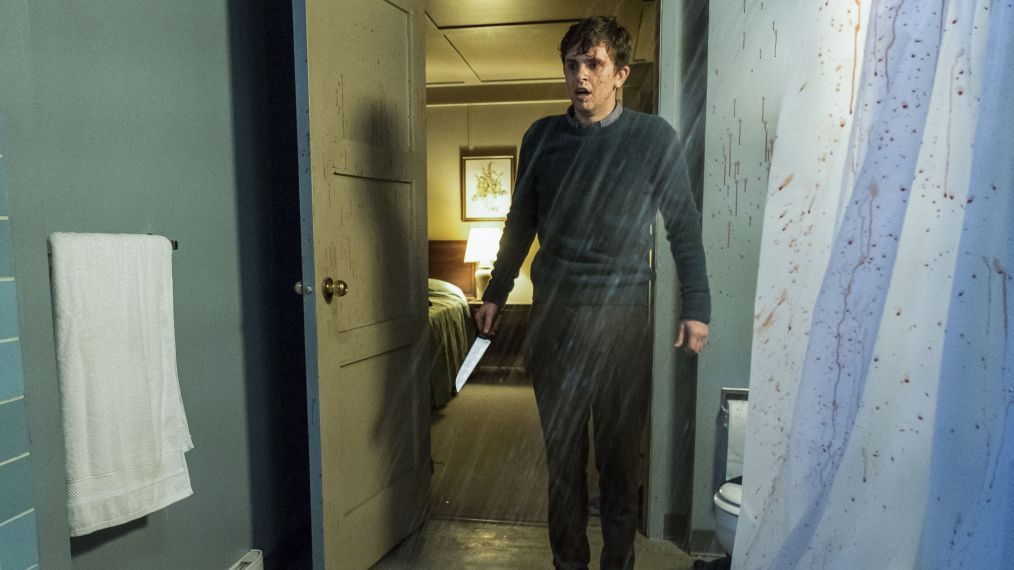
Dylan also meets Madeleine Loomis (Isabelle McNally), who comes to the motel to see if Norman has seen Sam, who has disappeared.  Dylan's fears are now full-blown, and at the nice dinner Norman has prepared, Dylan calmly tells his brother that Norman is ill and needs help.  He all but begs Norman to take at least one pill that Dylan had filled to prove he is back on.  At this time, Norman is simply not himself or anyone: Norman essentially channels Norma, telling Dylan that he loves him, but that there is room for only one son.  With that, he whacks Dylan with a glass bottle, and all Hell breaks loose.  "Norma" lunges at Dylan with a butcher knife, but "Norman" grabs her in a desperate effort to save a stunned and disbelieving Dylan.  From Dylan's perspective, we see Norman literally struggling with himself, Norman obviously seeing something that isn't there.

After 'Norman' wins the fight, he does what he has always wanted to do: he calls the police to inform them that he, Norman Bates, has murdered Sam Loomis.

Oh, and Sheriff Romero (Nestor Carbonell) is still recovering from his gunshot wound and plotting revenge against Norman Bates.

Perhaps one reason why Inseparable is my least favorite (though still good) Bates Motel episode is that the show still wants to have it both ways.  On the one hand, it trumpets how they are not going to be slaves to the Alfred Hitchcock film by sticking with the story the movie had.  On the other, the opening shot of a shocked/dead Sam Loomis is an exact replica of Janet Leigh's shot after her character was killed in Psycho.  I don't get how one can say 'we're going for something different' and copy the source material at the same time.

There's a difference between nodding to the original and straight-up copying it, which I don't mind.  I do mind when you say 'we're going to be different' and then go for the same.

I also had pretty much forgotten the Romero subplot (which I still wasn't sold on: the idea that after getting this massive blast, Romero would still be strong enough to go hours and miles before calling the ambulance to get some surreptitious help and then hole up in a friend's house to recover).

The big news here is the revelation that Dr. Edwards, far from helping Norman in an impromptu session, is actually missing (and we figure, not just merely dead but most sincerely dead).  I think it would be wildly out of left field if the good doctor just happened to die, but why would and how did Norman murder him?

Did Dr. Edwards, an openly gay man, spot 'Norma' at the White Horse Bar?  Did Dr. Edwards try to help Norman see that he was trying to be his own mother (and Norman/Norma kill him over that)?  Did the good doctor even try and take advantage of things by 'picking up' Norma only to be killed when 'Norma/Norman' figure things out? 

Maybe it isn't as exotic as all that: perhaps Dr. Edwards merely trigger something in a session that got him killed later on (it's highly unlikely that if Edwards had disappeared, the police wouldn't have looked at his list of patients as potential suspects).  We're going to need a very good reason why the audience was misled in such a dramatic way.

If we look at Inseparable in terms of acting, you are going to have to wonder how Freddie Highmore won't get an Emmy nomination for his simply fantastic work on Bates Motel (he probably won't: the show has been consistently ignored over such beloved things as Game of Thrones or House of Cards.  Maybe if it were called Motel of Bates...)  This particular episode had Highmore do more than just Norman Bates (though he did that incredibly well).  He also, in his performance, had to 'play' Norma, and had to play someone who knows the truth but still struggles with his own unhinged 'reality' (acknowledging that his mother is dead but also fully accepting she is with him too).

Highmore is so good that it leaves poor Thieriot, never the best actor around, kind of fumbling.  Thieriot is hit and miss: he is quite good when softly, quietly confronting Norman about his issues, but after he's struck on the head he doesn't have much reaction to just how crazy things are.  We'll give him some leeway in that he was momentarily knocked out but you'd think more shock or horror or sadness would be seen.

With things now finally in the open, and Norman about to be locked up, the last three episodes of Bates Motel will either end this fantastic series with a bang or a whimper.  Inseparable is more whimper than bang, but some great performances and genuinely surprising twists make it still a good episode.  Good, not great.


5/10

Next Episode: The Body

Monday, April 3, 2017

Bates Motel: Marion Review


BATES MOTEL: MARION

I'd call Marion, the most recent Bates Motel episode, a classic...a classic bait-and-switch.  Perhaps it is because the shower scene from Psycho is so iconic that anyone trying for it (even the ill-fated remake) would be hard-pressed to equal it, let alone top it.  The episode is called Marion.  Those of us who know the story of Marion Crane and her visit to the Bates Motel know that she will meet a certain fate.  Bates Motel, however, opted to try something completely different.  Did it work?  Did it not work?  Will Psycho fans be surprised? Disappointed?

Let's take a look.

Marion Crane (guest star Rihanna) has at long last, checked into the Bates Motel, determined to help her lover, Sam Loomis (Austin Nichols).  Motel owner Norman Bates (Freddie Highmore) is conflicted in more ways than one.  First, he is erotically drawn to Marion (who wouldn't?), which is usually where "Mother" (Vera Farmiga) will pop up to kill the object of desire).  Second, he knows that Sam is married, something that Marion is unaware of.

The two slowly bond, and eventually Marion asks for Sam's address.  Norman has the unenviable duty to tell her of Mrs. Loomis, which Marion doesn't believe until she goes to his house and sees Sam attempting to soothe Madeleine (Isabelle McNally).  So enraged is Marion that she smashes Sam's car windows.  To make things worse, when Sam runs out to find out what's going on, he sees Marion storming off into the Oregon night...and Madeleine promptly locks him out.

It isn't just Sam who is having a bad night.  Earlier that night, Marion has opted to shower...and lives to tell the tale.  When she comes back to the motel, Norman almost hysterically helps her pack and leave, urging her to start a new life away from Sam and from her past.  She drives away with the money and won't answer her phone.  Norman answers his, where he finds an enraged half-brother/uncle Dylan (Max Thieriot), furious about not being told Norma was dead.  Dylan insists Norma wouldn't have committed suicide, but Norman won't budge.

Into all this enters one Sam Loomis.  He goes to the motel to find Marion, hoping to do something.  She isn't there.  After the awful night he's had, he opts to take a shower too.  Unbeknown to him, Norman continues his argument with "Mother" (i.e. himself), him struggling to admit she isn't there.  "Mother" reminds him that Sam is like Norman's father, a cruel man who abuses women.

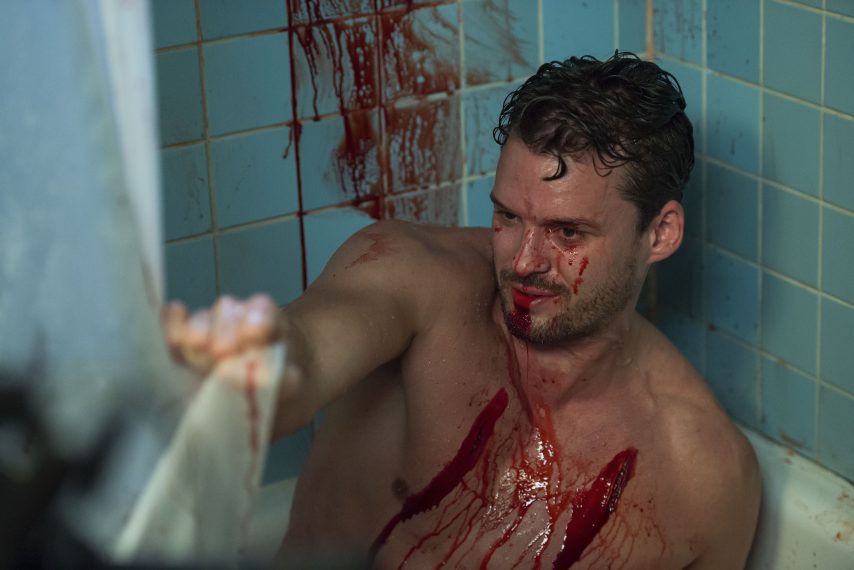
With that, Norman takes a knife, goes to Room One, and stabs SAM in the shower to death.


In the five years Bates Motel has been on, we all knew that eventually Norman would have to hit the showers.  However, I don't think anyone expected anyone other than Marion Crane to bite the dust.  I guess none of us counted on the idea that you just can't kill Ri-Ri.

Changing the established story to have our adulterous Sam be the one to meet the grisly fate, I imagine, will be one of those divisive moments for fans of both Psycho and Bates Motel.  The show has already changed quite a bit already: in the film, Sam wasn't married if memory serves correct.  He also didn't interact with Norman until after Marion was murdered.  As a result, I figure a good number of people will see Norman, dressed as himself, killing Sam rather than Marion to be a stroke of genius.
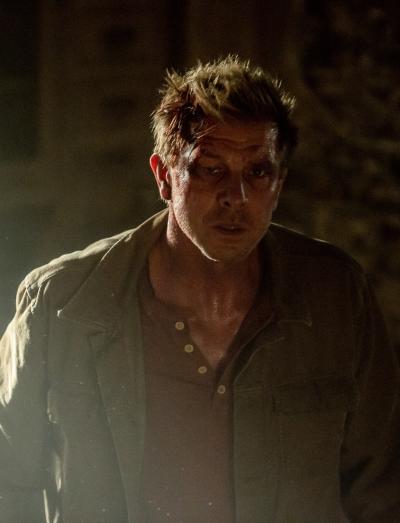
Others, I figure, will be displeased that it was not the object of desire that spurred "Mother" to kill (or even that "Mother" didn't do the killing).  Rather, "Mother" merely manipulated Norman to kill a man who represented his father, a curious version of patricide.  It almost makes it look justifiable, given how Sam cheated on both women.  No one should be killed for committing adultery and being reprehensible, but there you go.

I tend to fall on the latter side of the issue.  Lust, up to now, was a primary motivation for the killings, and to see Sam stabbed was a bit of an anticlimax, particularly again since the title of the episode is Marion.  I'm not sold on the idea that switching victims (and letting Marion live) was brilliant.  It also makes me wonder whether Sam was that unable to defend himself.  I figure Sam was physically stronger than Norman.  Yes, Norman did take him by surprise and he had a butcher knife coming at him, but unlike Marion he didn't have to worry about trying to both protect himself and cover his nakedness. 

Part of me still thinks Sam could have defended himself and not gotten himself killed.

Perhaps good, perhaps bad was in how Marion teased the audience with the infamous shower scene when Ri-Ri hit the showers, if memory serves right in the middle of the episode.  People were waiting for The Big Moment...only to not have it come. 

Perhaps if Marion had been killed in the way everyone expected, we would have been essentially watching a remake of the rest of Psycho (though it seems unlikely Madeleine or even Sam would have hired a detective to find Marion, and we had Dylan waiting in the wings).

Complicating things in the 'we've gone original' is that Marion didn't completely go original.  As Sam is dying, he copies the movements Marion did in Psycho (in shock, moving her hand to grab at the shower curtain, pulling them down as he/she collapses out of the shower, the look of disbelief etched on his/her face).  You can't say they opted to break with tradition while simultaneously adhering to it. The victim may have changed, but the imagery remained the same.

Let's move on to the performances.  Highmore again really excels as Norman Bates, particularly when he struggles with his sanity as he insists Mother isn't real until 'Norma' so overwhelms him that he surrenders.  He even has a moment of comedy when discussing with 'Mother' about being functional despite his insanity.

"The world is full of mad people who function, many of whom are Heads of State," he tells her.  Was that a sly dig at President Trump?  Who is to say?   

His scenes with Rihanna were also well-acted, particularly given how he, the trained actor from childhood, could have overwhelmed the relative newcomer.  However, both did real well when they talk quietly.

Ri-Ri is not a great actress (or even an actress given her few credits and primary career as a pop singer), and it shows in her last scene with Highmore when she expresses her disappointment in herself by getting involved with Sam.  However, credit should be given where credit is due, and Rihanna handled herself quite well.  It wasn't a great performance, but a good one, showing that perhaps with more training she might make a legitimate second career on screen to compliment her already successful one with a microphone.

Nichols too did well as the overwhelmed Sam, making him almost sympathetic.  Almost.

Curiously, it is the trained Thieriot whom I wasn't convinced with.  His scene where he discovers Norma's dead was not the greatest performance (I felt it a little blank), but he bounced back when he calls to confront Norman.  There was a rage there that pushed him forward.  I've always gone back and forth on both Thieriot and Dylan, and Marion was no exception.

Finally, back to The Change.  Ultimately, I wasn't convinced it was good.  It wasn't terrible and I'm not enraged that established lore was changed.  I just wasn't overwhelmed about its 'brilliance' either.  It was a bit more graphic than Psycho (we did see the knife plunge into Sam's back) but part of me didn't have that 'shock' that I did when I saw Marion in the shower.  I also don't know if having Roy Orbison's Crying during the scene helped or not (again, I lean on the 'not' side). 

I've read the reasons for the change, and I can understand them, even up to a point agree with them.  If we had Marion killed, we might have essentially seen the final Bates Motel episodes lose steam by remaking Psycho.  Still, I'm not fully on board with this alteration.  Could Marion have been killed and still have had major changes?  We already have with Norman killing Sam sans drag. 

I can see why things were done, but I'm still not there yet.


6/10

Next Episode: Inseparable

Saturday, March 25, 2017

Bates Motel: Dreams Die First Review


BATES MOTEL: DREAMS DIE FIRST

As we come to the end of the sad, strange journey of Norman Bates, a man destroyed by love of Mother, we get another deranged Bates Motel episode involving sexual decadence, realization of insanity, and another person about to be destroyed by love.  Dreams Die First gives us a great debut and more wild turns.

Secrets are all being revealed here.  In the subplot, Dylan Massett (Max Thieriot), half-brother/uncle to Norman Bates (Freddie Highmore), finally tells his wife Emma (Olivia Cooke) the truth about 'Norma's' earring.  Emma thinks Dylan has kept it as a way to keep his mother Norma close to him.  However, after internal struggle, he reveals that it isn't Norma's earring.  It's that of Emma's mother, and that he is highly concerned about her fate.  Emma is upset by all this, but while doing some bored online checking she finds that Norma is dead, something neither she or Dylan were aware of.

Norman, for his part, is concerned when 'Mother' is nowhere to be found.  He does find a matchbook for the White Horse Bar and calls asking if Norma was there.  To his surprise (and that of the viewer), he's told that Norma was there, and that she left her car there, having been too drunk last night to drive it.  While going to get the car, he finally reveals to Madeleine Loomis (Isabelle McNally) what he knows about Sam (Austin Nichols) and his mistress. Madeleine is facing her own problems: not just the potential that Sam is having an affair, but that Norman kept this from her.

For his part, Sam is having financial trouble, and the only person he confides this to is his mistress, Marion Crane (special guest star Rihanna).  Marion wants to help Sam, but it isn't as if she has thousands of dollars just lying around.  As it so happens, some money does fall into her lap, and in a spur of the moment decision, she takes it instead of depositing it and rushes to her love.  Sam cannot take her phone call, but no matter: Madeleine confronts him about whoever was calling.  Marion, for her part, with the rain coming down, stops at the Bates Motel.

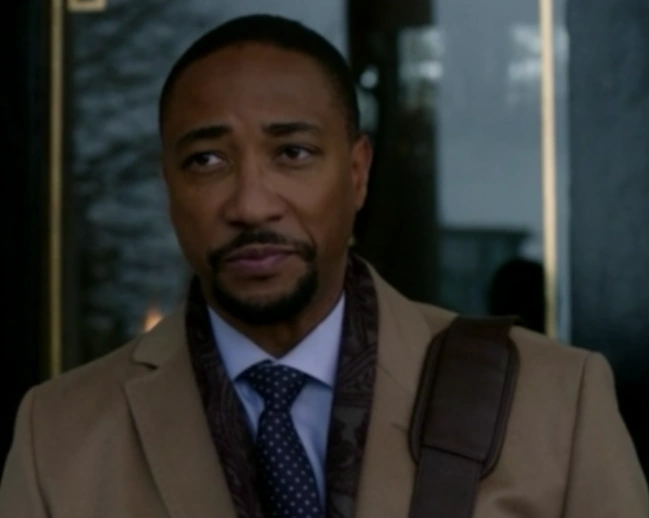
Poor timing, as Norman, with some unwitting help from his former psychiatrist, Dr. Edwards (Damion Gupta) finally puts everything together, and both conclusions fill him with horror.  First, he realizes that he sometimes sees Mother when she isn't there, which helps him realize that Norma really is dead.  Second, he finds that the bar 'Norma' has been going to, picking up guys from, and getting drunk at...is really a gay bar. 

Norman, in his total disassociate state, has been going to the White Horse Bar in full drag, calling himself 'Norma', and having sex with other men, not realizing that while everyone sees 'Norma' as at most a transvestite if not full-on transgender, Norman truly believes he is 'Norma'.  It isn't until an attractive man (Michael Doonan), with whom 'Norma' had sex with the night before, tries it again with Norman (who is aware that he is Norman, not Norma) that Norman realizes just how far he's separated the two identities.

Only on a show as bonkers as Bates Motel would the idea of someone in full drag not realizing that he is having gay sex be considered tame, almost rational.  However, right from the beginning, when the bartender tells Norman that 'Norma' was there would we have some logical conclusions.  I wrote in my notes for Dreams Die First that to explain 'Norma' appearing at the bar, we had one of two solutions.

The first is the wrong number/person theory, where it's another Norma they were talking about and it was mere coincidence.  The second was that Norman would go in full drag.  It didn't strike me until when Norman went into the bar, one with a certain style of techno music and few if any women that I figured he had indeed been going into the bar in full drag. 

It would make sense: a man in drag would look out of place at a straight bar.  It would only be at a gay bar where a man could appear dressed as a woman and even claim to be a woman and not raise eyebrows.  It must have been a shock to our straight/straight-laced, slightly puritanical Norman to have found not only was he a regular at a gay bar, but that the denizens recognized him sans drag.  The fact he had sex with other men while in deep blackouts where he thought he was a woman makes it all the more wild.

Highmore again gives it his all as Norman Bates and gives another great performance.  There's not just the realization that he's gone bisexual, but when he fesses up to Madeleine about Sam's indiscretions.  His hesitancy, his reluctance to speak on something he knows will hurt adds pathos to his performance.  We even get to see the dark side when he speaks to Sheriff Green (Brooke Smith).  There's a haughtiness, a defensiveness, a hostility that is barely masked.  It's an all-around strong performance.

We have also something I was not expecting: a strong performance by Rihanna.  Our beloved Ri-Ri is more a pop star/diva with few credits: apart from Battleship, she hasn't done much acting (though I thought she was one of the better aspects of Battleship). Rihanna got the fear and hesitancy of Marion's, the love she had for Sam versus her sense of morality (with the former winning out, much to her tragedy).  Ri-Ri was able to hold her own against professions, and one thinks she'll really do well against someone like Highmore, who has been acting practically all of Rihanna's life.

Though their roles were smaller, both Thieriot and Cooke did excellent in their quiet dramatic drama as Dylan and Emma, who love each other but also do foolish things to try and stop the other from being hurt.

I think it helps that they were aided by their Bates Motel costar, Nestor Carbonell, who directed the episode.  He at least has directed before, so he isn't just taking a stab at making an episode (no pun intended).  We also find that Dreams Die First is sticking close though not slavishly faithful to Psycho: as in the film, Marion steals money for her lover Sam, but Sam is married, not divorced.  It's enough to honor the original without stomping on it. 

With strong performances all around (and an impressive turn by pop diva Rihanna, a Bates Motel fan who got to show that she can be a competent actress), along with some really insane turns (Norman's visions of 'Norma's' sexual dalliance with the man who knew he was performing oral sex on a man) gives us a mixture of the insane and the brilliant.  These are things Bates Motel both aspires to and achieves.

10/10

Next Episode: Marion 

Friday, March 17, 2017

Bates Motel: Hidden Review


BATES MOTEL: HIDDEN

Generally, I'm wary whenever a star of a television show directs an episode of said show.  More often than not, he or she puts greater focus on the visuals than on the performances or story.  This was the case when Mark-Paul Gosselaar directed an episode of the abysmal Franklin & Bash, a show that was OK and then descended into a horror that I danced when I heard it was cancelled.  Hidden wasn't horrible, but parts of it stretched credibility and director Max Thieriot (who did not appear as his character of Dylan Massett) did care about visuals a tad much.

Norman Bates (Freddie Highmore) finds himself beset by problems both good and bad.  He wants to do the right thing and tell the police about the accident that killed his uncle Caleb.  However, both Chick (Ryan Hurst), who ran him down, and Mother Norma Bates (Vera Farmiga) are adamant Caleb be done away with.  Reluctantly, Norman agrees to let Chick take care of it, which involves him giving Caleb a Viking funeral.

Norman then has to stop Chick from moving in and trying to get rid of the car of the man sent to kill him.  His delusions of Mother are more pronounced, pushing him further into complete hysteria.  Finally, there's his growing attraction to Madeleine Loomis (Isabelle McNally).  Not only has Norman given her Mother's clothes (which fit her like a glove), but their attraction to each other grows.  She invites Norman to her house for dinner (Sam being away again) and they kiss.  As the kissing gets more intense, Norman has a vision of Mother and of Madeleine lying dead, her throat slashed.  In a panic, he flees to his house, where he finds himself truly alone.

In the other story, former Alex Romero (Nestor Carbonell) is still fleeing from the law and determined to get to Norman, despite the massive pellet gunshot wound he has.  He manages to live long enough to find a payphone and call for an ambulance, and while the EMT go into an apartment complex or hotel, he goes in, steals what he needs to do his own healing, and then moves on.

That is one aspect of Hidden that made me wonder whether Bates Motel had gone a bit off.  Here's Romero, having been shot once, bleeding profusely, and he still is able to walk for miles and miles and have strength and clarity of mind to hatch this plan to give himself treatment before reaching the home of a friend who can shelter him.

Something about that struck me as a bit far-fetched, which is something given the overall cuckoo-nature of Bates Motel.

Then we have these scenes and moments where I figure Thieriot wanted to show the visual flair he could bring (and as a side note, given that both Nestor Carbonell and Freddie Highmore are also set to direct a couple of episodes, with Highmore having penned his second one, I wonder whether given it's the last season the producers opted to let their cast have free range).

We have the Viking funeral, beautiful looking, yes, but somehow a bit bonkers.  I'm a bit torn on that scene: one on hand, it is logical to burn Caleb's body and Chick has his own dramatic flair that makes him a bit crazy too.  On the other, it is excessively elaborate and brought to mind "See a Viking Funeral!" from the spoof trailer to History of the World Part II.   Part of me wanted to chuckle at this scene (beautiful though it was).  The vision of a dead Madeleine and the final shot where Norman rushes into his house, a single blue light dominating as he walks towards us, again I felt were there to draw attention to itself.

I was also uninterested in the long, long scene where Norman and "Norma" went to find the car of their intended assassin only to opt to not move it.  It felt long and unnecessary, going on to where I was losing interest in watching.  Truth be told, my mind and eyes were beginning to drift off as Hidden continued, wondering how Romero could keep himself going and whether Chick should have thrown in some chanting as Caleb went up in smoke.

Still, I'm not going to dismiss some good moments we got in the episode.  The scene in Chick's run-down trailer where he and Norman have a conversation was quite good, with both Hurst and Highmore working well to make it a sad moment and giving strong performances.  McNally is also a highlight in her brief moments, her hesitancy mixed with her desires giving her much to work with.  Brooke Smith, making her debut as the new Sheriff, Jane Green, did extremely well as the Sheriff who is slowly investigating why Jim Brockwell (the thwarted assassin) had the Bates Motel address before jumping bail. 

You sense she doesn't suspect on the surface that something is wildly amiss but that she is starting to poke around because police work is dumb...until it isn't.  Yet given how Highmore seemed to overplay the worry any questions regarding Brockwell or Romero cause him, one wonders if Green isn't at least a bit curious as to what's up with him.

Hidden to me felt a bit like filler, something to take up our time before we get to the main event: Rihanna's guest turn as Marion Crane.  It looks like before Ri-Ri hits the showers, we've got to hit a slight bump.  Again, not horrible, but for once, I was willing to look away during a Bates Motel episode.


6/10

Next Episode: Dreams Die First

Friday, March 10, 2017

Bates Motel: Bad Blood Review


BATES MOTEL: BAD BLOOD

Never underestimate Bates Motel's ability to make crazy crazier.  Just when one thinks things couldn't be any more bonkers, out comes something even more outlandish yet surprisingly within normalcy of the series.  Bad Blood, the third episode in the last season, gives us two stories, loses Dylan and Emma, makes Chick simultaneously rational and repulsive, and ends with a sad but diabolical moment.

Norman Bates (Freddie Highmore) now has someone else know his 'secret': both his uncle Caleb (Kenny Johnson) and Chick (Ryan Hurst), the handyman who both stumbled into finding the body of Norma Bates (Vera Farmiga) and Norman in full drag as 'Norma'.  While Caleb freaked out to where he had to be chained up in the basement, Chick took all this remarkably well.  He played along with Norman's delusions, even having dinner with 'both' of them, attempting to keep up with whatever they were talking about.

Eventually, we learn why Chick is rather cool with everything going on: he plans to become a bit of a Robert Bloch and write all this down for what would probably be a wild best seller.  He even goes and gets a typewriter and secretly records Norma/Norman conversations.

Meanwhile, former Sheriff Alex Romero (Nestor Carbonell) is a desperate man.  Finding  that he will be transported to another jail, he takes the opportunity to escape, determined to get to Norman and enact revenge.  In his travels, he kidnaps a passerby and ends up attempting to hotwire a car.  The owner's teen child ends up blowing Romero with a shotgun, with Romero in shock.

As for Caleb, the guilt of his actions with Norma all those years ago, the insanity of his nephew, and the general chaos has left him resigned to a fate of death.  He too begins hallucinating between Norman and "Norma" (his head injury making things more muddled).  "Norma" tells Norman that for once, he has to the killing, in this case, of Uncle Caleb (as she cannot bring herself to do in her own brother).  Norman allows Caleb to flee and never return, but "Mother" comes down with a gun chasing after him.  All hell breaks loose when Caleb spots a car and desperately hails it.

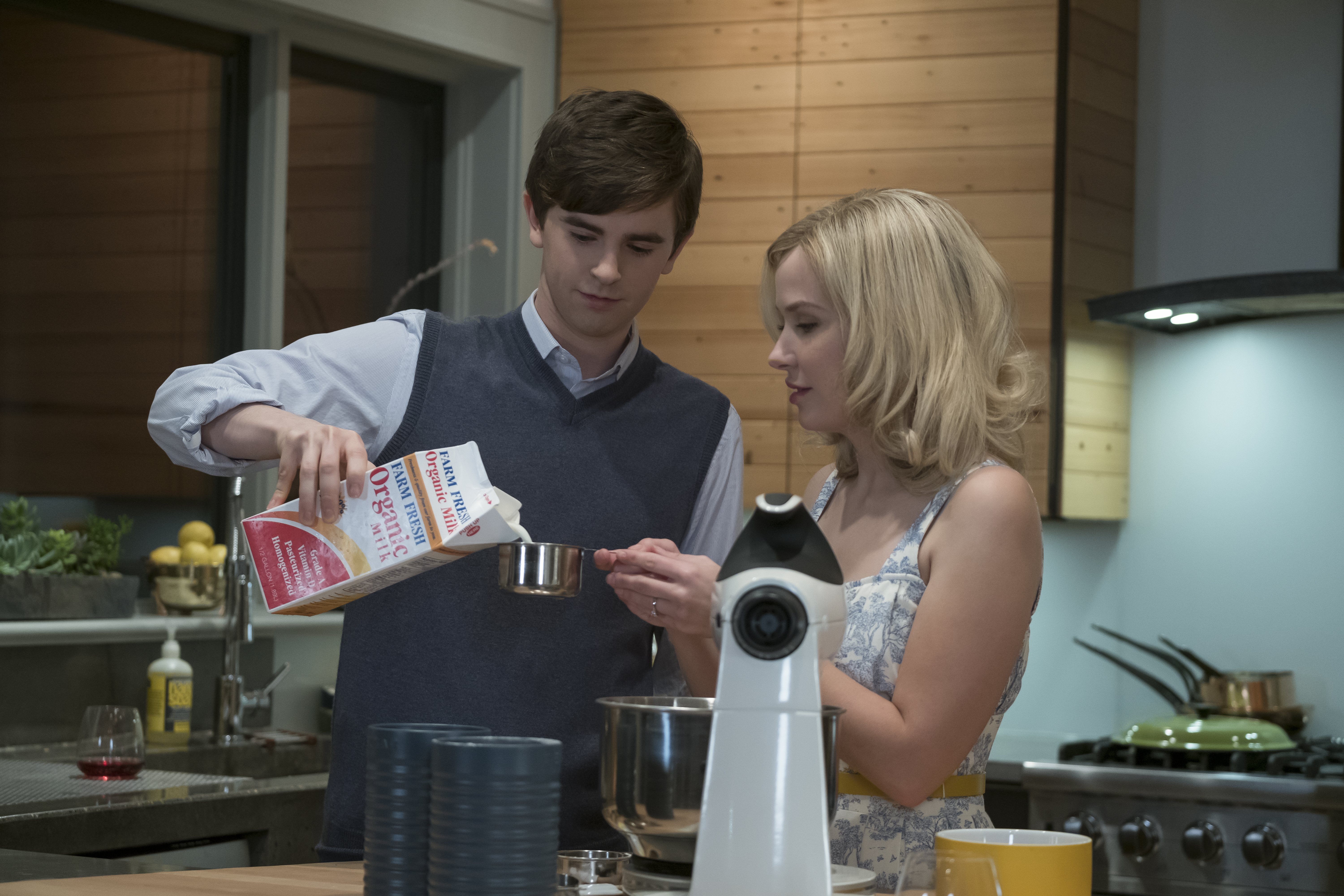
Unbeknown to him, it's Chick, who turns away to read a text from Norman/Norma about picking up milk.  He is distracted just enough to not see Caleb running towards him, causing Chick to run Caleb down.

It looks like everyone, even dead people, are using others in particularly wicked ways.  "Norma" wants her son to kill someone.  Chick is playing Norman's delusions to gain fame and fortune for himself.  Caleb is playing to "Norma's" sense of brotherly bond to stay alive, though by the end he figures his sins have finally found him out.  Romero uses the friendly nature of his guard to put him off guard, and pushes an innocent stranger into a ride of terror.

There is an overwhelming sense of tragedy in Bad Blood, where the actions done decades ago, both good and evil, have brought a perfect storm that is devouring everyone in its path.  Of particular note is when Romero frees Jason (Joshua Hinkson), the man he forced to help him in his getaway.

A green-tinted sky and landscape presses down on Jason and Romero, as if they are both in a nightmare not of their making.  Jason softly begs for his life, pleading he has a wife, two children, and a mother.  He fears he will die for no reason, and Romero sees where he now is: lost, with no real way back from the mess he both made and finds himself in.  He seems almost genuinely stunned that anyone would think he, Alex Romero, would harm anyone.  It's a haunting, sad moment, a true tragic situation for two people who meant no harm (and in Jason's case, was just at the wrong place at the wrong time).

Credit has to be given to two fine performances: Johnson and Highmore.  Bad Blood is perhaps Kenny Johnson's best performance in his recurring role.  His Caleb is one that fears for his life, but who also sees, more than ever before, the harm and pain he's caused and how despite his own wish, he will never be able to make amends.  Johnson's Caleb is a man who is tired of running, who is resigned to his awful fate, who has given up on life.  The fact that he was given an unexpected reprieve, and then to have it taken in the worst way, by someone who sought to benefit from it but now finds he too has done evil, is tragic too.  Johnson is simply excellent in his regret, his pain, and in his remorse.

Highmore does something quite interesting: he deliberately heightens his voice when he is seen in drag as 'Norma'.  His adoption of more feminine manners and his voice going up to sound more feminine show that Norman was doing his best to be 'Norma' and not Norman pretending to be Norma.  Couple that with Highmore still having to play Norman, particularly when he has a scene with Madeleine Loomis (Isabelle McNally), shows that Highmore is consistently excellent in the 'dual role'.

As a side note, while she had only one scene, McNally was heartbreaking when she details her own loneliness and efforts to reach out to the nice young man at the motel.

Even Hurst as Chick, a character I've pretty much hated since his debut, does a great job when he has dinner with the 'two' of them.  A credit to how Farmiga and Highmore also worked well to make this particularly bizarre meal work pretty well.

There's something to be said where the guy who committed incest turns out to be the most sane person around.

Perhaps because Caleb was run down in the clumsiest of ways (seriously, text), I thought Bad Blood stumbled slightly.  However, this was another intense hour in a show that hopefully will come down to an epic series finale.

9/10

Next Episode:  Hidden

Thursday, March 2, 2017

Bates Motel: The Convergence of the Twain Review


BATES MOTEL: THE CONVERGENCE
OF THE TWAIN

As we get closer to the series finale of Bates Motel, the show is absolutely determined to amp up the crazy.  In a certain sense, it has to: with Mother Bates technically dead, we have to have some wild finishes.  The Convergence of the Twain gives us a wild, wild finish, and actually makes good use of the one character I have always, always disliked.

Ghosts figurative and literal are all coming out.  Norman Bates (Freddie Highmore) continues to hold to his idea that his mother, Norma Bates (Vera Farmiga) is alive and hiding out at the house while pretending to be dead to the rest of the world.  He manages to throw in some good taunting of his stepfather, Sheriff Alex Romero (Nestor Carbonell) for good measure, showing himself to be very much alive.  Romero won't be denied, and his rage explodes into a fight in jail.  This may be a blessing in disguise, as it may allow him to be moved to another facility. 

For his part, Norman is not too eager to go on the date the hardware owner Madeleine Loomis (Isabelle McNally) has set up for him, but he quickly changes her mind when Madeleine tells him it's a double date.  He is even thrilled when he learns who her husband is: Sam Loomis (Austin Nichols), who went to the Bates Motel for a sexual liaison with his mistress, checking in as "David Davidson".  The moralistic, smug Norman is pleased to know who "David Davidson" is, but isn't about to tell his secret...and Sam is both worried and angry that Norman may reveal his indiscretion.

Norman continues to struggle against his growing desire for Madeleine, particularly since she bears a resemblance to Norma.  Norman now really slips out of control: going to a bar he truly cannot dissociate between himself and Norma, to where he carries on a conversation with the bartender as essentially Norma, but with dialogue that might make it look like it came from Norman.

Enter into all this lunacy Uncle Caleb (Kenny Johnson).  Having left Dylemma, he comes to find Norma, unaware that she is dead.  Once he learns this, Caleb is devastated.  Things are not helped by the emergence of Chick (Ryan Hurst).  Chick and Norman have come to a business arrangement: Chick will bring animals for Norman to stuff and then sell them to art collectors, splitting the profits.  Chick taunts Caleb with the knowledge that Caleb had raped Norma, but Caleb, like Romero, connects Norma's death to Norman's actions. 

Caleb, in a rage, goes to the house, where he makes a shocking discovery: Norma's body, frozen, all dressed.  He's knocked out, and Chick, who followed Caleb, comes across a scene that is so insane that he takes it all quite well: Norma's corpse, Caleb on the floor, and Norman, in full drag, telling him, "Well, now you know my secret.  I'm still alive".


We've had crazy in Bates Motel before, but few episodes, at least to my memory, have been flat-out bonkers as The Convergence of the Twain.  It has Freddie Highmore's best performance so far, one that would be considered a strong one for Emmy consideration if not for the Television Academy's fixation on ignoring the show altogether.  From Norman's smugness and self-righteousness at taunting Romero and looking down his nose at Sam to his ability to 'be Norma', Highmore really pushes himself.  We see the darkness and arrogance that Norman has, along with his conflicting emotions over Madeleine.  He dominates The Convergence of the Twain, and makes the difference between Norman and Norma believable, even frightening.

A highlight is the editing when Norman and 'Norma' are carrying on a conversation with the bartender (who was polishing the glass...I don't go to bars often, but is that ALL bartenders do?).  Not only is the editing itself really first-rate, but how the conversation flows between the 'three' of them.  It got to the point where I expected Norma to lose control and flirt with the bartender, which would have been stranger since from the bartender's perspective, it would have been Norman who was doing the flirting.  It was such a bizarre, surreal scene, one elevated by the writing, the editing, and Highmore and Farmiga's performance.

This as I said, is the first Bates Motel episode where Chick didn't annoy me.  He even appeared to be one of the few sane people in White Pine Bay, and his surprisingly calm reaction to witnessing the lunacy, a very soft "Holy S-hit", is almost wryly amusing.  Here he comes in to a dead woman all dressed in fine clothes, his enemy on the floor having been knocked out by a young man (22 if we go by the name on the joint tombstone, Norman born in 1995, Norma Louise: 1974-2015) dressed as the dead woman, complete with wig.

It's all pretty bonkers, but Chick takes it all in remarkably well. 

We also integrated the Loomis story into things in a way different from that of Psycho.  McNally is wonderful as the sweet, slightly flirtatious Madeleine and Nichols matches her as the slightly sleazy but not horrible Sam.

A few things didn't quite work.  One wonders why we went to Emma and Dylan at all, but it's not a surprise given how Bates Motel has struggled to integrate them into the show.   Johnson's grieving at Norma's grave was a bit over-the-top for me, and the Romero storyline better start paying dividends soon. 

Still, apart from that, The Convergence of the Twain gave us more cray-cray, which from Bates Motel, is what one loves the most.

9/10

Next Episode: Bad Blood

Sunday, February 26, 2017

Bates Motel: Dark Paradise Review


BATES MOTEL: DARK PARADISE

Curtains up!  Light the lights!  We've got nothing to hit but the heights! 

Bates Motel is saying goodbye, as the merry adventures of our favorite mother-obsessed serial killer come to a close.  Dark Paradise, Season Five's premiere, give us a lot of Norman craziness, but a few really tender moments and what looks like one last solid mystery to engulf our beloved nut-job.

It's been two years since last we saw Norman Bates (Freddie Highmore) and his 'late' mother Norma (Vera Farmiga).  Since then, Norma's husband, former Sheriff Alex Romero (Nestor Carbonell) is still in the slammer for his involvement in the drugs trade, and Norman's half-brother/uncle Dylan Massett (Max Thieriot) is now happily settled in Seattle, with his wife Emma Decody (Olivia Cooke) and their daughter. 

Both brothers are about to have their world upended.  For Dylan, it is the return of his father/uncle Caleb (Kenny Johnson), who is thrilled to be a grandfather.  Dylan, who at heart is very gentle, reluctantly agrees to let him stay with him and Emma, but Emma knows that this is killing Dylan.  She most reluctantly asks Caleb to leave.  If Caleb plans to see Norma, it would do him no good, for neither Caleb or Dylan are aware that Norma's dead.

Or is she?  Norman certainly seems to think that she is very much alive, though in his demented mind they both have to make out that she isn't, but is forced to remain inside the house forever 'to protect Norman'.  To the outside world, Norma Bates is dead, and even Norman says so, but it's clear that to him, Mother is very much with us.

Norman, however, is facing strange problems of his own.  First, there's his attraction to Madeleine Loomis (Isabelle McNally), the hardware shop owner who is beautiful, married but slightly flirtatious with Norman, and bears a resemblance to Norma.  Then there's the case of a man's wallet that Norman finds in his pocket, a man he doesn't know or remember ever registering.  One person he does remember registering is "David Davidson", someone who wants a room for a few hours.  The moralistic Norman won't rent out a room for assignations, but relents when he pays for the night.

Peeping through the hole, Norman becomes aroused at the sexual escapades of "David Davidson", but his own auto-erotic exercises are stopped when he gets a call from Mother.  Mother is displeased that Norman would want to start something with someone, and it is she who reveals a surprising secret: the man whose wallet they have came to the Bates Motel looking for Norman to kill.  It was "Mother" who stopped him, but why would anyone want Norman dead? 

That answer comes easily enough when the dead man's phone rings just before Norman and 'Norma' dump the man's body.  Norman picks up...and hears Romero's voice.


In many ways, Dark Paradise is a return to the beginning, for we end the episode in essentially the same way we ended the premiere episode from Season One (First You Dream, Then You Die...a title now tinged with irony after what happened to Norma Bates in last season's Norman, one of the most devastating episodes in the whole series, but I digress).

Whether this echo of the past was intentional or not, I would say it works brilliantly.  Dark Paradise is an excellent start to this, the final season, giving us just enough mysteries to pull us in, but actually answering the mysteries to build to new plot points.

The identity of the man in the wallet isn't answered until the end, and in such a way that it makes sense.  It also builds on what we know of Norman's totally unhinged state of mind while making clear that we are not going to get bizarre answers.  Norman, when told by Mother about the events that led to the man's death, asks 'logical' questions, such as how she could have come down from the house to the room so quickly.  She tells him "I don't know", which indicates that Norman may be so totally divorced from reality that things that would go against his ideas won't be answered but instead dismissed with non-answers.

We also see that Bates Motel is not skimping on the acting.  Highmore continues to make Norman almost sympathetic, even almost rational in how he behaves with others, but having that internal conflict between desire and despair forcing its way up.  Farmiga, who should have won an Emmy for her turn as the much-maligned Norma Bates, is now creating that idea of the domineering Mother that we all remember from Psycho, but we still see that she remains true to the character she created, someone who is not evil but just incapable of making good choices.

Thieriot is gentle as Dylan, the only sane member of the Bates extended family, and his scenes with Cooke are moments of calm in the storm of lunacy and mayhem Bates Motel unleashes.  It just seems such a pity that Cooke's Emma was given so little to do, since she was one of the standout characters.  Both Johnson and Carbonell had smaller parts, but they were strong in their limited scenes.

Dark Paradise is a great way to start the beginning of the end of this most twisted tale.  It's a pity that we'll have no more Bates Motel when the ten episodes are up, but as Farmiga said in the intro, 'it's time to check out'. 

8/10

Next Episode: The Convergence of the Twain

Monday, December 26, 2016

Bates Motel: The Complete Fourth Season Overview


BATES MOTEL: 
THE COMPLETE FOURTH SEASON

We are coming close to the end of Bates Motel, the Psycho prequel.  In the four years the show has been on, it's built on strength to strength, creating how Norman Bates will become the murderous figure he will become.

In the ten episodes of Season Four, it maintains a strong average of 8 (well, 7.9, but why quibble).  It's a pretty strong level of quality, due to many factors.

The first factor is in the acting.  The double-act of Vera Farmiga and Freddie Highmore as Norma and Norman Bates continues to astonish.  Farmiga makes Norma what she is: a woman who is well-meaning but who also keeps making things worse for herself.  She didn't mean to shape her son into someone who is an extension of herself, but she did.  She didn't mean to cause problems, but she also fails when she does try for good intentions.  Norma is either willfully blind to the danger Norman is or genuinely does not see it.  Either way, this inability to deal rationally with her Achilles heel has damned her to a shocking end.

Farmiga has softened the view of Mother Bates from what most of us who have seen Psycho or any of its sequels (especially Part IV, subtitled The Beginning).  Instead of a horrible person who abused and tortured her son, Farmiga's Norma Bates was a rational woman who had been herself tortured, from the rapes she endured from her own brother Caleb (resulting in her other son, Dylan) to her second husband, Sam Bates. 

Farmiga, I think, was always best when she was playing vulnerable, wounded, a woman on edge fighting to stay ahead and sane in a world that constantly pushed her down.  Granted, Norma herself made ghastly mistakes (she at times did put Norman in difficult positions, such as occasionally slipping into bed with him when he was technically an adult), but behind her at times stupid actions lay the heart of a good woman. 

She was matched by Highmore, who broke free from that troubled young man into being a thoroughly reprehensible person.  At times, he was clearly insane (such as when he close to losing control with his new stepfather).  Other times, Norman was just horrible: when he confronted his mother about her new marriage to Nestor Carbonell's Sheriff Alex Romero.

Highmore no longer made Norman a sympathetic figure.  He was selfish, arrogant, self-centered.  If anything, it was Norman who clung on to Norma rather than the other way around.  The season marked that evolution in his cruelty, and again, it makes one wonder why the Television Academy chose to ignore him and Farmiga.

Carbonell was equally complex as Sheriff Romero, someone who was a good man but also not above committing murders and hiding his own past sins.  Max Thieriot had some wonderful moments as Dylan, the only sane person in the whole series.

I've drifted to not mention another aspect of what made Season Four so successful: the scripts.  By and large Season Four kept building things slowly but to some shocking conclusions.  It was not perfect: poor Olivia Cooke as Emma Decody sometimes was shifted off, and the murder of Audrey Decody hopefully won't be forgotten.

Still, Season Four of Bates Motel was chilling, tragic, and leads up to its final season, one where we know where it will end: with Marion Crane taking her last shower.  Pop singer Rihanna will guest star in the role originated by the late Janet Leigh.  I'm not particularly sold on this casting, though RiRi was one of the better parts of the abysmal Battleship.  Will it be similar to the film or will they try for something else?

Season Four is another success for this Psycho-prequel, and while it's sad to see it go, the show was a great success.  At least it knows when to quit while it's ahead.


Next Episode:  Dark Paradise