Saturday, June 4, 2016

Alice Through the Looking Glass: A Review


ALICE THROUGH THE LOOKING GLASS

I cannot recall much if anything from Alice in Wonderland, apart from the fact that I absolutely hated it.  Therefore, it should come as no surprise in what is turning out to be the worst year in film in recent memory, that a sequel to a very bad film is what audiences actually want.

Then again, given that same audience also voted to have either Donald Trump or Hillary Clinton be the next President of the United States, they might actually have wanted an even worse sequel to an already bad film (American taste and logic having left long ago).  Alice Through the Looking Glass decided that we needed a giant case of 'the feels', to be sad for such characters as The Mad Hatter and even the Red Queen.  It's not their fault they grew up to be what they became...they were made that way by this cruel, cruel world.  We need to CARE about them, the film says. 

Pity the film makes no case for us doing so.

It's been three years since Alice Kingsleigh (Mia Wasikowska, aka My Secret Love) sailed and became one of the most successful ship captains in private business.  Oh sure, why not...makes perfect sense for a woman and seamen to mix.   Her latest journey to the Orient ended, she yearns to make one final journey, but her mother (Lindsay Duncan) has bad news.  Alice's company has been taken over by her ex-fiancée,  Lord Hamish Ascot (Leo Bill), and he intends to sell her ship, the Wonder, in exchange for the Kingsleighs to get their home back.  At the Ascot mansion, Alice, in her Mandarin-inspired ensemble, is distraught over all this.  However, there is hope, as the caterpillar-turned-butterfly Absolem (Alan Rickman, in his final role), leads her to a room in the estate, where she goes through the looking glass back into Underland.

There, she meets all her old friends: Queen Mirana (Anne Hathaway), Tweedledee & Tweedledum (Matt Lucas), the White Hare (Michael Sheen), the Cheshire Cat (Stephen Fry) and the Dormouse (Barbara Windsor).  They give Alice an important mission: save The Hatter (Johnny Depp)!  He's been sad and a bit out of it (even for him apparently) ever since he found a tiny hat he had made many years ago.  He's convinced that since his hat survived, so must have his family, whom he believed dead at the hands of the Jabberwocky and the evil Red Queen (Helena Bonham Carter).  Alice can't convince him of the impossibility of this, so now she has to go back in time to prevent the Hatter's family to die.

I already smell timey-wimey idiocy coming down the pike.

First though, she must get the Chronosphere, the device that controls time, from Time Himself (Sasha Baron Cohen).  Time isn't about to hand that over to anyone, let alone Alice.  He's turned down the requests to have it from his girlfriend, the Red Queen herself.  Time cannot be rewritten (which goes against all Doctor Who theology, but that's for another day).  Alice decides to steal the Chronosphere anyway and head on back to that fateful day, with Time in hot pursuit to set things in order.

On that fateful day, she learns how the Red Queen (real name Iracebeth) got such a big head (and how the Hatter got on her bad side PLUS shamed his family).  The young Mirana recalls that Eracebeth hasn't been the same since "that day".  Well, Alice figures that is she changes whatever "that day" was, things would change for the better for everyone.

Timey-wimey strikes again!

She goes further back to stop whatever happened at the stroke of six, only to discover rather than stop it, she caused it!  A quick sojourn to her world (where she's diagnosed as suffering from 'female hysteria') causes her to escape from the looney bin and go back through the looking glass, where she discovers that the Hatter's family weren't killed, but merely captured by the Red Queen...and turned into the size of ants.

Exactly WHY the Red Queen opts to hold the Hatter's family hostage for what I imagine must have been twenty to thirty years without ever doing anything with them (or threatening the Hatter over them) is just one of the many questions Alice Through the Looking Glass never bothers to answer, but there it is.

Eventually, while Time is weakening, a rescue attempt is made...which not only fails but lets the Red Queen get the Chronosphere.  She uses it to go back to the day of her accident, to confront her younger sister who lied about eating tarts and framing Iracebeth for the crime.  Pity that in her anger the Red Queen didn't realize what would happen if she met her younger self.  Soon all Underland starts going under, and it's a race to get the Chronosphere back to its rightful place or the world will end.

Back in the present, Alice's mother tells Lord Ascot off and ends up joining her daughter at sea, with First Mate James Harcourt (Ed Speleers) to join them in more adventures.

Alice Through the Looking Glass is a sheer mess of a movie: bombastic, overblown, frenetic, incoherent, and so convoluted I think most people will leave with a slightly puzzled reaction, wondering what exactly this...thing, was. 

Screenwriter Linda Woolverton has studied in the Steven Moffat School of Screenwriting, because the story so wildly depends on you a.) caring about 'feelings' over plot and logic, and b.) going back in time to get things right.  Alice Through the Looking Glass stubbornly insists that we really care about how sad the Hatter is, or how the Red Queen is just a misunderstood person and not just a loud, evil Queen who likes to lob people's heads off just because she likes it.

Moreover, as much as it tries, Alice Through the Looking Glass fails spectacularly to make us care about any of them.  The film never made a case as to why we should care anything about the Hatter's pain over the loss of his family (and as a side note, I think it would have been better if they had died and Alice led him to accept that and move on rather than have them magically come back).  Same goes for the loud, obnoxious Red Queen.

I doubt Underland would have fallen apart if the Hatter had died of a broken heart, or things improved if the White Queen had confessed to eating the tarts (for Iracibeth was pretty 'irascible' to begin with, with or without a head injury and tears).

I truly feel for the actors in this dreg, for the film is cluttered with genuine talents (and Sasha Baron Cohen).  I have never subscribed to the idea that SBC is a comedic genius, and while I wasn't puzzled as to why Time had a Germanic accent (a nod to Swiss watches? a comment on German efficiency?), I found him highly mannered and excessively idiotic.


I really don't want to go into Johnny Depp's performance.  Suffice it to say he made a nice chunk of change and has no interest in his artistic reputation.

Oh, Mia...I still love you, even when you're in horrors like this.  I think you try, you really do, to make things work, but director James Bobin's singular task was to get out of the way and let Alice Through the Looking Glass be about how big, how loud, how CGI everything could be.  As we race frantically through one odd sequence to another (the entire hospital scene was pointless, unless it was to give Andrew Scott something to do while he waits for Sherlock to bring Moriarty back...again).

Going back to the Steven Moffatization of Alice Through the Looking Glass, IF Alice interacted with the Underland characters when they were younger, wouldn't they have some memory of it all?  Did restoring the Chronosphere erase what had apparently happened in the past (and/or wiped out their memories of having met Alice in the past)?  How exactly did the Hatter's family survive all those years in the ant farm with no food or water?  Being so small, how'd they see the Hatter and make a sign to him? Like in any Moffat-Era Doctor Who episode, logic is irrelevant...so long as you cried.

It's not as if there were things I didn't actually enjoy in Alice Through the Looking Glass.  At the Tea Party that Time crashed, some of the time-related puns were funny (the Cheshire Cat appearing on top of him and declaring, "I'm right on time", and the Hatter taking Time's hand and telling everyone, "I've got Time on my hands").  I liked that the Kingdom was called "Wit's End".  I like that Iracebeth had this Duchess of Windsor-type hairdo. 

Honestly, Alice Through the Looking Glass is just a terrible film: loud, overblown, nonsensical (in a bad way versus Lewis Carroll's good nonsense).  It isn't even the story Carroll told (no Walrus, no trial, nothing really).  It's just a waste of everyone's time and talent.  I say smash this glass and throw it in the trash.


DECISION: F

Wednesday, June 1, 2016

Race (2016): A Review (Review #811)

RACE

There's something to be said for puns. 

The title of the Jesse Owens biopic, Race, is pretty clear about its double meaning.  Jesse Owens, the Fastest Man Alive, was a master at the foot race.  Jesse Owens, as a black man, was very conscious of how race affected his life.  These two meanings for 'race' would collide in the 1936 Olympic Games in Berlin, where the African American would come face-to-face with the racial theories of the Third Reich.  

As a film, Race is a pretty strong bit of primer education on Owens.  It is entertaining, inspiring, and well-acted.  It should get extra points for having Leni Riefenstahl come across as almost heroic.  How good or bad it is in regard to history I leave to others.  In some respects, Race may be the last good original film of 2016 (until screeners roll around).

Jesse Owens (Stephan James) is thrilled to be going to Ohio State, though he knows that as a black man, it will not be easy.  Adding to his difficulties is the fact that he has a daughter with his sweetheart, Ruth Solomon (Shanice Banton), whom he wants to marry.  At Ohio State, he meets formidable track coach Larry Snyder (Jason Sudekis), a former track superstar in his own right who sees Owens can run like no one he's ever seen.  The fact that Owens is black isn't exactly irrelevant to Snyder, but he is more interested in Owens' speed than skin.

A great opportunity to showcase Owens and have him be 'the fastest man alive' comes with the upcoming 1936 Olympic Games.  Only one problem: the Games are set for Berlin, and Berlin is the capital of the pernicious Nazi Germany.  The Nazis are open about their sense of racial superiority and don't really care what others think.  The scandal about the Nazi persecution of the Jews and their virulent racism is so great the U.S. Olympic Committee is seriously considering boycotting the Games altogether.  Sent to investigate is Olympic Committee member Avery Brundage (Jeremy Irons).  He finds the open assaults on the Jews repulsive and the Propaganda Minister Joseph Goebbels (Barnaby Metschurat) more repulsive.  The little sub-dictator isn't happy with Brundage either, but the latter has a Teutonic ally: none other than German filmmaker and actress Leni Riefenstahl (Carice van Houten), who serves as Brundage's unofficial translator.  Eventually a deal is struck between Goebbels and Brundage: there will be a cessation of attacks on Jews and other non-Aryans.


Owens, for his part, struggles with going or not.  As a black man, he knows the bigotry of the Nazi regime is worse than the American segregation system, but as a runner, the opportunity to compete in the Olympics (and show up the Nazis) is tempting.  He opts to go, even if it means Snyder won't serve as his coach (a situation they do manage to work around).  Director Leni Riefenstahl is feverishly working on her documentary of the 1936 Berlin Olympics, Olympia, constantly battling Goebbels for control of both the filming and the content.  Goebbels and Hitler do NOT want a black man showing up their ideas of Aryan superiority, but her concerns are only cinematic technique and capturing the greatness of the athletes regardless of race or even heritage (as the Olympic team has two Jewish track-and-field athletes too).

Owens continues his triumphant rise to four Olympic medals, besting even the German Karl "Luz" Long (David Kross), who finds the Nazi regime grotesque and finds greater satisfaction besting an athlete he genuinely admires for his extraordinary talents legitimately.  Still, despite his triumph in Deutschland, back home he is still considered a 'Negro' (or worse) and not even at a dinner in his honor is he allowed to use the front entrance, instead having to go through the service entrance so as to not offend the white patrons who have come to salute him.


Race up to a point has two stories: that of Owens and, to my surprise, that of Riefenstahl.  It's a credit to James and van Houten as actors that they made both Owens and Riefenstahl fascinating figures worthy of an audience's interest.  In a just world James and van Houten would be early favorites in the Best Actor and Supporting Actress categories (though I figure come awards time, they will be forgotten). 

As Owens, James does not make him into a living saint or monument.  Race's Owens is a flawed man, sometimes given to anger (righteous and otherwise) and it details a fling he had while the ever-loyal Ruth learned to her heartbreak of.  James delivers a fine performance of an athlete and man, who knows he has the talent to be great but who also wants to do the right thing for his peoples (Americans in general, African-Americans in particular).

Despite this being a biopic of Owens (or rather, a small section of his life concentrating on his Olympic triumph), I think van Houten stole the show as Riefenstahl.  Exactly how close she was to Goebbels and Hitler and the Third Reich in general can never be fully known (until her dying day, she was adamant about how Goebbels was her enemy, while Goebbels' diaries suggest a much warmer relationship, though never sexual).  Van Houten made Riefenstahl not just a sympathetic figure (insisting to the bigoted Goebbels that try as he might, he could not alter what was going on in Berlin, or the mood of the Germans cheering Owens on), but into a pro-Owens figure.

A highlight for both James and van Houten was near the end of Race, when Riefenstahl sheepishly asks Owens to essentially recreate his events so that she can get better shots for Olympia.  It lends a moment of lightness, even humor, to a film that could have been rather heavy.

Jason Sudekis is transitioning from comedy to drama with his turn as the snappish Snyder, and he holds his own rather well.  It might not be the great dramatic turn he needs to show he can do more than Saturday Night Live, but it is a strong calling card to a deeper talent than perhaps he's been given credit for. 

In smaller roles, both Metschurat and Kross give strong performances as Goebbels and Long respectively.  Metschurat has what is called 'presence', and every time Goebbels appears we automatically sense the grotesque nature of the Propaganda Minister, starting from his first scene, when those having a meal seem to essentially cower at his presence.  I admit to wondering where I had seen Kross before, and my failure to place him was driving me crazy. I also admit that I was not a fan of The Reader, but Kross made Long into a good competitor for Owens.

Race is not without its flaws.  I think time was wasted on the entire 'will they or won't they boycott Berlin' business, and trying to make the vote to decide this into some kind of titanic struggle between two factions seemed to come from another draft altogether.   Joe Schrapnel and Anna Waterhouse's screenplay also at times played on cliché and made mention of things that seemed a bit forced (Snyder's anger towards Owens' possible boycott versus Owens' anger towards Snyder for his 'white privilege'). While James does a better job of bringing Owens to life than the screenplay or director Stephen Hopkins do, Race could have been more.   That might be the frustrating thing about Race...that it could have been more.

Still, I'm not going to argue that what it is isn't good.  A bit long, sometimes given to tangents, Race is still a worthwhile film that introduces one of the greatest athletes of all time (and even throws in one of the great directors into the mix in a sympathetic light).  Despite the clichés and standard biopic fare, in a world of sequels, remakes, & comic book and video game adaptations, Race is downright original.

1913-1980


1902-2003

DECISION: B+

Tuesday, May 31, 2016

A League of Their Own: A Review (Review #810)

A LEAGUE OF THEIR OWN

Homerun Girls...

A League of Their Own has done some many remarkable things.  First and foremost, it has ensured that a small part of baseball history is never forgotten.  Second, it captures the spirit of both its time setting and the time of its release.  Third, the film hits all the emotional marks, making this a film about baseball, about gender roles, and a film about people in their humor and heartbreak.

World War II is taking all the Major League Baseball greats.  Fearing that America's pastime might slip into obscurity or worse, fold entirely, owners seize on an original idea: let women play professional baseball (at least until the men return)!  Scout Ernie Capadino (Jon Lovitz) is sent to find the talent to form the All-American Girls Professional Baseball League (AAGPBL for short).  He is highly interested in Dottie Hinson (Geena Davis), a catcher he spots in Oregon.  Dottie isn't interested in playing professional anything, satisfied in her life and waiting for her husband to come back from the war.  Her younger sister Kit (Lori Petty) on the other hand, yearns to get out of the farm and wants desperately to join.  After some arm-twisting on Kit's part, Dottie reluctantly agrees to the tryouts.  On their way, they pick up a phenomenal player, Marla Hooch (Megan Cavanagh), whom Ernie at first does not want to get because of her unattractiveness but who is forced to when both Dottie and Kit refuse to go without her.

At the tryouts, they encounter several other women of various social backgrounds, from a Southern belle and a (secretly) illiterate player to a couple of brash Nuw Yawkers, "All the Way" Mae Mordabito (Madonna) and her bosom buddy, bouncer Doris Murphy (Rosie O'Donnell).  I'll leave it up to you to figure out why her nickname is "All the Way" (here's a hint: I don't think it was her homerun skills, though I'm sure she managed to round the bases and was an expert in Grand Slams).  Dottie isn't intimated by them and they find themselves members of the Rockford Peaches.

Heading up the team is crusty, boozed-up, washed-up manager Jimmy Dugan (Tom Hanks), a former Cubs legend who is disdainful of both the idea of 'girls' playing professional baseball and of his career not what it was once before.  However, as time goes on, he starts seeing the genuine talent of the players, who show their skill, start bonding, and respecting each other.  Dottie and Kit, however, are starting to struggle with each other, one attempting to dominate and the other chafing to be free.  Kit is shifted to a rival team, and as things work out, they face each other in the championship.

In the end, the sisters do reconcile and now, going back to the beginning (as the film is an extended flashback), the various surviving players reunite at the Baseball Hall of Fame, which is having a special exhibition on the AAGPBL.  Dottie sees a display for Dugan and pauses, the impact of all she's lived through hitting her.  Still, this is a happy time despite the loss of others who shared the journey, for it is a reunion, and the real-life players take to the field one more time.


I'm pretty sure until A League of Their Own premiered, few people, even baseball aficionados, were aware of the short history of female professional baseball.  It was a pretty much forgotten story, until director Penny Marshall with screenwriters Lowell Ganz and Babaloo Mandel (with the story by Kim Wilson and Kelly Candaele) brought what could have been a stuffy history lesson or a lecturing 'women are equal to men' scenario and put things together remarkably well.

The first is that the film makes its case for the equality of women without making us feel as if we are being force-fed the idea.  Instead, A League of Their Own made the wise choice of having us invest in the characters as individuals, particularly when we see the women playing ball so well.  It also reminds us of how women at the time were perceived when we get a sequence of the 'girls' having to undergo charm school.  With the dichotomy of seeing them as both women and as professional baseball players, the film keeps the balance where one aspect doesn't overshadow the other.

As I said, the film gives us a wide variety of personalities to work with, and as such, we see them as these complex people, who work at sports, but who have extra burdens.  It is simply impossible not to have all the appropriate reactions: whether it's the comedy of the famous "There's no crying in baseball!" line or the tragedy of one of the players finding out her husband has been killed in action. 

In terms of performances, I think A League of Their Own is a showcase of veritable talent.  Geena Davis, to my mind, has simply never been better as the strong, assertive, no-nonsense Dottie.  Hanks owns every scene and always manages to make each scene he's in exactly as how it's supposed to be without overdoing it (be it the comic or dramatic side).  Even Madonna, who has had a hit-and-miss career in film (from the heights of Desperately Seeking Susan or Evita to the dredge of Body of Evidence or Swept Away) makes Mae into a brassy, tough, but also loveable and endearing girl who loves to dance and have a good time (a bit naughty but never horrid). 

I will confess one thing about A League of Their Own that I am not sure about.  Did Dottie really literally 'drop the ball' or not?

I found myself at the end of A League of Their Own totally enraptured by its story, so much so that I'm not ashamed to admit I shed a few tears at the end.  Thanks to A League of Their Own, the expression "you throw like a girl" can serve as a compliment.

DECISION: A-

Monday, May 30, 2016

Salt of the Earth: A Review

SALT OF THE EARTH


Parting The Red Salt...

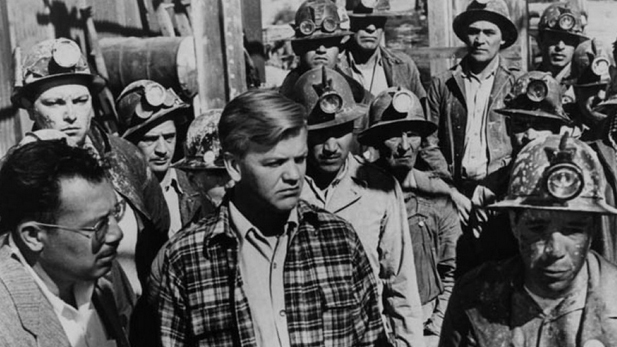
I am open about my sociopolitical views.  I'm center-right and in most respects socially conservative.  Therefore, Salt of the Earth, a film that was made by and funded by Communists (or fellow travelers) might not be up my street.  However, it is also about the plight of Hispanics being mistreated, and as a Hispanic, I am attuned to how my ancestors are portrayed on film.  Salt of the Earth is in some ways pretty accurate on some of the more unfortunate aspects of Hispanic culture, and it is a passion project for its worldview.  Sometimes it goes a bit overboard in how the proletariat will rise up against the evil company, but on the whole Salt of the Earth is a fascinating portrait of a particular idea/ideology.

Zinctown, New Mexico.  The Mexican-American miners of the Delaware Zinc Company are poorly paid and poorly treated.  We turn to the Quintero family: husband Ramon (Juan Chacon) and his pregnant wife, Esperanza (Rosauro Revueltas, one of the few professional actors in the production).  They are dirt poor, even for miners, particularly because the Mexican miners get paid less than their Anglo counterparts.  This does not sit well with Ramon, and neither does the payment system in the U.S.  "This installment plan, it's the curse of the working man," he declares in terms I know my parents always used when discussing finances.

Anyway, Ramon and his fellow Mexican miners opt to strike for better pay, and while they have sympathetic white supporters the vast majority of other miners aren't keen on the idea.  In particular, the Sheriff (Will Geer, better known as the Beloved Grandpa Walton on The Waltons) is fine if them Messicans stay in their place (a bit like Donald Tramp...er, Trump).  The union itself is having some difficulty, as this is considered 'men's work', and the men, particularly Juan, finds the idea of women picketing...or worse, VOTING, appalling.

However, because the men might lose their jobs if they do picket, the women take the initiative and form the picket line, taking advantage that they are not workers and thus, technically, are within the law.  The crisis grows until the company, which runs the town and the Sheriff, has the women all arrested.  Esperanza, who has had a political/social awakening, has joined the picketers, taking her baby with her.  The company is not afraid to play hardball, down to trying to run the women over.  In jail, the loud protests of the women for milk for their children among other demands so overwhelms the Sheriff he has no choice to give in.

Eventually, the women earn the right to vote in the union, but the company, enraged by the Quinteros actions, force them out of the company home.  However, they will not be denied, and in the end, triumph over the evils of capitalism.

It has always been my policy to give positive reviews to films that I think are well-made, even if I disagree with their views, and negative reviews to films that I think are poorly-made, even if I agree with their views.  As such, I give Salt of the Earth a very positive review because, given the low budget and few professional actors, it is a finely-crafted film.

Of particular note, and something I think Salt of the Earth has not been given as much credit as it should, is in how accurate it is regarding the machismo and blatant sexism of the Mexican-American males back then (and up to a certain point, still now).  Hispanic men can be more sexist than their Anglo counterparts, and their sexism goes beyond thinking that women should not do 'men's work', or even vote.  Salt of the Earth is clear about how the men felt free to make decisions that impacted the women without so much as consulting them.  It also shows that the sexism and the belittling the menfolk have against their sisters (Juan is a sexist pig, no way around it) held a pretty strong hold for years afterward.  In the Chicano movement of the 1970s, Mexican-American women faced the same difficulties their mothers in the 1950s did, the men stubbornly insisting a woman's place was in the kitchen and as support staff (Dolores Huante be damned). 

Salt of the Earth is a very well-made film if you don't mind accepting that to a point, it is propaganda.  Skillfully made propaganda in the same way Triumph of the Will is a skillfully-made propaganda, but propaganda nonetheless.  This film has the involvement of many left-wing people, all of whom had been blacklisted during the McCarthy Era by Hollywood. (Geer, Revueltas, director Herbert Bibermen, screenwriter Michael Wilson, who had been one of the infamous Hollywood Ten).  Salt of the Earth shows what can happen when a group of like-minded individuals are given free rein without any sense of censorship.  The people behind the film were craftsmen, but they also could not help going at times overboard in their depictions of 'good' versus 'evil'.

That line about installment plans being 'the curse of the working man' sounds rather forced, and the final image of Esperanza (there must be a reason the main female character's name is "Hope") is almost divine in how she (and by extension, the workers) are shown.  Even in some of the professional acting things are a bit overboard.  Revueltas at times seems like she was the amateur of the group, and while it's clear Chacon isn't an actor it's hard to be too harsh.  I do compliment Geer for not going overboard in making the Sheriff into a totally cartoonishly evil character, and shows that perhaps one needed professionals. 

Still, on the whole Salt of the Earth is a strong film and a fine example of how to use film to further a sociopolitical viewpoint.


As a side note, the screening of Salt of the Earth I attended at the Plaza Classic Film Festival had brief conversations with the descendants of the original miners after the film.  One of them, Elisa Sanchez, a daughter of a miner, pointed out that Local 890's Women's Auxiliary had been formed in 1948 and so was organized prior to the events of the film.  Ernestian Kirker, who I think was Ms. Sanchez's cousin, confirmed that children did march in the picket line and made an eloquent statement.  "I'm the legacy of what they did.  It's my story.  It's my people".

There was another person there, whom I know from work who is also related to the miners, whether by blood or marriage I don't know.  I can say on a personal level she is rather unpleasant to work with and she would make the mining company proud in her attitude and behavior towards the people who work under her.  She shall remain anonymous.

We did also learn that there was a 'tiny amount' of Communist funding for the film, though my memory is vague on whether the funding came from the American Communist Party itself or from Communists themselves.  I also note that someone had mentioned that Michael Wilson did not receive credit for Lawrence of Arabia as a result of being blacklisted.  There is still dispute about Wilson's role in the Lawrence script.  He had written a script but director David Lean opted to essentially throw it out and bring in playwright Robert Bolt to rework the screenplay.

The speaker I think might have had another David Lean film in mind, The Bridge on the River Kwai, which Wilson and another blacklisted writer, Carl Foreman, wrote.  The year of Bridge on the River Kwai's release, the screenplay was credited to the novel's author, Pierre Boulle, even though Boulle spoke no English, let alone wrote in English.

Therefore, I think Salt of the Earth is an excellent film, an interesting study in film as agitprop, and a historic film on the gender/civil rights of a hereto unrecognized community. 

DECISION: B+

Sunday, May 29, 2016

Bottle Rocket: A Review

BOTTLE ROCKET

WASP Crime Wave...

I've always found Wes Anderson a heavily acquired taste.  Sometimes I find him enchanting in his deliberate quirkiness (Moonrise Kingdom, The Grand Budapest Hotel), sometimes I find him excruciatingly self-indulgent and cutesy (The Royal Tennenbaums).  Love him or hate him (until recently I was in the latter), Anderson can be called an 'auteur'.  Bottle Rocket, his first full-length feature film, doesn't have all the Andersonian motifs (the camera does go other directions besides left to right...exclusively) and I figure he tried to ground it in some form of reality.  I found Bottle Rocket good, not great, but at least not as incessantly cloying as some of his other features that rely too heavily on the cutesy. 

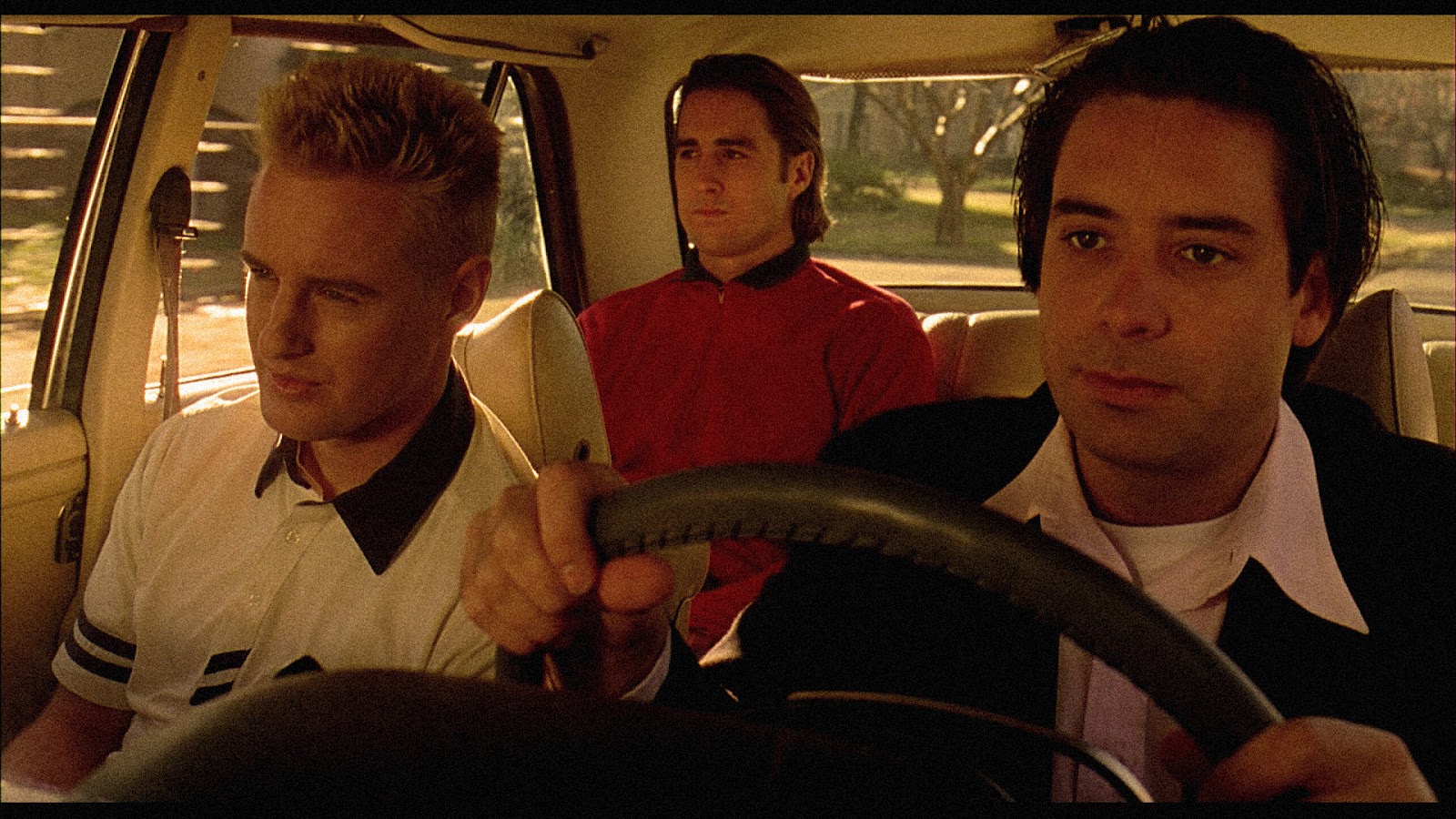
Dignan (Owen Wilson) picks up his friend Anthony (Luke Wilson) from the mental hospital Anthony checked himself in (I believe it was due to a bad breakup).  However, it is clear that Dignan is the one who should have been locked away in the looney bin, since he clearly has delusions of greatness regarding his '75-year-plan' for a life of crime.  Dignan fancies himself a future master criminal, though clearly inept in all aspects of it.  Despite what should have been his own common sense, Anthony goes along with Dignan's schemes (I guess it gives Dignan something to do and aspire to).

Dingan recruits perhaps the worst crime crew in human history, consisting of him, Anthony, and their friend Bob Mapplethorpe (Robert Musgrave) to be the getaway driver.  I think him being the only person who has a car helps in that.  They do pull off a bookstore robbery, though Anthony and Bob find Dingan's rather grand plan excessively complex to the point of idiocy.  Now 'on the lam', they 'hide out' at a second-rate motel, where a pretty young Latina housekeeper, Inez (Lumi Cavazos) catches Anthony's eye.  Soon, a romance ensues, despite the language barrier (because in East Texan Anderson's worldview, Hispanics are incapable of speaking English).


Now it's on to their biggest heist yet, sponsored by Dignan's criminal hero, Mr. Henry (James Caan).  However, by this time Anthony and Dignan have broken ties, with Dignan continuing his life of crime and Anthony doing his best to be on the straight and narrow.  However, Dingan gets Anthony to help in this big heist, which goes surprisingly wrong (I think of Mr. Henry's crew gets shot) and Dignan manages to get himself arrested.  To add to the overall idiocy of these three WASPs, we find that Mr. Henry stole from the Mapplethorpe house while these imbeciles were pulling off their great heist.  With Dignan in jail, Anthony and Bob go see him, and find that up to a point, Dignan is still Dignan, possibly planning an elaborate escape plan...or not.

Well, like a lot of Anderson's C.V., Bottle Rocket is going to be an acquired taste.  I'm slowly reconciling myself to the Andersonian worldview of cutesy, quirky, offbeat, WASPy characters living in their own universe barely resembling anything I could comprehend.  I figure that our worldviews clash because he's from East Texas, while I'm from West Texas...two universes divided by the same state.

What I see in Bottle Rocket was that Anderson hadn't given in to his total immersion into the self-awareness of the quirky.  Instead, he handled the characters as realistically as they could be, given how dumb and delusional they were.  He actually managed to move the camera from left to right and even did cross-editing.

It's also interesting that fellow Texans the Owen Brothers were also just starting out, but were essentially playing the types of characters they would continue to do so in their careers: Owen the offbeat, slightly dim type, Luke the more rational and responsible one.  One wonders whether they are playing themselves, but I don't know them to make such a broad characterization.

What I can say is that one marvels how Anthony could go along with Dingan's ideas.  As a side note, I figure Bottle Rocket is a portrait of WASP criminal delusions, for who names their child Dignan?  I also note, with disdain, the idea that the only Hispanic in the film serves both as 'the love interest' and has to be English-deficient.  Would it have killed Anderson to not go down this stereotypical route?

However, I can't say that I didn't enjoy Bottle Rocket (seeing Anderson go in other directions instead of his standard left-to-right stop-and-go manner helped).  It was amusing, with a nice twist at the end, and characters whom we do care about (it's hard not to like Owen Wilson's dimwitted, delusional Dignan).  Give Anderson credit for getting great performances out of the Wilson Brothers and Caan as the strong but much cleverer Mr. Henry.

I do remember leaving the screening of Bottle Rocket with a slightly higher opinion of Wes Anderson, though I still think he has a very particular, peculiar worldview that I don't share and sometimes find annoying.  The Wilsons were great and it told its offbeat story with genuine affection for this group of oddballs.

Who knows...maybe I'll learn to stop worrying and love Wes Anderson.

DECISION: B-

Thursday, May 26, 2016

A Hard Day's Night: A Review


A HARD DAY'S NIGHT

The Beatles Go On...

Are The Beatles the greatest band in history?  Let's just say that John, Paul, George, and Ringo are...very, very good.  A Hard Day's Night, their feature film debut, is equal to their music: a brilliant, fun film that captures the charm of our four Liverpool lads and spoofs both the madness and mayhem that Beatlemania brought.  This was when The Beatles were fun and unabashedly so, before they went psychedelic, before the Maharishi Mahesh Yogi, before John was shot and George was consumed with cancer.  Both as a light comedy and a document of its time, A Hard Day's Night is a film that even those who know nothing of music will think, "These guys could PLAY"!

Chronicling the lives of The Fab Four as they race to make a television appearance (whilst avoiding their crazed fans), the Beatles all try to keep their heads together all while keeping a wary eye on Paul's grandfather, John McCartney (Wilfrid Brambell), who is a 'clean old man'.  After the chaos of boarding the train, they find their time in their hotel a bit restrictive, but their manager does his best to keep them in line. 

Once they make it to the BBC Studios, Grandpa John talks Ringo, who is feeling left out of things, to wander about and find some freedom.  Needless to say, Ringo goes out...as the show gets ever closer!  Eventually, after an arrest of both Ringo and Grandpa John, all works out for the best as The Beatles entertain their fans with their songs, giving a respectful bow at the end.


I think A Hard Day's Night is simply a great way to introduce The Beatles to anyone who hasn't heard or heard of them.  I'm sure there must be someone out there.  We get the lads as I figure they probably were, for as far as I can tell, they were playing themselves (or at least, remarkable simulations of themselves).  Alun Owens' screenplay gives us such delightful moments of cheeky fun and bravado.  When facing against a hostile older gentleman on the train, he snaps at them, "I fought The War for the likes of you".  I think it was either Ringo or John who replied, "I bet you're sorry you won!" 

Another of the great and fun moments of A Hard Day's Night is when The Beatles endure a press conference.  Long before the term 'mockumentary' took hold, I figure director Richard Lester was creating it, as the boys go through the inanities of answering the same questions over and over again.  Ringo's cheeky replies ("I'm a mocker", when asked whether he is mod or a rocker) and Paul's repetitive answers all lend this sequence a light, breeze manner that runs throughout the film.

Of course, if you think about it, it is the music, the extraordinary music that is the real highlight of A Hard Day's Night.  I remember quite well when I went to the Plaza Classic Film Festival when A Hard Day's Night played, and Beatlemania was still in full swing.  The audience was happily singing along to the songs, and while I don't think anyone actually screamed like the fans in the concert scene (and even slightly muted they were still strong screams), everyone had a good time.

A Hard Day's Night captures the fun of being young, foolish, crazy, and in The Beatles' case, extremely, exceedingly talented.  A great soundtrack, with a fun a breezy manner, A Hard Day's Night is a delight from beginning to end.  She Loves You...and We Love You, Too.

Yeah, Yeah, Yeah.


DECISION: A+

Wednesday, May 25, 2016

Agnes of God: A Review

AGNES OF GOD

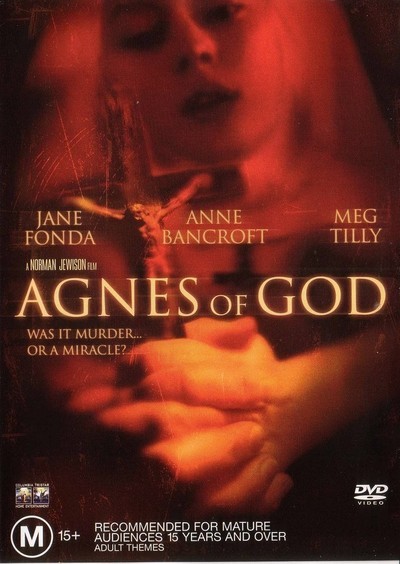
Agnes of God has many good qualities to it, well, to my mind, precisely two: Meg Tilly and Georges Delerue.  In other ways, it is a bit rushed and a bit muddled, but for myself I enjoyed it just enough to make it worth my time.

One night, in an isolated convent, a postulant is found bleeding.  The Mother Superior, Mother Miriam Ruth (Anne Bancroft), is shocked to see Sister Agnes (Meg Tilly) on the floor in such a shocking state.  Even more shocking is the dead baby in the wastebasket...apparently having been strangled with its umbilical cord.

What exactly happened on this night?  To investigate whether Sister Agnes is mentally fit to stand trial, the Quebec court enlists Dr. Martha Livingston (Jane Fonda).  The lapsed Catholic is still bitter about how the Church was towards her, her late sister, and the Church's attitudes towards her decisions (we learn when she visits her Alzheimer's afflicted mother that Martha has had both a divorce and an abortion).  Despite this, she agrees to investigate Sister Agnes' mental condition.

Dr. Livingston is shocked by the fact that Agnes has no memory of ever being pregnant, let alone giving birth.  Even more astonishing is her claim that she does not know how she became pregnant.  As far as Livingston can make out, Agnes has no knowledge of sex: both the mechanics and the pleasures of it.  It's as if Agnes conceived her child without her even knowing it.  Moreover, Sister Agnes is a woman who has visions and hears voices, one who is extremely devout in an unorthodox fashion.

Mother Miriam is no help to Dr. Livingston.  She is a woman of the world (having been married with children, and even grandchildren, before joining the order).  She is determined to keep Agnes an innocent, and is openly hostile to Livingston.  She also gives Livingston a surprising bit of information: Sister Agnes once had stigmata appear without cause. 

The time of conception has been pinpointed to a particular date, but we still do not know how Agnes, an innocent nun isolated from everyone save the other equally reclusive sisters, got pregnant.  Over Mother Miriam's objections, Dr. Livingston gets the court to order a hypnosis.  Here, we learn that she is indeed the mother, and that someone else knew she was pregnant.  Under a second hypnosis session, we discover that Agnes claims that on the night of another nun's death (a nun she was close to), she went through a secret passage that the late nun showed Agnes, and there, she met 'Michael', who in Agnes' mind could have been God Himself.

To everyone's shock, Agnes' stigmata returns, and Agnes claims that God knocked her up.  In her shock and anger, Agnes strangled the newborn (the pregnancy being known to Mother Miriam, who is also Agnes' aunt).  The court finds Agnes incompetent to stand trial and instead of a mental hospital is confined to the convent. 

Whoever actually fathered the child, be it human or divine, we will never know.

I think that perhaps this is one of Agnes of God's flaws: the mystery pops in and out to serve playwright John Pielmeier (adapting his own stage play) own musings on the possibility of miracles.  After all, if we believe Sister Agnes, then her child's conception was the work of the Divine...one she rejects.  Yet at the end, if we believe Dr. Livingston, she, this hardened atheist, now has room for doubt regarding her own lack of faith.

You have a mystery (who fathered Agnes' child and was this conception something Agnes sought or not) mixed in with the idea of a miracle (or not).  If you look at Agnes of God as a mystery, it isn't all that big of a mystery.  Agnes had the child, Agnes was in the room when the child was found dead.  It isn't hard to figure that Agnes murdered the child. 

The whole 'divine vs. human' debate Agnes of God would like to have doesn't quite come to fruition, or at least in how either Pielmeier or director Norman Jewison probably would have wanted.  However, the elements of Agnes of God that do work, work so well.   Those elements, as I mentioned in the beginning, are two.

The first is Meg Tilly's Oscar-nominated performance as the possibly deranged, possibly saintly Sister Agnes.  Tilly has an extremely difficult role: making Sister Agnes' intense faith something believable without making her seem downright bonkers.  Tilly kept that almost impossible balance between Agnes' innocence, almost sweetness and her more extreme reactions grounded without going all crazy.  Even in those scenes where she is some sort of mania (like when she is remembering her encounter that led to her pregnancy and the mass bleeding of her stigmata, Tilly never goes over the top or give in to the temptation to make Agnes a crazy person.  Instead, Tilly makes her a disturbed one, that mixture of naïve and ethereal into someone who could genuinely exist.

Bancroft, on the other hand, at times does go a bit hammy, her delivery deliberately too snappish and quick, with a bad tendency to make faces as a sign of her acting (her Oscar nomination notwithstanding).  Fonda, for her part, does great work with an underwritten part.  We get little hints of Dr. Livingston's life (the dementia-afflicted mother, her abandoning of her faith), but they don't go very far in exploring it. 


The other simply brilliant element is Georges Delerue's Oscar-nominated score.  Haunting and beautiful, it is an elegant and soothing counterpoint to the insanity that surrounds the Convent of the Little Sisters of Marie Magdalene. 

We also have Sven Nykvist's cinematography, capturing the beauty of the isolated convent and the intensity of the final hypnosis: the blending of the red and white frightening.

The mystery is never solved (I suspect that Agnes was raped...by a human, and in her state was unaware of what was going on save for the ecstasy she felt), and I think we are suppose to reach our own conclusions.  In that respect, we are left a bit frustrated, but in other aspects (Tilly and Delerue), Agnes of God is better than some of its parts.


DECISION: B-