Sunday, July 10, 2016

Gods of Egypt: A Review


GODS OF EGYPT

I pride myself on judging things for what they aim for, not for some grand vision.  If a movie is suppose to be silly or serious and succeeds, then I tend to favor it.  It's only when it tries to be something and fails spectacularly that I go full road-rage on it.  Therefore, I turn to Gods of Egypt with some puzzlement, but not at the film itself.  Instead, my puzzlement comes from the bashing it has received, ranging from mischaracterization of Egyptian deities to ethnic casting to story.

I think we need to remember at least one thing when it comes to Gods of Egypt.  It's called "Gods of Egypt", and everything about it indicates that none of this is meant to be taken seriously or literally.  What IS Gods of Egypt?  It's a romp, a silly, CGI-laden romp, and as such, why should I bash something that I enjoyed?

In an alternate universe of ancient Egypt where gods walk freely among men, Osiris (Bryan Brown) prepares to hand over the crown of Egypt to his son, the wastrel Horus, Lord of the Air (Nikolaj Coster-Waldau).  Horus and Hathor, Goddess of Love (Elodie Yung) are in love.  To witness the coronation is resourceful young thief Bek (Brenton Thwaites) and his beloved, Zaya (Courtney Eaton).  Bek has no belief in the gods, while Zaya is firm in her belief in the goodness of Horus. 

At the coronation storms Set (Gerard Butler), Osiris' brother who appears to at first be happy for them.  However, he soon kills Osiris and declares himself king in a coup d'état.  Not only that, but he has revoked Osiris' earlier proclamation that the Afterlife is available to all.  Now, you have to pay to enter the Afterlife, and if you don't, you're erased from existence itself after death.  Some of the other gods attempt to go against Set, but his guards overpower them.  Horus also tries to kill Set, but Set manages to blind him temporarily at first, then after defeating him, permanently by removing his nephew's eyes.

It is a year later.  Horus has gone into exile, indulging in self-pity at his tomb/temple.  Most of the other gods have either gone into hiding or been killed by Set.  For his part, Set has taken Hathor as his mistress, since technically I think he's still married to Nephthys (Emma Booth), the last major god to still hold out against his tyranny.  He has enslaved humans, though he grants his master builder Urshu (Rufus Sewell) some sway, especially since he's built an obelisk so tall Set's father Ra (Geoffrey Rush) can see it from the Heavens.

Bek is still stealing, and Zaya is now one of Urshu's many slaves.  They still love each other, and while Bek is for fleeing, Zaya is convinced Horus can retake the throne.  To do that, he'll need his eyes, which are kept in Set's treasury.  Guess who is capable enough of breaking in and stealing them?

Bek manages that feat with some help from Urshu's stolen map, but Urshu discovers Zaya's treachery and orders them both killed.  They make their escape but Urshu manages to kill Zaya with his arrow as they flee with one eye (there being only one at the treasury) to Horus'. Horus, bitter and angry about everything, eventually agrees to a bargain: in return for getting both his eyes and vengeance on Set, Horus will help Zaya return from the Land of the Dead (as there are many days between actual death and final judgment, especially since Zaya has no treasure to offer).

Bek agrees, but is unaware that not even Horus can bring someone back once they've entered the world of Anubis.  Horus knows this, but is too wrapped up in himself to care. 

They make a journey to see Grandpa Ra, who grants his grandson some water to quench the desert, making Set vulnerable (though he tells Horus the waters of Creation are not his to give, thus staying completely out of the power struggle).  Set, who know knows Horus is on the move, sends creatures to kill him and this pesky 'mortal'.  He also lays final siege to Nephthys' palace and removes her wings.  Hathor escapes from Set to join Horus, and they in turn seek help from Thoth (Chadwick Boseman), god of wisdom, to help solve the riddle of the Sphinx and get Horus' other eye.

Set is on to all of them, however, removing Thoth's brain as part of a plan to make a super-god, and despite Bek's anger his love Zaya tells him to keep faith on Horus (Hathor sacrificing herself to help Bek go to the Afterlife while he still lives).  Horus, regretful about his acts to this mortal, devices a new plan to defeat Set, especially after Set has attacked Ra to allow Chaos to enter Egypt.  Set believes that if he defeats Chaos, he will gain true immortality and rule forever, but does not realize the dangers. 

The final battle between Set and Horus commences.  After the victory, Ra appears, indebted to his grandson for helping restore him to keep Chaos at bay.  He agrees to grant him one wish...and Horus asks for nothing except the return of Bek and Zaya from the dead.

At the end, Horus declares that it is not gold, but good deed and noble living that will ensure immortality in the Afterlife, and he goes off to find Hathor, his one true love.

I'm going to say off the bat that I enjoyed Gods of Egypt as nothing more than a romp, a film that kind of just rolled around, broke no new ground, but never intended to be anything other than mild entertainment.

It had a very traditional script (arrogant hero learns through a journey to be true hero).  It draws, wittingly or not, from much better films like The Thief of Bagdad with its thief/hero.  One might even say Gods of Egypt rips off The Thief of Bagdad.

You can tell that Gods of Egypt isn't serious just by the acting.  At the top of the list is Gerard Butler, who is Egyptian by way of Glasgow, his Scottish brogue never getting in the way of logic.  His performance was like watching him do 300 By the Nile.  At one point, when he addresses his private army, his Set Division, I was half-expecting him to shout, "THIS IS CAIRO!"  This is typical Butlerian braggadocio par excellence, and by now I think people ought to stop wondering if he'll ever play subtle.

Certainly Academy Award-winner Geoffrey Rush wasn't apologizing for his nice paycheck and CGI-enhanced work, vamping it up for Ra to his endless amusement (and ours).  Same goes for Sewell, who I think had loads of fun as the camp villain.

I have heard of Nikolaj Coster-Waldau but don't know exactly what he's famous for, but here he did what was required of him: be the angry god who eventually learned to be a leader.  I hope Brenton Thwaites goes on to better things because he certainly, I think, is a far better actor than his turn here (particularly given he had this very curious semi-British accent).  He however did what he could with this role, his youthful, mischievous, eager, and in love thief being a bit endearing.

In fact, I think Gods of Egypt really didn't require much in terms of acting.  Boseman's turn is perhaps the most curious, his somewhat fey, foppish Thoth (complete with another faux-British accent) made one wonder whether he was camping it up to compete with Rush.  He was amusing if nothing else (and appeared amused by it all as well). I think Eaton was about the only one who really tried to do something serious with her role, but more the pity given that she wasn't given much to do.  I hope she and Thwaites get better roles.  As for Yung, well, she was very beautiful and I think she knew this was junk, so just too vamp it up a bit, though I get the sense that like Eaton, she was trying.
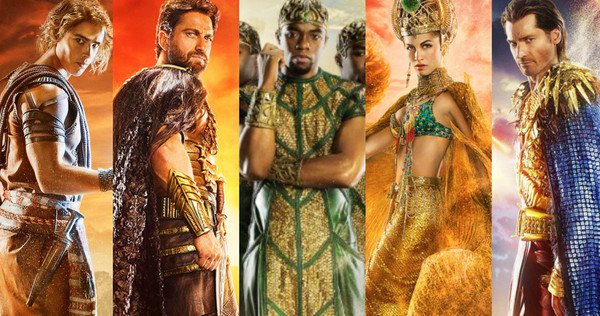

Let me digress slightly to address the controversy over the 'whitewashing' of the cast, the lack of non-Arab/black actors as Egyptians.  First, this is not meant to be history.  If Gerard Butler and Nikolaj Coster-Waldau had been cast as the leads of Nasser and Sadat: The Movie, then I would be the first to criticize this.   As they were playing mythological figures, I think people should pull back a bit and cut the filmmakers some slack. 

This isn't to say that casting Caucasians in practically every role was a good one.  Certainly the casting of Horus, Hothar, Zaya, and Nephthys didn't require white actors (though to be fair, Yung is half-Cambodian, half-French).  I make an exception for Thwaites' casting as Bek since I figure Gods of Egypt was a showcase for the up-and-comer, Rush as the 'guest star' to bring a touch of class to something as silly as Gods of Egypt, and Butler as the de facto 'star name' to serve as a draw.  They were wise to cast Boseman, who was quite good as the egocentric god of wisdom, but they should have in retrospect opened up the casting for more minorities. 

As there is no case as to why the casting was wrong, there is no case as to why the casting was right either.  If I had been advising them, I would have urged a wider and more diverse casting, though the idea that casting white actors to play Egyptian mythological beings is on par with D.W. Griffith's The Birth of a Nation having white actors in blackface is excessive.

Perhaps they could have selected this person to play Horus:


Omar Sharif, Jr. (grandson of the most famous Egyptian actor in history).  Since he IS ethnically Egyptian (and half-Jewish as well), what was to prevent casting him?  Name recognition cannot be a whole reason given that Coster-Waldau is not known as a film star. 

In short, while the casting could have been more open, I'm not going to trash Gods of Egypt for casting majority white actors to play non-real figures.  Still, I think the whole controversy in hindsight is educative on how films that do not require a particular ethnicity or race for a role should indeed allow for more inclusiveness.  Filmmakers should take note of the controversy over Gods of Egypt as to whom they consider and ultimately cast for roles and draw lessons from that.

Still, on the whole Gods of Egypt is dumb, silly, and unapologetic about it.  Its story doesn't quite make sense even within the confines of its mythology (we see Thoth's brain ripped out, but at the end he is restored to life and never get a reason as to how this was done). Still, I qualify Gods of Egypt as a romp: a silly, slightly fun film where you aren't asked or required to take any of it seriously.  As a result, I can enjoy myself and not worry about such pesky matters as historic accuracy or even total logic.

I don't think anyone will ever make the claim that Gods of Egypt is even a good picture, let alone a great one.  I CERTAINLY won't.  However, when a film embraces its own cheesiness and celebrates its own self-conscious absurdity, I cannot help but enjoy it for the romp that it is.

Besides, given how lousy 2016 has been, ANYTHING that looks even slightly fun is a step forward.

DECISION: C+

Saturday, July 9, 2016

Hail, Caesar!: A Review

HAIL, CAESAR!


I have found the Coen Brothers to be a very acquired taste, so much so that I have yet to acquire it.  As often as I'm told they are geniuses, I have yet to find much evidence of that.  Yes, Fargo was good, as was Inside Llewyn Davis and their remake of True Grit. However, that's pretty much it for me in the Coen Brothers department.  I'm one of the few who adamantly detested No Country for Old Men, and I still cannot bring myself to watch A Serious Man again (unless it's part of some mad scientist plot against me).  Now we come to Hail, Caesar!, but I'm not sure if it's meant as a love letter or a poison pen letter to classic Hollywood.  Hail, Caesar! likes to think it's funny, and there are a couple of good spots that make it better than some of the films of this, the anti-1939.  However, truth be told you can skip it, particularly if you find the Coens less genius and more poseurs.

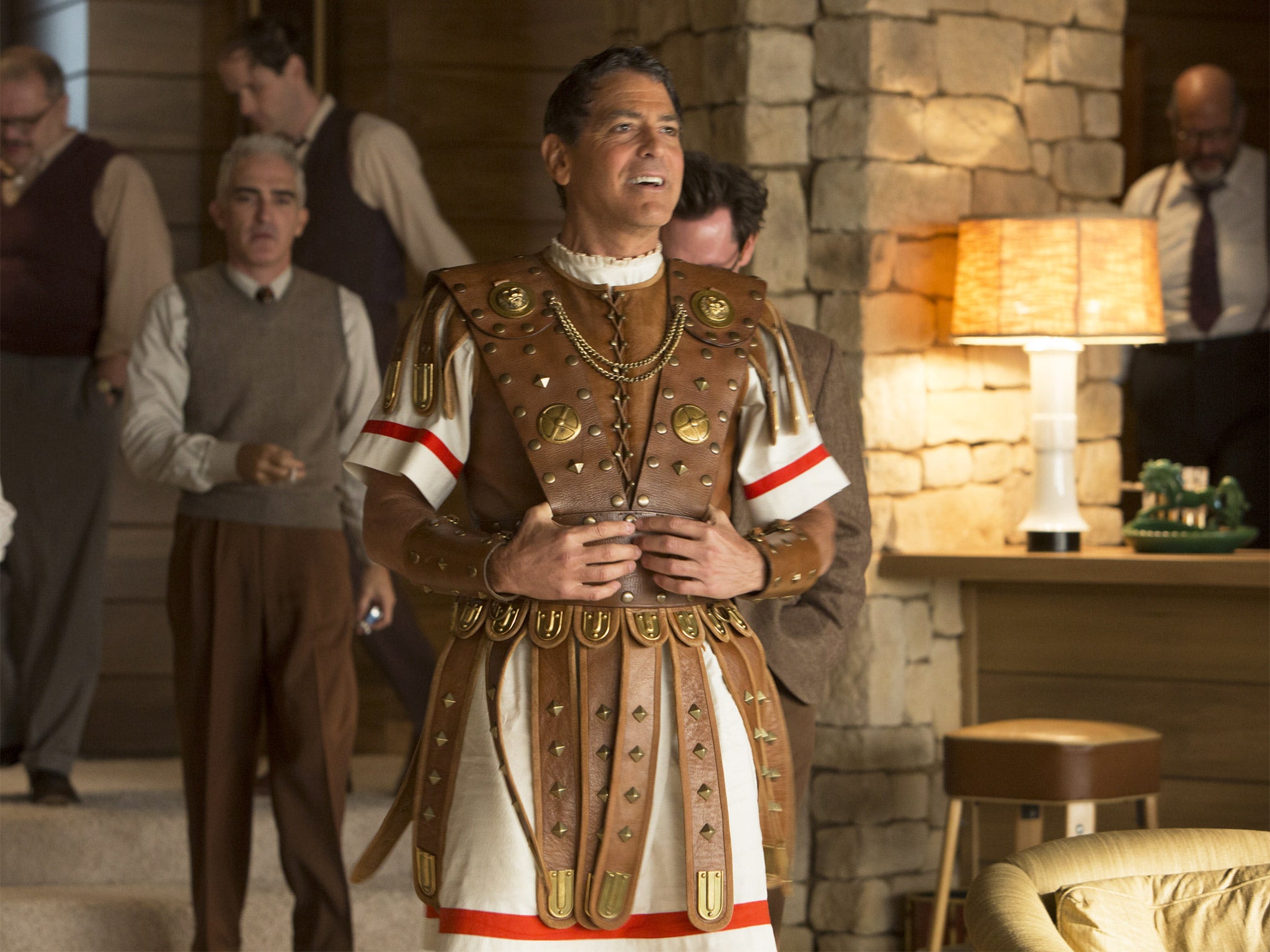
Eddie Mannix (Josh Brolin) is an executive at Capital Studios who is also a 'fixer', someone who takes care of problems the studio's stars get into.  He also oversees several productions ranging from aquatic musicals to sophisticated dramas to B-Cowboy pictures.  At the top of the production list is the Biblical epic Hail, Caesar!: A Tale of the Christ (making me wonder where they got THAT subtitle from).  The film's star is Baird Whitlock (George Clooney), who is a thorough dolt.  Whitlock is the unwitting victim of a scheme.  A couple of extras drug him between takes and abduct him. 

Mannix at first is not too concerned that his star has disappeared, suspecting he might be on a bender or shacked up with some woman or other.  He has more problems to contend with, such as whether religious figures brought in to look at the Hail, Caesar! script find anything objectionable.  The Catholic, Protestant, and Orthodox ministers don't find much to object to (though the Orthodox priest complains the idea of a charioteer jumping from one chariot to another in the middle of the race unbelievable).  The Rabbi for his part constantly complains that the script makes Jesus look like God...which he isn't, he keeps reminding them.

Mannix also has other productions to look into, such as Merrily We Dance, the latest prestige picture from European director Laurence Laurentz (Joseph Fiennes).  I'd like to point out that naming your uppity character "Laurence Laurentz" is what passes for 'sophisticated, witty humor' in Hail, Caesar! just so you know.  This A Place in the Sun-like production faces a major crisis when the New York office decides to put the Roy Rogers-type Hobie Doyle (Alden Ehrenreich) as their Montgomery Clift-type lead.  It's clear that this dolt, with his pronounced twang and general idiocy/naivete is not cut out for this production.  Over at the lavish aquatic musical film, the Esther Williams-like star DeAnna Moran (Scarlett Johansson), is as brash and coarse as they come, with her own Nuw Yawk accent.

She is also knocked up and unmarried, and she won't hear of a third weddin'.  To sort this out, they go to surety agent Joseph Silverman (Jonah Hill), to act as foster parent for her bastard until she is able to adopt her own child (no doubt the Coen Brothers were drawing from the life of Loretta Young, who also surreptitiously adopted her own daughter). 

Meanwhile, Baird finds himself with a 'study group' made up of Hollywood writers.  It's soon clear that they are all Communists (who have even by their own admission snuck in pro-Soviet propaganda into their films.  Where's Joe McCarthy when you need him!).  Within the day this group informs Baird that not only have they kidnapped him, with their name being "The Future", but have managed to make the dimwitted star a convert to the Red Cause.

Mannix by now is worried, especially with twin gossip columnists Thora and Thessaly Thacker (Tilda Swinton) hot on his heels.  The bitter Louella Parsons/Hedda Hopper types want an exclusive or either or both will reveal Baird Whitlock's great secret that involves...ON WINGS AS EAGLES!  Mannix also has an offer for a job at Lockheed to think over along with the fact that there is a ransom for Whitlock.

At another set, the Gene Kelly-like Burt Gurney (ex-stripper Channing Tatum) is doing a surprisingly risqué number, No Dames!, which frankly suggests that women and seamen don't mix (yes, I used that line before, but it's too good to pass up).  The ransom is left on that set, but it isn't until Hobie is on a date with the Carmen Miranda-type Carlotta Valdez (Veronica Osorio) that Hobie realizes who took the cash. 

Burt Gurney is the Leader of The Future!  Hobie manages to get to Gurney's seaside home, where a clearly stupid Whitlock asks if the singing cowboy is a Communist too (Whitlock clearly not understand what Communism actually is).  Gurney has his Hollywood Twenty sail him to the secret sub, where in his eagerness to save his dog Engels, he drops the cash.  Hobie spirits Baird off before the police arrive, and the next day, as Baird starts spouting off Commie propaganda as if he knew what he was talking about, Mannix starts slapping him about, telling him that the studio has been good to him and to everyone else, so drop the I Heart Stalin bit.

Eddie Mannix decides to stay in this crazy business.


I figure that Joel and Ethan Coen thought audiences would be rolling on the floor laughing at their brilliance.  They might have been laughing, but I argue it was more at them than with them, specifically at their pretentions of high intellect.

Now, it isn't as if I don't get what the Coens were going for (a romp through the world of 1950s moviemaking, particularly with the at times exaggerated mannerisms of certain genres).  It's in the fact that much of Hail, Caesar! isn't funny at all.

Now, I'm the first to say that there were some amusing bits, and all those courtesy of the future Han Solo, Alden Ehrenreich.  His Hobie could have come across as a total idiot, but Ehrenreich makes him more a sincere albeit dim character.  When he shows up at the Merrily We Dance set, he knows he is clearly out of his league, but being the trooper that he is, does his best to follow Laurentz's direction.

This involves a clever (but not laugh-out-loud-funny) bit where Hobie attempts to say the rather posh lines exactly like Laurentz, down to Laurentz's accent, which makes Hobie's efforts to sound as posh as Laurentz all the more amusing.   We see Hobie's intelligence when it is he, simpleton that he is suppose to be, advise Mannix to look at the extras working on Hail, Caesar! for clues as to who kidnapped Baird, saying that extras are rarely noticed.

Ehrenreich also shines when he's at his film, taking the reception to his Lazy Ol' Moon song with good spirits even if it was turned from a sincere love ballad into a bit of a comic relief scene which he didn't intend. 

As a side note, I would not object if either No Dames! or Lazy Ol' Moon found themselves in contention for Best Original Song Oscars (as well as Ehrenreich as Best Supporting Actor).


I don't fault Brolin for doing a good job here either.  His quick deliver was in the style of a screwball comedy, though the particulars that he has to face (save for the abduction) don't seem particularly interesting.  Clooney can do his himbo bit in his sleep. Johansson is wasted as the Esther Williams-meets-Jean Harlow broad.  Her whole storyline could have been cut without it impeding the story.

Same goes for the ex-stripper.  Granted, Tatum can move (as I'm sure he's proven before).  However, how would we get an indication that he was the Red Menace since I think he was in just that one scene (which was I figure an homage to On the Town).  I wonder if the Coens just picked him to be the Useful Idiot because he was there and couldn't palm it off on someone else.

Over and over in Hail, Caesar!, things appear only to have nothing to do with the overall story (the Esther Williams bit, Mannix's struggle over to stay or go).  The whole 'scandal' over On Wings As Eagles that we learn about at the very end of the movie (that Whitlock allegedly got his big break in this movie by performing sodomy with Laurence Laurentz) just appears out of nowhere.  Given that throughout Hail, Caesar!, Whitlock's rampant womanizing is suspected at first to be the reason for his disappearance, one wonders where this bit came from. 
You throw something at the audience which the audience has no evidence or clue to, so how do you expect them to react with either shock or amusement at something they've been given no information about?  That also applies with Burt being the Communist (though to be fair, Gene Kelly was a very liberal person, even by Hollywood standards). 

Moreover, the entire verbal spat between Christians and Jews seems to come from another world altogether.  It isn't funny (though it's trying to be), and no Jew I know would go into fits over the Christian concept of Jesus being God.  I think the Jewish community is fully aware where Gentiles stand on Jesus.  I've even seen a rabbi and a priest discuss the original Ben-Hur on TCM without any of the idiotic hostility the Hail, Caesar! rabbi expresses. Despite what the Coen Brothers may say or think, Jews are nowhere near that hostile to the idea of Christ.

The comedy save for Ehrenreich comes across as forced, unnatural, and unfunny (making the gossip columnists twins wasn't funny at all, but bless Tilda Swinton for trying).  For a comedy, the film is a flop. 

Finally, let me say how I hate voice-over (provided by Michael Gambon, Dumbledore Number 2).  It doesn't work here and is so distracting.

I was impressed by Alden Ehrenreich (to where I think he might pull off The Adventures of Young Han Solo).  A couple of the musical numbers were good.  Apart from that, the Coen Brothers continue to show how they are still a very acquired taste.  Still, given just how lousy 2016 in general has been, Hail, Caesar! actually looks good...and I feel bad.

I see at least one ass here.


DECISION: C-

Friday, July 8, 2016

The Huntsman: Winter's War. A Review

THE HUNTSMAN: WINTER'S WAR


After watching Alice Through the Looking Glass, I rhetorically asked myself could there be such a thing as a sequel that was worse than the original. 

I hadn't counted on The Huntsman: Winter's War.

I look around and wonder, was there anyone who really wanted more stories about the dull Huntsman, who has no personality and as embodied by Chris Hemsworth, no one to bring anything to life.  Yet here we are, following up the pretty dull Snow White & The Huntsman with something that is shockingly bad.  The Huntsman: Winter's War plays like the fevered ramblings of a crazed writer who decided to write some bizarre and boring mashup of The Lord of the Rings, The Lion, the Witch, and the Wardrobe, and even of all things, Frozen.

Winter's War is both a prequel and sequel to SW&TH, which makes for shall we say very jumbled viewing.  In the prequel part, Queen Ravenna (Charlize Theron, cashing a check) is displeased that her sister Freya (Emily Blunt, also cashing a check) is in love and with child.  She is convinced Freya is heading for heartbreak, and that she too has great powers yet untapped.  It isn't until Freya discovers that her beloved has burned their child that she explodes into the female Mr. Freeze, and thus Elsa in all but name emerges.

I'm serious: the children who were in the theater called her "Elsa" once she went all white and turned everything into an endless winter.

As part of her revenge on all mankind she gathers children to her castle by force and trains them to serve as her version of the Republican Guard.  They will be her "Huntsmen" (though that term is unisex since her Praetorian Guard includes girls).  Among them is Eric (Hemsworth), the titular character, and Sara (Jessica Chastain, who I figure doesn't have a good agent).  Eventually, they do fall in love, which violates Elsa's one law: NO LOVE!  It appears that Sara is killed by Queen Elsa, and Eric is dumped into the river (though whether they knew he was dead or alive I cannot verify, due to having fallen asleep off and on during the film).

It's here where things start getting really, really muddled.

We get a quick recap of SW&TH, then bounce seven years later.  It seems that Snow is slowly being driven insane by the magic mirror, so she has it sent off to a sanctuary.  However, the guard taking the mirror there have disappeared, and Her Majesty has commanded Eric to go fetch the mirror and take it to the sanctuary (and keep it from Queen Elsa's hands too).  Eric, however, knows the Frozen Queen's tricks and knows he's being followed.  He isn't thrilled to take two dwarves with him, but he does.

It is somewhere here that he discovers that Sara is alive and not dead (though again, the actual logic of all that is highly chaotic).  They join forces and find the mirror, but it has a dark power over those who look at it.  That makes it more imperative they throw it into Mt. Doom...I mean, take it to the sanctuary.  Sara, however, after a night of passion with Eric, has betrayed him to Elsa.  In another twist, Eric realizes that Sara has not betrayed him because she, who is a mistress archeress, did not kill him (she never misses, we often hear).  With that, it's off to the Wicked Witch's castle to destroy the mirror and save Sara.

It's here where Elsa uses the mirror and brings Ravenna back, her spirit somewhere between life and death.  A battle ensues between them all, especially after Elsa discovers what we all knew from the get-go: she was the one who burned her niece alive (having hypnotized the father to do it).  Eventually Ravenna is defeated...or is she?

Emily Blunt auditions for Frozen Live!

Within ten minutes of The Huntsman: Winter's War at the most, I was falling asleep.  It does not help that we get awful voice-over that serves as guide to things we are either seeing or things that are unimportant.

Were professional movie-makers involved in this?

I have made no secret of my utter hatred for voice-overs, finding that they very rarely work (Sunset Boulevard and Blade Runner being exceptions, but then again those were made by extraordinary directors).   This one was made by Cedric Nicolas-Troyan, who makes his feature film debut. 

He ain't no John Huston, that's for sure.

As I was slipping in and out of consciousness, wondering exactly how many other films Winter's War could steal from (Freya turning into Frozen's Elsa, only bitchier; the magic mirror whispering words of temptation to keep it from being destroyed, Freya turning people into statues and wondering where she kept Mr. Tumnus), I thought who seriously could find any of this interesting.

It's bad enough when you get good actors in bad films, Theron vamping it up to the Nth degree, Blunt looking almost confused.  It's worse when you get bad actors in bad films.  As much as Chris Hemsworth is thrown at me as a legitimate thespian, he has yet to make a good film or give a good performance that didn't involve him swinging a massive hammer. 

I think he was trying to cover up his native Australian accent with some curious Irish lilts, and in the process making himself almost unintelligible.  His already deep, growly voice is at times hard to understand, but throw in his efforts to sound like narrator Liam Neeson and it begs for us to have subtitles.   Chastain did herself no favors here either, with her own curious accent and dull performance.

Hemsworth is almost always dull, so why bother picking on him for failing to deliver once again?

It's odd that the film showed things that were never commented on or quickly passed over.  In what appears to be a magical forest, we see turtles and snakes made out of grass, but no one appears to notice.  When they do, it's to comment on how the fairies will help them race to Freya's castle, as if this is routine.

Almost comically bad performances, a boring story with a dull protagonist, it's as if The Huntsman: Winter's War was made to show us that not only was Snow White not necessary, but The Huntsman as well.  Whether Kristen Stewart was not asked to return or declined to I cannot say.  However, as lousy an actress as she is, at least she can say, "I really dodged a bullet that time".

DECISION: F

Thursday, July 7, 2016

The Finest Hours: A Review (Review# 820)


THE FINEST HOURS

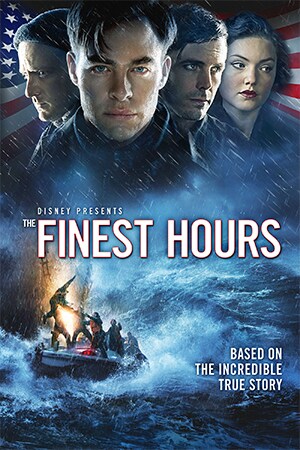
I cannot fault The Finest Hours for trying to be inspirational.  I can fault it for not succeeding. The Finest Hours, based on a true story, never seems to decide what story it wants to tell or how to go about telling it.  This leads to essentially two films (sometimes three) battling for domination and never working to build a whole.  While there are good elements within The Finest Hours that might make for an entertaining couple of hours (and some genuinely good performances given the limitations of the script), it is a minor miss.

Plot One & A Half involves Bernie Webber (Chris Pine), a Coast Guard member stationed in his native Massachusetts (figuring from his accent).  Chris is a very shy, hesitant man, unsure about how he can be attractive to women (despite looking like Chris Pine).  His friend/fellow Coast Guard member Gus (Beau Knapp) agrees to be part of a double date with Bernie's date, Miriam (Holliday Grainger).  Miriam and Bernie are instantly smitten, and she asks him to marry her.  At first hesitant due to his career, he agrees and being the by-the-book person he is, asks for permission from his commanding officer, Southerner Daniel Cluff (Eric Bana).  Cluff isn't popular among his men, primarily because he is from the South and has a funny accent (as opposed to those from Massachusetts, who speak without one).  Bernie then gets the go-ahead to see about the Pendleton, a ship in danger, taking his frenemy Richie (Ben Barnes), Andy Fitzgerald (Kyle Garner), and Navy member Ervin Maske (John Magaro), who just happened to be there.  They are they only ones able to go.

This news upsets Miriam, who still hasn't heard whether Bernie got permission to marry.  There is also something in Bernie's past, a failed rescue, that haunts the town, haunts Bernie, and is some of the friction between Bernie and Richie.

Now we go to Plot Two of The Finest Hours.  That is on the Pendleton, where Ray Sybert (Casey Affleck), the engineer, tries to keep the half of the ship he and others are in from sinking.  Some of the crew want to abandon ship, but Sybert knows that the storm will kill them on the lifeboats within seconds of getting launched.  He uses all his skill and the muscle of the crew to keep what's left of the Pendleton afloat (the ship having broken apart in the storm).  All sorts of actions are taken to keep the ship going, they hope for a rescue, the crew dislikes Sybert for some reason, and they do eventually get rescued, with only one loss.

The ship Bernie and his crew are in can hold only 12, but they manage to rescue 32 men, and despite having no compass, they make it safe to shore.

The Finest Hours is certainly serious given the subject matter, but it also fails to give us a sense of urgency or danger about the rescue or the men on the Pendleton.  Part of the problem is that we spend quite a bit of time in the Miriam/Bernie romance to where one wouldn't be blamed for thinking the love story was THE story. 

Part of the problem also stems from the fact that Scott Silver, Paul Tamasy, and Eric Johnson's adaptation of Michael Tuogias and Casey Sherman's nonfiction book throws bits that are suppose to tell us things about our figures but don't.  We keep hearing about a previous failed rescue by Bernie, but we also keep hearing he's a good man.  If he's a good man, then why does it appear the townsfolk constantly hold a grudge against him?  Richie's hostility suggests he's an antagonist, but he also appears to not be one (perhaps the very definition of frenemy).  Richie appears still bitter about the previous failed rescue, but then seems reluctantly willing to go on the rescue.

Worse is the situation on the Pendleton.  There is hostility towards Sybert, but I don't think we ever got a definitive answer as to why so many Pendleton crew members disliked him.  The closest we got was when Brown (Michael Raymond-James), the most belligerent of the crew, chides him for being 'separate' from everyone else.  Being reclusive isn't exactly cause to have the whole crew hate one, as far as I know.

A bigger part of the issue with The Finest Hours is that these disparate stories never appear to be in the same movie.  It almost seems that director Craig Gillespie made two or three films and put them together to see if he could get one in.  A whole film could have been made of the Coast Guard's rescue.  A whole film could have been made of the Pendleton crew.  A whole film could have been made of the Miriam/Bernie romance.  Somehow, these three stories never formed into one, which left the impression that each was competing with the other two.

Worse, the entire rescue of the Pendleton didn't come across as professional or even something the Coast Guard wanted to do.  Instead, it came across as almost a chore, which I figure was not the intention but was the end result. 


Not to throw the baby out with the bathwater, The Finest Hours did have some positives.  Despite the sheer limitations of the script, it's a credit that most of the actors rose far above them. A nice surprise is Chris Pine, who has been hit-and-miss onscreen.  He made the insecurity of Bernie with Miriam quite believable (even more so given that someone who looks like Chris Pine would have little to no problem attracting anyone).  I don't know Grainger all that well (though she has appeared in films I've seen).  However, she was simply excellent as Miriam, who loves her man but who won't allow even his commanding officer to put her man in danger (at least without a fight).  Maybe women and seamen don't mix, but I hope Grainger gets more and better parts that befit her talent.

I sometimes forget how good Bana can be (especially since a.) he started out as a comic in Australia and b.) he tried to be the Hulk).  I found his Southern accent quite believable and while again his role was limited I think he too did far better than the role.  I'm more Casey Affleck than his brother Ben in terms of acting, and The Finest Hours is yet another strong performance (though his stoic figure is the type he can do in his sleep, and sometimes it looked as if he was). 

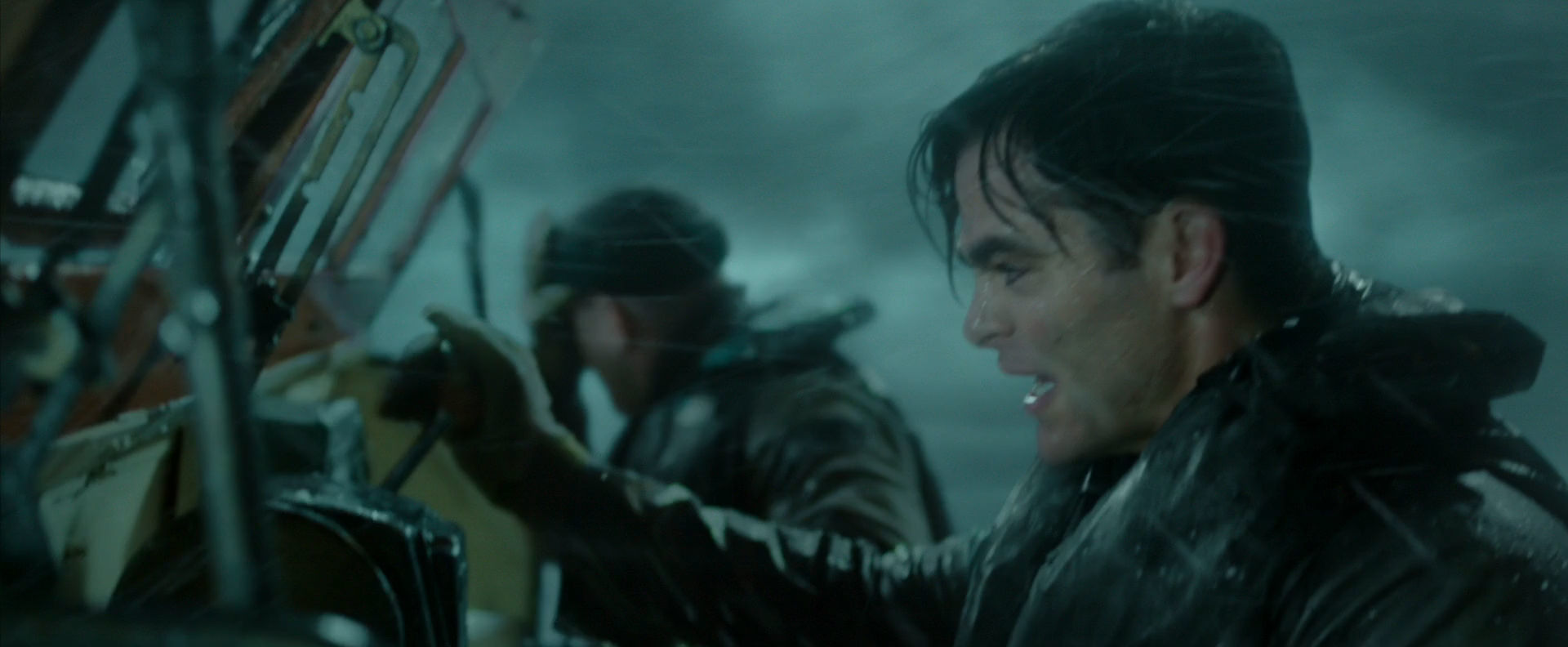
While sometimes the visuals of them passing through the stormy seas at times were almost gruesome, they also were effective in their overall appearance.

The Finest Hours could have been a great story, one of courage and strength under extremely difficult circumstances.  This story deserves better than what we ended up, which was respectable but stilted and a bit lifeless.  The actors did what they could with what they got and made it tolerable.  However, despite their best efforts, this film will not be considered their finest hours. 

DECISION: C-

Monday, July 4, 2016

King Kong Retrospective: The Conclusions


KING KONG: 1933 vs. 1976 vs. 2005

The Mightiest Kong Of All...

Now, of all the remakes I've covered, this is up to now the only one to have more than one version of the same story.  The curious thing is that the earlier the version , the shorter the film.  The original 1933 King Kong comes in at a brisk 104 minutes (or one minute shy of an hour and three-quarters of).  The 1976 remake tops it by thirty minutes, pushing King Kong to over two hours and fourteen minutes.  Peter Jackson's labor of love for his remake clocks in at a whopping THREE HOURS and seven minutes.  Again...OVER THREE HOURS!

I find it incredible that the same story, told three times over, can grow larger and larger.  Still, perhaps it shouldn't be a surprise, given that the 1933 version is an established classic, the 1976 version is derided for being bad (though I found good things within it), and the 2005 version is generally liked but one that I cannot get behind. 

Now, after a very lengthy delay, it is time to look back and see which ones stack up best.

BEST VISUAL EFFECTS


1933
1976
2005

It's an upset in a category that you'd think the most technologically advanced film would have, but I find that despite its Oscar win, the 2005 version now looks horribly dated and fake.  You can tell it's CGI.  The 1933 version, on the other hand, had to resort to stop-motion animation to make the effects real.  Granted, by today's standards they are pretty rudimentary, but if you see the 1933 version you can still feel the emotional impact of Kong's demise.  To me, the 1933 version of Kong looked real, and given we are 83 years removed from the film, its special effects still hold up.

The 2005 version effects, on the other hand, look like they were created, and while at the time they were impressive, I now don't believe them.  However, they are still miles ahead of the 1976 version, which are laughable.  It's clearly a man in an ape suit, and how it won a Special Visual Effects Oscar is downright bizarre.

BEST BEAUTY


Fay Wray
Jessica Lange
Naomi Watts

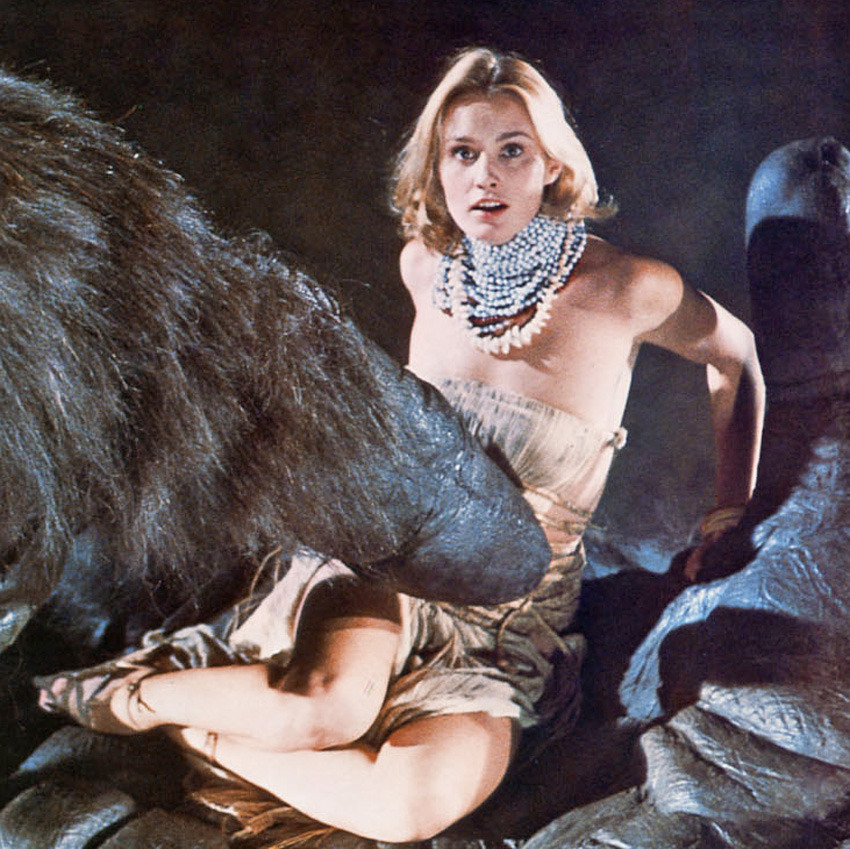
This is a bit of a difficulty for me.  Jessica Lange, who went on to become a respected Academy Award and Emmy-winning actress, made her debut in the 1976 King Kong, and it is one of the most disastrous debuts in film history.  The movie in many ways was bad (though I have a special place in my heart for it), and Lange in particular was held out for particular derision for her performance as Dwan, the femme fatale to our big monkey.  Therefore, why am I going for Lange?

Two reasons.  One: I find her the most attractive of our three lovelies (so sue me). Two: I think that people were far too harsh when it came to Lange.  She was making her debut and had very limited to no acting experience, so insisting she knock one out of the park on her first film is unfair.  Further, the part was so poorly written that I don't think even someone like Meryl Streep could have done much with it.  The fact that Lange managed to comeback and prove her worth after the horrendous reception to her first starring role is a credit to her as a person and actress.

Fay Wray is certainly iconic, so perhaps in terms of acting she is a better choice.  She and Lange are at least better than Watts, an actress I genuinely love but who was so ill-used in 2005.  Her little Chaplinesque routine with Kong made me cringe.

BEST VILLAIN


Robert Armstrong
Charles Grodin
Jack Black

I pretty much dismiss Armstrong merely because he hasn't had an impact the same way Wray did.  That narrows it down to between Grodin's camp oil executive Fred Wilson and Jack Black's deranged movie director Carl Denham (the original version).  Black is not among my favorite performers, and I found his Denham more repulsive than anything.  I think they were trying to make him so super-focused on his 'vision' that he didn't really seem to mind that many were dying for it.

Grodin, on the other hand, made Wilson almost hopelessly comic.  Again and again I find the term 'camp' comes to mind.  I found him hilarious as the somewhat crazed oil executive, and I was genuinely happy when he gets stomped on.  Maybe it's because Grodin was so over-the-top that I gravitate to him.  Still, on this one, the camp wins.

BEST HERO


Bruce Cabot
Jeff Bridges
Adrien Brody

"Generic" is what comes to mind when I think of Cabot.  "Crazed" is what comes to mind when I think of Bridges.  "Committed" is what comes to mind when I think of Brody.  Adrien Brody is not your typical leading man (though I know women who find him terribly attractive).  Perhaps because Brody isn't traditionally good looking, he could make his intellectual playwright Jack Driscoll more believable when he has to become heroic to rescue the damsel in distress.  I don't think he did it particularly well (at times looking bored with everything to where I think he thought he was far above the material), but bless him for trying.

Bridges, to my mind, was just a bit bonkers to be the romantic lead, and truth be told I cannot recall much if anything from Cabot.  Is this a decision by default, or perhaps a desperate pass to find ANYTHING good in the only King Kong film I truly dislike and wouldn't watch again? 

BEST SCORE


1933
1976
2005

The most interesting thing about the 1976 version, the thing that surprised me when I rewatched it, was that the film's score was by John Barry, one of the best composers of his era.  Listening to his score, I was surprised at how good it was for such a schlocky production.  It's as if he were the only one taking any of this seriously.  If it weren't tied into such a disaster as King Kong (though it's a popular disaster and one of the few films I'd argue is better than its reputation), I think Barry's score would have merited at least an Oscar nomination (if not win). 

I think Max Steiner's score is good (as is usually the case), but as for James Newton Howard, I find him perhaps one of the worst composers working today (with one or two exceptions, I find his music horrendous).

BEST VERSION


1933
1976
2005

It's clear that the 1933 original is still among the greatest films ever made.  Both remakes have failed to equal it, let alone top it.

Part of the problem with the 2005 version is that director Peter Jackson was simply too much in love with the whole project.  As a result, he couldn't leave well enough alone, making everything so big and monumental and important he forgot to give his King Kong a heart.  So many 'serious' moments were there, so many plot points introduced that were never resolved (were we really suppose to care about Billy Elliot's history?), and that damn ice-skating bit with Kong...ugh.  Furthermore, he really couldn't cut out a lot of unnecessary aspects (the Depression struggles of Ann, her song-and-dance with Kong, the endless Skull Island visit...not to mention the Cannibal Holocaust-like nature of the natives), aspects that dragged the film into being a bit of a bore.

I hold that the 1976 version, while nowhere in the 1933's league, has its own offbeat charm (very offbeat).  The effects were laughable, some of the acting even more so, and its efforts to be topical with the oil subplot make it a product of its time.  Still, I was entertained by it, something I didn't feel about the 2005 version both in 2005 and 2015 (when I rewatched it for the retrospective). 

Ten years after its release King Kong is a dated snoozefest. 

Forty years after its release King Kong is a flawed but enjoyable film.

Eighty-three years after its release King Kong still thrills, shocks, entertains, and even moves. 

There is no doubt that in this urban jungle, the 1933 King Kong still is the best, and will remain so.

Sunday, July 3, 2016

Dangerous Liaisons: A Review

DANGEROUS LIAISONS


I was obviously too young to see Dangerous Liaisons when it premiered, this wicked tale of French decadence and sexual one-upmanship not being considered proper family viewing.  Of course, I'm also from an age when parents didn't take their children to films unless they were family films (or marketed as such, thus explaining why I suffered the traumas of both Gremlins and Indiana Jones & The Temple of Doom).  Back when I was a child, if your parents wanted to go to the movies, they either hired a babysitter or left you with relatives for a few hours while they went out.  Nowadays, parents opt to take their children no matter how young with them to see a movie the parents want to see, even if it's to see things as varied as Fifty Shades of Grey or Insidious or Deadpool.  With that, something like Dangerous Liaisons is downright virginal. 

Dangerous Liaisons is a sharp, intelligent film about the dark side of love and seduction, how the players can get played themselves, and how love can be deadly to those who fall into it.

The Marquise de Merteuil (Glenn Close), a sexual adventuress, wants revenge on the Comte de Bastide, the lover who jilted her.  She asks her equally nefarious 'friend', the Vicomte de Valmont (John Malkovich) to seduce her ex-lover's fiancée, Cecile (Uma Thurman), recently out of the convent, as a way of punishing and humiliating him.  Valmont finds the whole thing rather boring and beneath him, stating that seducing a convent-educated girl who knows nothing of the world (or the pleasures of the flesh) would be far too easy.  He has his eyes on a real challenge: seducing Madame de Tourvel (Michelle Pfeiffer), a respected and respectable woman known for her fidelity and piety.  To have such a truly noble woman, a woman whose reputation is above-board even among the decadent French, as one of his many, many lovers is for him the ultimate challenge.  A secret deal is arranged: if Valmont succeeds in seducing de Tourvel (with written proof of their liaison), Merteuil will indulge Valmont with the pleasure of her company.

Now the two begin their wicked, wicked work.  Valmont takes advantage of the fact that de Tourvel is staying with his aunt, Madame de Rosemonde (Mildred Natwick) and takes a very different approach to his efforts at seduction.  Rather than use his usual tricks, he will seduce her with sincerity and piety.  Valmont professes love to de Tourvel, declaring that his love for her has redeemed him from his former past.  No dice, de Tourvel essentially says, for she has been warned about Valmont.  He is frustrated in his efforts, and gets his manservant to seduce de Tourvel's maid to get at Madame's correspondence.  Valmont learns who has been doing the warning: it is Cecile's mother, Madame de Volanges (Swoosie Kurtz), Merteuil's cousin.  Enraged by this, he opts to seduce Cecile as payback, and does so quickly.

De Volanges notices that something is amiss with her daughter, and asks Merteuil for help.  She knows nothing of the fact that Merteuil has been playing a wicked game of her own.  Having failed to get Valmont's help initially, she opts to take matters into her own hands by bringing the Chevalier Danceny (Keanu Reeves), a poor music teacher and intellectual, into the de Volanges residence.  Soon, her machinations get them to fall in love.  Merteuil then sweeps in and suggests that a 'dangerous liaison' between Danceny and Cecile has begun.  That is what sent them to take refuge with Madame de Rosemonde.  Now, after Valmont's seduction, Merteuil sweeps in and gives Cecile her own womanly advise: to take as many lovers as she can, and let Valmont be her 'tutor' in the art of pleasure.

Valmont continues to whittle down de Tourvel's resistance until she has fallen in love with him and sleeps with him.  However, Valmont has done something he has never done with any woman before: he has fallen in love with de Tourvel as well.  This does not dissuade him from going to Merteuil for her to keep her side of the bargain, but after learning that his feelings run deeper for de Tourvel than she hoped (and perhaps with anger that he doth not have those feelings for her), she refuses to sleep with him, using the lack of written proof as pretext.  It is clear (except perhaps to Valmont) that her refusal comes more from anger and jealousy than from the strict rules of their bargain. Merteuil has wasted no time for her own pursuits, having seduced Danceny into being her newest lover.

The war between Valmont and Merteuil continues, and she taunts him by subtly suggesting that should it be known that he has fallen in  love with someone, his reputation as a lothario will be wrecked.  In his mixture of emotions, Valmont dismisses de Tourvel with the constant refrain of "It is beyond my control".  Guilt-ridden and hurt, de Tourvel retreats to a convent and becomes violently ill.  Merteuil continues to refuse Valmont, and has gone further by informing Danceny of Valmont's seduction of Cecile.  Angered, he challenges Valmont to a duel...and wins.  As Valmont lays dying, his final requests are that Danceny tell the dying de Tourvel that she has his heart, and for him to make public the correspondence between him and Merteuil, revealing all their schemes.  When the truth is revealed, particularly the fact that she had a firm hand in de Tourvel's death (she essentially dying of a broken heart), she is socially ruined.  Attending the opera in her finest, the theater first goes silent at her appearance, then one "boo" turns into mass hisses from the theater at large (even the orchestra joins in).  Humiliated and socially disgraced, the Marquise de Merteuil removes her make-up, and as the screen fades to black, we can see tears slowly coming down her face.


Beneath the lavish costumes and sets of Dangerous Liaisons is a seedy story of two reprehensible people done in by the one force they deny: love.  Despite themselves, Valmont and Merteuil have discovered what love is, and both are destroyed by it.  Valmont is destroyed when he falls in love, Merteuil when she denies it.  It's a universal story, and one of the things that make the film work is the cast.

Glenn Close is brilliant as the Marquise de Merteuil because we see that behind her elegance and sophistication is a deeply hurt and angry woman.  She is frustrated by the strictness of French society on women and has decided to use the only weapon she has at her disposal: her body, keeping her heart locked.  It is Merteuil's hubris, her contempt for the emotions and feelings of others that ultimately bring her down, especially when she discovers that she is as vulnerable to love as those she plays with.  Close brings both the wickedness of Merteuil and her deep vulnerability to her performance, and it is a showcase for her range.

Malkovich is a surprise choice for the rakish Valmont given he isn't what can be called traditionally handsome.  That, however, is part of the brilliance of his performance.  It would be easy to believe that a gorgeous-looking man (say a Ryan Phillippe or a Channing Tatum...assuming Tatum could actually act) could be a seducer.  It is harder to think the more plain-looking Malkovich could be.  The fact that he could do it, and do it so well, is a credit to the fine actor that he is (making the failure of the Academy to not nominate him for Best Actor while giving Close and Pfeiffer two of the film's seven Oscar nominations all the more bizarre).

Pfeiffer is equally brilliant as the virtuous Madame de Tourvel, making her strong moral character's fall and tragic end all the more heartbreaking.  Pfeiffer is a beautiful woman, but I think her performance here should silence any critic who thinks her beauty alone is what carries her career.

Stephen Frears (who also was overlooked Oscar time) directed his cast (including Reeves and Thurman, who were newcomers, along with a small role for future Doctor Who Peter Capaldi) so well.  He kept things going smoothly where the film doesn't feel like a stuffed costume drama or a slog.

Dangerous Liaisons (which was remade and updated as Cruel Intentions) is still a strong case on the evils of using sex as a weapon against others, especially when said weapon is outdone by a more powerful one: love.  Love and Sex don't always go together, and today even less so.  While the film can be appreciated for its ancien regime setting, the core of Dangerous Liaisons is in the cruelty of people who toy with other's affection...and how payback can be quite brutal.    

DECISION: A-

Friday, July 1, 2016

Murder She Said: A Review (Review #818)


MURDER SHE SAID

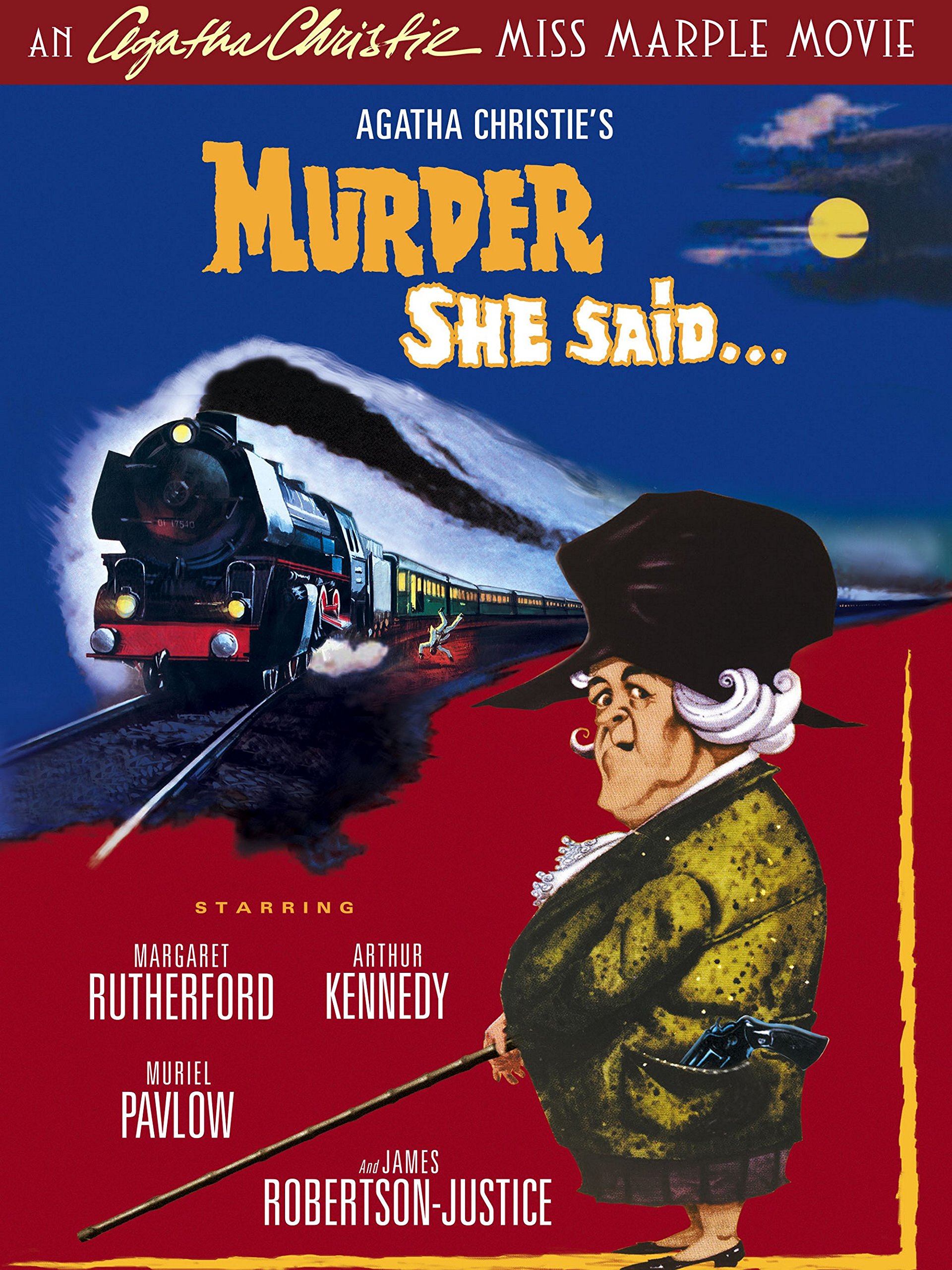
I love Agatha Christie.  As a middle school student, I devoured Christie's books.  Over time, the passion has tempered a bit, though And Then There Were None (aka Ten Little Indians) still remains among my favorite books.  Christie herself was not particularly fond of the film adaptations of her work, in particular with the four films based on her Miss Marple character.  Miss Marple, a spinster whose sharp intellect unmasked many a killer, was one of her two great detectives (the Belgian sleuth Hercule Poirot the other).  Murder She Said, the first of the four Miss Marple films, may not be faithful to the original novel it's based on (4:50 From Paddington), but it functions well for what it was meant to be: a lighthearted mystery romp, with a charming turn by its star, Margaret Rutherford.

Miss Marple (Rutherford) is aboard a train when she looks out the window and is shocked to see a woman being strangled on another train riding next to hers.  The police don't believe there was any murder, especially since they didn't find a body anywhere on route.  Miss Marple, being a fan of murder mysteries, decides she will investigate the crime herself.  Aiding her is the librarian Mr. Stringer (Rutherford's real-life husband, Stringer Davis), who is covertly sweet on her. 

Soon, Miss Marple's investigations lead her to Ackenthorpe Hall, where she finds just enough evidence to suggest the body of the murdered woman is there.  She decides to go undercover as a maid, and finds the Ackenthorpe family a very unhappy one.  Ruled by comically tyrannical Mr. Ackenthorpe (James Robert Justice), about the only child willing to tolerate him is his widowed daughter Emma (Muriel Pavlow).  All his sons save Edmund (who was killed in the war) stay as far away from Ackenthorpe Hall as possible, coming only when required.  Ackenthorpe's only grandson Alexander (Ronnie Raymond), a most mischievous fellow, is also at the Hall.

As the investigation goes on, Miss Marple manages to find the body.  Now the family knows there is a murderer about.  Things grow more complicated when it's discovered that the murdered woman may have been Edmund's hereto unknown widow, the product of a wartime marriage in France.  If it's proven that she was Edmund's widow, then it must have been someone in the family as only they would benefit from her death.

Emma has her own complications, as she and her father's doctor, Dr. Quimper (Arthur Kennedy) are in love but find that revealing their relationship at this time is out of the question.  More suspects...and more bodies...keep popping up, until Miss Marple at last, with a little accidental help from Alexander, realizes who the killer is.  Once brought to justice, Miss Marple leaves for her home, but not after turning down a surprise marriage proposal from the cantankerous Mr. Ackenthorpe.  Off she goes with Mr. Stringer, still very sweet on Jane, and as they ride off together, both are unaware that Alexander has tied a bunch of cans behind their car with a "Just Married" sign to it.

Murder She Said is not 4:50 From Paddington.  You know this straight off the bat by the book's alternate American title, What Mrs. McGillicuddy Saw.  Based on that, you can deduce that it was Miss Marple's friend Mrs. McGillicuddy who witnessed the murder, not Miss Marple herself.  There are other changes, large and small, from book to screen.  Christie disliked the whole thing, but while I tend to be on the purist side of film adaptations, I can forgive Murder She Said because the film didn't set out to be a serious drama.

Instead, Murder She Said is meant to be a light, almost comic film.  We know this first and foremost by Rutherford's take on Marple.  The stout, endearingly haggard Rutherford was nothing like the prim, proper, but shrewd Marple, a woman with a dark idea of human nature.  She makes Marple not into a figure of ridicule, but not someone who is inwardly suspicious of all people. 

The comedic nature of Murder She Said comes into the foreground particularly whenever Rutherford and Justice face off.  When Emma introduces the new maid, Jane, Ackenthorpe quickly turns to his gardener/footman and says, "And a plainer Jane I've never seen", to which Jane replies with aplomb, "We can't ALL be good-looking".  The verbal sparring between Rutherford and Justice, full of quick quips, verbal insults, and physical comedy, clearly shows that Murder She Said would mix, as the trailer says, "murder and mirth".

The comic elements are also evident in the scenes between Rutherford and Davis.  It's clear that Mr. Stringer is very sweet on Miss Marple, but whether Miss Marple returns the feelings isn't revealed.  There is a suggestion that she might eventually marry Mr. Stringer when she turns down Ackenthorpe's marriage proposal, saying that if she ever would enter that venture, it would be with someone else...perhaps the man picking her up from her latest adventure.  Davis and Rutherford have a wonderful rapport with each other, and together they lend more comedic elements to the story.

For those of us who are Christie fans, a particular highlight is the meeting of the two women best known for playing Miss Marple.  Joan Hickson, who would go on to play Marple in the highly acclaimed television series, has a small role as a part-time housekeeper.  It's interesting to see Hickson, whom I remember as the definitive Miss Marple, playing someone of a far lower social class than the more upmarket Miss Marple.  It shows that Hickson was a far more diverse actress than she was given credit for. 

If there is any debate as to whether Rutherford or Hickson made for the better Miss Marple, I would remind people that they were essentially playing two versions of the character.  Rutherford was playing a more lighthearted Miss Marple, while Hickson was playing it more straight.  Each succeeds in her own way to make the character her own, and while I personally favor Hickson, after watching Murder She Said, I find Rutherford was endearing, charming, and most pleasant as Miss Marple.  Both played the part correctly as they were written and directed, so both of them make ideal Miss Marples.

I found Murder She Said sometimes dragging slightly (despite its remarkably brief running time of 80-odd minutes), but apart from that the whole film can correctly be called 'a romp'.  We know this by the Ron Goodwin's light musical score; we can also tell from the fact that after the murderer was unmasked, we had a sight gag.  The murderer had tried to kill Marple with poison but was stopped by the police, who were listening in.  Once the murderer was removed, the Inspector turned to Marple, only to find that she had fainted dead away from delayed shock.

If you look at Murder She Said as a romp, something of a trifle to be enjoyed for a lighthearted take on murder, with a somewhat dotty but endearing detective, then you can enjoy it for the amusing picture that it is.  It may not please Christie purists (and it didn't please Christie at all, though in time she came around to the benefits of Rutherford's role in popularizing the character, dedicating a Miss Marple novel to her), but as a light treat with some deadly delights, Murder She Said is a pleasant diversion.

Two Branches of the Marple Tree

DECISION: B-