Tuesday, February 6, 2018

The Librarians: And The Trial of The One Review


THE LIBRARIANS: AND THE 
TRIAL OF THE ONE

As we get closer to the season finale of The Librarians, I find that it is not only picking up steam, but actually making it worthwhile to watch.  And the Trial of The One has many twists and turns that surprisingly fit well within the hour's running time.  There were a few times I checked to see if it was running over because it was so packed.  That was a good thing in this case, as And the Trial of the One has moments of surprising heaviness.

We start out with a 'Previously on The Librarians', an opening I don't think the show has used before.  The cloister bells are ringing (OK, they were something else, but The Librarians unashamedly borrows a lot from Doctor Who).  There is still no one to tether to, and time is running out.  Jenkins (John Larroquette) attempts to hold this off by temporarily tethering everyone to the oldest book in The Library, but warns them not to look at it.

As in The Bible, it is The Woman who falls first into temptation.  Cassandra Cillian (Lindy Booth), who is firmly into the 'magic is a source for good' line of thinking, opens it up.  As in The Bible, it is The Man who cements this deadly deal.  She asks Jacob Stone (Christian Kane) to read it, and read it he does.  With that, they find themselves swept up into a strange world.

The text is on The Trial of The One (the original translation of 'The Selection of The One' being off).  The Library has taken on physical form in the shape of Jenkins, whose body they are holding hostage.  The other Librarians, Cassandra, Jake, Ezekiel Jones (John Kim) and their Guardian Eve Baird (Rebecca Romijn), now must fight a battle to the Death, or the Library will kill the now-mortal Jenkins.  They must first wear a Ring of Nightmare, which will show each of them their greatest fears which they must first confront before the Final Hunger Games.


Each Librarian must now confront their own fear and past: Cassandra's fears of bullying from when she was young, Stone's fear of magic through greater tattoos overpowering him, and Jones' fear of actually being caught.  To make things more interesting, the other Librarians in these visions are no longer their friends, but their worst enemies.  They had failed to realize that in these alternate worlds, they did not know each other.  There is a way out, by pressing another red button, and once they do, the find themselves with a seemingly simple task: get to the center of a circle and press a golden button.

However, each now only remembers that he/she was a Librarian, not that he/she had others who worked with them.  Hearing Jenkins voice and knowing the danger he is in, they must now stop the others from getting to that button.  It's a race to the bitter end to see which of the two Librarians would die, leaving one to which to tether to.

Baird is helpless, only able to watch.  Just in the nick of time, she realizes that standing by helpless and watching is her nightmare.  Realizing that her reality is just as false as the ones she sees, she pulls off her own ring that she sees thanks to the Eye of Ampyx, a magical artifact that always reveals the truth, she gets to the center of the field first before the others can kill.  She convinces them of who they are and they drop their weapons.

Not good enough for the Library, as it must have The One.  At first it looks like Baird has outwitted the Library itself, but it is not to be.  The Library manages to stab Jenkins, who as a mortal now must die.  Jenkins' death so upsets the others that they resign in unison from the Library, heartbroken over their beloved Caretaker's death.

Baird too is devastated, until who should show up but Nicole Noone (Rachel Nichols).  In the slinkiest of dresses, she reveals that all of this was her elaborate plan for revenge.  She tells Baird that Jenkins was right about her all along, and that she had manipulated everything from the get-go in order to get the Library to break from reality itself.  Now, with victory at hand and no Librarian, the Library disappears around Baird, into a world of black and white.


And the Trial of The One has, as I've said, a lot of story packed into it.  We get flashbacks and fantasy sequences well-filmed: each section getting a distinct visual style that lends the sense of menace and danger to their situations.  There is no real sense of relief in this dark episode.  The closest to it comes at Jenkins' death, when he comments that Miss Cillian's cucumber sandwiches at the High Tea party she had were worth becoming mortal for.

This episode gave everyone a chance to extend on their acting as they played a variety of characters in each other's dream/fantasy sequences. Of particular note was Booth, who excelled in all her sequences: the frightened and bullied Cassandra, the tough officer to Jones, the witch to Stone.  Maybe the witch was a trifle camp, but you could roll with it.  Kane and Kim's best scenes were when they were Cassandra's bullies.

Nichols was on screen just at the end, but she was vamping it up for all its worth.

The curious thing is that And the Trial of the One was really heavy emotionally.  At the top of this is Jenkins' death, down to having the others wearing black as they carried his urn to his desk.  Cassandra seems the most affected, which is not surprising as she had a special fondness for him.  Stone, to be fair, wore grey, but he let the genuine pain slip through Stone's generally tough exterior, and Jones, all in black, showed that despite his generally blase manner he too felt Jenkins' loss greatly.  Jones, curiously, did something he rarely ever does: show he does care about the others.

"Librarians Together, Librarians Forever," he calls before they all push their red buttons, a rare admission that he holds team unity to heart.

Even I felt a twinge of sadness to see Jenkins go and really am pulling for him to be brought back somehow.  It just would not feel like the Library without our cantankerous, crusty yet lovable Caretaker.

It seems strange that And the Trial of The One should follow And Some Dude Named Jeff given how wildly different they were.  And Some Dude Named Jeff was frothy fun, something The Librarians specializes in.  And the Trial of The One was very dark and downbeat, almost tragic.  It was a good episode, especially as it leaves one wanting more.

I will say however, this is the first Librarians episode where I would have slight trepidation about watching with younger kids, primarily elementary school children who may not be acquainted with death.  It seems a bit down for them, and one thing The Librarians should never be is sad.

Here's hoping the season finale brings us a bit of joy and unexpected twists.

9/10

Next Episode: And the Echoes of Memory

Mudbound: A Review

MUDBOUND

I have been an admirer of writer/director Dee Rees ever since her spectacular debut Pariah.  Ever since then, however, Rees has been more hit than miss.  Her television movie biopic of Bessie Smith was decent but not as good as it could have been. Now we have Mudbound, an adaptation of Hillary Jordan's novel. It is not a bad film, but it has a central flaw that I simply could not overlook.

Mudbound covers the sometimes parallel, sometimes intertwined lives of two families in pre/post-World War II Mississippi. The black Jackson family has been sharecropping for generations ever since an act of violence stole their legal right to the land.  The white McAllan family are recent arrivals. Henry McAllan (Jason Clarke) was semi-prosperous, but he was swindled in a land deal.  Thinking he was going to buy a nice farm with a house, he finds the house already legally occupied, forcing him and his wife Laura (Carey Mulligan), their daughters and his father Pappy (Jonathan Banks) to live in a shack.

The Jacksons have their own troubles.  The patriarch Hap (Rob Morgan) is a stern but loving father to his children, while his wife Florence (Mary J. Blige) is a devoted housewife.  They all worry for their oldest son, Ronsel (Jason Mitchell), who has been recruited to go to war.  They also have to endure poverty and the legal discrimination against them.

The McAllans also are contributing to the war effort with Jamie (Garrett Hedlund), Hank's younger and dreamier Shakespeare-quoting brother.  Jamie becomes a pilot, Ronsel a tank commander.  Ronsel finds that the Europeans are better than the Americans: they are not racists and actually happy to see him.  He even finds a French lover.

It is after the war that the McAllans and Jacksons really begin to collide.  Florence, with reluctance, has started working for Laura after helping the girls get through the whooping cough.  The family needs the money after Hap is injured in an accident and the family struggles to farm.

When Jamie and Ronsel come home, neither really gets a hero's welcome.  Pappy is dismissive of his son's actions, commenting it's easy to kill when you are not looking the enemy eye-to-eye.  Pappy also happens to be a vile racist and is incensed when Ronsel wants to exit a grocery store through the front door.  The delicate balance between the races is coming undone by Jamie, who is fast becoming a shell-shocked alcoholic, and Ronsel, who is chafing at the life he has returned to.  Despite their radically different worlds, Jamie and Ronsel become friends of sorts, bonding over their mutual war experiences good and bad.

It isn't until Pappy and his cohorts see Ronsel riding alongside Jamie, and worse, when Pappy uncovers not only Ronsel's trysts with a white woman, but that said trysts now have produced a child, that we get shocking acts on both sides, with tragedy for many but not without in the end, a touch of hope.


Mudbound has one grand flaw, one thing that pushes it down: voice-overs.  Longtime readers know I generally detest voice-overs, finding them annoying, intrusive, and a lazy way to explain things.  I'm not opposed to voice-overs in general because they can work and serve a purpose (Blade Runner, Sunset Boulevard).  However, for the most part I find voice-overs to be a hindrance.

Having one voice-over is bad enough, but Mudbound has four: Laura, Florence, Jamie and Ronsel. In some particularly bad moments, one voice-over follows another, and it virtually turned Mudbound into an audiobook instead of a movie.  Long stretches of acting is interrupted by another voice-over, and we pretty much begin and end Mudbound with a voice-over.  It makes it hard to settle on whose story we are telling or under what setting the voice-overs take place in.

Are these voice-overs reminiscences?  Are they set in that time?  Are they to further the plot or explore motivations?  If it is the latter, then they should not be there.

Sometimes Mudbound is almost slightly unintentionally comical.  In a dogfight with Jamie, we have an unknown man as his copilot, worrying about making it to the next day.  Jamie promises he'll get him back home in one piece.

You know if someone promises such a thing, that other character is as good as dead.

Other elements and story elements get lost or aren't explained.  There's a subplot about Henry's white field hand Karl that does not hold up.  We don't know who he is, why Henry fires him, or why his wife Vera went out to kill him.  Technically, we do know as we're given information in pieces, but it does not add much if anything to the Jackson/McAllan stories, almost as poetic distractions.

Mudbound, to my mind, was a bit choppy in its storytelling, and it is surprising that a talented filmmaker like Rees could not see that there were simply too many voice-overs, too many curious threads (like Jamie and Henry referring to each other as 'Brother' repeatedly) that felt off.

Still, it is not possible to disparage Mudbound for when things do go right.  The most effective moments are when Rees drops that damn voice-over and lets the story flow.  The final third of the film, where Rondel's scandal is uncovered by Pappy is shocking and heartbreaking, though a bit confusing to me (I thought he was dead, making the final scene at first a bit strange).

The best performance for me was Morgan and Hap, a man who has strength and respect, but who also knows how far to go and push.  He is a fascinating character who would be a good film to himself.  Miss Blige too is elegant and strong as Florence, a woman who loves her family and who is never subservient to anyone.  Mulligan is one of my favorite actresses, and her Laura played well in the character's barely hidden anger about her reduced situations.  Mitchell's Ronsel too brought a mixture of strength and vulnerability: strength in standing up for himself to the racists, vulnerability when it came to his French paramour.

I found Banks' Pappy good but a slight caricature, doing nothing but growing at someone, but that was the character, so I'm not going to quibble.  Hedlund is determined to give a performance, and what better way to show it than to play a PTSD-afflicted veteran who uses booze as anesthesia, but I wasn't overwhelmed.  Same with Clarke, and I like him as an actor.

Mudbound is desperate to be great, but it suffocates under its own sense of greatness.  It takes its time getting to where it wants to go, and these are some of the elements that push Mudbound down.  It could have been great, if it had gotten out of its own way.

And those four damn voice-overs...

DECISION: C+

Monday, February 5, 2018

The Librarians: And Some Dude Named Jeff Review


THE LIBRARIANS: AND SOME DUDE NAMED JEFF

And Some Dude Named Jeff is, to my mind, notable for a few reasons.  First, it's the first Librarians episode that I have genuinely enjoyed, even if it was not the smartest or the most original of stories.  Second, it's a love letter to the fanbase, those Librarians In Training, and the wacky world they occupy.  There may be a temptation to say And Some Dude Named Jeff actually mocks fan culture in general and Librarian fans specifically. I could see that; however, I think the people behind The Librarians genuinely care and respect their fanbase, so I look upon And Some Dude Named Jeff more of a gentle spoofing than a downright mockery.

The Librarians notice that Jenkins (John Larroquette) is acting a bit strangely: less stuffy, almost flirtatious with Librarian Cassandra Cillian (Lindy Booth), high-fiving and smacking the backside of Jacob Stone (Christian Kane).  There is something amiss, but they can't quite figure it out.  They put it down to aftereffects of Jenkins now becoming human, but the Real Jenkins knows the truth.

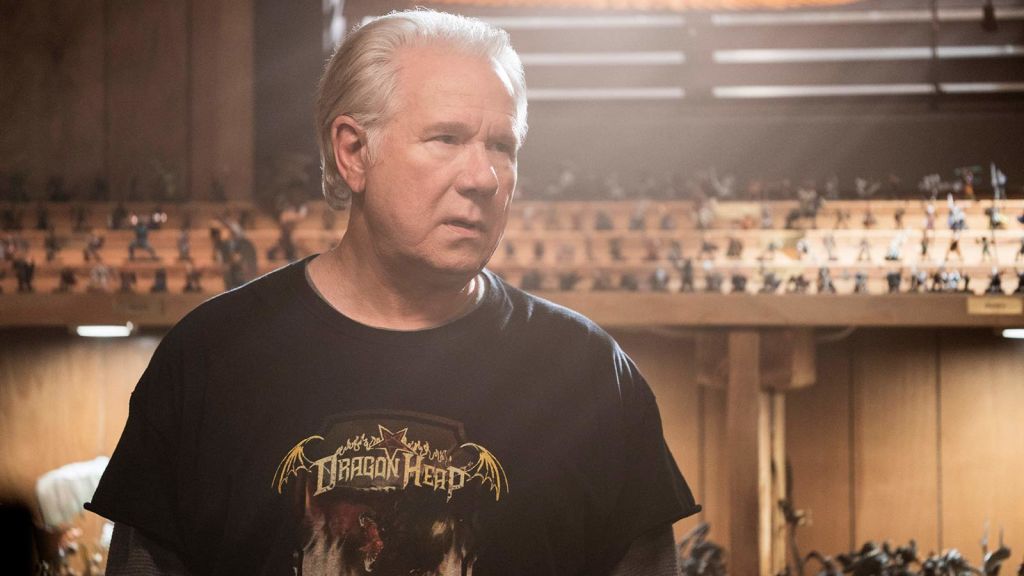
The Real Jenkins is shocked to find himself waking up in a basement filled with posters and him wearing a rock band t-shirt.  He's also shocked and appalled to be ordered about by a woman who insists he's his mother Dolores (Jeanine Jackson).  Things get stranger and stranger as a group of people from Gadget Gang come sweeping in, telling him they are all going to be late for work if he doesn't get himself together.

Jenkins is perpetually befuddled by this group, more so when they get together in the basement to play Dungeons & Dragons.  He's realized that he has switched bodies with Jeff Peppers (Andrew Caldwell), a 28-year-old whose life is stuck in second gear, and it hasn't been his day, his week, his month, or even his year.

If you get the reference, you are a Gen-Xer.

It isn't until Jeff's friends start the game that Jenkins realizes that Jeff has based the characters in this version on The Librarians themselves.  Aurora (Britney Young) has the character 'Cassandra the Sorceress', the more mature Dennis (Joseph Bertot) is 'Stone the Ranger', and Dragon Master Schmidt (Ryan Schwartz) is 'Flynn the Wise Sage'.  There is no one to be 'Baird the Warrior Princess' or 'Ezekiel the Cunning Thief' (his character I think was eaten).  Jeff always plays his favorite character: Jenkins.

Jeff is pretty obsessed with Jenkins, down to donning cosplay of our cantankerous Caretaker.  The group as a whole has built up the characters thanks to Wikileaks dumping DOSA files and certain newspaper reports by a certain Sarina.  Jenkins realizes that Jeff has literally switched places with Jenkins, and now it's up to Jenkins to break into the Library and set things right.


This is more important since Jeff has used a book found at an online auction to cast the spell.  This book, The Asmodius Grimoire, belonged to Merlin, and in it he had locked up Asmodeus, one of the Seven Princes of Hell.  With Jeff having used it, he has inadvertently released Asmodeus and worse, brought him into the Library.

Jenkins' odd behavior has now made the Librarians aware something is wildly wrong.  They put 'Jenkins' to the test by having him translate an ancient text.  Obviously, the False Jenkins cannot, and he confesses the truth: all he wanted was to be Jenkins for a little while to perk up his humdrum life.  Unfortunately, this slacker is no hero, especially as he hides from this monster.

The Real Jenkins sees that he needs Aurora, Dennis and Schmidt to break into the Library through the backdoor, something he finds quite horrifying.  The backdoor has many traps, but each of our D&D fans brings his/her own skills to thwart them.  A puzzle is easy for Schmidt, going past a booby-trapped hall requires Aurora's dance skills, and Dennis tells Jenkins a story about perseverance that he tells his children, which inspires Jenkins to literally break on through.

Despite their teamwork, Jenkins insists that they cannot enter the Library itself, much to their disappointment.  However, for their work, Jenkins dubs each of them Honorary Knights of the Round Table.  Real Jenkins is most displeased to find False Jenkins, insisting he return his body and Jeff return to as Real Jenkins puts it, 'his short, slightly overweight body'.

Jeff knows he's afraid and that his life is awful, but having spent time in Jeff's world, Jenkins sees what Jeff does not: Jeff has passionately loyal friends, a mother who genuinely loves him, and the possibilities of a wonderful life if he chooses to have one.  Jeff has to focus on the positives.

He also has a Prince of Hell to face off against.  After a quick stop to use a reversing potion, Jeff and Jenkins rush to Jeff's home to retrieve a stone that contained a bit of Asmodeus' power.  That stone, however, Jeff had given to his mother as a birthday gift.  It's a battle between Slacker Jeff, Sir Galahad, and Asmodeus for the sake of the world.

Asmodeus is defeated by the Real Jeff, who has overcome his fears.  Jenkins has found that 'people can be quite delightful', and rushes off to a 'meeting'.  That meeting?  A game of Dungeons & Dragons, where Jenkins brings pizza and insists his expertise on all matters supernatural make him the natural choice for Dragon Master.


And Some Dude Named Jeff is something we haven't seen from The Librarians in a while: a genuinely sweet story that has menace but also has heart.  There is a danger of sorts (like many one-off monsters, Asmodeus isn't going to make a return appearance), but for the most part And Some Dude Named Jeff is a lark, a nice romp where we can focus on characters.

In this case, it's Jenkins, and Larroquette has a wonderful turn, giving him a chance to show off his great comedic skills: after all, one of his signature roles was in the sitcom Night Court.  It's in the blending of Jenkins' person in Jeff's life that makes things funny: Jenkins' befuddlement over how automobiles operate or seeing do his take on Dance Dance Revolution that sells the premise.

There are few things as amusing as seeing the ever-stuffy Jenkins, in full metalhead t-shirt, remark on someone's 'short, slightly overweight body'.  And Some Dude Named Jeff is meant to show Jenkins' evolution to a softer, almost cuddly figure.

And Some Dude Named Jeff is also highlighted by its guest stars, specifically Caldwell as our fanboy.  He has to play someone who is both fan and individual, someone who fills his unhappy life with friends who are in their own way also outcasts in a fantasy world.  It cannot be a coincidence that Jeff has a photograph of himself dressed up as Jenkins, the nod to those Librarian cosplayers and cosplayers in general a nice one.

In turns endearing and inept, with curious turns of phrases (calling Cassandra 'Sassy Cassy' and Jacob Stone as 'Stoner'), it be nice to see Caldwell's Jeff make a return appearance.  It be nice to see all of them return again, as they would make a fine group to keep tabs on.

And Some Dude Named Jeff also has a unique aspect: it is Librarian costar Lindy Booth's directorial debut, and she proves herself a good director.  The episode didn't lag and balanced those moments of humor (the Dance-Off) with heart (Dennis telling Jenkins the rabbit story he tells his own kids).

The episode isn't perfect.  Jenkins' denial of letting the others into the Library was a quick and easy way to get rid of the characters, and in retrospect it shows a wild inconsistency.  Jenkins is stricter about letting visitors in, since he denied this group entrance while Stoner showed Sarina around.  Now, maybe Jenkins wasn't aware that Stone had brought his paramour into the Library, but that does show a bit of a discrepancy.

And Some Dude Named Jeff may be my favorite Librarians episode, at least from this season.  It's a welcome return to form after some major stumbles, a nice homage/gentle spoofing of fan culture that takes things a bit too seriously but ultimately mean no harm.  It was a nice romp, well-acted and directed, and one that I enjoyed.

Now, Gimme That Boom...


9/10

Next Episode: And the Trial of The One

The Librarians: And A Town Called Feud Review


THE LIBRARIANS: AND A 
TOWN CALLED FEUD

The Librarians in Season Four has stumbled a few times, the stories almost parodies.  And A Town Called Feud is part of the rebuilding effort, and it's a good one, putting in some things that are surprisingly logical and some things that sadly seem to come out of nowhere.

The Librarians are still divided over how to resolve the Tethering Issue.  The Guardian Eve Baird (Rebecca Romijn) has to be tethered to a Librarian, and it's been generally accepted that There Can Be Only One...Librarian.

The very first one, I suspect, was really a Highlander, but I digress.

Jacob Stone (Christian Kane) and Ezekiel Jones (John Kim) believe there can be only one, and that he should be The One.  Cassandra Cillian (Lindy Booth), and Caretaker Jenkins (John Larroquette) are firm in their belief that there can be more than one Librarian.  Baird for her part is stuck in the middle.  The Clippings Book comes to the rescue, as it sends them to the town of Feud, sight of the best visual metaphor for the Civil War.

Stone, Jones and Baird go to Feud, while Cassandra and Jenkins stay behind to do 'research'.  As a side note, it makes sense that after the Cassandra-centric And the Hidden Sanctuary that she sit this one out.

Stone, Jones and Baird find they've come at the annual Feud Festival, where there is a Civil War reenactment of a battle that pitted brothers Uriah and Carlton Loveday on opposite sides of the War Between Brothers: Uriah for the Confederacy, Carlton for the Union.  They killed each other in Fugue, a town which changed its name to Feud to commemorate the battle between the ironically-named Lovedays.


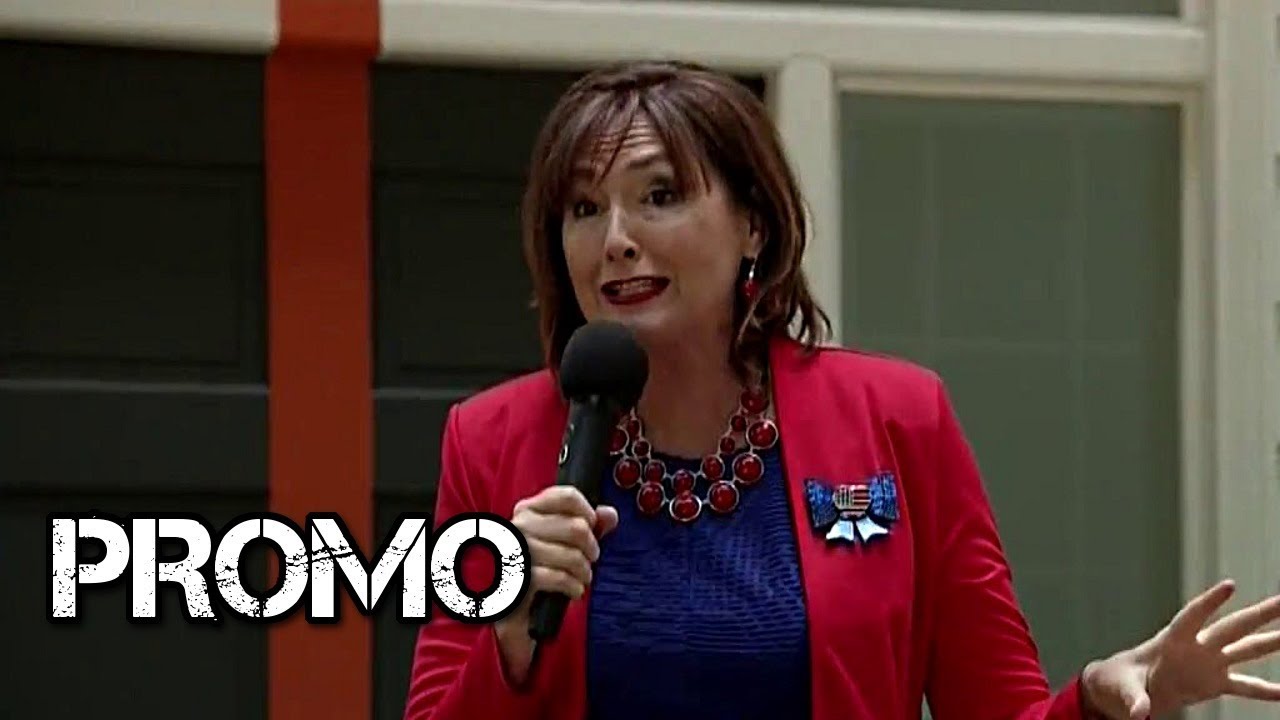
The Loveday House Museum director, Janet Hedge (Nora Dunn), has been the patroness of the Feud Festival and battle reenactment, literally painting a line through town and right down the Loveday House.  She also makes a surprise announcement: the second half of a locket the two brothers had received from their mother that they broke apart has been discovered, and it will be put together at the Festival as a symbol of reconciliation.

However, all of this sounds rather fishy, especially to the history-loving Stone.  Jones, for his part, struggles to not steal anything, and fails, picking up an "All American Boy" cap from the gift shop.  Once he slips it on, Stone quips 'You finally got your green card?'  Stone is more angry when Hedge tells them, 'History IS a theme park,' dismissing their concerns.

These concerns are more than quibbles about historical accuracy.  Rehearsals for the battle reenactment have spawned ghost sightings, warning that 'the brothers are coming'.  The reenactors too are fighting, especially Griz (Dan Considine), on the Confederate side who also believes in aliens and conspiracy theories, and Devon (Ben Newman), the Union reenactor who thinks Griz is bonkers and who has fought with him since high school.

Meanwhile, Cassandra essentially seduces Jenkins with High Tea into helping her find proof that the Westphalia Brothers, the only time the Library tried a dual Librarian role to disastrous results (their war leading to the Dark Ages), really is more myth than truth.  This is not helped by the curious clues left by a previous Librarian: Zelpha the Forgetful.  She had taken information about the Westphalia Brothers and left little notes to help her find them, but her notes are riddles that even she probably could not figure out.

Stone and Jenkins continue fighting over who would make the better Librarian, much to Baird's frustrations.  They stubbornly refuse to see that they compliment each other, their skills enhanced by the other's own.  Jones sees what he calls 'a golem leprechaun' apologizing for having lost something as he rings a bell, and Stone sees a woman dressed in black.  Both ghosts also say 'the brothers are rising', and with them come troops.

Eventually, the Loveday Brothers do rise, along with their respective ghost troops, after Hedge joins the two parts of the locket.  However, the Librarians find she had nothing to do with this, and the battle is about to commence when the ghosts take over the reenactors' bodies.  The two brothers take over Jones and Stone and they point their weapons on each other.  However, we learn the truth: the brothers had reconciled before they were killed together in Feud, the true story hidden in myth and hype.


The ghosts also reconcile with Carlton's son (the 'golem leprechaun') and Uriah's wife (who as a black woman, could not legally marry the man she loved).  The town will adopt a new name: Forgiveness.

Unfortunately,  once Stone and Jones now agree that the Library can have more than one Librarian, Jenkins and Cillian now see that it cannot, so we're right back where we started.

I think that A Town Called Feud makes clear that when the first ghost says 'The Brothers Are Rising', he don't mean fellow troops.  This episode split the team into two groups, and it worked well in showing how they came to opposite views from where they started, at least with the Jones/Stone side, less so with Cassandra/Jenkins.

We did have nice moments of comedy (Jenkins' elation at High Tea is a delight), as well as the squabbling between Jones and Stone.

I do wonder about the reenactors however.  Is it a coincidence that the eccentric cook/Confederate reenactor is named 'Griz' ('gris' being the French and Spanish word for 'grey')?  If that weren't already curious enough, the dialogue between Griz and Devon as they confront each other is curious to say the least.

Griz and Devon are holding weapons to each other, and Griz tells him about how angry he was that Devon 'stole his boyfriends'.  Devon replies that they left of their own accord and they loved him, not Griz.  I think what I found strange about this exchange is that it came completely out of left field.  There had been no indication that Devon and Griz were nothing more than school rivals, not thwarted lovers.  It just seemed to be there for no reason, just thrown in there.  It isn't funny, it isn't relevant; it just seemed pointless.

In terms of performances, And A Town Called Feud is proof that Dunn simply does not appear on television enough.  She was caustic, even slightly menacing but not without a touch of humor as Janet Hedge, History Perverter.   

And A Town Called Feud has a positive message (the power of forgiveness, though I would have thought the town should be renamed 'Reconciliation'), moved quickly, and had nice moments of comedy along with the action.  Minus a few hiccups, this shows The Librarians can return to form.

7/10

Next Episode: And Some Dude Named Jeff

Sunday, February 4, 2018

The Librarians: And the Hidden Sanctuary Review


THE LIBRARIANS: AND THE 
HIDDEN SANCTUARY

And the Hidden Sanctuary, while not a return to form to the zippy, madcap fun of previous Librarians episodes, is a step in the right direction.  I cannot say that I was overwhelmed with it, and up to a point I was finding things hard to believe, even here.  However, given what we have gone through, And the Hidden Sanctuary worked far better, even if I would say it was a bit rushed.

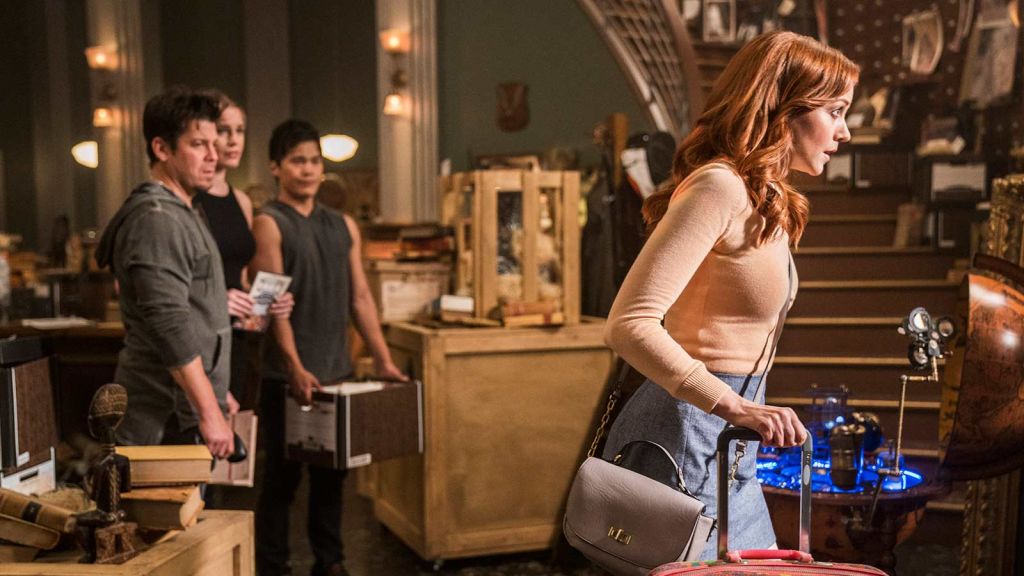
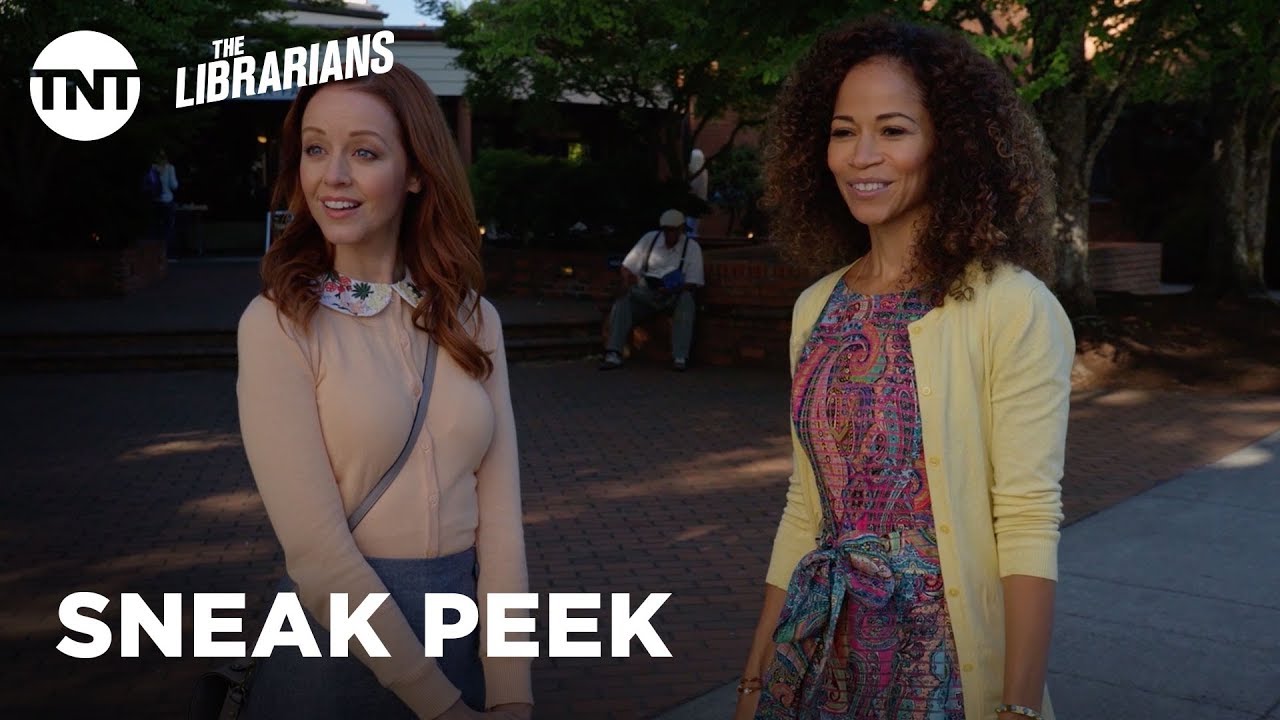
This is a Cassandra Cillian-centered episode, as most of the other Librarians barely made an appearance.  Cassandra (Lindy Booth) had a crisis of confidence in a previous mission, and she froze, leaving the other Librarians in danger.  After the trauma and aftereffects of her panic and inaction, Cassandra decides to leave the Library, not permanently but on a sabbatical.  As such, she goes to Havenport, Ohio, a city billed as 'the safest city in America'.

Havenport is more than safe: it is about to celebrate 10,000 days without a single accident of any kind.  We're not talking just car accidents or construction mishaps.  We're talking people not getting broken legs or even falling down stairs.  Havenport, OH is beyond idyllic, and Cassandra could not be more pleased.

She finds room and board with Karla (Sheri Saum) and her son, Freddie (Benjamin Flores, Jr.), whose only real interest is apparently photography.  The city is overseen by Councilman Weeks (Heath Koerschgen), who is getting things ready for a major festival celebrating their 10,000 Accident-Free Days.

As a side note, does anyone else thinks Havenport should have hired 10,000 Maniacs to perform, or is that just me?

Weeks is also smitten with Karla and probably vice-versa, but they cannot say it.  Cassandra, for her part, finds Havenport all the more wonderful, fitting her generally cheery outlook.  She in quick order becomes an actual public librarian, starting a STEM Program and joining the Quilting Bee, the Bake-Off, and other civic activities.


However, there is something wicked afoot.  On the verge of celebrating the 10,000 Days, these maniacs are suddenly flooded with disasters in quick succession.  Moreover, Cassandra, with Freddie's aid, sees that it is statistically impossible for Havenport to have remained so secure.  There is something unnatural in having close to 30 years without anything bad happening.

As the citizens demand answers, they soon blame the newcomer for bringing this upon them.  However, Freddie and Cassandra find the truth: Weeks had helped a fairy as a child when he was lost.  The fairy as reward would grant Weeks a wish.  His first wish of saving his father was impossible as Mr. Weeks was about to die, so Weeks wishes that there be no more accidents...and that's what he got.  He also put her in a snow-globe, and had essentially trapped her there.  Now, the angry fairy was wreaking havoc.

It's the same as when Cassandra freaked out, but words of wisdom from a vision of Jenkins (John Larroquette) give her enough confidence to restore order and outwit the fairy.  As Freddie had saved the fairy earlier during the first part of the rampage, the fairy is bound to grant him a wish.  He wishes that she know fear too, and it weakens her enough to stop her revenge.

As Cassandra returns to the Library, she notes that Freddie may get a call from them when he grows up and that the townsfolk have to accept risk.  The risks could be anything from looking both sides before crossing the street, to the risk of Councilman Weeks finally approaching Karla for coffee.


I can't say whether And the Hidden Sanctuary was meant to be a one-woman show, or whether letting individual Librarians have their own episodes is something that will happen more often.  I can't even say whether I'm on board as it being a good idea.  I can say that And the Hidden Sanctuary is more hit than miss.

Yes, it is implausible that Cassandra could so quickly integrate into town in the short amount of time she is there, down to winning the blue ribbon at the baking contest and joining a quilting bee while getting to be a major citizen.  However, you kind of roll with it because it is not meant to be too serious.  I would also say that after so many missions where she proved herself confident, to have her now suddenly collapse is also slightly implausible.

I would have preferred that she just take a vacation because she felt she needed one, or maybe visit her friend Karla, who found an ideal place to raise her son.

Maybe it's just me, but And the Hidden Sanctuary could be a story about how life is full of risks and that you cannot be perpetually safe from any, physical or emotional.  During the tense meeting, one of the citizens calls out, 'we need to be protected', but as Cassandra observes/learns, there is no such thing as a risk-free life.  This version of 'stranger danger' does not just come in the form of external fears, but internal ones too.  Karla, for example, constantly frets about her son, worrying both about his physical and emotional safety.  She is unwittingly stunting him in an effort to protect him, and the moral of And the Hidden Sanctuary is that life without risks or without a sense of danger is no life at all.

As a side note, it's interesting that Jenkins calls her 'Cassandra' rather than the usual 'Miss Cillian'.  Is there something there, especially since Jenkins is mortal now?

This is a showcase for Booth and the director, Noah Wyle, and both did so well.  Booth was charming and sweet and highly intelligent as Cassandra, and she brought not just those qualities to her performance, but also that vulnerability and acceptance of fear as part of life.  Wyle also kept things going quickly, though the montage of disasters in Havenport did not go over as well as they could have.  I also thought Flores was weak as Freddie, more whiny than intelligent.

Still, And the Hidden Sanctuary was cute, slightly whimsical but with a sense of both danger and acceptance.  It was nice to see Lindy Booth more than hold her own, but it had the negative of sidelining the others save Larroquette to virtual cameos. 

Sometimes, you can't give them what they want...


6/10

Next Episode: And A Town Called Feud

Padmaavat: A Review

PADMAAVAT

As someone who has come across Bollywood/Tollywood films, I can say that I'm not unfamiliar with the genre.  However, Padmaavat is a different type of Bollywood film altogether for me.  Unlike other Bollywood films, Padmaavat is the first one I have seen that is not set in contemporary times.  Second, Padmaavat is one that cannot be called 'jolly' in any sense of the word.  Finally, Padmaavat is the first Bollywood film, at least that I can recall, that has been met with controversy and scandal even before it was released, with some of that continuing afterwards.  This film, based on an epic poem which may or may not be based on actual historic events, now is finally released. 

Was it worth all the death threats and rioting?

Muslim warrior Alauddin (Ranveer Singh) has designs on Mehrunisa (Aditi Rao Hydari), the beautiful daughter of the Sultan.  Alauddin is not a good man: he is screwing a maiden on his wedding night and kills a loyal servant who tells him to go to the wedding dance.

Meanwhile, in the kingdom of Singhal, the Princess Padmavati (Deepika Padukone) is a warrior princess, one who enjoys the hunt.  She, however, accidentally hits Ratan Singh (Shahid Kapoor), a young king who is visiting on a state visit.  Padmavati nurses him to health and as things go, they fall madly and deeply in love.  They marry and she goes to Chittor, her new realm.

Alauddin, for his part, continues plotting to conquer the world, aided by his loyal manservant/assassin/potential lover Malik Kafur (Jim Sarbh).  Malik is totally devoted to his Master, and fortunately for him, he is the only one whom Alauddin seems to trust completely, unaware that at least once Malik spied on him in a lovemaking session (that scene was interrupted though, as from what I know of Indian films there is very little actually shown in terms of flesh and sex).

One person who did spy on his Rani and Rajah was Ratan Singh's guru, who was exiled.  Now, the guru arrives at Alauddin's court, and he has a prophesy for him.  He describes Padmavati's great beauty, and adds that if he were to conquer her, Alauddin could become the most powerful man in the world, a new Alexander the Great or Sikander-e-Sani.


With motivation like that, Alauddin declares war, as he puts it, not to extend his territory but to extend his arms.  Needless to say, Ratan Singh isn't going to let his second wife go off with another man, especially since he's madly in love with her.  He manages to withstand Alauddin's long siege, and Alauddin at first appears almost sane.  It isn't until he subtly suggests he'd like to see the Rani that Chittor is enraged.  Padmavati, for her part, agrees to a quick glimpse via mirrors and smoke, but that was a bad move.  The quick glimpse is not enough for Alauddin, but enough to make him more determined.

Alauddin tricks Ratan into becoming his prisoner, and now Padmavati faces a terrible choice: surrender or let her beloved die.  She agrees to meet with Alauddin, if certain conditions are met.  Alauddin agrees to them all: allowing her to bring 900 maidens, seeing the King first and seeing him released, and the head of the guru.  It's all a major ruse: the maidens are disguised warriors, and the lovers escape with help from Mehrunisa.  Enraged, Alauddin marches again on Chittor, with a larger army.  Ratan faces him in a one-on-one match, but is killed by Malik, contravening the rules of war.  Chittor is now totally left in ruins, but Alauddin will be defeated.

Padmavati, in a calm act, declares that she and all the women will commit Jauhar, ritual self-immolation, what is also termed 'sati', where women set themselves on fire.  Alauddin would not get his war booty.

Padmavaat was initially so controversial that even the original title caused outrage.  Originally titled after the main character, Padmavati, the title had to be changed to the epic poem about her (Padmavaat) because as the film points out in a post-script, she is held as a Goddess.  As such, you just cannot make a film about a Goddess without running the risk of offending some sensibilities.

Those sensibilities were later inflamed by unfounded rumors of a dream sequence between Padmavati and Alauddin where they became lovers (no pun intended).  While there was no 'love/dream sequence' and there was never one in writer/director Sanjay Leela Bhansali's script, the mere suggestion of such a sequence was enough to infuriate certain sections of the Indian population.  Death threats against Bhansali and actress Padukone were issued, and the set was damaged in an act of vandalism.   

As it stands, I'm a bit surprised these same people were upset, because the end result is that Padmavaat is actually pretty accommodating to an almost anti-Muslim worldview.  I claim no knowledge of how Alauddin was in real life and confess to having never heard of any of this prior to Padmavaat, but one can't watch how Alauddin is without coming away with strongly negative views on him.  As portrayed by Ranveer Singh, Alauddin is in turns crazed, almost demonic, and perhaps homosexual or bisexual (which might be seen as being even worse in some more conservative Indian circles).

We get quite a few suggestions about how close the relationship between Alauddin and Malik may be almost from the latter's first appearance.  Presented as a gift to Alauddin by his father-in-law, Malik appears to be almost in a bridal gown.  Later on, Ratan's generals say that Malik is so close to Alauddin that some call Malik 'his consort'. 


Perhaps the oddest and most overt claim of an 'unnatural' relationship between Malik and Alauddin comes from Malik's love song, Binte Dil.  As Malik starts singing this number to Alauddin, we had already been treated to the sight of them in a large bathtub together, though to be fair Malik was fully dressed.  As Malik starts singing, Alauddin does some writhing and thrusting in the tub, then finds himself in the throes of passion.  Granted, he was in the throes of passion with a woman, forcefully drawing the curtain on Malik as he continues singing, but the whole number is probably as homoerotic a musical number as we are likely to see from a Bollywood film. 

At least one that does not actually feature a same-sex love story, which given how conservative the Bollywood film industry appears to be, is not something likely to happen.

Another musical number, Khalibali, performed by Alauddin as he comes close to his victory, is also, well, a bit bizarre.  Yes, I think it's worth mentioning I'm coming at this from a thoroughly Western point of view, even if I have seen several Bollywood/Tollywood films, so I don't declare myself an expert on these musical numbers.  However, seeing an almost completely unhinged Alauddin with a group of warriors as backup dancers and he almost in a rage sings and dances is unnerving, and having the scene end with Alauddin getting hit by arrows is the coda on the general offbeat nature of Khalibali.

It's a sign of how unique the number is that one isn't even sure the arrows are real or a dream.

Credit should be given to Ranveer Singh, who makes Alauddin into a frightening, crazed being even when dancing in Khalibali, his manner intensely threatening.  I cannot say much for Kapoor other than he has an extremely firm body which is showcased often.  I put it more to the character, who at times seems so gentle, especially when looking at the second Rani of Chittor.  The one thing I remember about Padukone is that no matter what, she looked as if she was always on the verge of tears, her eyes perpetually red. 

It's a pity, as she started as a strong warrior princess, but once she was married she became if not docile at least less warlike, but again credit for making her a shrewd figure who out-thinks her enemies.

Out of the dance numbers, only Ghoomar has what most would consider a typical, or stereotypical, Bollywood number: the elaborate dance and lavish sets and costumes all befitting a spectacle.

As for the Jauhar, the film had the good sense to not show the actual mass suicide, giving us just enough to shock without delving into the full horror of it.  In this aspect, it is reminiscent of Masada, when the Jewish rebels committed mass suicide rather than surrender to the Romans. 

Padmaavat, for all the controversy and scandal it unleashed, was surprisingly very respectful to the legend of Padmavati and her act of jauhar; it might be interpreted closer to being about the present than the past.  The idea of the Muslim flag flying over the Hindu kingdom or Alauddin burning any historic text that didn't mention him evokes memories of ISIS and its brutality.  I cannot say whether this was in mind for Padmaavat, but in terms of cinema it was good but at times a little curious, with one good though crazed performance and songs I doubt will linger apart from Ghoomar

All Hail the Goddess...

DECISION: C+

Saturday, February 3, 2018

Black Girl (1966): A Review (Review #1010)


BLACK GIRL (LA NOIRE DE...)

In the short running time of Black Girl, Senegalese director Ousmane Sembene does a more succinct job of examining the effects of colonialism and racism than most films twice Black Girl's length.  Black Girl is unique in that it is from the African perspective, a portrait of someone who knows firsthand the darkness of even the most benevolent outsider.

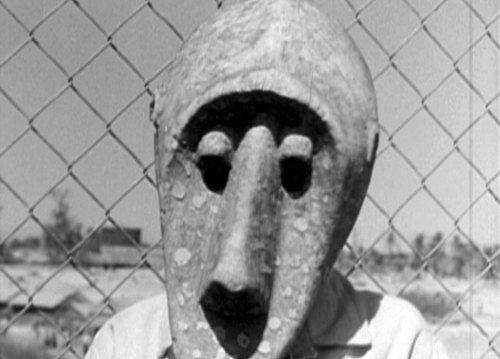
Based on Sembene's own short story, Black Girl is about Diouana (Mbissine Therese Diop), a woman from Dakar who comes to southern France to work for Madame (Anne-Marie Jelink) and Monsieur (Robert Fontaine).  The film flashes back repeatedly to Diouana's life in Senegal and the present day.  She had worked for Madame and Monsieur in Dakar when they were stationed there, and Diouana had been happy to work as the family nanny.  She was so grateful to them that she bought them a gift: a traditional African mask.  Diouana also had an off-again, on-again boyfriend (Momar Nar Sene), who was not thrilled to hear her deciding to accept the offer to move to France.

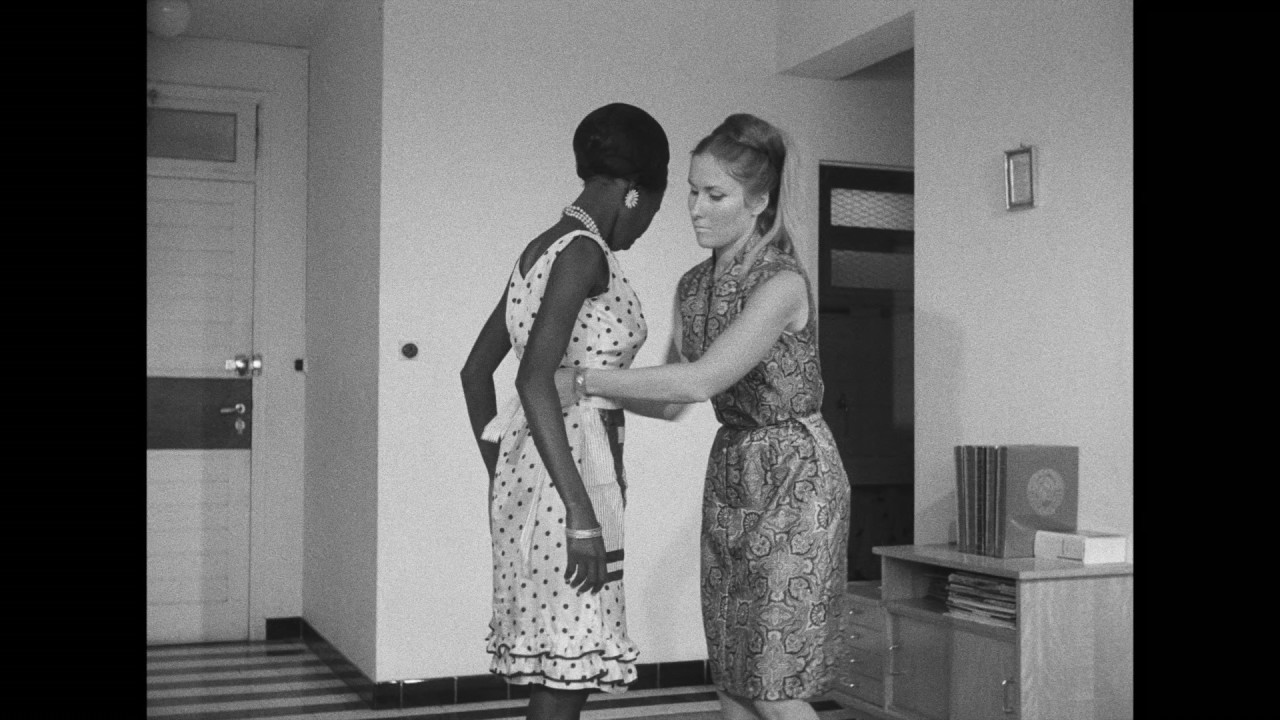
However, once Diouana arrives in France, Madame treats her with total contempt.  She is expected to be housekeeper, cook, servant and even sex object (one of the dinner guests boldly kisses Diouana on the cheeks against her will, exclaiming that he'd never kissed 'a Negress' before).  The children are temporarily gone, but once they come Diouana expects that burden will fall on her too.  Making things worse, Diouana is never allowed to venture to see any sights on her own, unless you count the butcher's.  A virtual slave and prisoner, Diouana can only look out into the darkness of the Riviera.

At long last, Diouana stands up for herself and makes clear she will not be mistreated.  She takes the mask and at first it appears she will leave to return to Senegal.  In a shocking twist, Diouana slits her throat in the bathtub.  Madame and Monsieur are not broken up over this, at least Madame does not appear to be.  Monsieur returns to Dakar, bringing Diouana's suitcase and mask to her family.  His offer of money is rejected by Diouana's mother, and as Monsieur leaves, a little boy pursues him, wearing the African mask, a reminder that try as he might, Monsieur cannot escape the ghosts of his (and European) mismanagement in African affairs.


Black Girl is a bit of a misnomer.  The actual title, La Noire de..., is more in a possessive form: The Black Female Of..., versus what 'black girl' would be in French (Fille Noire).  The title of 'The Black Female/Girl Of...', to my mind, is more indicative of what Sembene meant: to state that Diouana was, in the eyes of the unnamed Madame et Monsieur, a possession, who was not 'one of us'.   This view of casual and overt racism is held by the dinner guests, who comment on Diouana's rice that 'Africans all eat rice', as if the meal was Diouana's idea versus Madame's orders.  We also hear how one off-camera comments that 'the natives' lost something of a quality after independence.

For me, the best example of the racism Diouana has to face is when Madame says with regards to her, "I'm responsible for her," the subtext I read that of 'benevolent imperialism', as if Diouana had no mind, will or say of her own.  Not once did Madame ever ask Diouana about what she might have wanted, nor even when she would have a day off.

Sembene was wise in showing us Diouana's life in Dakar as well as in France, to show that while Madame and Monsieur were not monsters in Dakar to her, they weren't angels there and devils in France.  Their personalities did not change, only the extreme level of it.

Diop, in her film debut, was elegant and beautiful as Diouana, who mixes genuine puzzlement over Madame's behavior in France with a growing awareness of her anger.  She is also delightful in her Dakar scenes, where that sense of hope and optimism comes through when she is selected to work for Madame or on the thought of her going to France.  Her inexperience comes through at times in a somewhat detached manner, but for the film it works.

Jenilek was appropriately monstrous as Madame, constantly snapping at at one point striking Diouana, while Fontaine made Monsieur more a passive bystander, someone not overtly cruel but also not willing to help much.  Even when he sees that their actions led to Diouana's death, he seems genuinely puzzled as to why the offering for a large amount of francs does not placate either Diouana or her mother.

Generally, I dislike voice-overs but in Black Girl, I find that it works quite well.

I think the budget and relative inexperience of cast and crew come through in Black Girl.  There is not much movement in the film, the settings pretty set. The acting at times appears is more stiff than perhaps it should be.  However, Black Girl is a striking film, intelligent in how it shows the damage the imperial manner of outsiders has been to Africa and Africans.  It's summed up best by the final scene of the little boy in the mask, virtually chasing Monsieur out.

The ghost of both Diouana and Africa will haunt the Europeans, the film virtually says, a ghost that will not rest and will pursue them continuously.  Black Girl's message of how racism and colonialism has done immeasurable harm is one that is worth hearing and watching.


DECISION: A-