Sunday, August 6, 2023

These Old Broads: The Television Movie

THESE OLD BROADS

This review is part of the Summer Under the Stars Blogathon. Today's star is Debbie Reynolds.

I believe there was an ad campaign where famous and glamorous women of stage and screen wore beautiful furs with the tagline, "What becomes a legend most?". That line came to me while watching These Old Broads, but in a sad and ironic way. These Old Broads doth not become a legend, let alone four legendary actresses*. Too broad to be farce, too dumb to be remotely realistic, These Old Broads is cringe to the max.

The rerelease of the 1961 film Boy Crazy proves a shocking box office hit. Television executive Gavin (Nestor Carbonell) is persuaded to have an anniversary reunion with Boy Crazy's three stars on live television to cash in on the notoriety. Gavin turns to Wesley Westbourne (Jonathan Silverman), a documentary producer for help. Wesley, who specializes in films about former First Ladies, agrees to contact his estranged adoptive mother and Boy Crazy costar Kate (Shirley MacLaine) to pitch the concept. Gavin, in turn, will produce Wesley's program about former First Lady Ida Saxton McKinley.

As a side note, while it's not clear if the McKinley program is another documentary or a scripted show, it isn't too far-fetched given the recent The First Lady Showtime television series.

Wesley now has to contact not only Kate but the other Boy Crazy stars. Perky Piper Grayson (Debbie Reynolds) is wrapped up in her long and happy marriage to Bill (Peter Graves) and successful casino to show any interest. Potentially British, potentially American Addie Holden (Joan Collins) is more reclusive given her longtime romantic relationship with incarcerated mobster Tony Frank (Pat Harrington). Despite their mutual hatred for each other, eventually they are all talked or bribed into the special, in part thanks to their mutual agent Beryl Mason (Elizabeth Taylor).

Old rivalries and resentments quickly pop up, as do old boyfriends and family secrets. Will these three divas be able to pull themselves together emotionally and physically to get the show on the road? Will they end up driving Wesley and Gavin and everyone else crazy?

These Old Broads is full of these old clichés and inside jokes, so much so that one senses that almost no one is even bothering attempting to play anything remotely seriously. It is fine if one wants to wink at the audience, but sometimes things are so forced that you want to turn away more in sadness than in horror. Carrie Fisher and Elaine Pope's screenplay enjoys mocking the actresses' various off-screen personas and life incidents. There's Kate/Shirley's reincarnation ideas. There's Piper/Debbie's casino ventures. There's Addie/Joan's reputation as a sex kitten.

That might work, but we are not meant to see Shirley spoofing herself, or Debbie or Joan (Taylor is on a whole other planet). We are meant to see the characters, and they were nothing of interest either. Former costars who hate each other is not an original idea.

What would be an original, even hilarious idea, would be if the actresses switched parts. At the very least, These Old Broads would have done better if the actresses had spoofed the others' personas. Why, for example, could Reynolds not be the promiscuous Addie? Have Collins be the wacky alien-encountering Kate and MacLaine the sweet Piper. These Old Broads makes it too easy to see the actresses send themselves up, but all the performances are so forced that it plays like even they don't buy anything in the situations, so they don't bother.

These Old Broads also is wildly contradictory in its characters and plot elements. At the beginning of the movie, Gavin remarks that he was not asleep while watching Boy Crazy but instead imagining what the three stars look like now and "getting nauseous" at the thought. Later though, Gavin develops an erotic fixation with Addie, one so great that she is able to almost seduce him into giving them back their special after a disastrous run-through. If Gavin had started out by saying that he found "young Addie" hot and then later went weak in the knees for her, it would have not only made sense but been actually funny.

Think of how much funnier it would have been if he were sexually aroused by Debbie Reynolds.

Why not commit to having Addie be British? A strange suggestion that she is really from Kansas, down to having an American mother who says as much, makes things more bizarre. To be fair, nothing is as bizarre as Elizabeth Taylor in These Old Broads. Shoehorned in as their agent (which already makes one wonder why Wesley didn't just start out by asking her to get her clients in the first place), Taylor affects her own gonzo accent. Sometimes sounding Southern, sometimes sounding like she's from Queens, sometimes sounding like a Southerner from Queens, Taylor may be having a ball not acting, but it makes for some painful viewing.

The other women really did not do much in their roles. There was a bit of fun to be had when Reynolds becomes slightly, if not risqué at least a trifle more mean-spirited. As stated, both Collins and MacLaine did little more than spoof their own personas, which is not very interesting. 

Despite These Old Broads allegedly being a celebration of the women, it is the men who come out best. At one point, one of them comments to Wesley and Gavin that in her time, executives were fat and ugly and smelled like cigars. Now they looked like models. This is a fair assessment given that Carbonell is quite a good-looking man. Even Silverman manages to look good. That is not to say that they gave good performances. Carbonell acted as though he knew he was way above all this and thus went way overboard. Silverman did his best, even with a gay subplot that came out of nowhere and was a bit misleading (These Old Broads strongly suggests Wesley is in a heterosexual relationship). That, and that it did not add anything except forced drama. 

There are, to be fair, some good moments. When Kate tells Wesley for example, "I wasn't born yesterday", Wesley quips back, "Yeah, I'll say". Piper quips about Addie, "Why does she need a bodyguard for? Nobody would want her body in the first place". The two songs in These Old Broads (Boy Crazy and What a Life) are actually pretty good. I did chuckle at the predictably bad dress rehearsal. 

Still, These Old Broads is not good. It is a disservice for four actresses who are clearly game for the goings-on, but not so much the audience. 

2/10

*Reynolds, Taylor and MacLaine all were featured in the Blackglama "What Becomes a Legend Most?" campaign. Dame Joan Collins as of this date has not.  

Saturday, August 5, 2023

Too Much, Too Soon: A Review

TOO MUCH, TOO SOON

This review is part of the Summer Under the Stars Blogathon. Today's star is Errol Flynn.

Long before Mommie Dearest revealed the dark side of movie star parents, there was Too Much, Too Soon. Unlike Christina Crawford's story however, this is about the crackup of the daughter who was neglected by her parent versus helicoptered by them. Too Much, Too Soon tries for gripping drama but ends up dull farce. 

Diana Barrymore has longed for the love, affection and attention of her legendary father John Barrymore (Errol Flynn). Despite her mother's misgivings, Diana finally manages to spend time with Jack. He proves himself a caring and attentive father, until he isn't.

This pattern repeats itself often between John and Diana (Dorothy Malone): she wanting to be part of his life, he still dominated by drink and irresponsible behavior to be the loving father he does try to be. Diana decides to become an actress, and she is delighted when her Broadway debut is a smashing success.

Mother Michael Strange (Neva Patterson) knows better. The audience is not applauding Diana. They are applauding Barrymore, the newest member of the acting dynasty to enter the profession. Diana, despite her promise, stays with John when she goes to California to make her feature film debut. Both father and daughter appear to fall apart. Diana's debut is a fiasco, and John still cannot get past himself and the booze.

Eventually, Diana follows another Barrymore tradition: she becomes an alcoholic. With her father dead, Diana slips into disinterest in anything. That includes not just her failed acting career but her first marriage to fellow actor Vincent Bryant (Efrem Zimbalist, Jr.). Her second husband, tennis player John Howard (Ray Danton) is even worse. Diana manages to wreck not just her own life but that of her third husband, struggling alcoholic and actor Robert Wilcox (Edward Kemmer). Has Diana finally hit rock bottom, and will an old flame bring her back?

In truth, while Too Much, Too Soon gives viewers a bit of hope, the reality was far more tragic than this tawdry adaptation of Diana Barrymore's autobiography showed. Errol Flynn died in 1959, a year after Too Much, Too Soon premiered. Diana died the next year at age 38. I think that while Too Much, Too Soon could have been good, it ultimately was not due to Napoleon.

No, I am not blaming the French general Bonaparte or even his nephew Napoleon III, last King of France. I am blaming director/cowriter Art Napoleon (co-adapting Barrymore's book with Jo Napoleon). In terms of directing, Napoleon gave Dorothy Malone some awful guidance. Whether trying to play naive or pathetic, this Diana looked less self-destructive and more parody. What was meant to be a highly dramatic moment when she is smashing a window display only brought out giggles.

To be fair to both Napoleon and Malone, there were some good moments. When Diana, clearly sloshed out of her mind, is trying to entertain a strip club clientele with bad impersonations, one does feel great sadness. Napoleon also gives some of the actors some good lines. When Diana arrives in New York, a journalist asks her about a gossip columnists snide remarks about John Barrymore. 

Out of nowhere John appears. "Obviously the cadaverous Miss Steele is jealous of the fact that I'm vertical far more often than she is horizontal", a surprisingly daring quip for the times. Here is where Too Much, Too Soon excels: whenever Errol Flynn as John Barrymore is on screen. 

Flynn was forever dismissed due to his success as a swashbuckler. As a result, he was not seen as an actor but a star. Too Much, Too Soon shows that Flynn could be exceptional in a straight dramatic part. Coming close to looking and sounding like John Barrymore, Flynn is in turns sad and endearing as our troubled Jack. He is able to be witty and charming, enough to where he is forgiven many faults. He also showcases a surprising manner with Shakespeare.

Early on, Flynn as Barrymore recites the St. Crispian's Day speech from Henry V with vigor and passion so enrapturing that one gets almost caught up in that versus Diana's story. It is to where when while reciting this speech one can marvel at how well Flynn performs. Ultimately though, John Barrymore falls off the yacht and swims off with his friends, leaving his daughter alone. That captures what John Barrymore was like: brilliant actor, lousy man.

Flynn holds your attention so well, so masterfully, that one almost thinks Too Much, Too Soon is his story rather than Diana's. Once he leaves, you are stuck with Diana, who as performed by Malone sometimes becomes a caricature. She did have a few good moments, usually alongside Flynn. However, once she has to strike out on her own, the audience loses interest.

Too Much, Too Soon does have some good insight about the fickle nature of fame. Mother Michael observes to Diana's boyfriend Link (Martin Milner) that the audience is applauding "Barrymore", not "Diana". "The name of Barrymore is a commodity in this business," she flatly albeit perhaps sadly remarks. Michael is not taken in with Diana's ideas about her acting abilities. She, unlike her daughter, realizes that Diana is pursuing acting to try and get close to her father. She also sees that Diana should not be in this profession that would bring her nothing but misery.

As a side note, that line about the name Barrymore made me think of John Barrymore's granddaughter Drew. I imagine that early in her career, the famous surname brought more attention to her than if she had not been related to the First Family of Theater. 

I think Malone did her best, but at times she seemed so hellbent on being rich in drama that it went into comedy. Once she does not have Flynn to work with, everyone else seems to be pushing too hard to be dramatic. 

If not for Errol Flynn, I think Too Much, Too Soon would have been tawdrier and unintentionally funnier. Nothing against Diana Barrymore, but even her biopic ends up getting hijacked by her father. 

1921-1960


DECISION: C-

Friday, August 4, 2023

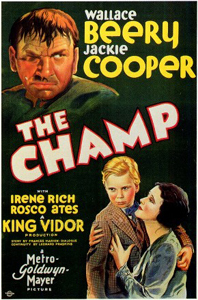
The Champ (1931): A Review (Review # 1730)

 THE CHAMP (1931)

This review is part of the Summer Under the Stars Blogathon. Today's star is Jackie Cooper.

The Champ, in some ways, is slight and manipulative. However, it is hard not to respond to this story of the love between a father and a son.

Andy Purcell (Wallace Beery) may be a washed-up ex-world heavyweight boxing champion, but to his son Dink (Jackie Cooper), he is a hero he always calls "Champ". Dink is not blind to Champ's flaws: his drinking, his inability to keep his word, his gambling and related financial irresponsibility. Dink is accepting of them, however, seeing the good, caring, and loving father Champ is. 

After buying a racing horse Dink names "Little Champ" to make more money, Champ is startled to see Linda (Irene Rich), his ex-wife and Dink's mother. Linda has remarried the wealthy Tony (Hale Hamilton) and has a daughter, but Champ is the one with legal custody. Linda and Tony pressure Champ to if not let Dink live with them, to at least start opening a relationship between Dink and Linda.

Champ agrees, eventually pushing Dink away for what he thinks is his own good. Despite how good Tony, Linda and his half-sister are to Dink, he still yearns to be with Champ. Running away to Tijuana to reunite with Champ, Dink's return revives Champ for him to make his comeback, clean and sober. The fight, however, takes everything out of Champ, and we see that while Dink has something of a happy end, it won't be with his beloved Champ.

I understand that one of Jackie Cooper's greatest appeals to contemporary audiences was his ability to cry. He certainly did a lot of crying in The Champ, though his character has reason to. He sees his beloved horse sold off, which is a sad moment given how attached he was to Little Champ. A more painful moment is when Champ pretends to reject Dink to send him to Linda.

As Cooper and Beery play off each other, it is near impossible not to be moved by both their performances. Major credit should be given to King Vidor in his directing of Beery and Cooper, especially the latter given how hard such strong performances can be for child actors. 

Beery, who tied with Fredric March that year for Best Actor*, really gets you in this scene. We see that Champ really loves Dink, the one good thing he has but which he keeps failing at. As he resorts to physically pushing Dink away, it is the audience that also is crying. 

Cooper completely breaks your heart in The Champ. It is Dink's total belief and devotion to Champ that makes his performance so beautiful. Cooper is so good in selling Dink's innocence with an acceptance and tolerance of Champ's faults, flaws and failings. 

The last scene where he tries desperately to rally Champ as his father is dying is absolutely heartbreaking. "Ain't you proud of your old man now?", a worn-out Champ asks. "Ah, gee Champ, I always was," is Dink's answer. Champ tells him his familiar refrain of "Keep your chin up," pushing Dink's head upwards. As Cooper tearfully forces a smile, we are aware that Champ has died. Dink's overwhelming grief simply tears at the viewer. No matter how everyone around him tries to console him, Dink's cries of "I WANT CHAMP!" grip you. 

This scene is an excellent showcase not just for Beery and Cooper. It is also a clever character reveal in Francis Marion's Oscar-winning original story. For most of The Champ, Dink calls his parents "Champ" and "Linda". In this final scene, however, Dink for the first and probably only time calls Andy "Daddy", and upon seeing Linda, tearfully cries out, "Mother!". It's an excellent but subtle display of how Dink has evolved. 

The Champ is also quite surprising in how it treats the minor character of Dink's best friend Jonah (Jesse Scott). Apart from someone mentioning that Jonah is "colored", no mention is made of Jonah's race. More surprisingly for the time, Jonah being black has no impact on how everyone around him treats Jonah. He is easily welcomed as Dink's best friend and occasional helper, treated as an equal by Dink, Champ and everyone else. It is a small thing, but a good sign for how things should have been. 

If there is a flaw in The Champ, it is from the performances of Rich and Hamilton as Linda and Tony respectively. While the film does well to show that they are genuinely loving to Dink, Rich comes across as a bit more theatrical in her manner. That, however, should be seen as how early sound film acting was with some actors. Hamilton at times was a bit too jovial, but perhaps that is more the character than the actor. 

The Champ should be shown every Father's Day, as it is a beautiful film about that great bond between a dad who struggles and the young man who loves and idolizes him. You can love your father without being blind to his failings, and The Champ, with standout performances from Beery and Cooper, gives one that truth so well-told. 

*Technically, Beery was one vote short of tying March, but the Academy rules at the time stated that if there was a three-vote difference between first and second, it was considered a tie. The rules were later amended to where it had to be an exact tie for there to be two winners. 

DECISION: A-

Thursday, August 3, 2023

The Nutty Professor (1963): A Review

THE NUTTY PROFESSOR (1963)

This review is part of the Summer Under the Stars Blogathon. Today's star is Stella Stevens.

The idea of changing oneself is nothing new. The Nutty Professor takes a horror story and reworks it into a comedy. Dominated by sight and sound gags, The Nutty Professor is not as funny as I thought it would be, but still has enough cleverness to enjoy.

Professor Julius Kelp (Jerry Lewis) is forever causing chaos at his laboratory and classroom. Nearsighted, slightly hunchbacked, with a thin voice and wild overbite, Professor Kelp is mocked and bullied by nearly everyone, administration and students alike. Only student Stella Purdy (Stella Stevens) shows him any kindness.

Kelp decides he needs to make a change. After failing to bulk up at the gym, he turns to chemistry, creating a concoction that turns him into the suave, cool but highly obnoxious and arrogant alter ego Buddy Love. As Buddy Love, he is able to push around others and get his way, oozing charm and sex appeal. Stella, for her part, is both drawn and repulsed by Buddy Love: intrigued by his looks and singing but put off by his manner.

Unfortunately for Love/Kelp, the formula is temporary. Love could be crooning That Old Black Magic or wooing Purdy, but eventually Love's voice and mannerisms start reverting to Kelp's. Can Kelp keep up this double act or will the truth eventually be exposed? Will Purdy go for the smooth Love or the whacky Kelp?

At its heart, The Nutty Professor is a comedic take on Doctor Jekyll and Mister Hyde. You have the somewhat mad scientist creating a formula that will completely alter him into a new being. Unlike the Robert Louis Stevenson novel, however, The Nutty Professor is more about whacky situations than dangerous ones. There is a nod to the Jekyll and Hyde transformation early on, when we see Kelp change almost into a wolfman-like creature.

Lewis, who directed the film, keeps up the audience's expectations by having a section where people react to this new figure but we don't see him for a while. It is not until we get to the swinging clue The Purple Pit when we see, instead of the monster we had earlier seen, the suave Buddy Love. 

Lewis does wonders with the sight and sound gags throughout The Nutty Professor. Early on, he has a clever sight gag when Kelp has to face the infuriated college president Dr. Warfield (Del Moore). The chair Kelp sits at is far too low for anyone, and seeing this extremely clumsy and timid man sitting there while his slow-burning president is shuffling papers is funny.

Other scenes, such as Kelp's disastrous efforts at bodybuilding or when as Love he gets Warfield do perform Hamlet's "To Be or Not to Be" soliloquy in a comic buildup also work well. Lewis also masters audio gags, particularly when Kelp is clearly hungover.

Attempting to not be overwhelmed by sounds, Lewis exaggerates every sound Kelp encounters to where even a student using a liquid dropper becomes a pounding force tormenting him. This is a brilliant use of sound for comedic effect.  Lewis (who cowrote the script with Bill Richmond) should be commended for their cleverness.

The Nutty Professor also has great production design. The Purple Pit in particular is an excellent example of using bright colors that pop out. 

The film's two lead performances are quite good. Lewis, I figure, is something of an acquired taste. Here, he plays two characters and does each of them well. His Professor Kelp is now a bit of a cliché: the thin, reedy-voiced weakling who wouldn't intimate a fly. He does, however, make Kelp into an endearing fellow, someone that we feel for more than mock. Yes, he does funny things and is meant for laughs. However, Lewis' Kelp is also a sweet figure, whom we genuinely want to succeed.

We, like Purdy, can also marvel at Love's smoothness but be appalled by his arrogance. It's surprising to see someone usually mocked for shouting "HEY LADY!" being debonair and even doing some singing.

Stella Steven's Stella Purdy breaks the fourth wall often, as if inviting us into her confusion over both Kelp and Love. She does make Purdy into a caring figure, one whose confusion about Kelp and Love keeps her forever flummoxed. At times Stevens does come across as perhaps too dreamy about things, but on the whole she is a perfect foil for both of Lewis' characters. 

The Nutty Professor sometimes is a bit too obvious with some of its gags. For example, Kelp confusing a group of men standing around the bowling alley for the pins themselves is almost too outlandish to believe. We also do not question the inappropriate relationship between a student and teacher which makes up a large part of the plot. Still, The Nutty Professor is not a film one takes seriously. It's a nice romp, with a strong performances by Jerry Lewis and Stella Stevens.  

DECISION: B+

Wednesday, August 2, 2023

The Matchmaker (1958): A Review (Review #1728)

THE MATCHMAKER

This review is part of the Summer Under the Stars Blogathon. Today's star is Anthony Perkins

It is a strange thing that pre-Psycho, Anthony Perkins was considered a light comedy performer and charming young man, even something of a teen heartthrob. The Matchmaker gives him and the rest of the cast a chance to show a funnier, more knowing side to a delightful romantic comedy.

With the characters at times speaking directly to the viewer, The Matchmaker is Dolly Gallagher Levi (Shirley Booth), a widow of refinement, charm, wit but not much money. Her newest client Yonkers, New York's wealthiest but miserly businessman, Horace Vandergelder (Paul Ford). Dolly initially has him set with pretty shopgirl Irene Molloy (Shirley MacLaine). Now however, Dolly now has decided Vandergelder should free himself of his money by marrying Dolly herself. Tricking him into looking at a fictitious woman named "Ernestina Simple", Horace heads to New York City.

Unbeknown to him, his long-suffering store clerks Cornelius Hackl (Perkins) and Barnaby Tucker (Robert Morse) decide to go to New York too, to find adventure and romance. Through a series of complications, Cornelius and Barnaby come upon Irene's millinery, unaware that Horace and Dolly are going there too. Dolly's efforts to explain the growing confusion meet with some success: Horace knows Irene is entertaining gentlemen callers, but not who. Dolly also leads Irene and her BFF Minnie (Perry Wilson) that Cornelius is a wealthy man-about-town who likes the odd practical joke.

Off to a lavish dinner at the Harmonia Gardens everyone eventually ends up at. Cornelius and Barnaby can hardly afford an apple between them, but Irene and Minnie have bamboozled them into going. Dolly has equally bamboozled Horace into paying for her meal, while attempting to woo him into marriage. More complications ensue and just when everything seems lost for the clerks and the matchmaker, Dolly dusts herself off and hoodwinks Horace into both an equitable partnership with Cornelius and into marriage.

The Matchmaker starts with our characters addressing the viewers, fully aware that they are in a movie. While this is not used often during the film, it is a nice touch from director Joseph Anthony to show that essentially, everyone is in on the joke. Anthony manages to also have one of these asides be quite dramatic and moving.

Dolly, despondent in her carriage on her way back from the disastrous Harmonia Gardens date, talks to us about her past. We hear about her great love for her late husband, Ephraim Levi, and how when she became a widow, she locked herself away from the world. It wasn't until an old oak leaf left by her husband in the Bible fell one day that she realized she was becoming like that old oak leaf: lifeless, dry, and pressed into history. 

It's a moving moment, the rare dramatic moment in the film, and Booth delivers the monologue movingly. The Matchmaker was Booth's final of her five-film career, preferring the Broadway stage and later the Hazel television series than a film career. Do not, however, let this suggest that Booth could not make things funny. Far from it: Booth is hilarious and charming as Dolly Levi, able to make lines sound funny while still grounding it in some semblance of reality.

She, for example, shows a photo of a scantily clad "Ernestina" and casually mentions that it is Ernestina's "graduation picture". Booth makes Dolly a delightful survivor, shrewd character who lives by her wits and always manages to come out on top. John Michael Hayes' adaptation of Thornton Wilder's play is full of funny lines delivered delightfully by the cast.

Ford, for example, informs the viewer that "Marriage is a bribe, to make a housekeeper think she's a householder". When Dolly is still pimping out "Ernestina", Horace asks how he will recognize her. "How do you recognize the Rocky Mountains?", she asks. Looking at the photo, he enthusiastically replies, "Well, those are big". It's a surprisingly risqué moment, the not-too-subtle line delivery implying something other than mountains.

Ford plays Vandergelder as a skinflint who can easily be hoodwinked, someone whose bark is worse than his bite. MacLaine as Irene makes her a survivor in her own right, someone who is looking out for herself until love gets in the way. 

Perkins, for his part, does well playing Cornelius' nervousness both romantically and financially. There is a long section where he and Morse have to try to hide from Horace, having skipped out on work for their New York sojourn. It's a nice bit of physical comedy ably handled by them. We even get a moment where Perkins and Morse, due to circumstances, have to escape the restaurant in drag. Perkins makes Cornelius an eager young fellow, looking for romance and adventure and finding it more than he can handle. 

The Matchmaker is a delightful romp, charming and self-aware. Later adapted into the musical Hello, Dolly!, The Matchmaker is a nice film that entertains. 

The film adaptation of Hello, Dolly! on the other hand...

DECISION: B+

Tuesday, August 1, 2023

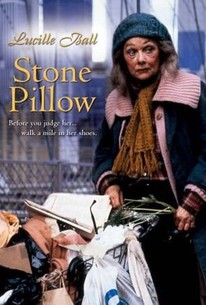
Stone Pillow: The Television Movie

STONE PILLOW

This review is part of the Summer Under the Stars Blogathon. Today's star is Lucille Ball.

Lucille Ball continues to bring us laughter through her television series I Love Lucy, The Lucy Show and Here's Lucy (the less said about Life with Lucy the better). It was therefore a shock to audiences to see their favorite wacky redhead as a bag lady. People taken aback by Stone Pillow, however, forget that Ball had a film career where she did drama as well as comedy. Stone Pillow does detail some of the issues facing the homeless, even if it did have at times some bad acting and some seemingly exaggerated moments.

Eager young homeless shelter employee Carrie (Daphne Zuniga) is floundering in her new job. Advised to get to know the homeless, she starts wandering New York City. One of the homeless she encounters is Florabelle (Ball). Flora is an elderly woman who holds on fiercely to her cart and is well-known, if not always well-liked, by the various workers and cops near "her" corner.

Circumstances lead Flora to believe that Carrie is a runaway new to the city. Reluctantly, Flora agrees to show Carrie the ropes of living out in the streets. Everything from finding the best edible food to keeping safe from potential rapists, Flora is there to help. As the day progresses, Flora bonds with this kid, down to sharing her painful memories of Sonny, her long-lost son who disappeared along with her husband after Flora suffered through an illness.

Eventually though, Flora discovers who Carrie really is. More difficulties come when Flora, against her will, is taken with a group of other women from Manhattan to a Brooklyn shelter. It is a dark night for both women, but eventually Carrie is able to help at least one person find a home to start again.

Stone Pillow has a strong central performance from Ball. She threw herself into this ragged but caring old bag lady, proud but also loving. She was appropriately cantankerous whenever facing off against those trying to harm her or Carrie. As the day goes on, however, we see through Ball's performance that Flora is caring. She is not all the time, such as when she dismisses a homeless Indian family as not being worth helping. It is not racism, however, but a fear of being discovered that motivates Flora's reaction, as she later stands up for the Indian woman when in the Brooklyn shelter. 

We even get a little romance when she goes to get medicine for Carrie through an old pharmacist who is sweet on her. It gives a little moment of lightness in a grim story where attempted rapes and a frightening prison-like setting are shown.

Ball was aiming for a big dramatic monolog when talking about Sonny, and she delivers. One has to have a heart of stone not to feel for Florabelle as she remembers her son. Director George Schaefer was wise in both not cutting away from Ball or using Georges Delerue's music play as she reveals why she holds on to an empty photo frame. 

Ball is I would argue the primary bordering on only reason to watch Stone Pillow, for almost everyone and everything else falls short. Zuniga, to be fair, was playing a green, inexperienced social worker. However, at times she was a little too hysterical and eager, depending on the situation. As the movie went on, however, Zuniga like Carrie seemed to pull herself together, the montage of her attempting to call various shelters to find Flora showing her own growth.

Rose Leiman Goldemberg's screenplay at times was too cute and clever for its own good. Naming this ragged figure "Florabelle" (Beautiful Flower in an Italian/French mix) is a bit too overtly symbolic. Her charm with everyone who interacts with her on a regular basis veered dangerously close to making this homeless person almost cute rather than in need. 

The extended Brooklyn shelter sequence played out like a "women in prison" film, where the only thing missing was the lesbian warden. Some of the acting from the other female homeless bordered on the farcical, though William Converse-Roberts as Max, a homeless advocate nicknamed "The Census Taker" by the homeless does well.

Goldemberg's screenplay also is heavy-handed when it shows a sign reading "Never before have so few done so much for so many with so little" right before the uncaring Brooklyn shelter administrator comes to answer the phone. How exactly Flora got back to Manhattan after the horrors of Brooklyn is left unanswered, as is how she happened to arrive at the exact time another person was found dead in "her spot". The ending, which curiously enough played over the credits, gives Flora a happy ending that seems if not completely strange at least curious.

Stone Pillow does, however, have other elements lifting it up. Delerue is a curious choice to score the project, his music going up against what is a gritty and mostly sad story. However, it works here. The film also shines a light on an important subject, even if like many stories on the homeless, it suggests it is more bad luck than anything else that leads to these types of situations.

No mention is made of addiction or mental health issues, both of which are a cause of homelessness. The film does run the risk of making the homeless, especially Florabelle, more of an enchanted creature than a woman struggling daily to survive.

On the whole, however, Stone Pillow mostly balances entertaining with enlightening. We do see a subject that oftentimes gets forgotten. With a strong, standout performance by Lucille Ball, I think fans of both Lucy and those mostly unaware of her work will find much to like in Stone Pillow.

8/10

Summer Under the Stars 2023: The Catalog

SUMMER UNDER THE STARS 2023

This is a catalog for the movies I will review for the 2023 Turner Classic Movies Summer Under the Stars series. Films marked with a 🅤 will be shown for that star's day. Entries marked with a 🅣 are television films. Random Harvest, reviewed for Greer Garson's day, will be shown on Ronald Colman's day. 

August 1: Lucille Ball: Stone Pillow 🅣

August 2: Anthony Perkins: The Matchmaker

August 3: Stella Stevens: The Nutty Professor (1963) 

August 4: Jackie Cooper: The Champ (1931) 🅤 

August 5: Errol Flynn: Too Much, Too Soon 

August 6: Debbie Reynolds: These Old Broads 🅣

August 7: Robert Ryan: Tender Comrade

August 8: Joan Blondell: The Champ (1979)

August 9: The Nicholas Brothers: The Pirate 🅤

August 10: Rhonda Fleming: Out of the Past 🅤

August 12: Deborah Kerr: Dream Wife 🅤

August 13: Paul Newman: Somebody Up There Likes Me 🅤

August 14: Greer Garson: Random Harvest

August 15: Ronald Colman: A Double Life

August 18: Carole Lombard: Mr. & Mrs. Smith (1941) 🅤

August 19: Fred Astaire: On the Beach

August 20: Barbara Stanwyck: The Lady Eve

August 21: James Stewart: Harvey

August 22: Geraldine Chaplin: Mother Teresa: In the Name of God's Poor 🅣

August 23: Vincent Price: Theater of Blood

August 24: Loretta Young: Taxi! 🅤

August 25: Ernest Borgnine: The Black Hole

August 26: Doris Day: Love Me or Leave Me 🅤

August 27: Humphrey Bogart: Passage to Marseille 🅤

August 29: Woody Strode: The Last Voyage 🅤