Tuesday, January 30, 2024

Golda: A Review (Review #1787)

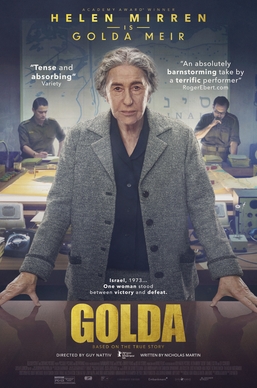
GOLDA

No one can foresee the future. Golda, the film covering Israeli Prime Minister Golda Meir's tenure during the Yom Kippur War, was I figure meant to commemorate the fiftieth anniversary of that war. Instead, it comes on the heels of Israel's newest war of survival against Hamas. As a film, Golda moves well keeps things going, even if at times it becomes a bit heavy-handed with its symbolisms. 

Using the narrative frame of an inquiry into the causes of the Yom Kippur War, we see a commission call an old woman into its chambers. That old woman is former Israeli Prime Minister Golda Meir (Helen Mirren). Various flashbacks take her to October 5, 1973.

While there are rumblings that Egypt will attack the Jewish state, Prime Minister Meir is dubious, as is her Minister of Defense, the formidable eyepatch-wearing Moshe Dayan (Rami Heurberger). Almost too late, Meir sees that Israel will be attack and she orders a partial mobilization but no preemptive attack.

That may have been a poor decision, as Egypt and Syria launch a full-scale assault on Israel. Even Dayan is left horrified when he observes the Syrian troops from the air. He is close to losing his mind, but still Meir will not let him go. She also faces the grandiose military plans of Ariel "Arik" Sharon (Ohan Knoller) and the machinations of U.S. Secretary of State Henry Kissinger (Liev Schriber). Kissinger would rather want a negotiated settlement to not incur Arab wrath and keep the oil flowing. No dice for Meir: it is total victory and recognition of Israel by Egyptian President Sadat or nothing.

Unlike Kissinger and Sadat, however, Meir knows that she has a few cards up her sleeve, mostly the knowledge that in his eagerness to be the Arab leader to wipe the Jews off the planet, he is leaving Cairo undefended. The war ends with an Israeli victory but at a high cost for the secretly ill Meir.

In many ways, Golda is safe. Director Guy Nattiv and screenwriter Nicholas Martin do not delve deep if at all into Meir's troubled mind and/or soul on the war. It is kept mostly behind the scenes, particularly when Meir and/or her staff listen in on the various battles. Granted, Golda is not going to have scenes of her leading troops into battle across the Sinai. However, it also does not explore much if anything about Meir or those around her.

We know, for example, that Meir has an aide whose son is sent to the front. We pretty much know what that young man's fate will be. However, it felt almost as if both her aide and the son (one barely seen, one never seen) were there to "humanize" the war. Given the past horrors of the Shoah which she was fully aware if (even if she did not live through them herself), I do not think Meir went into this situation unaware of the human cost.

Golda also at times leaves things unanswered. The main unanswered sections involve Dayan. At one point, he was shaking so much that I wondered if he had Parkinson's Disease. He also appeared to be at times almost going mad. To be fair, the situation would be almost unbearable to those going through it. However, we still get something of a distance with everyone in Golda.

At times, there are stabs at drawing us into just how close Israel came to falling. Golda Meir at one point tells her secretary that if the Arabs manage to take Tel Aviv, she would not be taken alive. It was a good effort, but not a completely successful one. Golda also indulges in symbolism that is at times opaque and at times far too overt. One scene has her literally with blood-stained hands as a major operation is going on. The closing scene, for reasons I cannot fathom, has dead birds all around her hospital room. 

Some of the acting is curious. Helen Mirren did not sound like Golda Meir. She sounded like Helen Mirren. Apart from that though, I think Mirren did well, though not great as Golda (I think Ingrid Bergman's performance in the television miniseries A Woman Called Golda was closer to the real Meir). Part of it is the script and directing, but part of it is with Mirren. Schrieber faces an uphill battle with Kissinger, as most actors focus on the late Secretary of State's distinctively accented bass voice. He did well, though again not great.

The film does have some positives. Dasha Dauenhauer's score worked well, particularly when Kissinger and Meir face off in Meir's kitchen. 

On the whole, Golda is an acceptable film, not great, but could be a good primer into this tumultuous time in Israel's troubled history and the woman behind it. 

1898-1978

DECISION: C+

Saturday, January 20, 2024

Echo Episode Five: Maya


ECHO EPISODE FIVE: MAYA

Written by: Amy Rardin, Steven Paul Judd, Ellen Morton and Chantelle M. Wells

Directed by: Sydney Freeland

Airdate: January 9, 2024

Maya, our fifth and final episode of Echo does something that I did not think possible: make the case that somehow, five episodes of this series was five episodes too long. It should be remembered that Echo was planned as an eight-episode first series now reduced to a five-episode miniseries. Maya is a disaster, a total snoozefest that does not justify its existence.

With Maya (Alaqua Cox) having turned down Wilson Fisk's (Vincent D'Onofrio) offer to go with him to New York, he has decided she must be eliminated. He has a few aces up his sleeve. Once again, Fisk is holding Bonnie (Devery Jacobs) hostage, along with her grandmother Chula (Tantoo Cardinal). They will be missed at the Choctaw powwow, as it is getting ready to take place. Zane (Andrew Howard) is also there, able to bully Biscuits (Cody Lightning) into parking wherever he wants to launch an RPG into the powwow to kill Maya should she pop up.

While Maya wrestles with what to do, she has a visit from her dead mother Taloa (Katarina Ziervogel), who advises her that she is the living embodiment of all the qualities of her various strong female Choctaw ancestors. From Lowak, strategy. From Tuklo, cunning. From Chafa, ferocity. From Taloa, love. Each "echo" within her. With that, she goes to a final confrontation with Fisk and his men. 

To confront and defeat Fisk, she is able to summon the power of the ancestors (if not the ancestors themselves), even transferring their powers to Bonnie and Chula. For their part, both Biscuits and Uncle Henry (Chaske Spencer) are able to destroy Kingpin's minions. As for Maya? She uses her powers to send Kingpin back to his troubled past so that he can heal and cry. Crying and asking what she did to him, Fisk leaves. Maya is also ready to go, but not before going to a backyard barbeque with her FAMILY. 

It is a bit hard to decide which element in Maya is the worst and which is the most unintentionally funny. Is it the idea that the various ancestors would return to rally around their descendant, a one-legged deaf, mute, potentially lesbian Native American? Is it that said ancestors managed to give power to Bonnie and Chula so they can take down men stronger, taller and younger than they are? Is it how easily it is for Maya to slip into the powwow without Fisk's goons noticing?

What about Henry managing to fire his gun at Zane, causing the RPG to launch into fireworks? Maybe Biscuits managing to run over more of Fisk's goons with his truck demolition derby style?

I think it might be how Maya manages to go into Fisk's mind and bring about healing to him. It was true then, it is true now: all major criminal masterminds really want is a hug.

I freely admit that I know nothing of the comic book character; however, I think that the name "Echo" comes from her ability to mimic or "echo" her opponents' powers. Now, it is that she is an "echo" of her strong female ancestors.

It took four people to come up with that?

A system glitch caused me to watch Maya with subtitles turned off, and I was surprised that I followed the story surprisingly well without the subtitles. That is no thanks to Cox, who still cannot express any emotion to save her life. Sydney Freeland poorly directed her to be as blank as possible. Not that Freeland's direction of D'Onofrio or anyone else was any better.  

Maya has nothing of interest. I am puzzled how anyone would think Echo would be a long-running series to add into the mythos of the world's longest and most expensive soap opera.

1/10

Next: Echo: The Complete Series

Friday, January 19, 2024

Echo Episode Four: Taloa

ECHO EPISODE THREE: TALOA

Written by: Ken Kristensen, Josh Feldman and Chantelle M. Wells

Directed by: Sydney Freeland

Airdate: January 9, 2024

It is amazing what a little Alison Krauss can do for me. Taloa, the fourth of five Echo episodes, was in a lot of ways still as bad as anything Echo has managed to pop out. However, anytime one can appreciate a good song, it can lift it up just enough for me to think well of it.

Now we feature not a strong female Choctaw woman, but young Maya (Darnell Besaw), denied ice cream because the seller does not understand her American Sign Language. Observing this is Wilson Fisk (Vincent D'Onofrio), who is enraged by said ice cream seller's behavior. He grabs him off the street and proceeds to punch the literal life out of him (it is unclear if the ice cream seller died as a result of the attack). Maya sees the aftermath, and proceeds to kick the visibly injured, potentially dying man before Fisk whisks her away.

As a side note, I think Kingpin's reaction was wildly over-the-top and excessive given the situation. Yes, the ice cream seller was a bit obnoxious to a deaf girl, but I don't think beating him up to where you almost if not actually kill him is the right response.

Back to present-day Oklahoma, where Kingpin is not upset or angry about seeing the person who shot him in the eye and left him for dead. Far from it: he wants to have their old traditional Thursday dinners again, just like before when he had his ASL interpreter killed for knowing too much.

As a side note, why not just get another henchman to learn sign language rather than go to the trouble of hiring one just to bump them off? Details, I guess.

Fisk wants Maya to be his successor as Ruler of the Criminal Underworld, urging her to return with him to New York. Maya is in need of wisdom, and who better than her estranged grandmother Chula (Tantoo Cardinal)? Chula tells her of how Maya's mother Taloa (Katerina Ziervogel) came to be born, not in a white hospital, but in the woods. Taloa had the gift of healing, which Maya could use now. Will Maya choose to join Fisk or return to the upcoming Choctaw powwow?

As part of the montage for the various characters while Maya sorts out her decision, we hear Alison Krauss' cover of Down to the River to Pray. It is a beautiful cover, and it does its best to make the situation into a very sad one as the various characters wrestle with their decisions. However, what I have found is that the music carries a lot of the emotional weight in Echo. It is not the performances, or the scripts, or the situations that do so. Down to the River to Pray, while a lovely song well-rendered by Krauss, simply should not be what sells the situation.

Taloa in some ways is almost comical. Kingpin is such a wimp, at one point screaming that Maya kill him with the same hammer he used to kill his abusive father. "FREE ME!" he screams, and one wonders why on Earth he would insist that only this one-legged, deaf, mute, potentially lesbian Native American should take his empire. D'Onofrio does try to sell the drama, but how can he when there is no drama?

At one point, Fisk is impressed with just about everything Maya does, down to shooting him in the head. 

Cox is wrong for the part because she is simply incapable of showing any emotion. Her facial expression never changes, and that is simply deadly for a show with her as the lead. 

One of the most curious elements is how Kingpin has some kind of technology to make Maya understand what he says without an ASL interpreter. A contact allows her to "see" Fisk's words turned into Sign Language. My thinking is that he could use that technology to go legit and make millions. Why waste it on just one person?

Taloa makes suggestions that there is some spiritual connection between Taloa and Maya which does not land. To be fair, the scene between Cardinal and Cox works well. That is due mostly to Cardinal and due to how the conversation is done mostly silently. I think that is more realistic than most of Echo has been.

Taloa is built up by Krauss and Cardinal. Everything else is not worth the limited time we have. With one episode left, Echo is leaving no mark.

3/10

Next Episode: Maya

Thursday, January 18, 2024

Echo Episode Three: Tuklo

ECHO EPISODE THREE: TUKLO

Written by: Marion Dayre and Ken Kristensen (Story by Ken Kristensen, Jason Gavin and Shoshannah Stern)

Directed by: Catriona McKenzie

Airdate: January 9, 2024

My understanding is that the Choctaw nation is a matriarchal society. As such, it should not be a surprise that the miniseries Echo builds its whole mythos around strong female Choctaws. Tuklo, the third episode, keeps to its thread of starting with a strong female ancestor to our one-legged, deaf, mute, potentially lesbian Native American antiheroine. Surprisingly devoid of plot, Tuklo is almost filler for something that is not there.

Oklahoma Territory, 1800's. Young Tuklo (Dannie McCallum) wants to join the Lighthorsemen, a group of Native American guards protecting their people against all enemies foreign and domestic. She is told that she cannot due to her gender. "Women are life-givers. Men are life-takers," she is reminded. Nevertheless, she persisted. Tuklo eventually goes all Mulan and saves the Lighthorsemen from attack by the white man.

Moving on to present-day, Maya (Alaqua Cox) has visions of her strong female ancestors but is abducted by Vickie (Thomas E. Sullivan), an employee at the skating rink owned by Maya's Uncle Henry (Chaske Spencer). Vickie knows of the bounty on Maya and wants it. He holds Maya and Henry hostage, later taking Maya's cousin Bonnie (Devery Jacobs) when she comes snooping around. In comes Zane (Andrew Howard), one of Wilson Fisk's main henchmen, to collect Maya. Unsurprisingly, Zane kills Vickie, though what exactly happened to the two white trash women that make up Vickie's Bloodhound Gang is left unexplained.

Zane is about to fulfill his mission to kill Maya, throwing in Henry for good measure, when his New York Minute ringtone goes off. Maya and Henry, apparently, are saved at the literal last minute by Don Henley. Maya's temporary escape is for naught, for who happens to come to her hideout but none other than Wilson Fisk aka Kingpin (Vincent D'Onofrio)? 

Tuklo is the only episode not directed by Sydney Freeland. Catriona McKenzie does the honors, and perhaps that is why Tuklo is slightly better visually than past Echo episodes. The episode begins in the style of an old silent Western film, complete with title cards. The action scene at the laser tag area of the bowling alley is perhaps an homage to The Lady from Shanghai (though perhaps that is giving them far too much credit). You also have a nice visual of Maya hung upside down with a disco ball above her.

Granted, this makes no sense to the actual story since it would have been easier to simply remove Maya's prosthetic leg and tie her up than literally hang her upside down in the middle of the rink. Details are not important when you can make it look nice. 

The visual moments in Tuklo are what elevate it. Those are the only things that elevate it, for in reality, Tuklo does not move the narrative forward. What you have are the two stories: Tuklo and Maya, neatly split in half, with the second half being almost unnecessary. A lot of Tuklo's second half revolves around everyone waiting for Zane to show up, but there is nothing there.

There is a whole lot that either does not make sense or is unimportant. When facing almost certain death, why does Bonnie decide this is the best time to reprimand Maya for her failure to make contact? Why do the villains throw Maya's prosthetic foot at her rather than hold onto it, so she won't be able to escape? What did happen to Vickie's two girl conspirators? Who are they? Why are they there at all? There is mention by another of Zane's men that one of them drove off, but I do not remember if they were ordered to hunt her down. Our white trash trio kind of just came and went. Vickie's death is not unexpected, though again, looked nice. 

Moreover, it is a cliche to have a cutesy ringtone for our henchman. That on top of having our leads saved at the literal last minute by said ringtone. Maya nor Henry do not appear all that surprised that things turned out the way they did, a very strange attitude to take. Fisk coming in is not that shocking. 

That three people have a "story by" credit and a mere two people wrote Tuklo suggests that there really is no one overseeing things. 

There are no performances here. Perhaps Howard's Zane can be given grudging credit for being a camp Russian henchman (at least he sounded Russian to me). Everyone else was just there, saying things and being thoroughly unconvincing about it all. 

Tuklo showed that even with a director with a better visual style, no amount of nice or clever imagery makes up for lousy scripts. 

3/10

Next Episode: Taloa

Wednesday, January 17, 2024

Echo Episode Two: Lowak

ECHO: LOWAK

Written by: Marion Dayre, Josh Feldman, Steven Paul Judd and Ellen Morton (Story by Marion Dayre, Ken Kristensen, Josh Feldman, Steven Paul Judd, Rebecca Roanhorse and Bobby Wilson)

Directed by: Sydney Freeland

Airdate: January 9, 2024

It is only two episodes into the five-episode run of Echo and already a theme is fast emerging. Each episode will be named after a strong Native American female, though I imagine that none will be as strong as our one-legged, deaf, mute, potentially lesbian Native American. Lowak has an astonishing six "story by" writers and four credited screenwriters. How four to six people could come up with something like Lowak almost makes the case that the studios were right to not want to have large writers' rooms if it was going to be so muddled and poor.

We go to 1200 A.D., where Choctaw warrior princess Lowak (Morningstar Angeline) plays for keeps in the Native American lacrosse. With her people's survival on the line, Lowak must win, which she does. Moving to present day, we see that former hitwoman Maya Lopez (Alaqua Cox) is still taking refuge in her hometown of Tamaha, Oklahoma to regroup after killing Wilson Fisk aka Kingpin, her former mentor and boss. She plans to take over Kingpin's empire, telling her Uncle Henry (Chaske Spencer) that it is time for a "Queen-Pin". As part of her plan, she opts to place a bomb on a shipping container on its way to New York, getting unwitting help from her idiot cousin Biscuits (Cody Lightning).

It is only through the power of the ancestors that Maya manages to free her prosthetic leg when it gets caught in the train link. Due to the damage to her prosthetic leg, Maya has to go to her grandfather Skully (Graham Greene), who tells her of her distant ancestor Chafa, the first Choctaw and savior of her people. Her grandmother Chula (Tantoo Cardinal) eventually learns that Maya is back, as does Maya's cousin Bonnie (Devery Jacobs), both due to Biscuit's general idiocy. Henry, who works for Fisk, warns Maya that she is playing with fire, but she will not listen. 


I figure that each succeeding Echo episode will connect Maya with another one of her strong, female ancestors. We got that in Chafa, and we get that in Lowak. How exactly this multigeneration contact can take place to where Maya can summon the power of Lowak to free her from the train Echo does not explain. I guess I am just supposed to take it on faith that Native Americans can get superpowers through their heritage, even if they do not know exactly from where these powers come from.

Lowak does feature some curious tropes that are now both cliche and slightly laughable. The ancestor Lowak somehow can take down a group of Native American men physically stronger and bigger than her also apparently due to her connection with her mythical, mystical ancestor. Maya similarly has almost superhuman strength and agility to silently take to a moving train, with poor Biscuits trying hard to keep up in Chula's truck.

Chula just so happened to see Biscuits drive by her in her thoroughly damaged truck. That is so unoriginal that it makes one want to scream. Why not, for example, have Bonnie pop in on Biscuits, see the extensive damage, and text their grandmother photos of what Biscuits did. It might have provided for more interaction between characters and even brought a bit of lightness to Echo, a show that seems to think it must be thoroughly serious to be good.

Lowak also indulges in a bit of comic racism when Skully is attempting to sell Indian tchotchkes to a couple of idiot na hullos (Biscuits' term for Anglos). As Skully works to sell them on  on the importance of the objects by making vague claims of their powers and autheticity, they hear from him what appears to be a Native American chant. It is clear that he is saying "Buy this damn thing" but says it in a cliched Native American sing-song manner that Lowak suggests that anyone with good hearing would be so easily fooled. 

Oddly, it reminds me of a similar scene from of all things, the Whoopi Goldberg/Ted Danson comedy Made in America. A pair of old white women go into Goldberg's Afrocentric gift shop, delighted in the many voodoo dolls and black paraphernalia that they purchase. Made in America was meant as a silly comedy. Echo is meant as a respectful homage to Native American women by making them superheroines. Yes, I know that that scene was meant to be a bit of lightness, but it does not work.

Again, we have a lack of good performances save for Greene and to a lesser extend Cardinal (the face she makes when she sees Biscuits drive away in her all-but-demolished truck is weird). Cox has such a hard face, one that shows no emotion. Lightning, to be fair, was tasked to play an idiot and wimp, so I guess he did well in that role. Jacob's Bonnie gets little to do, and it is a shame. 

What I figure was meant as the exciting section on the train looked second-rate, unexciting and a bit boring. Lowak continues to have the issue of simultaneously speaking and signing. I wish it would commit to one or the other. Oddly, the best scenes in Lowak are the ones not involving Maya. Both when Skully & Biscuits or Chula & Henry are involved, we see glimpses of a better story. The interplay between Biscuits and Bonnie on the other hand, did not work, though to be fair they were over walkie-talkies. 

Lowak again has four screenwriters and six story creators. The question then is, "it took six people to come up with this?". 

2/10

Next Episode: Tuklo

Tuesday, January 16, 2024

Echo Episode One: Chafa

ECHO: CHAFA

Written by: Marion Dayre, Josh Feldman, Steven Paul Judd and Ken Kristensen

Directed by: Sydney Freeland

Airdate: January 9, 2024

I was asked to watch Echo, the new Marvel Cinematic Universe Disney+ series build around a deaf, mute, one-legged potentially lesbian Native American. I know nothing of past MCU Disney+ shows and genuinely do not care to. Nevertheless, I am honoring the poll results asking me to review each Echo episode, all five of them. Perhaps I should consider myself lucky, as I understand that Echo was meant to be eight episodes long in a first season, then cut down to six episodes until it went to five for a one-season run. A miniseries, I understand, versus a long-spanning section to the world's longest and most expensive soap opera. Chafa, the first episode, feels more like a "Previously On" episode meant to catch up viewers like me who know nothing of our heroine. As such, it is a poor introduction and harbinger of more bad things.

Young deaf, mute Native American girl Maya Lopez survives a car accident that killed her mother Taloa (Katarina Ziervogel) and which leaves her with one leg. Her father William (Zahn McClarnon) takes her to New York City, which somewhat pleases Taloa's mother Chula (Tantoo Cardinal). William is part of the nefarious criminal work of Wilson Fisk also known as Kingpin (Vincent D'Onfrio). Maya (Alaqua Cox) has become a fierce hitwoman for Fisk as well as his informal niece. She faces off against a mysterious figure known as Daredevil (Charlie Cox, no relation to Alaqua), able to stand on equal footing with the Man Without Fear.

A chance encounter with Clint Barton aka Hawkeye (Jeremy Renner) quickly convinces her that Fisk ordered her father's killing and in turn shoots Fisk in the head. Now running to her hometown of Tamaha, Oklahoma five months later, she does make contact with her Uncle Henry (Chaske Spencer) and her cousin Biscuits (Cody Lightning). Hiding out in her grandmother Chula's neglected home, she does not plan to stay long or make contact with her former BFF, cousin Bonnie (Devery Jacobs). Maya does contact her grandfather Skully (Graham Greene) and plans now to become the Queenpin of the New York underworld. Unfortunately, the Kingpin is not dead, and we see that he awakes from what I figure is a coma.

I have heard about the importance of representation, but Echo veers dangerously close to parody of those efforts. Our character centers around a deaf, mute, one-legged Native American. If she ends up being a lesbian, we would have run through an entire gamut of minorities. Chafa is a shockingly weak debut episode far beyond the idea of centering a show around a deaf, mute, one-legged potentially lesbian Native American.

As our lead cannot communicate vocally, we need American Sign Language to not just see what Maya thinks but what others are saying to her. In my admittedly limited knowledge of ASL and the ASL community, my observations are that all communication is through signing. The non-deaf person does not speak with his/her vocal cords to speak to the deaf person. Chafa instead has almost everyone simultaneously speak and sign. That has the curious effect of slowing things down. The hearing actors appear to be reciting the dialogue for the television audience. If everyone signs or in Kingpin's case has an ASL interpreter at the ready, why do they have to speak at all?

Only once late in Chafa did we see what I think would be a more realistic conversation where all sides sign at each other. Why, however, Biscuits has to sign to his dog, Billy Jack, I cannot fathom a guess.

Chafa has other issues apart from the curious decision to speak and sign simultaneously. Alaqua Cox has exactly one expression throughout: a permanent scowl no matter what the situation. It is impossible to decipher what Maya is thinking and going through when her expression never changes. Perhaps to compensate, Lighting appears to go overboard as the goofy, near-idiot Biscuits. Spencer's Uncle Henry matches Cox in looking permanently angry. Almost everyone appeared to be in a foul mood.

That is except for three. There is the aforementioned Lightning. There is Greene, who brings a bit of a spark as Skully. Finally, there is D'Onofrio, but unlike the others, his Wilson Fisk is a generally weak, pathetic wimp of a man. Why this criminal mastermind seems to hold this deaf, mute, one-legged Native American so close to his heart never comes across in Chafa. For that matter, Renner's cameo (which I understand was pulled from Hawkeye) does not make sense. Why would she so quickly take his word that Fisk was behind William Lopez's killing? 

None of these questions are answered in Chafa despite the episode having four credited screenwriters. Moreover, director Sydney Freeland made some curious decisions. When Maya and Fisk are in his limo accompanied by Fisk's ASL interpreter (he's the only character who does not sign despite being her unofficial uncle and mentor), the interpreter is hidden in shadow. Like most of Chafa, we simultaneously heard and saw the signing. Here was no exception, but the way the scene was shot I would have found seeing the interpreter next to impossible. Had I been Maya, I would not have understood what Fisk was saying simply because I would not have been able to see the interpreter. It was a curious cinematic decision.

As a side note, Charlie Cox's Daredevil appears exactly once and is so unimportant to Chafa that is a puzzle as to why he is there apart from name recognition. There was nothing in their encounter that shows she is close to Daredevil's equal, let alone strong enough to get Fisk's admiration for passing this test. 

Chafa does nothing to build interest in it. The lead is blank, the story rushed and a bit disjointed and is almost hilarious in its conclusion. Seriously, despite shooting Fisk at point-blank range, Maya is unaware that Kingpin survived? How could he have possibly survived this? To be fair, why would he be all but begging for his life or not have any idea that she would discover his involvement in her father's death? Even at a mere five episodes, this will be a long Echo to sit through.

2/10

Next Episode: Lowak

Monday, January 15, 2024

The Beekeeper (2024): A Review

THE BEEKEEPER

I admire, even respect, films that know what they are. Such is the case with The Beekeeper. An action movie that tells its story quickly, hits its familiar beats and has a cast fully aware of itself, The Beekeeper is good entertainment.

Adam Clay (Jason Statham) is living a quiet life far off the grid raising bees. His only human contact is his landlord, Eloise Parker (Phylicia Rashad), a retiree with a respectable bank account who manages a charity. Unfortunately, scammers get Eloise to fall for a phishing scam, bilking her and her charity of millions. Despondent, she kills herself.

Initially thought of as a suspect by FBI Agent and Eloise's daughter Verona Parker (Emmy Raver-Lampman), Clay is quickly cleared. He, however, is now determined to find the scammers and bring justice to them. He reaches out to his former paramilitary group, known as The Beekeepers, for help. They get him the address and name of United Data Group.

Clay soon makes quick destruction of UDG, sending its head Mickey Garnett (David Witts) fleeing from the inferno. As Parker investigates the phishing crime, neither she nor Clay initially realize that this is part of a major crime headed up by Derek Danforth (Josh Hutcherson). Derek is a rich, vulgar ne'er do well who does not shrink from sending thugs to keep his empire growing. Despite the efforts to protect Derek by former CIA head Wallace Westwyld (Jeremy Irons), Clay is coming.

How high does Derek go to? What is his connection to a mysterious but powerful figure, his mother Jessica (Jemma Redgrave)? As the unrelenting Clay marches onwards, destroying anyone who gets in his way, Eloise and her partner Wiley (Bobby Naderi) follow behind, discovering the Beekeepers and Derek's connection to the highest power. 

Again, in its hour-forty-odd minute running time, The Beekeeper gives the audience what it wants: violent action, a stoic character, and an almost outlandish villain. The strong thing about The Beekeeper is that no one in front of or behind the camera ever tries to be smarter than Kurt Wimmer's screenplay. It is a simple, straightforward story and never suggests that there has to be more. This mysterious figure, with a shadowy past, is taking down a criminal enterprise.

I think one major plus in The Beekeeper's favor is the relatability of the crime. Clay is not taking down spies or a massive government conspiracy. Instead, it is internet scammers who take advantage of vulnerable people. People either know people who have been scammed or have been scammed themselves. As such, there is a vicarious thrill in seeing these people taken down in sometimes particularly vicious ways. 

The Beekeeper is also blessed with actors and performers who know what this film is and play it as such. No one will ever say that Jason Statham is an actor in the "Statham IS King Lear" mold. He is an action star, asked to do nothing more but take down criminals and show little emotion. As he approaches 60, Statham shows no signs of slowing down. Stoic in his delivery, his understated manner works well with some of his costars. Hutchinson as the vaguely Hunter Biden-like Derek is loving every minute, going all-in on the crazy and entitled nepo baby. 

The big surprise is Irons as Derek's minder. This is clearly a paycheck role, where he knows that he is almost unnecessary to the film and does not try to give his all. It is not a bad performance, and in fact he seems to be joining in the fun of things. 

Others, though, do not fare as well. Jemma Redgrave did her best to mask her British accent, but it still slipped through. Raver-Lampman was not the most convincing as either a grieving daughter or committed FBI agent, but it was serviceable. Naderi as her somewhat comic relief partner was better. 

The action scenes were at times a bit too violent for my tastes, but I think they worked well and will please action fans. Efforts to try to make the Beekeepers some kind of mythic figures, down to sending a Beekeeper who gets dispatched quickly (and violently) do not work as well as director David Ayers intended. Moreover, another assassin hired by Westwyld came across as almost parody.

On the whole, though, The Beekeeper knows what it is and lives up to its goals. Enjoyable and entertaining, I hope The Beekeeper does not inspire a franchise but stays a single event. 

DECISION: B-