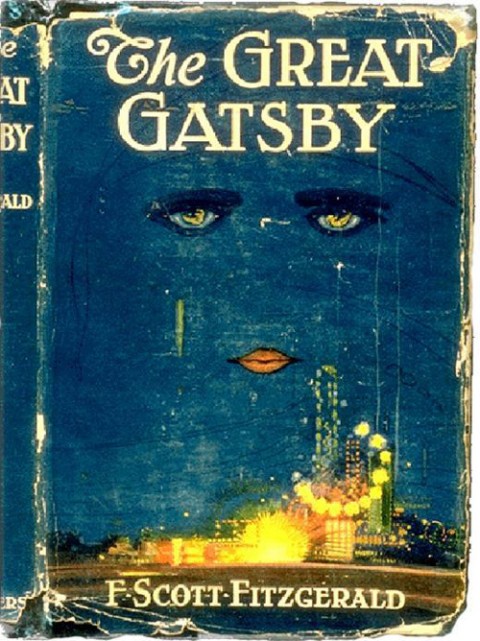
Showing posts with label Great Gatsby. Show all posts

Monday, September 23, 2013

The Great Gatsby Retrospective: The Conclusions


I have read The Great Gatsby and seen three adaptations of the F. Scott Fitzgerald novel: the 1974 film version, the 2000 television adaptation, and the 2013 film version.  There was a 1926 version which is a lost film, and a 1949 version currently unavailable on DVD.  Now, one would think that something as well-read (though perhaps, not well-enjoyed given its assigned reading versus when I read it for pleasure) and well-known as The Great Gatsby could inspire a whole series of great adaptions.  Sadly, despite their best efforts the quintessential version of Fitzgerald's opus remains as elusive as that green light across the bay. 

The three versions of The Great Gatsby I have seen have been pretty flawed affairs, some more than others.  That being said, when I say something or someone is 'the best', that should be taken with a grain of salt.  More often than not, it just means that the actual 'winner' is there by default (i.e. the others were worse).  Very rarely could I say there is a brilliant version in any of the three adaptations, but when I do find one, I'll let you know.

Now, without further ado...

BEST JAY GATSBY


Robert Redford
Toby Stephens
Leonardo DiCaprio

This is clearly a 'default' winner.  Is DiCaprio at 37 too old to play the young, romantic, doomed dreamer?  Perhaps, though I forgave it pretty quickly.  In terms of actual acting DiCaprio did bring a greater sense of both his foolish idealism and romanticism of the past than the other Gatsbys.  The affectation he used whenever he called someone 'old sport' I think was correct.  After all, Gatsby was 'playing a role', and the "old sport" was all part of that performance of his idea of what a successful, wealthy, powerful man was suppose to be. 

I would have said that overall, Redford is the best actual actor of the three, and while one would have thought he would have been idea as Gatsby he looked almost bored throughout his version, sleepwalking through his performance.  I should also point out that Redford was...37 when he played Gatsby.  Just a thought.

Finally, Stephens just can't act.  At 31 he is the youngest person to play the lead, but he actually looked older in the TV movie, and did I mention he can't act?  However, in one of those 'even a stopped clock' scenarios, Stephens didn't embarrass himself and managed to do better than Redford.  That is sad, but Stephens can't compete with DiCaprio.

BEST DAISY BUCHANAN


Mia Farrow
Mira Sorvino
Carey Mulligan

Talk about rather spoiled for choice.  If one looks at each of them, we learn two things.  One, they are all competent to great actresses.  Two, Daisy Buchanan must be the hardest character to play in all literature, because all of them were on the bad side.  It's only the degree of bad that they can be judged, and Mulligan is the least bad.  At least when she played Daisy, I got the sense that she knew the character was ethereal, unreal, a fantasy floating through life carelessly.

Farrow, who actually gives Mulligan a run for her money, would have won if not for the fact that her Daisy came across as a whiny airhead, one who screeches and whimpers her way through life (and that's after the points she earned by giving the most memorable line of all three versions, "Rich girls don't marry poor boys", which is not from the novel).  Sorvino also could have done wonders, but she sounded too much like she was auditioning for a Marilyn Monroe impersonator to give much life to Daisy.

I just wish that the next version of The Great Gatsby (and trust me, there will be another version) makes Daisy into something Farrow, Sorvino, and Mulligan could not make her: human.

BEST NICK CARRAWAY


Sam Waterston
Paul Rudd
Tobey Maguire

Here we have an all-out winner, and that is Rudd.  Nick is the moral center of the story, and of all the three actors I think Rudd is the one that came closest to making Nick both relateable and a nice guy caught up in the decadence of the Roaring Twenties.  It's sad that Paul Rudd is now known mostly for comedies, because the guy is a pretty good to great dramatic actor.  I hope someone gives him a chance to show that he can handle drama just as well as he can comedy.

The other two actors are pretty good in other films, but Waterston was drowned by a bad script to where he came off looking as bored/boring as everyone else, playing things a bit far too seriously.  Maguire on the other hand, got that 'gee-whiz' manner to him where he is more clueless than decent.  He did a good job, but there is a thin line between being good and being dim.  Just a thought.

BEST TOM BUCHANAN


Bruce Dern
Martin Donovan
Joel Edgerton

When I think of Tom Buchanan, I think of a brute, one who is big, beefy, and powerful.  When I saw Joel Edgerton as Tom, he fit the idea of what I thought the character should be as well as what he should look like.  Thank Heavens Bradley Cooper couldn't do it, otherwise we would have been stuck with THREE versions of a wimpy Buchanan.  Yes, Cooper's pretty, but he doesn't scream, 'bully'.  Edgerton does.

I always felt Dern was miscast as Tom Buchanan.  He's far too thin and unimposing physically (especially compared to Redford).  It does not help that the 1974 version gave Buchanan so little to do.  At least with Edgerton, he was more central to the story.  Finally, who remembers Martin Donovan?

BEST JORDAN BAKER


Lois Chiles
Francie Swift
Elizabeth Debicki

As with Rudd, another actor who just ran away with it and is by far the best version of the character we've had.  Debicki is the highlight of The Great Gatsby 2013 and a remarkable find.  She brought the energy and vitality to Jordan, and it is a terrible shame that the character's affair with Nick was not shown.  I suspect this was to make the perpetually innocent version of Nick just that, but what a waste.  If she had more screentime, I would have pushed for her as a possible Best Supporting Actress, because you just wanted to see more of Debicki and Debicki as Jordan.  Personally, if I were Gatsby, I would have forgotten about Dull Daisy and crossed into the Jordan Valley.

Debicki got that she was larger-than-life, and her Jordan embraced the decadence.  I hope Elizabeth Debicki gets more parts, because if there were any justice on this Earth, she should be a true star.

Chiles was like everyone else, bored and boring as Jordan.  She was the same in Moonraker (a film I am apparently one of two people who enjoyed it, the other being my friend Fidel Gomez, Jr., who may or may not be dead).  It was a pretty bad performance, and as with Martin Donovan, can anyone remember Swift?   

BEST COSTUMES
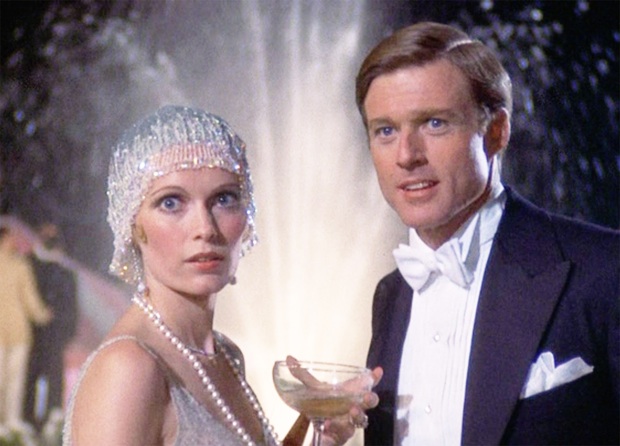


1974
2000
2013

If anything, The Great Gatsby always has us picturing the wild flapper styles of the Roaring Twenties.  The ideas of fast cars and faster women, speakeasies, gangsters, and hot jazz and always intrigues people.  Therefore, the costumes in any Great Gatsby adaptation are important.

When looking at the wardrobe for all three adaptations, the ones to the 1974 version had the perfect blend of originality and believability in its Academy Award-winning Costumes.  Those frocks and those hats and headpieces Farrow wore are beautiful, but they also look like clothes the characters would wear in real life.  The ones from 2000 were all right but not memorable, and while 2013 had big, lavish, and beautiful costumes, they also were a bit too theatrical to believe the clothes would belong to real people.  Catherine Martin may receive another Oscar nomination for her frocks, but for me, the 1974 version had better, more beautiful frocks all around.   

BEST ADAPTATION


1974
2000
2013

Again, this is damning with faint praise.  I know many critics didn't like the 2013 version of The Great Gatsby, and while I recognize the problems within it I found it entertaining and enjoyable.  I think the fact that it had some of the best performances of all three versions (Edgerton and Debicki in particular) pushed it forward.   

Then again, we have in the 1974 and 2000 versions slow clunkers, making the romance between Jay and Daisy a moribund affair.  That being the case, here is where we get a winner by default.  I will say that because I generally ignore 3-D adaptations I didn't suffer the effects of having things thrown at us.  If one looks at all three versions, the 2013 version at least has a semblance of life within it. 

WORST ADAPTATION


1974
2000
2013

Again, despite their own efforts none of the Great Gatsby adaptations are worthy of the book.  Therefore, we have to look at which one is the worst.  The 2013 version at least moves and entertains.  2000 is a respectable version, although it is not a good adaptation that brings shame to TV movies.  However, the 1974 version is just a disaster.

It is slow.  It is boring.  It is badly-filmed.  There is no energy.  It makes the Roaring Twenties squeak.  It has generally lousy performances.  It is infamous in its ineptitude, and it is just something that is worth your time only if you are having trouble sleeping.

Well, we have completed The Great Gatsby retrospective.  Personally, I liked the 2013 version, would watch the 2000 version if there was nothing on, and would have to be paid to watch the 1974 version.

Still, read the book.  It is very, very good.    

Bob, I just read the script!
Mia, I'm sure it'll be all right.  We're too beautiful to fail.


Tuesday, August 13, 2013

The Great Gatsby (2013): A Review (Review #549)

THE GREAT GATSBY (2013)

The curse of The Great Gatsby has been that it is a great novel which has had inevitably lousy adaptations.  Minus a 1926 silent film version (sadly a lost film) and a 1949 version yet to be released on DVD, every adaptation of the F. Scott Fitzgerald classic (the 1974 Robert Redford/Mia Farrow version and the 2000 television version) has focused far too much on either the decadence Fitzgerald chronicled before Jay and Daisy reunite or turns the already sad tale of dreams destroyed by reality into a moribund affair.  The newest version of The Great Gatsby, courtesy of Baz Luhrmann of Moulin Rouge! and William Shakespeare's Romeo + Juliet fame now turns his eyes to that other tale of Roaring Twenties woe.

I think this is the best adaptation of The Great Gatsby yet.  That shouldn't be interpreted to mean it is the best POSSIBLE version of The Great Gatsby, or the quintessential version of one of the great American novels.  Rather, it just means it is good enough, and that the others are weaker compared to this version. 

For those who do not know the plot (and there may be some who don't know), Nick Carraway (Tobey Maguire) is a bond broker with limited success.  He does have enough to rent out a tiny cottage on West Egg, Long Island, home to the nouveau riche.  Across the bay in East Egg live the old money crowd.  As it so happens, Nick's cousin Daisy (Carey Mulligan) lives in East End.  Married to Tom Buchanan (Joel Edgerton), they live lives of quiet desperation.  Daisy is fully aware that Tom is unfaithful, but she remains with him, with only her friend, golfer Jordan Baker (Elizabeth Debicki) to turn to.

Nick's neighbor is the mysterious Jay Gatsby (Leonardo DiCaprio).  All sorts of legends have emerged about who Gatsby is or how he came to his massive (and mysterious) fortune.  He throws lavish parties to which everyone wanders in but to which no one was actually invited.  However, Nick, to his amazement and puzzlement, receives an actual invitation, but there is an ulterior motive.  Gatsby, having learned through Jordan that Nick is Daisy's cousin, takes him under his wing to ask for a massive favor: introduce Daisy to Gatsby.  Daisy and Gatsby had been romantically involved before he went off to war.  Gatsby had lost Daisy to Tom when he returned, but now, with a second chance to recapture that love lost, he can squire the beautiful dream of Daisy away from the brutish Tom and keep her to a style she had grown accustomed to.

How Gatsby, the child of poverty, manages to gain so much wealth is quite simple (though if memory serves correct, never overtly stated): he is involved in criminal activities, working for the shady Meyer Wolfshiem (Amitabh Bachchan). 

However, on a tense and hot afternoon, all the secrets are laid bare.  Daisy cannot bring herself to go away from Tom or deny that she did love him once, devastating Gatsby.  Returning from the city, an accident kills Tom's mistress, Myrtle (Ilsa Fisher).  Her devastated husband George (Jason Clarke) recognizes the car as Tom's, but the simple-minded mechanic is convinced that someone else was driving it.  In the end, Gatsby literally dies for his dreams while the Buchanans are able to rush off, careless people careless with everyone they encounter.

The whole story is narrated by Carroway, with him working out this sorry tale in the sanitarium he is in.

I don't understand a few things about The Great Gatsby.  Chief among them was Luhrmann and co-writer Craig Peirce's decision to have this framing device of having Nick narrate his story via a mental institution.  This was a bad decision in that it takes away from the narrative.  Once we get the story going, we stop every so often to go back to Nick either talk about the events he's narrating, or worse, typing them out into a book he calls The Great Gatsby.  Such tricks are really ridiculous and distracting, not to mention unnecessary.

Secondly, I wonder why two important plot points were eliminated.  The first was the romance between Nick and Jordan (which is nonexistent in the film) and the second and I'd say more important is after Gatsby's death when his father arrives.  Mr. Gatz is one of the handful of mourners of the man who was once the envy of all who met him, but here, we see none of the true pathos that entombed Jay Gatsby and his dream of reliving the past to a perfect future.


If anything, Luhrmann goes back to what he knows best: making large, busy, wild pictures that call attention to their artificial nature.  Nothing captures this more than when Gatsby is finally revealed at one of his uber-swanky soirees.  To Gershwin's Rhapsody in Blue, fireworks a'blazin' behind him, our host with the most in the figure of the beautiful DiCaprio emerges. 

Much has been made that perhaps at 38, DiCaprio is too old to play the youthful dreamer.  This might be true, but I didn't find his age a handicap.  In terms of performance, he did a strong job of playing the man who believes he can keep his dreams of the past.  The affectation of 'old sport' WAS suppose to be a put-on, and everything about Gatsby was suppose to be artificial.  As such, DiCaprio was giving the correct interpretation to him, but every so often (such as when his nerves at being reunited with Daisy get the better of him) the mask slips off to reveal a frightened man, sure of only the love that has sustained his dreams and activities.

In terms of performances, I think two stick out.  Edgerton is the ideal Tom Buchanan: brutish, unfeeling, a bully.  He projected the bigotry of the character beautifully without making us feel anything for him.  Debicki is the true star in the sadly underused role of Jordan, her brash and direct manner being something to liven up all the proceedings.  She, to her credit, makes the most of her screen-time to where we want to see more of both Jordan and Debicki (and hope she gets more roles).

I think that Maguire and Mulligan gave the performances they were asked to give.  Whether this is good or bad I leave up to the audience: the former sometimes appearing far too naïve for someone who is suppose to be turning 30 in that fateful summer, the latter perhaps a bit too ethereal to be real.  Then again the character of Daisy was always suppose to be a bit ethereal and unreal, so I really don't think I can find fault with how Mulligan played the role.

In regards to other matters, The Great Gatsby puts it all up there.  Catherine Martin's costumes and production design (the latter with Karen Murphy) are appropriately lavish and grand and a bit gaudy...all the things one expects in a Roaring Twenties period picture where such things are paramount.  I can't say that the much vaunted Jay-Z felt completely out-of-place.  Sometimes it worked, sometimes not (hearing a soft version of Mrs. Carter's Crazy in Love was odd and distracting).  Here is where Luhrmann didn't quite decide whether to contemporize The Great Gatsby with a hip-hop soundtrack or keep it with a true 20's feel (you can have rap or you can have jazz, but can you really have both?). 

One thing I didn't care for was when one of Gatsby's guests tells Carraway to basically forget any romance with Jordan.  "Rich girls don't marry poor boys," he tells Nick.  Little nods to the 1974 version aren't appreciated, and nor are deliberate rip-offs of better films.  When we discover Gatsby's body in the pool, there is no way Luhrmann was not goading us to recall the opening of Sunset Boulevard.  Such things are not just distracting, but almost insulting. 

For all that jazz in The Great Gatsby, some of the best moments are when Luhrmann keeps things simple.  I didn't find it as horrendous as others have.  It isn't a perfect film, or even the ideal version of Fitzgerald's definitive work.  What The Great Gatsby is instead is a big picture that mostly works, close to the source material, that functions remarkably well all things considered. 

The Great Gatsby is not a fake but it is also fails to capture the elusive green light of being the definitive adaptation.   
 

DECISION: B-

Monday, September 10, 2012

The Great Gatsby (2000): The Television Movie

THE GREAT GATSBY (2000)

The Love That Past Us By...

The Great Gatsby has been enshrined into the pantheon of literary masterpieces, but in an interesting turn, the best adaptation (so far) has not been on film but on television, a medium far from existence at the F. Scott Fitzgerald's death.  This isn't to say the A & E version of that little drunk's novel is perfect.  It just happens to be the best one done, and if it means that this version of The Great Gatsby is the one that has sucked the least, well...

Told through the voice-over of Nick Carroway (Paul Rudd), The Great Gatsby tells the story of his summer neighbor: the mysteriously wealthy Jay Gatsby (Toby Stephens). Gatsby throws the greatest parties, but he has a secret longing unbeknown to Nick for Nick's married cousin, the beautiful Daisy Buchanan (Mira Sorvino).  Daisy is married to Tom (Martin Donova), but he is a hopeless womanizer, keeping the local mechanic's wife Myrtle (Heather Goldenhersh) as his mistress. 

Nick becomes the unwitting connection between Jay and Daisy, bringing them together as they rekindle their long-lost love affair interrupted by the First World War and Gatsby's pre-war poverty.  Now, however, he is rich by means best left to the imagination.  Eventually the lovers come to a head with Tom, and in a terrible twist of fate Myrtle is run down in Gatsby's car.  Myrtle's loyal but dimwitted husband Wilson (William Camp) tracks down the car's owner and kills Jay Gatsby.  Only Nick knows the truth Gatsby confessed: it was Daisy who was driving and who inadvertently ran over Myrtle, who had mistakenly thought Tom was coming back.

As adaptations go this version of The Great Gatsby has some good things going for it.  Rudd shows off what a strong dramatic actor he can be, which is something we can forget given that he's been in a run of film comedies.  When he's not speaking in voice-over (which I imagine is almost de rigueur in any adaptation of Fitzgerald's novel), we see Nick as the observer who has great sympathy for all concerned, but also great anger at how Jay's dreams end up not only destroying Gatsby but which were built on a lie.


Stephens was adequate as the titular hero, neither showing himself off as the lost romantic but not appearing stiff or bored.  He handled the American accent well but he was not able to really appear to be so passionately in love with the dream of Daisy.  Not a terrible performance, not a brilliant one.

It is Sorvino's take on Daisy that is a little bit puzzling.  It wasn't so much that she wasn't able to project the idea of that obscure object of desire that Daisy is, but it is her delivery that is perplexing.  The way she speaks all her lines is far too reminiscent of how she spoke as Marilyn Monroe in another t.v. movie, Norma Jean & Marilyn.  It was a bit too breathy, as if she were playing Marilyn Monroe playing Daisy Buchanan, and not even THE Monroe, but a Monroe impersonator. 

I think the fault lies in Robert Markowitz's directing, which told her to not so much speak her lines but breathe them out, a cross between Norma Jean & Marilyn and her hooker role in Mighty Aphrodite

Markowitz also has to answer for some poor choices on other fronts.  For example, while the costumes I figure were accurate, at the end of The Great Gatsby he ends up looking like Doctor Who.


I also think it was a mistake of John McLaughlin's screenplay to start with Wilson killing Gatsby.  This I imagine was done to start things off with a mystery: who got killed, why, but it only serves to take away the suspense that would build for the non-reader who now knows what to expect.  It might have been better to just start out with our characters being introduced to each other and let the story tell itself.  I will add that the whole thing with Gatsby holding on to the cuff links and having them sink to the pool was, visually, a touch too much, especially in the beginning. 

Finally, while I realize voice-over is something that appears unavoidable in The Great Gatsby, the film becomes a bit too reliant on it to where one becomes a bit irritated by how often Nick speaks to us.

Still, these I find are not reasons to think this version of The Great Gatsby is the best version we have going.  In particular Rudd's performance lifts the project, and whatever missteps it takes are made up for by his dramatic turn, of which I hope there will be more of in the future. 

4/10

Sunday, July 15, 2012

The Great Gatsby (1974): A Review (Review #420)

THE GREAT GATSBY (1974)

An Affair To Fall Asleep On...

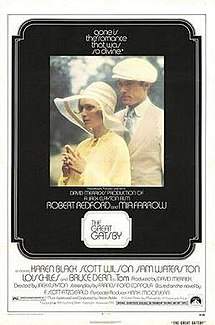
I remember watching one of those trashy television movies about the scandal over Woody Allen's breakup with Mia Farrow.  If I remember, it was more Farrow's story than about Farrow et Woodster.  At one point in the movie, she bemoans her fate over The Great Gatsby.  Here she is, making her comeback in an adaptation of the F. Scott Fitzgerald classic, with a script by Francis Ford Coppola, starring Robert Redford, and it turns out to be the biggest turkey of her career.

Well, Miss Farrow, just think how it was for us who had to watch it.

I should start off my review by saying two things. One: I took very few notes. Two: I fell asleep while watching. Thank heavens I read the book, otherwise I would not be able to go over the plot. 

Told through the voice-over of Nick Carraway (Sam Waterston), we soon encounter Nick's cousin, Daisy Buchanan (Farrow) and her husband Tom (Bruce Dern).  Nick also meets their friend, golf pro Jordan Baker (Lois Chiles), but Nick has a next door neighbor, the wealthy and mysterious Jay Gatsby.  Gatsby throws wild parties that put the roar in Roaring Twenties, and one day, Nick finds himself invited to the very soirees he's only been hearing about (and, judging by the proximity to his rented home, forced to listen to).

There is a reason why lowly Nick has been allowed entry into this rarefied world: Jay Gatsby himself (Robert Redford) wants to make friends with him, mostly because Daisy is his cousin.  We learn that Daisy was Gatsby's first love, but that she did not wait for him because, in the film's most famous line (which oddly, is not in the Fitzgerald novel)

Rich girls don't marry poor boys.

Now, however, Gatsby is rich, though exactly how he comes about his fabulous wealth we are not certain.  Gatsby himself gives contradictory explanations but Nick sees that Gatsby's association with shady character Meyer Wolfsheim (Howard Da Silva) may be a clue.

However, Nick has his own issues: both a curious romance with Jordan and being aware that the Buchanan's are a mess.  Tom has a few girlfriends, in particular Myrtle Wilson (Karen Black), wife of gas station owner George Wilson (Tom Wilson--what are the odds they'd have the same last name?).  Myrtle and Tom are carrying on, while poor George is totally unaware.

As much as Jay may want Daisy to leave Tom, she cannot bring herself to say that she never loved Tom.  Jay, while devastated, stays loyal to Daisy (and/or the idea of Daisy), even after Myrtle is killed in a car accident.  George finds out that the car belongs to Jay Gatsby and kills him (and himself), but Nick knows the truth: it was Daisy who drove the car, but Jay, ever loving, refused to turn her over.

Nick, having grown disillusioned by the shallowness of it all, decides to depart back to the Midwest, especially after being about the only person who mourned Jay Gatsby. 

One wonders how, despite having such rich material, and despite having a solid cast, people could screw it all up so shockingly.  The Great Gatsby should have wild parties, beautiful people, and a great tragedy within its two hour-twenty-three-minute running time.  What wasn't tame in The Great Gatsby was instead dull.  It is as if the film was determined to make the most boring television adaptation of the novel, to condemn future high school students to see the book as something to be endured rather than enjoyed.

One can't fault the cast: you have a film with Robert Redford (who is a good actor), Sam Waterston (ditto) and Mia Farrow (who can be as good as her material).  Yet for all the talent within The Great Gatsby, every appears to be almost bored with the proceedings.  None of them appeared to actually act.  Instead, they appeared to behave as though this was so serious and important, adapting a literary classic, that they had to give stiff and lifeless performances to show just how reverential they were to the text.

Rather than bring life to their characters, they brought death.

Take when Nick survives a harrowing party with the Buchanans where at the end he declares that he was 30 years old that very day.  As spoken by Waterston, it sounds more like something said to break the ice than a regret that this turning point is so marred by the tangled romances of the upper class.  Even more bizarre, even though Waterston was only 34 when he made The Great Gatsby, he looked far older.  I put that in to the serious tone everyone was taking.

The only one who appeared to try to do anything remotely close to acting was Farrow, but sadly for her and the film it was to overcompensate for Waterston and Redford's underplaying by overplaying her Daisy.  Rather than appearing as this beautiful, delicate but ultimately empty shadow that is not worthy of Gatsby's unrequited love, Farrow's Daisy was a trembling, whimpering, almost shrewish and twittering airhead.  Farrow was apparently directed to be excessively mannered in her trembling whenever she was on the screen.

As for Chiles, given that the only other film I have seen of her was the James Bond film Moonraker, I have very little point of reference to decided whether her Jordan was as dead and uninteresting as she is in The Great Gatsby or whether this is how Chiles is in all her films.  I'm going to say that because her Jordan was as lifeless as her Dr. Goodhead, Lois Chiles is pretty much a bland screen presence.

Finally, I think Bruce Dern was miscast as the beefy and self-assured but sleazy Tom Buchanan.  Dern seems remarkably thin to be this great threat to Gatsby, and I don't mean just by size but also because the script really gives no real motion or motivation for any of these people to do anything.

It takes a particular caliber of film to waste actors in even smaller roles.  Edward Herrmann (the epitome of the WASP world The Great Gatsby chronicles) is reduced to a mere cameo, and Da Silva's vaguely anti-Semitic character of Wolfsheim is likewise reduced to one scene that oddly doesn't add to the story even though it should be clear that his connection to Wolfsheim is how Gatsby made his fortune.

It is more incredible that Francis Ford Coppola was the screenwriter.  The dialogue appears so stilted and formal at times that again, there doesn't appear to be any life to them.  However, I have to give credit to where it's due.  Even thought it is not in the novel, the line


Rich girls don't marry poor boys, Jay Gatsby.  Haven't you heard?  Rich girls don't marry poor boys.


is now one of the most memorable lines to come from film.  As I understand it, this is what Fitzgerald was told in real life, and Coppola incorporated this devastating put-down to The Great Gatsby.  It's a great line, but about the only good part.

The script also has things that don't make any sense, at least if my memory of the book still hold.  Daisy for example immediately recognizes the name Gatsby, but wouldn't she have known him as James Gatz when they first courted?  Those who remember the book better may correct me on the matter.  This plot point about how Gatsby was really his nom de guerre wasn't addressed until the end of the movie, and this robs us of the chance to see just how tragic his life was in trying to recapture the past. 

The fault lies squarely at the feet of director Jack Clayton.  From being unable to draw performances out of any of his actors (save for Scott Wilson's character of the cuckold George, whose hurt and heartbreak over his wife's death and infidelity are signs of actual acting) to making the decadent world of Gatsby almost tame and dull (and frankly a little on the cheap side) to that damn voice-over (a bane of my existence) which not only was intrusive but that basically told you everything before it happened (when you hear a disembodied voice tell you that by September everything would be over, you don't have much suspense), Clayton made one bad choice after another that all but doomed The Great Gatsby.   

Now, having said all that, I will say that at least Theoni V. Aldredge's costumes were nice and worthy of The Great Gatsby's two Oscar wins (the other being Nelson Riddle's music score adaptation of the songs of the 1920s.  I should say that Riddle, who was Sinatra's orchestrator among his many other works, was brilliant with music, so he deserved his Oscar).  However, despite being an Academy Award-winning film that may capture what exactly is wrong with The Great Gatsby: it is a film where style is valued over substance, where the greatness of the story is drowned by the pretty clothes and pretty music enjoyed by the pretty people.

I imagine that high schoolers who have to read The Great Gatsby (which given how slim the book is lengthwise, should really take them a week or two at the most) will be forced to watch this adaptation.  I feel sorry for them.  Good thing I didn't read it in high school but later on, for my own pleasure, before seeing this dull treatment of this brilliant story. 
In short, The Great Gatsby may end up making people want to give up reading if the book is as boring as the movie. The book isn't, but tell that to all the kids who will have to suffer through it. 

If one can stay awake throught The Great Gatsby, watch it only for the costumes.  Ain't they pretty, and ain't we (not) got fun? 

DECISION: D-