Wednesday, September 5, 2018

The Marvel Cinematic Universe Retrospective: An Introduction


Image result for marvel cinematic universe
THE MARVEL CINEMATIC UNIVERSE RETROSPECTIVE: AN INTRODUCTION

I may not be the target audience for the Marvel Cinematic Universe.  I never read comic books as a kid and I genuinely would not know the difference between a Marvel and a DC character.

I guess that would make me a Philistine to many a Comic Con denizen.

Perhaps this is why I have not and cannot join in the fun so many of my fellow critical brethren shared at many a MCU film, particularly the final few of Guardians of the Galaxy Volume 2, Spider-Man: Homecoming, Thor: Ragnarok and Avengers: Infinity War.  Truth be told, out of the 'Phase Three' of what I call the world's longest and most expensive soap opera, the only ones I have genuinely enjoyed have been Doctor Strange and Black Panther (Captain America: Civil War was so-so for me).

I won't even dive into Marvel Studios' television franchises, though I have heard good things about Agent Carter.  I tried to watch Marvel's Agents of S.H.I.E.L.D., but I could not muster the interest.

All the intricacies and plot points and Infinity Stones and post-credit scenes are either lost to me or of no interest to me.  I know that these films are connected, but I also know I shouldn't have to bring a playbill to try and sort out not just who is who but what happened "Previously, on 'The Avengers'", let alone have to "stay tuned for scenes from the next episode of 'The Avengers'".

Worse is the idea that I would have to watch one of those short films attached as a special feature to a DVD to understand the nuances of another MCU film.

I simply cannot wrap my mind around the idea that people would devote days to sitting in a theater for a MCU Marathon, judging to see which movies to sleep through, possibly not bathing and eating poorly just to laugh at a bad Chris Pratt wisecrack.

However, as I look back at this long, long series which for some of its more devoted followers has marked turning points in their short lives, I have decided to go back and revisit every Marvel Cinematic Universe film as of today, from 2008's Iron-Man to 2018's Ant-Man & The Wasp.

I've already reviewed them, but I saw them out of order, sometimes leaving before the credits finished, with several years between one film and another.  I am an old-fashioned sort, to see a film as a stand-alone project, not the newest episode in this long-continuing saga that makes Wagner's Ring Cycle look like a YouTube cat video montage.

As such, I have decided to watch them all in order, all the way through to the end.  I will examine the following criteria:

The Hero
The Villain
The Love Interest
The Stars
Other MCU Characters
Post-Credit Scene(s)
Stan Lee Cameo
Stand Alone Film or Essentially Another MCU Film Trailer
The Good
The Bad
Final Conclusions

This is independent of a review itself, though I might add a Revised Grade based on my Second Look.

Finally, I will also look back at my original reviews and see whether I still agree with my first impression.

I hope to get through this Marvel Cinematic Universe Retrospective before the year is out.

Iron-Man (2008)
The Incredible Hulk (2008)
Iron-Man 2 (2010)
Thor (2011)
Captain America: The First Avenger (2011)
The Avengers (2012)

Iron-Man 3 (2013)
Thor: The Dark World (2013)
Captain America: The Winter Soldier (2014)
Guardians of the Galaxy (2014)
Avengers: Age of Ultron (2015)
Ant-Man (2015)

Captain America: Civil War (2016)
Doctor Strange (2016)
Guardians of the Galaxy Volume 2 (2017)
Spider-Man: Homecoming (2017)
Thor: Ragnarok (2017)
Black Panther (2018)
Avengers: Infinity War (2018)
Ant-Man & The Wasp (2018)

Marvel Cinematic Universe: The Conclusions

Tuesday, September 4, 2018

I Feel Pretty: A Review


I FEEL PRETTY

Apart from Trainwreck, Amy Schumer has not had a good run either on film or television.  Her follow-up to that film, Snatched, was critically reviled and commercially a failure.  With I Feel Pretty, Schumer and Company may have had pretty good intentions about self-acceptance, but they were off the mark just a touch.

Renee Bennett (Schumer) is an average woman who works on the website of  Lily LeClaire Cosmetics, far away from the actual headquarters.  She has a few friends but has concerns about her looks and figure, constantly comparing herself to more attractive women.

Her insecurities lead her to take a spinning class, but the first time her weight causes the bicycle to break and the second time, her over-enthusiasm causes her to fall off and hit her head.  When she comes to, she looks in the mirror and sees herself as the most beautiful woman in the world, not the frumpy Renee she 'was'.

With full confidence that she is now drop-dead gorgeous and a completely different-looking woman despite actually looking the same, she decides to take on the receptionist's job at Lily LeClaire, the metaphorical 'face' of the beauty company.  At first, the 'beautiful people' seem taken aback that the frumpy Renee is there, but they are soon taken in by her exuberance.

Among those taken in are Avery LeClaire (Michelle Williams) and her brother Grant (Tom Hopper).  Avery is attempting to make a more 'working-class' line for LeClaire, but with her thin, soft voice and patrician manner she is having difficulty with the line.  Renee, who 'used' to be schlubby but now isn't, happily helps Avery.

Image result for i feel prettyAs Renee is now 'gorgeous', she finds it easy to pick men up.  The man she now picks up is Ethan (Rory Scovel), a technical assistant at CNN who wants to move up but who similarly has confidence issues.  Despite being a bit startled by Renee's behavior, such as impulsively entering a bikini contest and making a spectacle of herself, Ethan still finds himself attracted to her.

Soon a romance develops between them, but Grant soon finds himself attracted to Renee.  She is in Boston to help Avery do a presentation for the new cosmetics line, and all the well since Renee's 'hotness' has alienated her old friends.  Renee herself struggles with temptation when Grant expresses an interest in her.  This freaks her out enough to try and get away, ending with her accidentally hitting her head in the shower.

To her surprise, this bump reveals to Renee that 'the magic' has gone and she is now back to her old self despite again never having actually changed her physical appearance.  She soon starts avoiding Ethan, convinced he was attracted to her only when she was 'beautiful' and she slips into a depression.

It isn't until she forces herself to attend the working-class cosmetics launch that she realizes that her external appearance never changed.  With the truth all out, she reconciles with her old friends and Avery, and more importantly, with Ethan.

Image result for i feel pretty michelle williamsWriter/directors Abby Kohn and Marc Silverstein have a genuinely good plot rattling around I Feel Pretty.  It is unfortunate that the execution was a bit bumbled.


For example, I Feel Pretty, with the story centering around a beauty cosmetics company complete with a 'hot' boss and frumpy receptionist comes across as a white version of Ugly Betty. Moreover, the 'bumping of the head' to cause the delusion and reverse it are also cheap, trite and very unoriginal.

It's strange that I Feel Pretty had a shout-out to Big when it could have learned something from it.  For example, rather than a bump on the head, why couldn't she have gone to a hypnotist, even as part of a comedy club act that convinced Renee she was beautiful?  Also, I thought it might have been fun to 'see' what exactly Renee saw when she looked at her reflection.

It might have even allowed for a 'cameo' by someone to suggest that Renee genuinely saw someone else.  Maybe Emma Stone, Charlize Theron, Gal Gadot or Aishwarya Rai could be the ones Renee saw reflected back at her.  Perhaps too that is not the most original idea, but at least it would make it more rational than Renee simply looking at herself and seeing 'someone' else.

Again, I get that the message is that she hasn't changed and that beauty is from within, but her constant protests that she is stunningly beautiful when everyone around her, even Ethan, don't hold to that idea makes her look rather bonkers.

Sometimes, one questions not just Renee's sanity, but others.  Ethan at times looked genuinely frightened of Renee, unclear whether he was dealing with someone who was insane.  All those elements pushed the narrative down a bit.

Related image
However, there are some very good positives in I Feel Pretty.  At the top are two performances that showcase the range of one, the rising status of the other.  Michelle Williams is fast becoming my favorite actress, and here she reveals a rarely-seen side: that of a true comedic talent.  She's stayed mostly in heavy dramas like Brokeback Mountain, Blue Valentine, and Manchester By the Sea, but in I Feel Pretty we see what a delightful comedienne she is.  Williams adopts a thin voice and a somewhat spacey manner, but she balances the rather oddball nature of Avery with a genuine sense of being.  It's a brilliant performance and a showcase to someone who should do more comedy.

Rory Scovel also does wonders with Ethan, his hesitancy and confusion balancing out into a remarkably believable character whom you can see genuinely falling for the sometimes bonkers Renee.  I have not seen or heard of Scovel until now, but he is quite delightful in this counterpoint to Schumer.  Out of all the characters, Ethan is my favorite, and not just because he reminds me of me, down to having some of the same experiences, which I won't go into and I'll leave it at that.

As for Schumer, she did well though not totally convincing as the newly empowered Renee, seeming more upbeat and cheerful than minx.

Adrian Martinez as Mason the tech/Renee's coworker was a scene stealer in his small role, and while Lauren Hutton seemed wasted, it is always good to see her again.  The only thing about Hopper than I can say is that he is very tall and muscular, and while that aspect of I Feel Pretty was underwritten, he did well.

As a side note, I think there was a good attempt to have Grant and Ethan engage in a little measuring contest during a dinner, which sadly wasn't pursued as well as it could have been.

There is a good message in I Feel Pretty, but the delivery needs work. Apart from two standout performances, I Feel Pretty feels pretty rote.

Image result for ugly betty white
DECISION: C-

Monday, September 3, 2018

The Death of Stalin: A Review (Review #1090)

THE DEATH OF STALIN

What could be funnier than the death of one of the world's most evil tyrants?  The Death of Stalin is billed as a comedy about politics gone mad after the demise of one of the most notorious of dictators, but I found that it is too self-conscious of the fact that it's a comedy, which for me is a death knell.

Moscow, 1953.  The Man of Iron, Joseph Stalin (Adrian McLoughlin) has the population in such fear that he sends a radio station into a panic when he requests a recording of a concert that went out live and was not recorded.  As a result, the harried radio producer has to quickly gather the orchestra, pull audiences out of the street and even drag another conductor out of bed to reenact the performance.

All this is going on while Lavrenti Beria (Simon Russell Beale), Stalin's head of his secret police, is rounding up and executing the newest people on Stalin's 'enemies list', a task he does not just with great methodical accomplishment but with glee.

The pianist at the concert, Maria (Olga Kuryenko), at first refuses to repeat her performance, especially for Stalin, who murdered her family.  Twenty thousand rubles changes her principles, but she also leaves a note on the record telling Stalin off.  He reads it and at first chuckles, then collapses.

The State and everyone at Stalin's court is so terrified of him that they won't check in on him despite hearing the thud of his collapse.  It isn't until Comrade Stalin's morning tea is brought to him that he is discovered.

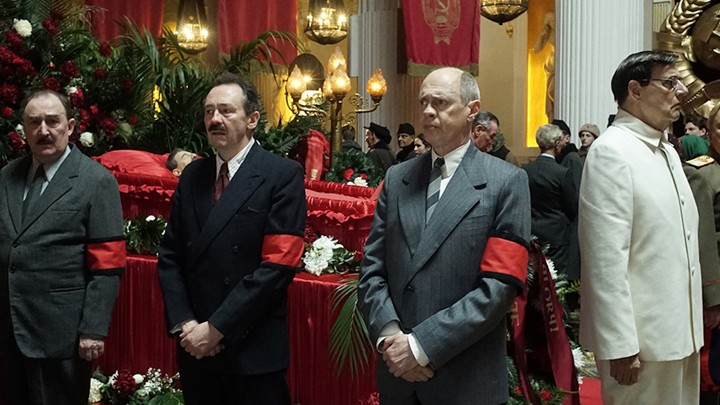
At this point, the Central Committee is both in panic mode and working feverishly to take over.  The ineffectual nominal head, Georgy Malenkov (Jeffrey Tambor) is permanently lost, so it's up to two factions to take power.  There's Beria, who is content to continue the reign of terror as is.  On the other side is Nikita Khrushchev (Steve Buscemi), who would like to see a little more liberalization and a lot less firing squads.

They also have to contend with Stalin's children, the perpetually drunk and bonkers Vasily (Rupert Friend) and the hysterical Svetlana (Andrea Riseborough). As the various factions deal with everything from funeral arrangements to who takes command, a plot is hatched with Field Marshal Zhukov (Jason Isaacs), who is displeased that Beria's own squad is doing the work of the Army.

In the end, one of them stages a virtual coup and takes the reins of power.

Image result for the death of stalinFor a comedy, I did not laugh once in The Death of Stalin.  I'd happily laugh at the death of Stalin, but not in this film about the aftermath of his death.

Part of it might be that the subject is really too serious to be funny. Given his track record of killings, imprisonments and general terror, I find little humor in his life and death.

Then again, a serious subject like nuclear annihilation can be funny, but that requires a much more firm and steady hand than Armando Iannucci, who cowrote the script with David Schneider and Ian Fellows.  Yes, some of Dr. Strangelove was broad, but some was grounded in reality, which is what makes it funny.

Here, everyone was playing things as though they knew it was played for laughs, as if the actors were conscious that we were 'supposed' to laugh.  When a film resorts to virtual mugging for the camera, then it fails for me.

Granted, there was no actual mugging, but there was for me a very clear line from all the actors that they were asked to play things in a deliberately broad manner.

If the decision to have this group of rather repulsive men played as a collection of dolts was meant to provide the comedy, for me it failed spectacularly.

Again and again I could not shake the idea that everyone was in on the joke and treated things as a joke.  "Your father is dead and your brother is shooting a gun," Khrushchev tells Svetlana when Vasily storms into the location where his father's brain is about to be removed.  It isn't as if I'm not aware of what's going on, and repeating things isn't making it funny.

There isn't much in the performances to comment on because everyone is deliberately so broad.  Again, I figure that was the goal but it does not make things amusing.  If I were to put spin on things, I think Isaacs, Buscemi and Tambor got the best as they made the silliness of their characters clear, and Friend shows great versatility as the volatile Vasily.

Despite the deliberate hamminess of it all, I could not shake the idea that it might have been better to have made this a straight drama with some comical moments, such as Vasily's ineptness.

Maybe The Death of Stalin has a lot to say about modern politics: the crawling, the catering to whims of crazed people in charge and such.  All well and good, but aren't you supposed to laugh at a comedy?

1878-1953


DECISION: F

Saturday, September 1, 2018

Best Popular Film. Worst Possible Idea. Thoughts on the Academy Award Changes


Image result for best popular film oscar
Much has been written and said about the changes the Academy of Motion Picture Arts & Sciences has made with regards to its Awards of Merit, also known as 'The Academy Awards' or 'The Oscars'.  One of the three changes has received the lion's share of attention, but I think all three not only deserve some analysis, but are also incredibly idiotic.

I know I am late to the party, but the unofficial Summer Under the Stars Blogathon got in the way.  Now, at last, I can share my views on the new rules for the upcoming Academy Awards.

The change that has received in my view the least attention is the third one, which announces a date change for the Oscar ceremony in 2020.  It moves the date up from the previously announced February 23 to February 9.  I think this was done to try and cut back on 'award fatigue' to where the major award winners are essentially known months ahead.

I do not think it will work.

I have written about what I think ails the Academy, and one of my points was that by the time the Oscars roll around, we know who is going to win.  In the time I have focused on the ceremony on a more professional level, I can remember only very few genuine shocks.  There was the time Marcia Gay Harden beat out the heavily-favored Kate Hudson for Best Supporting Actress and Christoph Waltz beat out Tommy Lee Jones for Supporting Actor, though I'd argue the latter was not a major shock versus Harden's win, which I think no one saw.

Apart from that though, the Academy Awards no longer have a genuine sense of either suspense or exclusivity.  There are a host of award shows critical, commercial and industry that trumpet the eventual winners.

Image result for allison janney oscar
Let's look at Allison Janney, the most recent Best Supporting Actress Oscar winner for I, Tonya.  This is not to say Janney didn't deserve to win, but a look at the awards she was presented for her performance in I, Tonya pretty much says it all (partial list courtesy of Wikipedia):

Golden Globe.
BAFTA (British Academy of Film and Television Arts).
Screen Actors Guild.
AAFTA (Australian Academy of Film and Television Arts).
Awards Circuit Community Awards (?).
Hollywood Film.
Independent Spirit.
Film critics associations in Austin, Chicago, Dallas, Denver, Florida.
National Board of Review.

On and on and on.  I count at least twenty-five, and that's not counting the ones where she was either nominated or declared 'runner-up'.  The sheer breathe and scope of times Janney won soon leads to a numbing effect to where if she ended up not winning it would be almost anticlimactic.

This applies to Sam Rockwell, Frances McDormand and Gary Oldman. They were not front-runners by the time the Academy announced the nominees. They were the de facto winners with the actual Oscars a mere formality.

Again, this isn't to say that Janney, Rockwell, McDormand or Oldman shouldn't have won (well, in my view Rockwell shouldn't, but why fight that battle again).  This is to say that all these other awards lead to both a herd mentality and a lack of interest when the Oscars essentially rubber-stamp the announced winners.  Why bother watching if we know who the winners are going to be?

In the past, the Golden Globes were the only other major awards that could suggest who the eventual Academy Award winner was going to be.  However, the time frame between the Golden Globe presentations and the Oscar nominations was sometimes a mere day if memory serves correct, so there could be a push for certain films but not necessarily a declaration for one or another.

Now, we have all these awards heralding the eventual winners' arrival, making for a more predictable and boring evening.

Seriously, before this glut of awards dulled the power of the Academy Awards, who genuinely cared about the Screen Actors Guild or the BAFTA Awards?

Worse, the eventual winner tends to beat the same group of people over and over again.  How many times did Janney beat out Laurie Metcalf for the same prize? It's gotten to a point to where we know not just who is going to be the winner but who the nominees are going to be long beforehand.

Rarely do we get a surprise, like when Leslie Manville got a surprise Supporting Actress nomination for Phantom Thread, but Phantom Thread was not, shall we say, a big commercial hit, so there's not much vested interest whether Manville pulled a real upset.

Moving up the date is a way for the Academy to try and stop the bleeding, but unless the other award shows keep to their schedule it is not going to help.

Image result for kazuhiro tsuji oscar
The second change is in the presentation of the awards. In their own words, they will work to keep to a three-hour show by presenting certain categories during the commercial breaks and then editing them into some kind of montage.

There will be twenty-five categories next year up from this year's twenty-four, so if they want to keep to a three-hour show, they would have to present an award every eight minutes, that is if they opt to give each category equal time.

Somehow, I suspect the Best Live-Action Short Film winner(s) won't get the same time as the Best Director winner.

This idea, perhaps to my readers' surprise, is not in my view entirely a bad one, or at least the thinking behind it.  The presentations have grown very long, and some of the categories are extremely obscure: I imagine most people do not know the difference between Best Sound Mixing and Best Sound Editing even if it is explained every year.

There should be reforms in acceptance speeches.  If there are multiple nominees for one film, such as three winners last year for Best Makeup, they should be asked to have one spokesman for them all.  All the winners should also observe time limits.

I have no problem cutting the microphone off if they go past their allotted time.

The winners should also exercise some common sense.  Nothing against Kazuhiro Tsuji, who won his first Oscar on his third nomination for Makeup for Darkest Hour, but why he felt compelled to thank his cats is simply beyond me.

However, the Academy makes a mockery of itself if it thinks people tune in to see 'stars' and not the actual awards.  Granted, more people are apt to know Gary Oldman over Kazuhiro Tsuji, but why the Academy thinks people want to hear three minutes of Oldman versus not hearing anything from Tsuji is again, beyond me.

Does the Academy genuinely hold to the idea that people would want to hear Leonardo DiCaprio wax rhapsodic on environmental and Native American issues over say, what film won Best Production Design?

If the actual presentation of the awards is essentially going to be an afterthought, why bother holding award presentations at all?

Image result for tiffany haddish oscar
I was not the only person who criticized this year's presentation for having endless and awful routines and skits that lengthened the presentation.  Now, the Academy Board has decided that the problem with the Oscars is not the presenters or host but those pesky awards.

Many of us said that this year's Jimmy Kimmel routine of crashing a Wrinkle in Time sneak preview  so as to have Armie Hammer launch hot dogs at befuddled audience members was not only dumb, but pointless, excruciating and made the telecast longer. It also came across as shockingly arrogant: here are these very wealthy people granting the hoi polloi a chance to gawk at them.  The idea behind and execution of this routine was horrendous, even when it mercifully ended.

The poor audience member pulled to introduce the next presenters genuinely had no idea who 'Tiffany Haddish' was, mangling her name.  Even the much-praised Haddish-Maya Rudolph bit was a fiasco: their "are the Oscars now 'too black'?" repartee seemingly endless.

I know the people I was watching the Oscars with a.) had no idea who Tiffany Haddish was and b.) were praying they'd finally shut up and actually present whatever award they were asked to present. One asked me if anyone thought Haddish was actually funny.

If the Academy really wanted to do itself a service, it would cut the 'repartee' between presenters, cut major parts of the host's opening monologue and do away with all these skits.

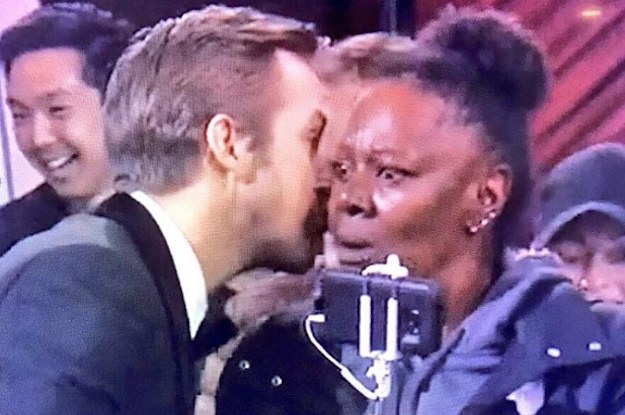
Image result for ryan gosling oscars meme
I digress slightly to note that recent hosts tend to think of the Oscars as an extension of their own programs.  Kimmel thinks the Oscars are a primetime Jimmy Kimmel Live! special, with his constant references to a faux-feud with Matt Damon that no one outside Kimmel or Damon thinks is funny.  Last year, Kimmel bringing a group of tourists into the theater was praised, but I found it a bit tawdry to make this group the unwitting dupes to a comedy routine.

Again, we have this bizarre sense of noblesse oblige between 'Hollywood Royalty' and the peasants who probably didn't see Moonlight or who couldn't sing any song from La La Land if their lives depended on it. 

When Seth MacFarlane hosted, he thought it was a live-action Family Guy.  How else to explain his We Saw Your Boobs opening number and the Here's to the Losers closing number (which even the theater audience ignored as they started leaving while he and Kristin Chenoweth started looking foolish).

Those type of things I can imagine Peter Griffin doing.  I cannot imagine Bob Hope or Johnny Carson doing the same.

The Academy clearly thinks the awards are the problem, or at the very least the obscurity of some of the categories.  As such, they believe focusing on the 'big prizes' will bump up ratings.

What they forget is that they've already tried this.

Image result for maureen o'hara oscar
Before 2009, the Academy Awards would routinely present the Honorary or Humanitarian Academy Awards during the actual telecast.  The Academy Board of Governors, however, decided that salutes to obscure figures like Peter O'Toole, Jack Cardiff, Andrzej Wajda and Satyajit Ray was what was causing declining ratings and a longer show.

As such, they decided to cut these awards from the telecast and have a Governor's Award dinner where they could bestow Oscars to people they suspect most viewers had either never heard of or would be surprised were still alive.  After all, people don't need to hear from such has-beens as Lauren Bacall, Maureen O'Hara or Donald Sutherland when we can hear from Sam Rockwell.  What did those losers ever do for film?

The Governor's Awards dinner looks like it's actually fun because it is mostly within the industry and they are not constrained by time.  Sadly though, it does mean that we won't get to see people get their due.

I remember when I saw the presentations to Cardiff, Wajda and Ray and being mesmerized by the brilliance of their work.  They were spellbinding montages that made me love film more.  Now, as they got shunted off to a whole other presentation, we won't get newer audiences appreciate what made O'Hara or Hayao Miyazaki so extraordinary.

We will, however, hear Matthew McConaughey drawl about his late father watching from Heaven while in his underwear drinking a six pack.

I expect it won't be too long before they shunt the 'minor' awards to the Governor's Dinner too to focus on 'marquee' categories.  It's a terrible and slippery slope that they are gleefully sliding down to their own detriment.

Image result for best popular film oscar
The third change is the addition of a new category: "Outstanding Achievement in Popular Film" (details forthcoming). I've read all sorts of things about "Best Popular Film" both pro and con.

Here are my views.

This is a deliberately obscure and ill-defined category motivated by a bizarre notion the Board of Governors has that 'the people' will watch if a movie they heard about is up for some kind of award.

What exactly constitutes 'popular'?  I know what 'Picture' means.  I know what 'Actor/Actress' means.  I even know what 'Cinematography' and 'Costume Design' mean.  However, what is 'popular'?

Will the nominees be based on box office?  Will they be based on number of screens?  Will they be based on Gallup Poll results?

There have been all sorts of wild ideas about 'Best Popular Film', almost all revolving around Black Panther.  They take one of two routes depending on what kind of conspiracy theory you believe:

'Best Popular Film' was created to include Black Panther at the Academy Awards.
'Best Popular Film' was created to exclude Black Panther at the Academy Awards.

Either way, the 'Best Popular Film' Oscar revolves around the idea of Black Panther being the de factor Best Picture winner and 'something' had to be done to either stop it from winning or give it a consolation prize if/when it would lose.

I'm one of the few people who has never heard a case as to why Black Panther is a Best Picture winner.  I'm not even sure it is the best Marvel film, let alone on the same level as Casablanca, Lawrence of Arabia or All Quiet on the Western Front.  I might concede that it is better than The Life of Emile Zola or Oliver!, but I have never believed Black Panther was destined to be Best Picture.

Nevertheless, the idea that Black Panther was destined to actually win Best Picture, the theory holds, is what motivated this new category, either to prevent it from winning Best Picture or ensuring it got recognized in some way should it either not get nominated or worse, not win.

This 'Outstanding Achievement in Popular Film' category is worse when you consider that the Academy, in its wisdom, has declared a film can be nominated in both categories.  What if a film wins both Best Picture and Best Popular Film?  Why is there even a divide?

The answer to the last question is simple, and rooted in again, the fact that the Academy has essentially done this already.

Image result for heath ledger oscar
After The Dark Knight, like Black Panther a comic book-based film, failed to receive a Best Picture nomination, the uproar among the public and critics was so great that in a panic, the Academy decided to 'open up' the Best Picture category to have up to ten nominees.

The idea behind this was to have, you guessed it, more 'popular' films in the running for Best Picture. Since 2009, this experiment has gotten some major hits in the mix: Avatar, American Sniper, Hidden Figures, Dunkirk, Get Out.

However, what ended up happening was that rather than have more popular films get Best Picture nominations, the Academy ended up nominating more obscure films instead.

One can argue the merits of American Sniper versus Birdman, but the trend towards more niche nominees was the unintended consequence of the Best Picture expansion, leading to films fewer people heard of let alone watched winning the top prize.  Personally, I think American Sniper is a better film than Birdman.  I also think more people in the future will watch American Sniper over Birdman, which the general public has probably never heard of and which fewer people in general will watch let alone care about.

In the years since the expanded field was first brought about, the actual Best Picture winners are films that, while perhaps good, I doubt will be remembered or seen repeatedly in the same way The Godfather or Schindler's List will be.

The King's Speech. The Artist. Argo. 12 Years a Slave. Birdman. Spotlight. Moonlight. The Shape of Water.

I think more people, decades from now, will be seeing Dunkirk than they will The Shape of Water, or as I lovingly call it, Fifty Fins of Grey. As much as I may think Mad Max: Fury Road is overrated, I think that and Hidden Figures will be the ones remembered, not Spotlight or Moonlight respectively whatever their merits.

Image result for luise rainer oscars
This year, the Best Picture nominees were among the most obscure to the film-going public: Call Me By Your Name, Phantom Thread, Three Billboards Outside Ebbing, Missouri.  They all might have been good (though I thought Three Billboards was full of itself), but I think many people simply did not care about the slate of nominees.

With essentially two Best Picture categories, the Academy has done itself the worst possible service.  This is not going to work.  Expanding the Best Picture field was supposed to bring in more 'popular' films.  That was not what happened.  The opposite happened.

With that being the problem, the Academy decided the solution was to create another category altogether.

I predict that within ten years at most, the Outstanding Achievement in Popular Films will be retired. I also think it should be retired now, but that's not likely.

The Academy would be wise to learn from its own history.  Between 1932 and 1943, when it had more than five Best Picture nominees, it selected some truly great films for Best Picture: It Happened One Night, Gone With the Wind, Casablanca.

It also selected some absolute clunkers and forgotten films over others that are still remembered and revered: Cavalcade over 42nd Street, The Great Ziegfeld over Mr. Deeds Goes to Town, The Life of Emile Zola over The Awful Truth, Stage Door and the original A Star is Born, Mrs. Miniver over Pride of the Yankees and Yankee Doodle Dandy, and perhaps most notoriously, How Green Was My Valley over Citizen Kane.

I to be honest like some of the aforementioned Best Picture winners, but I also know that no one is clamoring to watch Cavalcade or The Great Ziegfeld.

Image result for cecil b. demille oscar
I also know that when the Academy did reward the 'most popular film' with Best Picture, it ended up giving the award to The Greatest Show on Earth over High Noon and The Quiet Man.  When was the last time you watched The Greatest Show on Earth?

Have you even heard of The Greatest Show on Earth?

At least in the Academy's defense, people actually saw High Noon and The Quiet Man.  I can't say the same for The Shape of Water or Birdman.

Each decision the Academy has taken: moving up the presentation in 2020, cutting awards to commercial breaks, and 'Outstanding Achievement in Popular Film' are motivated to bring up sagging ratings.

None of them, however, addresses what truly ails the Academy Awards.  Some aspects are beyond their control (the scope of pre-Oscar awards).  Others are, and they will find, I believe, that their solutions will end up causing more problems of their own creation.

In short, it's all to quote another Best Picture winner, "Madness".
Friday, August 31, 2018

The Gorgeous Hussy: A Review (Review #1089)

Image result for the gorgeous hussy 1936
 

THE GORGEOUS HUSSY

This review is part of the Summer Under the Stars Blogathon. Today's star is Joan Crawford.

The Gorgeous Hussy is going to be among the oddities of Joan Crawford's career in that it was a rare venture into costume pictures.  Crawford was best known for contemporary films, as she was known as the epitome of the 1920's 'flapper'.  As such, seeing her in all these hoops and pantalettes might not have been a good fit, no pun intended.  What could have been a breakthrough for Crawford instead turned into a slight embarrassment, where she was gorgeous but hardly a hussy.

Margaret 'Peggy' O'Neill (Crawford) is the daughter of a respected Washington, D.C. innkeeper.  Politically aware and astute, she becomes an object of fascination and lust by the various politicos and wanderers to Major O'Neill's inn.  Among them are rakish sailor 'Bow' Timberlake (Robert Taylor) and John Eaton (Franchot Tone), a Senator.  However, Peggy has her heart set on two men: one romantically, one spiritually.  Her great love is another Senator, John Randolph (Melvyn Douglas), and her political soulmate is yet another Senator, Andrew Jackson (Lionel Barrymore).

Randolph thinks Peggy is too immature and young to marry, despite her protests of love.  She soon falls, perhaps reluctantly, for Timberlake, and accepts his marriage proposal.  Her dear 'Uncle Andy' and 'Aunt Rachel' (Beulah Bondi) are shocked to hear gallivanting going on in her bedroom, until Timberlake shows their marriage license.  Actually, the idiot lost the license, but Jackson did not bring his reading glasses and pretends to read it.  Timberlake actually showed the Jacksons his newest orders for the Caribbean.


Image result for the gorgeous hussy 1936
Peggy sadly learns that she is a widow, and now she throws herself into helping Uncle Andy become President.  She also keeps dreaming of Senator, now Russian Ambassador Randolph, who yearns for her too but cannot bring himself to seek her out.  One person who does seek her out is Eaton, who is also eager for Jackson to become President.

The 1828 campaign is a nasty one, dragging poor Rachel through the mud.  Rachel's divorce from her first husband had not technically been finalized when she married her beloved Jackson, so the Washington wives call her essentially a whore.  The fact that she's a pipe-smoking rustic woman does not help.

The Jackson campaign has managed to keep the most malicious press from 'Backwood Rachel', but she still learns about it on the eve of Jackson's win.  Heartbroken and humiliated, she dies, asking Peggy to take care of Andy.

By this time, the political divide between the Unionist Peggy and the Dixie-loving Randolph become too great for both and they reluctantly part ways.  Peggy becomes the unofficial First Lady, but despite her knowledge and grace the Washington wives don't care for 'Pothouse Peg', even after she marries the elegant Eaton, who becomes a Cabinet member.

Jackson, still carrying the anger of Rachel's treatment, sees Peggy as a wronged woman, one with whom he's willing to go to war with his own Cabinet over.  He has other pressures though, including a growing secession movement from the South.  Randolph finds himself caught up in this when he is approached to help ferment a revolution.  He refuses, and is promptly shot for it.  Peg rushes to a dying Randolph, escorted by a mutual friend, Rowdy Dow (James Stewart), a newspaper man.

Poor Peggy cannot catch a break: her going to the dying Randolph with a man not her husband sets tongues wagging, and Jackson is determined to stomp out this vitriol against our gorgeous hussy. A tense Cabinet meeting with them and their wives leads to Jackson demanding apologies for Mrs. Eaton, apologies they summarily refuse.  Jackson insists that it was he who asked Dow to accompany Peggy with Eaton's consent, but this will not protect any of their reputations.

Reluctantly, John and Peggy Eaton go off as a special envoy to Spain, where they can finally enjoy their love in this unofficial exile.

Image result for the gorgeous hussy 1936
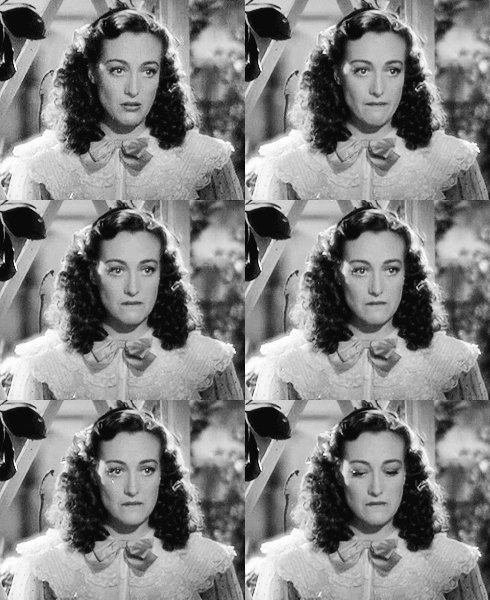
I think where The Gorgeous Hussy went wrong was in the casting of Crawford as our 'gorgeous hussy'.   It isn't that Crawford cannot act.  It is that she simply looks wrong trying to look younger than she was and as demure and innocent as Peggy was supposed to be.  She seems nervous on-screen, which is so out-of-character with both her persona and some of her  other performances.

It's as if she was put-off by all the costuming, and that unease seeped into her performance.

Sometimes, she looks genuinely angry and too strong to be this damsel in distress.  That could have worked to her advantage, such as when she has to stand up for herself against men who know less than she does in the political realm.  However, for the most part director Clarence Brown, who like Crawford was a pro, could not get her to convey that innocence or gentleness of this maligned female.

One particularly odd moment was when she was told that Bow had died.  On receiving news that her love was dead and that rather than the joyful reunion she expected she was now a widow, Crawford looked more angry than pained at hearing this news.  It wasn't an anger of the injustice of it all either, it was more of an irritated anger.

Crawford's performance in The Gorgeous Hussy was all wrong, sometimes comically so.  Ainsworth Morgan and Stephen Morehouse Avery's adaptation of Samuel Hopkins Adams' novel did not help.  "I'm not only too young for politics!  I'm too young to love too!" Peggy yells at Randolph at one point, and it's hard to make lines like those believable.

There were a few moments where Crawford and Brown showed they could do a few good things.  One nice moment was when Peggy silently kisses the door where Randolph is staying in, but for the most part Crawford looks out of place and ill at ease among the costumes and overwrought romance.

It wasn't as if any of the others did much better.  This was an early film for Stewart, and like Crawford, he looks uncomfortable and not convincing as Dow, among her court of suitors.  One really strange moment was when Peggy, Bow and Rowdy were on a hayride.  As Peggy and Bow were flirting, we see Rowdy glancing from behind playing his flute.  Few things look creepier and distracting, almost as if Stewart is trying to upstage them.

It was a small role, but I can see why so many women fell for Robert Taylor, the rakish but love-smitten Bow being a nice part, even if it was a bit overplayed.  Overplayed is how Louis Calhern was as Sunderland, Randolph's political enemy and killer.  The only thing he needed to do was twirl a mustache as he devours every scene he is in.

Tone was his usual formal man as the upstanding Randolph.  He did, however, have a good moment when he confronts his wife's accusers. "I demand proof of their accusations, and proof of their respectability", he thunders when he's told 'respectable ladies' have accused Mrs. Eaton of indecent behavior.

Image result for the gorgeous hussy 1936

I thought Barrymore was a bit over-the-top as the hillbilly-like Jackson, but over time Jackson's crotchety nature got to me.  Barrymore, to his credit, could be pulled back: a scene at a church window he dedicated to his late wife was very moving.  Bondi was the one who came out of The Gorgeous Hussy the best as Rachel Jackson.  She could play the more hillbilly-type mannerisms for gentle laughs than open mockery, but in the sadness she felt when she learns just how the public thinks of her, she is quite moving.

It's no surprise that Bondi earned the first of two Best Supporting Actress Oscar nominations for The Gorgeous Hussy, as her performance elevates the film tremendously.

The Gorgeous Hussy is a product of its time: the treatment of the African-American characters, such as there were, is highly problematic, and the 'Negro' choir singing hymns outside Master Randolph's window as he is dying is creepy.

Odd how 'creepy' keeps coming up again and again with regards to The Gorgeous Hussy.

The story of the 'Petticoat Affair' could make for an interesting feature film.  Hopefully we'll get one, for The Gorgeous Hussy, outside Bondi and those lovely frocks, has little that would make anyone's dander get up.

1799-1879
 
DECISION: C-

Thursday, August 30, 2018

A Special Day: A Review


Image result for a special day movieA SPECIAL DAY

This review is part of the Summer Under the Stars Blogathon. Today's star is Marcello Mastroianni. 

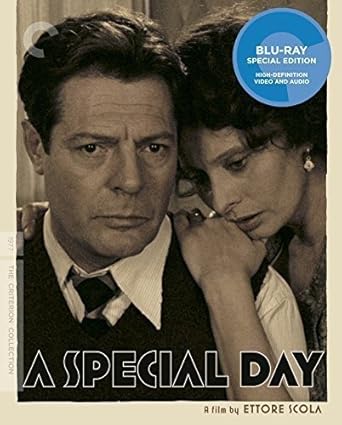
A Special Day (Una Giornata Particolare) is a departure for its two leading stars. It is a sad, haunting tale of two people who are so different and yet so alike, finding that the other is not what he/she seems.

May 8, 1938, Rome, Italy.  Adolph Hitler has come to meet his Fascist counterpart, Benito Mussolini.  Il Duce pulls out all the stops for Der Fuhrer, hosting him to a lavish parade and all Rome it seems is there.  Well, almost all Rome.

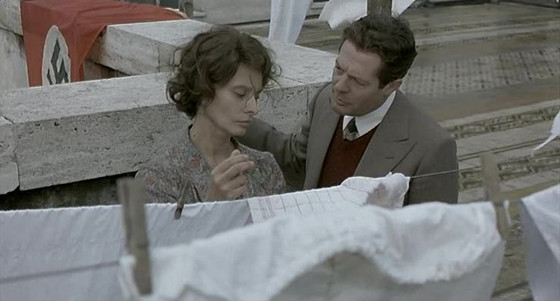
In a nondescript apartment complex there are at least three people who will not be attending.  Housewife Antonietta (Sophia Loren) would like to go with her husband and six children, but the housework cannot wait.  She knows that the apartment concierge (Francoise Berd) cannot go either, and Antoinetta figures she is alone in the complex.  After having readied her family to attend, all loyal if not fanatical Fascists like the concierge, she begins her duties.

One of them is feeding Rosamunda, the family myna bird. To her dismay, Rosamunda escapes and Antonietta becomes frantic.  Fortunately, she spies that someone else hasn't gone to the parade, a man living across the way.  She goes to that apartment and asks for help.  The man, Gabriele (Marcello Mastroianni) agrees and together they get the myna back.

Gabriele seems lonely, and Antonietta is surprised to discover he was a radio announcer, though now unemployed.  Both of them are very lonely people, and they begin a conversation.  She goes, but he then goes to her apartment, where over the course of 'a particular day', they spend the time laughing, arguing, commiserating, and revealing.  She discovers that Gabriele is a homosexual and anti-Fascist, two things our Catholic devotee of Mussolini doesn't understand.

Yet, she sees a kindred spirit in his kindness and need for someone. At the end of this day, they do appear to have a tryst, but she leaves to meet her family.  She begins reading the book he gave her, The Three Musketeers, and watches as the police take him away.

Image result for a special day movie
A Special Day is a showcase for our two actors, who essentially play it as a two-person play.  This is a total departure from the screen images of both Loren and Mastroianni.  The epitome of glamour and seductiveness, Loren plays a frustrated, sad, and somewhat frumpy housefrau. Mastroianni, of whom one can say is also the epitome of glamour and seductiveness, plays a quite, haunted homosexual. Both roles are clearly at odds with how most of us see them, and yet they surpass themselves in showing just how strong they are, both as actors and as a screen pairing.

In terms of performances, Loren and Mastroianni achieve something extraordinary; they display true emotions in these two figures.  Loren's Antoinetta seems to carry such unhappiness within, and in a way her support for Fascism and Mussolini is not one built out of hatred towards others like Gabriele, but more as something to make her life a little brighter.  She knows her husband is consistently unfaithful, and worse, his current mistress is something she is not: educated.  Loren as Antoinetta has wonderful moments, such as when she reveals the deep hurt she has, not so much of her husband's infidelity but in that his mistress has more education.  It is not the sex that bothers her so much as a sense that she isn't worthy.

Image result for a special day movieThat is probably why she gravitated towards Fascism and Mussolini, down to having a photo album of Il Duce, a collage of Il Duce made up of buttons, and even speaks movingly of when she saw him briefly on horseback, to where she fainted when their eyes met.  A Special Day, in that respect, gives an indication as to why Italy and Germany both fell sway to these tyrants.  It may not have been just a mad desire to wipe out peoples en masse.  It might just have been to feel part of something great, something that would improve their lives.

I feel I've wandered off a bit.  As strong as Loren is as this sad, heartbroken and simple woman, Mastroianni is equally strong as this man, finding himself on the verge of exile if he is lucky, hiding his sexual orientation and seeking solace among anyone with a friendly face.  Mastroianni is gentle and almost meek as Gabriele, a man on the verge of losing everything and finding on this day a kindred spirit in a most unlikely place.

However, when he rages, he rages.  Given how gentle Gabriele is, when he finally explodes with Antoinetta, screaming at the top of his lungs that he is homosexual, including terms for it that I won't use, you see the anger burning beneath him.

He and Loren give simply magnificent, heartbreaking performances.

It's to director Ettore Scola's credit that he kept the audience's interest when so much takes place in a confined space and with basically two people.  He also bathes the film in sepia, filling in with a sense of the pathos of the past.  He has a great tracking shot where we first enter the family apartment, the camera moving smoothly from room to room as Antonietta rises everyone and gets her family going, the weariness within her close to the surface.

A Special Day is a very quiet film, and a very moving one.  It's a sad and haunting tale of two people who find each other just when this monumental event will shape their small lives without their active participation.  It's a sympathetic portrait of these two different yet similar people, tenderly portrayed by two fine actors.

DECISION: A+

Wednesday, August 29, 2018

Young Man With a Horn: A Review


Image result for young man with a hornYOUNG MAN WITH A HORN

This review is part of the Summer Under the Stars Blogathon. Today's star is Lauren Bacall.

Young Man with a Horn is a thinly disguised biopic of Bix Biederbecke, a troubled jazz cornet player. Unlike Biederbecke, we get a happy ending.  We see some great performances, some very interesting subtext and all that jazz.

Willie Willoughby, better known as 'Smoke' (Hoagy Carmichael), tells us the story, both in voiceover and directly to the camera in the beginning and end.  Rick Martin had a troubled childhood: both parents dead by age 10, cared by a sister who wasn't that involved.  Rick began wandering away from school and life until he came upon a Rescue Mission and heard the piano.

Starting to play, he finds himself a bit of a prodigy, but it's when he hears the trumpet that Rick believes he's found his calling.  He soon starts being mentored by Art Hazzard (Juano Hernandez), a trumpeter who sees potential and trouble in Martin.

Rick (Kirk Douglas) soon starts showing his talent at various clubs and orchestras, but he also wants to play jazz 'his' way.  This method does not jive well with Jack Chandler's Dance Orchestra, which Chandler insists plays dance music in the same way for the audiences' benefit, not for artistic aspirations.  Rick's talent and genius attract Smoke and Jo Jordan (Doris Day), the band's singer, into being his friend.

After Rick does an impromptu jazz bit with other orchestra members, Rick's fired.  Jo, however, uses her influence to get him into another band, one that welcomes a trumpet soloist if he can rein himself in, which he does.  Jo also introduces Rick to one of her best friends, Amy Woods (Lauren Bacall), a beautiful, somewhat haughty and mysterious woman.  Rick is instantly taken with Amy, but there's something about Amy that we can't peg.

Jo warns Rick that Amy is "a strange girl", who is "all mixed-up inside", but it's too late: they've married.  Amy wants Rick to be more refined and high-class, not mix so much with juke joints and people like Art Hazzard, who is still playing though not at the strength he used to.  Rick soon struggles between his love for Amy and his love for the trumpet, whom Amy calls his 'alter ego'.

Eventually, things give way, especially since we get the strong suggestion that Amy may have designs on her fellow female student.  The end of his marriage sends Rick on a downward spiral where even his trumpet fails him.  A bout with alcoholism and depression wreck him more, along with guilt about how he dismissed Art before his death in a car accident.

Ultimately though, with the love and support of Smoke and Jo, Rick returns to be a better human than trumpet player.

Image result for young man with a hornYoung Man With a Horn is a surprise in many ways.  First, it comes from director Michael Curtiz, perhaps the most underappreciated director in history.  The man could direct everything from romantic melodrama like Casablanca to lavish musicals like Yankee Doodle Dandy to action films like The Adventures of Robin Hood to horror films like Mystery of the Wax Museum to strong dramas like this. 

As such, Curtiz brings certain elements that showed subtext.  One involves mirrors.  Almost every time we see Amy, we see her reflected in a mirror, as if Curtiz is suggesting that she is presenting an image, not the real person or even if she is real herself. 

Another is the 'lesbian' bit.  There is no overt mention that Amy is lesbian or even bisexual, but there is again enough subtext to let audiences fill in the idea if they wish to see it.  There is Jo's declarations of how Amy is 'strange' and 'all mixed-up inside'.  There's Amy's own affection for her other female friend, and a very telling bit of dialogue from Carl Foreman and Edward H. North, when Amy comments on how simple Jo's life is because she knows 'which door (she's going) to walk through'.

One can read that line as saying Amy envies Jo's straightforward life, but it could also mean that Jo, unlike Amy, goes only one way sexually versus Amy's 'confused' manner.

Another aspect that separates Young Man With a Horn from other films is the positive portrayal of African-Americans in the film. Art Hazzard is a mentor to Rick, almost a father figure. There is no suggestion that Rick thinks himself superior, and when Amy seems about to suggest something racist against Art, Rick flies into a rage.

One can quibble whether Hernandez's somewhat noble and patient Art is a step forward for African-Americans on screen or an early indication of the 'Magical Negro', though I would say it isn't since Art does not resolve anything for Rick.

Image result for young man with a horn
One surprise in the acting department is Carmichael, known better as a songwriter who wrote such hits as Stardust and Georgia on My Mind. Carmichael carved a good career as a supporting actor in film, usually playing a jaded or cynical musician, though not as jokey as say an Oscar Levant.  Carmichael holds his own against the cast as the guide to our story, bringing a world-weariness yet compassionate nature to Smoke. 

Interestingly, Carmichael knew Beiderbecke, the inspiration for Young Man With a Horn.  His friendship with the real 'young man with a horn' and his own musical experience more than likely informed Carmichael's performance.

Granted, I wasn't thrilled with the voiceover or having Smoke speak directly to us at the beginning and end, but one can't have everything.

Douglas managed to keep that volcanic over-acting that sometimes plagues his performances and makes Rick a talented man too in love with music to care for anything else only to get hurt when he slips for Amy.  He isn't raging like he is in other films that at times make his characters come across as hysterical or crazed, but here he seems genuine and at times rational.

Bacall keeps to being a cool to cold customer, one who is forever seeking and never satisfied.  She is almost sympathetic in her snobbery and yet obscure in her true self.  Day seems a little ill-at-ease in this drama, a bit unsteady.  However, as Young Man With a Horn was not just her fourth film overall but her first straight drama far from the more frothy musicals or comedies she started out with, Day acquitted herself quite well.  She shined when she sang, but she also showed her potential as a dramatic actress, which she would develop further.

Day was also fortunate to team up again with Curtiz in their third collaboration.  Having guided Day in musicals and comedies, she benefited from his expertise in this drama.

An element not mentioned often enough is trumpeter Harry James, who played the music, showcasing his versatility and why he was popular in the big band era.

Young Man With a Horn has the positives of strong performances, an interesting story and some wonderful music.  Perhaps the voiceover and direct narration, along with the happy-type ending may not be completely believable, but on the whole a worthy picture.

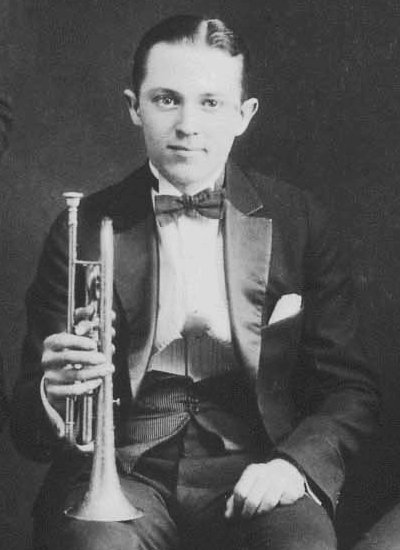
Bix Beiderbecke
1903-1931

DECISION: B+