Tuesday, November 19, 2024

Nowhere Special: A Review


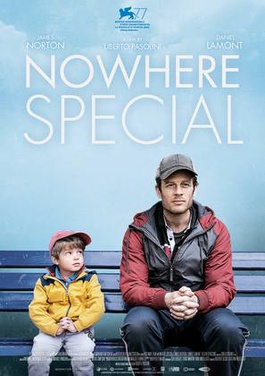
NOWHERE SPECIAL

Nowhere Special is a curious film in that we have a movie that technically is a four-year-old film that has spread slowly around the world, coming to the United States only now. Deeply moving, quiet, and told in a straightforward way, Nowhere Special is a beautiful film.

Belfast window washer John (James Norton) is a single father, his Russian-born partner having bolted back to Russia six months after their son Michael (Daniel Lamont) was born. John does his best to care for Michael, to whom he is a quiet and loving father. John, however, is dying of cancer, with precious little time left. Michael is unaware of how serious the situation is. He also does not question why John takes him to see so many people, mostly couples.

John, with the help of aid worker Shona (Eileen O'Higgins) is looking over prospective parents for Michael. They see wealthy couples, middle-class couples, a single mother and a mixed-race couple who have a mix of biological and foster children. All can offer Michael a good, caring home, are decent people and do want Michael. John, however, hesitates, wanting the very best for his son. John gets encouragement and advise from his own foster mother, Rosemary (Stella McCusker), who sadly is too old to repeat that job with Michael. With time fast running out, John must summon the courage to tell Michael about his own end and find the best person or people to take Michael.

After finishing Nowhere Special, I was reminded of another film about fathers and son and that deep bond between the two. Unlike the original The Champ, Nowhere Special does not involve sudden death but a gradual one. Like The Champ, however, Nowhere Special builds up its characters to where you do like them and become invested in their simple, specific stories. Writer/director Uberto Pasolini takes his time in building up the story, allowing us a chance to know who in specific John is.

John is like Nowhere Special as a whole is: quiet, gentle, steady. John is not flawless or perfect or even at times downright mean. In fairness, the only time John shows a negative side is when he goes back to a job with a very unpleasant client and throws eggs at the man's windows, even the former client's car. This is as gentle a revenge as John can find against a particular unpleasant person. However, this is probably the meanest anyone was in Nowhere Special. 

One element that elevates Nowhere Special is how ordinary and simple everyone is. As John and Shona visit each prospective family, none of them are either cartoonishly good or bad. They all get their specific moments where they talk about themselves and how they would be with Michael. Each of them is a good person, caring, understanding, willing to help. I think that reflects how people genuinely are in real life. Each of them has either had a child or been a foster/adoptive parent, so each brings his or her own experience to how they would be with Michael. 

In retrospect, only the last couple, a more uptight wife and put-upon husband, might be less than ideal for Michael. Even they, however, are not shown as monsters. They instead, are just not the right fit for John's son.

Nowhere Special has many quiet moments of beauty and sadness that never draw attention to themselves. When John makes a cake for his 34th birthday, he encourages Michael to keep adding candles. Michael, in his innocence, keeps adding red candles. It is when he offers a 35th candle that we get hit hard with John' reality.

The film gets to you even when we do not hear from John or Michael. McCusker's Rosemary tells John about her late husband, noting that she finally threw out his toothbrush last Christmas. Ella (Valerie O'Connor), the sole single woman that Shona presents to John, has a beautiful running story of how she got pregnant at 16 and decided to give the baby up for adoption. In her ramshackle apartment (she being caught unaware that the interview was for that day and not the next as she thought), she tells John and Shona about how she realizes that single parents do not often get the opportunity to foster, but how she has always longed for a second chance.

Those moments are deeply relatable, bringing Nowhere Special to almost feeling like a documentary. That the film is told very simply and quietly, with sparing but effective use of Andrew Simon McAllister's score, keeps things very grounded.

Nowhere Special is probably the best acted film of whatever year you see it in. James Norton gives an absolutely heartbreaking and moving performance as John. This a quiet man, one who loves his son deeply but who also struggles to accept the situation. When asked by Shona and agency head Mrs. Parkes (Laura Hughes) how he wants Michael to remember him, John states quietly, almost resignedly, "That I'm a window cleaner". In his own way, John does not want to face the reality of the situation. Aware that he is a dying man, he will not make a memory box for his toddler son, let alone tell him about his condition. As Nowhere Special goes on, we see how effective Norton is in making John a relatable, believable person.

He is very quiet but not withdrawn. He comes close only once to being harsh with Michael. In most films, I think, the moment when Michael becomes slightly rebellious over the wearing of other pajamas rather than his favorite ones might have been built up to almost operatic heights. Here though, we see that John is actually quite quietly proud of his son's rebellious streak. It is John's quiet manner, down to when he finally, gently, and beautifully tells Michael of what will come that moves you.

If you do not shed at least one tear when John starts looking over what to leave Michael, I question if you have a soul. 

Lamont's Michael too does wonderful work. He is not a cutesy kid, but a sweet kid, one who wants to emulate his father whom he loves, down to drawing marks on his arms similar to John's many tattoos. Nowhere Special is filled with these quiet moments that make things more real.

If I could fault Nowhere Special with anything, it is one scene where Michael has come across a dead bug and asks John why it isn't moving. Maybe the symbolism here is laid on a bit more than needed. That though is such a tiny flaw that it is almost stretching to find fault with the film. Maybe the selected parent was obvious, at least to me. 

I really am struggling to find fault with Nowhere Special. I did not expect to be as moved and touched by this simple, soft, straight story of a father and son.  Nowhere Special is a film that left me in tears, but not without hope. A simply beautiful film that should have a wider audience, Nowhere Special does not quite live up to its name, for it is one of the most special films that I have seen. 

DECISION: A+

Monday, November 18, 2024

The Wonderful Wizard of Ha's: The Television Special

THE WONDERFUL WIZARD OF HA'S

I have come across a few curious takes on L. Frank Baum's The Wonderful Wizard of Oz. I very much doubt, however, that the man who spun this yarn of farmgirls swept into magical lands by tornadoes ever imagined that his story would be adapted by Christian vegetables. The Wonderful Wizard of Ha's is an adaptation of the New Testament story of the Prodigal Son geared towards toddlers. With pleasant songs and cutesy animation, The Wonderful Wizard of Ha's works for its target audience.

For those not versed in VeggieTales lore, this is a franchise centered around Larry the Cucumber and Bob the Tomato. Bob tends to be the more sensible of the two, with Larry being the more oddball one. It is a bit like Abbott & Costello, with Bob being a much nicer and more patient Bud and Larry being a less dimwitted Lou. In this story, Bob comments that "Felix Rosenwinkel of Grinnell, Iowa" has written to them about how he is concerned that his father won't love him anymore because he stole something. With that, Bob and Larry recount a variation of the Prodigal Son parable, which is found in the Gospel of Luke, Chapter 15 verses 11 to 32.

Young Darby (Junior Asparagus) wants to go to an amusement park, the Land of Ha's, overseen by a wizard. Darby's father Farmer O'Gill, a farmer raising dental floss, tells him that they cannot afford such a trip now.

Before I go any further, it should be understood that VeggieTales operates on its own eccentric logic, so a dental floss farm where the crops are original or mint flavored dental floss should be seen as perfectly logical in this world.

Darby knows he has money in his piggy bank, but Father insists that the money is for Darby's future. Finding it too much to endure, and with a desire to go Somewhere Beyond the Barn, Darby takes the piggy bank and goes off to Ha's with his pet pig, Tutu. Wouldn't you know it: a tornado sweeps them to a land populated by peas known as Munchies. The fairy queen Splenda (Madame Blueberry) tells Darby that he has crushed the Munchie Muncher of the East. Now, Darby sets off to the Land of Ha's, led not by the Yellow Brick Road but by Yellow McToad, who is an old Scottish yellow toad.

On his way, he encounters a scarecrow, a tin woodsman and a lion, who all go with him. The Wizard of Ha's welcomes them, especially when Darby has enough to pay for a day's outing. There are more wonders in the magical land of Ha's, but Darby is out of money. No prospects, no real friends, no help from the Wizard who is just a guy running an amusement park. How will Darby get back home? Moreover, will his Father welcome him back if he is able to escape the land of Ha's?

As The Wizard of Oz is so engrained into American culture, I wonder if The Wonderful Wizard of Ha's target audience will get the references, such as Darby's three traveling companions and the parody versions of Follow the Yellow Brick Road or The Merry Old Land of Oz. I think that younger children do not have to have seen The Wizard of Oz to get the story. I do not know if they will follow the refrain of "Ohioans and fifers and mares! Oh my!" though. 

What children might not understand is His Name is Darby, the song that the Munchies sing in tribute to Darby's work in getting rid of the Munchie Muncher. The lyrics, which to be fair are meant to be nonsensical, make reference to Dana Carvey and Robert DeNiro. Leaving aside that the pictures of Carvey and DeNiro look nothing like them, at least to me, these references would clearly go over the heads of children. They might even go over the heads of some adults unfamiliar with Carvey, who is not as prevalent as he was when he was on Saturday Night Live. 

There is another song that does not fit anywhere in the narrative. Again, my understanding is that every VeggieTales episode is supposed to have a "Silly Song with Larry" which is superfluous to whatever plot there is. This episode's Silly Song, Monkey, is again meant to be as the intermission says, a silly song with Larry (the cucumber for anyone who forgot). To the constant refrain of "If it doesn't have a tail, it's not a monkey it's an ape", Larry confers the title of "monkey" or "ape" to every imaginable object or being. Therefore, a kite and a comet are monkeys because they have tails. When Larry and Bob finally spot a creature, Larry proudly calls it a monkey because it has a tail.

Never mind that it is actually a cow. Monkey has an amusing wit and melody to it, not just the song but the presentation. We can "hear" the set being wheeled out and the text "Not a Monkey" flash when we see the cow. Yes, it is silly. Yes, it has no reason for being there. Yes, very young kids will be amused. 

Most of the songs are quite catchy and amusing. Somewhere Beyond the Barn, an obvious nod to Over the Rainbow, is surprisingly moving. The closing song, You Can Always Come Home, is equally moving even if it is underplayed in the closing montage. Other songs, such as Follow Old Yellow McToad, are less silly and more eye-rolling. This is especially true as Yellow McToad plays no real role apart from a sight gag.

The Wonderful Wizard of Ha's does a very good job of putting both the Parable of the Prodigal Son and The Wizard of Oz into a more toddler-friendly mode. For example, Darby does not kill anyone, let alone witches. He merely crushes a Munchie Muncher. We do not see the wastrel life of the Prodigal Son in wild living. It is put in context that kids will understand without having to go into detail about the young man's wasted life. 

Sadly, it does what many retellings of the Prodigal Son do: leave out the dutiful older brother. I cannot fault it too much for that in that The Wonderful Wizard of Ha's is meant to be a primer, not a sermon.

It is also a bit unclear if the Wizard was meant to be villainous or not. From what I saw, he was not a bad man but a businessman trying to drum up business for his amusement park. However, he does cause Darby to become trapped in a dungeon. 

The Wonderful Wizard of Ha's succeeds in what VeggieTales bills itself as "Sunday morning values, Saturday morning fun!". It presents its moral on the Prodigal Son in a cute, amusing way. It even closes with 1 John: 3:1 to reinforce the lesson of God's unbounded love for His children. It is a pleasant parody of The Wizard of Oz, not meanspirited but sweet, if a bit eccentric. 

7/10

The Wizard of Oz Retrospective: An Introduction

The Wizard of Oz (1925)

The Wizard of Oz (1939)

The Wiz

Return to Oz

The Dreamer of Oz

The Muppets' Wizard of Oz

Oz the Great and Powerful

Lynch/Oz

Wicked Part I

The Wizard of Oz Retrospective: The Conclusions

Sunday, November 17, 2024

Frida (2024): A Review

FRIDA (2024)

What more is there to say about Frida Kahlo, the Mexican painter who has become an iconic figure long after her death? There has been a slew of films, and documentaries and merchandising built around Kahlo. There are even young girls named after her. What is there new that one can find? Well, Frida, the newest documentary on Kahlo, takes the novel approach of letting Frida speak for herself, so to speak. Using her own journal entries and artwork, Frida explores her life both external and internal. 

Frida Kahlo was always rebellious. The daughter of an atheist father and a deeply Catholic mother, Frida joined the Cachuchas (the Caps or Hatted Ones) as the lone female among the miscreants of her high-end school. Then came the horrific bus accident in 1925 that left her in immense pain physically and psychologically. Two years later, she embraced Communism, which was not an eccentricity in avant-garde Mexico City.

Then came muralist Diego Rivera. In this young girl, Diego found an artist of immense skill. He also found someone who would not defer to him. He actually deferred to her, and her "Frog Face" soon became his lover and later husband. As he ascended the artistic heights, down to a one-man show in New York, "Mrs. Rivera" found herself being both a companion and a minor celebrity in her own right. 

Despite their ardor for each other, they were not blind to their infidelities. Diego's string of mistresses and liaisons were not a particular bother to either, but Diego was very jealous whenever Frida took a lover, down to threatening sculptor Isamu Noguchi, one of Frida's lovers. Whether out of spite or gross irresponsibility, Diego had an affair with Frida's beloved sister Cristina. This was the breaking point for Kahlo, who promptly left Diego. She did soon reconcile with Cristina but divorced her Frog Face.

Soon, however, Frida began attracting attention of a different sort, becoming the toast of the New York art world. Paris, however, was a different matter. She found a frenemy in Surrealist writer Andre Breton, who championed her work while being inept in promoting her. Despite herself, she remarried Diego but never had sexual relations with him again. Reaching a certain contentment, her body finally began betraying her, dying in 1954 at the age of 47. 

Frida Kahlo is one of the most chronicled and documented artists of the Twentieth Century, or so it appears to be. She certainly has become iconic, so again, why delve back into more of her? Carla Gutierrez's film takes an approach that has been dabbled with in other Kahlo documentaries like The Life and Times of Frida Kahlo in using Kahlo's own words to tell her story. Gutierrez, though, used almost nothing but Kahlo's words in Frida. Apart from the words of some of her lovers, all men, the text is all from Frida's journals, letters and interviews. We know it is someone else as Frida puts their names on the screen, along with an accompanying image or Kahlo painting of them. The film also shows what they were at the time someone else spoke. Alejandro Gomez Arias, for example, is first billed as a "Classmate", then "Boyfriend", finally "Friend", if memory serves right. 

Frida is as close as one will get to hearing from Kahlo herself outside of a seance. Some of her observations are quite optimistic given her tumultuous life. "Love is the foundation of all life," she observes. There is at times, something almost joyful in her, a love of life that her physical and emotional troubles cannot squash. 

Other times, though, we see the sarcastic side of the artist. To be fair, Kahlo had every right to be enraged at Breton's wild mismanagement of her Parisian one-woman show. She has nothing but contempt for the Paris art world, which she finds pretentious and vapid and unwelcoming. To have her artwork exhibited with the tchotchkes that Breton purchased at a Mexican flea market enrages her. 

Finally, we see the vulnerable woman behind the legend. "I've adapted to his style," Frida quietly observes when writing about the influence Rivera had on her artistic manner. In her first romance with Arias, she muses, "I'm attracted to intelligent people. I choose those I feel are superior to me," a surprising revelation for someone held as an icon of feminist independence. The bus accident is described in surprisingly quiet terms. "It wasn't violent, but silent, slow," she observes. It is impossible to fully know how horrific and traumatic this moment was for Kahlo, but the still manner with which she wrote on it makes it all the more shocking. 

Frida takes a different tack when looking on her artwork. Rather than making them static, Frida choses to animate them, bringing them to life. I understand that some viewers dislike this method, thinking that it takes away from Kahlo's unique style and drawing attention to the animated style. Others find the animation clever, opening up the work. I fall more on the latter side. What I am surprised people have not comment on more is how Frida selectively adds color to archival footage, making reality more surreal in the Kahlo style. 

I found this decision clever, adding to the choice to make Frida more on how Kahlo looked at the world than on how the world actually looked. 

Frida delves into that mix of artistic freedom and personal courage. Like other Kahlo-centric projects, that pesky adoration of figures like Stalin and Mao is not touched on. Trotsky is a slightly different matter. I suppose there is a difference between sex and admiration. I also think some of the translations would not be how I would have translated the words (Frida is in Spanish, though appropriately subtitled). As I speak and understand Spanish, I had no trouble following the various words from Kahlo, Arias, Rivera and others. I do think that even non-Spanish speakers will enjoy two songs featured in Frida: En Cantos by Natalia Lafourcade and Amores by Marissa Mur and Luis Jimenez, the latter which closes the film. 

As a side note, En Cantos can serve as a pun in Spanish. En Cantos (two words) translates to "In Songs", while "Encantos" (one word) can be "enchantments" or "delights".

Frida is a strong introduction through the thoughts and art of this now-legendary Mexican figure. "What is joy? The creation born of discovery", Kahlo observes. Frida Kahlo is an icon to many. Frida does her right.

DECISION: B+

Saturday, November 16, 2024

Red One: A Review (Review #1895)


RED ONE

Somewhere lurking abouts Red One is the germ of an idea: what if Santa Claus was unable to ride out on Christmas Eve? However, Red One is lost in its own world, unable to fully go the family route or the more action route, ending up nowhere. 

Santa Claus, code name Red One (J.K. Simmons) continues spreading cheer and love the world over. Callum Drift (Dwayne Johnson), his head of security is tired after centuries of seeing how bitter adults are getting. Kris Kringle, for his part, keeps the faith and hopes that Callum will go on one more sleigh ride before formally retiring from ELF (Enforcement, Logistics and Fortifications). However, Santa has been abducted! Who is behind this nefarious plot two days away from Christmas Eve?

Eventually, we find that it is Gryla the Christmas Witch (Kiernan Shipka), who has her own evil plans to enact justice on all those on the Naughty List, everyone from killers to jaywalkers as she puts it. Unwittingly helping her is The Wolf, the mysterious hacker who can find anyone and anything. The Wolf is really Jack O'Malley (Chris Evans), who is a Level 4 Naughty Lister, the worst of the worst. Cynical, slovenly, selfish, greedy and a disengaged father to Dylan (Wesley Kimmell), he is now the only person who can find Santa. 

Forced to join the thoroughly stern Callum, he and Jack go from the sunny shores of Aruba to the hidden world of Santa's erstwhile brother, Krampus (Kristopher Hivju) to rescue the Claus and save Christmas. However, there are more twists and turns in finding Jolly Old St. Nick. Will Christmas be saved? Will Gryla enact her own perverse sense of justice on humanity?

The budget for Red One is calculated at about $250 million, and I think I can spot three areas where that money went to. You have the various special effects shots of the North Pole and the Snowmen attacking Callum, Jack and Gryla's middleman Ted (Nick Kroll) in Aruba. You have the elaborate makeup work of Krampus and his dark court. You have the decision to film this in IMAX.

You also, apart from the makeup, really have no reason to rush out to see Red One. At over two hours, it is a punishing length for a story that wanders hither and yon, with no direction. You could have cut the opening section where young Jack reveals the truth about where the gifts come from. The entire Krampus section had little payoff. Same with the Aruba section. It is as if screenwriter Chris Morgan opted to put in a lot but not bother with worldbuilding. 

Take for example Gryla the Christmas Witch. Who is she really? She tells us her plan to punish all those on the naughty list but capturing them in snow globes seems a rather dumb idea. For all the Sturm und Drang about keeping Ted safe from the snowmen because he is the only one who can lead them to his secret employer, he ends up frozen and then promptly forgotten. I think locking Dylan up in a snow globe next to his father seems a tad harsh. 

I think Red One wants to have it both ways and be both an action film and a heartwarming Yuletide treat. It is interesting that Jack mentions that Dylan has a great stepfather, but we never see said great stepfather. For someone who is meant to be something of a lone wolf, one is puzzled on why he even bothers recognizing Dylan as his. It is a way to get Jack to reform, I suppose. It just was not a good way. Did Jack really have to literally steal candy from a baby to show us what a horrible person he is?

I was puzzled not so much by why Santa Claus was grabbed but why ELF thought he was in mortal danger. Yes, I can see why he would need tight security in Philadelphia, where Santa goes to the mall to get recharged. Yet, when Callum barks out that there is a "Code Green", I thought, "has there been a previous attempt on Santa's life?". Perhaps if, say, Santa had been receiving threatening messages or Gryla had hacked the North Pole and issued threats, then we might have had something. As it is, however, Red One was not building up to anything.

To be fair, there were a few moments that I thought were mildly clever. At one point in Aruba, someone calls out that Ted can't get iced, though the pun escaped the audience. Hearing Ted call Callum and Jack the "Magic Mike Christmas Brigade" did make me smile, if only for the sheer idiocy of it all. There was just something sadly predictable in Red One, lazy almost. When they got to Aruba, the people next to me started singing, "Aruba, Jamaica, ooh I want to take you", the opening lines to the Beach Boys' Kokomo. When Callum tells Jack that he is one day short of retirement after 542 years of service, the person next to me whispered, "Always".

Johnson and Evans are slumming through Red One, looking almost disinterested in what is going on. Evans could not make Jack into anything: neither charming rogue nor cynical criminal. I get that Johnson's Callum was meant to be the straight man in how serious he was meant to be. It just did not play well against Evans' more lackadaisical manner. Simmons could have made for a great Santa, even showing off his buff arms. However, for most of Red One, his performance consisted of looking zonked out, so it must have been nice to be paid to look asleep. Maybe he was asleep, who is to say? Bonnie Hunt was sadly underused as Partridge, which I presume is Mrs. Claus' first name or like "Red One", her code name. Lucy Liu just popped in and out, potentially setting up a cinematic universe with the MORA: Mythological Oversight and Restoration Authority. 

Red One is not good. It may be too adult for young kids and despite its claims not kid enough for adults. It is not charming. It is not funny. It is not exciting. It is just there. Santa Claus may hate macaroons, but I think he would find Red One more distasteful. 

DECISION: D+

Friday, November 15, 2024

The Muppets' Wizard of Oz: The Television Movie

THE MUPPETS' WIZARD OF OZ

The Wizard of Oz and the Muppets are American institutions, beloved by generations. Why not then bring the two of them together? The Muppets' Wizard of Oz has a few positives in terms of staying close to the original L. Frank Baum story and with a good cast. However, the television movie never decided to be more kid-or-adult friendly, leaving a very disjointed end result. 

Young Dorothy Gale (Ashanti) dreams of leaving her Kansas home to become a singing superstar. Her big chance comes when The Muppets come to town to hold auditions. Dorothy's Aunt Em (Queen Latifah) opposes Dorothy auditioning, telling her that true happiness does not come from fame but from loving herself. Dorothy's Uncle Henry (David Alan Grier) is more supportive, quietly encouraging her to go. She misses the audition but does quickly meet the Muppets before they leave, handing her audition tape to Kermit and a very jealous Miss Piggy.

An argument between Em and Dorothy is interrupted by a sudden tornado, but Dorothy goes back to save Toto, her pet king prawn. With that, she and Toto, who is now Pepe the King Prawn, find themselves in the world of Oz. They also find themselves having killed the Wicked Witch of the East (Miss Piggy), after the house fell on her a second time when she could not lift it off her. Warned by the Wicked Witch's sister Tattypoo the Good Witch of the North (Miss Piggy) to avoid offending their sister the Wicked Witch of the West, they go off to find the Wizard of Oz.

On their way to the Emerald City, they meet up with the Scarecrow (Kermit the Frog), the Tin Thing (Gonzo the Great) and the Cowardly Lion (Fozzie the Bear), each joining her to get brains, a heart and courage, with Dorothy's great dream to become a pop star. They get briefly distracted at the Poppyfields Club before making it to the Emerald City. Here, the Wizard, coming in various forms, tells them that he will grant their wish if they can get the Wicked Witch of the West's magic eye. 

The Wicked Witch will not go down without a fight and a song. Will Dorothy and her friends outwit and outlast the Wicked Witch? Will Dorothy become an international sensation or find that there really is no place like home?


I found The Muppets' Wizard of Oz to have something of an identity crisis. It wants to appeal to children, no surprise given that L. Frank Baum's The Wonderful Wizard of Oz is a children's story. However, The Muppets' Wizard of Oz also wants to be daringly adult bordering on obscene. Early on, one of the Muppets comments on the difficulty of finding wholesome American girls to be part of their show. Rizzo the Rat replies that he can't believe that given how Girls Gone Wild can find them easily. Hearing a Girls Gone Wild shoutout in a Muppet movie is not daring. It is flat-out shocking.

Children are hopefully not going to get the reference. That is clearly something adults would understand. However, including something like Girls Gone Wild in what is targeted at families is to my mind, highly irresponsible. There are other moments in The Muppets Wizard of Oz that I think are not appropriate for children or that at least would not make sense to them. When we see the various forms the Wizard takes place, one of them involves a very sexy but creepy-looking CGI woman attempting to seduce Gonzo's Tin Thing. This version ends up shifting into Gonzo's chicken love Camilla, and the whole thing is quite strange to disturbing. Quentin Tarantino appears out of nowhere, attempting to pitch more violence in the special. Apart from being pointless, it is highly unlikely that kids would know who this crazed, intense figure is.

When Dorothy and her friends arrive at the Emerald City, the Guard (Sam the Eagle) asks her who she is. She states that she is Dorothy. Looking at the others, he asks who they are. "We're friends of Dorothy," Fozzie states, with silence following. I all but did a spit take when Fozzie basically comes out as gay. 


There are four writers for The Muppets Wizard of Oz: Adam Goldberg, Tom Martin, Steve L. Hayes and Debra Frank with the last two having a story credit. They could all make the argument that yes, technically Fozzie was correct in calling himself and the others "friends of Dorothy". It is also a fair argument that kids would hear that on a surface level and not think anything else. 

However, it is, I think, absolutely absurd to think that the writers did not know or intend to say anything more than that despite the phrase "friend of Dorothy" being longstanding code for saying that one was gay. Granted, the phrase "friend of Dorothy" has fallen out of use. However, to say that they were thoroughly unaware of the euphemism or did not intend to slide a gay joke in a Muppet movie is to my mind disingenuous. They knew what they were doing when they selected "friend of Dorothy" as the term used. 

To be fair, there were some clever bits in the script. I think either Fozzie Bear or Kermit asks the Wizard, "Are you by any chance a relation to Frank Oz?", Oz being a longtime puppeteer. There was also a bit where Pepe was commenting how everything they were going through was connected to 80's bands. Kansas? 80's band. Toto? 80's band. They were all on a Journey, which is an 80's band. 


However, these bits were few and far between. Most of the bits fall flat, such as when Dorothy enters a makeover machine and ends up coming out like Kelly Osbourne. "You've been reborn," one of the friends of Dorothy says. "No, you've been Osbourne," is another's reply. Pointless and unfunny, one just shakes their head.   

Out of the human performers, Latifah and Greer came out best, mostly because they came across as people. Ashanti exceled in the singing, but the acting was on the weaker side, consisting of mostly puzzled or irritated reactions. Jeffrey Tambor was the worst of the lot, looking bored as the Wizard. I was surprised that one of the Wicked Witch's lackeys was not voiced by Chazz Palminteri as he sounded exactly like Chazz Palminteri. 

The songs are surprisingly forgettable save for the first two. Kansas speaks about Dorothy's desires to find a better place from which to launch her life and hoped-for musical career. When I'm With You is a nice, charming number about how nice it is to be around supportive friends, of Dorothy or otherwise. As for the other three, well, The Witch is in the House is, curious. 

I think it would have been best to have fully embraced The Muppets' Wizard of Oz as a thoroughly family-friendly to children-oriented production. Too many contemporary bits will fly over kids heads and not be particularly appealing to adults. It simply could have been better.

2/10


Wednesday, November 13, 2024

I Am: Celine Dion. A Review

I AM: CELINE DION

I should, in the interest of total disclosure, begin my I Am: Celine Dion review by saying that I frankly do not like her music. In her catalog, I find only two songs that I actually like: A New Day Has Come and her cover of I Drove All Night. Apart from that, I have been known to occasionally walk out of the room if a Celine Dion song is playing, in particular her signature song, Titanic's My Heart Will Go On. I find her singing at times bombastic, grandiose, and the songs overall rather milquetoast. I also have to recognize that she is highly beloved and admired for her admittedly powerful voice. I Am: Celine Dion takes us into her private world, one shaken by a very rare disease that may cripple her body but not her spirit.

After a jokey faux interview by her son Nelson, we then shift to a truly shocking sight: Celine Dion in the grips of a terrifying attack from her Stiff Person Syndrome. This illness, which affects one in a million people, leaves Dion crippled, in great pain and totally immobilized. It is a jarring moment before we go to One Year Earlier, 2021.

We are informed that Dion has had to cancel her Las Vegas residency, but now we hear from the Canadian chanteuse about her life pre-and-post diagnosis. She was diagnosed seventeen years prior but kept working as long and as hard as she could. It did, however, force her and her team to concoct reasons for cancelling shows, something that she loathed to do. "It's not hard to do a show," she observes in one of the many interviews, "it's hard to cancel a show". Obviously distraught at both having to cancel a show and lying about the reason, Dion nevertheless attempts to keep things going.

We look over her past and present: her early life in Quebec as the member of a family of 14 children, her various outfits, the songbook and her devotion to her stage and home families. She even shows us that she is perfectly in on the joke, such as her song Ashes for Deadpool 2 and the spoofing of My Heart Will Go On and Titanic on The Late Late Show with James Corden.  

In the midst of all the humor and love of performing, SPS still wreaks havoc on her life and career. The voice is not as strong as it was. Her physical ability to sing and perform are weakened. After attempting to record a new song, Love Again, we see a crisis owing to her SPS. Despite this, Celine Dion is determined to keep singing. 


Again, I am nowhere near a Celine Dion fan. However, as much as I may not care for her massive ballad catalog, one finishes I Am: Celine Dion with great respect for Dion's professionalism and devotion to her fans. As she talks about having to create false stories to mask the real reason for cancellations, you can see how much it hurt her to lie to the fans. She is fully aware that people have come from far away, spent a great deal of money, and rearranged their schedules to see her live. As such, when she was forced to withdraw due to the stiff person syndrome, the knowledge that she, even inadvertently, caused great disappointment to people that love her moves her to tears. 

It is difficult to see the two crises of SPS that I Am: Celine Dion has the courage to show. As this powerhouse performer, we see her dominating the stages. Now, we see her totally incapacitated, inaudible, clearly distressed to terrified, unable to do anything except perhaps weep in sadness and frustration. Her medical team with medication and soothing talk work to get her to return to physical control. While they succeed, it is still very painful to see, and one imagines far harder to endure. 

I Am: Celine Dion is a brave revelation of one woman's struggle with a rare disease and her determination to keep doing what she clearly loves: sing. These moments of vulnerability, of seeing not the glamourous diva but the vulnerable woman, elevate director Irene Taylor's documentary. Those are the good moments.

The bad, or perhaps more curious, moments are when we are treated to a tour of her Citizen Kane-like warehouse of her artifacts. I can, with some reluctance, look through Madame Angelil's stage couture and hear about her love of shoes (she confesses she has bought shoes that do not fit because she clearly loves them). Do I or anyone else really need to know that she keeps every piece of artwork done by her children? I simply was bored by her waxing rhapsodic on the need for a sleeveless outfit to work with her grand stage costume. I also could have done without a curious section where she goes over various events on her calendar with her team.

One of them involved sending a videotaped 100th birthday wish to one Dorothy. I was thoroughly puzzled over who "Dorothy" was, or why Dion was sending her birthday wishes on Dorothy's centennial as if Dion were the Queen. 

Moreover, while unintentional, that her twins are named Nelson and Eddy made me think that she and her late husband Rene named them after American baritone and actor Nelson Eddy. They didn't, but as odd as it sounds that her twin's names are Nelson and Eddy, conjuring images of Nelson Eddy and Jeannette MacDonald singing an operetta was hard to shake.

Given the scope of her career and the courage she has shown in her struggle with stiff person syndrome, one would have to be terribly unfeeling to not think Celine Dion is, if nothing else, courageous. I left I Am: Celine Dion with greater respect and admiration for someone who values professionalism and respects her craft and audience. That, after this diagnosis, she still had fierce determination to continue singing makes one admire her more even if one is not a fan of her music.

Given all we know now about Celine Dion's physical troubles, that she was able to dominate the Paris 2024 Olympic Games Opening Ceremony with her performance at the Eiffel Tower makes one respect and admire her all the more. It was as if she was carried by sheer will to show that she could still perform at great heights, figuratively and literally. Her rendition of Hymne a l'amour did not close out I Am: Celine Dion, but it might serve as the unofficial theme to this premiere chanteuse Quebecoise. 


Tuesday, November 12, 2024

The Dreamer of Oz: The Television Movie

THE DREAMER OF OZ

There are few people, especially Americans, who are unfamiliar with the story of The Wizard of Oz. Most know it through the 1939 MGM musical film. There are those who have read the original Oz books along with their follow-ups. Few however, I think, know much if anything about the man who created this American myth. The Dreamer of Oz is the story of Lyman Frank Baum, the man behind the story of young Dorothy Gale from Kansas. Earnestly acted, The Dreamer of Oz does its best to follow a tried-and-true biopic trope of having the subject's best-known creation be made up of bits of the author's life rather than his imagination.

Using the framing device of an impromptu interview at The Wizard of Oz's premiere, The Dreamer of Oz has cub reporter Albert (John Cameron Mitchell) be the only one to recognize Maud Baum (Annette O'Toole), who is the widow of Oz's creator. Maud was the daughter of ardent feminist Matilda Gage (Rue McClanahan), which frightens struggling actor Lyman Frank Baum (John Ritter). However, at his sister's insistence, he makes the acquaintance of Maud and it is love at first sight. Despite Matilda's firm opposition to her college-bound daughter marrying a traveling performer, Maud and Frank marry and she begins touring with him.

Eventually, the need to settle down with their growing family brings the Baums to try a life in the Dakota Territory, where Frank is convinced his Baum's Bazaar will be a big hit in selling finery to the settlers. It isn't, and his other ventures in Chicago also meet with limited success. The one thing Frank has a strong affinity for is telling his children and their friends about a magical land with good and bad witches, scarecrows without brains and cowardly lions. He finally comes up a winner when he adapts Mother Goose rhymes into prose, then more success with a Father Goose book of original verse. However, he puts those royalties on the line for his dream project: the book on the Magical Land of Oz. 

Maude finally snaps, terrified that this will put them in financial ruin after their decades of struggle. Frank gets a surprising ally in Maude, who finally sees the positive of fantasy in people's lives. Together, they now work to find a proper title for the book and bring an original American mythology to the world.

As I watched The Dreamer of Oz, the word that came again and again is "earnest". No one can accuse anyone involved in The Dreamer of Oz of insincerity when it came to the subject. Richard Matheson's screenplay (with story by Matheson and David Kirschner) along with director Jack Bender clearly had affection for L. Frank Baum, who is shown as a man who is almost always optimistic, convinced that the next venture will be a success.

The Dreamer of Oz also shows what is sadly rather rare in many biopics: a remarkably happy marriage. By all accounts, Frank and Maud Baum were indeed happily married and devoted to the other. That is not to say that The Dreamer of Oz does not have them having down moments or struggles. However, I can recall only one or two instances where Frank and Maud were anything other than supportive or stable. In one scene, a despondent Frank comes close to destroying his then-titled Emerald City of Oz manuscript after it meets with constant rejection. In another, Maud finally berates Frank for putting the book royalties they are living off on the line to self-publish The Wonderful Wizard of Oz.

However, these scenes feel placed in the biopic to remind us that Frank and Maud were not perfect people who were forever looking doe-eyed at each other. 

The earnestness in The Dreamer of Oz extends to almost all the performances. John Ritter, gone too soon, will probably always be best known as the lovable rogue Jack Tripper on television's Three's Company. The level and depth of his talent was never fully tapped, so it is nice to showcase Ritter in something that does not call for pratfalls. His L. Frank Baum, as I stated, is always an optimist, a man who loves the life he has no matter how unstable or peripatetic it is. You do like Baum for his boundless optimism, his inventiveness, his sincere, almost childlike belief that things will turn out well. 

The same goes for Annette O'Toole, who rarely makes Maud's devotion and support for Frank look insipid or idiotic. Instead, her Maud is a woman who has faith in the man she loves and knows that in his way, he is perfect as he is. To be fair, sometimes that loving look manner to Maud becomes slightly silly, as when through a set of strange circumstances Frank ends up in a duel on the streets of Aberdeen, North Dakota. While her role is smaller, Rue McClanahan is in turns imperious and surprisingly supportive as Matilda Gage, the fearsome mother-in-law who ends up becoming Frank's champion. 

Other times, the love displayed between Frank and Maud does look comical. When Matilda comes to stay with her daughter and son-in-law, Frank becomes visibly irritated at how Matilda puts him down while he adds a new section to his story. As Matilda is typing away, Frank talks about how only wicked witches are ugly while good witches are beautiful. One guess as to how Matilda and Maud are visualized as he talks about wicked and good witches.

Here is, I think, where The Dreamer of Oz fails. I cannot vouch for the veracity of every aspect in the biopic. However, The Dreamer of Oz has the unfortunate trope of metaphorically bringing the various elements of The Wonderful Wizard of Oz come to Baum through real-life interactions. The genesis of The Wonderful Wizard of Oz, if The Dreamer of Oz is to be believed, is when he has to tell an impromptu story to distract his son from falling off the ledge while said son is holding Frank's razors. 

His mother-in-law? She is like a Wicked Witch. When he is building his Baum's Bazaar, who should come work for him but Ned Brown (Ed Gale), who happens to be a midget, almost Munchkin-like. He has a young niece named Dorothy, who tragically dies at a young age. The duel he has to fight with local bully Al Badham (Charles Haid)? Badham, this big, burly man, ends up running away in fright, almost like a Cowardly Lion. On one of his traveling salesman trips, he overhears an old wheeler-dealer named Sullivan (Frank Hamilton), who is a flim-flam artist but is also a wizard at selling himself. 

At one point, I genuinely wondered why Chicago did not look like an Emerald City when the Baums were headed that way. Perhaps that was a touch too much even for those involved the biopic.

The Dreamer of Oz goes almost out of its way to connect well-known elements from The Wonderful Wizard of Oz to Baum's life. I get what the biopic is going for: see how Baum found bits of his story along the way of his life. It is easy shorthand for the audience to connect Baum and his life to Baum and his work. I am sure that I have seen this kind of shorthand in other biopics of artists. However, those tend to be comedic like in Shakespeare in Love. Another recent biopic, Tolkien, did the same thing. For me, the results are always the same: slight frustration. 

The frustration comes from how I do not need to have the author's work spoon-fed to me via the author's life story. I know the stories well enough to not need these "Baum thought up Munchkins when he saw a midget" bits. Moreover, these elements, for me, take away from what I think makes an author successful: his or her imagination. I get why The Dreamer of Oz put in those parts and the visualizations of Oz. I, however, think that those parts actually downplay Baum's creativity and talent for storytelling. I do not know L. Frank Baum ever hired a midget to work at his emporium, but I do not think he needed one to come up with the Munchkins. 

A final element that works against The Dreamer of Oz is some simply ghastly makeup work when we get the older Frank and Maud. It looks downright freakish. Moreover, the ending seems a bit rushed where his death scene is rather quick. 

I keep going back to "earnest" to describe The Dreamer of Oz. It is that, a sincere, heartfelt love letter to a man who gave the world a uniquely American fairytale, one that still is beloved long after the author's death. Respectable, entertaining if perhaps a bit heavy-handed, The Dreamer of Oz gives us some insight into one of childhood's greatest friends.

1856-1919


5/10

The Wizard of Oz Retrospective: An Introduction

The Wizard of Oz (1925)

The Wizard of Oz (1939)

The Wiz

Return to Oz

The Muppets' Wizard of Oz

VeggieTales: The Wonderful Wizard of Ha's

Oz the Great and Powerful

Lynch/Oz

Wicked Part I

The Wizard of Oz Retrospective: The Conclusions