Thursday, November 28, 2024
Moana 2: A Review (Review #1904)
Wednesday, November 27, 2024
Moana (2016): A Review
Tuesday, November 26, 2024
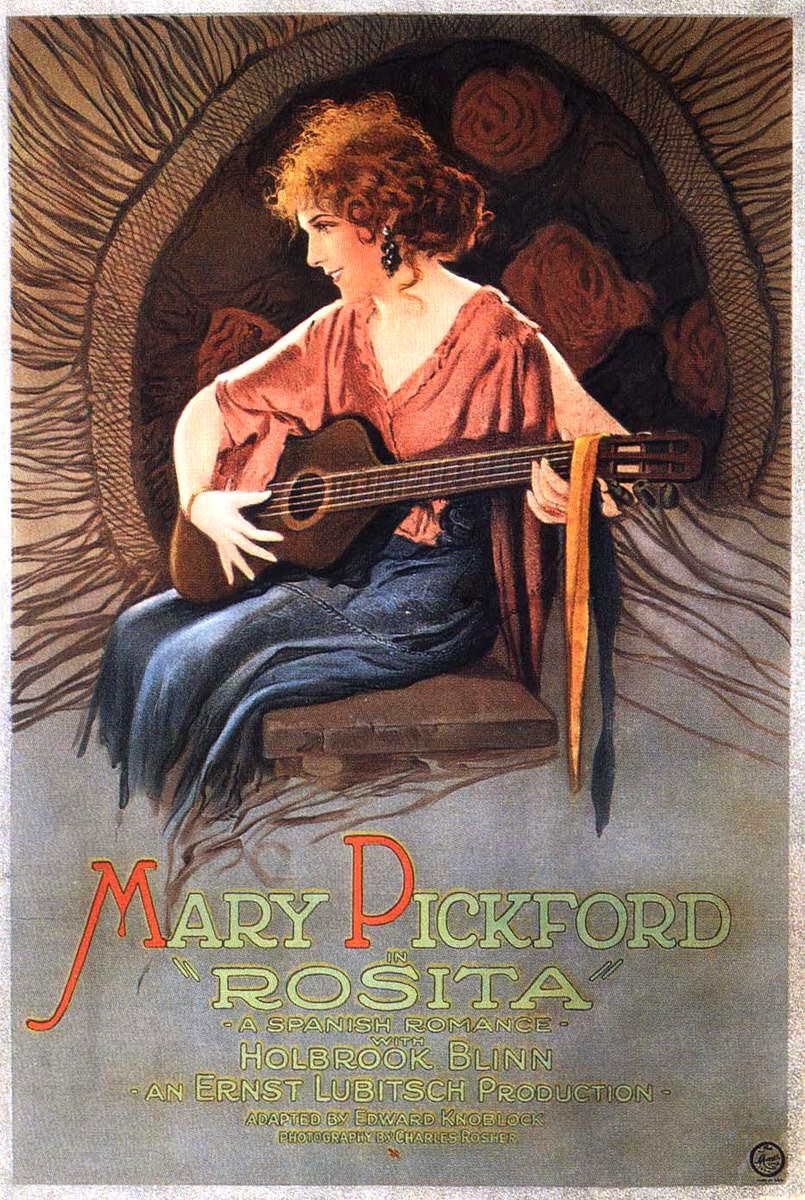
Rosita: A Review
Since film began, stars have struggled with typecasting and taken measures to change their image. Mary Pickford, one of the first film stars, was beloved as The Girl with the Golden Curls and America's Sweetheart, her Canadian birth notwithstanding. Rosita was a step in Pickford's efforts to be more risqué, culminating with her alliance with up-and-coming filmmaker Ernst Lubitsch. Rosita showcases Pickford's skills as a silent film actress and worth watching for that alone.
The randy King of Spain (Holbrook Blinn) is no stranger to decadence and debauchery. However, the good citizens of Seville seem to outdo their merry monarch in the libertine lifestyle. Either shamed into taking action or himself being shocked at how Seville is licentious, His Majesty sneaks into town to investigate things himself.
There, he spots the beautiful and popular street singer Rosita (Pickford). She is pretty and slightly risqué, but it is her anti-King song that gets her into hot water. His Majesty finds her very pretty, but his troops will not allow this act of lese-majeste to take place. As he is incognito, the King cannot stop his troops from arresting her or Don Diego (George Walsh), the army captain who defends Rosita.
She and Don Diego fall quickly in love, even if she has no idea who he is. The King, seeing an opening for a new seduction, using all his powers to get Rosita to submit. Perhaps in jest, perhaps in cruelty, the King has Rosita and Don Diego marry, albeit blindfolded to stop one from knowing who the other's spouse is. The King will also have Don Diego executed. Will Rosita and Don Diego truly reunite? Will the Queen (Irene Rich) find herself playing a hand in the torrid love lives of our group?
Rosita, from what I understand, was an effort by Mary Pickford to expand both herself artistically and work with the very best people around. Pickford was best known at the time for playing literal children, to where she was thought of in almost childlike terms rather than the shrewd businesswoman who was one of the founders of United Artists. Rosita therefore was a chance for Pickford to be more adult, almost alluring. It therefore is a mystery as to why Pickford decided against preserving Rosita when she was meticulous about preserving her filmography.
It is impossible to decide why Pickford opted to have Rosita fade away given how good she is in the film. Perhaps she had so embedded herself as "America's Sweetheart" that something as risqué, even in a somewhat tame manner as Rosita, was too much for her. History, however, decided to spare Rosita from being a lost film, which is a good thing in that the film is a showcase for both Pickford and Lubitsch.
Mary Pickford is quite strong as our street urchin. She is still the plucky figure that audiences had grown to love. However, Pickford showed a fun and flirtatious side to herself, wryly amusing and amused at how she can make the King frustrated. She, however, could handle the dramatic parts too. Late in the film, Rosita clearly wants to assassinate His Majesty for sending Don Diego to be executed. You can see in Pickford's eyes that desire for murder, making for a genuinely tense moment.
Lubitsch for his part created a world of delightful decadence in Rosita. He was able to get his actors to play the parts well, even if Walsh's Don Diego had that silent overacting for which silent films are usually mocked for. Lubitsch used some surprisingly advanced techniques in Rosita, such as shots of people spying on others with mirrors and flashes of color during the Carnival sections of the film.
Rosita has at least one flaw that was driving me a bit bonkers. The constant "will he or won't he kill Don Diego" was getting on my nerves. To my mind, you can pull the rug from the audience only so many times before it becomes repetitive and irritating. That is curious given that Rosita is only 90 minutes long. However, because it seemed that poor Don Diego kept getting dragged in and out of executions that I soon found myself wondering if we were ever going to settle things one way or another.
It should not have been a surprise to see how things went, as Rosita is supposed to be something of a romantic comedy. Exceptionally well-acted by Mary Pickford, ably directed by Ernst Lubitsch, Rosita is a strong film that works on almost every level.
Monday, November 25, 2024
Gladiator II: A Review
When Gladiator was sweeping the nation and then the Academy Awards, I never thought that we would need, let alone get, a sequel. I liked Gladiator well enough as good popcorn entertainment. However, had I been the one deciding things, I would have voted for Traffic as the Best Picture of 2000. Now, after almost a quarter of a century, we have Gladiator II, which goes into the tale of the original film's child character. Gladiator II is indeed an epic, an epic disaster. Boring, blank and at times cringeworthy, Gladiator II makes the case that the dead should remain buried.
Sixteen years after the events of Gladiator, we find ourselves in Numidia, 200 A.D. A young man known as Hanno (Paul Mescal) lives in relative peace with his female companion. Into his city sweep the Roman army, bent on conquest. Leading the troops is General Acacius (Pedro Pascal), who kills Hanno's beloved and takes him, along with other men, prisoner.
It is off to fight as gladiators for the captured men, where Hanno and his compatriots face off against bad CGI baboons. Hanno defeats them, in part by biting one of them. Looking on is former gladiator and trainer extraordinary Macrinus (Denzel Washington), who takes Hanno under his wing and into Rome itself. Acacius is being feted by twin Emperors Geta (Joseph Quinn) and Caracalla (Fred Hechinger), who are pretty bonkers but who want to celebrate Acacius. For his part, Acacius just wants to return to his wife, Lucilla (Connie Nielsen).
Hanno has sworn revenge against Acacius, but there are twists to endure. There are the machinations of Macrinus, who is plotting to overthrow the emperors and assume power. There is the hidden legacy of legendary gladiator Maximus, whose own legacy is tied to Hanno. Finally, there is Hanno's connection to Lucilla, for we discover that Hanno is really Lucius Aurelius, grandson of Marcus Aurelius and the son Lucilla sent away after the events of Gladiator for his own safety.
I guess Lucilla did not do a good job of keeping tabs on her only child, for he ended up in the backwaters of Numidia, facing off against sharks both metaphorical and literal. Lucilla perhaps was too busy plotting yet another overthrow of the imperial system to give much thought to what ever happened to her son. Still, will we get a mother and child reunion? Will Hanno/Lucius face off against Acacius? Will Macrinus succeed in his plot to ascend the throne or will some pipsqueak thwart his plans?
It was probably no more than fifteen minutes into Son of Gladiator that I asked myself, "are we getting the same beats to Gladiator"? We start Gladiator and Gladiator II: Judgment Day in the same way: our lead character, devoted family man, is taken prisoner to serve as a mysterious warrior, angry and thirsting for vengeance in this life or the next. David Scarpa's screenplay (from a story by Scarpa and Peter Craig) is a Gladiator remake in all but name. There is not one original idea in Son of Gladiator, for everything that was in Gladiator somehow found itself into Gladiator II.
A warrior who became a slave. A slave who became a gladiator. The gladiator who defied an emperor! You could sum up the plots to both Gladiator and Gladiator II: Electric Bugaloo in the same way. The only real tweaks between the two films are that Lucius was technically not a general (though he did lead armies) and there were two emperors. Apart from that and the Proximo character being a villain there was very little difference between the first and second film. One could make the argument that Gladiator's Maximus was split between Lucius and Acacius, but that is not a big point.
Think of it: Lucilla is not only still meeting in secret to try and restore the Roman Republic, but she is still working with the same people, like Sir Derek Jacobi's Senator Gracchus. You would think that after decades of working at something, the conspirators would either get it right or just give up. Instead, we have to drag Lucilla and Gracchus into things because Gladiator II was too lazy to come up with something remotely original.
As a side note, in what is meant as a climactic moment, you can spot out of the corner of your eye Sir Derek holding a large spear looking totally confused and unsure of what is supposed to be doing. A quick glimpse sees him killed off and I think, "Is the Shakespeare denier that hard up for work that he agreed to be in this drivel?".
Few films of 2024 have been this lazy, this poorly thought out, and frankly this embarrassing to almost all concerned. Ridley Scott, returning to helm this fiasco, appears to have decided that the people in front of the camera did not have to actually "act". Instead, they just had to look all sad, though my guess is that they looked that way because they realized that they were in Son of Gladiator.
The only other film that I remember Paul Mescal from is All of Us Strangers, where he played the ghost whom Andrew Scott had sex with. Ghost sex, as laughable as it may sound, apparently is surprisingly common in Hollywood franchises. I can think of another sequel in 2024 that featured ghost sex or at least the suggestion of it. I figure that "ghost sex" is different than "ghosting".
If Son of Gladiator is meant to be his big budget breakthrough, I think it will be anything but. His Hanno/Lucius is dull as dishwater, bland, boring and personality-free. He comes across as a stubborn idiot, permanently morose and devoid of any personal magnetism. We never get to know him other than with large brushstrokes: he lost his love, has no sense of humor or tragedy and apparently is simultaneously aware and unaware of his true identity. The idea of him inspiring his fellow gladiators into battle when we never see him interact with anyone, let alone his dishwater personality, makes the whole thing laughable.Matching him is Pedro Pascal as the Maximus-like Acacius. He is a reluctant warrior, but he too has nothing to make anything think he'd inspire the Praetorian Guard to select him as the next Emperor.
As a side note, I might not be the only person who confuses "Mescal" and "Pascal", so I hope I got the names right.
Connie Nielsen was dragged out to tie Gladiator to Gladiator 2: Freddy's Revenge, but she was just as bad as everyone else was in Gladiator II. Perhaps it is a bit unfair to condemn the actors given their awful dialogue. "Brother, let's not kill each other for their amusement," Hanno tells someone early in the film. Such grandiose, pompous things to say make things more ridiculous. At that previously climactic moment, she tells her son, "Go, my son". I wanted to shout in the theater, "Lady please, you should be dead. You ain't gonna be talking, let alone spouting out grandiose statements". The Two Emperors are so unimportant to whatever is laughingly called "the plot" that they were more distractions in their wild overacting. When one of them is killed, there was actual chuckling from some in the audience. Make that of it what you will.
Much praise has been thrown Denzel Washington's way as the scheming Macrinus to where he is held as an almost prohibitive frontrunner for Best Supporting Actor. To be fair, Washington seemed to be having himself a whale of a time, devouring the scenery with delightful abandon. He, I figured, understood that Son of Gladiator was not going to be good. Therefore, why not have fun with it all, and fun he did have. It does take a lot of skill to not start laughing when he is appointed Second Consul after seeing the First Consul be the surviving emperor's pet monkey.
Nothing in Son of Gladiator works. The visual effects are shockingly awful: the CGI baboons beyond dreadful to where I question Ridley Scott's sanity in approving them. The score uninspiring. The cinematography as bland as Mescal. I get that the final climactic arena match is supposed to be at night, or at least it looked that way. I don't care, it's all awful.
I have been criticized, with some accuracy, of my habit of being hung up on details. For the life of me, I simply cannot understand why Maximus' quote, "What we do in life echoes in eternity", which is etched on his tomb, is in English. It is literally written out in English. I sat there thoroughly flabbergasted in seeing it written out in a language that did not even exist at the time. Were those behind Son of Gladiator so lazy that they could even bother trying to write it out in Latin? Are audiences that lazy that they cannot be bothered to accept ancient languages set in ancient times?
Gladiator II is as much as sequel to Gladiator as Grease 2 is a sequel to Grease. I love Grease 2, but even I concede that its connection to Grease is extremely thin. In the same way, Son of Gladiator takes on the carcass of Gladiator and desecrates its predecessor. At one point, one of the characters says, "What is my purpose here?". I think that captures my sentiments on everything connected to Gladiator II.
Sunday, November 24, 2024
Wicked: Part I. A Review (Review #1900)
The Wicked Witch of the West was Elphaba Thropp (Cynthia Erivo), the product of an adulterous liaison between the Munchkins' Governor's wife and a mystery man. Whoever her birth father was, it caused her to have green skin, horrifying all. Elphaba manages great powers when angered but is protective of her younger sister Nessarose (Marissa Bode). Nessa, the apple of her father's eye in part because she is not green, is now off to Shiz University. Ostensibly there just to see that Nessa settles in, the ridicule that Elphaba receives by the hoity-toity Shiz students unleashes a great display of power.
As someone generally unfamiliar with either the Broadway musical or the Gregory Maguire novel on which the musical was based on, I can only speculate on how close or far the film veered from the source material. My sense is that Wicked may be perhaps too slavishly loyal to the original show, for it seems that almost nothing was cut. Whether that is a good thing or not I leave to individual audience members. I can say that Wicked feels long and a little bloated.
Thursday, November 21, 2024
Mona Lisa: A Review
There are some films that feel longer than they perhaps should be. Other films fly so quickly that you would not mind if they ran a bit longer. Mona Lisa is in the latter category. With standout performances and an engaging story, Mona Lisa is a surprisingly optimistic film amidst the world of the criminal.
George (Bob Hoskins) has just left prison after a seven-year stint. He wants to reconnect with his daughter Jeannie (Zoe Nathenson) but finds fierce opposition in his ex-wife. In need of work, he reconnects with his old boss, Mortwell (Michael Caine). The crime boss gives him a job as a chauffeur to Simone (Cathy Tyson), a high-end escort. George struggles with his job, having contempt for the posh Simone as well as with such cumbersome technology like beepers (which he calls bleeper). Simone, for her part, finds the working-class George uncouth and boorish.
Nevertheless, they soon start bonding over their mutual lowly positions and a friendship starts. George finds himself wanting to make it more than a friendship but is puzzled why Simone insists on driving past the seedy King's Cross area to see the other working girls. She soon reveals that she is searching for Cathy, a friend and fellow hooker whom Simone is worried about after having lost contact. George soon agrees to search for Cathy when he is not on the clock.
George eventually finds Cathy (Kate Hardie), who is terrified of her pimp Anderson (Clarke Peters). There is more going on underneath: kinky goings-on, violence and danger for Simone, Cathy and George. Will the trio manage to survive with Anderson and Mortwell after them? Will George manage to extract himself out this life to be a good father to Jennie?
At one point in Mona Lisa, Jeannie asks her father, "Are you still a bad lot?". I think this is the central theme of Mona Lisa: George's ultimate redemption. He knows that he has done bad things and is part of a dark, seedy world. At the same time, he seeks to protect Simone, save Cathy and be a good father to Jeannie. George is a common man in almost every way possible: working-class in his manner but also in his ethics. He finds the demimonde of sex workers and pornography vulgar. In a certain way, George is almost an innocent in this dark world.
Hoskins makes George a fascinating figure to follow in Mona Lisa (the title coming from the Nat King Cole song, one of the standards that George prefers to listen while driving or waiting for Simone). At heart, George is very traditional in his outlook: disdainful of the updates in technology, of the posh world of the elegant hotels Simone meets her clients. The gruff exterior hides a principled man, and Hoskins plays the part exceptionally well.
Writer/director Neil Jordan also reveals much in George's evolution in Mona Lisa. In one wonderful scene, Simone takes the very puzzled and reluctant George shopping for more appropriate clothes to change the loud outfits he prefers. He wears them, at first reluctantly and then acceptingly. Near the end, however, when he plans to help Simone and Cathy escape Anderson and Mortwell's clutches, he has gone back to the loud shirts that he came in with. This reveals that despite his best efforts, George is a working-class bloke, but one who has his standards of decency.
Jordan even allows a little bit of humor to sneak through. Late in Mona Lisa, Simone spies Cathy and Anderson at a clandestine meeting, with George accompanying her. George asks why it took place at a church. Simone replies, "It's the one place no one ever goes".
The other performances are also quite strong. Tyson's Simone was a mix of fragility and strength. "They can have me, but they can't hit me," she yells at George when he strikes her in a rage over a sex tape he discovers. Tyson makes Simone a survivor, one who cares about her girlfriend Cathy but who also comes to rely on George as a confidant and shoulder to cry on. Hardie's Cathy is more tragic, such as when she begs George, pretending to be a client, to tell Anderson that she made him happy.
Michael Caine may seem a strange choice as Mortwell insofar that it is a very small role. However, in his few scenes, he made Mortwell menacing in his ability to control others. Peters' Anderson too did well as this amoral pimp. Robbie Coltrane too did well as Thomas, George's friend and a mystery novel enthusiast.
I will say that I was not sure if Thomas merely read mystery novels or wrote them. I think people might get lost with some of the accents, so subtitles are advisable.
Mona Lisa earned Bob Hoskins a Best Actor Oscar nomination, but I was a bit surprised that In Too Deep by Genesis was not nominated. I believe it was written specifically for Mona Lisa, but there it is.
"Being cheap is one thing. Looking cheap is another," Simone tells George. The gap between appearance and being is an underlying theme in Mona Lisa, a tale where those in the underbelly of society display a quiet nobility and strength. It is a film that despite its neo-noir manner, has a happy ending, at least for some.
Wednesday, November 20, 2024
Lynch/Oz: A Review
"Pay no attention to that man behind the curtain" is one of the many memorable lines in 1939's The Wizard of Oz. It has now become a saying for whenever one suspects that there is chicanery going on, that there is something rather plain behind a grand image. Could that expression, however, apply to one of the most avant-garde filmmakers around? Lynch/Oz explores the connection between the quintessential children's fantasy and the filmography of one David Lynch. Could The Wizard of Oz be the inspiration for Mulholland Drive? Lynch/Oz makes that case, along with how The Wizard of Oz finds itself occurring and recurring amidst tales of murder, lost souls and psychopathic supernatural monsters.
Director Alexandre O. Philippe divides Lynch/Oz into six chapters with seven filmmakers in voiceover sharing their views on Lynch the man and the artist, The Wizard of Oz, the connections they see between the two and how both Lynch and Oz have influenced their own works. In order of presentation, the chapters and interviewees are Wind (Amy Nicholson), Membranes (Rodney Ascher), Kindred (John Waters), Multitudes (Karyn Kusama), Judy (Justin Benson and Aaron Moorhead) and Dig (David Lowery). After a brief and appropriately creepy presentation by "the lounge wizard" (Sid Pink), Lynch/Oz allows each of the filmmakers their say.
Wind speculates that in Lynch's films, we see a continuous theme of people going, willingly or not, into eccentric worlds. As with The Wizard of Oz, another film that has our lead character wanting to escape their world only to yearn to return may have touched on Lynch's cinematic world. That other film also became a beloved annual television event: It's a Wonderful Life. Membranes offers that Back to the Future too was like The Wizard of Oz; it too is another tale of a young person finding a world that had doppelgangers to his real world. While Back to the Future is not a David Lynch film, Mulholland Drive is, and there we have a twisted world of doppelgangers, a world where the central character travels to a different world, navigating dreams versus reality.
Kindred suggests that like the films of its interviewee John Waters, David Lynch finds the 1950's far from the halcyon world that that decade's films or memories made it out to be. The 1950's hid darkness beneath its outwardly pleasant visions. That evil lurking behind picket fences emerges in the portrayal of seemingly benevolent figures like Leland Palmer from Twin Peaks. That can be a mirror reflection of the Wizard himself, outwardly dangerous but in reality, a front. Multitudes offers that Mulholland Drive is almost a companion piece and even an inverse of Oz, the repeated themes of lip-syncing in front of curtains being a semi-conscious callout to the Wizard himself. We also hear from Kusama who quotes Lynch when he is asked about The Wizard of Oz after a Mulholland Drive screening. "There is not a day that goes by that I don't think about The Wizard of Oz," Kusama quotes Lynch as saying.
Judy has our only dual interviewees make the case that David Lynch is in their words, a "populist surrealist", one who shows the American myth versus the American dream. This reveals itself in how in many Lynch films, the women are brutalized and beaten up emotionally and sometimes physically. They see a parallel to how the film industry devoured Judy Garland. There is also a strong use of "Judy" in Twin Peaks: The Return, that keeps emerging. Dig is mostly on David Lowery's own interest in Oz, but he makes the case that despite the surreal, almost despairing Lynchian worlds of Lost Highway and Mulholland Drive, he still finds hope within the dark worlds he paints, of people who can return to the safety of their own Kansas.
Lynch/Oz can be best described as a filmed essay, where the various interviewees offer less a concrete case for their ideas and more a rumination on how one film has had such a powerful hold over a renowned filmmaker. Some of the observations are not unique. Lowery suggests that Lynch has similar imagery running through his films, then Philippe presents a montage of other filmmakers who use the same imagery or hit on the same themes.
Sometimes too, we hear different filmmakers speculate on a similar point. Both Waters and Benson & Moorhead think Lynch has a secret disdain for the 1950's conformity and outwardly peaceful veneer. How Benson & Moorhead tie the MAGA movement, such as it is, to something like Wild at Heart or other Lynch films, to my mind, is more of them trying to fit something that Lynch may not even care about.
As a side note, it is amusing to hear Waters' rather bitchy take on Glinda the Good Witch of the North. He remarks that she "dressed like she had gone insane getting ready for the prom".
Lynch/Oz makes much use of split screens to show us how The Wizard of Oz is referenced subtlety or overtly in films like Mulholland Drive or Eraserhead. To be fair, I have yet to see Wild at Heart, but judging from the clips Lynch/Oz shows, Wild at Heart looks like the most overt callout to the Victor Fleming film. The use of curtains, the red shoes, people falling into strange worlds and suffering great troubles to escape back into their original reality. These are fascinating ideas that Lynch/Oz presents us.
The film does cover a lot of ground, making its case on how The Wizard of Oz, this one particular film, resonated so much with young David Lynch that he finds himself by design or by accident repeatedly referencing it or what he drew from it. Even something as notorious as his adaptation of Dune can be vaguely Wizard of Oz like, everything from the sepia-like tones of Arrakis to the hero traversing a strange world to defeat a great evil.
Perhaps that is stretching, which is always a risk when speculating on a topic like whether David Lynch specifically revisits The Wizard of Oz in his films and television projects. It should be noted that outside a few archival interviews, David Lynch himself does not make his case for The Wizard of Oz being the film he draws so much from. Given his mercurial nature and refusal to give definitive interpretations on his films, we may never fully know if Lynch/Oz captures his mindset or is mere speculation. Still, it is hard to not think that Lynch/Oz is on the right track when we see David Lynch himself play Over the Rainbow on the trumpet (not very well in my opinion).
One may even think that Lynch/Oz is less about what David Lynch himself drew from The Wizard of Oz than on how others see a connection between the two. Many may even think that all this may be a case of reading more into things than intended. I do not know if Wizard of Oz director Victor Fleming or producer Mervyn LeRoy intended or imagined that The Wizard of Oz had some kind of great symbolism behind it. Sometimes a cigar is just a cigar. That quote, attributed to Sigmund Freud, may not have been uttered by the Austrian psychiatrist, but it might apply to how so many may be putting The Wizard of Oz into this bizarre cinematic universe. Maybe even David Lynch himself may have read more into The Wizard of Oz than The Wizard of Oz intended.
Lynch/Oz is a fascinating exploration connecting the Lynchian worldview with that of little Dorothy Gale from Kansas. Even I can see connections that were curious not remarked on by any of the interviewees. In Mulholland Drive, the restaurant is named Winkies, just like the Wicked Witch of the West's imperial guard. There is also a great deal of green in the restaurant, almost emerald color. You can find a connection between the filmography of David Lynch and The Wizard of Oz. You could miss it. It won't take away from either. Lynch/Oz makes its case well, but it is up to you if you accept it or want to throw water at its ideas.
The Wizard of Oz Retrospective: An Introduction


_poster.jpg)


_poster.png)