Monday, February 9, 2015

Uncle Tom's Cabin: A Review


UNCLE TOM'S CABIN

Our second African-American film involves one of the shameful chapters in American history and one that still haunts America: the peculiar institution of slavery.

Uncle Tom's Cabin is a book people know but rarely read.  The term 'Uncle Tom' has become a pejorative one, suggesting subservience and a willingness to play idiot, to scrape before others, to please someone the 'uncle tom' perceive to be 'superior'.  In short, it's akin to being a 'traitor'.  The truth, as always, is far more complex than popular ideas.  The whole issue around Uncle Tom's Cabin, book and film, is so tinged with animosity and racial animus that one can't enter it without some trepidation. It is truly a case of not seeing the forest for the trees.  The silent film version of Uncle Tom's Cabin may not square with the book (though again, not having read it I'm in no position at the moment to pass judgment on it).  However, I found myself moved emotionally by it, and while the liberties the film takes with both the story and portrayal of slavery may be surprising, there is still a great deal of good within Uncle Tom's Cabin.

We start in 1856, where fair-skinned slave Eliza (Margarita Fischer) is about to marry George Harris (Arthur Edmund Carew), another fair-skinned slave from a neighboring plantation.  In an uncharacteristic move in the South, Eliza's masters, the Shelbys, give her a big wedding.  Everyone is invited, and the slaves, particularly dear old Uncle Tom (James B. Lowe) is happy for Eliza and George.  All except George's master, who is enraged that his engineer is marrying without permission.  The Shelbys offer to buy George, but his master refuses, ordering him to return.

Somehow, George and Eliza have a child, Harry (Lassie Lou Ahern), who not surprisingly is basically white.  Mr. Shelby has fallen on hard times financially, and his creditor demands the sale of Eliza and Uncle Tom.  Mr. Shelby has no recourse but to sell some of his slaves, but he will not sell Eliza.  Seeing Harry, the creditor asks for the tyke instead.  Eliza learns of this, and she will not leave her child to such a fate.  With that,  she flees, making a harrowing journey in winter across the frozen Ohio River, with dogs and slave-catchers hot on her trail.  While she finds shelter with a Quaker family in the free state, the Dredd Scott decision compels both her and Harry to be returned.

Thus showing that the Supreme Court is not always right...just a thought.


Uncle Tom too is sold, and being a man of strong faith, he trusts God will not just bring him through but protect the wife and child he is forcibly separated from.  Sold down the river (which, by the way, a slavery term from which the expression comes from), Uncle Tom comes across Little Eva (Virginia Gray), one of the saintliest figures to ever come across 19th Century melodrama, let alone silent cinema.  She persuades her father to buy Uncle Tom.  However, unbeknown to everyone, George, passing for white, works on the same riverboat, and both Eliza and Harry are aboard as well.  George has been searching for his wife and child, and the slave catchers decide they can make more money by selling Harry.  In a particularly brutal scene, Harry is separated from his mother, with Eliza desperate to hold on to him.

She and Tom are sold off, but fortune does bring them together eventually.  Little Eva is a saint, and even Topsy (Mona Ray), a thieving little black girl, is awash in tears after Little Eva dies.  As I said, Tom and Eliza are brought together after Emancipation, which delights Tom.  Tom's final owner is a cruel man, but in the ways of good old 19th Century melodrama the woman who is being replaced in affection by Eliza by their new owner turns out to be Eliza's long-lost mother!  The Union troops come in just in time to save Eliza and her mother, with Tom having been murdered by the slaveholder.  As it so happens, George has spotted Harry earlier, rescued him and simultaneously been freed by the Union Army enforcing the Proclamation.  The troops come in to save the women, and the entire family is reunited.

There are things to look at in Uncle Tom's Cabin with some misgivings.  One is the blackface aspect.  Ray's Topsy is really a very uncomfortable thing to watch, as she descends into stereotypes and blatant idiocy.  Similarly, Gray's Little Eva is less endearing and more irritating.  She comes across as equally idiotic in her saintliness, as a little girl so sickeningly-sweet that you really don't mind if she dies.  Having a halo appear around Little Eva as she gently teaches the wicked little Topsy that stealing and lying is wrong puts an extra bit of heavy-handedness on the entire scene.

Adding to that Ray's wild overacting (even for a silent film), particularly in Little Eva's death scene.
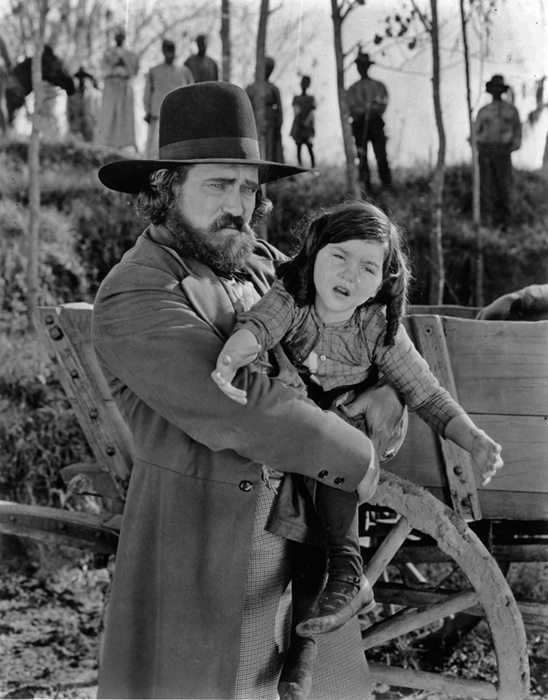
We can quibble about having non-white actors playing slaves, but here I'm willing to cut the film a little bit of slack.  After all, it's still a bit hard to show interracial couples on screen large or small.  Granted, the times they are a'changin', but things haven't gotten very far.  Therefore, it made some sense to cast white actors, explaining that they were fair-skinned blacks rather than suggest miscegenation.  In 1927 this would have been a scandal.  One has to look at it that way, rather than say 'oh, how silly'.

Less pleasing and more outlandish is the title card that says "Gentle rule of the slaves was typical of the South".  It's a silly idea and pretty insulting to our intelligence.  A quick scene of black children chasing after watermelons also is highly uncomfortable.  I also question Eliza's slave cabin, which is rather pimped out and cushy for a slave's digs, even one as favored and white as Eliza. 

Having said all that, and with some questions of how slavery was portrayed, Uncle Tom's Cabin also has some simply heartbreaking, even thrilling moments.  Eliza's flight across the Ohio is shockingly exciting and intense.  It is reminiscent of a scene in D.W. Griffith's Way Down East when someone crosses a frozen river.  However, Fischer's performance as she is desperate to escape to save her child is a powerful moment.  While perhaps director Harry A. Pollard didn't have this in mind, seeing the forced separation of families, sadly a true fact of that 'peculiar institution', is thought-provoking.  Seeing Tom separated from his wife and children is extremely upsetting, both when they learn of it and when it actually happens.  Similarly, the forced taking of Harry from a desperate Eliza I think will tear at people's hearts.

Perhaps because Harry and Eliza are 'white', white audiences could identify with the situation and the true horror of it.  Pollard really does well as Eliza makes a desperate race to save Harry, and people not moved by this will be extremely hard.  We also see great camera work as the camera moves from George, who can only watch helplessly as his wife and child are lost to him a second time.

Like in any good silent film, foreshadowing works well for it.  A storm cloud gathers over the Capital just before the Civil War breaks out, and it's a subtle nod to what is about to descend on America that we as an audience get. 

In terms of performances I think Lowe, the only African-American in the cast, did not make Uncle Tom anyone's fool and was far from the stereotype of the grinning idiot who scrapes to please his 'massa'.  Tom is a man of faith, but he is also joyful at reading about the Emancipation Proclamation.  This belies the concept that Uncle Tom wants to be a slave, that he is eternally loyal to his master.  No 'uncle Tom' would want freedom, but this Uncle Tom certainly did.  This Uncle Tom also stood up for himself and fought the slaveowner.  That he forgave him and his two black henchmen (whom I would say were more caricatures than that of Uncle Tom) is less to do with idiocy than in the character's deep Christian faith and him attempting to 'forgive as he has been forgiven'. 

Looking across a good almost 100 years since the film's debut, and more than a hundred years since the book's publication, it is fascinating to see how the myth of "Uncle Tom", a traitor to his race, a being who betrays his people's and his own interest at the cost of their/his freedom, may be more fiction than fact.  Until one reads the book it is impossible to say for certain whether Uncle Tom's Cabin is accurate to the source material.  It is even harder to say whether Uncle Tom was really an "Uncle Tom".  This version of the story, while not without some terrible flaws, is a well-made film, with some truly moving moments and excellent camera work. 

It may not be completely historically or literarily accurate, but is a strong film.     

I like this Little Eva better...


DECISION: A-

Saturday, February 7, 2015

The Americans: EST Men Review

THE AMERICANS: EST MEN

The Season Three opening of The Americans wasn't as intense and/or wild as the Season Two premiere, but it still has some wild moments.  EST Men, however, also has surprisingly soft moments within the violence and sex, and surprisingly enough for me not that much on EST.

Stanley Beeman (Noah Emmerich) is trying to rebuild his marriage, especially now that his mole/mistress Nina has been sent to Moscow and convicted of espionage and treason (pretty much dooming her).  With that in mind, he attends an EST meeting as his wife Sandra (Susan Misner) has become deeply involved with it.  He takes his neighbor/friend Philip Jennings (Matthew Rhys), and both find it idiotic. 

Philip's wife Elizabeth (Keri Russell) appears to have found something of religion as well, accompanying her daughter Paige (Holly Taylor) to church to help out at an anti-nuclear rally (these damn liberal churches...thank Heaven I always attended evangelical churches).  Paige's interest in religion displeases Elizabeth, but the pink nature of the congregation pleases her enough to consider the suggestion of the Centre, which wants Paige turned to an agent.  Philip is still stubbornly and fiercely against it, but Elizabeth tells Gabriel (Frank Langella), their former handler whom both are fond of, that Paige is open to Soviet ideas. 

Elizabeth and Philip have their own issues, as Agent Gaad (Richard Thomas) comes across Elizabeth after an angry female CIA agent slips her a list of Afghanistan operation members.  In the ensuing fight Elizabeth beats the crap out of Gaad and another agent, but loses the list.  It's decided to use Annelise (Gillian Alexy), who has been sleeping with Pakistan ISI Covert Operative head Yousaf (Rahul Khanna) to get the list.  Annelise has fallen in love with the secular Moslem, but when she tries to tell Yousaf of what she is doing, he becomes paranoid and strangles her.  Enter Philip, who offers to help him out of this most difficult situation.  Philip knows a little about wild sex, having shocked even himself when as 'Clark', he and Martha (Alison Wright) tried out the Kama Sutra.  Unbeknown to the Jennings, Leonid Brezhnev has just dies (setting this in November 1982).


I noticed first that both Costa Ronin (who plays Oleg, the Rezidentura officer who has fallen for Nina), and Thomas are now listed as cast regulars rather than guest stars, which really should have been done earlier.  It does indicate that Oleg and Gaad will play larger roles in The Americans, which is a good thing.  EST Men also has the benefit of having Langella as a guest star, and when you have someone of Langella's stature among the cast, you already have an already strong series become more intriguing.

Langella is excellent as Gabriel, almost a grandfatherly type to the Jennings.  He is calm and pleasant to them, offering them traditional Russian food.  However, he shows through the gentle demeanor a coldness as well, for he quietly pushes them to start Paige on the ways of the Motherland.

Here is where Russell and Rhys really show how strong they are as actors.  With the latter, we can see in his face alone just how angry he is about the mere concept of turning Paige to an agent.  You can tell he is seething as Elizabeth tells Gabriel that their daughter is open to 'new ideas'.  He is infuriated at all this and what appears his inability to get people to see things his way.  Rhys even has a bit of comedy when he appears stunned at the sexual intensity of the Kama Sutra

For her part, Russell never lets us see whether she truly agrees with Gabriel (whom she is extremely fond of) or is merely playing for time.  Her ambiguity regarding Paige extends to Philip, because as she argues with him about Paige, her words are open to interpretation.  She also gets some real action moments as she takes down Gaad (with Thomas lending some comedy with his bandages, especially as he was taken down by a smaller woman).  Russell also has nice soft moments as she and Paige work at the church, and we see the mother within her as she observes Paige's hesitancy with a young boy at the church.

Elizabeth has just learned that her mother is dying, and here both Russell and Rhys have a brief and quiet moment, and it says so much without saying much.

Other actors both regular and guest featured well.  Emmerich sometimes got stuck with just being either all-work or all-Nina.  However, here his domestic issues with Sandra are a major subplot which doesn't intrude.  We see that Beeman is a man struggling to find love after losing the two women who loved him (or at least that he thinks love him). 

Of particular note is Khanna as Yousaf, who is shocked by both his mistress' words and his killing.  We know it is a set-up for future episodes to put Yousaf in cahoots with the KGB, but one wonders what would have happened if either he hadn't killed her there or Philip wasn't around to 'bail him out'.  Then again, Yousaf wouldn't have been in this situation if not for Annalise, and her murder elicited a mix of sadness and horror at her own mix of naivete and stupidity.

It's interesting, though perhaps unintentional, that EST Men has a lot of parallels: Beeman tries EST, Elizabeth tries Christianity, 'Clark' tries Eastern sexual mysticism.  It's as if everyone here, who knows their job and does it well, is searching for something else.

If I had something to criticize about EST Men, it is the somewhat cliché 'strangling mistress at the most opportune time' that didn't strike me as original.  I know it had to be done to get Annalise out of the way and put Yousaf in a vulnerable position, but still...

However, apart from this EST Men had some wild action (Elizabeth's takedown of Gaad is a standout) and the conflict of whether the Paige will turn is a sign that it will be one of the ongoing stories.  We are very interested in seeing how it will play out.

Elizabeth and Philip are a fascinating couple: the parent who wants her progeny to follow her footsteps and has never fully integrated into American society versus the parent who wants his child to follow his/her own path and is more American.  Their parenting styles, their world views are always in conflict, and while they are united in taking down the United States, in the more important things, they have their own Cold War. 


8/10

Next Episode: Baggage

Friday, February 6, 2015

Gotham: Welcome Back, Jim Gordon Review


GOTHAM: WELCOME BACK,
JIM GORDON

It's odd that for a series built around future Commissioner James Gordon, it's the villains who are more interesting.  This is no slam on either Gordon or Ben McKenzie, as the character is meant to be noble and stoic through everything.  However, in what appears to be a tradition on Gotham, the title character in Welcome Back, Jim Gordon has less to do with the story as certainly Robin Lord Taylor's Oswald Cobblepott aka The Penguin or even David Mazouz's Bruce Wayne.  Even Jada Pinkett Smith's Fish Mooney has a greater role, and here is where we start.

Mooney has been left to be tortured to death for attempting a coup against Don Carmine Falcone (John Dorman).  She however, is defiant, her style of crazy finally fitting in.  Fortunately for her, Fish's loyal henchman Butch (Drew Powell) comes in at the perfect time to save her.  Butch urges her to flee, but she is determined to get revenge on Penguin and won't go without trying to kill him. 

Penguin, for his part, is too busy celebrating what he thinks is his ultimate triumph.  At Fish's club, which is now his, he brings Mama Gertrud Kapelput (Carol Kane) to see her son's new club.  She is thrilled with it all, thinking it reminiscent of opera houses back in the old country.  Champagne flows freely, and Mama Kapelput even finds a lovely scarf to accentuate her wardrobe. 

Oh, yeah, and then Gordon comes in, asking for a favor.  A witness to a drug-related murder has been murdered himself at police headquarters, and as usual Gordon is angry that there are corrupt cops.  He is convinced that Narcotics Officer Arnold Flass (Dash Mihok) is involved, if not the actual killer.  Gordon's partner, Harvey Bullock (Donal Logue) tells him Flass is involved in the drug trade himself, using his position to run narcotics, but while Bullock urges caution, Gordon goes in all guns blazing.  Gordon asks Penguin to get info on Flass, which Penguin (who trusts Gordon) agrees.


For his part, Bruce is back from temporary exile in Switzerland.  He is determined to find Selena Kyle (Camren Bicondova).  He and Alfred (Sean Pertwee) run into Ivy Pepper (Claire Foley), who does pass on the message.  Bruce has a gift for Selena, a snowglobe.  Selena, however, declines the gift and tells Bruce to leave her alone, and that she didn't witness the murder of his parents.  A brokenhearted Bruce is found by Alfred, crying, the snowglobe smashed.  Alfred asks if he'll keep crying, and Bruce tells him to get the broom.  He'll rally.

Penguin gets drunk metaphorically and literally, and is left unprotected as Fish and Butch get back to the club.  She is going to get hers against the little Penguin but at the exact right moment, Falcone's main hitman Victor Zsasz (Anthony Carrigan) comes in, not to save him, but to get Fish and Butch.  In the ensuing battle Penguin is saved, Fish escapes and Butch is recaptured.  Fish is helped to leave Gotham by Bullock, who may see Fish as more than a friend.  Gordon gets to arrest Flass, but this time Captain Essen (Zabryna Guevara) has his back, ordering Flass' arrest in the precinct.  Perhaps if Gordon knew how mean Flass has been to Edward Nygma (Cory Michael Smith) in his efforts to woo Records office staff Kristen Kringle (Chelsea Spack), he would have thrown a few other charges too.

Now, I think we might have to touch on perhaps WBJG's weakest point: Butch and Fish's escape.  Butch was trapped in a van, then when he was about to be hauled out, he was gone.  He then whacked the two drivers/hitmen and managed to get to Fish right on time.  Come to think of it, the 'nick of time' rescues of both Fish and Penguin were a bit far-fetched to believe.  We don't know how it was all done, but on this point I'm not going to belabor it.  I rolled along with this because we needed it to happen.  One hopes though that Gotham doesn't try to pull this stunt again.


It's just that everything else in WBJG that worked so well we can pretty much paper over some of the other more illogical aspects.  Let's start out with the performances.  This Robin Lord Taylor, this kid really has it and has made Penguin his own, matching (and in my view, outdoing) both Burgess Meredith and Danny DeVito's interpretation of the Penguin.  His scenes as he gloats privately at the empty club are both amusing and indicative of his drunken state. The quiver in his voice and body as Mama Kapelput slips on Liza's scarf is brilliant and subtle.  His genuine like for Gordon (whether it is just professional or not I leave up to the reader) is pleasant.  Seeing him kissing Fish's foot in an effort to save his life only to turn and gloat how even as he appears to be totally defeated he still managed to outwit her shows the guy's range.  RLT is simply astonishing as The Penguin, and I'll say it again: he deserves at the very least an Outstanding Supporting Actor in a Drama Emmy nomination for his role.

We also see that for once, JPS' Fish is uncharacteristically unhinged.  Now, I figure many people think that she always plays Fish as unhinged, but I would say she has always made Fish a bit camp.  Nevertheless, this time, as she too appears trapped with no way out, seeing her defiant is a great turn for someone who I think knowingly plays Fish as a bit over-the-top.  Powell's Butch comes into this own as her loyal aide, and of course, Carol Kane is still wildly fun as the slightly bonkers Mrs. Kapelput, so proud of her Ozzie.  Again, in my world there can never be too much Carol Kane.

CMS balances Edward Nygma's professionalism with his growing lunacy when examining the witness' body, offering riddles as to what the weapon was.  While Bullock is angrily dismissive of such things at a time like this, Gordon does come up with the answer.  "What's strong enough to smash ships but still fears the sun?", Nygma asks.  After a while, Gordon pops up, "Ice", and it was an icepick.  CMS has an almost sad moment as he attempts to woo Kringle, when he finds Flass has been mocking the card Nygma gave her.  When she comes to apologize and thank him for the card, we see Nygma's genuine hurt turn into odd hope.  I think WBJG is another highlight for CMS.

Another highlight is Mihok's arrogant Flass.  One hopes that, while he's been arrested, he does make a return appearance, for he was excellent as the corrupt cop that makes Bullock look like Gordon in comparison.  Logue too had a wonderful moment with JPS in their farewell, showing a softer side we rarely see.  McKenzie is still stubborn as ever, but his scenes with RLT as he finds himself slowly compromising also work extremely well, the struggle genuinely coming through.

In the smaller story, scenes between Mazouz and Bicondova work on so many levels.  They really work well together, her reluctance mixed with his earnestness.  When we see him cry, whether it is due to a potential first love lost or the idea that his parent's death will remain unsolved again is up to the audience, but either way it works beautifully.

There seem to be a lot of parallels in Welcome Back, Jim Gordon.  We have echoes of the past when Bullock and Fish are at the pier, remembering when Gordon urges Penguin to do the same: leave Gotham and not come back.  Fish and Penguin rescued in the nick of time can be another parallel.  Gordon coming to Penguin for help reminiscent of how Bullock had Fish as his informant.  Welcome Back, Jim Gordon really does so well balancing so much and throwing so much at us that it remains exciting and oddly emotional all at once. 

Oswald Chesterfield Cobblepot, Take A Bow.


10/10

Next Episode: The Fearsome Dr. Crane

Thursday, February 5, 2015

Gotham: What the Little Bird Told Him Review


GOTHAM: WHAT THE LITTLE BIRD TOLD HIM

You just can't keep a good man down.  Then again, you have to ask what you are keeping him down from.  When it comes to Detective James Gordon (Ben McKenzie) it means the always upright police officer will speak truth to power and follow the letter of the law.  When it comes to Oswald Cobblepot aka The Penguin (Robin Lord Taylor), it means staying one step ahead of everyone in his determination to come out on top.  What the Little Bird Told Him is shocking, brilliant, and does what Gotham needed done: maintain the balance between gritty noir detective story and a comic-book based series.

Jack Gruber (Christopher Heyerdahl), recent Arkham Asylum escapee, is on a crime rampage, enacting revenge on those who betrayed him.  His method of killing has earned him the press nickname of The Electrocutioner.  The Gotham City Police Department has been told the capture of The Electrocutioner is their top priority.  Enter Gordon, who promises he can get him within 24 hours...in exchange for restoring him to the GCPD and out of Arkham Asylum security.  His ever reluctant partner Harvey Bullock (Donal Logue) goes along with this, much to his displeasure.  Also unhappy is Police Commissioner Loeb (Peter Scolari), who blames Gordon for everything. 

The criminal underworld has its own problems, though Gruber does tie into all this.  Fish Mooney (Jada Pinkett Smith) has decided this is the time to make her play to overthrow Don Carmine Falcone (John Doman), and for that she'll use Liza (Mackenzie Leigh), the girl the Don has a soft spot for due to her resemblance to his mother.  Fish 'abducts' Liza, threatening her unless the Don retires and turns over control to her.  The Don, devastated that his favorite 'civilian' has been taken, reluctantly agrees.  Carmine's rival, Don Maroni (David Zayas) finds himself targeted by Gruber, as he was the one who sold him out.  The attack literally shocks Oswald Cobblepot, also known as The Penguin (Robin Lord Taylor).  In his confusion, Penguin lets out that he had to do something for Don Falcone! 

Since Maroni is the target, Gordon hits on the idea of taking him to the precinct under protective custody.  True to form, Gruber strikes, shocking everyone in the building...except for Gordon, who opted to use the rubber boots Forensics Edward Nygma (Cory Michael Smith) offered.  His defeat of The Electrocutioner is shockingly simple, and Gordon is restored. 

Penguin does manage to get to Falcone to tell him Liza has been a plant for Mooney all along.  Falcone doesn't want to believe it, but at Fish's club he confirms it to himself and strangles poor Liza.  Quietly enraged, he takes Fish and her loyal henchman Butch (Drew Powell), deciding they need special treatment.  Enter Penguin, who is delighted by the turn of events, greeting his rival with a gleefully evil, "Hello...FISH!"


What the Little Bird Told Him has one or two flaws.  I know a lot of people have an issue with how Gruber was defeated (with a literal cup of water), but I think it works.  It plays against the idea of having to have a massive battle with a super-villain.  It also shows that Gordon is highly intelligent.  I also have a problem with the 'revealing incriminating information while in shock' motif that has been seen before.

However, those really are minor points to me, as What the Little Bird Told Him has some simply shocking moments (no pun intended).  Of particular note is when Don Falcone strangles Liza.  I think this does take viewers by total surprise, as we have not seen the Don so violent.  He's come across as dangerous but also calm and rational.  His killing of Liza, whom he genuinely cared for, was cold and brutal, so shocking that even Fish shuddered at it.  We can see Falcone was genuinely heartbroken at this betrayal, not just by Liza but by Fish, that heartbreak mixing with rage that Fish would use his mother's memory against him.  We saw glimpses of Falcone being more than just a nice old man when he mixes the memory of his father's funeral with the killing of someone begging for his life.  Dorman gives a really strong and powerful performance, and I think it's one of his best of Gotham.


We also get to see CMS have a much larger role in Gotham; he serves to help Gordon and Bullock by offering protection, and we also see an interesting subplot develop as he attempts in his own way to woo GCPD Records staff Kristin Kringle (Chelsea Spack).  Nygma presents Kringle with the oddest gift: a cupcake with a bullet in it.  This gift creeps Kringle out, but once we get the resolution to Nygma's 'riddle' (a live bullet in a cupcake and a beautiful woman is a dangerous thing), it's almost sweet.  Almost.   It's nice to see CMS taking a larger role, and this subplot actually works in Gotham, since CMS gives Nygma a mix of odd but still not totally irredeemable.  We know he will become The Riddler, one of Batman's greatest foes (and a personal favorite), so I figure that his passion for riddles will make his identity to the GCPD not a secret whatsoever.  Still, so far the ride has been extremely fun.

I know JPS gets much grief for making Fish into a cartoonish figure, but here again she really used it well.  When her carefully-conceived plan crumbles rapidly, we see genuine panic and then silent rage to see her toadie come to gloat over his triumph over his hated rival. 

Almost everything in What the Little Bird Told Him works.  There's the opening of the episode to an appropriate use of Johnny Cash's God's Gonna Cut You Down (which works on so many levels) and the wild twists with the unfortunate Liza; there's the introduction of a romance between Gordon and Dr. Leslie Thompkins (Monica Baccarin) (which has the plus of pushing Barbara out to deal with her WASPy parents), and the super-villain Gruber, keeping within the world of Gotham and comic-book adaptations.  The always amazing performance of Robin Lord Taylor (who really needs to WIN the Outstanding Supporting Actor in a Drama Emmy) is complimented by everyone, in particular Dorman and Logue (who makes Bullock less the corrupt sleazy cop and more the reluctant hero).

Again, minus that 'revealing vital information in throes of shock, What the Little Told Him has to be among Gotham's wildest and most intense hour, building on what came before and building to more fascinating and tense stories.

Say good night, Liza...


9/10

Next Episode: Welcome Back, Jim Gordon

Tuesday, February 3, 2015

Birdman (2014): A Review


BIRDMAN, OR (THE UNEXPECTED VIRTUE OF IGNORANCE) (2014)

Between Fact And Fictionalized...

I think off the bat I should say Birdman is one of the oddest films of 2014, and I mean that in a good way.  I imagine that many people watching Birdman will say "What IS this?" or say "Pretty much everyone is playing a variation of their real selves".  Both would be pretty fair assessments, but Birdman and everyone involved with it at least knows that it skates pretty close to self-parody so one shouldn't worry too much whether it is in fact thinly veiled versions of reality.

Riggan Thomson (Michael Keaton) is an actor at the edge of sanity and in deep career doldrums.  Best known for playing a comic-book character named "Birdman", he appears pretty washed up.  This is why his big 'comeback' in a Broadway adaptation of Raymond Carver's What We Talk About When We Talk About Love is so important to him.  Carver had passed a note to a young Thomson when the author saw him perform in a play, which was the impetus to Riggan going into acting.  This is part tribute to Carver's early words of encouragement, but a way to show that Riggan is more than "Birdman".  However, there are problems with the production.  Riggan, who wrote and is directing the adaptation, is unhappy with one of the actors.  A light hits the unfortunate actor (an accident which Riggan thinks he caused with his mind).  Fortunately for him, Lesley (Naomi Watts), who is making her Broadway debut with What We Talk About... happens to know someone who could step in immediately, as the play is in final previews.

It is her boyfriend, Mike Shiner (Edward Norton), a highly respected Broadway actor known for his intense and realistic performances.  He is a big draw in New York, so his appearance in What We Talk About... practically guarantees a full house.   Mike, however, is a Method actor, and one who is rather intense about getting into character.  Riggan has invested a great deal of money into the production, but in Mike's first preview the volatile thespian proves to be slightly less bonkers than the star.  Mike is incensed that the whiskey was replaced with water, and breaks both character and the fourth wall to show his displeasure.  Riggan wants Mike out, but his lawyer Jake (Zach Galifianakis) tells him Mike is the main reason they have sell-outs...and that the contract is binding.

Mike, for his part, has taken a shine to Sam (Emma Stone), Riggan's daughter/assistant just out of rehab.  Mike is an odd duck: totally committed onstage, a bit adrift off.  Sam doesn't think much of anything revolving the play, which makes more pressure on Riggan.  Each preview has a moment of insanity: there was Mike breaking character, then Mike trying to have sex with Lindsey while onstage only to elicit laughter when his hard-on becomes visible in what is suppose to be an intensely dramatic moment, and then through a bizarre series of circumstances Riggan is forced to run down Times Square in his underwear and forced to perform the dramatic conclusion from the theater rather than the stage.


As nutty as the previews have been going, Riggan has shown he is hanging on to sanity himself, not an easy task given he can 'hear' Birdman constantly talking him down and Riggan looking on with barely concealed anger at how while other actors get respect for playing comic-book characters that he didn't.  It doesn't help that Tabitha Dickinson (Lindsay Duncan), the powerful New York Times theater critic who printed a lavish praise of Mike which included dismissive quotes from Shiner about Riggan, has told Riggan to his face that she will give What We Talk About... a negative review no matter what.   A poison pen, Tabitha thinks Riggan is nothing more than a shallow, talentless interloper, a spoiled 'movie star' trying to regain legitimacy and relevance on the sacred Broadway stage.  "You're no actor," she sneers.  "You're a celebrity".

(For full disclosure, these are my thoughts on Channing Tatum and Sam Worthington myself, but I digress).

Riggan's mind finally appears to snap, as Birdman finally emerges fully formed and tells him to regain the world.  Riggan appears to turn into his alter ego, but somehow ends up on opening night giving a bravura performance.  He also shoots off his nose at the climatic moment when his character appears to commit suicide, shocking the world and making him a cause celebre in the theater.   Birdman ends with what could be either Riggan's suicide by jumping out of a hospital room, or Sam witnessing her father take flight.     


Yep, Birdman is rather bizarre, but at least director/co-writer Alejandro G. Inarritu (writing with Nicolas Giacobone, Alexander Dinelaris, and Armando Bo) fully embrace the weird.   We see that Riggan is teetering on the edges, where he attempts to keep Birdman's arrogance and anger at bay through meditation.  We also see that Riggan is capable of functioning with others, but that the voice inside his head is playing with him.

It is extremely difficult not to see Birdman without thinking how it plays almost as biographical of Keaton's road from Batman to this being his own 'comeback'.  Keaton, like Riggan, became famous (or at least a big name) for playing a comic book hero in a successful franchise only to be discarded when he no longer played said character.  It is therefore tempting to think Birdman is Keaton playing a version of himself, but I would argue that Keaton is doing a really terrific feat of acting.

He is playing Riggan (which appears to be a thinly-veiled version of himself).  However, he also has to play Riggan playing the main character in What We Talk About When We Talk About Love, and watching him command the stage we can quickly forget that we are watching a film and not a Broadway performance.  When he is playing the scenes on stage, Keaton is really acting.  We also see in Riggan an anger and confusion as to how things are going so wildly wrong, how he has little control despite all his efforts, and how this deeply harried man is trying to keep things together.

A particularly noteworthy moment is when fans ask for his picture, and their child is confused as to who this guy is, only to be told, "He used to be Birdman".  It's very quick, but you could see how hard it was for Riggan to go through this humiliation, and fortunately it isn't something the film dwells on.  It's done quickly and efficiently, but it still stings.

I would argue that Birdman isn't just open to interpretation about how Keaton's life mirrors the film.  I think it could also be a thinly veiled critique of Norton's reputation as "an ACTOR with a Capital A".   Norton has always been a fantastic actor with a serious reputation (three Oscar nominations counting this one), but he also is someone who has been seen as 'difficult' due to his methods (unless there was there another reason why Norton, despite being in Marvel Canon, was not in The Avengers).  Norton for his part, really shines as Mike Shiner, someone who is a great actor but a questionable human being (his asking for sex right onstage as a turn on being wildly creepy).

I was really impressed with Watts' ingénue, who showed the insecurity and vulnerability beneath her lifelong dream of being a bona-fide Broadway actress.  I was more impressed with her than with Stone's slightly stoned out and bitter daughter, though her scenes with Keaton were extremely effective and moving.


There were things I disliked about Birdman, which made me reevaluate my original decision and downgrade it slightly.  First, I disliked the camera work, where everything was made to look like it was done in one shot.  It worked, mostly, but it also does what I really, really dislike: draw attention to itself.  I disliked having a brief lesbian scene with Watts and Andrea Riseborough as her costar which was never brought up again and to me, plays like a cliché of straight men turned on by lesbians.  Amy Ryan, playing Riggan's ex-wife, was I think underused.

Did I mention that single-shot style?

However, Birdman has a lot to recommend it.  It has clever lines ("You confuse love for admiration", Riggan is told, and the dialogue between Norton and Keaton about popularity versus performance when it comes to acting and the theater).  It has a wild story that makes sense in its world, and even genuine moments of laughter (Galifianakis telling Riggan that "Martin Score-Seas" is coming to see Riggan in the play as a lie to calm him down).  Birdman also has a fascinating turn when we see the adaptation of What We Talk About When We Talk About Love that would make great theater should it ever produced.

I think Birdman is a little too bonkers for my tastes, and it is something I would be reluctant to revisit.  However, when I see Michael Keaton in Birdman, I am reminded of Ronald Colman in A Double Life, where he played another actor who soon starts confusing fact and fantasy.

Colman won the Best Actor Oscar for his role.  Dare we see a repeat?

DECISION: C+

2015 Best Picture: Spotlight

Monday, February 2, 2015

Amistad: A Review (Review #692)

AMISTAD

Our first look at the African American experience via film involves own of the toughest: the slave trade.

If nothing else, Amistad tells its story of African slaves caught in a bizarre legal situation not of their making with a certain degree of realism.  I say 'certain degree' because, as in all historic films, a great many liberties with the strictly historic events were taken.  However, I think Amistad's primary role was to show to a new generation how brutal slavery was, as well as to how America struggled with to match its ideals to its practices.   

1839.  Although the importing of slaves to the United States has been outlawed since 1808, the human trafficking of Africans to America continued.  Now, the whole matter explodes onto the American stage thanks to the Amistad, a ship carrying Africans to Cuba or to the U.S.  The Amistad has an uprising by the captured Africans, led by Cinque (Djimon Hounsou), a leader in his homeland.  He demands the Spanish sailors return them to Africa, but the Spaniards decide to trick the Africans until they can find refuge themselves on more friendly ports.

As it turns out, those shores are America.  As the Africans have been bought legally in Cuba, the Spanish insist the Americans honor their treaty to the Spanish Crown and that they are the property of Her Majesty Queen Isabella (Anna Paquin in a cameo).  However, the salvage company that has taken the Amistad insists the property belongs to them, and that includes the Africans.  The surviving crewmen get in on the act, insisting the property belongs to them.  

Enter into this maelstrom one Roger Sherman Baldwin (Matthew McConaughey), a brilliant attorney (and this may be one of the few times 'brilliant' and 'McConaughey' appear in the same sentence).  he sees this as a legal question of claim, not morality.  Baldwin sees this as the way to win the case and set the Africans free.  He is aided by free black Theodore Jodson (Morgan Freeman) and abolitionist Lewis Tappan (Stellan Skarsgard).  For their part the Africans soon start separating into their own nations while they are kept in a military prison while all this is being sorted out.

The Amistad situation could not have come at a worse time for President Martin Van Buren (Nigel Hawthorne), deep in the midst of reelection. He does not want to displease the South but finds the more abolitionist North is not welcoming either.  The case also does not interest a former President, John Quincy Adams (Anthony Hopkins), who is pretty settled in the House of Representatives.  Eventually, he does come around, to argue the case to the Supreme Court.  Before we got to this stage, we had to endure a trial where Cinque, finally getting some English, stands and makes his demand, "Give us, free.  Us free."  The Amistad case puts one more nail on the coffin of slavery in America, the Africans are returned to their homeland, and Van Buren loses reelection.


There is certainly a lot to recommend in Amistad.  It has moments of extreme power that make the pernicious and evil work of the slave trade all the more shocking.  Of particular note is when we see the drowning at sea of men and women deemed too ill or unworthy for sale in Cuba.  The horror of this act is something director Steven Spielberg does not shy away from.

As a side note, it is unfortunate that Spielberg wants to focus too much on the visuals that I found a bit overdone.  Another moment is when a baby is born within the slave ship, the baby rising into the light amid the horror and storm the ship was passing through.  I felt it was a touch too poetic, as if it trying too hard to call attention on itself.  Another is early in the film, when a pleasure cruise of sorts is passing by the Africans aboard the Amistad, and both stare in disbelief at each other without saying anything.  A bit of gilding the lily to my view.

There is also the idea that Amistad is fighting a losing battle to draw parallels to our world.  A major subplot was the idea that Van Buren was caught in a situation that could be resolved with compromise.  Coming a year after another Presidential election where we had split government (a Democrat in the White House, a Republican-dominated Congress), I feel there was a subtext about how government with such different views could not work together was being spread around the film.  Granted, these are just my views and I cannot confirm them, but they did come to mind.

However, Amistad is an excellently made film.  Both Hawthorne as the weak-willed Van Buren and Hopkins as Old Man Eloquent Adams gave extremely good performances, not veering into camp or exaggeration but as real people.  I also note the performance of Jeremy Northam as Judge Coglin, who could lose his career if he rules for the Africans.  A figure doing what is right over what is safe...I wonder if we're getting more of those parallels.  Still, in his struggle to fit the idea of right with might, Northam gave a solid performance.


The real highlight was Hounsou as Cinque.  He was powerful as the African leader: one who was courageous, honest, frightened by the new surroundings but fully confident as a man.  While the scene between Cinque and President Adams may be historically inaccurate, it is still a wonderful moment in the film as they see the similarities between them, sons of famous fathers with a legacy to uphold. 

The film is extremely strong in how it makes things as real as possible. The struggle to communicate with their clients is handled correctly (the scenes where Judson is himself struggling to relate to the Africans of particular note, for he is American of African ancestry), as is how one of the Africans comes to Christianity.  Yamba (Razaaq Adoti) explains things in ways he would understand: when he points to pictures of Christ, he says that 'everywhere he goes he is followed by the sun' (that being his idea of what a halo is).  The retelling of the story of the Resurrection through African eyes is extremely beautiful and gentle.

Amistad is an excellent film. It is well-made, competently acted, visually splendid film.  It is perhaps a bit long (at a two-and-a-half hour running time that might have it drag a bit) and like I said, with sometimes too much call to its imagery.  However, those are minor points to an incredible film.      

DECISION: B+

Sunday, February 1, 2015

2014: Some Odds and Bitter Ends


As is my want I think it is time to look at some of the good and bad of the past year.  I now look back at 2014, a bit late admittedly.  However, I think it is time to look over the good, the bad, and the frightening.


DISHONORABLE MENTION

Of all the films released this year, Meet the Mormons is not the worst one I've seen.  Truth be told, I'd rather see this than something like The Theory of Everything (or as I call it, Eddie Redmayne's naked plea to get an Oscar).    While it is not the worst film of 2014, Meet the Mormons however, is the most deceptive.  Allegedly a documentary about how members of The Church of Jesus Christ of Latter-Day Saints (LDS) are ordinary, average, everyday people like you or me, Meet the Mormons really is a propaganda film. It is a recruitment video about just how awesome the LDS Church really is. 

Of particular infamy is how Meet the Mormons goes out of its way to highlight the racial diversity of the members it presents.  Only one of the featured speakers is white, and he's a bona fide war hero!  All the others are African-American or biracial or of other ethnic origin.  Even the song performed by American Idol runner-up David Archuleta highlight the LDS' diversity, while papering over the sketchy history the Church has with regards to its relation to black people, let alone black members who a mere thirty years ago could not achieve full priesthood status.  Meet the Mormons is a fraud: we are presented a black Bishop but said Bishop is not asked about how until 1978 black men could reach only a certain level within Church hierarchy. 

Expect Meet the Mormons to be handed out after a screening of Joseph Smith: Prophet of the Restoration as Sisters or Elders walk you around the grounds of Temple Square in Salt Lake City...since Meet the Mormons was produced by the LDS Church.  You can't expect a church-funded film to be objective, but the fact it pretends to be makes it all the more obscene. 


Most Unfairly Trashed Film

God's Not Dead is one of those Christian-based films that presents its own worldview.  Now, while I consider myself a Christian, I also am an 'art before theology' reviewer.  A Christian film does not get a pass from me just because I share the same faith as the filmmakers.  I have been particularly vociferous about the Kendrick Brothers' inability to make a good film, and have marveled at the films of Rich Cristiano, looking with a mixture of disdain and disbelief at their collective incompetence.

Having said that, I found God's Not Dead to be reasonably well-acted, well-directed, and with a worldview that makes it successful for what it's trying to do.  By no means perfect, it has some major flaws (some off performances, an incessant call-out to The Newsboys, whom I don't really care for).  However, it is far above something more ham-fisted like Courageous or Facing the Giants, which appear to have been made by people genuinely unfamiliar with moving pictures. 

Most Unfairly Praised Film

There are times when you grow to hate something to an almost pathological level.  Such is the case with The Theory of Everything, as shameless an Oscar-bait as I've seen this or any year.  I have never been so almost enraged by something as I have been with Eddie Redmayne and his insistence that this Oscar nomination was just a lucky chance rather than what it was: a cold and calculated master-plan.  This is what I have said about Eddie Redmayne in The Theory of Everything: it is a technically well-crafted performance, but Redmayne was simply too hung up on getting the mechanics right to invest his Stephen Hawking with any real sense of humanity.  This 'aw-shucks' routine is cutting no ice with me.  He saw the script and was shrewd enough to know this was his ticket to an Oscar.

A lot of people have been taken in by the Redmayniacs, but not I.  I will give no ground in calling out Redmayne for breathing no life into Hawking, but being nothing more than a strong impersonation.  It was an act, not even a real performance.  The Theory of Everything was soulless and empty, a hollow biopic of a deep mind.  Why so many insist on telling me I must love Redmayne and Theory of Everything is beyond me, for now I am watching to see this kid and Michael Keaton duel to the death for the Oscar Redmayne so nakedly covets.  All the other races are pretty much called, but Best Actor remains stubbornly too close to call. 

Biggest Surprise
When I read about Guardians of the Galaxy, I was laughing at what I considered total stupidity.  Chris Pratt?  A talking raccoon?  A talking TREE?!  I was not one of those who predicted Marvel would have its first flop because the material wasn't as well-known as say Captain America or The Avengers.  I just wondered how everything would work out to not make this look ridiculous.

As it turns out, I was the one who looked ridiculous, as Guardians of the Galaxy turned out to be really fun, witty, and not afraid to not take itself seriously...like the Guardians themselves. I was surprised how well I accepted Rocket Raccoon as a serious character and not a comedy bit.  I have not shifted my view that Chris Pratt is basically an idiot, more Channing Tatum than Gene Hackman.  However, while the idea that Pratt will ever play Shakespeare (or understand it should he be in a Shakespearean film) are low, at least he did make Guardians of the Galaxy fun.

Biggest Disappointment

I barely, barely tolerated The Amazing Spider-Man.  However, The Amazing Spider-Man 2 was too much even for a most forgiving man like me.  It wasn't a movie...it was a two-hour trailer for The Sinister Six.  It was everything wrong with filmmaking by commission: confused, lazy, idiotic. 

Whatever you say about Sam Raimi, it took him three films to utter destroy the franchise.  Marc Webb did it in two.  The Amazing Spider-Man 2 was so convoluted and jumbled that the film simply could not hold the weight of whatever story it tried to hold.  It makes me shudder to imagine what The Amazing Spider-Man 3 will look like.  It might not even have Andrew Garfield in the role of our friendly neighborhood Spider-Man.  I simply will not rush to see The Amazing Spider-Man 3 (should there be one).  Too much goodwill has been lost already. 

I think 2014 was better overall than 2013.  At least I didn't have anything close to the horror double-bill that was After Earth/The Big Wedding.

Then again, 2015 has one big-budget science-fiction epic that could sink not just the former wunderkind Wachowskis' fabled reputation, but couldn't have come at a worse time for a certain Oscar nominee, locked in a fierce fight who may find he's just Norbited himself out of the Oscar he thought he had in the bag...
 
 
THE OSCAR IS MINE BY DIVINE RIGHT!