Sunday, November 10, 2024

We Live in Time: A Review

WE LIVE IN TIME

You have two of my favorite actors along with the director of one of my favorite movies, so one would think I would adore We Live in Time. I did like it but could not shake the idea that it was a touch manipulative in its presentation. 

Told in a nonlinear manner, We Live in Time tells the love story of Tobias Durant (Andrew Garfield) and Almut Bruhl (Florence Pugh). Putting it in a more linear manner, Almut and Tobias meet cute when she runs him down as he is crossing a highway while he is in his bathrobe. He is in his bathrobe because he impulsively went to a store to buy a pen to sign his divorce papers and was distracted, coming across the highway too fast for Almut to stop. 

Almut feels horrendous about the accident. As a chef in an up-and-coming restaurant, she offers him and his wife a dinner on the house as compensation. Tobias sheepishly admits on arrival that he is now divorced, and they begin a romantic relationship of their own. Tobias' first marriage failed, in part, because of his desire for a family. Almut herself is not thrilled with the idea of motherhood, but after some stumbles in their relationship and tumbles in bed, they continue their romance until she does end up pregnant. She ends up giving birth in a convenience store on New Year's Eve after they get stuck in traffic.

Things seem to be going well with them and their daughter Ella (Grace Delaney) until Almut is diagnosed with ovarian cancer. She undergoes treatment and it looks like it went well. Unfortunately, the cancer returns. Almut is determined to keep going, though it means pushing herself secretly to compete in the Bocuse d'Or, a major and prestigious culinary competition. She hides this from Tobias because she knows that he will want her to focus on her treatment and Ella. Almut, however, wants to leave a legacy for Ella in case Almut does die. Will Almut be able to push on to victory both at the Bocuse d'Or and her cancer treatment?

We Live in Time certainly moved the audience that I attended the film with. I heard a lot of soft sobs as the story progressed. I am sure that those sobs were not over the sight of the physical beauty of both Pugh and Garfield, the former doing more nudity than the latter. Nick Payne's screenplay is somewhat relatable in its story of young love potentially cut down. The scene where Tobias confronts Almut about forgetting to pick up Ella, a result of her intense focus on rehearsals mixed with physical pain of her cancer, is effective. 

I do, however, wonder if We Live in Time would have worked better or at all if it had kept a linear structure. I think, ultimately, that it probably would not, though after a while the various pieces did not fit as well as they could have. When Almut is about to give birth, a sequence that brought about appropriate laughter, Tobias refers to her as his "partner". If I understand things correctly, they did eventually marry. However, the flashforward/flashback nature of We Live in Time muddled that plot point. 

I also go back to the use of "somewhat relatable" in that someone working in this very niche industry, complete with a major competition that I figure almost no one outside culinary circles has ever heard of, does keep Almut and Tobias a bit at a distance. I understand that a minor executive at a food company and a chef are not completely foreign occupations. I do, however, think that making the Bocuse d'Or a big part of things does come across as slightly elitist. I wonder if Payne might have made the characters less upper-class. I do not think we need to go to kitchen-sink drama levels, but I did not connect with Tobias and Almut (whom I thought was named Alma) as much as I could have.  

Payne's script also has other parts that perhaps we could have done without. When Tobias and Almut were attempting to explain Almut's cancer, he put in a bit where a clown was attempting to entertain Ella as her parents were trying to tell her about Almut's health. Eventually they snap at the clown, but while many laughed, I thought it was unnecessary.

Director John Crowley got good performances out of his cast. I thought both Garfield and Pugh did well as Tobias and Almut. I do think that Garfield's Tobias is the ultimate beta male, forever crying, crying, crying. Frankly, he struck me as a bit of a wimp. While Garfield did well in the role, playing it as I figure it was written, I still could not shake the idea that Tobias would have in reality have collapsed long ago. 

Much better was Pugh insofar as she had a character who was more complex. Almut could be standoffish, but she could also be vulnerable and driven, depending on the time we found her in. 

As I look back on We Live in Time, I found that I was not as impressed with it as others, critics and non, were. However, part of my job is to see how audiences reacted to it, which I use as part of my overall evaluation. I have always believed in judging a film, in part, on what it is attempting to accomplish. As such, We Live in Time works better than I thought it did. While I was less than impressed by the whole thing, particularly the nonlinear narrative, it was not a bad movie. If you want a good cry, We Live in Time certainly will do that for most, though you probably won't cry as much as Andrew Garfield did.

DECISION: B-

Saturday, November 9, 2024

Return to Oz: A Review

RETURN TO OZ

With a title like Return to Oz, one might expect it to be a sequel to the 1939 MGM musical film, which was at the time the most well-known adaptation of the L. Frank Baum book series. While Return to Oz is closer to the original source material, the film would probably end up frightening to terrifying younger viewers while boring older ones. 

Young Dorothy Gale (Fairuza Balk) is still going on about the land of Oz six months after her return. Her insistence on the reality of Oz bothers her depressed Uncle Henry (Matt Clark) and slightly less depressed Auntie Em (Piper Laurie). The natural solution is to take their niece to a hospital for electroshock therapy. The seemingly kind Dr. Worley (Nicol Williamson) and seemingly less kind Nurse Wilson (Jean Marsh) are stopped from sending electricity up through Dorothy due to a thunderstorm. Escaping with another girl, Dorothy flows down a river where she eventually finds herself back in Oz. 

Accompanied by Billina, a talking chicken who also comes from Oz, Dorothy finds a devastated, ruined Emerald City where creatures called Wheelers are flowing and terrorizing whoever comes in. They discover both the Tin Man and Lion have been turned to stone. Dorothy and Billina also encounter Tik-Tok, a metal soldier of Oz who gets literally wound up to provide protection. Now they must search for Princess Mombi, who know where the Scarecrow, who was King of Oz, is. Once they find Mombi (Marsh in a dual role), Dorothy finds that Mombi is anything but benevolent. She imprisons them and longs to add Dorothy's head to her collection of heads that she changes like they were gowns.

There, Dorothy and her friends meet a new creature, Jack Pumpkinhead, who is a large stick with a pumpkin for a head and calls Dorothy "Mom". They create a new creature to escape and cross the Deadly Desert to find the Nome King (Williamson in a dual role). The evil Nome King has imprisoned the Scarecrow and conquered Oz thanks in part to Dorothy's ruby slippers. He offers each of them a chance to find Scarecrow among the various object d'art that the Nome King has, giving each three guesses. If they fail, they are turned into objects themselves. Will Dorothy succeed in finding her friends and defeat the Nome King and his ally Princess Mombi? Will she return to Kansas? Will the rightful rule of Oz return? 

Return to Oz is in a curious position. It technically is closer to L. Frank Baum's writings, particularly The Marvelous Land of Oz and Ozma of Oz, which are the two books that follow the original The Wonderful Wizard of Oz. Such characters like Tik-Tok, the Gump (the oddly configured flying creature they manufactured in a hurry), and Jack Pumpkinhead all are true to Baum's oeuvre. As such, Return to Oz is faithful to the source material.

However, it is almost certain that there are more people familiar with the 1939 film than with any of the Oz books, which is why the film opted, at a great cost, to include the ruby slippers versus the book's original silver slippers. As such, Return to Oz wants to tie itself to The Wizard of Oz. The end result is a very confused and confusing affair, where the characters audiences have known and loved are pretty much not there and their replacements run from the curious to the downright frightening. Yes, the Gump is as described in The Marvelous Land of Oz. That does not mean that the end result is not a bit jolting when visualized.

That is to say nothing of Princess Mombi. Again, screenwriters Gill Dennis and Walter Mursh (who directed the film) are correct that Mombi replacing her head with a variety of others is part of Baum's Oz mythos. However, the end result would frighten children, with the group of them screaming when Dorothy steals the Powder of Life being particularly terrifying. 

For those defending Return to Oz as closer to the spirit of Baum's original stories, there can be no justifying the decision to start the film with Dorothy getting electroshock treatments. What child wants to see their heroine tied to a bed and about to get electrocuted? True, she ultimately was not shown to get electricity forced into her body, but that was more due to the electrical storm than anything else. Return to Oz is a wild miscalculation: attempting to be true to the source material while also trying to echo Oz's most famous adaptation. The balance does not hold and ultimately collapses.

There is no sense of joy or wonder, no charm or innocence in Return to Oz. In many ways, it is a horror film. The creatures are scary. The situations are scary. The arrival of Princess Ozma is not strictly terrifying, but a bit forced. Even here though, there is a good element, which is the Nome King. Yes, he too is frightening, though that was the intent.

Rather, it is in his creation and the work of some of his minions where Return to Oz does set high standards. The visual effects, which were Oscar nominated, are excellent and hold up remarkably well nearly forty years after its release. The makeup work on Williamson in his role as the Nome King is also quite effective to where you wonder if he actually is in there.

The performances are not terrible. Williamson and Marsh are good as the malevolent doctor and nurse as well as mad wizard and his loyal usurper. Laurie and Clark did well as Uncle Henry and Auntie Em. Balk, making her film debut, did her best to make Dorothy an innocent who is forced to do what she must. It was not Balk's fault that she had to carry Billinda around to where one wondered if the chicken could move. 

However, the few good qualities in Return to Oz cannot mask how in so many other ways, the film fails. There is no sense of magic in the film, but a sense of oppression bordering on misery. The sets do not bring a sense of wonder to Oz but look like large sets, though to be fair Princess Mombi's palace is quite lavish. However, in terms of enjoyment, Return to Oz is a sad disappointment. "I have always valued my lifelessness", Tik-Tok observes. I figure many feel this same way, but they don't decide to put a kid-friendly film to cure their insomnia.

DECISION: D-

The Wizard of Oz Retrospective: An Introduction

The Wizard of Oz (1925)

The Wizard of Oz (1939)

 The Wiz

The Dreamer of Oz

The Muppets' Wizard of Oz 

VeggieTales: The Wonderful Wizard of Ha's

Oz the Great and Powerful

Lynch/Oz

Wicked Part I

The Wizard of Oz Retrospective: The Conclusions

Wednesday, November 6, 2024

The Wizard of Oz (1939): A Review

THE WIZARD OF OZ (1939)

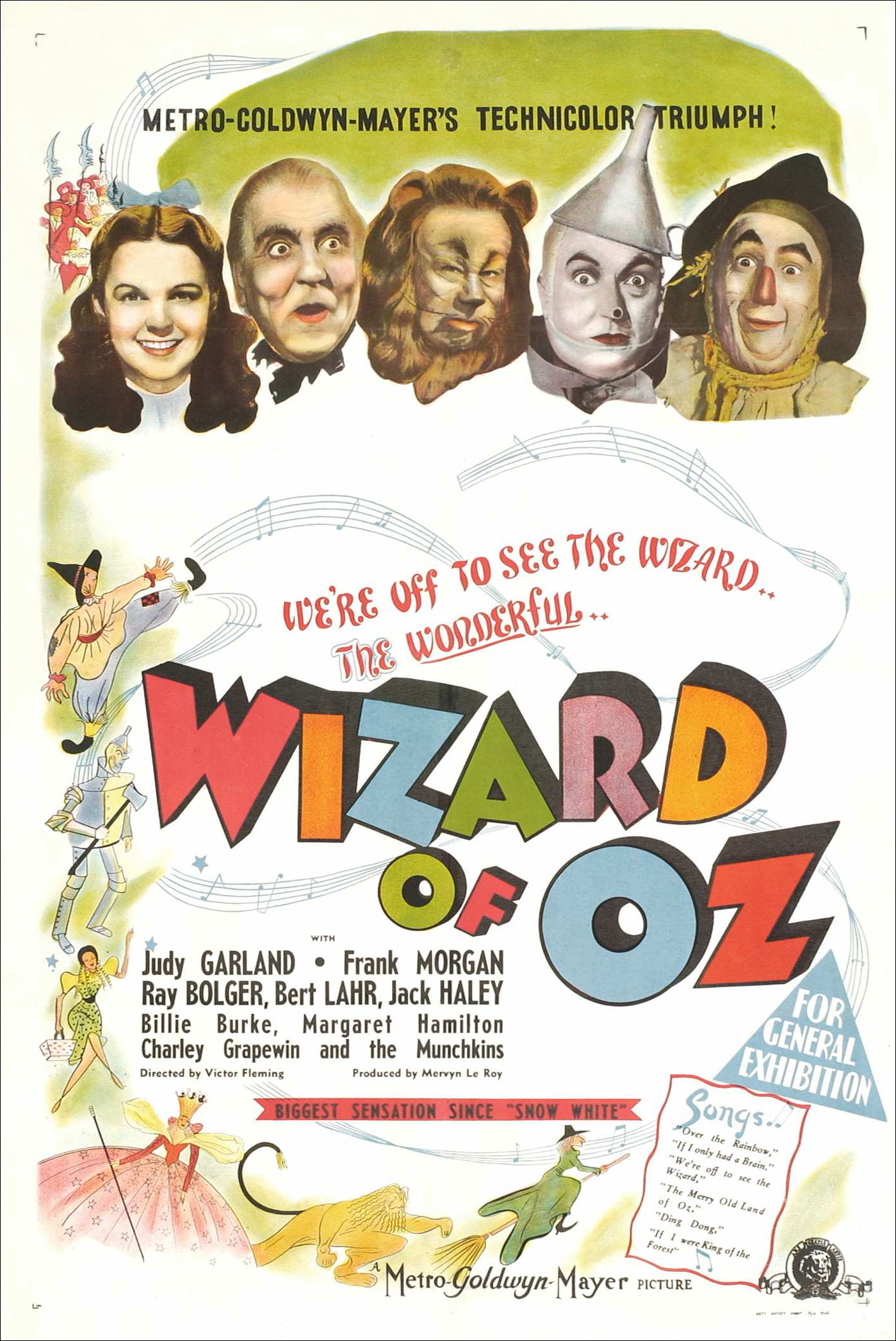
In the annals of film history, 1939 is held as the single greatest year in cinematic history. That year is filled with grand epics, definitive Westerns, sparkling and witty romantic comedies, and searing looks into American politics. Tucked in among such lofty films is one of the most charming, sweet and enchanting fantasy family films ever made: The Wizard of Oz. Few films are as beloved as The Wizard of Oz, its blending of fantasy, innocence and exceptional songs placing it among the Greatest Films Ever Made. 

Young Dorothy Gale (Judy Garland) feels ignored by all the adults around her. Uncle Henry (Charlie Grapewin) and Auntie Em (Clara Blandick) are loving but also highly preoccupied with farm business. The three farmhands Hunk (Ray Bolger), Hickory (Jack Haley) and Zeke (Bert Lahr) are also caring but in need to attend to other things. No one has time for Dorothy's terror about losing her beloved dog, Toto, at the hands of the wealthy but wicked Almira Gulch (Margaret Hamilton). Dorothy wonders if her problems can be solved if she ever can find her way Over the Rainbow.

In a desperate effort to save Toto, Dorothy decides to run away, encountering charming shyster Professor Marvel (Frank Morgan). Professor Marvel cons her into going back to the farm, but Dorothy is caught and swept into a tornado. When it lands, she finds that she and Toto are not in Kansas anymore. They are in a magical land known as Oz. To Dorothy's shock and horror, she has accidentally killed the Wicked Witch of the East. While the local citizens, the Munchkins, are thrilled, not so is her sister, the Wicked Witch of the West (Hamilton in a dual role). Taking the advice of Glinda, the Good Witch of the North (Billie Burke), Dorothy follows the Yellow Brick Road to seek help from the Wizard of Oz to find her way back home.

While on route, she encounters three figures who join her in seeking the Wizard's help. The Scarecrow (Bolger again) seeks a brain. The Tin Man (Haley) looks for a heart. The Lion (Lahr) wants courage. Once in the Emerald City, the quartet now must perform a task: bring the Wizard the broom of the Wicked Witch of the West. How will they face off against this monster? Will they succeed in their quest? What role does the man behind the curtain at the Wizard's receiving room (Morgan) have in all this? Will Dorothy find her way back home?

The Wizard of Oz's production was chaotic to say the least. While three people received screenplay credit (Noel Langley, Florence Ryerson and Edgar Allan Woolf), there were many hands working on the story. The directing of the film also has many fathers. Victor Fleming received sole credit and directed the bulk of The Wizard of Oz. However, he was the second or third director on the film, depending on how you count. Original director Richard Thorpe had shot two weeks work when he was reassigned, producer Mervin LeRoy displeased that the film lacked a charm he felt the production needed. George Cukor took a few days before starting work on Gone with the Wind to offer recommendations, most of which were used by Fleming when he stepped in. Ironically, Fleming took over for Cukor on Gone with the Wind when the latter was fired from that production. King Vidor then stepped in to direct what was unfinished, including the Over the Rainbow sequence. 

The overall production may have been a jumble, but the end results are surprisingly coherent. I think this is because first and foremost, everyone took the premise seriously. Despite the film being seen as one of the hallmarks of children's entertainment, The Wizard of Oz never talks down to the audience. Instead, the film has a very firm foundation. I think that at one point, we all yearn for adult validation of whatever our troubles are. We almost all have had pets we adore and whom we fear separation from. The notion of a place where our troubles are far away is something that speaks to the whole of humanity. The Wizard of Oz taps into all those emotions, which does not downplay the fantasy elements but rather enhances them.

The Wizard of Oz also succeeds because of the work put into it by those in front and behind the camera. The film keeps a balance between the "real" world of Kansas and the "fantasy" world of Oz with its use of sepia for the former, full-blown Technicolor for the latter. Even now, the transition from sepia to color when Dorothy opens the door to enter Munchkin Land is breathtaking in its seamlessness. While the sets do look like large matte paintings, the overall look is still solid in capturing this fantasy world of crabby apple trees and flying witches. 

The set design is top-notch and effective. Everything from the miniaturized Munchkin Land and the grandness of the Emerald City to the darkness of the Wicked Witch's castle looks authentic while keeping that fantasy element. The costumes and makeup work are also exceptional. The Wizard of Oz has many of the actors playing two roles, and the film does very well in making them distinct identities. There is a whimsy to the Munchkins, an elaborate nature to Glinda, and a sweetness to Dorothy's various wardrobes.

The Wizard of Oz also is so exceptionally well-acted. Judy Garland was not the first choice for Dorothy, perhaps not surprising as she was already a sixteen-year-old teenager at the time. However, her wide-eyed face and quivering voice worked to make Dorothy's fears and hopes so believable. She made Dorothy this sweet, innocent girl who despite her fears has to rise above them if she is to find her way home. Garland's performance in bringing that innocence to her character sells the character to the audience.

This is also captured by those playing dual roles. The screenplay gives Bolger, Haley and Lahr time to showcase their mirror opposites in both Kansas and Oz: Zeke telling Dorothy that she must have courage, Hunk advising her to use her brains, Hickory blustering about his prospects. When they become the Scarecrow, the Tin Man and the Cowardly Lion, each plays their roles correctly, blending a childlike manner with an almost manic glee whenever they sing and/or dance.

Frank Morgan is so underappreciated in general and perhaps in more so in The Wizard of Oz. Every character he played (Professor Marvel, the Wizard, the Emerald City doorman, the cabbie and the guard) he plays as if it were totally different. The best example of Morgan's skills is when we see him as Marvel and the Wizard. As Marvel, he is shrewd and shady but good-hearted, using his skills to get Dorothy to return home without openly saying so. As the Wizard, he is bumbling, a bit of a charlatan, but not a bad figure. As the Wizard says, he is a very good man, but a very bad wizard.

Margaret Hamilton's performance as the Wicked Witch of the West is pure perfection. Already rather curt and cruel as Almira Gulch in Kansas, her Wicked Witch is unrepentantly evil. In threatening Dorothy and her little dog too, in sending an army of flying monkeys to capture our heroine, even in mocking Dorothy's tearful pleas to Auntie Em, Hamilton makes the Wicked Witch into a frightening figure for children. 

In their smaller roles, both Grapewin and Blandick excel as Uncle Henry and Auntie Em, the caring relations who bring humor and heart to the Kansas sequence respectively.

The Wizard of Oz has one of the greatest songbooks in film history. Harold Arlen's music (adapted by Herbert Stothart) and Edgar Harberg's lyrics blend so well that almost every single song is perfect and so much part of the American vernacular that even those who have never seen the film would recognize something of the music or songs. There is the spinning seven-note theme for Almira Gulch/The Wicked Witch of the West, a twisty blend of menace and mirth. The score is charming and light when needed, such as when Dorothy and her companions escape dangerous poppy fields. It also is not afraid to be dark and surprisingly frightening, such as when the flying monkeys swoop into the Haunted Forest to attack our quartet. There is also the ominous "Oh-YEE-Oh, EEOO-AH!" chant of the Witch's guard, menacing but still child-friendly.

Then you have the songs, the simply brilliant songs. At the top of the list is Over the Rainbow, one of if not the most haunting, beautiful musical numbers ever filmed. It is the perfect song, with the perfect delivery by the perfect singer. The lyrics speak of great longing for a place of refuge, of hopes that resonate within each one of us. Garland's vocals are divine, blending softness with power. The yearning, the longing in Over the Rainbow come through in Judy Garland's rendition. It is the first song in The Wizard of Oz and came close to being cut from the film. It is one of the greatest decisions in cinema that Over the Rainbow was saved from the cutting room floor. If you listen to the lyrics of Over the Rainbow, you hear just how perfect they are. The message of longing for something beyond one's current situation and the hope for better come through. That longing, that desire, all come through the lyrics and Garland's delivery.

If, however, you listen to almost all the songs, you find that The Wizard of Oz has perhaps the most literate lyrics in a major film musical. Listen, for example, to the It Really Was No Miracle section of what technically part of the massive Ding-Dong! The Witch is Dead musical number. In that section, you had the rhymes "switch, pitch, unhitch, Witch, itch, hitch" all flow almost rap-like, with "rich" a near-rhyme closing part of it out. Throw in "slitch" and "ditch" in a similar sing-song manner and you have a smooth and funny musical section. One does not question what "slitch" means or if it even a word. It just works so well.

The entire Munchkin Land section shifts from the sweet introduction of The Lullaby League and faux toughness of The Lollipop Guild to the comical somberness of the Coroner who declared the Wicked Witch of the East not just merely dead but most sincerely dead. The various versions of If I Only Had a Brain/Heart and You're/We're Off to See the Wizard are so witty, unafraid to use nonsensical lyrics that still fit. 

The only song that I am not particularly enamored of is Lahr's solo number, If I Were King of the Forest. It is not a bad song and a showcase for Lahr's wild manner. It works within the story, but it still feels slightly out-of-place.

The Wizard of Oz is a landmark in film history. It is also a beautiful film, charming, sweet, innocent and moving. Well-acted all around, with perhaps the single greatest collection of songs written specifically for film, The Wizard of Oz truly is wonderful because of the wonderful things it does. 

DECISION: A+

The Wizard of Oz Retrospective: An Introduction

The Wizard of Oz (1925)

The Wiz

Return to Oz

The Dreamer of Oz

The Muppets' Wizard of Oz

VeggieTales: The Wonderful Wizard of Ha's

Oz the Great and Powerful

Lynch/Oz

Wicked Part I

The Wizard of Oz Retrospective: The Conclusions

Monday, November 4, 2024

Gary: The Television Documentary

GARY

The history of Hollywood is filled with child stars who fell once they became adults. There are to be fair more successful child star stories than people are willing to admit. Everyone from Shirley Temple to Elizabeth Taylor, Roddy McDowell and Jackie Cooper down to Jodie Foster, Kieran Culkin and Dakota Fanning have managed to carve out careers post-puberty or in Temple's case, a successful second act as an ambassador. However, it is the disastrous post-fame lives of child performers that we remember, or perhaps gleefully enjoy. Karl "Alfafa" Switzer. Natalie Wood. Sal Mineo. Anissa Jones. Brad Renfro. 

Among that unfortunate list is Gary Coleman, who delighted America as Arnold Jackson on television's Diff'rent Strokes. The travails of his post-Diff'rent Strokes life are probably well-known. Gary, the documentary about his life and career, gives us more insight due to the participation of many of those who ultimately harmed Coleman, intentionally or not as they might assert. 

Gary covers his all-too-brief life, mixing in interviews with his estranged ex-wife Shannon Price and his parents, Sue and Willie. While health issues eventually stunted his physical growth and would plague him the rest of his life, it also gave him a unique look that got him into commercials for a local bank. From that, he found his way to being on Diff'rent Strokes, a new television comedy about a white widower with a daughter who adopts the two black children of his late housekeeper. The show was an instant hit and Coleman became a star.

However, things show that work was hard, aggravated by his health problems that eventually resulted in him requiring dialysis. At eighteen, once Diff'rent Strokes ended, he really wanted to retire from showbusiness altogether, down to trying to find exile in Hawaii. There were, unfortunately, too many meal tickets riding on Coleman, so back to the grind with having less and less to show for it. The career was not the only thing faltering. Coleman's finances had been wildly mismanaged by those he trusted. 

Coleman kept going. In a curious turn, his job as a security guard was not a comedown in Coleman's eyes. It was instead something of a dream job, him having a long-held desire to be in law enforcement. An ugly encounter with a fan killed that hope. However, did his once-wife Shannon do more than kill Coleman's hopes? Their relationship, which by Price's own admission involved slapping, was tempestuous at best. Ultimately, the exact circumstances surrounding Coleman's death will never be confirmed to everyone's satisfaction. 

One may know the details about Gary Coleman, everything from how he had to sue his parents to how his altercation with a fan became physical. Gary, however, delves more into the circumstances that ultimately showed how awful the public was to someone they had once adored. While many, for example, saw his security guard job as the greatest fall from grace in former child star history, Gary reveals that he was actually quite enthusiastic and eager about it. He was looking forward to living out his hopes for something akin to law enforcement, so to see his dream job collapse because of Diff'rent Strokes was devastating. For all the mockery he got, Coleman was deeply hurt about his actions, and more so by the response.

A surprise revelation was how he wrote stories about spaceships and had a lifelong fascination with space travel. That love found an outlet not just in astronomy but in guest starring on Buck Rogers in the 25th Century. 

We also see footage of Coleman and Price's wedding. We see in his reciting the vows how he really loved Price. Whether she felt the same is hard to know. The idea that Price was not as enamored of Coleman as Coleman was of Price is brought to the forefront right at the beginning, when we hear her say, "I slapped him a couple of times. I mean, nothing major, nothing like red flag". It is a startling confession to make right off the bat. Gary closes with the selfie Price took with herself and a comatose, intubated Coleman. It is as tawdry an image as one can find. Price continues to defend the picture, but others in Gary find it as I did: an appalling spectacle.

Interviews with Coleman's family and friends reveal the struggles physical and emotional and financial that he went through. Of particular note is hearing about how so much money was coming in but not going to Coleman. $18 million was what he earned through Diff'rent Strokes run, but so much was being cut into by his parents, managers, agents and lawyers that there was less and less for Coleman himself. Add to that how people were diving into what were meant as blocked accounts and the whole thing is sad, so terribly sad. 

Gary is more than a cautionary tale, which I think Todd Bridges, the sole surviving Diff'rent Strokes cast member, calls it if memory serves right. Gary is a tale of how greed and the wrong people wrecked a genuinely talented person who would have been happier pursuing dreams of outer space than dreams of Hollywood stardom. Gary allows everyone say their piece, and sometimes the end results boomerang back at them. It lets the viewer decide what to make of all this. Hopefully, Gary will be an example to future young performers of what not to allow to happen.

7/10

Sunday, November 3, 2024

The Wizard of Oz (1925): A Review (Review #1890)

THE WIZARD OF OZ (1925)

Long before Judy Garland danced down the Yellow Brick Road, the L. Frank Baum novel The Wonderful Wizard of Oz had been seen by audiences in play and stage musical adaptations. It is unsurprising the early days of film tackled this popular tale. I think many would be surprised to learn that the 1939 musical is not the first film version of Baum's book. The silent film The Wizard of Oz may surprise fans of the MGM musical or those who have read Baum's book in how it is almost a whole new story. While not without its merits it is also a bit oddball in its presentation.

Using a framing device of a toymaker reading The Wizard of Oz to his granddaughter, we learn that there is discontent in the land of Oz. The rightful Queen has disappeared, and the Ozians are unhappy with the rule of their dictator, Prime Minister Kruel (Joseph Swickard). He stays in power through the work of his aide, Lady Vishuss (Virginia Pearson) and Ambassador Wikked (Otto Lederer). Also helping Kruel is the Wizard of Oz (Charles Murray), who is a flim-flam man and knows it. Only noble Prince Kynd (Bryant Washburn) stands up to them.

If anything, The Wizard of Oz is not subtle.  

Meanwhile, in distant Kansas, young Dorothy (Dorothy Dwan) is awaiting her eighteenth birthday. Her Aunt Em (Mary Carr) is sweetness herself, but her Uncle Henry (Frank Alexander) is a literal fat bastard, blustery and bullying everyone around. Dorothy does not escape his wrath, but getting the worst are his farmhands. There is one farmhand (Oliver Hardy, billed as Oliver N. Hardy) who seems to have a better shot of winning Dorothy over. The sad sack farmhand (writer/director Larry Semon) is also sweet on the pretty Dorothy, but he has less of a chance. The third farmhand, Snowball (Curtis McHenry), has no chance and isn't interested. 

Dorothy knows that she is a foundling but is unaware of a letter that is to be opened on her eighteenth birthday. Prime Minister Kruel, however, is and is desperate to stop her from reading it. Sending his Zorro-like minions to prevent this, but for once Uncle Henry is on Dorothy's side, refusing to hand the letter over to them. A fight ensues and eventually Dorothy, Uncle Henry and the farmhands are swept by a tornado to Oz. Prime Minister Kruel must stop the future Queen Dorothy of Oz by any means necessary, but will he win out? Will Dorothy ascend the throne of Oz? Who will she choose: the homely but loveable farmhand disguised as the Scarecrow or the more traditionally attractive Prince Kynd?

In some ways, The Wizard of Oz is surprisingly meta. The use of the grandfather (played by Semon in one of his three roles) reading the story to his granddaughter, who also makes comments about the story, predates a similar scenario in The Princess Bride. We also get a very strange number involving "The Phantom of the Basket", a figure the Wizard whipped up apparently out of thin air. With that, 1920's audiences were treated to a dance by one Fredrick Ko Vert, a drag queen with a name that makes anything from RuPaul's Drag Race look positively Rockwellian. 

There was nothing covert about Ko Vert or his dance. It was superfluous to the plot, yet one watches in somewhat stunned disbelief that a drag dance is part of whimsical children's entertainment. 

The film did take up a lot of time on both the Ozian political machinations as well as the romantic entanglement of Kansas waifs. It takes an awful long time for the Kansas group to make it to Oz, which is what I think contemporary audiences would look at.

One element in The Wizard of Oz that would look familiar would be the use of the farmhands as the three figures Dorothy meets on the way to the Emerald City. Granted, the story makes clear that they are in disguise. However, this is a development that may have come down in a more familiar form despite it not originally in the Baum story. 

The film does have some strong positives to it. There are some surprisingly good visual effects for the time, such as the tornado. We get a blend of animation and humor with a sequence involving bees and lighting that bounces off Snowball's head. There are clever sight gags, such as when Semon discovers that the eggs he stuffed into his pants and which Uncle Henry smashed with his foot end up hatching baby chicks. 

The title cards also feature amusing bits. When Uncle Henry is elevated to a position of power in Oz, the title card reads that he is now The Prince of Whales, an obvious crack at his girth. Prime Minister Kruel nicknames the Wizard "Wizzy". 

The Wizard of Oz also has some surprisingly frightening stunts, such as when two farmhands perform a dive into a haystack. Semon filmed this in slow-motion, adding to the overall look. 

We even have the positive of having one of the farmhands being black. Snowball's race is never brought up or treated as anything out of the ordinary. For the time, I figure this is extremely progressive. McHenry is introduced in the film eating watermelons, which is cringe nowadays and makes for uncomfortable viewing. Again, this bit, which is mercifully very brief, is a slight hiccup on things. It should also be seen through 1920's eyes, which would have found it acceptable. 

As a side note, we have gone in a century from a Wizard of Oz adaptation featuring a black man eating a watermelon to a Wizard of Oz adaptation featuring a black woman as the Wicked Witch of the West. If that does not show progress, what does?

The Wizard of Oz features a pre-Laurel & Hardy appearance by Oliver Hardy. He is pretty adept as the frenemy to Dorothy and her crew, shifting between helping and hindering them. Writer/director Larry Semon was certainly the star, going the Peter Sellers route by playing three characters: the grandfather in the framing story, the lovelorn farmhand and the Scarecrow (or a version of him). He did make himself the center of The Wizard of Oz, so a lot of the action involves him either trying to woo Dorothy, evade Uncle Henry, his farm activities or his adventures in Oz. 

Dorothy Dwan is pretty as Dorothy from Kansas, but she does have some of that stereotypical silent film acting that would come across as exaggerated today. Dorothy as a character seems almost secondary to The Wizard of Oz itself. 

The film loses a little steam when we get everyone to Oz. It also takes up much too much time in Kansas with Semon's farmhand. However, on the whole The Wizard of Oz is an interesting film separate from the overall Oz mythos. There are some surprisingly effective visual effects and stunts that lift the film to if not a faithful adaptation at least a unique one.

DECISION: B-

The Wizard of Oz Retrospective: An Introduction

The Wizard of Oz (1939) 

The Wiz

Return to Oz

The Dreamer of Oz

The Muppets' Wizard of Oz

VeggieTales: The Wonderful Wizard of Ha's

Oz the Great and Powerful

Lynch/Oz

Wicked Part I

The Wizard of Oz Retrospective: The Conclusions

Saturday, November 2, 2024

Venom: The Last Dance. A Review (Review #1889)

VENOM: THE LAST DANCE

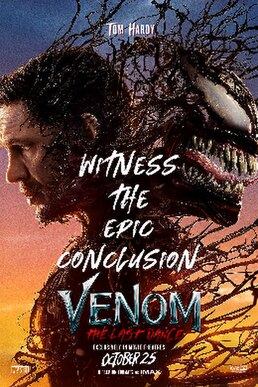
I have not been a fan of the previous Venom films, though in retrospect, I think Venom: Let There Be Carnage is mildly passable junk entertainment. Not so Venom: The Last Dance, a nonsensical, chaotic piece of garbage that is so awful it manages to dislodge Argylle as the Worst Movie of 2024 (so far). 

Eddie Brock (Tom Hardy) and his symbiote Venom continue hiding out in Mexico, hoping to clear their names for a killing from the last movie. However, the shadowy villain eventually revealed as Knull (Andy Serkis), who has been forced into a space prison, finds that Venom contains the Codex, the MacGuffin that will free him. With that, Knull sends his creatures to find Venom.

Also looking for our odd couple is General Strickland (Chiwetel Ejiofor), who wants to capture another symbiote whom he considers menaces to humanity. Not with him on that idea are Doctors Teddy Payne (Juno Temple) and Sadie Christmas (Clark Backo), who are determined to investigate what the symbiotes are and what if anything they can do for humanity.

Eddie manages to get into the United States despite both the military and Knull's crickets after him. He bonds with a group of alien enthusiasts determine to get to Area 51 before it is officially decommissioned. They take him to Las Vegas where Eddie gets into the luxurious Paris Casino, loses what little money he has, and dances with a clearly happy Mrs. Chen (Peggy Lu), with whom Venom dances with to Dancing Queen.

Captured, Eddie/Venom are in great danger. Martin (Rhys Ifans), the alien enthusiast, is also in family as are his wife and kids when they sneak into Area 51 before the climatic confrontation, where the escaping symbiotes by accident or design bond with hosts to fight off the growing army of Knull's crickets. Who will live and who will die in this battle royale to save or conquer Earth?


Twenty minutes into Venom: The Last Dance, I pretty much checked out because I simply did not care. There was nothing in The Last Dance that was interesting, not to mention cohesive. I will walk that back a bit, for there was one interesting thing in The Last Dance. That was seeing Tom Hardy evolve into Nick Nolte in voice and in looks. I am often told that Tom Hardy is a serious actor devoted to his craft. That can be the case, as The Bikeriders has shown. However, it is hard to think of Hardy in such lofty terms when he not only appears in junk like The Last Dance but has a story credit with its writer/director, Kelly Marcel.

The Last Dance is rushed to where it is incoherent. I figure that for those well-versed in Venom lore, everything was clear. I however, simply had no idea who the shadowy villain was and by the end, he proved to be nothing that I wondered why we needed him in there. Well, perhaps to set up more films. I would like those who know the name of every symbiote in The Last Dance to explain why we needed a running gag of Eddie constantly losing whatever shoes he had. I cannot explain why anyone thought that was funny.

There was a lot that The Last Dance thought was funny, such as when Eddie/Venom go into the Paris Casino, dance with Mrs. Chen (an entirely pointless section) or Ifans' hippie-drippy alien enthusiast. We could not have original characters with Martin's family: you had the equally addled supportive wife, the sullen and bored teenage girl, and the more enthusiastic but sweet younger brother. I figure they have names, but The Last Dance cares so little for them that I don't think we got them. I found the lot so boring and useless that when they faced mortal danger, I actually wished the guard tower would fall. 

I was amused by Backo's Sadie Christmas only because I asked if her name was some kind of odd homage to Denise Richards' Dr. Christmas Jones from The World is Not Enough. I spent much time wondering why her name was Christmas, which is a sign of how bored I was at The Last Dance. 

As a side note, I did wonder why Mrs. Chen and Venom opted to dance to Abba's Dancing Queen and not Donna Summer's Last Dance. 

There are no performances here. Hardy, continuing some oddball voice, struggles to be funny or menacing. Ejiofor does nothing but look stern, but given the circumstances I can give him credit for not consistently laughing at what he had to do. I'm sure that I have seen Juno Temple in something, but she had no real character to play. Lu is the only one who is clearly having a ball, fully aware that this is nothing but just so glad as to be getting paid for all this.

Perhaps that is harsh on Ifans, who is also aware that The Last Dance is not worth anything other than I hope a good paycheck.

If anything, Venom: The Last Dance makes an effort to get us to feel sad when Venom sacrifices himself. The film pumps out music to try and have us sob both in Dan Deacon's score and the use of Maroon 5's Memories. I did not feel sadness, only a mix of irritation and chuckles. 

I held out as long as I could. I fought off strong contenders like Deadpool & Wolverine and A Family Affair and Joker: Folie a Deux and The Crow. However, I have to finally throw in the towel. Venom: The Last Dance is worse than Argylle. 

Friday, November 1, 2024

The Wizard of Oz Retrospective: An Introduction


THE WIZARD OF OZ RETROSPECTIVE: 
AN INTRODUCTION

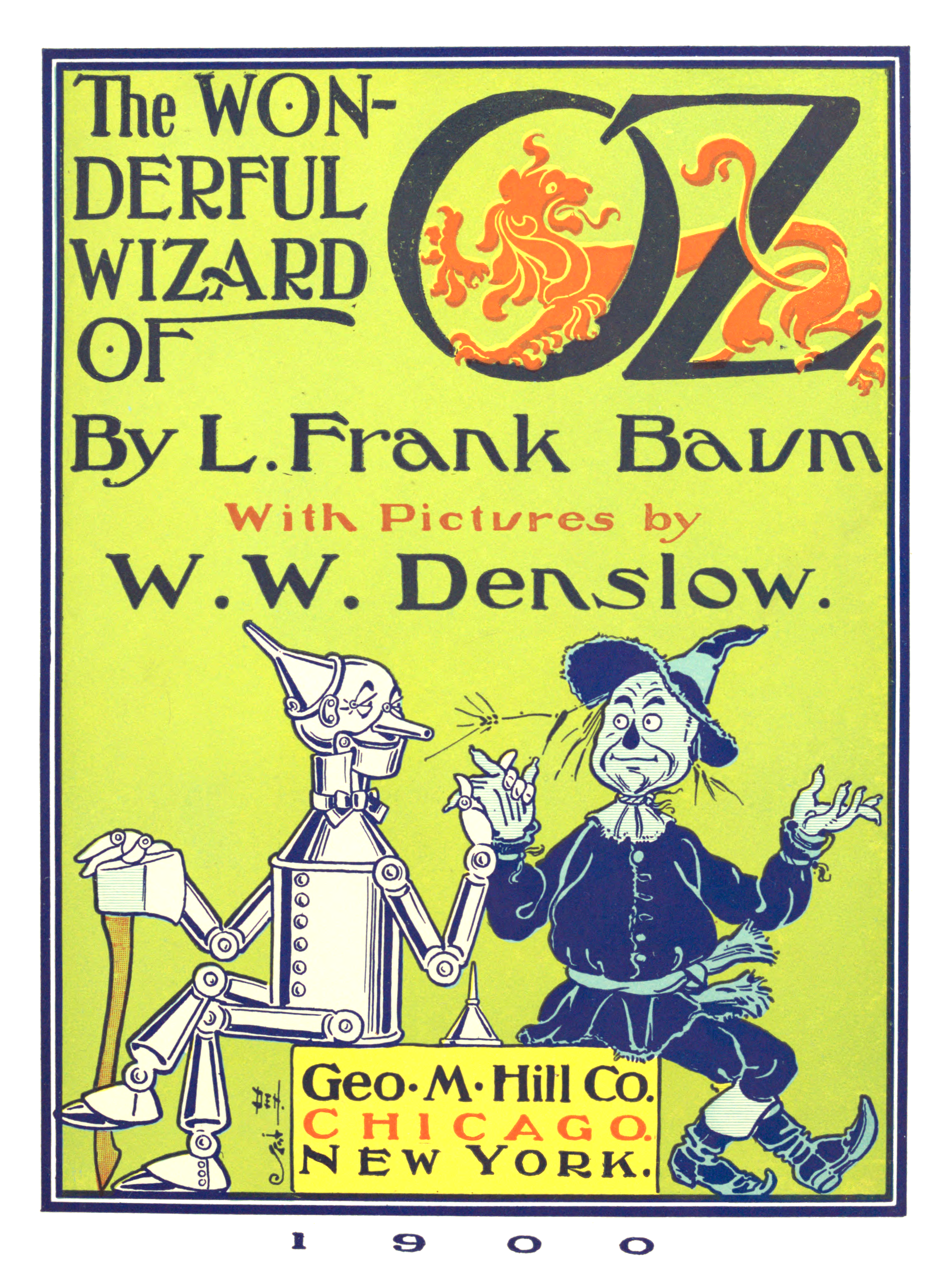
If there is an American mythology, the L. Frank Baum book series about a magical land populated with wise scarecrows and wicked witches would be a strong contender. The Wonderful Wizard of Oz is the first of an eventual fourteen books that Baum would write, with the series continuing with other writers in the same vein. I think most Americans are familiar with at least the story in the first book, that of little Dorothy Gale from Kansas, swept into the world of Oz where she meets curious friends and foes in a quest to get back home.

Oz could be the American equivalent to J.R.R. Tolkien's Middle-Earth The Lord of the Rings and its ensuing books. Both reflect their writers' world: the bucolic shires for Tolkien, the flat Midwest expanse for Baum. Both have fantastical worlds and figures drawing from earlier legends such as wizards and witches. Oz is so engrained into the American psyche that it feels almost as our collected heritage. For a nation that did not have myths and legends except for those of Native Americans, Baum's Oz series is something that unites us as Americans. 

The power of Oz is probably best captured in the 1939 MGM musical film. The Wizard of Oz is one of the crown jewels of that magical year in film, one whose legend has grown more ever since it became a tradition to broadcast The Wizard of Oz once a year. Lines of dialogue and sequences are fully ingrained in the American vernacular. If you say anything from "It's a twister! It's a twister!" to "I'll get you my pretty, and your little dog too!", or talk about flying monkeys or start shouting, "Ding-dong, the witch is dead!" it is almost certain that you know where all that originates from.

Yet, The Wizard of Oz is not the first or the only film or television adaptation of the Baum book series. There was at least one silent film made in 1925. There are also variations of the Oz stories, sequels, prequels and stage musicals. Wicked, a successful prequel that tells the origin story of the Wicked Witch of the West, may now rule the Great White Way, but is not the first time there is an Oz-based Broadway show. There was a 1902 musical as well as The Wiz, a black-centric version, shifting the story from Kansas to Harlem. 

There are so many variations on Baum's stories that it would take days to go over them. However, with the upcoming film adaptation of the musical Wicked, I thought it would be a good time to explore some projects connected to L. Frank Baum's masterful vision of this fantasy world. As such, I start on my Wizard of Oz Retrospective. I will look over various versions of the Oz stories set to film, along with a television biopic of Oz's creator, L. Frank Baum. There is also a documentary that connects The Wizard of Oz with avant-garde film director David Lynch. 

We're off to see the Wizard in various film and television incarnations. I hope everyone enjoys our stroll down the Yellow Brick Road with this Wizard of Oz Retrospective.